Respect all members: no insults, harassment, or hate speech.
Be tolerant of different viewpoints, cultures, and beliefs. If you do not agree with others, just create separate note, article or collection.
Clearly distinguish between personal opinion and fact.
Verify facts before posting, especially when writing about history, science, or statistics.
Promotional content must be published on the “Related Services and Products” page—no more than one paragraph per service. You can also create subpages under the “Related Services and Products” page and publish longer promotional text there.
Do not post materials that infringe on copyright without permission.
Always credit sources when sharing information, quotes, or media.
Be respectful of the work of others when making changes.
Discuss major edits instead of removing others' contributions without reason.
If you notice rule-breaking, notify community about it in talks.
Do not share personal data of others without their consent.
On the RGB and CMYK color wheel, Azure is defined as the colour halfway between blue and cyan. The colour halfway between blue and cyan on the RGB color wheel has a hex code of 0080FF.[1]
On the RGB color wheel, "azure" (hexadecimal #0080FF) is defined as the color at 210 degrees, i.e., the hue halfway between blue and cyan. In the RGB color model, used to create all the colors on a television or computer screen, azure is created by adding a 50% of green light to a 100% of blue light.
In the X11 color system, which became a model for early web colors, azure is depicted as a pale cyan or white cyan.
The color azure ultimately takes its name from the vivid-blue gemstonelapis lazuli, a metamorphic rock. Lapis is the Latin word for "stone" and lāzulī is the genitive form of the Medieval Latinlāzulum, which is taken from the Arabicلازوردlāzaward[laːzwrd] (listenⓘ), itself from the Persianلاژوردlāžaward, which is the name of the stone in Persian[6] and also of a place where lapis lazuli was mined.[7][8]
The name of the stone came to be associated with its color. The Frenchazur, the Italianazzurro, the Polishlazur, Romanianazur and azuriu, the Portuguese and Spanishazul, Hungarianazúr, and the Catalanatzur, all come from the name and color of lapis lazuli. The dropping of the initial l in Romance languages may be a case of the linguistic phenomenon known as rebracketing, i.e. Romance speakers may have perceived the sound as the initial phoneme of the definitive article in their respective language.
The word was adopted into English from the French, and the first recorded use of it as a color name in English was in 1374 in Geoffrey Chaucer's work Troilus and Criseyde, where he refers to "a broche, gold and asure" (a brooch, gold and azure).[9][10][11]
Some languages, such as Italian, generally consider azure to be a basic colour, separate and distinct from blue. Some sources even go to the point of defining blue as a darker shade of azure.[12]
Azure also describes the color of the mineral azurite, both in its natural form and as a pigment in various paint formulations. In order to preserve its deep color, azurite was ground coarsely. Fine-ground azurite produces a lighter, washed-out color. Traditionally, the pigment was considered unstable in oil paints, and was sometimes isolated from other colors and not mixed.
The use of the term spread through the practice of heraldry, where "azure" represents a blue color in the system of tinctures. In engravings, it is represented as a region of parallel horizontal lines, or by the abbreviation az. or b. In practice, azure has been represented by any number of shades of blue. In later heraldic practice a lighter blue, called bleu celeste ("sky blue"), is sometimes specified.
According to the logic of the RGB color wheel, indigo colors are those colors with hue codes between 255 and 225 (degrees), azure colors are those colors with hue codes between 195 and 225, and cyan colors are those colors with hue codes between 165 and 195. Another way of describing it could be that cyan is a mixture of blue and green light, azure is a mixture of blue and cyan light, and indigo is a mixture of blue and violet light.
All of the colors shown below in the section shades of azure are referenced as having a hue between 195 and 225 degrees, with the exception of the very pale X11 web color azure – RGB (240, 255, 255) – which, with a hue of 180 degrees, is a tone of cyan, but follows the artistic meaning of azure as sky blue.
In the Bandai Namco video game series Soulcalibur, one of the main characters, Nightmare, is frequently referred to as the "Azure Knight" due to the azure color of his armor.
^On colour plate 33 (page 89) of the 1930 book A Dictionary of Color by Maerz and Paul, the colours on the right side of colour plate 33 from top to bottom represent the most highly saturated colours on the color wheel from cyan to azure, and the colours on the bottom of colour plate 33 from right to left represent the most highly saturated colours on the colour wheel from azure to blue. The colour sample that represents azure is colour sample L12 on Plate 33 on Page 89. See reference to Azure on Page 190 in the index. See also discussion of the color azure, Page 149.
Azure is a vivid cyan-blue color historically associated with the semi-precious stone lapis lazuli, from which the prized pigment ultramarine was laboriously extracted by grinding the mineral and purifying it through oil-based processes.[1] The term originates from the Old Frenchazur, borrowed from Medieval Latinlazur and ultimately from the Persian lāzhuward, denoting the stone's sky-like hue, with the initial "l" often dropped in European languages due to phonetic assimilation with the French definite article.[2] In heraldry, azure serves as one of the five principal tinctures for blue, symbolizing loyalty, truth, and vigilance, and is conventionally rendered in illustrations as a medium to deep blue without fixed shade variations to maintain heraldic clarity.[3]![Lapis lazuli block, the mineral source of the azure pigment]float-rightThe color's prominence stems from lapis lazuli's rarity and expense—sourced primarily from Afghan mines like Sar-e-Sang—as a pigment more valuable than gold in medieval Europe, reserved for sacred art such as the Virgin Mary's robes in Renaissance paintings, where its intense, lightfast blue resisted fading unlike plant-based alternatives.[4] Synthetic substitutes like Prussian blue emerged in the 18th century, democratizing azure-like tones, while modern digital standards approximate it variably, with web-safe representations often using hex #007FFF (RGB 0,127,255) for a bright variant or #F0FFFF for a lighter sky tone.[5] Beyond art and symbolism, azure evokes clear skies and oceans, influencing flags (e.g., Israel's blue stripes), architecture (Portuguese azulejos tiles), and nature (e.g., azure-tinted birds like the azure tit), underscoring its enduring role as a marker of purity and celestial expanse.[6]
Physical and Perceptual Properties
Spectral Characteristics and Color Models
Azure, as a hue in the visible spectrum, corresponds to light with dominant wavelengths approximately between 450 and 495 nanometers, the general range for blue-cyan perceptions, with standard representations peaking around 461 nanometers for vivid instances.[7] This positioning midway between pure blue (around 475 nm dominant) and cyan (shorter wavelengths) aligns with its perceptual brightness and clarity, evoking clear sky conditions under midday sunlight where shorter blue wavelengths scatter preferentially in the atmosphere.[8]In digital additive color models, azure is standardized in sRGB as RGB values (0, 127, 255), equivalent to hexadecimal #007FFF, placing it at a hue angle of 210° in the HSV color space with full saturation (100%) and value (100%).[5] This formulation positions azure precisely halfway between blue (hue 240°) and cyan (hue 180°) on the RGB color wheel, ensuring consistent reproduction across displays calibrated to sRGB standards.[9]For subtractive printing in CMYK, the equivalent values for #007FFF approximate cyan 100%, magenta 50%, yellow 0%, and black 0%, though exact conversions vary slightly with printer profiles and gamut limitations, often resulting in minor desaturation to fit ink constraints.[5] In perceptual uniform spaces like CIELAB, derived from sRGB azure, coordinates approximate L* ≈ 66, a* ≈ -37, b* ≈ -107, reflecting high chroma and blue dominance, though precise values depend on the reference illuminant such as D65.[10] These models facilitate accurate specification in design and manufacturing, grounded in empirical measurements of human tristimulus values rather than subjective nomenclature.
Distinctions from Similar Hues
Azure occupies a distinct position on the RGB color wheel at approximately 210 degrees in the HSV color model, intermediate between cyan at 180 degrees and blue at 240 degrees, yielding a hue that balances cyan's greenish tint with blue's purity while favoring the latter.[5] This placement results in RGB values of roughly (0, 127, 255), with maximal blue intensity, moderate green, and absent red, producing a vivid, saturated mid-tone blue brighter than deeper navy shades (e.g., RGB 0, 0, 128) but less violet-leaning than pure blue.[9] In contrast to cyan's equal green and blue components (RGB 0, 255, 255), which emphasize a turquoise-green perception, azure's reduced green saturation shifts it perceptually toward a clearer, less verdant blue, appearing darker and more desaturated relative to pure cyan under standard lighting.[11]Sky blue, often represented as RGB (135, 206, 235), differs through its lighter value and lower saturation, evoking diluted daylight skies rather than azure's intense, crystalline depth.[12] Cerulean, typically a darker greenish-blue (e.g., RGB 32, 91, 167), incorporates more teal undertones and reduced brightness, distinguishing it from azure's higher chroma and balanced cyan-blue equilibrium that avoids excessive green bias.[13] These perceptual variances arise from hue angles and component ratios: azure's 210-degree positioning enhances its vibrancy in additive color spaces, making it appear more luminous against grays than desaturated analogs like powder blue.[14]Among pigment-derived blues, ultramarine exhibits a warmer, reddish-violet undertone from its sulfur composition (hue shifting toward 240-250 degrees), contrasting azure's cooler, neutral clarity historically approximated by finer lapis lazuli grades but now synthetically brighter.[15]Cobalt blue, derived from cobalt aluminate, shares a cool neutrality but features lower saturation and greater opacity in artistic media, rendering it less vivid and more granular when mixed compared to azure's transparent, high-intensity modern equivalents.[16] Perceptually, these distinctions manifest in azure's superior clarity and medium lightness, evoking unclouded horizons without the subtle warmth of ultramarine or the subdued tone of cobalt, as confirmed by comparative swatch analyses in pigment chemistry.[17]
Historical Origins
Etymology
The English word "azure," denoting a vivid sky-blue color, entered the language in the late 14th century as "asure" or "azur," borrowed from Old French "azur."[2] This Old French term, in turn, stems from Medieval Latin "lazurum" or "azurum," a modification of Arabic "al-lāzaward," referring to lapis lazuli, the deep-blue semi-precious stone prized in antiquity for pigments and jewelry.[18] The Arabic form derives from Middle Persian "lāzward" or "lāžward," ultimately tracing to the mineral's name and its characteristic hue.[19]By the 1370s, "azure" specifically described the intense blue pigment obtained by grinding lapis lazuli, distinguishing it from lesser blues like those from plant or mineral alternatives.[2] The term's adoption in European languages reflects the stone's importation via trade routes from Afghanistan, where superior deposits were sourced as early as the 7th century BCE, influencing artistic and heraldic traditions across medieval Europe.[20] Cognates appear in Italian "azzurro," Spanish and Portuguese "azul," and Polish "lazur," illustrating the word's dissemination through Romance languages and beyond.[2]
Early Pigment Use and Artistic Applications
The earliest known use of a blue pigment in Europe involved azurite, identified on a sandstone artifact from the Upper Paleolithic site of Hohle Fels in Germany, dated to approximately 13,000 years ago.[21] This discovery, confirmed through spectroscopic analysis, marks the first evidence of deliberate blue pigment preparation in the region, potentially for body adornment or symbolic markings rather than extensive artistic depictions.[22] Azurite, chemically Cu3(CO3)2(OH)2, occurs naturally as deep blue crystals and was ground into powder for use, reflecting early human exploitation of mineral colors for aesthetic or ritual purposes.[23]In ancient Egypt, azurite appeared sporadically from the predynastic period onward, applied in minor decorative roles on artifacts and paintings, though it was overshadowed by the more stable synthetic Egyptian bluefrit, invented around 3000 BCE for tomb and temple decorations.[23] Concurrently, lapis lazuli from Badakhshan mines in present-day Afghanistan, valued for its vivid ultramarine blue, entered Egyptian and Mesopotamian art by the late fourth millennium BCE, ground directly into pigment for inlays, jewelry, and wall paintings symbolizing divinity and the heavens.[24] Extraction of pure ultramarine from lapis involved labor-intensive purification, yielding a translucent azure tone prized for its intensity but limited by scarcity and cost.[4]By the Middle Ages, azurite dominated European artistic practice as the primary affordable blue, sourced from mines in Germany and Hungary, and employed in tempera, fresco, and manuscript illumination to render skies, drapery, and architectural elements.[25] Artists like those in 13th- and 14th-century Sienese workshops combined azurite with ultramarine for layered effects in panel paintings, achieving depth through successive glazes often bound with animal glue or egg.[26]Ultramarine, imported via Venetian trade routes at prices exceeding gold by weight—up to 10 times its value in 15th-century Florence—reserved for elite works such as the Virgin Mary's robes in altarpieces, where its unchanging azure hue conveyed purity and celestial themes.[27] This pigment's application required meticulous technique to prevent fading when exposed to binders or light, influencing compositional choices in Gothic and early Renaissance art.[23]
Natural Occurrences
Atmospheric and Oceanic Phenomena
The azure hue observed in clear daytime skies results from Rayleigh scattering, wherein molecules in Earth's atmosphere—primarily nitrogen and oxygen—scatter shorter-wavelength blue light from the sun more effectively than longer-wavelength red light, with scattering intensity proportional to the inverse fourth power of the wavelength.[28][29] This process dominates under low aerosol conditions, producing the vivid cyan-blue tint characteristic of zenith skies at midday, though ozone absorption in the ultraviolet-to-blue spectrum contributes approximately two-thirds of the perceived blue color in some models.[30]Dust, water vapor, or pollution can mute this effect, shifting the appearance toward paler or grayer tones, but pristine atmospheres yield the archetypal azure.[31]In oceanic contexts, clear seawater exhibits an azure appearance primarily due to selective absorption of longer wavelengths (red and orange) by water molecules, allowing shorter blue wavelengths—around 450-500 nanometers—to penetrate deeper and scatter back to the observer's eye via molecular interactions similar to Rayleigh scattering in air.[32][33] This effect intensifies in shallow, low-phytoplankton waters of tropical regions, where minimal suspended particles enhance transmission and backscattering of blue light, evoking the bright azure of places like the Mediterranean or Caribbean seas; surface reflection of the azure sky further amplifies the hue under calm conditions.[34] In contrast, nutrient-rich or sediment-laden waters appear greener or murkier, as chlorophyll or particulates absorb and scatter additional wavelengths.[35] Pure water's intrinsic absorption spectrum, measured in laboratory conditions, confirms minimal absorption in the blue range, underpinning these observations.[36]
Biological and Mineral Examples
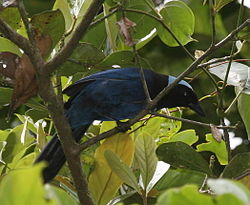
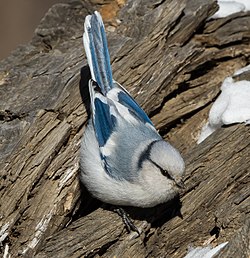
Azurite (Cu₃(CO₃)₂(OH)₂), a soft copper carbonate mineral with Mohs hardness of 3.5–4, is renowned for its deep azure-blue coloration due to copper ions absorbing red and yellow light while transmitting and reflecting blue wavelengths. It typically forms tabular to prismatic crystals in the oxidized zones of copper ore deposits, often associated with malachite.[37][38]Chalcanthite (CuSO₄·5H₂O), a hydrated copper sulfate mineral with Mohs hardness of 2.5, displays vibrant sky-blue to azure hues from similar copper-based light absorption, forming efflorescent crusts or triclinic crystals in arid copper mine environments where groundwater evaporation concentrates sulfates. Its color intensity varies with hydration levels and impurities.[39]Glaucophane, a sodium-rich amphibole mineral (Na₂(Mg,Fe)₃Al₂Si₈O₂₂(OH)₂), contributes azure-blue tones to blueschist metamorphic rocks through iron and titanium inclusions that produce pleochroic effects from azure to lavender-blue. It crystallizes in prismatic forms under high-pressure, low-temperature conditions in subduction zones.[40]In biological contexts, azure coloration in animals arises primarily from structural mechanisms rather than pigments, as true blue pigments are scarce; nanostructures in feathers, scales, or skin scatter short blue wavelengths via thin-film interference or photonic crystals. For instance, the azure tit (Cyanistes cyanus) exhibits bright azure-blue plumage on its crown, cheeks, and underparts during breeding season, achieved through melanin-backed keratin barbules that selectively reflect blue light.[41]The azure kingfisher (Alcedo azurea), a Southeast Asian bird, features iridescent azure-blue upperparts and rufous underparts, with the blue derived from feather microstructure rather than pigmentation, aiding in camouflage and mate attraction in forested waterways. Similarly, the European roller (Coracias garrulus) displays azure-blue flight feathers and back, where structural coloration intensifies under sunlight, supporting thermoregulation and signaling in open habitats.[41][42]
Human Symbolism and Applications
Heraldic and Cultural Significance
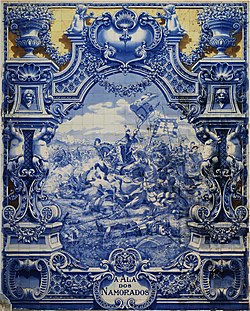
In heraldry, azure serves as the designated tincture for blue, one of the five primary colors alongside gules, vert, purpure, and sable, distinguished in blazons and engravings by parallel horizontal lines.[3] This color embodies attributes such as nobility, honor, vigilance, truth, loyalty, chastity, and perseverance, often evoking the clarity of the sky or sea to signify steadfastness and moral integrity.[3][43] Heraldic conventions trace these associations to medieval European traditions, where azure contrasted with metals like or and argent to ensure visual clarity under the rule of tincture, prohibiting color-on-color placements.[44]Culturally, azure recurs as a symbol of celestial and divine order. In Chinese mythology, the Azure Dragon, or Qinglong, represents the eastern direction, spring season, and wood element among the Four Symbols, embodying benevolence, growth, renewal, and protective forces against imbalance.[45][46] This entity, depicted as a serpentine blue dragon, guards cosmic harmony and prosperity, influencing feng shui practices where its placement on a site's left side augurs auspicious energy.[46]In Judaism, the biblical dye tekhelet— a vivid sky blue akin to azure—held sacred status, mandated for fringes on garments (Numbers 15:38) and elements of the Tabernacle and Solomon's Temple, symbolizing the divine throne, heavenly expanse, and reminder of spiritual obligations to God.[47][48] Derived from the murex snail, tekhelet dye production ceased around the 7th century CE but was revived in the 1990s through rediscovered techniques, restoring its use in tzitzit to evoke infinity and nobility.[49] The Israeli flag incorporates two azure-like horizontal stripes flanking the Star of David, intended to echo this tekhelet tradition as a marker of Jewish identity and heritage.[50]In Iberian culture, particularly Portugal, azure manifests in azulejos—tin-glazed ceramic tiles predominantly in cobalt blue on white grounds—introduced via 14th-century Islamic influences and peaking during the 16th-18th centuries' manual production boom.[51] These tiles adorn public buildings, churches, and homes, signifying protection, coolness in Mediterranean climates, and artistic narrative of history, mythology, and daily life, with over 1.5 million square meters documented in Lisbon alone by the 19th century.[52] Azulejos' enduring prevalence reflects Portugal's maritime empire and aesthetic fusion of Moorish, Renaissance, and Baroque styles.[51]
Psychological and Symbolic Interpretations
In color psychology, azure—a bright, sky-like blue—is commonly associated with promoting tranquility, mental clarity, and emotional calm, attributes linked to its visual similarity to clear daytime skies and open waters that evoke openness and stability.[53][54] This perception aligns with broader empirical findings on blue hues, where exposure to such colors in controlled environments has been observed to lower heart rates and self-reported stress levels, though effects vary by individual and context, with limited specificity to azure itself in peer-reviewed studies.[55] Azure is also attributed with inspiring focus, determination, and a sense of purpose, potentially enhancing cognitive sharpness without the overstimulation of warmer tones.[56][57]Symbolically, azure embodies expansiveness, freedom, and intuition, reflecting natural phenomena like vast skies and oceans that historically signify boundless potential and renewal across cultures.[58] In Eastern traditions, particularly Chinese mythology, azure represents the Azure Dragon (Qinglong), a guardian of the east associated with spring, wood element, growth, and cosmic harmony, as detailed in classical texts linking it to directional symbolism and seasonal vitality.[59] Western symbolic interpretations often tie azure to enlightenment, divine connection, and balance, evoking heavenly realms and purity, while in broader cultural motifs it connotes peace, trust, and logical thoughtfulness rather than emotional intensity.[60][61] These associations persist in modern design and spirituality, where azure's luminosity suggests inspiration and sensitivity without aggressive connotations.[62]
Modern Uses in Design and Technology
In digital branding, azure serves as the signature hue for Microsoft Azure, the cloud computing service introduced by Microsoft on February 1, 2010. The platform's name and logo draw directly from the color's connotation of expansive blue skies, embodying themes of reliability, innovation, and boundless scalability in enterprise technology.[63][64]Within graphic design, azure's vibrant yet serene tone—often rendered in RGB as approximately (0, 127, 255)—facilitates modern palettes that evoke stability and depth, particularly when contrasted with neutrals for clean interfaces or accented against whites for emphasis in infographics and branding materials.[8][65]In UI/UX applications, designers leverage azure to foster user trust and tranquility, integrating it into elements like buttons, backgrounds, and icons for web and mobile experiences, as its sky-like clarity reduces visual fatigue while signaling professionalism in sectors such as finance and healthcare software.[66][67] For instance, pairing deeper azure shades with subtle gradients creates perceived openness in dashboard layouts, aligning with empirical preferences for blue tones in high-engagement digital environments.[68]
Astronomical Contexts
Naming Conventions and Descriptions
In modern astronomical descriptions, the term "azure" denotes a vivid, sky-like blue hue observed in certain celestial bodies, distinct from deeper indigos or teals, often resulting from atmospheric scattering or absorption. For instance, Neptune's atmosphere exhibits an azure tint primarily due to methane gas absorbing red and infrared wavelengths while scattering shorter blue light, as confirmed by spectroscopic analyses from Voyager 2 and subsequent ground-based observations.[69] Similarly, the hot Jupiterexoplanet HD 189733b is characterized as azure blue by Hubble Space Telescope imaging spectrography, attributed to high-altitude silicate particles and hazes that preferentially scatter blue wavelengths from its host star, rendering it one of the deepest blue exoplanets detected at visible wavelengths.[70][71]Astronomical naming conventions incorporating "azure" are most prominently featured in traditional Chinese stellar cartography, where the ecliptic and circumpolar regions are partitioned into four symbolic guardians, or xiu groups. The eastern quadrant, known as the Azure Dragon (Qīnglóng or Cānglóng), encompasses seven of the Twenty-Eight Lunar Mansions—specifically Horn (Jiǎn), Neck (Kàng), Root (Dǐ), Room (Fáng), Heart (Xīn), Tail (Wěi), and Winnowing Basket (Jī)—spanning approximately 90 degrees of celestial longitude aligned with the vernal equinox direction.[72] This nomenclature, dating to at least the Warring States period (circa 475–221 BCE) and refined in texts like the Shiji (circa 100 BCE), integrates color symbolism wherein "azure" evokes a blue-green (qīng) essence tied to wood, renewal, and the eastern horizon's dawn skies, contrasting with the White Tiger (west), Vermilion Bird (south), and Black Tortoise (north).[72]These conventions reflect a mythological-observational framework rather than empirical spectral classification, prioritizing directional and seasonal correspondences over quantitative colorimetry; the Azure Dragon's hue symbolizes cosmic harmony and imperial authority, influencing calendar-making and feng shui alignments in Han dynasty astronomy (206 BCE–220 CE).[72] In Western astronomy, no standardized naming protocol mandates "azure" for specific spectral types or objects, but it appears adjectivally in qualitative reports to convey perceptual blueness, as in Hubble's archival descriptions, avoiding formal IAU cataloging which favors numerical designations like HD 189733b.[70] This descriptive usage underscores azure's role in bridging visual phenomenology with physical causes, such as Rayleigh scattering in planetary atmospheres, without implying a rigid taxonomic hierarchy.[71]



_2_(cropped).jpg)
.png)

_3.jpg)

 Color coordinates


_in_tree,_Costa_Rica.jpg)


