


Community hub
Recent from talks
Contribute something
Nothing was collected or created yet.
University of Basel
View on Wikipedia

Key Information


The University of Basel (Latin: Universitas Basiliensis; German: Universität Basel) is a public research university in Basel, Switzerland. Founded on 4 April 1460, it is Switzerland's oldest university and among the world's oldest universities. The university is traditionally counted among the leading institutions of higher learning in the country.[5]
The associated Basel University Library is the largest and among the most important libraries in Switzerland. The university hosts the faculties of theology, law, medicine, humanities and social sciences, science, psychology, and business and economics, as well as numerous cross-disciplinary subjects and institutes, such as the Biozentrum for biomedical research and the Institute for European Global Studies. In 2020, the university had 13,139 students and 378 professors. International students accounted for 27 percent of the student body.[6]
In its over 500-year history, the university has been home to Erasmus of Rotterdam, Paracelsus, Daniel Bernoulli, Leonhard Euler, Jacob Burckhardt, Friedrich Nietzsche, Tadeusz Reichstein, Karl Jaspers, Carl Gustav Jung, Karl Barth, and Jeanne Hersch. The institution is associated with ten Nobel laureates and two presidents of the Swiss Confederation.[7]
History
[edit]
The University of Basel was founded in connection with the Council of Basel.[8] It was during the years the catholic clergy resided in Basel, a temporary university was established between the years 1432 und 1448.[8] In May 1432 it was authorized for Simon de Valla from Venice to lecture on canon law, in 1434 Jacques d'Attigny from France and was also permitted to lecture on canon law in Basel.[9] d'Attigny had before been lecturing canon law at the University of Rome.[10] In 1437 Demetrius was called to lecture Greek language.[9][10] Also the function of a bedel is mentioned, but there was no mention of a dean or a University order.[9] The same year Pope Eugen IV attempted to move the council to Ferrara, but many involved in Basel stayed and kept negotiating and in 1439 the council elected a counterpope in the figure of the Duke of Savoy Amadeus VIII who would become known as Felix V.[9] Felix V then established a formal "University of the Clergy" (German:Kurienuniversität) which was inaugurated in November 1440 with a mass in the Barfüsser Church.[9] In 1448, the German King Frederick III came to an agreement with Pope Nicholas V, the successor of Eugen IV and ordered the city to remove the security of the councilors.[9] The university was then formally closed in July 1448 and the clergy moved on to Lausanne.[9] After they left, the former lecturers urged for a regular university to be established.[8] The deed of foundation given in the form of a Papal bull by Pope Pius II on 12 November 1459 in Mantua and the official opening ceremony was held on 4 April 1460, the day of Saint Ambrose in the Minster of Basel.[11] Originally the University of Basel was decreed to have four faculties—arts, medicine, theology, and jurisprudence. From 1497, the Grand Council of Basel discussed whether the University was to be closed and only in 1501, the year Basel joined the Swiss Confederation, it was decided not to close the university.[12] The faculty of arts served until 1818 as the foundation for the other three academic subjects. In the eighteenth century as Basel became more commercial, the university, one of the centres of learning in the Renaissance, slipped into insignificance. Enrollment which had been over a thousand around 1600, dropped to sixty in 1785 with eighteen professors. The professors themselves were mostly sons of the elite.[13]
Over the course of centuries as many scholars came to the city, Basel became an early centre of book printing and humanism. Around the same time as the university itself, the Basel University Library was founded. Today it has over three million books and writings and is the largest library in Switzerland.
Located in what was once a politically volatile area, the university's fate often ebbed and flowed with regional political developments, including the Reformation, the Kantonstrennung (separation of the Canton of Basel City from Basel Land), and both World Wars. These factors affected student attendance, funding, university-government relations. In 1833 the Canton of Basel split in two with the Federal Diet requiring that the canton's assets, including the books at the university library, be divided—two-thirds going to the new half canton of Basel-Landschaft. The city, Basel-Stadt, had to buy back this share and the university became so impoverished that it drastically reduced its course offerings. Students were expected to continue their education after two years or so at a German university.[13]
Student enrollment surged after the university shed its medieval curriculum (including the elimination of Latin as the official language of the course catalog in 1822) and began to add more faculties, especially those in the humanities and sciences. Liberal Arts became a faculty in 1818, from which the Philosophy and History and Natural History faculties were derived in 1937.[14] The university subsequently established the Faculty of Science (1937), the Faculty of Business and Economics (1996), and the Faculty of Psychology (2003).[14] During the 20th century, the university grew rapidly, from one thousand students in 1918 to eight thousand in 1994.[15] The first woman who was admitted to the university, Emilie Frey, began her medical studies in 1890.[16]
After the seizure of power in the year 1933 by the Nazis in Germany, numerous renowned German professors decided to emigrate to Basel and started to work at the University of Basel. Several Swiss scholars also returned, inter alia the Law Professor Arthur Baumgarten (1933), the Theologians Karl Barth (1935) and Fritz Lieb (1937) and after World War II the Philosopher Karl Jaspers from Heidelberg University (1948), as well as the surgeon Rudolf Nissen (1952).[17]
On 1 January 1996, the University of Basel became independent from the cantonal government and thus earned its right to self-government.[18] In 2007, the Canton of Basel-Landschaft voted in favor to share the sponsorship of the university in parity with the Canton Basel-Stadt.[19]
Seal
[edit]Since 1460, the seal of the University showed a Virgin surrounded with sun rays standing a crescent moon as mentioned in the Revelation of John.[20] Below the moon is the coat of arms of Basel.[20] In her right hand, she holds a scepter, and on her left arm sits Jesus the child.[20] The religious motive is described to denote the religious bond the university counted with at the beginning of its existence.[20] The seal was also used after the reformation and used continuously until 1992.[20]
Reputation and rankings
[edit]| University rankings | |
|---|---|
| Global – Overall | |
| ARWU World[21] | 95 (2024) |
| QS World[22] | 158 (2026) |
| THE World[23] | =123 (2024) |
| USNWR Global[24] | =168 (2024-25) |
Well-respected rankings attest to the University of Basel's international academic performance:
- Times Higher Education World University Ranking (THE) (2021): 92[25]
- CWTS Leiden Ranking (2019): 53[26]
- Academic Ranking of World Universities (ARWU) (2019): 87[27]
Organization
[edit]University administration
[edit]Since 1 January 1996, the University of Basel has been independent. The University Law of 1995 stipulates that, "The University of Basel is an institution established under public law. It has its own legal personality and right to self-government."[28] As the entity that formally receives the Performance Mandate (Leistungsauftrag) for the University from both supporting cantons, the University Council (Universitätsrat) is the supreme decision-making body of the university.[29] The Council consists of eleven voting members and three non-voting members, including the President, the Executive Director, and the Secretary of the Council. Beneath the University Council are the Senate (Regenz) and the President's Board. The 80-member Senate consists of the senior members of the President's Board, faculty deans, professors, lecturers and research assistants, assistants, students, and administrative and technical employees. The President's Office is tasked with leading the overall university business. It consists of the President and her staff, a General Secretariat, an Administrative Directorate, the Communications and Marketing Office, and two respective Vice-Presidents for Research and Education.[30]
Faculties and departments
[edit]-
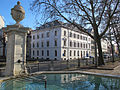 Institute of Musicology
 -
 Biozentrum and Department of Pharmaceutical Sciences
 -
 Faculty of Law
 -
 Bernoullianum, Department of Environmental Sciences
 -
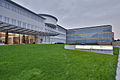 University Hospital of Basel


The University of Basel currently houses seven faculties:[31]
- Theology[32]
- Law[33]
- Medicine[34]
- Department of Biomedicine Archived 26 February 2018 at the Wayback Machine (a joint venture among the University of Basel, the University Hospital, and the University Children's Hospital)
- Department of Biomedical Engineering
- Department of Public Health
- Department of Clinical Research
- Department of Sport, Exercise and Health Archived 3 March 2018 at the Wayback Machine
- Humanities and Social Sciences (Phil I)[35]
- Department of Ancient Civilizations Archived 9 December 2018 at the Wayback Machine
- Department of History Archived 9 December 2018 at the Wayback Machine
- Department of Social Sciences[permanent dead link]
- Department Arts, Media, Philosophy Archived 1 December 2017 at the Wayback Machine
- Department of Languages and Literatures Archived 1 December 2017 at the Wayback Machine
- Digital Humanities Lab
- Science (Phil II)[36]
- Business and Economics[37]
- Psychology[38]
Interdisciplinary institutions
[edit]- Institute for European Global Studies[39]
- Center for Philanthropy Studies (CEPS)
- Institute for Biomedical Ethics (IBMB) Archived 3 February 2021 at the Wayback Machine
- Institute of Education
Associated institutes
[edit]- Swiss Tropical and Public Health Institute (Swiss TPH)[1]
- Friedrich Miescher Institute for Biomedical Research (FMI)[40]
- Basel Institute on Governance [2] Archived 24 June 2018 at the Wayback Machine
- Swiss Centre for Rescue, Emergency and Disaster Medicine (SZRNK)
- Swisspeace
Notable alumni and faculty
[edit]The University is counted among the country's leading institutions of higher learning and has a large number of politicians, scientists and thinkers as professors and alumni from around the world:[41]
-
![Paracelsus, physician and alchemist[42]](//upload.wikimedia.org/wikipedia/commons/thumb/4/4a/Paracelsus.jpg/120px-Paracelsus.jpg) Paracelsus, physician and alchemist[42]
Paracelsus, physician and alchemist[42] -
![Jacob Bernoulli, mathematician[43]](//upload.wikimedia.org/wikipedia/commons/thumb/1/19/Jakob_Bernoulli.jpg/120px-Jakob_Bernoulli.jpg) Jacob Bernoulli, mathematician[43]
Jacob Bernoulli, mathematician[43] -
![Leonhard Euler, mathematician and physicist[44]](//upload.wikimedia.org/wikipedia/commons/thumb/6/60/Leonhard_Euler_2.jpg/120px-Leonhard_Euler_2.jpg) Leonhard Euler, mathematician and physicist[44]
Leonhard Euler, mathematician and physicist[44] -
![Friedrich Nietzsche, philosopher[45]](//upload.wikimedia.org/wikipedia/commons/thumb/4/4b/Nietzsche1882_detail.jpg/120px-Nietzsche1882_detail.jpg) Friedrich Nietzsche, philosopher[45]
Friedrich Nietzsche, philosopher[45] -
![Friedrich Miescher, physician[46]](//upload.wikimedia.org/wikipedia/commons/thumb/d/d6/Johann_Friedrich_Miescher._Photograph._Wellcome_V0026860.jpg/120px-Johann_Friedrich_Miescher._Photograph._Wellcome_V0026860.jpg) Friedrich Miescher, physician[46]
Friedrich Miescher, physician[46] -
![Karl Gustav Jung, physician and surgeon[47]](//upload.wikimedia.org/wikipedia/commons/thumb/3/37/Karl_Gustav_Jung.png/120px-Karl_Gustav_Jung.png) Karl Gustav Jung, physician and surgeon[47]
Karl Gustav Jung, physician and surgeon[47] -
![Carl Gustav Jung, psychiatrist[48]](//upload.wikimedia.org/wikipedia/commons/thumb/5/5b/ETH-BIB-Jung%2C_Carl_Gustav_%281875-1961%29-Portrait-Portr_14163_%28cropped%29.tif/lossy-page1-97px-ETH-BIB-Jung%2C_Carl_Gustav_%281875-1961%29-Portrait-Portr_14163_%28cropped%29.tif.jpg) Carl Gustav Jung, psychiatrist[48]
Carl Gustav Jung, psychiatrist[48] -
![Karl Jaspers, philosopher and psychiatrist[49]](//upload.wikimedia.org/wikipedia/commons/thumb/1/1e/Karl_Jaspers_1946.jpg/120px-Karl_Jaspers_1946.jpg) Karl Jaspers, philosopher and psychiatrist[49]
Karl Jaspers, philosopher and psychiatrist[49] -
![Tadeus Reichstein, chemist and Nobel Prize laureate[50]](//upload.wikimedia.org/wikipedia/commons/thumb/4/4d/Thadeus_Reichstein_ETH-Bib_Portr_10137.jpg/120px-Thadeus_Reichstein_ETH-Bib_Portr_10137.jpg) Tadeus Reichstein, chemist and Nobel Prize laureate[50]
Tadeus Reichstein, chemist and Nobel Prize laureate[50] -
![Werner Arber, microbiologist and Nobel Prize laureate[51]](//upload.wikimedia.org/wikipedia/commons/thumb/e/e0/Werner_Arber_at_Biozentrum%2C_University_of_Basel.jpg/120px-Werner_Arber_at_Biozentrum%2C_University_of_Basel.jpg) Werner Arber, microbiologist and Nobel Prize laureate[51]
Werner Arber, microbiologist and Nobel Prize laureate[51] -
![Christiane Nüsslein-Volhard, biologist and Nobel Prize laureate[52]](//upload.wikimedia.org/wikipedia/commons/thumb/0/04/Christiane_N%C3%BCsslein-Volhard_mg_4372_cropped.jpg/120px-Christiane_N%C3%BCsslein-Volhard_mg_4372_cropped.jpg) Christiane Nüsslein-Volhard, biologist and Nobel Prize laureate[52]
Christiane Nüsslein-Volhard, biologist and Nobel Prize laureate[52]
![Paracelsus, physician and alchemist[42]](https://en.wikipedia.org/wiki/File:Paracelsus.jpg)
![Jacob Bernoulli, mathematician[43]](https://en.wikipedia.org/wiki/File:Jakob_Bernoulli.jpg)
![Leonhard Euler, mathematician and physicist[44]](https://en.wikipedia.org/wiki/File:Leonhard_Euler_2.jpg)
![Friedrich Nietzsche, philosopher[45]](https://en.wikipedia.org/wiki/File:Nietzsche1882_detail.jpg)
![Friedrich Miescher, physician[46]](https://en.wikipedia.org/wiki/File:Johann_Friedrich_Miescher._Photograph._Wellcome_V0026860.jpg)
![Karl Gustav Jung, physician and surgeon[47]](https://en.wikipedia.org/wiki/File:Karl_Gustav_Jung.png)
![Carl Gustav Jung, psychiatrist[48]](http://upload.wikimedia.org/wikipedia/commons/thumb/5/5b/ETH-BIB-Jung%2C_Carl_Gustav_%281875-1961%29-Portrait-Portr_14163_%28cropped%29.tif/lossy-page1-97px-ETH-BIB-Jung%2C_Carl_Gustav_%281875-1961%29-Portrait-Portr_14163_%28cropped%29.tif.jpg)
![Karl Jaspers, philosopher and psychiatrist[49]](https://en.wikipedia.org/wiki/File:Karl_Jaspers_1946.jpg)
![Tadeus Reichstein, chemist and Nobel Prize laureate[50]](https://en.wikipedia.org/wiki/File:Thadeus_Reichstein_ETH-Bib_Portr_10137.jpg)
![Werner Arber, microbiologist and Nobel Prize laureate[51]](https://en.wikipedia.org/wiki/File:Werner_Arber_at_Biozentrum,_University_of_Basel.jpg)
![Christiane Nüsslein-Volhard, biologist and Nobel Prize laureate[52]](https://en.wikipedia.org/wiki/File:Christiane_N%C3%BCsslein-Volhard_mg_4372_cropped.jpg)
- Emil Abderhalden (1877–1950), Swiss biochemist and physiologist
- Bonifacius Amerbach (1495–1562) Swiss jurist
- Johann Konrad Ammann (1669–1724, Swiss physicist and educator of deaf children)
- Werner Arber (1929–), Swiss microbiologist and geneticist, Nobel Prize in Physiology or Medicine in 1978
- Johann Jakob Bachofen (1815–1887), Swiss antiquarian and jurist
- Karl Barth (1886–1968), Swiss Protestant theologian
- Caspar Bauhin (1560–1624), Swiss botanist
- Johann Bauhin (1541–1613), Swiss botanist
- Daniel Bernoulli (1700–1782), Swiss mathematician and physicist
- Jacob Bernoulli (1655–1705), prominent Swiss mathematician, after whom Bernoulli numbers are named
- Johann Bernoulli (1667–1748), Swiss mathematician
- Johann Georg Birnstiel (1858–1927), Swiss writer and clergyman
- James Montgomery Boice (1938–2000), American theologian and pastor
- Jacob Burckhardt (1818–1897), Swiss historian
- Meehyun Chung (1963–) South Korean theologian, professor of Yonsei University
- Jacques Dubochet (1942–), Swiss biophysicist, Nobel Prize in Chemistry in 2017
- Nikolaus Eglinger (1645–1711), Swiss physician
- Paul Erdman (1932–2007), American business and financial writer
- Leonhard Euler (1707–1783), mathematician and physicist
- Rudolf Eucken (1846–1926), philosopher, Nobel Prize in Literature in 1908
- Till Förster (1955), Prof.em.Dr., anthropologist, founding director of the Centre for African Studies, University of Basel
- Christoph Gerber professor at the Department of Physics, co-inventor of the atomic force microscope
- Fina Girard (2001–), Swiss politician and youth climate activist[53]
- Albert Gobat (1848–1914), Swiss politician, Nobel Peace Prize in 1902
- Arno David Gurewitsch (1902–1974), professor, Columbia‐Presbyterian Medical Center, and personal physician to Eleanor Roosevelt
- Paul Herrling, professor of Drug Discovery Science
- Jeanne Hersch (1910–2000), Swiss philosopher
- Robert Jacob (physician) (died 1588), English court physician to Elizabeth I and the Russian Czarina
- Karl Jaspers (1883–1969), German-Swiss psychiatrist and philosopher
- Karl Gustav Jung (1795–1864), German-Swiss physician and surgeon, Rector and professor of the University
- Carl Gustav Jung (1875–1961), Swiss psychiatrist, and founder of Analytical Psychology
- Eberhard Jüngel (1934–2021), German Lutheran theologian
- Jack Dean Kingsbury (1931–), American New Testament theologian and professor at Union Presbyterian Seminary[54]
- Michael Landmann (1913–1984), Swiss-Israeli philosopher
- Yeshayahu Leibowitz (1903–1994), Israeli public intellectual and polymath
- Friedrich Miescher (1844–1895), Swiss physician and biologist, first researcher to isolate nucleic acid
- Alice Miller (1923–2010), Swiss psychologist and author
- David-François de Montmollin (1721–1803), Swiss colonist to Canada, Protestant minister, landowner
- Paul Hermann Müller (1899–1965), Swiss chemist, Nobel Prize in Physiology or Medicine in 1948
- Annegret Mündermann, professor in the field of regenerative medicine & biomechanics
- Friedrich Nietzsche (1844–1900,) German philosopher, held Chair of Classical Philology at the University of Basel at the age of 24
- Christiane Nüsslein-Volhard (1942–), German biologist and biochemist, Nobel Prize in Physiology or Medicine in 1995
- Paracelsus (1493–1541), Swiss philosopher, physician, botanist and astrologer
- Tadeus Reichstein (1897–1996), Polish-Swiss chemist, Nobel Prize in Physiology or Medicine in 1950
- John H. Rodgers Jr. (1930–2022), American systematic theologian and Anglican bishop
- Otto Stich (1927–2012), President of the Swiss Confederation
- Emmanuel Stupanus (1587–1664), Swiss physician
- William Theilheimer (1914–2005), German-American scientist
- Lilian Uchtenhagen (1928–2016), Swiss politician and economist
- Peter Werenfels (1627–1703), Swiss theologian
- Kurt Wüthrich (1938–), Swiss chemist, Nobel Prize in Chemistry in 2002
- Iona Yakir (1896–1937), Red Army commander
- Rolf Zinkernagel (1944–), Swiss physician, Nobel Prize in Physiology or Medicine in 1996
- Hans Zingg (M.D.) — Professor Emeritus of Pharmacology and Therapeutics, Professor of Medicine, Professor of Obstetrics and Gynecology, and Wyeth-Ayerst Chair in Women's Health at McGill University
- Mirjana Spoljaric Egger (1972–), Swiss diplomat, the President of the International Committee of the Red Cross (ICRC)
Student life
[edit]The university hosts several formal institutions that are intended to serve the needs of its students. The Student Advice Center[55] provides advice on academic degree programs and career opportunities. The Student Services provides information on applications, grants, mobility, exchanges, and disability services.[56]
Student organizations
[edit]There are also a variety of organizations that cater to international students, such as local chapters of Toastmasters and AIESEC, and associations that perform community services (Beraber, for instance, provides remedial lessons to immigrant youth). There is a foreign affairs association (Foraus), a Model United Nations team, and various choirs and orchestras.[57] There are also various religious groups.[58]
A number of other student groups exist out of formal venues. The most recognizable are the "Studentenverbindungen," traditional student associations dating from the 19th century that organize social events, share common uniforms, and often focus on particular hobbies, such as sword fighting. Such associations include the Akademische Turnerschaft Alemannia zu Basel, AKW Raurica, Helvetia Basel, Jurassia Basiliensis, Schwizerhüsli, A.V. Froburger, and Zofingia. Membership in many is restricted to men, though A.V. Froburger also accepts women.[59]
University sports
[edit]University Sports provides a gym, fitness classes, and sport and dance camps to students and employees of the university.[60]
Student union
[edit]The Studentische Körperschaft der Universität Basel (skuba) speaks on behalf of the students and represents their needs and interests. It acts as an official student representative and has no political or religious affiliations.[61]
Alumni association
[edit]The university has a general alumni association, AlumniBasel, as well as specific alumni associations for the Europainstitut, Medicine, Law, Business and Economics, Dentistry, and Nursing.[62]
See also
[edit]Notes and references
[edit]- ^ Actes du Jubilé de 1909 (in Swiss French). Geneva, Switzerland: Georg Keck & Cie. 1910. ISBN 9781360078335.
{{cite book}}: ISBN / Date incompatibility (help) - ^ a b c "University of Basel, Facts & Figures". University of Basel. Retrieved 15 March 2022.
- ^ "Die Rektorin". www.unibas.ch. Archived from the original on 28 April 2017. Retrieved 28 November 2017.
- ^ "Colors". www.unibas.ch. Retrieved 24 May 2023.
- ^ Universities, Swiss. "University of Basel". Swiss Universities Handbook – Top Universities in Switzerland. Archived from the original on 21 October 2020. Retrieved 7 April 2018.
- ^ "Herbstsemester 2020". Archived from the original on 20 September 2022. Retrieved 27 February 2021.
- ^
- "All Nobel Prizes". www.nobelprize.org. Retrieved 10 February 2018.
- Bundesrat, Der. "Bundespräsidenten". www.admin.ch (in German). Retrieved 10 February 2018.
- ^ a b c Burghartz, Susanna. "1460–1560: Von der erfolgreichen Gründung zu internationaler Bedeutung". www.unibas.ch (in German). Archived from the original on 22 October 2022. Retrieved 22 October 2022.
- ^ a b c d e f g Staehelin, Ernst. "Die Universität Basel in Vergangenheit und Gegenwart". Archiv für das schweizerische Unterrichtswesen: 7–8 – via E-Periodica.
- ^ a b Schwarz, Brigide (1 January 2013). Die Universität des Basler Konzils. Brill. pp. 392–393. ISBN 978-90-04-23720-9.
- ^ Wallraff, Martin; Stöcklin-Kaldewey, Sara (2010). Schatzkammern der Universität. Schwabe Verlag. p. 16. ISBN 978-3-7965-2674-9.
- ^ Haegen, Pierre Louis (2001). Der frühe Basler Buchdruck: ökonomische, sozio-politische und informationssystematische Standortfaktoren und Rahmenbedingungen (in German). Schwabe. p. 144. ISBN 978-3-7965-1090-8.
- ^ a b Grossman, Lionel, Basel in the age of Burckhardt (Chicago, 2000) p. 35, and note 20; p. 118
- ^ a b Georg Kreis, "550 Years of the University of Basel: Permanence and Change" (Basel, 2010) p. 26
- ^ Georg Kreis, "550 Years of the University of Basel: Permanence and Change" (Basel, 2010) p. 25
- ^ Fellmann. "550 Jahre Universität Basel". www.unigeschichte.unibas.ch. Archived from the original on 11 April 2014. Retrieved 28 November 2017.
- ^ Kreis, Georg. "Universität Basel". HLS-DHS-DSS.CH (in German). Retrieved 10 February 2018.
- ^ Fellmann. "550 Jahre Universität Basel". www.unigeschichte.unibas.ch. Archived from the original on 28 March 2016. Retrieved 28 November 2017.
- ^ Fellmann. "550 Jahre Universität Basel". www.unigeschichte.unibas.ch. Archived from the original on 25 September 2013. Retrieved 28 November 2017.
- ^ a b c d e Wallraff, Martin; Stöcklin-Kaldewey, Sara (2010).p.30
- ^ "ShanghaiRanking-Univiersities". www.shanghairanking.com. Retrieved 29 August 2024.
- ^ "QS World University Rankings".
- ^ "World University Rankings". timeshighereducation.com. 6 August 2023. Retrieved 26 August 2023.[permanent dead link]
- ^ "U.S. News Education: Best Global Universities 2024-25". Retrieved 29 August 2024.
- ^ "World University Rankings". 25 August 2020.
- ^ "UniversityRankings.ch".
- ^ "ARWU". Archived from the original on 23 May 2015.
- ^ Kreis, p. 79.
- ^ "Aufgaben". www.unibas.ch. Archived from the original on 28 November 2017. Retrieved 28 November 2017.
- ^ "Rektorat".
- ^ "Universität Basel | UNIBAS | eduwo.ch".
- ^ "Theologische Fakultät". Pages.unibas.ch. Archived from the original on 10 July 2008. Retrieved 2 October 2011.
- ^ "Juristische Fakultät Universität Basel". Ius.unibas.ch. Archived from the original on 16 October 2011. Retrieved 2 October 2011.
- ^ "Webseite der Medizinischen Fakultät Basel". Medizin.unibas.ch. Archived from the original on 6 October 2011. Retrieved 2 October 2011.
- ^ "Philosophisch-Historische Fakultät". Philhist.unibas.ch. Archived from the original on 7 October 2011. Retrieved 2 October 2011.
- ^ "Philosophisch-Naturwissenschaftliche Fakultät". Philnat.unibas.ch. 29 July 2011. Archived from the original on 25 September 2011. Retrieved 2 October 2011.
- ^ "WWZ: Home". Wwz.unibas.ch. 26 September 2011. Archived from the original on 8 September 2011. Retrieved 2 October 2011.
- ^ "Fakultät für Psychologie". Psycho.unibas.ch. 28 September 2011. Archived from the original on 7 October 2011. Retrieved 2 October 2011.
- ^ "Europainstitut: Home". europa.unibas.ch. Archived from the original on 25 October 2017. Retrieved 28 November 2017.
- ^ FMI. "FMI – Friedrich Miescher Institute for Biomedical Research". www.fmi.ch. Archived from the original on 19 July 2017. Retrieved 28 November 2017.
- ^ "Die Universität Basel braucht wieder eine Vision – Prime News".
- ^ "Paracelsus".
- ^ "Bernoulli, Jacob".
- ^ "Euler, Leonhard".
- ^ "Nietzsche, Friedrich".
- ^ "Miescher, Friedrich".
- ^ "Jung, Karl Gustav".
- ^ "Jung, Carl Gustav".
- ^ "Jaspers, Karl".
- ^ "Reichstein, Tadeusz".
- ^ "Arber, Werner".
- ^ "Christiane Nüsslein-Volhard - Biozentrum". Archived from the original on 3 May 2021. Retrieved 2 May 2021.
- ^ "Fina Girard rückt für Beatrice Messerli nach" [Fina Girard replaces Beatrice Messerli]. Grand Council of Basel-Stadt (in German). 20 December 2022. Retrieved 5 November 2023.
- ^ "Dr. Jack Dean Kingsbury Chair of New Testament Theology". Retrieved 10 February 2019.
- ^ "Student Advice Center". www.unibas.ch. Archived from the original on 2 February 2017. Retrieved 28 November 2017.
- ^ "Student Services". University of Basel. Retrieved 15 March 2022.
- ^ "Student Organizations". www.unibas.ch. Archived from the original on 30 September 2015. Retrieved 28 November 2017.
- ^ "Recognized Associations". University of Basel. Retrieved 15 March 2022.
- ^ "Akademische Verbindung Froburger". Akademische Verbindung Froburger. Retrieved 15 March 2022.
- ^ "University Sports". University of Basel. Retrieved 15 March 2022.
- ^ "Über uns – Studentische Körperschaft der Universität Basel". www.skuba.ch. Archived from the original on 27 March 2017. Retrieved 28 November 2017.
- ^ "Alumni". www.unibas.ch. Archived from the original on 1 August 2017. Retrieved 28 November 2017.
Further reading
[edit]- Bonjour, Edgar, Die Universität Basel von den Anfängen bis zur Gegenwart 1460–1960 (Basel : Helbing und Lichtenhahn, 1971)
External links
[edit]
- Official Website of the university
- History website of the university
- Swiss Tropical and Public Health Institute (Swiss TPH) – an associated institute of the university – travel and tropical medicine, international health, medical parasitology and the biology of infection, public health and epidemiology.
- Information about the university
- Studierendenstatistik der Universität Basel
- University Rankings – University of Basel (2008)

| International | |
|---|---|
| National | |
| Geographic | |
| Academics | |
| Artists | |
| Other | |

University of Basel
View on GrokipediaHistory
Founding and Medieval Period
The University of Basel was established as Switzerland's first university through a papal bull issued by Pope Pius II on 12 November 1459 in Mantua, at the behest of the Basel City Council, which sought to capitalize on the city's intellectual and economic prominence following the departure of Habsburg influence and the recent founding of the University of Freiburg.[7][8] The bull designated the Bishop of Basel as chancellor and outlined the institution's structure, including four faculties: theology, law, medicine, and arts (philosophy).[4][8] The university's formal opening occurred on 4 April 1460 with a solemn mass in Basel Minster, where Bishop Johann von Venningen appointed Georg von Andlau as the first rector and, alongside the former mayor, declared the institution operational.[4][9] Lectures commenced the following day across all faculties, attracting an immediate influx of students as recorded in the rector's registers.[8] On 28 May 1460, the city council granted the Letter of Freedoms, conferring statutes, privileges, and autonomy, while the university reciprocated on 6 September with commitments to uphold civic order and not abuse these rights.[7] This foundational phase built on a precursor Council University operational from 1432 to 1448 during the Council of Basel (1431–1449), which had emphasized theological education for ecclesiastical participants.[10] During its initial decades, the university consolidated on Cathedral Hill, with key activities centered around the minster and adjacent structures, fostering growth amid medieval scholarly traditions.[11] Statutes underwent complete revision in 1477 to refine governance and curriculum.[7] However, by the late 15th century, enrollment and financial strains emerged, culminating in a crisis from 1494 to 1507 that prompted reform discussions and municipal financial readjustments, setting the stage for subsequent transformations.[7]Reformation and Early Modern Era
The introduction of the Reformation in Basel during the mid-1520s precipitated an existential crisis for the University of Basel, as theological and humanistic factions clashed among its faculty and students.[12] In 1522, internal disputes intensified, exemplified by a demonstrative meal involving roasted pork that led to the revocation of teaching licenses for figures like Bonifaz Wolfhart, while the city council appointed reformers Johannes Oecolampadius and Konrad Pellikan as theology professors in 1523.[12] By 1528, enrollments had plummeted to a single student, and in June 1529, following the city's formal adoption of the Reformation, a majority of professors and students fled to the Catholic University of Freiburg im Breisgau, prompting the council to seize university assets on June 14.[12] Despite the turmoil, limited operations persisted during this interregnum, with some faculty salaries maintained.[12] The university reopened on September 20, 1532, under new statutes that subordinated it to the city council, stripping traditional privileges such as tax exemptions and jurisdictional autonomy while emphasizing practical training for roles in the Reformed state, including pastors, officials, and physicians.[12] [13] Oecolampadius, who authored a pivotal 1531 legal opinion supporting reformation-aligned theological education grounded in humanism and scripture, played a central role in preserving the institution, ensuring the survival of the theology faculty as a reformed entity.[14] Oswald Bär served as the last rector before the 1529 disruptions and the first afterward, overseeing initial recovery.[12] Statutes were revised in 1539, granting faculty greater teaching independence but retaining council oversight of appointments.[13] The faculty of liberal arts regained full functionality by 1536, marking a shift toward philological and empirical approaches in theology, law, and medicine.[12] In the sixteenth century, the university experienced renewed growth and internationalization, with enrollments rising from 18 students in 1532 to 175 by 1580, and approximately one-fifth of the roughly 5,600 matriculants between 1532 and 1600 hailing from abroad, including significant numbers from France (around 500) and the Netherlands/Friesland (250).[13] This expansion was bolstered by scholarships, such as those from the Erasmus Foundation (1,618 recipients between 1562 and 1585), and Basel's reputation as a tolerant printing hub attracting scholars like Paracelsus, who lectured in medicine in 1527.[13] [4] Infrastructure advancements included the first public anatomical dissection in 1531, the establishment of an anatomical theater and botanical garden ("hortus medicus") in 1588, and library expansions incorporating 2,700 volumes from dissolved cloisters by 1590.[12] [4] The medicine faculty gained prominence through empirical methods, while law emphasized primary source analysis.[13] During the seventeenth and eighteenth centuries, the university maintained operations amid recurring tensions with city authorities over governance and funding, leading to ongoing reform discussions, particularly in the latter half of the eighteenth century when Basel's growing commercial orientation strained academic priorities.[4] The acquisition of the Amerbach Cabinet in 1661, opened to the public in 1671, enhanced its scholarly resources, though overall institutional vitality waned relative to earlier humanist peaks.[4] The university relocated key facilities, including the Upper College in the former Augustinian monastery seized in 1538, solidifying its presence on Cathedral Hill.[12]19th to 20th Century Expansion
In the 19th century, the University of Basel experienced academic differentiation beyond its longstanding four faculties (arts, medicine, law, and theology), with the establishment of specialized departments reflecting broader European trends in scientific and humanistic specialization.[4] This period addressed longstanding infrastructural deficiencies, as facilities on Cathedral Hill were deemed inadequate and decrepit by century's start, prompting a shift to the city's western periphery.[11] The construction of a new museum building in 1849, replacing the aging Upper College, initiated sustained spatial expansion and urban construction activity, funded through municipal support and private philanthropy; subsequent developments included the Bernoullianum for physics and mathematics, Vesalianum for anatomy, and expansions to the university library and hospital.[15] These changes accommodated growing enrollment and disciplinary needs, while intellectual highlights included the 1869 appointment of Friedrich Nietzsche as professor of classical philology.[4] In 1890, Emilie Louise Frey became the first woman admitted to study medicine, marking an incremental shift toward broader access amid Switzerland's federal educational reforms.[4] The 20th century brought intense growth for the university, with student numbers expanding from around 1,000 in the interwar period to over 10,000 by century's end, despite disruptions from two world wars and economic pressures.[15] This enrollment surge drove further infrastructural development, including the completion of the Kollegienhaus main building at Petersplatz in 1939 as a central humanities hub, and the new university library in 1965 to support burgeoning research demands.[4] [15] Spatial organization evolved with natural sciences relocating to the St. Johann district for expanded laboratory facilities, while humanities consolidated around Petersplatz, resulting in over 40 sites across 90 properties by the late century.[15] Departmental vertical expansions in humanities—such as subdivisions in philosophy, German studies, and history—occurred between the 1866 and 1937 university acts, with medicine witnessing spatial proliferation at the turn of the century as clinical and preclinical needs grew.[16] [17] Research infrastructure advanced notably with the 1971 founding of the Biozentrum, an interdisciplinary center for molecular biology and life sciences that exemplified the university's pivot toward modern scientific collaboration.[4] Nobel recognitions, including Tadeusz Reichstein's 1950 prize in physiology or medicine for adrenal cortex hormones and Werner Arber's 1978 award for restriction enzymes, underscored Basel's rising profile in biomedical fields amid post-war recovery and federal investments.[4] These expansions positioned the institution as a key player in Switzerland's knowledge economy, balancing traditional strengths with emerging disciplines.Post-World War II Developments and Modern Era
Following World War II, the University of Basel experienced steady institutional growth amid Switzerland's post-war economic recovery, expanding its research and teaching capacities despite the disruptions of the preceding global conflicts. The 20th century overall was characterized by demographic and academic expansion, with the university adapting to increased demand for higher education.[4] In 1950, professor Tadeus Reichstein was awarded the Nobel Prize in Physiology or Medicine for his work on hormones, underscoring the institution's emerging strength in biomedical research.[4] By the 1960s, infrastructure developments included the completion of a new university library in 1965 and the introduction of a flat-rate tuition fee in 1966, facilitating broader access.[4][7] A pivotal advancement occurred in 1971 with the inauguration of the Biozentrum, an interdisciplinary center for molecular life sciences that pioneered integrated biological research in Europe at the time.[3][7] This facility focused on molecular and cellular biology, fostering breakthroughs that contributed to the 1978 Nobel Prize in Physiology or Medicine awarded to microbiologist Werner Arber for his discoveries in restriction enzymes.[7] The Biozentrum's model emphasized collaborative, cross-disciplinary approaches, aligning with Basel's burgeoning pharmaceutical sector influenced by local industries like Novartis and Roche. In 1976, the Canton of Basel-Landschaft agreed to co-fund the university, broadening its financial base beyond the City of Basel.[7] Additional initiatives included the 1979 launch of the Senior University for lifelong learning and Basel's role as a founding member of the European Confederation of Upper Rhine Universities (EUCOR) in 1989, enhancing regional academic networks.[7] The late 20th and early 21st centuries brought greater autonomy and structural diversification. On January 1, 1996, a new University Act granted the institution independence from direct cantonal administration, marking Switzerland's first such reform and allowing enhanced self-governance while securing ongoing support from both Basel cantons.[18][4] This shift preceded the establishment of the Faculty of Business and Economics in 1997 and the Pharmaceutical Center in 2000, bolstering applied sciences.[7] In 2003, the Faculty of Psychology was founded as the seventh faculty, independent from the humanities and social sciences, reflecting growing emphasis on behavioral and cognitive studies.[19] By 2007, equal funding commitments from both cantons solidified fiscal stability.[7] The university marked its 550th anniversary in 2010 with extensive programs, and in 2021, the Biozentrum opened a state-of-the-art research building, reinforcing its leadership in life sciences.[7] Today, with approximately 13,300 students and doctoral candidates enrolled in 2024, the university maintains a research-intensive profile, particularly in biomedicine and sustainability.[20]Academic Profile and Reputation
Rankings and Metrics
In major global university rankings, the University of Basel consistently positions among the top 150 institutions worldwide, reflecting its strengths in research output and citations, particularly in natural sciences and medicine. The Academic Ranking of World Universities (ARWU) for 2025 ranks it 94th globally, emphasizing metrics such as publications in high-impact journals like Nature and Science, highly cited researchers, and per capita academic performance.[21] The QS World University Rankings 2025 places it 131st, incorporating academic reputation, employer reputation, citations per faculty, faculty-student ratio, and international faculty and student proportions.[22] Similarly, the Times Higher Education (THE) World University Rankings 2025 assigns it 126th overall, with a research quality score of 87.5 based on citation impact and a research environment score of 42.8 derived from research income and reputation.[23] The CWTS Leiden Ranking 2024, which prioritizes the proportion of top 10% cited publications from Web of Science data, ranks it 123rd.[24]| Ranking | Year | Global Position |
|---|---|---|
| ARWU | 2025 | 94 |
| QS World | 2025 | 131 |
| THE World | 2025 | 126 |
| Leiden | 2024 | 123 |