



Community hub
Wikipedia
Bergamasque dialect
View on Wikipedia| Bergamasque | |
|---|---|
| Bergamàsch | |
| Native to | Italy |
| Region | Lombardy |
Native speakers | (undated figure of 700,000[citation needed]) |
| Official status | |
| Regulated by | Ducato di Piazza Pontida |
| Language codes | |
| ISO 639-3 | – |
| Glottolog | berg1241 |
| IETF | lmo-u-sd-itbg |
 | |
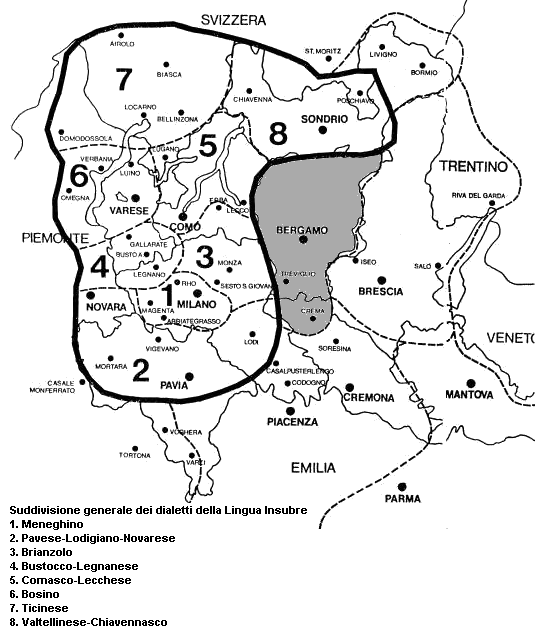
The Bergamasque dialect is the western variant of the Eastern Lombard group of the Lombard language. It is mainly spoken in the province of Bergamo and in the area around Crema, in central Lombardy.
Bergamasque has official status in the province of Bergamo, according to the Regional Law 25/2016.
Classification
[edit]Bergamasque is a Romance language and belongs to the Gallo-Italic branch. Its position on the language family is genetically closer to Occitan, Catalan, French, etc. than to Italian.
Geographic distribution
[edit]Bergamasque is primarily spoken in the province of Bergamo and in the area around Crema, in central Lombardy.
Bergamasque is generally mutually intelligible for speakers of Eastern Lombard's variants of neighbouring areas (i.e. from Brescia) but this is not always true for distant peripheric areas, especially in alpine valleys. Differences include either lexical, grammatical and phonetic aspects. Bergamasque is often referred to as a dialect of the Italian language; this is not correct, as Bergamasque and Italian are not mutually intelligible.
Following the migrations of the 19th and 20th centuries, the Bergamo dialect was transplanted and is spoken in various communities of southern Brazil, for example in the municipality of Botuverá.[2]
Speakers
[edit]Monolingual Bergamasque speakers are now virtually non-existent. All Lombard speakers also speak Italian, and their command of each of the two languages varies according to their geographical position as well as their socio-economic situation, the most reliable predictor being the speakers' age.[3]
Samples of literary works in Bergamasque
[edit][...] hec mulier id est la fomna et dicitur mulier, [...] hoc ignifer id est ol bernaz et dicitur ignifer [...]
E fì senorzat da Peter e incalzat da Martì, [...] cola pena mal temprata no po fì bona letra.
— E. Zerbini, Note storiche sul dialetto bergamasco ex B. Belotti, op. cit. in note, Petrus dominatur mihi. Et Martinus insequitur me, [...] calamo quem quis male moderatus est non potest fieri bona littera
A nomo sia de Crist ol dì present
Di des comandament alegrament
I qua de de pader onnipotent
A morsis per salvar la zent.
E chi i des comandament observarà
in vita eterna cum Xristo andarà [...]
— Ex B. Belotti, op.cit.
...Se bé cognosse, chesto nost parlà
bergamasch no s'convè a lodà la zét,
gnè da fà pians, perché chi lès o sèt
al gà fà piotost gni vòia d'grignà...
— Giovanni Bressani, (1489–1560)
I armi, i fomni, i soldacc, quand che in amôr
I andava d' Marz, af voi cuntà in sti vers,
Che fü in dol tèp che con tancc furôr
Al vign de za dol mar i Mor Pervers,
Condücc dal re Gramant, so car signôr,
Che voliva più Franza e l'univers
E destrüz sech Re Carlo e i Paladì
Per vendicà sò Pader Sarasì.
— Belotti. op. cit.
Che per spiegass bé e spert, sciassegh e stagn
a tate lengue ch'è montade in scagn,
al Fiorentì, al Franses
la nost lagh dà neuf per andà ai dès.
[...]
Mi per efett de ver amour, de stima,
Lavori e pensi in prima
A i mè compatriogg a i mè terèr;
E dopo, se 'l men vansa, a i forestèr.
— ex Belotti, op. cit.
Al vé vià quacc diàvoi chi gh'è mai
Al segn de quel teribel orchesù.
De pura 'l sa sgörlè i mür infernai.
E serè fò Proserpina i balcù;
I è röse e fiur, borasche e temporai,
Tempeste e sömelèc, saete e tru,
E a par de quel tremàs là zo de sot,
L'è cöcagna balurda 'l teremòt.
— ex Belotti, op. cit.
Another example
[edit]The Lord's Prayer
English-
Our Father who art in heaven, Hallowed be thy name. Thy kingdom come. Thy will be done on earth as it is in heaven. Give us this day our daily bread, and forgive us our trespasses, as we forgive those who trespass against us, and lead us not into temptation, but deliver us from evil.
Italian-
Padre nostro, che sei nei cieli, sia santificato il tuo nome, venga il tuo regno, sia fatta la tua volontà, come in cielo così in terra. Dacci oggi il nostro pane quotidiano, e rimetti a noi i nostri debiti come noi li rimettiamo ai nostri debitori, e non ci indurre in tentazione, ma liberaci dal male. Amen.
Bergamasque-
Pader nòst che te sé in cél a'l sìes santificàt ol tò nòm, a'l végne 'l tò régn, la sìes facia la tò olontà cóme in cél, isé 'n tèra. Daga 'ncö ol nòst pà de töcc i dé e pàghega i nòscc débecc cóme nóter m' ghi paga ai nòscc debitùr faga mìa börlà in tentassiù, ma sàlvega del mal. Amen.
Bibliography
[edit]- Bortolo Belotti, Storia di Bergamo e dei bergamaschi.
- Carmelo Francia, Emanuele Gambarini, Dizionario italiano-bergamasco, Bergamo, Grafital, 2001.
- Carmelo Francia, Emanuele Gambarini, Dizionario bergamasco-italiano, Bergamo, Grafital, 2004.
- Umberto Zanetti, La grammatica bergamasca, Bergamo, Sestante, 2004. ISBN 88-87445-59-1.
- Paganessi, Giulia (2017). Brazilian Bergamasch: an Italian language spoken in Botuverá (Santa Catarina, Brazil) (MA). Leiden University. hdl:1887/52581.
Further reading
[edit]- Anesa, Marino; Rondi, Mario (1981). Fiabe bergamasche. Mondo popolare in Lombardia. Vol. 11. Regione Lombardia; Milano: Silvana Editoriale.
References
[edit]- ^ Hammarström, Harald; Forkel, Robert; Haspelmath, Martin; Bank, Sebastian (2023-07-10). "Glottolog 4.8 - Piemontese-Lombard". Glottolog. Leipzig: Max Planck Institute for Evolutionary Anthropology. doi:10.5281/zenodo.7398962. Archived from the original on 2023-10-29. Retrieved 2023-10-29.
- ^ Paganessi (2017)
- ^ 2006 report Archived 2010-07-04 at the Wayback Machine by the Italian institute for national statistics.(ISTAT)
External links
[edit]- Orbilat - An interesting site more for western lombard, but the map of the distribution of the two main varieties is noteworthy.
- Italian/Bergamasque Dictionary - Carmelo Francia, Emanuele Gambarini - Ducato di piazza Pontida Archived 2022-10-16 at the Wayback Machine
- Ducato di piazza Pontida (folkloristical and linguistic association)
- Difficult phrases in Bergamasque (in Italian)
- A collection of comedies in Bergamasque
- a Casiratese-Italian vocabulary Archived 2007-12-02 at the Wayback Machine, a dictionary for the Bergamasque variety of Casirate d'Adda village, in Italian.
| |||||||||||||||||||||||

Grokipedia
Bergamasque dialect
View on GrokipediaClassification and origins
Linguistic classification
Bergamasque is a Romance language belonging to the Italo-Western branch, specifically within the Gallo-Italic subgroup of Gallo-Romance languages. This classification positions it alongside other northern Italian varieties such as Piedmontese, Emilian, and Ligurian, distinguishing it from the central and southern Italo-Dalmatian languages like Standard Italian.[4] Within the Lombard language continuum, Bergamasque represents the western variant of the Eastern Lombard group, which encompasses dialects spoken primarily in the provinces of Bergamo, Brescia, and Mantua. Unlike Western Lombard varieties, such as Milanese, Eastern Lombard dialects including Bergamasque exhibit closer structural affinities to those in adjacent areas like Brescia (Brescian) and Cremona (Cremonese), based on shared lexical and morphological isoglosses identified through dialectometric analysis.[5][4] Bergamasque shares structural similarities with other Gallo-Romance languages like French and Occitan, rather than with Standard Italian, resulting in mutual unintelligibility between Bergamasque and Italian. In contrast, it demonstrates partial mutual intelligibility with neighboring Eastern Lombard variants, facilitating communication within the subgroup despite local variations.[5][4]Historical development
The Bergamasque dialect originated from the Vulgar Latin spoken in the Roman-era province of Bergamo, part of Gallia Cisalpina, which was Romanized starting in the 1st century BC over a pre-existing Celtic substratum.[6] Following the Lombard (Germanic) invasions in the 6th century AD, the dialect evolved while retaining its core Romance structure, incorporating limited Germanic loanwords but resisting full substrate replacement due to the rapid adoption of local Latin varieties by invaders.[6] As a western variant of the Eastern Lombard group within the Gallo-Italic branch, Bergamasque developed distinct features amid these early influences, maintaining continuity with other northern Italian Romance varieties.[6] During the medieval period, Bergamasque matured under alternating Venetian and Milanese rule from the 13th to 18th centuries, contributing to a regional "franco-italiano" koiné that blended northern dialects with French elements in literary and administrative contexts.[6] The first written attestations appeared in the 15th and 16th centuries, notably in satirical poems by Giovanni Bressani, a Bergamasque author whose works, such as those composed during wartime in the 1560s, preserved local orthography and vocabulary.[7] These texts mark the dialect's emergence in literature, reflecting its use in everyday and poetic expression before the dominance of Tuscan-based Italian. In the 19th and early 20th centuries, amid Italian unification, standardization efforts for Bergamasque arose alongside the promotion of standard Italian, which marginalized regional varieties through education and media.[8] Mass immigration of Bergamaschi to southern Brazil, particularly to areas like Botuverá in Santa Catarina starting in the late 19th century, helped preserve archaic forms of the dialect in isolated communities, where it evolved as "Brazilian Bergamasch" with Portuguese influences but retained core lexical and phonological traits.[9] These diaspora pockets maintained oral traditions that resisted full assimilation. Post-World War II Italianization policies accelerated the dialect's decline, shifting usage to informal domains as standard Italian became prevalent in schools and public life.[6] This trend was countered by Regional Law 25/2016 (7 October 2016) in Lombardy, which provides for the safeguarding of the Lombard language—including variants like Bergamasque—through cultural promotion and educational initiatives.[10][11]Linguistic features
Phonology
The phonology of Bergamasque, a variety of Eastern Lombard, features a seven-vowel oral system in stressed syllables: /a, e, ɛ, i, o, ɔ, u/. These vowels distinguish tense and lax mid vowels (/e/ vs. /ɛ/, /o/ vs. /ɔ/), with /a/ remaining neutral to height contrasts. In unstressed positions, the system reduces to five vowels (/a, e, i, o, u/), where mid-low vowels (/ɛ, ɔ/) raise to mid-high (/e, o/). Nasal variants exist, particularly as allophones before the palatal nasal /ɲ/, resulting in nasalization of the preceding vowel, such as [ã] in nás 'nose'. A key process is metaphony, a regressive vowel harmony triggered by unstressed final high vowels (/i/ or /u/), which raises preceding stressed mid vowels: /e/ → /i/, /ɛ/ → /e/ before /i/; /o/ → /u/, /ɔ/ → /o/ before /u/. This asymmetric harmony primarily affects rounded mid vowels when triggered by /u/ and is non-iterative in Bergamasque, differing from iterative patterns in nearby Bresciano varieties.[12] The consonant inventory includes 20 phonemes, with plosives (/p, b, t, d, k, g/), fricatives (/f, v, s, z, ʃ/), affricates (/tʃ, dʒ/), nasals (/m, n, ɲ/), liquids (/l, r/), and approximants (/j, w/). In some varieties, particularly rural or border areas, Latin /k/ and /g/ are preserved before front vowels without full palatalization to affricates, differing from standard Italian. Gemination is common in intervocalic positions, creating phonemic length contrasts, such as in minimal pairs involving doubled stops or fricatives, and historical evidence shows retention of geminates in rural varieties before eventual partial degemination in urban speech.[12][13] Stress in Bergamasque is primarily penultimate, aligning with common Romance patterns, but it can be phonemic, shifting to the final syllable in some words to distinguish meanings, e.g., /ˈbeka/ 'goat' vs. /beˈka/ 'peck'. Cliticization affects prosody by forming a single stress domain with the host verb, often resulting in resyllabification and stress shift, as clitics lack independent stress and integrate into the verb's rhythmic structure. Bergamasque exhibits Gallo-Italic prosodic features, including stress-based rhythm that leans toward stress-timing, contrasting with the syllable-timed rhythm of Tuscan-based Italian. Intonation contours rely on fundamental frequency (F₀) rises for questions and falls for statements, with utterance-final boundary tones (e.g., H% for polar questions) aiding illocutionary distinctions.[14]Morphology and syntax
Bergamasque nouns distinguish two genders—masculine and feminine—and two numbers, singular and plural. Masculine nouns typically end in -o in the singular and form plurals with endings such as -i, while feminine nouns end in -a and often pluralize to -e, following patterns common in Western Lombard varieties. Definite articles elide before vowels and include forms like el or l' for masculine singular, la or l' for feminine singular, i for masculine plural, and e for feminine plural; indefinite articles are ü (un) for masculine singular and öna (una) for feminine singular.[15] Like other Gallo-Italic varieties, Bergamasque is a non-pro-drop language, requiring overt subject pronouns in finite clauses due to the affixal nature of verbal agreement. It employs a dual system of subject pronouns: clitic forms (e.g., al 'he') that are obligatory before the verb in declaratives, and tonic forms (e.g., lü 'he') used for emphasis or in isolation. Phrasal verbs are common, particularly those indicating movement direction, combining a verb with a prepositional adverb, such as ’nda-a śó 'go down'.[1] Verb conjugation in Bergamasque features a simplified tense system relative to standard Italian, with synthetic forms for the future tense, such as vivró ('I will live') from viv ('to live'). Compound tenses employ two auxiliary verbs: avèr (from Latin habere, 'to have') for transitive and most intransitive verbs, and èser (from Latin esse, 'to be') for inchoative, motion, and reflexive verbs, with agreement in gender and number for the latter. For example, the perfect tense of a transitive verb like magnà ('to eat') uses avèr: i l'à magnà ('he has eaten'), while an inchoative like murí ('to die') uses èser: l'è mòrt ('he has died').[16][17][15] The pronominal system relies heavily on clitics, which are typically enclitic—attaching to the end of verbs—contrasting with the proclitic positioning in standard Italian. Subject clitics are obligatory in declarative sentences and precede the verb, as in al viv ('he lives'), but shift postverbally in interrogatives. Object and reflexive pronouns encliticize, such as in fàm ('do it to me' or 'give to me'), from fà ('to do' or 'to give') + -m (me).[16][15] Bergamasque syntax follows a basic subject-verb-object order, though clitic placement introduces flexibility, allowing fronting for emphasis. Adjectives are commonly postposed to the noun they modify and agree in gender and number, as in caèrna nigra ('black meat'). Negation employs particles like nò or mìa, positioned postverbally in simple sentences, for instance, ’ndó mìa ('I don't go') from ’ndà ('to go').[15][16]Lexicon and vocabulary
The lexicon of the Bergamasque dialect derives primarily from Vulgar Latin, adapted through Gallo-Italic innovations that distinguish it from Standard Italian. Core terms often retain simplified forms, such as òl for 'oil' (from Latin oleum), contrasting with Italian olio (from oliu), reflecting a direct evolution without the intervocalic -l- development typical in central-southern Romance varieties. Other examples include pàder ('father', from Latin pater) and màder ('mother', from mater), preserving archaic Romance structures in familial contexts, as well as piö as a regional spelling and pronunciation of Italian più meaning 'more' or 'anymore,' used in expressions like gh'è piö ('there is more') or piö-llu ('no longer him,' in clitic forms).[18] Borrowings enrich the vocabulary, particularly from Venetian due to Bergamo's governance under the Venetian Republic from 1421 to 1797, influencing trade-related terms like those for commerce and administration. French loanwords entered during the Napoleonic era (1797–1814), adapting to local phonology in areas like military and bureaucratic lexicon, though specific integrations vary by sub-dialect. Modern Italianisms appear in urban speech, such as astròlogo becoming stròlegh, illustrating ongoing lexical convergence with Standard Italian.[19] Dialectal variants show lexical divergence between Bergamo city and peripheral areas like Val Brembana, where highland isolation fosters unique terms for local flora and fauna, such as balatró for 'lizard' or lagòlt for a specific bird type, absent in lowland variants. In Val Brembana sub-dialects, terms like anghuanin ('young calf') reflect pastoral specifics not emphasized in urban Bergamo. Semantic fields like agriculture and kinship preserve archaic Romance forms, diverging from Standard Italian. Agricultural vocabulary includes vedèl ('calf', from Latin vitellus), castagn ('chestnuts'), and falzón ('scythe'), tied to rural practices and maintaining Vulgar Latin roots without Tuscan innovations. Kinship terms such as fiöl ('son', from filius) and fràiri ('brother', from frater) retain Gallo-Italic pluralizations and diminutives, like sòrèl ('sister'), evoking pre-Standard Italian familial designations.Geographic distribution and usage
Primary areas of distribution
The Bergamasque dialect is predominantly distributed within the province of Bergamo in Lombardy, northern Italy, where it serves as the primary vernacular in both urban and rural settings. This core region includes the city of Bergamo itself, as well as the surrounding alpine territories such as the Val Brembana to the northwest and the Val Seriana to the northeast, where the dialect exhibits its most traditional characteristics.[6] Beyond Bergamo, the dialect extends into adjacent areas, notably the Crema district in the province of Cremona to the south. These peripheral zones reflect transitional influences from neighboring Lombard varieties, with urban centers like Bergamo showing more standardized forms compared to the conservative traits preserved in rural alpine valleys such as those in Val Brembana and Val Seriana.[6] The dialect's spread outside Italy stems from large-scale Italian migrations between the 1870s and 1920s, which carried Bergamasque to diaspora communities in southern Brazil. It is notably spoken in Botuverá, a municipality in the state of Santa Catarina, where a small community maintains varying degrees of proficiency alongside Brazilian Portuguese.[9] In its primary Italian heartland, Bergamasque retains greater vitality in rural Bergamo province, particularly in isolated valley communities, while facing decline in urban areas due to population mobility and the dominance of standard Italian.[6]Speakers and sociolinguistic status
The Bergamasque dialect is spoken primarily by residents of the Bergamo province in Lombardy, Italy, with estimates of 100,000 to 200,000 fluent speakers as of the early 2020s, all bilingual with standard Italian, as the dialect lacks official use in formal domains such as education and administration. Proficiency in Bergamasque is higher among older generations, particularly rural residents who acquired it as their first language through intergenerational transmission, while younger urban speakers often exhibit reduced fluency due to limited exposure.[20] Sociolinguistic patterns reveal a gendered dimension in language use and maintenance, with adult men associating Bergamasque more strongly with local identity and employing it at high rates (around 95%) in informal settings, whereas women, as primary caregivers, tend to prioritize Italian in family interactions, contributing to declining transmission to children.[20] This dynamic has accelerated a shift toward Italian, driven by its dominance in schools, media, and public life, resulting in fewer young speakers and positioning Bergamasque as an endangered variety despite its cultural vitality; the COVID-19 pandemic further disrupted transmission by disproportionately affecting elderly speakers.[20][2] Efforts to revitalize Bergamasque include initiatives by cultural associations like the Ducato di Piazza Pontida, which operates a dialect school to foster intergenerational learning and organizes festivals and events that incorporate the language in performances and community gatherings.[21] Local media, such as regional broadcasts and publications, also feature Bergamasque content to promote its use among younger audiences, with ongoing revival activities noted as of 2024.[21][22] Under Regional Law 25/2016, Bergamasque is recognized as a local variety of the Lombard language, with the Lombardy region committed to its promotion through cultural policies that support preservation, including its use in signage, events, and educational programs in the Bergamo province.[11]Literature and cultural role
Literary history
The literary history of Bergamasque dialect traces its origins to the Renaissance period, when the dialect began appearing in written form amid the broader cultural influences of Venetian rule over Bergamo from 1428 onward. The earliest documented literary uses include 15th-century strambotti, or humorous poetic forms, composed "a la bergamasca," which reflect rustic and local themes, though many remain unpublished or fragmentary. By the mid-16th century, the poet Giovanni Bressani (c. 1490–1560), a prolific humanist from Bergamo, incorporated Bergamasque into his multilingual oeuvre, notably in a collection of epitaffs written in Latin, Italian, and the dialect, preserved in a manuscript at the Biblioteca Civica di Bergamo.[23][24] This period also saw the dialect's integration into prose and theater, influenced by Venetian linguistic patterns, as evidenced in local documents and early comedic sketches. In the 19th century, Bergamasque experienced a revival during the Romantic era, aligning with the Italian Risorgimento's emphasis on regional identity and folklore. Poets such as Pietro Ruggeri da Stabello (1797–1858) elevated the dialect through lyrical works capturing Bergamo's rural life and traditions, with collections like his Poesie in dialetto bergamasco published posthumously in 1858 by Antonio Tiraboschi. Tiraboschi (1838–1883), himself a key figure in this movement, not only compiled Ruggeri's verses but also contributed original poetry and a significant 1875 anthology of Bergamasque proverbs, blending demological insight with literary expression to preserve local customs amid national unification efforts. This revival positioned the dialect as a vehicle for cultural resistance and authenticity, distinct from standard Italian.[25][26] The 20th and 21st centuries have seen Bergamasque thrive in theater and oral traditions, with the dialect playing a central role in Bergamo's comedic plays and folk music. The archetype of the Zanni character in 16th-century commedia dell'arte, originating from Bergamo and speaking a caricatured Bergamasque, laid the groundwork for enduring theatrical use, evolving into modern amateur and professional troupes like Gruppo Teatro 2000, active since the 1970s in staging dialect comedies. Playwright Dario Fo (1926–2016), drawing on Lombard dialects including Bergamasque elements, incorporated them into innovative grammelot techniques in works like Mistero Buffo (1969), blending humor and social critique. In folk music, Bergamasque persists in traditional songs and contemporary recordings, maintaining its vitality in cultural performances.[27][28][29] Standardization efforts gained momentum in the late 20th century, particularly through institutions promoting orthographic consistency and lexicography to support literary production. The Ducato di Piazza Pontida, founded in 1924, has led these initiatives by establishing a dialect school in Bergamo, publishing dictionaries, and developing an online Italian-Bergamasque vocabulary, fostering a de facto orthographic standard for contemporary writing while respecting historical variations. Recent publications, such as Michele Poli's Storia e letteratura del dialetto bergamasco (2024), further document and analyze this tradition, aiding preservation amid ongoing sociolinguistic shifts.[30][31][24][32]Notable works and samples
One notable historical example of Bergamasque literature is a satirical poem by Giovanni Bressani, a 16th-century Bergamo poet known for his works in the local dialect during the Italian Wars. In a verse reflecting on the conflict between Emperor Charles V and King Francis I around 1550, Bressani laments the hardships of war while offering counsel, showcasing the dialect's rhythmic and expressive qualities. An excerpt reads:Se bé mi no só bó de dar consey,This translates to Italian as approximately: "Sebbene non sono bravo a dare consigli, / soprattutto in questo parlare così grossolano, / che le sue parole sembrano parole vuote..." and to English: "Though I'm not good at giving advice, / especially in this coarse speech, / where his words seem like empty words...". The poem's use of nasalized vowels and simplified syntax, such as "só bó" for "sono buono," highlights early Bergamasque's divergence from standard Italian, emphasizing local resilience amid turmoil.[7] Religious texts provide another key sample, demonstrating the dialect's adaptation for devotional purposes. The Lord's Prayer, or Pader Nòst, in Bergamasque illustrates grammatical features like the auxiliary verb "sìes" (from Latin sis) and possessive "tò" (thy), which differ from Italian "sia" and "tuo." A full version is:
Maximament in sto parlar xi gross,
Que y su parolles par es balosey...
Pader nòst che te sé in célThe English translation is: "Our Father who art in heaven, / Hallowed be thy name. / Thy kingdom come. / Thy will be done / On earth as it is in heaven. / Give us this day our daily bread, / And forgive us our trespasses, / As we forgive those who trespass against us, / And lead us not into temptation, / But deliver us from evil. / Amen." This rendition preserves the prayer's solemnity while incorporating Bergamasque's phonetic shifts, such as "cél" for heaven (with closed vowel) and "dèbecc" for debts, underscoring the dialect's role in everyday spirituality.[33] A modern example appears in 20th-century Bergamo folklore, often performed in local theater and storytelling traditions. The short folk tale Ol Piero lèlo ("Silly Peter"), a humorous narrative set in the Bergamo valleys, exemplifies the dialect's phonetic uniqueness—like the uvular "r" in "gh'era" (c'era) and lexical items such as "tus" (ragazzo)—while capturing rural life. An excerpt:
a'l sìes santificàt ol tò nòm,
a'l végne 'l tò régn,
la sìes facia la tò olontà
cóme in cél, isé 'n tèra.
Daga 'ncö ol nòst pà de töcc i dé
e pàghega i nòscc débecc
cóme nóter m' ghi paga ai nòscc debitùr
faga mìa börlà in tentassiù,
ma sàlvega del mal.
Amen.
Öna òlta àla Pianca ‘l gh'era ü tus che l'era'n po' lélo.This translates to Italian: "Una volta alla Pianca c'era un ragazzo un po' sciocco. / Un giorno il suo papà lo mandò a San Giovanni Bianco dal mugnaio a comprare la farina. 'Vi raccomando', gli disse il padre, 'né più, né meno venti chili'." And to English: "Once in the Pianca there was a somewhat foolish boy. / One day his father sent him to San Giovanni Bianco the miller to buy flour. 'I recommend,' the father said, 'neither more nor less than twenty kilos'." The full tale follows Piero's misadventures through Bergamo locales like Fòp and Brembo, ending in comedic mishaps that rely on dialect puns and idioms absent in standard Italian.[34] These samples reveal Bergamasque's expressiveness, particularly in humor and local identity: Bressani's verse conveys wartime grit through coarse, vivid phrasing; the prayer adapts sacred text to intimate, phonetic familiarity; and the folk tale uses playful misunderstandings tied to Bergamo's geography (e.g., "Pianca" valley, Brembo river) to foster community bonding, setting it apart from Italian's more formal tone by infusing everyday resilience and wit.[7][33][34]
Ü dé 'l sò tata 'l'a mandà a San Gioàn dèl mülinér, a crumpà la farina. "Ma rècomande", 'l ga dis ol tata, "gnà piö, gnà meno inte chili".