


Community hub
Capirote
View on Wikipedia | This article has multiple issues. Please help improve it or discuss these issues on the talk page. (Learn how and when to remove these messages)
|


.JPG)
A capirote[1] is a Christian pointed hat of conical form that is used in Italy, Spain and Hispanic countries by members of a confraternity of penitents, particularly those of the Catholic Church. It is part of the uniform of such brotherhoods including the Nazarenos and Fariseos during Lenten observances and reenactments during Holy Week in Spain and its former colonies, though similar hoods are common in other Christian countries such as Italy. Capirote are worn by penitents so that attention is not drawn towards themselves as they repent, but instead to God.
History
[edit]Historically, the flagellants are the origin of the current traditions, as they flogged themselves with a discipline to do penance. Pope Clement VI ordered that flagellants could perform penance only under control of the church; he decreed Inter sollicitudines ("inner concerns" for suppression).[2] This is considered one of the reasons why flagellants often hid their faces.
The use of the capirote or coroza was prescribed in Spain by the holy office of Inquisition. Men and women who were arrested had to wear a paper capirote in public as sign of public humiliation. The capirote was worn during the session of an Auto-da-fé. The colour was different, conforming to the judgement of the office. People who were condemned to be executed wore a red coroza. Other punishments used different colours.
When the Inquisition was abolished, the symbol of punishment and penitence was kept in the Catholic brotherhood, however, the capirotes used today are different; they are covered in fine fabric, as prescribed by the brotherhood. To this day, they are still worn during the celebration of the Holy Week/Easter most notably in Andalusia, by penitentes (who perform public penance for their sins) who walk through streets with the capirote.
The usage of the capirote during the Holy Week was once common throughout Spain's colonies, but this custom has since died out in most of them by the late 19th century. Notable exceptions to this are some parts of Mexico, Guatemala, and the Philippines.
In the Philippines, a former Spanish colony, male Catholic penitents of the Tais-Dupol confraternity wear capirotes during Holy Week in Palo, Leyte. The group's name comes from Waray tais, meaning "pointed", and dupol, meaning "blunt", referring to the shape of the hood. The tradition has been followed since the late 1800s when the group was organized by the Franciscan friar Pantaleon de la Fuente. The wearing of the hood is based on Matthew 6:16-18 which advocates for anonymity during fasting.[3]
The capirote is today the symbol of the Catholic penitent: only members of a confraternity of penance are allowed to wear them during solemn processions. Children can receive the capirote after their first holy communion, when they enter the brotherhood.
Design
[edit]Historically the design is called the capirote, but the brotherhoods cover it with fabric together with their face, and the medal of the brotherhood that is worn underneath. The cloth has two holes for the penitent to see through. The insignia or crest of the brotherhood is usually embroidered on the capirote in fine gold.
The capirote is worn during the whole penance.
Use outside of the Catholic Church
[edit]
The capirote was appropriated by the early 20th-century American Ku Klux Klan, a white supremacist and anti-Catholic group.[4] Alison Kinney of New Republic traces the modern uniform to the popularity of the film The Birth of a Nation, whose costume inspiration was not credited.[5]
In popular culture
[edit]- The Penitent One, the protagonist of the video games Blasphemous and Blasphemous 2, wears a metal helmet that combines a capirote with a face mask.
- In the 1979 Lupin III film The Castle of Cagliostro, during the wedding of the Count and Clarisse, as they approach the altar, they are accompanied by a procession of his armored assassins, all wearing black capirotes and robes over their usual armor.
- In the tabletop skirmish game Trench Crusade, many of the Trench Pilgrims wear an iron capirote as military equipment, said to render them utterly fearless.
- The Neo Atlantean soldiers from the 1990s anime Nadia: The Secret of Blue Water wear capirote like hoods with a face mask, the color and design of the face masks differ to signify different ranks and professions within the organization.
Gallery
[edit]-
 A confraternity of penitents in Italy mortifying the flesh with disciplines in a seven-hour procession; hoods similar to the capirote are worn by penitents in order to not draw attention to themselves, but to God (2010)
 -

-
 A Procession of Flagellants, Goya, 1812–1819
 -
 Prisoner wearing capirote and Sanbenito, Goya
 -
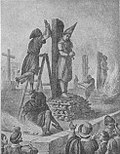 Execution of Francisca Nuñez de Carabajal, Mexico City, 1601
.jpg)


See also
[edit]

References
[edit]
- ^ Diccionario de la lengua castellana
- ^ A History of Christianity: The First Three Thousand Years Door Diarmaid MacCulloch
- ^ "'Tais-Dupol' in Palo, Leyte stirs netizens". GMA Regional TV News. 30 March 2024. Retrieved 7 April 2024.
- ^ Michael K. Jerryson, Religious Violence Today: Faith and Conflict in the Modern World, 2020, 217
- ^ Kinney, Alison (8 January 2016). "How the Klan Got Its Hood". The New Republic. Retrieved 29 November 2022.
Capirote
View on GrokipediaHistorical Origins
Medieval Penitential Practices
The practice of wearing conical headgear as part of penitential discipline emerged in medieval Europe during the 13th century, particularly among flagellant movements in Italy, where lay groups organized public processions of self-mortification to atone for sins amid crises like the Black Death. These flagellants, originating around 1260 in Perugia, processed in hooded robes while whipping themselves with disciplines, emphasizing collective humility and spiritual purification over individual recognition.[5] The hoods, evolving from monastic cucullae—simple cowls worn by ascetics for seclusion—served to conceal identities, aligning with biblical injunctions for discreet fasting and prayer, as in Matthew 6:16-18, to direct focus toward divine repentance rather than human acclaim.[1] By the 14th and 15th centuries, such attire influenced lay confraternities, or disciplinati, in regions like central Italy and emerging in Spain, where brotherhoods adopted pointed hoods for anonymous participation in processional penances. Historical accounts of these groups, such as those in Umbria and Tuscany, describe penitents donning tall, conical caps during Lenten rituals to symbolize the soul's upward striving toward God while mortifying the flesh through flagellation or barefoot marches. This voluntary anonymity contrasted with earlier public shaming but rooted in Catholic ascetic traditions tracing to early Church fathers like Tertullian, who advocated bodily discipline for sin's remission. Empirical evidence from chronicles, including those of Dominican observers who regulated flagellant excesses under papal bulls like Clement VI's Inter sollicitudines (1349), notes the use of hooded garments to maintain order and piety in these semi-clericalized movements.[4][2] In Spain, parallel developments saw cofradías of penitents incorporating similar conical headpieces by the late medieval period, drawing from Italian models via pilgrimage routes and shared Iberian-Italian trade ties, though records emphasize their role in fostering communal discipline without the ecstatic excesses of northern flagellants. These practices, documented in municipal statutes and ecclesiastical visitations from the 1400s, underscored a causal link between visible yet veiled self-abasement and perceived spiritual efficacy, as participants sought to emulate Christ's Passion through embodied humility. Unlike later inquisitorial impositions, this era's use remained largely voluntary, confined to approved brotherhoods under episcopal oversight to prevent heresy accusations.[1][5]Inquisition-Era Development
The coroza, an early variant of the capirote characterized by its tall, conical shape, was introduced by the Spanish Inquisition during the late 15th century as a compulsory garment for public penitents and the condemned. Established in 1478 under Ferdinand II of Aragon and Isabella I of Castile, the Inquisition mandated the coroza alongside the sanbenito tunic during autos-da-fé, elaborate public ceremonies intended to enforce religious orthodoxy through visible shame and coerced recantation.[1][6] This attire marked wearers as heretics—often conversos suspected of Judaizing or Muslims feigning conversion—symbolizing their spiritual degradation and the Crown's demand for conformity, with the pointed form evoking infernal imagery to underscore divine judgment.[7] In practice, reconciled penitents donned a plain yellow coroza and sanbenito adorned with red crosses or flames, parading through streets to major cathedrals before audiences numbering in the thousands, as seen in the inaugural auto-da-fé in Seville on February 6, 1481, where over 500 penitents were processed.[1] Those unrepentant or relapsed faced a coroza painted with devils and flames, signaling imminent execution by burning, a fate documented in Inquisition records from tribunals across Spain and its colonies, such as the 1536 sentencing in Mexico City where indigenous and mestizo suspects were compelled to wear the hat during cathedral masses as perpetual infamy.[7] Trial archives, preserved in institutions like the Archivo Histórico Nacional, reveal over 44,000 cases processed by 1530, many culminating in such garbed processions to deter relapse through communal ostracism and psychological coercion.[6] Contemporary accounts and edicts from inquisitors like Tomás de Torquemada emphasized the coroza's role in causal enforcement of repentance: public exposure stripped anonymity, compelling abjuration to avoid escalation to torture or death, with garments fabricated from cheap pasteboard to ensure disposability after penance.[1] By the mid-16th century, as Inquisition fervor waned under Philip II's reforms, some voluntary flagellant groups began adapting similar conical headwear for self-imposed disciplines, marking an initial divergence from punitive origins toward internalized contrition, though still echoing the era's mechanisms of visible atonement.[1]Transition to Voluntary Use in Confraternities
The capirote transitioned from a compulsory symbol of public humiliation imposed by the Spanish Inquisition in the late 15th century to elective attire for penitents in Catholic confraternities during the 16th century, marking a shift toward institutionalized voluntary penance. This adaptation began as brotherhoods, or hermandades, incorporated the conical hood into Holy Week processions to enable anonymous participation, redefining its purpose from coerced shame to self-imposed devotion. In Seville, the Hermandad de la Hiniesta became the first documented confraternity to adopt the capirote in the 16th century, differentiating between penitents based on the garment's form to signify levels of austerity.[8] The Counter-Reformation played a pivotal role in this evolution, channeling earlier medieval flagellant movements—often unstructured and prone to excess—into regulated public expressions of faith that emphasized communal discipline over isolated sin. Church authorities, responding to Protestant critiques of Catholic practices, promoted elaborate processions as visible affirmations of orthodoxy, with statutes for Spanish confraternities formalized between 1538 and 1563 in Seville to standardize penitential rites including hooded anonymity. By the 17th and 18th centuries, this institutionalization peaked, as seen in the expanded rules and processions of established groups like Seville's Hermandad de la Vera Cruz, founded in 1448 but whose penitential statutes were refined amid reformist oversight to foster orderly devotion.[9][1] This voluntary framework spread to Spanish American colonies through missionary confraternities, integrating the capirote into local Holy Week traditions as part of broader evangelization efforts. Records indicate early adoption in viceregal centers, with processions featuring nazarenos in hooded attire emerging in Mexico and Peru by the colonial 17th century, adapting Iberian models to indigenous and creole contexts under ecclesiastical approval.[2]Religious and Symbolic Meaning
Core Penitential Symbolism
The capirote functions primarily as a penitential garment in Catholic practice, symbolizing the wearer's humility, detachment from personal identity, and commitment to emulating Christ's Passion through acts of mortification and repentance.[4] By concealing the face and social markers, it directs focus away from the individual toward God and communal atonement, enabling sincere contrition without risk of vainglory or public scrutiny.[1] This anonymity underscores the doctrine that true penance prioritizes interior conversion over external display, fostering a state of spiritual recollection amid processional disciplines.[2] In the context of Holy Week brotherhoods, nazarenos wear the capirote to represent collective sinfulness and solidarity in seeking divine mercy, shifting emphasis from personal distinction to shared human frailty and redemption.[10] The garment's use promotes detachment from worldly concerns, aligning with Catholic teachings on sin confession that require humble acknowledgment of faults to facilitate grace.[1] Empirical accounts from Spanish processions confirm its role in creating an atmosphere of uniform penitence, where participants endure physical discomfort—such as carrying heavy crosses or walking barefoot—to mirror Christ's suffering and atone for societal sins.[4] The capirote's symbolism connects to ancient Christian penitential traditions, adapting biblical imperatives for visible repentance, such as the king's sackcloth in Jonah 3:6 or the call for sackcloth and ashes in Matthew 11:21, which denoted debasement and mourning for transgressions.[11] Unlike those overt markers, the capirote evolves the practice toward visual uniformity and concealment, emphasizing anonymous humility over self-abasement to avoid pride in penance while maintaining public witness to faith.[12] This adaptation reflects causal progression from early Church disciplines to medieval confraternities, where anonymity preserved the integrity of voluntary mortification against potential social motivations.[1]Anonymity and Spiritual Aspiration
The capirote conceals the wearer's identity to ensure penitence remains an authentic act of humility, shielding participants from the risks of vainglory or seeking public admiration for their devotion.[13] This anonymity aligns with Catholic moral theology, which stresses that spiritual practices must prioritize interior sincerity over external validation, as performative piety undermines true conversion.[4] By masking facial features and personal identifiers, the garment redirects attention from the individual to the communal act of atonement, fostering a psychological state conducive to self-examination without the distraction of social recognition.[3] The conical shape of the capirote embodies the theological concept of the soul's upward striving toward God, with its tapered form evoking aspiration and detachment from material concerns.[2] This design element symbolizes spiritual elevation, where the height of the hood represents the penitent's degree of commitment to divine orientation, as taller structures indicate a more profound renunciation of ego in favor of heavenly focus.[3] In confraternity practices, such proportions reinforce the wearer's intentional shift toward interior reform, promoting a disciplined mindset that values eternal aspirations over temporal identity.[2]Biblical and Theological Foundations
The practice of penitential veiling or head-covering finds precedents in Old Testament expressions of mourning and repentance, where covering the head signified profound humility and sorrow for sin before God. For instance, King David ascended the Mount of Olives "weeping as he went, barefoot and with his head covered" in response to Absalom's rebellion, embodying public contrition and submission to divine judgment (2 Samuel 15:30). Similarly, the elders of Zion sat in silence with heads bowed low, symbolizing collective penitence amid calamity (Lamentations 2:10). These acts underscore a biblical pattern of external signs manifesting internal repentance, prioritizing communal edification over personal concealment. In the New Testament, the capirote's underlying ethos of self-abnegation aligns with Christ's exemplary humility, as articulated in Philippians 2:7-8, where Jesus "emptied himself, by taking the form of a servant, being born in the likeness of men. And being found in human form, he humbled himself by becoming obedient to the point of death." This kenotic model—self-emptying for others' sake—forms the theological core of Christian penance, urging believers to imitate divine lowliness rather than worldly exaltation. Early patristic interpretations reinforced this, viewing such humility as essential to sacramental reconciliation, distinct from mere ritualism. Theologians like St. Thomas Aquinas affirmed the role of public penance in ecclesial discipline, arguing that visible, solemn acts remedy public scandals and foster communal repentance, as private sins alone suffice for lesser faults but grave offenses demand outward manifestation to restore order.[14] Aquinas emphasized that such practices, rooted in scriptural calls to "rend your hearts and not your garments" (Joel 2:13), yet incorporating external disciplines, prevent hypocrisy by aligning outward behavior with inward conversion. This framework defends penitential anonymity not as evasion but as a safeguard against vainglory, ensuring focus on God amid public witness. Catholic tradition preserves these foundations through unbroken liturgical continuity—from apostolic-era public penitents in sackcloth to medieval confraternities—evidenced by conciliar decrees mandating visible contrition, contrasting with episodic secular adaptations lacking scriptural depth or ecclesial sanction. Empirical records of early Church discipline, such as the Didache's exhortations to repentance, affirm causal links between biblical humility imperatives and enduring practices, prioritizing fidelity to revealed truth over cultural reinterpretations.Physical Design and Variations
Construction and Materials
The capirote features a rigid conical framework, typically crafted from sturdy cardboard reinforced for structural integrity, though esparto grass is also employed in some traditional variants to provide lightweight yet firm support that allows the tip to either stand erect or slightly droop under its own weight.[1][3] This core structure is then enveloped in a layer of fabric, such as linen or cotton, ensuring breathability and resistance to wear during extended processions.[1] The overall height of the cone ranges from 90 centimeters to 1.15 meters, calibrated to the wearer's stature and the prescribing confraternity's norms to balance visibility and proportion while in motion.[15] Attached to the cone is a trailing fabric panel, or antifaz, which extends downward to obscure the face and neck, secured via stitching or ties for secure fit during hours-long marches.[16] These elements are predominantly handmade by skilled artisans or confraternity members in Seville-area workshops, utilizing manual techniques like cutting, folding, and gluing to achieve the necessary durability against nocturnal weather and physical exertion in Holy Week events.[16][17] Modern iterations occasionally incorporate synthetic reinforcements for added resilience, though traditional cardboard and natural fibers predominate to preserve functionality and tactile authenticity.[1]Height, Shape, and Functional Features
The capirote is defined by its conical form, featuring a broad, blunt base that rests on or near the shoulders and a sharply tapered peak that extends upward.[1] This pointed silhouette serves an aesthetic and symbolic purpose, directing the gaze heavenward to signify spiritual aspiration during processions.[18] Unlike flat or rounded hoods used in other penitential contexts, the capirote's elongated cone provides visual elevation without implying intimidation, prioritizing ritual elevation over enclosure.[19] Heights of capirotes vary significantly, typically ranging from 40 cm to 120 cm, with common sizes including 60 cm for standard adult wear and up to 110 cm for taller expressions of devotion.[20] [21] This variability accommodates individual preferences and confraternity norms, where greater height may denote intensified penitential commitment or hierarchical status within the group, as taller peaks enhance the wearer's prominence in processions symbolizing proximity to the divine.[19] [22] Functional adaptations ensure practicality for prolonged use in rites. The neck opening is often adjustable via elastic bands, Velcro fasteners, or drawstrings, allowing secure fitting around the antifaz (face mask) while preserving anonymity by fully obscuring facial features.[23] [24] Many models employ breathable rejilla (mesh) fabric, which promotes airflow to mitigate heat buildup and discomfort during hours-long marches, thus enabling sustained participation without compromising the garment's concealing role.[20] These ergonomic elements, derived from traditional craftsmanship, balance devotional anonymity with physical endurance in outdoor settings.[25]Color Coding and Regional Adaptations
The colors of capirotes and associated nazareno habits are prescribed in the statutes of individual confraternities, reflecting thematic elements of Christ's Passion, virtues, or devotion to specific Marian advocations, with variations tied to local traditions rather than a uniform scheme. Purple signifies penitence and Lenten preparation, commonly used in Seville by hermandades such as the Silencio, whose statutes emphasize this hue for its association with mourning and spiritual discipline.[26][27] Black denotes mourning and death, frequently appearing in Málaga processions on Good Friday, as in brotherhoods evoking the solemnity of the crucifixion.[28] Red symbolizes the blood of Christ and martyrdom, while white represents purity and resurrection hope, and green hope or eternal life; these are codified in hermandad rules dating to the 17th and 18th centuries, such as those of Málaga's Rescate, linking colors to trinitarian crosses and sacrificial motifs.[29][30] Regional adaptations maintain the conical form but adjust height, fabric, and ornamentation. In Italy, equivalent hoods known as cappucci, worn by flagellant confraternities during Holy Week processions like those in Guardia Sanframondi, are typically shorter than Spanish capirotes to emphasize anonymity without excessive elevation, aligning with medieval penitential practices focused on self-mortification.[31] In Latin American contexts, such as Mexican or Guatemalan Semana Santa observances influenced by Spanish colonial transmission, capirotes often incorporate embroidery or local textile motifs on habits, enhancing visual distinction while preserving the penitential symbolism, though statutes prioritize functional austerity over decoration.[32] This polychromatic diversity, empirically consistent across centuries in primary sources like confraternity bylaws, underscores identity-bound usage over any monolithic standard, directly countering notions of white as a dominant or default hue in traditional Catholic contexts.[28]Primary Use in Catholic Traditions
Integration in Holy Week Processions
The capirote forms an essential element of the nazareno's attire in Spain's Holy Week processions, where participants wear it while accompanying pasos—ornate floats depicting scenes from Christ's Passion—through city streets during Semana Santa, observed annually from Palm Sunday to Easter Sunday. In Seville, these processions trace origins to the early 16th century, when Catholic brotherhoods formalized public displays of penance amid the Counter-Reformation emphasis on visible devotion. Nazarenos integrate the capirote into their processional role by donning it upon assembly at parish churches, forming extended lines that precede and flank the pasos as they navigate predefined routes, often spanning 12 to 14 hours per outing.[1] Seville's Semana Santa exemplifies the capirote's logistical prominence, involving around 50,000 nazarenos from 61 brotherhoods who participate across daily processions, with the largest single group exceeding 5,000 members. These events unfold chronologically: initial parades on Palm Sunday evoke Christ's entry into Jerusalem, escalating through Maundy Thursday's nocturnal vigils—known as the Madrugá—where nazarenos don capirotes at midnight for processions illuminated by candles and flares, culminating in quieter Easter Sunday observances. The hood's conical form aids visibility in dense formations, allowing penitents to maintain focus amid throngs while preserving the procession's disciplined cadence.[33][34][35] Nationally, millions witness these spectacles, but Seville alone attracts tens of thousands of daily spectators, underscoring the capirote's role in sustaining the event's immersive scale and rhythmic progression, as brotherhoods coordinate departures to avoid overlaps on key thoroughfares like the Via Crucis route. Logistical adaptations include color-specific capirotes per brotherhood, ensuring visual cohesion within each procession while differentiating from others, a practice rooted in statutes dating to the 17th century. This structured integration reinforces the capirote's function in channeling collective penance through synchronized urban movement.[36][35]Role and Duties of Wearers (Nazarenos)
Nazarenos function as the primary penitential participants in Holy Week processions, marching in disciplined, silent formations for durations often exceeding 10 hours through urban streets. They bear heavy burdens such as candles weighing 20 to 50 kilograms or wooden crosses, symbolizing acts of self-imposed discipline and service to the brotherhood's sacred images (pasos). This role emphasizes endurance over public display, with participants frequently proceeding barefoot to heighten physical austerity.[37][38][39] Membership in a cofradía or hermandad entails formal commitment, including annual preparation for processions where individuals are assigned specific duties based on seniority and proven reliability. In Seville, these brotherhoods collectively mobilize around 50,000 nazarenos across 61 groups during Holy Week, with individual cofradías deploying up to 3,000 members per event. This structured involvement requires adherence to internal protocols, such as maintaining formation and coordinating with costaleros who carry the pasos beneath street level.[33][40][38] Through these duties, nazarenos provide essential support for the procession's execution, including guiding routes and exemplifying collective discipline, which sustains the event's scale and regularity year after year. The physical and organizational demands—evident in the coordination of thousands—foster interpersonal bonds within brotherhoods, as participants share the rigors of preparation and performance, reinforcing local social ties via repeated communal exertion.[41][42][43]Global Spread to Hispanic and Italian Contexts
The tradition of the capirote extended to Hispanic regions via Spanish colonization starting in the 16th century, when Franciscan and other missionaries transported penitential practices from Spain to the Americas and Asia, integrating them into local Holy Week observances.[44] In Mexico, nazarenos don black robes and conical hoods during processions in Puebla, where brotherhoods carry statues of Jesus of Nazareth, and in Taxco, preserving elements of these colonial introductions amid ongoing annual events.[44] In the Philippines, acquired by Spain in 1565, capirotes appear in penitential groups like those in San Leonardo, Nueva Ecija, on Good Friday, and the all-male Tais-Dupol in Palo, Leyte, reflecting adaptations of Spanish customs to indigenous Catholic fervor.[45] Similarly, in Central America, Guatemala's Antigua hosts processions with hooded penitents hauling massive alfombras-covered platforms, a practice blending Spanish imports with Mayan elements and designated UNESCO Intangible Cultural Heritage in December 2022.[46] In Colombia, Popayán's Holy Week processions, active since the 16th-century colonial era, feature similar hooded participants and earned UNESCO recognition in 2009.[47] In Italian contexts, pointed hoods akin to the capirote—often termed cappucci—emerged independently in medieval confraternities of flagellants, predating significant Spanish influence and rooted in 13th-century practices of anonymous penance.[4] Sicily's Mysteries of Holy Week, such as Enna's Good Friday procession, incorporate these hoods to conceal identities during multi-hour marches, emphasizing humility over public recognition in a tradition documented since the late Middle Ages.[48] These Italian variants persist in southern regions like Campania and Sardinia, maintaining devotional continuity without direct ties to Iberian colonial dissemination.[49]Misconceptions and External Associations
Visual Parallels with Ku Klux Klan Attire
The capirote and the Ku Klux Klan's (KKK) hood share a superficial resemblance in their pointed, conical shape, both serving to conceal the wearer's identity.[2] However, structural differences are pronounced: the capirote features a tall, soft fabric cone attached to a flowing veil or capa that covers the upper body, with eye openings allowing partial visibility and often adorned in colors denoting specific confraternities, whereas the KKK hood incorporates a rigid mask with precise slits for eyes and mouth, designed for intimidation and paired with a full white robe.[50] [2] Photographic evidence underscores these variations: capirotes appear in processions with diverse heights—ranging from 1 to 2 meters—and hues like purple, black, or red, reflecting adaptive designs for public daylight penance, in contrast to the KKK's standardized white, shorter-pointed hoods intended for secretive night operations.[18] [51] The capirote's form evolved from medieval European penitential garb, predating KKK regalia by centuries, with documented use in Spanish Holy Week by the 16th century at the latest.[1] The KKK's pointed hood emerged specifically with the organization's 1915 refounding, standardized via commercial suppliers and inspired by the film The Birth of a Nation, which evoked medieval spectral figures rather than direct emulation of Catholic conical headwear.[51] [52] No historical records indicate borrowing from the capirote tradition, as the second-era KKK's imagery stemmed from broader Gothic and folklore motifs in American popular culture of the early 20th century.[53]Chronological and Ideological Distinctions
The capirote originated in 15th-century Spain, decreed by the Spanish Inquisition—established in 1478—for public penitents convicted of religious crimes to wear during processions of repentance, symbolizing shame and humility while concealing identity to focus penance on spiritual atonement rather than social recognition.[54] This practice evolved from medieval Christian confraternities of penitents, predating the Inquisition but formalized through its tribunals, and persisted continuously in European Catholic Holy Week observances, including Spain's Semana Santa processions by the 16th century onward.[2] In contrast, the Ku Klux Klan formed in 1865 in Pulaski, Tennessee, as a secret society of Confederate veterans opposing Reconstruction-era policies, with its second iteration reviving in 1915 amid nativist fervor and peaking in membership during the 1920s at approximately 4-5 million adherents.[55] The KKK's timeline thus postdates the capirote by over four centuries, with no documented transmission of the garment across the Atlantic before the 19th century, as capirote use remained confined to Catholic Iberian and Italian contexts without influence on American Protestant groups.[2] Ideologically, the capirote embodies Catholic doctrines of contrition and mortification, where anonymity shields the wearer from worldly judgment, directing attention toward personal sin and divine mercy in line with penitential traditions traceable to early Christian flagellant movements adapted in medieval Spain.[1] The KKK, however, pursued Protestant nativist supremacy, explicitly targeting Catholics as threats to Anglo-Saxon Protestant dominance, with its 1920s platform advocating immigration restrictions against Catholic Europeans and promoting anti-papal rhetoric as part of a broader agenda of racial hierarchy and political intimidation.[55] This anti-Catholic animus—evident in KKK campaigns against Catholic schools and political influence—renders implausible any deliberate emulation of a Catholic penitential symbol, as the organization's rituals instead drew from Masonic secrecy and romanticized Confederate imagery to enable anonymous violence against perceived enemies, including lynchings and cross-burnings.[56] Historical records show no causal link or inspirational borrowing; the KKK's adoption of hooded attire aligned with its terroristic goals of instilling fear, fundamentally opposing the capirote's intent of humble devotion, with the two evolutions remaining causally independent due to divergent religious and political contexts.[2]Origins of the Equivalence Myth
The misconception equating the capirote with Ku Klux Klan hoods emerged prominently in the 20th century, driven by the visual shock value of pointed conical headwear to audiences primarily familiar with the KKK's attire through American popular culture. As Spain's tourism industry expanded rapidly after the Spanish Civil War—welcoming over 3 million visitors annually by 1960—foreign tourists, especially from the United States, encountered Holy Week processions featuring nazarenos in capirotes without contextual knowledge of their penitential origins.[4] This exposure, amplified by early television broadcasts and print media depicting the stark, anonymous silhouettes, fostered initial associations based on shape alone, as noted in retrospective analyses of cultural misunderstandings.[54] Media coverage further propagated the confusion, particularly from the mid-20th century onward, when global news outlets began featuring images of Spanish Semana Santa alongside domestic references to the KKK, whose second iteration standardized pointed hoods in 1915 via the film The Birth of a Nation.[2] Articles like a 2017 BBC piece explicitly acknowledged that the capirote's appearance "will horrify many who see it," attributing the reaction to ingrained KKK imagery rather than shared ideology or practice.[4] Such reporting, often from outlets with audiences in Protestant-majority regions, overlooked the capirote's documented use in Catholic confraternities since at least the 16th century, predating the KKK's founding in 1865 by centuries and deriving from medieval European penitential traditions independent of American nativism.[50] Critiques equating the two via optics, frequently advanced in left-leaning media and academic commentary, ignored chronological precedence and the KKK's foundational anti-Catholic platform, which explicitly targeted Hispanic and immigrant Catholic communities as threats to white Protestant supremacy.[53] Empirical examination reveals no overlapping rituals, symbols, or doctrines: capirotes signify anonymous humility before God in public processions, while KKK regalia masked terroristic intimidation, with the cone shape representing a coincidental medieval European trope for disguise or penance, not mutual derivation.[57] No historical records indicate influence from Spanish Holy Week on KKK uniform design, which evolved from 19th-century ghostly disguises in the American South rather than Iberian Catholicism.[2]Controversies and Debates
Links to Historical Punishments
During the Spanish Inquisition, established in 1478, the capirote—often paired with the sanbenito tunic—served as a garment of public humiliation imposed on penitents and heretics during auto-da-fé ceremonies.[2] These spectacles, which paraded thousands of accused individuals before pronouncing sentences ranging from reconciliation to execution, utilized the tall, pointed capirote to mark the wearers as contrite or unrepentant, with records from events like the 1559 auto-da-fé in Valladolid documenting its enforced use on reconciled prisoners.[1] The practice symbolized shame and subordination to ecclesiastical authority, affecting an estimated tens of thousands over the Inquisition's span, though exact figures for capirote-specific impositions vary due to incomplete archival survival.[3] By the 16th century, as flagellant brotherhoods and cofradías proliferated, the capirote transitioned to voluntary adoption in penitential processions, decoupling it from state-mandated coercion and reframing it as an instrument of personal atonement and emulation of Christ's humility.[1] This reclamation emphasized spiritual elevation, with the hood's height metaphorically directing gaze toward divine repentance rather than earthly judgment, a shift evident in the statutes of Seville's hermandades by the early 1600s.[2] Critics, including some historians, argue this evolution glosses over the garment's origins in enforced degradation, potentially perpetuating associations with institutional oppression.[3] Proponents counter that the voluntary context transformed it into a tool for fostering individual virtue, sustained through Church-sanctioned devotions independent of inquisitorial mechanisms. The Spanish Inquisition formally ceased operations in 1834 under Queen Isabella II, yet the capirote's use in Holy Week persisted and expanded via lay confraternities, underscoring a divergence from punitive roots to consensual religious expression approved by the Catholic hierarchy.[1] This endurance highlights a reclamation wherein historical baggage yields to devotional practice, though debates persist on whether visual continuity inherently evokes past coercions.[2]Accusations of Promoting Division or Archaicism
Critics from secular and laicist perspectives in Spain have argued that the capirote's tradition in Holy Week processions contributes to social division by reinforcing Catholic hegemony in public life, potentially alienating non-religious or minority faith communities through its prominent display of penitential anonymity. Organizations advocating strict church-state separation, such as those documented in laicist advocacy platforms, contend that the processions' occupation of urban streets and municipal support symbolize an exclusionary prioritization of one religion, exacerbating tensions in increasingly pluralistic societies.[58] Historical left-wing critiques, particularly during the transition from Franco's regime, framed the capirote-wearing nazarenos as emblems of "blind religious fanaticism" tied to authoritarian conformity, accusing the rituals of perpetuating ideological divisions that hinder secular progress.[58] This view posits that anonymity under the hood enables unaccountable expressions of collective fervor, which some claim could mask or normalize regressive social attitudes rather than genuine personal repentance. On the charge of archaism, detractors describe the capirote as a vestige of medieval or Inquisitorial-era punishments, irrelevant and even counterproductive in a modern context emphasizing individual rights and psychological well-being over public mortification. Literary works like Alfonso Grosso's El capirote (1979) exemplify this by using the hood as a metaphor to critique entrenched social hypocrisies and outdated communal structures in Andalusian society, implying the tradition's obsolescence amid rapid secularization.[59] Such arguments often highlight the potential for international misinterpretation, where the attire's visual opacity fuels perceptions of insularity or extremism abroad, despite domestic participation exceeding one million in Seville alone during peak years.[60]Counterarguments Emphasizing Devotional Intent
Advocates for the capirote highlight its primary function in promoting anonymity during penance, allowing participants to direct their acts of contrition toward God without seeking personal recognition or social validation. This intentional concealment of identity underscores a commitment to humility and interior conversion, aligning with longstanding Catholic teachings on the value of private devotion over performative piety.[61][3]Participation in these hooded processions reinforces moral discipline through structured practices of self-denial and communal solidarity, as brotherhood members collectively embody virtues of sacrifice and endurance. Sociological observations note that such rituals strengthen social bonds and provide a framework for ethical reflection, with Spain's approximately 14,000 active religious brotherhoods demonstrating sustained engagement that fosters civic cohesion and personal accountability.[62][41] Broader studies on religious involvement link regular devotional activities to enhanced life satisfaction and ethical behavior, suggesting tangible benefits in countering moral drift.[63]
Critics of equating the capirote with divisive symbols argue that such comparisons ignore its essence as a tool for genuine repentance, prioritizing objective spiritual realities over subjective political interpretations. Conservative Catholic perspectives position these traditions as safeguards against cultural relativism, preserving a concrete acknowledgment of sin and redemption that resists erosion by modern ideologies favoring individual expression over collective atonement.[64] The unbroken continuity of these practices within Catholic liturgy further refutes attempts to recast them as artifacts of enmity, affirming instead their role in cultivating enduring communal virtue.[1]