Hubbry Logo
Spanish MainSpanish MainMain
Open search
Spanish Main
Community hub
Spanish Main
logo
8 pages, 0 posts
0 subscribers
Be the first to start a discussion here.
Spanish Main
Spanish Main
from Wikipedia

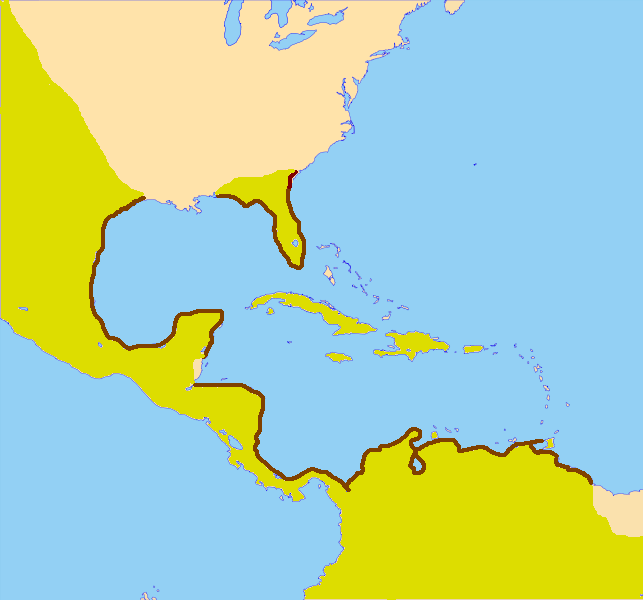
During the Spanish colonization of the Americas, the Spanish Main comprised the parts of the Spanish Empire that were on the mainland of the Americas and had coastlines on the Caribbean Sea or Gulf of Mexico. The term was used by English speakers to distinguish those regions from the numerous islands Spain controlled in the Caribbean, which were known as the Spanish West Indies.[1]

Key Information

Etymology

[edit]

The word main in the expression is a contraction of mainland.[2]

Composition

[edit]

The Spanish Main included Spanish Florida and New Spain, the latter extending through modern-day Texas, Mexico, all of Central America, to Colombia and Venezuela on the north coast of South America. Major ports along this stretch of coastline included Veracruz, Porto Bello, Cartagena de Indias and Maracaibo.[citation needed]

The term is sometimes used in a more restricted sense that excludes the territories on the Gulf of Mexico. The Spanish Main then encompassed the Caribbean coastline from the Isthmus of Darien in Panama to the Orinoco delta on the coast of Venezuela.[2][3] In this sense, the Spanish Main roughly coincides with the 16th century Province of Tierra Firme (Spanish for "mainland province").[citation needed]

Economic importance and piracy

[edit]
A Bermuda sloop on the Spanish Main, circa 1807

From the 16th to the early 19th century, enormous wealth was shipped from the Spanish Main to Spain in the form of gold, silver, gemstones, spices, hardwoods, hides and other valuable goods.[4] Much of the wealth was silver in the form of pieces of eight, from the mines near Potosí. It was carried to the Spanish Main by llama and mule trains via the Pacific coast. Other goods originated in the Far East, having been carried to the Pacific coast of Spain's possessions on the Manila galleons, often through the port of Acapulco, then transported overland to the Spanish Main for onward shipment to Europe.

The Spanish Main became a frequent target for pirates, buccaneers, privateers and countries at war with Spain, seeking to capture some of these riches.[4] To protect this wealth, the Spanish treasure fleet was equipped with heavily armed galleons. The organization of the fleets in large convoys proved highly successful, with only a few successful examples of major privateer attacks along the Spanish Main, such as the capture of Cartagena de Indias by Francis Drake in 1586; the capture of a Spanish treasure fleet sailing from Mexico by the Dutch West India Company in 1628; the capture of Chagres and Panama City by Henry Morgan in 1670–71; and the Raid on Cartagena by the French in 1697. Pirates operating in the area included the Dutchman Laurens de Graaf, who raided Veracruz in 1683 and Cartagena in 1697.

See also

[edit]

References

[edit]

Further reading

[edit]
[edit]
Revisions and contributorsEdit on WikipediaRead on Wikipedia
from Grokipedia
The Spanish Main denoted the mainland territories of the in the Americas contiguous to the , encompassing the northern coast of from the to the River delta, along with adjacent regions of and the coast. This area, known in Spanish as Tierra Firme (Mainland), contrasted with the islands and served as a primary hub for colonial administration, resource extraction, and transshipment of wealth including , silver, emeralds, and tropical goods to via annual treasure fleets departing from fortified ports such as Cartagena, Porto Bello, and . Established through early 16th-century explorations and conquests following Christopher Columbus's voyages, the Spanish Main facilitated Spain's economic dominance in the by linking inland mining operations—such as those in Colombia's for emeralds and Peru's for silver, transported overland—to maritime export routes, generating immense revenues that funded European wars and Habsburg ambitions. However, its strategic importance and visible bullion flows made it a persistent target for interlopers from , , and the , culminating in the buccaneering era of the mid-17th century, exemplified by Henry Morgan's 1671 sacking of , which exposed defensive frailties despite Spanish investments in galleons, presidios, and convoy systems. The region's significance waned with Spain's military overextension during conflicts like the and the rise of rival colonial powers, paving the way for independence movements in the early 19th century that dismantled these territories into modern nations including , , and .

Geography and Extent

Definition and Historical Boundaries

The Spanish Main, derived from the Spanish term Tierra Firme ("Firm Land"), referred to the continental coastline of the in the along the , as opposed to the offshore Antillean islands colonized earlier. This region primarily encompassed the Caribbean-facing shores from the northward, including the modern territories of , coastal (such as the Province of Cartagena), and (including the Province of and the Gulf of Venezuela), with extensions into the eastern coasts of under the Audiencia of . The term emphasized the mainland's role as a strategic corridor for overland shipment of precious metals extracted from South American interiors, transported via mule trains across Panama's narrow 50-mile-wide isthmus from Pacific ports like (founded 1519) to Atlantic embarkation points such as Nombre de Dios (established 1510). Post-1492 exploration defined initial boundaries: Christopher Columbus's third voyage in 1498 reached the in present-day , marking the first European contact with the mainland, initially mistaken for an island. Subsequent expeditions, including de Bastidas's 1501-1502 voyage along Colombia's coast and Balboa's 1513 traversal of , solidified the region's contours by linking it to Peru's silver mines via the Pacific. By the 1530s, Spanish control extended the effective Spanish Main northward to include and under New Spain's influence, though the core remained the South American littoral up to the Orinoco River delta, excluding inland highlands and island dependencies like Trinidad (claimed 1498 but sparsely settled until later). Administrative evolution refined boundaries without altering the geographical focus: the Audiencia of initially oversaw early mainland outposts, but by 1564, the Real Audiencia of governed the isthmus and adjacent coasts, integrating them into treasure transit networks. The , erected in 1717 (suppressed 1723, reestablished 1739), formalized inclusion of and Venezuela's coasts, while New Spain's viceregalty (from 1535) administered Central American segments up to the , occasionally extending claims to Florida's eastern shore via explorations like Ponce de León's 1513 expedition. This delineation prioritized coastal accessibility for fleets, with geography—rugged sierras paralleling the shore and riverine estuaries like the Magdalena—facilitating port development at sites such as (1525) and Río de la Hacha (1524), while limiting interior penetration.

Key Provinces, Ports, and Infrastructure

The Spanish Main's core territorial components centered on Tierra Firme, the mainland province encompassing the and the adjacent northern coasts of present-day and extending influences toward . This region, initially administered through the Audiencia of Panama established in 1538, functioned as the vital transshipment point for Andean silver and gold en route to . Cartagena de Indias, founded on February 16, 1533, served as a principal administrative and logistical center for the Province of Cartagena, coordinating regional governance, trade oversight, and defense along the northern South American seaboard. As a key node in the viceregal system under until 1717, it managed inflows of emeralds, , and pearls from interior mines. Essential ports included Nombre de Dios, operational from around 1510 as the initial Caribbean outlet for isthmian traffic, and its successor , founded on March 20, 1597, which offered a superior natural harbor for the annual Tierra Firme fleet arrivals. hosted the galleons that loaded Peruvian treasure mule-transported from the Pacific side, with complementing as the Mexican counterpart for silver aggregation into combined convoys bound for . Supporting infrastructure featured the Camino Real, a rugged overland trail spanning roughly 77 kilometers across the from to , developed in the early to expedite transfers. Fortifications such as those at San Lorenzo guarded this artery, where thousands of mules annually hauled silver bars and gold dust, underscoring the route's role as the empire's imperial lifeline for resource extraction logistics.

Terminology and Etymology

Origins and Evolution of the Term

The term "" emerged in English-language sources during the early to designate the continental coastline of bordering the , distinguishing it from the offshore islands; "main" here derives from "mainland," a usage rooted in nautical and colonial contexts contrasting landmasses with insular territories. Its earliest documented appearance occurs in the naturalist Hans Sloane's A Voyage to the Islands Madera, , Nieves, S. Christophers and (Volume II, 1725), where it refers to the American mainland proximate to the Caribbean, reflecting observations from Sloane's travels and collections gathered amid English colonial expansion. In Spanish administrative parlance, no direct equivalent existed; the region was instead termed Tierra Firme ("firm land" or mainland), a designation formalized by the early for the governorship encompassing the , northern (including modern and ), and associated pearl fisheries, as opposed to the Islas (islands) of the . This Spanish nomenclature prioritized geographic and jurisdictional continuity over the plunder-oriented lens of foreign rivals, with official documents often specifying sub-regions via terms like costas (coasts) or audiencias rather than a unified "main." The English adoption thus encapsulated a strategic outsider's view, emphasizing vulnerable coastal provinces as targets for privateering and by Dutch, English, and French interlopers from the late onward. By the mid-18th century, the term's usage evolved in Anglo-European literature, particularly accounts of buccaneering exploits, to loosely extend beyond the strict mainland to include adjacent waters and raid-prone ports, inverting its original land-focused meaning amid narratives glorifying figures like . This conceptual broadening, evident in works chronicling 17th-century filibusters, aligned with mercantilist rivalries but diverged from Spanish self-references, which maintained Tierra Firme until administrative reorganizations in the Bourbon era rendered it obsolete by the late 1700s. Primary sources from the period, such as naval logs and expedition reports, underscore the term's utility in non-Spanish contexts for denoting high-value extraction zones—, silver, and pearls—rather than reflecting indigenous or imperial geographic realities.

Historical Origins and Conquest

Early Exploration and Settlement (1492–1530s)

Christopher Columbus's third voyage in 1498 marked the first European contact with the mainland coast of the Spanish Main, when he sighted the in present-day on August 5 after reaching Trinidad on August 1. Sailing under Spanish patronage motivated by prospects of gold, trade routes to , and evangelization, Columbus explored the River delta, noting abundant fresh water and native populations but mistakenly interpreting the region as an island or continental extension of . His fourth voyage in 1502 further probed Central American coasts, establishing temporary footholds amid hostile encounters and shipwrecks, yet yielding detailed navigational insights that informed later expeditions. Subsequent voyages by and in 1499-1500 systematically charted the northern South American coastline from to the Gulf of , confirming the continental nature of the landmass through Vespucci's observations of its extent and geography. These expeditions, departing from on May 20, 1499, involved four ships and focused on reconnaissance for pearls, , and settlement sites, encountering indigenous groups like the Arawaks and Caribs while documenting coastal features such as . Vespucci's letters emphasized the region's vast resources and separation from , contributing to the recognition of a "" by 1507, driven by empirical mapping rather than mere speculation. The first permanent mainland settlement, Santa María la Antigua del Darién, was founded in 1510 by on the western Gulf of Urabá in present-day , serving as a base for further incursions after earlier failed attempts like Ojeda's 1509 colony. Balboa's group of about 70 Spaniards established encomiendas, granting conquerors rights to indigenous labor and tribute in exchange for nominal protection and Christian instruction, a system rooted in medieval Iberian precedents but applied to extract resources like gold from local Cuna and other groups. This initiative facilitated Balboa's 1513 Pacific crossing but involved violent subjugation, including enslavement and warfare, amid high settler mortality from tropical diseases and native resistance. European-introduced diseases, including and , caused catastrophic indigenous population declines across the Spanish Main, with overall estimates indicating a drop from approximately 60 million to 6 million within a century of contact, primarily through waves rather than solely . In northern , pre-contact densities of 1-5 persons per square kilometer collapsed by 80-90% by mid-century, as pathogens exploited virgin-soil susceptibilities, undermining societal structures and easing Spanish consolidation despite abuses. These demographic shifts, empirically documented in colonial records and archaeological correlates, highlight disease as the dominant causal factor in depopulation, enabling settlements like Darién to endure where initial conquests failed due to numerical superiority.

Consolidation of Control (1530s–1600)

In 1536, departed from the coastal settlement of with approximately 800 men, navigating up the into the interior highlands to conquer the Muisca Confederation, whose decentralized polities controlled key territories along the Spanish Main's eastern extent. Facing severe logistical challenges including famine, disease, and hostile terrain that reduced his force to fewer than 200 by 1537, Quesada's expedition engaged the in a series of battles, exploiting divisions among their zipa (rulers) and leveraging steel weapons, firearms, and against indigenous forces armed primarily with clubs, slings, and poisoned arrows. By mid-1538, after decisive victories such as the Battle of Chocontá, the Muisca submitted, enabling Quesada to found Santa Fe de Bogotá on August 6, 1538, as the administrative center of the newly proclaimed , which integrated the conquered interior with coastal provinces like Cartagena and . Further consolidation involved resolving overlapping claims from rival expeditions, culminating in 1539 when Quesada met (advancing from ) and Sebastián de Benalcázar (from the south via , founded 1536) at ; the crown later ratified Quesada's leadership through the Real Audiencia, establishing systems to distribute labor and tribute while suppressing localized resistance, including guerrilla tactics and ritual retaliations documented in Spanish judicial records. In , intermittent coastal holdings were stabilized by Diego de Losada's 1566–1567 campaign against the Caracas indigenous groups, culminating in the founding of Santiago de León de Caracas on July 25, 1567, after overcoming fierce ambushes through fortified advances and alliances with subjugated tribes, thereby securing the western Venezuelan littoral against both native incursions and potential European rivals. These efforts relied on riverine supply lines from and the , underscoring how coastal bases provided the causal foundation for inland penetration without which highland campaigns would have collapsed due to unsustainable overland provisioning. Infrastructure development reinforced territorial hold, with rudimentary roads—often mule paths widened from indigenous trails—linking to coastal ports like Cartagena by the 1540s, facilitating troop movements and administrative oversight despite persistent mudslides and banditry that limited wheeled transport until the late . Franciscan and Dominican missions, established from the 1540s onward in heartlands and Venezuelan frontiers, aimed to supplant indigenous shamanism through baptisms and communal labor, with Spanish chroniclers justifying conquest as a civilizing imperative to eradicate reported practices like occasional human sacrifices in mojasa rituals, which they equated to pagan barbarity meriting evangelization and pacification. Indigenous records, filtered through Spanish notaries, reveal persistent resistance via flight to remote sierras and selective alliances, yet demographic collapse from epidemics—reducing populations by over 90% in decades—enabled demographic dominance, allowing garrisons and cabildos to enforce loyalty oaths and tribute quotas by 1600.

Colonial Administration and Governance

Viceregal and Audiencia Systems

The administration of the relied on a hierarchical designed to extend royal authority from , featuring , governors, audiencias, and eventually viceroys to oversee the mainland provinces along the and Pacific coasts. , granted royal commissions to lead expeditions of and settlement, often transitioned into governors upon success, wielding combined military, judicial, and administrative powers in newly claimed territories such as and the Venezuelan littoral. These early officials, like those in Tierra Firme (the mainland province encompassing much of the ), operated with significant autonomy but were subject to recall or oversight by the in , which reviewed their actions to prevent unchecked personal enrichment. To curb potential abuses by these frontier administrators and ensure uniform application of royal , established audiencias—high courts with oidores (judges) empowered to hear appeals, advise governors, and in some cases assume interim governance. The Audiencia of , created by royal decree on February 26, 1538, held jurisdiction over the and adjacent coasts, functioning as both a judicial body and a check on local governors until its temporary suppression in amid jurisdictional disputes. Similar institutions extended to key ports like Cartagena, where judicial oversight integrated into broader viceregal structures, prioritizing centralized fiscal control over treasure routes and trade. This framework, rooted in Habsburg administrative precedents, contrasted with less structured colonial models by enforcing legal accountability, though empirical records show persistent , such as bribe-taking by officials, which royal visitations periodically exposed but rarely eradicated. The formal integration of the Spanish Main into the in 1717 marked a Bourbon-era consolidation, placing provinces from to under a single in Santa Fe de , who coordinated defense, revenue collection, and governance while reporting directly to the . This viceregal layer, briefly dissolved in 1723 before permanent reestablishment in 1739, subordinated local governors and audiencias to viceregal decrees, enhancing Madrid's extractive efficiency—evidenced by streamlined silver remittances from Pacific ports—while maintaining audiencias in and Cartagena for regional adjudication. The system imposed rule-of-law mechanisms absent in anarchic settler frontiers elsewhere, fostering relative stability amid threats, though viceregal correspondence reveals ongoing tensions between central directives and local graft. The Requerimiento of 1513, drafted by theologian Juan López de Palacios Rubios, served as the primary legal justification for Spanish conquest in the , requiring conquistadors to read a proclamation to indigenous groups demanding submission to the Spanish Crown and Christian faith; refusal authorized immediate invasion and subjugation as rebels against divine and papal authority. This document, rooted in medieval and papal bulls like (1493), aimed to formalize territorial claims while providing moral cover for expansion, though its efficacy was limited by linguistic barriers and indigenous incomprehension of the terms. The New Laws of the Indies, promulgated by Charles V in 1542 following reports of indigenous depopulation from , prohibited the enslavement of native peoples except in cases of just war captivity, abolished hereditary s, and mandated gradual replacement of s with crown officials to ensure sustainable labor extraction and royal revenue. These reforms reflected a causal shift from unchecked plunder— which had halved indigenous populations in core areas like by the 1540s—to long-term imperial viability, prioritizing population preservation for tribute and mining output over short-term gains by settlers. Enforcement proved inconsistent, sparking revolts such as Gonzalo Pizarro's in (1544–1548), leading to partial repeal of restrictions in 1545; while overt enslavement declined, loopholes persisted via systems like the mita forced draft in and repartimiento labor rotations, sustaining de facto coercion. Audiencias, as appellate courts established from 1511 in onward, issued decrees upholding Spain's trade monopoly by adjudicating violations of the Casa de Contratación's regulations, which funneled all colonial exports through to prevent and ensure mercantilist control. These bodies enforced reforms like the 1542 laws through local oversight, fining encomenderos for excess labor demands and prioritizing crown audits over settler interests, though corruption and distance from often diluted implementation in remote mainland provinces. By the late , such frameworks had stabilized governance, reducing frontier anarchy but embedding bureaucratic hurdles that favored sustainable, centralized extraction over autonomous plunder.

Economic Systems and Resource Extraction

Mining, Agriculture, and Primary Exports

The extraction of precious metals, particularly silver, underpinned the economic significance of the , with outputs relayed through key ports such as Cartagena de Indias for shipment to . The mines in (modern ), operational from 1545, generated substantial silver yields that traversed the isthmus and coast; annual production averaged around 150-200 metric tons by the late , contributing to the 17,000 tons total for over that period. These quantities, processed via mercury amalgamation, represented a primary driver of imperial revenue, enabling 's mercantilist policies and global trade linkages, though the method's toxicity caused enduring ecological damage to water sources and landscapes. Gold mining complemented silver in northern Andean zones, notably around in New Granada (modern ), where placer operations yielded significant but lesser volumes—silver output dwarfed gold by a factor of 50 by weight across the colonial era. By the early , emerged as the kingdom's premier gold-producing area, sourcing from riverine deposits and fueling local minting of escudos, though precise annual figures remain elusive due to informal extraction. Efforts in the Colombian and Chocó region added alluvial gold, but outputs were intermittent and secondary to Andean veins, with total colonial gold from New Granada estimated far below silver hauls. Agricultural production focused on exportable staples suited to tropical lowlands, including cacao from Venezuelan plantations near , which surged as the region's leading commodity by the early following initial plantings in the 1590s. Hides from expansive cattle herds in the and coastal hinterlands provided another bulk export, alongside and , though these generated lower value per unit than minerals and were vulnerable to , which degraded pastures and contributed to . Overall, primary exports prioritized high-value minerals over agrarian goods, sustaining Spain's fiscal inflows—cumulatively 25,000 tons of silver by 1600—while imposing that hampered long-term .

Treasure Fleets and Mercantilist Trade

The Flota de Indias, or treasure fleet system, was formalized in 1564 through royal ordinances issued by Philip II, mandating annual departures of two protected convoys from (later ) to the , with one fleet directed to in and the other to Cartagena and on the Spanish Main for aggregating silver and other exports from the mainland viceroyalties. These sailings, departing in spring and summer respectively, followed circuitous routes via the to avoid northern latitudes, unloaded European goods, loaded bullion via overland mules from ports like Nombre de Dios or , and reconvened at for the return voyage in late summer. The system embodied Spain's mercantilist doctrine of state-monopolized trade, prioritizing bullion accumulation to bolster royal revenues over free-market competition, as regulated by the in , which licensed vessels, enforced cargo manifests, and imposed penalties like 50,000-peso fines for stragglers to maintain integrity. Convoy compositions typically included 20 to 100 , varying by era and —peaking at an average of 100 vessels annually between 1590 and 1600—escorted by 4 to 16 armed galleons equipped with cannons and soldiers to safeguard against storms, reefs, and . By 1600, these fleets had transported approximately 25,000 tons of silver alongside gold and emeralds, with royal fifths (quinto real) alone yielding revenues that escalated from 35,000 ducats in 1516 to over 2 million by 1556, enabling Habsburg monarchs like Charles V and Philip II to finance protracted European wars, including conflicts with , the Ottomans, and the Dutch Revolt. This influx, however, precipitated domestic inflation—the so-called —diluting currency value and exacerbating fiscal strains as silver outflows to creditors and allies outpaced inflows. While the convoys secured transatlantic commerce against diffuse threats, mercantilist strictures bred systemic inefficiencies, including delayed sailings that disrupted colonial economies, widespread to evade monopolies, and rife in the through bribe-extorted licenses and underreported cargoes. Administrative and , such as overloading for private gain, compounded risks from natural hazards, with fleets occasionally suffering total losses—though data indicate overall success in delivering bulk until silver production waned post-1620s. These rigidities, rooted in bullionist priorities over productive investment, ultimately constrained Spain's industrial growth, channeling wealth into military expenditures rather than domestic .

Maritime Security and Piracy

Vulnerabilities and Major Raids (16th–18th Centuries)

The Spanish Main's vulnerabilities stemmed from its expansive coastline spanning thousands of miles, coupled with undergarrisoned ports where military resources were prioritized for escorting fleets rather than static coastal defense, leaving many settlements with fewer than 200 soldiers despite frequent alerts of approaching raiders. These weaknesses were exacerbated by logistical delays from , corruption among local officials, and the economic focus on inland operations, which diverted manpower and funds away from frontier outposts. European powers, particularly , , and the , capitalized on this through state-sanctioned privateering, issuing letters of marque that framed raids as lawful reprisals against Spain's mercantilist exclusion of foreign trade, though Spanish edicts denounced such actions as unlicensed brigandage violating international norms. The 1588 defeat of the further emboldened English expeditions, as weakened naval projection allowed privateers to operate with reduced risk of interception. Francis Drake's 1585–1586 expedition exemplified these incursions, launching amid the Anglo-Spanish War with a fleet of 20+ ships and 2,000 men targeting key ports for their accumulated silver and gold shipments. On January 1, 1586, Drake's forces surprised , the oldest European city in the , overcoming its 300 defenders through a night assault, plundering warehouses and churches before extracting a 25,000-ducat to spare further destruction. Advancing to Cartagena de Indias by February 9, 1586, he blockaded the harbor, landed troops to seize the city after minimal resistance from its garrison, occupied it for six weeks amid burning suburbs and disease outbreaks that killed hundreds on both sides, and secured roughly 110,000 ducats in plus seized goods valued at over 100,000 more. These hauls, equivalent to millions in contemporary silver, funded further English ventures while draining Spanish colonial treasuries. In the , raids intensified amid renewed Anglo-Spanish hostilities, with Henry Morgan's July 1668 assault on illustrating tactical opportunism against a fortified handling Pacific trade goods. Departing with 10 ships and 500 men, Morgan transferred forces to canoes for a stealthy approach on July 11, overwhelming the 300 Spanish troops by using captured friars as human shields and exploiting narrow defenses, resulting in 18 English deaths versus over 100 Spanish. looted churches, homes, and warehouses of silver, , and slaves, amassing an estimated 70,000–100,000 pesos in plunder before withdrawing after two weeks of occupation, though demands for 350,000 pesos ransom went unmet due to the port's prior depletion. Such events, repeated by French and Dutch privateers like the 1628 capture of a treasure fleet yielding 11 million guilders, cumulatively extracted tens of millions of pesos from Spanish holdings, underscoring how concentrated wealth in a few hubs invited predation despite occasional fierce resistance. Spanish chroniclers decried these as atrocities, citing civilian massacres and , while English accounts justified them as countermeasures to Iberian naval dominance and trade restrictions.

Fortifications and Naval Responses

The Spanish Crown invested heavily in coastal fortifications along the Spanish Main to safeguard key ports like Cartagena and Portobelo from seaborne incursions, with construction emphasizing strategic hilltop positions and multi-layered defenses. The Castillo de San Felipe de Barajas in Cartagena exemplifies this engineering, initiated in 1536 under military engineer Antonio de Arévalo and expanded significantly in 1657 with royal approval on September 20 of that year, incorporating tunnels, ramparts, and artillery emplacements that rendered it nearly impregnable. Further enlargements occurred between 1762 and 1765, adding advanced bastions that integrated the fortress into a broader harbor defense network, demonstrating iterative adaptations based on prior threats. Similar systems emerged at Portobelo-San Lorenzo in Panama, where 17th- and 18th-century forts formed interconnected barriers to protect transshipment routes, prioritizing durability through masonry and elevated batteries. Complementing static defenses, naval strategies relied on the convoy system formalized in 1566, whereby treasure-laden merchant vessels sailed in protected flotas and galeones escorted by armed warships, minimizing isolated vulnerabilities during annual transits from ports like Cartagena to . The Armadas de Barlovento provided roving patrols across the , enforcing blockades and intercepting raiders, while presidios—fortified garrisons—supported landward security at vulnerable mainland outposts. These measures evolved pragmatically, with post-raid analyses prompting reinforcements, such as enhanced artillery allocations and ship designs optimized for both cargo and combat. Under the Bourbon monarchy in the , reforms centralized naval command and expanded colonial fleets, reallocating resources to rebuild squadrons depleted by European wars and integrating professional officers to oversee patrols. This revamp, peaking under , correlated with a marked decline in successful penetrations of Spanish Main harbors after 1700, as fortified ports and escorts repelled assaults that earlier eras had endured, underscoring the system's adaptive efficacy in preserving .

Society, Demographics, and Labor

Indigenous Populations and Encomienda

The primary indigenous groups inhabiting the regions comprising the prior to European contact included the in the islands such as and , and mainland peoples like the (also known as Chibcha) in the Andean highlands of present-day and adjacent areas. Pre-Columbian population estimates for the across the ranged from 100,000 to over 1,000,000 individuals, with higher extrapolations suggesting up to 3 million when accounting for broader Arawak-related groups, though these figures remain debated due to reliance on archaeological and early Spanish accounts. For the , scholarly assessments place their numbers at over 500,000, forming one of the denser populations in northern outside the Inca sphere. These societies featured hierarchical structures, with caciques overseeing villages engaged in agriculture and , while communities specialized in goldworking, textiles, and terrace farming. Following Spanish arrival in 1492, indigenous populations in experienced catastrophic decline, primarily driven by diseases such as , , and to which natives lacked immunity, resulting in virgin soil epidemics with mortality rates exceeding 80-90% in affected communities. numbers on plummeted from hundreds of thousands to fewer than 500 by the 1540s, with the group effectively extinct as a distinct entity by the late due to combined epidemiological, exploitative, and migratory factors. Mainland groups like the saw similar collapses, with regional censuses indicating drops of 40% or more within single generations from the 1570s to 1600, exacerbated by warfare, , and relocation into missions. By around 1600, the indigenous population across Spanish American territories, including the Main, had fallen from an estimated 20-60 million continent-wide to under 6 million, reflecting causal chains where disease initiated mass die-offs, followed by labor demands that prevented demographic recovery. Spanish ecclesiastical and administrative records, such as those from the 1570s visitas, provide empirical corroboration through headcounts showing sustained low fertility and high amid these pressures. The encomienda system, formalized in the early 1510s as grants from the Spanish crown to conquistadors and settlers, theoretically obligated encomenderos to protect and Christianize assigned indigenous communities in return for tribute in goods, produce, or labor services. First implemented in the Caribbean and extended to mainland areas like Venezuela and New Granada by the 1520s, it devolved into widespread exploitation, with natives compelled into mining, farming, and personal service under conditions approximating de facto slavery, contributing to excess mortality beyond disease alone. Initial regulations like the 1512 Laws of Burgos sought to cap labor demands at 75 days annually and mandate religious instruction, but enforcement was lax, allowing abuses documented in crown inquiries. The 1542 New Laws, promulgated under Charles V in response to reports from figures like Bartolomé de las Casas, prohibited new encomiendas, banned their heritability after one lifetime, and aimed to transition labor to crown-supervised repartimiento, though implementation faced violent resistance from encomenderos and varied regionally, with partial persistence in the Spanish Main until the late 16th century. Cultural dynamics under these pressures involved both erasure and selective assimilation, with forced resettlements into reducciones and leading to the of many languages and rituals by the , as native cosmologies were supplanted by Catholic orthodoxy. However, empirical evidence from colonial ethnographies and archaeological survivals indicates syncretic adaptations, such as communities incorporating Catholic saints into pre-existing ancestor veneration or descendants blending herbalism with folk Christianity, preserving elements amid demographic collapse. This hybridity, while not mitigating overall cultural loss, arose from pragmatic native agency in navigating imposition, as opposed to total erasure, though institutional biases in sources may understate resistance or continuity.

African Slavery and Transatlantic Trade

The Spanish Crown regulated the importation of enslaved Africans through the , a series of monopoly contracts granting exclusive rights to supply slaves to its American colonies, beginning with early agreements like the 1518 contract to Genoese merchants and evolving into formalized systems by the late . In 1595, received a prominent asiento for an eight-year term, reflecting Spain's reliance on foreign traders due to papal divisions of trade spheres under the , though smuggling often exceeded official quotas. These contracts stipulated annual deliveries—such as 4,800 slaves per year under the 1713 British asiento—with ports like Cartagena de Indias serving as primary entry points for the Spanish Main's coasts. Between the early 16th and late 18th centuries, over 800,000 enslaved Africans disembarked at Spanish American ports, with significant concentrations along the Spanish Main's mainland coasts in regions like and , where demand arose for labor in export-oriented and . This trade filled critical shortages in coercive labor systems, particularly after mid-16th-century disruptions, directing most imports to coastal zones rather than interior viceroyalties. Official asientos underrepresented totals due to widespread contraband trade, but empirical records indicate the Spanish share of the transatlantic trade was lower in volume compared to Portuguese or British islands, focusing instead on regulated inflows to sustain specific economic nodes. Enslaved Africans primarily labored in gold and emerald mines of Colombia's region and Venezuela's district, as well as on cacao and plantations along the Venezuelan coast, where they performed tasks from field cultivation to processing for export via treasure fleets. In these settings, slaves extracted minerals under hazardous conditions or toiled on estates producing staples for European markets, contributing to the Spanish Main's role as a peripheral supplier within the empire's mercantilist network. High mortality from overwork and disease necessitated continuous imports, with owners replacing losses through asiento allocations or illicit channels centered on hubs like Cartagena. Spanish legal codes, drawing from the medieval Siete Partidas, imposed nominal protections such as the right to marry, form families, accumulate property for self-purchase (coartación), and seek judicial remedy against excessive cruelty, principles reiterated in the 1681 Recopilación de Leyes de las Indias. These regulations aimed to stabilize the institution by recognizing slaves' humanity and limiting arbitrary violence, contrasting with British colonial codes that offered fewer avenues for or and permitted harsher disciplinary measures. In practice, enforcement varied by locale, with remote plantations and mines often flouting provisions amid profit-driven exploitation, though metropolitan oversight via audiencias provided more structured complaints mechanisms than in less centralized British systems. This framework causally sustained labor inputs by balancing coercion with minimal incentives for reproduction and productivity, adapting to demographic voids without the unchecked brutality seen elsewhere.

Colonial Social Hierarchy

The colonial social hierarchy of adhered to the casta system, a racial and ancestral classification that privileged European descent while incorporating mixtures resulting from colonial intermixing. , individuals born in , occupied the uppermost stratum, dominating viceregal appointments, military commands, and bishoprics due to their perceived loyalty to ; for instance, in the (encompassing much of the Spanish Main), peninsulares held nearly all audiencia judgeships as of 1700. Criollos, American-born descendants of Spaniards, formed the elite below them, controlling urban commerce, haciendas, and local cabildos, though resentment brewed over their exclusion from top posts, as evidenced by petitions in 18th-century records. Lower castas included mestizos (Spanish-Indigenous offspring), mulatos (Spanish-African), and zambos (Indigenous-African), with unmixed Indigenous groups and Africans relegated to tributary status, though legal distinctions blurred in practice beyond official tax rolls. Despite the system's intent to enforce purity of blood (), archival parish and census data reveal substantial intermarriage and miscegenation, driven by the demographic imbalance of male-heavy Spanish expeditions; in early 16th-century settlements like , Spanish men commonly partnered with Indigenous women, yielding majorities by the mid-17th century in mainland provinces. Empirical records from indicate that mixed unions comprised 15-25% of registered marriages by 1650, enabling economic ascent for some castas through trade or military service, contrasting with Europe's estate-based rigidity where noble birth trumped merit absent racial overlays. This fluidity manifested in cases like artisans rising to mastery in Cartagena, underscoring how wealth and Catholic sacraments often superseded strict lineage in daily social navigation. Urban ports epitomized hierarchical yet interdependent life, with merchants—often criollo or Basque financiers—coordinating convoy trade via the , amassing fortunes from silver drafts while clergy enforced orthodoxy through inquisitorial oversight and charitable confraternities. In hubs like Cartagena, daily routines blended mercantile haggling in plazas with ecclesiastical processions, where Dominican and Franciscan friars mediated disputes and baptized casta offspring, fostering nominal integration. Rural hacienda existence, centered on export crops, reinforced elite dominance under criollo overseers, yet Jesuit in frontier zones like the integrated Indigenous groups via doctrinal instruction, permitting limited mobility for converts who adopted customs. Overall, the hierarchy's relative permeability—evident in 18th-century casta paintings' stylized exaggerations versus probate inventories showing cross-status alliances—distinguished it from more absolutist European models, prioritizing pragmatic adaptation over unyielding exclusion.

Controversies, Achievements, and Criticisms

Debates on Conquest Legitimacy (e.g., )

The , convened by Emperor Charles V in , , from August 1550 to 1551, constituted a pivotal scholastic inquiry into the legitimacy of Spanish conquests in the Americas, specifically whether just war permitted the subjugation of for evangelization and . The disputation, held before a junta of theologians, jurists, and officials, featured Dominican friar as the primary defender of indigenous rights against theologian , whose positions reflected broader 16th-century Spanish debates on and ius ad bellum. No verbatim transcripts survive, and the proceedings ended inconclusively without a declared victor, yet they encapsulated tensions between coercive and humanitarian restraints. Sepúlveda, in works like Democrates Alter (1547), defended conquest by classifying indigenous Americans as "cultural barbarians" and natural slaves under Aristotelian terms, arguing their practices—such as human sacrifice, idolatry, and alleged cannibalism—constituted violations of natural law warranting punitive subjugation. He invoked Thomistic just war doctrine, per Augustine and Aquinas, positing that Spaniards, as civilized Christians, held a natural right to impose order and faith, with war serving both retributive justice for sins against reason and the greater good of salvation; resistance to evangelization thus equated to hostility justifying domination. Sepúlveda reconciled this with papal bulls authorizing missionary expansion, claiming they implicitly endorsed force against irrational inferiors unfit for self-rule. Las Casas rebutted these claims by affirming indigenous rationality and full humanity, drawing on to argue that all peoples possess and dominion over their polities absent voluntary consent or heinous aggression against outsiders. He rejected Aristotelian as inapplicable to empirically observed American societies, which exhibited complex governance, agriculture, and morality comparable to ancient non-Christians, insisting evangelization demanded non-coercive preaching per scriptural mandates and Francisco de Vitoria's Relectio de Indis (1539), which limited Spanish authority to , , or defense against true threats. Las Casas cited Pope Paul III's bull (June 2, 1537), which declared "true men" capable of faith, explicitly forbidding their enslavement or deprivation of and "even though they be outside the faith of Christ." , he contended, breached and divine order, equating to tyranny rather than legitimate . These arguments highlighted Spanish theologians' application of scholastic to novel colonial realities, prioritizing reasoned deduction from principles over unchecked expansion, in contrast to later historiographical distortions exaggerating unreflective brutality. The debate's emphasis on empirical observation of indigenous capacities and strict just war criteria—requiring proper , cause, and proportionality—demonstrated causal prioritization of ethical constraints in conquest policy formation.

Impacts on Indigenous and Enslaved Peoples

The arrival of Europeans in the Spanish Main triggered a catastrophic demographic collapse among indigenous populations, primarily driven by exposure to Old World diseases such as smallpox, measles, influenza, and typhus, to which native groups like the Taíno and Caribs had no immunity. Estimates indicate that pre-contact populations in the Caribbean islands numbered in the hundreds of thousands, with the Taíno alone comprising perhaps 100,000 to 500,000 individuals across Hispaniola, Cuba, and Puerto Rico; by the mid-16th century, these had plummeted to near extinction, with mortality rates reaching 80–95% within decades of contact. This viral catastrophe, exacerbated by nutritional stress and social disruption, accounted for the overwhelming majority of deaths, far outstripping losses from direct violence, enslavement, or overwork in systems like the encomienda, which, while abusive, affected a smaller fraction after initial epidemics had already halved populations. Cultural impacts included the erosion of traditional practices amid forced conversions and labor demands, though some missionary efforts by Franciscan and Dominican orders documented indigenous languages and customs for evangelization purposes, preserving fragments of and oral traditions in colonial records. Abuses such as excessive labor in pearl fisheries and gold mines along the Venezuelan and Colombian coasts contributed to secondary mortality, but empirical records from early 16th-century censuses show disease as the dominant causal factor, with survivors often integrated into mission communities that, despite , provided limited protections under royal decrees like the 1542 aimed at curbing colonial excesses. For enslaved Africans imported to replace depleted indigenous labor in , mines, and urban settings across —totaling around 1.5 million arrivals to Spanish American ports by 1800—conditions were harsh, marked by high mortality from tropical diseases, malnutrition, and overwork, yet outcomes diverged from those in English colonies through higher rates of and family formation. Shipboard and early rates reached 20–30% in the first years, but Spanish legal frameworks like coartación allowed self-purchase of freedom, resulting in rates of 1–2% annually in hubs like Cartagena and , far exceeding Anglo-American figures where natural slave population increase was rare due to negative birth- balances. By the late , outnumbered slaves in many Spanish Main regions, reflecting reproductive success and church-sanctioned freedoms that mitigated total demographic erasure, though abuses persisted despite inquisitorial and ecclesiastical oversight prosecuting some extreme cases of mistreatment.

Achievements in Administration and Cultural Integration

The Spanish colonial administration in the Spanish Main established several institutions of higher learning that facilitated governance and intellectual development, including the Colegio Mayor de Nuestra Señora del Rosario in , founded in 1653 as a that later attained status and contributed to legal and training. Similar foundations, such as the established by in 1538, represented early efforts to transplant European educational models, producing clergy, administrators, and scholars who sustained bureaucratic operations across viceroyalties. Grand cathedrals, like those in Cartagena and constructed from the late onward, served as administrative hubs integrating judicial, religious, and civic functions while exemplifying durable stone architecture adapted to tropical climates. These structures, often built atop indigenous sites, underscored centralized planning that imposed uniform urban grids and infrastructure, including repaired pre-Columbian roads in regions like New Granada for commerce and troop movement. Cultural integration manifested through syncretic practices that blended indigenous and European elements, fostering hybrid expressions in art, religion, and daily life; for instance, the veneration of the Virgin of Guadalupe, emerging from the 1531 apparition on Tepeyac hill—a site linked to the Aztec goddess Tonantzin—combined Marian devotion with native symbolism, becoming a cornerstone of colonial identity in New Spain and beyond. Artistic syncretism appeared in mestizo Baroque styles, where indigenous motifs like feathered serpents merged with Catholic iconography in church facades and altarpieces across the mainland territories. Centralized viceregal authority also curtailed pre-conquest practices such as ritual human sacrifice; in Mexico, Aztec rites involving an estimated 20,000 victims annually at Tenochtitlan ceased following the 1521 fall of the empire, with Spanish edicts prohibiting such acts and redirecting temple sites to Christian use. In Peru, Inca capacocha sacrifices of children for imperial rituals ended after the 1532 conquest, as enforced by royal prohibitions and missionary oversight. This administrative framework promoted stability by suppressing inter-indigenous conflicts and imperial wars that had characterized pre-conquest polities, enabling demographic recovery among native populations by the ; indigenous numbers in central , for example, stabilized and grew modestly after nadir levels around 1620, attributable to reduced warfare, mission protections, and Bourbon-era reforms enhancing and legal safeguards against abuse. Legal continuity further evidenced effective governance, as Spanish civil law codes—rooted in the and Leyes de Indias—persisted in post-independence Latin American states, forming the basis for property, family, and inheritance systems in countries like and . Such persistence reflects the adaptability of colonial institutions, which provided a cohesive legal scaffold enduring beyond imperial rule.

Decline, Independence, and Legacy

Erosion of Spanish Control (18th–19th Centuries)

The Bourbon Reforms, commencing with Philip V's accession in 1700 after the War of the Spanish Succession and accelerating under Charles III from 1759 to 1788, aimed to streamline colonial administration, enhance revenue extraction, and fortify defenses amid European rivalries. These changes introduced intendants to supplant audiencias and corregidores, curbing local corruption while centralizing fiscal oversight, and enacted the 1778 Reglamento de Libre Comercio, which expanded legal trade ports from two to thirteen and reduced reliance on the convoy system for non-treasure goods. In the Spanish Main—encompassing Venezuela, New Granada, and adjacent Caribbean holdings—these policies boosted crown revenues through new excise taxes and tobacco monopolies, yet they systematically favored peninsular-born officials over criollos for viceregal, military, and ecclesiastical posts, engendering elite disenfranchisement. Military reforms under José de Gálvez, including the 1765 expulsion of and creation of urban militias, further alienated criollos by reserving officer commissions for and imposing garrisons that drained local resources without proportional benefits. Empirical gains were evident: trade volumes in and Cartagena doubled between 1778 and 1790, and intendants reduced smuggling by enforcing port controls, yet these efficiencies masked rising tensions, as criollo exclusion from power contradicted Enlightenment-inspired merit claims and fueled proto-nationalist sentiments. Indigenous revolts, such as the 1781 Comuneros Rebellion in New Granada involving over 20,000 participants, underscored how tax hikes and labor drafts exacerbated fissures, though Spanish forces quelled them, demonstrating short-term administrative resilience offset by long-term legitimacy erosion. The 1808 Napoleonic invasion of shattered this fragile equilibrium, as French forces captured on March 19, compelled the abdications of Charles IV and on May 6, and enthroned , paralyzing metropolitan authority over distant colonies. With fragmented into resistance juntas, colonial invoked fidelity to the captive to justify , but this devolved into de facto autonomy amid communication breakdowns lasting months. In the , the crisis manifested acutely in , where news of the Bayonne abdications arrived in April 1810; on April 19, the Caracas , amid public unrest, forced Captain General Vicente Emparán's resignation from a balcony before a crowd, promptly installing the Supreme of Caracas to administer in Ferdinand's name—yet comprising exclusively criollo leaders who swiftly pursued severance from Spanish oversight. This junta's formation ignited chain reactions: it declared provisional independence on July 5, 1811, mobilizing armies that captured key ports like , but Spanish loyalists under Domingo de Monteverde reconquered by July 1812, executing hundreds in reprisals. Parallel insurgencies in New Granada, including the July 1810 junta, fragmented Spanish Main cohesion, as Bourbon-era troops—bolstered to 15,000 regulars by 1800—proved insufficient against and British smuggling arms to rebels. While reforms had yielded fiscal surpluses funding initial suppressions, the legitimacy vacuum and criollo mobilization rendered reconquests pyrrhic, culminating in effective Spanish expulsion from mainland territories by 1821, as imperial armies dwindled from attrition and desertions exceeding 50% in Venezuelan campaigns.

Long-Term Economic and Cultural Impacts

The mercantilist economic system of , centered on extraction and monopolized through ports like Cartagena and , established extractive institutions that shaped long-term development patterns in northern South American successor states. Silver and from regions adjacent to the Main, such as Colombia's emerald mines and Venezuela's coastal deposits, formed the basis for enduring economies; for example, Colombia's sector still contributes over 2% to GDP annually, building on colonial . This legacy included state-controlled monopolies via institutions like the , which influenced post-independence interventionist policies, evident in Venezuela's 20th-century oil nationalization mirroring Spanish crown exclusivity over resources. While critics attribute persistent inequality to these extractive origins, empirical analyses link colonial-era liberal bourgeois networks in hubs to higher long-run growth in areas with early administrative investment, contrasting with inland extractive enclaves. Culturally, the imposition of as the administrative and liturgical language unified diverse indigenous and imported populations, making it the official tongue in all successor nations today, spoken natively by over 90% in countries like and . Catholicism, disseminated through evangelization and tied to colonial governance, endures as the predominant faith, with encompassing approximately 40% of the world's Catholics in 2014 surveys, fostering shared festivals, ethics, and social structures despite syncretic indigenous elements. from Spanish settlers, concentrated in coastal urban centers due to port-based , results in modern populations with elevated European autosomal ancestry—typically 40-60% in Venezuelan and Colombian coastal groups, higher than inland averages—reflecting directional mating patterns that elevated civilizational technologies like and . The viceregal and audiencia systems of Spanish administration provided foundational rule-of-law mechanisms, including codified property rights and judicial oversight, which persisted into 19th-century constitutions across the and underpin contemporary legal frameworks emphasizing centralized authority over fragmented tribal norms. This institutional transplant, while hierarchical, enabled scalable governance over vast territories, contributing to relative stability in rule adherence compared to non-colonized analogs, though undermined by post-colonial caudillismo.

References

Add your contribution
Related Hubs
User Avatar
No comments yet.