


Centre Block
View on Wikipedia
The Centre Block (French: Édifice du Centre) is the main building of the Canadian parliamentary complex on Parliament Hill, in Ottawa, Ontario, containing the House of Commons and Senate chambers, as well as the offices of a number of members of parliament, senators, and senior administration for both legislative houses. It is also the location of several ceremonial spaces, such as the Hall of Honour, the Memorial Chamber, and Confederation Hall.
Key Information


Built in the Gothic Revival style, the present Centre Block is the building's second iteration. The first was destroyed by fire in 1916; all that remains of the original building is the Library of Parliament, at the rear of the Centre Block. Though construction began immediately after the blaze, sculpting work on the interior continued through the 1970s. Then, from 2018, MPs were moved elsewhere for renovations lasting until 2031.
One of the most recognizable buildings in Canada, the Centre Block is depicted on the Canadian $10 bill (the Library of Parliament), $20 bill (the Peace Tower), and the $50 bill.
Characteristics
[edit]Designed by Jean-Omer Marchand and John A. Pearson, the Centre Block is a symmetrical structure, 144 m (472 ft) long by 75 m (246 ft) deep, and six storeys high,[2][full citation needed] built in the modern Gothic Revival style. As such, it displays a multitude of stone carvings, including gargoyles, grotesques, and friezes, keeping with the Victorian High Gothic style of the rest of the parliamentary complex. The walls are faced with more than 50,000 blocks of over 24 different types of stone, though a rustic finished Nepean sandstone is the predominant kind of masonry, with dressed stone trim around the 550 windows and other edges.[3] The roof is of reinforced concrete covered with copper, and dotted with dormer windows. The interior walls are sheeted with Tyndall stone, a dolomitic limestone quarried in southeastern Manitoba and chosen by the architect for the richness of its vibrant colour and rich pattern formed by darker brown spots which are fossilized shallow marine mud burrows. These surfaces are augmented by sculptural decoration done in Indiana limestone.[4]
The Centre Block houses offices and facilities, including the office of the Prime Minister, that of the Leader of the Official Opposition, and the offices of other party leaders, as well as senators, ministers, and Commons staff. Further, there are numerous parliamentary committee rooms and the Parliamentary Press Gallery.[5]
Confederation Hall
[edit].jpg)
The Centre Block is arranged symmetrically around Confederation Hall, located immediately inside the main entrance. It is an octagonal chamber, the perimeter of which is divided by limestone clustered columns into eight bays of two different sizes, themselves subdivided by dark green syenite pillars. Behind these runs a vaulted ambulatory that supports the upper gallery. The arcaded arches are topped by gables sculpted to commemorate the confederated nature of Canada and they support one side of the hall's fan vaulted ceiling with carved bosses, while the other side rests on a single column in the centre of the room. This column is borne on a stone carved with an image of Neptune amongst sea lions and fish in a mythical sea. It was placed at noon on 2 July 1917, to mark the 50th anniversary of Confederation,[6] and above it was carved the words:[7]
1867 July 1917 On the fiftieth anniversary of the Confederation of British Colonies in North America as the Dominion of Canada the Parliament and People dedicate this Building in process of reconstruction after damage by fire as a memorial of the deeds of their Forefathers and of the valour of those Canadians who in the Great War fought for the liberties of Canada, of the Empire and of Humanity.

Around the central column is an inlaid marble floor with a 16-point windrose of Verde Antique serpentine from Roxbury, Vermont, and a swirl pattern of green serpentine from the Greek island of Tinos, embedded in Missisquoi Boulder Grey marble, from Philipsburg, Quebec.[8] The overall pattern represents the essential element of water, alluding to Canada's motto: a mari usque ad mare (from sea to sea).[9] The inner and outer circles of the floor are made of a Missisquoi Black marble from Philipsburg, Quebec, and white travertine from Italy, as well as Verde Antique serpentine separated by a band of Missisquoi Boulder Grey marble.[8]

Though a design model of the room was presented as early as January 1918, Confederation Hall was the last part of the Centre Block's interior to be completed; the Missisquoi black marble base was laid on 11 August 1921 and the Tyndall limestone vault—built from a full scale wood and plaster model—was completed in December of the following year.[6] Still, the detailed carving, the designs for which had been finalized by Cléophas Soucy in 1941, remained incomplete until 1953, due to occurrence of the Second World War. Upon completion of this work, the tympanums were adorned with the coats of arms of Canada and the provinces, each surrounded by relevant floral symbols: on the east wall thistles for Nova Scotia, Tudor roses for Prince Edward Island, and grapes and apples for New Brunswick; on the south wall lilies, maple leaves, and Tudor roses for Newfoundland and Labrador, pine cones, oak leaves, and acorns for Nunavut, and maple leaves for British Columbia; on the west wall grapevines and apples for Saskatchewan, sunflowers, corn, and wheat for Alberta, and wheat and pine cones for Manitoba; and on the west wall sunflowers, wheat, and corn for Ontario, pine cones, oak leaves, and acorns for Canada, and Tudor roses for Quebec. The remaining territorial coats of arms are located in the southeast (Northwest Territories) and southwest (Yukon) corners. The gable springers all display the coats of arms of the provincial and territorial capitals, while the gable ramparts bear symbols of Canada's fauna.
The apex stones atop each central arch are carved into figures from Canadian life, two Inuit with huskies being found on the east wall, two heads each representing the merchant marine and agriculture on the south wall, two of Canada's First Nations people on the west wall, and a lumberjack and miner with a wheel of industry on the north wall.[10] There were originally two renditions of the sovereign's Canadian arms, one each on the north and south walls of Confederation Hall; however, the latter was reworked in 2000 by Maurice Joanisse into the above-mentioned coat of arms of the newly created territory of Nunavut.[11]
Hall of Honour
[edit]
_(9450261870).jpg)
Extending from Confederation Hall is the Centre Block's north to south axis, running between the Library of Parliament and the Peace Tower, through the Hall of Honour, which serves as the route of the parades for both speakers of parliament, as well as where the lying in state segment of some state funerals takes place. It is a long, rib-vaulted space of Tyndall limestone divided into five bays by superimposed double arcades of lancet arches atop clustered columns on pedestals. These bays are subdivided in half by single-storey pointed arches on dark green syenite pillars, above which sit clerestory windows of cusped lights segmented by Missisquoi Black marble posts, though only those on the east of the hall are windows, while the others are blind. Running the length of the hall and resting on corbels carved into early English foliage and other customary symbols, is a ribbed vault ceiling rising to bosses carved with Tudor roses and fleurs-de-lis. The hall is bisected by small, vaulted corridors, the east one leading to a committee room, and the west to the old reading room; the latter is known as the Correspondents' Entrance, as it is lined with bosses and label stops sculpted by Cléophas Soucy between 1949 and 1950 into the visages of ten notable parliamentary correspondents: Charles Bishop, Henri Bourassa, John Wesley Dafoe, Joseph Howe, Grattan O'Leary, Frank Oliver, John Ross Robertson, Philip Dansken Ross, Joseph Israël Tarte, and Robert S. White.
The north end of the hall is crossed on both levels by the Centre Block's north corridor, with an overlooking gallery lined by iron railings by Paul Beau.[12] The Hall of Honour was intended to be a gallery where statues of notable Canadians would be arranged in the niches along each side. That plan was later abandoned in favour of a more general purpose of commemorating the 1916 fire, as well as honouring those who participated in the Great War. The sculptures remain incomplete; only the north end, closest to the Library of Parliament, has completed carvings. The largest of these stone sculptures is a low relief memorial to nursing in Canada, depicting those care-givers who participated in World War I,[13] while another work, Canada Remembers, pays tribute to those who were involved in the Second World War.[14] Two other pieces mark the efforts of early nation-building, such as that donated by Canadians living in the United States and which celebrates the 60th anniversary of Confederation.[8]
Senate Chamber
[edit].jpg)
In Centre Block's east wing is the Senate chamber, in which are the thrones for the Canadian monarch and his consort, or for the federal viceroy and his or her consort, and from which the sovereign or the governor general gives the Speech from the Throne and grants royal assent to bills passed by Parliament. The senators in the chamber who belong to the governing party sit to the speaker of the Senate's right and the opposition sit to the speaker's left.[15] On the centre table sits the Diamond Jubilee Calendar, paid for by donations from senators and commissioned to mark the 60th anniversary of Elizabeth II's accession as Queen of Canada, it displays symbols chosen to depict the evolution of the French and British Crowns into that of Canada.[16]

The Senate chamber's overall colour is red, seen in the upholstery, carpeting, and draperies, and reflecting the colour scheme of the House of Lords in the United Kingdom; red was a more royal colour, associated with the Crown and hereditary peers. Capping the room is a gilt ceiling with deep octagonal coffers, each filled with heraldic symbols, including maple leaves, fleurs-de-lis, lions rampant, clàrsach, Welsh Dragons, and lions passant. This plane rests on six pairs and four single pilasters, each of which is capped by a caryatid, and between which are clerestory windows. Below the windows is a continuous architrave, broken only by baldachins at the base of each of the above pilasters.
On the chamber's east and west walls are eight murals depicting scenes from the First World War. Painted in between 1916 and 1920, they were originally part of the more than 1,000 piece Canadian War Memorials Fund, founded by the Lord Beaverbrook, and were intended to hang in a specific memorial structure. But the project was never completed and the works were stored at the National Gallery of Canada until, in 1921, parliament requested some of the collection's oil paintings on loan for display in the Centre Block.[17][18] The murals have remained in the Senate chamber ever since.

Edgar Bundy's Landing of the First Canadian Division at Saint-Nazaire, 1915, depicts the first landing of Canadian troops in France, at Saint-Nazaire, led off the Novian by the pipe band of the 13th Battalion (Royal Highlanders of Canada), CEF, and watched by officers, troops, and townspeople.[19] Algernon Talmage painted A Mobile Veterinary Unit in France, showing a scene on the Cambrai front, where a Canadian Mobile Veterinary Unit is taking wounded horses to an evacuating station.[20] Railway Construction in France was painted by Leonard Richmond to show the construction of a railway by the Canadian Overseas Railway Construction Corps in the deepest trench in France.[21] James Kerr-Lawson was commissioned by the Canadian War Memorials Fund to create both Arras, the Dead City—which depicts the ruins of Arras Cathedral as they were in 1917[22]—and The Cloth Hall, Ypres, a painting of the destroyed, 600-year-old Cloth Hall in Ypres.[23] Claire Atwood's On Leave documents (as battlefield scenes were thought inappropriate subject matter for female artists) the home front activities of the Canadian Expeditionary Force at a YMCA canteen in one of London's train stations as they await their train to the battlefront.[24] The Watch on the Rhine (The Last Phase) was painted by Sir William Rothenstein to symbolically represent the defeat of Germany, with a British howitzer facing across the Rhine, and old and new Germany embodied in the ancient hills and factory chimney.[25] And Sir George Clausen's Returning to the Reconquered Land was painted to illustrate agricultural land behind the front lines in France and shows people returning to their destroyed homes following the armistice.[26]
Senate foyer
[edit].jpg)
To the Senate's immediate south is that room's foyer, a double-height space surrounded by a double-layered colonnade, the inside ring of attached shaft columns rising to the ceiling and the outside ring of rose coloured limestone columns supporting a second-floor gallery. Within the stonework are sculpted depictions of important figures in pre-Confederation Canada, as well as self-portraits of the sculptors who fashioned the stone. A number are dedicated as the Sovereigns' Arches, with corbels sculpted into depictions of Canada's monarchs; the latest addition being that of Queen Elizabeth II, unveiled on 9 December 2010.[27] The entire ceiling is of a Tudor-style stone tracery filled with stained glass depicting royal emblems, such as provincial coats of arms, as well as symbols of First Nations and the names of all the speakers of the Senate up until the ceiling's installation in 1920.
Above the exterior entrance into the foyer is a stained glass window commemorating the Diamond Jubilee of Queen Elizabeth II. Designed by Christopher Goodman and Angela Zissoff of Kelowna, British Columbia, with input from the Speaker of the Senate, Noël A. Kinsella, and the Canadian Secretary to the Queen and Usher of the Black Rod, Kevin MacLeod, and approved by the Queen,[28] the window shows Elizabeth and Queen Victoria with their respective royal cyphers and renditions of the Centre Block during the reign of each monarch.[29][30] A gift to the monarch from the Senate, it was constructed over six weeks from 500 pieces of machine-made and mouth-blown glass from France, the United Kingdom, Germany, and the United States.[28] The Queen unveiled a model at Rideau Hall on 30 June 2011 and, after the finished piece's installation, the window was dedicated by Governor General David Johnston on 7 February 2012.[31]
The foyer walls bear portraits of Canada's past monarchs. The portrait of Queen Victoria by John Partridge has notably been rescued four times from fire,[32][33] while others were added after the new Centre Block was built.[15]
Commons chamber
[edit]The building's western wing contains the House of Commons chamber, along with its antechamber and lobbies for the government and opposition, on the east and west sides of the main commons space. The doors to all are of white oak trimmed with hand-wrought iron.[34]

The chamber is 21 metres long, 16 metres wide,[34] and has seats for 320 members of parliament and 580 persons in the upper gallery that runs around the room's second level.[35] The overall colour scheme is in green—visible in the carpeting, bench upholstery, draperies, paint within the gilded honeycomb cork plaster work of the cove, and the stretched linen canvas over the ceiling—and is reflective of the colour used in the House of Commons of the United Kingdom since at least 1663.[34] That canvas, sitting 14.7 m above the commons floor and designed in 1920 by the New York decorating firm Mack,[34] Jenney and Tyler, is painted with the heraldic symbols of the Canadian, provincial, and territorial coats of arms, with medallions at the intersections of diagonal stencilled bands in an argyle pattern. Running below this, and above the cove, is a continuous gold leaf cornice created in 1919 by Ferdinand Anthony Leonard Cerracchio (1888–1964), which displays a row of gilt figures, broken at the peak of each pointed arch by cherubs holding a cartouche, and behind all of which runs a painted grapevine with Tudor roses.[36]

On the floor, the opposing members' benches are spaced 3.96 m apart on either side of the room, a measurement said to be equivalent to two swords' length, harkening back to when English members of parliament carried swords into the chamber. Directly between, directly opposite the main door, on the chamber's axis, is the speaker's chair, made in 1921 by the English firm of Harry Hems as an exact replica of that in the British House of Commons.[37] It is topped by a carved wood canopy bearing a rendition of the royal coat of arms of Canada sculpted in wood from the roof of the Westminster Hall, which was built in 1397; the whole was a gift from the British branch of what is today the Commonwealth Parliamentary Association. The chair has since been augmented with a hydraulic lift, lighting, writing surfaces, and, at the foot of the chair, a television screen and computer screen to aid the speaker in monitoring the process of the house. Behind the chair is a door that gives the speaker access to the speaker's corridor, which links the commons chamber to the speaker's chambers, and which is lined with portraits of past speakers of the House of Commons.[34]
In the commons chamber's east and west walls are 12 windows topped by pointed arches with hood moulds terminated by pendant drops. The glazing within is stained glass, commissioned as a Centennial Project in 1967 by then-speaker Lucien Lamoureux. Each window contains approximately 2,000 pieces of hand-blown glass—created in Ottawa by Russell C. Goodman using medieval techniques—arranged in a Decorated Gothic style pattern designed by R. Eleanor Milne. Divided into four sections by stone mullions, the upper parts contain geometrical tracery and provincial and territorial floral emblems amongst ferns; in the tracery at the head of the windows are symbols extracted from the coats of arms of the provinces and territories.[38]
_(9450215390).jpg)
As with other areas of the Centre Block, the commons walls are enriched with shafts, blind tracery, friezes, and a sculpture programme. The room was the last space in the building to be carved, with sculptural work only beginning in the late 1950s and continuing intermittently for the following two decades; approximately 225 blocks of varying sizes still remain uncarved.[4] Amongst the work done are three series of stone works: The British North America Act, a set of 12 high reliefs on the east and west walls of the chamber, carved between 1978 and 1985, and illustrating through symbols and narrative themes associated with the federal and provincial responsibilities laid out in the British North America Act;[39] Evolution of Life, a series of 14 sculptures within the spandrels of the pier-arches at the north and south ends of the House of Commons, depicting Canada's palaeontological past and the evolution of humanity through philosophy, science, and the imagination;[40] and Speakers and Clerks, comprising four heads carved on the jambs of the two doors on either side of the Speaker's chair, depicting the speakers and clerks of the House of Commons at the time of the opening of both parliament buildings in 1867 and 1920, respectively.[41]
With the closure of Centre Block for renovations in December 2018, the Commons chamber was relocated to the nearby West Block.
Commons foyer
[edit]Directly south of the House of Commons is that room's foyer, a rectangular, two storey arcaded hall surrounded by clustered limestone piers and moulded arches that support an upper cloister lined with black marble posts. The foyer is approached from Confederation Hall by the South Corridor, which is lined with portraits of former prime ministers,[34] as well as via an entrance hall that opens to the front of the Centre Block and which is separated from the foyer by a Rose Tavernelle marble balustrade. The floor of the commons foyer is of Missisquoi Boulder Grey marble with borders of Verde Antique serpentine.[citation needed]

The walls bear a series of 10 bas-relief panels showing 25,000 years of Canada's history and,[34] directly above, is a stone tracery ceiling with soft green coloured glass infill manufactured by the N.T. Lyon Glass Company of Toronto. The ceiling's appearance is similar to that found in the Senate foyer, except here the borders are of oak leaves, pine cones, and acorns; the octagonal panels are filled with Tudor roses and fleur-de-lis; the monogram HC (for House of Commons) is placed in all the small oblong panels; and the oval panels bear symbols of the various government departments amid sprigs of maple leaves: a steam crane represents Public Works; a beaver and bees represent trade and industry; a lighthouse and ship represent the naval services and a military ship at sea represents the overseas military; letters, stamps, and caduceus represent the Postmaster General; fish and an anchor represent the fisheries; wheat and a sickle represent agriculture; pounds and dollars represent finance; a crowned globe represents the Geological Survey; a moose and crown represents the Ministry of the Interior; a helmet and weapons represent militia and defence; crates and 33+1⁄3% represent customs; a steam locomotive represents the railway; a scale and sword represents justice; picks, shovels, and a saw represent mining and forestry; and a crown, mace, and the granting of Royal Assent represent parliament itself.[42]
Other rooms
[edit]Railway Committee Room
[edit]The Railway Committee Room is to the east of and accessed from the Hall of Honour. It is a double-height space done in a Beaux-Arts style, with a heavily coffered ceiling and, above a one-storey-high ashlar stone base, pilasters on the walls—all the aforementioned painted in a cream colour—between which are panels of moss green fabric, except where there are windows on the east wall. In it hangs a reproduction of Robert Harris's painting The Fathers of Confederation, as well as a rendition of the Canadian Royal Arms and the Will Longstaff painting The Ghosts of Vimy Ridge which commemorates the Battle of Vimy Ridge.[43]
It is used by the official Opposition party for meetings, as well as by various committees. The current room dates from 1916 and replaced the same that existed in the 1866 Centre Block and was named for the 166-member Railway Committee that once met in it. That space also served as home to the Supreme Court of Canada from 1876 to 1889.[44]
Reading Room
[edit].jpg)
Directly across the Hall of Honour is the Reading Room,[44] where the governing party's caucus meets. It is in a similar architectural style to the Railway Room, except between its pillasters are Art Nouveau murals.
Salon de la Francophonie
[edit]
On the Centre Block's east side, near the Senate foyer and used as a meeting room for senators, is the Salon de la Francophonie, dedicated to Canada's membership in the Organisation internationale de la Francophonie. The space is in a Tudor Gothic Revival style, with oak panelling carved with tracery, exposed wood beams, and textured plaster, as well as bosses carved into flowers, human faces, and gargoyles. A limestone fireplace is flanked by reading nooks with half-vaulted canopies.
It was originally used as a smoking room until, in 1992, the Canadian wing of the Assemblée parlementaire de la Francophonie proposed a commemoration of the country's place in la Francophonie. The following year, the Senate approved granting the room its present name. It is furnished with French emblems, such as fleurs-de-lis and portraits of French monarchs during the time of New France. There are also bronze busts of Samuel de Champlain and Senator Raoul Dandurand. The room is mirrored by the Commonwealth Room, the House of Commons' former smoking room.[45]
History
[edit]Construction
[edit]
On 7 May 1859, the Department of Public Works for the Province of Canada sent a call for architects to submit proposals for the new parliament buildings to be erected on Barrack Hill. After the 298 submitted entries were narrowed down to three, Governor General Sir Edmund Walker Head was approached to break the stalemate, and the winner was announced on 29 August 1859. The Centre Block, departmental buildings, and a new residence for the governor general were each awarded separately, and the team of Thomas Fuller and Chilion Jones, under the pseudonym of Semper Paratus (Always Ready), won the prize for the first category with their Victorian High Gothic scheme with a formal, symmetrical front facing a quadrangle, and a more rustic, picturesque back facing the escarpment overlooking the Ottawa River.[46]
The groundbreaking took place on 20 December 1859; however, workers soon hit bedrock, which, combined with a change to the design that saw the foundation moved to 17 feet deeper, meant costly blasting. Still, by 16 April of the following year, the first of the many coloured varieties of stone were laid – Nepean sandstone, red sandstone from Potsdam, New York, and a grey Ohio freestone. On 1 September 1860, Prince Albert Edward, Prince of Wales (later King Edward VII) arrived in Ottawa as part of his wider royal tour of the province, and laid the cornerstone of the growing Centre Block,[47] with a luncheon on the grounds for the workers and their families. The Ottawa Citizen said on 6 June of the upcoming event:

[I]t will be the first occasion on which he will be publicly recognized as the Heir-Apparent and he will see in the demonstrations of the Canadians something of a political rather than of a personal and individual character[...] in after, when he occupies a more elevated position he will gratefully remember that his 'first appearance' as the representative of sovereign power and the warmth of feeling evinced towards him will make him more disposed to redress any grievances of the Canadians and more anxious to give his support to measures calculated to promote the prosperity of that country.[48]
By 1866, the United Province of Canada's parliament (Legislative Assembly of the Province of Canada and Legislative Council of the Province of Canada) sat in its first and only session in the new building, by then dominated by the central Victoria Tower on the formal front, and with an articulated rear façade shaped along the curves of the adjacent cliff. The stonework contained carved mouldings, sculpted foliage, real and mythical animals, grotesques, and emblems of France, England, Ireland, and Scotland, spread across and over pointed windows in various groupings, turrets, towers, and finials, while the roof was of grey and green slate, topped with iron cresting painted china blue with gilt tips.[49] Beautiful as the building was, the final tallies of the costs showed the original budget had been far surpassed, with the total price of the Centre Block being $1,373,633, at 1866 rates, when $1,093,500 had originally been allocated for the construction of the entire parliamentary precinct.[48]

On 1 July 1867, the Dominion of Canada was formed, with Ottawa as the capital, and the houses of parliament the legislature, for a larger territory than for which they had originally been built; within four years, the Dominion stretched from the Atlantic to the Pacific Ocean. From 1906 to 1914, the Centre Block was expanded to suit the additional members of parliament and staff from the newly formed provinces of Alberta and Saskatchewan.[49]
Great fire
[edit]A fire alarm was raised in the Centre Block on 3 February 1916, at 8:37 pm; something had been seen smouldering in a wastepaper basket in the Reading Room, but as that was not terribly unusual, a clerk was called to assist. However, by that point, the fire had progressed beyond control in the wood-panelled and paper-filled room. The House of Commons was in session that evening and was interrupted by the chief doorkeeper of the Commons calling for evacuation.
Some women in the gallery, unaware of the urgency, attempted to reclaim their fur coats from the coat check and perished. Others, meanwhile, formed a human chain to carry furniture, files, and artwork out of the burning structure; the portrait of Queen Victoria in the commons chamber was rescued from flames for the second time after the 1849 burning of the Parliament buildings in Montreal. Half an hour after the fire started came the first of five explosions,[50] and, shortly after midnight, the large bell in the Victoria Tower crashed to the ground; it had tolled each hour until midnight, when, after ringing eleven times, it ceased to function.[50] When the fire crews thought that the inferno had been quelled, flames emerged in the Senate chamber.
Within twelve hours, the building was completely destroyed, except for the Library of Parliament, spared by the closing of its heavy metal doors. Bowman Brown Law was the only member of parliament who died in the fire, bringing the total to 7.[51] The Cabinet immediately moved to meet at the nearby Château Laurier hotel [52] while parliament itself relocated to the Victoria Memorial Museum Building.[53]
With the fire occurring during the First World War, rumours began to circulate a German arsonist had started the blaze, the Toronto Globe asserting that while the official cause of the fire was reported as a carelessly left cigar, "unofficial Ottawa, including many Members of Parliament, declare 'the Hun hath done this thing.'"[54]
-
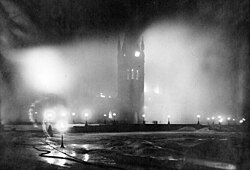 Centre Block ablaze in 1916
 -
 The Library of Parliament immediately after the fire.


Rebuilding
[edit]Reconstruction of the Centre Block began immediately, with a team of architects led by John A. Pearson and Jean-Omer Marchand overseeing a design much like the original, but expanded in size and pared down in ornament, more in keeping with the Beaux-Arts ethos of the time. By 1 September 1916, less than seven months after the fire, the original cornerstone was relaid by the then governor general, Prince Arthur, Duke of Connaught and Strathearn, exactly 56 years after his brother, the future King Edward VII, had done the same. The new building was to be constructed with a steel frame, and an interior predominantly finished in stone, as well as with a more logical layout and clear exiting strategy.[55]
During the reconstruction, the House of Commons and Senate sat at the Victoria Memorial Museum Building.
On 26 January 1920, the first sitting of parliament in the new Centre Block was opened by Governor General the Duke of Devonshire. However, the ceremony was also exceptional for the fact that it took place in the House of Commons, rather than the Senate, as the latter had not yet been constructed. Similarly, the corridors and main chambers were still devoid of their decorative carvings, which would be completed over the ensuing fifty years, and it was not until Dominion Day of 1927 that the Peace Tower was dedicated by Governor General the Viscount Willingdon.[55]
-
 Centre Block under reconstruction in June 1916
 -
 Governor General the Viscount Willingdon outside Centre Block for Dominion Day celebrations, 1927


Security issues
[edit]On 18 May 1966, Paul Joseph Chartier killed himself as he left a Centre Block washroom by accidentally detonating the bomb he had been preparing to throw onto the floor of the House of Commons from the public galleries to, as he put it in his notes, "exterminate as many members as possible." The building's security was heightened; however, tests of this by journalism students that November proved the precautions had been little improved.[56] Later, in 1989, Charles Yacoub hijacked a Greyhound Lines bus and drove it up onto Parliament Hill.
Several shooting incidents occurred on 22 October 2014 around Parliament Hill and in the Centre Block, primarily in the Hall of Honour. Michael Zehaf-Bibeau,[57] after fatally shooting Corporal Nathan Cirillo, a soldier mounting the guard of honour at the National War Memorial, made his way to Parliament Hill and to the Centre Block.[58] There, he engaged in a firefight with Sergeant-at-Arms of the House of Commons Kevin Vickers and members of the Royal Canadian Mounted Police, which ended when he was killed by RCMP Constable Curtis Barrett.[59][60]
Centre Block project
[edit]
By the 1990s, it was deemed necessary for an upgrade to be made to the Centre Block's mechanical and electrical systems, which would necessitate a new plant for these amenities. To avoid disturbing the building's heritage façades and spaces, as well as erecting new structures within the parliamentary precinct, the two storey, 50 m × 40 m (160 ft × 130 ft) square plant and new loading docks, called Centre Block Underground Services (CBUS), were constructed underground, seeing, in 1997, the removal of 25,000 m3 (883,000 cu ft) of rock from under and near the Centre Block.[61][62]
Future upgrades have led to extensive internal renovations, including both parliamentary chambers and associated areas. As this would cause a multi-year disruption, plans were made to enclose the East and West blocks' courtyards for use as temporary legislative chambers while the Centre Block is out of commission.[63] These plans were later changed, and the Senate chamber has been housed in the former Union Station, currently the Government Conference Centre, since 2019.[64] Commons has occupied the West Block as previously arranged, after it was renovated from 2011 to 2019.[65]
From 2018, MPs were moved from Centre Block for a decade-long renovation at a cost of over $4 billion set to be complete for 2031.[66] Starting in spring 2020, excavators dug 23 metres into the bedrock with the plan of expanding the Parliament Welcome Centre to provide access for more visitors to Parliament Hill in a three-floor basement. The upgrade will also protect the site from an earthquake up to a 6.0 magnitude by adding 500 base isolators (shock absorbers). For the renovation, the 20,000 heritage assets and artifacts were removed, and parts of the building reduced to a shell. The project aims to restore the heritage of the building. In doing so, of the 400,000 stones supporting the Centre Block, approximately a third are being removed for repair or replacement. During parts of the renovation, a tarp named “trompe-l’œil” (trick of the eye) has been installed around the building to offer protection for workers and be aesthetically pleasing for visitors.[67][68]
Public access
[edit].jpg)
About 355,000 visitors tour the Centre Block each year.[69] Guided, free daily tours are conducted year-round by the Library of Parliament and include an opportunity to visit the Peace Tower.[70][71] Visitors are able to "discover the history, functions and art of Canada’s Parliament",[72] and curriculum-based tours are available to school groups.[73] The federal Crown is constructing an underground welcome centre, expected to open in June 2017.[69] As of December 2017, all excavation is complete, and exterior construction started in May 2017. Finishing the face and interior work will signal the end of the project. The completion date has been set to the Fall of 2018 or earlier.[74] The first phase, the Visitor Welcome Centre opened in January 2019. Construction is underway (as of October 2023) on the second phase of the project, the Parliament Welcome Centre, which will link the East, Centre, and West blocks into a single, interconnected complex. It is also expected to provide additional operating space for Parliament's activities.[75]
See also
[edit]References
[edit]- ^ www
.pc .gc .ca /apps /dfhd /page _fhbro _eng .aspx?id=2833 - ^ Beauchesne, Arthur (1948). Canada's Parliament Buildings: The Senate and House of Commons, Ottawa. Ottawa. p. 24.
{{cite book}}: CS1 maint: location missing publisher (link) - ^ Public Works and Government Services Canada. "A Treasure to Explore > Parliament Hill > History of the Hill > Centre Block > Centre Block Exterior". Queen's Printer for Canada. Archived from the original on 6 May 2009. Retrieved 30 December 2008.
- ^ a b Library of Parliament. "The House of Commons Heritage Collection > Heritage Spaces > House of Commons Chamber > Architectural Sculpture". Queen's Printer for Canada. Retrieved 1 January 2009.
- ^ Public Works and Government Services Canada. "A Treasure to Explore > Parliament Hill > History of the Hill > Centre Block > Centre Block Underground Services (CBUS)". Queen's Printer for Canada. Archived from the original on 14 July 2009. Retrieved 30 December 2008.
- ^ a b Library of Parliament. "The House of Commons Heritage Collection > Heritage Spaces > Confederation Hall". Queen's Printer for Canada. Retrieved 30 December 2008.
- ^ Library of Parliament. "The House of Commons Heritage Collection > Heritage Spaces > Confederation Hall > Thumbnail index > Column". Queen's Printer for Canada. Archived from the original on 30 August 2009. Retrieved 30 December 2008.
- ^ a b c Library of Parliament. "The House of Commons Heritage Collection > Heritage Spaces > Confederation Hall > Thumbnail index > Floor". Queen's Printer for Canada. Archived from the original on 30 August 2009. Retrieved 24 December 2008.
- ^ Public Works and Government Services Canada. "A Treasure to Explore > Parliament Hill > History of the Hill > Centre Block > Rotunda". Queen's Printer for Canada. Archived from the original on 13 July 2009. Retrieved 30 December 2008.
- ^ Library of Parliament. "The House of Commons Heritage Collection > Heritage Spaces > Confederation Hall > Thumbnail index". Queen's Printer for Canada. Retrieved 31 December 2008.
- ^ Library of Parliament. "The House of Commons Heritage Collection > Heritage Spaces > Confederation Hall > Architectural Sculpture – Gables". Queen's Printer for Canada. Retrieved 30 December 2008.
- ^ Public Works and Government Services Canada. "A Treasure to Explore > Parliament Hill > History of the Hill > Centre Block > Hall of Honour". Queen's Printer for Canada. Archived from the original on 31 July 2009. Retrieved 30 December 2008.
- ^ Library of Parliament. "The House of Commons Heritage Collection > Heritage Spaces > Hall of Honour > Architectural Sculpture thumbnail index > Nurses' Memorial". Queen's Printer for Canada. Retrieved 31 December 2008.
- ^ Library of Parliament. "The House of Commons Heritage Collection > Heritage Spaces > Hall of Honour > Architectural Sculpture thumbnail index > Canada Remembers". Queen's Printer for Canada. Retrieved 31 December 2008.
- ^ a b Public Works and Government Services Canada. "A Treasure to Explore > Parliament Hill > History of the Hill > Centre Block > Senate". Queen's Printer for Canada. Archived from the original on 14 September 2009. Retrieved 30 December 2008.
- ^ [1]
- ^ Library of Parliament. "The War Paintings in the Senate Chamber > Introduction". Queen's Printer for Canada. Archived from the original on 30 August 2009. Retrieved 1 January 2009.
- ^ Library of Parliament. "The War Paintings in the Senate Chamber > Foreword". Queen's Printer for Canada. Archived from the original on 30 August 2009. Retrieved 1 January 2009.
- ^ Library of Parliament. "The War Paintings in the Senate Chamber > Paintings > Landing of the First Canadian Division at Saint-Nazaire, 1915". Queen's Printer for Canada. Archived from the original on 30 August 2009. Retrieved 1 January 2009.
- ^ Library of Parliament. "The War Paintings in the Senate Chamber > Paintings > A Mobile Veterinary Unit in France". Queen's Printer for Canada. Archived from the original on 1 September 2009. Retrieved 1 January 2009.
- ^ Library of Parliament. "The War Paintings in the Senate Chamber > Paintings > Railway Construction in France". Queen's Printer for Canada. Archived from the original on 31 August 2009. Retrieved 1 January 2009.
- ^ Library of Parliament. "The War Paintings in the Senate Chamber > Paintings > Arras, the Dead City". Queen's Printer for Canada. Archived from the original on 30 August 2009. Retrieved 1 January 2009.
- ^ Library of Parliament. "The War Paintings in the Senate Chamber > Paintings > The Cloth Hall, Ypres". Queen's Printer for Canada. Archived from the original on 24 October 2012. Retrieved 1 January 2009.
- ^ Library of Parliament. "The War Paintings in the Senate Chamber > Paintings > On Leave". Queen's Printer for Canada. Archived from the original on 1 September 2009. Retrieved 1 January 2009.
- ^ Library of Parliament. "The War Paintings in the Senate Chamber > Paintings > The Watch on the Rhine (The Last Phase)". Queen's Printer for Canada. Archived from the original on 1 September 2009. Retrieved 1 January 2009.
- ^ Library of Parliament. "The War Paintings in the Senate Chamber > Paintings > Returning to the Reconquered Land". Queen's Printer for Canada. Archived from the original on 30 August 2009. Retrieved 1 January 2009.
- ^ Office of the Governor General of Canada (7 December 2010). "Governor General to Unveil the Corbel of Her Majesty Queen Elizabeth II". Queen's Printer for Canada. Retrieved 7 December 2010.
- ^ a b Parliament of Canada. "The Diamond Jubilee Window: A Celebration of the Crown in Canada > The Diamond Jubilee Window". Queen's Printer for Canada. Archived from the original on 12 March 2012. Retrieved 15 April 2012.
- ^ Foot, Richard (29 June 2010). "Queen Elizabeth in Halifax". Global News. Archived from the original on 7 June 2011. Retrieved 1 July 2010.
- ^ Foot, Richard (27 June 2010), "Queen Elizabeth to skip Quebec on Canadian tour", Montreal Gazette, archived from the original on 30 June 2010, retrieved 1 July 2010
- ^ Office of the Governor General of Canada (6 February 2012). "Governor General to Attend the Dedication Ceremony of the Diamond Jubilee Window in Senate Foyer". Queen's Printer for Canada. Retrieved 9 February 2012.
- ^ Public Works and Government Services Canada (31 July 2015). "Explore the Centre Block". Public Works and Government Services Canada. Retrieved 24 September 2016.
- ^ "Canada A Constitutional Monarchy". Parliament of Canada. Archived from the original on 9 May 2011. Retrieved 26 February 2017.
- ^ a b c d e f g Marleau, Robert; Montpetit, Camille. "House of Commons Procedure and Practice > 6. The Physical and Administrative Setting". Queen's Printer for Canada. Retrieved 2 January 2009.
- ^ Library of Parliament. "The House of Commons Heritage Collection > Heritage Spaces > House of Commons Chamber". Queen's Printer for Canada. Retrieved 31 December 2008.
- ^ Library of Parliament. "The House of Commons Heritage Collection > Heritage Spaces > House of Commons Chamber > Ceiling of the House of Commons Chamber". Queen's Printer for Canada. Retrieved 31 December 2008.
- ^ Olding, Simon (1977). "The Indefatigable Mr. Hems of Exeter". Devon and Cornwall Notes and Queries. 33 (8): 290–94.
- ^ Library of Parliament. "The House of Commons Heritage Collection > Heritage Spaces > House of Commons Chamber > Stained Glass Windows". Queen's Printer for Canada. Retrieved 31 December 2008.
- ^ Library of Parliament. "The House of Commons Heritage Collection > Heritage Spaces > House of Commons Chamber > Architectural Sculpture > British North America Act series". Queen's Printer for Canada. Retrieved 1 January 2009.
- ^ Library of Parliament. "The House of Commons Heritage Collection > Heritage Spaces > House of Commons Chamber > Architectural Sculpture > Evolution of Life series". Queen's Printer for Canada. Retrieved 1 January 2009.
- ^ Library of Parliament. "The House of Commons Heritage Collection > Heritage Spaces > House of Commons Chamber > Architectural Sculpture > Speakers and Clerks series". Queen's Printer for Canada. Retrieved 1 January 2009.
- ^ Library of Parliament. "The House of Commons Heritage Collection > Heritage Spaces > House of Commons Foyer > Ceiling". Queen's Printer for Canada. Retrieved 31 December 2008.
- ^ "The Ghosts of Vimy Ridge - History, Arts and Architecture - House of Commons". www.ourcommons.ca. Retrieved 25 February 2022.
- ^ a b Carlson, Kathryn Blaze (11 May 2011). "Liberals take their leave of the Railway Room". National Post. Retrieved 26 February 2015.
- ^ The Salon de la Francophonie (PDF), Senate of Canada, retrieved 22 October 2023
- ^ Public Works and Government Services Canada. "A Treasure to Explore > Parliament Hill > The History of Parliament Hill > Construction, 1859–1916 > Who would design it?". Queen's Printer for Canada. Archived from the original on 6 October 2011. Retrieved 1 January 2009.
- ^ Hubbard, R. H. (1977). Rideau Hall. Montreal and London: McGill-Queen's University Press. pp. 8–9. ISBN 978-0-7735-0310-6.
- ^ a b City of Ottawa. "Residents > Heritage > Archives > A Virtual Exhibit: Ottawa Becomes the Capital > Building the Physical Reality". City of Ottawa. Archived from the original on 9 December 2008. Retrieved 2 January 2009.
- ^ a b Public Works and Government Services Canada. "A Treasure to Explore > Parliament Hill > The History of Parliament Hill > Construction, 1859–1916". Queen's Printer for Canada. Archived from the original on 30 August 2009. Retrieved 1 January 2009.
- ^ a b Ottawakiosk.com. "Ottawa > Arts & Entertainment > Attractions > Parliament Hill Tour". Ottawa Kiosk. Archived from the original on 15 June 2006. Retrieved 2 January 2009.
- ^ "The Parliament Hill Fire of 1916".
- ^ Public Works and Government Services Canada. "A Treasure to Explore > Parliament Hill > The History of Parliament Hill > The Fire of 1916". Queen's Printer for Canada. Archived from the original on 25 January 2009. Retrieved 1 January 2009.
- ^ Public Works and Government Services Canada. "A Treasure to Explore > Parliament Hill > The History of Parliament Hill > The Fire of 1916 > Temporary legislature". Queen's Printer for Canada. Archived from the original on 30 August 2009. Retrieved 2 January 2009.
- ^ "The Home Front (1914–1918)". Library and Archives Canada. 28 January 2016. Retrieved 26 February 2017.
- ^ a b Public Works and Government Services Canada. "A Treasure to Explore > Parliament Hill > The History of Parliament Hill > Reconstruction, 1916–1965". Queen's Printer for Canada. Archived from the original on 30 August 2009. Retrieved 1 January 2009.
- ^ Hanlon, John (20 October 2007), "The Day We Broke the Silence of Centre Block", Ottawa Citizen, archived from the original on 7 November 2012, retrieved 24 October 2009
- ^ Edwards, Peter (23 October 2014). "Only one shooter involved in Parliament Hill attack, Ottawa police say". Toronto Star. Retrieved 24 October 2014.
- ^ "RCMP release security footage of Michael Zahef Bibeau during attack, say he shot soldier in back". National Post. 23 October 2014.
- ^ Ivison, John (2 June 2015). "Who fired the fatal shot that killed Michael Zehaf-Bibeau? Eyewitness account suggests it wasn't Kevin Vickers". National Post. Archived from the original on 15 October 2015. Retrieved 13 October 2015.
- ^ CTVNews.ca staff (13 October 2015). "Mounties who helped end Parliament Hill attack still not recognized". CTV News. Archived from the original on 14 October 2015. Retrieved 15 October 2015.
- ^ Carter, T.G.; Webb, G.S.; van Bers, M.V.; Culham, G. (2000). Design and construction solutions for excavation under and adjacent to the Parliament Buildings, Ottawa (PDF). Toronto: Golder Associates Ltd. p. 3. Retrieved 2 January 2009.
- ^ "Centre Block Underground Services (CBUS)". Archived from the original on 6 July 2011. Retrieved 27 October 2010.
- ^ Public Works and Government Services Canada. "Rehabilitation Phases". Queen's Printer for Canada. Archived from the original on 10 June 2011. Retrieved 3 July 2009.
- ^ Canada, Senate of. "The Senate of Canada Building". SenCanada. Retrieved 20 February 2024.
- ^ "New look for Ottawa's old train station approved by NCC". Canadian Broadcasting Corporation. Retrieved 19 July 2016.
- ^ "Here's what the Centre Block renovations on Parliament Hill look like". ctvnews.ca. CTV News. 16 July 2023.
- ^ "Latest progress on the Centre Block project". canada.ca. 3 September 2023. Retrieved 22 October 2024.
- ^ Thurton, David (24 June 2023). "Take a peek at Canada's largest-ever heritage restoration project". cbc.ca.
- ^ a b Bryden, Joan (29 June 2012). "Visitors Get $49-Million Welcome Centre But Fewer Chances To Tour Parliament". The Globe and Mail. Retrieved 23 December 2015.
- ^ Library of Parliament. "Plan a Visit to Parliament". Queen's Printer for Canada. Retrieved 23 December 2015.
- ^ "Parliament Hill". Ottawa Tourism. Retrieved 23 December 2015.
- ^ Library of Parliament. "Centre Block Guided Tours". Queen's Printer for Canada. Retrieved 23 December 2015.
- ^ Department of Canadian Heritage (1 November 2014). "Parliament of Canada". Queen's Printer for Canada. Retrieved 23 December 2015.
- ^ "Visitor Welcome Centre – Canada's Parliamentary Precinct". Government of Canada, Public Works and Government Services Canada, Parliamentary Precinct Branch. 19 January 2016. Retrieved 29 December 2017.
- ^ Services, Public; Canada, Procurement. "Parliament Welcome Centre - Canada.ca". canada.ca. Retrieved 8 October 2023.
External links
[edit]
| Parliament of Canada |  | |
|---|---|---|
| Centre Block | ||
| Monuments | ||
| Parliamentary Precinct | ||
| Miscellaneous | ||


| National | |
|---|---|
| Geographic | |

Centre Block
View on GrokipediaHistorical Background
Origins and Pre-Confederation Construction
In 1857, Queen Victoria selected Ottawa as the seat of government for the Province of Canada, resolving longstanding disputes among rival cities such as Toronto, Quebec City, and Montreal over the capital's location. The choice favored Ottawa's strategic position on cliffs overlooking the Ottawa River, providing natural defensibility against potential American incursions due to its distance from the border. This decision, formalized on December 31, 1857, led to the planning of parliamentary buildings on a 25-acre site known as Barrack's Hill, a limestone outcrop previously used for military purposes.[5][12] A design competition for the new parliamentary precinct was launched on May 7, 1859, seeking Gothic Revival-style structures to symbolize Canada's emerging national identity. Thomas Fuller and Chilion Jones emerged victorious for the Centre Block design, announced on August 29, 1859, with their "Semper Paratus" submission emphasizing a Civic Gothic aesthetic suited to the rugged landscape. Groundbreaking occurred on December 20, 1859, utilizing local Nepean sandstone for the facade, and the cornerstone was laid on September 1, 1860, by the Prince of Wales, the future Edward VII.[5][13] Construction progressed amid challenges, including a halt in 1861 due to costs exceeding the budget by 2.5 times, before resuming in 1863 under revised oversight. The Centre Block, intended to house the legislative assembly, was sufficiently complete for official opening on June 6, 1866, approximately one year prior to Confederation on July 1, 1867. This pre-Confederation structure established the core of what would become Canada's federal parliamentary complex, reflecting the Province of Canada's aspirations for permanence and grandeur.[5][13]The 1916 Great Fire
On February 3, 1916, at approximately 8:37 p.m., a fire broke out in the reading room of the House of Commons within the Centre Block of the Parliament Buildings in Ottawa, while a session was underway.[5] The blaze originated near an overheated stove or possibly from careless smoking, though the exact cause remained undetermined despite investigations.[14] Amid World War I, initial suspicions of German sabotage circulated due to the wartime context and recent fires in Ottawa, but no evidence supported arson, and official inquiries concluded it was accidental.[15] The fire spread rapidly through the wooden interior and scaffolding from ongoing renovations, fueled by strong winds that carried embers across the roof.[16] By 10:00 p.m., the Centre Block was engulfed, with the Victoria Tower collapsing around midnight, and the structure was fully gutted by 2:00 a.m.[15] Firefighters from Ottawa and surrounding areas battled the inferno for hours, but the building's age—constructed primarily between 1859 and 1876—and dry conditions hindered containment.[17] Seven individuals perished in the disaster: Member of Parliament Bowman Brown Law, who fell to his death while attempting to escape; a policeman and three civil servants crushed by a collapsing wall; and two others among the responders and staff.[18] Numerous parliamentarians and staff evacuated amid chaos, with some leaping from windows using mattresses or tied curtains for safety.[16] Remarkably, the Library of Parliament, connected to the Centre Block, survived intact due to the quick actions of assistant librarian Almon Carswell, who shut heavy iron doors to seal off the fire's path, preventing its spread into the book stacks.[6] This preservation spared over 300,000 volumes and irreplaceable documents, though the main parliamentary chambers, offices, and historic artifacts, including the House of Commons mace, were lost.[15] The event prompted immediate relocation of legislative activities to the West Block and other temporary spaces, underscoring the vulnerability of the aging Gothic Revival structure.[17]Reconstruction and Completion (1916-1927)
Following the destruction of the original Centre Block by fire on February 3, 1916, Canadian government officials quickly decided to rebuild on the same site, prioritizing a design that preserved the Gothic Revival aesthetic while incorporating modern fire-resistant materials and enhanced safety features.[5] The cornerstone for the new structure was laid on September 1, 1916, with construction emphasizing steel framing, reinforced concrete, Nepean sandstone cladding, limestone interior walls, and marble floors to minimize fire risks, contrasting with the wood-heavy original.[5] [19] John A. Pearson served as chief architect, collaborating with Jean-Omer Marchand as associate, blending Gothic Revival elements with Beaux-Arts influences to create a larger edifice—six storeys instead of the original four—adding approximately 2,500 square metres of space.[20] [19] The design retained the surviving Library of Parliament and integrated symbolic features like Confederation Hall with its fan vaulting and a compass-rose floor depicting Canada as a "ship of state."[21] By late 1917, construction had reached the fourth storey, reflecting rapid progress amid World War I demands.[19] The main building became operational in early 1920, allowing the Senate to reconvene on February 26 and the House of Commons to resume sessions shortly thereafter, though some areas remained unfinished.[19] [5] The iconic Peace Tower, a 92-metre memorial to First World War casualties featuring a carillon and the Memorial Chamber with stones from European battlefields, began construction around 1919 and was dedicated on July 1, 1927, marking full completion.[20] [19] Symbolic carvings, including a phoenix rising from ashes and uncarved stones left for future generations, underscored themes of resilience and continuity.[21]Post-Reconstruction Developments and Modifications
Following its completion in 1927, the Centre Block underwent limited structural alterations, preserving much of its post-fire Gothic Revival architecture amid routine maintenance to support ongoing parliamentary functions. The building's core layout, including the House of Commons and Senate chambers, remained substantially unchanged, with adaptations focused on operational necessities rather than aesthetic or expansive redesigns.[22][23] A significant event prompting modifications occurred on May 15, 1952, when an electrical short ignited a fire in the cupola of the adjacent Library of Parliament, resulting in extensive smoke damage and water intrusion from firefighting efforts that affected interiors and approximately 80,000 volumes in the collections. Structural repairs followed, including reinforcement of the library's dome and restoration of damaged elements, though the fire did not compromise the building's overall integrity.[6][24][17] Subsequent decades saw piecemeal mechanical updates, such as electrical enhancements to address aging infrastructure, but no large-scale interventions altered the edifice's heritage features until preparatory assessments in the 2010s highlighted systemic obsolescence.[8]Architectural and Symbolic Features
Overall Design and Gothic Revival Style
The current Centre Block, reconstructed between 1916 and 1927 following the destruction of the original by fire, features a symmetrical rectangular plan measuring approximately 144 meters in length, with east and west wings flanking a central block dominated by the 92-meter Peace Tower.[17] Architects John A. Pearson and Jean-Omer Marchand designed the structure to incorporate modern engineering, such as a steel frame for enhanced fire resistance and structural integrity, while adhering to the Gothic Revival style to maintain visual continuity with the surviving Library of Parliament.[25] This approach blended traditional Gothic ornamentation with contemporary construction techniques, allowing for larger spans and taller elements without compromising aesthetic coherence.[26] The Gothic Revival style, characterized by pointed arches, ribbed vaults, intricate stone tracery, and profuse sculptural detailing including gargoyles and pinnacles, draws from medieval precedents adapted to Canadian contexts through the use of local Nepean sandstone.[3] Pearson and Marchand's design retained the high Victorian Gothic elements of the original Centre Block by Thomas Fuller, such as steeply pitched roofs and elaborate fenestration, but introduced a more streamlined massing suited to the era's functional needs for expanded legislative chambers.[27] The style symbolizes parliamentary democracy's rootedness in historical traditions, with symbolic carvings depicting Canadian flora, fauna, and historical figures integrated into facades and interiors.[3] Key interior spaces, like the Hall of Honour, exemplify High Gothic Revival through vaulted ceilings and heraldic motifs, serving as ceremonial gateways that emphasize the building's role in national governance.[3] The overall composition prioritizes axial symmetry and verticality, culminating in the Peace Tower's carillon and observation deck, which reinforce the Gothic emphasis on aspiring forms and light-filled interiors via extensive glazing within traceried frames.[26] This stylistic fidelity ensured the reconstructed Centre Block harmonized with Parliament Hill's ensemble, preserving a unified architectural identity despite technological advancements.[25]Exterior Elements and Peace Tower
The Centre Block's exterior embodies Gothic Revival architecture, characterized by pointed arches, ribbed detailing, and vertical emphasis to evoke medieval cathedrals.[28] Constructed primarily from Nepean sandstone—a durable, cream-colored quartz-rich stone quarried locally—the building's facades feature irregular and symmetrical elements including buttresses, pinnacles, and gargoyles that enhance its monumental presence.[29] [30] The structure spans 144 meters in length and 75 meters in depth, encompassing six storeys topped by copper roofing.[17] Intricate stone carvings adorn the walls, towers, window surrounds, and parapets, depicting provincial shields, historical figures, flora, fauna, and allegorical motifs symbolizing Canadian identity and governance.[31] [32] The west facade, facing the Ottawa River, presents the primary public entrance framed by the Peace Tower, with separate portals to the Senate and House of Commons chambers on either side, underscoring functional symmetry in a Beaux-Arts influenced layout.[28] The Peace Tower, rising 92 meters as a freestanding Gothic spire crowned by four corner turrets, dominates the skyline and serves as the building's symbolic apex.[33] [30] Erected between 1919 and 1927 under architect John A. Pearson to replace the destroyed Victoria Tower, it commemorates the World War I armistice and embodies peace through its design, including illuminated clock faces installed in 1927 and stone grotesques representing virtues like mercy and fortitude.[33] At its summit lies an observation gallery, while the base houses the Memorial Chamber with Books of Remembrance honoring Canadian war dead, floored by battlefield stones.[34] Integral to the tower is its carillon of 53 bells, spanning four octaves and cast by Gillett & Johnston in Croydon, England, from 1925 to 1927; the largest bell weighs approximately 10 tons, and the ensemble totals over 60 tons, rung mechanically or via keyboard for daily recitals and national occasions.[35] [36] These elements collectively reinforce the Centre Block's role as a national emblem, blending aesthetic grandeur with historical commemoration.[3]Interior Chambers and Key Spaces
The interior chambers and key spaces of the Centre Block exemplify Gothic Revival architecture, with vaulted ceilings, intricate stone and wood carvings, stained glass windows depicting Canadian flora and fauna, and symbolic elements representing national unity and regional identities.[3] These spaces were reconstructed following the 1916 fire, completed by 1927 under architects John A. Pearson and Jean-Omer Marchand.[3] The Hall of Honour functions as the primary ceremonial corridor and divides the east and west wings, featuring ribbed vaulted ceilings, limestone arches, wrought-iron gates, and sculptures such as a memorial to nurses; it has hosted lying-in-state ceremonies for figures including Prime Minister Pierre Trudeau in 2000 and Canada's Unknown Soldier in 2002.[3] Confederation Hall, or the Rotunda, serves as the central formal entrance with a soaring vaulted ceiling encircled by the coats of arms of Canada's provinces and territories, and a commemorative central column inscribed with a First World War tribute bearing a mariner's compass motif.[3] The House of Commons Chamber in the west wing accommodates debates among 338 members on green-upholstered benches, with stained-glass windows illustrating provincial flowers, carved borders featuring Canadian wildlife, and traditional seating arrangements preserving historical precedents like the Speaker's chair and mace.[3] Its adjacent foyer includes marble flooring, dramatic lighting, 1919 sculptures of human and mythical figures, provincial emblems, and portraits of former prime ministers.[3] In the east wing, the Senate Chamber houses up to 105 appointed senators on red carpet under a gilded coffered ceiling with bronze chandeliers, ornate stone carvings, and a throne for the monarch or viceroy; addresses from the Crown, such as the Speech from the Throne, occur here.[3][37] The Senate foyer, its ceremonial antechamber, boasts columns, arches, portraits of eight monarchs including originals of Queen Victoria and Queen Elizabeth II, and a Tudor-style stained-glass ceiling inscribed with Speakers' names through 1920 alongside royal cyphers.[3][38]Governmental and Ceremonial Role
Housing the Senate and House of Commons
The Centre Block accommodates the Senate and House of Commons chambers as the core venues for Canada's federal legislative proceedings, including debates, readings of bills, and question periods. The Senate Chamber occupies the eastern end of the structure, accessible via a dedicated entrance, while the House of Commons Chamber is positioned at the western end with its own separate entry, allowing each house to conduct business independently yet within the same building. This layout facilitates the bicameral system's distinct operations while maintaining proximity for joint sessions in adjacent ceremonial spaces like Confederation Hall.[17] The House of Commons Chamber features a rectangular design approximately 21 metres long and 16 metres wide, clad in Tyndall limestone with green leather-upholstered benches on tiered seating under a high ceiling. Seating is divided by a central aisle, with government members positioned to the right of the Speaker's chair and opposition members to the left, accommodating 338 elected Members of Parliament alongside public galleries, press areas, and support spaces for procedural efficiency.[39][40][41] In the Senate Chamber, or Red Chamber, 105 appointed senators are seated in a more compact arrangement on crimson flooring, emphasizing the chamber's deliberative function with ornate Gothic Revival details such as carved stonework and symbolic artwork. Both chambers incorporate heritage elements from the 1920s reconstruction, including vaulted ceilings and historical motifs, to underscore parliamentary tradition amid daily legislative work.[37][41]Symbolic Significance in Canadian Democracy
The Centre Block stands as the core of Canadian parliamentary democracy, serving as the venue for the Senate and House of Commons to convene, debate legislation, and exercise legislative authority since its completion in 1927. As the seat of federal government on Parliament Hill in Ottawa, it embodies the bicameral structure of Canada's Westminster-style system, where elected members of the Commons and appointed senators represent regional and national interests in law-making processes.[3][26] Employing Gothic Revival architecture, the building draws on medieval European precedents to symbolize the enduring foundations of parliamentary governance inherited from Britain, with vertical spires and pointed arches evoking aspiration toward just rule and moral order. Canadian adaptations, such as carvings of provincial coats of arms, indigenous wildlife, and industrial motifs in spaces like the Rotunda and foyers, illustrate federalism's balance of provincial autonomy within a unified nation, while the Hall of Honour's vaulted ceremonial corridor facilitates processions that underscore the gravity of democratic rituals, including the Speech from the Throne.[3][26] The 92.2-meter Peace Tower, completed in 1927 atop the Centre Block, memorializes Canada's 60,000 war dead from the First World War and signifies a national resolve for peace as the safeguard of democratic institutions, with its Memorial Chamber housing seven Books of Remembrance listing conflict casualties and a verse from Psalm 72 inscribed above the south window: "Give the king thy judgments, O God, and thy righteousness unto the king's son." The tower's 53-bell carillon, operational since 1927, peals for ceremonial events, reinforcing themes of remembrance, unity, and the causal link between sacrifice and preserved freedoms in Canada's constitutional framework.[33][42] Through these elements—royal symbols linking to Canada's monarchical constitution, stained-glass provincial emblems, and sculptures depicting pre-Confederation history—the Centre Block visually narrates the evolution of Canadian sovereignty from colonial assembly to independent federation, functioning as a tangible icon of accountable governance and civic heritage.[3][26]Renovation Project
Project Initiation and Objectives
The Centre Block Rehabilitation Program was formally approved in 2016 as part of Public Services and Procurement Canada's Long Term Vision and Plan (LTVP) for the Parliamentary Precinct, which originated from planning efforts dating back to 2001.[11] [43] This approval followed the successful rehabilitation of the West Block, completed in 2018, which provided a model for addressing similar issues in the aging Centre Block, constructed between 1916 and 1927.[44] The project initiation involved extensive consultations with parliamentarians, heritage experts, and stakeholders to balance preservation with modernization needs, culminating in the relocation of the House of Commons and Senate to temporary facilities in 2018 and 2019, respectively, to enable full-site access for renovations.[45] Primary objectives include restoring the building's structural integrity, upgrading it to comply with contemporary National Building Code standards for fire safety, seismic resilience, and accessibility, and modernizing mechanical, electrical, and plumbing systems to support efficient parliamentary operations.[11] [1] The initiative also aims to enhance security infrastructure, incorporate sustainable technologies for energy efficiency, and expand functional spaces to accommodate a growing number of parliamentarians and staff, all while conserving the Gothic Revival architectural features and symbolic elements that define its role as the epicenter of Canadian governance.[46] [47] These goals address decades of deferred maintenance exacerbated by the building's exposure to harsh weather and heavy use, ensuring the Centre Block remains a viable workspace for future generations without compromising its heritage status, as recognized under the Historic Sites and Monuments Act.[8] The project is framed as a once-in-a-century opportunity to renew Canada's most iconic parliamentary structure, prioritizing causal factors like material degradation and code non-compliance over superficial updates.[48]Progress, Timeline, and Technical Challenges as of 2025
The Centre Block rehabilitation project, approved in 2016, entered its major construction phase following the building's closure in 2019, with parliamentary operations temporarily relocated to the West Block and other facilities.[11] As of September 2025, key progress includes the completion of main excavation work, the initiation of east and west courtyard basement excavations (with approximately 770 truckloads of material removed), and the advancement of the Parliament Welcome Centre's structural build to 10% completion, encompassing concrete pouring for the lowest basement level, foundation walls, columns, and elevator pits.[10] Masonry restoration on the east and west façades stands at about 22% overall, while load transfer—shifting the building's weight onto new structural posts—has begun on the east side ahead of the planned fall 2025 schedule.[10] These milestones reflect a "rebuild" phase focused on foundational and subsurface elements, with all reported activities rated on track despite potential schedule pressures.[10][49] The overall timeline targets construction completion between 2030 and 2031, followed by a one-year period for parliamentary testing and commissioning, with full reopening anticipated in 2031–2032.[11][10] Initial planning and design phases spanned from 2011 onward, but fragmented decision-making among parliamentary partners delayed finalization of user requirements, such as configurations for the east courtyard, until March 2022.[11] By July 2022, approximately $880.7 million had been expended, split between planning/design ($450 million) and early construction ($430.7 million), underscoring the project's phased progression amid ongoing heritage assessments.[11] Current quarterly assessments maintain a schedule health rating of 7 out of 10, indicating manageable risks but vulnerability to further impacts as complexity increases.[10] Technical challenges stem from the building's century-old condition, including a rusting steel frame, non-compliance with modern seismic standards, pervasive water infiltration from deteriorated copper roofs and pipes, and the presence of asbestos and other hazardous materials requiring abatement.[9] The project demands simultaneous heritage preservation—such as conserving masonry, sculptures, stained glass, and interior features—while integrating seismic base isolation, net-zero emissions systems (aiming for 75% energy reduction and 50% water reduction), and upgraded mechanical, electrical, and ventilation infrastructure in constrained spaces.[8][9] Excavation and load transfer under the occupied historic structure pose risks to stability, with transfers projected to continue into 2027, compounded by the need for accessibility upgrades and enhanced security without compromising the Gothic Revival aesthetic.[50][11] These elements render the effort Canada's most complex heritage rehabilitation, balancing causal structural decay with forward-looking functionality.[8]Controversies and Criticisms
Cost Overruns and Fiscal Implications
The Centre Block rehabilitation project carries an estimated total cost of $4.5 billion to $5 billion Canadian dollars, a figure established in 2021 for the comprehensive restoration of the heritage structure, including seismic upgrades, modernization for accessibility and energy efficiency, and the construction of an adjacent Parliament Welcome Centre.[51] [10] This budget encompasses construction, contingencies for risks such as unforeseen heritage discoveries, and provisions for inflation, with approved funding totaling $5.121 billion through fiscal year 2025–26.[11] As of October 2024, cumulative expenditures reached $975 million, focused on initial phases like demolition, asbestos abatement, and structural stabilization, with no reported exceedance of the overall envelope to date.[52] Certain contracts have seen value increases—for instance, one engineering services agreement expanded from $15 million to $39.3 million due to scope adjustments—yet Public Services and Procurement Canada maintains that rigorous procurement and phased contracting have contained costs amid inflationary pressures and supply chain disruptions.[52] [53] The 2023 Auditor General report commended early cost management but identified risks from fragmented governance and delayed parliamentary approvals, which could precipitate overruns if not addressed through enhanced decision-making protocols.[51] [54] Fiscal implications extend beyond the headline figure, imposing a multi-year draw on federal revenues equivalent to a significant share of infrastructure allocations, with annual outlays projected to accelerate post-2025 as rebuilding commences.[55] This commitment, funded entirely by taxpayers without private partnerships, highlights trade-offs in resource allocation, as the project's scale—Canada's largest heritage rehabilitation—diverts funds from alternative public investments while underscoring the challenges of balancing preservation with fiscal restraint in government-led undertakings.[56] Ongoing quarterly monitoring aims to mitigate escalation risks, though external factors like labor shortages and material costs continue to exert pressure on the baseline estimate.[57]Debates on Necessity, Delays, and Alternatives
The necessity of rehabilitating Centre Block has centered on balancing its structural imperatives against fiscal prudence, with federal assessments underscoring deferred maintenance issues like widespread asbestos, water ingress, and seismic vulnerabilities that posed risks of "total failure" by the mid-2020s absent intervention.[11] Proponents, including Public Services and Procurement Canada, emphasize that the 107-year-old Gothic Revival edifice—rebuilt post-1916 fire—embodies Canada's parliamentary heritage and requires upgrades to comply with contemporary codes for fire safety, accessibility, and energy efficiency, rendering inaction untenable for operational continuity.[8][11] Detractors argue the mandated preservation under heritage designations inflates costs beyond those of greenfield construction, potentially diverting funds from broader public needs without proportional democratic enhancements.[58] Project delays, initially projected for a 10-year timeline from 2018 closure to 2028 reopening but extended to 2031, arise from fragmented governance involving the House of Commons, Senate, and Library of Parliament, which slowed user requirements and approvals—such as the east courtyard redesign, deferred from spring 2020 to March 2022.[11][59] On-site challenges, including inflation-driven material costs, complex subsurface excavations for foundational reinforcements, and adaptive design changes amid heritage constraints, have compounded these, though officials report substantial progress like completed interior demolition by November 2024.[59][60] The Auditor General has recommended semi-annual progress reporting to mitigate such risks, highlighting inadequate prior oversight.[11] Alternatives to full rehabilitation, such as demolition and reconstruction or relocation to a modern campus, have surfaced in policy discourse but lack formal endorsement due to the building's entrenched symbolic role in federal ceremonies and its designation under the Parliamentary Precinct Long Term Vision and Plan.[58][61] Suggestions for redesigned chambers—drawing from international models like Australia's horseshoe layout—were floated during consultations but dismissed in favor of retaining historical spatial configurations to preserve institutional familiarity.[58] Critics, including some parliamentarians, decry the absence of broader public debate on these options, contrasting the project with faster renovations elsewhere, like Austria's parliament completed in under six years.[58][62] Heritage mandates and site-specific constitutional ties, however, have precluded viable pursuits of wholesale replacement, prioritizing adaptive reuse over radical reinvention.[8]Public Access and Cultural Impact
Standard Access and Tourism Features
![A tour guide waits for people to gather around her in the Senate foyer.](./assets/A_tour_guide_waits_for_tourists_to_gather_around_Prior to the 2019 closure for rehabilitation, public access to the Centre Block was provided through free guided tours originating from the Visitor Welcome Centre on the west side of Parliament Hill. Visitors underwent mandatory security screening, including bag checks and metal detectors, before proceeding to tour groups assembled in a plaza adjacent to the entrance. Tours operated daily during non-sitting periods and select hours when Parliament was in session, accommodating up to 1,000 participants per day in peak seasons.[63][64] Guided tours, lasting approximately 45 to 60 minutes and available in English and French, traversed ceremonial spaces such as the Hall of Honour with its marble columns and historical motifs, the Confederation Hall rotunda featuring provincial coats of arms, and the Senate or House of Commons chambers when accessible. These itineraries emphasized the building's Gothic Revival architecture, including intricate stone carvings, stained glass, and the adjacent Library of Parliament, which remained open for separate visits showcasing its 1876 neo-Gothic design that survived the 1916 fire. Parliamentary guides delivered factual narratives on legislative functions, historical events, and symbolic elements like the Peace Tower's clock and carillon.[3][65][38] Tourism features included public galleries in the chambers for observing debates and committee proceedings during sittings, promoting transparency in governance. Additional attractions comprised daily carillon performances from the Peace Tower's 53 bells, audible across Ottawa, and limited climbs to the tower's observation deck offering panoramic views of the city and Ottawa River. Self-guided exploration was supported via brochures detailing architectural highlights and grounds monuments, while no on-site parking directed visitors to nearby lots or public transit. Annually, these features drew over 900,000 tour participants pre-closure, peaking in summer with extended hours and higher capacity.[66][67][68]