Hubbry Logo
League of Nations mandateLeague of Nations mandateMain
Open search
League of Nations mandate
Community hub
League of Nations mandate
logo
8 pages, 0 posts
0 subscribers
Be the first to start a discussion here.
League of Nations mandate
from Wikipedia

League of Nations mandates
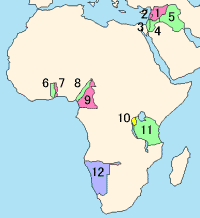
Class A, mandates in Western Asia:
Class B, mandates in Central and East Africa:
Class C, mandates in Southern Africa:

A League of Nations mandate represented a legal status under international law for specific territories following World War I, involving the transfer of control from one nation to another. These mandates served as legal documents establishing the internationally agreed terms for administering the territory on behalf of the League of Nations. Combining elements of both a treaty and a constitution, these mandates contained minority rights clauses that provided for the rights of petition and adjudication by the Permanent Court of International Justice.[1]

The mandate system was established under Article 22 of the Covenant of the League of Nations, entered into force on 28 June 1919. Two governing principles formed the core of the Mandate System, being non-annexation of the territory and its administration as a "sacred trust of civilisation" to develop the territory for the benefit of its native people.[2]

According to historian Susan Pedersen, colonial administration in the mandates did not differ substantially from colonial administration elsewhere. Even though the Covenant of the League committed the great powers to govern the mandates differently, the main difference appeared to be that the colonial powers spoke differently about the mandates than their other colonial possessions.[3]

With the dissolution of the League of Nations after World War II, it was stipulated at the Yalta Conference that the remaining mandates should be placed under the trusteeship of the United Nations, subject to future discussions and formal agreements. Most of the remaining mandates of the League of Nations (with the exception of South West Africa) thus eventually became United Nations trust territories.

Basis

[edit]

The mandate system was established by Article 22 of the Covenant of the League of Nations, drafted by the victors of World War I. The article referred to territories which after the war were no longer ruled by their previous sovereign, but their peoples were not considered "able to stand by themselves under the strenuous conditions of the modern world". The article called for such people's tutelage to be "entrusted to advanced nations who by reason of their resources, their experience or their geographical position can best undertake this responsibility".[4]

U.S. President Woodrow Wilson and South African General Jan Smuts played influential roles in pushing for the establishment of a mandates system.[5] The mandates system reflected a compromise between Smuts (who wanted colonial powers to annex the territories) and Wilson (who wanted trusteeship over the territories).[6][7]

Generalities

[edit]

All of the territories subject to League of Nations mandates were previously controlled by states defeated in World War I, principally Imperial Germany and the Ottoman Empire. The mandates were fundamentally different from the protectorates in that the mandatory power undertook obligations to the inhabitants of the territory and to the League of Nations.

The process of establishing the mandates consisted of two phases:

  1. The formal removal of sovereignty of the state previously controlling the territory.
  2. The transfer of mandatory powers to individual states among the Allied Powers.

Treaties

[edit]

The divestiture of Germany's overseas colonies, along with three territories disentangled from its European homeland area (the Free City of Danzig, the Memel Territory, and the Saar), was accomplished in the Treaty of Versailles (1919), with the territories being allotted among the Allies on 7 May of that year. Ottoman territorial claims were first addressed in the Treaty of Sèvres (1920) and finalised in the Treaty of Lausanne (1923). The Ottoman territories were allotted among the Allied Powers at the San Remo conference in 1920.

Types of mandates

[edit]
Article 22 of the Covenant of the League of Nations, highlighting the three mandate classes:
  • Red: Class A (ex Ottoman)
  • Blue: Class B (ex German Central Africa)
  • Yellow: Class C (ex German South West Africa and Pacific)

The League of Nations decided the exact level of control by the mandatory power over each mandate on an individual basis. However, in every case the mandatory power was forbidden to construct fortifications or raise an army within the territory of the mandate, and was required to present an annual report on the territory to the Permanent Mandates Commission of the League of Nations.

The mandates were divided into three distinct groups based upon the level of development each population had achieved at that time.

Class A mandates

[edit]

The first group, or Class A mandates, were territories formerly controlled by the Ottoman Empire that were deemed to "... have reached a stage of development where their existence as independent nations can be provisionally recognised subject to the rendering of administrative advice and assistance by a Mandatory until such time as they are able to stand alone. The wishes of these communities must be a principal consideration in the selection of the Mandatory."

Class B mandates

[edit]

The second group of mandates, or Class B mandates, were all former German colonies in West and Central Africa, referred to by Germany as Schutzgebiete (protectorates or territories), which were deemed to require a greater level of control by the mandatory power: "...the Mandatory must be responsible for the administration of the territory under conditions which will guarantee freedom of conscience and religion." The mandatory power was forbidden to construct military or naval bases within the mandates.

Class C mandates

[edit]

Class C mandates, including South West Africa and the South Pacific Islands, were considered to be "best administered under the laws of the Mandatory as integral portions of its territory."

List of mandates

[edit]
Class Mandate Territory Mandate Power Prior name Prior sovereignty Comments Current state Document
A Mandate for Syria and the Lebanon Greater Lebanon France Ottoman sanjaks of Beirut, Tripoli, and Mount Lebanon Ottoman Empire 29 September 1923 – 24 October 1945. Joined the United Nations on 24 October 1945 as an independent state and Founding Member Lebanon
Syria Ottoman sanjaks of Damascus, Hauran, Latakia, Homs, Hama, Aleppo, and Zor 29 September 1923 – 24 October 1945: This mandate included Hatay Province (a former Ottoman Alexandretta sanjak), which broke away from the mandate on 2 September 1938 to become a separate French protectorate, which lasted until Hatay Province was ceded to the new Republic of Turkey on 29 June 1939. Joined the United Nations on 24 October 1945 as an independent state Syria
Mandate for Palestine Mandatory Palestine United Kingdom Ottoman sanjaks of Jerusalem, Nablus, and Acre 29 September 1923 – 15 May 1948.[8][9][10] A United Nations Partition Plan for Palestine for peacefully dividing the remainder of the Mandate failed.[11] The Mandate terminated at midnight between 14 May and 15 May 1948. On the evening of 14 May, the Chairman of the Jewish Agency for Palestine had declared the establishment of the State of Israel.[12] Following the war, 75% of the area was controlled by the new State of Israel.[13] Other parts, until 1967, formed the West Bank of the Hashemite Kingdom of Jordan and the All-Palestine Government under the Egyptian-controlled Gaza Strip. Israel
Palestine
Emirate of Transjordan Ottoman sanjaks of Hauran and Ma'an In April 1921, the Emirate of Transjordan was provisionally added as an autonomous area under the United Kingdom,[14][15] and it became the independent Hashemite Kingdom of Transjordan (later Jordan) on 17 June 1946 upon joint ratification of the Treaty of London of 1946. Jordan
Indirect Mandatory Iraq Various Ottoman sanjaks The draft British Mandate for Mesopotamia was not enacted and was replaced by the Anglo-Iraqi Treaty of October 1922.[16] Britain committed to act the responsibilities of a Mandatory Power in 1924.[17] Iraq attained independence from the United Kingdom on 3 October 1932. Iraq
B Belgian Mandate for East Africa Ruanda-Urundi Belgium German East Africa German Empire From 20 July 1922 to 13 December 1946. Formerly two separate German protectorates, they were joined as a single mandate on 20 July 1922. From 1 March 1926 to 30 June 1960, Ruanda-Urundi was in administrative union with the neighbouring colony of the Belgian Congo. After 13 December 1946, it became a United Nations trust territory, remaining under Belgian administration until the separate nations of Rwanda and Burundi gained independence on 1 July 1962. Rwanda
Burundi
British Mandate for East Africa[18] Tanganyika Territory United Kingdom From 20 July 1922 to 11 December 1946. It became a United Nations trust territory on 11 December 1946, and was granted internal self-rule on 1 May 1961. On 9 December 1961, it became independent while retaining the British monarch as nominal head of state, transforming into a republic on the same day the next year. On 26 April 1964, Tanganyika merged with the neighbouring island of Zanzibar to become the modern nation of Tanzania. Tanzania Equivalent document as for Ruanda-Urundi, with all articles substantially the same[19]
British Mandate for the Cameroons British Cameroon United Kingdom German Kamerun Became part of the United Nations trust territories after World War II on 13 December 1946 Part of Cameroon and Nigeria Equivalent document as for French Cameroons, with all articles substantially the same[20]
French Mandate for the Cameroons French Cameroon France Under a Resident and a Commissioner until 27 August 1940, then under a governor. Became part of the United Nations trust territories after World War II on 13 December 1946 Cameroon
British Mandate for Togoland British Togoland United Kingdom German Togoland British Administrator post filled by the colonial Governor of the British Gold Coast (present day Ghana) except 30 September 1920 – 11 October 1923 Francis Walter Fillon Jackson). Transformed on 13 December 1946 into a United Nations trust territory; on 13 December 1956 it ceased to exist as it became part of Ghana. Volta Region, Ghana Equivalent document as for French Togoland, with all articles substantially the same[20]
French Mandate for Togoland French Togoland France French Togoland under a Commissioner till 30 August 1956, then under a High Commissioner as the Autonomous Republic of Togo Togo
C Mandate for the German Possessions in the Pacific Ocean situated South of the Equator other than German Samoa and Nauru Territory of New Guinea Australia German New Guinea German Empire Included German New Guinea and "the group of islands in the Pacific Ocean lying south of the equator other than German Samoa and Nauru".[21] From 17 December 1920 under an (at first Military) Administrator; after (wartime) Japanese/U.S. military commands from 8 December 1946 under UN mandate as North East New Guinea (under Australia, as administrative unit), until it became part of present Papua New Guinea at independence in 1975 Part of Papua New Guinea Equivalent document as for Nauru, with all articles substantially the same[21]
Mandate for Nauru Nauru United Kingdom British mandate, administered by Australia, New Zealand, and the United Kingdom. Became part of the United Nations trust territories after liberation from Japanese occupation in World War II Nauru
Mandate for the German Possessions in the Pacific Ocean lying North of the Equator[22] South Seas Mandate Japan Known as the South Seas Mandate. Became part of the United Nations trust territories and administered by the United States after World War II Palau
Marshall Islands
Federated States of Micronesia
Northern Mariana Islands
Equivalent document as for Nauru, with all articles substantially the same[21]
Mandate for German Samoa Western Samoa New Zealand German Samoa From 17 December 1920 a League of Nations mandate, renamed Western Samoa (as opposed to American Samoa), from 25 January 1947 a United Nations trust territory until its independence on 1 January 1962 Samoa Equivalent document as for Nauru, with all articles substantially the same[21]
Mandate for German South West Africa South West Africa South Africa[23] German South West Africa From 1 October 1922, Walvis Bay's administration (still merely having a Magistrate until its 16 March 1931 Municipal status, hence a Mayor) was also assigned to the mandate. Namibia Equivalent document as for Nauru, with all articles substantially the same[21]

Rules of establishment

[edit]
Map of the League of Nations mandates

According to the Council of the League of Nations, meeting of August 1920:[24] "draft mandates adopted by the Allied and Associated Powers would not be definitive until they had been considered and approved by the League... the legal title held by the mandatory Power must be a double one: one conferred by the Principal Powers and the other conferred by the League of Nations."[25]

Three steps were required to establish a Mandate under international law: (1) The Principal Allied and Associated Powers confer a mandate on one of their number or on a third power; (2) the principal powers officially notify the council of the League of Nations that a certain power has been appointed mandatory for such a certain defined territory; and (3) the council of the League of Nations takes official cognisance of the appointment of the mandatory power and informs the latter that it [the council] considers it as invested with the mandate, and at the same time notifies it of the terms of the mandate, after ascertaining whether they are in conformance with the provisions of the covenant."[25][26]

The U.S. State Department's Digest of International Law says that the terms of the Treaty of Lausanne provided for the application of the principles of state succession to the "A" Mandates. The Treaty of Versailles provisionally recognised the former Ottoman communities as independent nations.[4] It also required Germany to recognise the disposition of the former Ottoman territories and to recognise the new states laid down within their boundaries.[27] The terms of the Treaty of Lausanne required the newly created states that acquired the territory detached from the Ottoman Empire to pay annuities on the Ottoman public debt and to assume responsibility for the administration of concessions that had been granted by the Ottomans. The treaty also let the States acquire, without payment, all the property and possessions of the Ottoman Empire situated within their territory.[28] The treaty provided that the League of Nations was responsible for establishing an arbitral court to resolve disputes that might arise and stipulated that its decisions were final.[28]

A disagreement regarding the legal status and the portion of the annuities to be paid by the "A" mandates was settled when an Arbitrator ruled that some of the mandates contained more than one State:

The difficulty arises here how one is to regard the Asiatic countries under the British and French mandates. Iraq is a Kingdom in regard to which Great Britain has undertaken responsibilities equivalent to those of a Mandatory Power. Under the British mandate, Palestine and Transjordan have each an entirely separate organisation. We are, therefore, in the presence of three States sufficiently separate to be considered as distinct Parties. France has received a single mandate from the Council of the League of Nations, but in the countries subject to that mandate, one can distinguish two distinct States: Syria and the Lebanon, each State possessing its own constitution and a nationality clearly different from the other.[29]

Later history

[edit]

After the United Nations was founded in 1945 and the League of Nations was disbanded, all but one of the mandated territories became United Nations trust territories, a roughly equivalent status.[11] In each case, the colonial power that held the mandate on each territory became the administering power of the trusteeship, except that of the Empire of Japan, which had been defeated in World War II, lost its mandate over the South Pacific islands, which became a "strategic trust territory" known as the Trust Territory of the Pacific Islands under U.S. administration.

The sole exception to the transformation of the League of Nations mandates into UN trusteeships was that of South Africa and its mandated territory South West Africa. Rather than placing South West Africa under trusteeship like other former mandates, South Africa proposed annexation, a proposition rejected by the UN General Assembly. Despite South Africa's resistance, the International Court of Justice affirmed that South Africa continued to have international obligations regarding the South West Africa mandate. Eventually, in 1990, the mandated territory, now Namibia, gained independence, culminating from the Tripartite Accords and the resolution of the South African Border War — a prolonged guerrilla conflict against the apartheid regime that lasted from 1966 until 1990.

Nearly all the former League of Nations mandates had become sovereign states by 1990, including all of the former UN trust territories with the exception of a few successor entities of the gradually dismembered Trust Territory of the Pacific Islands (formerly Japan's South Pacific Trust Mandate). These exceptions include the Northern Mariana Islands which is a commonwealth in political union with the U.S. with the status of unincorporated organised territory. The Northern Mariana Islands does elect its own governor to serve as territorial head of government, but it remains a U.S. territory with its head of state being the President of the United States and federal funds to the commonwealth administered by the Office of Insular Affairs of the U.S. Department of the Interior.

Remnant Micronesia and the Marshall Islands, the heirs of the last territories of the Trust, attained final independence on 22 December 1990. (The UN Security Council ratified termination of trusteeship, effectively dissolving trusteeship status, on 10 July 1987.) The Republic of Palau, split off from the Federated States of Micronesia, became the last to effectively gain its independence, on 1 October 1994.

See also

[edit]

Sources and references

[edit]

Further reading

[edit]

References

[edit]
Revisions and contributorsEdit on WikipediaRead on Wikipedia
from Grokipedia
The League of Nations mandate system, formalized in Article 22 of the League Covenant signed on 28 June 1919, assigned certain former German and Ottoman territories to Allied powers for temporary administration under international supervision, with the stated purpose of advancing the inhabitants toward rather than outright . Territories were categorized into three classes—A for former Ottoman provinces deemed provisionally capable of , such as , , , , and Transjordan; B for Central African regions requiring direct tutelage, including Tanganyika, , , and ; and C for sparsely populated or strategically distant areas like South-West Africa, Pacific islands under Japanese, , and control, treated as extensions of the mandatory's territory. Administering powers, primarily Britain and for Class A mandates alongside , , , , and for others, held legislative and administrative authority subject to League oversight, including annual reports and potential petitions from inhabitants. While the system marked an early experiment in collective international trusteeship, facilitating transitions like 's in 1932, it faced criticism for perpetuating imperial control, uneven implementation, and conflicts arising from mandates such as , where British administration intertwined with Zionist settlement and Arab resistance amid unfulfilled promises.

Historical Origins

Post-World War I Context and Territorial Redistribution

The Armistice of Compiègne on November 11, 1918, marked the defeat of the , leading to the collapse of the and the , and the subsequent occupation of their non-European territories by Allied forces during the war. German overseas possessions, captured progressively from 1914 onward, included and in by Anglo-French forces, by British, Belgian, and Portuguese troops, by South African forces, and Pacific islands by and . These territories, relinquished under the signed on June 28, 1919, encompassed regions that Allied powers had pledged not to treat as spoils of war in pre-armistice agreements. Similarly, Ottoman Arab provinces were overrun by British forces following the of 1916 and advances in and , with the empire's partition foreshadowed by the secret Sykes-Picot Agreement of May 1916, which delineated British spheres in (Iraq) and , French spheres in and , and areas for international administration. The formally capitulated via the on October 30, 1918, enabling Allied occupation of key regions including the Anatolian heartland and the . These wartime occupations set the stage for formal redistribution, as the Ottoman territories outside —spanning modern , , , , , and parts of —were detached under the in 1920, though later modified by Turkish nationalist resistance. At the Paris Peace Conference, opening on January 18, 1919, the principal Allied leaders— of the , of Britain, of , and Vittorio Orlando of —grappled with administering these former enemy holdings amid tensions between imperial ambitions and Wilson's advocacy for in his of January 1918. Direct was rejected to align with anti-colonial rhetoric and avoid accusations of hypocrisy, particularly from the U.S., which had entered the war partly to uphold neutral shipping rights and democratic ideals. Instead, the conference endorsed a provisional trusteeship model, formalized in Article 22 of the League of Nations Covenant adopted on April 28, 1919, whereby mandatory powers would govern territories until they achieved self-sufficiency, ostensibly advancing local welfare and autonomy under international oversight. This redistribution effectively transferred control without outright sovereignty claims: Britain assumed mandates for , (including Transjordan), and Tanganyika; for Syria-Lebanon and parts of and ; for ; for ; for certain Pacific islands north of the ; and for others south. The system masked continuities of colonial administration while providing a legal veneer of temporariness, with mandatory powers selected based on wartime conquests and strategic interests rather than competitive bidding. Specific treaties, such as the Anglo-French Agreement of December 23, 1920, further delineated boundaries in the , reflecting pragmatic divisions over ethnic or geographic logic.

Proposals for Administering Former Enemy Territories

Following the , Allied forces occupied former German colonies in and the Pacific, as well as Ottoman territories in the , prompting debates on long-term administration. Initial proposals among the victors favored direct annexation or division into spheres of influence; for instance, British Dominions like , , and advocated absorbing adjacent German holdings such as , , and the Pacific islands, respectively, citing strategic and economic imperatives. French and Belgian interests similarly targeted Central African territories like and for integration into their empires. In December 1918, , , advanced a seminal alternative in his pamphlet The : A Practical Suggestion, proposing that territories detached from defeated powers—initially emphasizing tropical African colonies unsuited for immediate self-rule—be administered by advanced nations as "mandatories" under oversight, framed as a "sacred trust of civilization" to promote development without outright . Smuts envisioned provisional tutelage leading to , with mandatory powers reporting to the League, though he excluded settler colonies like from this scheme, preferring direct transfer to capable neighbors. This plan drew from imperial precedents like British protectorates but innovated international accountability to mitigate conquest's stigma. Woodrow Wilson, arriving at the Paris Peace Conference on 18 1919, endorsed and broadened Smuts' framework to encompass all former enemy territories, aligning it with his ' emphasis on and rejecting or annexations that disregarded native populations' interests. Wilson argued for League-administered mandates to ensure impartiality, transforming Smuts' limited tropical focus into a universal system that included German settler areas and Ottoman Arab provinces, where provisional independence was deemed feasible. For Ottoman lands, proposals incorporated earlier Anglo-French accords like Sykes-Picot () but adapted to mandates, with Britain securing and , and Syria-Lebanon, under League supervision to balance imperial ambitions with anti-annexation principles. At the Conference's Mandate Commission, convened in January 1919 under Smuts' influence, delegates reconciled competing claims by classifying territories into provisional (Class A for Ottoman remnants), collective (Class B for African), and integrated (Class C for Pacific/Oceanic) categories, embedding the system in Article 22 of the Covenant drafted by 28 April 1919. This compromise preserved Allied control—evident in Australia's retention of despite Wilson's objections—while establishing nominal oversight, though enforcement proved limited by mandatory powers' dominance. The U.S. King-Crane Commission's August 1919 report on Ottoman Asia Minor urged minimal foreign administration favoring local autonomy, but its recommendations were largely disregarded amid geopolitical realities.

Integration into the League Covenant

The mandate system was incorporated into the Covenant of of Nations through Article 22, which outlined the administration of territories detached from defeated powers as a "sacred trust of civilisation" to be supervised by . This provision emerged during the Paris Peace Conference of 1919, where the Commission on of Nations, chaired by U.S. President , addressed the disposition of former German colonies and Ottoman territories to avoid outright annexation by Allied powers, aligning with principles of while accommodating imperial interests. The article specified that mandates would differ based on the territories' development stage, geographical situation, and economic conditions, dividing them into three classes: A for near-independent Arab states, B for African territories requiring , and C for those administered as integral portions of the mandatory power's territory. The conceptual foundation for Article 22 drew significantly from South African General Jan Smuts' memorandum "The League of Nations: A Practical Suggestion," published on December 16, 1918, which proposed trusteeship arrangements for underdeveloped peoples under League oversight to promote their advancement toward self-governance. Smuts' ideas, emphasizing temporary tutelage rather than permanent sovereignty transfer, influenced the drafting process, with much of Article 22's phrasing reflecting his original proposal. Initial drafts of the Covenant, released on February 14, 1919, evolved through revisions in the commission, culminating in the inclusion of Article 22 in the final report approved by the Peace Conference plenary on April 28, 1919. Article 22's integration ensured League supervision via an advisory commission to review mandatory powers' annual reports and recommend actions, embedding the system within the Covenant's broader framework for international cooperation and preventing unilateral control. The Covenant, as Part I of the , was signed on June 28, 1919, and entered into force on January 10, 1920, formalizing mandates as provisional regimes rather than conquest spoils, though critics noted the classification allowed de facto perpetuation of colonial rule under legal guise. This structure balanced Allied strategic claims with the League's collective authority, though implementation later revealed tensions between mandatory obligations and national interests.

Core Provisions of Article 22

Article 22 of the Covenant of the League of Nations established the mandate system as a mechanism for administering territories detached from defeated powers following , applying specifically to colonies and territories whose peoples were deemed "not yet able to stand by themselves under the strenuous conditions of the modern world." It framed this administration as a "sacred trust of civilisation," with the Covenant providing securities to ensure the well-being and development of these populations through tutelage by "advanced nations" selected as mandatory powers on behalf of the League, based on their resources, experience, or geographical position. The provision specified that the character of each mandate would vary according to the territory's stage of development, geographical situation, economic conditions, and similar factors, leading to three distinct classes. Class A mandates applied to certain former Ottoman communities, such as those in the Middle East, which had advanced to a stage where provisional independence could be recognized, subject to administrative advice and assistance from a mandatory power until self-sufficiency was achieved; the wishes of these communities were to be a principal factor in selecting the mandatory. Class B mandates covered peoples, particularly in Central Africa, requiring the mandatory to assume full administrative responsibility while guaranteeing freedom of conscience and religion (subject to public order and morals), prohibiting abuses like the slave trade, arms traffic, and liquor traffic, preventing military fortifications or training beyond police and defense needs, and ensuring equal trade opportunities for all League members. Class C mandates encompassed territories like South-West Africa and certain South Pacific islands, which—due to sparse population, small size, remoteness, or contiguity to the mandatory's territory—could be administered as integral portions under the mandatory's laws, albeit with safeguards for the indigenous population's interests mirroring those in Class B. Supervisory elements mandated that each mandatory power submit annual reports on its territory to the , with the degree of authority, control, or administration explicitly defined by the if not previously agreed among members. A permanent commission was to be established to receive and examine these reports, advising the on mandate observance and related matters, thereby institutionalizing oversight to prevent exploitation and promote the trust's fulfillment.

Duties Imposed on Mandatory Powers

The duties of mandatory powers stemmed directly from Article 22 of the Covenant of of Nations, which framed the administration of former enemy territories as a "sacred trust of civilisation" to advance the well-being and social progress of inhabitants. Mandatory powers were required to exercise tutelage on behalf of , with obligations tailored to the developmental stage of each territory's population, its geography, economy, and related factors. These duties prohibited outright , emphasizing temporary stewardship rather than permanent . Core administrative obligations included maintaining public order and morals while guaranteeing freedom of conscience and . Mandatory powers were explicitly forbidden from establishing fortifications, military or naval bases, or conducting native training beyond police duties and territorial defense. They also had to suppress abuses such as the slave trade, arms trafficking, and liquor trafficking within mandated territories. Economic duties mandated securing equal opportunities for trade and commerce among all League members, preventing discriminatory practices that favored the mandatory power's nationals. Politically, for territories nearing , mandatories provided advisory and assistive governance to foster self-rule, with the communities' wishes considered in selecting administrators. In all cases, powers submitted annual reports to the League detailing administration, scrutinized by the Permanent Mandates Commission for compliance. Specific mandate instruments, approved by the between 1920 and 1922, elaborated these duties for individual territories, such as promoting constitutional development in Class A mandates like and . Non-compliance could prompt League intervention, though enforcement relied on diplomatic pressure rather than coercive mechanisms.

Criteria for Classifying Territories

Article 22 of the Covenant of the League of Nations established the mandate system by stipulating that territories detached from defeated powers after , inhabited by peoples deemed unable to govern themselves under modern conditions, required tutelage under advanced nations acting as mandatories on behalf of the League. The classification of these territories into distinct mandate categories hinged on adaptive criteria to tailor administrative oversight to varying needs, ensuring the well-being and development of inhabitants as a "sacred trust of civilisation." The primary factors for differentiation included the stage of development of the local , the geographical situation of the territory, its economic conditions, and other analogous circumstances. These elements determined the degree of and external guidance required, with more advanced communities receiving provisional recognition of under advisory mandates, while less developed or strategically isolated areas warranted fuller integration or control by the mandatory power. For territories like former Ottoman provinces, the criterion emphasized a developmental threshold where could be anticipated soon, making community wishes a key consideration in mandatory selection. In contrast, Central African territories were classified based on their populations' lower readiness for self-rule, necessitating comprehensive administrative responsibilities by the mandatory, including safeguards against exploitation such as bans on slave trading, , and military bases beyond police needs. Territories such as South-West Africa or South Pacific islands qualified for the most assimilated status due to factors like sparse population, small size, remoteness from civilized centers, or proximity to the mandatory's own lands, allowing administration under the mandatory's laws with minimal additional protections for natives. This framework, formalized in the Covenant signed on June 28, 1919, reflected a hierarchical assessment rooted in perceived civilizational capacities rather than uniform standards, influencing subsequent League approvals of specific mandates.

Mandate Classifications and Characteristics

Class A Mandates: Paths to Provisional Independence

Class A mandates encompassed territories detached from the following , classified under Article 22 of the League of Nations Covenant as having attained a developmental stage permitting provisional recognition of their existence as independent nations, contingent on temporary administrative guidance from a mandatory power until self-sufficiency was achieved. This classification distinguished them from Classes B and C by emphasizing tutelage over outright colonial administration, with the mandatory obligated to foster political institutions, , and capacities while respecting local wishes in mandatory selection—though Allied decisions at the 1920 largely predetermined assignments to Britain and . The five territories included , (encompassing Transjordan), and Syria-Lebanon, with Britain receiving mandates for (confirmed July 20, 1922), (September 29, 1923), and Transjordan (via 1922 separation), and for Syria-Lebanon (1923). The provisional independence framework mandated powers to implement "administrative advice and assistance" rather than direct sovereignty, aiming to establish constitutional governments, judicial systems, and representative assemblies as prerequisites for termination. In , Britain facilitated a national , promulgated a 1925 constitution under King Faisal I, and secured treaty-based on October 3, 1932, after suppressing the revolt and navigating tribal and ethnic divisions through gradual devolution of powers. Palestine's path involved British efforts to balance commitments with Arab representation via the , but persistent communal tensions delayed self-rule, culminating in the mandate's 1948 termination amid UN partition proposals rather than unified . Transjordan progressed toward autonomy under Emir Abdullah, achieving formal as in 1946 via revisions. France's administration in Syria-Lebanon diverged from rapid devolution, imposing centralized control that sparked the 1925-1927 , suppressed with over 6,000 casualties, before gradual concessions like 's 1926 constitution and separate status; full independence followed Free French declarations in 1943-1944 amid pressures, with sovereign by April 17, 1946, and by November 22, 1943. League oversight via the Permanent Mandates Commission required annual reports on progress toward self-government, petitions from inhabitants, and verification of non-annexation, yet enforcement proved limited, as mandatory powers often prioritized strategic interests—evident in military interventions and economic exploitation—over strict adherence to provisional status, extending tutelage beyond initial expectations in all cases until post- accelerated endings by 1949. This approach reflected a nominal commitment to , rooted in Wilsonian ideals but constrained by imperial , with all Class A territories ultimately attaining through negotiated treaties or unilateral withdrawals rather than seamless League-approved transitions.

Class B Mandates: Collective Security and Development Focus

Class B mandates encompassed former German colonies in Central and , specifically Tanganyika (administered by the ), (), and the partitioned territories of and (divided between and the following plebiscites in 1920 and 1922). These areas were deemed by to require sustained administrative oversight owing to their populations' perceived developmental stage, lacking the provisional independence trajectory of Class A mandates. Mandate instruments were formally approved between 1922 and 1923, with Tanganyika's confirmed on July 20, 1922, and 's on July 20, 1922, under League supervision. The framework prioritized through explicit demilitarization provisions in Article 22 of the Covenant: mandatory powers could not construct fortifications, establish military or naval bases, or train indigenous forces beyond policing and basic territorial defense needs. This structure shifted defense burdens to the League's collective guarantee, where member states implicitly pledged mutual support against external aggression, aligning with the organization's broader security ethos but without dedicated enforcement mechanisms beyond oversight. In practice, this meant mandatories like Britain in Tanganyika relied on imperial forces for internal stability while forgoing expansionist military postures, though violations of equality or local occasionally prompted League inquiries. Development imperatives centered on advancing inhabitants' welfare via prohibitions on slave trading, arms and trafficking, and mandates to foster social progress, , and economic openness. Equal access for all League members enforced an "open door" policy, barring preferential tariffs or monopolies by the mandatory, which aimed to stimulate commerce—evidenced by Tanganyika's export growth from sisal and booms under British administration—while curbing colonial . Annual reports to the Permanent Mandates Commission tracked metrics like (e.g., railways extended 1,200 km in Tanganyika by 1930) and (enrollment rising to 30,000 pupils by late ), yet empirical data reveal uneven implementation, with prioritizing resource extraction over broad capacity-building. This focus reflected causal intent to transition territories via tutelage, though without fixed timelines, often extending administrative control indefinitely.

Class C Mandates: Integration into Mandatory Administrations

Class C mandates covered former German territories, chiefly South-West Africa and Pacific islands, deemed incapable of standalone governance owing to sparse populations, diminutive scale, remoteness, or adjacency to the mandatory power's domain, as stipulated in Article 22, paragraph 6 of the League Covenant. These areas were designated for administration "under the laws of the Mandatory as integral portions of its territory," while incorporating protections against slavery, the arms trade, and liquor trafficking, alongside fostering equitable trade conditions and suppressing abuses. Unlike Classes A and B, this classification omitted any trajectory toward provisional independence, enabling seamless incorporation into the mandatory's legal and administrative framework with attenuated League scrutiny. The assumed the South-West Africa mandate on December 17, , exercising comprehensive legislative and administrative authority by extending Union statutes and institutions, effectively rendering the territory a de facto fifth province contiguous to its borders. governed the (encompassing northeastern and adjacent islands) from May 9, 1921, applying ordinances and bureaucratic oversight to integrate it as an external possession, while jointly administering from 1923 under similar legal extensions for Britain, , and . received Western Samoa as a mandate in , subsuming it within imperial administration via native regulations harmonized with dominion laws, prioritizing strategic and economic cohesion. secured the over the Caroline, Mariana (north of ), and in , incorporating them into its colonial apparatus with military governance that facilitated resource utilization and naval basing, despite nominal prohibitions on . This integrative approach yielded administrative efficiency for mandatory powers, allowing unhindered application of metropolitan policies, yet it engendered critiques of veiled , as evidenced by South Africa's persistent incorporation efforts rebuffed by League resolutions and Japan's wartime contravening mandate stipulations. Annual reporting persisted, but enforcement remained perfunctory, underscoring the system's deference to mandatory sovereignty in Class C contexts. Post-League dissolution in 1946, these territories transitioned to trusteeships, preserving integral administration until decolonization pressures prompted independence, such as Namibia's in 1990 following rulings against South African tenure.

Administration and League Supervision

Operations of the Permanent Mandates Commission

The Permanent Mandates Commission operated as an advisory body to the League of Nations Council, tasked with assessing mandatory powers' adherence to the obligations outlined in Article 22 of the League Covenant. Established by Council resolution on June 24, 1921, it began its first session in October 1921 and continued until its final meetings in 1939, convening approximately twice per year in ordinary and extraordinary sessions to evaluate reports from the eleven mandated territories. Membership comprised ten individuals appointed by the Council for renewable three-year terms, selected for personal expertise in colonial administration, , or related fields rather than as governmental delegates; this included nationals from both mandatory and non-mandatory states to balance perspectives, though many members had prior experience in imperial governance. Sessions followed a structured procedure: the Commission reviewed mandatory powers' annual reports, which detailed , , , and progress toward as required under mandate terms. Accredited representatives from the administering states appeared to defend policies and answer questions, often facing scrutiny on issues like fiscal management or native welfare; for instance, during the fifth extraordinary session in 1923, the Commission interrogated French administration in on and Arab cooperation. Petitions from territory inhabitants—numbering over 400 by —were examined after mandatory powers appended their observations, adapting League procedures for minority protections to allow direct input on alleged violations, though petitioners rarely appeared in person due to logistical and political barriers. Following deliberations, the Commission produced minutes and reports for the , offering observations on compliance—such as approving Iraq's readiness for in after verifying adherence—or recommendations for reforms, like enhanced anti-slavery measures in Class B mandates. These outputs emphasized empirical indicators, including trade statistics, school enrollments, and mortality rates, but avoided binding judgments. The Commission's influence stemmed from publicity and reputational costs rather than coercive authority, as it possessed no mechanisms; non-compliance risked only debate or League Assembly discussion, which proved ineffective against major powers, evidenced by unheeded critiques of administration or British policies amid rising unrest. In practice, operations revealed tensions between supervisory ideals and mandatory : while the Commission documented advancements, such as in Tanganyika or Nauru phosphate revenues funding welfare, it frequently noted shortfalls in local promotion, attributing these to mandatory priorities favoring strategic or economic interests over rapid tutelage. Over 82 sessions, it processed thousands of report pages and petitions, fostering incremental but ultimately limited by the absence of on-site inspections until late experiments in and the League's broader diplomatic weaknesses.

Responsibilities and Practices of Mandatory Governments

Mandatory governments were entrusted with administering former German and Ottoman territories under the terms of specific mandate instruments approved by the League of Nations , derived from Article 22 of the Covenant, which emphasized a "sacred trust of civilisation" to promote the well-being and development of inhabitants while preventing exploitation. These governments, typically headed by a or equivalent appointed by the mandatory power (e.g., Britain or ), were required to exercise authority provisionally, without claiming , and to facilitate the territory's progression toward according to its classified stage of development. For Class A mandates, responsibilities included supporting provisional through administrative advice, ascertaining inhabitants' wishes via plebiscites or consultations where feasible, and ensuring treaties were concluded only with League approval; in practice, British authorities in installed King Faisal I in 1921 after suppressing tribal revolts with aerial bombardment by the Royal Air Force, granting nominal via the while retaining military bases and economic privileges until full in 1932. In Class B mandates, such as British Tanganyika or , mandatory governments focused on direct administration, economic openness to League members, suppression of and arms trafficking, and collective security arrangements prohibiting fortifications or native armies without consent; empirical administration involved establishing colonial-style bureaucracies that prioritized resource extraction, with Britain in Tanganyika developing cash-crop agriculture (e.g., exports rising from 1,000 tons in 1920 to over 30,000 tons by 1930) but limiting local political institutions to advisory councils dominated by . French practices in included partitioning the for administrative efficiency, investing in like the Douala-Yaoundé railway completed in 1927, yet enforcing labor that echoed pre-mandate forced labor systems, prompting League scrutiny via petitions. Across classes, all mandatory governments submitted annual reports detailing administrative, economic, and social progress, which the Permanent Mandates Commission examined in sessions with mandatory representatives; for instance, Britain's 1921-1939 reports documented Jewish land purchases exceeding 1 million dunams by 1936 alongside Arab landlessness complaints, reflecting tensions between development mandates and commitments to a Jewish national home. Practices often diverged from tutelary ideals toward strategic control, as seen in French where the 1923 mandate instrument required fostering self-government, but administrators under Robert de Caix divided the region into sectarian states (e.g., Alawite and entities) to weaken , culminating in the Great Revolt of 1925-1927 suppressed by 40,000 troops and aerial operations, delaying representative assemblies until 1930. In Class C mandates like Australia's or South Africa's , integration into the mandatory's laws permitted settler expansion—South Africa extended voting rights to whites only, importing 10,000 European farmers by 1926—while nominal safeguards against abuse were enforced through League petitions, though enforcement relied on resolutions lacking coercive power. Economic policies universally mandated non-discriminatory trade, yet mandatory powers secured preferential loans and concessions; Britain's Iraq Development Board, established 1927, funded irrigation but funneled revenues to debt servicing for costs, yielding oil concessions to British firms by 1934. Overall, while infrastructure (roads, ports) and health measures advanced—e.g., malaria control in reducing incidence by 50% from 1920-1935—local resistance and uneven self-rule progression highlighted the tension between League oversight and mandatory autonomy.

Reporting, Petitions, and Enforcement Mechanisms

Mandatory powers were obligated under Article 22 of the League Covenant to submit annual reports on the administration of mandated territories to the Council of the of Nations. These reports detailed measures taken toward fulfilling mandate objectives, including political, economic, and social developments, as specified in individual mandate instruments; for instance, the Palestine Mandate required an annual report on steps to secure establishment of the Jewish national home alongside safeguards for non-Jewish communities. The Permanent Mandates Commission (PMC), established in 1921, served as the primary supervisory body, systematically examining these reports during its sessions, interrogating accredited representatives from the mandatory powers, and soliciting supplementary information as needed to assess compliance with mandate terms. Inhabitants of mandated territories possessed a qualified right to submit petitions to the PMC concerning the interpretation or application of mandate provisions, adapting procedures originally designed for minority complaints under the system. Petitions were required to be channeled through the mandatory administration, which forwarded them to the Secretariat along with its own observations and could delay or filter submissions, thereby limiting direct access and enabling potential suppression of dissenting voices. The PMC reviewed petitions in tandem with annual reports, classifying them by relevance—admissible ones addressing mandate observance were discussed in sessions, while frivolous or irrelevant claims were dismissed; in select cases, such as those involving significant grievances in or Tanganyika, the Commission granted oral hearings to petitioners or their representatives to provide testimony. Enforcement mechanisms under the mandate system relied predominantly on advisory recommendations rather than coercive authority, reflecting 's broader structural limitations in compelling compliance among sovereign mandatory powers. The PMC forwarded its findings and suggestions to the , which could endorse reports, urge adjustments in administration, or, , terminate a mandate for gross violations—though this ultimate sanction was never invoked during the League's existence. Absent military or tailored to mandates, oversight depended on , public scrutiny via published minutes, and diplomatic pressure; for example, repeated PMC criticisms of British policies in and prompted policy reviews but yielded minimal substantive changes, underscoring the system's dependence on the goodwill of mandatories like Britain, , and others. This evidentiary weakness contributed to perceptions of the mandates as veiled continuations of imperial control, with empirical data from PMC sessions revealing persistent gaps between mandated duties and on-ground implementation.

Specific Territories and Case Studies

Middle Eastern Class A Mandates

The Middle Eastern Class A mandates encompassed former Ottoman territories in the region, classified under Article 22 of the League of Nations Covenant as sufficiently advanced for provisional recognition as independent nations, subject to temporary administration by mandatory powers to achieve full self-governance. These included Mesopotamia (later Iraq), Palestine (encompassing Transjordan), and Syria (including Lebanon), allocated to Britain and France at the San Remo Conference on April 25, 1920, which formalized the division of Ottoman Arab provinces. Britain received mandates for Mesopotamia and Palestine-Transjordan, while France took Syria and Lebanon, with the stated aim of provisional independence rather than outright colonization. In , Britain established administration following the 1920 against direct colonial rule, formalizing the mandate in 1921 with the installation of Faisal I as king under a . The mandate period involved suppressing tribal unrest and developing infrastructure, such as the Railway extension, but faced ongoing resistance, culminating in the 1922 Anglo-Iraqi Treaty that granted nominal independence while retaining British military bases and oil interests. achieved formal independence on October 3, 1932, upon admission to the League of Nations, ending the mandate after 12 years, though Britain secured influence via treaties until 1958. The French Mandate for Syria and Lebanon, effective from 1920 and approved by the League in July 1922, divided the territory into states like Greater Lebanon and the Alawite State to manage sectarian divisions, with France retaining control over foreign policy, military, and finances. Administration involved direct rule from Beirut, prompting the Great Syrian Revolt of 1925-1927, which required French forces numbering up to 80,000 to suppress, highlighting tensions over independence delays. Lebanon declared independence in 1941 and Syria in 1943 amid World War II pressures, but French troops withdrew only in 1946 after international intervention, marking the mandate's end after 26 years. Britain's , assigned in 1920 and confirmed in 1922, covered the area west and east of the , incorporating the 1917 Balfour Declaration's provision for a Jewish national home while safeguarding non-Jewish communities' rights. In 1921-1922, Transjordan was separated as a semi-autonomous under Abdullah I, comprising three-quarters of the mandate , with restrictions on Jewish settlement there. The period saw escalating Arab-Jewish violence, including the 1929 riots and 1936-1939 , amid British efforts to balance quotas and land sales amid rising Zionist settlement, which increased the Jewish population from 11% in 1922 to 33% by 1947. The mandate terminated on May 15, 1948, following the 1947 UN partition plan, leading to Israel's and the 1948 Arab-Israeli War, with Transjordan annexing the . Across these mandates, the Permanent Mandates Commission oversaw annual reports and petitions, but enforcement was limited by the mandatory powers' status, resulting in variable progress toward self-rule amid local nationalisms and external influences. Empirical outcomes included constitutional frameworks in and but prolonged conflicts in and , underscoring the system's tension between tutelage and sovereignty.

African Class B and Select Class C Mandates

The Class B mandates in Africa encompassed former German protectorates in central and equatorial regions, classified under Article 22 of the League of Nations Covenant as territories requiring a system of administration to promote welfare and development while prohibiting outright annexation or slavery. These mandates emphasized open economic access for all League members, collective security against external aggression, and annual reporting to the Permanent Mandates Commission, distinguishing them from pre-war colonial practices by formal international oversight. The territories included Tanganyika, Ruanda-Urundi, and the divided Togoland and Cameroon, allocated to Britain, Belgium, and jointly Britain and France following Allied occupation during World War I. Tanganyika Territory, comprising approximately 360,000 square miles and a of about 5 million in 1921, was mandated to Britain effective July 22, 1922, after initial by General H.A. Byatt. British governance under the mandate implemented through native authorities, focusing on infrastructure like railways and health services, with exports of and rising from 10,000 tons in 1920 to over 40,000 tons by 1930. The League approved the mandate instrument on July 22, 1922, requiring Britain to suppress slave trading remnants and promote , though primary schooling enrollment remained below 100,000 by the 1930s due to resource constraints. Ruanda-Urundi, covering 21,000 square miles with around 2.5 million inhabitants primarily and , was assigned to as a Class B mandate on July 20, , following provisional administration since 1916. Belgian reinforced dominance in local governance, expanding cash crop production such as , which increased from negligible levels to exporting 1,200 tons annually by , while infrastructure included 1,500 kilometers of roads by the mandate's end. Annual reports to detailed suppression of internal unrest, like the 1920s resistance in northern areas, but highlighted limited self-governing progress, with no elected assemblies established. Togoland, partitioned by the 1919 Milner-Simon agreement, saw its eastern two-thirds (about 33,000 square miles, population 800,000) mandated to France on July 20, 1922, and the western sliver (13,000 square miles, 300,000 people) to Britain, integrated administratively with the Gold Coast. French administration emphasized cocoa plantations, boosting output to 5,000 tons by 1930, alongside railway extensions totaling 200 kilometers, under League oversight that verified compliance with non-annexation clauses. focused on and education, with missionary schools educating 10% of children by 1930, though petitions to the League in the 1930s raised concerns over labor recruitment practices. Cameroon followed a similar division, with France receiving 166,000 square miles (population 2.5 million) via mandate on July 20, , and Britain a northern strip (34,000 square miles, 400,000 people) contiguous to . developed banana exports reaching 20,000 tons annually by 1938 and built 500 kilometers of roads, while suppressing unrest like the 1922 uprisings through military means reported to the League. British Cameroon prioritized cotton production, increasing yields to 2,000 tons by 1930, with administration reports noting improvements in reducing mortality from 30 per 1,000 in 1920 to 20 per 1,000 by 1935. Among select Class C mandates in , , spanning 317,000 square miles with 200,000 inhabitants including Herero and Nama—was granted to the on September 17, 1920, as an integral portion of its territory under laws applicable to itself. This classification allowed extensive settler immigration, with European population growing from 13,000 in 1921 to 30,000 by 1936, focused on diamond mining (output 500,000 carats annually by 1930) and ranching, though League petitions from indigenous groups in the documented land dispossessions and restrictions on movement. The Permanent Mandates Commission reviewed South African reports, approving the mandate but noting deviations from welfare objectives in cases like the 1922 Bondelswarts rebellion suppression, which resulted in 100 indigenous deaths.

Pacific and Other Class C Mandates

The Pacific Class C mandates encompassed former German territories in , classified under Article 22 of the Covenant as requiring administration akin to integral portions of the mandatory powers' domains due to their small size, sparse populations, or geographical isolation. These included the —comprising northeastern , the , Bougainville, and adjacent islands—awarded to ; Western Samoa, granted to ; , jointly mandated to the with administration by on behalf of the and ; and the northern Pacific islands (Caroline, Mariana excluding , and ), assigned to as the . The League Council confirmed these mandates on December 17, 1920, stipulating annual reports on administration, prohibition of abuses like and the arms trade, and promotion of native welfare, though without timelines for self-governance. Australia administered the Territory of New Guinea from 1921 as a distinct entity under the Native Regulation and Land Acts, focusing on economic extraction including copra and gold , while maintaining separate governance from the adjacent of Papua until their merger in 1949. New Zealand governed Western Samoa through a resident commissioner, implementing policies emphasizing , and , though facing resistance such as the 1929 protesting administrative overreach, which resulted in 11 deaths during a on , 1929. Nauru's mandate involved operations that generated revenue shared among the mandatories—Australia received 42%, the UK 42%, and New Zealand 16%—but led to and from 1,500 in 1920 to under 1,000 by 1939 due to relocation for mining and disease. Japan's saw rapid development, including airfields and ports, with a population of about 65,000 natives supplemented by 20,000 Japanese settlers by 1935, though reports to the League minimized military activities despite fortifications built in contravention of the demilitarization intent for Pacific mandates. The other principal Class C mandate was , former , confirmed to the on December 17, 1920. South Africa integrated the territory administratively as a fifth by 1925, applying its domestic laws including land segregation under the 1923 Natives Land Act extension and promoting white settlement, with the native population of approximately 200,000 Herero, Ovambo, and others subjected to labor reserves comprising 12% of land while Europeans controlled 80%. League oversight via the Permanent Mandates Commission prompted 15 annual reports from 1923 to 1936, critiquing racial policies but lacking enforcement, as South Africa resisted petitions from groups like the Bondelswarts in 1922, where aerial bombardment quelled a tax revolt killing 100 rebels. These mandates generally prioritized strategic and economic interests over developmental tutelage, with minimal indigenous political advancement until post-World War II transitions.

Controversies and Empirical Outcomes

Accusations of Neo-Colonialism vs. Stabilizing Tutelage

The League of Nations mandate system provoked debate over whether it represented neo-colonial continuation of imperial control or a progressive mechanism of stabilizing tutelage to nurture self-governing capacity. Critics contended it legitimized the redistribution of territories from defeated powers— and the —to victorious Allies under nominal international supervision, enabling economic extraction and strategic dominance without formal annexation. For instance, British forces quelled the 1920 against mandate imposition, resulting in over 6,000 Iraqi deaths and entrenching RAF air control for oil security. Similarly, French troops suppressed the 1925–1927 , bombarding and killing thousands, actions decried as imperial aggression masked by tutelary rhetoric. Post-colonial analyses, such as Pedersen's examination, portray the system as prolonging empire by cloaking self-interested administration in humanitarian guise, with the Permanent Mandates Commission (PMC) often deferential to mandatory powers despite petitions highlighting abuses. In Class B and C mandates, accusations intensified due to closer integration into imperial economies; South Africa's administration of () from 1920 imposed segregationist policies, exploiting resources like diamonds while delaying self-rule until 1990, contravening Article 22's developmental mandate. Economic data from such territories often reflected mandatory benefit over local uplift, with phosphate mining in yielding profits primarily for , Britain, and joint administration from 1920 to 1940s, leaving ecological degradation. Nationalist voices, including Arab leaders like Faisal I, rejected mandates as violating principles enunciated by Wilson, viewing PMC oversight—limited to biennial sessions reviewing reports—as ineffective against great-power vetoes. Proponents countered that mandates instituted stabilizing tutelage distinct from prior , as Article 22 of the 1919 Covenant designated advanced nations as trustees for peoples' "well-being and development," calibrated by class—A for near-independent states, B for communal , C for administrative incorporation— with PMC enforcement via annual reports, accredited representatives' hearings, and petition rights from 1923 onward. Empirical markers of progress included Class A transitions: , after British mandate from 1920, satisfied PMC criteria for stable institutions, achieving on October 3, 1932, with a and army. In mandated Tanganyika (1922–1946), British initiatives expanded railways by over 1,000 kilometers and boosted exports from lows to 40,000 tons annually by 1930s, fostering fiscal self-sufficiency. PMC minutes from 1923–1930s sessions noted advancements in health (e.g., control) and enrollment, critiquing delays like forced labor persistence but compelling reforms, such as banning it in some territories by late . Causal realism favors tutelage's partial success: absent mandates, territories risked unconditional per Versailles victors' claims, lacking oversight that PMC's 50+ sessions (1921–1946) provided, yielding for five Class A states by 1946 versus protracted direct colonies elsewhere. While biases in mandatory reporting inflated gains—academia's post-1960s critiques often amplify exploitation from -era lenses—the system's framework demonstrably accelerated autonomy in viable cases, stabilizing vacuums through structured capacity-building over anarchic partition. Controversial claims of pure neo-colonialism overlook this , as evidenced by UN Trusteeship retaining mandate principles for further .

Instances of Resistance and Mandate Revocations

The of 1920 erupted in May against British administration in , shortly after the territory was designated a Class A mandate, with widespread demonstrations by Sunni and Shia communities evolving into armed uprisings across rural areas south of by summer. Tribes attacked British garrisons and supply lines, prompting a British counteroffensive involving over 58,000 troops that suppressed the rebellion by October, at a cost of approximately 6,000 Iraqi deaths and 2,000 British casualties. The revolt compelled Britain to revise its direct rule approach, leading to the installation of Faisal I as king under the 1922 Anglo-Iraqi Treaty and eventual mandate termination on October 3, 1932, when was admitted to as independent. In the French Mandate for Syria and Lebanon, the began in July 1925 in , triggered by French attempts to centralize authority and disrupt local traditions, rapidly spreading to and with involvement from nationalist groups and veterans. French forces responded with aerial bombings, including the October 1925 destruction of parts of , killing hundreds of civilians, and ground operations that quelled the uprising by 1927 after an estimated 6,000 rebel deaths. The revolt exposed mandate vulnerabilities but did not lead to immediate revocation; instead, France restructured administration, and the mandate persisted until termination in 1946 amid post- independence pressures. Palestinian Arab resistance to the British Mandate intensified from the , with riots in and in April-May 1920 and August 1929 killing over 200, escalating into the 1936-1939 involving general strikes, sabotage of infrastructure, and guerrilla attacks against British and Jewish targets, resulting in about 5,000 Arab deaths from British suppression. Driven by opposition to increased Jewish under the mandate's provisions, the revolt prompted British military reinforcements and the 1939 restricting immigration, but the mandate endured until Britain's unilateral termination on May 15, 1948, coinciding with the League's dissolution and the onset of civil war. Mandate revocations were rare, as the system emphasized supervised tutelage toward rather than punitive withdrawal; Class A mandates typically ended via League-approved , as with in 1932, while Class B and C persisted longer. Efforts to revoke South Africa's Class C mandate for in the 1920s-1930s failed due to mandatory resistance and League procedural limits, with the territory remaining under South African control until a 1966 ruling declared it illegal occupation. Japan's withdrawal from the League in 1933 did not formally revoke its Pacific Class C mandates, which continued until Allied occupation post-1945 transferred them to trusteeship. Overall, resistance accelerated timelines for some Class A territories but rarely prompted outright League revocations, highlighting enforcement weaknesses.

Assessments of Developmental Achievements and Failures

The Permanent Mandates Commission (PMC) periodically evaluated mandatory powers' annual reports, noting progress in basic and across several territories, though these gains were often incremental and unevenly distributed. In British-mandated (1920–1932), oil concessions granted to foreign companies generated revenues that funded railroads extending over 1,300 kilometers by 1930 and irrigation projects reclaiming , while hospital capacity expanded from rudimentary facilities to over 1,000 beds by the mandate's end. Similarly, in the French Mandate for and (1920–1946), investments yielded a tripling of networks to approximately 7,000 kilometers and establishment of over 1,000 schools by 1939, correlating with literacy rates rising from under 10% to around 20% in urban areas. These developments, as documented in PMC-reviewed reports, reflected a shift from wartime neglect toward rudimentary modernization, albeit primarily to support administrative control and resource extraction rather than broad-based prosperity. Public health initiatives under mandates yielded measurable reductions in mortality from endemic diseases. In British-mandated Tanganyika (1920–1946), anti-sleeping sickness campaigns, including eradication and mass treatments, lowered incidence rates by up to 90% in affected districts by the 1930s, supported by and colonial medical outposts that vaccinated thousands annually. Palestinian health services under Britain saw drop from 150 per 1,000 births in 1922 to about 100 by 1938, aided by sanitation improvements and enforcement, though rural areas lagged. The PMC commended such efforts for aligning with Article 22's "well-being and development" mandate, yet critics, including petitioners from affected populations, highlighted that funding prioritized expatriate and urban elites, with per capita health expenditures in African Class B mandates remaining below 1 annually in many cases. Economic development, however, exposed systemic shortcomings, as mandates rarely fostered industrialization or diversified exports beyond raw commodities. In Class B territories like , rubber and cocoa plantations expanded output by 200% from 1920 to 1930, but profits accrued disproportionately to mandatory firms, with local wages stagnant and forced labor persisting under "open door" policies that PMC reports deemed inadequately enforced. Pacific Class C mandates, such as Australian , focused on mining that stripped 80% of topsoil by 1940 without reinvestment in or education, yielding negligible GDP growth for inhabitants. Historians assessing PMC archives argue that while oversight curbed outright plunder compared to pre-1914 , the system's emphasis on "tutelage" masked continued extraction, with aggregate trade surpluses benefiting —e.g., Iraq's exports rose from nil to 4 million tons annually by 1932, yet domestic reinvestment covered only 20% of revenues. Preparations for self-rule faltered most evidently in non-Class A mandates, where political institutions remained embryonic. In South African-mandated , land allocations favored white settlers, displacing indigenous groups and stunting communal development, with enrollment for Africans hovering below 5% by 1939. Even in ostensibly advanced Class A areas like Transjordan, fiscal dependencies on Britain persisted, undermining fiscal autonomy. Empirical reviews, such as those by League economists, indicate that while mandates averted total stagnation—e.g., via League-facilitated loans totaling £10 million for by 1930—they entrenched dependencies that causal analyses attribute to mandatory incentives prioritizing geopolitical stability over indigenous capacity-building, as evidenced by revocation petitions citing suppressed local governance. This duality underscores the system's partial humanitarian veneer atop imperial continuity, with post-mandate trajectories revealing limited enduring institutional legacies in most territories.

Dissolution and Enduring Effects

Impact of World War II on the System

The outbreak of in effectively paralyzed the League of Nations' supervisory mechanisms over the mandate system, as the Permanent Mandates Commission ceased its regular sessions and the organization's headquarters operated at minimal capacity amid member states' wartime priorities. With many mandatory powers—such as Britain, , and —diverted to military campaigns, annual reporting and petition reviews under Article 22 of the League Covenant lapsed, prioritizing strategic control over developmental obligations. This de facto suspension exposed the system's reliance on voluntary compliance, as mandatory powers invoked wartime exigencies to deviate from non-fortification clauses and tutelary goals without League enforcement. In the Pacific Class C mandates administered by , the war transformed the (encompassing the Caroline, Marshall, and ) into a fortified naval bastion, contravening League prohibitions on established in 1920. had already begun secret fortifications by , but wartime expansion included airfields and bases on islands like Truk and Kwajalein, supporting operations until U.S. forces captured them between 1943 and 1945 during the island-hopping campaign. This not only nullified the mandate's civilian administration but also resulted in the territories' reversion to Allied control post-surrender on , 1945, bypassing League ratification. Similarly, other Pacific mandates like and saw disrupted administration due to Japanese advances, with Australian and forces reclaiming them amid combat that killed thousands of indigenous laborers conscripted for defenses. Middle Eastern Class A mandates faced direct territorial contests tied to Axis-Allied rivalries. In the French Mandate for and , Vichy French authorities assumed control after France's June 1940 armistice with , allowing German aircraft refueling and troop transit that threatened British supply lines. Allied forces, including British, Australian, and Free French troops, invaded in Operation Exporter on June 8, 1941, defeating defenders by July 14 after battles at and , thereby restoring Free French oversight but fueling local independence declarations on September 27, 1941. In British-mandated (independent since 1932 but under League influence) and , pro-Axis coups and strategic basing led to British military interventions, such as the May 1941 to oust Rashid Ali al-Gaylani's regime, subordinating mandate governance to wartime security. These actions underscored how global conflict overrode the system's anti-annexation framework, with mandatory powers treating territories as wartime assets rather than provisional trusts. African Class B mandates experienced less direct invasion but indirect strain from divided colonial loyalties. French-administered and Cameroons split between and Free French factions, disrupting unified administration until Allied consolidation post-1940, while British Tanganyika and Belgian served as staging grounds with minimal oversight reporting. South Africa's Class C mandate over remained stable under Union control, though wartime resource extraction intensified without League scrutiny. Overall, the war's demands—evident in the 's formal dissolution on April 18, 1946—hastened the mandate system's obsolescence, as surviving territories transitioned to United Nations trusteeships under Chapter XII of the UN Charter, ratified in 1945, reflecting a shift toward formalized international accountability amid pressures.

Transition to United Nations Trusteeships

The dissolution of the League of Nations on April 19, 1946, facilitated the transfer of its supervisory functions over mandate territories to the , primarily through the international trusteeship system outlined in Chapters XII and XIII of the UN , ratified on , 1945. Article 77 of the explicitly extended trusteeship applicability to territories previously held under League mandates, alongside territories detached from enemy states in and any voluntarily placed under the system by administering powers. This transition aimed to address perceived shortcomings in the mandate framework, such as limited enforcement mechanisms and insufficient emphasis on , by introducing greater international oversight via the Trusteeship Council, mandatory annual reporting, and periodic visiting missions to assess progress toward independence or self-rule. Of the original mandates, Class A territories—primarily former Ottoman provinces in the Middle East—did not enter the trusteeship system, as most had transitioned to sovereignty by 1946: Iraq achieved independence in 1932 under British oversight ending in 1932, Syria and Lebanon gained freedom from French administration in April and November 1946 respectively, and Transjordan followed in May 1946, though Palestine's mandate terminated amid partition and the 1948 Arab-Israeli War, precluding trusteeship placement. In contrast, the majority of Class B (African) and Class C (Pacific and other remote) mandates converted to the 11 UN trust territories established between 1947 and 1950, administered by powers including Britain, France, Belgium, Australia, New Zealand, and the United States. Notable examples include British Tanganyika (trusteeship agreement approved December 13, 1946), French Cameroun and Togo (1946-1947), Belgian Ruanda-Urundi (1946), and the U.S.-administered Pacific Islands (formerly Japanese Class C mandates, approved 1947). Administering states were required to negotiate and submit trusteeship agreements to the UN for approval, often after Council review, formalizing continued administration under stricter UN scrutiny compared to the League's Permanent Mandates Commission. Exceptions arose where powers resisted full integration: refused to place () under trusteeship, opting instead for annexation attempts, which sparked advisory opinions in 1950 and 1956 affirming UN competence over the . , detached post-World War II rather than a direct mandate, joined as the 11th trust in 1950 under Italian administration leading to in 1960. By design, trusteeships emphasized economic and social advancement metrics, protections, and petitions from inhabitants, contrasting the League's looser "sacred trust of civilization" phrasing, though empirical outcomes showed persistent administering power influence delaying full in some cases until the 1960s-1990s.

Historical Evaluations of Effectiveness

Historians have offered mixed assessments of the system's effectiveness, viewing it as an innovative but ultimately limited mechanism for transitioning former Ottoman and German territories toward self-governance. While the system's Article 22 framework emphasized "sacred trust of civilization" obligations—such as promoting welfare, suppressing , and preparing for —the Permanent Mandates Commission (PMC) provided annual report reviews and hearings, fostering some administrative absent in pre-war . Scholars like Quincy Wright noted that effectiveness hinged on mandatory powers' voluntary compliance, which often prioritized strategic interests over developmental goals. In Class A mandates, evaluations highlight partial successes in achieving formal independence, as these territories were deemed closest to self-rule. , under British administration, received sovereignty on October 3, 1932, after infrastructure investments like the Railway expansion and oil revenue sharing, though political instability persisted, culminating in the 1936 coup and 1958 revolution. and , French mandates, gained independence in 1946 following post-World War II pressures, with modest gains in education and health systems. However, Palestine's mandate is widely critiqued as a failure, as British policies exacerbated Arab-Jewish tensions, leading to the 1936–1939 revolt and 1947 UN partition amid unfulfilled promises. Class B and C mandates in Africa and the Pacific elicited more polarized views, with some recent scholarship identifying developmental benefits amid exploitation. In Tanganyika (British Class B), abolition in 1922 and local council establishment advanced governance, contributing to 1961 independence as ; (French/ British) followed suit in 1960. Yet, critics argue resource extraction—such as phosphates in (Class C)—dominated, with minimal indigenous empowerment; South Africa's Southwest Africa administration resisted PMC oversight, delaying independence until 1990. Empirical outcomes show varied progress: literacy and health metrics improved in select areas (e.g., Ruanda-Urundi's campaigns), but economic dependency endured, as mandatory powers retained veto-like control. Broader analyses portray the system as a normative precursor to rather than a transformative , given the League's 1919–1946 lifespan limited sustained oversight amid global depression and rising nationalism. While it prevented outright annexation by Allies and influenced UN trusteeship continuity, enforcement weaknesses—exemplified by ignored petitions and non-binding PMC recommendations—underscored great-power dominance, aligning with arguments that mandates preserved imperial structures under international guise. Post-mandate independences in the 1960s are attributed more to II's anti-colonial momentum than inherent system efficacy, though its documentation of abuses informed later norms.

References

Add your contribution
Related Hubs
User Avatar
No comments yet.