


Community hub
Recent from talks
Contribute something
Nothing was collected or created yet.
Geography of Mali
View on Wikipedia


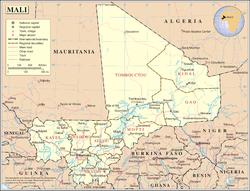
Mali is a landlocked nation in West Africa, located southwest of Algeria, extending south-west from the southern Sahara Desert through the Sahel to the Sudanian savanna zone. Mali's size is 1,240,192 square kilometers.
Desert or semi-desert covers about 65 percent of Mali's total area (1,240,192 square kilometers). The Niger River creates a large and fertile inland delta as it arcs northeast through Mali from Guinea before turning south and eventually emptying into the Gulf of Guinea.[1]
The territory encompasses three natural zones: the southern cultivated Sudanese zone, central semi-desert Sahelian zone, and northern desert Saharan zone. The terrain is primarily savanna in the south and flat to rolling plains or high plateau (200–500 meters in elevation) in the north. There are rugged hills in the northeast, with elevations of up to 1,000 meters.
The Niger (with 1,693 kilometers in Mali) and Senegal are Mali's two largest rivers. The Niger is generally described as Mali's lifeblood, a source of food, drinking water, irrigation, and transportation.[1]
The country's lowest point is on the Senegal River (23 m) and its highest point is Hombori Tondo (1155 m).
Climate
[edit]
Mali is one of the hottest countries in the world, and has overall a hot, sunny and dry climate dominated by the subtropical ridge. The thermal equator, which matches the hottest spots year-round on the planet based on the mean daily annual temperature, crosses the country.[1] Most of Mali receives negligible rainfall and droughts are very frequent.[1] Late April to early October is the rainy season in the southernmost area. During this time, flooding of the Niger River is common, creating the Inner Niger Delta. The vast northern desert part of Mali has a hot desert climate (Köppen BWh) with long, extremely hot summers and scarce rainfall which decreases northwards. The central area has a hot semi-arid climate (Köppen BSh) with very high temperatures year-round, a long, intense dry season and a brief, irregular rainy season. The southern areas have a tropical savanna climate (Köppen Aw) featuring very high temperatures year-round with a dry season and a rainy season.[1] During the hottest season of the year, temperatures are high throughout the country. Timbuktu, Taghaza, Taoudenni, Araouane, Gao, Kidal and Tessalit are some of the hottest spots on Earth during their warmest months. Kayes, with an average high temperature of about 44 °C or 111.2 °F in April is nicknamed "the pressure cooker of Africa" due to the extreme heat year-round. The heat is more extreme to the north in the Sahara Desert; the maximum average high temperature of the year reaches 46 °C or 114.8 °F in Araouane in June[2] and comes close to 48 °C or 118.4 °F in the Taoudenni region during July.[3] Sunshine duration is high in Mali, reaching the highest levels in the northern arid zone with about 3,600 – 3,700 h a year.
Examples
[edit]| Climate data for Bamako (1950–2000, extremes 1949–2015) | |||||||||||||
|---|---|---|---|---|---|---|---|---|---|---|---|---|---|
| Month | Jan | Feb | Mar | Apr | May | Jun | Jul | Aug | Sep | Oct | Nov | Dec | Year |
| Record high °C (°F) | 38.9 (102.0) |
42.8 (109.0) |
43.9 (111.0) |
43.5 (110.3) |
45.0 (113.0) |
42.0 (107.6) |
40.0 (104.0) |
37.8 (100.0) |
38.4 (101.1) |
38.9 (102.0) |
42.0 (107.6) |
40.0 (104.0) |
45.0 (113.0) |
| Mean daily maximum °C (°F) | 33.4 (92.1) |
36.4 (97.5) |
38.5 (101.3) |
39.6 (103.3) |
38.5 (101.3) |
35.3 (95.5) |
32.1 (89.8) |
31.1 (88.0) |
32.2 (90.0) |
34.6 (94.3) |
35.3 (95.5) |
33.4 (92.1) |
35.0 (95.0) |
| Mean daily minimum °C (°F) | 17.0 (62.6) |
19.9 (67.8) |
22.9 (73.2) |
25.2 (77.4) |
25.4 (77.7) |
23.6 (74.5) |
22.2 (72.0) |
21.8 (71.2) |
21.6 (70.9) |
21.3 (70.3) |
18.4 (65.1) |
16.8 (62.2) |
21.3 (70.3) |
| Record low °C (°F) | 8.7 (47.7) |
9.0 (48.2) |
12.0 (53.6) |
15.8 (60.4) |
17.8 (64.0) |
16.1 (61.0) |
17.5 (63.5) |
17.2 (63.0) |
18.0 (64.4) |
14.7 (58.5) |
10.8 (51.4) |
6.0 (42.8) |
6.0 (42.8) |
| Average rainfall mm (inches) | 0.6 (0.02) |
0.7 (0.03) |
2.1 (0.08) |
19.7 (0.78) |
54.1 (2.13) |
132.1 (5.20) |
224.1 (8.82) |
290.2 (11.43) |
195.9 (7.71) |
66.1 (2.60) |
5.2 (0.20) |
0.5 (0.02) |
991.3 (39.03) |
| Average rainy days (≥ 0.1 mm) | 0.2 | 0.2 | 0.6 | 3.3 | 6.3 | 7.7 | 16.7 | 17.9 | 14.7 | 5.7 | 0.3 | 0.1 | 73.7 |
| Average relative humidity (%) | 24 | 20 | 22 | 33 | 50 | 67 | 77 | 81 | 78 | 65 | 38 | 27 | 49 |
| Mean monthly sunshine hours | 277.4 | 253.0 | 268.1 | 230.4 | 242.6 | 233.6 | 216.6 | 218.3 | 221.7 | 253.7 | 270.7 | 268.6 | 2,954.7 |
| Source 1: World Meteorological Organization[4] | |||||||||||||
| Source 2: NOAA (sun 1961–1990),[5] Deutscher Wetterdienst (extremes and humidity)[6] | |||||||||||||
| Climate data for Sikasso, Mali (1950-2000, extremes 1940-1994) | |||||||||||||
|---|---|---|---|---|---|---|---|---|---|---|---|---|---|
| Month | Jan | Feb | Mar | Apr | May | Jun | Jul | Aug | Sep | Oct | Nov | Dec | Year |
| Record high °C (°F) | 40.5 (104.9) |
41.2 (106.2) |
42.1 (107.8) |
42.0 (107.6) |
44.0 (111.2) |
39.2 (102.6) |
42.2 (108.0) |
36.7 (98.1) |
38.9 (102.0) |
38.9 (102.0) |
40.0 (104.0) |
39.2 (102.6) |
44.0 (111.2) |
| Mean daily maximum °C (°F) | 33.5 (92.3) |
36.0 (96.8) |
37.4 (99.3) |
37.3 (99.1) |
35.6 (96.1) |
32.9 (91.2) |
30.7 (87.3) |
29.9 (85.8) |
31.0 (87.8) |
33.3 (91.9) |
34.4 (93.9) |
33.1 (91.6) |
33.8 (92.8) |
| Mean daily minimum °C (°F) | 15.3 (59.5) |
18.3 (64.9) |
22.1 (71.8) |
24.6 (76.3) |
24.1 (75.4) |
22.4 (72.3) |
21.5 (70.7) |
21.4 (70.5) |
21.3 (70.3) |
21.5 (70.7) |
18.5 (65.3) |
15.2 (59.4) |
20.5 (68.9) |
| Record low °C (°F) | 8.2 (46.8) |
10.0 (50.0) |
13.0 (55.4) |
16.8 (62.2) |
17.1 (62.8) |
17.7 (63.9) |
17.2 (63.0) |
17.0 (62.6) |
18.0 (64.4) |
14.0 (57.2) |
10.0 (50.0) |
8.0 (46.4) |
8.0 (46.4) |
| Average rainfall mm (inches) | 1.4 (0.06) |
4.1 (0.16) |
12.8 (0.50) |
45.9 (1.81) |
109.1 (4.30) |
152.3 (6.00) |
243.7 (9.59) |
308.8 (12.16) |
210.0 (8.27) |
84.4 (3.32) |
11.7 (0.46) |
2.0 (0.08) |
1,186.2 (46.71) |
| Average rainy days (≥ 0.1 mm) | 0.2 | 0.6 | 2.3 | 5.4 | 9.9 | 12.7 | 17.0 | 20.0 | 14.5 | 9.0 | 1.4 | 0.2 | 93.2 |
| Average relative humidity (%) | 31 | 27 | 33 | 48 | 61 | 72 | 79 | 82 | 80 | 71 | 52 | 38 | 56 |
| Mean monthly sunshine hours | 263.1 | 242.3 | 237.6 | 217.5 | 242.0 | 220.8 | 203.2 | 176.6 | 190.7 | 243.0 | 257.6 | 261.6 | 2,756 |
| Source 1: World Meteorological Organization[7] | |||||||||||||
| Source 2: NOAA (sun 1961–1990),[8] Deutscher Wetterdienst (extremes and humidity)[9] | |||||||||||||
| Climate data for Kayes (1950-2000) | |||||||||||||
|---|---|---|---|---|---|---|---|---|---|---|---|---|---|
| Month | Jan | Feb | Mar | Apr | May | Jun | Jul | Aug | Sep | Oct | Nov | Dec | Year |
| Mean daily maximum °C (°F) | 33.6 (92.5) |
36.6 (97.9) |
39.4 (102.9) |
41.7 (107.1) |
41.9 (107.4) |
38.2 (100.8) |
33.6 (92.5) |
32.0 (89.6) |
33.1 (91.6) |
36.1 (97.0) |
36.7 (98.1) |
33.5 (92.3) |
36.4 (97.5) |
| Mean daily minimum °C (°F) | 16.9 (62.4) |
19.3 (66.7) |
22.2 (72.0) |
25.5 (77.9) |
28.4 (83.1) |
26.6 (79.9) |
24.2 (75.6) |
23.3 (73.9) |
23.2 (73.8) |
23.0 (73.4) |
20.0 (68.0) |
17.2 (63.0) |
22.5 (72.5) |
| Average rainfall mm (inches) | 0.0 (0.0) |
0.4 (0.02) |
0.1 (0.00) |
0.6 (0.02) |
12.0 (0.47) |
82.6 (3.25) |
155.2 (6.11) |
215.9 (8.50) |
140.9 (5.55) |
41.2 (1.62) |
2.7 (0.11) |
1.1 (0.04) |
652.7 (25.69) |
| Average rainy days (≥ 0.1 mm) | 0.0 | 0.0 | 0.1 | 0.1 | 2.8 | 7.8 | 12.3 | 14.8 | 11.4 | 4.0 | 0.1 | 0.0 | 53.4 |
| Mean monthly sunshine hours | 263.5 | 250.0 | 282.1 | 285.0 | 279.0 | 215.0 | 211.8 | 223.2 | 240.0 | 263.5 | 264.0 | 260.6 | 3,037.7 |
| Source 1: World Meteorological Organization[10] | |||||||||||||
| Source 2: NOAA (sun 1961–1990)[11] | |||||||||||||
| Climate data for Mopti (1950-2000, extremes 1935-1994) | |||||||||||||
|---|---|---|---|---|---|---|---|---|---|---|---|---|---|
| Month | Jan | Feb | Mar | Apr | May | Jun | Jul | Aug | Sep | Oct | Nov | Dec | Year |
| Record high °C (°F) | 39.2 (102.6) |
44.0 (111.2) |
44.6 (112.3) |
45.5 (113.9) |
48.3 (118.9) |
46.7 (116.1) |
43.2 (109.8) |
43.3 (109.9) |
42.8 (109.0) |
44.4 (111.9) |
44.5 (112.1) |
39.3 (102.7) |
48.3 (118.9) |
| Mean daily maximum °C (°F) | 31.7 (89.1) |
34.9 (94.8) |
37.7 (99.9) |
40.2 (104.4) |
40.5 (104.9) |
38.3 (100.9) |
34.6 (94.3) |
32.6 (90.7) |
33.3 (91.9) |
35.5 (95.9) |
35.0 (95.0) |
31.6 (88.9) |
35.5 (95.9) |
| Mean daily minimum °C (°F) | 15.1 (59.2) |
17.6 (63.7) |
21.2 (70.2) |
24.7 (76.5) |
26.5 (79.7) |
25.7 (78.3) |
23.9 (75.0) |
23.3 (73.9) |
23.7 (74.7) |
23.4 (74.1) |
19.5 (67.1) |
16.0 (60.8) |
21.7 (71.1) |
| Record low °C (°F) | 6.1 (43.0) |
7.2 (45.0) |
10.0 (50.0) |
13.4 (56.1) |
15.8 (60.4) |
18.3 (64.9) |
17.4 (63.3) |
18.0 (64.4) |
15.0 (59.0) |
14.4 (57.9) |
11.9 (53.4) |
7.0 (44.6) |
6.1 (43.0) |
| Average rainfall mm (inches) | 0.8 (0.03) |
0.0 (0.0) |
0.8 (0.03) |
4.0 (0.16) |
23.4 (0.92) |
55.8 (2.20) |
140.5 (5.53) |
165.6 (6.52) |
88.7 (3.49) |
19.8 (0.78) |
0.3 (0.01) |
0.4 (0.02) |
500.1 (19.69) |
| Average rainy days (≥ 0.1 mm) | 0.1 | 0.1 | 0.4 | 1.1 | 3.4 | 7.5 | 12.3 | 14.0 | 8.6 | 3.0 | 0.1 | 0.1 | 50.7 |
| Average relative humidity (%) | 24 | 20 | 19 | 21 | 33 | 47 | 62 | 70 | 66 | 49 | 31 | 27 | 39 |
| Mean monthly sunshine hours | 272.6 | 270.0 | 274.2 | 254.6 | 269.2 | 242.3 | 244.3 | 246.2 | 249.8 | 278.5 | 282.0 | 264.3 | 3,148 |
| Source 1: World Meteorological Organization[12] | |||||||||||||
| Source 2: NOAA (sun 1961-1990),[13] Deutscher Wetterdienst (extremes and humidity)[14] | |||||||||||||
| Climate data for Timbuktu (1950–2000, extremes 1897–present) | |||||||||||||
|---|---|---|---|---|---|---|---|---|---|---|---|---|---|
| Month | Jan | Feb | Mar | Apr | May | Jun | Jul | Aug | Sep | Oct | Nov | Dec | Year |
| Record high °C (°F) | 41.6 (106.9) |
43.5 (110.3) |
46.1 (115.0) |
48.9 (120.0) |
49.0 (120.2) |
49.0 (120.2) |
46.0 (114.8) |
46.5 (115.7) |
45.0 (113.0) |
48.0 (118.4) |
42.5 (108.5) |
40.0 (104.0) |
49.0 (120.2) |
| Mean daily maximum °C (°F) | 30.0 (86.0) |
33.2 (91.8) |
36.6 (97.9) |
40.0 (104.0) |
42.2 (108.0) |
41.6 (106.9) |
38.5 (101.3) |
36.5 (97.7) |
38.3 (100.9) |
39.1 (102.4) |
35.2 (95.4) |
30.4 (86.7) |
36.8 (98.2) |
| Daily mean °C (°F) | 21.5 (70.7) |
24.2 (75.6) |
27.6 (81.7) |
31.3 (88.3) |
34.1 (93.4) |
34.5 (94.1) |
32.2 (90.0) |
30.7 (87.3) |
31.6 (88.9) |
30.9 (87.6) |
26.5 (79.7) |
22.0 (71.6) |
28.9 (84.0) |
| Mean daily minimum °C (°F) | 13.0 (55.4) |
15.2 (59.4) |
18.5 (65.3) |
22.5 (72.5) |
26.0 (78.8) |
27.3 (81.1) |
25.8 (78.4) |
24.8 (76.6) |
24.8 (76.6) |
22.7 (72.9) |
17.7 (63.9) |
13.5 (56.3) |
21.0 (69.8) |
| Record low °C (°F) | 1.7 (35.1) |
7.5 (45.5) |
7.0 (44.6) |
8.0 (46.4) |
18.5 (65.3) |
17.4 (63.3) |
18.0 (64.4) |
20.0 (68.0) |
18.9 (66.0) |
13.0 (55.4) |
11.0 (51.8) |
3.5 (38.3) |
1.7 (35.1) |
| Average rainfall mm (inches) | 0.6 (0.02) |
0.1 (0.00) |
0.1 (0.00) |
1.0 (0.04) |
4.0 (0.16) |
16.4 (0.65) |
53.5 (2.11) |
73.6 (2.90) |
29.4 (1.16) |
3.8 (0.15) |
0.1 (0.00) |
0.2 (0.01) |
182.8 (7.20) |
| Average rainy days (≥ 0.1 mm) | 0.1 | 0.1 | 0.1 | 0.6 | 0.9 | 3.2 | 6.6 | 8.1 | 4.7 | 0.8 | 0.0 | 0.1 | 25.3 |
| Mean monthly sunshine hours | 263.9 | 249.6 | 269.9 | 254.6 | 275.3 | 234.7 | 248.6 | 255.3 | 248.9 | 273.0 | 274.0 | 258.7 | 3,106.5 |
| Source 1: World Meteorological Organization,[15] NOAA (sun 1961–1990)[16] | |||||||||||||
| Source 2: Meteo Climat (record highs and lows)[17] | |||||||||||||
| Climate data for Gao, Mali (1950–2000) | |||||||||||||
|---|---|---|---|---|---|---|---|---|---|---|---|---|---|
| Month | Jan | Feb | Mar | Apr | May | Jun | Jul | Aug | Sep | Oct | Nov | Dec | Year |
| Mean daily maximum °C (°F) | 30.8 (87.4) |
33.8 (92.8) |
37.2 (99.0) |
40.7 (105.3) |
42.5 (108.5) |
41.5 (106.7) |
38.5 (101.3) |
36.6 (97.9) |
38.4 (101.1) |
39.3 (102.7) |
35.8 (96.4) |
31.4 (88.5) |
37.2 (99.0) |
| Mean daily minimum °C (°F) | 14.8 (58.6) |
17.0 (62.6) |
20.8 (69.4) |
24.7 (76.5) |
28.2 (82.8) |
28.8 (83.8) |
26.6 (79.9) |
25.4 (77.7) |
26.0 (78.8) |
24.9 (76.8) |
19.9 (67.8) |
15.8 (60.4) |
22.7 (72.9) |
| Average rainfall mm (inches) | 0.0 (0.0) |
0.1 (0.00) |
0.3 (0.01) |
1.7 (0.07) |
7.7 (0.30) |
22.8 (0.90) |
63.6 (2.50) |
84.2 (3.31) |
33.5 (1.32) |
4.8 (0.19) |
0.0 (0.0) |
0.1 (0.00) |
218.8 (8.61) |
| Average rainy days (≥ 0.1 mm) | 0.1 | 0.1 | 0.3 | 0.3 | 1.3 | 3.9 | 7.9 | 8.4 | 5.2 | 0.9 | 0.0 | 0.1 | 28.5 |
| Mean monthly sunshine hours | 269.8 | 257.9 | 269.6 | 254.2 | 274.9 | 227.1 | 249.7 | 251.5 | 253.5 | 279.8 | 280.8 | 261.9 | 3,130.7 |
| Source 1: World Meteorological Organization[18] | |||||||||||||
| Source 2: NOAA (sun 1961–1990)[19] | |||||||||||||
| Climate data for Kidal (1950–2000) | |||||||||||||
|---|---|---|---|---|---|---|---|---|---|---|---|---|---|
| Month | Jan | Feb | Mar | Apr | May | Jun | Jul | Aug | Sep | Oct | Nov | Dec | Year |
| Mean daily maximum °C (°F) | 28.0 (82.4) |
31.1 (88.0) |
34.8 (94.6) |
38.8 (101.8) |
41.5 (106.7) |
41.9 (107.4) |
39.9 (103.8) |
38.4 (101.1) |
39.1 (102.4) |
38.0 (100.4) |
33.4 (92.1) |
28.9 (84.0) |
36.2 (97.2) |
| Mean daily minimum °C (°F) | 12.5 (54.5) |
14.8 (58.6) |
18.7 (65.7) |
23.0 (73.4) |
27.0 (80.6) |
28.6 (83.5) |
27.2 (81.0) |
26.2 (79.2) |
26.0 (78.8) |
23.2 (73.8) |
18.0 (64.4) |
13.7 (56.7) |
21.6 (70.9) |
| Average rainfall mm (inches) | 0.6 (0.02) |
0.1 (0.00) |
0.2 (0.01) |
1.0 (0.04) |
5.3 (0.21) |
11.6 (0.46) |
36.8 (1.45) |
45.9 (1.81) |
23.1 (0.91) |
3.0 (0.12) |
0.2 (0.01) |
0.2 (0.01) |
128.0 (5.04) |
| Average rainy days (≥ 0.1 mm) | 0.2 | 0.1 | 0.2 | 0.2 | 1.0 | 3.0 | 6.1 | 6.9 | 3.9 | 0.6 | 0.1 | 0.3 | 22.6 |
| Mean monthly sunshine hours | 274.5 | 267.3 | 286.1 | 283.9 | 294.0 | 230.8 | 269.8 | 276.9 | 271.6 | 296.4 | 286.6 | 275.5 | 3,313.4 |
| Source 1: World Meteorological Organization[20] | |||||||||||||
| Source 2: NOAA (sun 1961–1990)[21] | |||||||||||||
| Climate data for Araouane | |||||||||||||
|---|---|---|---|---|---|---|---|---|---|---|---|---|---|
| Month | Jan | Feb | Mar | Apr | May | Jun | Jul | Aug | Sep | Oct | Nov | Dec | Year |
| Mean daily maximum °C (°F) | 27.2 (81.0) |
31.1 (88.0) |
36.7 (98.1) |
43.3 (109.9) |
44.4 (111.9) |
46.6 (115.9) |
43.9 (111.0) |
42.8 (109.0) |
42.8 (109.0) |
39.4 (102.9) |
32.8 (91.0) |
28.3 (82.9) |
38.3 (100.9) |
| Daily mean °C (°F) | 18.0 (64.4) |
21.1 (70.0) |
26.2 (79.2) |
31.4 (88.5) |
33.8 (92.8) |
36.7 (98.1) |
35.0 (95.0) |
33.9 (93.0) |
34.2 (93.6) |
30.3 (86.5) |
24.2 (75.6) |
19.1 (66.4) |
28.7 (83.6) |
| Mean daily minimum °C (°F) | 8.9 (48.0) |
11.1 (52.0) |
15.6 (60.1) |
19.4 (66.9) |
23.3 (73.9) |
26.7 (80.1) |
26.1 (79.0) |
25.0 (77.0) |
25.6 (78.1) |
21.1 (70.0) |
15.6 (60.1) |
10.0 (50.0) |
19.0 (66.3) |
| Average precipitation mm (inches) | 1 (0.0) |
1 (0.0) |
0 (0) |
0 (0) |
0 (0) |
5 (0.2) |
5 (0.2) |
15 (0.6) |
13 (0.5) |
2 (0.1) |
2 (0.1) |
1 (0.0) |
45 (1.7) |
| Source: Weather and Climate in Africa[22] | |||||||||||||
| Climate data for Taoudenni | |||||||||||||
|---|---|---|---|---|---|---|---|---|---|---|---|---|---|
| Month | Jan | Feb | Mar | Apr | May | Jun | Jul | Aug | Sep | Oct | Nov | Dec | Year |
| Mean daily maximum °C (°F) | 26.2 (79.2) |
30 (86) |
32.5 (90.5) |
39.8 (103.6) |
42.6 (108.7) |
46.7 (116.1) |
47.9 (118.2) |
46.6 (115.9) |
44.1 (111.4) |
38.6 (101.5) |
31.6 (88.9) |
26.4 (79.5) |
37.8 (100.0) |
| Daily mean °C (°F) | 18.1 (64.6) |
21.1 (70.0) |
24.4 (75.9) |
29.8 (85.6) |
33.1 (91.6) |
37.2 (99.0) |
38.8 (101.8) |
37.8 (100.0) |
35.9 (96.6) |
30.4 (86.7) |
23.9 (75.0) |
18.6 (65.5) |
28.2 (82.8) |
| Mean daily minimum °C (°F) | 9.9 (49.8) |
12.2 (54.0) |
16.3 (61.3) |
19.8 (67.6) |
23.6 (74.5) |
27.6 (81.7) |
29.6 (85.3) |
29 (84) |
27.6 (81.7) |
22.1 (71.8) |
16.2 (61.2) |
10.8 (51.4) |
20.4 (68.7) |
| Average precipitation mm (inches) | 0.5 (0.02) |
0.1 (0.00) |
0.0 (0.0) |
0.2 (0.01) |
0.2 (0.01) |
0.4 (0.02) |
3.0 (0.12) |
8.5 (0.33) |
5.4 (0.21) |
1.6 (0.06) |
0.5 (0.02) |
0.4 (0.02) |
20.8 (0.82) |
| Average precipitation days | 0.0 | 0.0 | 0.0 | 0.0 | 0.0 | 0.0 | 0.9 | 1.8 | 0.6 | 0.0 | 0.0 | 0.0 | 3.3 |
| Average relative humidity (%) | 33.5 | 29.1 | 25.6 | 23.1 | 23.5 | 28.9 | 35.8 | 43.0 | 40.4 | 31.4 | 32.3 | 34.2 | 31.7 |
| Source: Weatherbase[23] | |||||||||||||
| Climate data for Teghaza | |||||||||||||
|---|---|---|---|---|---|---|---|---|---|---|---|---|---|
| Month | Jan | Feb | Mar | Apr | May | Jun | Jul | Aug | Sep | Oct | Nov | Dec | Year |
| Mean daily maximum °C (°F) | 25.2 (77.4) |
29.0 (84.2) |
31.7 (89.1) |
38.3 (100.9) |
41.3 (106.3) |
45.7 (114.3) |
48.2 (118.8) |
46.8 (116.2) |
43.5 (110.3) |
37.4 (99.3) |
30.5 (86.9) |
25.1 (77.2) |
36.9 (98.4) |
| Daily mean °C (°F) | 17.0 (62.6) |
20.1 (68.2) |
23.5 (74.3) |
28.3 (82.9) |
31.7 (89.1) |
35.8 (96.4) |
38.7 (101.7) |
37.7 (99.9) |
35.1 (95.2) |
29.1 (84.4) |
22.8 (73.0) |
17.4 (63.3) |
28.1 (82.6) |
| Mean daily minimum °C (°F) | 8.8 (47.8) |
11.2 (52.2) |
15.3 (59.5) |
18.4 (65.1) |
22.2 (72.0) |
26.0 (78.8) |
29.2 (84.6) |
28.6 (83.5) |
26.7 (80.1) |
20.8 (69.4) |
15.2 (59.4) |
9.7 (49.5) |
19.3 (66.8) |
| Average precipitation mm (inches) | 0 (0) |
1 (0.0) |
0 (0) |
0 (0) |
0 (0) |
0 (0) |
1 (0.0) |
3 (0.1) |
4 (0.2) |
1 (0.0) |
1 (0.0) |
0 (0) |
11 (0.3) |
| Source: Climate-Data.org[24] | |||||||||||||
Geology
[edit]

Geologically, Mali consists mostly of vast flatlands of granite and shale covered by sandstone and alluvial quartz.[25] Mali extends over two main geological structures, the West African craton in the west and the Tuareg shield in the southeast, which came together at the end of the Precambrian era between 600 and 550 million years ago. The suture zone is to the west of the Adrar des Ifoghas mountains.[26]
The underlying rocks of the West African craton are covered in the northwest by sediments of the Taoudeni basin, with two main outcrops of crystalline rocks in the northern Reguibat shield in Mauritania and the southern Leo shield which includes the Bougouni and Kenieba outcrops, both of which contain valuable minerals.[26] There may also be petroleum reserves in the Taoudeni basin.[27]
Borders
[edit]Mali shares a total of 7,243 kilometers (4,500 miles) of land boundaries with seven bordering states:
North and northeast: Algeria- 1,376 km/855 mi
East: Niger- 821 km/510 mi
Southeast: Burkina Faso- 1,000 km/621 mi
South: Ivory Coast- 532 km/330 mi
Southwest: Guinea- 858 km/533 mi
West: Senegal and Mauritania- 419 km/260 mi and 2,237 km/1,390 mi (respectively)
Natural resources
[edit]Mali is endowed with bauxite, copper, diamonds, gold, Granite, gypsum, iron ore, kaolin, limestone, lithium, manganese, phosphates, salt, silver, uranium, and zinc. Not all deposits are being exploited, and some may not be commercially viable. Mali also has ample hydropower.
Land use
[edit]65% of Mali's land area is desert or semi-desert. According to estimates in 2011, only 5.63% of Mali's area can be classified as arable land, and 0.1% was planted to permanent crops. Mali was estimated to have 2,358 km2 of irrigated land in 2003. Mali has 100 cubic kilometers of total renewable water resources as off 2011 estimates.[1]
Environmental issues
[edit]Mali faces numerous environmental challenges, including desertification, deforestation, soil erosion, drought, and inadequate supplies of potable water. Deforestation is an especially serious and growing problem. According to the Ministry of the Environment, Mali's population consumes 6 million tons of wood per year for timber and fuel. To meet this demand, 400,000 hectares of tree cover are lost annually, virtually ensuring destruction of the country's savanna woodlands.[1]
Mali is a party to international treaties on Biodiversity, Climate Change, Climate Change-Kyoto Protocol, Desertification, Endangered Species, Hazardous Wastes, Law of the Sea, Ozone Layer Protection, Wetlands, and Whaling. It has signed, but not ratified the selected agreements.
Natural hazards
[edit]Natural hazards in Mali include:
- Desert sandstorms in the north
- Dust-laden harmattan wind is common during dry seasons, bringing a dust haze which may ground aircraft and damage computers and sensitive electronics and machines, as well as aggravating respiratory diseases.
- Recurring droughts
- Wildfires in the south
- Occasional floods, for example in July 2007.[28]
- Tropical thunderstorms in the south, which may bring wind and lightning damage as well as flash floods.
- Occasional Niger River flooding
Extreme points
[edit]This is a list of the extreme points of Mali, the points that are farther north, south, east or west than any other location.
- Northernmost point – the northern section of the border with Mauritania, Tombouctou Region*
- Easternmost point – the eastern section of the border with Niger**
- Southernmost point – Fonto Kourou on the border with Côte d'Ivoire, Sikasso Region
- Westernmost point – the tripoint with Senegal and Mauritania, Kayes Region
- *Note: Mali does not have a northernmost point, the border being formed by a straight east–west line
- **Note: Mali does not have an easternmost point, the border being formed by a straight north–south line
See also
[edit]References
[edit]- ^ a b c d e f g "Mali country profile" (PDF). Library of Congress Federal Research Division. January 2005.
- ^ Dubief, Jean (January 1999). L'Ajjer, Sahara central. ISBN 9782865378968.
- ^ Correspondance d'Orient (Report). Brussels, Belgium: Centre pour l'étude des problèmes du monde musulman contemporain. 1960. pp. 23–24.
- ^ "World Weather Information Service – Bamako". World Meteorological Organization. Archived from the original on 13 March 2013. Retrieved 20 June 2013.
- ^ "BKO–s (Bamako) Climate Normals 1961–1990". National Oceanic and Atmospheric Administration (FTP). Retrieved 10 September 2015. (To view documents see Help:FTP)
- ^ "Klimatafel von Bamako (Flughafen) / Mali" (PDF). Baseline climate means (1961–1990) from stations all over the world (in German). Deutscher Wetterdienst. Archived (PDF) from the original on 9 June 2020. Retrieved 3 February 2019.
- ^ "World Weather Information Service – Sikasso". World Meteorological Organization. Retrieved 12 October 2015.
- ^ "Sikasso Climate Normals 1961-1990". National Oceanic and Atmospheric Administration (FTP). Retrieved 12 October 2015. (To view documents see Help:FTP)
- ^ "Klimatafel von Sikasso / Mali" (PDF). Baseline climate means (1961-1990) from stations all over the world (in German). Deutscher Wetterdienst. Retrieved 26 January 2016.
- ^ "World Weather Information Service – Kayes". World Meteorological Organization. Retrieved 12 October 2015.
- ^ "Kayes Climate Normals 1961–1990". National Oceanic and Atmospheric Administration. Archived from the original on 22 November 2023. Retrieved 12 October 2015.
- ^ "World Weather Information Service – Mopti". World Meteorological Organization. Retrieved 12 October 2015.
- ^ "Mopti Climate Normals 1961-1990". National Oceanic and Atmospheric Administration (FTP). Retrieved 12 October 2015. (To view documents see Help:FTP)
- ^ "Klimatafel von Mopti / Mali" (PDF). Baseline climate means (1961-1990) from stations all over the world (in German). Deutscher Wetterdienst. Retrieved 26 January 2016.
- ^ "World Weather Information Service – Tombouctou (1950–2000)". World Meteorological Organization. Retrieved 14 February 2011.
- ^ "Tomb (Tombouctou) Climate Normals 1961–1990". National Oceanic and Atmospheric Administration (FTP). Retrieved 12 October 2015. (To view documents see Help:FTP)
- ^ "Station Tombouctou" (in French). Meteo Climat. Retrieved 10 June 2016.
- ^ "World Weather Information Service – Gao". World Meteorological Organization. Retrieved 12 October 2015.
- ^ "Gao Climate Normals 1961–1990". National Oceanic and Atmospheric Administration. Archived from the original on 16 October 2020. Retrieved 12 October 2015.
- ^ "World Weather Information Service – Kidal". World Meteorological Organization. Retrieved 12 October 2015.
- ^ "Kidal Climate Normals 1961–1990". National Oceanic and Atmospheric Administration. Archived from the original on 1 November 2020. Retrieved 12 October 2015.
- ^ Buckle, Colin (1996). Climatological data for Araouane, Mali (temperatures, rainfall). ISBN 9780582093331. Retrieved 31 May 2013.
- ^ "Weatherbase". Retrieved 19 June 2015.
- ^ "Climate: Teghaza". Climate-Data.org. Retrieved 28 March 2020.
- ^ John Middleton, ed. (1997). "Mali". Encyclopedia of Africa South of the Sahara. Vol. 3. Charles Scribner's Sons.
- ^ a b Imrich Kusnir (1999). "Gold in Mali" (PDF). Acta Montanistica Slovaca. Retrieved 14 March 2009.
- ^ "Taoudeni Basin, OnshoreMali & Mauritania" (PDF). IHS. August 2007. Retrieved 14 March 2009.
- ^ International Federation of Red Cross And Red Crescent Societies (IFRC): "Mali: Floods DREF Bulletin No. MDRML004". 13 July 2007. ReliefWeb site retrieved 13 August 2007.
Geography of Mali
View on GrokipediaLocation and Borders
Geographical Position and Extent
Mali is a landlocked country situated in West Africa, extending from the southern fringes of the Sahara Desert southward into the Sahel region.[5] Its central geographic coordinates are approximately 17° N latitude and 4° W longitude.[8] The nation spans latitudes from roughly 10° N to 25° N and longitudes from 12° W to 4° E, positioning it entirely within the northern hemisphere and encompassing diverse climatic zones from arid desert in the north to semi-arid savanna in the south.[9] With a total area of 1,240,192 square kilometers, Mali ranks as the eighth-largest country in Africa, larger than twice the size of France or Spain.[10] [11] The country's maximum dimensions measure approximately 1,852 kilometers from east-northeast to west-southwest and 1,258 kilometers from north-northwest to south-southeast, reflecting its elongated shape that facilitates trans-Saharan trade routes historically.[12] This vast expanse, predominantly flat and arid, underscores Mali's strategic yet challenging geographic profile as a bridge between North Africa and sub-Saharan regions.[13]Bordering Nations and Demarcations
Mali, a landlocked nation in West Africa, shares land borders totaling 7,908 kilometers with seven neighboring countries.[1] These borders, primarily established during the colonial era by France as divisions between administrative territories in French West Africa and adjacent colonies, follow a mix of straight lines, parallels of latitude, and natural features such as rivers in certain segments.[1] To the north, Mali borders Algeria for 1,359 kilometers, a demarcation largely along the 19th to 25th parallels north, reflecting Saharan transitional zones with minimal natural barriers.[1] Northwestward, the 2,236-kilometer border with Mauritania runs along the Senegal River in parts and straight lines, facilitating cross-border pastoral movements but also posing challenges for security due to porous desert terrain.[1] To the west, the 489-kilometer boundary with Senegal follows the Senegal River upstream before transitioning to straight segments, a legacy of French colonial partitioning that separated related ethnic groups.[1] Southwest, Guinea adjoins Mali for 1,062 kilometers, with borders defined by colonial treaties and running through forested and savanna regions.[1] Southward, the 599-kilometer border with Côte d'Ivoire traverses savanna and transitions to more defined lines post-independence surveys.[1] Southeast, Burkina Faso shares a 1,325-kilometer frontier, subject to a historical dispute resolved by the International Court of Justice in 1986, which delimited the boundary using the uti possidetis juris principle to inherit colonial lines; physical demarcation efforts have proceeded intermittently since.[1][14] To the east, Niger borders Mali for 838 kilometers, mostly straight lines across semi-arid landscapes.[1]| Neighboring Country | Border Length (km) | Primary Orientation |
|---|---|---|
| Algeria | 1,359 | North |
| Mauritania | 2,236 | Northwest |
| Senegal | 489 | West |
| Guinea | 1,062 | Southwest |
| Côte d'Ivoire | 599 | South |
| Burkina Faso | 1,325 | Southeast |
| Niger | 838 | East |
Topography and Landforms
Major Physiographic Regions
Mali's physiography is dominated by three principal regions aligned latitudinally: the arid Saharan desert in the north, the semi-arid Sahelian steppe in the center, and the Sudanian savanna in the south. These divisions reflect gradients in elevation, landforms, and aridity, with the terrain generally comprising flat to rolling plains interrupted by localized rugged features.[3][5] The northern Saharan region, encompassing roughly 65 percent of the country's 1,240,192 square kilometers, features extensive sand-covered plains, ergs (dune fields), and regs (gravel-strewn plateaus) at elevations of 200 to 500 meters above sea level. This zone includes the Adrar des Ifoghas massif in the northeast, a rugged sandstone plateau spanning about 250,000 square kilometers with peaks exceeding 900 meters, providing the most prominent relief in the otherwise monotonous desert landscape.[5][16] Transitioning southward, the central Sahelian zone consists of flat to rolling plains and low plateaus, with sparse vegetation and occasional rocky outcrops or inselbergs, maintaining similar elevations but exhibiting greater seasonal fluvial influence from rivers like the Niger. This intermediary belt, narrower than the northern desert, serves as a transitional landform between hyper-arid sands and more vegetated terrains.[3][1] In the south, the Sudanian savanna region presents wooded grasslands and open plains, with terrain varying from level floodplains to scattered hills and cliffs, supporting higher relief in areas like the Mandingue Plateau. Elevations here average around 300 meters, with the landscape dissected by major river valleys that enhance local topographic diversity compared to the uniformity of northern expanses.[3][5]Elevation Extremes and Relief Features
Mali's highest elevation is Hombori Tondo at 1,155 meters, located in the Mopti Region near the town of Hombori.[1][3] The lowest point occurs along the Senegal River at 23 meters above sea level in the northwest.[1][5] The country's mean elevation stands at 343 meters, reflecting its predominantly low-relief landscape.[1] The relief of Mali consists primarily of flat to rolling plains and high plateaus, with the northern regions featuring barren desert expanses contoured by sand dunes and rocky outcroppings typically below 300 meters.[3] In the northeast, the rugged Adrar des Ifoghas massif introduces more pronounced elevation variations, with hills exceeding 1,000 meters, though none surpass Hombori Tondo.[17][5] Central and southern areas include sandstone plateaus and the Mandingue Plateau near Bamako, where elevations range from 600 to over 640 meters amid savanna terrain.[17] Southeastward, relief features gentle rises from around 300 meters near Sikasso to 530 meters at Mount Mina.[17] Overall, Mali lacks significant mountain ranges, contributing to its characterization as a vast, low-lying plateau dissected by major river systems.[3]Geology and Mineralogy
Geological Structure and History
Mali's geological structure is dominated by the Precambrian basement of the West African Craton (WAC), a stable continental block comprising Archean nuclei and Paleoproterozoic domains that stabilized around 1700 Ma after accretionary orogenic events.[18] The WAC extends across Mali, featuring ancient gneisses, granitoids, and supracrustal sequences formed between 3.5 Ga and 1.7 Ga, with the craton's margins influenced by later Proterozoic and Phanerozoic sedimentation.[19] In southern Mali, Paleoproterozoic greenstone belts like the Syama and Tabakoroni, part of Birimian terranes, consist of volcano-sedimentary assemblages including basalts, andesites, shales, and intrusions dated to approximately 2.1 Ga, hosting major gold deposits through hydrothermal alteration and shearing.[20] [18] The tectonic history of Mali centers on the Eburnean orogeny (ca. 2.3–1.9 Ga), which assembled the WAC through subduction-related accretion, magmatism, and collision, as evidenced by U-Pb zircon dating of deformational phases in southern Mali: an early isoclinal folding (D1) bracketed at 2098 ± 5 Ma, followed by regional shear tectonics (D2) at 2074 +9/-8 Ma.[21] This orogeny produced north-northeast-trending litho-structural corridors with mineralized shear zones, as seen in the Loulo and Syama districts where Paleoproterozoic gold lodes formed via fluid-rock interactions in greenschist facies metamorphism.[22] Post-orogenic stabilization led to intracratonic basin development, notably the Neoproterozoic to Paleozoic Taoudeni Basin covering northern and western Mali with flat-lying sandstones, shales, and limestones up to several kilometers thick, including Cambrian aquifers in the north.[23] In northern Mali, the Gourma fold-and-thrust belt records Neoproterozoic-early Paleozoic subduction and collision along the WAC's eastern margin, with ultrahigh-pressure coesite-bearing eclogites exhumed rapidly around 615 Ma during closure of the Pharusian Ocean, marking one of Earth's earliest known UHP events.[24] Phanerozoic history involves subsidence and sedimentation in the Iullemmeden and Gao basins, depositing Upper Cretaceous to Lower Paleogene marine and continental strata, such as sandstones and clays in the Tilemsi Trough, influenced by the opening of the South Atlantic and regional epeiric seas.[25] Overall, Mali's geology reflects cratonic stability punctuated by marginal orogenic pulses and basin infill, with minimal Cenozoic tectonics beyond erosional planation and laterite formation under tropical weathering regimes.[26]Soil Types and Composition
Mali's soils exhibit marked zonal variation tied to its climatic gradients and underlying geology, with sandy textures predominating due to quartz-rich parent materials from Precambrian shields and sedimentary basins. In the northern Saharan desert, Arenosols form the primary soil type, featuring loose, quartz-dominated sands exceeding 80% coarse fractions, minimal clay (<10%), and organic carbon below 0.5%, which severely limits water infiltration capacity and nutrient holding via low cation exchange (typically <5 cmol/kg). These immature soils, derived from aeolian deposits and sandstones, support sparse vegetation and are prone to wind erosion.[27] The central Sahelian transition hosts Regosols, Cambisols, and Luvisols, often with sandy loam surface horizons (70-85% sand) overlying weakly developed clay-enriched subsoils, reflecting incipient pedogenesis under semi-arid conditions. Organic matter contents range from 0.3% to 1.0%, with low available phosphorus (trace to 10 mg/kg) and nitrogen deficiencies exacerbating fertility decline from overcultivation and erosion. Vertisols occur locally in clay-rich depressions, characterized by high smectite content leading to swelling-cracking behavior, though these represent minor extents compared to coarser types.[28][29] In southern Sudanian savannas, more weathered Lixisols and Plinthosols prevail, with textural contrasts showing sandy tops (60-80% sand) over kaolinitic clay accumulations and iron-aluminum oxide nodules (plinthite), fostering acidic profiles (pH 4.2-5.6) and low base saturation (<35%). These soils, influenced by ferruginous parent rocks, display variable fertility influenced by mottling and induration, yet suffer phosphorus fixation and leaching losses, with organic carbon seldom exceeding 1.5% in uncultivated areas. Overall, Mali's soil composition underscores widespread constraints from low inherent fertility and degradation, necessitating targeted amendments for agricultural viability.[30][31][29]Climate Patterns
Climatic Zones and Classification
Mali exhibits a pronounced north-south climatic gradient, classified under the Köppen-Geiger system into three main zones: hot desert (BWh) in the north, hot semi-arid (BSh) in the central Sahel, and tropical savanna (Aw) in the south. This classification is based on thresholds of temperature, precipitation, and seasonality, with dry climates (B) dominating over 80% of the territory due to the country's position in the subtropical high-pressure belt and limited monsoon influence in northern latitudes.[32] The northern BWh zone covers approximately 51% of Mali's land area, receiving less than 200 mm of annual rainfall, primarily from sporadic convective storms, and experiences persistent aridity driven by the harmattan winds from the Sahara.[33] The central Sahelian region, classified as BSh, spans about 27% of the country and features annual precipitation of 200-500 mm, concentrated in a short wet season from June to September as the Intertropical Convergence Zone (ITCZ) shifts northward. This zone transitions from desert to semi-arid conditions, with potential evapotranspiration far exceeding rainfall, leading to recurrent droughts and vulnerability to desertification.[32][33] In contrast, the southern Sudanian zone (Aw) occupies roughly 20% of the area, with rainfall ranging from 500-1,100 mm annually, supporting savanna woodlands through more reliable monsoon rains, though still marked by a distinct dry season from November to May. A narrow Sudano-Guinean subzone in the extreme south, less than 2% of the territory, receives over 1,100 mm, bordering wetter climates but remaining within the Aw category due to pronounced dry winters.[33][29] These zones reflect causal influences from global atmospheric circulation, including the seasonal migration of the ITCZ and subsidence from the Azores High, resulting in decreasing precipitation with latitude and high year-round temperatures averaging above 18°C in the coldest month across all regions. Empirical data from 1991-2020 confirm the stability of these boundaries, though variability in rainfall has increased, with southern zones showing greater interannual fluctuations.[32][29]Temperature, Precipitation, and Variability
Mali experiences consistently high temperatures across its territory, with annual means ranging from approximately 24°C in the northern highlands to 28–30°C in the southern Sudanian zones. Daytime maxima frequently surpass 40°C during the pre-monsoon hot season (March–May), while nocturnal lows in the arid north can descend to 10–15°C under clear skies, yielding large diurnal amplitudes exceeding 20°C. In contrast, the more humid south exhibits smaller daily swings due to higher moisture retention. Historical observations from 1900–2009 reveal a warming trend of about 0.8°C overall since 1975, with amplified increases of over 0.7°C during the June–September rainy period, consistent with broader Sahelian patterns driven by reduced cloud cover and land-atmosphere feedbacks.[34][35] Precipitation in Mali is markedly seasonal, occurring primarily during the West African monsoon from June to September, with negligible amounts outside this window. Spatial gradients are steep: annual totals average under 100 mm in the northern Sahara, 300–600 mm in the central Sahel, and 800–1,100 mm (locally up to 1,700 mm) in the southern Sudanian savannas, reflecting the southward progression of monsoon moisture. These patterns stem from the Intertropical Convergence Zone's latitudinal shift, modulated by Atlantic sea surface temperatures and continental convection. Long-term data indicate no robust monotonic trend in total rainfall, though monthly distributions show slight intensification in peak events.[35][36][37] Interannual variability dominates Mali's hydroclimate, particularly in precipitation, where standard deviations often exceed 20–30% of mean values, fostering cycles of drought and pluvial excess. The 1970s–1980s Sahel drought halved rainfall in central regions relative to 1950s–1960s norms, attributed to shifts in African Easterly Jet dynamics and cooler tropical Atlantic waters, with lingering effects on soil moisture and vegetation. Partial recovery ensued in subsequent decades, yet episodes like the 2011–2012 shortfalls underscore persistent fluctuations, outpacing temperature variability. Rising temperatures exacerbate aridity by elevating evapotranspiration rates—often 2,000–3,000 mm annually—outstripping sparse rains in marginal zones, though precipitation's stochastic nature precludes simple linear projections without accounting for teleconnections like El Niño.[38][39][34]Hydrology and Water Resources
River Systems and Drainage
The Niger River constitutes the primary artery of Mali's river system, entering the country from Guinea in the southwest and traversing approximately 1,700 kilometers eastward through the nation's interior before exiting toward Niger.[40] With a total length of about 4,100 kilometers, it drains a basin encompassing roughly 80 percent of Mali's territory, channeling vital perennial flows estimated at over 30 cubic kilometers annually into the country.[40] [41] The river's course shifts from a narrow, swift channel in the upper reaches near Bamako—where annual discharges peak at 1,500 cubic meters per second during the wet season—to a broader, meandering path that fosters extensive seasonal flooding.[42] In central Mali, the Niger expands into the Inner Niger Delta, a vast inland floodplain spanning roughly 390 kilometers from Dire to Tombouctou, where it anastomoses into a network of distributaries, lakes, and marshes covering up to 20,000–30,000 square kilometers during peak inundation from July to October.[43] This delta, fed principally by the Niger and its major tributary the Bani River—which joins near Mopti and contributes about 21 percent of the inflow—is sustained by monsoon rains from upstream Guinea and southern Mali, resulting in water levels rising 5–8 meters annually.[44] The system's hydrology relies on low-gradient terrain (slopes under 0.02 percent), promoting sediment deposition and nutrient-rich flooding that supports agriculture, fisheries yielding over 100,000 tons yearly, and pastoralism for millions of residents.[45] The Sénégal River, secondary in scale but critical in western Mali, forms where its headstreams—the Bafing and Bakoye—converge at Bafoulabé, then flows roughly 400 kilometers northwest along the Mali-Mauritania border before entering Senegal.[46] Totaling 1,830 kilometers with a basin of 289,000 square kilometers, it delivers perennial flows averaging 680 cubic meters per second, regulated by the Manantali Dam upstream since 1988, which mitigates floods but has reduced natural sediment transport and downstream wetland vitality.[46] [41] Mali's overall drainage patterns reflect its Sahelian aridity, with the Niger and Sénégal basins capturing nearly all surface runoff—totaling about 50 cubic kilometers per year—directed ultimately to the Atlantic via exorheic outlets, while northern regions feature ephemeral wadis and endorheic sinks with negligible perennial flow due to evaporation exceeding 2,000 millimeters annually.[41] [42] Seasonal tributaries like the Falémé (to the Sénégal) and Tilemsi (to the Niger) activate briefly during rains, but groundwater recharge remains limited outside riparian zones, exacerbating vulnerability to drought cycles observed in the 1970s–1980s and 2010s.[42]Lakes, Wetlands, and Groundwater
Mali possesses few permanent lakes, with most water bodies being seasonal and concentrated in the central Inner Niger Delta region, where they form through annual flooding of the Niger River. Lake Débo, located in the northern part of the delta near Mopti, is one of the more stable features, spanning approximately 30 km in diameter during high water periods, though its shallow depth limits navigation by larger vessels.[47] Lake Faguibine, situated about 80 km west of Timbuktu, was historically Mali's largest lake, reaching up to 590 square kilometers during the rainy season, but it has significantly diminished in recent decades due to reduced inflows and climatic variability, often drying into ephemeral pools.[12] These lakes support fisheries and agriculture but exhibit high interannual variability, with surface areas contracting sharply outside the flood season from September to December. The Inner Niger Delta constitutes Mali's primary wetland complex, encompassing fluvial wetlands, floodplains, and interconnected lakes across an area of roughly 4.1 million hectares, designated as a Ramsar site in 2004.[48] Spanning central Mali from Djenné in the south to Tombouctou in the north, this semi-arid floodplain ecosystem relies on seasonal Niger River inundation, creating shallow waters and supporting exceptional biodiversity amid surrounding Sahelian dryness.[49] It ranks as the Sahel's largest wetland and Africa's second-largest, functioning as a critical hydrological buffer that sustains pastoralism, rice cultivation, and migratory bird populations, though upstream dams and drought have reduced flood extents, shrinking many permanent lakes into seasonal features.[50][42] Groundwater resources in Mali vary regionally, with southern areas featuring shallow aquifers in lateritic formations or underlying sediments that receive some recharge from seasonal precipitation, while the arid north depends on vast nonrenewable fossil groundwater stores in deep sedimentary basins.[30][42] Major aquifer systems, including Paleozoic and Mesozoic formations, hold substantial volumes of both active and paleowater, enabling borehole extraction critical for rural water supply via hand-pumps and urban needs, such as in Bamako where aquifers serve about 55% of the population.[23][51] However, recharge rates are low in the Sahel and Sahara zones, raising sustainability concerns for long-term extraction, as communities increasingly rely on these reserves amid surface water scarcity.[52]Biogeography and Ecosystems
Vegetation Belts and Flora
Mali's vegetation forms distinct north-south belts aligned with decreasing aridity, ranging from hyper-arid desert shrublands to Sudanian savannas. The northern Saharan zone features minimal cover, limited to scattered drought-resistant perennials such as thorny Acacia species and succulents in wadis and dune depressions, with vegetation density below 5% due to annual rainfall under 100 mm. [53] Transitioning southward, the Sahelian belt supports open Acacia savannas on sandy soils, dominated by genera like Acacia senegal and Acacia seyal, alongside Ziziphus shrubs and seasonal herbaceous layers that emerge post-rainfall. [54] These formations, covering much of central Mali, include scattered baobab trees (Adansonia digitata) whose water-storing trunks enable survival in 200-600 mm precipitation regimes. [55] In the southern Sudanian and Sudan-Guinean zones, vegetation shifts to wooded savannas and dry forests, with tree densities increasing to 10-20 per hectare amid 600-1200 mm rains. Characteristic flora includes shea trees (Vitellaria paradoxa) for butter production, parkland species like Faidherbia albida that fix nitrogen and shed leaves during the growing season to reduce crop competition, and gallery forests along rivers featuring Borassus aethiopum palms. [56] [57] Dry deciduous woodlands with Anogeissus and Combretum dominate uplands, while the Inner Niger Delta hosts floodplain grasses like Echinochloa and Vossia for seasonal grazing. [58] Agricultural parklands, comprising 39% of land area, integrate these trees with millet and sorghum fields, enhancing soil fertility but vulnerable to overexploitation. [56] Flora diversity peaks in the south, with over 1,800 vascular plant species recorded, though endemism is low outside riparian zones; Acacia and Combretaceae families prevail across belts for their adaptations to fire and drought. [57] Human pressures, including fuelwood harvest exceeding regeneration rates by 2-3 times in Sahelian areas, have degraded woody cover, reducing tree densities by 20-30% since the 1970s droughts. [59] Restoration efforts emphasize native species like Acacia for agroforestry to combat degradation. [56]Fauna and Biodiversity Hotspots
Mali's fauna encompasses over 100 mammal species, reflecting adaptations to its arid Sahelian north, Sudanese savanna center, and riverine wetlands, though populations of large mammals have declined due to habitat fragmentation and poaching.[60] Key carnivores include lions (Panthera leo), leopards (Panthera pardus), cheetahs (Acinonyx jubatus), spotted hyenas (Crocuta crocuta), African wild dogs (Lycaon pictus), servals (Leptailurus serval), caracals (Caracal caracal), and African sand cats (Felis margarita), while herbivores feature African elephants (Loxodonta africana), common hippopotamuses (Hippopotamus amphibius), and antelopes such as kob (Kobus kob) and various gazelles.[61] Primates like common chimpanzees (Pan troglodytes) persist in forested gallery zones, and Nile crocodiles (Crocodylus niloticus) inhabit major rivers. Reptiles are diverse, with species including the Mali carpet viper (Echis omanensis) and various lizards adapted to desert fringes.[62][63] Avian diversity is substantial, with Mali hosting species across migratory flyways, including raptors like the African fish eagle (Haliaeetus vocifer) and peregrine falcon (Falco peregrinus), waterbirds in the Inner Niger Delta, and endemics or near-endemics such as the fox kestrel (Falco alopex). BirdLife International records over 500 species, with notable concentrations in wetland and savanna habitats. Endangered taxa, per IUCN assessments, include the African lion, elephant, and white-backed vulture (Gyps africanus), reflecting pressures from human expansion and illegal trade.[64][65] Biodiversity hotspots in Mali are primarily within its 27 protected areas, spanning 9,010,757 hectares and covering key ecosystems like savannas, wetlands, and gallery forests. The Boucle du Baoulé National Park, established in 1991 and encompassing 5,570 km², serves as a critical refuge for elephants, lions, and antelopes amid the Baoulé River loop, supporting transboundary wildlife corridors. Bafing National Park, covering 5,130 km² in the northwest, protects chimpanzee populations in the Manding Plateau's woodlands and cliffs, alongside baboons and hyenas. The Inner Niger Delta, a vast floodplain wetland, functions as a seasonal hotspot for migratory birds, hippos, and fish-dependent species, though not formally a national park. These sites align with 17 Key Biodiversity Areas identified under the Convention on Biological Diversity, where protected area coverage averages 61.6%, prioritizing conservation of endemic and threatened vertebrates.[66][67][68][69]Natural Resources
Mineral Deposits and Extraction
Mali possesses substantial mineral deposits, with gold being the most economically significant, concentrated in the Paleoproterozoic Birimian greenstone belts of the Kayes and Sikasso regions in the southwest.[70] Other notable deposits include uranium in the Falea region of southwestern Mali, phosphates in the Tilemsi Valley near Gao, and iron ore in the Bale, Djidian, and Diamou areas south of Kita, with estimated reserves exceeding 6 billion tons of ore.[71] Bauxite, limestone, kaolin, salt, gypsum, manganese, tin, and copper also occur, though many remain underexplored due to security challenges and infrastructure limitations.[72] Gold extraction dominates Mali's mining sector, primarily through industrial operations supplemented by widespread artisanal and small-scale mining (ASGM), which accounts for a significant portion of output but often involves environmental and safety risks. Major industrial mines include the Loulo-Gounkoto complex in the Kayes region, operated by Barrick Gold, which produced 723,000 ounces (approximately 22.5 metric tons) in 2024 before partial suspensions in 2025 due to disputes over a revised mining code.[73] Total national gold production reached 70 metric tons in 2024, up slightly from 67 tons in 2023, though industrial output dropped 32% year-on-year to 26.2 tons by August 2025 amid operational halts at key sites like Loulo-Gounkoto.[74] [75] Extraction methods typically involve open-pit and underground mining with cyanide leaching for gold recovery, conducted by multinational firms under concessions granted by the Ministry of Mines.[76] Uranium deposits at Falea, estimated at resources suitable for exploration by GoviEx Uranium since discovery in the 1970s, remain undeveloped for commercial extraction as of 2025, with ongoing feasibility studies hindered by regional instability.[77] Phosphate mining in Tilemsi produces limited quantities for domestic fertilizer use, while iron ore deposits, despite vast reserves, lack large-scale extraction infrastructure, with only exploratory drilling reported.[78] Salt extraction occurs artisanally in northern saline lakes, and limestone and gypsum are quarried for construction, contributing modestly to local industry but not to major exports.[72] The 2023 mining code revision, increasing royalties to 10% from 6.5% and mandating 35% local ownership, has prompted foreign investor withdrawals and production disruptions, as seen in Barrick's temporary halt of operations, underscoring tensions between resource nationalism and sustained extraction viability.[79] Despite these challenges, gold mining generated 79% of export revenues in recent years, highlighting its causal role in fiscal stability amid broader economic reliance on extractives.[80]Agricultural and Renewable Resources
Agriculture in Mali is predominantly subsistence-based and rain-fed, contributing approximately 33 percent to the national GDP while employing nearly 80 percent of the workforce. Arable land accounts for about 5.6 percent of the country's total land area, with staple crops such as millet and sorghum dominating production in the southern Sudanian and central Sahelian zones due to their drought tolerance. Cotton remains the principal cash crop, supporting export revenues, alongside rice and maize, which are increasingly cultivated in floodplains and irrigated perimeters along the Niger River.[81][2][82] Livestock rearing, integral to pastoral economies in the arid north, encompasses cattle, sheep, and goats, and generates over 40 percent of agricultural GDP through meat, milk, and hides. Transhumant herding patterns leverage seasonal migrations to access pastures, though constrained by water scarcity and conflict.[83] Irrigated agriculture, vital for yield stability, equips only about 6 percent of arable land, covering roughly 3,780 square kilometers as of 2012, despite an estimated potential of 2.2 million hectares suitable for expansion, primarily in the Office du Niger region.[84][2][85] Mali's renewable energy resources are abundant, with hydropower potential derived from the Niger River (1,700 km traversal) and Senegal River (800 km), enabling dams and run-of-river facilities that currently supply 36 percent of electricity. Solar photovoltaic capacity benefits from high global horizontal irradiation, classified into seven output tiers by the International Renewable Energy Agency, supporting off-grid and utility-scale deployment that constitutes 3 percent of generation. Wind potential varies regionally, with viable sites for turbines in elevated northern areas, while biomass from crop residues and wood fuels traditional energy needs.[86][87][88][89]Land Use Patterns
Arable and Pastoral Lands
Mali's arable land comprises approximately 6.8 percent of the total land area, equivalent to about 84,000 square kilometers, based on 2023 estimates derived from satellite and survey data.[90] These lands are predominantly situated in the southern Sudanese savanna and Sahelo-Sudanian zones, where annual precipitation ranges from 600 to 1,200 millimeters, enabling rainfed agriculture without extensive irrigation. Cultivation focuses on cereals like millet, sorghum, maize, and rice, with significant concentrations along the fertile floodplains of the Niger River inner delta in the regions of Ségou and Mopti, as well as in the Sikasso region bordering Côte d'Ivoire. Permanent crops, such as cotton and groundnuts, occupy a minor fraction, less than 1 percent of arable land, often integrated into crop rotations to maintain soil fertility.[91] Pastoral lands, primarily permanent meadows and pastures, account for roughly 28.4 percent of Mali's territory, spanning the central Sahelian belt and extending northward into semi-arid transitional zones with rainfall below 600 millimeters.[91] These areas support extensive livestock grazing, sustaining an estimated 10-12 million cattle, sheep, and goats through transhumant systems practiced by Fulani herders who migrate seasonally between wet-season pastures in the south and dry-season rangelands in the north. Sylvo-pastoral zones, covering around 49 million hectares, integrate sparse vegetation like Acacia and Andropogon grasses adapted to periodic droughts, though overgrazing and woody encroachment degrade productivity in regions such as Gao and Tombouctou. Agricultural land overall, including arable and pastoral components, constitutes 35.5 percent of the land area, with the remainder dominated by desert and sparse shrubland unsuitable for sustained farming or herding.[92] Land use patterns reflect a historical agropastoral equilibrium disrupted by demographic pressures, with arable expansion into former grazing corridors—driven by a population growth rate exceeding 3 percent annually—reducing available pasture by up to 150 percent in peri-urban zones since 1980, according to remote sensing analyses.[93] This shift intensifies resource competition, manifesting in farmer-herder disputes over access to water points and residual crop stalks, particularly during the post-harvest period when herders seek dry-season fodder. Despite policy efforts like the Regional Sahel Pastoralism Support Project restoring management over 13 million hectares of rangeland, institutional weaknesses and climate variability continue to challenge sustainable delineation between arable and pastoral domains.[94][95]Urban and Infrastructure Development
Mali's urban population constitutes approximately 46.2% of the total population as of 2023, with an annual urbanization rate of 4.57% estimated for 2020-2025, reflecting rapid migration from rural areas driven by economic opportunities and agricultural pressures in the Sahelian and desert zones.[1] The capital, Bamako, located along the Niger River in the southwest, is the dominant urban center, housing over 2 million residents and serving as the economic and administrative hub, though estimates for its metropolitan area vary up to 4 million due to informal sprawl.[96] Other significant cities include Sikasso, Segou, and Mopti in the south and center, which function as regional trade nodes for agriculture and livestock, while northern cities like Gao and Timbuktu face isolation from arid terrain and insecurity, limiting their growth. This urbanization exacerbates geographic challenges, including uneven resource distribution across Mali's expansive 1.24 million square kilometers, leading to overcrowded services in southern cities and underdeveloped northern peripheries.[97] Infrastructure development in Mali is constrained by its landlocked status, sparse population density outside the Niger River valley, and vulnerability to desertification, with national road networks totaling around 20,000 kilometers as of recent assessments, of which only a fraction—primarily radial routes from Bamako—are paved and maintained.[98] The Dakar-Niger Railway, a colonial-era line spanning approximately 1,300 kilometers from Senegal to Mali's northern regions, remains operational but deteriorated, with rehabilitation efforts stalled by security issues in jihadist-affected areas since 2012.[99] Air transport relies on Bamako-Sénou International Airport as the primary gateway, handling most domestic and international flights, though regional airstrips in cities like Timbuktu serve limited cargo and passenger needs amid fuel and maintenance shortages. World Bank-supported projects, such as a $157 million financing package in 2023, aim to rehabilitate key roads like the Bamako-Kayes corridor to enhance connectivity to coastal ports in Senegal and Côte d'Ivoire, addressing isolation costs estimated at 10-15% of GDP in trade inefficiencies.[100] [101] Energy infrastructure lags significantly, with national electricity access at about 50% in 2019, rising unevenly to urban rates of 55-75% by 2023, powered largely by hydropower from the Sélingué and Manantali dams on the Senegal River, contributing to an installed capacity of roughly 310 megawatts amid frequent outages.[102] [103] Solar potential in the southern and central regions offers untapped renewable opportunities, but rural-urban disparities persist, with only 15-31% access in non-urban areas, hindering industrial growth in cities like Sikasso. Government targets include 70% national access by 2025, supported by international financing, yet conflict disruptions and low investment—averaging $0.72 per capita in urban areas—impede progress, as evidenced by World Bank reports on systemic inefficiencies losing up to $200 million annually in the late 2000s, a gap likely widened by post-2012 instability.[104] [105] [106] Urban development faces acute challenges from uncontrolled sprawl, insecure land tenure in informal settlements comprising much of Bamako's periphery, and inadequate basic services, compounded by geographic aridity limiting water supply and flood risks along riverine cities. Projects like the UN-Habitat initiatives emphasize master plans for demarcation, but implementation falters due to weak governance and farmer-herder conflicts displacing populations toward urban fringes. In northern regions, infrastructure deficits amplify risks from aridity and jihadist control, stalling initiatives such as proposed Kidal-Bamako rail links under frameworks like China's Belt and Road, which remain on hold as of 2023. Overall, while southern urban cores benefit from incremental investments, Mali's infrastructure reflects causal constraints of its topography—vast deserts isolating nodes—and sociopolitical volatility, prioritizing resilient, low-maintenance systems over expansive networks.[107] [108] [109]Environmental Dynamics
Desertification Processes
Desertification in Mali manifests as land degradation in arid and semi-arid zones, characterized by soil erosion, loss of vegetative cover, and diminished soil fertility, primarily affecting the northern Sahelian and Saharan regions. These processes are driven by a combination of climatic variability and anthropogenic pressures, including recurrent droughts that reduce rainfall infiltration and promote wind and water erosion. For instance, the severe Sahel drought from 1968 to 1993 resulted in a 15–25% rainfall deficit relative to long-term averages, leading to widespread vegetation die-off and soil crusting that exacerbates runoff and aridity.[110] Overgrazing by livestock disturbs soil structure, contributing to dust storms—estimated at 25% anthropogenic in origin—and accelerating topsoil loss.[111] Human activities intensify these mechanisms through deforestation for fuelwood, with approximately 600,000 tons consumed annually in Bamako alone, and unsustainable agricultural practices such as cotton monocropping, which depletes nutrients and promotes erosion. Forest cover declined by 79,100 hectares per year between 1990 and 2010, reducing natural barriers against desert encroachment and creating feedback loops where bare, compacted soils reflect more solar radiation, further inhibiting plant regrowth.[111] In the Gourma region, shallow soils exhibit declining vegetation productivity and heightened runoff, underscoring how initial degradation amplifies vulnerability to episodic events like dust storms prevalent in the Niger River area. Approximately 70% of Mali's land is affected by such degradation, with nearly 98% of the territory at risk due to these interacting natural and human-induced factors.[112][113] Despite these processes, empirical observations indicate partial reversals through improved rainfall since the mid-1990s and adaptive practices like farmer-managed natural regeneration (FMNR), which has increased tree densities, particularly of nitrogen-fixing species such as Faidherbia albida, enhancing soil fertility in agrosystems. Cereal yields in Mali's inner Sahel zones doubled from 350 kg/ha in 1995 to over 800 kg/ha by the 2010s, reflecting better rain-use efficiency and countering pure desertification narratives. However, ongoing pressures from population growth—projected to quadruple rural numbers by 2025 compared to 1968—sustain degradation risks unless land management intensifies. Economic costs include 2–4% annual losses to agricultural GDP and up to 8% of overall GDP from reduced productivity.[110][114][115]Resource Scarcity and Degradation
Mali experiences acute water scarcity, particularly in its arid northern regions and rural areas distant from major river basins, where annual renewable freshwater availability falls below 1,000 cubic meters per capita, classifying it as scarce under international thresholds.[42] Drought events, the country's primary natural hazard, affect an average of 400,000 people annually with direct water shortages, compounded by erratic rainfall patterns and over-reliance on the Niger River basin, which supplies 47% of surface water but faces upstream damming and seasonal variability.[116] [117] Human factors, including population growth exceeding 3% annually and inefficient irrigation practices, intensify this scarcity, leading to groundwater depletion rates that outpace recharge in the Sahelian zones.[118] Soil degradation manifests primarily through erosion, nutrient loss, and salinization across Mali's semi-arid landscapes, with on-site economic costs from erosion alone estimated at 6% of GDP annually due to reduced agricultural productivity on overgrazed and monocropped lands.[119] Overall land degradation, driven by deforestation for fuelwood—consuming over 13 million tonnes yearly—and unsustainable pastoralism, imposes losses exceeding 20% of GDP, or approximately 680 billion FCFA, through diminished soil fertility and vegetation cover.[120] [121] These processes accelerate desertification, with farmers reporting yield reductions of up to 50% in affected areas along north-south climatic gradients, where poor rainfall and overexploitation erode topsoil at rates far surpassing natural regeneration.[122] Resource degradation feeds back into scarcity cycles, as degraded soils retain less moisture and support fewer crops or livestock, heightening vulnerability to climate variability that has seen 40 major shocks since 1970, including intensified droughts.[123] Institutional challenges, such as weak enforcement of land management policies amid conflict, exacerbate overexploitation, with studies indicating that without interventions like agroforestry or regulated grazing, degradation could expand by hundreds of thousands of hectares yearly in the Sahel region encompassing Mali.[124] [125] Empirical assessments from organizations like the World Bank underscore that causal drivers—aridification from global warming, population pressures, and extractive practices—outweigh mitigation efforts, rendering resource bases increasingly precarious for Mali's predominantly agrarian economy.[126]Natural Hazards and Risks
Drought and Aridity Events
Mali's geography, spanning the Sahel and Sahara regions, exposes it to frequent drought and aridity events driven by low and erratic rainfall patterns. Annual precipitation decreases sharply from over 800 mm in the southern Sudanian zones to less than 200 mm in the northern desert areas, fostering hyper-arid to semi-arid conditions that limit vegetation and water availability.[127] These climatic features result in prolonged dry spells, exacerbated by rising temperatures that increase evapotranspiration rates.[128] Historically, severe droughts have struck Mali as part of broader Sahelian crises, with the 1972-1974 event causing massive crop failures and livestock losses across the region, contributing to famine that affected millions.[129] The 1983-1985 drought followed, intensifying food insecurity and prompting significant rural-to-urban migrations, particularly in northern pastoral communities.[129] These events, linked to shifts in the Intertropical Convergence Zone, reduced groundwater recharge and degraded pastures, with recovery hindered by overgrazing and soil erosion.[130] In the early 21st century, droughts persisted, including notable episodes in 2005, 2010, and 2011-2012, which lowered water tables, decimated herds, and fueled displacement amid overlapping conflicts.[131] The 2011-2012 drought, one of the worst in decades, impacted over 18 million people across the Sahel, with Mali facing acute malnutrition rates exceeding 15% in some districts due to failed harvests.[117] Recent data indicate ongoing aridity, with drought-affected areas covering 48,400 km² in mid-2023 and expanding to 56,000 km² by early 2024, reflecting continued rainfall deficits.[132] Aridity events compound Mali's vulnerability through desertification, where wind erosion and reduced vegetative cover amplify soil degradation, particularly in the north. Standardized precipitation indices from 2024 show negative values below -1.3 in many zones, signaling persistent dry anomalies that threaten rain-fed agriculture, which supports 80% of the population.[133] These patterns, observed in long-term rainfall records, underscore a trend of increasing drought frequency since the 1970s, independent of short-term variability.[35]Flooding and Other Geological Risks
Flooding in Mali primarily occurs along the Niger River and its tributaries in the southern Sudanian and Sahelian zones, where seasonal heavy rainfall from July to October leads to riverine overflows and flash floods in low-lying areas.[129] These events have intensified due to climate variability, with fluvial and pluvial floods causing annual losses of life and property across the Sahel region, including Mali.[134] In 2024, unprecedented floods affected over 64,500 people nationwide, resulting in 54 deaths and impacting 18,140 households across 18 regions, prompting international aid requests.[135] [136] Urban areas like Bamako face heightened vulnerability from rapid population growth and poor drainage, exacerbating pluvial flooding during intense rain events.[137] Historical data indicate floods comprised 50% of disasters in Mali from 1980 to 2020, with notable incidents in 2012 affecting over 60,000 people and 2016 causing widespread displacement.[116] [129] Southern regions bear the brunt, where uneven topography and proximity to waterways amplify risks, though northern arid zones experience minimal flooding.[138] Other geological risks in Mali are limited, with low seismic activity due to the absence of major active fault lines in its Precambrian Birimian basement and sedimentary formations.[139] [140] Landslides occur sporadically in localized highland or hilly terrains, affecting an average of 40 people annually, often triggered by heavy rains rather than tectonic forces.[129] No significant volcanic or tsunami threats exist, given Mali's landlocked position and stable geological structure dominated by ancient cratons and sandstones.[141]References
- https://en.wikivoyage.org/wiki/Adrar_des_Ifoghas