Hubbry Logo
Contiguous United StatesContiguous United StatesMain
Open search
Contiguous United States
Community hub
Contiguous United States
logo
8 pages, 0 posts
0 subscribers
Be the first to start a discussion here.
Contiguous United States
from Wikipedia

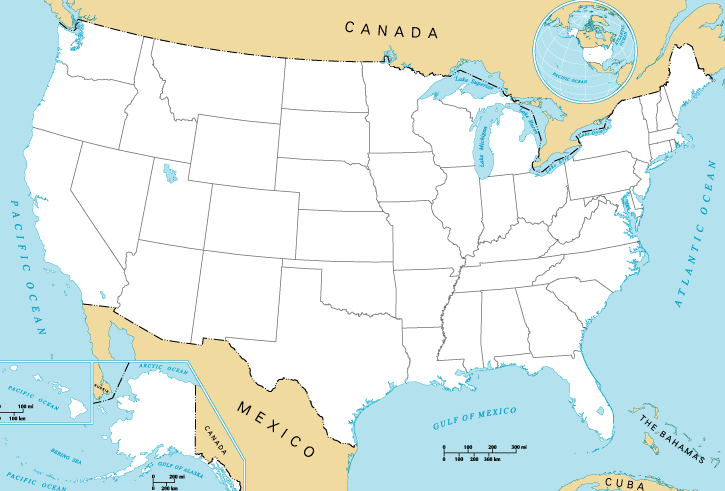
A map showing the contiguous United States and (in insets at the lower left) the two states that are not contiguous
Map highlighting Alaska and Hawaii's geographical relationship to the contiguous United States. Alaska in red is in the upper part of the map, while Hawaii is the islands also in red to the far left. Contiguous US is near center in pale

The contiguous United States, also known as the U.S. mainland, officially referred to as the conterminous United States, consists of the 48 adjoining U.S. states and the District of Columbia of the United States in central North America.[1][2] The term excludes the only two non-contiguous states and the last two to be admitted to the Union, which are Alaska and Hawaii, and all other offshore insular areas, such as the U.S. territories of American Samoa, Guam, the Northern Mariana Islands, Puerto Rico, and the U.S. Virgin Islands.[3][4] The colloquial term Lower 48 is also used, especially in relation to Alaska.[5] The term The Mainland is used in Hawaii. The related but distinct term continental United States includes Alaska, which is also in North America, but separated from the 48 states by British Columbia in Canada, but excludes Hawaii and all the insular areas in the Caribbean and the Pacific.[1][6]

The greatest distance on a great-circle route entirely within the contiguous U.S. is 2,802 miles (4,509 km), coast-to-coast between Florida and Washington state;[7] the greatest north–south line is 1,650 miles (2,660 km).[8] The contiguous United States occupies an area of 3,119,884.69 square miles (8,080,464.3 km2). Of this area, 2,959,064.44 square miles (7,663,941.7 km2) is actual land, composing 83.65 percent of the country's total land area, and is comparable in size to the area of Australia.[9] Officially, 160,820.25 square miles (416,522.5 km2) of the contiguous United States is water area, composing 62.66 percent of the nation's total water area.

The contiguous United States, if it were a country, would be fifth on the list of countries and dependencies by area, behind Russia, Canada, China, and Brazil. However, the total area of the United States, including Alaska and Hawaii, ranks third or fourth. Brazil is 166,000 square miles (431,000 km2) larger than the contiguous United States, but smaller than the entire United States including Alaska, Hawaii and overseas territories. The 2020 U.S. census population of the area was 328,571,074, comprising 99.13 percent of the nation's total population, and a density of 111.04 inhabitants/sq mi (42.872/km2), compared to 93.844/sq mi (36.233/km2) for the nation as a whole.[10]

Other terms

[edit]

While conterminous U.S. has the precise meaning of contiguous U.S. (both adjectives meaning "sharing a common boundary"), other terms commonly used to describe the 48 contiguous states have a greater degree of ambiguity.

Continental and mainland United States

[edit]

Because Alaska is also a part of North America, the term continental United States also includes that state, so the term is qualified with the explicit inclusion of Alaska to resolve any ambiguity.[3][11][12][13] On May 14, 1959, the United States Board on Geographic Names issued the following definitions based partially on the reference in the Alaska Omnibus Bill, which defined the continental United States as "the 49 States on the North American Continent and the District of Columbia..." The Board reaffirmed these definitions on May 13, 1999.[1] However, even before Alaska became a state, it was properly included within the continental U.S. due to being an incorporated territory.[14]

The term mainland United States is sometimes used synonymously with continental United States, but technically refers only to those parts of states connected to the landmass of North America, thereby excluding not only Hawaii and overseas insular areas, but also islands which are part of continental states but separated from the mainland, such as the Aleutian Islands (Alaska), San Juan Islands (Washington), the Channel Islands (California), the Keys (Florida), the barrier islands (Gulf and East Coast states), and Long Island (New York).[15]

CONUS and OCONUS

[edit]

CONUS, a technical term used by the U.S. Department of Defense, General Services Administration, NOAA/National Weather Service, and others, has been defined both as the continental United States, and as the 48 contiguous states.[16][17] The District of Columbia is not always specifically mentioned as being part of CONUS.[17]

OCONUS is derived from CONUS with O for outside added, thus referring to Outside of Continental United States.[16][18]

The lower 48

[edit]

The term lower 48 is also used to refer to the conterminous United States. The National Geographic style guide recommends the use of contiguous or conterminous United States instead of lower 48 when the 48 states are meant, unless used in the context of Alaska.[5][19] Almost all of Hawaii is south of the southernmost point of the conterminous United States in Florida.

Zone of the Interior

[edit]

During World War II, the first four numbered Air Forces of the United States Army Air Forces (USAAF) were said to be assigned to the Zone of the Interior by the American military organizations of the time—the future states of Alaska and Hawaii, then each only organized incorporated territories of the Union, were respectively covered by the Eleventh Air Force and Seventh Air Force during the war.[citation needed]

Terms used in the non-contiguous U.S. jurisdictions

[edit]

Residents of Alaska, Hawaii and off-shore U.S. territories have unique labels for the contiguous United States because of their own locations relative to them.

Alaska

[edit]

The vast territory of Alaska became the 49th state of the United States on January 3, 1959. Alaska is the northwest extremity of the North American continent, separated from the U.S. West Coast by the Canadian province of British Columbia. The term Lower 48 has, for many years, been a common Alaskan equivalent for "contiguous United States";[20][21] some Alaskans may use the term Outside for those states, though some may use Outside to refer to any location not within Alaska.[22]

Hawaii

[edit]

The territory of Hawaii, consisting of the entire Hawaiian Islands archipelago except for Midway Atoll,[a] became the 50th state of the United States on August 21, 1959. It is the southernmost U.S. state, and the latest one to join the Union. Not part of any continent, Hawaii is located in the Pacific Ocean, about 2,200 miles (3,541 km) from North America and almost halfway between North America and Asia. In Hawaii and overseas American territories, for instance, the terms the Mainland or U.S. Mainland are often used to refer to the 49 states in North America.[23][24]

Puerto Rico

[edit]

Puerto Rico is an unincorporated territory of the United States located in the northeast Caribbean Sea, approximately 1,000 miles (1,609 km) southeast of Miami, Florida. Puerto Ricans born in Puerto Rico are U.S. citizens and are free to move to the mainland United States. The term Stateside Puerto Rican refers to residents of any U.S. state or the District of Columbia who were born in, or can trace their family ancestry to, Puerto Rico.[25]

U.S. Virgin Islands

[edit]

The U.S. Virgin Islands is a U.S. territory located directly to the east of Puerto Rico in the Caribbean Sea.[26] The term stateside is used to refer to the mainland, in relation to the U.S. Virgin Islands[27] (see Stateside Virgin Islands Americans).

American Samoa

[edit]

American Samoa is a U.S. territory located in the South Pacific Ocean in Polynesia, south of the equator — it is 2,200 miles (3,500 km) southwest of Hawaii.[28] In American Samoa, the contiguous United States is called the "mainland United States" or "the states"; those not from American Samoa are called palagi (outsiders).[29]

Non-contiguous areas within the contiguous United States

[edit]

Apart from off-shore U.S. islands, a few continental portions of the contiguous United States are accessible by road only by traveling through Canada. Point Roberts, Washington; Elm Point, Minnesota, and two nearby points; the Northwest Angle in Minnesota; a peninsula in Osthus Lake in North Dakota's Rolette County and a slice of land on the edge of Lake Metigoshe in Bottineau County bordering Winchester, Canada, are seven such places. Alburgh, Vermont, is not directly connected by land to the rest of the contiguous US, but is accessible by road via bridges from within Vermont and from New York, and nearby Province Point is accessible over land only from Canada, though no roads go there.[30] In contrast, Hyder, Alaska, is physically part of contiguous Alaska and is its easternmost town, but the only practical overland access is by road through Canada.

List of contiguous U.S. states

[edit]

The 48 contiguous states are:

In addition, the District of Columbia is within the contiguous United States.

See also

[edit]

Notes

[edit]

References

[edit]
[edit]
Revisions and contributorsEdit on WikipediaRead on Wikipedia
from Grokipedia
The Contiguous United States, also known as the Lower 48 or CONUS (contiguous United States), comprises the 48 geographically connected states and the District of Columbia that form the continuous mainland portion of the United States on the North American continent, excluding the non-contiguous states of Alaska and Hawaii. This region represents the foundational territorial core of the country, established through historical expansions such as the Louisiana Purchase and westward settlements, and serves as the primary focus for most federal policies distinguishing it from overseas or distant territories. Spanning a vast land area of 2,954,841 square miles (calculated as the total U.S. land area of 3,531,905 square miles minus Alaska's 570,641 square miles and Hawaii's 6,423 square miles), the contiguous United States encompasses diverse landscapes ranging from coastal plains and major river systems like the to mountain ranges including the Rockies and Appalachians, and extensive prairies and deserts. As of , 2024, its population is estimated at 337,913,721 , accounting for about 99.3% of the total U.S. population of 340,100,000, with the remainder in Alaska (740,133) and Hawaii (1,446,146). This dense concentration of people and resources underscores its as the nation's economic powerhouse, generating the bulk of GDP through industries such as , , , and services, while hosting key urban centers like New York, , and . The contiguous United States features a varied climate influenced by its latitudinal extent from about 25°N to 49°N, supporting ecosystems from temperate forests and wetlands to arid regions and tundra-like conditions in higher elevations, and it borders Canada to the north and Mexico to the south, with coastlines along the Atlantic, Pacific, Gulf of Mexico, and Great Lakes. Demographically, it is home to a multicultural population shaped by waves of immigration, indigenous communities, and internal migrations, with major metropolitan areas driving innovation and cultural output, though it also includes vast rural expanses where agriculture and natural resource extraction remain vital. Politically, it contains all but two states and the federal capital, influencing national governance through its electoral weight and legislative representation.

Definition and Scope

Core Definition and Boundaries

The contiguous United States, also referred to as the conterminous United States, consists of the 48 states located on the North American continent that share common land borders, along with the District of Columbia. This definition encompasses an unbroken expanse of covering approximately 3,119,884 square miles, excluding , , and all overseas territories and possessions. The term "contiguous" specifically denotes geographical adjacency via connections, without interruption by significant maritime gaps, distinguishing this core area from the nation's non-adjacent jurisdictions. Geographically, the contiguous United States is delimited by international land borders and oceanic coastlines. To the north, it shares the world's longest undefended international boundary with Canada, extending approximately 5,525 miles from the Pacific coast of Washington state through the Great Lakes region to the Atlantic coast of Maine; this border was established through a series of treaties, including the 1818 Convention and the 1846 Oregon Treaty. To the south, the boundary with Mexico spans about 1,954 miles from the Pacific coast of California eastward through Arizona, New Mexico, and Texas to the Gulf of Mexico, primarily defined by the 1848 Treaty of Guadalupe Hidalgo and the 1853 Gadsden Purchase. Eastward, the Atlantic Ocean and Gulf of Mexico form the eastern and southeastern coastlines, while the Pacific Ocean delineates the western edge, with the total coastal length for the contiguous area approximately 61,000 miles when including bays, sounds, and inlets. Internally, the region features prominent natural divisions such as the watershed, which drains over 1.2 million square miles across 31 states and forms a critical hydrological axis separating eastern and western drainage basins. of Columbia is included due to its enclaved position within , ensuring continuity with the surrounding states without requiring maritime traversal. This configuration reflects the historical completion of continental expansion in 1912, when and achieved statehood, finalizing the land-contiguous framework of the .

Distinction from Total United States

The is legally distinguished from the total United States in various federal regulations and statutes, where it is defined as the 48 adjoining states and of Columbia, excluding , , and U.S. territories. This definition appears in contexts such as rules under the (FAR), which specifies the (often abbreviated as CONUS in official usage) for purposes like , transportation, and logistics planning. Similarly, the (e.g., 47 CFR § 25.103) uses this scope for communications licensing, limiting "" to the 48 states and D.C. to delineate operational boundaries separate from non-contiguous regions. Administratively, the contiguous United States operates with a unified framework of four primary time zones—Eastern, Central, Mountain, and Pacific—facilitating synchronized national operations like broadcasting and financial markets, whereas the total spans six time zones for the states alone, adding and -Aleutian zones that require adjustments for interstate coordination. Interstate commerce laws, governed by the of the U.S. (Article I, Section 8), uniformly across all states but feature practical exceptions for non-contiguous areas; for instance, shipping between contiguous ports falls under standard regulations, while inter-port to or invokes the (Jones Act), mandating U.S.-flagged vessels and increasing costs due to geographic separation. These distinctions ensure tailored federal oversight, such as in environmental and trade policies, without fragmenting the contiguous region's integrated economic fabric. In practical terms, transportation networks highlight the separation: the , authorized by the , comprises over 48,000 miles of roadways connecting the 48 contiguous states and D.C. for seamless overland mobility, allowing one to drive from Washington, D.C., to all 48 contiguous states via the interconnected U.S. interstate system on paved roads. However, it relies on air and maritime links for access to and , which have independent highway designations (e.g., Alaska's Interstate A1) without direct continental integration. This infrastructure divide underscores logistical challenges, as non-contiguous areas depend on federal subsidies for ferries and flights to bridge isolation. Geographically, the contiguous United States encompasses approximately 3.12 million square miles in total area (including inland waters), representing about 82% of the total U.S. area of 3.8 million square miles when including , , and territories. This disparity affects , with the contiguous portion dominating federal land management and disaster response priorities due to its denser population and economic activity.

Terminology and Usage

Alternative Names and Synonyms

The contiguous United States, comprising the 48 states connected by land borders, is referred to by various alternative names that highlight its geographical continuity and distinction from non-contiguous areas. The term "Lower 48" or "Lower 48 states" gained prominence after Alaska's admission to the Union as the 49th state on January 3, 1959, denoting the preceding states in sequential order of statehood while excluding Hawaii. This phrase originated in popular media and everyday discourse, often implying the "lower" numerical status relative to Alaska and Hawaii, and it became widespread in contexts like travel and shipping to differentiate the core landmass. Another is the "Continental United States," a historical term back to the that generally describes the main North American landmass of the , though definitions from onward typically include but exclude . In common usage, it often overlaps with the contiguous United States to emphasize the unbroken continental expanse, contrasting with overseas territories. The "Mainland United States" is a further alternative that underscores the continuous landmass, particularly when contrasting with island jurisdictions like Hawaii or U.S. possessions in the Pacific and Caribbean. This term highlights the territorial integrity of the 48 states as the primary, interconnected portion of the nation's geography, avoiding implications of separation by water. It is frequently employed in logistical, economic, and cultural discussions to specify the core domestic area. In casual and regional speech, especially in Alaska and Hawaii, shorthand variants like "the 48" or simply "the mainland" are used interchangeably with these names, reinforcing the conceptual separation from non-contiguous regions. Military contexts occasionally reference the area as CONUS, which excludes Alaska and Hawaii.

Official and Military Designations

The U.S. Department of Defense employs the acronym CONUS, standing for Continental United States, to designate the 48 contiguous states and the District of Columbia, excluding Alaska, Hawaii, and U.S. territories and possessions. This term originated in the mid-20th century, particularly during and after , to address logistical and operational needs in distinguishing domestic continental operations from overseas deployments. CONUS facilitates military planning, supply chain management, and resource allocation by clearly delineating areas within the North American continent between Canada and Mexico, including adjacent territorial waters. As the counterpart to CONUS, the Department of Defense uses OCONUS, meaning Outside the Continental United States, to refer to all locations beyond the 48 contiguous states and the District of Columbia, encompassing , , U.S. territories such as and , and foreign sites. This designation supports uniform policies for personnel assignments, allowances, and transportation in non-continental areas, ensuring consistent treatment of diverse global postings. Historically, the U.S. referred to the contiguous United States as the Zone of the Interior (ZI) during , defining it as the domestic territory supporting overseas combat operations through training, logistics, and administration. This term, detailed in official War Department records, encompassed the continental borders for rear-area functions, excluding theaters of war abroad, and persisted into for similar purposes before evolving into modern usage. In international and official U.S. government contexts, the contiguous is sometimes termed the " proper" to distinguish it from non-contiguous states and territories, as seen in federal statutes and historical addresses excluding , , , and other possessions. While the and standards primarily recognize the full "" without subdividing for contiguity, U.S. agencies like the U.S. Geological Survey use "conterminous " for the 48 states and of Columbia in geographic and statistical aggregates.

Constituent Components

List of Included States

The contiguous United States comprises 48 states located entirely within the North American mainland and the District of Columbia, forming a continuous landmass without interruption by non-contiguous territories. The following table lists these 48 states in alphabetical order, along with their respective dates of admission to the Union:
StateStatehood Date
AlabamaDecember 14, 1819
ArizonaFebruary 14, 1912
ArkansasJune 15, 1836
CaliforniaSeptember 9, 1850
ColoradoAugust 1, 1876
ConnecticutJanuary 9, 1788
DelawareDecember 7, 1787
FloridaMarch 3, 1845
GeorgiaJanuary 2, 1788
IdahoJuly 3, 1890
IllinoisDecember 3, 1818
IndianaDecember 11, 1816
IowaDecember 28, 1846
KansasJanuary 29, 1861
KentuckyJune 1, 1792
LouisianaApril 30, 1812
MaineMarch 15, 1820
MarylandApril 28, 1788
MassachusettsFebruary 6, 1788
MichiganJanuary 26, 1837
MinnesotaMay 11, 1858
MississippiDecember 10, 1817
MissouriAugust 10, 1821
MontanaNovember 8, 1889
NebraskaMarch 1, 1867
NevadaOctober 31, 1864
New HampshireJune 21, 1788
New JerseyDecember 18, 1787
New MexicoJanuary 6, 1912
New YorkJuly 26, 1788
North CarolinaNovember 21, 1789
North DakotaNovember 2, 1889
OhioMarch 1, 1803
OklahomaNovember 16, 1907
OregonFebruary 14, 1859
PennsylvaniaDecember 12, 1787
Rhode IslandMay 29, 1790
South CarolinaMay 23, 1788
South DakotaNovember 2, 1889
TennesseeJune 1, 1796
TexasDecember 29, 1845
UtahJanuary 4, 1896
VermontMarch 4, 1791
VirginiaJune 25, 1788
WashingtonNovember 11, 1889
West VirginiaJune 20, 1863
WisconsinMay 29, 1848
WyomingJuly 10, 1890
These statehood dates reflect the historical process of admission under Article IV, Section 3 of the U.S. , with as the first state to ratify the Constitution on December 7, 1787, and and as the last contiguous states admitted on February 14, 1912, and January 6, 1912, respectively. , serves as the and seat of the U.S. government, established by an on July 16, 1790, ceded from portions of and .

Geographic Exclaves and Anomalies

The contiguous United States encompasses the 48 states connected by land s, but it includes minor geographic anomalies known as exclaves or pene-exclaves—territories that are legally part of these states yet separated from their main bodies by international or interstate boundaries, creating access challenges. These areas arose from historical border delineations, such as treaties and river shifts, and while they are fully integrated into the U.S. framework, their isolation highlights quirks in North American geography. One prominent example is , a 4.9-square-mile unincorporated exclave situated on the southern tip of Canada's , south of the . This pene-exclave, bordered by the to the west and south and to the east, became U.S. territory under the , which established the parallel as the international boundary without accounting for the peninsula's protrusion. As a result, is physically detached from the Washington mainland, requiring residents to cross into Canada twice by road for land access or rely on water routes, such as a ferry from its marina to Bellingham, Washington. With a population of 1,191 as of the 2020 United States Census, the community depends heavily on cross-border ties for daily needs, amplifying logistical issues during border restrictions. In , the Alburgh Tongue refers to a narrow in extending southward from , , forming part of the town of Alburgh in Grand Isle County. Geographically, much of this 5-mile-long feature lies closer to Canadian soil than to 's mainland, stemming from the imprecise 18th-century surveys that defined the U.S.- border along the 45th parallel. However, unlike true exclaves, Alburgh remains connected to the U.S. interior via bridges spanning the lake to Swanton, , allowing direct access without entering . This configuration makes it a practical pene-exclave, primarily notable for its position as 's northernmost point and its in local ecology, including birdwatching and shoreline habitats. Further south, the —also known as New Madrid Bend or Bubbleland—is a 30-square-mile exclave of , created by a dramatic in the near the border. Formed in the early 19th century through a combination of surveying errors and the powerful 1811–1812 New Madrid earthquakes, which reshaped the river's course and isolated the flat, fertile peninsula, the area is encircled by the river on three sides and bordered by to the south. Access from the rest of Kentucky requires crossing into or Missouri, posing challenges for the sparse population of 9 residents as of the 2020 United States Census, who maintain small farms and hunting grounds amid vast wetlands. Historical disputes over sovereignty with were resolved in Kentucky's favor, solidifying its status. The , located in County, , is another notable exclave encompassing approximately 146 square miles and extending north of the 49th parallel—the only portion of the contiguous United States above this line. This protrusion resulted from a in the 1783 Treaty of Paris, which defined the along the parallel but overlooked the ' position. Access by from the rest of requires a roughly 40-mile journey through the Canadian provinces of and , or alternatively by boat across the lake or winter ice roads. The area supports a small community with a population of approximately 150 residents, focused on fishing, resorts, and outdoor recreation, and includes the community of Angle Inlet. Legally, these areas hold full status as integral parts of their respective contiguous states—Washington, Vermont, Kentucky, and Minnesota—governed under standard U.S. federal and state laws without special designations. Their exclave nature stems solely from geographic happenstance, not political separation, though the anomalies necessitate unique arrangements for services like emergency response, mail delivery, and border crossings, often involving binational cooperation. For instance, Point Roberts operates its own U.S. customs station, while Alburgh and the Kentucky Bend rely on interstate infrastructure to mitigate isolation. These features underscore the contiguous United States' imperfect continuity, where border irregularities create pockets of complexity within an otherwise unified .

Non-Contiguous Jurisdictions

Alaska and Hawaii

and are the two non-contiguous states of the , meaning they do not share land borders with the 48 contiguous states and are excluded from the definition of the contiguous . Both were admitted to the Union in 1959, granting them full statehood rights equivalent to all other states, despite their physical separation. , admitted as the 49th state on January 3, 1959, through the (Public Law 85-508), is located in the northwest corner of and separated from the contiguous by approximately 500 miles of Canadian territory. Known as "The Last ," reflecting its unexplored , 's includes the southeastern Panhandle—a narrow coastal strip along the that borders , , and has been subject to historical contiguity issues stemming from the 1903 boundary dispute, where contested U.S. claims to the region's coastal access. This separation underscores 's isolation, although it is technically reachable by driving from the contiguous United States via the Alaska Highway through Canada, a multi-day journey involving border crossings; however, much of the state accessible only by air or water, particularly in remote areas referred to as "bush ," which denotes regions not connected to the North American road network and emphasizing the challenges of non-contiguous logistics. Hawaii, admitted as the 50th state on August 21, 1959, under the ( 86-3), consists of an of eight main islands in the central , over 2,000 miles from the nearest point on the contiguous U.S. mainland, with no land connection whatsoever, requiring access by air or sea and shipping of vehicles. Officially nicknamed "The Aloha State" since 1959, a term evoking the Hawaiian spirit of welcome and affection, Hawaii's island chain formation further highlights its distinct non-contiguous status, integrated into the U.S. through in and subsequent territorial governance before statehood. Like , Hawaii enjoys complete sovereign equality as a state, unaffected by its oceanic isolation.

Insular Territories and Possessions

The maintains several non-contiguous unincorporated territories in the and Pacific, collectively referred to as "insular areas" under the oversight of the Office of Insular Affairs in the U.S. Department of the Interior. These areas, including , the U.S. Virgin Islands, , , and the Commonwealth of the , are distinct from the contiguous and its states, with limited application of the U.S. Constitution as established by rulings known as the from 1901 to 1922. These decisions held that while the territories belong to the , they are not fully part of it, allowing broad authority to govern them without extending all constitutional protections to residents. Puerto Rico, the largest of these insular areas, achieved commonwealth status in 1952 through a new approved by the U.S. , establishing it as the Estado Libre Asociado de Puerto Rico, or Free Associated State. This status grants significant local self-governance while maintaining U.S. , and Puerto Rico functions as a separate customs territory for certain and purposes, distinct from the customs territory encompassing the 50 states and the District of Columbia. The U.S. Virgin Islands were acquired from Denmark in 1917 for $25 million in gold, primarily for strategic naval purposes during World War I, with formal transfer occurring on March 31 of that year. Often promoted as "America's Paradise" due to its scenic beaches and tropical environment, the territory features local governance structured under the Revised Organic Act of 1954, which established a single unicameral legislature and an elected governor, serving as its basic governing framework in lieu of a state constitution. American Samoa has been an unincorporated territory since 1899, when local chiefs ceded the islands to the through a series of deeds ratified in a with Britain and . Residents emphasize their cultural identity through the concept of fa'a Samoa, the traditional Samoan way of life centered on communal structures, chieftain systems, and customary practices that influence local and social organization. Guam and the Commonwealth of the Northern Mariana Islands, both in the Pacific, are additional key insular areas administered by the Department of the Interior, with operating as an unincorporated since its acquisition in 1898 and the Northern Mariana Islands entering status in 1976 following a covenant with the . These territories, like the others, fall under the framework, which limits full constitutional applicability and underscores their status as possessions rather than integral parts of the nation.

Geography and Environment

Land Area and Physical Features

The contiguous United States encompasses a land area of approximately 2,954,841 square miles (7,653,006 square kilometers), constituting about 83% of the total land area of the . This vast expanse, excluding and , forms a continuous block stretching roughly 2,800 miles from east to west and 1,650 miles from north to south, providing a diverse foundation for its . Key physical features define the region's , including the , in the west extending from to with peaks often exceeding 14,000 feet, influencing regional drainage and climate patterns. To the east of the Rockies lie the , a broad expanse of gently rolling grasslands and prairies spanning from northward into , characterized by low relief and elevations averaging 2,000 to 5,000 feet. In the eastern portion, the form an ancient, eroded range running from to , with maximum elevations around 6,684 feet at , featuring rounded peaks and extensive plateaus. The basin dominates the central interior, a massive drainage system covering over 1.2 million square miles and serving as a vital hydrological artery from its headwaters in to the . Bordering the northern Midwest are the —Superior, , Huron, Erie, and —which collectively cover about 94,250 square miles of freshwater surface, forming the largest group of freshwater lakes in the world by area. The region's tidal shoreline totals approximately 55,068 miles (88,614 kilometers) along the Atlantic Ocean, Pacific Ocean, and , providing extensive maritime interfaces; this detailed measurement accounts for intricate indentations such as bays and sounds. Elevation varies dramatically, with the highest point in the contiguous United States at in 's Sierra Nevada, rising to 14,494 feet (4,418 meters) above , and the lowest at in Death Valley, , plunging to 282 feet (86 meters) below —these extremes highlight the topographic diversity within a relatively compact area.

Climate and Natural Resources

The contiguous United States exhibits a wide range of climate zones according to the Köppen-Geiger classification system, reflecting its vast latitudinal and topographic diversity. The Southeast features a humid subtropical climate (Cfa), characterized by hot, humid summers and mild winters with year-round precipitation, supporting lush vegetation and agriculture. In contrast, the Southwest is dominated by arid desert climates (BWh), with extremely low precipitation, high evaporation rates, and hot temperatures year-round, leading to sparse vegetation adapted to water scarcity. The Northeast experiences a humid continental climate (Dfa/Dfb), marked by cold winters, warm to hot summers, and even precipitation distribution, while the Pacific Northwest has a temperate oceanic climate (Cfb), with mild temperatures, high winter rainfall, and dry summers influenced by marine air masses. The region is rich in natural resources that underpin its environmental and economic significance. Coal reserves are concentrated in the Appalachian region, where the hold substantial bituminous and deposits essential for energy production. The Permian Basin in and represents one of the world's largest and formations, with estimated undiscovered technically recoverable resources exceeding 46 billion barrels of and 281 trillion cubic feet of gas. Timber resources abound in the , where dense coniferous forests of and ponderosa pine cover vast areas managed for sustainable harvest. Agriculture thrives in the Midwest's , encompassing states like and , where fertile soils and temperate conditions yield high outputs of corn and soybeans as staple crops. Environmental challenges vary by region, exacerbating vulnerabilities in certain zones. Water scarcity persists in the arid West, where limited precipitation and high demand strain river basins like the , affecting ecosystems and human use. The Gulf Coast faces heightened risks from hurricanes, as warm Gulf waters fuel frequent tropical cyclones that bring destructive winds, storm surges, and flooding to coastal areas from to . These pressures highlight the need for amid shifting climate patterns. Biodiversity hotspots underscore the ecological richness of the contiguous United States. The in southern form a unique subtropical , supporting diverse and including alligators, wading birds, and mangroves, though threatened by and hydrological alterations. In the West, the Sierra Nevada forests harbor coniferous woodlands and alpine meadows, hosting species like giant sequoias and diverse wildlife such as black bears and , serving as critical habitats amid mountainous terrain.

History and Development

Territorial Expansion

The territorial expansion of the contiguous United States during the transformed the nation from a coastal into a transcontinental power through a series of strategic acquisitions, treaties, and conflicts with European powers and . These events, primarily occurring between 1803 and 1853, added vast western territories and resolved lingering border disputes, establishing the core boundaries of the 48 contiguous states as they exist today. Driven by and economic imperatives, the expansions were facilitated by negotiations that capitalized on European colonial weaknesses and post-war settlements. The of 1803 marked the first major expansion, effectively doubling the size of the United States by acquiring approximately 828,000 square miles of territory from France for $15 million. Negotiated by President Thomas Jefferson's envoys Robert Livingston and , the deal encompassed lands west of the , including the , which secured vital access to the for American commerce. This acquisition, ratified by the on October 20, 1803, laid the foundation for westward migration and exploration, such as the . Subsequent treaties further clarified and extended U.S. borders. The Adams-Onís Treaty of 1819, signed between U.S. Secretary of State and Spanish minister Luis de Onís, ceded East and to the United States and defined the western boundary along the Sabine River, the Red River, and the to the , while renounced claims to the . This agreement resolved ambiguities from earlier explorations and prevented further European encroachments in the Southeast. In 1846, the with established the northern boundary at the 49th parallel from the to the , averting potential conflict over the and securing present-day Washington, , and for U.S. settlement. Acquisitions from Mexico dramatically expanded the Southwest. The annexation of in 1845, following its independence from Mexico in 1836, incorporated the as the 28th state via a under President , despite Mexican protests over the border. This led to the Mexican-American War (1846–1848), culminating in the , which ceded over 500,000 square miles—including present-day , , , and parts of , , , and —to the for $15 million. The war and treaty resolved territorial claims south of the 49th parallel and solidified U.S. control over the . Finally, the of 1853 acquired a 29,670-square-mile strip in and from for $10 million, primarily to facilitate a southern route and adjust the border from the earlier treaty. These expansions completed the contiguous framework by the mid-19th century.

Modern Implications and Changes

The contiguous United States reached its current configuration of 48 states with the admission of as the 46th state on November 16, 1907, following the merger of the Oklahoma and Indian Territories under the Oklahoma Enabling Act of 1906. This was swiftly followed by the admissions of as the 47th state on January 6, 1912, and as the 48th state on February 14, 1912, which completed the territorial expansion of the contiguous landmass from the Atlantic to the Pacific Oceans. These final admissions resolved long-standing debates over joint statehood proposals and ensured the contiguous United States encompassed all mainland territories acquired through 19th-century expansions, without further additions to its core borders. In the , minor border adjustments occurred through and maintenance efforts, particularly along the northern boundary with . A notable example is the 1925 Treaty between the and , which established the International Boundary Commission to maintain and resurvey the shared border, including segments in such as the and areas, addressing discrepancies from earlier surveys and natural shifts. Further refinements in , including surveys and delimitations under the commission's auspices, clarified ambiguous sections of the Minnesota- boundary, preventing disputes over islands and waterways without altering the overall territorial extent. These adjustments emphasized cooperative boundary management rather than expansion or contraction. Since the mid-20th century, no major territorial shifts have occurred within the contiguous United States, but emerging environmental challenges pose indirect threats to its boundaries. Climate change-driven and are causing land loss along shorelines, potentially complicating the definition and enforcement of state boundaries, especially in low-lying areas like the Gulf Coast and Atlantic seaboard. For instance, accelerated rates, exacerbated by and storm surges, have led to the inundation of approximately 13 miles of beaches in some regions, raising legal questions about jurisdictional lines in affected coastal zones. Legally, the contiguous United States' status was further delineated by the 1959 admissions of on January 3 and on August 21, which expanded the nation to 50 states but explicitly as non-contiguous additions, preserving the 48-state mainland as the core geographic entity. This marked the end of significant statehood-driven changes to U.S. borders, shifting focus to environmental and diplomatic mechanisms for boundary preservation.

Demographics and Economy

Population Distribution

The contiguous United States, consisting of the 48 states and the District of Columbia, had a resident population of 329,260,619 according to the 2020 Census, accounting for approximately 99.3% of the total U.S. population across all 50 states and the District of Columbia. This figure excludes the populations of Alaska (733,391) and Hawaii (1,455,271), which together represent a small fraction of the national total. As of July 1, 2024, estimates indicate the contiguous population at 337,913,721, reflecting ongoing demographic trends such as domestic migration and natural increase, though growth rates have slowed in recent years due to factors like aging and varying fertility rates. Population density within the contiguous United States exhibits stark regional disparities, shaped by historical settlement patterns, economic opportunities, and . The boasts the highest densities, with urban agglomerations like the New York-Newark-Jersey City metropolitan area surpassing 1,000 people per , driven by concentrated economic hubs and . In contrast, the Western states feature much lower densities; for instance, Nevada's statewide average stands at about 28 people per , highlighting vast arid landscapes and sparse rural communities that limit widespread habitation. These variations underscore a broader east-west , where over 90% of the land area in the West remains sparsely populated compared to the more compact . Urbanization is a defining feature of the contiguous United States, with roughly 80% of the population—over 263 million people—living in urban areas as delineated by the 2020 Census. This high level of urban concentration is exemplified by megacities such as New York (population 8.8 million), (3.8 million), and (2.7 million), which serve as focal points for commerce, culture, and innovation, drawing migrants from rural areas and abroad. The remaining 20% resides in rural settings, often in agricultural heartlands of the Midwest or remote Western expanses, contributing to a polarized that influences and policy priorities. The ethnic and racial composition of the contiguous United States reflects its diverse immigrant history and internal migrations, with the 2020 Census reporting 57.8% identifying as non- White, 18.7% as or Latino (of any race), and 12.1% as Black or African American alone. These proportions are broadly representative of the national totals but show subtle regional nuances; for example, higher concentrations of populations occur in the Southwest, while non- White majorities persist in the Midwest and parts of the Northeast. , at 6.1%, and those identifying with two or more races, at 10.2%, further highlight increasing multiracial dynamics, particularly in coastal urban centers. This distribution excludes variations in non-contiguous areas, where Native American and populations are more prominent.

Economic Characteristics

The economy of the contiguous United States represents the core of the national economic output, generating approximately $28.99 trillion in nominal gross domestic product (GDP) in 2024, which accounted for over 99% of the total U.S. GDP of $29.18 trillion. This economic powerhouse is overwhelmingly driven by the services sector, contributing roughly 77% of GDP through activities such as finance, real estate, professional services, and information technology, while manufacturing accounts for about 11%, encompassing production in automobiles, electronics, and chemicals. The scale of this economy underscores its role in global trade and innovation, with major hubs like Silicon Valley in California leading advancements in technology and software, generating billions in value through companies focused on semiconductors and digital services, and Wall Street in New York serving as the epicenter of global finance, facilitating trillions in transactions annually. Agriculture remains a vital sector within the contiguous United States, particularly in the California Central Valley, which produces about 8% of the nation's total agricultural output and supplies a significant share of fruits, nuts, and essential to domestic . This region, spanning over 20,000 square miles, leverages advanced and fertile soil to yield crops that contribute to about 25% of U.S. fruits and nuts, supporting both local markets and exports. The Interstate in Article I, Section 8 of the U.S. Constitution has been instrumental in fostering this integrated economic landscape by empowering to regulate interstate commerce, thereby preventing state-imposed barriers and enabling a seamless national market that amplifies efficiency across industries. Despite its overall strength, the contiguous United States exhibits notable regional economic disparities, exemplified by the decline of the —encompassing states like and —where manufacturing job losses from since the 1970s have led to persistent and population outflows, contrasted with the rapid growth of the in the and West, including and , fueled by migration, lower costs, and expansion in services, , and sectors. These shifts have widened income gaps, with Sun Belt metropolitan areas like Austin and Phoenix experiencing GDP growth rates exceeding 4% annually in recent years, while some Rust Belt cities lag behind at under 2%. Trade flows further highlight the region's dominance, as approximately 95% of U.S. exports and imports—valued at over $3 trillion in goods in 2023—transit through ports in contiguous states, such as and New York/, underscoring their for international commerce.

References

Add your contribution
Related Hubs
User Avatar
No comments yet.