Hubbry Logo
Air interdictionAir interdictionMain
Open search
Air interdiction
Community hub
Air interdiction
logo
8 pages, 0 posts
0 subscribers
Be the first to start a discussion here.
Air interdiction
Air interdiction
from Wikipedia
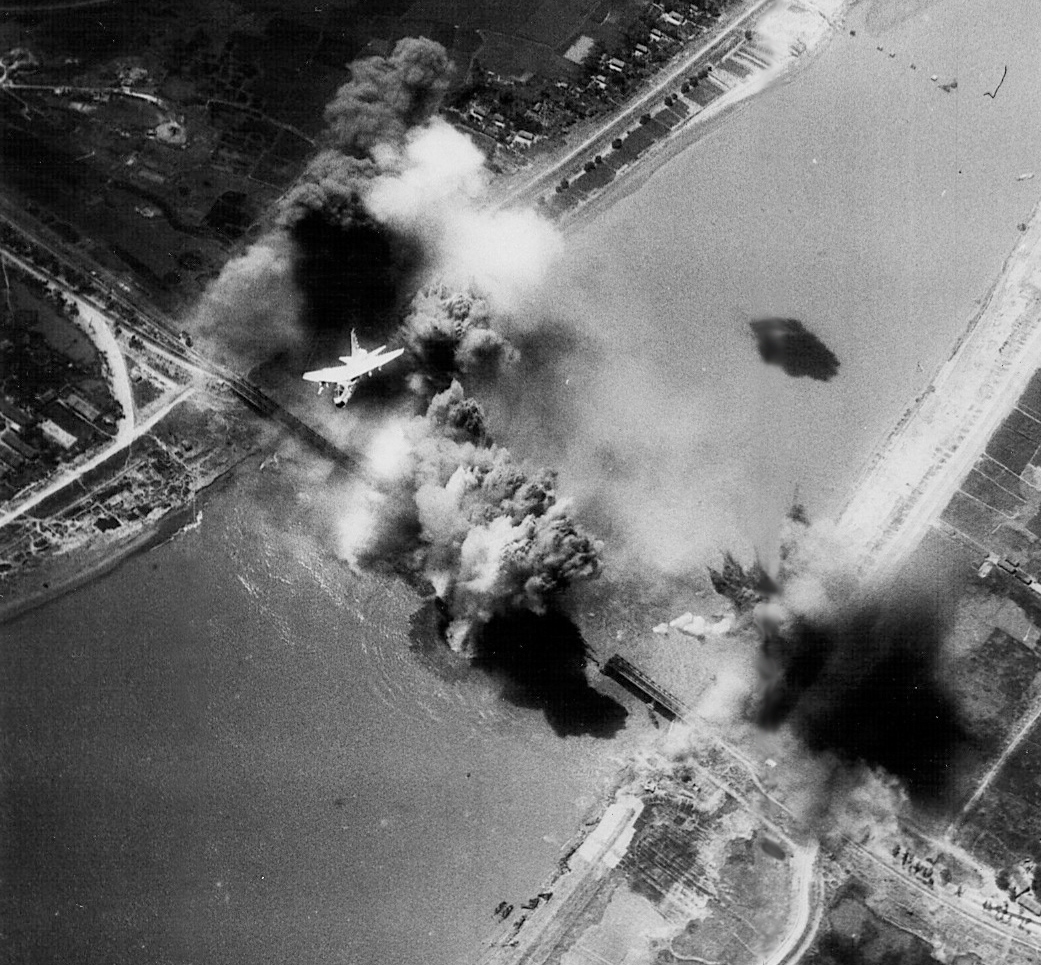
A U.S. Navy A-7E Corsair II bombs the Hai Duong bridge in North Vietnam in 1972.

Air interdiction (AI), also known as deep air support (DAS), is the use of preventive tactical bombing and strafing by combat aircraft against enemy targets that are not an immediate threat, to delay, disrupt or hinder later enemy engagement on friendly forces. It is a core capability of virtually all military air forces, and has been conducted in conflicts since World War I. Aircraft that are used for this purpose are known as interdictors.

A distinction is often made between tactical and strategic air interdiction, depending on the objectives of the operation. Typical objectives in tactical interdiction are meant to affect events rapidly and locally, for example through direct destruction of forces or supplies en route to the active battle area. By contrast, strategic objectives are often broader and more long-term, with fewer direct attacks on enemy fighting capabilities, instead focusing on infrastructure, logistics and other supportive assets.

Deep air support can be contrasted with close air support, highlighting the difference between their respective objectives. Close air support, as the name suggests, is directed towards targets close to friendly ground units, as closely coordinated air-strikes, in direct support of active engagement with the enemy. Deep air support or air interdiction is carried out further from the active fighting, based more on strategic planning and less directly coordinated with ground units. Despite being more strategic than close air support, air interdiction should not be confused with strategic bombing, which is unrelated to ground operations.

A 4-ship Vic formation of Pakistani F-86F Sabres returning from an interdiction mission during the 1965 war

Air interdiction can cause the physical destruction or attrition of soldiers and matériel before they can reach the battlefield, sever enemy's lines of communication, prevent soldiers and matériel from reaching the battlefield. It can create systemic inefficiencies in the enemy's logistic system so that soldiers and matériel arrive at the battlefield more slowly or in an uneconomical manner.[1][2][3]

History

[edit]

World War II

[edit]

In the lead up to the invasion of France, the Allied strategic bomber force was switched from the destruction of the enemy air force and means of production to a destruction of the railway routes to the intended landing areas. Once the landings were underway, the Allied tactical and strategic air forces were used to prevent the German strategic armoured reserves from being brought up to the coast and reinforce the divisions there.

Aerial bombing of German railroad yards at Siena during Operation Strangle by Martin B-26 Marauder medium bombers on April 11 1944, On the alternate line from Pisa and Florence south to Rome, the Siena yards were bombed by Mediterranean Allied Air Force Bombers.

Operation Strangle was a series of air interdiction operations during the Italian Campaign of World War II by the Allied air forces to interdict German supply routes in Italy north of Rome from 19 March 1944 to 11 May 1944. Its aim was to prevent essential supplies from reaching German forces in Central Italy and compel a German withdrawal. The strategic goal of the air assault was to eliminate or greatly reduce the need for a ground assault on the region. The Allies failed in the overly ambitious objective of the campaign, namely the forced withdrawal of German forces from the Gustav Line, and did not curtail the flow of supplies. However, the air interdiction seriously complicated the German conduct of defensive operations and played a major role in the success of the subsequent Allied ground assault Operation Diadem.[4][5]

Two principal interdiction lines were maintained across the narrow boot of Italy. This meant that no through trains were able to run from the Po Valley to the front line, and that south of Florence nearly all supplies had to be moved by truck. Over the course of eight weeks, the Allies flew 21,000 sorties (388 per day) and dropped 22,500 tonnes of bombs.[5][6] The operation employed medium bombers and fighter bombers over a 150-square-mile (390 km2) area from Rome to Pisa and from Pescara to Rimini.[7]

Korean War

[edit]

Operation Strangle was a sustained interdiction attack on North Korea's supplies and communications by the United Nations forces during the Korean War. Beginning in August 1951, the campaign's 87,552 interdiction sorties were credited with destroying 276 locomotives, 3,820 railroad cars, 19,000 rail cuts,[clarification needed] and 34,211 other vehicles.[citation needed] The North Koreans countered the campaign by moving anti-aircraft (AA) guns and crews towards the front line and placing them in higher concentrations around important targets, causing heavy casualties in the UN forces. Despite high losses, Operation Strangle destroyed 900 AA gun positions and damaged 443.[8]

By December 1951, North Korea was able to repair rail cuts in less than six hours, bridges in two to four days, and other bomb damages fairly quickly. By May 1952, it was apparent that their supply efforts had increased support to their front-line troops despite the air attacks. By June, half of the North's anti-aircraft guns—132 cannons and 708 automatic weapons—were posted along North Korea's railroads.[9]

Cold War

[edit]

During the Cold War, the NATO alliance leaned into the concept of air interdiction.[10] "Air interdiction ... is essential to the overall effectiveness of the Allies' military forces. Their role in supporting operations, on land and at sea, will require appropriate long-distance airlift and air refuelling capabilities."[10]

Vietnam War

[edit]

Operation Commando Hunt was a covert U.S. Seventh Air Force and U.S. Navy Task Force 77 aerial interdiction campaign that took place during the Vietnam War. The operation began on 15 November 1968 and ended on 29 March 1972. The objective of the campaign was to prevent the transit of People's Army of Vietnam (PAVN) personnel and supplies on the logistical corridor known as the Ho Chi Minh Trail (the Truong Son Road to the North Vietnamese) that ran from southwestern North Vietnam through the southeastern portion of the Kingdom of Laos and into South Vietnam.

A 388th TFW SAM hunter-killer team refueling on its way to North Vietnam, October 1972

Operation Linebacker was the codename of a U.S. Seventh Air Force and U.S. Navy Task Force 77 air interdiction campaign conducted against North Vietnam from 9 May to 23 October 1972, during the Vietnam War.

Its purpose was to halt or slow the transportation of supplies and materials for the Nguyen Hue Offensive (known in the West as the Easter Offensive), an invasion of the South Vietnam by the North Vietnamese People's Army of Vietnam (PAVN) that had been launched on 30 March. Linebacker was the first continuous bombing effort conducted against North Vietnam since the end of Operation Rolling Thunder in November 1968.

Iran–Iraq War

[edit]

Both the Iranian Air Force (IIAF) and the Iraqi Air Force (IQAF) made concerted efforts during the early days of the Iran–Iraq War to interdict the other side. For both sides this largely amounted to engaging in armed reconnaissance and attacking targets of opportunity, with few attacks on pre-planned targets. The IIAF did have the advantage of having superior munitions and tactical reconnaissance—possessing a squadron of RF-4E Phantoms and pre-revolution targeting intelligence—but their efforts largely mirrored that of the IQAF.[11]

The IQAF's interdiction efforts peaked during the first 45 days of the war, but later declined to more sporadic missions, increasing in conjunction with major offensives. Interdiction by the IIAF was more sustained through late 1980 but after mid-January 1981 also declined. While both sides caused considerable damage on the other, with the Iranians arguably achieving more, neither interdiction effort was particularly effective nor did they play a factor in the outcome of the war. Both sides pulled back their air forces to avoid mounting losses and with the reasoning that, while they might not play a role in winning the war, they could still be used to avoid defeat.[11]

Gulf War, 1990–1991

[edit]

The third and largest phase of the air campaign targeted military targets throughout Iraq and Kuwait: Scud missile launchers, weapons research facilities, and naval forces. About one-third of the Coalition airpower was devoted to attacking Scuds, some of which were on trucks and therefore difficult to locate. Some U.S. and British special forces teams had been covertly inserted into western Iraq to aid in the search and destruction of Scuds. The lack of adequate terrain for concealment hindered their operations, and some of them were killed or captured, such as occurred with the widely publicised Bravo Two Zero patrol of the SAS.[citation needed]

See also

[edit]

References

[edit]

Bibliography

[edit]
[edit]
Revisions and contributorsEdit on WikipediaRead on Wikipedia
from Grokipedia
Air interdiction is the coordinated use of air power to attack enemy military capabilities—such as routes, troop concentrations, and —in rear areas, aiming to , delay, or destroy their ability to support frontline operations before these forces engage friendly troops effectively. This tactic differs from , which targets immediate threats near ground forces, by focusing on deeper operational-level effects to weaken enemy sustainment and maneuver. Emerging as a distinct mission during but refined in through campaigns like the of transport networks in and Operation Strangle in , air interdiction has shaped aerial doctrine across subsequent conflicts, including Korea and , where it targeted supply lines via armed reconnaissance and precision strikes. Its implementation relies on intelligence-driven targeting, suppression of enemy air defenses, and integration with joint operations to maximize ion of adversary . Empirical evaluations from historical campaigns reveal that air interdiction achieves notable success in degrading enemy mobility and resupply when synchronized with ground advances, as seen in post-invasion efforts, but standalone efforts often face challenges from enemy dispersal, repair capabilities, and adverse weather, limiting decisive outcomes without complementary maneuver. Defining characteristics include the emphasis on high-value, time-sensitive targets like bridges and convoys, with modern variants incorporating precision-guided munitions and real-time surveillance for enhanced causal impact on enemy operational tempo.

Definition and Fundamentals

Definition

Air interdiction refers to air operations conducted to divert, disrupt, delay, or destroy an adversary's military potential—such as ground forces, networks, supply lines, and reinforcements—prior to their effective engagement with friendly forces. This form of aerial action typically occurs at distances from forward ground elements where detailed, real-time integration of strikes with surface maneuvers is impractical, distinguishing it from operations requiring immediate ground coordination. The objective is to degrade combat effectiveness through targeted attacks on lines of communication, assembly areas, and sustainment infrastructure, thereby shaping the in favor of joint forces without direct reliance on proximate ground fire support. In joint military doctrine, air interdiction encompasses both preplanned strikes against fixed or anticipated targets and dynamic attacks on targets of opportunity identified during armed reconnaissance missions. It forms a core component of counterland operations, leveraging airpower's speed, range, and precision to impose attrition on enemy capabilities independently of the forward line of own troops (FLOT). Unlike strategic bombing, which targets an enemy's overall war-making capacity far removed from tactical battles, air interdiction remains operationally linked to ground campaigns, focusing on immediate threats to maneuver units rather than long-term industrial disruption. Effectiveness hinges on accurate intelligence, suppression of enemy air defenses, and synchronization with broader joint efforts to maximize causal impact on adversary momentum. Air interdiction operations target enemy military forces, , and infrastructure beyond the immediate vicinity of friendly ground troops, aiming to delay, disrupt, or destroy their ability to support frontline combat units. This contrasts with (CAS), which involves coordinated air strikes on hostile targets in close proximity to friendly forces—typically defined as areas where operations require detailed integration to avoid endangering ground elements. In CAS, the ground commander designates and approves targets to ensure synchronization with maneuver elements, whereas air interdiction allows air component commanders greater autonomy in target selection and execution, focusing on broader operational effects without direct ground force oversight. Unlike , which seeks to undermine an adversary's overall war-sustaining capacity through attacks on industrial bases, command structures, or civilian infrastructure deep in the homeland, air remains focused on tactical and operational-level targets such as supply convoys, concentrations, and command nodes that directly enable enemy field operations. Strategic efforts prioritize long-term attrition of national resources and , often independent of ground campaigns, while interdiction integrates with theater objectives to shape the by interdicting flows to the area. Air interdiction also differs from counterair operations, which emphasize achieving air superiority by neutralizing enemy air threats through offensive and defensive measures like fighter sweeps or suppression of air defenses, rather than engaging surface targets. While both may involve similar platforms, interdiction's counterland orientation prioritizes ground denial over air domain control. Battlefield air (BAI), a subset of interdiction, operates within the land battle area but excludes CAS zones, targeting reserves or en route to contact without the proximity constraints of direct support.

Core Objectives and Principles

Air interdiction seeks to divert, disrupt, delay, or destroy the enemy's potential prior to its engagement with friendly forces, thereby isolating adversary units from reinforcements, supplies, and command structures to support force commander objectives. These objectives operate at operational and strategic depths, distinct from , which demands detailed coordination with maneuvering ground units in proximity to friendly troops. The objective of diversion compels the enemy to redirect forces or resources into terrain or routes advantageous to the joint force, such as bypassing interdicted lines of communication. Disruption targets vulnerabilities in or networks to fragment enemy cohesion and operational . Delay impedes enemy momentum, affording friendly forces time to consolidate positions or exploit opportunities, often through sustained strikes on transportation . Destruction eliminates key assets, including personnel, equipment, or facilities, to reduce the enemy's overall combat effectiveness. These effects are achieved via lethal or nonlethal means, with air-delivered precision munitions enabling scalable responses across theater-wide areas. Guiding principles emphasize unity of effort through centralized planning and decentralized execution, ensuring responsive strikes while optimizing scarce assets. with ground maneuver creates dilemmas for the enemy, amplifying 's impact by forcing resource diversion or exposure. Effective operations demand persistent application, concentration on high-payoff targets informed by real-time , , and , and integration across joint components to avoid and maximize . Full-spectrum superiority, particularly air dominance, underpins these efforts, allowing interdiction to shape the without undue risk to aircrews or platforms.

Tactics and Operational Framework

Targeting Strategies and Intelligence Integration

Targeting strategies in air interdiction distinguish between deliberate and dynamic approaches to disrupt enemy , , and reinforcements beyond immediate ground contact. Deliberate targeting focuses on pre-planned engagements against fixed or semi-fixed , such as rail lines, bridges, and depots, developed through systematic analysis of target systems and incorporated into the (ATO) 72-96 hours in advance. This method prioritizes targets based on their potential to yield cumulative effects, like severing lines of communication (LOC), as guided by the joint force commander's (JFC) objectives and the Joint Integrated Prioritized Target List (JIPTL). Dynamic targeting, conversely, targets fleeting or time-sensitive opportunities, such as troop convoys or emerging threats, prosecuted via on-call or immediate requests using re-tasked assets during ATO execution. Prioritization in both emphasizes critical vulnerabilities— nodes, , and mobile forces—assessed for their indirect impact on ground maneuver, often sequencing strikes to maximize attrition over isolated hits. The joint targeting cycle structures these strategies across six iterative phases: defining commander's objectives and guidance; target development and prioritization; capabilities analysis; decision and force assignment; mission planning and execution; and combat assessment. In air interdiction, this cycle translates operational effects—delay, disruption, or destruction—into discrete actions, matching appropriate air assets to targets while accounting for risks like and (ROE). For instance, weaponeering evaluates munitions needed for desired effects, such as precision-guided weapons against hardened LOC targets, ensuring compliance with principles during validation. Intelligence integration underpins the cycle, particularly in target development, where joint intelligence preparation of the operational environment (JIPOE) identifies adversary systems' critical elements and vulnerabilities using all-source data from (HUMINT), (SIGINT), and (GEOINT). , surveillance, and reconnaissance (ISR) assets, including unmanned aerial systems (UAS) and moving target indicators, provide real-time find-fix-track inputs for dynamic via the F2T2EA (find, fix, track, target, engage, assess) process, enabling rapid nomination of high-value targets. Validation verifies target accuracy and legality, often involving national-level vetting, while battle damage assessment (BDA) measures of effectiveness (MOE) and performance (MOP) feed back into re-prioritization, ensuring persistent pressure on enemy sustainment. Liaison elements, such as battlefield coordination detachment (BCD), fuse ground component nominations with air ISR to align with joint maneuvers, mitigating limitations like incomplete enemy disposition data. This integration demands timely dissemination through data links and common operational pictures to avoid over-reliance on outdated .

Execution Techniques

Air interdiction operations are executed through a mix of preplanned and dynamic targeting to divert, disrupt, delay, or destroy enemy military potential prior to its engagement with friendly forces. Techniques emphasize sustained pressure on critical vulnerabilities, such as lines of communication (LOCs), nodes, and (C2) systems, to channel enemy movements into predictable paths, constrict sustainment flows, and force reactive, vulnerable maneuvers. For instance, strikes on lateral LOCs restrict maneuver options, while attacks on petroleum, oils, and lubricants (POL) storage and supply concentrations degrade operational tempo over time. Execution methods prioritize precision and persistence, employing unguided bombs, missiles, cluster munitions, precision-guided munitions (PGMs), air-deliverable scatterable mines, and electronic warfare to achieve effects like neutralization or attrition. Low-altitude approaches minimize detection, while time-delayed or scatterable ordnance creates enduring obstacles on routes and chokepoints. Electronic jammers and antiradiation missiles degrade enemy air defenses and C2 links, enabling follow-on strikes. In dynamic scenarios, airborne assets on-call for (e.g., XAI or GAI missions) shift to emerging targets, supported by real-time , , and (ISR). Planning integrates centralized command with decentralized execution, using mission-type orders for flexibility amid uncertainty. Preplanned strikes target anticipated threats via the (ATO), while immediate requests handle time-sensitive targets through diversions or kill boxes—geographic areas designated for rapid, low-coordination attacks beyond the fire support coordination line (FSCL). Kill boxes, often purple (joint fires) or blue (air-only), facilitate massed effects with predefined , minimizing deconfliction delays. Battle damage assessment loops back to refine targeting, ensuring cumulative attrition prevents enemy reconstitution. Coordination with joint forces occurs via the (JFACC), who sequences air assets through theater air control systems, prioritizing nominations from ground components. Suppression of enemy air defenses (SEAD) precedes main efforts, often via dedicated missions refueled mid-air for extended loiter. Success hinges on air superiority, persistent ISR fusion, and synchronization with surface maneuver to exploit interdiction-induced delays, as seen in operations where air strikes trapped advancing columns in open terrain.

Coordination with Joint Forces

Effective coordination of air interdiction with joint forces relies on centralized planning under the joint force commander (JFC), who designates the joint force air component commander (JFACC) to unify and direct joint air operations, including interdiction missions aimed at disrupting enemy logistics and reinforcements. The JFACC serves as the supported commander for theater-wide air interdiction, integrating inputs from land, maritime, and special operations components through liaison mechanisms such as joint air component coordination elements (JACCEs) and the battlefield coordination detachment (BCD). Component commanders nominate targets, specify desired effects, and align interdiction with their operational schemes, ensuring synchronization via the joint air operations plan (JAOP) and air tasking order (ATO) produced by the joint air operations center (JAOC). This process follows the joint air tasking cycle, encompassing six phases from objective setting to assessment, to prioritize resources and adapt to dynamic threats. Deconfliction between air interdiction and surface-based fires is critical to avoid and maximize effects, primarily through the fire support coordination line (FSCL), established by land or amphibious commanders to delineate areas where air operations require procedural or positive control short of the line, while permitting expeditious attacks beyond it upon coordination. The FSCL, not a fixed boundary, is positioned based on enemy dispositions, operational , and weapon ranges, with adjustments disseminated via on-order positions or real-time updates through joint fires elements (JFE). Airspace control, often delegated to the JFACC as airspace control authority (ACA), employs positive control (real-time surveillance) or procedural methods (pre-planned measures) detailed in the airspace control order (ACO), integrating interdiction sorties with ground maneuvers, naval operations, and air defense. The joint targeting coordination board (JTCB) further supports this by resolving target nominations, deconflicting efforts across components, and prioritizing based on JFC guidance. Supporting and supported relationships are mission-defined, with the JFACC providing operational-level interdiction to shape the for land components, while maritime forces may contribute interdiction in littoral areas via coordinated strike packages. , surveillance, and reconnaissance (ISR) assets from multiple components feed the interdiction planning process, enabling effects-based targeting to delay, disrupt, or destroy enemy capabilities before they reach friendly lines. Assessment metrics, including battle damage assessment (BDA) and enemy behavioral changes, loop back to refine coordination, emphasizing centralized control with decentralized execution to exploit interdependencies.

Technological Evolution

Aircraft and Platforms

Air interdiction platforms have evolved from propeller-driven aircraft in to supersonic multirole jets and unmanned systems, adapting to improvements in speed, range, payload, and survivability. Early efforts relied on fighter-bombers and light bombers for tactical strikes against supply lines and transport. In the , the entered service in December 1950 as a key interdiction platform, conducting strikes against North Korean logistics with its enabling faster response times over propeller predecessors. The Douglas B-26 Invader provided night interdiction capabilities, flying the first and last bombing missions of the conflict with its rugged design suited for low-level operations. During the , the served as the primary strike aircraft for interdiction, executing thousands of missions against North Vietnamese targets with its large internal bomb bay and supersonic speed. The F-105G variant pioneered dedicated Suppression of Enemy Air Defenses (SEAD) roles as platforms, using anti-radiation missiles to neutralize surface-to-air threats enabling follow-on interdiction strikes. The supplemented these efforts, with squadrons deploying from bases like by late 1965 for multi-role bombing and escort. Support platforms such as the extended operational range through , critical for sustained campaigns over extended distances. Post-Vietnam developments emphasized multirole fighters for flexible . The Fairchild Republic A-10 Thunderbolt II, introduced in the , specialized in but also performed with its and precision munitions against armored columns and convoys. The General Dynamics F-16 Fighting and McDonnell Douglas F-15E Strike Eagle integrated advanced for all-weather strikes, carrying smart bombs and standoff weapons to minimize exposure to defenses. In the 21st century, unmanned aerial vehicles (UAVs) have augmented manned platforms, offering persistent surveillance and strike without pilot risk. The MQ-9 Reaper conducts armed interdiction with Hellfire missiles and laser-guided bombs, loitering for hours over target areas. Collaborative combat aircraft like the Kratos XQ-58 Valkyrie, tested with F-15E and F-16 pilots in 2025, enable manned-unmanned teaming for dynamic targeting. Stealth platforms such as the Lockheed Martin F-35 Lightning II further evolve interdiction by penetrating contested airspace with low observability and sensor fusion.

Weapons Systems and Munitions

Air interdiction operations utilize a variety of weapons systems and munitions designed to disrupt enemy , troop movements, and from standoff distances or low-altitude passes. Early campaigns relied heavily on unguided gravity bombs, such as the Mk 80 series general-purpose bombs, alongside rockets, , and white phosphorus incendiaries for area saturation effects against convoys and supply lines. These munitions, including iron bombs and unguided rockets, were delivered by fighter-bombers to target roads, rail yards, and bridges, though their inaccuracy often necessitated high volumes to achieve desired effects. The introduction of precision-guided munitions (PGMs) in the late 20th century markedly improved interdiction efficacy by enabling strikes on specific targets under adverse conditions like poor visibility. Laser-guided bombs (LGBs), electro-optical guided bombs, and GPS-inertial aided systems like the (JDAM) allow for minimal collateral damage while neutralizing chokepoints such as bridges and armored columns. Air-to-surface missiles, notably the , provide tactical flexibility for interdiction missions, employing electro-optical or infrared seekers to engage moving vehicles and hardened targets at medium ranges. Cluster bomb units (CBUs) have been employed to deny areas and fragment enemy forces, dispersing submunitions over wide swaths to interdict troop concentrations and logistics hubs. Gun systems, such as the 30mm and 105mm cannons on AC-130 gunships, deliver support for close-range , particularly against slow-moving targets like convoys in permissive environments. These systems integrate with aircraft sensors for real-time targeting, enhancing responsiveness in dynamic battlefield scenarios. Modern interdiction increasingly incorporates standoff munitions like glide bombs and advanced missiles to mitigate risks from enemy air defenses, allowing delivery from beyond visual range while maintaining precision. The shift toward PGMs has reduced requirements and improved success rates, as evidenced in operations where weather-independent guidance enabled sustained campaigns against mobile forces.

Enabling Technologies and Support Systems

Intelligence, surveillance, and reconnaissance (ISR) systems form the foundational enabler for air interdiction by identifying and tracking enemy logistics and forces in real time, utilizing platforms such as unmanned aerial vehicles equipped with electro-optical/infrared cameras and for persistent monitoring. These technologies integrate data from multiple sensors to provide actionable targeting , reducing reliance on ground-based scouts and enabling strikes against moving targets like convoys. Airborne warning and control systems (AWACS), exemplified by the E-3 Sentry introduced in 1977, deliver all-weather surveillance, command, and control capabilities, detecting aircraft and surface targets up to 250 miles away to coordinate interdiction missions and deconflict friendly forces. The rotating dome on the E-3 processes tracks for over 1,000 targets simultaneously, relaying data via secure links to strike aircraft for dynamic retargeting. Aerial refueling technology, operational since but refined with boom systems in the , extends fighter and bomber endurance for deep interdiction, allowing missions like those in where KC-135 Stratotankers supported strikes far beyond ferry ranges. This capability multiplies sortie rates by enabling multiple refuelings per mission, as demonstrated in operations requiring over 20 refueling tracks to sustain bomber task forces. Electronic warfare (EW) support systems, including dedicated suppression of enemy air defenses (SEAD) platforms, neutralize radar-guided threats to protect interdiction aircraft, with missions using missiles to home on emissions since 1965. Integrated EW suites on escort aircraft jam communications and radars, ensuring safe penetration of contested airspace for logistics disruption. Secure data links and joint networks, such as Link 16 adopted in the 1990s, facilitate real-time information sharing between ISR assets, AWACS, and strikers, compressing the sensor-to-shooter timeline to minutes for time-sensitive targets.

Historical Applications

World War II

Air interdiction in World War II involved Allied air forces systematically targeting enemy lines of communication, including roads, railways, bridges, and supply convoys, to hinder Axis troop movements and logistics. This tactic was employed across multiple theaters, particularly in the Mediterranean and Western Europe, where air superiority allowed sustained operations. Unlike strategic bombing of cities, interdiction focused on tactical disruption far from the front lines, aiming to weaken enemy sustainment without direct ground engagement. In the following in November 1942, Allied air units under Northwest African Air Forces conducted interdiction against Axis supply lines, particularly maritime convoys ferrying reinforcements to . By early 1943, these efforts sank numerous vessels and reduced Axis resupply, contributing to the isolation of German-Italian forces under . Interdiction sorties targeted ports, shipping, and desert tracks, with aircraft like the P-40 Warhawk and B-25 Mitchell proving effective in low-level attacks despite challenging terrain and weather. This campaign demonstrated early integration of air interdiction with ground operations, though initial coordination issues limited impact until doctrinal refinements in February 1943. Operation Strangle, launched on March 19, 1944, in the Italian Campaign, represented a dedicated interdiction effort by the U.S. and RAF against German lines of communication south of . Over 53 days until May 11, 1944, Allied aircraft flew approximately 21,000 sorties, dropping 27,000 tons of bombs and strafing attacks that destroyed or damaged over 1,000 bridges, 200 locomotives, and thousands of vehicles. The operation aimed to starve German forces of supplies ahead of the Anzio breakout and Gustav Line offensive, forcing reliance on foot and animal transport; however, German countermeasures like decoy targets, night movements, and rapid repairs mitigated full paralysis, with interdiction succeeding more in conjunction with the ground push . Preceding the Normandy invasion, the Allied Transportation Plan from April to June 1944 involved over 72,000 tons of bombs dropped by and U.S. on French rail yards, bridges, and repair facilities, reducing operational locomotives by about 50% and severely hampering German reinforcements to the invasion beaches. Post-D-Day on June 6, 1944, tactical air forces shifted to battlefield interdiction, targeting roads and River crossings to isolate German Army Group B, with and Second Tactical Air Force flying thousands of sorties that destroyed 2,000 locomotives and impeded Panzer movements during the breakout. This interdiction, supported by Ultra intelligence, delayed German responses and facilitated Allied advances, though high civilian costs in occupied raised operational debates. In the Ardennes Offensive () starting December 16, 1944, poor weather initially grounded Allied air, but clearing skies from December 23 enabled massive interdiction by the and RAF Second Tactical Air Force, which flew over 5,000 sorties in five days, destroying fuel depots, bridges, and 1,200 vehicles while sinking 100 locomotives. This effort cut German fuel supplies—critical for their mechanized thrust—and contributed decisively to the offensive's failure, underscoring interdiction's vulnerability to weather but potency under air superiority.

Korean War

United Nations air forces, led by the United States Air Force (USAF), conducted extensive air interdiction operations throughout the Korean War (1950–1953) to disrupt North Korean People's Army (NKPA) and Chinese People's Volunteer Army (CPV) lines of communication, supply routes, and troop movements behind the front lines. These efforts targeted railroads, bridges, roads, vehicles, and river crossings, aiming to isolate enemy forces from reinforcements and logistics in a mountainous terrain that favored ground transport. Interdiction complemented close air support and strategic bombing, with USAF and naval aircraft flying hundreds of thousands of sorties despite challenges like adverse weather, antiaircraft artillery (AAA), and rapid enemy repairs. In the war's early phase following the Inchon landing on September 15, 1950, intensified interdiction from mid-August targeted NKPA supply lines, destroying vehicles, trains, and infrastructure to support UN ground advances northward. This contributed to the rapid collapse of NKPA logistics, limiting their operational tempo and enabling UN forces to outpace enemy resupply. By late 1950, as CPV forces entered, interdiction shifted to blunt their offensives, focusing on approaches and Manchurian border routes, though effectiveness waned due to increased enemy camouflage, night movements, and dispersed transport. Operations like Pressure Pump in 1951 emphasized rail cuts and bridge bombings, with fighter-bombers such as the F-84 Thunderjet and F-80 Shooting Star employing rockets, bombs, and against transient targets. A major campaign, Operation Strangle, launched on May 31, 1951, by the , systematically attacked North Korean transportation networks to starve frontline troops, destroying hundreds of locomotives, rail cars, and bridges over months. Successive efforts like Operation Saturate and Spring Thaw in 1951–1952 extended this, incorporating night interdiction with pathfinder techniques and flares to counter enemy adaptations. Overall, UN interdiction accounted for approximately 320,000 sorties, averaging nearly 9,000 monthly, which inflicted significant attrition on enemy transport—estimated at over 80,000 vehicles and 1,000 trains destroyed—but repair crews and alternative paths mitigated total paralysis. Assessments of interdiction's impact reveal partial success: it forced NKPA and CPV to rely on nocturnal, low-volume supply convoys, reducing daily to front lines and constraining offensives, as evidenced by captured documents and post-armistice analyses. However, limitations including daytime-only operations in early phases, rugged enabling bypasses, and Soviet-supplied AAA restricted decisive effects, with enemy sustaining prolonged stalemate despite air efforts. Tactical innovations, such as armed and joint targeting with ground , improved yields, but proved more supportive than campaign-ending, highlighting dependencies on sustained pressure and all-weather capabilities absent in Korea.

Vietnam War

United States air interdiction efforts during the targeted North Vietnamese supply lines, particularly the network through and , to hinder infiltration and logistics support for communist forces in . Initial operations, such as starting in December 1964, focused on , employing tactical aircraft to strike trucks, bridges, and storage areas, but faced challenges from dense jungle cover, anti-aircraft defenses, and rapid enemy repairs. By 1965, truck traffic on the trail had escalated from hundreds to thousands daily, underscoring the limited initial impact despite increased sortie rates. Operation Rolling Thunder, conducted from March 2, 1965, to October 31, 1968, extended interdiction to 's rail, road, and port infrastructure, aiming to reduce the flow of war southward. The campaign delivered approximately 643,000 tons of bombs via over 300,000 sorties, yet political restrictions barred strikes on key supply routes near and the Chinese border, allowing to import sufficient aid—peaking at 200,000 tons monthly by 1968—to sustain operations. Empirical data reveal that while interdiction damaged 65% of 's bridges and , infiltration rates remained high, with 200,000 North Vietnamese Army troops deployed annually, indicating failure to achieve decisive disruption. Subsequent phases, including Commando Hunt from November 1968 to April 1972, integrated sensor technology like acoustic and seismic devices under to detect and target trail traffic, claiming destruction of over 35,000 trucks and 7,000 anti-aircraft guns. All-weather capabilities via AC-130 gunships and laser-guided bombs improved strike precision, but North Vietnamese countermeasures—such as manual labor for repairs, decoy targets, and trail proliferation—ensured supplies averaging 40 tons daily reached the south, sufficient for protracted given the enemy's minimal logistical footprint of 20-30 tons per division monthly. Assessments from military analyses conclude these efforts imposed attrition but could not interdict due to sanctuary areas in and , where ground operations were prohibited. In response to the 1972 , I, initiated April 6, 1972, shifted to unrestricted interdiction, combining aerial mining of harbor—sinking or damaging 80% of North Vietnam's shipping—with strikes on 18 major rail yards and storage, reducing fuel imports by 95% within weeks. This campaign, involving 40,000 sorties and dropping 155,000 tons of ordnance, stalled the mechanized by depleting armored units' mobility, as evidenced by captured equipment losses exceeding 1,000 tanks. Linebacker II's December 1972 B-52 strikes further pressured , contributing to the by demonstrating air power's coercive potential when unrestrained, though long-term strategic victory eluded due to underlying political and ground force dynamics. Overall, Vietnam War air interdiction highlighted causal limitations: while imposing verifiable costs—over 3.4 million tons of bombs dropped across Indochina, at the price of 2,200+ aircraft losses—it proved insufficient against an adaptive adversary with low sustainment needs and external support, as quantitative metrics like persistent infiltration rates and successful offensives demonstrate. Doctrinal critiques note overreliance on attrition over decisive cuts, exacerbated by that preserved enemy recovery capacity.

Post-Cold War Conflicts (1980s–1990s)

The (April–June 1982) featured constrained British air interdiction efforts, primarily due to the remote theater and limited organic air assets. Vulcan bombers executed , a series of seven long-range raids from —over 6,000 kilometers distant—targeting the Argentine-occupied Stanley airfield to crater runways and hinder resupply and fighter operations. The first raid on May 1, 1982, dropped 21 tons of bombs, partially disabling the runway and forcing Argentine aircraft to operate from mainland bases, though subsequent raids had diminishing returns owing to bomb inaccuracies and defensive repairs. Sea Harriers supplemented these with tactical strikes on ground logistics, such as ammunition dumps, but overall interdiction remained secondary to achieving local air superiority and defending the amphibious . The 1991 Gulf War (Operation Desert Storm, January–February 1991) marked a pivotal application of air interdiction on a massive scale, leveraging coalition technological superiority to dismantle Iraqi and isolate forward-deployed forces in . Following initial strategic and counter-air phases, battlefield interdiction dominated from mid-January, with U.S.-led forces flying approximately 40,000 air-to-ground sorties using over 1,600 combat to target supply lines, bridges, command nodes, and units. Strikes severed key routes like the Baghdad-to-Kuwait highways, destroying or damaging 137 of 159 fixed bridges in the theater of operations and disrupting fuel and ammunition convoys, which contributed to Iraqi forces expending reserves at unsustainable rates. Precision-guided munitions, comprising 8% of ordnance but 40% of strategic hits, enhanced accuracy against mobile targets, while suppression of enemy air defenses enabled sustained operations with minimal coalition losses—only 38 downed, mostly to ground fire. Post-campaign analysis indicated air interdiction neutralized about 50% of Iraq's operational armor and through attrition, shaping conditions for the 100-hour ground offensive by February 28, 1991, though debates persist on overestimation of destruction rates due to challenges amid desert camouflage and decoys.

21st Century Operations

In Operation Iraqi Freedom, initiated on March 20, 2003, coalition air forces emphasized to dismantle Iraqi conventional capabilities, targeting command nodes, divisions, and logistics networks south of . U.S. and allied flew approximately 20,700 combat sorties, delivering strikes on 19,900 aim points with precision-guided munitions that severed supply lines and immobilized armored formations. This approach yielded catastrophic effects on Iraqi field units, with interdiction accounting for the destruction or incapacitation of up to 50 divisions through attrition of fuel, ammunition, and cohesion, often prior to ground contact. The U.S. Air Force alone contributed over 24,000 missions from 863 , representing nearly 60% of total coalition sorties and enabling ground maneuver by denying enemy reinforcement. The NATO-led in , commencing March 31, 2011, under UN Security Council Resolution 1973, focused interdiction on Gaddafi loyalist forces to enforce a and halt advances on opposition-held areas. Alliance aircraft conducted strikes against ammunition stockpiles, resupply convoys, and ground-attack assets east of Tripoli and in , disrupting regime logistics and command structures. Over seven months, executed 26,500 sorties, with more than 9,700 strike sorties targeting military infrastructure, which eroded Gaddafi's operational tempo and facilitated rebel gains without direct allied ground involvement. Precision weapons minimized collateral risks in urban environments, though assessments noted challenges in verifying target effects amid fluid insurgent dynamics. In against the and (), launched August 8, 2014, coalition air interdiction targeted terrorist supply routes, oil refineries, and convoy movements across and to starve territorial holdings. U.S. Central Command forces, including B-52s flying 1,800 sorties, struck over 100,000 targets by 2019, prioritizing logistics chokepoints that reduced ISIS fuel revenues by 90% and hampered reinforcements for battles like . This campaign integrated unmanned systems for persistent surveillance, enabling dynamic targeting of transient threats and supporting partner ground forces, with air-delivered effects crediting 80% of ISIS combat losses in key theaters. Empirical data from post-strike assessments confirmed interdiction's role in compressing ISIS maneuver space, though urban embedding of assets complicated full disruption. In under (2001–2014) and Resolute Support (2015–2021), air interdiction adapted to against networks, focusing on border supply trails and vehicle convoys via AC-130 gunships and drones. Initial phases post-September 11, 2001, interdicted al-Qaeda logistics in , but sustained operations emphasized close air support over deep strikes due to rugged terrain and enemy dispersal. By 2010, interdiction sorties targeted opium-funded routes, yielding measurable reductions in resupply, though adaptive smuggling limited long-term efficacy.

Effectiveness Assessment

Metrics and Measurement Challenges

Assessing the effectiveness of air interdiction relies on metrics such as reductions in enemy logistics throughput (e.g., tons of supplies or vehicles reaching forward areas), delays in enemy movement (measured by increased travel times or halted advances), and correlations between strikes and enemy operational tempo, as evaluated in post-campaign analyses of , Korea, and . However, these metrics often prove unreliable due to incomplete battle damage assessment (BDA), where pilot reports and photographic overestimate destruction by factors of 2-5 times, as enemy forces employ , decoys, and rapid repairs to obscure true losses. For instance, during the Vietnam War's Commando Hunt campaigns (1968-1972), U.S. claims of destroying over 30,000 trucks were contradicted by sustained North Vietnamese infiltration rates of 100-200 tons per day via the , highlighting how metrics like vehicle kills fail to capture adaptive rerouting or portering. Causal attribution poses a core challenge, as interdiction outcomes intertwine with ground maneuvers, weather, and enemy countermeasures, making it difficult to isolate air contributions; RAND analyses of rail interdiction (1950-1953) note that while strikes cut North Korean supply lines temporarily, overall effectiveness was confounded by Chinese human-wave logistics and Soviet repairs, with no clear quantitative link to battlefield delays beyond anecdotal correlations. Enemy opacity exacerbates this, as regimes withhold logistics data, forcing reliance on indirect proxies like advance rates or POW interrogations, which are prone to bias; in European theater interdiction, the U.S. Survey struggled to quantify rail network disruptions amid German dispersal tactics, estimating only partial throughput reductions despite 1944-1945 sortie rates exceeding 100,000 monthly. Long-term versus short-term effects further complicate measurement, with initial disruptions often dissipating due to enemy , yet lacking standardized models for projection; studies emphasize that absolute metrics like interdicted ignore qualitative factors such as or forced , which evaded empirical capture in where interdiction sorties (over 500,000 by 1972) correlated weakly with ’s resolve. Modern evaluations, informed by these historical pitfalls, advocate multi-source validation—including and econometric modeling of supply flows—but persistent gaps in real-time data persist, particularly against peer adversaries with integrated air defenses that limit persistent .

Empirical Evidence from Major Campaigns

In World War II's European Theater, the Allied Transportation Plan from April to targeted French and Belgian rail infrastructure to isolate ahead of D-Day, dropping 67,000 tons of bombs across 52,000 sorties and rendering two-thirds of the rail network inoperable or severely damaged by early June. Postwar analyses credited this with delaying German reinforcements, as only 20 of 58 divisions initially available reached the front promptly, though adaptive repairs and road/ferry alternatives allowed eventual mobilization of over 30 divisions. In the Italian campaign, Operation Strangle (March–May 1944) flew 15,000 sorties against supply lines, destroying 3,700 vehicles and numerous bridges, but failed to starve German forces due to stockpiled supplies and rapid bridging, contributing minimally to the breakthrough. During the (1950–1953), air forces conducted continuous interdiction, flying over 1.2 million sorties overall with a focus on bridges, rail, and roads north of the 38th parallel, destroying 245 locomotives and damaging 95% of North Korean rail lines by 1951. Despite these efforts, which included 635,000 tons of bombs, enemy logistics persisted via decentralized truck convoys, foot marches, and quick repairs, limiting impact on Chinese offensives; assessments noted interdiction's utility only when synchronized with ground advances, as in the Pusan Perimeter defense. In the , (March 1965–November 1968) aimed to interdict North Vietnamese supply lines through 306,000 sorties and 864,000 tons of ordnance, targeting bridges, roads, and the , yet infiltration rates rose from 20,000 to 200,000 tons monthly by 1968 due to enemy redundancies, camouflage, and repair crews. Linebacker II (December 1972) dropped 20,000 tons in 11 days, destroying 1,600 vehicles and key bridges like Hai Duong, temporarily halting offensives, but overall campaigns showed limited long-term disruption against adaptive logistics, with truck sightings increasing 500% post-bombing pauses. In the 1991 , coalition air forces executed interdiction during the 39-day campaign, flying 41,000 and battlefield interdiction sorties that destroyed or damaged 1,400 Iraqi tanks, 1,100 artillery pieces, and most fixed bridges south of , severing and contributing to the Iraqi Republican Guard's immobility, with ground forces encountering depleted units averaging 50% equipment losses pre-invasion. Air Power Survey data indicated 80–90% degradation of Iraqi fielded forces via precision-guided munitions and suppression of defenses, enabling a 100-hour ground campaign, though some claims of total paralysis were overstated due to unverified battle damage assessments.

Influencing Factors and Causal Analysis

The effectiveness of air interdiction operations hinges on the establishment of air superiority, which causally enables high sortie rates and minimizes losses, allowing sustained pressure on enemy and forces. In the , U.S. interdiction succeeded early on due to near-absolute air dominance, destroying 57% of 180 surveyed North Korean Army tanks with F-51 and F-80 strikes, thereby blunting armored thrusts and delaying advances toward Pusan in August-September 1950. Conversely, persistent enemy sanctuaries, such as those in , permitted resupply and repairs, undermining supply-line interdiction despite over 320,000 total s, as North Korean forces adapted via night movements and rapid bridge reconstruction. Intelligence quality and real-time directly cause targeting efficiency by identifying chokepoints and vulnerabilities, amplifying disruption through concentrated strikes rather than dispersed efforts. Pre-campaign assessments of enemy routes and intra-campaign , including night operations, were pivotal in campaigns like in 1944, where interdiction delayed German Panzer redeployments by targeting rail and road networks. Poor or outdated intelligence, however, leads to wasted sorties on low-value or repaired targets, as seen in where dense jungle cover and manual porter systems on the evaded detection, sustaining enemy throughput despite 100,000+ interdiction sorties from 1965-1968. ![KC-135A refueling Wild Weasel team Oct 1972][float-right] Enemy air defenses, including ground-based systems like antiaircraft and surface-to-air missiles, impose causal attrition that reduces operational tempo and availability, forcing tactical shifts toward suppression missions. In , escalating North Vietnamese defenses from 1965 onward constrained low-level strikes, elevating loss rates and diverting resources to specialized Suppression of Enemy Air Defenses (SEAD) efforts, such as operations, which mitigated but did not eliminate the threat. Mechanized, centralized amplify vulnerability to by concentrating targets, whereas dispersed, low-tech alternatives—prevalent in 's trail networks—build resilience through and human labor, requiring exponentially higher strike volumes for marginal gains. Technological advancements, particularly precision-guided munitions (PGMs) and stealth, causally enhance hit probabilities and survivability against defended targets, shortening campaign durations compared to unguided bombing. During the 1991 Gulf War, coalition use of PGMs and stealth aircraft like the F-117 enabled precise interdiction of Iraqi supply lines and command nodes, crippling mechanized forces by destroying over 1,400 tanks and 1,800 artillery pieces in the first weeks, as centralized desert logistics offered few concealment options. Weather, terrain, and sortie persistence further modulate outcomes: adverse conditions limit visual acquisition, while continuous operations (>10,000 sorties per month) overwhelm enemy recovery, as intermittent efforts in Korea's Operation Strangle (1952-1953) failed to interdict supplies due to insufficient pressure. Air-ground coordination causally integrates interdiction with maneuver, preventing friendly interference and maximizing battlefield effects, though doctrinal silos have historically reduced joint efficacy.

Controversies and Critical Debates

Civilian Casualties Versus Military Necessity

In air interdiction operations, the principle of under permits attacks on legitimate military objectives such as supply lines, bridges, and troop concentrations, even if incidental civilian harm occurs, provided the anticipated military advantage outweighs the expected —a doctrine known as proportionality. This tension arises because interdiction targets are often embedded in civilian infrastructure, like roads and rail networks used for dual purposes, leading to unavoidable bystander casualties when precision weapons were absent or terrain concealed movements. Empirical assessments from historical campaigns indicate that while civilian deaths numbered in the tens of thousands across major wars, interdiction frequently achieved decisive disruptions to enemy , shortening conflicts and preserving allied lives, though critics from academic and media sources—often exhibiting institutional biases toward emphasizing Western accountability over enemy tactics—contend such outcomes do not justify the human cost. During , Allied interdiction of Axis transportation systems in , including rail yards and bridges vital for troop redeployments, resulted in significant civilian casualties as bombs inevitably struck populated areas adjacent to targets; for instance, attacks on Italian infrastructure in 1943-1944 caused hundreds of deaths per raid due to area bombing techniques necessitated by inaccurate ordnance and enemy dispersal. prevailed as these operations immobilized German forces, contributing to the collapse of logistics that enabled advances like the breakout, with post-war analyses affirming that forgoing such strikes would have prolonged the war and increased overall fatalities. However, the era's lack of distinction between combatants and civilians in target areas fueled debates, where proportionality was weighed against the existential threat posed by totalitarian regimes employing economies reliant on civilian labor. In the Vietnam War, U.S. interdiction campaigns like (1965-1968) targeted North Vietnamese supply routes and bridges, inflicting an estimated 52,000 civilian deaths alongside military losses, as Hanoi integrated logistics with populated regions and used human shields, complicating distinction efforts despite imposed restrictions to avoid populated areas. Proponents of necessity argue these strikes degraded the Trail's throughput by up to 75% at peak, forcing enemy reliance on inefficient night movements and contributing to eventual negotiations, though operational analyses reveal that political constraints on targeting—rather than technical limits—amplified civilian risks without proportionally enhancing interdiction efficacy. In contrast, the Korean War's interdiction efforts, which destroyed over 80% of North Korean rail and bridge capacity by 1951, compelled nocturnal enemy operations with minimal documented civilian toll relative to military gains, underscoring how terrain and enemy behavior influence proportionality outcomes. Post-Cold War examples, such as the 1991 , demonstrated evolving capabilities with precision-guided munitions reducing casualties to under 1,000 from 100,000 sorties—far below WWII or ratios—while paralyzing Iraqi command and , validating necessity when technology enables better distinction without sacrificing operational impact. Yet debates persist, with some analyses questioning whether empirical data on (often underreported in non-Western contexts due to opaque regimes) truly balances against strategic effects, as enemy forces historically exploit proximity to deter strikes, shifting the causal burden of harm. Causal realism dictates evaluating interdiction not in isolation but against alternatives like ground invasion, which historically incur higher total casualties; for instance, forgoing air campaigns in Korea or would likely have escalated ground fighting, amplifying on both sides. This framework reveals that while losses remain tragic, interdiction's net effect in shortening wars aligns with necessity when weighed against sustained enemy offensives enabled by unimpeded .

Disputes Over Strategic Impact

Air interdiction campaigns have sparked ongoing debates regarding their capacity to deliver strategic-level outcomes beyond immediate tactical disruptions to enemy and mobility. Historical assessments indicate that while frequently achieves operational effects, such as delaying advances or reducing supply flows, its translation into war-ending leverage remains contested, often hinging on enemy adaptability, political restrictions, and complementary ground operations. For instance, analyses of , Korea, and Vietnam highlight that interdiction payoffs are complex and difficult to quantify, with outcomes rarely matching pre-campaign expectations despite evident tactical efficacy in hindering enemy movements. The exemplifies these disputes, where U.S. efforts, including over 8 million tons of bombs dropped from 1964 to 1973, failed to prevent communist takeovers in , , and by 1975, underscoring airpower's limitations against low-logistics requiring minimal daily supplies (around 34 tons). (1965–1968) aimed to interdict North Vietnamese infiltration but proved ineffective due to rapid enemy repairs, alternate routes, and sanctuaries in and , compounded by restrictive (ROE) and gradual escalation that allowed adaptation. However, the 1972 Linebacker I campaign demonstrated greater success by interdicting 70% of materiel imports, closing key ports like , and dismantling rail networks, which limited (PAVN) divisions to 12 operational units instead of 18–20, contributing to a shift in negotiations—though critics attribute this to a transition to rather than alone. In contrast, conventional conflicts like the 1991 Gulf War reveal interdiction's potential for strategic paralysis, where U.S.-led air operations reduced Iraqi transportation capacity from to by 90%, immobilizing forces and facilitating a rapid ground advance, though debates persist on whether air efforts alone would have compelled withdrawal without the subsequent invasion. Similarly, in World War II's Normandy campaign, interdiction destroyed French rail and road networks in 1944, preventing German armored reserves from countering D-Day landings, as acknowledged by Field Marshal . These cases fuel arguments that interdiction's strategic impact amplifies against mechanized foes reliant on vulnerable supply lines, yet skeptics, drawing from , emphasize causal factors like enemy resilience, minimal material needs, and the necessity of unrestricted targeting to overcome adaptation—political constraints in democratic wars often mitigating airpower's full coercive potential.

Doctrinal and Political Critiques

Doctrinal critiques of air interdiction emphasize its limitations as a standalone operational concept, particularly when divorced from integrated ground maneuvers or when facing adaptive adversaries. U.S. military analyses have identified discrepancies in interdiction doctrine at the operational level, where assumptions about disrupting enemy logistics often fail to account for enemy countermeasures such as dispersion, camouflage, and alternative supply routes, leading to overstated expectations of decisive impact without complementary surface forces. For instance, post-Vietnam assessments highlighted misperceptions regarding feasible payoffs from targeting infrastructure, with doctrine underemphasizing the need for persistent surveillance and real-time intelligence to counter enemy resilience, as evidenced by North Vietnamese adaptations during campaigns like Rolling Thunder that sustained infiltration despite heavy losses. Critics within air power scholarship argue that modern doctrinal frameworks, such as those prioritizing parallel warfare or systemic paralysis over traditional interdiction, have marginalized proven extended campaigns, reflecting a bias toward rapid, high-tech strikes that neglect historical evidence of interdiction's value in attrition-based attrition of enemy sustainment. In environments, doctrinal constraints further undermine interdiction's efficacy by conceptually limiting air operations to supportive roles, restricting strikes against transient or civilian-proximate targets and thereby reducing overall disruption of insurgent . air interdiction, once central to joint integrating air and ground efforts for maximum effect, has seen diminished emphasis in contemporary formulations, with theorists noting a failure to evolve principles that ensure and versatility against peer competitors capable of . These critiques underscore a broader doctrinal tension: while air interdiction defines success in terms of delay, disruption, or destruction of enemy potential prior to ground , empirical shortfalls reveal overreliance on air-centric metrics that ignore causal factors like enemy initiative and operational depth. Political critiques focus on interdiction's entanglement with strategic signaling and escalation management, often prioritizing domestic or alliance optics over operational autonomy. In , restrictive —imposed to signal limited commitment and avoid broader war—hampered by preserving sanctuaries and constraining target selection, transforming doctrinally sound operations into punitive gestures that failed to coerce due to mismatched political objectives. Such campaigns exemplified air power's instrumentalization as a tool for graduated response, where political limits on intensity and duration undermined causal linkages between and enemy capitulation, as leaders weighed escalation risks against marginal gains in supply denial. More recent analyses critique interdiction's deployment in politically constrained conflicts, where its symbolic projection of resolve—evident in precision strikes against in asymmetric wars—masks ineffectiveness against ideologically resilient foes, fostering a politically tuned for short-term deterrence rather than sustained disruption. This approach risks , as policymakers favor air interdiction for its perceived low footprint and deniability, yet encounter backlash from incomplete victories that prolong engagements, as seen in debates over its role in enforcing no-fly zones or disrupting illicit networks without ground follow-through. Overall, these political dimensions reveal interdiction's vulnerability to higher-level agendas that dilute doctrinal purity, substituting empirical measures of logistic strangulation for vague notions of coercive pressure.

References

Add your contribution
Related Hubs
User Avatar
No comments yet.