Hubbry Logo
National Day of the Republic of ChinaNational Day of the Republic of ChinaMain
Open search
National Day of the Republic of China
Community hub
National Day of the Republic of China
logo
8 pages, 0 posts
0 subscribers
Be the first to start a discussion here.
National Day of the Republic of China
from Wikipedia

National Day of the Republic of China
A combination of two ('ten') characters, often seen during the holiday
Also calledDouble Tenth Day, Double Ten Day, Anniversary of the Xinhai Revolution, Taiwan National Day
Observed byRepublic of China (as National Day or Double Ten Day)
People's Republic of China (as the Anniversary of the Xinhai Revolution)
TypeHistorical, cultural, nationalist
Celebrationsfestivities, including fireworks and concerts
Date10 October
Next time10 October 2026 (2026-10-10)
Frequencyannual
First time10 October 1911
Related to1911 Revolution
Chinese name
Traditional Chinese國慶日[1]
Simplified Chinese国庆日
Transcriptions
Standard Mandarin
Hanyu PinyinGuóqìng Rì
Bopomofoㄍㄨㄛˊ ㄑㄧㄥˋ ㄖˋ
Southern Min
Hokkien POJKok-khèng-ji̍t
Double Ten Day[2]
Traditional Chinese雙十節
Simplified Chinese双十节
Transcriptions
Standard Mandarin
Hanyu PinyinShuāngshí Jié
Bopomofoㄕㄨㄤˉ ㄕˊ ㄐㄧㄝˊ
Southern Min
Hokkien POJSiang-si̍p-chiat

The National Day of the Republic of China, also referred to as Double Ten Day or Double Tenth Day, is a public holiday on 10 October, now held annually as national day in the Republic of China (ROC, commonly known as Taiwan). It commemorates the start of the Wuchang Uprising on 10 October 1911 which ultimately led to the establishment of the Republic of China on 1 January 1912, and the collapse of the imperial Qing dynasty, ending 2,133 years of imperial rule of China since the Qin dynasty.[3] The day was once held as a public holiday in mainland China during the Mainland Period of the ROC before 1949. The subsequent People's Republic of China continues to observe the Anniversary of the Xinhai Revolution on the same date but not as a public holiday and places more emphasis on its revolutionary characteristics as a commemoration of a historical event rather than celebrating it as the founding of the Republic of China.

Following the consequence of the Chinese Civil War, the ROC government lost control of mainland China to the Chinese Communist Party and retreated to the island of Taiwan in December 1949. The National Day is now mainly celebrated in the Taiwan Area, thus the name "Taiwan National Day" is also used by some groups, but it is also celebrated by many overseas Chinese communities.

Names

[edit]

Double Ten Day can be referred to variety of names such as the National Day of China or Chinese National Day[4] when the ROC was in power in mainland China and as the internationally recognized government of "China" until the 1970s. Another name Taiwan National Day, is also used but in dispute as the ROC was founded in 1912, contemporarily Taiwan was ruled by the Empire of Japan.[5][6] The name "Taiwan National Day" has been criticized by former ROC president Ma Ying-jeou.[7]

Celebration in Taiwan

[edit]
Generalissimo and former president Chiang Kai-shek presiding over the 1966 Double Ten celebrations.

During the establishment of the Republic of China, Taiwan and Penghu were under Japanese rule, which began in 1895. In 1945, after surrender of the Empire of Japan in World War II, Taiwan and Penghu were placed under the control of the ROC.

In Taiwan, the official celebration begins with the raising of the flag of the Republic of China in front of the Presidential Office Building, along with a public singing of the National Anthem of the Republic of China. It is then followed by celebrations in front of the Presidential Office Building; from time to time, a military parade may occur. Festivities also include many aspects of traditional Chinese and/or Taiwanese culture, such as the lion dance and drum teams, and cultural features coming from Taiwanese aborigines are integrated into the display in recent years. Later in the day, the president of the Republic of China would address the country and fireworks displays are held throughout the major cities of the island. In 2009, all government sponsored festivities for the Double Ten Day were cancelled, and the money intended for the festivals (NT$70 million) were reallocated for reconstruction of the damage done by Typhoon Morakot.

In 2022 former President Ma Ying-jeou, who opposes the styling of the holiday as Taiwan National Day, publicly called for current President Tsai Ing-wen to stop using the name Taiwan National Day in material associated with the holiday. His view was criticized by Robert Tsao as obsolete.[8]

Because of the lack of direct relations between the origin of the holiday and Taiwan in modern Taiwan the holiday is widely believed to be slightly absurd but is still widely celebrated.[9]

National Day Military Parade

[edit]

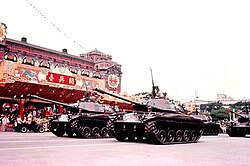
Traditionally, the Republic of China Armed Forces (ROCAF) have staged a military parade. During prior parades, troops and equipment march past a reviewing platform in front of the Presidential Office Building. Typically, foreign ambassadors, military officers, and other representatives and dignitaries are invited to view the parade. Following the National Anthem and the firing of a 21-gun salute, the parade commander, a general-ranked officer of any of the service branches of the ROCAF, would then be driven to the front of the grandstand to request permission from the President to commence the parade proper. Until 1975, the President also inspected the parade formations while riding a vehicle, as each battalion of the parade formations presented arms in the presence of the President and all the unit colours and guidons also dipped in their presence. After all the units in the ground column marched past the grandstand, they would reassemble at the center of the road for a holiday address delivered by the President to the ROCAF and the country, marking the close of the parade.

The parade has been held intermittently during the period of the Republic of China on Taiwan. The military parade on 10 October 1949, was the first public military parade held in Taiwan with Chen Cheng serving as the Grand Review Officer. The 1964 National Day parade was struck by tragedy when a low flying air force F-104 Starfighter fighter aircraft struck a Broadcasting Corporation of China tower, causing the plane's fuel tank to fall and kill three people including a woman and her baby in front of the Central Weather Bureau building in downtown Taipei. The other two remaining F-104 aircraft were ordered to look for the crashed aircraft and accidentally collided and crashed in Tucheng City, Taipei County (now New Taipei City), killing both pilots. The parade was not held again until 1971 (the 60th anniversary), while the mobile column and flypast segments returned in 1975. When Chen Shui-bian became president, the parade was not held until 2007 and then it was entitled a "Celebration Drill" and not a traditional military parade. Since Ma Ying-jeou became president, one parade has been held on the centenary celebrations of the Double Tenth Day, and another on the 105th, the only one under Tsai Ing-wen's presidency.

The tradition of shouting "Long live the Republic of China!" (中華民國萬歲; Zhonghua Mingguo Wansui!) at the end of the addresses by the president of the Republic of China was not held for the first time in 2016. It was also the very year that fire and police services joined the parade for the first time in history, breaking the tradition of an exclusively-military parade to include personnel from civil uniformed services.

List of Republic of China National Day Parades
Parade Year Exercise Name Grand Review Officer Venue Parade Commander Number of Troops Remarks
1949 Chen Cheng Taipei Unknown First military parade held in Taiwan under the control of the Republic of China.
1951 Chiang Kai-shek Taipei Ai Ai ROC Fortieth Anniversary
1952 復華演習 Chiang Kai-shek Taipei Tang Shou-chi 10,046
1953 Chiang Kai-shek Taipei Zhou Yuhuan 19,000
1954 Chiang Kai-shek Taipei Xu Rucheng Flyby aircraft was requisitioned for the defense of Quemoy during the First Taiwan Strait Crisis
1955 光華演習 Chiang Kai-shek Taipei Cheng Wei-yuan
1956 光復演習 Chiang Kai-shek Taipei Liu Dinghan 21,500
1957 中興演習 Chiang Kai-shek Taipei Hu Xin 12,000
1960 鼎興演習 Chiang Kai-shek Taipei Chu Yuan-Cong
1961 復興演習 Chiang Kai-shek Taipei Cheng Wei-yuan ROC Fiftieth Anniversary (Golden Jubilee)
1962 復華演習 Taipei Cancelled on September 11, 1962
1963 復漢演習 Chiang Kai-shek Taipei Yuan Guo-Zheng 15,370
1964 興漢演習 Chiang Kai-shek Taipei Hau Pei-tsun Two F-104 aircraft collided after an air formation, killing both pilots
1971 Chiang Kai-shek Taipei First parade after 6 years absence, marked the 60th Anniversary of the ROC, ground column only present
1975 大漢演習 Yen Chia-kan Taipei Zhang Jiajun Full remastered video of 1975 National Day parade
1978 漢威演習 Chiang Ching-kuo Taipei Chiang Chung-ling Flypast cancelled due to rainy weather
1979 Chiang Ching-kuo Taipei Ground column only present, air flypast and military mobile column cancelled
Full video of 1979 National Day parade
1980 Chiang Ching-kuo Taipei
1981 漢武演習 Chiang Ching-kuo Taipei Hsu Li-nung 11,966 ROC Seventieth Anniversary

(Part 1) (Part 2) (Part 3) (Part 4) (Part 5) (Part 6)

1982 Chiang Ching-kuo Taipei
1986 Chiang Ching-kuo Taipei ROC Seventy-Fifth Anniversary (Diamond Jubilee)
1987 僑泰演習 Chiang Ching-kuo Taipei It was the last military parade held during Chiang Ching-kuo's administration. It was held on 11 October, the day after the Double Ten Day celebrations due to Chiang's ailing condition.
(Also the first since the abolition of Martial Law in Taiwan earlier that July.)
1988 光武演習 Lee Teng-hui Taipei Chen Tingchong 13,166 ROC Seventy-Seventh Anniversary

(Part 1) (Part 2) (Part 3) (Part 4)

1991 華統演習 Lee Teng-hui Taipei Ro Wenshan 12,566 ROC Eightieth Anniversary

(Part 1) (Part 2) (Part 3) (Part 4)

2007 同慶操演 Chen Shui-bian Taipei Wu Sihuai 3,000 Exhibitions presented on national defense, non-traditional military parade
2011 Ma Ying-jeou Taipei 1,000+ The centennial event featured a skydiving show of 12 paratroopers of the Army Airborne Training Center above the plaza in front of the Presidential Office.[10] Military parade involving 1,000+ personnel, 71 aircraft and 168 vehicles.[11] On the part of the ground troops only the ROCAF Honor Guard Battalion and the ROCAF Composite Headquarters Band joined the parade on behalf of the armed forces.
2016 慶祥操演 Tsai Ing-wen Taipei 2,500+
2017 Tsai Ing-wen Taipei
2021 Tsai Ing-wen Taipei
2022 Tsai Ing-wen Taipei
2023 Tsai Ing-wen Taipei [12]
2024 Lai Ching-te Taipei

Full order of march past for National Day Parades until 1991

[edit]
Combined ROCAF marching bands (2018)

Until 1991, following the opening report by the Parade commander, usually a lieutenant general or vice admiral of the ROCAF, the massed military bands of the ROC Armed Forces, led by the Senior Drum Major, would take their positions in the parade, playing the ROC Armed Forces March, a medley of the official songs of the service branches of the armed forces. Then the parade would march past, in the following sequence, with minor variations over the years:

Ground column

[edit]
Ground column (2015)

Flypast

[edit]
Flypast over the Presidential Office (2018)

The parade's flypast segment was for many years organized in like manner as in the Bastille Day military parade. First, while the honor guard departs from the presidential grandstand the training, fighter and transport aircraft of the ROC Air Force, the transport and anti-submarine aircraft of ROCN Naval Aviation and transport planes of ROCA Army Aviation fly past first, followed by the helicopters of all three service branches, together with those of the National Police Agency, National Fire Agency and Coast Guard Administration after the ground column segment is concluded.

Mobile column

[edit]
ROCMP motorcycle column (2018)

The mobile column, for many years, served as a crowd favorite of National Day civil-military parades, since in this segment the ROC shows off to its people the advanced and modern military equipment and vehicles in service and those being introduced, many of them nationally produced, for use by the servicemen and women of the ROCAF, and since 2016, the state civil security institutions. As in every parade, the ROCMP's motorcycle column leads off the mobile column segment, followed by (as of 2016):

  • ROCN mobile column
  • Republic of China Air Force mobile column
    • Air defense guns and missiles
    • Equipment and materiel, including air to air missiles
  • Mobile column of ROCA formations and equipment (order as of 1991, 2007, 2011 and 2016 parades)
    • Anti-tank weapons
    • Signals
    • Armored cavalry
    • CBRN defense
    • ROCA Corps of Engineers
    • Motorized and mechanized infantry
    • Armored formations
    • Logistical and combat support
    • Air defense and missiles (mobile missile and gun systems and truck-towed systems)
    • Towed guns of the field artillery
    • Self propelled artillery (MRLs and self-propelled guns)
    • Disaster risk and response vehicles and equipment for calamity response operations
  • National Police Agency
    • Criminal Investigation Bureau vehicles and equipment
    • NPA National Highway Police
    • Mobile vehicles of the NPA's Special Police Corps
  • National Fire Agency vehicles and equipment
  • Coast Guard Administration small marine equipment and vehicles

Alongside the military and civil security mobile column, in the parades of the 70s and 80s and in more recent parades, a civil mobile column is present, composed of vehicles from the automobile and truck companies, state-owned firms, and the private sector.

Celebrations outside the Republic of China

[edit]

Mainland China and special administrative regions

[edit]

As the Chinese Communist Party became the official government of mainland China in 1949, 10 October is now celebrated in the People's Republic of China as the anniversary of the Xinhai Revolution and the Wuchang Uprising.

The former British colony of Hong Kong celebrated the ROC National Day as a public holiday until the government of the United Kingdom cut its diplomatic relations with the ROC Government as London recognized Beijing in 1950, shortly after the PRC's founding and it was postponed.[13] The former Portuguese colony of Macau had celebrated the ROC national day as a public holiday until the government of Portugal cut its relations as Lisbon recognizes Beijing in 1979. After the civil war in mainland China, the National Day was celebrated in regions inhabited by Chinese patriots who remained loyal to the Republic. Before the sovereignty of Hong Kong was transferred to the PRC in 1997 and Macau also transferred in 1999, many ROC supporters there would display patriotic and colourful flags (mainly the national flag of ROC) to celebrate the National Day. Taiwan agencies in Hong Kong and Macau have annually held a public ceremony to celebrate the National Day of ROC with members of pro-ROC private groups.[14] The day continues to be celebrated in Hong Kong and Macau after the transfer of sovereignty to the mainland, but the national flags publicly shown have been removed by Police of Hong Kong since July 1997 and by Police of Macau since December 1999.[15] Flag-raising ceremony at Hung Lau, Tuen Mun, Sun Yat-sen's revolutionary base, is the most noticeable yearly event, organized by Johnny Mak. Since 2020, the event was celebrated as the PRC's Anniversary of the Xinhai Revolution rather than the ROC's Double Ten Day in line with the holidays in mainland China. Chris Tang claimed in September 2021 that celebrations in Hong Kong for Double Ten Day could risk breaching the national security law.[16][17] The event in Macau is commemorated under the name of the Xinhai Revolution Memorial Day.

Other countries

[edit]

Overseas Chinese played a key role in the birth of the ROC since the nation's founding father Sun Yat-sen, a medical doctor by training, received financial support mainly from the overseas Chinese communities abroad to overthrow the imperial Qing dynasty and establish the second republic in Asia in 1912. Outside Taiwan, the National Day is also celebrated by many Overseas Chinese communities. Sizable National Day parades occur yearly in the Chinatowns of San Francisco and Chicago.

See also

[edit]

References

[edit]
[edit]
Revisions and contributorsEdit on WikipediaRead on Wikipedia
from Grokipedia
The National Day of the Republic of China, observed annually on October 10 and known as Double Tenth Day, commemorates the of 1911, an armed rebellion against the that ignited the Xinhai Revolution and culminated in the establishment of the republic on January 1, 1912. In the territory currently governed by the Republic of China—primarily and associated islands—the holiday serves as a public observance featuring presidential addresses, flag-hoisting ceremonies at the Presidential Office Building in , cultural performances, and periodic military parades showcasing national defense capabilities. These events underscore the republic's foundational commitment to , as articulated by , and affirm its continuity as Asia's oldest surviving republic amid ongoing geopolitical tensions with the , which contests the legitimacy of the 1911 revolution's outcomes. Overseas communities aligned with the Republic of China, particularly in Chinatowns and diaspora networks, also mark the day with flag displays and gatherings to honor the anti-monarchical legacy. The observance highlights empirical milestones in ending over two millennia of imperial rule through revolutionary action, though historical narratives vary due to ideological divergences between republican and communist interpretations of the era's causal dynamics.

Historical Origins

The 1911 Wuchang Uprising and Founding of the ROC

The Wuchang Uprising erupted on October 10, 1911, in Wuchang, Hubei Province, when a bomb-making accident exposed revolutionary plotters among the New Army's Eighth Division, prompting an impromptu mutiny against Qing authorities. Rebel forces, numbering around 4,000 soldiers under initial leaders like Xiong Bingkun and later Li Yuanhong, seized key government buildings and declared Hubei independent from the dynasty. This localized rebellion served as the catalyst for the Xinhai Revolution, as uprisings proliferated across fourteen provinces by mid-November, eroding Qing control amid widespread discontent over corruption, foreign encroachments, and failed reforms. Revolutionary momentum stemmed from organizations like the , established by in on August 20, 1905, which united disparate anti-Qing factions under the ""—nationalism to expel Manchu rule, democracy via constitutional government, and people's livelihood through equitable economic policies. The group orchestrated over a dozen failed uprisings prior to 1911 but cultivated networks within the modernized New Armies, fostering ideological commitment to over imperial autocracy. , Sun's chief military lieutenant and Tongmenghui co-founder, arrived in Wuchang shortly after the uprising's onset to assume command of revolutionary forces, directing operations that repelled Qing counterattacks and expanded control to nearby regions. As revolutionary assemblies convened, , who had been abroad fundraising in the United States during the uprising, returned to on December 25, 1911. On December 29, a provisional senate in elected him provisional president of the Republic of , reflecting his stature as the movement's ideological architect despite limited direct involvement in Wuchang. The republic was proclaimed on January 1, 1912, in , with Sun's inauguration marking the formal abolition of the Qing after 2,132 years of imperial succession in ; the dynasty's abdication followed on February 12, 1912, under regent . This establishment prioritized a with a unicameral legislature, though early instability soon compelled Sun to yield power to for unification.

Early Commemorations and Republican Symbolism

The inaugural official commemoration of Double Tenth Day took place on October 10, 1912, observing the first anniversary of the that precipitated the Republic of China's founding. These events featured public rallies, orations underscoring national cohesion and repudiation of monarchical governance, alongside flag-hoisting rituals with provisional republican ensigns, all aimed at embodying the revolutionary overthrow of imperial authority and fostering anti-imperialist resolve. Central to these observances were emergent republican emblems tracing to the revolutionary vanguard. The white sun motif, devised by in 1895 for the flag, symbolized renewal and egalitarian governance; it appeared in naval variants from 1912 and culminated in the national flag's formal ratification on December 17, 1928, by the Nationalist regime, thereafter integral to Double Tenth pageantry as a marker of the uprising's triumph over dynastic rule. Similarly, the "" composition, lyrics by set to a 1921 melody derived from a Japanese military tune, gained traction in early festivities to invoke , , and popular welfare, evolving into the official anthem by 1930 to encapsulate the republic's foundational ethos. Through the ensuing warlord period (1916–1928), amid territorial by militarists, Double Tenth rites endured as convocations to exhort centralized republican authority, deploying Sun Yat-sen's Three Principles to assail factional disunity and affirm the revolution's unifying imperative. In the (1927–1937), with the consolidating control, celebrations amplified invocations of these principles to steel public sentiment against Japanese expansionism, notably post-Mukden Incident, thereby perpetuating the holiday's role in cultivating ideological solidarity and vigilance toward external perils.

Official Designation and Date

The National Day of the Republic of China falls on October 10 each year, fixed to commemorate the Wuchang Uprising's outbreak on that precise date in 1911, when revolutionary forces seized key sites in Wuchang, province, igniting the chain of events that toppled the and led to the republic's formal inauguration on January 1, 1912. This date, rather than a lunar or variable observance, underscores the republican era's emphasis on modern calendrical standardization, with celebrations formalized as the "Double Tenth" from the republic's early years to symbolize the pivotal "double ten" numerals. In the Republic of China's legal framework, is enshrined as a statutory national holiday, granting public employees and workers paid leave, as stipulated in holiday observance regulations administered by labor authorities. The observance distinctly positions the Republic of China as the successor to the 1911 revolutionary founding, in contrast to the People's Republic of China's October 1 National Day, which marks the 1949 communist takeover of the mainland; this temporal and ideological divergence reinforces the ROC's claim to the original republican continuity amid ongoing cross-strait tensions.

Alternative Names and Linguistic Variations

The holiday is officially designated in as 國慶日 (Guóqìng rì), meaning "," in Republic of government documents and proclamations. It is also commonly termed 雙十節 (Shuāngshí jié), or "Double Tenth Festival," a directly referencing the dual digits of the date and evoking the 1911 Wuchang Uprising's pan-Chinese revolutionary significance. In English-language contexts, particularly in official communications and overseas observances, it is rendered as Double Tenth Day or National Day of the Republic of China, maintaining fidelity to the Mandarin etymology without substantive alteration. Phonetic adaptations exist in Taiwan's other , such as Taiwanese Hokkien's Siang-si̍p-chiat for Shuāngshí jié, though official usage prioritizes Mandarin for uniformity across state and ceremonial functions. Following the Republic of China's relocation to in 1949, these names persisted unchanged in Kuomintang-led and documentation to affirm the holiday's linkage to the republican founding, in contrast to the People's Republic of China's separate observance established that year. Informal and diaspora adaptations abroad, such as in community events among , retain these core terms to preserve the event's historical essence amid varying local integrations.

Celebrations in Taiwan

Presidential Address and State Ceremonies

The official state ceremonies for the Republic of China begin with a flag-raising event at the Presidential Office Building in , symbolizing national unity and . This is followed by the president's annual delivered from the plaza in front of the building, attended by high-ranking officials from the legislative, judicial, and executive branches. The ceremony underscores the continuity of the ROC's republican foundations established in 1911. On October 10, 2025, President (賴清德) presented the address for the 114th , themed "A New Rises in a Time of Change," highlighting advancements in , , economic resilience, and defense capabilities amid regional challenges. Lai emphasized bolstering national strength through democratic governance and a rules-based international order, while noting a relative softening in direct references to cross-strait tensions compared to prior speeches, focusing instead on domestic priorities like improving citizens' livelihoods. The address affirmed the ROC's rejection of forcible unification under the , positioning as a defender of and . Broadcast live nationwide via television and online platforms, as well as internationally, the presidential address functions as a key policy statement reinforcing the ROC's democratic legitimacy and strategic posture against external threats. It draws on the historical legacy of the , invoking Sun Yat-sen's principles to rally support for sustained vigilance in defense and economic self-reliance. Dignitaries and foreign representatives in attendance highlight the event's role in projecting Taiwan's global partnerships and internal cohesion.

Military Parades and Security Demonstrations

Military parades on the National Day of the Republic of China have traditionally served to exhibit the operational readiness and modernization of the , particularly in the context of persistent threats from the . From the 1950s through the 1990s, annual events in featured extensive ground formations, including infantry battalions, armored columns such as tanks in 1966, and coordinated aerial flypasts by fighter aircraft. These displays underscored the ROC's defensive posture during the era and the ongoing standoff. Following and fiscal reevaluation in the post-1990s period, full-scale ground parades were largely discontinued in favor of more restrained demonstrations, with major iterations reserved for significant anniversaries like the 2007 and 2011 centennial events. The 2007 parade highlighted indigenous anti-ship and air-defense missiles, signaling technological self-sufficiency and deterrence capabilities against amphibious threats. Similarly, the 2011 parade incorporated the CM-32 wheeled , an domestically produced 8x8 platform equipped with a remote station, emphasizing mobility and integration into doctrines. In contemporary annual observances, military elements focus on precision and symbolism, including honor guards from the , , , and ; static exhibitions of systems like Hsiung Feng series; and dynamic aerial maneuvers. For instance, the 2020 celebrations featured flyovers by upgraded F-16V fighters, UH-60 Black Hawks, and CH-47 Chinooks, while 2021 included 47 aircraft and four types. The 2025 event incorporated helicopter flag-bearing formations and Black Hawk passes over the Presidential Office, reinforcing aerial superiority and rapid response amid heightened cross-strait tensions. These components collectively project resolve and technological advancement without the logistical burden of massed troop movements.

Public Festivities and Cultural Events

Public festivities on National Day emphasize community participation and cultural expression, with major events centered in and other cities. A highlight is the annual fireworks display launched from , attracting tens of thousands of spectators to witness synchronized bursts symbolizing national unity and progress; in 2025, the show incorporated drone formations for added spectacle. Street fairs, concerts, and performances featuring traditional dances, indigenous music, and modern youth ensembles fill public squares, promoting through accessible, family-oriented programming. Educational initiatives in schools reinforce the day's historical significance, often including assemblies where students recite excerpts from Sun Yat-sen's , , and people's livelihood—as a means to instill republican values and appreciation for Taiwan's democratic evolution from its post-1949 governance. Exhibits on the revolutionaries and interactive displays about the Republic's founding are common in museums and community centers, fostering grassroots historical awareness without formal state oversight. Government-backed promotions via cultural agencies highlight Taiwan's achievements, such as its rapid industrialization and transition to multiparty , framing these as enduring legacies of the republican establishment to boost domestic pride and during the long weekend holiday. Local initiatives encourage visits to heritage sites with themed events, underscoring economic resilience and civic freedoms as direct outcomes of the revolution's principles applied in Taiwan's context.

Observances Beyond Taiwan

Overseas Chinese Communities

communities, particularly those aligned with the Republic of China (ROC), mark the National Day with flag-raising ceremonies, parades, and cultural receptions in cities across , emphasizing the founding and the ROC's enduring republican framework. In , annual parades in or nearby areas feature local associations, martial arts demonstrations, and ROC flag displays, drawing over 1,500 participants in some years to honor the anti-monarchical . These gatherings, often coordinated by Economic and Cultural Offices, include speeches by expatriate leaders highlighting democratic values and resistance to communist governance. In New York, events in Flushing and Manhattan's involve community marches and flag ceremonies, where participants affirm ROC sovereignty amid local political tensions, with resolutions from state legislatures recognizing the occasion. Vancouver's Taiwanese expatriates host receptions attended by hundreds, featuring addresses from Canadian officials praising Taiwan's democratic model and attended by nearly 400 guests in 2025. sees similar observances, including giant ROC flag displays in and county proclamations commemorating the 1911 uprising's legacy of . Such celebrations underscore the diaspora’s commitment to the ROC's anti-communist narrative post-1949 retreat, distinguishing them from pro-People's Republic of China activities in shared ethnic enclaves, where ROC supporters prioritize the original revolutionary ideals over subsequent mainland developments. Expatriates from ROC-allied perspectives use these occasions to lobby for international acknowledgment of Taiwan's de facto independence, with performances of traditional lion dances and Sun Yat-sen tributes reinforcing historical continuity. In Montreal's Chinatown, ROC flags and Double-Dix banners similarly signal adherence to these principles among francophone communities.

Restricted or Altered Celebrations in Mainland China and SARs

In the (PRC), public observances of October 10 as the National Day of the Republic of China (ROC) are not permitted, with the date instead incorporated into official as the commencement of the 1911 Xinhai Revolution, portrayed as a precursor to the communist victory and the founding of the PRC on October 1, 1949. State-controlled media and education emphasize this narrative to affirm the Chinese Communist Party's (CCP) exclusive claim to revolutionary legitimacy, suppressing any framing that honors the ROC's continuity from the 1911 republic. Private expressions recognizing the ROC holiday risk classification as separatist activities, subject to penalties under anti-subversion statutes, though specific enforcement data for this date remains opaque due to restricted reporting. In Hong Kong Special Administrative Region (SAR), Double Tenth celebrations, which included flag-raising ceremonies and community gatherings by pro-ROC groups prior to 2019, have been curtailed following the enactment of the Hong Kong National Security Law on June 30, 2020. Authorities canceled planned events in 2021, citing potential violations of the law's provisions against secession or subversion, effectively prohibiting organized commemorations of Taiwan's National Day. On September 23, 2021, Hong Kong's Secretary for Security explicitly warned residents against actions promoting Taiwan's separation from China around October 10, interpreting such activities as threats to national unity. This shift reflects heightened self-censorship among civil society, with previously active Kuomintang-affiliated organizations facing operational constraints or dissolution risks under the security framework. In Macau SAR, observances of Double Tenth Day have historically been subdued compared to , with minimal public events even before recent political tightening, and no large-scale curtailments reported post-2020 akin to those in . The SAR's alignment with PRC similarly subordinates the events to CCP narratives, limiting expressions of ROC symbolism to avoid scrutiny under alignments with mainland policies. Overall, these restrictions underscore the PRC's prioritization of its founding date for national celebrations, relegating to a depoliticized or reframed historical footnote devoid of republican implications.

Political Significance and Debates

Affirmation of ROC Continuity and Anti-Communist Legacy

The National Day of the Republic of China, marking the on October 10, 1911, underscores the unbroken continuity of the ROC as the successor to the republican government established that year, which overthrew imperial rule and instituted principles of . Despite the ROC government's relocation to in December following the , this observance reaffirms the state's legitimacy as the preserver of the 1912 founding charter against the Chinese Communist Party's subsequent territorial control of the mainland. The holiday thus positions the ROC as the institutional heir to 's vision, rejecting the establishment of the as an interruption rather than a legitimate evolution of republican governance. Central to this affirmation is the anti-communist legacy embedded in celebrations, which historically served to denounce the CCP's actions as a coup against the constitutional republic rather than a fulfillment of its ideals. Taiwan's democratization process, including the lifting of in 1987 and the inaugural direct on March 23, 1996—won by incumbent —embodies Sun Yat-sen's second principle of minquan (democracy), enabling power transitions through free elections under both and rule. This contrasts sharply with the PRC's one-party authoritarianism, where no comparable multiparty competition or direct national leadership elections occur, highlighting Taiwan's adherence to republican democratic norms. The ROC Constitution of 1947, as amended, sustains the claim to represent the entirety of while governing the "free area" of , , , and Matsu, thereby framing as a symbolic assertion of over communist-held territories. Empirical successes under this framework include 's economic transformation, with average annual GDP growth exceeding 8% from 1960 to 1990, elevating to levels surpassing many peers, alongside robust protections such as and press freedom, which underscore the causal efficacy of republican institutions over the PRC's centralized model marked by economic state intervention and documented suppressions of dissent. These outcomes validate the holiday's role in perpetuating Sun's third principle of minsheng (people's livelihood) through market-oriented policies and welfare advancements, distinct from the PRC's approach.

Controversies Over Taiwanese Relevance and Identity

Advocates for Taiwanese have criticized the for its historical disconnection from Taiwan's local experience, noting that the 1911 occurred on the Chinese mainland while was under Japanese colonial rule from 1895 to 1945, rendering the commemoration an import imposed by the (KMT) government after its retreat to the island in 1949. Pro-localization and pro-independence groups, often aligned with "deep green" ideologies, have described as a "political trap" that prioritizes Republic of (ROC) symbolism over distinct Taiwanese and identity, suppressing narratives centered on indigenous or post-colonial Taiwanese . In response to such views, proponents of the holiday's observance emphasize its celebration of broader republican principles—opposition to monarchical and authoritarian rule—that transcend geographic origins and align with Taiwan's integration into the ROC framework following Japan's surrender in 1945, as formalized in Allied agreements like the Cairo Declaration of 1943 and Potsdam Proclamation of 1945. They argue that dismissing the date ignores Taiwan's legal status as ROC territory since , with the holiday serving as a marker of anti-communist continuity rather than mainland-specific . Empirical data on public sentiment reveals persistent divides, with polls indicating that while a growing share of Taiwanese identify exclusively as "Taiwanese" rather than "Chinese" (reaching around 60-67% in recent surveys), a majority—often over 80%—prefer maintaining the of under the ROC over immediate formal changes that could provoke conflict. This ambivalence sustains the holiday's observance, as evidenced by annual state ceremonies and public events drawing broad participation despite sporadic protests by groups, which have called for alternatives like a separate " " tied to local milestones but have not displaced the tradition.

Cross-Strait Implications and PRC Responses

The National Day of the Republic of China underscores the ROC's claim to legitimate continuity as the government founded in , directly contesting the of China's (PRC) assertion of exclusive sovereignty over all Chinese territory, including . This annual affirmation of ROC sovereignty, particularly through presidential addresses emphasizing democratic governance and resistance to communist rule, prompts the PRC to interpret the event as a provocative endorsement of . In response, routinely escalates military posturing in the to signal coercive deterrence against perceived independence moves, as evidenced by the launch of the "Joint Sword-2024B" exercises on , 2024, involving over 100 and naval vessels encircling Taiwan and its outlying islands, just days after President Lai Ching-te's October 10 speech reiterating Taiwan's distinct status. These drills, framed by PRC as "stern warnings" to "separatist forces," aim to normalize high-intensity operations and erode Taiwan's defensive resolve without immediate escalation. PRC countermeasures extend to diplomatic isolation, pressuring foreign entities to shun ROC observances as a means to delegitimize Taiwan's international presence. For instance, in October 2025, Chinese diplomats demanded that a hotel cancel a Taiwanese reception, an effort rebuffed by the venue but illustrative of Beijing's broader campaign to deter third-party engagement with Taiwan's symbols. Such tactics complement economic and restrictions on cross-strait exchanges, contrasting with Taiwan's bolstering of alliances, including U.S. arms sales packages approved in totaling over $2 billion for defensive capabilities like missiles and radar systems, which enable to counterbalance PRC pressure. Beijing's Foreign Ministry has consistently condemned Lai's addresses as "ridiculous and dangerous" fabrications that exacerbate tensions, attributing any instability to Taiwan's refusal to accept the "" principle under PRC terms. From a cross-strait perspective, advocates in Taiwan, including elements within the , view the holiday's emphasis on ROC continuity as a stabilizing bulwark against PRC aggression by reinforcing independence without formal declaration, potentially deterring hasty unification demands. Marginal unificationist voices, such as those from the New Party, criticize the celebrations for unnecessarily provoking and hindering , arguing they perpetuate division inherited from the . Conversely, proponents of greater Taiwanese distinctiveness, aligned with the Democratic Progressive Party's platform, leverage the occasion to advance narratives, framing the ROC's founding as a rejection of rather than a pan-Chinese legacy, which Beijing counters by amplifying claims of inevitable reunification through military modernization and "restoration" commemorations like the October 25, 2025, designation of "Taiwan Restoration Day." These dynamics highlight the holiday's role in perpetuating a , where PRC responses prioritize to compel while Taiwan's observances sustain resolve amid asymmetric threats.

Recent Developments

Parades and Events Post-2000

Following the large-scale on October 10, , which involved approximately 2,000 troops, flyovers by fighter jets, and displays of home-developed missiles like the Tien Kung III, events transitioned to more restrained formats. This event, the first full in 16 years, marked a peak in overt showcasing before a shift toward cost-effective, targeted demonstrations aligned with Taiwan's and emphasis on doctrines. Subsequent celebrations incorporated modern technologies reflecting evolving threats from PRC missile and cyber capabilities, such as drone formations in public displays. For example, amid heightened cross-strait tensions, events highlighted unmanned systems and precision assets over massed troop maneuvers. The COVID-19 pandemic prompted further adaptations from 2020 to 2022, with scaled-back in-person gatherings prioritizing health measures while retaining core elements like presidential addresses and limited performances. The 2020 observance, described as low-key, featured a drone light show with 400 units forming the Double Tenth logo during , blending tradition with virtual dissemination to maintain public engagement and symbolize resilience. Post-pandemic returns emphasized hybrid formats, underscoring adaptive defense postures without reverting to pre-2000 grandeur.

2024-2025 Observances and Tensions

On October 10, 2024, President delivered the Republic of China's 113th National Day address in , emphasizing Taiwan's determination to safeguard its sovereignty amid persistent threats from the (PRC). The event featured a flag-raising , aerial flyovers by , and public gatherings, but lacked a full-scale , continuing the trend of scaled-back displays focused on ceremonial and defensive symbolism rather than large troop mobilizations. Lai highlighted the ROC's democratic achievements and called for unity against external aggression, attributing heightened PRC military pressure to Taiwan's refusal to accept unification under Beijing's terms. Attendance drew thousands to the plaza in front of the Presidential Office Building, with live broadcasts amplifying the message internationally. The 114th National Day celebration on October 10, 2025, similarly centered on President Lai's address, which shifted emphasis toward bolstering defense capabilities—including vows to develop a "T-Dome" system—and economic resilience, while softening direct rhetoric on cross-strait ties compared to prior years. Thousands assembled again before the Presidential Office for speeches, performances, and aerial demonstrations, underscoring themes of national unity and international partnerships for stability. Lai framed as a key democratic bulwark, pledging advancements in public health, intergenerational support, and deterrence without explicit provocation toward the PRC. Media coverage, including from and Taiwanese outlets, highlighted the event's focus on internal strengths amid ongoing disputes, with no reports of major disruptions despite routine PLA surveillance flights in the vicinity. Tensions escalated shortly after the 2025 observance when the PRC's formalized October 25 as the "Commemoration Day of Taiwan's Restoration," repurposing the date—historically Taiwan's marking the end of Japanese rule in 1945—to assert Beijing's territorial claims and counter the ROC's foundational narrative. Taiwanese officials, including the , condemned the move as a distortion of , arguing it ignores the ROC's legal continuity and the island's post-1949 under a separate . This PRC initiative, timed in proximity to the ROC holiday, reflected heightened rhetorical competition, accompanied by persistent PLA activities such as increased aircraft incursions and naval patrols around , which surged in frequency leading into late 2025 without direct correlation to the October 10 events but amplifying the broader contest over legitimacy. Such actions underscored the causal link between ROC affirmations of and PRC escalations in military posturing and historical revisionism.

References

Add your contribution
Related Hubs
User Avatar
No comments yet.