


Community hub
Recent from talks
Contribute something
Nothing was collected or created yet.
Mule (smuggling)
View on Wikipedia

A mule or courier is someone who personally smuggles contraband across a border (as opposed to sending by mail, etc.) for a smuggling organization. The organizers employ mules to reduce the risk of getting caught themselves. Methods of smuggling include hiding the goods in vehicles or carried items, attaching them to one's body, or using the body as a container.
In the case of transporting illegal drugs, the term drug mule applies. Other slang terms include Kinder Surprise and Easter Egg. Small-scale operations, in which one courier carries one piece or a very small quantity, are sometimes called the ant trade.
Techniques
[edit]Concealment
[edit]Methods of smuggling include hiding the goods in a large vehicle,[1] luggage,[2] or clothes.[1] In a vehicle, the contraband is hidden in secret compartments.[1]
Sometimes the goods are hidden in the bag or vehicle of an innocent person, who does not know about the contraband, for the purpose of retrieving the goods elsewhere.
Some contraband is legal to possess but is subject to taxes or other import restrictions, such as second-hand clothes and computers, and the purpose of the smuggling is to get around these restrictions. In this case, smuggling may be done in plain sight, in smaller quantities, so that a suitcase full of used clothes or a new computer can be passed off as a personal possession rather than an importing business.[3]
Body packing
[edit] |
.jpg)
The practice of transporting goods outside or inside of the body is called body packing. This is done by a person usually called a mule or bait. The contraband is attached to the outside of the body using adhesive tape, glue, or straps, often in such places as between the cheeks of the buttocks or between rolls of fat. Other inconspicuous places, like the soles of cut out shoes, inside belts, or the rim of a hat, were used more often prior to the early 1990s. Due to increased airport security the "body packing" method is rarely used any more.
Some narcotics-trafficking organizations, such as the Mexican cartels, will purposely send one or two people with drugs on the outside of their body to be caught, so that the authorities are preoccupied while dozens of mules pass by undetected with drugs inside their body. However, even these diversionary tactics are becoming less prevalent as airport security increases.
Swallowing
[edit]
This is often done using a mule's gastrointestinal tract or other body cavities as containers. Swallowing has been used for the transportation of heroin,[1][4][5] cocaine,[6] and MDMA (ecstasy).[7] A swallower typically fills tiny balloons with small quantities of a drug. The balloons may be made with multilayered condoms, fingers of latex gloves,[6] or more sophisticated hollow pellets. One smuggling method involves swallowing the balloons, which are recovered later from the excreted feces. Alternatively, the balloons may be hidden in other natural or artificial body cavities – such as rectum,[6] colostomy,[8] vagina, and mouth[9] – although this method is far more vulnerable to body cavity searches. A drug mule may swallow dozens upon dozens of balloons.[5] The swallower then attempts to cross international borders, excrete the balloons, and sell the drugs.
It is most common for the swallower to be making the trip on behalf of a drug lord or drug dealer. Swallowers are often impoverished and agree to transport the drugs in exchange for money or other favors. In fewer cases, the drug dealers can attempt extortion against people by threatening physical harm against friends or family, but the more common practice is for swallowers to willingly accept the job in exchange for big payoffs. As reported in Lost Rights by James Bovard: "Nigerian drug lords have employed an army of 'swallowers', those who will swallow as many as 150 balloons and smuggle drugs into the United States. Given the per capita yearly income of Nigeria is $2,100, Nigerians can collect as much as $15,000 per trip."[10] Swallowers have been apprehended from a variety of age groups, including adults, teens, and children.[5]
Detection and medical treatment
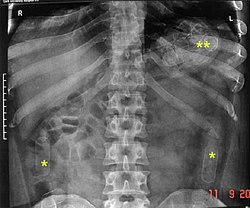
[edit]Routine detection of the smuggled packets is extremely difficult, and many cases come to light because a packet has ruptured or because of intestinal obstruction. Unruptured packets may sometimes be detected by rectal or vaginal examination, but the only reliable way is by X-ray of the abdomen. Hashish appears denser than stool, cocaine is approximately the same density as stool, while heroin looks like air.[11][12]
An increasingly popular type of swallowing involves having the drug in the form of liquid-filled balloons or condoms/packages. These are impossible to detect unless the airport has high-sensitivity X-Ray equipment, as a liquid mixture of water and the drug will most likely not be detected using a standard X-Ray machine. Most of the major airports in Europe, Canada, and the US have the more sensitive machines.
In most cases, it is only necessary to wait for the packets to pass normally, but if a packet ruptures or if there is intestinal obstruction, then it may be necessary to operate and surgically remove the packets.[13] Oil-based laxatives should never be used, as they can weaken the latex of condoms and cause packets to rupture.[14] Emetics like syrup of ipecac, enemas, and endoscopic retrieval all carry a risk of packet rupture and should not be used.[15] Repeat imaging is only necessary if the mule does not know the packet count.
Ruptured packets can be fatal, leading to a drug overdose and may require admission to an ICU. Body packers are not always reliable sources of information about the contents of the packages (either because of fears about information being passed on to law enforcement agencies or because the mule genuinely does not know). Urine toxicology may be necessary to determine what drugs are being carried and what antidotes are needed.[4][13]
International incidents
[edit]China
[edit]Some mobile phones and electronics are available for less in Hong Kong, one of China's Special Administrative Regions where the tax laws are relaxed. Mules employed by smugglers have been found with devices strapped to their bodies in an effort to smuggle them across the border from Hong Kong to Shenzhen. According to Customs Law of China and Smuggling Penalties, a person shall be subject to a criminal charge if found smuggling small quantities of goods three times in one year. The maximum jail sentence is three years.[16][17]
United States
[edit]The U.S. Supreme Court dealt with body packing in United States v. Montoya De Hernandez. In Hernandez, a woman attempted to smuggle 88 balloons of cocaine in her gastrointestinal tract. She had been detained for over 16 hours by customs inspectors before she finally passed some of the balloons. She was being held because her abdomen was noticeably swollen (she claimed to be pregnant), and a search of her body had revealed that she was wearing two pairs of elastic underpants and had lined her crotch area with paper towels. This is done because balloon swallowing makes bowel movements difficult to control. The woman claimed her Fourth Amendment rights had been violated, but the court found in favor of the border authorities.
With regard to traffic from South America to the US, the US Drug Enforcement Administration reports: "Unlike cocaine, heroin is often smuggled by people who swallow large numbers of small capsules (50–90), allowing them to transport up to 1.5 kilograms of heroin."
United Kingdom
[edit]In 2003, over 50% of foreign female prisoners in UK jails were drug mules from Jamaica.[18] Nigerian women make a large contribution to the remaining figure.[citation needed]
In all, around 18% of the UK's female jail population are foreigners, 60% of whom are serving sentences for drug-related offences – most of them drug mules.[19]
Russian Federation
[edit]Wholesalers
[edit]Since the import of drugs into the territory of the Russian Federation practically does not occur, and the production of so-called "bath salts" is localized even in the Far North, therefore, drug transportation is almost always within the country. Wholesalers carrying approximately 1 to 10 kg drive cars, loading their prohibited goods into places not intended for cargo transportation, for example, in the hood or under the body.
Local drug couriers
[edit]The retail sale of drugs in Russia usually takes place through the darknet.The purchase is paid for in cryptocurrency, then the courier tells the buyer the geolocation of the drug drop, after which the recipient comes and picks it up. Local drug couriers in Russia usually come from the poorest part of the indigenous population of the Russian Federation or foreign citizens of Central Asian states.
Today, the salary of such couriers reaches one million rubles per month, which is approximately 10 times the average salary in the Russian Federation. However, their criminal work often lasts less than a month, after which they are arrested under Article 228 of the Russian Criminal Code, which carries a prison sentence of 10 to 20 years. On average, 20,000 to 50,000 such couriers are arrested in Russia each year.
See also
[edit]References
[edit]- ^ a b c d Statement of Michael A. Braun, Chief of Operations, Drug Enforcement Administration, Before the House International Relations Committee, Subcommittee on Western Hemisphere, November 9, 2005 – "The Illicit Drug Transit Zone in Central America", U.S. Drug Enforcement Administration (DEA), November 9, 2005, archived from the original on December 10, 2005
- ^ Kouri, Jim (March 20, 2006). "Panamanian Drug Gang and "Swallowers" Nailed by NYPD". mensnewsdaily.com. Men's News Daily. Archived from the original on February 4, 2012.
- ^ Guo, Eileen (13 March 2018). "Here's What Really Happens to Your Used Clothes - Racked". www.racked.com. Retrieved 2018-03-23.
- ^ a b Sribanditmongkol, P; Supasingsiripreecha, W; Thampitak, S; Junkuy, A (January 2006). "Fatal Heroin Intoxication in Body Packers in Northern Thailand during the Last Decade: Two Case Reports". Journal of the Medical Association of Thailand. 89 (1): 106–10. PMID 16583590.
- ^ a b c Traub, SJ; Kohn, GL; Hoffman, RS; Nelson, LS (February 2003). "Pediatric "body packing"". Archives of Pediatrics & Adolescent Medicine. 157 (2): 174–7. doi:10.1001/archpedi.157.2.174. PMID 12580688.
- ^ a b c Parisek, Sonja I. "Cocaine overdose secondary to rupture of latex cocaine packet". Uniformed Services University of the Health Sciences. Archived from the original on 2015-02-17.
Dx by: Abdominal radiograph, physical evidence of packet, exploratory laparotomy to remove additional packets, sigmoidoscopy.... These were found INSIDE the patient's bowel.... Cocaine packets recovered in the Emergency Department from rectal cavity of patient. Cocaine is stuffed into latex glove fingers and tied. Condoms may also be used - but are more expensive.
- ^ Low, VHS; Dillon, EK (October 2005). "Agony of the ecstasy: Report of five cases of MDMA smuggling". Australasian Radiology. 49 (5): 400–3. doi:10.1111/j.1440-1673.2005.01503.x. PMID 16174179.
- ^ Walter, Benjamin M.; Martignoni, M.; Säckl, J.; Felgenhauer, N.; Eyer, F.; Tratzl, V.; Schmid, R. M.; von Delius, S. (July 2012). "A curious case of body packing: impaction of cocaine capsules in a colostomy exit". Forensic Toxicology. 30 (2): 199–201. doi:10.1007/s11419-012-0139-4. S2CID 32808024.
- ^ Khan FH (2005). "The cocaine 'body-packer' syndrome: Diagnosis and treatment". Indian Journal of Medical Sciences. 59 (10): 457–8. doi:10.4103/0019-5359.17054. hdl:1807/7635. PMID 16272682.
- ^ Bovard, James (1995). Lost Rights: the Destruction of American Liberty. Palgrave Macmillan Trade. ISBN 978-0312123338.
- ^ Hergan K, Kofler K, Oser W (2004). "Drug smuggling by body packing: what radiologists should know about it". European Radiology. 14 (4): 736–42. doi:10.1007/s00330-003-2091-5. PMID 14566426. S2CID 206954313.
- ^ "סחר בסמים". Saturday, 22 May 2021
- ^ a b Dueñas-Laita A, Nogué S, Burillo-Putze G (2004). "Body packing". New England Journal of Medicine. 350 (12): 1260–1. doi:10.1056/NEJM200403183501220. PMID 15028835.
- ^ Traub SJ, Hoffman RS, Nelson LS (2003). "Body packing—the internal concealment of illicit drugs". New England Journal of Medicine. 349 (26): 2519–26. doi:10.1056/NEJMra022719. PMID 14695412.
- ^ Pidoto RR, Agliata AM, Bertoline R, Mainini A, Rossi G, Giani G (2002). "A new method of packaging cocaine for international traffic and implications for the management of cocaine body-packers". The Journal of Emergency Medicine. 23 (2): 149–53. doi:10.1016/S0736-4679(02)00505-X. PMID 12359282.
- ^ Goren, Lauren (March 5, 2012). "iPhone Mules Attempt to Smuggle Tech into China". Mashable.
- ^ Li Hao. "Man in jail for multiple smugglings". Shenzhen Daily. Shenzhen. Archived from the original on 2014-09-03.
- ^ "Jamaica's women drug mules fill UK jails". BBC News. 2003-09-13. Retrieved 2010-05-13.
- ^ "Nigerian drug mules 'on the rise'". BBC News. 2005-10-03. Retrieved 2010-05-13.
Mule (smuggling)
View on GrokipediaDefinition and Historical Context
Definition and Role in Smuggling
A smuggling mule, commonly referred to as a drug mule in the context of narcotics trafficking, is an individual recruited to transport illicit substances across international borders or security checkpoints, typically concealing the contraband on their person or internally within their body, with no ongoing commercial stake beyond the act of conveyance itself.[9] This role distinguishes mules from higher-level organizers or distributors, as they function primarily as disposable couriers in hierarchical smuggling networks, often paid a flat fee or enticed by promises of quick financial gain.[7] Empirical data from U.S. border enforcement indicate that mules handle substantial loads, with median seizures of approximately 30 kilograms of drugs per incident along the U.S.-Mexico border, underscoring their utility in moving bulk quantities that evade bulk cargo screening.[10] In smuggling operations, mules play a critical logistical function by bridging production sites and consumer markets, exploiting human mobility to bypass detection technologies designed for vehicles or shipments.[2] Their deployment allows trafficking syndicates to externalize risks—such as arrest, health complications from concealment, or asset forfeiture—to low-level participants, thereby insulating kingpins from direct exposure.[1] For instance, U.S. Customs and Border Protection data reveal thousands of annual arrests of such couriers at ports of entry, primarily involving internal body packing of cocaine, heroin, or methamphetamine, which facilitates the influx of an estimated 90% of hard drugs entering via land borders.[7] This method's prevalence stems from its cost-effectiveness relative to alternative routes, as mules can blend into legitimate passenger traffic, though success rates remain low due to advancing imaging and canine detection capabilities.[6] The role extends beyond drugs to other contraband like cash or wildlife products, but narcotics dominate, with mules often selected for their perceived disposability and willingness to accept calculated risks for compensation averaging under 1% of the drugs' street value.[10] Despite occasional narratives of coercion, economic analyses highlight voluntarism driven by poverty or greed, as evidenced by repeat offenders in arrest records, challenging portrayals of mules as unwitting victims.[7] Overall, their integration into supply chains amplifies the resilience of global illicit trade, sustaining flows that empirical models link to heightened violence and addiction rates in destination countries.[11]Origins and Evolution of Mule Usage
The use of human mules for smuggling narcotics internally, termed body packing, originated in the early 1970s as international drug cartels adapted to heightened border inspections and the need for low-profile transport of high-value substances like cocaine and heroin.[12] This method involved individuals swallowing or inserting sealed packets of drugs to bypass detection by customs officials relying on external searches or canine units.[1] Prior to this, smuggling primarily utilized external concealment, maritime vessels, or animal carriers, but escalating enforcement—such as U.S. customs enhancements following the 1970 Controlled Substances Act—prompted the shift to human couriers willing to risk personal health for payment.[13] The earliest medical documentation of body packing appeared in 1973, with case reports describing fatalities from packet ruptures during gastrointestinal transit, highlighting the technique's inherent dangers from the outset.[12] Anecdotal accounts indicate possible informal use predating these records, likely among South American traffickers exporting to North America and Europe amid rising demand for cocaine refined from coca leaves in Peru and Colombia.[12] By 1975, the practice had proliferated sufficiently for recognition in forensic contexts, coinciding with the Medellín cartel's expansion and the first major seizures of internally concealed cocaine at U.S. entry points.[14] Over subsequent decades, mule usage evolved in response to counter-trafficking measures, transitioning from ad hoc latex-wrapped bundles—often condoms filled with 8-12 grams per packet—to engineered, multi-layered encapsulations using materials like synthetic polymers and adhesives to minimize rupture risks, which historically exceeded 5% in early cases.[15] This refinement paralleled advancements in imaging detection, such as plain radiography and computed tomography, forcing packers to reduce packet density and incorporate non-radio-opaque fillers.[1] Global dissemination accelerated in the late 1970s, with the technique entering Asian routes from the Golden Triangle heroin producers, where Chinese authorities reported initial detections around 1978-1979.[16] By the 1980s, mules transported an estimated thousands of kilograms annually across transatlantic and transpacific flights, with organizations like Colombia's Cali cartel systematizing recruitment to sustain volumes despite high attrition from arrests and medical emergencies.[13] Modern iterations incorporate digital coordination for mule handlers and pseudo-medical protocols to monitor swallowers, underscoring a causal progression driven by profit maximization amid persistent interdiction pressures.[15]Recruitment and Motivations
Methods of Recruitment
Recruiters for smuggling mules primarily target individuals facing economic hardship, such as those in debt or seeking quick income, using tactics that range from deceptive job offers to direct threats. These methods exploit vulnerabilities like poverty in source countries such as Mexico, Peru, and Colombia, where potential mules are often promised payments of around $1,000 for a single trip.[17][18] One common approach involves public advertising disguised as legitimate employment. Historically, newspaper classifieds in Mexico featured vague postings for drivers or couriers to transport "company vehicles" across borders, leading respondents to hidden drug loads.[19] More recently, social media platforms like Facebook have been exploited by transnational criminal organizations to post job ads for roles such as money transport or general labor, often specifying border crossings like El Paso to Ciudad Juárez. In a 2021 case documented by U.S. Homeland Security Investigations, recruiters contacted respondents via direct messages, assured them of legality, conducted interviews in Mexico, and then loaded their vehicles with narcotics before instructing them to enter U.S. ports of entry.[20][19] Similar 2019 Facebook ads targeted U.S. citizens with "money-making opportunities," resulting in arrests for smuggling methamphetamine and heroin.[19] Personal networks and word-of-mouth recruitment leverage trust within families, friendships, or criminal groups to enlist mules, often downplaying risks or withholding details about the cargo. Interviews with incarcerated female traffickers in Trinidad and Tobago revealed that seven out of thirteen were initially approached by acquaintances posing as friends offering vacations or favors, which evolved into smuggling requests amid economic pressures like single parenthood.[17] In one U.S. example, a Chula Vista high school student in 2019 recruited peers through casual conversations, leading to their involvement in cross-border drug runs organized by cartel associates.[19] Prior involvement in low-level drug activities can also facilitate recruitment, as seen in cases where spouses or associates draw in experienced individuals for higher-stakes roles.[17] Coercive methods, including threats of violence, are employed particularly against women from vulnerable backgrounds, where initial job lures like caregiving positions in Europe turn into forced smuggling. A 2023 Spanish judicial probe into a Barcelona-based gang uncovered recruiter "Martina" targeting Peruvian and Colombian women, providing plane tickets under false pretenses, confiscating passports to create debt (e.g., $2,000 owed), and issuing warnings such as "Remember that I can have your family killed" to ensure compliance with cocaine concealment.[18] Such tactics often involve collusion with insiders, like airline staff, to facilitate internal body packing before flights.[18] While some recruits enter voluntarily for financial gain, coercion enforces participation once committed, as evidenced by intercepted communications planning multi-kilogram shipments.[18][17]Economic and Personal Incentives
Individuals acting as mules in smuggling operations, particularly for drugs across borders like the US-Mexico frontier, receive compensation that reflects a competitive labor market balancing risk and reward. Empirical analysis of convicted mules reveals a median payment of $1,313 per trip, with a mean of $1,604, varying by drug type: cocaine yields an average of $2,272, methamphetamine $1,719, and marijuana $1,464.[7] These amounts enable mules to potentially earn salaries comparable to legal alternatives, such as a US truck driver's $35,000 annually, through approximately two trips per month, assuming successful evasion of detection.[7] The economic appeal stems from high short-term gains relative to local opportunities in source countries, where poverty and limited employment drive participation. Payments incorporate compensating differentials for apprehension risks, estimated at 5-10% per crossing, with higher premiums for riskier loads like cocaine or methamphetamine, where mules earn roughly 1,400 extra per additional expected year of imprisonment.[7] In regions with weak economies, such as parts of Latin America or West Africa, smuggling offers quick profits unavailable in legitimate sectors, attracting individuals from low-wage backgrounds.[21] Personal incentives often intersect with economic pressures, including debt repayment, family support, and immediate financial crises like medical emergencies or child-rearing costs. Interviews with female drug smugglers highlight motivations tied to single parenthood, wedding expenses, or funding personal aspirations, with some knowingly recruited via trusted networks for these gains.[17] Others cite life-changing opportunities or addiction funding as drivers, though empirical accounts emphasize voluntary engagement for promised sums of £5,000-£10,000 per trip amid grinding poverty, rather than widespread coercion.[4][22] These factors underscore how mules perceive smuggling as a rational, albeit hazardous, path to alleviate personal hardships.Coercion Claims Versus Evidence of Voluntarism
Claims of coercion in drug mule recruitment frequently cite threats to family members, debt bondage, or deception about the nature of the cargo, portraying mules as unwitting victims exploited by cartels. Such narratives appear in reports from organizations like the United Nations Office on Drugs and Crime (UNODC), which note instances of psychological coercion, including intimidation during recruitment processes for female mules in cocaine trafficking. For example, some cases involve partners or recruiters misleading individuals about trip details or using family ties to pressure participation, as documented in regional analyses of prison smuggling in Latin America. However, these claims often stem from self-reported accounts by convicted mules, which may be influenced by incentives to mitigate sentences, and lack corroboration from independent verification. Empirical studies contradict the prevalence of outright coercion, indicating that most mules participate voluntarily, primarily motivated by financial incentives. A phenomenological study of 20 female drug mules incarcerated in South African correctional centers found that 18 cited economic necessity—such as supporting families amid insufficient legitimate income—as the key driver, with 13 employed yet seeking higher earnings; only 8 reported deception or threats, and 4 explicitly volunteered after learning of the opportunity from known recruiters. Similarly, qualitative interviews with 23 mules (14 women) in Ecuadorian prisons revealed that while a minority faced direct threats (2 cases) or debt pressures, the majority were driven by monetary rewards, such as advances of $2,000 or funds for property purchases, viewing smuggling as a rational means to alleviate relative deprivation.[23] UNODC's analysis of women's roles in the cocaine supply chain further supports voluntarism, stating that available evidence shows only a minority are coerced or deceived, with initial involvement often voluntary due to socio-economic vulnerabilities like poverty and sole-provider status; for instance, 59% of Colombian female prisoners surveyed attributed participation to household needs. Experts emphasize that women are selected not for coercibility but for perceived lower scrutiny at borders, and many knowingly engage despite risks, as evidenced by reluctance to name accomplices post-arrest, suggesting agency rather than victimhood. Repeat participation by some mules—such as documented cases of multiple smuggling attempts—further indicates informed choice over one-time duress, as coerced individuals rarely re-engage voluntarily. While economic desperation limits options, first-principles assessment reveals these decisions as calculated trade-offs for substantial payouts relative to local wages, not equivalent to forcible compulsion.[11][11]Smuggling Techniques
External Concealment Methods
External concealment methods involve affixing drug packages to the exterior of the body using adhesive tape, elastic straps, or glue, typically concealed beneath layers of clothing to evade visual and physical detection during border crossings.[24] This approach allows mules to transport relatively small quantities of narcotics, such as cocaine or methamphetamine, across ports, airports, or land borders, often targeting areas like the lower extremities or torso where bulges can be minimized with loose attire or padding.[25] A common technique targets the legs and ankles, where packages are flattened and taped tightly to reduce detectability during routine pat-downs or walks. In August 2015, U.S. Customs and Border Protection (CBP) officers at Port Everglades, Florida, arrested a Bahamian national after discovering 2.4 pounds (1.1 kilograms) of cocaine taped to his ankles following a pat-down search.[26] Similarly, in August 2016, CBP agents in Nogales, Arizona, apprehended two Mexican women smuggling methamphetamine wrapped around their calves using tape.[27] Torso strapping, securing packages to the back, waist, or abdomen under oversized garments, represents another frequent method; for example, in April 2020, a 15-year-old male was detained at a U.S. border crossing with methamphetamine strapped to his back and waist area beneath his clothing.[25] Smugglers occasionally employ creative modifications to body appearance for added obfuscation, such as integrating drugs into wigs, prosthetics, or disguised padding. In 2019, Spanish police in Barcelona seized 0.5 kilograms of cocaine hidden beneath a poorly fitted toupee on a Colombian traveler at Josep Tarradellas Airport.[28] Prosthetic enhancements, like cushion-like fake buttocks attached via swim trunks, concealed 1 kilogram of cocaine on a Brazilian man arrested at Lisbon Airport in 2018.[28] Disguises further aid these efforts; in 2013, three Colombian women, dressed as nuns, were caught at a Colombian airport with 2 kilograms of cocaine each strapped to their bodies under their habits.[28] These variants prioritize portability and low-volume loads suited for individual mules rather than bulk cargo.[24]Internal Body Concealment
Internal body concealment, commonly known as body packing, involves smugglers ingesting drug-filled packets or inserting them into body cavities to transport illicit substances across borders.[29] Body packers typically swallow multiple latex-wrapped or condom-encased packets containing cocaine, heroin, or cannabis derivatives, with each packet weighing approximately 10 grams and designed to withstand gastrointestinal transit.[30] Advanced packaging techniques include multiple layers of plastic, aluminum foil, or carbon paper to minimize radiographic detection and prevent leakage.[3] In body packing operations, mules often ingest 50 to 100 packets, totaling up to 1 kilogram of drugs, and may use antimotility agents to prolong intestinal retention until reaching the destination.[29] [2] For instance, a 2021 case in a low-resource setting involved a mule carrying 93 heroin pellets weighing 900 grams.[31] Insertion methods, termed body pushing, place smaller quantities into the rectum or vagina, though these are less common for high-volume smuggling due to limited capacity.[32] Body stuffing differs from packing as it entails hasty ingestion of poorly wrapped drugs during imminent apprehension, involving fewer packets with higher rupture risk, but remains a form of internal concealment primarily for evasion rather than international transport.[33] Cocaine predominates in swallowed consignments due to its high value and compact form, followed by heroin, with smugglers increasingly employing sophisticated wraps to counter imaging technologies.[1] These methods have evolved since the 1970s, with detection challenges persisting despite innovations like multi-layer barriers.[34]Advanced or Specialized Techniques
Advanced body packing techniques employ multiple layers of latex, condoms, or synthetic materials to encapsulate drugs, reducing the risk of rupture during transit and minimizing radiodensity to evade detection on plain abdominal radiographs.[35] These methods often involve co-ingestion of laxatives or other substances to facilitate controlled expulsion, while the packets are shaped or coated to mimic ingested food or fecal matter on imaging.[34] Such refinements, documented in case studies from 2019, have lowered detection rates on standard x-rays, necessitating advanced computed tomography (CT) scans for identification due to subtle signs like uniform density or compartmentalization.[35] Surgical implantation represents a highly specialized technique, where drugs are embedded within prosthetic body enhancements or subcutaneous pockets created by medical professionals. In December 2012, Italian authorities arrested a Peruvian model at Rome's Fiumicino Airport after discovering 2.5 kilograms of cocaine surgically placed in her breast and buttock implants, highlighting the use of cosmetic surgery to conceal contraband internally without relying on gastrointestinal transit.[36] Similarly, in March 2016, German customs officials at Frankfurt Airport intercepted a 24-year-old Colombian woman carrying 1 kilogram of cocaine in surgically altered breast implants, demonstrating the adaptation of elective procedures for smuggling purposes.[37] These methods, often executed by trafficker-affiliated "surgeons," evade routine body cavity searches but carry elevated risks of infection and surgical complications, with documented cases tracing back to organized networks in South America.[38] Rectal and vaginal concealment serve as specialized alternatives to oral ingestion, particularly for shorter routes or when gastrointestinal packing is impractical, involving insertion of sealed packets into these cavities to bypass scanner-focused checks on the abdomen.[1] Female mules have utilized vaginal packing with multi-layered wraps to transport up to several hundred grams of cocaine or heroin, as evidenced in forensic reports, though detection via physical examination or targeted imaging remains feasible despite efforts to use low-density materials.[39] These techniques prioritize volume limitation and rapid retrieval but increase vulnerability to leakage from physical activity or poor sealing.[40]Risks and Health Consequences
Health Hazards from Internal Concealment
Internal concealment of drugs, known as body packing, typically involves swallowing multiple latex- or condom-wrapped packets containing substances such as cocaine, heroin, or amphetamines, or inserting them into the rectum or vagina.[41] The primary health hazard arises from packet rupture or leakage, leading to acute overdose and systemic toxicity. For cocaine body packers, rupture can cause rapid absorption of lethal doses, resulting in symptoms including seizures, hyperthermia, myocardial infarction, and sudden cardiac death.[41] [5] In opioid cases, such as heroin, rupture may present with respiratory depression, coma, or seizures, as documented in fatal incidents where packets disintegrated in the gastrointestinal tract.[42] Between 1990 and 2001 in New York City, 50 body packer deaths occurred, with 37 attributed to acute intoxication from ruptured packages.[43] Non-toxic mechanical complications include gastrointestinal obstruction from the bulk of undigested packets, which can mimic bowel obstruction and necessitate surgical intervention.[44] Packet perforation, though less common, risks chemical peritonitis or secondary bacterial infection, exacerbating abdominal pain, fever, and sepsis.[45] Opioid-laden packets may induce severe constipation or ileus due to the drug's pharmacological effects even without rupture, prolonging transit time and increasing rupture risk.[12] Studies indicate that while the overall population-level mortality from body packing remains low—comparable to other smuggling-related incidents—individual cases carry high fatality potential if complications arise before medical detection.[46] Conservative management with laxatives and observation is often employed for asymptomatic individuals, but surgical removal is required in 10-20% of hospitalized cases involving obstruction or toxicity.[47]Legal and Personal Perils
Drug mules face severe legal consequences upon detection, including extended prison sentences and substantial fines under federal and international laws prohibiting narcotics importation and distribution. In the United States, federal trafficking statutes under 21 U.S.C. § 841 and related provisions mandate minimum terms of 5 to 40 years for first offenses involving quantities such as 5 kilograms of cocaine, with penalties escalating for repeat violations or larger amounts. The United States Sentencing Commission reported an average sentence of 77 months for drug trafficking offenses in fiscal year 2019, with 96.4% of convicted individuals incarcerated.[48] Illustrative convictions highlight the rigidity of enforcement: In September 2024, a New York-based American Airlines mechanic received 9 years for conspiring to import cocaine concealed in aircraft compartments.[49] Similarly, in November 2024, a South Texas resident was sentenced to 235 months—nearly 20 years—for smuggling over 15 tons of marijuana across the border.[50] A Florida woman convicted in October 2024 of large-scale methamphetamine and fentanyl distribution drew 25 years, reflecting prosecutorial emphasis on deterrence through harsh terms.[51] These outcomes often include asset forfeiture and supervised release, compounding economic devastation.[52] Beyond incarceration, mules encounter personal hazards from the criminal syndicates orchestrating the operations. Traffickers frequently impose threats of violence against mules or their families to ensure compliance and silence post-arrest, leveraging the cartels' established patterns of intimidation and retaliation documented in enforcement reports.[53] Failed deliveries or perceived disloyalty can provoke lethal reprisals, as syndicates prioritize operational security over individual welfare.[2] Conviction in foreign jurisdictions exacerbates these perils, subjecting individuals to prolonged separation from dependents, cultural isolation, and exposure to violent prison environments, with limited avenues for early release or repatriation.[54]Detection and Enforcement
Technological and Behavioral Detection
Technological detection of drug mules, particularly those employing internal concealment, relies primarily on imaging modalities to identify ingested or inserted packets within the gastrointestinal tract or body cavities. Plain abdominal radiography remains the initial and most accessible method, capable of visualizing foreign bodies as radio-opaque densities or the "double condom sign" indicative of layered packaging, though its sensitivity varies with packet composition and can miss low-density substances like cocaine.[1][55] Computed tomography (CT) scans, especially unenhanced low-dose protocols, offer superior accuracy with sensitivity exceeding 96% for packet detection, enabling visualization of packet shapes, numbers, and complications like obstruction without contrast risks.[6][56] Ultrasound serves as a radiation-free alternative, detecting packets via hyperechoic masses with acoustic shadowing, particularly useful in resource-limited settings or for initial screening.[34][57] Advanced non-invasive tools include millimeter-wave body scanners deployed at airports and borders, which penetrate clothing to reveal concealed anomalies without ionizing radiation, enhancing detection of externally or shallowly hidden contraband.[58] Emerging technologies, such as automated computer-aided analysis of X-ray images, aim to accelerate identification of body packing patterns in high-volume screening environments.[59] Canine units trained to detect odors of narcotics like cocaine, heroin, and methamphetamine contribute to initial alerts, though their efficacy diminishes for well-sealed internal packets where scents are minimal; they are more reliable for external concealment or residual odors on persons and luggage.[60] Fingerprint-based sweat analysis for drug metabolites provides rapid field testing to flag recent handlers or users, potentially corroborating suspicion but not directly confirming internal loads.[61] Behavioral detection involves trained officers observing passengers for indicators of deception or stress, such as excessive nervousness, inconsistent responses during questioning, exaggerated physical mannerisms like yawning or throat clearing, or avoidance of eye contact, which may prompt secondary inspections.[62][63] Programs like the TSA's Behavior Detection Activities employ standardized cues derived from psychological research, though independent reviews, including a 2013 GAO assessment, have found limited empirical validation for their predictive validity in identifying threats or smugglers, with high false-positive rates.[64][65] Customs and Border Protection officers integrate behavioral profiling with risk-based targeting, using travel history, itinerary anomalies, and verbal inconsistencies to escalate to pat-downs or imaging, as evidenced in cases where initial cues led to discoveries of concealed bundles.[66] Despite these methods, smugglers adapt by employing unwitting carriers or minimizing overt signs, underscoring the need for layered, intelligence-driven approaches over sole reliance on behavioral cues.[67]Medical Interventions and Treatment
Medical management of body packers, individuals who internally conceal drug packets for smuggling, prioritizes conservative approaches for asymptomatic cases to facilitate safe packet expulsion while minimizing rupture risks. Upon hospital admission, patients typically receive whole bowel irrigation (WBI) using polyethylene glycol electrolyte solutions to accelerate gastrointestinal transit and packet elimination, often combined with serial abdominal radiographs to monitor progress until two to three packet-free stools are confirmed or imaging verifies clearance.[68][29] This method, adopted widely since the 1990s for improved packet integrity, avoids opioids or antimotility agents that could prolong retention and has shown success in over 90% of uncomplicated cases without surgical needs.[69] For symptomatic body packers exhibiting signs of packet rupture—such as acute toxicity from cocaine, heroin, or other substances—treatment shifts to targeted decontamination and supportive care. Cocaine toxicity, for instance, involves benzodiazepines for agitation and seizures, cooling measures for hyperthermia, and sodium bicarbonate for QRS widening, while opioid overdoses receive naloxone; however, these address symptoms rather than the source until packets are removed.[47][70] Endoscopic retrieval is generally contraindicated due to rupture risks but may be considered per ASGE guidelines for gastric heroin packets stalled beyond 24-48 hours in select low-risk scenarios.00017-1/fulltext) Surgical intervention becomes necessary in approximately 5-10% of cases involving bowel obstruction, impending rupture evidenced by imaging, or refractory toxicity despite medical efforts, typically via exploratory laparotomy for direct packet extraction.[71][33] Historical data from the 1980s emphasized routine surgery for cocaine body packers due to fragile packaging, but contemporary protocols reserve it for complications, reporting low perioperative mortality under 1% in specialized centers when performed promptly.[47][68] Post-treatment, patients require multidisciplinary monitoring for complications like peritonitis or delayed toxicity, with hospital stays averaging 2-5 days for conservative management.[72]Legal Frameworks and Penalties
International Variations in Sentencing
Sentencing for drug mules, typically low-level couriers transporting controlled substances across borders, exhibits stark international disparities, reflecting differing policy emphases on deterrence, rehabilitation, and harm reduction. In Southeast Asian nations, penalties often include mandatory capital punishment for quantities exceeding specified thresholds, aimed at suppressing trafficking networks through exemplary severity. By contrast, Western jurisdictions impose graduated prison terms calibrated to drug quantity, offender role, and mitigating factors like coercion or minimal involvement, with provisions for sentence reductions via cooperation or plea deals. These variations stem from legal frameworks prioritizing public health in some regions versus strict prohibition in others, though empirical deterrence effects remain debated among criminologists.[73] In Singapore, the Misuse of Drugs Act mandates death by hanging for trafficking over 15 grams of heroin or diamorphine, 30 grams of cocaine, or 500 grams of cannabis, applied rigorously to mules regardless of personal circumstances. For instance, in April 2023, Tangaraju Suppiah was executed for coordinating the delivery of 1,017 grams of cannabis, underscoring the law's impartial enforcement even for non-violent roles. Executions resumed in 2022 after a hiatus, with at least four drug-related hangings that year, primarily for importation offenses involving mules.[74][75] Indonesia enforces the death penalty under Narcotics Law No. 35/2009 for smuggling "Group I" drugs like cocaine or heroin in quantities over 1 gram, with firing squads as the method; over 500 individuals, including 96 foreigners, awaited execution as of June 2025. British national Lindsay Sandiford received a death sentence in 2013 for trafficking 4.8 kilograms of cocaine hidden in clothing but was repatriated to the UK in October 2025 following diplomatic negotiations, avoiding execution. Recent cases include three British nationals charged in June 2025 for smuggling nearly 1 kilogram of cocaine into Bali, facing potential capital punishment if convicted.[76][77] Malaysia historically imposed mandatory death for trafficking over 200 grams of cannabis, 15 grams of heroin, or 50 grams of cocaine under the Dangerous Drugs Act 1952, but abolished this requirement in April 2023, allowing judicial discretion for alternatives like life imprisonment or whipping. Pre-repeal, sentences were uniformly lethal for qualifying mules; post-reform, 11 drug convicts had death sentences commuted to life terms by November 2023. As of July 2024, new death sentences for drug trafficking persisted in regions like Sabah and Sarawak, totaling 14 cases.[78][79][80]| Country | Threshold Triggering Severe Penalty | Typical Mule Sentence Range | Key Notes/Source |
|---|---|---|---|
| Singapore | >15g heroin; >500g cannabis | Mandatory death | Enforced via hanging; no mitigation for role.[81] |
| Indonesia | >1g cocaine/heroin (Group I drugs) | Death by firing squad | Applies to importation; diplomatic reprieves rare.[82] |
| Malaysia | >15g heroin; >200g cannabis (pre-2023 mandatory) | Death (now discretionary) or life | 2023 reform allows alternatives; commutations increasing.[78] |
| United States | 100g+ heroin; 500g+ cocaine (federal) | 5-40 years mandatory minimum | USSC guidelines adjust for minimal role; reductions possible.[83] |
| United Kingdom | Category 1 (e.g., >5kg heroin equivalent) | 7-14 years custody (mules often lower) | Sentencing Council guidelines factor culpability; e.g., 4 years for 270kg cannabis import in 2025.[84] |
| Australia | Commercial quantity (e.g., >500g cocaine) | Life max; 25 years min for some imports | Federal Criminal Code; mules charged under importation sections.[85] |