Hubbry Logo
Holy SaturdayHoly SaturdayMain
Open search
Holy Saturday
Community hub
Holy Saturday
logo
8 pages, 0 posts
0 subscribers
Be the first to start a discussion here.
Holy Saturday
Holy Saturday
from Wikipedia

Holy Saturday
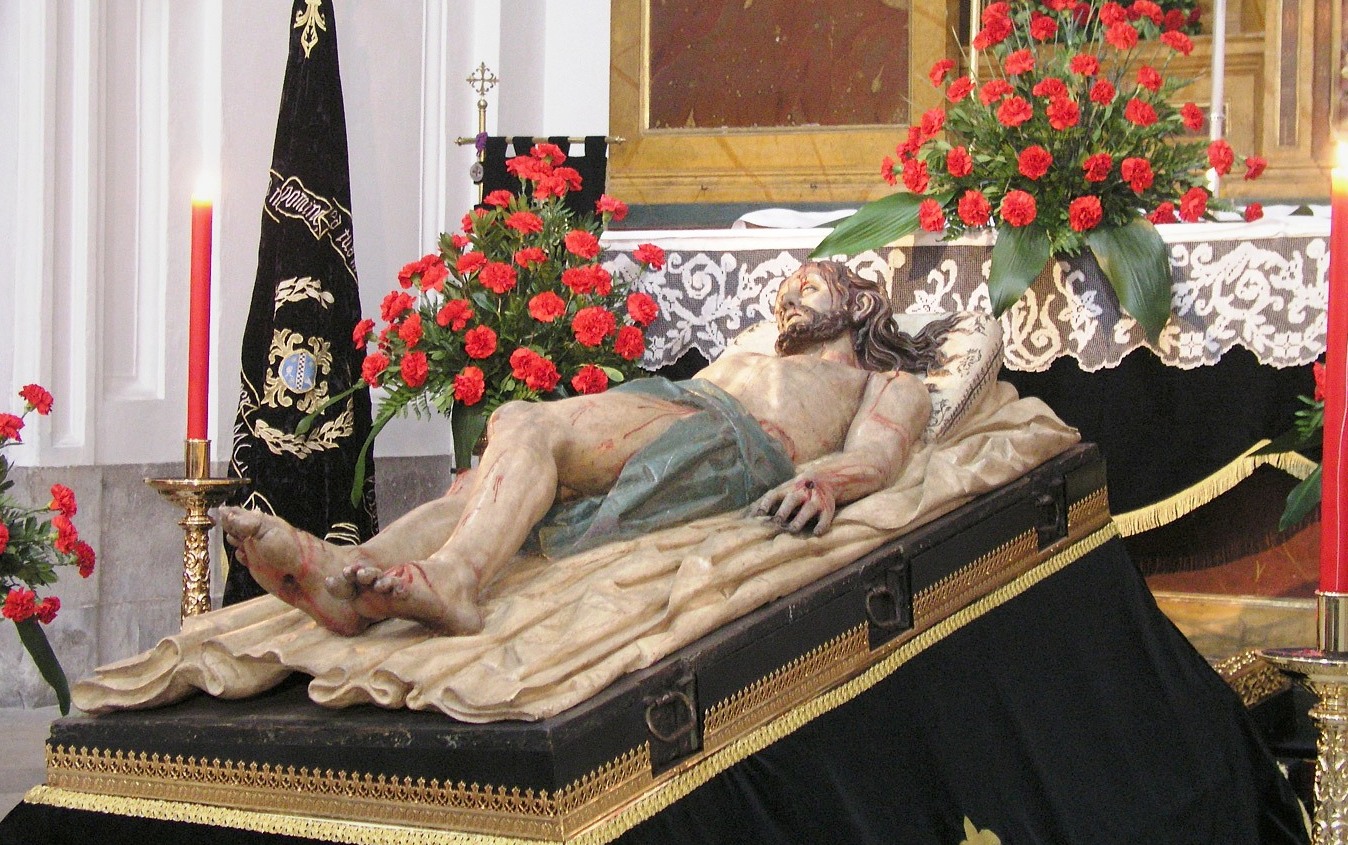
Statue of Christ in the tomb by Gregorio Fernández. (Monastery of San Joaquín y Santa Ana, Valladolid)
Official nameHoly Saturday
Also calledEaster Eve, Black Saturday
Observed byChristians
TypeReligious
SignificanceMemory of the day Jesus Christ's body lay in the tomb and the Harrowing of Hell
DateDay after Good Friday
2024 date
  • March 30 (Western)
  • May 4 (Eastern)
2025 date
  • April 19 (Western)
  • April 19 (Eastern)
2026 date
  • April 4 (Western)
  • April 11 (Eastern)
2027 date
  • March 27 (Western)
  • May 1 (Eastern)
Frequencyannual
Related toEaster

Holy Saturday (Latin: Sabbatum Sanctum), also known as Great and Holy Saturday, Low Saturday, the Great Sabbath, Hallelujah Saturday, Saturday of the Glory, Easter Eve,[1] Joyous Saturday, the Saturday of Light, Good Saturday, or Black Saturday,[1] among other names, is the final day of Holy Week, between Good Friday and Easter Sunday, and when Christians prepare for the Christian feast of Easter.[2][3]

The day commemorates the Harrowing of Hell while Jesus Christ's body lay in the tomb. Christians of the Catholic, Lutheran, and Anglican denominations begin the celebration of the Easter Vigil service on Holy Saturday, which provides a transition to the season of Eastertide; in the Moravian Christian tradition, graves are decorated with flowers during the day of Holy Saturday and the celebration of the sunrise service starts before dawn on Easter Sunday.[2][3] Congregations of the Reformed and Methodist denominations may hold either the Easter Vigil or an Easter Sunday sunrise service.[4]

Terminology

[edit]

Jewish Nazarenes

[edit]

Whereas the Great Sabbath in Jewish liturgy occurs the sabbath before the Feast of Unleavened Bread, the sabbath in the midst of the feast is celebrated as a Special Shabbat § Shabbat Chol Hamoed Pesach. In Hebrews 4, Jewish Christians are admonished to make every effort to enter this sabbath and every sabbath in repentance, and Psalm 95 is excerpted by the author of Hebrews: "today if you hear his voice, do not harden your hearts." The entire Psalm 95 is read on Friday afternoon every week in synagogue prayers immediately before receiving the sabbath in rabbinic Judaism.

Eastern traditions

[edit]

Eastern Orthodoxy

In Eastern Orthodoxy this day, known as Holy and Great Saturday, is also called The Great Sabbath since it is on this day that Christ "rested" physically in the tomb. But it is also believed that it was on this day he performed in spirit the Harrowing of Hell and raised up to Paradise, having liberated those who had been held captive.

Oriental Orthodoxy

In the Coptic, Ethiopian and Eritrean Orthodox Churches, this day is known as Joyous Saturday, otherwise known as the night of light and joy.[5] It is known as the Saturday of Good Tidings or Gospel Saturday in the Syriac Church, which is also a day where Syriac Christians remember their departed.[6]

Syriac Christianity

In the Syriac Christian tradition, this day is known as ܫܲܒܬ݂ܵܐ ܕܢܘܼܗܪܵܐ šábbṯā d-núhrā or the Saturday of Light.

Western traditions

[edit]

In Western traditions, the day is usually called Holy Saturday, although in the Moravian Church, the day is referred to as the Great Sabbath and in the Anglican Communion, the Book of Common Prayer refers to the day as Easter Even.[7][8]

Although the term Easter Saturday is usually applied to the Saturday in Easter week,[9][10] in English-speaking countries it is sometimes erronouesly applied to Holy Saturday,[11] with the term even being present in legislation in the Australian states of New South Wales and Queensland,[12] and by Australian government agencies.[13] In the Catholic tradition, the Blessed Virgin Mary is honored on this day under the title Our Lady of Solitude, referring to her grief at the death of her son.

Religious and cultural practices

[edit]

Eastern traditions

[edit]

Eastern Orthodox

[edit]
The icon of Holy and Great Saturday, portraying the Harrowing of Hades
Holy Fire in 2022

Matins of Holy and Great Saturday (in parishes usually held on Friday evening)[14][15] takes the form of a funeral service for Christ. The entire service takes place around the Epitaphios, an icon in the form of a cloth embroidered with the image of Christ prepared for burial. The first part of the service consists of chanting Psalm 118, as usual at both Saturday matins and at funerals, but interspersed with hymns (enkomia or lamentations) between the verses. The predominant theme of the service is not so much one of mourning, but of watchful expectation:[16]

Today Thou dost keep holy the seventh day,
Which Thou has blessed of old by resting from Thy works.
Thou bringest all things into being and Thou makest all things new,
Observing the Sabbath rest, my Saviour, and restoring strength.[17]

Near the end of matins, at the end of the Great Doxology, the Epitaphios is taken up and carried in procession around the outside of the church, while the Trisagion is sung, as is done when carrying the body to the cemetery in an Orthodox burial.

Divine Liturgy of Holy Saturday in a Greek Orthodox church in the United States

On Saturday, a vesperal Divine Liturgy of Saint Basil the Great is celebrated, called the First Resurrection Service (Greek: Ἡ Πρώτη Ἀνάστασις), named so because chronologically it was composed earlier than the Paschal Canon by St. John of Damascus[18] rather than because it occurs earlier liturgically.[19] This is the longest Divine Liturgy of the entire year and is performed later than on any other day of the year, "at the tenth hour of the day".[20]

On 'Lord, I call', four of the usual Sunday hymns from the Octoechos are sung, followed by four for the day, the doxasticon from Lauds the night before and the usual dogmatikon. After the Little Entrance, there is no Evening Prokimenon, but there are 15 Old Testament readings that recall the history of salvation, many of which relate to Passover, baptism, or the Resurrection (note that book names here are given according to the Septuagint):

  • Genesis 1:1-13 – God creates the universe
  • Isaiah 60:1-16 – Isaiah prophecies a golden age for Judah
  • Exodus 12:1-11 – God gives instructions for the first Passover
  • Jonah 1:1-4:11 – Jonah spends three days in the belly of a sea monster
  • Joshua 5:10-15 – Joshua celebrates Passover
  • Exodus 13:20-15:19 – The Israelites cross the Red Sea (note that the final 19 verses are sung as a canticle)
  • Zephaniah 3:8-15 – God promises refuge to Israel
  • 3 Kings 17:8-24 – Elijah meets the widow of Zarephath and resurrects her son
  • Isaiah 61:10-62:5 – Isaiah celebrates a coming salvation
  • Genesis 22:1-18 – God tests Abraham by telling him to sacrifice his son Isaac
  • Isaiah 61:1-9 – Isaiah explains the role of a prophet and the relationship Israel will have with God
  • 4 Kings 4:8-37 – Elisha resurrects the son of the Shunamite woman
  • Isaiah 63:11-64:5 – Isaiah remembers the crossing of the Red Sea and prays for his people
  • Jeremiah 31:31-34 – Jeremiah prophecies the new covenant
  • Daniel 3:1-89 – The Three Holy Youths are cast into a fiery furnace (note that the final 33 verses (and three extra-biblical ones) are sung as a canticle)

In place of the Trisagion, the baptismal hymn 'As many as have been baptised into Christ have put on Christ. Alleluia.' is sung. The Prokimenon is from Psalm 65 (66), made up of verses from the First Antiphon of Pascha: 'Let all the earth worship Thee: sing of Thee and praise Thy Name, O most High.' The Epistle is Romans 6:3-11, St. Paul's explanation of the role of death and resurrection in baptism. This is the standard epistle read at baptisms.

Unique to this day, the Alleluia is replaced with Psalm 81 (82) being sung: "Arise, O God, judge Thou the earth: for Thou shalt have an inheritance in all the nations" while the deacon performs a censing of the church. In Slavic tradition where the service is begun in dark vestments, the hangings, altar cloths, curtain and vestments are changed to bright. In Greek and Arabic tradition, the clergy strew laurel leaves (a symbol of victory) and flower petals all over the church to symbolize Jesus' triumph over death, often accompanied – especially in Cypriot custom[21] – by the congregation making a loud noise by stamping their feet, banging on pews and sticks, and even clanging pots and pans, all to symbolize Christ shattering the gates and breaking the chains of hell.

The liturgical atmosphere changes from sorrow to joy at this service. The faithful continue to fast and the Paschal greeting, "Christ is risen!", is not exchanged until after midnight during the Paschal Vigil since this service represents the proclamation of Jesus' victory over death to those in Hades. The Resurrection has not yet been announced to those on earth, which takes place during the Paschal Vigil.

The Gospel reading is Matthew 28:1-20, St. Matthew's account of the Resurrection. While the first fifteen verses are not read at any other time, the final five verses form one of the Sunday Matins Gospels and are the standard Gospel reading for baptisms.

The Cherubic Hymn is replaced by 'Let all mortal flesh keep silence', an analogous hymn from the ancient Liturgy of Saint James, and the Hymn to the Theotokos is replaced with the irmos from Ode 9 of the Canon the night before, Christ's promise to His Mother that she will be magnified following His Resurrection, but other than that the Liturgy proceeds as any other Liturgy of St. Basil. After the service, in many places, it is customary to break and bless bread as at a Vigil, but to omit the blessing of oil.

Great Lent was originally the period of catechesis for new converts in order to prepare them for baptism and chrismation and when there are converts received, that occurs during the Old testament readings during the vesperal divine liturgy. Before the midnight service, the faithful gather in church for the reading of the Acts of the Apostles in its entirety. Preceding midnight the Paschal Vigil begins with the Midnight Office, during which the Canon of Holy Saturday is repeated, toward the end of which the epitaphios is removed from the center of the church and placed on the altar table where it remains until the Ascension.[a] Then, all of the candles and lights in the church are extinguished, and all wait in darkness and silence for the proclamation of the Resurrection of Christ.

Western traditions

[edit]
Holy Saturday and other named days and day ranges around Lent and Easter in Western Christianity, with the fasting days of Lent numbered

Roman Catholicism

[edit]
Lighting of the Paschal Candle from the Easter fire symbolises Christ's triumph over darkness.

In the Catholic Church, the altar remains stripped completely bare (following the Mass of the Lord's Supper on Maundy Thursday). The celebration of the Sacraments is extremely limited: Holy Communion is given only as Viaticum to the dying; while penance, Anointing of the Sick and baptism may be administered because they, like Viaticum, are helpful to ensuring salvation for the dying. The day is the second day of the Paschal fast as outlined in Sacrosanctum Concilium, Article 110.[22] In the Roman Catholic Church, plenary indulgence is obtained if two or more faithfuls pray the Holy Rosary or if the faithful attends the celebration of the Easter Vigil and renews their baptismal promises, which are part of the liturgy of the same Mass.[23]

Catholics typically perform the sacrament of Baptism on Holy Saturday Mass.
Sprinkling of holy water following the renewal of baptismal vows

In the predominantly Catholic Philippines, the day is legally and colloquially known as Black Saturday, given the colour's role in mourning. It commemorates the day that Jesus lay in his tomb.[24] Traditional taboos from the previous day are carried over and are sometimes broken; swimming is allowed in the afternoon. Most commercial establishments resume operations, with smaller enterprises remaining closed until or before Easter. Television and radio stations broadcast on shorter hours with special programming or remain off-air.[25]

In predominantly Catholic Poland, Święconka (Polish pronunciation: [ɕvʲɛnˈtsɔnka]), meaning "the blessing of the Easter baskets", on Holy Saturday, is one of the most enduring and beloved traditions. Baskets containing eggs, ham, bread, sweet breads, horseradish, and lamb cakes or butter lambs are brought to church to be blessed.[26]

Protestantism

[edit]

Lutheran, Anglican, Methodist, and other Churches observe many of the same customs as the Catholic Church; however, their altars may be covered in black instead of being stripped. The Anglican Book of Common Prayer uses Easter Even to designate the day. In some Anglican churches, including the Protestant Episcopal Church in the United States of America, provision is made for a simple Liturgy of the Word on this day, with readings commemorating the burial of Christ. Daily Offices are still observed. In the Moravian Church, the day is known as Great Sabbath.[7]

In the Catholic, Lutheran, Anglican and Methodist traditions, Holy Saturday lasts until nightfall, after which the Easter Vigil is celebrated, marking the official start of the Easter season.[27]

In the Moravian Church, people decorate the graves in God's Acre with flowers; the sunrise service, the first liturgy of Paschaltide, begins before dawn of Easter Sunday.[3]

Notes

[edit]

References

[edit]

Sources

[edit]
[edit]
Revisions and contributorsEdit on WikipediaRead on Wikipedia
from Grokipedia
Holy Saturday, also known as the Vigil of or Great and Holy Saturday in Eastern Orthodox traditions, is the final day of and the day preceding Sunday in the Christian liturgical calendar. It commemorates the day after Jesus Christ's crucifixion on , when his body rested in the tomb and, according to Christian doctrine, his soul descended into to proclaim victory over death. This day symbolizes a period of solemn waiting, reflection on Christ's Passion and Death, and anticipation of the , often marked by , , and the absence of Eucharistic celebrations during daylight hours. In the Roman Catholic tradition, Holy Saturday is described as the "Second Sabbath," during which the Church waits at the Lord's tomb in prayer and fasting, meditating on his Descent into Hell while preparing for the Easter Vigil. No Mass is celebrated until the evening, when the Easter Vigil begins after nightfall with the blessing of a new fire, the lighting of the Paschal candle, and the singing of the Exsultet to proclaim Christ's Resurrection. Holy Communion is reserved solely for the dying as Viaticum during the day. In Eastern Orthodox practice, Great and Holy Saturday focuses on the burial of Christ and his descent into Hades, serving as a day of watchful expectation where mourning transforms into joy through liturgical services like the Vesperal Liturgy, which includes Old Testament readings and hymns emphasizing the Harrowing of Hell. Among Anglicans and in the broader Protestant observance, Holy Saturday reflects the disciples' sorrow and uncertainty following the , often observed through continued from and culminating in the service after sunset. This vigil, sometimes called "Easter Eve," features the lighting of the to symbolize the light of the , followed by scriptural readings, renewal of , and the , bridging the emptiness of the tomb to the joy of . Across denominations, the day underscores themes of amid desolation, with customs varying by region, such as Easter foods in some Eastern European Catholic communities.

Historical and Biblical Context

Biblical Foundations

Holy Saturday, observed as the day between Jesus' crucifixion on Good Friday and his resurrection on Easter Sunday, finds its primary scriptural foundation in the New Testament accounts of his burial and the ensuing Sabbath rest. The Gospels describe the entombment occurring on the evening of the crucifixion, emphasizing the urgency due to the approaching Sabbath. In Matthew 27:57-66, Joseph of Arimathea requests Jesus' body from Pilate, wraps it in clean linen, and places it in a new tomb, rolling a large stone across the entrance; meanwhile, the chief priests and Pharisees secure the tomb with a guard and seal to prevent any disturbance. Mark 15:42-47 similarly recounts the burial by Joseph, noting that it was the day of Preparation, the day before the Sabbath, with Mary Magdalene and Mary the mother of Joses observing where Jesus was laid. Luke 23:50-56 details Joseph as a respected member of the council who, being a disciple of Jesus, takes the body, wraps it in linen, and lays it in a rock-hewn tomb not yet occupied, while the women from Galilee prepare spices but rest on the Sabbath in obedience to the commandment. John 19:38-42 adds that Nicodemus assists Joseph, bringing a mixture of myrrh and aloes, and they bind the body with spices and linen cloths according to Jewish burial customs, placing it in the nearby new tomb because of the Jewish day of Preparation. These parallel narratives underscore the finality of the burial, portraying Holy Saturday as a day of stillness in the tomb, with no reported activity involving Jesus until the resurrection. The observance of Holy Saturday aligns with the Jewish , the seventh day of the week commanded for rest in the Hebrew Scriptures. Exodus 20:8-11 instructs, "Remember the day, to keep it holy. Six days you shall labor, and do all your work, but the seventh day is a to the your ," prohibiting any work under penalty of death, a tradition rooted in 's rest after creation. In the Gospel context, this falls during week, compelling the disciples to cease activities; Luke 23:56 explicitly states that the women "returned and prepared spices and ointments. On the they rested according to the commandment," illustrating adherence to Mosaic law even amid . This rest period frames Holy Saturday as a liminal time, bridging the sorrow of and the joy of , while respecting the cultural and religious imperatives of first-century . Chronologically, Holy Saturday represents the seventh day of in Christian tradition, positioned as the culmination of the — the three-day liturgical unity encompassing , , and —yet biblically, it serves as the intervening that enforces a pause after the Friday preparations. The Gospels consistently date the crucifixion to the day of Preparation before the (e.g., Mark 15:42), implying that Friday evening to Saturday sunset constitutes this sacred rest, during which the tomb remains sealed and guarded as per Matthew's account. This placement highlights the 's role in the passion narrative, allowing time for the women's preparations to resume post-Sabbath, leading into the discovery of the on Sunday. Beyond the canonical Gospels, apocryphal texts like the Gospel of Nicodemus (also known as the Acts of Pilate), dating to the fourth century, expand on the entombment period by describing Jesus' descent to Hades during Holy Saturday, though these writings hold no doctrinal authority in mainstream Christianity and served primarily as devotional influences in medieval piety.

Development in Early Christianity

In the second and third centuries, early Christian communities began to formalize observances commemorating Christ's burial on the day following the crucifixion, drawing from Jewish Sabbath traditions while emphasizing fasting and vigil as acts of mourning and anticipation. The Didascalia Apostolorum, a third-century Syrian church order, explicitly prescribes a complete fast on the Friday and Saturday before Pascha, stating, "on Friday and on Saturday ye shall fast completely, and eat nothing," to honor the Passion without interruption by meals. Similarly, the Apostolic Tradition attributed to Hippolytus of Rome (circa 215 AD) mandates a strict fast for all Christians on the Friday and Saturday preceding Easter, with the faithful joining catechumens in this discipline to prepare for baptismal rites during the ensuing vigil. These texts reflect an emerging practice of treating the Sabbath as a day of solemn rest and prayer, distinct from ordinary weekly Sabbaths, though still influenced by scriptural accounts of Christ's entombment. The Council of Nicaea in 325 AD played a pivotal role in standardizing the across the church, establishing on the after the following the vernal equinox and thereby fixing Holy Saturday as the culminating day of mourning within this unified framework. This decision addressed longstanding quartodeciman controversies, where some Asian churches observed Pascha on the 14th of regardless of the day of the week, by enforcing a celebration that integrated the , , and Holy Saturday—as a cohesive liturgical sequence. The council's canons and accompanying letters emphasize communal harmony in Paschal observance, implicitly reinforcing Holy Saturday's role as a period of quiet reflection on Christ's descent into the tomb. Early Christian adaptations of Jewish traditions significantly shaped these developments, as evidenced in of Caesarea's , which documents debates over computations to align with but diverge from Jewish lunar calendars. recounts how figures like Hippolytus proposed a sixteen-year cycle for determining the date, noting, "he sets forth a register of the times and puts forward a certain canon of a sixteen-years cycle for the ," to ensure Christian observance reflected redemption themes while avoiding direct dependence on Jewish reckoning. By the fourth century, Holy Saturday had evolved from a simple fast into a fully liturgical day in key centers like and Antioch. In , the pilgrim Egeria (circa 381–384 AD) describes an elaborate Saturday observance, including all-night vigils, scriptural readings, and processions to the , marking a shift toward dramatic reenactments of and expectation. In Antioch, the (late fourth century) outline a structured , incorporating Saturday and eucharistic preparations that integrated local Syrian customs with broader imperial standardization.

Theological Significance

The Harrowing of Hell

The doctrine of the refers to Christ's descent into the realm of the dead ( or ) following his , where he proclaimed victory and liberated the righteous. This belief draws primary scriptural support from 1 Peter 3:18-20, which describes Christ, "put to death in the body but made alive in the Spirit," going to preach to the "spirits in prison" who disobeyed in the days of . Similarly, :8-10 speaks of Christ descending "to the lower regions, the earth," before ascending and filling all things, interpreted as his journey to the . Early patristic interpreters elaborated on these texts; (c. 150–215), in his Stromata, viewed the "spirits in prison" as the righteous souls awaiting redemption, to whom Christ announced salvation. (c. 185–253), in Against Celsus (2.43), affirmed Christ's descent to to preach repentance and release the just, countering pagan criticisms of the doctrine. The Harrowing is explicitly affirmed in the , formulated in its core form by the and expanded by the 4th, which states that Christ "descended into " after his burial and before his on the third day. This phrase, translating the Latin descendit ad inferos, underscores the completeness of Christ's humiliation and triumph over death. The doctrine finds parallel affirmation in Eastern creeds, such as the Niceno-Constantinopolitan Creed (381), which implies the descent through Christ's full humanity, and in Western traditions like the , emphasizing his sojourn among the dead. These creedal statements integrated the Harrowing as a of , portraying it as the bridge between promises and fulfillment. Symbolically, the Harrowing represents Christ's definitive victory over death and the powers of sin, breaking the gates of and leading the captive righteous into paradise. In this event, Christ is depicted as harrowing—plundering—the , freeing figures such as , the prophets, and other saints who had awaited the in the . This liberation underscores the universality of , extending retroactively to the faithful before the , and fulfills prophecies like Psalm 68:18, quoted in Ephesians, of ascending on high with captives in tow. Historical debates over the doctrine emerged prominently in the 16th-century Reformation. While Catholic and Eastern Orthodox traditions upheld the literal descent and liberation as essential to Christ's redemptive work, some Protestant reformers rejected or reinterpreted it to avoid implications of postmortem salvation opportunities. For instance, the Westminster Confession of Faith (1646) omits the phrase from the Apostles' Creed and interprets any "descent" as Christ's suffering on the cross, not a post-mortem journey to Hades. Influential Reformed theologian John Calvin, in his Institutes (3.16.8–9), spiritualized the Harrowing as Christ's endurance of hellish agonies during the crucifixion, aligning with sola scriptura emphases on explicit biblical texts over patristic elaborations. Despite these variances, the doctrine remains a vital affirmation of hope in many Christian confessions, distinguishing Holy Saturday as the day of cosmic conquest.

Themes of Descent and Anticipation

Holy Saturday embodies the theological motif of the "Sabbath in the tomb," portraying Christ's rest in the grave as the ultimate fulfillment of the Jewish Sabbath tradition, offering believers a foretaste of eternal repose. This imagery draws directly from New Testament teachings on the Sabbath rest promised to God's people, as articulated in Hebrews 4:9-10: "There remains, therefore, a Sabbath rest for the people of God. For the one who has entered His rest has himself also rested from his works, as God did from His." In this view, Jesus' burial on the seventh day signifies not mere inactivity but a sacred cessation that echoes God's original rest after creation, transforming the tomb into a space of divine completion and anticipation for resurrection. Byzantine hymnography reinforces this, with the Holy Saturday Matins declaring, "The King of the ages ... keeps the Sabbath in the tomb, granting us a new Sabbath," emphasizing Christ's bodily rest as the inauguration of a renewed covenantal peace. The day also highlights the church's communal waiting, a posture of quiet mourning and hidden grief that mirrors the disciples' experience after the . As recorded in Luke 24:21, the disciples lamented, "But we had hoped that he was the one to redeem . Yes, and besides all this, it is now the third day since these things happened," capturing their dashed expectations and somber . This shared anticipation underscores Holy Saturday as a liminal time of descent into despair, where the community holds space for unresolved loss while trusting in God's unfolding promise, fostering a spiritual discipline of patient endurance. The serves as one interpretive lens for this descent, framing the silence as a prelude to liberation, though the primary emphasis remains on the stillness preceding dawn. Patristic interpretations further illuminate the day's silence as essential preparation for resurrection joy, portraying it as a profound hush enveloping creation. An ancient for Holy Saturday articulates this: "Today there is a great over the earth, a great silence and stillness, a great silence because the King sleeps; the earth was in terror and was still, because slept in the flesh." Attributed to early in the tradition, this view—echoed in sermons by figures like Augustine, who described divine delay as stretching the soul's desire for greater joy—positions the quiet not as absence but as fertile ground for hope's emergence, aligning human waiting with Christ's redemptive repose. Modern theological reflections extend these themes, with feminist interpretations centering Mary's vigil as a model of resilient amid patriarchal silence and loss. Scholars highlight how Mary's presence at the embodies a subversive waiting that challenges narratives of passive , reimagining Holy Saturday as a for women's embodied and communal in the face of death's isolation. Similarly, eco-theological perspectives recast the day's rest as "holy idleness," a deliberate pause that critiques anthropocentric busyness and invites of creation's renewal, urging ecological through contemplative non-action that honors the earth's rhythms of rest and regeneration.

Terminology and Naming

Etymology and Linguistic Variations

The term "Holy Saturday" originates from the Latin Sabbatum Sanctum, translating to "Holy Sabbath," which underscores the day's observance as a sacred rest following Christ's crucifixion, aligning with the biblical Sabbath. This Latin designation evolved in early Christian liturgy to distinguish the day as one of solemn repose in the tomb. In the Eastern Christian tradition, particularly Greek Orthodox usage, it is known as Mega Sabbaton or "Great Sabbath," reflecting the New Testament reference in John 19:31 to the Sabbath as a "high day" (mega to sabbaton in Greek), emphasizing its exceptional significance during Passover week. The nomenclature also draws influence from Jewish terminology, specifically Shabbat ha-Gadol ("Great Sabbath"), the Sabbath immediately preceding , which early Christians saw as prefiguring the rest of Christ in the tomb after fulfilling the . Linguistic variations across preserve this Sabbath-rooted theme: in French, Samedi Saint ("Holy Saturday"), directly adapting the Latin to the vernacular day name; and in Spanish, Sábado Santo ("Holy Saturday"), where sábado derives from the Latin Sabbatum. In English, "Holy Saturday" emerged as the standard term by the medieval period, supplanting earlier descriptive phrases tied to the liturgical calendar. Post-Reformation shifts in Protestant contexts introduced alternatives like "Easter Eve," reflecting a focus on anticipation of the rather than observance, though "Holy Saturday" persists widely.

Denominational and Regional Names

In the Eastern Orthodox tradition, Holy Saturday is commonly referred to as Great and Holy Saturday, known in Greek as Megáli kai Ágia Sabbátou or simply Megálo Sávvato, emphasizing its solemnity as the Great during which Christ rested in the tomb following his . In the , it is called Velikaya Subbota (Great Saturday), a term that underscores the day's liturgical importance as a period of quiet anticipation before the . Western Christian denominations employ varied nomenclature reflecting linguistic and historical influences. In the Roman Catholic Church of Italy, the day is known as Sabato Santo (Holy Saturday), a direct that highlights its sacred character within the . German-speaking Catholics and Protestants refer to it as Karsamstag, derived from the linkage to Charfreitag () and denoting the mournful vigil before . Anglicans typically use "Holy Saturday," though it is also called "Easter Even" in some liturgical contexts, evoking the eve of the . Regional adaptations further diversify the terminology, often tying into local languages and Sabbath observances. In the , Holy Saturday is designated Qidame Shur in , meaning "unobserved" or "silent," to signify the subdued waiting without major services. Polish Catholics observe it as Wielka Sobota (Great Saturday), a name associated with the tradition of blessing Easter baskets in churches.

Liturgical Observances

Eastern Orthodox Practices

In the Eastern Orthodox tradition, Holy Saturday is marked by the Vespers of Lamentations, also known as the Epitaphios service, which is typically celebrated on the evening of Holy Friday as the of Holy Saturday. This service begins with the singing of "God is the Lord" followed by the "The Noble Joseph," which recounts how took Christ's body from the cross, wrapped it in clean , anointed it with spices, and laid it in a new . The core of the service consists of the Lamentations (Encomia), a series of poetic hymns divided into three stases that mourn Christ's burial while foreshadowing His , chanted at the epitaphios—a richly embroidered cloth depicting Christ in the —placed on a in the center of the church. The faithful venerate the epitaphios by kissing it or prostrating before it, emphasizing themes of descent and anticipation. The service culminates in the procession of the epitaphios, where the bier is carried around the exterior of the church by and holding lit candles, accompanied by the chanting of the Lamentations and the "The Angel Came." This procession symbolizes Christ's funeral cortege and His descent into , with the darkened church and flickering candles evoking the solemnity of the sealed tomb. Upon returning to the church, the epitaphios is placed in a flower-decked tomb-like structure, where it remains until the Paschal procession on night. During the daytime hours of Holy Saturday, the Vesperal of St. Basil the Great is celebrated, combining with the to commemorate Christ's rest in the tomb. This service features twelve readings, including passages from Genesis, Exodus, and , which prophetically point to the , followed by the (Romans 6:3–11) and (:1–20). Midway through, after the epistle, the liturgical color shifts from black or purple to white, signifying the transition from mourning to joy, though the royal doors of the remain closed to symbolize the sealed tomb of Christ. The concludes the daytime observances, preparing the faithful for the midnight Paschal that transitions into . In Slavic Orthodox traditions, a notable practice following the Vesperal is the blessing of the Paschal basket, containing symbolic foods such as red-dyed eggs representing new life and Christ's blood, kulich (sweet bread) signifying the risen Christ, and butter or cheese molded into a lamb shape to denote sacrificial love. Regional variations include adding horseradish for the bitterness of Christ's passion in Ukrainian customs or pysanky (decorated eggs) in Carpatho-Russian practices, all blessed by the to sanctify the breaking of the Lenten fast. Monastic communities observe Holy Saturday with rigorous , maintaining a total fast—abstaining from all food and drink—until sunset or the conclusion of the Vesperal , in emulation of Christ's time in the and to heighten spiritual vigilance. This strict xerophagy (dry eating of uncooked foods like bread and fruits, if any) underscores the day's profound silence and expectation, with the closed in monastic churches reinforcing the imagery of the guarded and sealed sepulcher.

Roman Catholic Rites

In the Roman Catholic Church, Holy Saturday is observed as a day of quiet waiting and prayer, with no Mass celebrated during daylight hours to underscore the Church's contemplation of Christ's time in the tomb. The liturgical focus shifts to the Liturgy of the Hours, particularly the Office of Readings and Morning Prayer, which meditate on the Passion, Death, and Descent into Hell. The principal rite of Holy Saturday is the , the "mother of all vigils," held after nightfall and before midnight to evoke the biblical account of the women discovering the at dawn. This solemn celebration, integral to the , comprises four main parts: the Service of Light (Lucernarium), the Liturgy of the Word, the Baptismal Liturgy, and the Liturgy of the Eucharist. The Service of Light begins outside the church with the blessing of the , symbolizing Christ as the light dispelling darkness, followed by the into the darkened church where the candle is used to light individual tapers held by the assembly. The Liturgy of the Word then features up to seven readings recounting salvation history, an , and proclaiming the , with the hymn sung after the candle lighting to proclaim the victory of light over darkness. The Baptismal Liturgy follows, highlighting Holy Saturday's ancient association with Christian initiation, where catechumens are baptized and confirmed, and the entire assembly renews their baptismal promises through a litany and sprinkling with blessed water. The Vigil concludes with the Liturgy of the Eucharist, the first Mass of Easter, during which the Paschal candle remains lit throughout the Easter season. These elements were standardized in the post-Vatican II reforms promulgated in the 1969 Roman Missal, which restored the Vigil's ancient structure as outlined in the Council's Sacrosanctum Concilium to foster fuller participation and emphasize baptismal themes. Devotional practices on Holy Saturday complement the liturgical framework, including visits to the Altar of Repose—a side where the Blessed reserved from the Holy is adored in silence, evoking the disciples' vigil. In some parishes, remnants of the traditional service persist, combining and with the gradual extinguishing of fifteen candles on a Tenebrae to symbolize the world's spiritual darkness and abandonment at the .

Protestant Observances

In Lutheran traditions, Holy Saturday is observed through the , a service held between sunset and sunrise that marks the transition to and includes the lighting of the , baptismal renewals, and readings from narratives such as the creation account and deliverance. This vigil adapts elements from ancient Christian practices, emphasizing anticipation of the resurrection while maintaining a tone of solemn waiting. Anglican churches, particularly in the Episcopal tradition, similarly conduct the on Holy Saturday evening, beginning in darkness with a service of light, scriptural readings, the renewal of , and the , bridging the emptiness of the tomb to the joy of . Both denominations occasionally incorporate elements, such as gradual dimming of lights to symbolize absence and descent, though these are more commonly associated with . Hymns like "Were You There?", an African American spiritual reflecting on the and its emotional weight, are frequently sung during these services to evoke personal contemplation. Reformed and Evangelical Protestant communities often approach Holy Saturday with minimal formal , prioritizing quiet reflection on the Apostles' Creed's clause describing Christ's descent to the dead, which underscores themes of solidarity with humanity in suffering and the completion of atonement. In Reformed settings, such as Presbyterian churches, the day forms part of the , culminating in an that includes word-based services with readings on salvation history, fostering a sense of expectant stillness without elaborate rituals. Evangelicals may hold informal gatherings for meditation or Bible studies on passages like 1 Peter 3:19, emphasizing personal application of the creed's descent motif to everyday faith, though many forgo structured observances in favor of individual prayer. Methodist observances of Holy Saturday draw from John Wesley's teachings on disciplined holy living, incorporating practices like family vigils or simplified meals to encourage on Christ's and the hope of . These may include or love feasts—simple communal meals of bread and water—as extensions of Wesleyan class meetings, promoting fellowship and spiritual renewal during , though not exclusively tied to Saturday. Such customs align with Wesley's broader emphasis on experiential piety, using the day for quiet preparation through scripture reading and shared testimonies. Since the 20th century, ecumenical Protestant movements, supported by organizations like the , have encouraged joint observances that incorporate Holy Saturday, fostering unity through shared vigils and reflections on common creedal elements across denominations. These trends, evident in collaborations between Lutheran, Reformed, and other Protestant bodies, promote interchurch services highlighting the descent clause and anticipation of , as seen in consultations dating back to the .

Cultural and Secular Aspects

Traditional Customs and Folklore

In various European cultures, Holy Saturday is marked by folk practices that blend anticipation of resurrection with symbolic preparations. In , families traditionally dye hard-boiled eggs red on Holy Thursday—often referred to as Red Thursday—to symbolize the shed on the , a custom that carries over into Holy Saturday observances where the eggs are used in games and shared among households. Similarly, in , a longstanding involves cutting branches on and soaking them in water to encourage sprouting by , with the branches later incorporated into blessings and symbolizing renewal and health. Among Slavic peoples, particularly in , the preparation of święconka baskets on Holy Saturday stands out as a cherished folk ritual. These baskets, lined with white linen and filled with symbolic foods like , eggs, salt, and , are crafted at home before being brought to church for , representing abundance and the end of Lenten . Accompanying this is a rooted in honoring the rest, where many refrain from housework, fieldwork, or handcrafts on Holy Saturday to avoid disturbing the solemnity of Christ's time in the , a belief echoed in Serbian traditions that prohibit such activities to invite good fortune and spiritual peace. In Latin American folklore, Mexico's Quema de Judas exemplifies vivid anti-Judas sentiment tied to Holy Saturday. Early in the morning, communities construct and burn effigies of —often made of paper-mâché or cardboard, sometimes satirizing local figures or politicians—symbolizing the purging of betrayal and evil before Christ's resurrection. This fiery ritual, dating back centuries, fosters communal catharsis and reinforces moral lessons from the Passion narrative. African and Middle Eastern variants, such as those in the Coptic Orthodox tradition, emphasize prolonged fasting through Holy Saturday as an extension of the , abstaining from food and drink until the evening to meditate on Christ's descent into . Communal gatherings often include recitations and shared reflections on the Passion story, drawing from scriptural readings to foster spiritual anticipation and collective remembrance of the events leading to . In and other parts of , traditional bonfires are lit on Holy Saturday evening, symbolizing the light of the and warding off evil spirits, with communities gathering around the fires for songs and prayers.

Modern and Global Celebrations

In contemporary observances, ecumenical initiatives have fostered joint Holy Saturday vigils among Catholic, Orthodox, and Protestant communities, building on efforts by the to promote unified Paschal celebrations. These collaborations emphasize shared anticipation of the , often through interdenominational prayer services that highlight common Christian heritage. Among global diaspora practices, Filipino communities worldwide maintain the Pabasa ng , a devotional chanting of Christ's Passion that spans and sometimes extends into Holy Saturday in certain traditions, blending solemn recitation with communal solidarity. In , Christian communities in regions like and observe the on Holy Saturday night, incorporating local elements such as floral decorations in church services to celebrate the . Secular integrations of Holy Saturday have gained prominence in various countries, reflecting its role as a bridge to festivities. In the United States, many families and communities use the day for practical preparations, including setting up hunts, which symbolize renewal and family bonding amid the liturgical quiet. In , Holy Saturday—observed as a in several states like and —often features community events such as outdoor gatherings, markets, and family picnics, capitalizing on the long weekend for social activities. The in the 2020s prompted significant adaptations to Holy Saturday observances, including widespread virtual Easter Vigils streamed online to maintain communal participation while adhering to health restrictions. These digital formats allowed global audiences to join in real-time, often incorporating elements of quiet reflection to support amid isolation and uncertainty. Church leaders highlighted how such virtual gatherings provided spiritual solace, reinforcing the day's themes of waiting and during collective crises.

References

Add your contribution
Related Hubs
User Avatar
No comments yet.