Hubbry Logo
Paper embossingPaper embossingMain
Open search
Paper embossing
Community hub
Paper embossing
logo
8 pages, 0 posts
0 subscribers
Be the first to start a discussion here.
Paper embossing
Paper embossing
from Wikipedia
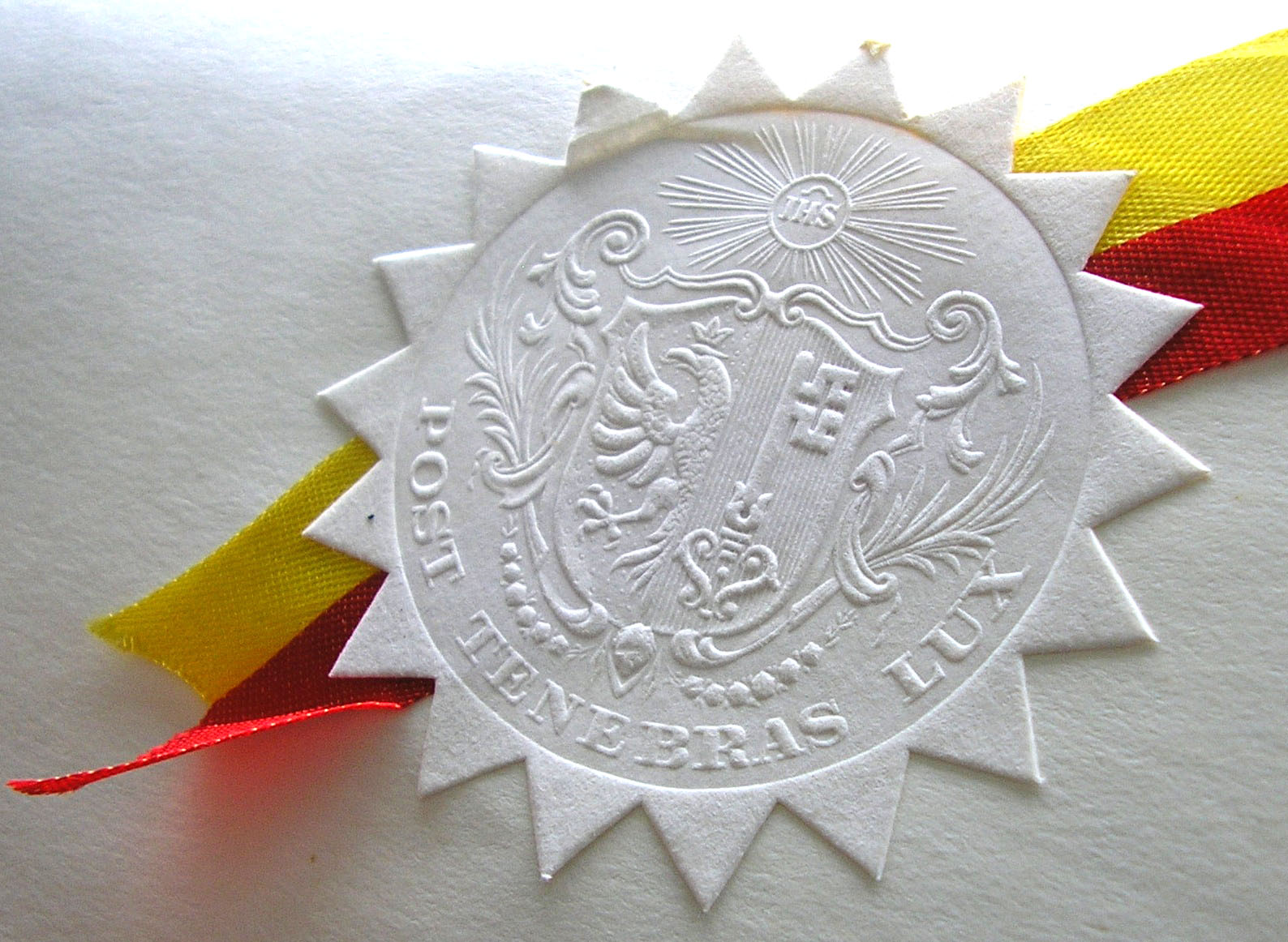
Embossed paper seal
An embossed postcard, Carnegie Library, Houston, Texas (circa 1900–1924).
A debossed map of the British Isles, from William Moon's Light for the Blind, published in 1877.
Hand-operated embossing machine
Hand-operated embossing for a photographer's copyright notice.

Embossing and debossing are the processes of creating either raised or recessed relief images and designs in paper and other materials. An embossed pattern is raised against the background, while a debossed pattern is sunken into the surface of the material but might protrude somewhat on the reverse side.

Techniques

[edit]

Often used in combination with foil stamping, embossing alters the surface of paper stock or other substrates by providing a three-dimensional or raised effect on selected areas. The procedure requires the use of two dies: one that is raised and one that is recessed. The dies fit into each other so that when the paper is pressed between them, the raised die forces the stock into the recessed die and creates the embossed impression. A specific level of pressure is applied to the dies in order to squeeze the fibers of the paper, which results in a permanently raised area in the paper. When the dies are produced, a die maker engraves the desired image into several metal plates, which are the embossing dies for use on an embossing press. A thorough understanding of the process will enable a more successful result. Generally, embossing is the process most often employed to attract attention or convey a high quality textural contrast in relation to the surrounding area of the paper stock.

"Debossing" is similar to embossing, but recesses the design rather than raising it. Rather than the paper being raised in specific areas, it is indented. The process involves applying pressure to the front side of a substrate and forcing the material down from the surface. Although it is not as common as embossing, it is occasionally used to provide a different effect or appearance that fits a particular theme. Embossing and debossing on digitally printed applications is an off-line process, which may add a significant cost to the job.

Embossing is basically used to create a distinctive effect. The greatest concern and emphasis on the client's behalf should be placed on the outcome of the embossed effect. In order to achieve the best possible effect, it is important to understand the embossing process and the types of dies that are used for embossing. The three factors that need to be controlled during the embossing process are:

  1. Pressure: the intensity of the impact on the weight of the stock being embossed.
  2. Heat: the ability to maintain a consistent heat level for the best impression.
  3. Die depth: the client's artwork or the engraver's efforts will initially determine the die depth, however, if by looking at the artwork it appears that an adjustment of the die depth may be necessary, the die may need to be retooled to achieve a greater depth. Most types of paper can be embossed, and size is not normally a consideration. Embossing without ink, so that the image is raised but not colored, is called "blind embossing". Embossing used in conjunction with ink, so that the raised area is coloured, is called "colour register embossing". Embossing used in conjunction with foil stamping is called "combination stamping" or "combo stamping".

Embossing involves a separate stage in the production process, after any varnishing and laminating. It requires a separate press run, and is priced accordingly. In addition to being used as a design element on packaging, stationery, and marketing materials—such as presentation folders and business cards[1]—embossing can be used to improve the performance of paper products like napkins, diapers, and tissue paper.

Die materials

[edit]

The metals most often used for die construction are zinc, magnesium, copper, and brass. The material used for a specific application depends upon a number of factors.

Embossing types

[edit]

Blind emboss

[edit]
Blind embossed stationery

Blind embossing does not include the use of ink or foil to highlight the embossed area. The change in the dimensional appearance of the material is the only noticeable difference resulting from the embossing. The blind embossing process provides a clean and distinctive or subtle image on paper stock. It is best used to create a subtle impression or low level of attention to the piece, yet provide some slight form of differentiation for the finished work.

Registered emboss

[edit]

Registered embossing is a process that places the embossed image in alignment with another element created with ink, foil, punching, or with a second embossed image.

Combination emboss

[edit]

Combination embossing is the process of embossing and foil stamping the same image. It involves imprinting and aligning foil over an embossed image to create a foil emboss. A sculptured die, generally made of brass is used for this procedure. The process requires close registration that must be controlled to keep the image and foil matched precisely. The process of embossing and foil stamping is accomplished in one operation with the use of a combination die. The combination die has a cutting edge around the perimeter to cleanly break the excess foil away from the embossed area.

Pastelling

[edit]

Pastelling is also referred to as tint leaf embossing. It involves the process of using a combination die to provide a subtle antique appearance to a substrate that is embossed and foil stamped. Pearl finishes, clear gloss, or similar pastel foil finishes can be selected that provide a soft two-color antique look (without scorching) to the embossed image. Lighter colored stocks work best to provide this soft contrasting effect.

Glazing

[edit]

Glazing refers to an embossed area that has a shiny or polished appearance. Most often this process is accomplished with heat that is applied with pressure in order to create a shiny impression on the stock. Dark colored heavy weight stocks generally work best with glazing because the polished effect is much more noticeable and the dark color of the stock helps to eliminate or soften any burned appearance that may result from the application of the heat. When used in conjunction with foil, the process can provide the foil with a slightly brighter appearance.

Scorching

[edit]

Scorching is similar to glazing except that it is not used to polish the stock. Instead, scorching does what it implies: as the temperature of the die heating plate is increased beyond a normal temperature range, a scorched effect is created in the embossed image, which results in an antique or shaded appearance. It is best to use a lighter colored stock for this procedure in order to provide a unique two-toned appearance. Caution should be used in requesting this effect, since it is easy to burn the stock if too much heat is used. If scorching occurs too close to the printed copy, it can interfere with the clarity of the printed copy; however, this may be the effect that is desired for a particular application.

Document authentication

[edit]

A notary public may use an embossed seal to mark legal papers, either in the form of an adhesive seal, or using a clamp-like embossing device, to certify a signature on a document, contract, etc., or cause to become certified through a notary public or bill. Registered professional engineers also use embossing seals to certify drawings, thereby guaranteeing to the recipient that due diligence has been exercised in the design. Government agencies use embossed seals to certify that an important document, such as a birth certificate, court order, etc., is an authentic, original copy, rather than a photocopy that could be altered in the copying process.

On stamps

[edit]
Embossing on an 1886 revenue stamp of Great Britain.

Embossing has been used regularly on postage and other types of stamps. The embossed paper of a letter sheet or stamped envelope is called an indicium. Notable early examples include some of the earliest stamps of Italy, Natal, and Switzerland, as well as the early high values of Great Britain (1847–54).[2] Modern stamps still sometimes use embossing as a design element.

See also

[edit]

References and sources

[edit]

Sources

[edit]
Revisions and contributorsEdit on WikipediaRead on Wikipedia
from Grokipedia
Paper embossing is a technique that creates raised or recessed (debossed) three-dimensional images and designs on paper by pressing it between a mold or die and a , typically without the use of , resulting in a tactile effect. This process leverages the malleability of damp or wet paper to alter its surface, adding sculptural depth and texture for both functional and decorative purposes. The origins of paper embossing trace back to the late , when French educator Valentin Haüy developed it in 1784 as a method to produce raised-letter books for blind readers, marking the beginning of tactile printing for accessibility. The technique spread across Europe after the in 1815, with Scottish inventor James Gall introducing it to Britain in 1827 to create embossed literature and educational materials for the visually impaired. By the 1830s, decorative applications emerged, as English printer Joseph Addenbrooke patented a method in 1834 to emboss and file edges for lace-like effects in Victorian valentines and , transitioning the craft from utilitarian to ornamental uses. In traditional handmade embossing, paper is soaked until damp, blotted to remove excess water, and then sandwiched between a relief mold—made from materials like wood blocks, linocuts, textured fabrics, or found objects—and protective layers such as tissue or felts before being passed through a press to imprint the design. Factors like paper thickness (ideally 250 gsm or heavier for dramatic results), pulp consistency, and applied pressure influence the depth and durability of the embossed effect, with thicker sheets yielding more pronounced relief. Industrial processes, by contrast, employ precision metal dies and hydraulic presses, often combining embossing with foil stamping or die-cutting for high-volume production. Today, paper embossing remains a versatile technique in , , and commercial printing, enhancing invitations, business cards, and book covers with subtle tactility that highlights craftsmanship under proper lighting. It also continues in conservation and accessibility contexts, such as producing braille-integrated materials, while modern adaptations incorporate digital design for custom dies.

Fundamentals

Definition and Principles

Paper embossing is a technique that creates raised or recessed designs on surfaces by applying mechanical pressure to deform the fibers, altering the texture without the use of or pigments. This process enhances the tactile and visual appeal of products, such as , , and covers, by producing three-dimensional patterns that can range from subtle textures to prominent motifs. Unlike wet methods, embossing relies solely on the physical manipulation of the substrate to achieve its effects, making it a versatile finishing option in and . The core principle of embossing involves compressing the between a male die, which features a raised design, and a die, which has a corresponding recessed counterpart, to form permanent patterns through displacement and deformation. When is applied, the fibers in the targeted areas are compacted and stretched, creating elevated (embossed) or depressed (debossed) regions while the surrounding areas remain relatively unchanged. This differentiation arises because embossing produces both raised and potentially recessed elements in a single operation, whereas debossing exclusively creates indented designs by pressing the material into a single recessed die. In contrast, foil stamping combines with to adhere metallic or colored foils to the surface, adding reflective or pigmented elements rather than relying on deformation alone. The physics of embossing exploits the viscoelastic properties of fibers, which exhibit elasticity to allow temporary under and inelastic behavior to retain permanent shape changes after release. Optimal results in industrial applications depend on the 's content, typically maintained at 4-6% to balance flexibility and prevent cracking or excessive spring-back; higher reduces fiber stiffness, facilitating deeper impressions, while lower levels increase rigidity and risk brittle failure. In industrial applications, this deformation requires substantial , with presses delivering up to 100 tons to ensure uniform pattern depth across large sheets, though the exact varies with thickness and complexity.

Historical Development

The precursors to paper embossing emerged in ancient civilizations through the use of seals to create raised impressions on materials like clay and . In ancient , decorative seals originated during the (c. 1600–1046 BCE), initially applied to these substrates to produce tactile patterns. By the in , embossing became integral to , particularly in monasteries where artisans applied the technique to covers of books containing pages in illuminated manuscripts. Gold-tooled and blind embossing created symbolic raised motifs, such as Gothic patterns on religious texts, enhancing both aesthetic and protective qualities of codices. This period marked a shift toward substrates as spread from Islamic regions to around the . The late saw the development of paper embossing for accessibility, when French educator Valentin Haüy created raised-letter books in 1784 for blind readers at the Institution Nationale des Jeunes Aveugles in , using mechanical pressure to form tactile Roman letters on . This innovation laid the groundwork for modern embossing techniques in printing. The brought industrial advancements that transformed embossing into a mass-production process. In 1834, English inventor Joseph Addenbrooke introduced a method of embossing sheets and filing the raised areas to achieve intricate lace-like effects, widely used in Victorian-era greeting cards and . Steam-powered presses, emerging around 1860, enabled efficient commercial application for book covers and packaging, aligning with the rise of . Key figures like , through the Arts and Crafts movement in the late 1800s, championed artistic embossing in handcrafted bookbindings to counter industrial uniformity, influencing designs with natural motifs and fine tooling. In the , embossing gained prominence in following , where raised tactile features deterred counterfeiting in documents, passports, and currency through combined intaglio and blind techniques. The late 20th and early 2000s saw digital integration, with CNC machining revolutionizing die production for custom embossing, allowing precise, computer-aided designs while preserving traditional compression principles.

Materials and Equipment

Paper Characteristics

Paper suitable for embossing must possess specific properties to withstand the mechanical pressure applied during the process while achieving a clear, durable impression. Ideal papers typically range in thickness from 170 to 300 grams per square meter (), as this provides sufficient structural integrity for depth without excessive resistance that could damage equipment or the sheet itself. Papers with high or rag content, often 100% , offer superior resilience due to their long, flexible , which compress and rebound effectively under pressure. Additionally, low content is essential to prevent brittleness, as lignin degradation can lead to fiber weakening and cracking over time; -free or acid-free papers are preferred for archival-quality embossing. The composition of fibers significantly influences the embossing outcome, particularly the depth of the impression and detail retention. Long fibers, such as those found in rag or pulps, allow for deeper impressions by providing greater tensile strength and elasticity, enabling the paper to stretch and hold intricate patterns without fracturing. In contrast, short fibers prevalent in or wood pulp papers result in shallower impressions due to reduced flexibility, though they contribute to a smoother surface that aids in fine detail capture. Surface smoothness plays a key role as well: uncoated papers retain embossed textures more vividly by allowing fibers to conform closely to the die, whereas coated papers may resist deformation, leading to blurred or shallow results despite their initial gloss. Preparation of the is crucial to optimize flexibility and minimize defects during embossing. Pre-creasing along intended fold lines helps distribute stress and prevents cracking by compressing fibers in advance, particularly for thicker . Controlling environmental at 50-60% relative (RH) maintains paper flexibility without causing warping or excessive absorption, which could distort the sheet; deviations beyond this range can make fibers too rigid or swollen. Common challenges in paper embossing include cracking and , which can compromise quality. Cracking often occurs under on brittle or thin papers, but it can be mitigated by using beveled dies that gradually apply force to the fibers. Recycled papers are prone to due to their inconsistent and variable fiber lengths, resulting in uneven impressions across sheets; selecting virgin alternatives or pre-testing batches helps address this.

Die Materials and Tools

Die materials for paper embossing are selected based on factors such as production volume, design complexity, and required durability, with , magnesium, and being the most common choices. dies, prized for their balance of strength and , are widely used in high-volume runs due to their high mechanical strength and excellent conductivity, enabling consistent performance over extended use. These dies typically exhibit a hardness of 70-90 on the Rockwell B scale, providing resistance to wear while allowing for detailed . Magnesium dies, being lightweight and cost-effective, suit prototypes and short-run applications, offering good thermal properties but faster wear on paper stocks. dies excel in intricate, long-life designs, providing superior durability for demanding industrial processes, though they require more fabrication time. Essential tools for paper embossing include flatbed presses, which facilitate custom, low-to-medium volume work by allowing precise alignment of dies with paper sheets. Rotary dies, often configured as engraved cylinders, enable continuous high-speed production in web-fed systems, ideal for large-scale printing operations. For manual applications, hand tools such as bone folders and embossing styluses provide controlled pressure to create subtle reliefs on paper without machinery. Fabrication of embossing dies employs methods tailored to design intricacy and material. Chemical produces fine lines and shallow reliefs by selectively removing metal through and exposure, suitable for detailed magnesium or prototypes. CNC milling achieves high precision for complex geometries in or , using computer-controlled cutters to carve dies with tolerances under 0.01 mm. builds intricate 3D reliefs up to 0.5 mm in depth by electrodepositing metal onto a conductive mold, often used for multilevel dies in applications. Maintenance of embossing dies involves regular cleaning and polishing to prevent adhesive buildup from paper fibers or inks, ensuring smooth operation and extended usability. Brass dies, when properly maintained, can withstand 500,000 to 2 million impressions before significant wear, while magnesium variants are limited to 1,000-5,000 cycles depending on paper texture. Steel dies offer the longest lifespan, often exceeding 5 million impressions in optimal conditions.

Processes and Techniques

Manual Embossing Methods

Manual embossing methods rely on direct hand application of pressure to create textured designs on , typically for artisanal or small-batch production in fields like and custom . These approaches emphasize precision and customization, using simple tools to deform the fibers without adhesives, inks, or heat in the primary dry technique. The process involves positioning the between a patterned die (or ) and a backing surface, then applying controlled force to raise or depress the design. A fundamental setup for manual embossing uses a hand-operated press or mechanism to sandwich the between matching dies, with a soft like rubber, felt, or beneath to distribute evenly and prevent tearing. In finishing, this mirrors traditional stamping techniques where a standing press with brass-banded boards secures the assembly, allowing artisans to apply force manually for impressions on covers or edges. For lighter applications, a roller can roll over the assembly to ensure uniform contact, particularly useful in aligning and pressing larger sheets without specialized machinery. Key techniques include dry embossing, where a hand-cut metal or stencil is placed behind the over a light source, and a pointed traces the openings to push the forward, creating a raised visible from the front. This method suits intricate, localized designs and requires dampening heavier papers to avoid cracking. Another variation is foil-assisted stamping, combining embossing with metallic foil applied via a heated or small manual press, transferring a subtle sheen to the raised areas for decorative effect in . Dies for these manual processes are often crafted from or for durability under repeated hand pressure. Artisans employ specialized tools such as fine-tipped styluses for detailed impressions, adjustable embossing boards or folders to maintain paper alignment, and countersunk plates to support the reverse side during pressing. In book arts, gouges and fillets serve as handheld dies for custom patterns, heated lightly if needed for foil work. These tools enable high levels of , such as monograms or ornamental borders, but are constrained by , making them ideal for prototypes or limited runs rather than high-volume output.

Mechanical and Industrial Processes

Mechanical and industrial paper embossing processes utilize automated machinery to achieve high-volume production with consistent precision, evolving from manual techniques as precursors to enable efficient large-scale operations. Key equipment includes platen presses, which handle flat sheets and operate at speeds of up to 3,300 impressions per hour, suitable for short to medium runs in applications like and book covers. For , rotary systems employing embossing cylinders process web-fed paper rolls, commonly in packaging industries to imprint textures on flexible materials at higher throughput rates. The process begins with die alignment using registration marks to ensure accurate positioning of the embossed design relative to printed elements on the sheet. is then calibrated, typically between 10 and 50 psi for fine work on delicate papers to avoid fiber damage while achieving desired depth. Following embossing, sheets undergo post-emboss trimming to remove excess material and refine edges, often integrated into the same machine line for streamlined workflow. Modern enhancements include integration with , where inline embossing occurs immediately after inkjet application to combine with tactile effects in a single pass. Vacuum-assisted feeding mechanisms prevent slippage during high-speed sheet transport, maintaining alignment and reducing jams in automated lines. involves inspecting embossed depth uniformity using precision measurement tools to verify consistent across the sheet, ensuring aesthetic and functional standards. In high-speed lines capable of up to 10,000 sheets per hour, waste reduction strategies such as automated defect detection minimize material loss and optimize yield.

Embossing Variations

Blind Embossing

Blind embossing is a printing technique that produces a raised or recessed design on or other substrates solely through mechanical pressure, without the application of , foil, or any coloring agents. The resulting monotone relief becomes visible primarily through variations in shadow, light reflection, and tactile differences, offering a subtle, elegant texture that enhances the material's dimensionality. The process employs a pair of symmetrical male and female dies, where the male die features the raised design and the female die its recessed counterpart, both typically crafted from durable metal such as or magnesium. The stock is placed between these dies in an embossing press, and —often exceeding several tons—is applied to compress the fibers along the design's edges, creating crisp borders and a defined . This focused deforms the without penetrating it, achieving a typical raise or depth of 0.15 to 0.5 mm, which provides a noticeable yet refined tactile effect suitable for fine papers. Variations in blind embossing include single-level designs, which produce a uniform flat raise across the motif for a clean, even impression, and multi-level designs that incorporate sculpted depths up to 1 mm through graduated die profiles, allowing for more intricate, three-dimensional effects such as shadowed contours or layered textures. In applications, blind embossing is favored for business cards and , where it imparts an elegant tactility that elevates simple designs into premium, touch-sensitive pieces without visual clutter. Historically, it has been used to create leather-like effects on , mimicking the grain and raised patterns of leathers through textured embossing on heavy stocks, a technique prominent in early 20th-century decorative papers for and .

Registered Embossing

Registered embossing is a specialized printing technique that precisely aligns raised embossed designs with pre-existing printed elements, such as ink, foil, or other graphics, on paper substrates to produce integrated three-dimensional effects that enhance both visual and tactile qualities. This method builds upon basic embossing principles by incorporating registration systems to ensure the embossed features overlay specific areas of the printed image without deviation. Unlike standalone blind embossing, which focuses solely on texture, registered embossing emphasizes synchronization with visual components for a cohesive, layered appearance. The process begins with pre- the base image or graphic on the using standard techniques like offset or flexographic printing, followed by the embossing stage where custom dies raise targeted elements, such as text or logos, directly over flat color fields or foil applications. Alignment is achieved through optical sensors that detect registration marks printed alongside the , allowing the embossing station to adjust in real-time for accuracy. For instance, in label production, sensors monitor the web's position and trigger the embossing head to imprint raised emblems within narrow tolerances relative to the printed content. Equipment for registered embossing typically includes multi-unit inline presses with integrated registration systems, featuring micro-adjustments via servo motors and encoders to synchronize print and emboss stations. These setups are prevalent in luxury packaging applications, where the technique adds premium dimensionality to items like high-end boxes, , and product labels, elevating brand perception through subtle yet impactful texture alignment. A primary challenge in registered embossing is misregistration, which can result in blurred or offset designs that diminish the intended effect, often caused by variations in substrate movement or tension. This is mitigated through precise tension control mechanisms, such as sensors on unwind and rewind stands, which automatically adjust the paper's pull to maintain consistent alignment and prevent stretching or slack. Such controls ensure the process operates efficiently at speeds up to 150 meters per minute while preserving design integrity.

Combination Embossing

Combination embossing is a layered technique that integrates traditional embossing—such as blind or registered methods—with additional stamping processes like foil application or to create multi-dimensional designs on . This approach enhances the tactile and visual impact by overlaying metallic or colored elements onto raised or aligned embossed features, producing a premium, sculptural effect without relying solely on . The execution typically involves sequential processing stations or a single die setup in a platen press, where the first undergoes embossing to form the raised image, followed by foil stamping using and for . levels for substrates are generally maintained between 90°C and 120°C to ensure the foil's layer bonds effectively while preventing damage like warping or scorching. Depth is carefully controlled during embossing—often with a counter die—to minimize foil cracking on curved surfaces, particularly on coated stocks, by applying a preliminary foil layer if needed. A common example is the production of official certificates, where an embossed crest or is topped with foil stamping to highlight the raised areas, adding luster and authenticity to the document. This technique is also used in high-end business cards or book covers, where foil accents over embossed logos create a shimmering, textured finish. The primary benefits include heightened dimensionality and sensory appeal, making it ideal for luxury branding and security features that demand both visual sophistication and tactile engagement. By merging with metallic or pigmented elements, combination embossing elevates standard prints to , memorable pieces suitable for premium markets.

Pastelling

Pastelling, also known as tint embossing, is an embossing variant that adds subtle color to the recessed areas of a design on using a combination die to apply thin foil selectively. This process eliminates registration challenges associated with soft colors behind an embossed image by designing the die such that foil adheres only to the indented portions, creating an or shaded appearance without filling the raised areas. The technique typically involves a single-run operation in a platen press, where the embossing and foil application occur simultaneously for precision. Key materials include thin metallic or colored foils compatible with substrates, applied at controlled and to ensure without bleeding or . This foil-based method provides a durable, iridescent or matte tint that enhances depth while preserving the embossed structure, distinguishing it from full foil stamping or applications. The resulting effects feature delicate coloring concentrated in the valleys of the design, yielding a soft, integrated finish that evokes historical , such as those in Victorian-era enhanced with subtle embossed and tinted elements for elegant correspondence. Pastelling offers advantages in efficiency for premium prints but requires precise die fabrication to avoid foil pickup on raised surfaces. It is less prone to fading than pigment-based alternatives and suitable for moderate-handling items like , though not ideal for high-wear applications without additional sealing.

Glazing

Glazing is a post-embossing finishing technique that imparts a glossy, polished appearance to the raised areas of embossed by fusing surface fibers through controlled heat and pressure. This process enhances the tactile and visual contrast of the embossed , creating a smooth, burnished surface that highlights the motifs without altering the underlying structure. It is commonly applied to blind embossed images on textured or heavy-weight stocks, particularly those in medium to dark colors, to achieve optimal results while minimizing the risk of scorching. The technique involves passing the embossed paper through heated dies or rollers, where the elevated temperature softens and melds the paper fibers, producing a shiny effect on the elevated portions. Heat is applied judiciously during or immediately after the embossing stage to ensure even fusion, resulting in a reflective, mirror-like sheen that elevates the aesthetic appeal of the design. This method is especially valued in premium applications, such as covers and , where the glossy highlights add a of luxury and depth to the overall composition. Process variations include spot glazing, which targets heat application to localized embossed areas for selective shine, and flood glazing, which treats the entire sheet uniformly to create a broad polished surface. These options allow designers to customize the level of gloss based on the project's requirements, with spot glazing offering precision for intricate details and flood glazing providing consistent coverage across larger formats. Both approaches rely on the paper's composition to achieve durability in the finished product.

Scorching

Scorching is a specialized embossing technique that involves applying high to create a effect on , enhancing the with darkened edges for visual contrast. In this process, heated dies, typically maintained at temperatures exceeding 150°C, make brief contact with the under mechanical pressure, carbonizing the edges of the raised areas to produce a two-tone outline around the embossed design. This method is performed using blind embossing without foil or , relying on the to achieve the desired shading. Precise temperature control is essential to prevent full ignition or excessive damage to the , with experienced operators monitoring the die heating plate to avoid burning the . Adequate ventilation is required to manage any fumes produced during the , and the technique is employed cautiously due to the inherent fire risk associated with heating paper. The resulting aesthetic provides a rustic, appearance, often featuring shaded or darkened highlights that evoke an aged quality, making it suitable for invitations, prints, and decorative on lighter-colored papers. This effect works best on uncoated, thick papers, which allow the to localize around the without spreading or compromising the sheet's integrity.

Applications and Uses

Document Security and Authentication

Paper embossing serves as a key mechanism in document security by creating raised or indented textures that provide both tactile verification and resistance to replication through common means like photocopying. Notarial embossers, for instance, produce a raised seal on legal documents that authenticates the notary's involvement and deters fraud, as the three-dimensional imprint does not reproduce clearly in copies due to its physical depth and texture. Micro-embossing further enhances this by embedding fine patterns or micro-text into the paper surface, which remain invisible to the naked eye but become discernible under magnification, such as a 15x lens, allowing for covert authentication without altering the document's overt appearance. Historically, embossing has been employed in official documents to ensure authenticity, with printed forms incorporating embossed text and elements as early as the to prevent falsification alongside watermarks and revenue stamps. This practice contributed to the evolution of secure travel documents, becoming more standardized following the international passport conventions of the 1920s under of Nations, where tactile security features like embossing helped verify bearer details and issuance legitimacy. In contemporary applications, embossing integrates with advanced technologies for heightened protection, such as holographic embossing paired with RFID chips in identity cards and passports, enabling multi-layered verification through optical and electronic reading. Detection methods often involve specialized tools; for example, certain embossed features incorporate latent images that reveal hidden patterns under UV , confirming genuineness without invasive inspection. Smart embossing variants, using 3D metallized reliefs, allow via analysis of the tactile structure, combining overt visual cues with covert digital verification. Embossing offers distinct advantages over flat printing techniques in high-security contexts, including tamper-evidence since alterations typically flatten the raised elements, making manipulations detectable by touch or sight. This physical integrity, coupled with its relative cost-effectiveness for mass production—as it integrates into existing printing processes without specialized tooling—makes it ideal for secure items like currency notes, where intaglio embossing creates durable, tactile portraits and motifs that resist counterfeiting while facilitating manual verification.

Philatelic Embossing on Stamps

Philatelic embossing on postage stamps refers to the specialized application of die-embossing techniques to create raised three-dimensional designs on stamps or , enhancing visual appeal, tactile quality, and security against counterfeiting. This method, distinct from flat or intaglio , involves pressing a die into the to produce a effect, often on higher-value stamps for international or . Early adoption focused on such premium issues, evolving from hand-embossed production to more automated methods while incorporating anti-forgery features like silk threads or watermarks. Primarily issued by the between 1847 and 1854, embossed stamps were rare and declined with the rise of efficient intaglio ; modern uses are limited to commemoratives with embossed holograms or foils as of 2023. Britain's 1847 embossed issues marked a pioneering use of true paper embossing, with the 1-shilling green stamp featuring a raised Young Head portrait of , produced via hand-operated presses at to deter replication through the complex relief texture. Security features evolved post-1900 in British surface-printed issues, incorporating watermarked paper aligned with embossed elements to further complicate forgery, as seen in later high-value definitives. The 10d red-brown embossed stamp of 1848 used Dickinson silk-thread paper fed through coining-style presses, with threads embedded parallel to the design for added authentication. Production of embossed stamps typically involves engraved dies on specialized , ensuring precise alignment to perforations for clean separation—often within tight tolerances to maintain aesthetic integrity. Modern commemorative stamps occasionally incorporate die-cut embossing for 3D effects, such as embossed holograms on thematic issues from various postal authorities, providing contemporary and collectible novelty without compromising print speed on rotary equipment. Among philatelists, embossed stamps are prized for their rarity and production challenges, with errors like double impressions or inverted watermarks significantly boosting value—such as the British 6d purple of 1854, where a misaligned emboss led to tinted gum variants fetching premiums due to their . Valuation factors include impression depth, which affects the tactile and perceived authenticity; deeper, crisper embosses on well-centered examples command higher prices, as shallower ones may indicate wear or poor striking during hand-embossing eras. Collectible embossed errors remain elusive, with only limited sheets produced historically, making pristine specimens from the 1847-1854 British series highly sought after in auctions.

Commercial and Decorative Applications

Paper embossing plays a significant role in commercial , particularly for , where raised logos on boxes enhance visual and tactile appeal to boost shelf presence and consumer engagement. Since the mid-20th century, brands like Hershey's incorporated embossed elements on chocolate wrappers until around 1950, contributing to a premium perception through textured designs that provide a sensory beyond flat . In modern applications, embossing on rigid chocolate boxes creates depth and sophistication, as seen in high-end products where foil accents combine with raised motifs to evoke opulence and improve brand recall. This technique not only elevates shelf appeal by drawing attention in retail environments but also offers tactile feedback that encourages handling and purchase. In stationery and print materials, embossing adds a luxurious dimension to items like wedding invitations and business collateral, conveying elegance and professionalism through subtle raised motifs. Foil-embossed wedding invitations, often featuring metallic accents on motifs such as floral patterns or monograms, have become a staple for formal events, providing a gilded, three-dimensional effect that impresses guests with its craftsmanship. For business applications, embossed letterheads and cards impart a premium tactile quality, enhancing brand recognition and perceived value in professional communications. These finishes, typically applied via pressure dies on high-quality cardstock, differentiate collateral from standard prints by engaging multiple senses. Bookbinding employs embossing extensively on cloth-covered hardbacks to create durable, aesthetically pleasing covers, a practice rooted in 19th-century innovations that allowed for intricate stamped titles and designs. Victorian-era publishers used embossed cloth bindings to produce affordable yet decorative hardcovers, with techniques like blind-stamping adding texture without color for subtle elegance. Recent trends emphasize eco-friendly versions, incorporating recycled paper substrates that maintain emboss integrity while reducing environmental impact through sustainable sourcing. This shift supports broader industry efforts to blend traditional craftsmanship with modern sustainability in book production. Emerging applications of paper embossing integrate digital-hybrid methods for cards, enabled by on-demand printers since the that combine electronic design with tactile finishing. These systems allow custom raised elements on greeting or business cards, produced in small runs for individualized appeal without large-scale setup costs. Such innovations facilitate quick , merging digital precision with embossing's physical texture to meet demands for , high-end print products in .

References

Add your contribution
Related Hubs
User Avatar
No comments yet.