


Community hub
Recent from talks
Contribute something
Nothing was collected or created yet.
Xuande Emperor
View on Wikipedia
The Xuande Emperor (16 March 1399[3] – 31 January 1435), personal name Zhu Zhanji,[d] was the fifth emperor of the Ming dynasty, reigning from 1425 to 1435. He was the son and successor of the Hongxi Emperor.
Key Information


The Xuande Emperor ascended to the throne following his father's brief reign. He had a passion for poetry and literature, and was also known for his skill in painting and warfare. Upon taking power, he made the decision to reverse his father's plan to relocate the capital from Beijing to Nanjing. His uncle Zhu Gaoxu rebelled against the young emperor but was ultimately unsuccessful. With the guidance of capable advisors, the Xuande Emperor personally led his army against his uncle and easily defeated him.
Early in the Xuande Emperor's reign, a prolonged war in Jiaozhi (present-day northern Vietnam) ended with Ming defeat and the Viet's independence. However, his rule was marked by a period of relative peace, with no major internal or foreign conflicts. Relations with Southeast Asian nations stayed peaceful. Communication continued with Korea, and ties were established with Japan in 1432. The northern region faced minimal Mongol threats, with relations established with the Eastern Mongols and Western Oirats. The Xuande Emperor permitted Zheng He's final Indian Ocean voyage in 1431–1433. During the Xuande Emperor's rule, eunuchs gained influence, particularly in the secret police. The Emperor sought order through purges in the Censorate and military service reforms in 1428, but these did not fully address inefficiencies and low morale among hereditary soldiers. After his death, historians regarded his reign as the golden age of the dynasty.
The Xuande Emperor's government attempted to promote the use of paper money and discourage the use of coins and precious metals, but this effort was ultimately unsuccessful and paper money fell out of circulation. In the past, high taxes in heavily taxed prefectures, particularly in Jiangnan, had caused peasants to leave the economy. In response, the Emperor lowered taxes and dispatched "grand coordinators" to the provinces to improve the performance of local authorities. These coordinators were responsible for addressing issues of injustice and corruption among tax collectors, as well as assessing the state of military units.
Youth
[edit]Zhu Zhanji, the future Xuande Emperor, was born on 16 March 1399, as the eldest son of Zhu Gaochi (the future Hongxi Emperor) and Lady Zhang. His father was the eldest son and heir to the then Prince of Yan, Zhu Di (the future Yongle Emperor).[4] In the summer of 1399, Zhu Di rebelled against the Jianwen Emperor, defeated him in a three-year civil war, and became the third Ming emperor in 1402.[5]
As a child, Zhu Zhanji was trained in both military skills and Confucian literature by Hanlin academics. He was a talented man of letters, but his physical prowess, in contrast to his father's frail health, made him excel in military disciplines. This impressed the Yongle Emperor,[6] who shared Zhu Zhanji's love for hunting and riding.[7] The Yongle Emperor allowed Zhu Zhanji to accompany him on hunting trips and military inspections. In 1414, the Emperor even took the prince with him on a campaign against the Mongols.[4] Later, as emperor, Zhu Zhanji personally participated in skirmishes with the Mongols on the northern border. During one of these battles, he demonstrated his skill with a bow by shooting several Mongol warriors.[6]
In 1411, Zhu Zhanji was appointed as Huang Taisun (皇太孫; literally 'imperial grandson-heir') while his father had been Huang Taizi (皇太子; literally 'crown prince') since 1404.[8] Zhu Zhanji's education in Confucian teachings and ways of government was overseen by Grand Secretary Hu Guang (胡廣). He also dedicated himself to studying military expeditions.[4] In court intrigues, Zhu Zhanji consistently defended his father against the latter's younger brothers Zhu Gaoxu and Zhu Gaosui. This earned him their resentment. They were also concerned about his decisiveness, popularity with the Yongle Emperor, and close cooperation with the grand secretaries. They feared that their own positions would be threatened if Zhu Zhanji were to take over.[4]
Beginning of reign
[edit]Accession
[edit]
In August 1424, the Yongle Emperor died due to a stroke while returning from the fifth Mongol campaign in the Mongolian steppe. His eldest son succeeded him as the Hongxi Emperor at the beginning of September.[9] On 1 November 1424, the Hongxi Emperor named Zhu Zhanji as crown prince. In April 1425, he sent the prince to Nanjing to make preparations for the relocation of the capital from Beijing. However, the Hongxi Emperor's health deteriorated and he called the prince back, but died before his son could return.[4]
On 27 June 1425, Zhu Zhanji officially ascended the imperial throne in Beijing,[7] becoming the fifth emperor of the Ming dynasty. He chose to cancel the move of the capital to Nanjing due to his familiarity with Beijing, where he grew up, and his shared concern with the Yongle Emperor for the security of the northern border.[10] He adopted the era name Xuande, which means "proclamation of virtue".[11]
Upon his accession, the new emperor's officials received him calmly, as he shared his father's idealistic conservative policies. He was not only a man of letters, but also a patron of the arts, and his reign was marked by significant cultural and political achievements.[12] Despite his short temper, he was open to advice.[13] He was a conscientious ruler and sought to balance the influence of various factions within the Ming elite–including civil officials, eunuchs, and generals. While he was capable of making strong decisions when necessary, he typically relied on the proposals of the grand secretaries and ministers when issuing imperial decrees.[7] In contrast to his predecessors, he lived a life of luxury and debauchery, and upon his death, thousands of women were released from the palace.[14]
Despite this, the Xuande Emperor successfully resolved major issues during the first two years of his reign, including his uncle Zhu Gaoxu's rebellion and the war in Jiaozhi. Under his rule, the northern border remained relatively stable and peaceful relations were maintained with neighboring states in Central, East, and Southeast Asia.[12] This stability allowed for internal reforms to take place.[4]
Zhu Gaoxu rebellion
[edit]Zhu Gaoxu challenged his nephew's accession, but unlike the Yongle Emperor's usurpation, he was unsuccessful in his attempt. Zhu Gaoxu was favored by the Yongle Emperor due to his military prowess.[15] He proved to be a capable and energetic commander during the civil war of 1399–1402, but his arrogance and contempt towards his older brother, the Hongxi Emperor, caused tension.[6] Zhu Gaoxu became bitter when he was not named as a successor in 1404. His disobedience eventually led to his banishment to the backwater city of Le'an in Qingzhou prefecture, Shandong.[15] Believing that he was the rightful heir to the throne in 1424, instead of his ailing older brother, he began plotting a coup after his brother's death.[6] Shortly after the Xuande Emperor's ascension to the throne on 2 September 1425, Zhu Gaoxu attempted to follow in the footsteps of the Yongle Emperor by rebelling against the Emperor.[15] He accused the Xuande Emperor of abusing his power by appointing individuals with noble titles to civil offices and appointing unworthy individuals.[16] Underestimating his young nephew as a formidable opponent, he also failed to recognize the strength of the government, which had functioned effectively during the Yongle Emperor's extended absences on campaigns in Mongolia. Furthermore, he did not consider the significant decrease in the princes' influence that the Yongle Emperor had achieved. As a result, he was in a much weaker position than the Yongle Emperor had been in 1399.[6]
The Emperor initially hesitated, but eventually succumbed to pressure from Grand Secretary Yang Rong and other advisors, ultimately taking personal command of the punitive expedition on 9 September. A vanguard of 20,000 soldiers, led by the experienced general Xue Lu (薛祿; 1358–1430), laid siege to Le'an on 21 September. Despite the defenders' refusal to surrender, the imperial army successfully captured the city the following day. Zhu Gaoxu was subsequently brought to Beijing, demoted to a common subject, and ultimately tortured to death. In addition, over 600 of his followers were executed, while another 2,200 were deported to the border. An investigation revealed that other relatives of the Emperor, including Zhu Gaoxu's brother Zhu Gaosui, were also involved in the rebellion, but they were not punished in order to preserve the prestige of the imperial family.[16]
Administration
[edit]Grand secretaries, ministers, and eunuchs
[edit]The grand secretaries during the reign of the Xuande Emperor, from 1425 to 1435:[17][18]
- Yang Rong, 1402–1440;
- Yang Shiqi, 1402–1414 and 1414–1444;
- Jin Youzi (金幼孜), 1402–1431;
- Huang Huai, 1402–1414 and 1424–1427;
- Yang Pu, 1424–1446;
- Zhang Ying (張瑛), 1426–1429;
- Quan Jin (權謹), 1425
- Chen Shan (陳山), 1427–1429.
In the years 1424–1444, Yang Shiqi served as the head of the Grand Secretariat.[19]
The Xuande Emperor retained his father's advisors and ministers, but some offices underwent changes in their functions. The most significant reforms were made to the grand secretaries, who, during the Yongle Emperor's reign, only had an advisory role of reading the emperor's correspondence and drafting replies. During the reign of the Hongxi Emperor, they gained more influence and were now granted real executive power. This was formalized by granting ministerial titles to Yang Shiqi (minister of war), Huang Huai (minister of revenue), and Jin Youzi (minister of rites). Due to their long service to the state, they were highly respected and trusted by the Emperor.[10] Other close advisors to the Emperor included Jian Yi (minister of personnel from 1402 to 1422 and 1423–1435)[20] and Xia Yuanji (minister of revenue from 1402 to 1421 and 1424–1430).[10][20] Even after the Xuande Emperor's death, the composition of the most influential officials and the grand secretaries remained unchanged. As a result, the top government was dominated by the same group of people from 1424 until the early 1440s.[21]
The Emperor established a process for routine and important decrees, in which proposals from various offices were reviewed and evaluated by the grand secretaries. These secretaries would then attach their recommendations for solving issues to the documents, which the emperor would typically approve and send to the relevant ministries for implementation. Significant government decisions were made during meetings between the emperor and the grand secretaries,[10] during which the emperor would discuss and sign the drafts of his decrees. The ministers were responsible for carrying out these decrees. This system allowed for faster and more flexible decision-making, as the secretaries no longer needed to consult with the ministers beforehand.[22]

At the same time, the influence of the eunuchs serving in the imperial palace and completely dependent on the emperor grew. During the reign of the Hongwu Emperor, the first Ming emperor, eunuchs were prohibited from communicating with government authorities. Even the Yongle Emperor maintained strict control over them. The Xuande Emperor, on the other hand, provided them with education and utilized them more in confidential correspondence.[22] Despite opposition from officials, the eunuchs' business continued to thrive, benefiting the emperor's personal projects such as logging and shipbuilding.[21] In situations where the emperor did not agree with the ideas of grand secretaries, he would use eunuchs to convey his orders to lower branches of the state administration. As the ministers did not question the emperor's orders,[22] the eunuchs were able to give orders to the ministers on behalf of the sovereign without his knowledge. This abuse of power was a major concern for the Hongwu Emperor.[15] The Xuande Emperor, however, maintained control over the eunuchs and was not afraid to execute them if they overstepped their boundaries. In the long run, this approach left room for eunuchs to exploit their power if a less assertive emperor was in power.[15]
Censorate, provincial administration, and army
[edit]

In terms of internal politics, the Emperor focused on implementing reforms in the Censorate, local administration, and the army. His main goal was to bring discipline and order to the state administration. He also took a keen interest in prominent criminal cases and often ordered judgments to be reviewed, resulting in justice for thousands of innocent people.[23] In August 1428, he replaced the long-standing head of the Censorate, Liu Quan (劉觀), who had been in the position since 1415, with the honorable Gu Zuo (顧佐). Within a few months, Gu Zuo dismissed 43 censors from the Beijing and Nanjing offices, and Liu Quan himself was punished for numerous abuses of power. The Censorate underwent a reorganization, with changes made to procedures and an increase in the powers of the censors. Additionally, commissioners were appointed to oversee military farms, large construction projects, and military training camps near Beijing, as well as to manage taxes in Nanzhili. These taxes were collected in the form of products, mainly rice, which was crucial for the nutrition of the people of Beijing.[24]
After the purge of 1428, the censors became more efficient and open. This was evident in their thorough checks of all branches of the state administration, including both civil and military sectors. In fact, over 240 officials were dismissed between 1424 and 1434, which was three times the number of dismissals in the previous decade.[24] While officials and censors who abused their powers were punished, they were not executed.[24][23]
During the reign of the Xuande Emperor, the regional administration saw a regular posting of grand coordinators (xunfu). These officials were responsible for coordinating the work of the three provincial offices—civil, military, and surveillance. This practice of having coordinators in the regional administration was not new, as previous emperors had also employed them. For example, the Hongwu Emperor had sent his crown prince, Zhu Biao, to "tour and pacify", while the Yongle Emperor had sent both the Hongxi and Xuande emperors to the provinces. In 1421, the Yongle Emperor even sent 26 high-ranking government officials to the provinces. The Xuande Emperor took this practice a step further by sending these officials on long-term assignments, rather than just once like his predecessors.[25] For example, in September 1425, he sent two commissioners to Nanzhili and Zhejiang,[26] and in 1430, they were sent to Hunan, Shanxi, and Sichuan.[24] They were also dispatched to Jiangxi and Shaanxi around 1426.[27]
The role of grand coordinators was not an independent function, but rather a mandate imposed on high-ranking officials of the central authorities. Typically, these officials held the rank of deputy minister, particularly in the military, and later also held high positions in the Censorate. They also held the rank of (co-)superintendant of military affairs.[28] This gave them the authority to oversee civil, military, and surveillance offices. The immediate result of implementing grand coordinators was the transfer of command over troops in the provinces to civilian hands.[27] The system of grand coordinators reached its final form during the Zhengtong era (1436–1449),[28] when they were assigned to all provinces except Fujian and six of the nine frontier garrisons on the northern border.[27]
Considerable problems persisted in the army during this time period. Corrupt officers were known to bring in poor conscripts for campaigns, while allowing the wealthy to avoid service for a fee. These officers also embezzled the salaries of the soldiers and used them as personal servants.[28] The supply of military farms was also a major issue, as it often dropped and made it difficult to properly equip the army.[29] Additionally, capable officers had limited opportunities for advancement during times of peace, resulting in the army being led by individuals who inherited their positions without merit. These commanders, who had not experienced war themselves, often neglected to properly train their soldiers and instead used them for their own personal needs.[26] This led to a decline in discipline, an increase in desertion, and a decrease in the overall strength of the army.[28]
In an attempt to address these issues, inspection officials were appointed in 1427 to verify the condition and numbers of the army detachments and restore discipline, but their efforts were largely ineffective. The local military headquarters also came under the supervision of control authorities, but this did not have much impact either.[26] In 1429, the Emperor attempted to boost morale by holding a large military parade with guard units from the Beijing garrison and three training camps located around Beijing, but this did not have a significant impact on the morale of the army. The years of peace had led to a decline in the quality of training, and the Emperor's leniency towards guilty officers only worsened the situation. The consequences of this decline in the army's strength were not fully realized until 1449, at the Battle of Tumu,[29] when the Mongols were able to defeat the Ming army led by Emperor Yingzong and even take the Emperor prisoner.[26]
Economic policy
[edit]Finance and currency
[edit]
In the late 1420s, the Xuande Emperor's government faced significant financial challenges. The ongoing war in Jiaozhi drained a significant amount of resources, and the subsequent loss of mineral wealth further exacerbated the situation. The imposition of high taxes and levies placed an unbearable burden on the economy of wealthy regions in China, resulting in a decline in government revenue.[30] For instance, Suzhou, the economic hub of China, was three years behind in paying its taxes by the late 1420s.[31] Moreover, the profitability of silver and copper mines declined in the early 1430s.[30] To address these difficulties, the government attempted to promote the use of paper money, reduce and reform taxes, and limit government spending.[31]
The Hongwu Emperor established paper money, known as baochao banknotes, as the primary form of currency. For smaller transactions, copper coins were also used, which were circulated alongside state notes during the Yongle era.[32] However, both the coins and the copper used to make them were in short supply. In contrast, the government printed large quantities of banknotes, causing their value to rapidly decrease. By 1425, baochao banknotes were only worth 2% of their nominal value.[32] In an unsuccessful attempt to promote paper currency, the Hongxi Emperor closed precious metal mines, but the Xuande government allowed for a partial resumption of mining.[33]
The Xuande Emperor and his advisors implemented various measures in an attempt to support the state's economy. One such measure was the pressure placed on the use of copper coins, which were seen as competition for paper money. As a result, copper coins were almost completely phased out of circulation.[32] In addition, Minister of Revenue Xia Yuanji suggested a solution to combat the decline in the value of government banknotes by increasing business taxes and only accepting payment in government banknotes, but this approach did not yield the desired results.[34] The government then shifted to a more cautious strategy, selling licenses to trade salt for state coins. This measure also failed to increase the value of state stamps.[35] The government introduced new trade fees and customs duties on the Grand Canal, which could only be paid in shillings, but these fees had a negative impact on trade.[32] As a result, there was strong opposition to these fees and they were eventually abolished after a few years. Despite the government's efforts, these measures did not effectively support the state's economy.[36] The value of paper money continued to decline.[34] By the 1430s, banknotes were no longer in use and were only used to pay employees to a limited extent. They were also withdrawn as a mandatory form of payment for trade fees. Ultimately, these measures had little impact on the country's economy.[37]
The widespread distrust of paper currency and the scarcity of coins resulted in a growing trade in silver. Despite the government's opposition to replacing copper coins and paper currency with silver, attempts to prohibit the use of silver in commercial transactions were unsuccessful,[38] but silver alone was not enough to meet the demands of the market. It was primarily used for large payments and paying taxes, while copper coins remained the preferred currency for smaller transactions in cities.[37]
In 1433, the Xuande government closed the mints, causing disruptions throughout the region from Japan to Java. This halt in coin production led to a surge in counterfeit coins and hoarding of precious metals.[39] Despite the dissatisfaction of officials in Beijing, they were unable to suppress the circulation of coins produced by private entrepreneurs, but they also did not make the decision to resume state production of coins.[37] Towards the end of the Xuande era, the government began to tolerate the use of silver. In 1433, Governor of Nanzhili Zhou Chen began to collect land taxes in silver in the most heavily burdened prefectures of Jiangnan.[35]
Taxation in Jiangnan and the empire
[edit]One of the areas that the Emperor focused on for reform was fiscal policy, particularly in Jiangnan. This region, which includes prefectures such as Suzhou, Hangzhou, Songjiang, Jiaxing, and Zhenjiang, contributed a significant portion of the empire's land tax, accounting for a quarter of the total amount[40] (despite the Ming dynasty having almost 160 prefectures). In Suzhou Prefecture alone, even after a reduction in the tax rate in 1393, the land tax still made up almost a tenth of the empire's total tax quota, equivalent to 2.81 million dan of rice (with 1 dan being equivalent to 107.4 liters). Additionally, Songjiang Prefecture contributed 4.14% of the total tax quota.[41]
During the Yongle Emperor's reign, the country saw a ten percent increase in land tax revenue, which was likely distributed evenly throughout the country. However, this increase in taxes proved to be too much for the peasants in Suzhou and Songjiang, leading to a growing number of tax arrears. As if this was not enough, natural disasters struck towards the end of the Yongle era, causing even more peasants to abandon their land. By 1422–28, the amount of tax arrears had reached several million dan of rice annually.[41] This posed a serious threat to the supply of Beijing, which relied on tax rice shipped from Jiangnan via the Grand Canal. In an effort to maintain a steady supply of rice, the government decided to reduce taxes and forgive a portion of the arrears. In August 1426, imperial commissioner Zhou Gan (周干) was tasked with investigating the situation on the ground. He proposed a plan to reduce taxes, eliminate corruption in tax collection, and improve local administration with the help of experts sent from headquarters, led by a special commissioner.[41] While the reduction of taxes was supported by the great secretaries, the Ministry of Revenue was able to delay its implementation for four years. Finally, in May 1430, the relevant imperial decree was issued.[42]
In October 1430, the Emperor dispatched a group of high-ranking officials (zongdu) to oversee the collection of taxes. Among them was Zhou Chen (周忱), Left Vice Minister of Works, who was sent to Nanzhili. Along with Kuang Zhong (况钟), the prefect of Suzhou since June 1430, they played a significant role in implementing tax reforms in Jiangnan. During their visit, they witnessed the aftermath of a large-scale migration from the region, with some areas losing up to ninety percent of their peasant population. As a result, the remaining households were burdened with the same total amount of taxes. To address this issue, Zhou Chen introduced five major measures:
- unified measures and weights to prevent collectors from cheating;
- in each county, warehouses were built to collect the tax rice; previously, it had been stored in barns by tax captains (landowners responsible for transporting rice from villages to designated locations, such as the capital);[42]
- the government introduced a tax supplement designated for covering the costs of transportation along the Grand Canal to Beijing, thereby easing the burden on taxpayers who only transported rice to the canal, rather than all the way to Beijing;
- in each county, restored support granaries where surplus crops were stored in fertile years in case of famine;
- introduced the collection of a portion of taxes not in rice, but in silver[e] and fabrics, which was beneficial for both taxpayers and the government, and in the southern regions of the empire, it promoted the monetization of the economy and the textile industry.[43]
The court generally agreed with the proposals of Zhou Chen and Kuang Zhong, but the Ministry of Revenue blocked them. It was not until 1433 that they received imperial approval to reduce taxes in Suzhou by a quarter. Other reforms in the same direction continued after 1436.[43]
During natural disasters and epidemics, the Xuande government was known for its swift and effective response in aiding the population. Specially appointed commissioners oversaw the distribution of grain from government stocks, as well as implementing a 20–40% reduction in land taxes and forgiving other taxes for a period of one to two years. These actions were highly praised and recorded in the official history of the dynasty.[44]
In comparison to previous reigns, land tax revenue during the Xuande era decreased to 30 million dan of rice, which was 8% less than during the Hongxi era and 5% less than during the Yongle era. The trend continued in the Zhengtong era (1436–1449) with a further reduction of 10–15%. By the end of the Ming dynasty, the land tax remained at 25–28 million dan.[44] This reduction in expenses allowed the state to maintain a balanced budget during the Xuande era, a feat that was not always achieved in later eras.[44]
Foreign policy
[edit]Jiaozhi/Đại Việt
[edit]During the early years of the Xuande era, a major issue that arose was the war in Jiaozhi Province (present-day northern Vietnam), which had been ongoing since 1408. In 1425, Ming troops, led by newly appointed commanders Li An (李安) and Chen Zhi, suffered multiple defeats at the hands of the Viets, led by Lê Lợi. In response, the Emperor appointed a new commander, Wang Tong (王通), and a new head of civil administration, minister Chen Qia (陳洽),[45] in May 1426. When consulting his advisors, the Emperor revealed his inclination to end the conflict and grant the Viets self-rule,[16] recalling both the Hongwu Emperor's prohibition on invading Đại Việt (and other countries) and the Yongle Emperor's original goal of restoring the Trần dynasty. Ministers Jian Yi and Xia Yuanji advocated for using military force to suppress Viet resistance, while Grand Secretaries Yang Shiqi and Yang Yong suggested withdrawing from Jiaozhi, but due to conflicting opinions, the meeting ended without a resolution.[46]

In the winter of 1426, the Ming army suffered heavy losses of 20,000–30,000 men due to Viet attacks.[46] To counter this threat, the Emperor issued orders in January 1427 for Mu Sheng, the commander of Yunnan troops, to gather an army in Yunnan and bring it to Jiaozhi. Additionally, General Liu Sheng (柳升) was tasked with leading a second army from Guangxi. The experienced Huang Fu was appointed to oversee the civil administration of the province. (Huang Fu had previously administered Jiaozhi from 1407 to 1424). Meanwhile, Lê Lợi continued to expand his operations into the Red River Valley, posing a threat to Đông Quan, the capital of the province (present-day Hanoi).[45] Despite this, the Ming garrison successfully defended against the attack on Đông Quan, but due to the incompetence of Wang Tong, the Ming forces failed to capitalize on their success, allowing the Viets to prepare for the arrival of reinforcements.[47]
On 30 September 1427, Liu Sheng's army reached the border, where Lê Lợi unexpectedly proposed handing over power to Trần Cảo, a descendant of the Trần dynasty. This proposal was made under the condition that Trần Cảo would rule under Chinese suzerainty. However, Lê Lợi had ulterior motives and immediately lured Liu Sheng's army into a trap, resulting in a crushing defeat. The Chinese army suffered heavy losses, with approximately 70,000 men killed. In the aftermath of this disaster, Wang Tong, without the Emperor's knowledge, accepted Lê Lợi's proposal and began withdrawing troops from Jiaozhi on 12 November.[46] Meanwhile, Mu Sheng had reached the upper reaches of the Red River and began constructing ships to advance downstream, but upon learning of Wang Tong's withdrawal, Mu Sheng retreated back to China.[47]
On 16 November 1427, the Xuande Emperor was informed of Lê Lợi's offer. Despite divided opinions from his advisors, the Emperor quickly made the decision to accept the proposal on 20 November. A delegation was immediately sent to Jiaozhi to negotiate the details.[46] This move was seen as a surrender by the Ming after their defeat in battle, solidifying Lê Lợi's prestige. Lê Lợi informed the negotiators that Trần Cảo had died, another member of the Trần family was no longer alive, and they should recognize him as the king. He also refused to repatriate Chinese prisoners and officials.[48] The Xuande Emperor, however, refused to recognize Lê Lợi as the ruler of Đại Việt and demanded the return of the Trần dynasty. It was not until 1431, when Lê Lợi sent a humble letter, that the Xuande Emperor appointed him as "administrator of the affairs of the state of Annan" (Annan being the Chinese name for Đại Việt). Lê Lợi's son was officially recognized and given a royal title by the Beijing government in November 1436, after the Xuande Emperor's death.[46]
The Ming's withdrawal from Jiaozhi was a blow to their pride and prestige, but it also provided much-needed financial relief.[24] For the Viets, it was a significant victory that left a lasting impact on their culture and state. The two decades of Ming rule and education had a transformative effect on Đại Việt. The long-term warfare also resulted in a strong and efficient Viet army, whose strength would heavily impact the southern kingdom of Champa in the following decades.[49]
Southeast Asia and the Indian Ocean
[edit]
Envoys from Southeast Asian countries, such as Champa, Java, Ayutthaya, and Sumatra, regularly visited Beijing,[50] but there were no envoys from the Indian Ocean coast.[51] The ban on unauthorized trade and overseas travel by subjects was still in place, but it was not effectively enforced.[50]
Government officials[f] strongly opposed long-distance voyages and influenced the Emperor to cancel a shipbuilding program in 1429, led by the Emperor's eunuchs.[51] A few months later, after the death of a leading opponent of the voyages, Xia Yuanji, the Emperor changed his mind. The last of Zheng He's great expeditions took place in 1430–33, possibly to restore the empire's prestige after their retreat from Jiaozhi.[50] Zheng He brought envoys from Sri Lanka, Cochin, Calicut, Hormuz, Aden, the East African coast, and other countries to China, which pleased the Emperor.[51]
After the Xuande Emperor's death, the Ming did not undertake any further long-distance expeditions. These expeditions were only supported by the palace eunuchs, as the Confucian officials were strongly opposed to them. With the opening of the Grand Canal, the need to transport rice by sea to the north disappeared, leading officials to view naval expeditions as expensive and unnecessary imperial ventures.[51] This decision had long-term negative consequences, as it weakened the morale and strength of the Ming fleet, leaving them later unable to effectively deal with the wokou pirates.[51] Additionally, it also had a negative impact on China's influence in Southeast Asia and the Indian Ocean.[50] As a result, the end of the early Ming period marked the end of China's 300-year dominance in the East Asian seas.[51]
Mongolia
[edit]During the Xuande era, there was relative calm on the northern border. The Jurchens, who lived in present-day Manchuria, acknowledged Ming sovereignty and did not oppose the expeditions led by eunuch Yishiha. These expeditions even reached the mouth of the Amur River.[52] The Eastern Mongols were ruled by Arughtai,[44] while the Western Mongolian Oirats were led by Toghon. However, Arughtai was not recognized by the Uriankhai Mongols in the southeast of Mongolia. As a result, he maintained friendly relations with the Ming dynasty and engaged in trade, exchanging horses for silk and tea.[53]
In October 1428, the Uriankhaians were known to occasionally raid the borderlands, but during an inspection in which the Emperor was accompanied by 3,000 soldiers, they were successfully driven away. By May 1430, the Chinese had fortified cities along the border between China and the steppe (along the later Great Wall of China) south of Kaiping (formerly the Yuan capital of Shangdu and the last Ming garrison in the steppe) and then withdrew from it. This shortened the border, providing relief to exhausted troops, but was later criticized by historians. This shift in the border to the south and the loss of a base in the steppe made it much more challenging for the Chinese to conduct raids against the Mongols.[53]
The Ming government had hoped that the Eastern Mongols would be able to defeat the Oirats, but the Oirats proved to be stronger and launched repeated attacks against the Eastern Mongols. In September 1434, the Oirats were successful in defeating and killing Arughtai. After this victory, Toghon maintained good relations with the Ming dynasty.[53]
Japan and Korea
[edit]The Xuande Emperor made repeated attempts to establish relations with Japan, but the shogun Ashikaga Yoshimochi (r. 1394–1428) adamantly refused any communication.[54] However, his successor Yoshinori (r. 1429–1441) was very interested in trade with China. In 1432, using the mediation of the king of the Ryukyu Islands, Ming envoys arrived at the shogun's court.[g] The first Japanese delegation arrived in China in June 1433, bringing with them horses, armor, swords, and other goods.[54] They also brought 2.6 tons of copper.[55] The Ming government paid for these goods with banknotes (baochao), which the Japanese immediately exchanged for silk (one-fifth) and copper coins (the rest).[56]
The Ming authorities only accepted Japanese traders at the port of Ningbo.[21] After 1433, Japanese delegations arriving in China were primarily composed of agents of daimyos, monasteries, and temples who were eager to access the Chinese market. Along with luxury goods, they were particularly interested in Chinese copper coins.[57] This trade proved to be highly profitable for the Japanese, leading to a lasting relationship between the two countries until 1529. However, there were frequent disputes over the valuation of Japanese goods and the Ming government often complained about the Japanese government's inability to control piracy.[21] Despite this, the shoguns were unable to effectively intervene against the pirates due to a lack of resources.[54]
Relations with Korea were generally peaceful, with regular delegations traveling between the two capitals.[58] According to Chinese records, the Emperor often requested horses from the Koreans, while also asking them not to send gold, silver, or other unusual gifts that were not produced in their country. Additionally, the Emperor rejected a request to admit Korean students to the Imperial University in Beijing, instead donating a collection of Confucian classics and historical literature to Korea as a replacement. While the official Chinese description of the relationship emphasizes mutual respect, Korean records highlight the Emperor's personal motives for his requests—including a desire for women,[h] falcons, hunting dogs, tigers, cooks, and eunuchs.[58]
The Emperor as an artist
[edit]_imperial_blue_and_white_vase,_from_The_Metropolitan_Museum_of_Art._%E6%98%8E%E5%AE%A3%E5%BE%B7_%E6%99%AF%E5%BE%B7%E9%8E%AE%E7%AA%AF%E9%9D%92%E8%8A%B1%E8%B2%AB%E8%80%B3%E7%93%B6,_%E7%BA%BD%E7%BA%A6%E5%A4%A7%E9%83%BD%E5%8D%9A%E7%89%A9%E9%A6%86_.jpg)
The Xuande Emperor was an ideal combination of the virtues of a Chinese warrior and scholar.[14] He was a talented artist and poet, and often found more enjoyment in art and leisure than in his duties as ruler.[7] He was known for his skill in calligraphy, poetry, writing, and painting. He painted landscapes, figures, "grass and insects", and particularly enjoyed the genre of "flowers and birds".[59] He was especially skilled in depicting animals, particularly dogs.[14] He drew inspiration from the techniques and styles of literati painters of his time, particularly Xia Chang.[60] He typically used ink without the use of colors, choosing subjects with symbolic and allegorical meanings.[59] He was considered the best painter among Chinese emperors since Emperor Huizong of Song (r. 1100–1126).[14]
Some of the Xuande Emperor's works are held by prestigious institutions such as the National Palace Museum in Taipei, the Palace Museum in Beijing, and formerly in the Arthur M. Sackler Museum (a division of Harvard Art Museum) in Cambridge, Massachusetts. In 2007, Robert D. Mowry, the curator of Chinese Art Collections at the Arthur M. Sackler Museum, described him as "the only Ming emperor who displayed genuine artistic talent and interest".[61] The Dutch orientalist Robert van Gulik (1910–1967) praised one of the Xuande Emperor's paintings, Gibbons at play, as "skilfully painted" although "not a beautiful work". The vibrant paintings suggest that the Emperor painted from real animals, likely kept in the palace gardens.[62][63]
Not only did the Emperor engage with art, but he also actively supported and influenced artistic trends of his time. He personally evaluated the works of painters applying for court positions and aimed to elevate court painting to the level of the peak of Song era culture in the early 12th century.[59] He also financially supported several calligraphers and painters, such as Shang Xi, by appointing them as officers of the Imperial Guard.[64] His reign is also renowned for its exceptional craftsmanship in bronzes and porcelain, particularly the famous Jingdezhen blue and white.[14]
- The Xuande Emperor's paintings
-

-
 Mouse and Stone (苦瓜鼠圖; 1427), The Palace Museum, Beijing
 -
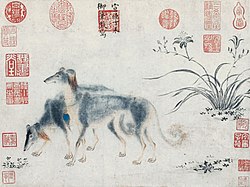 Two Saluki Hounds (猎犬圖; 1427), Harvard Art Museum, United States
 -
![Three Yang [Goats], an Auspicious Start (to the New Year) (三陽開泰; 1429), National Palace Museum](//upload.wikimedia.org/wikipedia/commons/thumb/9/9f/%E6%98%8E_%E6%9C%B1%E7%9E%BB%E5%9F%BA_%E4%B8%89%E9%98%B3%E5%BC%80%E6%B3%B0%E8%BD%B4.jpg/120px-%E6%98%8E_%E6%9C%B1%E7%9E%BB%E5%9F%BA_%E4%B8%89%E9%98%B3%E5%BC%80%E6%B3%B0%E8%BD%B4.jpg) Three Yang [Goats], an Auspicious Start (to the New Year) (三陽開泰; 1429), National Palace Museum
Three Yang [Goats], an Auspicious Start (to the New Year) (三陽開泰; 1429), National Palace Museum -
 Imperial Imitation of Huang Quan's Flower-and-Bird Painting (御臨黃筌花鳥; 1429), National Palace Museum
 -
![Marquis Wu[i] in Repose (武侯高臥圖; 1428), The Palace Museum](//upload.wikimedia.org/wikipedia/commons/thumb/7/78/Xuande_Bamboo.jpg/330px-Xuande_Bamboo.jpg)


![Three Yang [Goats], an Auspicious Start (to the New Year) (三陽開泰; 1429), National Palace Museum](https://en.wikipedia.org/wiki/File:%E6%98%8E_%E6%9C%B1%E7%9E%BB%E5%9F%BA_%E4%B8%89%E9%98%B3%E5%BC%80%E6%B3%B0%E8%BD%B4.jpg)

![Marquis Wu[i] in Repose (武侯高臥圖; 1428), The Palace Museum](https://en.wikipedia.org/wiki/File:Xuande_Bamboo.jpg)
Death and succession
[edit]In the autumn and winter of 1434, the Emperor led a military detachment on a tour of the northern border, but upon returning to Beijing, he fell ill.[66] He was sick for almost two months,[13] until he suddenly died on 31 January 1435.[67] He died in the Palace of Heavenly Purity in the Forbidden City.[68] He was given the posthumous name Emperor Zhang (章帝; 'Distinguished Emperor') and the temple name Xuanzong (宣宗; 'Penetrating Ancestor').[67] He was buried in the Jing Mausoleum in the Ming tombs near Beijing.[68]
The Xuande Emperor's successor was his elder son, Zhu Qizhen, who had been created crown prince in May 1428.[67] He became emperor at the age of eight, but the rules established by the Hongwu Emperor did not anticipate the accession of a child emperor, making it impossible to appoint a regent to govern the country in place of a minor monarch.[13] As a result, the Xuande Emperor's decision was to have senior officials consult on government matters with the young emperor's grandmother, Grand Empress Dowager Zhang, who effectively ruled the empire.[67] Through her cooperation with the grand secretaries, state policy remained consistent until the early 1440s.[66]
Legacy
[edit]
The Xuande Emperor was a capable, active, and skilled ruler. Some civil officials criticized his indulgence in frequently sending eunuchs to the southern provinces seeking entertainers and virgins for his harem, and his entrusting greater authority to eunuchs—which caused problems for his successors.[13] He saw himself as a warrior and, like the Yongle Emperor, personally led military campaigns, but his actions were relatively small (such as suppressing his uncle's rebellion) or insignificant (such as clashes with the Mongols on the northern border).[27] The Xuande Emperor was the last Ming emperor to actively participate in governing the state and remained impartial towards the various groups that made up the ruling elite. He relied on civil officials, but also frequently utilized eunuchs and military commanders. In contrast, later Ming emperors abandoned their role as stabilizing figures and instead indulged in palace pleasures, leaving the reins of government in the hands of officials who were often divided into rival factions or, more commonly, palace eunuchs.[66] As a result, subsequent generations of officials viewed the Xuande era as a golden age of ideal governance, in contrast to the factional conflicts and institutional decay of their own time.[59][66]
The Xuande era is widely regarded by historians as the high point of the Ming dynasty, characterized by stability and peace.[6] This was a stark contrast to the harsh administrative purges of the Hongwu era and the civil war of the Jianwen era.[14] Capable and often long-serving ministers and officials, under the leadership of the "Three Yangs" (Yang Shiqi, Yang Rong, and Yang Pu), governed the country with a level of continuity and reliability unique to the Ming era, in accordance with the Confucian ideals of wise ministerial rule led by a capable ruler.[14] The government also made efforts to improve the lives of its people, gave up expansion in Đại Việt, and implemented administrative reforms. While the Emperor may have been harsh towards officials and lenient towards high-ranking officers, this did not significantly impact the overall character of the government.[14]
The rebellion of the Emperor's uncle confirmed to the Emperor and officials that the decision to remove members of the imperial family from any influence on the military was the right one. The failure of the war in Jiaozhi and the subsequent defeat in Tumu were constant arguments used by officials against military adventures,[26] which could potentially return power to the hands of the generals and disrupt the establishment of the Ming dynasty's dominance in government. The Ming dynasty's originally diverse elites, including generals, members of the imperial family, Confucian officials, and eunuchs, saw the first two groups lose their influence on the governance of the country. During the Xuande era, Confucian officials gained supremacy over the other groups and maintained it until the end of the Ming dynasty, marking the end of the early Ming period in the 1430s. Despite the significant increase in population and economy, the Ming military and political institutions remained relatively unchanged until the end of the dynasty.[69]

Consorts and issue
[edit]- Empress Gongrangzhang (恭讓章皇后) of the Hu clan (胡氏; 1402–1443), personal name Shanxiang (善祥)[70]
- Empress Xiaogongzhang (孝恭章皇后) of the Sun clan (孫氏; 1399–1462)[73]
- Princess Changde (常德公主; d. 1470), third daughter[71]
- Married Xue Huan (薛桓) in 1440
- Zhu Qizhen (朱祁鎮), Emperor Yingzong (英宗; 1427–1464), first son[74]
- Princess Changde (常德公主; d. 1470), third daughter[71]
- Consort Rongsixian (榮思賢妃) of the Wu clan (吳氏; 1397–1462)[75]
- Zhu Qiyu (朱祁鈺), the Jingtai Emperor (景泰帝; 1428–1457), second son[76]
- Noble Consort Duanjing (端靜貴妃) of the He clan (何氏; d. 1435)[77]
- Consort Shu (淑妃) of the Liu clan (劉氏)[78]
- Consort Chunjingxian (純靜賢妃) of the Zhao clan (趙氏; d. 1435)[77]
- Consort Zhenshunhui (貞順惠妃) of the Wu clan (吳氏; d. 1435)[77]
- Consort Zhuangjingshu (莊靜淑妃) of the Jiao clan (焦氏; d. 1435)[77]
- Consort Zhuangshunjing (莊順敬妃) of the Cao clan (曹氏; d. 1435)[77]
- Consort Zhenhuishun (貞惠順妃) of the Xu clan (徐氏; d. 1435)[77]
- Consort Gongdingli (恭定麗妃) of the Yuan clan (袁氏; d. 1435)[77]
- Consort Zhenjinggong (貞靜恭妃) of the Zhu clan (諸氏; d. 1435)[77]
- Consort Gongshunchong (恭順充妃) of the Li clan (李氏; d. 1435)[77]
- Consort Suxicheng (肅僖成妃) of the He clan (何氏; d. 1435)[77]
- Lady Gongshen (恭慎夫人) of the Korean Cheongju Han clan[79][j]
- Concubine Zhen'ai (貞哀國嬪) of the Guo clan (郭氏; d. 1435), personal name Ai (愛)[80]
See also
[edit]Notes
[edit]- ^ Chinese: 宣德; pinyin: Xuāndé
- ^ simplified Chinese: 宪天崇道英明神圣钦文昭武宽仁纯孝章皇帝; traditional Chinese: 憲天崇道英明神聖欽文昭武寬仁純孝章皇帝 (conferred by Emperor Yingzong in 1435)[2]
- ^ Chinese: 宣宗; pinyin: Xuānzōng
- ^ Chinese: 朱瞻基; pinyin: Zhū Zhānjī
- ^ The so-called "gold flower silver".[43]
- ^ At the forefront of the opponents of long-distance voyages were Grand Secretary Yang Shiqi and the Minister of Revenue Xia Yuanji.[50]
- ^ The mission was led by the eunuch Chai Shan (柴山).[51]
- ^ After the Emperor's death, the Ming government allowed 53 Korean women to return to their homeland.[58] Several thousand Chinese women were also released from service in the Forbidden City.[14]
- ^ Marquis of Wu was the title of Zhuge Liang (181–234), a military leader during the Three Kingdoms period.[65]
- ^ She was the sister of the Yongle Emperor's Consort Kanghuizhuangshuli.[79]
References
[edit]Citations
[edit]- ^ Goodrich & Fang (1976), p. xxi.
- ^ Moule (1957), p. 107.
- ^ Xuanzong Shilu, vol. 1.
- ^ a b c d e f Chan (1988), p. 285.
- ^ Chan (1988), pp. 196–201.
- ^ a b c d e f Mote (2003), p. 623.
- ^ a b c d Dreyer (1982), p. 226.
- ^ Li, Yang. "Timeline of the Ming & Qing Palace Events. The Yongle Emperor (r. 1403-1424)". Beijing: The Palace Museum. Archived from the original on 2021-05-18. Retrieved 23 December 2020.
- ^ Mote (2003), p. 622.
- ^ a b c d Chan (1988), p. 286.
- ^ Wang (2020), p. 207.
- ^ a b Chan (1988), p. 284.
- ^ a b c d Mote (2003), p. 626.
- ^ a b c d e f g h i Mote (2003), p. 625.
- ^ a b c d e Chan (1988), p. 288.
- ^ a b c Chan (1988), p. 289.
- ^ Chan (1988), pp. 208–209.
- ^ Dreyer (1982), pp. 222, 224, 235.
- ^ Chan (1988), p. 210.
- ^ a b Tsai (2002), pp. 93–94.
- ^ a b c d Dreyer (1982), p. 234.
- ^ a b c Chan (1988), p. 287.
- ^ a b Chan (1988), p. 304.
- ^ a b c d e Chan (1988), p. 291.
- ^ Chan (1988), pp. 291–292.
- ^ a b c d e Dreyer (1982), p. 230.
- ^ a b c d Dreyer (1982), p. 231.
- ^ a b c d Chan (1988), p. 293.
- ^ a b Chan (1988), p. 294.
- ^ a b Atwell (2002), p. 91.
- ^ a b Huang (1997), p. 181.
- ^ a b c d Von Glahn (1996), p. 74.
- ^ Atwell (2002), p. 86.
- ^ a b Li (2007), pp. 121–122.
- ^ a b Von Glahn (1996), p. 75.
- ^ Von Glahn (1996), pp. 74–75.
- ^ a b c Von Glahn (1996), p. 83.
- ^ Atwell (2002), pp. 86–87.
- ^ Atwell (2002), p. 97.
- ^ Von Glahn (1996), p. 73.
- ^ a b c Chan (1988), p. 295.
- ^ a b Chan (1988), p. 296.
- ^ a b c Chan (1988), p. 297.
- ^ a b c d Chan (1988), p. 298.
- ^ a b Dreyer (1982), p. 227.
- ^ a b c d e Chan (1988), p. 290.
- ^ a b Dreyer (1982), p. 228.
- ^ Dreyer (1982), p. 229.
- ^ Wade (2004), p. 35.
- ^ a b c d e Chan (1988), p. 302.
- ^ a b c d e f g Dreyer (1982), p. 233.
- ^ Goodrich & Fang (1976), pp. 685–686.
- ^ a b c Chan (1988), p. 299.
- ^ a b c Chan (1988), p. 300.
- ^ Von Glahn (1996), pp. 90–91.
- ^ Von Glahn (1996), p. 91.
- ^ Von Glahn (1996), p. 90.
- ^ a b c Chan (1988), p. 301.
- ^ a b c d "From the Brush of Xuande: Painting and Calligraphy of the Ming Emperor Xuanzong : Introduction". Taipei: National Palace Museum. Archived from the original on 6 April 2012. Retrieved 6 January 2013.
- ^ Fong & Watt (1996), pp. 338–339.
- ^ Mowry, Robert (May–June 2007). "Imperial Salukis. Speedy hounds, portrayed by a Chinese emperor". Harvard magazine.
- ^ Gulik (1967), pp. 94–95.
- ^ Geissmann (2008), p. 3.
- ^ "Shang Xi". cultural-china.com. Archived from the original on 22 May 2012. Retrieved 2 January 2012.
- ^ Theobald, Ulrich. "Persons in Chinese History - Zhuge Liang 諸葛亮". Chinaknowledge - a universal guide for China studies. Retrieved 7 February 2013.
- ^ a b c d Dreyer (1982), p. 236.
- ^ a b c d Chan (1988), p. 303.
- ^ a b "Zhu Zhanji - Emperor Xuanzong of the Ming Dynasty". Cultural China. 2007–2010. Archived from the original on 15 October 2012. Retrieved 14 February 2013.
- ^ Dreyer (1982), p. 237.
- ^ Wong (1997), p. 86.
- ^ a b History of Ming, vol. 121, p. 3671.
- ^ Xianzong Shilu, vol. 293.
- ^ Wong (1997), p. 89.
- ^ History of Ming, vol. 10, p. 127.
- ^ Wong (1997), p. 92.
- ^ History of Ming, vol. 11, p. 141.
- ^ a b c d e f g h i j Wong (1997), p. 97.
- ^ Wong (1997), p. 96.
- ^ a b Wong (1997), p. 98.
- ^ History of Ming, vol. 113, p. 3515.
Works cited
[edit]- Atwell, William S (2002). "Time, Money, and the Weather: Ming China and the "Great Depression" of the Mid-Fifteenth Century". The Journal of Asian Studies. 61 (1). ISSN 0021-9118.
- Chan, Hok-lam (1988). "The Chien-wen, Yung-lo, Hung-hsi, and Hsüan-te reigns". In Mote, Frederick W.; Twitchett, Denis C (eds.). The Cambridge History of China Volume 7: The Ming Dynasty, 1368–1644, Part 1. Cambridge: Cambridge University Press. pp. 182–304. ISBN 0521243327.
- Dreyer, Edward L. (1982). Early Ming China: A Political History. Stanford: Stanford University Press. ISBN 0-8047-1105-4.
- Fong, Wen; Watt, James C. Y (1996). Possessing the Past: Treasures from the National Palace Museum, Taipei. New York: Metropolitan Museum of Art. ISBN 9780810964945.
- Goodrich, L. Carington; Fang, Chaoying (1976). Dictionary of Ming Biography, 1368-1644. Vol. 1, A–L. New York: Columbia University Press. ISBN 0-231-03801-1.
- Gulik, Robert van (1967). The gibbon in China. An essay in Chinese animal lore. Leiden, Nizozemsko: E.J. Brill.
- Geissmann, Thomas (2008). "Gibbon paintings in China, Japan, and Korea: Historical distribution, production rate and context" (PDF). Gibbon Journal (4): 1–39. ISSN 1661-707X. Archived from the original (PDF) on 17 December 2008. Retrieved 17 December 2008.
- Huang, Ray (1997). China: a macro history. Armonk, NY: M. E. Sharpe. ISBN 1-56324-730-5.
- Li, Kangying (2007). "A study on the Song, Yuan and Ming monetary policies within the context of worldwide hard currency flows during the 11th-16th centuries and their impact on Ming institutions". In Schottenhammer, Angela (ed.). The East Asian maritime world 1400-1800: its fabrics of power and dynamics of exchanges. Wiesbaden: Otto Harrassowitz Verlag. pp. 99–136. ISBN 9783447054744.
- Mote, Frederick W (2003). Imperial China 900-1800. Cambridge, Massachusetts: Harvard University Press. ISBN 978-0674012127.
- Moule, Arthur Christopher (1957). The rulers of China, 221 B.C. – A.D. 1949; chronological tables. New York: F. A. Praeger.
- Tsai, Shih-Shan Henry (2002). Perpetual Happiness: The Ming Emperor Yongle. Seattle, Wash.; Chesham: University of Washington Press; Combined Academic. ISBN 0295981245.
- Von Glahn, Richard (1996). Fountain of Fortune: money and monetary policy in China, 1000–1700. Berkeley, California: University of California Press. ISBN 0-520-20408-5.
- Wade, Geoffrey (2004). "Ming China and Southeast Asia in the 15th Century: A Reappraisal". Working Paper Series (28). Archived from the original on 9 January 2014. Retrieved 19 August 2011.
- Wang, Yuan (2020). Space and Time as Context and Device: Dialogue and Contention in Early Luso-Chinese Interactions (PDF) (Ph.D. (Portuguese) thesis). Madison, Wisconsin: University of Wisconsin-Madison.
- Wong, Nai-kwan (1997). Ming dai huang shi yan jiu 明代皇室研究 [A Study of the Imperial Family of the Ming Dynasty] (MPhil thesis) (in Chinese). Pokfulam, Hong Kong: The University of Hong Kong. doi:10.5353/th_b3122010.
- Xuanzong Shilu 宣宗實錄 [Veritable Records of Emperor Xuanzong] (in Literary Chinese).
- Xianzong Shilu 憲宗實錄 [Veritable Records of Emperor Xianzong] (in Literary Chinese).
- Zhang, Tingyu (1974) [1739]. Ming Shi 明史 [History of Ming] (in Literary Chinese). Beijing: Zhonghua Book. ISBN 7101003273.
Further reading
[edit]- Dreyer, Edward L (2007). Zheng He : China and the Oceans in the Early Ming Dynasty, 1405-1433 (Library of World Biography Series ed.). New York: Pearson Longman. ISBN 978-0321084439.
- Levathes, Louise L (1994). When China ruled the seas: the treasure fleet of the Dragon Throne, 1405-1433. New York: Simon & Schuster. ISBN 0671701584.
External links
[edit]
- "明宣宗書畫展 / From the Brush of Xuande: Painting and Calligraphy of the Ming Emperor Xuanzong : Introduction". Taipei: National Palace Museum. Archived from the original on 7 April 2012. Retrieved 6 January 2013.
- Li, Yang. "Timeline of the Ming & Qing Palace Events. The Reign of the Xuande Emperor (approx. 1426–1435)". Beijing: The Palace Museum. Archived from the original on 6 December 2018. Retrieved 5 December 2018.
