Hubbry Logo
Fictional universeFictional universeMain
Open search
Fictional universe
Community hub
Fictional universe
logo
8 pages, 0 posts
0 subscribers
Be the first to start a discussion here.
Fictional universe
Fictional universe
from Wikipedia
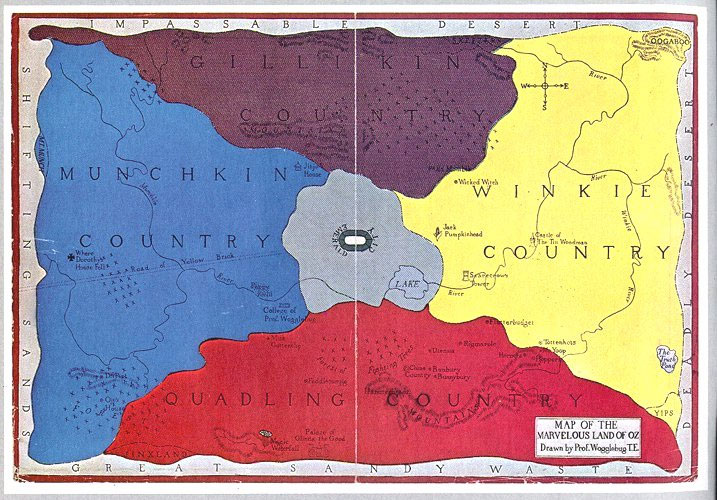
Map of the Land of Oz, the fictional realm that is the setting for L. Frank Baum's Oz series

A fictional universe, also known as an imagined universe or a constructed universe, is the internally consistent fictional setting used in a narrative or a work of art. This concept is most commonly associated with works of fantasy and science fiction, and can be found in various forms such as novels, comics, films, television shows, video games, and other creative works.[1][2]

In science fiction, a fictional universe may be a remote alien planet or galaxy with little apparent relationship to the real world (as in Star Wars). In fantasy, it may be a greatly fictionalized or invented version of Earth's distant past or future (as in The Lord of the Rings).[1]

Fictional continuity

[edit]

In a 1970 article in CAPA-alpha, comics historian Don Markstein defined the fictional universe as meant to clarify the concept of fictional continuities. According to the criteria he imagined:[3]

  1. If characters A and B have met, then they are in the same universe; if characters B and C have met, then, transitively, A and C are in the same universe.
  2. Characters cannot be connected by real people—otherwise, it could be argued that Superman and the Fantastic Four were in the same universe, as Superman met John F. Kennedy, Kennedy met Neil Armstrong, and Armstrong met the Fantastic Four.
  3. Characters cannot be connected by characters "that do not originate with the publisher"—otherwise it could be argued that Superman and the Fantastic Four were in the same universe, as both met Hercules.
  4. Specific fictionalized versions of real people—for instance, the version of Jerry Lewis from DC Comics' The Adventures of Jerry Lewis, who was distinct from the real Jerry Lewis in that he had a housekeeper with magical powers— can be used as connections; this also applies to specific versions of public-domain fictional characters, such as Marvel Comics' version of Hercules or DC Comics' version of Robin Hood.
  5. Characters are only considered to have met if they appeared together in a story; therefore, characters who simply appeared on the same front cover are not necessarily in the same universe.

Collaboration

[edit]

Fictional universes are sometimes shared by multiple prose authors, with each author's works in that universe being granted approximately equal canonical status. For example, Larry Niven's fictional universe Known Space has an approximately 135-year period in which Niven allows other authors to write stories about the Man-Kzin Wars. Other fictional universes, like the Ring of Fire series, actively court canonical stimulus from fans, but gate and control the changes through a formalized process and the final say of the editor and universe creator.[4]

See also

[edit]

References

[edit]

Further reading

[edit]
Revisions and contributorsEdit on WikipediaRead on Wikipedia
from Grokipedia
A fictional universe is a constructed, self-consistent imaginary world that serves as the backdrop for one or more works of , encompassing its own rules, , , characters, and elements that diverge from reality. This setting, often developed through world-building techniques, consists of a world-structure (defining the and laws of the environment) and a story-structure (outlining narratives and events within it), enabling authors to explore alternate realities with internal logic. Fictional universes are particularly prominent in genres such as and fantasy, where they facilitate immersion by providing detailed, believable environments that enhance thematic depth and reader engagement. In , for instance, these universes often draw on familiar real-world elements to craft entirely new landscapes, supporting explorations of identity, growth, and . Many such universes evolve into shared universes, where multiple creators contribute interconnected stories, characters, and lore across diverse media like novels, films, comics, and games, fostering expansive transmedia franchises. The creation and expansion of fictional universes highlight key literary and media practices, including consistency in canon to avoid contradictions and the use of possible worlds theory to conceptualize them as non-actual realms with autonomous properties. This approach not only enriches storytelling but also influences cultural phenomena, as audiences invest in these worlds through fan communities and adaptations, blurring lines between fiction and communal imagination.

Definition and Characteristics

Definition

A fictional universe is a cohesive, self-contained fictional setting that integrates multiple narratives, characters, locations, and governing rules across various works or media forms, providing a consistent backdrop for . This constructed world operates independently from reality, with its own internal logic that ensures events and elements remain believable within the established framework. Unlike standalone fiction, which typically confines its scope to a single plot or isolated tale, a fictional universe emphasizes interconnectedness, where stories share elements such as timelines, histories, and consequences that link disparate narratives into a unified whole. This distinction allows for expansive exploration, enabling creators to build upon prior works without resetting the foundational reality, fostering depth through recurring motifs and cross-references. The terminology surrounding fictional universes includes "universe" to denote the comprehensive fictional realm and "shared universe" for settings collaboratively expanded by multiple authors or teams while maintaining continuity. These terms highlight the scale and collaborative nature of such worlds, originating in contexts like science fiction literature and comic books to describe expansive, multi-work ecosystems. At its core, a fictional universe requires as a prerequisite, functioning as a self-sustaining where rules of physics, , magic, or technology apply uniformly to support narrative immersion and logical progression across all incorporated stories. This logical framework distinguishes it from mere settings, ensuring that the universe evolves coherently as new elements are introduced. For instance, universes like the exemplify this by weaving films, series, and comics into a single, rule-bound expanse.

Key Characteristics

Fictional universes are distinguished by their interconnectivity, where events, characters, and timelines from individual stories are linked to form a cohesive larger , allowing for cross-references and shared lore that enhance depth across multiple works. This interconnection fosters a sense of continuity, enabling readers to perceive the universe as a living entity beyond any single tale. A core trait is , referring to the stable rules governing physics, magic systems, societal norms, or other foundational elements within the universe, which must remain unaltered unless deliberately changed by events to maintain immersion. This consistency ensures that the world's logic feels reliable, preventing contradictions that could disrupt the audience's , and is achieved through adherence to self-defined principles that mirror real-world plausibility in a fictional . Scalability represents the universe's capacity to expand via sequels, spin-offs, or crossovers while preserving immersion, relying on a modular structure that accommodates new elements without undermining established lore. This flexibility allows creators to introduce additional stories or media adaptations that integrate seamlessly, scaling the narrative scope from localized events to galaxy-spanning epics through layered world details. Fictional universes vary in rigidity, with "hard" types enforcing strict, logically rigorous rules—such as precise scientific extrapolations in science fiction—to ensure verifiability and realism within their parameters. In contrast, "soft" universes permit greater flexibility, as in fantasy where magical or societal elements can bend without rigid justification, prioritizing thematic or emotional resonance over unyielding adherence to mechanics. These variations influence how universes engage audiences, with hard examples demanding intellectual alignment and soft ones emphasizing imaginative freedom.

Historical Development

Origins in Literature

The earliest precursors to modern fictional universes emerged in ancient literary traditions through interconnected mythological cycles that wove shared gods, heroes, and worlds into cohesive frameworks. , spanning epic poems like Homer's and (c. BCE) to later works by and the tragedians, constituted a proto-fictional universe where deities such as and Apollo, along with mortal heroes like Achilles and Odysseus, interacted across disparate tales within a consistent cosmology of Olympus, the , and mortal realms. This shared story world allowed for continuity and expansion without a single authorial voice, functioning as a cultural repository for exploring human themes like fate and heroism. Similarly, the Arthurian legends, originating in medieval Welsh and French texts such as Geoffrey of Monmouth's (c. 1136) and Chrétien de Troyes's romances (late 12th century), formed another proto-universe centered on , , and recurring figures like , , and the Knights of the , blending Celtic with chivalric ideals across centuries of oral and written iterations. By the , the rise of serialized novels marked a pivotal emergence of more structured fictional universes in , driven by the demands of periodical and audience engagement. Authors like serialized most of their works, such as (1836–1837) and (1849–1850), in monthly installments, creating recurring settings and character ensembles that spanned multiple novels and fostered a sense of ongoing narrative continuity. similarly employed in newspapers for expansive sagas like (1844) and its sequel (1845), featuring shared protagonists (Athos, , , and D'Artagnan) and historical French backdrops that linked adventures across volumes, effectively building an interconnected world of intrigue and swashbuckling. This format not only democratized access to fiction but also encouraged authors to develop persistent universes to retain readers over extended periods. Key milestones in this literary evolution include Allan Poe's interconnected detective tales, which introduced systematic shared elements within a genre framework. Poe's stories—"The Murders in the Rue Morgue" (1841), "" (1842), and "" (1844)—unfold in a consistent 19th-century setting with the recurring narrator and , establishing early precedents for ratiocinative narratives in a unified fictional milieu that influenced later mystery universes. Jules Verne's series (1863–1910), comprising 54 novels, further advanced this by linking scientific adventures through overlapping characters (e.g., appearing in Twenty Thousand Leagues Under the Seas (1870) and (1874–1875)) and a global exploratory world grounded in , creating a proto-science universe that emphasized geographical and inventive consistency. The transition to modern forms of fictional universes in literature was catalyzed by the influence of early 20th-century pulp fiction magazines, which proliferated serialized adventure series in affordable formats. Publications like Argosy (starting 1882, pulped from 1896) and (1923–1954) hosted recurring characters and worlds by authors such as , whose and (John Carter) tales shared thematic and occasional crossover elements across issues, while Robert E. Howard's Conan stories built a barbaric universe through episodic publications. This medium's emphasis on formulaic, expandable narratives in genres like fantasy and laid groundwork for expansive, multi-author shared worlds in subsequent decades, bridging literary traditions to mass-market storytelling.

Evolution Across Media

The evolution of fictional universes in the 20th century marked a significant shift from primarily literary origins to multimedia expansions, particularly through and radio serials that introduced visual and auditory dimensions to shared worlds. Building on literary foundations such as serialized novels, publishers like DC and Marvel pioneered interconnected narratives in the mid-20th century, allowing characters and events to coexist within expansive, ongoing universes. For instance, DC Comics established a shared superhero universe with the formation of the of America in 1960, integrating heroes like and Batman into a cohesive continuity that spanned multiple titles. Similarly, , under editors like , unified its characters into the starting in 1961, with crossovers in titles like enabling richer world-building through visual storytelling and serialized adventures. This model facilitated visual expansions by depicting detailed settings, costumes, and action sequences that were difficult to convey in text alone, fostering fan engagement through collected editions and annual events. Parallel to comics, radio serials in the early to mid-20th century extended fictional universes via auditory immersion, particularly in science fiction genres that serialized epic narratives across episodes. Programs like Buck Rogers in the 25th Century (1932–1947) built a persistent futuristic world of interplanetary conflict, airing four times weekly to develop lore through voice acting, sound effects, and cliffhangers that encouraged listener investment in the universe's continuity. Likewise, Flash Gordon (1935) adapted comic strip elements into a 26-week radio serial, expanding its alien planet Mongo with dramatic audio cues for space battles and exotic environments, thus bridging print visuals with sound-based storytelling. These radio formats enabled auditory expansions by leveraging imagination-evoking techniques to create shared universes that influenced later media adaptations. From the 1970s onward, the film and television era transformed fictional universes through live-action integrations, deepening immersion via cinematic spectacle and episodic depth, as exemplified by franchises like Star Wars. George Lucas's Star Wars (1977) initiated a blockbuster saga that blended myth-inspired lore with , expanding a galactic universe across films, novels, and merchandise to create a multimedia empire. This approach revitalized on screen by prioritizing visual world-building—such as practical models for spaceships and alien planets—while television spin-offs like The Mandalorian (2019–present) further embedded the universe in serialized live-action, allowing real-time exploration of side stories and character arcs. Such adaptations enhanced immersion by translating static elements into dynamic performances, though they required careful scaling of narrative scope to fit runtime constraints. In the digital age from the 2000s, fictional universes embraced through video games, , and interactive platforms, introducing participatory elements that allowed audiences to co-explore worlds beyond passive consumption. The Matrix franchise (2003) exemplified this by releasing films alongside the Enter the Matrix, which expanded the simulated reality universe with player-driven narratives and lore not depicted on screen. and digital content, such as official transmedia extensions in universes like Lost (2004–2010), utilized online platforms for alternate perspectives and hidden details, fostering interactive engagement via forums and apps. Video games further enabled this by offering non-linear experiences, as in massively multiplayer online titles that let players inhabit and alter fictional worlds in real time, marking a shift toward convergent media ecosystems. Adapting fictional universes across media, however, presents inherent challenges, notably timeline discrepancies that arise when translating print-based chronologies to visual or interactive formats. For example, condensing multi-volume literary timelines into runtimes often results in altered event sequences or omitted arcs, as seen in live-action adaptations where pacing demands lead to perceived inconsistencies with source material. These issues stem from medium-specific constraints—such as limits versus expansive —potentially disrupting canon and fan expectations, requiring retcons or supplemental media to reconcile divergences. Despite such hurdles, these adaptations have driven the proliferation of transmedia universes by innovating narrative delivery while navigating fidelity to original visions.

Core Elements

World-Building and Setting

World-building forms the foundational layer of a fictional universe, involving the deliberate construction of immersive environments, logical rules, and intricate backstories that support narrative coherence and depth. This process ensures that the universe operates as a self-contained system, where elements interact predictably to foster reader engagement and . In science fiction and fantasy, world-building distinguishes expansive shared universes by integrating speculative elements with realistic constraints, allowing for scalable storytelling across media. Physical and metaphysical elements are crafted to establish the universe's core structure, including the design of planets, ecosystems, urban landscapes, or supernatural frameworks like systems and advanced technologies. Consistency in rules is paramount; for instance, metaphysical systems must adhere to defined limitations and consequences to avoid narrative inconsistencies, as seen in structured hierarchies where power sources and costs are explicitly delineated. Physical settings draw from real-world analogs—such as geological formations or climatic patterns—adapted to fictional needs, creating believable backdrops that influence plot and character actions. Timelines and histories provide chronological depth, outlining key events like interstellar wars, societal collapses, or evolutionary milestones that underpin the universe's evolution. Authors develop these chronologies to establish cause-and-effect relationships, ensuring that past events logically inform present conflicts and future possibilities, thereby enhancing the universe's perceived authenticity. This historical layering allows for non-linear , where flashbacks or prophecies reveal how eras of prosperity or turmoil have shaped enduring institutions and alliances. Cultural and societal layers enrich the setting by inventing languages, economic systems, religious practices, and social hierarchies that reflect diverse populations within the . These elements promote realism through interconnected details, such as how trade routes influence cultural exchanges or how class structures dictate access to metaphysical resources. By modeling societies on anthropological principles—adapted to fictional contexts—creators achieve immersive variety, where customs and norms vary across regions or to mirror complexity. Tools and techniques for documenting the setting include visual aids like detailed maps to illustrate geography and migration patterns, glossaries for defining terminology and lore, and appendices that compile timelines or societal overviews. These resources, often appended to primary texts, serve as reference points for audiences, facilitating deeper exploration without disrupting narrative flow. In practice, such documentation reinforces internal consistency, enabling creators to track evolving elements across multiple installments.

Characters and Lore

In fictional universes, characters often embody archetypal roles that recur across narratives, providing a framework for storytelling consistency and thematic depth. Heroes typically follow a monomyth structure, embarking on quests involving trials, transformation, and return, as outlined in Joseph Campbell's The Hero with a Thousand Faces. Villains serve as archetypal antagonists, representing chaos or moral opposition, while supporting ensembles—such as mentors, allies, or rivals—evolve in roles to facilitate ensemble dynamics and interpersonal conflicts. These archetypes, drawn from Carl Jung's concept of collective unconscious motifs, allow characters to adapt across stories while maintaining recognizable traits that reinforce the universe's thematic core. The mythos of a fictional universe encompasses overarching legends, religions, and prophecies that interconnect individual tales, creating a cohesive backstory narrative. Prophecies often function as narrative devices to propel plotlines, foretelling cataclysmic events or destined confrontations tied to ancient artifacts or divine interventions, as seen in speculative fiction where mythology shapes world events. These elements draw from traditional mythic structures, blending creation stories, cosmic battles, and moral allegories to establish religions or belief systems that influence character motivations and societal norms within the universe. Artifacts, such as legendary weapons or relics, serve as tangible links to the mythos, symbolizing power or fate and integrating prophecies into the lore's foundational fabric. Character continuity ensures the integrity of the by addressing aging, , and resurrections in ways that align with established rules, preventing fragmentation across serialized works. In extended franchises, characters may age realistically or remain static through conventions, with providing stakes and resurrections justified via lore-specific mechanisms like magical revival or alternate timelines to sustain ongoing arcs. This approach maintains emotional investment by balancing progression with reversibility, allowing evolving roles without undermining prior events, particularly in serialized where long-term development hinges on consistent temporal and causal logic. Lore dissemination occurs through integrated narrative techniques, revealing backstories via novels, in-universe documents, or supplementary materials that immerse readers in the universe's history. Epistolary formats, using letters or diaries, gradually unveil character origins and mythic events, fostering intimacy and authenticity in backstory delivery. In-universe documents, such as fictional histories or codices, present lore as authentic artifacts, embedding prophecies and ensemble backstories within the narrative to enhance verisimilitude and encourage deeper engagement. These methods tie character development to the broader mythos, often constrained by the universe's settings to ensure revelations align with environmental and cultural logics.

Creation Processes

Individual Authorship

Individual authorship in fictional universes emphasizes the solitary vision of a single creator who constructs intricate, self-contained worlds driven by personal imagination and thematic depth. exemplifies this through his development of , a mythology rooted in his linguistic inventions and desire to craft a "mythology for " that integrated ancient influences like Norse sagas and Anglo-Saxon poetry into a cohesive narrative framework. Similarly, pioneered the as a personal exploration of cosmic horror, inventing entities like and ancient tomes such as the to evoke humanity's insignificance in an indifferent universe, without initial intent for collaborative expansion. Single authors often expand their universes iteratively through sequels, prequels, and supplementary materials that layer additional depth. Tolkien's (1954–1955) built upon (1937) by incorporating extensive appendices detailing genealogies, calendars, and historical events, which provided a broader chronological scope to Middle-earth's lore. His unpublished notes and drafts, compiled posthumously into The Silmarillion (1977), further illustrate this process, revealing an evolving legendarium that spanned creation myths to the Third Age. Ownership and control over such universes rest with the creator during their lifetime, governed by copyright laws that protect original elements like characters, settings, and plots from unauthorized use. Tolkien retained full literary rights to until selectively selling film and merchandising rights in 1969 to , preserving his control over print publications. Lovecraft maintained personal authority over the elements in his stories, with copyrights vesting in his estate upon his 1937 death, though many works entered the by the mid-20th century due to lapsed renewals under U.S. . Solo creators face inherent limitations in maintaining expansive universes, including the finite scope of one individual's and writing capacity, as well as challenges in posthumous . Tolkien's vast legendarium, while richly detailed, remained incomplete at his in 1973, requiring editorial intervention by his son to organize and publish unfinished works, which sometimes involved reconciling inconsistencies across drafts. Lovecraft's mythos, similarly constrained by his solitary output and early , saw initial posthumous publications by associates like , highlighting the difficulties of preserving an author's unframed vision without external additions. These constraints often prompt eventual shifts toward collaborative efforts to sustain and adapt the beyond the creator's lifespan.

Collaborative Development

In studio and franchise models, large media companies such as and (WBD) oversee the collaborative expansion of fictional universes through coordinated teams of writers, artists, and directors. For instance, 's management of the (MCU) involves as Chief Creative Officer, who unifies creative direction across films, television, comics, and novels to maintain narrative consistency. Similarly, in the (DCU), co-CEOs and direct a shared vision for interconnected projects, assigning specific roles to screenwriters, comic artists, and filmmakers to align story elements across media. These models emphasize centralized oversight to leverage , with applying a similar approach to Star Wars by integrating film directors like with novelists and game developers for transmedia extensions. Cross-media teams further enhance fictional universe development by involving diverse creators in transmedia projects, where story elements are dispersed across platforms to build immersive worlds. Novelists contribute lore depth, as seen in the MCU's books that expand character backstories, while game developers like those at craft interactive narratives within the Star Wars universe, requiring alignment with filmmakers' visions. Filmmakers, in turn, adapt these elements for visual media, fostering a braided narrative that demands ongoing collaboration; for example, transmedia strategies in franchises like Star Wars coordinate scriptwriters with visual effects artists to ensure cohesive world-building across films, series, and . This approach contrasts with individual creator foundations by emphasizing collective input to scale universes beyond a single medium. Fan communities occasionally contribute to official development through sanctioned incorporations, such as contests or approved fiction integrated into canon. In Marion Zimmer Bradley's , she curated and published fan-written stories in official anthologies, granting some canonical status to fan-generated lore and characters. Similarly, J.K. Rowling endorsed a fan interpretation of Albus Dumbledore's sexuality, incorporating it into the canon via author statements, while linguist David J. Peterson's , originally developed for the Game of Thrones TV adaptation, was adopted into George R.R. Martin's source novels. These examples highlight how studios selectively harness fan creativity to enrich universes, often through official channels like writing contests. Coordination in collaborative development presents challenges, including conflicts in creative vision that lead to reboots or alternate timelines for resolution. Maintaining narrative coherence across teams can result in divergent authorial interpretations, as in DC's use of multiverses to accommodate varying director visions without fully rebooting the core . Reboots, such as those in franchise models, arise from misaligned team inputs, requiring resets to unify timelines and restore consistency, though they risk alienating audiences accustomed to established lore. Budget and technological constraints exacerbate these issues, forcing improvisation in transmedia projects and highlighting the need for robust oversight to balance innovation with continuity.

Continuity and Canon

Maintaining Consistency

In fictional universes, maintaining consistency begins with establishing canon hierarchies that delineate official from non-official materials, ensuring a coherent narrative framework across media. For instance, in the Star Wars franchise, a structured hierarchy was historically used, with "G-canon" (George Lucas-approved films and scripts) at the top, followed by "T-canon" (television content), "C-canon" (continuity novels and comics), "S-canon" (secondary expanded universe elements), and "N-canon" (non-canon works); this system, managed by Lucasfilm's Holocron database, prioritized core stories while allowing supplementary materials to fit without contradiction until the 2014 Disney acquisition simplified it to a binary of current canon versus "Legends" non-canon. Similarly, Marvel Comics operates without a rigid tier but treats all published material in its primary Earth-616 continuity as canon unless explicitly retconned by editorial decree, with multiverse variants (e.g., Earth-1610 Ultimate Universe) serving as parallel but subordinate narratives to preserve the mainline integrity. These hierarchies prevent narrative fragmentation by officially endorsing select works, often labeling fan-preferred "headcanon" interpretations—personal blends of official and unofficial elements—as non-binding to avoid diluting the franchise's authoritative storyline. Editorial oversight further enforces consistency through dedicated tools and personnel who monitor details across productions. Central to this is the "series bible" or "universe bible," a comprehensive document compiling character backstories, world rules, timelines, and key events to guide writers and creators; for example, in television franchises like , the bible has evolved from Gene Roddenberry's original 1960s guide to updated versions tracking lore across decades of series. In comics, publishers employ continuity editors—such as Marvel's Tom Brevoort, who has overseen titles for over 30 years—to review scripts for alignment with established lore, flagging inconsistencies like contradictory power levels or timelines before publication. This process, which may incorporate inputs from collaborative development teams, ensures that evolving stories remain logically coherent without requiring constant resets. When inconsistencies arise, retcons () and reboots provide official mechanisms to revise past events while minimizing audience alienation. A retcon subtly alters prior canon through in-universe explanations, such as reinterpreting a character's origin; in DC Comics, the 1980s event merged multiple realities into one streamlined timeline, excising contradictory elements while honoring fan-favorite arcs through gradual integration in subsequent titles. Reboots, by contrast, initiate a fresh continuity, often soft-launched to retain core appeal—Marvel's 2015 relaunch reset the post-event, allowing selective carryover of popular elements like character relationships to ease transitions for long-term readers. These techniques balance innovation with fidelity, using narrative events to justify changes rather than abrupt erasures, thereby sustaining engagement in expansive universes. Legal frameworks underpin these efforts by safeguarding universe integrity via trademarks and licensing agreements that control how elements are used externally. Trademarks protect distinctive character names, logos, and phrases (e.g., Disney's "Mickey Mouse" mark, renewed indefinitely through active use), preventing unauthorized dilutions that could confuse canon with derivative works. Licensing contracts for franchises like Marvel impose strict guidelines on licensees—such as toy manufacturers or game developers—requiring adherence to official lore and pre-approval of content to maintain narrative consistency; violations can lead to termination, as seen in oversight of cross-media adaptations. This intellectual property strategy not only monetizes the universe but enforces a unified vision, deterring inconsistencies from proliferating through commercial extensions.

Fan and Official Expansions

Official spin-offs, including prequels, sequels, and tie-in novels, extend the core canon of fictional universes by introducing new narratives that build directly on established lore and characters. For example, the Star Trek franchise has utilized post-finale novels to continue the storyline of the Deep Space Nine series after its 1999 cancellation, providing fan-oriented extensions of the timeline and character arcs as licensed but non-canon material. Similarly, multimedia franchises like Assassin's Creed incorporate tie-in fiction from video games and television to weave additional historical and narrative layers into the central world-building. These authorized expansions often serve as merchandise or licensed content, such as comic books and novels, that enrich the universe without altering foundational elements. Fan works, encompassing role-playing games (RPGs), video game modifications (mods), and conventions, enable communities to generate parallel universes that reinterpret or augment the original fiction. In gaming contexts, fan-created mods for titles like Civilization 4 allow users to introduce custom scenarios, units, and lore, effectively transforming the base world into personalized extensions. Conventions, such as those dedicated to transmedia properties, foster immersive role-playing sessions where participants enact alternate storylines, creating communal narratives that operate alongside the canon. Fan fiction further contributes by producing user-generated texts that explore "what if" dimensions, as observed in the Fringe universe where stories shift established transmedia boundaries through community storytelling. These participatory elements, including artwork and fan productions, transform passive audiences into active co-creators, often shared via online platforms or zines. Notable cases of integration occur when fan ideas directly influence official content, blurring the lines between community input and authorized development. In the franchise, early fan novels and productions have inspired episode adaptations and served as experimental prototypes for future official series, demonstrating how fan creativity can inform canonical expansions. For instance, fanzines from the onward contributed to the evolution of Trek lore by suggesting character backstories and plot elements that later appeared in televised episodes, highlighting the franchise's openness to fan-driven innovation. Such integrations are guided by official policies that encourage non-commercial fan films while prohibiting direct reproductions, ensuring contributions remain original yet aligned with the universe's spirit. Debates over boundaries center on distinguishing "true" expansions from potential infringement, with canon typically defined as official storylines and fanon as community-constructed interpretations that may contest or supplement the source material. Scholars argue that fan practices treat the fictional universe as a contested site, where unreliable official texts invite fan interventions to resolve inconsistencies or fill representational gaps. In philosophical terms, fanfiction creates possible worlds adjacent to the canon, raising questions about authorship and validity when fan works gain semi-official status through creator endorsement. These discussions often emphasize legal and ethical limits, such as avoiding commercial exploitation, to prevent fan expansions from undermining the intellectual property while still allowing creative freedom. While maintaining consistency in core elements remains essential, these expansions thrive by navigating such tensions to sustain long-term engagement.

Notable Examples

Literary Universes

Literary universes in represent expansive, interconnected worlds primarily constructed through written narratives, often spanning multiple novels, short stories, and supplementary materials like appendices and maps. These universes allow authors to explore intricate lore, character arcs, and thematic depths that evolve across texts, establishing benchmarks for world-building. Prominent examples from fantasy and horror genres demonstrate how print media can foster immersive settings that influence subsequent and adaptations. Middle-earth, created by , stands as a foundational example of a richly detailed fantasy universe developed through prose. Encompassing the settings of (1937), (1954–1955), and The Silmarillion (1977), it features a mythic history spanning thousands of years, including the creation of the world Arda and the struggles among elves, men, dwarves, and other races against forces of darkness. Tolkien's lore integrates cosmological elements, such as the Music of the Ainur—a divine that shapes reality—and genealogies tracing lineages across eras. Central to its depth are the invented languages, including and for the elves, which Tolkien developed as a philologist, drawing from his expertise in , Norse, and Gothic to create grammars, vocabularies, and scripts that characters speak authentically. Maps, hand-drawn by Tolkien and refined by his son , depict regions like , , and the Misty Mountains, providing spatial coherence and enabling readers to trace quests and migrations visually. This meticulous integration of language and geography has positioned as a benchmark for fantasy world-building, influencing how authors construct believable, lived-in realms. The Cthulhu Mythos, originated by H.P. Lovecraft in the 1920s and 1930s, exemplifies a collaborative horror universe expanded through shared literary contributions. Introduced in stories like "The Call of Cthulhu" (1928), it portrays a cosmos indifferent to humanity, populated by ancient, eldritch entities such as Cthulhu—a colossal, tentacled being slumbering in the sunken city of R'lyeh—and other Great Old Ones whose mere awakening threatens sanity and existence. Lovecraft's framework emphasized cosmic horror, where forbidden knowledge from tomes like the Necronomicon reveals humanity's insignificance. The mythos grew collaboratively as Lovecraft encouraged peers to contribute; August Derleth formalized and extended it post-Lovecraft's death in 1937 by founding Arkham House to publish related works and coining the term "Cthulhu Mythos" to unify the shared elements. Other authors, including Robert Bloch—who penned "The Haunter of the Dark" (1935) featuring Lovecraft as a character—and Robert E. Howard, integrated mythos creatures into their tales, creating a loose canon of interconnected horrors that emphasized dread over resolution. This open structure allowed the universe to evolve organically through dozens of stories, establishing a template for shared-world horror anthologies. Discworld, authored by Terry Pratchett across 41 novels from 1983 to 2015, illustrates a satirical fantasy universe built through interconnected prose narratives. The world is a flat disc carried by four elephants atop a giant , A'Tuin, orbiting through space—a premise that parodies epic fantasy tropes while critiquing real-world society, politics, and human folly. Stories like (1983) and Guards! Guards! (1989) follow recurring characters such as the inept wizard , the City Watch of , and personified, whose arcs span sub-series while intersecting in larger events like the Auditors' schemes or troll-human relations. Pratchett's lore incorporates magic powered by belief, diverse species including dwarfs, trolls, and witches, and a detailed urban center in that evolves from chaotic medievalism to proto-industrialism. The satirical bent shines in episodes mocking , , and roles, all woven into a cohesive timeline without rigid chronology, allowing standalone reads amid the web of references. These literary universes have achieved significant commercial and cultural success, evidenced by robust book sales and adaptations that extend their reach. Tolkien's works have sold over 150 million copies worldwide, with alone exceeding 150 million and inspiring film trilogies that grossed billions. The , while more niche, has influenced horror literature through anthologies and reprints, with editions sustaining its legacy and leading to adaptations in films like (2001). Pratchett's series has sold over 100 million copies in 40 languages, spawning stage plays, TV miniseries such as (2006), and graphic novels that preserve its humorous tone. Their enduring influence is seen in genre conventions, where detailed lore and satire continue to shape fantasy and horror writing.

Audiovisual Universes

Audiovisual universes represent a dynamic subset of fictional universes, emphasizing visual storytelling through , television, adaptations, and like video games. These universes leverage formats to create immersive experiences that extend beyond static narratives, often incorporating shared timelines, character crossovers, and evolving lore that engages audiences across platforms. Unlike purely literary constructs, audiovisual universes prioritize spectacle, , and to convey complex worlds, frequently adapting source material from or original concepts into interconnected sagas. The (MCU) exemplifies interconnected audiovisual storytelling, comprising a series of films and television series produced by that share a unified timeline and feature extensive crossovers among superheroes. Launched in 2008 with , the MCU has expanded into multiple phases, each building toward large-scale ensemble events like Avengers: Endgame, where characters from disparate stories converge to address universe-spanning threats. This shared continuity allows for narrative threads introduced in one film or Disney+ series—such as the multiverse concept in —to influence subsequent entries, fostering a cohesive yet expansive that has grossed over $32 billion worldwide as of 2025. Star Wars stands as a pioneering audiovisual universe, originating with George Lucas's 1977 film Star Wars (later subtitled A New Hope) and evolving over nearly five decades into a multimedia franchise encompassing films, television series, novels, and video games. Under Lucasfilm's oversight, the canon has grown to include live-action series like The Mandalorian on Disney+, which explores post-Return of the Jedi eras and integrates with the sequel trilogy, while animated shows such as Star Wars: The Clone Wars fill prequel gaps with detailed lore on characters like Ahsoka Tano. Video games, including Star Wars Jedi: Fallen Order, further expand the timeline by depicting unexplored periods like the Imperial era, all while maintaining a consistent mythology centered on the Force and galactic conflicts. This iterative expansion has sustained the universe's relevance, with ongoing projects like Ahsoka bridging film and TV narratives. The DC Universe illustrates the adaptation of comic book origins into diverse audiovisual formats, transitioning from print to both animated and live-action media while navigating multiple shared continuities. Rooted in DC Comics since the 1930s, the universe gained prominence through films like Superman (1978) and the DC Extended Universe (DCEU) starting with Man of Steel in 2013, which interconnected heroes like Batman and Wonder Woman in crossovers such as Justice League. Animated variants, including the DC Animated Movie Universe (DCAMU) from 2013's Justice League: The Flashpoint Paradox, offer a separate shared timeline with direct comic adaptations, emphasizing darker tones and ensemble stories like Justice League Dark. The 2023 reboot under DC Studios has launched Chapter One: Gods and Monsters, beginning with the animated series Creature Commandos in December 2024 and the live-action film Superman in July 2025, unifying live-action films and Max series into a single interconnected slate while blending legacy elements with new interpretations. In video game-based audiovisual universes, interactivity distinguishes them by allowing player choices to influence lore and world-building, as seen in Nintendo's The Legend of Zelda series. Spanning over 20 titles since 1986, the franchise centers on the kingdom of Hyrule and recurring archetypes like Link, Zelda, and , with a flexible timeline that branches based on in-game decisions—such as the split in The Legend of Zelda: Ocarina of Time between child and adult timelines. Games like The Legend of Zelda: Breath of the Wild enhance this through open-world exploration and , where players' actions shape environmental interactions and story outcomes, effectively co-authoring elements of the lore. This player-driven approach has influenced subsequent entries, including Tears of the Kingdom, creating a living universe that evolves with audience engagement.

Cultural and Analytical Impact

Fictional universes have profoundly influenced through extensive , generating substantial economic value across media, merchandise, toys, theme parks, and conventions. For instance, the Star Wars universe has amassed approximately $46.7 billion in total revenue, with merchandise sales alone contributing over $29 billion, alongside box office earnings and theme park integrations like those at Disney's Galaxy's Edge attractions. Similarly, the has exceeded $34 billion in revenue, driven by interconnected films, comics, and merchandise that extend the franchise's narrative into consumer products. Theme parks amplify this impact; Disney's parks, heavily featuring elements from universes like Star Wars and Marvel, produce an annual U.S. economic impact of nearly $67 billion through visitor spending, job creation, and local business stimulation. Conventions further bolster this economy, with events like generating over $160 million in regional impact annually via attendee expenditures on lodging, food, and merchandise tied to fictional worlds. These universes permeate everyday language and digital culture through memes and iconic references, embedding their elements into broader societal discourse. The Star Wars phrase "May the Force be with you" exemplifies this, evolving into a widespread for wishing good fortune and inspiring annual celebrations like on , which draws global participation and media coverage. Such references extend to internet memes, where characters and quotes from universes like or the are repurposed in viral content, influencing trends and casual communication. Fandoms surrounding fictional universes foster vibrant social phenomena, including cosplay, fan art, and expansive online communities that build communal bonds and creative expression. Cosplay events at conventions allow fans to embody characters from audiovisual universes like Star Wars, promoting immersive participation and artistic innovation. Online platforms host millions of users; for example, Fandom's communities feature over 10,000 integrated Discord servers dedicated to these universes, where fan art and discussions enhance emotional connections and mental well-being. These activities drive cultural movements, turning passive consumption into active, community-driven creativity that sustains long-term engagement. The global reach of fictional universes is evident in their adaptation to diverse cultures through localization, ensuring resonance across borders. Star Wars, for instance, incorporates Japanese cultural elements like aesthetics in its storytelling, while localized versions include dubbing in more than 50 languages and region-specific merchandise to align with local traditions. In , the franchise ties into events like promotions, blending themes with traditional motifs to appeal to local audiences and expand . This cultural tailoring not only boosts international sales but also inspires hybrid fan creations, such as fusing universe elements with indigenous art forms in .

Scholarly Perspectives

In narratology, the concept of world-building refers to the systematic construction of immersive fictional environments that extend beyond plot and characters to encompass consistent rules, histories, and cultural logics, enabling deeper narrative engagement. Scholars like Mark J.P. Wolf argue that this process involves creating "possible worlds" that operate under their own semiotic systems, where signs and symbols within the narrative signify broader ontological structures distinct from the real world. In semiotics, world-building is analyzed as a form of diegetic expansion, where textual elements—such as maps, glossaries, or implied backstories—function as signifiers that build a cohesive semiotic universe, allowing readers to infer unspoken details and co-create the world. This framework draws from possible worlds semantics in philosophy, adapted to literature, emphasizing how fictional universes achieve plausibility through internal consistency rather than empirical truth. Media studies have extensively examined fictional universes through the lens of , where narratives unfold across multiple platforms to expand a shared world. defines transmedia as a process in which "integral elements of a get dispersed systematically across multiple delivery channels," fostering participatory cultures that deepen audience immersion in expansive universes like those in the . This approach highlights world-building as a collaborative extension, where each medium adds unique facets—such as providing or allowing interactive —without , thereby constructing richer, more navigable fictional ontologies. Recent scholarship builds on Jenkins by exploring how transmedia universes leverage digital affordances for nonlinear world expansion, treating the fictional realm as a dynamic, evolving that blurs boundaries between consumption and creation. Psychological research underscores the role of fictional universes in facilitating , where immersion in alternate realities provides temporary relief from real-world stressors by activating cognitive disengagement mechanisms. Studies indicate that engagement with such worlds enhances , particularly during , as individuals project personal narratives onto characters and settings, fostering self-exploration and emotional resilience. For instance, identification with media characters in expansive universes correlates with reduced , as fans internalize fictional mythologies to construct collective identities that mirror real social bonds. This process also supports broader psychological functions, such as empathy development through vicarious experiences in diverse fictional societies, though excessive may risk detachment if not balanced with real-life integration. Scholarly critiques of fictional universes often focus on issues of representation and diversity, revealing how world-building can perpetuate or challenge power imbalances. Analyses in science fiction highlight imperialist undertones, where colonial logics manifest in narratives of and domination, framing alien worlds as resources for human expansion and reinforcing Eurocentric hierarchies. In fantasy genres, critiques address the marginalization of non-white identities, arguing that homogenized portrayals of races and species overlook ethnic futurity and sustain exclusionary myths under the guise of . Diversity discussions emphasize the need for inclusive world-building that incorporates multicultural perspectives to counter historical , as seen in evolving representations that interrogate rather than exoticize difference. These examinations call for ethical frameworks in creation, ensuring fictional universes promote equitable narratives without reproducing real-world inequities.

References

Add your contribution
Related Hubs
User Avatar
No comments yet.