


Community hub
Recent from talks
Contribute something
Nothing was collected or created yet.
Film score
View on Wikipedia | This article needs additional citations for verification. (July 2013) |

A film score is original music written specifically to accompany a film or a television program. The score consists of a number of orchestral, instrumental, or choral pieces called cues, which are timed to begin and end at specific points during the film in order to enhance the dramatic narrative and the emotional impact of the scene in question.[1] Scores are written by one or more composers under the guidance of or in collaboration with the film's director or producer and are then most often performed by an ensemble of musicians – usually including an orchestra (most likely a symphony orchestra) or band, instrumental soloists, and choir or vocalists – known as playback singers – and recorded by a sound engineer. The term is less frequently applied to music written for media such as live theatre, television and radio programs, and video games, and that music is typically referred to as either the soundtrack or incidental music.
Film scores encompass an enormous variety of styles of music depending on the nature of the films they accompany. While the majority of scores are orchestral works rooted in Western classical music, many scores are also influenced by jazz, rock, pop, blues, new-age and ambient music, and a wide range of ethnic and world music styles. Since the 1950s, a growing number of scores have also included electronic elements, and many scores written today feature a hybrid of orchestral and electronic instruments.[2]
Since the invention of digital technology and audio sampling, many modern films have been able to rely on digital samples to imitate the sound of acoustic instruments, and some scores are created and performed wholly by the composers themselves, by using music composition software, synthesizers, samplers, and MIDI controllers.[citation needed]
Songs such as pop songs and rock songs are usually not considered part of the film's score,[3] although songs do also form part of the film's soundtrack.[4] Although some songs, especially in musicals, are based on thematic ideas from the score (or vice versa), scores usually do not have lyrics, except when sung by choirs or soloists as part of a cue. Similarly, pop songs that are dropped into a specific scene in a film for emphasis or as diegetic music (e.g., a song playing on a character's car radio) are not considered part of the score, although the score's composer will occasionally write an original pop song based on their themes, such as James Horner's "My Heart Will Go On" from Titanic, written for Celine Dion.
Terminology
[edit]A film score may also be called a background score, background music, film soundtrack, film music, screen composition, screen music, or incidental music.[5]
Process of creation
[edit]Spotting
[edit]The composer usually enters the creative process towards the end of filming at around the same time as the film is being edited, although on some occasions the composer is on hand during the entire film shoot, especially when actors are required to perform with or be aware of original diegetic music. The composer is shown an unpolished "rough cut" of the film before the editing is completed and talks to the director or producer about what sort of music is required for the film in terms of style and tone. The director and composer will watch the entire film, taking note of which scenes require original music. During this process, composers will take precise timing notes so that they know how long each cue needs to last, where it begins, where it ends, and of particular moments during a scene with which the music may need to coincide in a specific way. This process is known as "spotting".[6]
Occasionally, a filmmaker will actually edit their film to fit the flow of music, rather than have the composer edit their score to the final cut. Director Godfrey Reggio edited his films Koyaanisqatsi and Powaqqatsi based on composer Philip Glass's music.[7] Similarly, the relationship between director Sergio Leone and composer Ennio Morricone was such that the finale of The Good, the Bad and the Ugly and the films Once Upon a Time in the West and Once Upon a Time in America were edited to Morricone's score as the composer had prepared it months before the film's production ended.[8]
In another example, the finale of Steven Spielberg's E.T. the Extra-Terrestrial was edited to match the music of his long-time collaborator John Williams: as recounted in a companion documentary on the DVD, Spielberg gave Williams complete freedom with the music and asked him to record the cue without pictures; Spielberg then re-edited the scene later to match the music.
In some circumstances, a composer will be asked to write music based on their impressions of the script or storyboards without seeing the film itself and has more freedom to create music without the need to adhere to specific cue lengths or mirror the emotional arc of a particular scene. This approach is usually taken by a director who does not wish to have the music comment specifically on a particular scene or nuance of a film and which can instead be inserted into the film at any point the director wishes during the post-production process. Composer Hans Zimmer was asked to write music in this way in 2010 for director Christopher Nolan's film Inception;[9] composer Gustavo Santaolalla did the same thing when he wrote his Oscar-winning score for Brokeback Mountain.[10]
Syncing
[edit]When writing music for film, one goal is to sync dramatic events happening on screen with musical events in the score. There are many different methods for syncing music to picture. These include using sequencing software to calculate timings, using mathematic formulas and free timing with reference timings. Composers work using SMPTE timecode for syncing purposes.[11]
When syncing music to picture, generally a leeway of 3–4 frames late or early allows the composer to be extremely accurate. Using a technique called Free Timing, a conductor will use either (a) a stopwatch or studio size stop clock, or (b) watch the film on a screen or video monitor while conducting the musicians to predetermined timings. These are represented visually by vertical lines (streamers) and bursts of light called punches. These are put on the film by the Music Editor at points specified by the composer. In both instances, the timings on the clock or lines scribed on the film have corresponding timings which are also at specific points (beats) in the composer/conductor score.
Written click track
[edit]A written click track is a method of writing bars of music in consistent time values (e.g. 4 beats in :02+2⁄3 seconds) to establish a constant tempo in lieu of a metronome value (e.g. 88 bpm). A composer would use a written click if he or she planned to conduct live performers. When using other methods such as a metronome, the conductor has a perfectly spaced audible click playing. This can yield stiff and lifeless performances in slower more expressive cues. A standard bpm value can be converted to a written click where X represents the number of beats per bar and W represents time in seconds by using the following equation:
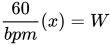
Written clicks are expressed using 1⁄3 second increments, so the next step is to round the decimal to either 0,1⁄3, or 2⁄3 of a second. The following is an example for 88 bpm:
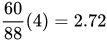
2.72 rounds to 2.66, so the written click is 4 beats in :02+2⁄3 seconds.
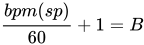
Once the composer has identified the location in the film with which to sync musically, he or she must determine the musical beat this event occurs on. To find this, conductors use the following equation, where bpm is beats per minute, sp is the sync point in real-time (i.e. 33.7 seconds), and B is the beat number in 1⁄3 increments (i.e. 49+2⁄3).
Writing
[edit]Once the spotting session has been completed and the precise timings of each cue determined, the composer will then work on writing the score. The methods of writing the score vary from composer to composer; some composers prefer to work with a traditional pencil and paper, writing notes by hand on a staff and performing works-in-progress for the director on a piano, while other composers write on computers using sophisticated music composition software such as Digital Performer, Logic Pro, Finale, Cubase, or Pro Tools.[12] Working with software allows composers to create MIDI-based demos of cues, called MIDI mockups, for review by the filmmaker prior to the final orchestral recording.[13]
The length of time a composer has to write the score varies from project to project; depending on the post-production schedule, a composer may have as little as two weeks or as much as three months to write the score. In normal circumstances, the actual writing process usually lasts around six weeks from beginning to end.
The actual material of the score depends on several different variables that factor into how a composer may write - for instance, the emotion the composer is trying to convey, the nature of the character on screen, the scenery and geography of the set, along with multiple more different variables. A composition could consist of different instrumentations, varying genres, and different influential styles.
Each composer has his or her own inspirations and pragmatic impressions that create unique and compelling sounds that can help to make a scene memorable. One example of this is in the "Lord of The Rings" score where Howard Shore uses a specific melodic idea to refer to The Shire by employing a tin flute to evoke a Celtic feeling. Shore does this throughout the three films of the trilogy to underscore a character's feeling of nostalgic reminiscence (Lawson, Macdonald, 2018).[14]
Other scores include not only original orchestrations but also popular music that represents the era and or the character being portrayed. Many films do this, such as Guardians of the Galaxy or Back to the Future. Alan Silvestri at times orchestrates compositions that are accompanied by tracks such as "The Power of Love" and "Back in Time", both by Huey Lewis and The News. This creates a sense of lightness that deviates from the fanfare-like main theme.(Lawson, Macdonald,2018).[14]
Many scores often try to draw from worldly influence to create sound that cements itself into popular culture. An example of this would be the score from The Good, The Bad, and The Ugly. In this score, composer Ennio Morricone uses a culmination of post-tonal music theory, Celtic song, gregorian chant, and mariachi trumpets to create the sound of the spaghetti western, one that is often associated with the wild west (Kalinak 2010).[15]
Orchestration
[edit]Once the music has been written, it must then be arranged or orchestrated in order for the ensemble to be able to perform it. The nature and level of orchestration varies from project to project and composer to composer, but in its basic form the orchestrator's job is to take the single-line music written by the composer and "flesh it out" into instrument-specific sheet music for each member of the orchestra to perform.
 | This section may be unbalanced towards certain viewpoints. (September 2021) |
Some composers like Ennio Morricone orchestrate their own scores themselves, without using an additional orchestrator. Some composers provide intricate details in how they want this to be accomplished and will provide the orchestrator with copious notes outlining which instruments are being asked to perform which notes, giving the orchestrator no personal creative input whatsoever beyond re-notating the music on different sheets of paper as appropriate. Other composers are less detailed, and will often ask orchestrators to "fill in the blanks", providing their own creative input into the makeup of the ensemble, ensuring that each instrument is capable of performing the music as written, and even allowing them to introduce performance techniques and flourishes to enhance the score. In many cases, time constraints determined by the film's post-production schedule dictate whether composers orchestrate their own scores, as it is often impossible for the composer to complete all the required tasks within the time frame allowed.
Over the years, several orchestrators have become linked to the work of one particular composer, often to the point where one will not work without the other.
Once the orchestration process has been completed, the sheet music is physically printed onto paper by one or more music copyists and is ready for performance.
Recording
[edit]When the music has been composed and orchestrated, the orchestra or ensemble then performs it, often with the composer conducting. Musicians for these ensembles are often uncredited in the film or on the album and are contracted individually (and if so, the orchestra contractor is credited in the film or the soundtrack album). However, some films have recently begun crediting the contracted musicians on the albums under the name Hollywood Studio Symphony after an agreement with the American Federation of Musicians. Other performing ensembles that are often employed include the London Symphony Orchestra (performing film music since 1935)[16] the City of Prague Philharmonic Orchestra (an orchestra dedicated mostly to recording), the BBC Philharmonic, and the Northwest Sinfonia.[citation needed]
The orchestra performs in front of a large screen depicting the film, The conductor and musicians habitually wear headphones that sound a series of clicks called a "click-track" that changes with meter and tempo, assisting to synchronize the music with the film.[17]
More rarely, the director will talk to the composer before shooting has started, so as to give more time to the composer or because the director needs to shoot scenes (namely song or dance scenes) according to the final score. Sometimes the director will have edited the film using "temp (temporary) music": already published pieces with a character that the director believes to fit specific scenes.
Elements of a film score
[edit]Most films have between 45 and 120 minutes of music. However, some films have very little or no music; others may feature a score that plays almost continuously throughout.
Temp tracks
[edit]In some instances, film composers have been asked by the director to imitate a specific composer or style present in the temp track.[18] On other occasions, directors have become so attached to the temp score that they decide to use it and reject the original score written by the film composer. One of the most famous cases is Stanley Kubrick's 2001: A Space Odyssey, where Kubrick opted for existing recordings of classical works, including pieces by composer György Ligeti rather than the score by Alex North,[19] although Kubrick had also hired Frank Cordell to do a score. Other examples include Torn Curtain (Bernard Herrmann),[20] Troy (Gabriel Yared),[21] Pirates of the Caribbean: The Curse of the Black Pearl (Alan Silvestri),[22] Peter Jackson's King Kong (Howard Shore),[23] Air Force One (Randy Newman)[24] and The Bourne Identity (Carter Burwell).[25]
Structure
[edit]Films often have different themes for important characters, events, ideas or objects, an idea often associated with Wagner's use of leitmotif.[26] These may be played in different variations depending on the situation they represent, scattered amongst incidental music. The themes for specific characters or locations are known as a motif where the rest of the track is usually centered around the particular motif and the track develops in line with the motif.
This common technique may often pass unnoticed by casual moviegoers, but has become well known among genre enthusiasts. One prominent example is John Williams' score for the Star Wars saga, and the numerous themes in Star Wars music associated with individual characters such as Darth Vader, Luke Skywalker, and Princess Leia.[27] Similarly, the music of the Lord of the Rings film series featured recurring themes for many main characters and places. Another notable example is Jerry Goldsmith's Klingon theme from Star Trek: The Motion Picture (1979), which later composers in the Star Trek film series quoted in their Klingon motifs, and which was included on numerous occasions as a theme for Worf, the franchise's most prominent Klingon character.[28] Michael Giacchino employed character themes in the soundtrack for the 2009 animated film Up, for which he received the Academy Award for Best Score. His orchestral soundtrack for the television series Lost also depended heavily on character and situation-specific themes.
Source music
[edit]"Source music" (or a "source cue") comes from an on screen source that can actually be seen or that can be inferred (in academic film theory such music is called "diegetic" music, as it emanates from the "diegesis" or "story world"). An example of "source music" is the use of the Frankie Valli song "Can't Take My Eyes Off You" in Michael Cimino's The Deer Hunter. Alfred Hitchcock's 1963 thriller The Birds is an example of a Hollywood film with no non-diegetic music whatsoever. Dogme 95 is a filmmaking movement, started in Denmark in 1995, with a manifesto that prohibits any use of non-diegetic music in its films.
Artistic merit
[edit] | This section needs additional citations for verification. (September 2013) |
Music criticism
[edit]The artistic merits of film music are frequently debated. Some critics value it highly, pointing to music such as that written by Erich Wolfgang Korngold, Aaron Copland, Bernard Herrmann, and others. Some consider film music to be a defining genre of classical music in the late 20th century, if only because it is the brand of classical music heard more often than any other. In some cases, film themes have become accepted into the canon of classical music. These are mostly works from already noted composers who have done scores; for instance, Sergei Prokofiev's score to Alexander Nevsky, or Vaughan Williams' score to Scott of the Antarctic. Others see the great bulk of film music as meritless. They consider that much film music is derivative, borrowing heavily from previous works. Composers of film scores typically can produce about three or four per year. The most popular works by composers such as John Williams are still far from entering the accepted classical canon, although there is a growing appreciation for the broader contribution of composers such as Williams among some classical composers and critics; for example, the Norwegian contemporary classical composer Marcus Paus has said that he considers Williams to be "one of the great composers of any century" who has "found a very satisfying way of embodying dissonance and avant-garde techniques within a larger tonal framework" and who "might also have come the closest of any composer to realizing the old Schoenbergian utopia that children of the future would be whistling 12-tone rows."[29] Even so, considering they are often the most popular modern compositions of classical music known to the general public, major orchestras sometimes perform concerts of such music, as do pops orchestras.
Preservation efforts
[edit]In 1983, a non-profit organization, the Society for the Preservation of Film Music, was formed to preserve the "byproducts" of creating a film score, including the music manuscripts (written music) and other documents and studio recordings generated in the process of composing and recording scores which, in some instances, have been discarded by movie studios.[30] The written music must be kept to perform the music on concert programs and to make new recordings of it. Sometimes only after decades has an archival recording of a film score been released on CD.
History
[edit]The origins of film music are disputed, although they are generally considered to have aesthetic roots in various media forms associated with nineteenth-century Romanticism.[31] According to Kurt London, film music "began not as a result of any artistic urge, but from a dire need of something which would drown the noise made by the projector. For in those times there was as yet no sound-absorbent walls between the projection machine and the auditorium. This painful noise disturbed visual enjoyment to no small extent. Instinctively cinema proprietors had recourse to music, and it was the right way, using an agreeable sound to neutralize one less agreeable."[32] On the contrary, film historian James Wierzbicki asserts that early film showings (such as the Lumière brothers' first film screening) would have been social events to the capacity that they had no need to mask the sounds of a projector mechanism. As these early films began to move out of exhibition spaces and into vaudeville theaters, the role of film began to shift as well. Given that vaudeville theaters typically employed musicians, it is likely that this is the point when it became commonplace for film to be accompanied by music. Audiences at the time would have come to expect music in the vaudeville space, and as such live musical accompaniment to films grew out naturally.[33]
Before the age of recorded sound in motion pictures, efforts were taken to provide suitable music for films, usually through the services of an in-house pianist or organist, and, in some cases, entire orchestras, typically given cue sheets as a guide. A pianist was present to perform at the Lumière brothers' first film screening in 1895.[34] In 1914, The Oz Film Manufacturing Company sent full-length scores by Louis F. Gottschalk for their films.[35] Other examples of this include Victor Herbert's score in 1915 to The Fall of a Nation (a sequel to The Birth of a Nation) and Camille Saint-Saëns' music for The Assassination of the Duke of Guise in 1908. It was preceded by Nathaniel D. Mann's score for The Fairylogue and Radio-Plays by four months, but that was a mixture of interrelated stage and film performance in the tradition of old magic lantern shows.[36] Most accompaniments at this time, these examples notwithstanding, comprised pieces by famous composers, also including studies. These were often used to form catalogues of photoplay music, which had different subsections broken down by 'mood' and genre: dark, sad, suspense, action, chase, etc.
German cinema, which was highly influential in the era of silent movies, provided some original scores such as Fritz Lang's movies Die Nibelungen (1924) and Metropolis (1927) which were accompanied by original full scale orchestral and leitmotific scores written by Gottfried Huppertz, who also wrote piano-versions of his music, for playing in smaller cinemas.[citation needed] Friedrich W. Murnau's movies Nosferatu (1922 – music by Hans Erdmann) and Faust – Eine deutsche Volkssage (1926 – music by Werner Richard Heymann) also had original scores written for them. Other films like Murnau's Der letzte Mann contained a mixing of original compositions (in this case by Giuseppe Becce) and library music / folk tunes, which were artistically included into the score by the composer. Much of this influence can be traced further back to German Romantic forms of music. Richard Wagner's ideas on Gesamtkunstwerk and leitmotif in his operas were later picked up on by prominent film composer Max Steiner. Steiner and his contemporary Erich Korngold both immigrated from Vienna, bringing with them musical structures and ideologies of the late Romantic period.[37]
In France, before the advent of talkies, Erik Satie composed what many consider the first "frame by frame" synchronous film score for director René Clair's avant-garde short Entr'acte (1924).[38][39] Anticipating "spotting" techniques and the inconsistencies of projection speeds in screenings of silent films, Satie took precise timings for each sequence and created a flexible, aleatoric score of brief, evocative motifs which could be repeated and varied in tempo as required.[40] American composers Virgil Thomson and Aaron Copland cited Satie's music for Entr'acte as a major influence on their own forays into film scoring.[41]
When sound came to movies, director Fritz Lang barely used music in his movies anymore. Apart from Peter Lorre whistling a short piece from Edvard Grieg's Peer Gynt, Lang's movie M – Eine Stadt sucht einen Mörder was lacking musical accompaniment completely and Das Testament des Dr. Mabuse only included one original piece written for the movie by Hans Erdmann played at the very beginning and end of the movie. One of the rare occasions on which music occurs in the movie is a song one of the characters sings, that Lang uses to put emphasis on the man's insanity, similar to the use of the whistling in M.
Early attempts at the synchronization of sound and image were failures, in large part due to mechanical and technological limitations. Phonographs, the only medium available for recorded sound in the early twentieth century, were difficult if not impossible to synchronize with the rotation of film projectors. In the cases where an attempt was made, sound was further limited by an inability to properly amplify it. However, in the 1920s improvements in radio technology allowed for the amplification of sound, and the invention of sound on film allowed for the synchronization thereof.[42] A landmark event in music synchronization with the action in film was achieved in the score composed by Max Steiner for David O. Selznick's 1933 King Kong. A fine example of this is when the aborigine chief slowly approaches the unwanted visitors to Skull Island who are filming the natives' sacred rites. As he strides closer and closer, each footfall is reinforced by a background chord.
Though "the scoring of narrative features during the 1940s lagged decades behind technical innovations in the field of concert music,"[43] the 1950s saw the rise of the modernist film score. Director Elia Kazan was open to the idea of jazz influences and dissonant scoring and worked with Alex North, whose score for A Streetcar Named Desire (1951) combined dissonance with elements of blues and jazz. Kazan also approached Leonard Bernstein to score On the Waterfront (1954) and the result was reminiscent of earlier works by Aaron Copland and Igor Stravinsky with its "jazz-based harmonies and exciting additive rhythms."[43] A year later, Leonard Rosenman, inspired by Arnold Schoenberg, experimented with atonality in his scores for East of Eden (1955) and Rebel Without a Cause (1955). In his ten-year collaboration with Alfred Hitchcock, Bernard Herrmann experimented with ideas in Vertigo (1958) and Psycho (1960). The use of non-diegetic jazz was another modernist innovation, such as jazz star Duke Ellington's score for Otto Preminger's Anatomy of a Murder (1959).
Composers
[edit]Academy Award nominees and winners
[edit]Box office champions
[edit]The following list includes all composers who have scored one of the 100 highest-grossing films of all time but have never been nominated for a major award (Oscar, Golden Globe etc.).
- William Alwyn – Swiss Family Robinson (1960)
- Joseph DeBeasi – American Sniper (2014)
- David Buttolph – House of Wax (1953)
- Brad Fiedel – Terminator 2: Judgment Day (1991)
- Alexander Janko – My Big Fat Greek Wedding (2002)
- Bill Justis – Smokey and the Bandit (1977)
- Harald Kloser – The Day After Tomorrow (2004), 2012 (2009)
- Heitor Pereira – Despicable Me (2010), The Smurfs (2011), Despicable Me 2 (2013)
- Trevor Rabin – Armageddon (1998), National Treasure: Book of Secrets (2007)
- Thomas Wanker – 2012 (2009)
- Pharrell Williams – Despicable Me (2010), Despicable Me 2 (2013)
- Chris Wilson – My Big Fat Greek Wedding (2002)
Relation with directors
[edit] | This section may be too long to read and navigate comfortably. (May 2025) |
Sometimes, a composer may unite with a director by composing the score for many films of a same director. John Williams' professional relationship with Steven Spielberg and George Lucas is one of the most prominent in film history, with Williams scoring all but five of Spielberg's films, and all the installments of both of Lucas' blockbuster franchises (Star Wars and Indiana Jones); Williams won all five of his Oscars in his collaborations with the two. Additionally, Danny Elfman did the score for all the movies directed by Tim Burton, with the exception of Ed Wood (score by Howard Shore) and Sweeney Todd: The Demon Barber of Fleet Street (score by Stephen Sondheim). Other documented instance of director-composer relationships includes: Bernard Herrmann with Alfred Hitchcock; Jerry Goldsmith with Joe Dante and Franklin Schaffner; Ennio Morricone with Sergio Leone, Mauro Bolognini, and Giuseppe Tornatore; Henry Mancini with Blake Edwards; Georges Delerue with François Truffaut; Alan Silvestri with Robert Zemeckis; Angelo Badalamenti with David Lynch; James Newton Howard with M. Night Shyamalan; Éric Serra with Luc Besson; Patrick Doyle with Kenneth Branagh; Dave Grusin with Sydney Pollack; Howard Shore with David Cronenberg, Peter Jackson, and Martin Scorsese; Carter Burwell with Joel & Ethan Coen; Bill Conti with John G. Avildsen; Lalo Schifrin with Don Siegel, Stuart Rosenberg, and Brett Ratner; Hans Zimmer with Ridley Scott and Christopher Nolan; Harry Gregson-Williams with Tony Scott and Andrew Adamson; Clint Mansell with Darren Aronofsky; Dario Marianelli with Joe Wright; Trent Reznor and Atticus Ross with David Fincher;[45] Steve Jablonsky with Michael Bay, Mychael Danna with Ang Lee and Atom Egoyan, Terence Blanchard with Spike Lee, Randy Newman with John Lasseter; Thomas Newman with Sam Mendes; David Newman with Danny Devito, Brian Levant, and Stephen Herek; John Debney with Jon Favreau and Garry Marshall; Gabriel Yared with Anthony Minghella; Joe Kraemer with Christopher McQuarrie; Michael Giacchino with J. J. Abrams and Brad Bird; James Horner with James Cameron and Ron Howard; John Barry with Bryan Forbes, Anthony Harvey, Terence Young, and Guy Hamilton; Elmer Bernstein with John Landis, John Sturges, and Robert Mulligan; Maurice Jarre with David Lean, Peter Weir, and Georges Franju; Philip Glass with Godfrey Reggio; Cliff Martinez and David Holmes with Steven Soderbergh; Akira Ifukube with Ishirō Honda; A. R. Rahman with Mani Ratnam; George Fenton with Richard Attenborough, Nicholas Hynter, Ken Loach, and Stephen Frears; Klaus Badelt and Ernst Reijseger with Werner Herzog; Randy Edelman with Ivan Reitman and Rob Cohen; Marc Shaiman with Rob Reiner; Elliot Goldenthal with Julie Taymor and Neil Jordan; Rachel Portman with Beeban Kidron, Lasse Hallström, and Jonathan Demme; Christophe Beck with Shawn Levy; Arthur B. Rubinstein and David Shire with John Badham; John Powell with Doug Liman and Paul Greengrass; Trevor Rabin with Renny Harlin and Jon Turteltaub; Harald Kloser with Roland Emmerich; David Arnold with Michael Apted and John Singleton; Michael Kamen with Richard Donner, John McTiernan, and Terry Gilliam; Jorge Arriagada with Raúl Ruiz; Zbigniew Preisner with Krzysztof Kieślowski; Mark Isham with Alan Rudolph and Robert Redford; Basil Poledouris with John Millius; Joseph Trapanese with Joseph Kosinski; Jonny Greenwood and Jon Brion with Paul Thomas Anderson; Brian Tyler with Justin Lin and Sylvester Stallone; John Ottman with Bryan Singer; Marco Beltrami with Wes Craven and Guillermo del Toro; Tyler Bates with James Gunn, Zack Snyder, and Rob Zombie; Pino Donaggio with Brian De Palma; and Alexandre Desplat with Wes Anderson, Roman Polanski, and George Clooney.
Production music
[edit]Many companies provide music to various film, TV and commercial projects for a fee. Sometimes called library music, the music is owned by production music libraries and licensed to customers for use in film, television, radio and other media. Examples of firms include Warner Chappell Production Music, Jingle Punks, Associated Production Music, FirstCom Music, VideoHelper and Extreme Music. Unlike popular and classical music publishers, who typically own less than 50 percent of the copyright in a composition, music production libraries own all of the copyrights of their music, meaning that it can be licensed without seeking the composer's permission, as is necessary in licensing music from normal publishers. This is because virtually all music created for music libraries is done on a work for hire basis.[citation needed] Production music is therefore a very convenient medium for media producers – they can be assured that they will be able to license any piece of music in the library at a reasonable rate.
Production music libraries will typically offer a broad range of musical styles and genres, enabling producers and editors to find much of what they need in the same library. Music libraries vary in size from a few hundred tracks up to many thousands. The first production music library was set up by De Wolfe Music in 1927 with the advent of sound in film, the company originally scored music for use in silent film.[46] Another music library was set up by Ralph Hawkes of Boosey & Hawkes Music Publishers in the 1930s.[47] APM, the largest US library, has over 250,000 tracks.[48]
See also
[edit]
References
[edit]- ^ Savage, Mark. "Where Are the New Movie Themes?" BBC, July 28, 2008.
- ^ "Bebe Barron: Co-composer of the first electronic film score, for 'Forbidden Planet'". The Independent. London. May 8, 2008. Retrieved May 2, 2010.
- ^ "Film Scores Facts, Worksheets, Definition & History For Kids". KidsKonnect. June 3, 2020. Retrieved March 29, 2021.
- ^ Rockwell, John (May 21, 1978). "When the Soundtrack Makes the Film". The New York Times. Retrieved August 10, 2010.
- ^ Hickman, Roger (2017). Reel music: exploring 100 years of film music (Second ed.). New York. ISBN 978-0-393-93766-4. OCLC 976036236.
{{cite book}}: CS1 maint: location missing publisher (link) - ^ Karlin, Fred; Wright, Rayburn (January 1, 2004). On the Track: A Guide to Contemporary Film Scoring. Routledge. ISBN 9780415941365 – via Google Books.
- ^ "About the Naqoyqatsi team". Archived from the original on December 26, 2008.
- ^ "The Good, The Bad and The Ugly – Expanded Edition Soundtrack (1967)".
- ^ "We Built Our Own World: Hans Zimmer and the Music of 'Inception'".
- ^ "Gustavo Santaolalla". thenitmustbetrue.com. Archived from the original on April 12, 2005.
- ^ "SMPTE". Archived from the original on August 26, 2011. Retrieved August 6, 2011.
- ^ Kompanek, Sonny. From Score To Screen: Sequencers, Scores And Second Thoughts: The New Film Scoring Process. Schirmer Trade Books, 2004. ISBN 978-0-8256-7308-5
- ^ Häberlin, Andreas (2025). "12. Opportunities". A Music Transcription Method: Notating Recorded Music by Ear (1st ed.). New York / Abingdon: Routledge. pp. 136–137. ISBN 9781032842547.
- ^ a b Tan, Li (November 2018). "Almost sure convergence rate of <mml:math xmlns:mml="http://www.w3.org/1998/Math/MathML" id="mml3" display="inline" overflow="scroll" altimg="si1.gif"><mml:mi>θ</mml:mi></mml:math>-EM scheme for neutral SDDEs". Journal of Computational and Applied Mathematics. 342: 25–36. doi:10.1016/j.cam.2018.04.007. ISSN 0377-0427.
- ^ Kalinak, Kathryn (May 1, 2010). Film Music. Oxford University Press. doi:10.1093/actrade/9780195370874.001.0001. ISBN 978-0-19-537087-4.
- ^ London Symphony Orchestra and Film Music Archived September 30, 2011, at the Wayback Machine LSO. Retrieved June 30, 2011
- ^ "5 RTAS Plug-Ins You Can Download for Free". Archived from the original on January 10, 2016. Retrieved July 21, 2008.
- ^ George Burt, The art of film music, Northeastern University Press
- ^ Paterson, Jim. "2001 A Space Odyssey – Original soundtrack by Alex North, commissioned but unused by Stanley Kubrick, conducted by Jerry Goldsmith".
- ^ "Torn Curtain Soundtrack (1966)".
- ^ "Gabriel Yared's Troy – Article".
- ^ "Filmtracks: Pirates of the Caribbean: The Curse of the Black Pearl (Hans Zimmer/Klaus Badelt)".
- ^ "Music on Film:: News:: Article in Variety about James Newton Howard's King Kong score". Archived from the original on 12 December 2007. Retrieved 30 July 2008.
- ^ "Air Force One (Jerry Goldsmith/Joel McNeely)".
- ^ "The Bourne Identity". Archived from the original on 19 September 2008. Retrieved 22 July 2008.
- ^ "Leitmotif". Merriam-Webster Dictionary (online ed.). August 3, 2023.
- ^ Evensen, Kristian (2008). "The Star Wars series and Wagner's Ring: Structural, thematic and musical connections". Richard Wagner Web Site. Archived from the original on 26 July 2010.
- ^ FilmChat (May 7, 2013). "Music for Klingons, part one: Jerry Goldsmith". FilmChat. Retrieved December 13, 2017.
- ^ Green, Edward (2020). "Interview with Composer Marcus Paus". Iconi. Vol. 2, no. 3. pp. 56–67.
- ^ "About the Film Music Society". Film Music Society.
- ^ Kitchen, Will. (2020) Romanticism and Film: Franz Liszt and Audio-Visual Explanation. London and New York: Bloomsbury Academic. pp. 41-77.
- ^ London. Film Music, p.28. Faber and Faber. Cited in Albright, Daniel, ed. (2004). Modernism and Music, p.96n40. ISBN 0-226-01267-0.
- ^ Wierzbicki, James Eugene (2009). Film music : a history. New York: Routledge. pp. 26–27. ISBN 978-0-203-88447-8. OCLC 309903138.
- ^ Film music: a history By James Eugene Wierzbicki, p.20
- ^ Dienstfrey, Eric (2014). "Synch Holes and Patchwork in Early Feature-Film Scores". Music and the Moving Image. 7 (1): 40–53. doi:10.5406/musimoviimag.7.1.0040 – via academia.edu.
- ^ Fairylogue was released September 24, 1908; Assassinat was released November 17, 1908. Dienstfrey, p 53.
- ^ Larsen, Peter (2007). Film music. John Irons. London: Reaktion. p. 95. ISBN 978-1-86189-341-3. OCLC 132314768.
- ^ Ornella Volta (ed.), "Satie Seen Through His Letters", Marion Boyars Publishers, London, 1989, p. 199.
- ^ "Erik Satie". Royal Opera House.
- ^ Robert Orledge, "Satie the Composer", Cambridge University Press, 1990, p. 244.
- ^ Justin Wintle (ed.), "New Makers of Modern Culture", Routledge, 2016, p. 1342.
- ^ Buhler, James (2010). Hearing the movies : music and sound in film history. David Neumeyer, Rob Deemer. New York: Oxford University Press. pp. 290–293. ISBN 978-0-19-532779-3. OCLC 276515073.
- ^ a b Cooke, Mervyn (2008). A History of Film Music. New York: Cambridge University Press. [citation needed]
- ^ Source: Box Office Mojo – All-Time Domestic Box Office Grosses [1], All-Time Domestic Box Office Grosses Adjusted for Inflation [2], All-Time Worldwide Box Office Grosses [3]
- ^ "Are David Fincher And Trent Reznor The Next Leone and Morricone?". October 4, 2014.
- ^ De Wolfe, Warren (1988). de wolfe millennium catalogue. London: De Wolfe Music.
- ^ Wallace, Helen (2007). Boosey & Hawkes The Publishing Story. London: B&H London. ISBN 978-0-85162-514-0. [citation needed]
- ^ "PRWeb July 2007". Archived from the original on January 31, 2008. Retrieved July 20, 2007.
Further reading
[edit]- Andersen, Martin Stig. "Electroacoustic Sound and Audiovisual Structure in Film". eContact! 12.4 — Perspectives on the Electroacoustic Work / Perspectives sur l'œuvre électroacoustique (August 2010). Montréal: CEC.
- Dorschel, Andreas (ed.). Tonspuren. Musik im Film: Fallstudien 1994–2001. Universal Edition, Vienna 2005 (Studien zur Wertungsforschung 46). ISBN 3-7024-2885-2. Scrutinizes film score practice at the turn from the 20th to 21st century. In German.
- Elal, Sammy and Kristian Dupont (eds.). "The Essentials of Scoring Film". Minimum Noise. Copenhagen, Denmark.
- Harris, Steve. Film, Television, and Stage Music on Phonograph Records: A Discography. Jefferson, N.C.: McFarland & Co., 1988. ISBN 0-89950-251-2.
- MacDonald, Laurence E. (1998) The Invisible Art of Film Music: A Comprehensive History. Scarecrow Press. ISBN 9781461673040.
- Holly Rogers and Jeremy Barham, The Music and Sound of Experimental Film. Oxford: Oxford University Press, 2017.
- Slowik, Michael. After the Silents: Hollywood Film Music in the Early Sound Era, 1926–1934. New York: Columbia University Press, 2014.
- Spande, Robert. "The Three Regimes – A Theory of Film Music" Archived November 17, 2021, at the Wayback Machine Minneapolis, 1996.
- Stoppe, Sebastian, ed. Film in concert: film scores and their relation to classical concert music. Glückstadt: Verlag Werner Hülsbusch, 2014. ISBN 978-3-86488060-5. doi:10.25969/mediarep/16802.
- Stubblevine, Donald J. Cinema Sheet Music: A Comprehensive Listing of Published Film Music, from Squaw Man (1914) to Batman (1989). Jefferson, N.C.: McFarland & Co., 1991. ISBN 0-89950-569-4.
- Various contributors [wiki]. "Films with Significant Electroacoustic Content[permanent dead link]". eContact! 8.4 — Ressources éducatives / Educational Resources (September 2006). Montréal: CEC.
- Skinner, Frank. Underscore: A Combination Method-Text-Treatise on Scoring Music for Motion Picture Films or T.V. Hollywood, CA: Skinner Music Company, 1950.https://archive.org/embed/skinner-frank.-underscore.-hollywood-ca-skinner-music-company-1950
External links
[edit]- Film music organizations
- Journals (online and print)
- Education
- Language
- "Terms of Art: Film Composer Lingo with Carter Burwell". Studio 360. Public Radio International and WNYC. August 31, 2017 [March 23, 2017]. Retrieved September 3, 2017.
| Definition | |||||||
|---|---|---|---|---|---|---|---|
| Major periods and eras |
| ||||||
| By country | |||||||
| Students by teacher | |||||||
| Performance | |||||||
| Related | |||||||


| Development | |||
|---|---|---|---|
| Pre-production | |||
| Production |
| ||
| Post-production | |||
| Distribution | |||
| Related | |||

| International | |
|---|---|
| National | |
| Other | |

Film score
View on GrokipediaFundamentals
Terminology
A film score refers to original music composed specifically to accompany a motion picture, typically consisting of instrumental pieces tailored to enhance the film's narrative and emotional elements.[9] In contrast, a soundtrack encompasses a broader compilation that includes the score along with pre-existing songs, licensed recordings, or source music featured in the film.[10] Within film scoring, key terminology includes "underscore," which denotes background music designed to subtly support dialogue, action, and mood without drawing overt attention from the audience.[11] A "cue" is a discrete musical segment composed for a particular scene or sequence, often synchronized precisely with on-screen events to heighten dramatic tension or transition.[12] The term "leitmotif" describes a short, recurring musical theme associated with a specific character, object, place, or idea, allowing it to evolve and reappear to reinforce narrative connections.[13] The word "score" in a musical context derives from the Old Norse "skor," meaning a notch or incision, which evolved to describe the lines and markings on a staff used to notate music by the early 18th century.[14] Its application to film emerged in the early 20th century during the silent era, when composers began adapting theatrical accompaniment practices—such as live orchestral cues—to synchronize with projected images, marking the transition from stage to cinematic music.[15]Role in Film
Film scores play a crucial role in enhancing the emotional depth of a film by conveying subtle feelings, building suspense, and supporting dialogue in harmony with the visual elements. Music underscores key moments to amplify viewer empathy without overshadowing the narrative, often operating as an "unheard melody" that guides emotional responses subconsciously. For instance, low strings or dissonant harmonies can heighten tension during suspenseful scenes, signaling impending danger while allowing spoken lines to remain clear and prominent.[16] In terms of audience perception, film scores influence how viewers interpret mood transitions and character development, using recurring motifs to symbolize evolving arcs or psychological states. A score might shift from minor to major keys to reflect a character's redemption, thereby shaping the audience's emotional alignment with the story. This narrative reinforcement helps direct focus and imbue scenes with symbolic meaning, making abstract concepts like inner conflict more tangible.[17][18] Psychologically, film music boosts viewer immersion by elevating attention and engagement with the on-screen action. Studies indicate that background scores increase attentional focus compared to silent viewing, fostering a deeper sense of presence in the film's world. Additionally, music aids memory retention by organizing narrative fragments into cohesive emotional units, enhancing recall of plot points and character details long after viewing.[19][20]Creation Process
Spotting and Temp Tracks
In the film scoring process, the spotting session marks the initial collaborative phase where the director, composer, and often the editor review the assembled edit of the film to determine the placement and duration of music cues. This meeting typically occurs during post-production, after a rough cut is available, and involves playing the film from start to finish while pausing at key moments to discuss emotional beats, transitions, and narrative needs that require musical support. Precise timings are noted using timecode, outlining cue sheets that specify start and end points, moods, and intensities for each segment, ensuring the music aligns with dialogue, sound effects, and visual pacing.[21][22][23] Temp tracks, consisting of pre-existing music from other films, albums, or stock libraries, serve as temporary placeholders during editing and spotting to help filmmakers visualize the emotional and rhythmic impact of the final score. Directors and editors select these tracks based on their ability to match the desired tone, tempo, and instrumentation of the scene, often choosing pieces that evoke specific moods like tension, romance, or triumph without directly influencing the composer's originality. For instance, a suspenseful sequence might use a track from a thriller soundtrack to test pacing, allowing the team to refine cuts before the spotting session. The primary purpose is to facilitate clearer communication of the director's vision, streamline the editing process by providing auditory rhythm, and guide the composer toward the intended atmosphere during cue planning.[24][25][26] One significant challenge in using temp tracks is the risk of over-reliance, which can unintentionally shape the final score to mimic the placeholder's style, a phenomenon known as "temp track syndrome." Composers must actively transcend these influences to create original music, as clinging too closely to the temp can limit creative freedom and result in a derivative sound that fails to innovate for the film's unique needs. To mitigate this, professionals recommend muting temp music during spotting when possible or selecting unfamiliar tracks to avoid preconceived expectations. Synchronization techniques, such as aligning temp rhythms to visual edits, may be referenced briefly in spotting but are refined later in the process.[27][25][28]Composition and Synchronization
Following the spotting session, composers begin drafting individual cues—short musical segments tailored to specific scenes—using detailed spotting notes that outline timecodes, emotional arcs, and key visual beats. These notes serve as a blueprint, guiding the creation of music that underscores narrative tension or resolution without overpowering dialogue. For instance, a cue for a chase sequence might emphasize rhythmic drive to mirror on-screen urgency, while a reflective moment calls for subtler, flowing lines.[29] To develop these drafts efficiently, composers often employ MIDI software and digital audio workstations (DAWs) such as Logic Pro or Cubase for initial sketches. MIDI allows rapid prototyping of melodies, harmonies, and textures using virtual instruments, enabling quick iterations and mock-ups that simulate full orchestral arrangements before committing to notation. This digital approach facilitates experimentation, such as layering percussion to evoke intensity or adjusting dynamics to align with subtle character expressions, all while maintaining flexibility for revisions.[29][30] Synchronization during composition ensures the music locks precisely with film action, often relying on techniques like click tracks—metronome-based audio cues set to specific beats per minute (BPM)—to map temporal alignment without constant visual reference. Composers calculate timings using written notations, such as bar lengths tied to SMPTE timecode or predetermined scene beats, allowing cues to "hit" pivotal moments like a door slam or emotional reveal within a 3-4 frame tolerance. For scenes with variable tempos, such as accelerating action sequences, drafts incorporate ritards, accelerandos, or flexible phrasing to adapt to narrative pacing, preventing rigid metronomic feel in expressive passages.[31] The drafting phase involves iterative revisions, where composers refine cues based on director feedback to optimize narrative flow and emotional impact. Adjustments might shorten a motif to quicken tension in a dialogue-heavy scene or extend phrases to sustain suspense, ensuring the music's tempo variations enhance rather than disrupt the film's rhythm. Temp tracks from earlier planning provide inspirational starting points for these tweaks, but composers prioritize original material to avoid derivative synchronization. Multiple rounds of mock-up playback against the film help calibrate pacing, particularly in dynamic sequences where tempo shifts reflect escalating drama.[32][7]Orchestration and Recording
Orchestration involves adapting a composer's sketched cues, often in the form of a MIDI score or synthesizer demo, into detailed sheet music for specific instruments and ensembles to realize the intended timbre and texture.[33] This process requires transcribing the music while addressing playability issues for human performers, such as adjusting complex rhythms or ranges to suit orchestral capabilities, and may incorporate electronic elements for hybrid sounds.[33] Orchestrators use notation software to create parts that enhance emotional depth, ensuring the arrangement aligns with the film's narrative demands through careful selection of instrumental colors, like lush strings for tension or brass for heroism.[34] The recording process typically occurs in a professional studio equipped for large ensembles, where live musicians perform under a conductor who cues entrances to maintain synchronization with the film's visuals.[35] Multiple takes are captured to select the strongest performances, with sections edited and layered in post-production to build a cohesive track, often blending acoustic recordings with digital synthesis for added flexibility.[35] Final mixing involves balancing elements like dynamics and spatial effects, using tools such as digital audio workstations to integrate the score seamlessly into the film's sound design.[36] In the 2020s, remote collaboration tools within digital audio workstations have enabled composers and orchestrators to share files and conduct virtual sessions across locations, reducing logistical barriers while preserving creative input.[37] As of 2025, AI tools have further matured, with initiatives like guidelines for AI-assisted scores introduced at the Cannes Film Festival, enhancing ethical and creative integration in workflows.[38] AI-assisted orchestration, through tools like AIVA, allows for rapid generation of arrangements from text prompts or melodies, fine-tuned on datasets to suggest instrumental textures and support hybrid human-AI workflows.[39] Virtual instruments, powered by advanced sample libraries, simulate orchestral sounds with high fidelity, facilitating cost-effective recording and experimentation in smaller setups.[40]Musical Elements
Thematic Structure
In film scores, thematic structure often relies on leitmotifs—short, distinctive musical motifs associated with specific characters, emotions, or narrative elements—to provide continuity and depth. These motifs, adapted from operatic traditions, recur throughout the score with variations in melody, harmony, rhythm, or orchestration to mirror plot developments or emotional shifts, such as transforming a triumphant theme into a somber variation to signify a character's downfall.[41] This technique fosters audience recognition and emotional engagement by linking auditory cues to visual storytelling, ensuring motifs evolve without losing their core identity.[42] The overall architecture of a film score balances diegetic music, which characters perceive within the story world, and non-diegetic music, intended solely for the audience to underscore mood or tension. Overarching motifs span the entire narrative, unifying disparate scenes, while shorter elements like montages employ repetitive or accelerating patterns to condense time and heighten pacing, and stingers—sharp, abrupt chords—punctuate moments of surprise or revelation.[43] This interplay creates a layered soundscape where non-diegetic elements often dominate for emotional amplification, occasionally blurring boundaries for dramatic effect. To achieve structural cohesion, composers employ modular cues—discrete, interchangeable musical segments that can be edited, layered, or rearranged during post-production to align with final cuts. These modules, typically built from a limited palette of motifs and harmonic blocks, allow flexibility in timing and intensity, ensuring the score adapts seamlessly to the film's evolving structure without disrupting thematic integrity.[44] Such techniques enhance synchronization to on-screen action, maintaining narrative flow through precise cue assembly.[45]Source Music Integration
Source music, also known as diegetic music, refers to audio elements within a film that originate from the story's fictional world and are perceptible to the characters, such as a radio broadcast, a live band performance, or a jukebox selection. This contrasts with non-diegetic underscore, which exists outside the narrative space and guides audience emotions without character awareness. The term draws from narrative theory, emphasizing music as an integral part of the diegesis to anchor scenes in a believable environment.[43] By embedding source music, filmmakers enhance realism and immersion, allowing viewers to experience the film's world through authentic, context-specific sounds that reflect cultural or temporal settings. For instance, in American Graffiti (1973), rock 'n' roll tracks playing from car radios not only propel the plot but also evoke the 1960s California youth culture, making the narrative feel immediate and relatable. Studies show that diegetic music fosters perceptions of environmental authenticity, as characters' interactions with the sound—such as dancing to a band or commenting on a tune—reinforce the scene's lived-in quality, heightening emotional engagement without overt narration.[46][47] Integrating source music with the broader score presents challenges, particularly in achieving seamless transitions to avoid disrupting viewer immersion; sudden shifts from character-heard music to invisible underscore can create perceptual jarring, pulling attention to the film's construction rather than its story. Logistical issues, such as balancing audio levels during post-production to mimic natural spatial acoustics, further complicate this, as mismatched volumes may undermine the diegetic illusion. Creatively, however, composers leverage source music by evolving it into underscore—a technique termed "source scoring"—to amplify dramatic tension; a diegetic melody might fade from its onscreen origin and reemerge non-diegetically to underscore later emotional peaks. In The Graduate (1967), Simon & Garfunkel's "The Sound of Silence" begins as source music on a radio before transitioning to non-diegetic layering, bridging personal isolation themes across the narrative. This approach not only maintains continuity but also subtly reinforces thematic motifs from the score.[48][47][46]Historical Development
Silent Era to Golden Age
During the silent film era of the 1910s and 1920s, musical accompaniment played a vital role in enhancing the viewing experience, as films lacked integrated soundtracks and relied on live performers to provide emotional depth and cover mechanical noises from projectors.[49] In smaller venues, a single pianist or organist might improvise based on the film's mood, while larger urban theaters often featured full orchestras capable of delivering synchronized cues to match on-screen action.[50] To standardize this practice, cue sheets emerged around 1913 as practical guides distributed by studios and music publishers, listing suggested pieces—drawn from classical works, popular tunes, or stock library compositions—for specific scenes, allowing accompanists to create cohesive, improvised scores without prior rehearsal.[51] These sheets typically included tempo indications, mood descriptors like "agitato" for tension or "andante" for pathos, and timings to align music with visual beats, fostering a theatrical atmosphere that bridged cinema with vaudeville traditions.[52] The transition to synchronized sound films in the late 1920s revolutionized scoring by enabling pre-composed music to integrate seamlessly with dialogue, effects, and visuals, moving away from live improvisation toward a more narrative-driven approach.[53] Max Steiner, a Viennese émigré and RKO Pictures' musical director, spearheaded this evolution with his score for King Kong (1933), which is credited as one of the first complete, original orchestral accompaniments for a Hollywood feature, spanning nearly the entire runtime without relying on pre-existing songs.[54] Steiner employed leitmotifs—recurring themes associated with characters like the titular ape—to underscore psychological tension and exotic adventure, while synchronizing swells and stings with key moments, such as the beast's rampage, to amplify spectacle and emotional impact.[55] This technique not only masked the limitations of early sound technology but also established orchestral underscoring as a standard, influencing subsequent composers to treat music as an invisible narrative force rather than mere filler.[56] In the Golden Age of Hollywood, spanning the 1930s to the 1950s under the studio system, film scoring crystallized into a set of conventions that emphasized symphonic grandeur and emotional specificity, deeply informed by Richard Wagner's operatic innovations.[57] Wagner's leitmotif system, where short musical ideas represent recurring dramatic elements, was adapted to track character arcs and thematic motifs across films, as seen in scores that wove personal themes through expansive narratives.[58] Composers routinely used swelling string sections, often with lush, chromatic harmonies, to convey romance and pathos, evoking intimacy in scenes of love or longing through sustained melodies and dynamic crescendos. Conversely, bold brass fanfares and ostinatos signaled heroism, action, or triumph, their piercing timbre and rhythmic drive heightening epic confrontations and moral victories in genres like adventure and war films. This Wagnerian influence, combined with late-Romantic orchestration, created a unified "Hollywood sound" that prioritized invisible support for the story, adhering to studio guidelines while elevating cinema's emotional palette during an era of prolific output.[59]Post-War to Contemporary
The post-war era of film scoring, particularly from the 1960s onward, witnessed a significant diversification in stylistic approaches, driven by technological innovations and cultural shifts. In the 1960s and 1970s, composers increasingly integrated electronic elements and pop influences, diverging from the orchestral dominance of earlier decades. This transition was especially evident in science fiction films, where synthesizers provided futuristic textures; although the final score for 2001: A Space Odyssey (1968) primarily used pre-existing classical pieces—including works by György Ligeti—the film's production featured influential electronic temp tracks by Wendy Carlos, helping pioneer synth use in sci-fi sound design.[60] By the 1980s, this trend expanded with synth-heavy scores for films like Blade Runner (1982) by Vangelis and Tron (1982) by Wendy Carlos, blending analog synthesizers with minimalistic motifs to evoke dystopian worlds, reflecting broader advancements in affordable electronic instruments.[61] These changes marked a departure from symphonic conventions, influenced by the countercultural movements and rock music's rise, allowing scores to function more as sonic landscapes than narrative drivers.[62] Amid this electronic shift, John Williams played a pivotal role in reviving orchestral grandeur during the late 1970s and 1980s, reintroducing symphonic elements to blockbuster cinema. His score for Jaws (1975), with its relentless ostinato patterns evoking primal tension, earned an Academy Award and signaled a return to large-scale orchestration, drawing from the romantic styles of Max Steiner and Erich Wolfgang Korngold.[63] This momentum peaked with Star Wars (1977), where Williams' lush, leitmotif-driven score—performed by the London Symphony Orchestra—sold over 650,000 soundtrack albums in its first two months and won an Oscar, sparking a "Film Music Renaissance" that restored orchestral scores' commercial viability.[6] Williams' approach, blending Wagnerian influences with Hollywood tradition, countered the pop and electronic dominance, influencing subsequent composers in adventure and fantasy genres.[64] From the 1990s to the present, digital technologies have transformed the composition and production of film scores, enabling greater accessibility and stylistic experimentation. The advent of digital audio workstations (DAWs) like Pro Tools and Logic Pro, alongside expansive sample libraries, allowed composers to mock up orchestral arrangements virtually, reducing reliance on live ensembles and shortening production timelines from months to weeks.[65] This shift democratized scoring, empowering independent creators while facilitating hybrid genres that merge acoustic and synthetic elements; for example, Hans Zimmer's work on Inception (2010) combined orchestral brass with electronic pulses and slowed-down samples for immersive tension.[66] Globalization has further diversified scores, incorporating non-Western traditions—such as the African rhythmic motifs in Ludwig Göransson's Black Panther (2018) score or the Middle Eastern influences in Hans Zimmer and Junkie XL's Dune (2021)—reflecting cinema's increasingly multicultural narratives. In the 2020s, this integration has intensified, with scores like those for Everything Everywhere All at Once (2022) by Son Lux blending Asian folk elements with electronic experimentation to underscore themes of cultural diaspora.[67] In 2023–2025, the trend continued with scores like Ludwig Göransson's for Oppenheimer (2023), blending orchestral and electronic elements to win the 2024 Academy Award for Best Original Score, and Zimmer's work on Dune: Part Two (2024), further integrating global influences.[68] The rise of home video in the 1980s and streaming platforms in the 2010s has amplified the prominence and reuse of film scores beyond theatrical releases. Home video formats like VHS spurred soundtrack album sales, with 1980s blockbusters such as Top Gun (1986) generating millions in revenue through pop-infused scores that became radio hits, extending their cultural reach via repeated home viewings.[69] Streaming services have further elevated scores' standalone value, releasing them simultaneously with films on platforms like Spotify, where algorithms curate playlists mixing scores with ambient genres, boosting streams for works like The Mandalorian (2019–present).[70] This has encouraged reuse in trailers, ads, and user-generated content, though it poses challenges like music replacement in re-edited streams due to licensing, ultimately making scores more integral to multimedia ecosystems.[71]Notable Composers
Academy Award Recipients
The Academy Award for Best Original Score recognizes excellence in composing music specifically created for a motion picture and has been presented annually since the 7th Academy Awards in 1935. Initially known as the Academy Award for Best Scoring, the category evolved over time; from 1934 to 1945, it encompassed both original and adapted scores, but by 1946, it focused more distinctly on original compositions. A significant change occurred in 1995 when the Academy split the category into Best Dramatic Score and Best Original Musical or Comedy Score to address perceived imbalances, such as Disney's dominance in animated features; these were merged back into a single Best Original Score category starting with the 73rd Academy Awards in 2001.[72][73] Among the earliest recipients, Max Steiner won for his score to The Informer (1935), a dramatic adaptation of Liam O'Flaherty's novel that utilized leitmotifs to underscore themes of betrayal and redemption in 1920s Ireland. Steiner's innovative approach, blending symphonic elements with Irish folk influences, set a precedent for narrative-driven film music and earned him three total Oscars over his career. Alfred Newman, another foundational figure, secured a record nine wins in the category, often for epic films that demanded expansive orchestral palettes; notable victories include The Hunchback of Notre Dame (1939), with its gothic choral and brass motifs evoking medieval grandeur, and Alexander's Ragtime Band (1938), highlighting his versatility in period pieces. Newman's scores for 20th Century Fox classics like How Green Was My Valley (1941) exemplified the Golden Age emphasis on emotional depth through full symphony orchestras.[74][75][76] In more contemporary selections, Hans Zimmer won for The Lion King (1994) at the 67th Academy Awards, blending orchestral swells with African percussion and choral elements to capture the film's savanna majesty and coming-of-age narrative. Zimmer's score, which integrated Lebo M.'s Zulu vocals into symphonic arrangements, marked a bridge between traditional orchestration and global influences, grossing over $968 million worldwide and influencing hybrid scoring trends.[77] More recently, the category has seen increased diversity, with Hildur Guðnadóttir becoming the first woman to win for her atmospheric score to Joker (2019), emphasizing psychological tension through strings and electronics. Ludwig Göransson won for Oppenheimer (2023, awarded 2024), using pulsating rhythms and orchestral layers to underscore the film's themes of scientific ambition and destruction. The most recent winner as of the 97th Academy Awards in 2025 is Daniel Blumberg for The Brutalist (2024), noted for its intense, modernist soundscape complementing the biographical drama.[78][68][79] Award trends reveal a longstanding preference for orchestral scores that enhance dramatic storytelling, particularly in the category's formative decades when composers like Steiner and Newman dominated with lush, thematic works for prestige dramas and epics. While electronic and minimalist compositions have garnered wins—such as Vangelis for Chariots of Fire (1981)—wins have historically favored acoustic ensembles, reflecting the Academy's valuation of classical symphonic traditions over purely synthetic soundscapes until the late 20th century. This bias shifted modestly with Zimmer's victory, signaling openness to innovative fusions, though orchestral dominance persists in selections for high-profile films.[75][72]| Composer | Film | Year | Notable Contribution |
|---|---|---|---|
| Max Steiner | The Informer | 1935 | Pioneering use of leitmotifs for emotional narrative drive. |
| Alfred Newman | The Hunchback of Notre Dame | 1939 | Expansive gothic orchestration evoking historical drama. |
| Hans Zimmer | The Lion King | 1994 | Hybrid orchestral-African fusion enhancing thematic depth. |