



Community hub
Recent from talks
Contribute something
Nothing was collected or created yet.
Seminole Tribe of Florida
View on Wikipedia
The Seminole Tribe of Florida is a federally recognized Seminole tribe based in the U.S. state of Florida. Together with the Seminole Nation of Oklahoma and the Miccosukee Tribe of Indians of Florida, it is one of three federally recognized Seminole entities. It received that status in 1957. Today, it has six Indian reservations in Florida.
Key Information


The Florida Seminole, along with the Miccosukee, speak the Mikasuki language, also spelled Miccosukee. The language has been referred to as a descendant of Hitchiti,[a] a dialect of Hitchiti, and another term for Hitchiti.[2][3][4][5] Additionally, some Florida Seminole communities speak a dialect of the Mvskoke language called Florida Seminole Creek.[6][7]
In 1975, the Tribe established tax-free smoke shops and a high-stakes bingo operation that became one of the first tribal gaming endeavors in the United States. These ventures, particularly the gaming operation, have generated significant revenues for education, welfare and economic development. A 2005 tribal audit said it took in $1.1 billion in revenues that year.[8] The Seminole Tribe is also known widely for owning the Hard Rock Cafe as well as nearly all Hard Rock-branded properties including casinos, hotels, and resorts since 2006. The tribe requires members to have at least one-quarter Seminole blood quantum. As of 2016, the estimated wealth of the tribe is near US$12 billion.[9]
History
[edit]The Seminole emerged in a process of ethnogenesis from various Native American groups who settled in Florida in the 18th century, primarily Muscogee from what is now northern Florida, Georgia and Alabama.[10] They distanced themselves increasingly from other Muscogee groups, and expanded and prospered owing to their thriving trade network during Florida's British and second Spanish periods (c. 1767–1821).[11] These settlers joined with the survivors of Florida's original Native American communities (Tequesta, etc.) in the interior of south Florida. While some scholars have thought that the Calusa[12] were also integrated into the Seminole tribes, there is no documentation to support that theory.[13]
During this period, the largely autonomous Native American villages developed alliances with African-American maroons, mostly self-emancipated former slaves from the South's Low Country and some free blacks from the Spanish period of rule. These people became known as Black Seminoles, establishing towns near Native American settlements.[14]
During the Seminole Wars against the United States in the 19th century, however, particularly after the second war, most Seminole and Black Seminole were forced by the US to relocate west of the Mississippi River to Indian Territory. A smaller group – possibly fewer than 500 – refused to leave Florida and moved deep into the Everglades, where they avoided settlers and thrived in pseudo-isolation. They fostered a culture of staunch independence. The modern Florida Seminole, about 17,233 at the 2010 census, Miccosukee and Traditionals descend from these survivors.[6]
The Florida Seminole re-established limited relations with the United States and Florida governments in the late 19th century, and by the early 20th century were concentrated in five camps in the Everglades. The portion who spoke more Muskogee consolidated in the northern part of the Everglades near the Cow Creek Camp, becoming known as the Cow Creek Seminole. The Miccosukee, who spoke the Mikasuki language, were located to the south, in an area cut through by completion of the Tamiami Trail in 1928.[15]

The Cow Creek Seminole eventually received 5,000 acres (20 km2) of reservation land in the 1930s, beginning with Brighton Reservation. At first, few Seminoles had any interest in relocating to reservations, preferring their traditional lifestyle to a more sedentary reservation life. Following the efforts of Creek Christian missionaries, more Seminole moved to reservations in the 1940s to form their own churches.[16] Other factors in the move include Florida's drainage of the wetlands and shift toward wide-scale agriculture. This contributed to the depletion of game and other resources by the state's expanding population, reducing the tribal people's ability to live in traditional ways.[17]
Tribal reorganization
[edit]From 1920 to 1940, many changes took place in Seminole land and environment.[18] Settlers and developers wanting to convert wetlands to farms and residential communities had built drainage projects, which altered the wetlands ecosystem and damaged many species that it supported.[19] As early as 1916, Royal Palm State Park, which would be incorporated into the Everglades National Park in 1947, was set aside as a conservation area.[20] Construction of the Tamiami Trail across the center of the Everglades,[18] the Civilian Conservation Corps projects from 1933 to 1934,[21] and the eventual opening of the National Park, all served to displace many Seminole families who had lived throughout the area.[18]
In the 1930s, the US government established a reservation at Brighton and tried to recruit Seminole to resettle there. The government fenced in the reservation and introduced cattle, which had been part of Seminole culture for three centuries. The first government shipment of cattle arrived from Arizona in 1934 and, by the late 1930s, the cattle business was a way of life for many Seminole.[22] In 1936, the US government supplied cattle to the Florida Seminoles with an understanding that the tribes would repay for the livestock in the coming years.[23]
Cattle trustees
[edit].jpg)
With the introduction of cattle to Brighton, the Seminoles were introduced to democratic ideas and tribal organization. The trust agreement established by the Commissioner of Indian Affairs, on September 12, 1939, required that the tribe elect three trustees to transact the business of the cattle program. The first "election" was largely guided by the Florida Agricultural Extension Agent, Fred Montsdeoca, and a local missionary. They promoted men who knew English and were good at White-Native cooperation, as opposed to allowing the tribe to select those most skilled in animal husbandry. Montsdeoca was extremely influential in making decisions regarding the cattle program and, next to the Indian Affairs official at the reservation, was the most important local White man for the Seminole.[18]
Given their success at Brighton, in 1941, the Seminole acquired 150 head of cattle from Florida for the Big Cypress Reservation. By 1944, the Big Cypress Seminole wanted their own trustees and drafted an agreement with the government. Approved by the BIA commissioner on August 8, 1945, this agreement called for the establishment of the Brighton Agricultural and Livestock Enterprise and the Big Cypress Agricultural and Livestock Enterprise, each with their own three trustee cattle managers. The tribal trustees would be appointed, with each of the cattle trustee groups and the BIA agent appointing a tribal trustee. The three appointees on each reservation would also serve as tribal representatives. In essence, this requirement ensured that those adept at navigating between the Native American and non-Native worlds would gain the positions. According to Covington, men who were adept at developing consensus decisions and had converted to Christianity were most likely to be selected.[18]
Although such tribal organization was relatively weak, the tribe used it as a basis for their team to file a land claim with the Indian Claims Commission, seeking compensation for lands taken by the federal government.[18]
Land claims
[edit]In October 1948, the two livestock associations met with the Bureau of Indian Affairs superintendent to discuss pursuing a land claim against the U.S. Government through the newly formed Indian Claims Commission.[18] They contacted Jacksonville attorney Roger J. Waybright, who initially was reluctant to take the case because the tribe had limited funding and the government dictated the amounts the attorneys could charge. Waybright was soon persuaded of the merits of the case and agreed to represent the tribe,[24] signing a contract with his partner John O. Jackson on October 15, 1949. The 12 representatives who made the claim were the six trustees for the livestock associations and the 6 tribal representatives: Josie Billie, Jimmy Cypress, John Cypress, Junior Cypress, John Henry Gopher, Little Charlie Micco, Bill Osceola, Frank Shore, Jack Smith, Morgan Smith, Ben Tommie, and Sammy Tommie.[18]
The claim was filed August 14, 1950, and represented land taken under the Treaty of Moultrie Creek in 1823, land taken under the Treaty of Payne's Landing in 1832, land taken in the Macomb Treaty of 1839, and land taken in 1944 for the Everglades National Park —– in all totaling nearly $48,000,000. In July 1951 the Seminole Nation of Oklahoma had also filed a petition before the Indian Claims Commission for claims involving their removal to Oklahoma and substantially the same land takings under Moultrie and Payne's Landing as the Florida Seminoles. Because of the overlapping of claims, the commission split the Florida claim into two cases, one sharing the Oklahoma claims in the treaties and the other, dealing with Florida's sole claim to land taken for the Everglades National Park.[24]
Government delays; tribal reorganization, which caused Waybright to resign from the case; resignation of the female replacement for Waybright, Effie Knowles, who felt the tribe would be happier with male representation; the hiring of Roy Struble of Miami and Charles Bragman of Washington, DC; and the death of attorney John Jackson all contributed to the claim dragging into the 1960s. Then in 1962, the Miccosukee Tribe of Indians of Florida organized their tribe and gained federal recognition. They sought to intervene in the case in 1968, but were not allowed. Finally on May 13, 1970, the Claims Commission awarded $12,262,780, which was promptly appealed by both the Oklahoma and Florida Seminoles. In 1975, in a compromise settlement to prevent further delays, the two groups agreed to $16,000,000 as a final settlement, but were required to have general meetings with their tribes to confirm the amount.[24]
In January 1976, the Florida Seminole were presented with the terms of settlement; it was translated into both the Mikasuki language and Muscogee language. Only seven tribemembers opposed accepting the agreement. In March 1976, the unorganized Traditionals in Florida filed an injunction to stop the award. On March 11, 1977, the Traditionals' complaint was dismissed. On April 20, 1977, the Macomb claim was disallowed, but an additional $50,000 was awarded for land in the Everglades. With those final decisions the awards were completed, but it took another fourteen years before the funds were distributed. The Claims Commission gave no direction as to how the judgment was to be split between the tribes of Oklahoma and Florida Seminoles, the Miccosukee and Traditionals.[24]
The groups had to negotiate as to how the settlement would be apportioned, leading to the most contact among them in a century. During this period, the money was put in trust and earning interest. In 1990, the groups finally agreed to the Seminole Nation of Oklahoma receiving three-quarters of the settlement, based on early population records from 1906 to 1914, when members had blood quantum; and the Florida Seminole in total to receive one-quarter, based on reconstructed early 20th-century censuses. At the time of the settlement, the two Florida tribes and Traditionals had a higher percentage of full-bloods due to their endogamous marriage practices. They also had blood quantum requirements for tribal membership. By 1990, the total value of the trust had reached $46 million.[25]
Threats of termination
[edit]In 1953, the Seminole were informed they were on the congressional list for termination of their tribal status and federal benefits, under the federal Indian termination policy to reduce costs and the determination that some tribes no longer needed any special relationship with the federal government. But termination would result in their eviction from the three existing reservations. Few of the Seminole at the time had gained formal education or graduated from high school, and they worried about being able to organize as a tribe in order to deal with the government.
The federal government persisted in classifying all the 918 Native Americans in the Florida agency area as Seminole, although the 305 Miccosukee and Traditionals closer to the Tamiami Trail did not identify with the reservation Seminole. They had asserted their independence from the reservation group since the 1920s.[26] The Seminole appealed to have federal supervision continued so they could better prepare to manage their affairs.
The superintendent of the Seminole Agency in Florida asked tribal leaders to elect representatives from the reservations to have people at hearings: Dania (now Hollywood) was represented by Sam Tommie and Laura Mae Osceola; Brighton by Billy Osceola and Toby Johns; Big Cypress by Josie Billie and Jimmie Cypress; and the Trail people by Henry Cypress and Curtis Osceola, as the founding representatives.[26] Mvskoke and Mikasuki language interpreters were appointed. Although the Traditionals or Trail people wanted to continue with their Tribal Council, the Seminole continued to develop an alternative form of government.
They went to Washington to testify to Congress, and solicited help from the women's groups who had formed to help the Seminole, such as The Friends of the Seminoles Florida Foundation, Inc., the Seminole Indian Association, Indian Welfare, and the Florida Federation of Women's Clubs. After that their officers also testified for the Seminole.[26] The women had developed organizations to aid the Seminole; for instance, they helped support children to go to boarding schools, lobbied to get Seminole admitted to local public schools, which were racially segregated and classified the Seminole as among "colored" to attend with African Americans; and loaned money to men trying to buy homes.[26]
The Seminole consulted with other tribes and experts to help them develop their government structure. They wrote a constitution and corporate charter, modeled on the Indian Reorganization Act of 1934. The vote was opened in 1957 to the 448 reservation Seminole and any Trail Indians who wanted to participate; the Seminole approved the constitution and corporate charter on August 21, 1957.[26] The Seminole Tribe of Florida received federal recognition later that year.[16]
This process had heightened the differences among the groups. The Trail peoples, who were Mikasuki-language speakers, formed their own government, receiving state recognition in 1957 and federal recognition as the Miccosukee Tribe of Indians of Florida in 1962. Some Traditionals refused to affiliate with either tribe, as they wanted to avoid relations with the federal government.[16] The Miccosukee had reservation land taken into trust for them by the federal government. In addition, the two tribes made a long-term lease arrangement in 1983 with the state of Florida for access and use of nearly 200,000 acres of wetlands. This access greatly expanded their ability to maintain traditional fishing and hunting practices.[27]
Governance and leadership
[edit]The Seminole Tribe of Florida is led by an elected tribal council with representatives from each of its reservations. It elects a chairman and vice-chairman as leaders. The tribal headquarters are located in Hollywood, Florida.
Notable leaders
[edit]In 1975 Howard Tommie was re-elected as chairman to a second term by a wide margin. He led the Tribe through 1979 in a number of important initiatives that created a new direction for the people, with the assertion of sovereignty, significant revenue generation, and accelerated economic development. He urged acceptance of the US land claims settlement in 1976; the Florida and Oklahoma Seminole negotiated for more than a decade before reaching their final agreement in 1990 as to distribution of trust funds. He initiated negotiations with the state of Florida over water rights at the Seminole reservations, winning legal standing and protecting their resources.[28]
Jim Billie, who was re-elected in 2011 with 58.4% of the council vote, after previously serving from 1979 to 2001,[29] led the tribe through a dramatic expansion of operations, with development of new programs and facilities as it invested the revenues generated from gaming and related entertainment.
Economic development
[edit]Learning from operations on the Colville reservation in Washington state, Chairman Tommie directed the establishment of a tax-free cigarette shop on the Hollywood Reservation, where the tribe started to generate more substantial income. Next, they pursued a high-stakes bingo operation on their reservation, which also started to generate substantial revenues.[28]
Bingo, casino gaming, hotels
[edit]
Jim Billie furthered the tribe's 1979 high-stakes bingo plan. Surviving multiple court challenges, the first major Indian gaming establishment in the United States was opened in 1981 by the Seminole. Subsequent changes in federal and state laws have paved the way for dozens of other tribes to increase their revenues through development of gambling casinos, resorts, and related hotels and retail outlets.[30] All generate revenue as well for the states in which they are located, under compacts regulated by the Indian Gaming Regulatory Act of 1988.
The Seminole tribe has six reservations.[31] They have developed more extensive hotels and related resorts for gaming on some of their reservations. In 2007, the Tribe bought the Hard Rock Cafe franchise for $965 million, including 124 Hard Rock Cafes, four Hard Rock Hotels, two Hard Rock Hotels and Casino-Hotels, two Hard Rock Live concert venues, and stakes in three unbranded hotels.[32] Since then, they established the Hard Rock Cafe brand in their hotels and casinos. They now have a total of six casinos.[33]
Online sports wagering
[edit]In 2021, Florida Governor Ron DeSantis signed a deal with the tribe to operate online sports betting.[34][35] However, on November 23, 2021, D.C. District Court Judge Dabney L. Friedrich held that the compact violated Federal Law, specifically the Indian Gaming Regulatory Act (IGRA).[36][37] At the heart of the matter was a Seminole plan to offer sports betting state-wide using servers housed on tribal lands. The compact violated IGRA because any state-sanctioned gambling must occur on tribal lands, unless state law allows online wagering from any location in the state. Since Florida law does not permit such activity, the agreement between Governor DeSantis and the tribe was declared void.[38]
The judge further ordered the state of Florida to reinstate the 2010 compact previously agreed to by Seminole tribe. The tribe subsequently appealed the court's ruling on November 24, 2021.[39] On December 3, 2021, the District of Columbia appellate court denied the appeal because they failed to demonstrate any irreparable harm resulting from the loss of its state-wide sports betting operation.[40] The Department of Justice - which failed to follow the law when it initially approved the compact - also filed its appeal in late January 2022.[41] Online sports wagering resumed on November 7, 2023, for previous users of the Hard Rock Bet app.[citation needed]
Other industries
[edit]Other significant parts of their economy are based on production of the citrus groves and cattle farming on the Brighton and Big Cypress reservations, and forestry.[27] Beginning with a small group of cattle brought from the West in the 1930s, the Seminole Tribe has developed the 12th-largest cattle operation in the country. It is located primarily on the Big Cypress and Brighton reservations. In a related development, since 2008 the Seminole Tribe has marketed its beef under the brand, Seminole Beef. They are featuring it in their Hard Rock Cafe and hotels, and intend to market it to other Native American tribes, military installations, restaurants, and grocery stores throughout the country.[42]
Tourism, both as related to the casinos and in terms of attracting people to the reservations for hunting, fishing, and guided tours, is also a part of their economy.
Revenue and employment
[edit]According to a tribal audit, in 2005 the tribe took in $1.1 billion in revenue.[8] They pay a dividend to tribal members on a monthly basis from a portion of the income to the tribe. In February 2012, the Tampa Bay Times reported that the Seminole Tribe employed a total of 12,000 people at its headquarters and six casino operations.[43]
Citizenship
[edit]In the early part of the 20th century, the Seminole were still mostly full-bloods and had prohibitions against members marrying outside the tribe. In a 1999 interview, Betty Mae Tiger Jumper, chairwoman of the tribe from 1967 to 1971, said that in the late 1920s, Seminole medicine men had threatened to kill her and her brother, then young children, because they were of mixed heritage with a White father. She heard that other people of mixed heritage had been killed. Her great-uncle moved her family to the Dania reservation for safety.[44]
Similarly, former chairman Jim Billie, who also had a White father, recounted that, as an infant, he was threatened in 1944 by tribal men because he was of mixed ancestry; his mother and Betty Mae Tiger, then a young woman, saved his life.[45]
The tribe has since become more open to intermarriage. It also permits non-tribal spouses (including White or Black) to live on the reservations, unlike in earlier times. It requires tribal citizens to have a documented blood quantum of at least one-quarter Seminole ancestry.[46] Enrolled citizens must be directly related to an individual listed on the 1957 Tribal Roll, the Base Roll of the Seminole Tribe of Florida.[47]
As of 2000 there were around 2,000 enrolled citizen in the tribe,[1] with over 1,300 living on the reservations.[27] The Tribe includes some Black Mixed Seminoles, including 50 living on Fort Pierce Reservation.[46]
Reservations
[edit]The Seminole Tribe currently has six reservations:[31]
- Big Cypress Reservation, the largest territory, including 81.972 sq mi (212.306 km2)[42]
- Brighton Reservation, 57.090 sq mi (147.862 km2)
- Hollywood Reservation, 497 acres (2.01 km2) [48]
- Immokalee Reservation, in Immokalee, Collier County, 594.45 acres (2.4057 km2)
- Tampa Reservation, in Hillsborough County, 38.67 acres (0.156 km²)
- Fort Pierce Reservation, a 50 acres (0.20 km2) site in St. Lucie County, taken into trust for the tribe in 1995 by the U.S. Department of Interior. The tribe has constructed a modern housing development, known as Chupco's Landing, and a community center for members.
Additionally, the tribe has purchased a 796-acre (322 ha) tract of land at the edge of the Green Swamp north of Lakeland, Florida, known as the Lakeland Trust Lands, which it intends to turn into a 151-home tribal residential development with facilities for residents' social, cultural, and educational needs.[49] Bidding to construct the first phase of the development ended in October 2018.[50]
-
 Location of Big Cypress Reservation
 -
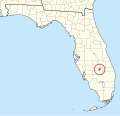 Location of Brighton Reservation
 -
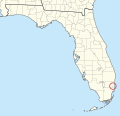 Location of Hollywood Reservation
 -
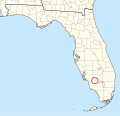 Location of Immokalee Reservation
 -
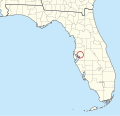 Location of Tampa Reservation
 -
 Location of Fort Pierce Reservation
 -
 Location of Lakeland Trust Lands


_Trust_Land_Locator_Map.svg)
Language
[edit]Most members of the Tribe are bilingual, speaking the Mikasuki language (also spoken by the Miccosukee Tribe) and English. The language has been referred to as a descendant of Hitchiti, a dialect of Hitchiti, and another term for Hitchiti.[2][3][4][5] In the 1970s, all members of the Big Cypress Reservation and most Florida Seminole spoke Mikasuki.[51] Some Florida Seminole communities, notably those on the Brighton Reservation, speak the Florida Seminole Creek dialect of the Mvskoke language.[7][6] Use of both Muskogean languages has declined among younger people.[citation needed]
Culture
[edit]The Seminole continue to observe traditional practices such as the Green Corn Dance. They have two ceremonial grounds within the boundaries of the Big Cypress National Preserve.
In addition, they have created some new celebrations: the Big Shootout at Big Cypress, celebrated since 1997. A few years ago, they added an historical re-enactment to the annual Big Shootout, in which re-enactors take the part of Seminole, Black Seminole and US forces.[52]
In 1956, Betty Mae Tiger Jumper (later to be elected as chairwoman of the tribe) and Alice Osceola established the first tribal newspaper, the Seminole News, which sold for 10 cents a copy. It was dropped after a while, but in 1972 the Alligator Times was established.[53] In 1982, it was renamed the Seminole Tribune, as it continues today. Betty Mae Tiger Jumper became the editor-in-chief. As the tribal storyteller, she contributed oral history and articles about Seminole culture. In 1989, the monthly Seminole Tribune became the first Native American newspaper to win a Robert F. Kennedy Journalism Award and was nominated for a Pulitzer Prize. A member of the Native American Journalists Association, it earned five awards from that organization in 1997.[54]
_P002_crop.jpg)
Libraries
[edit]The Seminole tribal libraries include Billy Osceola Memorial Library in Brighton, Willie Frank Memorial Library in Big Cypress, Dorothy Scott Osceola Memorial Library in Hollywood, and Diane Yzaguirre Memorial Library in Immokalee.[55] The libraries are public, and emphasize material related to the Seminole Tribe and Florida. The libraries feature more than 23,000 titles, periodicals, videos, CD ROMS, photo archives, and tapes. It also includes four decades of news articles related to the Seminole Tribe including an archive of the Seminole Tribune. The Tribal Memorabilia Collection at Ah-Tah-Thi-Ki Seminole Indian Museum is a continually growing collection of many kinds of objects that represent activities and events of the Seminole Tribe of Florida for more than 20 years.[56] The libraries are visited yearly by more than 20,000 people and feature summer programs. Tribal and nontribal individuals use the library as a research center.
The idea of a tribal library originated in the 1940s at the Brighton Day School by William Boehmer and his wife with a book collection at the school. This system was improved on in 1985 with the help of Director of Education Winnifred Tiger and her assistant Patricia Jagiel. A professional librarian by the name of Norman H. Tribbet was hired along with additional staff. The Libraries' collections were updated along with their furnishings. Recently,[when?] the library has made efforts to modernize by updating and automating its systems. Their card catalogues have been automated and an Electric Library has been established where patrons can view thousands of books, magazines, and radio and television transcripts. The Dorothy Scott Osceola Memorial Library located at the Hollywood Reservation was temporarily relocated to other facilities during construction. Both this and the Billy Osceola Memorial Library were built in the late 1990s. After construction, the new building located at the Hollywood Reservation contained all Education programs. The addition at the Brighton Reservation doubled the size of the old library. All services were available at both sites during construction.[57]
In 2021, the libraries received a grant from the Institute of Museum and Library Services in collaboration with the Ah-Tah-Thi-Ki Seminole Indian Museum to decolonize historic narratives and make a historic newspaper collection more accessible to the museum's community.[58]
Florida State University
[edit]Florida State University in Tallahassee uses the Seminole name and imagery for its athletics programs, the Florida State Seminoles.[59] The name was adopted in 1947 after a fan vote; reportedly the new college football team preferred it so much that they stuffed the ballot box in its favor.[60] Since 1978, a student portraying Osceola has been the official symbol at football games.[61]
In the 1980s and 1990s, when mascots based on Native Americans were viewed as controversial, and considered by some to be racially problematic, many Native Americans and supporters protested their use. Florida State consulted with the Seminole Tribe of Florida, emphasizing that their use of the names and Osceola were not intended to be demeaning. Several representatives of the Seminole Tribe, including Chairman James E. Billie and Council Member Max Osceola, have given FSU their blessing to use Osceola and Seminole imagery.[62][63][64] However, the matter remains controversial for other Florida Seminoles, as well as members of the Seminole Tribe of Oklahoma.[65][66] In 2005, FSU was among the schools potentially facing NCAA sanctions for using "abusive and hostile " Native American mascots and names; after much deliberation, the NCAA gave FSU an exemption, citing the university's relationship with the Seminole Tribe of Florida as a major factor.[64][67] Today, both FSU and the Tribe publicly praise their mutually agreeable relationship.[68][69]
In 1996, Carla Gopher was the first member of the Seminole tribe to graduate from FSU.[70]
Tribal chairmen since reorganization
[edit]- 1957–1966:[71] Billy Osceola, inaugural holder.[72]
- 1967–1971: Betty Mae Tiger Jumper, first and only chairwoman of the tribe, editor-in-chief of the Seminole Tribune,[54] tribal communications director,[73] and the last matriarch of the Snake clan. Jumper spoke English, Mikasuki, and Muskogee.[74]
- 1971–1979: Howard Tommie,[75] political leader and two-term chairman of Seminole Tribal Council who initiated programs in the 1970s, including accepting the U.S. land claim settlement; successfully negotiated with the State of Florida for water rights for the Seminole reservations, and establishment of tax-free smoke shops and high-stakes bingo as revenue generators. Tommie speaks English, Mikasuki, and Muskogee.[76]
- 1979–2003: Jim Billie, suspended in 2001, officially removed in 2003.[77] Billie chaired during an expansion of Indian gaming and increase in tribal wealth and economic development.
- 2003[78]–2011:[79] Mitchell Cypress
- 2011–2016:[80] Jim Billie, re-elected and again removed by Seminole Tribal Council in a unanimous vote (4–0) on account of "various issues with policies and procedures of the Chairman's office."
- 2016–present: Marcellus Osceola Jr.
Notable Florida Seminole
[edit]- Abiaka, medicine chief and war chief of the Miccosukee during the Seminole Wars who successfully defied attempts by the Jackson administration to extract native tribes from the Southeastern United States to present-day Oklahoma.
- Jim Billie, longest-serving chief.
- Louise Gopher, first Seminole Tribe of Florida college graduate.
- Betty Mae Tiger Jumper, first female chief.
- Dr. Tomasina Chupco, Ed.D, youngest Seminole to receive a Doctorate.
- Cheyenne Kippenberger, first Seminole woman to be crowned Miss Indian World.
- Micanopy, principal chief from 1825, through the Second Seminole War, until his death in 1849 in Indian Territory.
- Osceola, born William Powell Jr., war chief during the Seminole Wars
- Jim Shore, first Florida Seminole to become a lawyer, now General Counsel of the Tribe,[43] took a major role in land claims negotiations in the late 20th century[81]
- Desoto Tiger, trapper, first Seminole murder victim whose White killer was convicted of murder, although no time was served.
- Susie Jim Billie, traditional maker of medicine and grand matriarch of the Panther clan in her region
Notes
[edit]- ^ Pronounced /ˈhɪʧəˌti/.[2]
- ^ a b Pritzker, page 389.
- ^ a b c Martin, Jack B. (May 24, 2017), "Muskogean Languages", Oxford Research Encyclopedia of Linguistics, doi:10.1093/acrefore/9780199384655.013.39, ISBN 978-0-19-938465-5, retrieved December 4, 2023
- ^ a b Brown, Cecil H. (1998). "Spanish Loanwords in Languages of the Southeastern United States". International Journal of American Linguistics. 64 (2): 148–167. doi:10.1086/466354. ISSN 0020-7071.
- ^ a b Weisman, Brent R. (December 2007). "Nativism, Resistance, and Ethnogenesis of the Florida Seminole Indian Identity". Historical Archaeology. 41 (4): 198–212. doi:10.1007/bf03377302. ISSN 0440-9213. S2CID 53460080.
- ^ a b Hardy, Heather & Janine Scancarelli. (2005). Native Languages of the Southeastern United States, Lincoln, NE: University of Nebraska Press, pp. 69-70
- ^ a b c Mahon, pages 201–202.
- ^ a b Martin, Jack B. (2004). "Southeastern Languages" (PDF). Handbook of North American Indians. 14 (68–86): 15.
- ^ a b Sally Kestin, "FEMA paid tribe's hotel tab", Sun Sentinel, 29 November 2007, accessed 17 April 2013
- ^ Debter, Lauren. "An Alligator Wrestler, A Casino Boss And A $12 Billion Tribe". Forbes. Retrieved July 22, 2024.
- ^ Mahon, pages 183–187.
- ^ Mahon, pages 187–189.
- ^ Frank, Andrew K. (2017). Before the pioneers : Indians, settlers, slaves, and the founding of Miami. Gainesville: University Press of Florida. p. 57. ISBN 9780813054513.
- ^ MacMahon, Darcie A.; Marquardt, William H. (2004). The Calusa and Their Legacy: South Florida People and Their Environments. University Press of Florida. pp. 118–121. ISBN 0-8130-2773-X.
- ^ Mulroy, Kevin. "Seminole Maroons", Handbook of North American Indians: Southeast, Volume 14, ed. William Sturtevant, Smithsonian Institution, 2004
- ^ Alexander Spoehr, Camp, Clan, and Kin among the Cow Creek Seminole of Florida, Field Museum, Anthropological Series, Volume 33, Number 1 (August 2, 1941), pages 9–10.
- ^ a b c Mahon, pages 203–204.
- ^ Pritzker, page 390.
- ^ a b c d e f g h Covington, James W. (1980). "Seminole Leadership: Changing Substance, 1858–1958" (PDF). University of Tampa. pp. 32–34. Retrieved January 15, 2015.
- ^ "History & Culture". National Park Service. Retrieved January 15, 2015.
- ^ "Royal Palm State Park". National Park Service. Retrieved January 15, 2015.
- ^ Jensen, Bob (May 3, 2012). "CCC's work in 1933 Homestead forged the trails for Everglades National Park". South Dade New Leader. Retrieved January 15, 2015.
- ^ Second-Jumper, Sigfried R. (2011). Second Jumper: Searching for His Bloodline. [S.l.]: Lulu Com. pp. 108–109. ISBN 978-1-4357-9099-5. Retrieved January 15, 2015.
- ^ Neill, Wilfred T. (1956). The Story of Florida's Seminole Indians (2d ed.). St. Petersburg, Florida: Great Outdoors. p. 48. ISBN 978-0-8200-1018-2.
{{cite book}}: ISBN / Date incompatibility (help) - ^ a b c d Kersey Jr., Harry A. (July 1993). "The Florida Seminole Land Claims Case, 1950–1990". The Florida Historical Quarterly. 72 (1). Florida Historical Society: 35–55. JSTOR 30148665.
- ^ Kersey, pages 142–146
- ^ a b c d e Patsy West, "A Vote for Destiny", Seminole Tribune', 40th Anniversary Issue, accessed 18 April 2013
- ^ a b c Pritzker, p. 392
- ^ a b Kersey (1996), pp. 118–126
- ^ Gallagher (2004)
- ^ Fixico, pp. 188–191.
- ^ a b "Seminole Tribe of Florida Reservations". www.semtribe.com. Seminole Tribe of Florida. 2013. Retrieved April 16, 2013.
- ^ Adrian Sainz (December 7, 2006). "Seminoles buy Hard Rock cafe". Seattle Post-Intelligencer. seattlepi.com. Retrieved March 20, 2012.
- ^ Clary (2011)
- ^ Swisher, Skyler. "DeSantis signs sweeping gambling deal that may bring sports betting to Florida". sun-sentinel.com. Retrieved May 20, 2021.
- ^ "Florida pari-mutuels, Seminole Tribe reach sports betting agreements". Tampa Bay Times. News Service of Florida. October 28, 2021. Retrieved November 10, 2021.
- ^ "Sports Betting In Florida Struck Down By Federal Court Ruling". Play USA. November 23, 2021. Retrieved March 2, 2022.
- ^ "From Lawsuits To Lobbying, The Latest Updates On Florida Sports Betting". Play USA. November 23, 2021. Retrieved March 2, 2022.
- ^ "Case 1:21-cv-02192-DLF Document 43 Filed 11/22/21" (PDF). www.govinfo.gov. Retrieved April 24, 2022.
- ^ "Florida Online Sports Betting: Seminole Compact and Petitions". www.sportsbetting3.com. April 13, 2022. Retrieved April 24, 2022.
- ^ "Seminole Tribe Appeals Ruling That Blocks Gambling Expansion". miami.cbslocal.com. Retrieved April 24, 2022.
- ^ "Federal government will appeal Florida Gaming Compact ruling". www.floridapolitics.com. January 21, 2022. Retrieved April 24, 2022.
- ^ a b "Red Barn, Glades County, Florida", National Register of Historic Places, National Park Service, accessed 26 December 2011
- ^ a b Justin George, "Seminole Tribe's James Billie recovering from stroke", Tampa Bay Times, 28 February 2012
- ^ "Betty Mae Jumper interview". Seminole Oral History Collection, Samuel Proctor Oral History Program. University of Florida Digital Collections. June 28, 1999. p. 4.
- ^ Peter B. Gallagher, "The Rise and Fall of Chief Jim Billie", Sarasota Magazine, June 2005, at Highbeam, accessed April 17, 2013
- ^ a b Mike Clary (November 26, 2007). "On Fort Pierce Reservation, black mixed Seminoles complain of isolation". South Florida Sun-Sentinel. Archived from the original on May 26, 2013. Retrieved April 15, 2013.
- ^ "Frequently Asked Questions". Seminole Tribe of Florida. Retrieved January 18, 2025.
- ^ Daniel Chang, "Seminole Tribe to Close Park Near Hollywood", Miami Herald, 14 September 2012
- ^ Palmer, Tom (February 13, 2011). "Seminoles Pursue New Reservation in Polk". The Ledger. Lakeland, Florida. Retrieved October 18, 2018.
- ^ "Seminole Tribe of Florida Request for Proposals: RFP 99-2018 Infrastructure Development Phase I, Lakeland Trust Lands" (PDF). Seminole Tribe of Florida. Retrieved October 18, 2018.
- ^ Kersey, p. 118
- ^ Current issue, Seminole Tribune, March 2013
- ^ "About Alligator times. (Hollywood, Fla.) 1972–1983". Chronicling America: Historical American Newspapers. Library of Congress. Retrieved January 27, 2014.
- ^ a b "About Us", The Seminole Tribune, 2013
- ^ Seminole Tribe of Florida.Tribal Library Program
- ^ Ah-Tah-Thi-Ki
- ^ "Seminole Tribal Library System". Digital Collections.
- ^ Institute of Museum and Library Services. Native American/Native Hawaiian Museum Services. Seminole Tribe of Florida. 2021.
- ^ University, Florida State. "Florida State University". www.fsu.edu. Retrieved July 11, 2024.
- ^ King, C. Richard; Charles Fruehling (2001). Team Spirits: The Native American Mascots Controversy. University of Nebraska Press. p. 136. ISBN 978-0803277984. Retrieved April 18, 2013.
- ^ King, C. Richard; Charles Fruehling (2001). Team Spirits: The Native American Mascots Controversy. University of Nebraska Press. p. 142. ISBN 978-0803277984. Retrieved April 18, 2013.
- ^ "Why Florida State, Seminole Tribe stand behind the Seminoles nickname". Tampa Bay Times. Retrieved July 11, 2024.
- ^ King, C. Richard; Charles Fruehling Springwood (2001). Team Spirits: The Native American Mascots Controversy. University of Nebraska Press. pp. 143–145. ISBN 978-0803277984. Retrieved April 18, 2013.
- ^ a b Steve Wieberg (August 23, 2005). "NCAA allowing Florida State to use its Seminole mascot". USA Today. Retrieved March 1, 2013.
- ^ King, C. Richard; Charles Fruehling Springwood (2001). Team Spirits: The Native American Mascots Controversy. University of Nebraska Press. pp. 145–147. ISBN 978-0803277984. Retrieved April 18, 2013.
- ^ Rosier, Paul C. (2003). Native American Issues (Contemporary American Ethnic Issues). Greenwood. p. 14. ISBN 978-0313320026. Retrieved April 18, 2013.
- ^ "Florida State Can Keep Its Seminoles". The New York Times. August 24, 2005. Retrieved April 18, 2013.
- ^ Chuck, Culpepper (December 29, 2014). "Florida State's unusual bond with Seminole Tribe puts mascot debate in a different light". The Washingtonpost.
- ^ "Relationship with the Seminole Tribe of Florida | Messages | University Communications".
- ^ University, Florida State. "Florida State University". www.fsu.edu. Retrieved July 11, 2024.
- ^ Kersey, Harry A. (1996). An assumption of sovereignty : social and political transformation among the Florida Seminoles, 1953–1979. Lincoln [u.a.]: Univ. of Nebraska Press. pp. 118–119. ISBN 978-0-8032-2728-6.
- ^ "Seminole Timeline". Retrieved January 14, 2015.
- ^ Betty Mae Tiger-Jumper and Patsy West, A Seminole Legend, University Press of Florida, 2001
- ^ Kersey (1996), p. 118
- ^ Harry A. Kersey, "Howard Tommie, Seminole", The New Warriors: Native American Leaders Since 1900, ed. R. Edmunds, University of Nebraska Press, 2004, p. 171
- ^ Kersey (1996), pp. 120–126
- ^ Testerman, Jeff (March 19, 2003). "Seminoles sack chairman James Billie". St. Petersburg Times On Line. Retrieved January 14, 2015.
- ^ Fogelson, Raymond D.; Sturtevant, William C., eds. (2004). Handbook of North American Indians, Vol. 14, Southeast. Washington: Smithsonian Inst. p. 445. ISBN 978-0-16-072300-1. Retrieved January 14, 2015.
- ^ "James Billie Once Again Chairman Of Seminole Tribe". CBS Local Media. Associated Press. May 11, 2011. Retrieved January 14, 2015.
- ^ Sweeney, Dan. "Seminole Tribe elects new chairman". Sun-Sentinel.com. Retrieved March 5, 2017.
- ^ Harry A. Kersey, An Assumption of Sovereignty: Social and Political Transformation Among the Florida Seminoles, 1953–1979, U of Nebraska Press, 1996, p. 148
References
[edit]- Clary, Mile (May 10, 2011). "Once ousted, James Billie returns to lead Seminole Tribe". South Florida Sun-Sentinel. Archived from the original on May 26, 2013. Retrieved October 3, 2011.
- Fixico, Donald Lee (2006). American Indians in a Modern World. Rowman Altamira. ISBN 0-7591-1170-7
- Gallagher, Peter B. (October 2004). "The Rise and Fall of Chief Jim Billie". Gulfshore Life. Retrieved October 3, 2011.
- Kersey, Harry A. An Assumption of Sovereignty: Social and Political Transformation Among the Florida Seminoles, 1953–1979, University of Nebraska Press, 1996
- Kersey, Harry A., "Howard Tommie, Seminole", The New Warriors: Native American Leaders Since 1900, ed. R. Edmunds, University of Nebraska Press, 2004
- Mahon, John K.; Brent R. Weisman (1996). "Florida's Seminole and Miccosukee Peoples". In Gannon, Michael (Ed.). The New History of Florida, pp. 183–206. University Press of Florida. ISBN 0-8130-1415-8.
- Mulroy, Kevin. "Seminole Maroons", Handbook of North American Indians: Southeast, Vol. 14, ed. William Sturtevant, Smithsonian Institution, 2004
- Pritzker, Barry (2000) A Native American Encyclopedia: History, Culture, and Peoples. Oxford University Press. ISBN 0-19-513897-X
Further reading
[edit]- National Park Service, Goss, James A. Usual and Customary Use by the Miccosukee and Seminole Indians in Big Cypress National Preserve, Florida, National Park Service, 1995
- Garbarino, Merwyn S. (1972). Big Cypress: A Changing Seminole Community, New York: Holt, Rinehart & Winston.
- Garbarino, Merwyn S. (1988). The Seminole, New York: Chelsea House.
- Hudson, Charles (1976). The Southeastern Indians, Knoxville: University of Tennessee Press.
- McReynolds, Edwin C. (1957). The Seminoles, Norman: University of Oklahoma Press.
- Sturtevant, William C. (1971). "Creek into Seminole." In North American Indians in Historical Perspective, edited by Eleanor B. Leacock and Nancy O. Lurie, 92–128. New York: Random House.
- Sturtevant, William C. (1987). A Seminole Source Book, New York: Garland Publishing.
External links
[edit]
- Seminole Tribe of Florida, official website
- Patricia R. Wickman, "History of the Seminole People of Florida", Seminole Tribune
| International | |
|---|---|
| National | |
| Other | |

Seminole Tribe of Florida
View on GrokipediaOrigins and Early History
Pre-Colonial Roots and Migration
The pre-colonial ancestors of the Seminole people were part of the broader Muskogean-speaking indigenous populations of the southeastern United States, with evidence of human occupation in Florida extending back more than 14,000 years to Paleo-Indian hunter-gatherers who adapted to post-glacial environments through big-game hunting and early coastal resource use.[6] These groups evolved into Archaic and Woodland period societies, characterized by shell middens, pottery, and semi-sedentary villages, before the emergence of Mississippian mound-building cultures around 1000 CE, which influenced agricultural practices like maize cultivation in northern Florida.[7] Muskogean linguistic and cultural stocks predominated among the ancestors, including tribes such as the Apalachee in northwestern Florida, who numbered approximately 8,000 individuals by the early 16th century and constructed platform mounds for chiefly residences and ceremonies while trading deerskins and foodstuffs.[8][9] By the time of initial European contact in 1513, Florida's indigenous landscape featured diverse Muskogean-affiliated groups alongside non-Muskogean peoples like the Timucua and Calusa, but northern and central regions hosted proto-Creekan bands connected through trade networks extending into present-day Georgia and Alabama.[5] These pre-colonial societies maintained matrilineal kinship, clan-based social structures, and animistic spiritual practices centered on natural forces, with subsistence reliant on hunting, fishing, and limited farming in fertile river valleys.[10] Population estimates for Florida's indigenous peoples prior to sustained Spanish missions in the late 1500s ranged from 100,000 to 350,000, though exact figures for Muskogean subgroups remain speculative due to limited archaeological quantification.[7] Early migrations of Muskogean peoples into Florida occurred gradually over centuries before intensive European influence, driven by resource competition, environmental shifts, and inter-tribal conflicts, with small bands moving southward from the Chattahoochee River basin to exploit underutilized wetlands and escape northern pressures.[11] Spanish expeditions and mission systems from the 1600s onward accelerated demographic disruptions through introduced epidemics—smallpox and measles reducing Apalachee numbers by over 90% between 1656 and 1704—and slave raids, creating ecological and territorial vacuums in the peninsula's interior.[12] This set the stage for larger 18th-century influxes of Creek (Muscogee) dissidents from Georgia and Alabama, who fled Yamasee War aftermath in 1715 and British colonial expansion, intermarrying with surviving local Muskogeans like Hitchiti and Mikasuki speakers to form the basis of Seminole ethnogenesis by the 1770s.[3] These migrants, numbering in the low thousands initially, adopted Florida's Everglades-adapted subsistence strategies, including canoe-based travel and chickee hut construction, while retaining core Muskogean linguistic elements.[5]Formation of Seminole Identity Amid Colonial Pressures
The Seminole identity emerged in the early 18th century as diverse groups from the Creek Confederacy, primarily Lower Creek bands speaking Mikasuki and Hitchiti languages, migrated southward into Spanish Florida to evade English colonial expansion, intertribal warfare, and slave-raiding expeditions following the Yamasee War of 1715.[10][12] These migrants, numbering in the hundreds initially, settled in northern Florida among remnants of depopulated Timucua and Apalachee communities, establishing autonomous villages that rejected the hierarchical structure of the broader Creek towns to the north.[13] The term "Seminole," derived from the Creek word simanó-li meaning "runaway" or "wild one," reflected their status as refugees who had broken away, fostering a distinct ethnogenesis marked by cultural adaptation rather than continuity with Creek traditions.[3][10] Spanish colonial policy, which offered asylum to escaped slaves from British plantations as a counter to Anglo-American influence, accelerated population growth and cultural fusion by the 1730s, drawing hundreds of African fugitives who formed semi-autonomous maroon communities allied with Seminole bands.[7][3] These Black Seminoles, often paying annual tribute in crops or livestock for protection, intermarried selectively and shared military strategies against slave catchers, contributing to a decentralized social structure emphasizing village-level matrilineal clans over centralized authority.[10][14] By the British interregnum (1763–1783), when Florida briefly fell under Crown rule, Seminole groups had expanded to an estimated 1,000–2,000 individuals, adopting European-introduced cattle herding and trade networks that bolstered economic independence amid ongoing borderland raids.[15] This period solidified alliances, as Seminoles leveraged British goods like guns and iron while resisting missionary efforts and land concessions, further differentiating their identity through pragmatic autonomy.[7] American independence intensified pressures after 1783, with U.S. settlers encroaching northward and demanding the return of fugitives, prompting Seminole leaders to fortify alliances with Black communities and Spanish authorities in St. Augustine.[3] By the 1790s, the combined Seminole population, including allied maroons, approached 5,000, concentrated in semi-subsistence villages practicing slash-and-burn agriculture and seasonal hunting in Florida's wetlands, which served as natural defenses against incursions.[12] These adaptations—rooted in causal responses to existential threats like plantation expansion and bounty hunters—crystallized a resilient identity centered on territorial sovereignty and martial readiness, evident in early skirmishes such as the 1812–1813 raids by Creek Red Sticks and U.S. forces under Andrew Jackson.[16][10] Unlike their Creek kin, who fragmented under similar pressures, Seminoles maintained cohesion through fluid leadership councils, setting the stage for organized resistance.[13]Seminole Wars and Resistance
First Seminole War (1816–1818)
The First Seminole War arose from cross-border raids by Seminole warriors and their allies, including escaped slaves, into southern Georgia and Alabama settlements, exacerbating U.S. concerns over frontier security and the recovery of fugitive enslaved people whom Seminoles sheltered in northern Florida.[17] These tensions predated formal hostilities, with a pivotal incident occurring on July 27, 1816, when U.S. forces under Colonel Daniel Newnan and Major David E. Twiggs, acting on orders influenced by Major General Andrew Jackson, bombarded the Negro Fort on the Apalachicola River—a British-built stronghold housing approximately 300 Black refugees and Seminole allies.[18] A heated cannonball ignited the fort's magazine, causing an explosion that killed around 250 defenders, mostly women and children, in what marked the deadliest single engagement for Black combatants against U.S. forces up to that point.[19] This event, while not formally part of the war, intensified Seminole grievances and prompted further raids, as the fort had served as a base for marauders disrupting U.S. supply lines and plantations. In December 1817, Jackson assumed command of U.S. troops tasked with suppressing Seminole incursions, receiving vague authorization from Secretary of War John C. Calhoun to pursue hostiles into Spanish Florida if necessary to secure the border.[20] On March 15, 1818, Jackson led an expedition of about 3,000 soldiers, including Tennessee and Georgia militia, allied Creek warriors, and regulars, crossing the Florida line to invade Spanish territory.[17] He swiftly destroyed Mikasuki villages, including the town of Chief Chennabee, and on April 6 captured Fort St. Marks after Seminoles briefly raised a British flag in a ruse that lured two chiefs—Homathlemico and Eneeshaway—into custody, where they were later executed for raids.[17] Jackson's forces then targeted Bowlegs' Town on the Suwannee River, scattering Seminole and Black fighters who offered guerrilla resistance but lacked the numbers and artillery to match the invaders' firepower and mobility. Amid these operations, Jackson arrested British subjects Alexander Arbuthnot, a Scottish trader supplying Seminoles with arms and inciting resistance, on April 7, and Robert Ambrister, a former Royal Marine officer aiding Seminole logistics, on April 18.[20] A military court-martial at St. Marks convicted both on April 29, 1818, sentencing Arbuthnot to hang for fomenting war against the U.S. and Ambrister initially to 50 lashes and a year of labor before Jackson overruled the latter to execution by firing squad, citing their roles in prolonging Seminole hostilities that cost American lives and property.[20] These executions drew international protest from Britain and Spain but underscored Jackson's determination to eliminate foreign interference. By May 24, 1818, Jackson occupied Pensacola after brief resistance from Spanish forces, prompting Governor José Masot's surrender and further diplomatic fallout.[20] The war concluded in June 1818 with Jackson's withdrawal, having destroyed multiple Seminole settlements and displaced survivors southward into central and southern Florida's swamps, where they regrouped under leaders like Chief Boleck.[17] U.S. casualties numbered fewer than 50, while Seminole and allied losses exceeded 200 from combat and village burnings, though exact figures remain imprecise due to the hit-and-run nature of engagements.[17] Spain's inability to control Florida amid these incursions accelerated negotiations, culminating in the Adams-Onís Treaty of February 22, 1819, by which Spain ceded the territory to the United States for $5 million, effectively resolving the immediate border threats but leaving Seminole autonomy intact for the time being.[20]Second Seminole War (1835–1842)
The Second Seminole War erupted from Seminole resistance to U.S. enforcement of the Indian Removal Act of 1830, particularly following the Treaty of Payne's Landing signed on May 9, 1832, by which Seminole delegates agreed to cede their Florida lands for territory west of the Mississippi River in exchange for $15,400 annually for three years, livestock, and other provisions, with relocation to commence within three years.[21] [22] Seminole leaders like Micanopy contested the treaty's legitimacy, claiming it was coerced and did not bind the entire tribe, as only a minority of delegates had participated, fueling widespread opposition to emigration.[17] Hostilities commenced on December 28, 1835, with coordinated Seminole attacks: warriors under Osceola, a prominent sub-chief rather than a hereditary leader, killed U.S. Indian Agent Wiley Thompson and four others outside Fort King, while approximately 180-250 Seminole fighters ambushed Major Francis L. Dade's 110-man column (including three officers and about 100 enlisted men from companies of the 2nd and 4th Infantry Regiments, plus a six-pounder field piece and wagon train) en route from Fort Brooke to Fort King near present-day Bushnell, Florida.[23] [24] [25] The ambush, exploiting dense hammock terrain and Seminole marksmanship with rifles, resulted in 107 U.S. deaths (all but two soldiers and one interpreter), marking the war's bloodiest single engagement for American forces and galvanizing federal mobilization.[24] Seminole strategy emphasized guerrilla warfare, utilizing Florida's swamps, everglades, and chickee camps for mobility and ambushes, often in alliance with free Black Seminoles who provided auxiliary fighters and intelligence; leaders including Osceola, Alligator, and Jumper inflicted attrition through hit-and-run tactics against U.S. columns.[17] Key clashes included the December 31, 1835, Battle of Lake Okeechobee—actually fought on the Kissimmee River—where 800 U.S. troops under Colonel Zachary Taylor engaged 400 Seminoles, suffering 26 killed and 112 wounded in a costly advance through sawgrass, while Seminole losses were estimated at 11 killed and 23 wounded, demonstrating the defenders' effective defensive positions.[26] U.S. commanders, rotating through Winfield Scott, Thomas Jesup, and others, deployed up to 9,000 regular troops, militia, and volunteers but faced logistical failures, tropical diseases like malaria, and supply shortages that caused over 1,500 military deaths, predominantly non-combat.[27] Osceola's influence peaked in 1836-1837, orchestrating raids that disrupted settlements and fortifications, but his capture on October 23, 1837, under a flag of truce during peace negotiations orchestrated by General Jesup—deemed a violation of parley customs—effectively decapitated Seminole leadership; imprisoned at Fort Marion (Castillo de San Marcos), he died of quinsy on January 30, 1838, in Fort Moultrie, South Carolina.[28] [27] The war concluded in August 1842 when General William J. Worth declared an end to major operations after coerced surrenders and deportations of roughly 3,000-4,000 Seminoles to Indian Territory, though 300-500 evaded removal by retreating deeper into the Everglades, preserving a remnant population that endured isolation and formed the core of Florida's independent Seminole bands.[17] The conflict cost the U.S. government approximately $20-40 million and highlighted the limitations of conventional infantry against irregular native forces in subtropical environments.[27]Third Seminole War (1855–1858) and Everglades Survival
The Third Seminole War erupted in late 1855 amid escalating tensions over land surveys in south Florida, where U.S. government efforts to map and allocate territory for white settlement encroached on the remaining Seminole holdings in the Big Cypress Swamp and Everglades. A pivotal incident occurred on December 20, 1855, when Seminole warriors ambushed a U.S. Army surveying party led by Lieutenant George L. Hartsuff near the headwaters of the Miami River, killing five soldiers and wounding others in retaliation for perceived violations of their sovereignty and resources.[29] This skirmish ignited the conflict, driven by the U.S. policy of removing the estimated 75 to 100 Seminole families—totaling around 200 to 500 individuals—who had evaded relocation after the Second Seminole War.[30] Chief Billy Bowlegs (Holata Micco), the primary Seminole leader at the time, directed guerrilla-style operations characterized by hit-and-run raids on military outposts, supply lines, and isolated settlers, leveraging intimate knowledge of the swampy terrain to minimize casualties on their side. U.S. forces, numbering up to 1,000 troops at peak under commanders like Colonel Harvey Brown and later William Harney, mounted punitive expeditions but suffered from disease, flooding, and logistical failures in the hostile environment, resulting in fewer than 25 American deaths and perhaps a dozen Seminole losses over three years.[31] The war's limited scale reflected the diminished Seminole population and their strategic retreat into impenetrable wetlands, contrasting with the more protracted engagements of prior wars.[32] By early 1858, exhaustion and U.S. incentives— including cash payments of up to $6,500 per band for relocation—prompted Bowlegs to negotiate surrender. On May 7, 1858, he and his followers, comprising 38 warriors and approximately 100 women and children, departed Fort Brooke (Tampa) by steamer for Indian Territory (modern Oklahoma), marking the effective end of organized resistance.[31] The U.S. expended over $500,000 on the campaign, achieving removal of most holdouts but failing to eradicate the presence entirely.[33] A remnant of 100 to 400 Seminoles, organized in autonomous family bands under leaders like Chipco and Billie, rejected emigration and dispersed deeper into the Everglades' labyrinthine sawgrass prairies, mangrove thickets, and cypress stands, where federal pursuit proved untenable due to seasonal inundation and navigational hazards.[34] Survival hinged on adaptive subsistence: hunting deer, turkey, and fish with traditional tools; harvesting turtles, coontie roots for flour, and alligators for meat, oil, and hides used in trade or crafting; and constructing elevated chickee huts on hammocks to evade floods and predators.[35] These groups maintained cultural continuity through oral traditions and minimal external contact, periodically raiding farms for crops while avoiding treaties that could mandate further displacement, thus preserving a foothold in Florida for over eight decades of isolation.[5]Federal Relations and Reorganization
Post-War Isolation and Early 20th-Century Challenges
Following the Third Seminole War's end in 1858, approximately 200 Seminoles remained in Florida, retreating deep into the Everglades' uninhabitable interior to evade U.S. military patrols and removal efforts.[17] These survivors, leveraging wartime adaptations to the wetland terrain, established semi-permanent camps of chickee structures elevated on platforms, prioritizing mobility and concealment over permanence.[5] Subsistence centered on hunting deer and small game, fishing in glades and bays, and cultivating corn, beans, and pumpkins in hammock clearings, with occasional trade in hides and plumes sustaining limited external goods.[36] This deliberate isolation, persisting for over four decades, preserved tribal cohesion but precluded federal annuities, rations, or oversight afforded to removed Seminoles in Oklahoma, fostering self-reliance amid vulnerability to environmental fluctuations and sporadic settler incursions.[37] Population estimates remained elusive due to avoidance of enumerators; the 1900 U.S. Census identified 208 Seminoles, distributed across scattered bands in Monroe, Dade, and adjacent counties, a fraction of the pre-war total surpassing 5,000.[38] Early 20th-century challenges mounted as state-led drainage initiatives, expanding post-1905 with federal engineering input, excavated canals that diverted sheetflow, desiccated wetlands, and reduced aquatic habitats critical for fish and wading birds.[39] These alterations, coupled with unregulated non-Indian plume hunters depleting egret rookeries, eroded the viability of traditional pursuits, compelling some bands toward peripheral trading posts for staples.[40] The Seminole economy, reliant on otter pelts, bird plumes, and alligator skins exchanged for ammunition, cloth, and tools, unraveled by the 1910s from habitat loss, market saturation, and federal prohibitions on plume commerce under conservation laws.[41] Resulting destitution manifested in malnutrition and endemic illnesses like tuberculosis, exacerbated by isolation from physicians, though bands rebuffed intrusive government agents—such as Lorenzo Creel's 1911 mission—as threats to sovereignty.[41] Special census schedules in 1900 and 1910 yielded incomplete tallies, reflecting persistent wariness, yet foreshadowed mounting pressures from southward expansion that would necessitate adaptive shifts by the 1920s.[42]Land Claims, Cattle Industry, and Termination Threats
In the post-World War II era, the Seminole Tribe of Florida actively pursued land claims to address historical dispossessions stemming from 19th-century treaties and forced removals. The tribe filed a petition with the Indian Claims Commission in 1948, seeking compensation for approximately 22.3 million acres of ancestral lands ceded under duress, which the commission later valued at over $42 million before offsets.[43] These claims were complicated by ongoing disputes over state-held swamplands and development pressures during Florida's land boom, where Seminole camps were encroached upon by non-Native settlers and developers.[44] Despite federal trusteeship, the tribe maintained an open claim for much of central and south Florida, protesting government interventions that undermined their territorial integrity.[45] Parallel to land advocacy, the Seminoles expanded their cattle industry as a key economic pillar on reservations like Brighton, established in the 1930s specifically to support ranching operations. Cattle herding traced back to the tribe's acquisition of Spanish livestock in the 18th century, with records from 1775 documenting herds of 7,000 to 10,000 on Paynes Prairie alone.[46] By the 1920s, Seminole ranchers formed a cooperative to market beef collectively, leveraging the vast, unfenced prairies of their reservations for open-range practices that persisted into the mid-20th century.[47] This industry not only provided subsistence and trade goods but also asserted practical sovereignty over reservation lands, with the tribe becoming one of Florida's significant beef producers by employing traditional methods alongside modern breeding of breeds like Brangus.[48][49] These developments faced existential peril from the federal Indian termination policy of the 1950s, which aimed to assimilate tribes by ending federal recognition, services, and land protections. In 1953, Seminole leaders were notified that the tribe was slated for termination, threatening dissolution of reservations and exposure of remaining lands—totaling about 132,000 acres—to state taxation and private sale.[50] The policy, framed by Congress as emancipation from federal oversight, was perceived by tribal members as a direct assault on their autonomy, potentially nullifying land claims and dismantling cattle operations reliant on protected grazing areas.[51] Facing impoverishment and cultural erasure, the Seminoles resisted by organizing petitions and elections, ultimately adopting a tribal constitution in 1957 to affirm their viability as a self-governing entity and avert termination.[40] This period underscored the tribe's strategic use of economic self-reliance in cattle and legal persistence in land claims to counter assimilationist threats.Formal Reorganization and Recognition (1957)
In the mid-1950s, the Seminole people in Florida faced federal policies threatening tribal termination, prompting leaders to pursue formal organization to preserve sovereignty and access government services. Community meetings across reservations, including Big Cypress, Brighton, Hollywood, and Dania, facilitated the drafting of a constitution and corporate charter modeled after the Indian Reorganization Act of 1934.[45][3] On July 21, 1957, eligible voters—primarily from the reservations, numbering around 448—approved the documents by a significant majority, establishing the Seminole Tribe of Florida as a federally recognized entity.[3] Ratification occurred on August 21, 1957, creating a dual governance structure: a Tribal Council for political matters, comprising a chairman, vice chairman, and representatives from each reservation, and a Board of Directors for economic affairs, with eight elected members handling corporate powers such as land management and enterprises.[52][45] The constitution defined jurisdiction over trust lands at Dania, Big Cypress, Brighton, Hollywood, and Tampa reservations, emphasizing self-governance while adhering to federal oversight through the Bureau of Indian Affairs.[52] Federal recognition, granted later in 1957 by the Bureau of Indian Affairs, marked the tribe's transition from fragmented, reservation-based communities to a unified political body, enabling negotiations for land claims, health services, and economic development amid ongoing isolation in the Everglades.[53] This reorganization distinguished the Seminole Tribe from the emerging Miccosukee group, who sought separate recognition in 1962, reflecting internal divisions over governance and federal alignment.[54] The structure has endured, with elections held every four years for council positions, providing stability despite early challenges like limited enrollment and resource scarcity.[45]Governance and Sovereignty
Tribal Government Structure
The Seminole Tribe of Florida operates under a constitution ratified on August 21, 1957, which established a sovereign tribal government recognized by the U.S. Congress.[45][55] This framework created a two-tiered structure comprising the Tribal Council as the primary political body and a Board of Directors for economic oversight, with elected representatives ensuring reservation-specific input.[45] The Tribal Council holds ultimate authority over tribal affairs, including negotiation with federal and state entities, land management, ordinance enactment, and fund administration, subject to limited federal oversight via the Secretary of the Interior for certain approvals.[55] The Tribal Council consists of eight members: a Chairman, a Vice-Chairman, and one Council Representative from each of the tribe's six reservations (Big Cypress, Brighton, Hollywood, Immokalee, Tampa, and Fort Pierce). Members must be enrolled tribal citizens aged 21 or older, with reservation representatives required to maintain residency qualifications.[55] Elections occur via secret ballot among qualified tribal voters, originally held biennially under the 1957 bylaws but aligned with four-year terms in practice to stagger leadership transitions.[55] Candidates file declarations supported by petitions from eligible voters, with elections supervised to ensure broad participation, such as requiring at least 30% voter turnout for validity in amendments.[55] The Chairman and Vice-Chairman lead council proceedings, while representatives advocate for their communities' interests. The Council exercises executive, legislative, and judicial functions, overseeing entities like the Seminole Police Department, Human Resources, gaming operations, citrus groves, the Ah-Tah-Thi-Ki Museum, and utilities. In coordination, the Board of Directors manages the Seminole Tribe of Florida, Inc., a federally chartered Section 17 corporation focused on business enterprises such as cattle operations, convenience stores, and expansion projects to promote economic self-sufficiency.[56] The Board's President serves as the Tribal Council's Vice-Chairman, and the Council's Chairman as the Board's Vice-President, linking political governance with commercial activities while maintaining separation for sovereignty and efficiency.[56] Amendments to the constitution require majority voter approval in a tribal election, ratified by the Secretary of the Interior, reflecting the tribe's adaptation to growing reservations and enterprises since 1957.[55]Key Sovereignty Disputes and Legal Victories
The Seminole Tribe of Florida has asserted its sovereignty through protracted legal battles over gaming rights, land claims, and state taxation, often prevailing despite federal constraints on tribal-state negotiations. In Seminole Tribe of Florida v. Florida (1996), the U.S. Supreme Court ruled 5-4 that Congress lacked authority under Article I to abrogate state sovereign immunity via the Indian Gaming Regulatory Act (IGRA), barring tribes from suing reluctant states in federal court to compel compact negotiations for Class III gaming.[57] This decision curtailed tribal leverage nationwide but did not prevent the Seminoles from securing voluntary compacts with Florida, starting with a 2001 agreement that granted exclusivity for certain casino games in exchange for revenue sharing exceeding $1 billion over five years. Subsequent compacts faced challenges testing the Tribe's exclusive rights. A 2010 renewal compact was invalidated by the Florida Supreme Court in 2013 on state constitutional grounds, prompting renegotiation.[58] The Tribe achieved a landmark victory with the 2021 compact, approved by the U.S. Department of the Interior, which authorized sports betting via a server-based "hub-and-spoke" model routed through tribal lands to comply with IGRA's Indian lands requirement.[59] Challenges from rival operators and the Seminole Nation of Oklahoma led to a 2021 district court injunction, but the Eleventh Circuit reversed in June 2023, upholding the compact's validity and the Tribe's statewide sports betting monopoly.[60] The U.S. Supreme Court denied certiorari in June 2024, solidifying the agreement and enabling expanded operations, including mobile betting launched in November 2023.[61] Land sovereignty disputes centered on historical claims and resource rights. Through the Indian Claims Commission established in 1946, the Tribe pursued compensation for pre-1835 land takings, filing docket 90 in 1950 for over 13 million acres ceded under unratified treaties.[43] This culminated in a 1976 award of approximately $47.8 million plus interest for lands lost before the Second Seminole War, offset against prior federal expenditures but enabling land acquisitions.[62] A parallel Everglades water rights suit against Florida and the South Florida Water Management District resolved in 1987 via the Seminole Indian Land Claims Settlement Act, which extinguished aboriginal title claims in exchange for trust status on expanded reservations and a tripartite compact allocating water resources, averting federal litigation under the McCarran Amendment.[63][64] Taxation disputes highlight ongoing tensions over off-reservation commerce. In 2013, the U.S. Supreme Court denied review of a federal appeals ruling requiring the Tribe to pay state fuel taxes on purchases outside reservations, rejecting claims of inherent sovereignty exemption.[65] Conversely, the Tribe upheld sovereign immunity in internal matters, as in a 2016 Florida appellate decision affirming tribal council authority over employment disputes without state jurisdiction.[66] A 2014 federal ruling favored the Tribe against Hendry County, invalidating a zoning change for non-conforming land use near Brighton Reservation, reinforcing federal preemption over tribal territory development.[67] These outcomes have fortified the Tribe's autonomy, channeling gaming revenues—estimated at $3.5 billion annually by 2023—into trust assets exceeding 10 reservations totaling over 70,000 acres.Leadership Succession and Notable Chairmen
The Chairman of the Seminole Tribe of Florida is elected directly by eligible tribal members through a popular vote, with terms typically lasting four years and opportunities for re-election.[68] Elections feature multiple candidates, as in the 2016 contest where Marcellus W. Osceola Jr. won with 38 percent of votes against four competitors, including former Chairman James Billie.[68] The Tribal Council, the tribe's primary governing body, includes the Chairman, a Vice Chairman (also serving as President of the Board of Directors), and one elected representative from each of the five reservations, totaling eight members elected by secret ballot under the tribe's constitution and bylaws.[55][45] Recall mechanisms exist, enabling the council to remove a Chairman for policy or performance issues, as occurred with James Billie in 2001 and 2016 via unanimous 4-0 votes.[69][70] Billy Osceola (1920–1974) served as the inaugural Chairman from 1957 to 1966, leading the tribe immediately after its formal reorganization and federal recognition under a new constitution ratified that year.[71] His tenure focused on establishing governance amid post-termination threats and early economic challenges, including land claims and cattle operations. Betty Mae Tiger Jumper (1923–2011) held the position from 1967 to 1971, becoming the first and only woman elected Chairman; she also founded the Seminole Tribune in 1956, serving as its editor to promote tribal news and culture.[72] James E. Billie chaired the tribe from 1979 to 2001—its longest continuous tenure—and again from 2011 to 2016, initiating high-stakes bingo operations in 1979 that evolved into the multibillion-dollar gaming industry central to tribal sovereignty and revenue.[73] A Vietnam War veteran and former alligator wrestler, Billie emphasized economic self-reliance over federal dependency, though his leadership ended twice via council recalls amid internal disputes.[69] Mitchell Cypress served as Chairman from 2003 to 2011, securing re-election in 2007 by 100 votes over challenger Moses B. Osceola; his administration addressed environmental concerns on reservations and tribal health initiatives, including diabetes advocacy.[74][75] Marcellus W. Osceola Jr., Chairman since his 2017 inauguration following a 2016 special election, has overseen gaming compact negotiations, legal victories against state challenges, and revenue-driven socioeconomic improvements, with re-elections in 2019 and 2023.[76][69]Economic Transformation
Traditional Subsistence and Early Enterprises
Following the Third Seminole War (1855–1858), the surviving Seminoles retreated deep into the Everglades, adapting their subsistence practices to the wetland environment. They cultivated limited crops such as corn, pumpkins, and potatoes on elevated hammocks and tree islands, supplemented by hunting deer, turkey, and small game, as well as fishing in the waterways. Gathering wild plants, including coontie root for starch extraction, provided additional sustenance.[77] Alligator hunting became a cornerstone of their economy in the late 19th century, employing traditional fire-hunting techniques where hunters used burning torches at night to disorient the reptiles before spearing them from canoes. This yielded both meat for consumption and hides for trade, as alligator meat spoiled quickly in the humid climate. Commercial trade in alligator, otter, and bird plumes sustained families into the early 20th century, with hides exchanged at trading posts for goods.[78][10] Early enterprises expanded beyond pure subsistence through craft production and nascent ranching. Seminoles produced and traded items like baskets and clothing, leveraging traditional skills for market exchange. Cattle herding, rooted in pre-war practices acquired from Spanish-introduced livestock in the 16th–18th centuries, saw revival among Florida Seminoles in the early 20th century; by the 1920s, they formed cooperatives to improve herds, establishing operations on purchased lands like the Brighton area. The Bureau of Indian Affairs supported modernization in the 1930s–1940s, providing breeding stock from western tribes and constructing facilities such as the Red Barn on Brighton Reservation in 1941 to process beef, marking a shift toward commercial agriculture.[44][79]Gaming Compact and Casino Expansion
The Seminole Tribe of Florida initiated gaming operations with high-stakes bingo halls in the late 1970s, securing federal court victories that affirmed their rights under pre-IGRA precedents.[80] Following the 1988 Indian Gaming Regulatory Act, which mandated tribal-state compacts for Class III gaming such as slots and table games, the tribe negotiated its first comprehensive compact in 2010 with Governor Charlie Crist.[80] This agreement authorized slots, banked card games, and poker at the tribe's casinos in exchange for annual payments exceeding $200 million to the state, establishing exclusivity for certain games until disputes arose in 2015 over expiring provisions.[80] Subsequent negotiations addressed exclusivity conflicts with Florida's pari-mutuel facilities, leading to payment suspensions in 2015 and 2019.[80] In April 2021, Governor Ron DeSantis approved a 30-year compact that expanded offerings to include craps, roulette, and mobile sports betting conducted exclusively via servers on tribal lands, with geo-fencing to restrict access outside reservations.[81] [80] The deal projected minimum payments of $2.5 billion to the state over the first five years, rising to an estimated $6 billion by 2030, while legal challenges from competitors voided the compact temporarily in 2021 before reinstatement by the D.C. Circuit Court of Appeals in June 2023.[81] [80] These compacts facilitated major casino expansions under the tribe's Hard Rock International brand, acquired in 2007.[82] The Seminole Hard Rock Hotel & Casino Hollywood underwent a $1.5 billion renovation completed in October 2019, featuring a 638-room guitar-shaped tower, expanded gaming floor, and enhanced amenities.[83] Similar upgrades occurred at the Tampa property, including a $700 million project announced in 2018 that added hotel rooms and gaming space.[84] In 2023, the tribe introduced craps and roulette at select locations following compact approvals.[85] Beyond Florida, Seminole Gaming acquired the Mirage in Las Vegas in July 2024 for conversion to Hard Rock Las Vegas, slated to reopen in early 2027 after a three-year renovation.[82] These developments have driven substantial revenue, with the tribe paying Florida at least $650 million annually as of late 2023.[86]Legal Battles Over Gaming Rights
The Seminole Tribe of Florida entered into its first statewide gaming compact with the state in 1989, following the enactment of the Indian Gaming Regulatory Act (IGRA) in 1988, which required tribes and states to negotiate agreements for Class III gaming activities such as slot machines and table games.[58] Disputes arose in the 1990s when the tribe sought to expand operations, leading to Seminole Tribe of Florida v. Florida (1996), in which the U.S. Supreme Court ruled 5-4 that IGRA's provision allowing tribes to sue states in federal court for failing to negotiate in good faith violated state sovereign immunity under the Eleventh Amendment, effectively limiting tribal leverage in compact negotiations unless states consented.[57] This decision shifted dynamics, prompting Florida to engage in voluntary compacts but fostering ongoing tensions over exclusivity and revenue sharing. A major escalation occurred after the 2010 compact, which granted the tribe exclusivity for certain card games and slots in exchange for $225 million annually in payments to the state, but allowed Florida to authorize limited blackjack at non-tribal venues like racetracks.[59] The tribe contended this breached exclusivity provisions, filing suit in 2015; a federal district court ruled in the tribe's favor in November 2016, ordering non-tribal facilities to cease such games, which led to temporary closures and heightened state revenue losses estimated at over $100 million by 2017.[87] The parties settled in July 2017, with Florida agreeing to drop its appeal and the tribe resuming payments, though the compact expired in 2019 amid stalled renegotiations, suspending tribal gaming contributions until a new agreement.[88] The 2021 compact, ratified by the Florida Legislature and signed by Governor Ron DeSantis on May 6, 2021, extended exclusivity for 30 years, including a novel "hub-and-spoke" model for mobile sports betting routed through servers on tribal lands, projected to generate $2.5 billion for the state over five years.[59] Competitors, including West Flagler Associates and Bonita-Fort Myers Corp., challenged it under IGRA, arguing the off-reservation nature of mobile wagers violated federal law requiring Class III gaming on Indian lands; a federal district court invalidated the sports betting provision in November 2021, halting operations.[89] The Eleventh Circuit Court of Appeals reversed this in June 2023, upholding the compact by interpreting Florida law as authorizing the betting mechanism, a decision affirmed when the full court denied rehearing and the U.S. Supreme Court denied certiorari on June 24, 2024.[90] State-level challenges persisted, citing Florida's 2018 Amendment 3, which mandates voter approval for casino expansions; a federal court dismissed these claims in 2023, ruling they did not preempt the compact.[91] In October 2024, the tribe settled with racetrack operators, allowing resumption of mobile betting via Hard Rock Bet app, but a new April 2025 lawsuit by Protect the Constitution LLC in Leon County Circuit Court alleged constitutional violations, prompting Florida's Attorney General to move for dismissal in June 2025 on grounds of sovereign immunity and compact validity.[92][93] As of October 2025, operations continue amid unresolved state litigation, underscoring persistent conflicts between tribal sovereignty, state fiscal interests, and competing gambling entities.[94]Diversification, Revenue, and Socioeconomic Impacts
The Seminole Tribe of Florida has diversified its economy beyond gaming through strategic acquisitions and investments, most notably purchasing Hard Rock International in 2007 for an undisclosed sum, which expanded operations into global hospitality, cafes, and entertainment venues. This acquisition shifted the tribe from regional casino reliance to a broader portfolio including hotels and branded merchandise, with Hard Rock generating significant international revenue streams. Further diversification includes real estate ventures, such as apartment investments initiated around 2020 to create a sovereign wealth fund aimed at long-term financial stability, alongside sustained agriculture like cattle ranching on reservations such as Brighton.[95][96] Gaming revenues dominate the tribe's finances, accounting for over 90% of its budget, with Florida's Seminole casinos netting approximately $2.5 billion annually as of recent estimates. The 2021 gaming compact with the state of Florida secures exclusive rights to certain wagering, providing the tribe with stable income while directing payments to Florida projected at $4.43 billion through the 2028-2029 fiscal year. Hard Rock's expansion, including a $1.1 billion investment in acquiring The Mirage Hotel and Casino operations in Las Vegas in 2022, has bolstered overall earnings, contributing to credit upgrades and recognition as a top-managed company in 2024 and 2025.[4][97][98] Socioeconomic impacts from these revenues have transformed tribal conditions, funding over $1 million annually in education grants, scholarships, and the Ah-Tah-Thi-Ki Museum operations, alongside infrastructure and health programs on reservations. Per capita distributions to enrolled members have raised average household incomes substantially, enabling homeownership and reduced poverty rates, with general studies on tribal gaming showing 26% employment growth and 14% declines in working poverty four years post-casino openings. However, the heavy gaming dependence exposes the tribe to economic volatility from competition or regulatory shifts, as evidenced by past compact disputes, though diversification mitigates some risks by spreading income geographically and sectorally.[99][100]Reservations and Demographics
Reservation Locations and Infrastructure
The Seminole Tribe of Florida maintains six federally recognized reservations spanning diverse geographies across the state, primarily in south and central Florida. These lands, held in trust by the United States, total over 200 square miles and support tribal governance, housing, and community facilities. The reservations were established progressively from the 1930s onward under federal Indian policy, with infrastructure developments including schools, health clinics, housing complexes, and cultural sites funded partly through tribal revenues.[3] Big Cypress Reservation, the largest at approximately 82 square miles, is situated in the Florida Everglades in Hendry and Collier Counties, about 45 miles south of Clewiston. Designated in 1938, it houses around 600 residents and features infrastructure such as the Ah-Tah-Thi-Ki Museum for cultural preservation, a rodeo arena at the Junior Cypress Entertainment Complex, campgrounds, and traditional chickee housing alongside modern residences. The reservation includes wastewater treatment facilities and supports cattle ranching operations.[101][102] Brighton Reservation covers about 36,000 acres (roughly 56 square miles) in Glades County near Lake Okeechobee, established in the 1930s for agricultural use. It emphasizes ranching infrastructure, including grazing lands for cattle, a field station for tribal enterprises, community housing, and basic utilities like water management systems adapted to the wetland environment. The site supports a smaller population focused on traditional herding practices.[103] Hollywood Reservation, located in Broward County adjacent to Fort Lauderdale, spans a smaller urban-adjacent area established in the mid-20th century. Infrastructure includes tribal administrative offices, residential developments, a health center, and proximity to major roadways facilitating commerce; it serves as a hub for denser population needs with modern housing and educational facilities.[104][105] Immokalee Reservation in Collier County near the town of Immokalee provides community infrastructure such as housing for farmworkers, a tribal school branch, and health services tailored to agricultural communities. Tampa Reservation in Hillsborough County supports urban tribal members with residential and administrative buildings. The smallest, Fort Pierce Reservation, established in 1995 on 50 acres of pine forest in St. Lucie County, includes basic housing and community facilities on its limited land base.[3][106][107]| Reservation | County/Location | Approximate Size | Key Infrastructure |
|---|---|---|---|
| Big Cypress | Hendry/Collier (Everglades) | 82 sq mi | Museum, rodeo arena, campgrounds, housing[101] |
| Brighton | Glades (near Okeechobee) | 36,000 acres | Ranching lands, field station, housing[103] |
| Hollywood | Broward (near Fort Lauderdale) | Urban tract | Administrative offices, health center[104] |
| Immokalee | Collier (near Immokalee) | Rural tract | School branch, health services[3] |
| Tampa | Hillsborough | Urban tract | Residential buildings[3] |
| Fort Pierce | St. Lucie | 50 acres | Basic housing, community facilities[106] |