Hubbry Logo
Votive candleVotive candleMain
Open search
Votive candle
Community hub
Votive candle
logo
8 pages, 0 posts
0 subscribers
Be the first to start a discussion here.
Votive candle
Votive candle
from Wikipedia
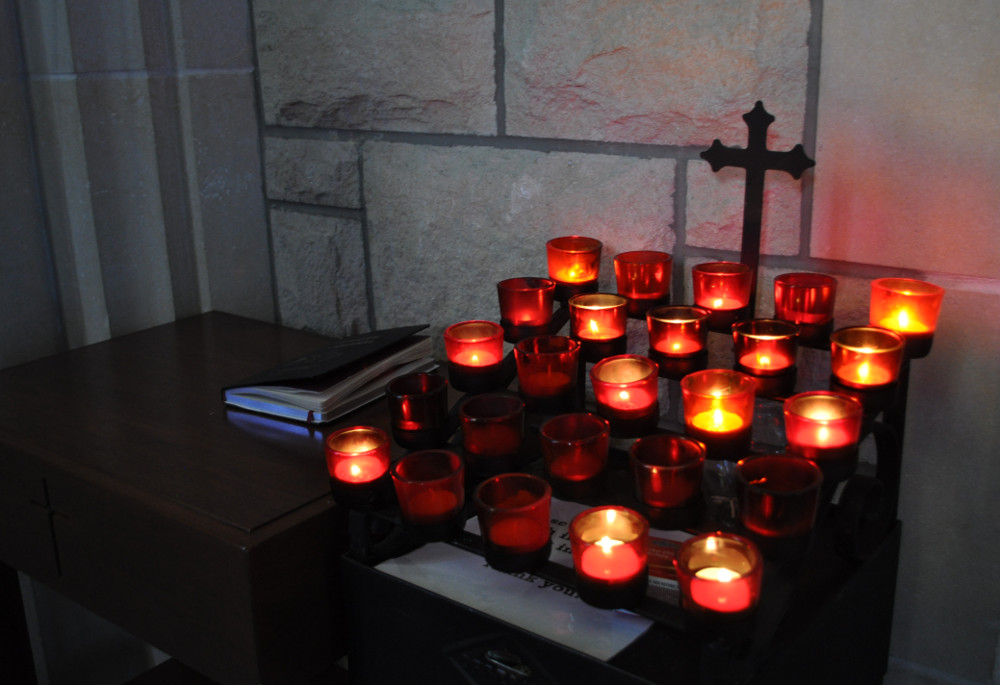
A votive candle rack at Grace Episcopal Cathedral, an Anglican Christian cathedral in Topeka

A votive candle or prayer candle is a small candle, typically white or beeswax yellow, intended to be burnt as a votive offering in an act of Christian prayer, especially within the Anglican, Lutheran, and Roman Catholic Christian denominations, among others.[1][2][3][4] In Christianity, votive candles are commonplace in many churches, as well as home altars, and symbolize the "prayers the worshipper is offering for him or herself, or for other people."[5][3][4] The size of a votive candle is often two inches tall by one and a half inches diameter, although other votive candles can be significantly taller and wider. In other religions, such as Hinduism and Buddhism, similar offerings exist, which include diyas and butter lamps.

Use by Christian denominations

[edit]
Votive candles at a small Roman Catholic Christian grotto in the American state of Texas
Votive candles on sale for Halloween in a United States department store

Candles are lit for prayer intentions. To "light a candle for someone" indicates one's intention to say a prayer for another person, and the candle symbolizes that prayer. Many times, "a board is placed nearby with names of those for whom prayer is requested."[1] A donation box is usually placed near a votive candle rack in order that Christians lighting the votive candles can help defray the cost of votive candles, and make a votive offering to the church.

Eastern Orthodoxy and Oriental Orthodoxy

[edit]
Orthodox churches use long, thin candles, which are placed in round containers.

In the Eastern Orthodox Church, candles are lit before icons, usually of Jesus Christ or the Theotokos. Usually Orthodox churches only use long, thin candles. These are usually placed in round containers, having either various sockets to hold the candles, or in a container filled with sand in which the worshipers place their candles. Orthodox churches will usually have a separate place to put candles lit for the departed; Lutheran, Anglican and Roman Catholic churches make no such distinction.

Catholicism

[edit]

In the Roman Catholic Church, candles are at times placed before a statue of Jesus, of the Blessed Virgin Mary, or of some other saint. Often, in older or traditional churches, this will be before a bye-altar.

A votive candle signifies literally that the lighting is done in fulfillment of a vow (Latin, votum), although in most cases the intention is to give honor and to seek help from the saint before whose images the candle is lit and to pray for the dead.[6]

Candles used may vary from long, taper-type candles to tealight candles. Tealight candles are either placed in holders or just on a platform in front of the statue. Long candles may be placed in a special holder.[7]

Lutheranism

[edit]

Lutheran churches may use votive candles which may be lit at home, as a part of personal or family devotions, or at the church. They are usually lit on the altar rails, or in front of the altar cross. They are also often lit during the liturgy of Good Friday.

Votive candle holder stands before an icon of Christ in a Church of Sweden parish church in Skellefteå, Sweden.

Within the Nordic Lutheran churches of Sweden, Norway, Denmark and Finland, all High Church Lutheran denominations, the use of votive candles is commonplace and most, if not all, churches and chapels will have a votive candle holder (Swedish: Ljusbärare). These are somewhat similar to the Eastern Orthodox type, usually a round metal frame with several sockets surrounding a central, larger candle on which to light the votive candles. As in Eastern Orthodox Churches, Nordic Lutheran votive candles are also long and thin.

Anglicanism

[edit]

Some Anglican churches, especially those that worship in the High Church or Anglo-Catholic tradition, have votive candles for purposes of praying for the dead as well as asking for saintly intercession.

Methodism

[edit]

In the United Methodist Church, those churches which worship in the High Church tradition make use of votive candles. During the liturgical celebration of Allhallowtide, especially on All Saints' Day (All Hallows' Day), votive candles are lit and a prayer is said for each person of the congregation who has died that year.[8]

Reformed

[edit]

In the Reformed tradition (inclusive of the Continental Reformed, Presbyterian, Congregationalist denominations), votive candles are lit during Totensonntag, a holy day that commemorates the faithful departed.

History

[edit]

During all the Middle Ages the burning of lamps, or sometimes candles, before relics, shrines, statues, and other objects of devotion was a form of piety which greatly appealed to the alms of the faithful. Almost every collection of early English wills bears witness to it, and even in the smaller churches the number of such lights founded by private beneficence was often surprisingly great. It not infrequently happened that every guild and association maintained a special light of its own, and, besides these, there were such objects of devotion as the "Jesus light", the "Hok-light" (which seems to have to do with a popular festival kept on the second Monday or Tuesday after Easter Sunday), the "Rood light", the "egg light" (probably maintained by contributions of eggs), the "bachelor's light", the "maiden's light", the "Soul's light", etc. Many of these bequests will be found conveniently illustrated and classified in Leland Duncan and Arthur Hussey's Testamenta Cantiana, London 1906.

Secular adaptations

[edit]

In the 2010s, votive candles have been sold with celebrities or political figures fashioned to look like saints.[9] Some secular subjects of votive candles include Ruth Bader Ginsburg and Jonathan Van Ness.[9] The secular appropriation of votive candles, a religious symbol, has caused controversy. Kim Kardashian faced backlash after selling an $18 votive candle with her face in the likeness of the Virgin Mary.[10] In 2019, Vox wrote that "by replacing a saint with a celebrity that is outright silly (like Steve Buscemi or Harambe the gorilla), you are dismissing the function of the prayer candle altogether." Bill Donohue of the Catholic League said he did not find the candles offensive. "By definition, a celebrity doesn't need a PR presence, so the likely motivating force is narcissism," he says. "By ripping off Catholic iconography, these celebs pay a backhanded compliment to the Catholic Church in their quest for notoriety."[9]

Composition

[edit]

Votive candles are made from different types of waxes including paraffin, soy wax, or beeswax. There are different grades of wax with different melting points. Paraffin is often mixed with other types of waxes, such as beeswax or vegetable wax. This is done to obtain the rigidity necessary for the type of candle being made. The speed at which the candle burns depends on the composition of the wax. A taper candle that sits in a ring-shaped candle holder may have a low melting point and produce little to no oil, whereas a votive candle set in a glass cup may have a very low melting point and turn to oil. Pillar candles, large candles often with multiple wicks, have their own formula. Soy jar candles tend to have a lower melting point than pillars and votive candles. Candle quality also varies widely depending on the candle maker. The aroma of a lighted scented candle is released through the evaporation of the fragrance from the hot wax pool and from the solid candle itself.[citation needed]

Lead wicks are unlikely to be found in any candle sold in the U.S. today: lead-core wicks have been banned from the U.S. since 2003, and members of the National Candle Association – which account for more than 90% of candles made in the U.S. – have not used lead wicks for more than 30 years. Reputable manufacturers use cotton, cotton-paper, zinc-core or tin-core wicks, all of which are known to be safe.[11]

[edit]

See also

[edit]

References

[edit]
[edit]
Revisions and contributorsEdit on WikipediaRead on Wikipedia
from Grokipedia
A votive candle is a small, typically white or yellow wax candle lit as a in Christian devotional practices, symbolizing , sacrifice, and petition to or saints. Similar practices involving candle-like offerings exist in other religions, such as diyas in and butter lamps in . These candles are commonly placed and burned before altars, tabernacles, icons, or statues in churches to represent ongoing intentions, gratitude for , or remembrance of the deceased. The term "votive" derives from the Latin votum, meaning a or , reflecting the act's roots in fulfilling religious pledges. The tradition of votive candles traces back to ancient religious customs, including the perpetual lights mandated in Jewish temples and synagogues to signify God's enduring presence, as described in Exodus 27:20-21 and Leviticus 24:2-4. In pre-Christian Roman paganism, candles were used in religious and military processions to invoke divine aid or favor, a practice that influenced early Christian adaptations. By the AD, lit candles or lamps at martyrs' tombs as acts of , with St. Jerome (d. 420) documenting their use before sacred images and relics in his work Contra Vigilantium. During the , the symbolism deepened: represented Christ's purity, the wick His soul, and the His , while the burning signified personal sacrifice. Votive candles hold particular prominence in Catholicism, where they are lit during Masses, funerals, and personal devotions to honor the or seek , serving as a visible reminder that a prayer intention persists before even after the worshiper departs. In Eastern Orthodox , they form part of ex voto offerings, often alongside icons or shrines, to express vows, , or pleas for , drawing from Byzantine-era practices like animal sacrifices that evolved into simpler symbolic acts. Some Anglican traditions incorporate votive lights in worship for similar purposes, such as illuminating or marking holy seasons like Epiphany. Lutheran traditions also use votive candles in personal devotions, worship services like , and seasonal observances, though generally less emphasized than in Catholic or Orthodox rites. Biblically, their light evokes as "the " (John 8:12), embodying faith, truth, and divine illumination.

Religious Uses

In Christianity

In Catholicism, votive candles are commonly lit before altars, statues of saints, or the to symbolize ongoing intentions and to seek . These candles serve as a visible sign of the faithful's petitions, often accompanied by spoken or silent prayers for personal needs, gratitude, or remembrance of the deceased, with the representing the of Christ entering into God's presence. The practice emphasizes communal solidarity, as the candle burns continuously—ideally until fully consumed—to signify a complete offering of one's devotion, and donations are typically provided to support church maintenance. In and Oriental Orthodoxy, votive candles, often made of to evoke purity, are lit before icons of Jesus Christ, the , or saints during services like or personal devotions, as a of and in divine assistance. This ritual underscores the believer's turning to God and the saints with fervent , with the candle's light fostering a spiritual connection that persists beyond the individual's presence. Placement typically occurs in icon corners or stands within the church, and both individual for private intentions and communal acts during are observed, with the candle allowed to burn out fully to represent enduring . Among Lutheran, Anglican, Methodist, and Reformed traditions, votive candles are used more selectively, often in high-church settings for personal devotions or during services like , placed near altars or memorials to express individual and without the same emphasis on saintly intercession. In these denominations, the focus lies on personal encounters with , such as a candle during morning or remembrance rituals to symbolize inner and commitment, contrasting with Catholic practices by prioritizing direct expression over mediated appeals. Individual lighting prevails, with candles burning to completion in designated stands, though communal use appears in liturgical moments like vigils.

In Other Faiths

In , diyas—small clay oil lamps—are lit as votive offerings during festivals like , symbolizing the invocation of deities such as for prosperity and the dispelling of ignorance through the victory of light over darkness. These lamps are placed before altars or in homes as part of puja rituals, where the flame represents spiritual enlightenment and the removal of obstacles, differing from Christian votive candles by their emphasis on cyclical lighting tied to seasonal celebrations rather than individual, single-use intentions. In , butter lamps filled with or oil are burned before altars or during rituals as offerings to accumulate merit and symbolize the dispelling of , fostering enlightenment and . These lamps, often lit in monasteries or by devotees for the deceased or the ill, highlight wisdom's light overcoming mental afflictions, with practices like the Tsongkhapa Butter Lamp Festival integrating them into meditative gatherings for communal merit-building, in contrast to the more personal, consumptive burning of Christian votives. Judaism features the ner tamid, an eternal light suspended above the synagogue ark, representing God's perpetual presence and divine continuity rather than a temporary votive offering. During , candles on the menorah commemorate the miracle of oil lasting , symbolizing faith's endurance and rededication, while yahrzeit memorial candles are lit in homes or s for remembrance of the deceased, evoking the as God's lamp but typically relit annually rather than burned out in one session like Christian counterparts. In , fire temples maintain eternal flames as sacred symbols of divine purity and wisdom, with devotees offering or other substances to the during rituals for blessings and spiritual alignment. These perpetual fires, tended by priests, underscore fire's role as a divine agent rather than temporary lamps, integrated into daily worship without the single-burn focus of Christian votives. Among indigenous African traditions, such as Yoruba-derived practices, candles are incorporated into ancestral altars for , lit alongside water and offerings to honor forebears, seek guidance, and maintain spiritual connections. These rituals emphasize communal lineage ties and cyclical renewal during life events or festivals, using the candle's light to invoke protection and wisdom from ancestors, distinct from the individualistic petitionary use in . Key distinctions across these faiths include a preference for relit or eternal flames symbolizing enduring divine presence and integration with meditative or holiday cycles, unlike the Christian emphasis on single-use burning to fulfill specific vows.

History

Ancient Origins

The practice of offering light sources as votive dedications has roots in ancient religious customs, including the use of lamps in Mediterranean cultures. By 500 BCE, Roman traditions incorporated early forms, such as tapers made by dipping wicks in or , into religious dedications at shrines, symbolizing vows or promises to deities—hence the term "votive" from the Latin votum, meaning a . In , sanctuaries like received bronze incense burners and figurines as votive deposits during the 5th century BCE, often placed in sacred precincts without intent of retrieval to honor gods such as Apollo, as evidenced by archaeological finds in the Sanctuary of Athena Pronaia. Roman practices involved light-based offerings, such as lamps, at shrines to invoke divine favor, with archaeological evidence from sites like Pompeii's Sanctuary of Apollo revealing votive caches of and other items from the 6th century BCE onward, intentionally buried or positioned to remain undisturbed. By the 1st century CE in the Mediterranean, trade networks supported the production of beeswax candles by Romans, enabling more portable votive lights for shrine use alongside prevalent oil lamps.

Christian Development

Votive candles were used in early Christianity from the 3rd century CE, with Christians adapting pre-existing practices of lamp offerings at martyrs' tombs in catacombs, transforming them into symbolic acts of reverence representing Christ's light and petitions to God. This practice expanded in the 4th century following Emperor Constantine's Edict of Milan in 313 CE, which legalized the faith and allowed public worship in basilicas. During the medieval period from the 8th to 12th centuries, the use of votive candles expanded significantly, particularly through monastic production of high-quality varieties. Monasteries, leveraging their apiaries, revived and scaled beeswax candle-making to supply churches, emphasizing purity as a symbol of divine light over cheaper alternatives. This production supported pilgrimage sites, such as , where pilgrims donated wax or lit candles at shrines like that of as votive offerings for healing or protection. The 14th-century profoundly influenced votive candle practices, as widespread fear of the plague led to heightened intercessory rituals, including increased lighting of candles during processions and at saints' shrines to invoke and protection. Public displays of candles in feast-day celebrations and pleas for deliverance amplified this devotional surge across . The Protestant Reformation in the curtailed ornate votive candle uses in many traditions, viewing them as superstitious or idolatrous when tied to saint veneration, though some Protestant groups retained simplified symbolic lighting for remembrance or illumination in worship. Catholic practices persisted and were reinforced during the to affirm sacramental devotion. In the 19th and 20th centuries, votive candles underwent standardization, with the issuing guidelines emphasizing wax composition—at least 51% for liturgical use—to ensure dignity and symbolism, as outlined in post-Tridentine norms and later Vatican instructions. The enabled through mechanized molding, making affordable glass-enclosed votive candles widespread for safe, sustained burning in churches.

Symbolism and Rituals

Theological Meanings

In , the votive candle's flame primarily symbolizes Christ as the , overcoming spiritual darkness, as articulated in John 8:12: "I am the of the world. Whoever follows me will not walk in darkness, but will have the of life." This imagery draws from the Gospel of John, where represents divine enlightenment, , truth, wisdom, virtue, grace, and the sacred presence emanating from Christ, illuminating the path for believers amid and . The candle's burning embodies an offering of , paralleling the believer's devotion or as it is expended in service to . This act mirrors a personal , where the signifies the soul's willingness to be expended for divine , echoing sacrificial traditions in Scripture and preparing the heart for total dedication. As the candle continues burning after the worshipper departs, it represents the persistence of and , maintaining a spiritual vigil before or the saints on behalf of the offerer. This enduring visually extends the prayer's presence, symbolizing unwavering and the hope that intentions remain active in the divine realm even in absence. Color symbolism enhances these meanings, with white votive candles denoting purity, innocence, joy, and glory, evoking Christ's unblemished light. Red candles, by contrast, signify burning charity, the blood of martyrs, and passionate devotion, linking the flame to themes of sacrifice and fervor in the faith. In Eastern Orthodox traditions, beeswax votive candles underscore natural purity, their unadulterated composition symbolizing Christ's sinless human nature derived from the Virgin Mary and calling believers to a correspondingly pure heart. The wax, produced by virgin bees, represents supple obedience and repentance, with the clear flame evoking the clarity of divine teachings.

Practical Rituals

In , lighting a votive candle typically begins with selecting an unlit candle from a provided supply and using a , taper, or —often available near the stand—to ignite it, either from an existing flame to symbolize shared or directly. Once lit, the candle is placed securely in a holder, such as a cup or sand-filled base, while the individual states a personal intention or offers a silent to accompany the act. This procedure emphasizes reverence, ensuring the flame is steady before stepping away. Placement of votive candles follows established protocols to maintain order and safety in the worship space. In many Catholic churches, candles are arranged in tiered racks or stands near statues of saints or the , allowing multiple offerings to burn simultaneously in communal areas. Anglican churches often provide individual stands or prickets near shrines or the for more personal placement. These arrangements facilitate collective devotion without disrupting the . Votive candles are generally allowed to burn fully to completion, representing the ongoing nature of the or , though in some cases they may be snuffed with a tool if necessary to prevent excess smoke or for practical reasons, rather than blown out to preserve the integrity of the offering. Communal lighting enhances this practice during specific observances, such as on (), when parishioners collectively light candles in remembrance of the deceased, often during or after to invoke s for souls in . Similarly, during the , the community participates in a where individual tapers are lit from the in stages—at the church entrance, midpoint, and altar—fostering shared illumination and unity. Etiquette for votive candles includes offering a suggested , often around $5 though amounts vary by (typically $1 to $10), to support the church's supply of wax and maintenance, though it is not mandatory and the remains valid without it.

Composition and Production

Materials

Votive candles are primarily composed of wax, which forms the core material determining their quality and duration. In Catholic churches, votive candles are mainly made of paraffin wax for its inexpensive and durable properties, often mixed with stearin to improve burning characteristics. Some may include at least 51% to meet requirements for ritual purity in liturgical use. Traditional votive candles often use , a natural substance derived from , valued for its slow-ing properties that allow for extended illumination without excessive or odor. candles can two to three times longer than paraffin equivalents per ounce, providing a steady and minimal emission due to their high and clean . In contrast, modern votive candles frequently employ paraffin wax, a petroleum-based that is inexpensive to produce and widely available, enabling mass manufacturing while maintaining a consistent . Paraffin offers good fragrance retention and even melting but may produce more than natural waxes if not properly formulated. Eco-friendly alternatives include soy wax, derived from soybeans, and palm wax, sourced from , both of which are renewable and biodegradable options that cooler and cleaner than paraffin, reducing environmental impact; however, soy and palm waxes are rare in traditional church use as they are modern options. Soy and palm blends are particularly suited for votives, as they adhere well to containers and minimize frosting on the surface. The wick in a votive candle is essential for regulating the flame and ensuring even consumption. Most contemporary votive wicks are made from or braided , materials that promote a steady, self-trimming without excessive mushrooming or uneven flickering. These natural fibers draw efficiently, contributing to the candle's overall and reliability. Lead-core wicks, once common for rigidity, were banned in by the Consumer Product Safety Commission due to health risks from airborne lead emissions, leading to the widespread adoption of lead-free alternatives. Additives are incorporated into the wax to enhance specific properties, though their use is limited in traditional religious votives to preserve purity. Dyes are added to create colored variants, allowing for visual distinction in rituals or settings, while scents are rarely used in devotional contexts but may appear in secular adaptations for aromatic appeal. Hardeners, such as or Vybar polymers, improve shape retention and opacity, preventing the wax from becoming too soft during prolonged burning and aiding in better scent throw if fragrances are included. Votive candles require specialized holders to contain the liquefied pool, distinguishing them from freestanding types like tapers. Glass cups are the most common, designed to fit standard 2-inch votives and capture all melting for complete utilization, while metal stands provide stability and aesthetic versatility. holders offer superior heat resistance, reducing the risk of cracking or scorching surfaces during extended use. These materials collectively enable votive candles to achieve burn times of 10 to 18 hours, depending on size and wax type, with and soy variants often reaching the upper end due to slower consumption rates. Compared to taper candles, votives produce lower emissions when burned in proper holders, as the contained minimizes drafts and promotes a controlled , enhancing for indoor religious or settings.

Manufacturing

Votive candles are produced through a variety of methods, ranging from traditional artisanal techniques to large-scale industrial processes, ensuring consistency in shape, burn quality, and safety. In artisanal manufacturing, the process begins with melting wax, typically in a double boiler over medium heat to maintain precise temperatures around 185°F (85°C) for paraffin or slightly lower for natural waxes like beeswax. Once melted, optional dyes or fragrances are added and stirred thoroughly to achieve uniform color and scent distribution. The liquid wax is then poured into pre-prepared molds, such as aluminum or silicone forms, which already contain centered wicks secured by pins or clips at the base to prevent shifting during cooling. The molds are allowed to cool at room temperature or in a controlled environment for several hours, allowing the wax to solidify into the characteristic short, cylindrical shape of votive candles, typically 1.5 to 2 inches in diameter and height. After unmolding, excess wax is trimmed from the top, and wicks are cut to approximately 1/4 inch for optimal burning. Industrial production scales these steps using automated systems to meet high-volume demands, particularly for church and retail markets. Modern facilities employ continuous pouring lines where is melted in large vats and dispensed via robotic arms into multi-cavity molds on conveyor belts, enabling simultaneous production of hundreds of units. For some operations, methods form into preliminary shapes before molding, though pouring remains dominant for votives due to their molded profile. These automated lines, often integrated with cooling tunnels and automated trimming stations, have facilitated since the late adaptations of earlier candle-making machinery. Quality control is integral throughout to ensure safety and performance, with tests focusing on burn time, wick alignment, and adherence to standards like ASTM F2417. Manufacturers conduct tests by lighting sample candles for 2-4 hours to measure total burn duration—typically 10-15 hours for standard votives—and verify even melting without tunneling or soot. Wick centering is checked visually and via burn simulations to confirm the wick remains positioned to avoid uneven flames or hazards, as misalignment can cause excessive heat on mold walls. Compliance with ASTM F2417 involves evaluating flame height (not exceeding 3 inches), stability, and secondary ignition risks, with products labeled accordingly for consumer safety. Wax sourcing influences these processes, with paraffin derived from refineries for cost-effective, high-melt-point blends, while beeswax is obtained from apiaries emphasizing ethical practices. Since the early , manufacturers have increasingly shifted to sustainable alternatives like soy or wax from renewable agricultural sources to reduce environmental impact and meet eco-conscious demands. Finished votive candles are packaged in bulk sets, often 72 units per box, with included holders for stable burning in church or settings, facilitating distribution to religious institutions and retail outlets.

Secular and Modern Adaptations

Memorial and Vigil Uses

Votive candles play a significant role in secular funerals and graveside , where they are lit to honor the deceased regardless of background, offering a simple yet poignant way to symbolize life amid loss and provide a shared focal point for mourners. In these settings, attendees or family members often light a single white unscented pillar at the service's outset, representing warmth and reflection, or engage in a where multiple tapers are ignited sequentially to evoke collective emotional connection without requiring verbal participation. Beyond individual memorials, votive candles feature prominently in public candlelight vigils for social causes, emerging as a tool for nonviolent expression and unity since the mid-20th century, including peace demonstrations during the era and responses to global disasters. For instance, annual 9/11 commemorations across the , such as those at Putnam County's Heroes Memorial, involve participants candles to pay to victims and promote resilience, transforming public spaces into sites of communal . Similarly, the International AIDS Candlelight Memorial, observed annually since 1983 in over 100 countries, encourages candles—real or virtual—to remember those lost to and advocate for affected communities, emphasizing global empathy over religious doctrine. In interfaith adaptations, votive candles bridge traditions during remembrances, as seen in the United Kingdom's Holocaust Memorial Day events, where diverse groups light candles to honor the six million Jewish victims and others killed in genocides, combining elements of Jewish practices with broader inclusive rituals. This usage marks a symbolic evolution from votive candles' origins in personal devotion to emblems of collective mourning, frequently employing white variants to signify purity, peace, and enduring hope in the face of tragedy. For safety in large-scale gatherings, modern vigils increasingly incorporate battery-powered LED votive candles, as in 9/11 and AIDS memorials, to replicate the 's flicker without fire risks, ensuring accessibility for families with children or in enclosed venues. This adaptation of religious light symbolism underscores remembrance and in secular contexts.

Commercial and Decorative Applications

In the late , votive candles gained widespread popularity in home decor as affordable accents for creating ambient lighting and cozy atmospheres, often placed in hurricane holders to protect the and enhance visual appeal. Scented varieties, such as those infused with or , became staples in living spaces like mantels and coffee tables, aligning with the era's and wellness trends that emphasized relaxation and sensory comfort. Colored votives, in hues like and for seasonal displays, further integrated into everyday , with annual U.S. candle sales reaching $2 billion by 1998, driven by their versatility in both casual and romantic settings. Commercial production of votive candles has expanded through branded lines from major manufacturers, offering diverse scented and themed options for consumer markets. , a leading producer, markets mini filled votive candles in premium plant-based with wicks, available in over 150 true-to-life scents and designed for up to 10 hours of burn time. These products often feature seasonal themes, such as packs with spiced or evergreen fragrances, packaged in compact containers suitable for gifting or home accents like candlescapes. Beyond traditional lighting, votive candles have adapted to wellness and applications, where scented versions support practices for and stress reduction. Essential oil-infused votives, such as those with lavender or , have been shown to lower anxiety and improve mood by influencing the during focused breathing exercises. In settings, these candles promote relaxation through inhalation effects, with studies indicating benefits like enhanced quality from soy wax variants scented with natural aromas over extended use. This secular shift emphasizes therapeutic outcomes over religious symbolism, making votives a tool for personal routines. The global candle market, including votive variants, has experienced steady growth since 2000, fueled by rising demand for home fragrance products and accessibility. Valued at approximately USD 14.06 billion in , the market is projected to reach USD 20.10 billion by 2030, with a (CAGR) of 6.4% from 2025 onward. channels have accelerated this expansion, growing at a 7.3% CAGR through personalized , while eco-friendly options like votives—renewable and low-emission—have seen a 7.5% CAGR, appealing to environmentally conscious consumers. Innovations in votive candle design include LED electric alternatives that simulate a realistic flickering flame without open fire, prioritizing safety in commercial and event settings. These battery-operated flameless votives, often with timers for 200+ hours of use, eliminate risks like soot or wax spills, making them ideal for rentals in weddings, hotels, and parties where fire hazards are prohibited. Waterproof models further extend their utility to outdoor events, maintaining the decorative warmth of traditional votives while ensuring child- and pet-safe operation.

References

Add your contribution
Related Hubs
User Avatar
No comments yet.