


Community hub
Recent from talks
Contribute something
Nothing was collected or created yet.
Chenopodium
View on Wikipedia | This article needs additional citations for verification. (March 2021) |
| Chenopodium | |
|---|---|

| |
| Chenopodium berlandieri | |
Scientific classification 
| |
| Kingdom: | Plantae |
| Clade: | Tracheophytes |
| Clade: | Angiosperms |
| Clade: | Eudicots |
| Order: | Caryophyllales |
| Family: | Amaranthaceae |
| Subfamily: | Chenopodioideae |
| Tribe: | Atripliceae |
| Genus: | Chenopodium L. (1753) |
| Species[1] | |
|
132; see text | |
| Synonyms[1][2] | |
| |
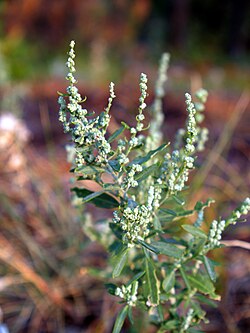
Chenopodium is a genus of numerous species of perennial or annual herbaceous flowering plants known as the goosefoot, which occur almost anywhere in the world.[3] It is placed in the family Amaranthaceae in the APG II system; older classification systems, notably the widely used Cronquist system, separate it and its relatives as Chenopodiaceae,[4] but this leaves the rest of the Amaranthaceae polyphyletic. However, among the Amaranthaceae, the genus Chenopodium is the namesake member of the subfamily Chenopodioideae.[2]
Description
[edit]The species of Chenopodium (s.str., description according to Fuentes et al. 2012)[2] are annual or perennial herbs, shrubs or small trees.[5] They generally rely on alkaline soil.[5] They are nonaromatic, but sometimes fetid (foul-smelling). The young stems and leaves are often densely covered by vesicular globose hairs, thus looking farinose. Characteristically, these trichomes persist, collapsing later and becoming cup-shaped. The branched stems grow erect, ascending, prostrate or scrambling. Lateral branches are alternate (the lowermost ones can be nearly opposite). The alternate or opposite leaves are petiolate. Their thin or slightly fleshy leaf blade is linear, rhombic or triangular-hastate, with entire or dentate or lobed margins.[2]
Inflorescences are standing terminal and lateral. They consist of spicately or paniculately arranged glomerules of flowers. Plants are monoecious (rarely dioecious). In monoecious plants flowers are dimorphic or pistillate. Flowers consist of (4–) 5 perianth segments connate, basally (at the base) or close to the middle, usually membranous margined and with a roundish to keeled back; almost always 5 stamens, and one ovary with 2 stigmas.[2]
In fruit, perianth segments become sometimes coloured, but mostly keep unchanged, somewhat closing over or spreading from the fruit. The pericarp is membranous or sometimes succulent, adherent to or loosely covering the seed. The horizontally oriented seeds are depressed-globular to lenticular, with rounded to subacute margin. The black seed coat is almost smooth to finely striate, rugulose or pitted.[2]
-
 C. album (White goosefoot)
 -

-

-

-
 ʻĀheahea (C. oahuense)
.jpg)


Taxonomy
[edit]The genus Chenopodium was described by Carl Linnaeus in 1753 (In: Species Plantarum, Vol. 1, p. 218–222). Type species is Chenopodium album. This generic name is derived from the particular shape of the leaf, which is similar to a goose's foot: from Greek χήν (chen), "goose" and πούς (pous), "foot" or ποδίον (podion), "little foot".
In its traditional circumscription, Chenopodium comprised about 170 species.[3] Phylogenetic research revealed, that the genus was highly polyphyletic and did not reflect how species were naturally related. Therefore, a new classification was necessary. Mosyakin & Clemants (2002, 2008) separated the glandular species as genus Dysphania (which includes epazote) and Teloxys in tribe Dysphanieae. Fuentes-Bazan et al. (2012) separated many species to genera Blitum (in tribe Anserineae), Chenopodiastrum, Lipandra, and Oxybasis (like Chenopodium in tribe Atripliceae). They included Rhagodia and Einadia in Chenopodium.[2]
Species
[edit]132 species are currently accepted.[1]
- Chenopodium acerifolium Andrz.
- Chenopodium aciculare (Paul G.Wilson) S.Fuentes & Borsch
- Chenopodium acuminatum Willd.
- Chenopodium adpressifolium Pandeya & A.Pandeya
- Chenopodium albescens Small
- Chenopodium album L. – white goosefoot, nickel greens, dungweed, bathua, chandali, chandaliya, fat hen, lamb's quarters, pigweed
- Chenopodium album var. album (synonym Chenopodium strictum Roth)
- Chenopodium allanii Aellen
- Chenopodium atripliciforme Murr
- Chenopodium atrovirens Rydb. – dark goosefoot, pinyon goosefoot
- Chenopodium attenuatum Charit.
- Chenopodium aureum Benet-Pierce – golden goosefoot
- Chenopodium auricomiforme Murr & Thell.
- Chenopodium auricomum Lindl. – Queensland bluebush
- Chenopodium ayare Toro Torr.
- Chenopodium baccatum Labill. (Syn. Rhagodia baccata)
- Chenopodium benthamii Iamonico & Mosyakin (Syn.: Rhagodia latifolia)
- Chenopodium berlandieri Moq. – pitseed goosefoot, southern huauzontle, lambsquarters
- Chenopodium berlandieri var. berlandieri (synonym Chenopodium nuttalliae Saff.) – huauzontle, chia roja, quelit
- Chenopodium betaceum Andrz.
- Chenopodium × binzianum Aellen & Thell.
- Chenopodium × bohemicum F.Dvořák
- Chenopodium × borbasii Murr
- Chenopodium brandegeeae Benet-Pierce – Brandegee's goosefoot
- Chenopodium bryoniifolium Bunge – Korean goosefoot[6]
- Chenopodium candolleanum (Moq.) S.Fuentes & Borsch (Syn.: Rhagodia candolleana)
- Chenopodium carnosulum Moq.
- Chenopodium chaldoranicum Rahimin. & Ghaemm.
- Chenopodium cordobense Aellen
- Chenopodium cornutum (Torr.) Benth. & Hook.f. ex S.Watson
- Chenopodium × covillei Aellen
- Chenopodium crusoeanum Skottsb.
- Chenopodium cuneifolium Vahl
- Chenopodium curvispicatum Paul G.Wilson
- Chenopodium cyanifolium Pandeya, Singhal & A.K.Bhatn.
- Chenopodium cycloides A.Nelson – sandhill goosefoot
- Chenopodium × dadakovae F.Dvořák
- Chenopodium desertorum (J.M.Black) J.M.Black – desert goosefoot
- Chenopodium desiccatum A.Nelson – narrowleaf goosefoot
- Chenopodium detestans Kirk – New Zealand fish-guts plant
- Chenopodium diversifolium (Aellen) F.Dvořák
- Chenopodium drummondii (Moq.) S.Fuentes & Borsch (Syn.: Rhagodia drummondii)
- Chenopodium eastwoodiae Benet-Pierce – Eastwood's goosefoot
- Chenopodium eremaeum (Paul G.Wilson) S.Fuentes & Borsch (Syn.: Rhagodia eremaea)
- Chenopodium erosum R.Br.
- Chenopodium eustriatum F.Dvořák
- Chenopodium × fallax (Aellen) F.Dvořák
- Chenopodium ficifoliiforme F.Dvořák
- Chenopodium ficifolium Sm. – fig-leaved goosefoot, small goosefoot
- Chenopodium flabellifolium Standl. – San Martin Island goosefoot, flabelliform goosefoot
- Chenopodium foggii Wahl – Fogg's goosefoot
- Chenopodium fremontii S.Watson – Fremont's goosefoot
- Chenopodium frutescens C.A.Mey.
- Chenopodium × fursajevii Aellen & Iljin
- Chenopodium gaudichaudianum (Moq.) Paul G.Wilson
- Chenopodium giganteum D.Don (synonym Chenopodium formosanum Koidz.) – tree spinach, red quinoa, djulis
- Chenopodium griseochlorinum F.Dvořák
- Chenopodium grubovii Lomon. & Uotila
- Chenopodium × gruellii Aellen
- Chenopodium harae Sukhor.
- Chenopodium hastatifolium Pandeya & A.Pandeya
- Chenopodium × haywardiae Murr
- Chenopodium hederiforme (Murr) Aellen
- Chenopodium hians Standl.
- Chenopodium hircinum Schrad.
- Chenopodium hoggarense Uotila & C.Chatel.
- Chenopodium howellii Benet-Pierce – Howell's goosefoot
- Chenopodium hubbardii Aellen
- Chenopodium × humiliforme (Murr) F.Dvořák
- Chenopodium iljinii Golosk.
- Chenopodium incanum (S.Watson) A.Heller – mealy goosefoot
- Chenopodium incognitum Wahl
- Chenopodium indicum T.K.Paul
- Chenopodium iranicum (Aellen) Hamdi & Malekloo
- Chenopodium × jedlickae F.Dvořák
- Chenopodium × jehlikii F.Dvořák
- Chenopodium karoi (Murr) Aellen
- Chenopodium khorasanica Hamdi & Malekloo
- Chenopodium lenticulare Aellen
- Chenopodium × leptophylliforme Aellen
- Chenopodium leptophyllum (Moq.) Nutt. ex S.Watson – narrowleaf goosefoot
- Chenopodium × linciense Murr
- Chenopodium lineatum Benet-Pierce – Mono goosefoot
- Chenopodium littoreum Benet-Pierce & M.G.Simpson – coastal goosefoot
- Chenopodium lobodontum H.Scholz
- Chenopodium loureiroi Steud.
- Chenopodium luteorubrum Mandák & Lomon.
- Chenopodium luteum Benet-Pierce – yellow goosefoot
- Chenopodium × mendelii F.Dvořák
- Chenopodium moquinianum Aellen
- Chenopodium mucronatum Thunb.
- Chenopodium neomexicanum Standl. – New Mexico goosefoot
- Chenopodium nesodendron Skottsb.
- Chenopodium nevadense Standl. – Nevada goosefoot
- Chenopodium nitens Benet-Pierce & M.G.Simpson
- Chenopodium nitrariaceum (F.Muell.) F.Muell. ex Benth. – nitre goosefoot
- Chenopodium nitens Benet-Pierce & M.G.Simpson – shiny goosefoot
- Chenopodium novopokrovskyanum (Aellen) Uotila
- Chenopodium nutans (R.Br.) S.Fuentes & Borsch (Syn.: Rhagodia nutans)
- Chenopodium oahuense (Meyen) Aellen – ʻĀheahea (Hawaiʻi)
- Chenopodium obscurum Aellen
- Chenopodium opulifolium Schrad. ex W.D.J.Koch & Ziz – grey goosefoot
- Chenopodium pallescens Standl. – pallid goosefoot
- Chenopodium pallidicaule Aellen – kañiwa, "cañahua"
- Chenopodium palmeri Standl. – Palmer's goosefoot
- Chenopodium pamiricum Iljin
- Chenopodium parabolicum (R.Br.) S.Fuentes & Borsch (Syn.: Rhagodia parabolica)
- Chenopodium × paradoxum Mandák
- Chenopodium parryi Standl. – Parry's goosefoot
- Chenopodium perttii Sukhor.
- Chenopodium petiolare Kunth
- Chenopodium philippianum Aellen
- Chenopodium phillipsianum Aellen
- Chenopodium pilcomayense Aellen
- Chenopodium × podperae F.Dvořák
- Chenopodium polygonoides (Murr) Aellen
- Chenopodium × praeacutum Murr
- Chenopodium pratericola Rydb. – pale goosefoot, desert goosefoot, narrowleaf goosefoot
- Chenopodium preissii (Moq.) Diels (Syn. Rhagodia preissii)
- Chenopodium × preissmannii Murr
- Chenopodium × pseudoleptophyllum Aellen
- Chenopodium × pseudostriatum (Zschacke) Druce
- Chenopodium pueblense H.S.Reed
- Chenopodium quinoa Willd. – quinoa
- Chenopodium × reynieri Ludw. & Aellen
- Chenopodium robertianum Iamonico & Mosyakin (Syn.: Rhagodia hastata)
- Chenopodium ruiz-lealii Aellen
- Chenopodium sanctae-clarae Johow
- Chenopodium sancti-ambrosii Skottsb.
- Chenopodium sandersii Benet-Pierce – Sander's goosefoot
- Chenopodium santoshei Pandeya, Singhal & A.K.Bhatn.
- Chenopodium scabricaule Speg.
- Chenopodium simpsonii Benet-Pierce – Simpson's goosefoot
- Chenopodium × smardae F.Dvořák
- Chenopodium sonorense Benet-Pierce & M.G.Simpson – Sonoran goosefoot
- Chenopodium sosnowskyi Kapeller
- Chenopodium spegazzinii F.Dvořák
- Chenopodium spinescens (R.Br.) S.Fuentes & Borsch (Syn. Rhagodia spinescens)
- Chenopodium standleyanum Aellen – Standley's goosefoot
- Chenopodium stenophyllum (Makino) Koidz.
- Chenopodium striatiforme Murr
- Chenopodium subficifolium (Murr) Druce
- Chenopodium subglabrum (S.Watson) A.Nelson – smooth arid goosefoot, smooth goosefoot
- Chenopodium suecicum Murr – green goosefoot
- Chenopodium × thellungii Murr
- Chenopodium tonkinense Courchet
- Chenopodium triandrum G.Forst. (Syn.: Rhagodia triandra)
- Chenopodium × tridentinum Murr
- Chenopodium × trigonocarpum Aellen
- Chenopodium trigonon Schult. (Syn.: Einadia trigonos)
- Chenopodium twisselmannii Benet-Pierce – Twisselmann's goosefoot, high meadow goosefoot
- Chenopodium ulbrichii Aellen
- Chenopodium ulicinum Gand.
- Chenopodium × unarii F.Dvořák
- Chenopodium × variabile Aellen (C. album × C. berlandieri)
- Chenopodium vulvaria L. – stinking goosefoot, notchweed
- Chenopodium wahlii Benet-Pierce – Wahl's goosefoot
- Chenopodium watsonii A.Nelson – Watson's goosefoot
- Chenopodium wilsonii S.Fuentes, Borsch & Uotila (Syn.: Rhagodia crassifolia)
- Chenopodium × zahnii Murr
- Chenopodium zerovii Iljin
- Chenopodium zoellneri Aellen
Excluded species
[edit]- Blitum (12 species):[2]
- Blitum bonus-henricus – Good King Henry, perennial goosefoot, poor-man's asparagus, Lincolnshire spinach, markery
- Blitum californicum – California goosefoot, Indian lettuce
- Blitum capitatum – strawberry blite, blite goosefoot, strawberry goosefoot, strawberry spinach, Indian paint, Indian ink
- Blitum virgatum (Syn. Chenopodium foliosum) – leafy goosefoot
- Chenopodiastrum (5 species):[2]
- Chenopodiastrum murale – nettle-leaved goosefoot
- Chenopodiastrum simplex – giant seed goosefoot
- Dysphania (about 43 glandular species, as C. botrys, C. carinatum, C. cristatum, C. melanocarpum, C. multifidium, C. pumilio and more)
- Lipandra (one species):[2]
- Lipandra polysperma – many-seeded goosefoot
- Oxybasis (5 species):[2]
- Oxybasis chenopodioides – small red goosefoot, saltmarsh goosefoot
- Oxybasis glauca – oak-leaved goosefoot
- Oxybasis rubra – red goosefoot, coastblite goosefoot
- Oxybasis urbica – upright goosefoot
- Teloxys (one species):
- Teloxys aristata
- Suaeda australis – austral seablite (as C. australe, C. insulare)
Ecology
[edit]Certain species grow in large thickets, providing cover for small animals. Goosefoot foliage is used as food by the caterpillars of certain Lepidoptera.[citation needed] The seeds are eaten by many birds, such as the yellowhammer (Emberiza citrinella) of Europe or the white-winged fairy-wren (Malurus leucopterus) of Australia.[citation needed] Goosefoot pathogens include the positive-sense ssRNA viruses – apple stem grooving virus, sowbane mosaic virus and tobacco necrosis virus.[citation needed]
Uses
[edit]
The genus Chenopodium contains several plants of minor to moderate importance as food crops as leaf vegetables – used like the closely related spinach (Spinacia oleracea) and similar plants called quelite in Mexico – and pseudocereals.[citation needed] These include white goosefoot (C. album), kañiwa (C. pallidicaule) and quinoa (C. quinoa). On the Greek island of Crete, tender shoots and leaves of a species called krouvida (κρουβίδα) or psarovlito (ψαρόβλητο) are eaten by the locals, boiled or steamed.[citation needed] As studied by Bruce D. Smith, Kristen Gremillion and others, goosefoots have a history of culinary use dating back to 4000 BC or earlier, when pitseed goosefoot (C. berlandieri) was a staple crop in the Native American Eastern Agricultural Complex,[citation needed] and when white goosefoot was apparently used by the Ertebølle culture of Europe.[citation needed] Members of the eastern European Yamnaya culture also harvested white goosefoot as an apparent cereal substitute to round out an otherwise mostly meat and dairy diet c. 3500–2500 BC.[7]
There is increased interest in particular in goosefoot seeds today, which are suitable as part of a gluten-free diet.[citation needed] Quinoa oil, extracted from the seeds of C. quinoa, has similar properties, but is superior in quality, to corn oil.[citation needed] Oil of chenopodium is extracted from the seeds of epazote, which is not in this genus anymore.[citation needed] Shagreen leather was produced in the past using the small, hard goosefoot seeds.[citation needed] C. album was one of the main model organisms for the molecular biological study of chlorophyllase.[citation needed]
Goosefoot pollen, in particular of the widespread and usually abundant C. album, is an allergen to many people and a common cause of hay fever.[8] The same species, as well as some others, have seeds which are able to persist for years in the soil seed bank.[citation needed] Many goosefoot species are thus significant weeds, and some have become invasive species.[8]
In Australia, the larger Chenopodium species are among the plants called "bluebushes".[citation needed] According to the 1889 book The Useful Native Plants of Australia, Chenopodium auricomum "is another of the salt-bushes, which, besides being invaluable food for stock, can be eaten by man. All plants of the Natural Order Chenopodiaceae (Salsolacese) are more or less useful in this respect." The book goes on to give the following account from the Journal de la Ferme et des Maisons de campagne:[9]
We have recently gathered an abundant harvest of leaves from two or three plants growing in our garden. These leaves were put into boiling water to blanch them, and they were then cooked as an ordinary dish of spinach, with this difference in favour of the new plant, that there was no occasion to take away the threads which are so disagreeable in chicory, sorrel, and ordinary spinach. We partook of this dish with relish—the flavour—analogous to spinach, had something in it more refined, less grassy in taste. The cultivation is easy: sow the seed in April (October) in a well-manured bed, for the plant is greedy; water it. The leaves may be gathered from the time the plant attains 50 centimetres (say 20 inches) in height. They grow up again quickly. In less than eight days afterwards another gathering may take place, and so on to the end of the year.
Safety
[edit]Sphaeraphides occur in the leaves, stem, pith and mesophloem.[10]
Fossil record
[edit]†Chenopodium wetzleri fossil seeds of the Chattian stage, Oligocene, are known from the Oberleichtersbach Formation in the Rhön Mountains, central Germany.[11]
References
[edit]- ^ a b c Chenopodium L. Plants of the World Online. Retrieved 4 April 2024.
- ^ a b c d e f g h i j k Susy Fuentes-Bazan, Pertti Uotila, Thomas Borsch: A novel phylogeny-based generic classification for Chenopodium sensu lato, and a tribal rearrangement of Chenopodioideae (Chenopodiaceae). In: Willdenowia. Vol. 42, No. 1, 2012, p. 5-24.
- ^ a b Gelin Zhu, Sergei L. Mosyakin & Steven E. Clemants: Chenopodium - In: Wu Zhengyi, Peter H. Raven, Deyuan Hong (Hrsg.): Flora of China. Volume 5: Ulmaceae through Basellaceae. Science Press/Missouri Botanical Garden Press, Beijing/St. Louis 2003, ISBN 1-930723-27-X, p. 378-.
- ^ Chisholm, Hugh, ed. (1911). . Encyclopædia Britannica. Vol. 6 (11th ed.). Cambridge University Press. p. 80.
- ^ a b Taylor, Ronald J. (1994) [1992]. Sagebrush Country: A Wildflower Sanctuary (rev. ed.). Missoula, MT: Mountain Press Pub. Co. p. 64. ISBN 0-87842-280-3. OCLC 25708726.
- ^ English Names for Korean Native Plants (PDF). Pocheon: Korea National Arboretum. 2015. p. 407. ISBN 978-89-97450-98-5. Archived from the original (PDF) on 25 May 2017. Retrieved 24 December 2016 – via Korea Forest Service.
- ^ Anthony, David (2007). The horse, the wheel, and language. Princeton university press. pp. 302–303.
- ^ a b "Amaranthus and Chenopodium". alabamaallergy.com. 2017-10-13. Retrieved 2021-03-03.
- ^ J. H. Maiden (1889). The useful native plants of Australia: Including Tasmania. Turner and Henderson, Sydney. pp. 15–16.
- ^ Gulliver 1864, p. 251.
- ^ The floral change in the tertiary of the Rhön mountains (Germany) by Dieter Hans Mai - Acta Paleobotanica 47(1): 135-143, 2007.
Bibliography
[edit]- Gulliver, George (1864). "Observations on Raphides and other Crystals". The Annals and Magazine of Natural History, Including Zoology, Botany, and Geology. Third Series. 14: 250–252.
Further reading
[edit]- Sukhorukov, Alexander P.; Zhang, Mingli (2013). "Fruit and Seed Anatomy of Chenopodium and Related Genera (Chenopodioideae, Chenopodiaceae/Amaranthaceae): Implications for Evolution and Taxonomy". PLOS ONE. 8 (4) e61906. Bibcode:2013PLoSO...861906S. doi:10.1371/journal.pone.0061906. PMC 3633980. PMID 23626750.
| National | |
|---|---|
| Other | |

Chenopodium
View on GrokipediaDescription and Morphology
General Characteristics
Plants in the genus Chenopodium are primarily annual or perennial herbs, though some species form shrubs or small trees reaching up to 3 meters in height.[10][11] They exhibit a weedy growth habit, often with erect or ascending stems that are branched and range from green to reddish in color.[5] The stems are typically not jointed or armed, and in some cases, they may appear somewhat succulent.[10] Leaves are arranged alternately on the stems, simple in form, and usually petiolate, though sometimes sessile.[5] They measure 2-15 cm in length and are often triangular, lanceolate, or rhombic, with margins that can be entire, toothed, or lobed. The leaf blades vary from thin to thickish, occasionally fleshy, and lack aromatic qualities.[10] A distinguishing feature of Chenopodium species is the frequent presence of a mealy or farinose coating on young stems and leaves, resulting from dense coverings of vesicular globose hairs that collapse into persistent cup-shaped structures at maturity.[10][5] These plants belong to the Amaranthaceae family and typically produce dense inflorescences that contribute to their overall bushy appearance.[5]Reproductive Structures
The flowers of Chenopodium species are typically small, greenish, and hermaphroditic, though rarely unisexual, measuring approximately 1–3 mm in diameter and arranged in dense, spicate or paniculate inflorescences that form terminal or axillary glomerules.[5][12] The perianth consists of (3–)5 free or basally connate tepals that are rounded or keeled on the abaxial surface, lacking petals and sepals as distinct structures; these tepals often enclose the reproductive organs and may persist into fruiting.[5] Inside, there are 1–5 stamens with filiform filaments and versatile anthers, surrounding a superior, unilocular ovary topped by a single style (sometimes absent) and 2(–5) filiform stigmas.[5] Pollination in Chenopodium is primarily anemophilous, with wind facilitating pollen transfer among the inconspicuous flowers, though self-pollination predominates due to their hermaphroditic nature and proximity of anthers to stigmas.[12] Outcrossing occurs at low rates, up to 3% in species like C. album, mediated by wind over short distances of up to 2 m.[12] Fertilization follows standard angiosperm patterns, with pollen grains germinating on the stigmas to form pollen tubes that deliver sperm to the embryo sac; the latter develops via the Polygonum-type pattern, where a single megaspore mother cell undergoes meiosis to produce a functional megaspore that matures into a seven-celled, eight-nucleate embryo sac containing egg cell, synergids, central cell, and antipodals.[13] This process ensures double fertilization, yielding zygote and endosperm formation, though endosperm is often scant and perisperm-dominant in the mature seed.[13] Following fertilization, the ovary develops into a utricle, an indehiscent or irregularly dehiscent dry fruit that encloses a single seed and is often retained within the persistent perianth for protection.[5] The pericarp is thin (5–600 µm), hyaline, and 1–3 layered, sometimes bearing papillae up to 120 µm tall in core Chenopodium sections, with adherence to the seed coat varying from loose to tight.[9] Seeds are typically horizontal (rarely vertical), lens-shaped (lenticular) to subglobose, 1–2 mm in diameter, and colored black, brown-black, or reddish-brown, featuring a crustaceous seed coat (5–150 µm thick) that may exhibit smooth, undulate, or alveolate surface patterns useful for species identification.[5][9] The embryo is annular or horseshoe-shaped (hippocrepiform), surrounding abundant farinaceous perisperm, with an inferior or centrifugal radicle.[5] Reproductive strategies in the genus show variability, particularly in seed heteromorphism observed in species like C. album, where plants produce two seed types—larger, non-dormant brown seeds for immediate germination and smaller, dormant black seeds with enhanced longevity (viable for over 30 years)—allowing adaptation to fluctuating environmental conditions.[12] This polymorphism, combined with facultative selfing and occasional outcrossing, contributes to the genus's ecological success without reliance on asexual seed production.[12]Taxonomy and Classification
Etymology and History
The genus name Chenopodium derives from the Greek words chēn (goose) and pous (foot), referring to the goosefoot-shaped leaves characteristic of many species in the genus.[5] The genus was formally established by Carl Linnaeus in his seminal work Species Plantarum (1753), where he described 22 species under a broad circumscription that included diverse herbaceous plants with farinose or glabrous stems and variable leaf forms. Linnaeus designated Chenopodium album as the type species, setting the foundation for subsequent taxonomic treatments. Early recognition of Chenopodium species appears in ancient Greek literature, such as the 1st-century AD De Materia Medica by Pedanius Dioscorides, who described Chenopodium botrys (known then as botrys) as a honey-yellow, shrub-like plant useful for repelling moths from clothing due to its strong odor. This reflects the long history of the plants' practical uses in Mediterranean cultures. In the 19th and 20th centuries, botanists like Paul Aellen advanced the understanding through detailed monographs, including his 1929 systematic treatment of American Chenopodium species based on extensive herbarium collections. Aellen's work highlighted the genus's morphological variability and initial broad delimitation, which encompassed taxa later recognized as distinct. Key contributions to modern taxonomic revisions have come from Sergei L. Mosyakin and Steven E. Clemants, whose studies in the late 20th and early 21st centuries refined the genus's scope using comparative morphology and early phylogenetic insights.[5]Phylogenetic Relationships
Chenopodium is placed within the subfamily Chenopodioideae of the family Amaranthaceae, as recognized by the Angiosperm Phylogeny Group IV classification system, which merged the former Chenopodiaceae into Amaranthaceae based on molecular evidence. This subfamily encompasses a diverse array of genera, with Chenopodium sensu lato historically including a broad range of taxa that molecular studies have revealed to be polyphyletic. Early phylogenetic analyses, such as those by Kadereit et al. (2010), utilized nuclear ribosomal ITS and chloroplast matK sequences to delineate major clades within Chenopodioideae, highlighting the non-monophyletic nature of the traditional Chenopodium and supporting its division into distinct lineages based on morphological, chemical, and genetic differences. Building on this, Fuentes-Bazán et al. (2012) conducted a comprehensive molecular phylogenetic study using expanded ITS and matK/trnK datasets, confirming polyphyly and proposing a revised generic classification that segregates taxa into genera such as Dysphania (for taxa lacking betalains and characterized by different flavonoid chemistry, primarily in the Americas and Australia) and Blitum (for Eurasian lineages with distinct fruit morphology). These revisions narrowed the circumscription of Chenopodium to a monophyletic core clade centered on Eurasian and North American species with horizontal testa cells and betalain pigmentation. Subsequent updates have reinforced this framework, integrating additional genomic data to refine tribal arrangements within Chenopodioideae. Within Chenopodioideae, Chenopodium in its current sense shows close phylogenetic affinity to genera like Atriplex (tribe Atripliceae) and Beta (subfamily Betoideae, though basal relationships remain somewhat unresolved), as evidenced by chloroplast genome comparisons that place them in neighboring clades supported by shared synapomorphies in seed coat anatomy and floral evolution. However, potential for hybridization, particularly within polyploid complexes like the C. album aggregate, complicates generic and species boundaries, with introgression blurring phylogenetic signals. Ongoing debates in Chenopodium phylogeny center on species delimitation, driven by high phenotypic plasticity in response to environmental factors and evidence of reticulate evolution through hybridization and polyploidy, which challenge traditional morphological classifications and necessitate integrated molecular and cytological approaches for resolution.Accepted Species
The genus Chenopodium comprises approximately 132 accepted species in its current circumscription, primarily annual or short-lived perennial herbs distributed worldwide, with a concentration in temperate and subtropical regions.[14] Among the most notable species is Chenopodium album L., commonly known as lamb's quarters, a widespread annual weed characterized by triangular to lanceolate leaves with toothed margins and farinose (mealy) indumentum on the undersides, native to temperate Eurasia and now cosmopolitan due to human dispersal. Its seeds are black, lenticular, and horizontal, aiding in its identification. Another prominent species is Chenopodium quinoa Willd., an annual crop plant from the Andes with broad, lobed leaves and dense inflorescences of small green flowers, native to regions from Ecuador to northwestern Argentina, where it grows in high-altitude saline or alkaline soils. Chenopodium berlandieri Moq., known as pitseed goosefoot, is a North American annual featuring serrated, evenly lobed leaves and distinctive honeycomb-pitted seeds with a thin testa, occurring in disturbed habitats from southern Canada to Mexico.[15][16][17] Regional endemics include Chenopodium foggii Wahl., a rare annual restricted to eastern North America, from Ontario and Quebec southward to Virginia, inhabiting calcareous woodlands, ledges, and cliff bases on high-pH bedrock, with narrow-ovate leaves and sparse farinose covering. Similarly, Chenopodium standleyanum Aellen, or woodland goosefoot, is native to the eastern and central United States, from Quebec to Florida and west to Texas, favoring shaded, disturbed soils in open woods, thickets, and floodplains, distinguished by its ovate leaves with dentate margins and horizontal, reddish-brown seeds.[18][19] Species delimitation in Chenopodium often relies on seed testa patterns—such as pitted, smooth, or reticulate surfaces—and leaf indumentum variations, including the density and distribution of farinose glands, which provide key diagnostic traits amid morphological variability influenced by environmental factors.[9]Formerly Included Species
Several species formerly placed in Chenopodium have been reclassified into separate genera following phylogenetic studies that revealed distinct evolutionary lineages within the traditional broad concept of the genus. A prominent segregate is Dysphania, which comprises aromatic, glandular species such as D. ambrosioides (previously Chenopodium ambrosioides), noted for their volatile oils and vesicular leaf hairs that distinguish them from core Chenopodium.[20] These traits, combined with molecular data from plastid trnL-F and matK genes plus nuclear ITS regions, support Dysphania as a monophyletic group sister to Chenopodium sensu stricto. The genus Blitum was reinstated for taxa like B. capitatum (formerly Chenopodium capitatum) and B. bonus-henricus (formerly Chenopodium bonus-henricus), characterized by compact inflorescences and smooth, horizontal seed testa, differing from the vertical orientation in Chenopodium.[9] Phylogenetic analyses positioned Blitum in a clade distant from core Chenopodium, justified by both genetic divergence and fruit anatomy. Species such as Oxybasis rubra (previously Chenopodium rubrum) were transferred to Oxybasis, a genus defined by dimorphic fruits, open perianth at maturity, and a basal position in the Chenopodium alliance per molecular evidence.[20] These segregations, primarily from a 2012 study, reduced the size of Chenopodium from around 250 species in the sensu lato sense to approximately 130 accepted species today, enhancing monophyly and aligning taxonomy with evolutionary relationships.[14] Regional treatments, including updates in the Flora of North America, have incorporated these changes, reassigning former Chenopodium taxa to genera like Dysphania and Blitum.[21]Distribution and Ecology
Global Distribution
The genus Chenopodium is cosmopolitan in its native distribution, occurring primarily in temperate and subtropical zones across Eurasia, the Americas, Africa, and Oceania. It is native to a vast array of regions, including North America (from Alaska to Mexico), Europe (from Albania to Ukraine), Africa (from Algeria to Zimbabwe), Asia (from Afghanistan to Japan), and South America (from Bolivia to Chile), with approximately 130 species documented worldwide.[14][9] The origins of the genus trace back to Eurasia and the Americas, where phylogenetic studies indicate early diversification in these areas, supported by haplotype diversity patterns in key species aggregates.[22][23] Centers of species diversity include the Andean region of South America and parts of Eurasia, such as the Mediterranean Basin, where environmental conditions have fostered endemic speciation and adaptation.[24][25] Biogeographic patterns reveal a Holarctic influence, with significant radiation in northern temperate zones and subsequent southward extensions into subtropical areas. Approximately 34 species are recorded in North America, reflecting this pattern, though the total rises when including broader continental tallies. Dispersal has been facilitated by lightweight seeds adapted for wind and animal transport, as well as extensive human-mediated movement through trade and agriculture, enabling the genus to colonize diverse landscapes.[5][22] The genus has been widely introduced outside its native ranges, particularly as weeds in Australia, parts of Africa, and temperate North America, where species like C. album have become invasive in agricultural fields and disturbed sites. Introduced populations are documented in 35 additional regions, including the Caribbean (e.g., Bahamas, Cuba), northern Europe (e.g., Finland, Iceland), and Pacific islands (e.g., New Caledonia).[25][14] Recent studies from 2024–2025 indicate ongoing range expansions, particularly into urban areas, driven by climate change-induced shifts in temperature and precipitation that favor ruderal species tolerance. For instance, a 2025 study predicts contractions in highly suitable areas for C. hybridum in China, with expansions into arid and high-altitude regions under future climate scenarios. Modeling also predicts northward and urbanward shifts for species like C. hybridum in Asia, with similar patterns observed in North American and European contexts.[26][27][28]Habitat Preferences
Species of the genus Chenopodium predominantly occupy disturbed habitats, including roadsides, agricultural fields, waste areas, and other human-modified sites, where they exhibit a ruderal life strategy characterized by rapid growth in open, sunny environments.[12][29] This adaptability allows them to thrive in nutrient-enriched conditions, particularly as nitrophilous plants favoring eutrophic soils high in nitrogen, often resulting from agricultural runoff or organic waste.[12] For instance, C. album is commonly found in such nitrogen-rich, disturbed locales across temperate regions.[30] The genus demonstrates broad tolerance to challenging soil conditions, including saline, alkaline, and compacted substrates, enabling colonization of marginal sites like salt marshes and alkaline flats.[12] Climate preferences span temperate to arid zones, with many species enduring drought through a farinose (mealy) leaf covering that reduces transpiration and water loss.[12] Some taxa extend to specialized microhabitats, such as wetlands or coastal dunes, though the majority favor well-drained, open areas; C. quinoa, for example, persists in high-altitude arid Andean environments.[12] In human-influenced ecosystems, Chenopodium species are prevalent in agroecosystems, often as archaeophytes—plants introduced pre-1500 AD and now naturalized in crop fields and settlements.[31] C. album, a classic archaeophyte in Europe and beyond, exemplifies this by colonizing arable lands and ruderal zones near human activity, reflecting its historical association with early agriculture.[31][30]Ecological Role and Interactions
Species in the genus Chenopodium serve as important food sources for various wildlife, including birds, mammals, and insects. The seeds of Chenopodium album, commonly known as lamb's quarters, are consumed by songbirds and small mammals, providing a nutrient-rich resource in disturbed habitats.[6] Leaves and foliage support herbivorous insects, such as the caterpillars of several moth species, including skippers, which feed on the foliage during their larval stage.[32] Additionally, the pollen from Chenopodium species acts as an allergen, contributing to interactions in ecosystems where it affects sensitive organisms, though primarily noted in human contexts; its protein structure, such as the Che a 1 allergen in C. album, highlights its biochemical role in plant-insect dynamics.[33] Chenopodium species function as hosts for several plant pathogens, facilitating the spread of viruses that impact agricultural ecosystems. For instance, C. album serves as a reservoir for Beet western yellows virus (BWYV), a polerovirus transmitted by aphids, which can infect nearby crops like lettuce and sugar beet, leading to yield reductions.[34] Similarly, Chenopodium spp. are natural hosts for Sowbane mosaic virus (SoMV), a sobemovirus that primarily affects chenopods but can vector to other plants via mechanical means or insects, exacerbating disease cycles in weed-crop interfaces.[35] In terms of competition and invasion, Chenopodium exhibits allelopathic effects through the release of biochemical compounds from its tissues, inhibiting the growth of neighboring plants. Extracts from C. album significantly reduce shoot biomass and nutrient uptake in species like tomatoes, demonstrating its role in suppressing competitors via leachates and root exudates.[36] As a pioneer species, C. album thrives in early successional stages on disturbed soils, rapidly colonizing bare areas and facilitating soil stabilization before giving way to later seral communities. The genus influences biodiversity variably across regions. In agroecosystems, Chenopodium supports pollinators by providing pollen resources, attracting bees and other insects that contribute to crop pollination services, as seen in studies of weed-pollinator interactions.[37] However, as an invasive weed in non-native areas, it can reduce native plant diversity by outcompeting local flora through dense stands and allelopathy, altering community composition in grasslands and fields.[38]Uses and Cultivation
Culinary and Nutritional Uses
Several species of Chenopodium are valued for their edible parts, particularly C. album (lamb's quarters), whose tender leaves and shoots serve as a nutritious potherb similar to spinach. These leaves are consumed raw in salads or smoothies and cooked by steaming, sautéing, or adding to soups and curries, providing a source of essential nutrients including proteins (3.7–5.0% fresh weight), vitamins A (11,000 IU/100 g) and C (80–155 mg/100 g), and minerals such as calcium (98.70–178.75 mg/100 g fresh weight) and iron (255 mg/100 g dry weight).[39] C. quinoa (quinoa) is another prominent edible species, with its seeds functioning as a pseudocereal that is naturally gluten-free and rich in high-quality protein (13.81–21.9% of dry weight, containing all essential amino acids), dietary fiber (~6%), and minerals like iron (5.2 mg/100 g) and magnesium (170–270 mg/100 g).[40][41] Historically, Chenopodium species have been dietary staples in the Americas. In South America, C. quinoa was cultivated for approximately 7,000 years and revered as the "mother grain" by pre-Columbian Inca and Tiahuanaco cultures, forming a key component of diets in the Andean highlands alongside maize and potatoes.[40] In North America, C. berlandieri (pitseed goosefoot) was part of the Eastern Agricultural Complex, domesticated around 3,000 years ago and harvested as early as 8,500 years before present for its seeds and leaves, supporting sedentary indigenous communities.[42][43] Today, C. quinoa remains widely cultivated in the Andes, particularly in Bolivia and Peru, where it sustains local populations and contributes to global food security. Global production reached approximately 147,000 metric tons in 2024, with ongoing expansion into new regions like North America and Europe.[40][44] Nutritionally, Chenopodium species offer a balanced profile with bioactive compounds. The seeds and leaves of C. quinoa are rich in omega-3 fatty acids (such as alpha-linolenic acid) and antioxidants like betalains, which exhibit high free radical scavenging activity as measured by FRAP, ABTS, and ORAC assays.[45] Similarly, C. album contains significant omega-3 fatty acids (45.33% of total fatty acids), enhancing its functional value in diets.[39] These species also provide fiber and minerals that support digestion and mineral intake, though antinutrients like saponins in C. quinoa seeds impart bitterness and are reduced through traditional processing methods such as washing, abrading, or cooking.[46] In culinary applications, Chenopodium parts are versatile and incorporated into diverse preparations. C. quinoa seeds are boiled for soups, ground into gluten-free flours for breads and porridges, or used in salads, while C. album leaves feature in fermented dishes like idli and dosa or dehydrated forms added to dals and flatbreads at 3–15% levels.[39][41] Underutilized species, such as C. ficifolium, hold potential in indigenous diets of regions like Manipur, India, where they contribute to nutritional diversity through leaf consumption, though they remain largely unexplored for broader food applications.[47]Medicinal and Traditional Uses
Chenopodium species have been employed in traditional medicine across various cultures for their purported therapeutic properties, particularly in treating parasitic infections and inflammatory conditions. Formerly classified as Chenopodium ambrosioides (now Dysphania ambrosioides), the plant has been widely used as a vermifuge to expel intestinal parasites such as roundworms and hookworms, with decoctions of leaves and seeds administered orally in Central American and African folk practices.[48][49] Leaves of Chenopodium species, including C. album, are applied as poultices for anti-inflammatory effects against skin irritations, wounds, and joint pain in indigenous remedies from South Asia and the Americas.[50][51] Phytochemical analyses reveal that flavonoids and saponins in Chenopodium contribute to its antimicrobial and antioxidant activities, inhibiting bacterial pathogens like Staphylococcus aureus and scavenging free radicals in vitro.[52][53] Extracts from C. quinoa demonstrate anti-diabetic potential by lowering blood glucose levels and improving insulin sensitivity in streptozotocin-induced diabetic rat models, attributed to polysaccharide fractions that modulate gut microbiota.[54][55] Recent pharmacological research as of 2025 highlights bioactive peptides derived from C. quinoa proteins, which exhibit antihypertensive effects in preclinical studies through gut microbiome modulation.[56][57] In ethnomedicinal traditions of India and Africa, C. album infusions are used to alleviate digestive issues such as dysentery, abdominal pain, and constipation, with saponin-rich preparations acting as mild laxatives and stomachics.[50][58] Culturally, Chenopodium species hold significance beyond medicine, serving as famine foods during scarcity in historical North American and European subsistence economies, where seeds provided essential nutrition.[59] In Andean rituals, C. quinoa features in ceremonial preparations like qarasiña, symbolizing cultural heritage and community bonding.[60] Jamaican folklore employs D. ambrosioides leaves in spiritual practices to ward off malevolent spirits, underscoring its role in holistic healing traditions.[61]Agricultural and Other Uses
Chenopodium quinoa, commonly known as quinoa, serves as a major grain crop cultivated primarily in the Andean region, with global production reaching approximately 147,000 metric tons in 2024. This pseudocereal is valued for its adaptability to marginal soils and harsh climates, enabling expansion into new areas like North America and Europe for sustainable agriculture. Varieties are grown for both grain and dual-purpose uses, including forage, contributing to diversified farming systems.[44] Certain Chenopodium species, including C. quinoa, function as cover crops to enhance soil health by suppressing weeds, reducing erosion, and improving nutrient cycling through associations with nitrogen-fixing rhizosphere bacteria such as Bacillus strains. These microbial partnerships facilitate nitrogen availability in nutrient-poor soils, promoting overall soil fertility without relying on synthetic fertilizers. For instance, in the Peruvian Altiplano, integrating Chenopodium with legume cover crops has demonstrated significant erosion reduction and yield improvements.[62][63][64] Industrial applications of Chenopodium biomass include its use as green manure, where post-harvest residues are incorporated into soil to boost organic matter and nutrient retention. While seeds have been explored for biofuel potential due to their high oil content, practical implementation remains limited; instead, pericarp waste from processing is utilized in biosorption processes to remove industrial dyes from wastewater.[65][66] Some Chenopodium species, such as C. giganteum with its red-flushed stems and C. rubrum, are cultivated as ornamental plants for their colorful foliage in gardens. Additionally, C. album acts as a soil bioindicator for heavy metal contamination, accumulating metals like cadmium and lead, which signals polluted sites for remediation efforts.[67][68] In agricultural settings, Chenopodium species pose challenges as weeds, particularly C. album, which exhibits resistance to herbicides like atrazine due to mutations in the psbA chloroplast gene. This resistance, first documented in the 1970s, complicates weed management in crops such as maize and soybeans, necessitating integrated strategies like crop rotation and alternative herbicides.[69][70]Safety and Toxicity Concerns
Chenopodium species, particularly C. album and C. quinoa, contain antinutritional compounds such as oxalic acid and nitrates in their leaves, which can pose health risks when consumed in excess. Oxalic acid levels in raw C. album leaves range from 360 to 2,000 mg per 100 g fresh weight, potentially interfering with calcium absorption and contributing to kidney stone formation in susceptible individuals. Nitrates, present at 3–5% dry weight primarily in stems, may accumulate to levels that exacerbate these risks if leaves from nitrate-rich soils are not properly prepared. Saponins impart bitterness and can cause gastrointestinal upset, including diarrhea, upon excessive intake due to their irritant effects on the intestinal mucosa.[39][71][72] Allergenic potential is another concern, with pollen from wind-pollinated Chenopodium species serving as a significant trigger for hay fever and allergic rhinitis. Exposure to C. album pollen, which disperses widely during late summer and autumn, commonly induces symptoms such as sneezing, nasal congestion, itchy eyes, and coughing in sensitized individuals. Additionally, calcium oxalate crystals (including druse forms) in the plant tissues can irritate skin and mucous membranes upon direct contact, leading to localized inflammation or discomfort, though this is less pronounced than in raphide-containing species.[73][74][75] To mitigate these risks, preparation methods like boiling or leaching are recommended to reduce antinutrient levels. Boiling C. album leaves for 2 minutes leaches out soluble oxalates, decreasing total content by about 39% and soluble forms by 43%, while also lowering nitrates and saponins through thermal degradation and water extraction. Washing and cooking seeds similarly diminishes saponin bitterness and gastrointestinal irritancy. Pregnant individuals should avoid consumption of certain species, such as C. ambrosioides (epazote), due to its emmenagogue properties that may stimulate uterine contractions and pose miscarriage risks; moderation is advised for all Chenopodium uses during pregnancy.[76][39][77] Recent 2025 research highlights progress in developing low-toxicity cultivars, particularly for C. quinoa, with studies identifying genotypes exhibiting reduced cadmium accumulation suitable for expanded, safer cultivation. Thermal processing techniques evaluated in these works further confirm that antinutritional factors remain within safe limits post-preparation, supporting broader agricultural applications.[78][79]Evolutionary History and Fossil Record
Fossil Evidence
Fossil records of Chenopodium extend back to the Eocene epoch, primarily consisting of pollen grains preserved in sedimentary deposits across Europe and Asia. The earliest known occurrences include pollen from the middle Eocene of Germany, spanning from approximately 48 to 38 million years ago, as documented in palynological analyses of European floras.[80] Similar pollen grains have been identified in middle Eocene to early Oligocene sediments from the Tibet region of China, contributing to evidence of the genus's presence in early Tertiary palynofloras.[81] These microfossils indicate that Chenopodium or closely related chenopod taxa were part of diverse Eocene vegetation, often in subtropical to temperate settings. Macroremains, such as seeds and fruits, appear in the fossil record during the late Oligocene to Miocene. Chenopodium-like seeds, measuring about 0.7 mm in length, have been reported from lower Miocene deposits (23.3–16 million years ago) in southern Germany, resembling modern seeds of the subgenus Chenopodium.[82] These carpological fossils provide key calibration points for phylogenetic studies, suggesting early diversification within the genus during the early Miocene in Eurasia. Preservation of Chenopodium fossils is favored in anoxic lake sediments, where pollen, seeds, and fruits are commonly found due to rapid burial and minimal decay in fine-grained deposits. Such occurrences, from Eocene lake beds in Europe to Miocene sites in North America, highlight the genus's association with wetland margins and disturbed soils as an ancient weed or pioneer plant.[83]Evolutionary Significance
The genus Chenopodium likely originated through divergence within the subfamily Chenopodioideae during the Eocene epoch, following the post-Cretaceous expansion of open habitats after the K-Pg boundary mass extinction event around 66 million years ago. This period marked a shift toward disturbed and arid-adapted environments, facilitating the radiation of early chenopods from ancestral lineages in the broader Amaranthaceae family, whose common ancestor dates to approximately 60.8 million years ago in the Paleocene. Within Chenopodioideae, the split from other subfamilies occurred around 30.3 million years ago in the Oligocene, aligning with global cooling and the initial aridification trends that favored halophytic and weedy growth forms.[84][84][85] Diversification of Chenopodium accelerated during the Oligocene-Miocene transition, driven by intensifying aridification across continents, which promoted speciation in saline and disturbed soils. The crown age of the genus is estimated at about 9.1 million years ago in the Miocene, coinciding with widespread drought events that expanded ecological niches for drought-tolerant lineages. Hybridization and polyploidization events further propelled this radiation, serving as key mechanisms for speciation; for instance, allotetraploid formation in complexes like C. album aggregate involved interspecific crosses that generated novel genetic combinations and adaptive traits. Multiple independent origins of C4 photosynthesis within Chenopodioideae, dating to 15-21 million years ago, enhanced photosynthetic efficiency in arid settings and contributed to the subfamily's overall success, though Chenopodium itself remains predominantly C3.[84][86][87][88] In modern contexts, weediness in Chenopodium represents a derived evolutionary trait, emerging from ancestral adaptations to disturbance and enabling invasive success in agroecosystems worldwide. This trait underscores the genus's resilience but highlights conservation challenges for underutilized species like C. quinoa, which possess climate-adaptive qualities such as salinity and drought tolerance amid ongoing global change. Efforts to conserve these species are increasingly vital, as their genetic diversity could bolster food security in warming, aridifying regions.[89][90] Significant gaps persist in understanding Chenopodium's evolutionary timeline, particularly due to limited molecular clock calibrations that integrate fossil and genomic data across the genus. Recent advances, such as the 2025 genome assembly of C. ficifolium using PacBio HiFi sequencing, are beginning to address these by providing a diploid model for allotetraploid relatives like quinoa and elucidating hybridization histories.[91]References
- https://en.wiktionary.org/wiki/Chenopodium