


Community hub
Recent from talks
Contribute something
Nothing was collected or created yet.
Hadhramaut
View on Wikipedia
Hadhramaut[note 1] (Arabic: حَضْرَمَوْت, romanized: Ḥaḍramawt ⓘ; Hadrami Arabic: حَضْرَمُوت, romanized: Ḥaḍramūt ⓘ) is a geographic region in the southern part of the Arabian Peninsula which includes the Yemeni governorates of Hadhramaut, Shabwah and Mahrah, Dhofar in southwestern Oman, and Sharurah in the Najran Province of Saudi Arabia, and sometimes the Aden, Abyan and Lahij governorates of Yemen at a more stretched historical definition. The region's people are known as the Hadharem. They formerly spoke Hadramautic, an old South Arabian language, but they now predominantly speak the Hadhrami dialect of Arabic.
Key Information


.jpg)


.jpg)


Though the origins of the name are unknown, the name Hadhramaut is traditionally explained as a compound word meaning "death has come" or "court of death," derived either from the Arabic ḥaḍara ("he came") plus mawt ("death"), a folk nickname for Amer bin Qahtan, the region's legendary first settler, or from the Biblical Hebrew ḥaṣar ("court" or "dwelling") plus māweṯ ("death") as seen in Hazarmaveth. The name is of ancient origin and is reflected in the name of the modern-day Yemeni governorate of Hadhramaut.
The boundaries of Hadhramaut stretches from the Empty Quarter desert in the north down through its Wadi Hadhramaut and its coastal plain on the Arabian Sea, historically spanning from modern-day Aden in the west across Dhofar to the east but today spans Yemen's Shabwah from the west and Oman's Dhofar to the east. The region once comprised the Qu'aiti and Kathiri sultanates whose lands now form the Hadhramaut governorate, with tribal Hadhrami towns clustered around oasis wells in the wadis, where they farm wheat, millet, dates, coconuts and coffee, while Bedouin herders graze flocks on the plateau. Physically, the region divides into Inner Hadhramaut,centered on the main wadi and its tributaries, and Coastal Hadhramaut, a narrow plain backed by the steep Jowl escarpment rising to about 1,370 m; to the north the highland plateau (Haḍbat Ḥaḍramawt) slopes down sharply into the Empty Quarter, creating a transition from lush valley to arid desert.
Toponymy
[edit]The origins of the name Ḥaḍramawt is disputed, and numerous debated hypotheses regarding its meaning exist. The most popular folk etymology is that the word comes from a nickname of Amer bin Qahtan, who is thought to be the first person to dwell in the region, meaning "death has come", from the words in Arabic: حَضَر, romanized: ḥaḍara, lit. 'he came' and Arabic: مَوْت, romanized: mawt, lit. 'death'.[2][3] Another theory is that it is a variant of the name of Islamic prophet Hud[a] who was sent to this region or his last words "Ludara al-mawt," meaning "death has come."[4]
The name Ḥaḍramawt has also been found within Biblical Hazarmaveth.[note 2] The name means "court of death" and is composed of two parts: Hebrew: חֲצַרְ, romanized: ḥaṣar, lit. 'dwelling; court' and Hebrew: מָוֶת māweṯ "death".[7] There, Hud was the descendant of ʿĀd, son of Joktan,[b] the purported ancestor and progenitor of the South Arabian kingdoms. According to tradition, the family of ʿĀd was the first to settle in the region, and when the sons of ʿĀd had died, Amer bin Qahtan, nicknamed "Hadhramaut", came to power.[4]
Though the origins of the name are unknown, there are several scholarly proposals. Kamal Salibi says that the diphthong "-aw" is an incorrect vocalisation, noting that "-ūt" is a frequent ending for place names in the Ḥaḍramawt; given that "Ḥaḍramūt" is the colloquial pronunciation of the name, and also its ancient pronunciation, the correct reading of the name would thus be "place of ḥḍrm". Salibi proposes, then, that the name means "the green place", which is appropriate given its well-irrigated wadis, giving a lushness that contrasts with the surrounding high desert plateau.[8]
Variations of the name are attested to as early as the middle of the 1st millennium BC. The names ḥḍrmt (𐩢𐩳𐩧𐩣𐩩) and ḥḍrmwt (𐩢𐩳𐩧𐩣𐩥𐩩) are found in texts of the Old South Arabian languages (Ḥaḍramitic, Minaic, Qatabanic and Sabaic), though the second form is not found in any known Ḥaḍramitic inscriptions.[9] In either form, the word itself can be a toponym, a tribal name, or the name of the kingdom of Ḥaḍramawt. In the late fourth or early 3rd century BC, Theophrastus gives the name Άδρραμύτα,[10] a direct transcription of the Semitic name into Greek.
History
[edit]| Part of a series on the |
| History of Yemen |
|---|
 Yemen portal Yemen portal |

.jpg)


Prehistory
[edit]The earliest human activities in the region date from the Middle Palaeolithic, with the local population using a Levallois technique for flake preparation until the appearance of tools produced by a desert-dwelling pre-agricultural population. From this latter period, or perhaps the succeeding one, can be dated several megalithic structures, large stone circles, and four dolmen-like strictures whose inner surfaces were decorated with repetitive rows of pecked meander or crenellated design.[11]
Ancient
[edit]
The Kingdom of Hadhramaut was established in the early 1st millennium BCE.[12] Its capital was Shabwa, not far from the city of Teman (the capital of the Kingdom of Qataban),[13] a tribal federation consisting of several tribes united by their common veneration of the lunar god Sin. Hadhramaut became independent from Sheba in c. 330 BCE.[14] Hadhramaut and its god Sin are mentioned in the inscription of Surwah by the Makrib Sabean writer Karib'il Watar I around 700–680 BCE.
The Kingdom, led by King Shahr-al-Khuraymat, allied with the Minaeans and the Kingdom of Qataban and became independent from the Kingdom of Sheba around 330 BCE, during which the Himyarite dynasty ruled the Kingdom of Sheba.[15][16] The relationship between the Kingdom of Hadhramaut and the Himyarite Kingdom remained tense, with both sides waging wars against each other for control of the trade routes and territory in the region.[17] Early Islamic authors believed the nomadic Kinda tribe that founded a kingdom in central Arabia were originally from Hadhramaut, although distinct from the settled Hadhrami population.[18]

The Hadhrami are referred to as "Chatramotitai" in ancient Greek texts. Hadhramautic texts come later than Sabaean ones, and some Sabaean texts from Hadhramaut are known. Greek, Latin, Sabaean and Hadhramautic texts preserve the names of many kings of Hadhramaut, but there is as yet no definitive chronology of their reigns. Their capital was Shabwa in the northwest corner of the kingdom, along the Incense trade route. Eratosthenes called it a metropolis. It was an important cult centre as well. At first, the religion was South Arabian polytheism, distinguished by the worship of the Babylonian moon god Sin. By the sixth century, the monotheistic cult of Rahmanan was followed in the local temple.[18]
The political history of Hadhramaut is not easy to piece together. Numerous wars involving Hadhramaut are referenced in Sabaean texts. From their inscriptions, the Hadhrami are known to have fortified Libna (now Qalat)[citation needed] against Himyar and to have fortified mwyt (Ḥiṣn al-Ghurāb حِصْن ٱلْغُرَاب) against the Kingdom of Aksum in the period following the death of Dhū Nuwās.[14] The kingdom ceased to exist by the end of the 3rd century CE, having been annexed by the Himyarite Kingdom. Hadhramaut continued to be used in the full titulature of the kings of Sabaʾ and Dhu Raydān (Himyar).[18]
In the 2nd century CE, Hadhramaut was known for its frankincense and myrrh trade.[19] The incense trade route (southern incense route) that passed through the southern part of Hadhramaut helped the region flourish economically and culturally.[20] The Kingdom of Hadhramaut played a significant role in connecting the cultures of Arabia, Mesopotamia, East Africa, and the Roman Empire.[21]
Middle Ages
[edit]Islamic
[edit].png)
.jpg)
Islam reached Hadhramaut in c. 630 after Islamic prophet Muhammad sent Wael bin Hajar as a da'i to the region.[14] The tribes of the region and the ancient aristocracy initially resisted the religion for a considerable period with the city of Tarim being the only adopter of the religion. Nevertheless, companions of Muhammad like Miqdad ibn Aswad and Islamic military leaders like Qaisabah ibn Kalthum were from the region.[22][23]
In the 11th century, the Hadhramaut region came under the rule of the Mahdids, who were of Banu Hadhrami origin.[24]: 237 They established the Qasimi dynasty, which ruled the region for several centuries.[24]: 239
was reportedly from Hadhramaut. Several prophets before them are believed to have dwelt here, including Hud of ʿĀd. He is thought to be buried at Qabr Hud.[25][26]
Portuguese and Ottoman Influence
[edit]In the 16th century, the Portuguese arrived in Hadhramaut and established several settlements along the southern coast. However, their influence was short-lived as the Yemeni Imams managed to drive them out by the 17th century.[27]: 115 Subsequently, Hadhramaut came under Ottoman influence, and the Ottomans maintained control over the region until the early 20th century.[27]: 114
Modern
[edit]Sultanates and the British rule
[edit]

The Qu'aiti sultans ruled the vast majority of Hadramaut, under a loose British protectorate, the Aden Protectorate, from 1882 to 1967, when the Hadhramaut was annexed by South Yemen. The Qu'aiti dynasty was founded by Umar bin Awadh al-Qu'aiti, a Yafa'i tribesman whose wealth and influence as hereditary Jemadar of the Nizam of Hyderabad's armed forces enabled him to establish the Qu'aiti dynasty in the latter half of the 19th century, winning British recognition of his paramount status in the region in 1882. The British Government and the traditional and scholarly sultan Ali bin Salah signed a treaty in 1937, appointing the British government as "advisors" in Hadhramaut. The British exiled him to Aden in 1945, but the Protectorate lasted until 1967.[citation needed]
Communist rule
[edit]In 1967, the former states of the British Aden Protectorate became an independent Communist state, the People's Democratic Republic of Yemen. South Yemen was united with North Yemen in 1990 as the Republic of Yemen.[28]
Contemporary Yemen
[edit]The capital and largest city of Hadhramaut is the port Mukalla. Mukalla had a 1994 population of 122,400 and a 2003 population of 174,700, while the port city of Ash Shihr has grown from 48,600 to 69,400 in the same time. One of the more historically important cities in the region is Tarim. An important locus of Islamic learning, it is estimated to contain the highest concentration of descendants of Muhammad anywhere in the world.[29]
Geography
[edit].jpg)
Political geography
[edit]The borders of Hadhramaut have varied over time to include the territory between Aden and Dhofar, but it always included the Wadi Hadhramaut, the lands between the Wadi and the coast, and the desert region of the Empty Quarter north of the Wadi.[30] This encompasses the current governorates of Hadramaut and Mahra in their entirety as well as parts of the Shabwah Governorate.[31][30] The current governorate of Hadhramaut roughly incorporates the former territory of the two sultanates.[30]
The Hadharem live in densely built towns centered on traditional watering stations along the wadis. Hadharem harvest crops of wheat and millet, tend date palm and coconut groves, and grow some coffee. On the plateau, Bedouins tend sheep and goats. Society is still highly tribal, with the old Seyyid aristocracy, descended from the Islamic prophet Muhammad, traditionally educated, strict in their Islamic observance, and highly respected in religious and secular affairs.[32]
Physical geography
[edit]
Hadhramaut is geographically divided into Inner Hadhramaut (Hadrami Arabic: حضرموت الداخل) which is made up of Wadi Hadhramaut, smaller tributary wadis south from the main wadi, and Coastal Hadhramaut (Hadrami Arabic: حضرموت الساحل)[32] which consists of a narrow, arid coastal plain bounded by the steep escarpment of a broad plateau locally known as the Jowl (Hadrami Arabic: ٱلْجَوْل, romanized: al-Jawl, averaging 1,370 m (4,490 ft)).[33] The undefined northern edge of Hadhramaut slopes down to the desert of the Empty Quarter, where the Hadhramaut Plateau or Highlands (Arabic: هَضْبَة حَضْرَمَوْت, romanized: Haḍbat Ḥaḍramawt) meets the Gulf of Aden in the Arabian Sea, elevation abruptly decreases.[34]
-
 Shibam in Wadi Hadhramaut, with mountains in the background
 -
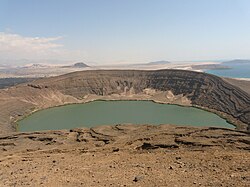


Inner Hadhramaut
[edit]Mountains
[edit]The Hadhramaut Mountains (Arabic: جِبَال حَضْرَمَوْت, romanized: Jibāl Ḥaḍramawt),[35] also known as the "Mahrat Mountains"[36] (Arabic: جِبَال ٱلْمَهْرَة, romanized: Jibāl Al-Mahrah), are a mountain range in Yemen.[37] They are contiguous with the Omani Dhofar Mountains to the northeast,[34] and James Canton considered Aden in the southwest to be in the mountains' recesses.[38]
Wadis
[edit].jpg)
Wadi Hadhramaut (Arabic: وادي حضرموت) is the main wadi in the region, which has 16 tributary wadis, which are:[1]
| Southern plateau | Northern plateau |
|---|---|
| Wadi Dahr | Wadi Hanin |
| Wadi Rahyah | Wadi Sad |
| Wadi 'Amd | Wadi Na'am |
| Wadi Dawan | Wadi Ja'imah |
| Wadi al'Ain | Wadi Thabi |
| Wadi Manoob bin Ali | Wadi al-Jon |
| Wadi 'Adim | |
| Wadi 'Aynat | |
| Wadi Tena | |
| Wadi Sena |
Desert
[edit]![[icon]](https://en.wikipedia.org/wiki/File:Wiki_letter_w_cropped.svg) | This section is empty. You can help by adding to it. (November 2024) |
Coastal Hadhramaut
[edit] | This section is empty. You can help by adding to it. (November 2024) |
Economy
[edit]
Historically, Hadhramaut was known for being a major producer of frankincense, which in the early 20th century was mainly exported to Mumbai in India.[39]: 84 The region has also produced senna and coconut. Farming and fishing are other economic activities in the region, where 5.8% of Yemen's total agriculture comes from the Hadhramaut Governorate alone. Key agricultural products from this region include dates and various grains. Additionally, the fishing sector serves as a primary economic resource for the local population, benefiting from a lengthy coastline along the Arabian Sea that is rich in diverse fish and marine life.[14]
The governorate's lands also hold mineral resources, notably oil and gold, further enhancing its economic significance.[14] Currently, Hadhramaut produces approximately 260,000 barrels of oil per day; one of the most productive fields is Al Maseelah in the strip (14), which was discovered in 1993. The Yemeni government is keen to develop its oil fields to increase oil production to increase national wealth in response to the requirements of economic and social development in the country. Oil contributes 30–40% of the nation's GDP, over 70% of total state revenues, and more than 90% of the value of the country's exports.[39]: 85
Oil and gas
[edit]A Soviet discovery in the southern governorate of Shabwah has proven only marginally successful even when taken over by a different group. A Western consortium began exporting oil from Masila in the Hadhramaut in 1993, and production there reached 67,000 m3/d (420,000 bbl/d) in 1999. There are new finds in the Jannah (formerly known as the Joint Oil Exploration Area) and east Shabwah blocks. Yemen's oil exports in 1995 earned about US$1 billion. Yemen's offshore oil and gas deposits are estimated to contain billions of barrels of oil and gas. Marib oil contains associated natural gas. In September 1995, the Yemeni Government signed an agreement that designated TotalEnergies of France to be the lead company for a project for the export of liquefied natural gas (LNG). In 1997, Yemen Gas Company joined with various privately held companies to establish Yemen LNG (YLNG).

In August 2005, the government gave final approval to three LNG supply agreements, enabling YLNG to award a $2 billion contract to an international consortium to build the country's first liquefaction plant at Balhaf on the Arabian Sea coast. The project is a $3.7 billion investment over 25 years, producing approximately 6.7 million tons of LNG annually, with shipments likely to go to the United States and South Korea. Production of LNG began in October 2009. The Yemen government expects the LNG project to add $350 million to its budget and enable it to develop a petrochemicals industry.[40]
Hadramout produces approximately 258.8 thousand barrels per day.[41] One of the prominent oil fields is the Masila Basin Sector (14), discovered in 1993. The Yemeni government is committed to developing its oil fields to increase oil production, aiming to enhance national wealth in response to the country's economic and social development needs. Oil contributes between 30% and 40% of the gross domestic product (GDP) value and represents more than 70% of the total general budget revenues of the state. Moreover, it constitutes more than 90% of the country's export value.[42]
Culture
[edit]Music and dance
[edit]Hadhrami Music is one of the five main Yemeni musical genres or "colours" (alwan). It is native to the Hadhramaut region and regarded as one of the most prominent forms of Arabic music. Its unique maqamat are widely employed by composers and musicians throughout the Arabian Peninsula. It compasses vocal performances in the Hadhrami Arabic dialect and features melodic phrases and a characteristic humming-style known as the Dan.
Hadhramaut's strategic location along the ancient incense road has shaped a unique musical tradition. Indian and African musical elements have intermingled with indigenous forms over time.[43] Besides, It has been deeply influenced by Sufism.[44]
The region is renowned for its vast array of over four hundred distinct rhythmic patterns that vary by locality. These rhythms are closely tied to daily activities and special occasions—from planting and fishing to wedding celebrations. A key musical form in the region is al-Dan, a fixed melodic structure in which the melody precedes the lyrics; in contrast, in other songs, the lyrics typically come before the melody.[45] Steps have been taken by the Yemeni government to include the Dan art on UNESCO Intangible Cultural Heritage, Cultural authorities in Yemen have already received initial approval from UNESCO to consider its inclusion.[46]
Numerous art critics note that the Hadhrami Dan has played a pivotal role in shaping vocal traditions throughout the Arab world, particularly within the Gulf region. This distinctive musical form is regarded as a foundational element for many singing schools, with contemporary artists continuing to draw inspiration from its rich heritage and folkloric melodies.[47]
The Hadhrami Dan has spread to the Arabian Gulf through the migration of Hadhrami musicians who settled in Gulf countries. Over time, local musicians integrated the Hadhrami Dan and other forms of the Dan and other Hadhrami musical forms into their own repertoires.[44][48] Furthermore, Hadhrami music has significantly influenced the cultural landscapes of regions beyond the Arabian Peninsula, notably in parts of Africa and East Asia.[49][50]
Several Hadhrami influential musicians and poets played an important role in shaping Hadhrami and the wider Arabian music. Abu Bakr Salem Belfkih (1932–2017), for example, modernised al-Dân songs by incorporating contemporary musical instruments, while poets such as Haddad al-Kaff (1910–1970) and Hussein al-Mihdhar (1932–2000) enriched the tradition with their lyrics. Additionally, Mohammed Juma Khan (1903–1963) is celebrated as a pioneer who blended his Punjabi musical influences with local traditions.[45]
Moreover, several prominent non-Hadhrami Arab musicians have also embraced Hadhrami styles. These include Kuwaiti singer Abdallah Al Rowaished; Saudi singers Abdul Majeed Abdullah and Abdel Rab Idris, the latter of Hadhrami origin; as well as Emirati singers Ahlam and Hussain Al Jassmi.[51]
The instruments used in Hadhrami music vary widely, encompassing percussion instruments, string instruments, wind instruments, and simple clapping techniques, often used individually or in combination. This includes notably the Qanbūs, which the Hadhrami migrants spread across the Indian Ocean across the Muslim Southeast Asia areas (notably in Indonesia, Malaysia, and Brunei).
Architecture
[edit]The Hadhramaut region has significant tourism potential due to its historical and cultural heritage. The ancient city of Shibam, known as "the Manhattan of the Desert," is a UNESCO World Heritage Site. It is famous for its high-rise mud-brick buildings and has attracted tourists worldwide.[52] Other notable tourist attractions in the region include the historic towns of Tarim and Seiyun, the Wadi Hadramout with its lush palm groves, and the traditional mud-brick architecture found throughout the region.
Mukalla, a coastal city in the Hadhramaut region. The city's buildings exhibit intricate facades adorned with geometric patterns, reflecting local craftsmanship. Minarets with delicate latticework rise gracefully, reflecting a blend of architectural and spiritual significance. Mukalla's urban design features narrow alleys and courtyard houses, showcasing adaptation to the arid climate and fostering community interaction. The use of indigenous materials further emphasizes its connection to the local context.
-
 Sultan al-Quaiti Palace, now a Museum
 -
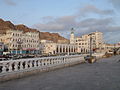 Old city of Mukalla
 -
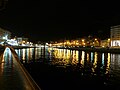 The Mukalla creek

.jpg)

Tarim has a distinctive Hadhrami architecture with filigreed facades and minarets. It has interconnected alleyways and courtyards.[53] Tarim was the Islamic Capital of Culture in 2010.[53] It has the world's tallest mudbrick minaret, located in the Al-Muhdhar Mosque.[53] There are initiatives to protect and restore its mud structures.[53]
-
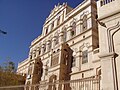 Qasr al-'Ishshah, Tarim
 -

-
 View of Qasr al-'Ishshah
 -

.jpg)
_(2286434547).jpg)
.jpg)
.jpg)
Shibam, which is now a UNESCO World Heritage Site, is known for its distinct architecture. The houses of Shibam are all made out of mudbrick, and about 500 of them are tower blocks, which rise 5 to 11 stories high,[54] with each floor having one or two rooms.[55] This architectural style was used in order to protect residents from Bedouin attacks.[56] While Shibam has been in existence for an estimated 1,700 years, most of the city's houses originate from the 16th century. Many, though, have been rebuilt numerous times in the last few centuries.
Shibam is often called "the oldest skyscraper city in the world".[57] It is one of the oldest and best examples of urban planning based on the principle of vertical construction.[58] The city has some of the tallest mud buildings in the world, with some of them over 30 m (98 feet) high,[59] thus being early high-rise apartment buildings. In order to protect the buildings from rain and erosion, the walls must be routinely maintained by applying fresh layers of mud. The city is surrounded by a fortified wall, giving it the name "the walled city of Shibam".[58]
-
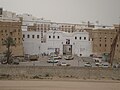 City's gate
 -
 street view of the city
 -
 Closeup of the details of a window in Shibam
 -
 Shibam buildings with balconies
 -
 View of Old Walled City of Shibam


.jpg)


Habban, an ancient city within the Shabwa governorate, boasts a distinct architectural legacy characterized by ingenious mud and straw construction techniques. Notable features include towering mud structures with intricate carvings, reflecting both historical significance and artistic flair. Habban's architecture showcases a blend of utilitarian functionality and aesthetic charm. The enduring mud buildings' diverse architectural styles, including palaces, mosques, and tombs, capture the city's cultural tapestry. Rooted in Yemeni heritage, Habban's architecture is a living embodiment of the intersection between local culture and the built environment, reflecting the city's historical and cultural significance.[citation needed]


Demographics
[edit]The people of the region are known as the Hadharem, generally belong to the Semitic south Arabians who claim descent from Yarub bin Qahtan. There is, however, a large number of Sada (Hadrami Arabic: سادة, romanized: Sadah; Singular: Sayyid), or descendant of the Islamic Prophet Muhammad, and of townsmen of northern origin, besides a considerable class of African or mixed descent. The Sada, descendants of Husain ibn Ali, grandson of the Islamic Prophet, form a numerous and highly respected aristocracy. They are divided into families, the chiefs of which are known as Munsibs, who are looked on as the religious leaders of the people and are even, in some cases are regarded with great respect as saints. Among the leading families are that of Sheikh Abu Bakar bin Salem (Hadrami Arabic: الشيخ ابو بكر بن سالم) of ʽAynat, al-Aidarus (Hadrami Arabic: العيدروس) of Shihr and Wadi Dawan, Bin Sumayt (Hadrami Arabic: بن سميط) of Shibam and the Sakkaf (Hadrami Arabic: سقاف) of Seiyun. They do not bear arms, nor occupy themselves in trade, nor manual labour, nor even agriculture; though owning a large proportion of the land, they employ labourers to cultivate it. As compared with the other classes, they are well educated and are strict in their observance of religious duties, and owing to the respect due to their descent, they exercise a strong influence both in temporal and spiritual affairs.[60][61]
The Mashayikh (Hadrami Arabic: المشايخ) is another highly regarded group that is second in prestige to the Sada. Like the Sada, they don't bear arms.[62] Men from this group are given the honorific surname Sheikh (Hadrami Arabic: شيخ) and women are given the surname Sheikha (Hadrami Arabic: شيخة) which is different from the term Sheikh (Arabic: شيخ) that is used to refer to a tribal chief or a Muslim scholar.[62] Prominent Mashayikh families include the ‘Amudi (Hadrami Arabic: العمودي), Ba Wazir (Hadrami Arabic: با وزير), and Ba ‘Abbad (Hadrami Arabic: با عبّاد) families.[62]
The Qaba'il (Hadrami Arabic: القبائل) or tribesmen, as in the rest of Arabia, are the predominant class in the population. All the adults carry arms. Some of the tribes have settled towns and villages, others live a bedouin life, keeping however within the territory which is recognised as belonging to the tribe. They are divided into sections or families, each headed by a chief while the head of the tribe is called the muqaddam or sultan. He is the leader in peace and in war, but the tribesmen are not his subjects; he can only rule with their support.[60] Historically, the most powerful tribes in Hadhramaut was the Qu’aiti, a branch of the Yafa'a tribe. Originally invited by the Sada to protect the settled districts against the marauding tribes, they established themselves as rulers of the country, and possessed the coastal districts with the towns of Mukalla and Shihr as well as Shibam in the interior. The family had accumulated great wealth and was in the service of the Nizam of Hyderabad in India as commander of the Arab levy composed of his tribesmen.[60][61]
The townsmen are the free inhabitants of the towns and villages as distinguished from the Sada and the tribesmen; they do not carry arms, but are the working members of the community, merchants, artificers, cultivators, and servants and are entirely dependent on the tribes and chiefs under whose protection they live. The servile class contains a large African element, brought over formerly when the slave trade nourished on this coast; as all Islamic countries they are well treated, and often rise to positions of trust.[60][61]
Hadhrami diaspora
[edit]
Since the early 19th century, large-scale Hadhramaut migration has established sizable Hadhrami minorities all around the Indian Ocean,[63] in South Asia, Southeast Asia and East Africa, including Mombasa, Hyderabad, Aurangabad, Maharashtrian Konkan,[64][65] Mangalore, Bhatkal, Gangolli, Malabar, Sylhet, Tanzania, the Malay Archipelago, Sri Lanka, southern Philippines and Singapore.[66] In Hyderabad and Aurangabad, the community is known as Chaush and resides mostly in the neighborhood of Barkas. There are also settlements of Hadharem in Gujarat, such as in Ahmadabad and Surat. In South India, the Nawayath community also descends from Hadrami traders.
Earlier, several sultans in the Malay Archipelago such as the Malacca Sultanate,[67] Pontianak Sultanate or Sultanate of Siak Sri Indrapura were descents of Hadharem . In the 19th century, Hadhrami businessmen owned many of the maritime armada of barks, brigs, schooners and other ships in the Malay archipelago.[68] In modern times, several Indonesian ministers, including former Foreign Minister Ali Alatas and former Finance Minister Mar'ie Muhammad are of Hadhrami descent, as is the former Prime Minister of East Timor, Mari Alkatiri (2006).[69]
The Hadharem have also settled in large numbers along the East African coast,[70] and two former ministers in Kenya, Shariff Nasser and Najib Balala, are of Hadhrami descent. It has also been proved by genetic evidence[71] that the Lemba people of Southern Africa bear some relation to the people of Hadramaut.[72]
Within the Hadhramaut region there has been a historical Jewish population.[73][74][75]
See also
[edit]Explanatory notes
[edit]Language notes
[edit]- ^ Also romanized as Hadramaut, Hadramout or Hadramawt, pronounced /ˌhɑːdrəˈmɔːt/ ⓘ HAH-drə-MAWT.
- ^ Biblical Hebrew: חֲצַרְמָוֶת, romanized: Ḥăṣarmāweṯ; Genesis 10:26[5] and 1 Chronicles 1:20[6]
References
[edit]- ^ a b "حضرموت" [Hadhramaut - National Information Center of Yemen]. المركز الوطني للمعلومات (in Arabic). Retrieved 14 November 2024.
- ^ Al-Ameri, Aidah (June 2018). "في مفهوم حضرموت والحضارمة" [On the concept of Hadhramaut and the Hadhramis]. Hadramawt Cultural Journal (in Arabic). 8. Hadramawt Center for Historical Studies: 38.
لقد أفاضت المصادر العربية الإسلامية في ذكر دلالة تسمية حضرموت، ومما جاء عندهم في هذا الأمر عدد من الروايات، الأولى ترى أن عامر بن قحطان كان أول من نزل بالأحقاف، وكان إذا حضر حربًا أكثر من القتل فصار يقولون عند حضوره (حضر موت)، ثم صار ذلك عليه لقبًا وصاروا يقولون للأرض التي بها قبيلته (أرض حضرموت)، ثم أطلق على البلاد ذاتها
[Arab-Islamic sources have elaborated on the significance of the name Hadhramaut, including several narratives. The first of these states that Amer ibn Qahtan was the first to land in Al-Ahqaf and that when he attended a war, he used to kill more than anyone had killed, so they used to say when he came, death has come (Hadhara al-maut), and then it became a nickname for him. They used to call the land where his tribe was (the land of Hadhramaut), and then the country itself.] - ^ Everett-Heath, John (22 May 2014), "Hadhramaut", The Concise Dictionary of World Place-Names, Oxford University Press, doi:10.1093/acref/9780191751394.001.0001, ISBN 978-0-19-175139-4, retrieved 20 March 2025
- ^ a b Lewcock 1986, p. 21.
- ^ Genesis 10:26
- ^ 1 Chronicles 1:20
- ^ Hitchcock, Roswell (2013). Hitchcock's Bible Names Dictionary. Send The Light Distribution LLC. ISBN 9781481024761.
- ^ Salibi, Kamal (1981). al-Qāḍī (ed.). "Ḥaḍramūt: A Name with a Story". Studia Arabica et Islamica: Festschrift for Iḥsān ʿAbbās on His Sixtieth Birthday: 393–397.
- ^ "General word list". DASI: Digital Archive for the Study of pre-islamic arabian Inscriptions. Retrieved 1 May 2016.
- ^ Theophrastus: Historia Plantarum. 9,4.
- ^ Van Beek 1997.
- ^ Avanzini 2016, p. 184.
- ^ Naval Western Arabia & The Red Sea p.224 Routledge, 2013 ISBN 978-1-136-20995-6
- ^ a b c d e "حضرموت" [Hadhramaut]. Al Jazeera Arabic (in Arabic). 19 October 2014. Retrieved 21 March 2025.
- ^ Holger Gzella Languages from the World of the Bible p.162 Walter de Gruyter, 2011 ISBN 978-1-934078-63-1
- ^ Woodard The Ancient Languages of Syria-Palestine and Arabia p.145 Cambridge University Press ISBN 978-1-139-46934-0
- ^ Leonard & Brunschvig The Encyclopaedia of Islam Vol. II, p.183 ISBN 978-90-04-05745-6
- ^ a b c Beeston, A. F. L. (1971). "Ḥaḍramawt, I. Pre-Islamic Period". In Lewis, B.; Ménage, V. L.; Pellat, Ch. & Schacht, J. (eds.). The Encyclopaedia of Islam, Second Edition. Volume III: H–Iram. Leiden: E. J. Brill. pp. 51–53. OCLC 495469525.
- ^ Robin (2017). Arabia and the Arabs: From the Bronze Age to the Coming of Islam. Routledge. p. 281. ISBN 978-1-134-64634-0.
- ^ Miller Arabic Geography in the Ninth and Tenth Centuries p.37 Indiana University Press, 1999
- ^ Gazetteer of the Persian Gulf, Oman, and Central Arabia p.953 Government of India, 1908
- ^ al Asqalani, Ibn Hajar; Muhammad ibn Idrīs al-Shafii, Abū ʿAbdillāh; ibn Kathir, Ismail; ibn Faisal al-Tamimi al-Darimi, Abu Hatim Muhammad. "Al-Isabah Fi Tamyiz Al-Sahabah by Ibn Hajr; al Istishaab by Shafii; al Bidayah wan Nihayah by Ibn Kathir; Kitab al Sahaba by Ibn Hibban". Islam story. Story of Islam. Retrieved 11 February 2020.
- ^ Lewcock 1986, p. 29.
- ^ a b Daftary, Farhad. The Isma'ilis: Their History and Doctrines. pp. 237–239.
- ^ Wensinck, A.J.; Pellat, Ch. (1960–2007). "Hūd" (PDF). In Bearman, P.; Bianquis, Th.; Bosworth, C.E.; van Donzel, E.; Heinrichs, W.P. (eds.). Encyclopaedia of Islam (2nd ed.). Brill. p. 537. doi:10.1163/1573-3912_islam_SIM_2920. ISBN 978-90-04-16121-4. Archived from the original (PDF) on 23 April 2015. Retrieved 28 November 2022.
{{cite book}}: ISBN / Date incompatibility (help) - ^ van der Meulen, Daniel [in Dutch]; von Wissmann, Hermann (1964). Hadramaut: Some of its mysteries unveiled. Publication of the De Goeje Fund no. 9. (1st ed.). Leiden, the Netherlands: E.J. Brill. ISBN 978-9-0040-0708-6.
{{cite book}}: ISBN / Date incompatibility (help) - ^ a b Malekandathil, Pius. The Indian Ocean in the Making of Early Modern India. pp. 114–115.
- ^ "2 Yemens Become One, and Celebrate". The New York Times. 23 May 1990. ISSN 0362-4331. Retrieved 2 September 2024.
- ^ Alexandroni, Sam (18 October 2007). "No Room at the Inn". New Statesman. Archived from the original on 9 July 2008.
- ^ a b c Talib, Saadaldeen; Petouris, Thanos; Lackner, Helen; Kaptein, Nicolaas J. G.; Arai, Kazuhiro; Clarence-Smith, William G.; Spencer, James; Walker, Iain; Pétriat, Philippe (2017). Brehony, Noel (ed.). Hadhramaut and its diaspora: Yemeni politics, identity and migration. Library of modern Middle East studies. Hadhramaut Research Centre. London New York: I.B. Tauris. p. 2. ISBN 978-1-78672-167-9.
- ^ Schofield, Richard N.; Blake, Gerald Henry (1988), "Arabian Boundaries: Primary Documents, 1853–1957", Archive Editions, vol. 22, p. 220, ISBN 1-85207-130-3,
...should be made along the coast to the west as far as the DHOFAR-HADHRAMAUT frontier...
- ^ a b ميخائيل رودينوف. عادات وتقاليد حضرموت الغربية.
- ^ Boxberger 2002, p. 13.
- ^ a b Ghazanfar, Shahina A.; Fisher, Martin (17 April 2013). "1–2". Vegetation of the Arabian Peninsula. Sultan Qaboos University, Muscat, Oman: Springer Science & Business Media. pp. 27–55. ISBN 978-9-4017-3637-4.
- ^ Bilādī, ʿĀtiq ibn Ghayth (1982). بين مكة وحضرموت: رحلات ومشاهدات (in Arabic). دار مكة.
- ^ Cavendish, Marshall (2006). "I: Geography and climate". World and Its Peoples: The Middle East, Western Asia, and Northern Africa. Cavendish Publishing. pp. 9–144. ISBN 0-7614-7571-0.
- ^ Scoville, Sheila A. (2006). Gazetteer of Arabia: a geographical and tribal history of the Arabian Peninsula. Vol. 2. Akademische Druck- u. Verlagsanstalt. pp. 117–122. ISBN 0-7614-7571-0.
- ^ Canton, James (25 August 2014). "4: Modernising Arabia". From Cairo to Baghdad: British Travellers in Arabia. London and New York City: I.B. Tauris. p. 91. ISBN 978-0-8577-3571-3.
- ^ a b Prothero, G.W. (1920). Arabia. London: H.M. Stationery Office. pp. 84–85.
- ^ Country Profile: Yemen (PDF), Library of Congress – Federal Research Division, December 2006, archived from the original (PDF) on 26 July 2008This article incorporates text from this source, which is in the public domain.
- ^ "International - U.S. Energy Information Administration (EIA)". Archived from the original on 3 March 2016.
- ^ "CIA World Factbook". Archived from the original on 9 February 2018.
- ^ Hasan, Gamal (29 July 2020). "الأغنية الحضرمية كصورة للرحابة والتنوع" [Hadhrami Singing as an Image of Openness and Diversity] (in Arabic). Khuyut. Retrieved 5 February 2025.
- ^ a b AlMaslami, Farea (23 September 2016). "جغرافيا الغناء في اليمن" [Geography of Music in Yemen] (in Arabic). السفير العربي. Retrieved 5 February 2025.
- ^ a b Bawazir, Fatima. "In Hadhramaut, Music Rings with Youth Ambitions". Arabia Felix. Retrieved 7 February 2025.
- ^ Al-Shadely, Abdullah (8 October 2022). "الدان الحضرمي: متعة الكلمة واللحن" [Hadhrami Dan: The Pleasure of Word and Melody] (in Arabic). South24. Retrieved 16 February 2025.
- ^ Abdulmalek, Mohammed (14 June 2019). "الدان الحضرمى في طريقه إلى قائمة اليونسكو" [Hadhrami Dan on Its Way to a UNESCO List] (in Arabic). The New Arab. Retrieved 2 February 2025.
- ^ "Document Title". HAL-SHS. Retrieved 7 February 2025.
- ^ Topp Fargion, Janet (2002). "The Music of Zenj: Arab-African crossovers in the music of Zanzibar". Persee. Retrieved 6 February 2025.
- ^ "Musical Practice of Zafin/Zapin Arab in Singapore". National Library Board, Singapore. Retrieved 6 February 2025.
- ^ AlNadhami, Ahmed (11 February 2019). "الأغنية الحضرمية.. ذات أجنحة لا تعترف بحدود الجهات الأربع..!" [Hadhrami Song... With Wings That Recognize No Boundaries] (in Arabic). AlAyyam Newspaper. Retrieved 11 February 2025.
- ^ "Old Walled City of Shibam - UNESCO World Heritage Centre". Archived from the original on 9 August 2018.
- ^ a b c d Yemeni town named cultural capital, 9 March 2010, retrieved 14 August 2023
- ^ Helfritz, Hans (April 1937). "Land without shade". Journal of the Royal Central Asian Society. 24 (2): 201–16. doi:10.1080/03068373708730789.
- ^ Jerome, Pamela; Chiari, Giacomo; Borelli, Caterina (1999). "The Architecture of Mud: Construction and Repair Technology in the Hadhramaut Region of Yemen". APT Bulletin. 30 (2–3): 39–48 [44]. doi:10.2307/1504639. JSTOR 1504639.
- ^ Morrison, Alastair M.; Coca-Stefaniak, J. Andres (27 August 2020). Routledge Handbook of Tourism Cities. Routledge. ISBN 9780429534805 – via Google Books.
- ^ "Wadi Hadramowt and walled city of Shabam". ShibamOnline.net. Archived from the original on 3 July 2010. Retrieved 3 January 2010.
- ^ a b Old Walled City of Shibam, UNESCO World Heritage Centre
- ^ Shipman, J. G. T. (June 1984). "The Hadhramaut". Asian Affairs. 15 (2): 154–162. doi:10.1080/03068378408730145.
- ^ a b c d
 One or more of the preceding sentences incorporates text from these sources, which are in the public domain: India Office (1917). Gazetteer of Arabia Vol. I (Qatar Digital Library). pp. 727–729.
- ^ a b c Encyclopædia Britannica 11 ed. Vol. 12 (Gichtel, Johann Georg to Harmonium). Cambridge University Press. 1911. This article incorporates text from this source, which is in the public domain.
- ^ a b c Boxberger 2002, pp. 19–37.
- ^ Ho, Engseng (2006), The Graves of Tarim: Genealogy and Mobility across the Indian Ocean, University of California Press, ISBN 978-0-520-93869-4
- ^ Khalidi, Omar (1996), "The Arabs of Hadramawt in Hyderabad", in Kulkarni; Naeem; De Souza (eds.), Mediaeval Deccan History, Bombay: Popular Prakashan, ISBN 978-8-1715-4579-7
- ^ Manger, Leif (2007), Hadramis in Hyderabad: From Winners to Losers, vol. 35, Asian Journal of Social Science, pp. 405–433 (29)
- ^ Tan, Joanna (20 July 2018). "Singapore's Arab community traces ancestral roots to Yemen's Hadhramaut Valley". Arab News. Retrieved 11 December 2023.
- ^ Freitag, Ulrike; Clarence-Smith, William G. (1997). Hadhrami Traders, Scholars and Statesmen in the Indian Ocean, 1750s to 1960s. Brill. ISBN 9-0041-0771-1.
- ^ Ibrahim, Hassan; Shouk, Abu (16 March 2009). The Hadhrami Diaspora in Southeast Asia: Identity Maintenance or Assimilation?. BRILL. ISBN 978-90-474-2578-6.
- ^ Agence France-Presse
- ^ Bang, Anne K. (2003), Sufis and Scholars of the Sea: Family Networks in East Africa, 1860–1925, Routledge, ISBN 978-0-415-31763-4
- ^ Soodyall, Himla (11 October 2013). "Lemba origins revisited: tracing the ancestry of Y chromosomes in South African and Zimbabwean Lemba". South African Medical Journal = Suid-Afrikaanse Tydskrif vir Geneeskunde. 103 (12 Suppl 1): 1009–1013. doi:10.7196/samj.7297 (inactive 12 July 2025). ISSN 0256-9574. PMID 24300649.
{{cite journal}}: CS1 maint: DOI inactive as of July 2025 (link) - ^ Espar, David (22 February 2000). "Tudor Parfitt's Remarkable Quest". NOVA. PBS. Retrieved 4 February 2015.
- ^ Wahrman, Miryam Z. (1 January 2004). Brave New Judaism: When Science and Scripture Collide. UPNE. p. 150. ISBN 978-1-58465-032-4.
- ^ Ahroni, Reuben (1994). The Jews of the British Crown Colony of Aden: History, Culture, and Ethnic Relations. BRILL. ISBN 978-90-04-10110-4.
- ^ Skolnik, Fred (2007). Encyclopaedia Judaica: Gos-Hep. Macmillan Reference USA. ISBN 978-0-02-865936-7.

Sources
[edit]- Darles, Christian (2018). "Mud Brick Architecture in Ḥaḍramawt-Yemen under the Qu'aiti and Kathiri Sultanates". In Pradines, Stéphane (ed.). Earthen Architecture in Muslim Cultures: Historical and Anthropological Perspectives. Brill. ISBN 978-90-04-35633-7.
- Jerome, Pamela; Chiari, Giacomo; Borelli, Caterina (1999). "The Architecture of Mud: Construction and Repair Technology in the Hadhramaut Region of Yemen". APT Bulletin: The Journal of Preservation Technology. 30 (2/3): 39–48. doi:10.2307/1504639. ISSN 0848-8525. JSTOR 1504639.
- Avanzini, Alessandra (2016). By Land and by Sea: A History of South Arabia Before Islam Recounted from Inscriptions. "L'Erma" di Bretschneider. ISBN 978-88-913-1110-8.
- Boxberger, Linda (2002). On the Edge of Empire: Hadhramawt, Emigration, and the Indian Ocean, 1880s–1930s. State University of New York Press. doi:10.1353/book4490. ISBN 978-0-7914-8935-2.
- Van Beek, Gus W. (1997). "Ḥadhramaut". In Dever, William G.; Meyers, Carol L.; Muhly, James D.; Pardee, Dennis; Sauer, James A.; Finney, Paul Corby; Jorgensen, John S. (eds.). The Oxford Encyclopedia of Archaeology in the Near East. Vol. 2. Oxford, United Kingdom; New York City, United States: Oxford University Press. pp. 452–453.
- Lewcock, Ronald B. (1986). Wādī Ḥaḍramawt and the Walled City of Shibām. Unesco. ISBN 978-92-3-102338-5.
External links
[edit]

- Architecture of Mud: documentary Film about the rapidly disappearing mud brick architecture in the Hadhramaut region
- Nova special on Ubar, illustrating a hydreuma
- Book review of a biography of Qu'aiti sultan Alin din Salah
- Hadhrami migration in the 19th and 20th centuries
- Ba`alawi.com Ba'alawi, the Definitive Resource for Islam and the Alawiyyen Ancestry
| International | |
|---|---|
| Other | |


.svg)

Hadhramaut
View on GrokipediaEtymology
Origins and Historical Usage of the Name
The name Hadhramaut, transliterated from Arabic as Ḥaḍramawt (حَضْرَمَوْت), is of pre-Islamic origin and refers to a historical region in southern Arabia encompassing the wadi (seasonal river valley) and surrounding territories now largely within Yemen. A prevalent folk etymology in Arabic tradition parses it as ḥaḍara al-mawt, literally "death has come" or "death was present," derived from the roots ḥaḍara ("to come" or "be present") and mawt ("death"). This interpretation is tied to Islamic narratives associating the name with the catastrophic end of the ancient 'Ad tribe, mentioned in the Quran as inhabitants of al-Ahqaf (the sandy dunes near Hadhramaut), or with a figure named 'Amr bin Qahtan, surnamed Hadhramaut after witnessing widespread mortality in the region.[9] [10] Such etymologies, while enduring in local lore, lack direct attestation in ancient epigraphy and may reflect later interpretive overlays rather than the term's Semitic linguistic roots, potentially linked to Hadramautic (an Old South Arabian dialect) terms for settlement or valley features. Biblical parallels appear in Genesis 10:26, where Ḥaṣarmāwet (Hazarmaveth) is listed as a son of Joktan, with some scholars proposing a cognate meaning "court of death," though this connection remains conjectural without archaeological corroboration. Alternative derivations, such as from Greek hydreumata ("watering stations" in enclosed valleys), have been suggested to explain fortified oases but find limited support in primary texts.[11] Historically, the name surfaces in classical Greco-Roman accounts of Arabia Felix (the fertile south). Pliny the Elder, in Natural History (c. 77 CE), references the Astramitae (a variant of Hadhramaut inhabitants) as controllers of frankincense groves in the interior, eight days' journey from the coast, emphasizing their role in the incense trade monopoly enforced at the capital Shabwa. Claudius Ptolemy's Geography (c. 150 CE) maps Chatramotitae regnum (kingdom of the Chatramotitae) along the southern Arabian coast, positioning it between the Sabaeans and the Oman region, with coordinates aligning to the wadi's extent. These usages denote not just geography but a polity known for exporting aromatics, resins, and aloes via ports like Kanê (Qana) to the Mediterranean and India, predating Islamic conquest by centuries. Later medieval Arabic geographers, such as al-Hamdani (10th century), retained Ḥaḍramawt for the valley and its dynasties, preserving the term through chronicles of trade and tribal migrations.[12]History
Prehistory and Ancient Civilizations
Archaeological surveys in the Hadramawt region have identified evidence of Middle Paleolithic occupation, including lithic industries from sites in Wâdî Wa'shah and Wâdî Sanâ, with tools indicative of Acheulean traditions dating potentially to the early phases of human dispersal in southern Arabia.[13] Neolithic settlements appear during the early to mid-Holocene, as evidenced by occupations at Manayzah in Wâdî Sanâ, featuring lithic scatters and structural remains associated with hunter-gatherer or early pastoralist adaptations to the wadi environments around 8000–4000 BP.[14] By the early Bronze Age (circa third millennium BCE), small-scale monuments such as stone tombs, platforms, and alignments emerged in the highlands, particularly at sites like Jebel Jidran and Jebel Ruwiq, reflecting ritual or commemorative functions among non-literate pastoral communities; these structures, often reused over time, include evidence of animal sacrifices and are distributed across arid plateaus.[15] The site of Shi'b Munayder represents one of the earliest known sedentary settlements in Wâdî Hadramawt, with stratigraphic layers and radiocarbon dates indicating post-Neolithic establishment in the second millennium BCE (circa 2000–1000 BCE), featuring mudbrick architecture along tributaries suited for early agriculture.[16] The Kingdom of Hadramawt coalesced as an independent South Arabian polity by the early first millennium BCE, contemporaneous with neighboring states like Sabaʾ and Qatabān, and persisted until the late third century CE; its capital at Shabwah, initially settled from the second millennium BCE, developed into a fortified trapezoidal city by the mid-first millennium BCE, encompassing over 1,500 hectares with multi-story merchant houses, temples dedicated to deities such as Siyân, and an advanced irrigation system supporting oasis agriculture.[17] Shabwah's prominence stemmed from control over inland trade routes for frankincense, myrrh, and spices, as attested by classical accounts and local inscriptions, extending influence eastward to regions now in Oman.[17] Excavations at sites like Hureidha reveal contemporaneous temple complexes, farmsteads, and cliff tombs, underscoring a transition to urbanized societies reliant on agro-pastoral economies and ritual architecture by the late first millennium BCE.[18]Rise of Islam and Medieval Developments
Islam arrived in Hadhramaut during the early 7th century, shortly after the emergence of the faith in Arabia, through missionary efforts and subsequent military campaigns. Traditional narratives attribute initial conversions to delegations sent by Muhammad around 630 CE, which gained adherents among local tribes, though these accounts derive from later Islamic historiography. Following Muhammad's death in 632 CE, widespread apostasy erupted across Arabia, including in Hadhramaut, where tribal leaders and groups resisted centralized authority from Medina, often blending religious dissent with fiscal grievances over tribute payments.[19] The Ridda Wars (632–633 CE), waged under Caliph Abu Bakr, decisively reincorporated Hadhramaut into the Islamic polity. Muslim forces under commanders Muhajir ibn Abi Umayya and Ziyad ibn Labid advanced into the region, defeating rebels at key sites such as Zafar, the ancient capital, in late January 633 CE, and Nujair in early February 633 CE, where they overcame the Kinda tribe's remnants.[20] Resistance in Hadhramaut included social elements, such as groups of women—later termed the "harlots of Hadramaut"—who opposed shifts in customary practices under Islamic governance, highlighting tensions between pre-Islamic norms and emerging religious orthodoxy.[21] These campaigns solidified Rashidun control, paving the way for Umayyad and Abbasid oversight, though the region retained tribal autonomy and experienced intermittent Kharijite settlements around 685 CE, followed by Ibadi influences from Iraq in the mid-8th century before Sunni dominance reasserted by 951 CE.[22] Medieval developments centered on the influx of Alawi sayyids—descendants of Ali ibn Abi Talib and Fatima—who migrated from Basra around 952 CE (340 AH), led by Ahmad ibn Isa al-Muhajir, the eighth generation from the Prophet's family. These sayyids established fortified religious enclaves (hawtahs) in settlements like al-Hajarayn and al-Husayisah, promoting Shafi'i jurisprudence and curbing tribal excesses through spiritual authority.[23] By 1127 CE (521 AH), Tarim emerged as a pivotal scholarly hub, with sayyid influence eclipsing earlier mashayikh (sheikhly) networks by the late 12th century (c. 1195 CE/590 AH).[23] A landmark was the early 13th-century (9th AH) figure Muhammad ibn Ali al-Faqih al-Muqaddam, who formalized the Alawi tariqa, blending Sufi mysticism with orthodox Sunni practice and fostering Hadhramaut's role as a conduit for Islamic learning across the Indian Ocean.[23] This era marked a shift toward sayyid-mediated governance, where religious prestige tempered political fragmentation amid declining overland trade routes.[24]Sultanates, Trade, and External Influences
The Kathiri Sultanate originated in the interior Wadi Hadhramaut, with its establishment attributed to Badr as-Sahab ibn al-Habrali Bu Tuwairik around 1395, who consolidated tribal authority in Seiyun.[25] This dynasty maintained dominance over central Hadhramaut valleys and oases through the 15th and 16th centuries, expanding to coastal areas like Ash-Shihr by the 1460s via conquests that secured trade access.[25] By the 19th century, however, internal succession disputes and tribal rivalries weakened its hold, setting the stage for challenges from emerging coastal powers.[26] In contrast, the Qu'aiti Sultanate arose in the early 19th century along the Hadhramaut coast, founded by 'Umar bin 'Awad al-Qu'ayti, a Hadhrami who amassed wealth and military prowess as an officer in the Nizam of Hyderabad, India.[27] Leveraging returns from Indian service, Qu'aiti clans established control over ports such as Shihr and Mukalla, challenging Kathiri inland supremacy through armed conflicts and economic leverage from maritime commerce.[27] This rivalry intensified in the mid-19th century, marked by intermittent warfare and shifting tribal alliances, with Qu'aiti forces often gaining the upper hand due to superior resources from diaspora networks.[26] Hadhramaut's economy during this era relied heavily on trade, building on ancient incense routes that exported frankincense and myrrh from inland production centers to Indian Ocean markets.[28] By the 19th century, ports like Mukalla facilitated exports of dates, hides, and fish, while Hadhrami emigrants in Aden, Jeddah, and Southeast Asia remitted funds that financed both sultanates' administrations and military endeavors.[29] These diaspora merchants, often numbering in the thousands by the late 1800s, formed economic colonies that bolstered local elites against rivals.[30] External powers exerted intermittent influence amid these dynamics. Portuguese naval expeditions in the 16th century targeted southern Arabian coasts, capturing Socotra in 1507 and raiding ports like Shihr to monopolize spice and incense trades, thereby disrupting Hadhrami maritime networks until Ottoman countermeasures in the 1530s.[31] The Ottoman Empire, establishing suzerainty over Yemen from 1538, extended nominal authority to Hadhramaut by the 19th century, offering the Kathiri Sultan military aid promises against Qu'aiti advances in exchange for loyalty oaths, though actual intervention remained limited due to logistical constraints.[26] These influences underscored Hadhramaut's strategic position in regional power contests, often amplifying local sultanate competitions.[26]British Protectorate and Path to Independence
British involvement in Hadhramaut began in the late 19th century as part of efforts to secure the Aden Colony's hinterland and maritime routes. In 1888, the United Kingdom signed a protectorate treaty with the Qu'aiti Sultan of Shihr and Mukalla, ratified on February 26, 1890, which recognized British protection in exchange for the sultan's commitment to abolish slavery and prevent foreign interference.[32] This agreement marked the formal incorporation of coastal Hadhramaut into the Aden Protectorate, with the Qu'aiti state controlling key ports like Mukalla.[33] Internal rivalries persisted, particularly between the Qu'aiti and the inland Kathiri sultanate; a 1918 treaty, mediated by British officials from the Aden Residency, resolved a longstanding dispute by confirming Qu'aiti dominance over the coast while allowing Kathiri autonomy in the Wadi Hadhramaut interior.[34] Administration remained indirect, relying on local rulers under advisory treaties to maintain order and British strategic interests, such as countering Ottoman and later Italian influences. In 1937, Britain formalized an advisory treaty with the Qu'aiti sultan, followed by a similar agreement with the Kathiri sultan in 1939, enhancing oversight without full colonial governance.[35] The Aden Protectorate was administratively divided in 1937 into Western and Eastern sections, with the Eastern Aden Protectorate encompassing Hadhramaut states and headquartered in Mukalla; this structure persisted until the 1950s, when British policy shifted toward federation to counter rising Arab nationalism.[32] Tribal levies, like the Hadhrami Bedouin Legion formed in the 1930s, supported security but highlighted the limited reach of central authority amid feuds and smuggling. The path to independence accelerated amid post-World War II decolonization and local insurgencies. In 1959, several protectorates formed the Federation of Arab Emirates of the South (later Federation of South Arabia), including Qu'aiti and Kathiri states by 1963, as Britain sought a unified entity before withdrawal; however, the National Liberation Front (NLF), backed by Egypt, boycotted and escalated violence against British forces and traditional rulers.[36] Sultanates were abolished by August 27, 1967, amid NLF gains, and upon British departure on November 30, 1967, the NLF proclaimed the People's Democratic Republic of Yemen, incorporating Hadhramaut without recognizing prior autonomies.[32] This transition ended British protection but imposed Marxist governance, suppressing Hadhrami elites and diaspora ties.[37]Unification, Communist Era, and Early Conflicts
Following the British withdrawal from the Aden Protectorate on November 30, 1967, Hadhramaut was incorporated into the newly independent People's Democratic Republic of Yemen (PDRY), a Marxist-Leninist state that became the only communist regime in the Arab world.[22] The National Liberation Front (NLF), which seized power, reorganized the region administratively, dividing Hadhramaut into three provinces: al-Mukalla, Shihr and al-Qusayir, and Sayun and al-Wadi.[22] Aligned closely with the Soviet Union, Cuba, and East Germany, the PDRY pursued aggressive socialist policies, including land redistribution, collectivization of agriculture, and nationalization of trade networks, which disrupted Hadhramaut's entrenched tribal hierarchies, merchant classes, and religious institutions dominated by Sayyids and Sufi orders.[38] These measures fostered latent resistance in rural and wadi areas, where tribal loyalties and Islamic practices clashed with state atheism and centralization efforts, though overt rebellions remained sporadic compared to urban purges in Aden.[39] Saudi Arabia provided covert support to southern anti-communist exiles and tribes, including those from Hadhramaut, using the kingdom as a base for operations against the PDRY.[40] Economic stagnation and the collapse of Soviet subsidies in the late 1980s precipitated unification talks between the PDRY and the Yemen Arab Republic (North Yemen). On May 22, 1990, the two states merged to form the Republic of Yemen, with Hadhramaut retaining its status as a governorate but gaining integration into a multi-party system that nominally preserved southern socialist elements alongside northern tribal and Islamist influences.[41] Initial optimism stemmed from shared resources, including Hadhramaut's emerging oil fields in the Masila Basin discovered in the 1980s, but unification exacerbated north-south asymmetries, with northern elites dominating key posts and southern grievances over economic marginalization intensifying.[42] Tensions boiled over into the 1994 civil war, triggered by southern secessionist declarations on May 21, 1994, amid disputes over power-sharing and perceived northern encroachment. Hadhramaut, as a southern stronghold with strategic oil infrastructure, became a focal point of resistance, holding out longer than Aden against northern advances led by President Ali Abdullah Saleh's forces.[43] Northern troops captured Mukalla, the governorate's capital and key port, on July 4, 1994, after southern defenses collapsed, marking the effective end of the secession and the flight of Yemeni Socialist Party leaders.[44] The war displaced thousands in Hadhramaut and entrenched local resentments, as northern integration policies, including forced retirements of southern officers, fueled protests against perceived discrimination.[45] Post-war, sporadic unrest persisted, exemplified by 1997 demonstrations in Mukalla decrying resource mismanagement and political exclusion.[46]Contemporary Conflicts, Separatism, and Autonomy Drives
Hadhramaut has been embroiled in Yemen's broader civil war since 2015, with jihadist groups like al-Qaeda in the Arabian Peninsula (AQAP) exploiting governance vacuums in remote valleys and coastal areas, leading to localized clashes and UAE-backed counterterrorism operations that captured Mukalla in 2016 before its handover to pro-government forces.[2] The governorate's oil fields and ports have drawn competing militias, including Houthi incursions from the north and southern factions, resulting in sporadic violence that displaced thousands and disrupted resource extraction, with ACLED recording over 500 conflict events between 2020 and 2024 involving tribal militias and Islamist remnants.[2] Local security elites, often tribal-based, have filled voids left by the fractured Yemeni military, prioritizing anti-jihadist efforts amid Sana'a's weakened control.[3] Separatist sentiments in Hadhramaut intensified post-2011 Arab Spring uprisings, fueled by perceptions of economic marginalization and resource mismanagement under unified Yemen, prompting the formation of the Hadhramaut Tribal Alliance in 2015 as a coalition of sheikhs representing over 80% of the governorate's tribes.[3] This group has organized mass protests, such as those in 2021 demanding control over oil revenues estimated at $1 billion annually from fields like Masila, arguing that central authorities siphon funds without local investment.[2] Autonomy drives emphasize Hadhramaut's distinct cultural and geographic identity, rejecting full integration into either Houthi-dominated north or pan-southern projects, with tribal leaders citing historical sultanate precedents for self-governance.[47] The UAE-supported Southern Transitional Council (STC), established in 2017 to advocate southern independence, expanded into coastal Hadhramaut by 2020, securing Mukalla and deploying Security Belt forces, which locals view as external imposition eroding tribal authority.[2] This provoked resistance, including 2022 clashes between STC-aligned militias and Hadhrami elites over port revenues and recruitment, exacerbating divides as Hadramis prioritize regional autonomy over STC's vision of a unified southern state encompassing diverse governorates.[48] STC deployments, such as 2,500 fighters to the Hadhramaut coast in April 2025, drew warnings from the Hadhramaut Inclusive Conference of potential escalation into proxy conflicts.[49] In response, Saudi Arabia facilitated the Hadramawt National Council's (HNC) formation in Riyadh in late 2023, uniting tribal and political figures to advance Hadrami-specific empowerment and counter STC influence, framing it as a buffer against UAE expansionism.[47] The HNC has lobbied for federal arrangements granting Hadhramaut veto power over resources, aligning with Saudi interests in stabilizing eastern Yemen against Houthi threats while curbing UAE footholds.[48] This Saudi-Hadhrami axis clashed with UAE proxies, contributing to intra-coalition frictions within the anti-Houthi front. By 2025, autonomy momentum peaked with the Hadhramaut Tribal Confederacy's April "Historic Hadhramaut Meeting," declaring administrative separation as a "minimum entitlement" backed by Saudi logistics, followed by a May committee to draft self-rule documents amid reports of emerging armed groups fueled by Riyadh-Abu Dhabi rivalries.[50] These developments risk fragmenting southern Yemen further, as tribal demands for resource sovereignty—controlling 70% of Yemen's proven oil reserves—intersect with great-power competition, potentially prolonging instability unless integrated into national peace talks.[51][52]Geography
Administrative Boundaries and Political Divisions
Hadhramaut forms Yemen's largest governorate by land area, encompassing diverse subregions from the coastal plain along the Arabian Sea to the inland Wadi Hadhramaut valley and extending northward toward the Rub' al-Khali desert.[5] Its administrative boundaries border Saudi Arabia to the north, Al Mahrah Governorate to the east, Shabwah Governorate to the west, and include coastal access to the Gulf of Aden.[2] Formally, it operates as a unitary governorate under Yemen's central administrative framework, subdivided into 28 districts with Mukalla serving as the capital and primary urban center.[5][1] Key districts include Sayun, Tarim, and Ash Shihr, each managing local governance, security, and resource allocation amid varying population densities—such as over 185,000 residents in Mukalla City District as of 2004 census data.[4] Politically, Hadhramaut's divisions reflect Yemen's ongoing civil war fragmentation rather than strict administrative lines, creating a de facto split between coastal (Sahl) and interior (Wadi) zones since around 2015.[53] The coastal areas, including Mukalla, fall under predominant control of the Southern Transitional Council (STC), a separatist entity backed by the United Arab Emirates, which administers security and civil affairs through local elites and militias while the nominal governor retains ties to Yemen's Internationally Recognized Government (IRG).[2] In contrast, the Wadi Hadhramaut maintains closer alignment with the IRG, though tribal hierarchies and informal alliances with Saudi Arabia influence governance, with sporadic al-Qaeda in the Arabian Peninsula (AQAP) incursions disrupting stability.[3] This bifurcation stems from historical precedents, as pre-unification Hadhramaut comprised the Qu'aiti Sultanate dominating coastal trade routes and the Kathiri Sultanate controlling interior valleys, patterns echoed in modern power centers.[54] Local autonomy aspirations have intensified, with the 2020 Hadrami Elite conference advocating a federal model granting Hadhramaut semi-independent status over oil revenues and security, resisting both Houthi expansion and STC overreach.[50] These efforts highlight tensions between IRG nominal authority, STC expansionism—driven by Hadhramaut's oil fields producing over 200,000 barrels daily—and external influences from Saudi-led coalitions prioritizing counterterrorism over unification.[46] Tribal councils and sheikhs mediate disputes, often overriding district-level administration in resource disputes or conflict resolution, underscoring the primacy of customary law over state structures.[53]Topography, Climate, and Environmental Features
Hadhramaut's topography centers on the Wadi Hadhramaut, a seasonal river valley running parallel to the Arabian Sea coast for roughly 150 kilometers, with widths varying from 2 to 15 kilometers and depths reaching several hundred meters in places.[55] The valley is flanked by limestone plateaus and dissected highlands, featuring flat-topped hills, sinuous ridges, and an intricate network of tributary wadis that drain into the main channel.[55] Elevations across the region span from sea level along the narrow coastal plain to 600–1,900 meters in the interior escarpments and plateaus. The coastal zone transitions abruptly to steep escarpments rising to the al-Jawl plateau, averaging 1,370 meters, which dominates the inland landscape.[56] The climate is arid subtropical, with annual precipitation typically under 100 mm, concentrated in sporadic summer flash floods from monsoon influences, while prolonged droughts are common.[57] Average annual temperatures range from lows of 22°C in January to highs exceeding 40°C in July, with coastal humidity providing slight moderation but interior valleys experiencing extreme diurnal variations.[58] Wind patterns include seasonal shamal northerlies and khareef southerlies, contributing to dust storms and occasional cyclones affecting the Gulf of Aden coast. Environmentally, Hadhramaut exhibits hyper-arid desert conditions, with vegetation limited to drought-tolerant shrubs on rocky limestone plateaus and denser oases of date palms, alfalfa, and grains in wadi bottoms reliant on alluvial aquifers and floodwater harvesting.[59] Biodiversity is low but includes desert-adapted species such as acacia trees and endemic reptiles, confined largely to ephemeral wadi ecosystems; frankincense-bearing Boswellia trees persist in higher elevations despite historical overexploitation.[60] Key challenges encompass groundwater overexploitation leading to aquifer depletion, flash flood-induced erosion, and accelerating desertification from overgrazing, deforestation, and climate variability, which have degraded rangelands and threatened agricultural viability in the valleys.[61][62]Key Subregions and Their Characteristics
The Wadi Hadhramaut constitutes the central fertile valley of the region, characterized by a seasonal watercourse that supports oasis agriculture, including date palms and wheat cultivation, and hosts densely populated historic settlements.[63] This subregion features distinctive mud-brick architecture, with multi-story buildings constructed from local earth materials reinforced by straw and palm fibers, as seen in towns like Tarim and Shibam.[64] The valley's urban centers, such as Seiyun and Tarim, developed as religious and trading hubs, with the latter known for Sufi institutions and the towering Al-Muhdhar Mosque minaret reaching 43 meters in height as of its completion in 843 AH (1440 CE).[64] The coastal plain of Hadhramaut, stretching along the Arabian Sea, forms a narrow, arid littoral zone backed by steep escarpments, serving as the primary gateway for maritime trade and fisheries.[65] Mukalla, the region's largest city and port, exemplifies this subregion with its white-washed buildings, historic forts like Al-Ghwayzi, and a fish-canning industry that processes local catches, supporting a population of approximately 595,000 as of 2023.[65] The coast experiences slightly more humidity than inland areas, enabling limited vegetation and seasonal tourism, though desert conditions dominate with average annual rainfall below 50 mm.[66] Northern Hadhramaut encompasses the expansive plateau and desert interiors, including al-Sahra areas transitioning into the Rub' al-Khali, marked by rugged highlands intersected by deep wadis and extreme aridity with sparse nomadic populations.[2] This subregion's barren sandstone plateaus, visible in aerial views, contrast with the valley's fertility, hosting minimal settlements and serving as routes for overland trade, though limited by water scarcity and high temperatures exceeding 40°C in summer.[67] Biodiversity hotspots persist in isolated wadis, supporting endemic species amid the overall hyper-arid environment.[60]Economy
Resource Extraction: Oil, Gas, and Other Minerals
Hadhramaut's primary resource extraction activities center on oil and natural gas from the Masila Basin, which contains approximately 80 percent of Yemen's proven oil reserves.[68] Commercial oil production commenced in the Masila fields in 1993 under a consortium led by Canadian Occidental Petroleum, with initial exports averaging 120,000 barrels per day (bpd) via facilities in Al-Shihr port.[69] By late 1999, aggregate daily output across multiple fields reached 210,000 stock tank barrels per day (STB/D), supported by water injection and gas handling systems producing 6.5 million cubic feet per day (MMCF/D) of solution gas.[70] Production peaked in the early 2000s before declining due to maturing fields and Yemen's broader instability, with the Masila Block consistently ranking as the country's top oil producer.[71] Prior to the 2015 escalation of Yemen's civil war, Hadhramaut's seven oil fields maintained a capacity of 104,000 bpd, operated primarily by Masila Petroleum Exploration and Production Company (PetroMasila).[2] Conflict disruptions, including Houthi drone attacks on facilities in 2022, have intermittently halted operations, though PetroMasila has sustained some output and invested in gas-fired power for decarbonization as of 2023.[72][73] Natural gas extraction accompanies oil production in the Masila and adjacent East Shabwah fields, yielding 300 million cubic meters in 2020 for domestic use, with no liquefied natural gas exports recorded.[74] Other mineral resources remain underdeveloped; exploratory efforts by the Yemeni-Spanish Minerals Company have targeted aluminum and magnesium silicates near Al-Mukalla, but no significant commercial extraction has materialized.[75] Isolated reports of gold mining exist, often linked to informal or foreign-influenced operations amid governance vacuums, though these lack verified large-scale output data.[76]Agriculture, Fisheries, Ports, and Traditional Trade
Agriculture in Hadhramaut is primarily concentrated in the fertile valleys of Wadi Hadhramaut and coastal plains, relying on traditional spate irrigation systems that capture seasonal flash floods for water distribution across fields.[77] These ancient methods, including earthen diversion structures and flood protection bunds, have sustained cultivation for centuries despite the arid climate, with ongoing rehabilitation efforts by organizations like the FAO to enhance flood resilience and irrigation efficiency.[77][78] Key crops include date palms as the main cash crop, wheat, sorghum, sesame, onions, tomatoes, watermelon, and citrus fruits, with fodder crops like alfalfa supporting local livestock.[79][80] Approximately 48,000 hectares in Wadi Hadhramaut hold potential for further irrigated development, though droughts and erratic flooding frequently damage crops and erode soil productivity.[81][82] Fisheries form a vital component of the coastal economy, particularly along the Arabian Sea shores, where small-scale traditional fishing accounts for about 79% of the estimated 127,000 tons annual marine catch from Yemen's coasts.[83] In Hadhramaut specifically, sea fisheries production reached a peak of 217,896 tons in 2014, driven by abundant small pelagic species such as sardines and anchovies, with a regional biomass estimated at 450,000 tons.[84][85] Initiatives to support coastal communities include distribution of boats, engines, and nets to around 150 small-scale fishermen in 2022, aiming to bolster livelihoods amid conflict disruptions.[86] The Port of Mukalla serves as Hadhramaut's primary maritime gateway on the Arabian Sea, handling imports, exports, and fishing-related activities; it was officially opened in January 1985 as the region's sole international seaport.[87] This facility supports the local fishing industry, including a fish-canning plant, and facilitates regional trade in goods like agricultural products and minerals.[88] An additional oil export terminal operates at al-Dahbba in al-Shihr district, complementing Mukalla's general cargo functions.[2] Traditional trade in Hadhramaut encompasses local exchanges of agricultural staples like dates, grains, and tobacco, alongside coastal fish products, honey, and lime, often channeled through Mukalla for export.[89] These activities echo historical commerce rooted in monsoon-driven routes and the ancient incense trade, with diaspora networks historically amplifying the flow of goods to East Africa and beyond.[89][29] Small-scale markets and tribal exchanges persist, though wartime instability has constrained volumes compared to pre-2014 peaks.[84]Economic Governance, Revenues, and Persistent Challenges
Economic governance in Hadhramaut operates within Yemen's fragmented political landscape, where the Internationally Recognized Government (IRG) exerts nominal central authority, but local actors—including governors, tribal alliances, and the Southern Transitional Council (STC)—wield significant influence over resource management. Governors in oil-rich eastern governorates like Hadhramaut retain a percentage of collected taxes and fees to finance basic administration and local investments, reflecting a de facto decentralization amid weak national institutions.[90][5] However, oil revenues are largely channeled through national mechanisms, with payments directed to al-Ahli Bank in Riyadh rather than local banks, limiting direct fiscal control and fueling demands for greater autonomy from groups like the Hadrami Elite Union.[90] Local initiatives, such as the 2017 Hadhramaut Inclusive Conference, have pushed for bottom-up resource control to mitigate wartime divisions, though implementation remains contested between IRG loyalists, STC affiliates, and tribal entities.[3] Revenues primarily derive from hydrocarbon extraction in the Masila Basin, which produces the majority of Yemen's oil and accounted for roughly half of national output pre-escalation, with a capacity of approximately 104,000 barrels per day across seven fields as of 2015.[2][91] By 2022, production had declined to around 80,000 barrels per day before Houthi drone attacks on export terminals like al-Dabba halted operations, severely curtailing IRG finances.[2] Approximately 20% of these oil revenues is allocated to Hadhramaut for local use, supporting initiatives like power station construction from crude storage sales, though actual disbursement often faces delays and diversions.[92][72] Supplementary income stems from customs at Mukalla port and the Al-Wadiah border crossing with Saudi Arabia, alongside minor taxes, fines, and fisheries, but these are vulnerable to smuggling and factional interference.[3][5] Persistent challenges include inequitable revenue distribution, with locals frequently excluded from oil and customs benefits despite production occurring on their territory, prompting protests and a 2024 ultimatum from the Hadhramaut Tribal Alliance demanding fairer shares from the Yemeni government.[3][93] Corruption allegations, such as subsidized diesel sales at inflated prices by local authorities, erode trust and efficiency, while Houthi strikes on infrastructure underscore external vulnerabilities that have repeatedly disrupted exports and heightened economic instability.[94] Political fragmentation—exacerbated by STC-IRG rivalries and tribal militias—hinders coordinated governance, leading to port congestion, delayed customs inspections, and underinvestment in diversification beyond oil dependency.[95][96] These issues compound broader wartime effects, including uneven public services like electricity shortages and rising costs for essentials, perpetuating underdevelopment in a governorate that spans 36% of Yemen's land but struggles with service delivery amid autonomy aspirations.[3][97]Politics and Governance
Tribal Hierarchies and Traditional Authority Structures
Hadhramaut's traditional social structure is characterized by a hierarchical stratification rooted in genealogy, religious prestige, and occupational roles, with the sada (descendants of the Prophet Muhammad) occupying the apex as spiritual and moral authorities. These sada families, such as the Al-Attas and Al-Aydarus, hold revered status due to their prophetic lineage, granting them roles in mediation, religious scholarship, and community arbitration, often transcending tribal boundaries.[98] Below them are the mashayikh, religious scholars and Sufi leaders who provide theological guidance and reinforce the sada's influence through education and ritual authority.[99] The core of tribal authority resides in the qaba'il (tribesmen), comprising armed, nomadic, or semi-nomadic groups descended from ancient Arabian lineages like Qahtan, who form the political and military backbone of society. Tribal sheikhs lead confederations, enforcing customary law ('urf) in disputes over resources, honor, and alliances, with loyalty structured around kinship and collective defense mechanisms. Notable tribes include the Nahd and those aligned with historical sultanates like the Kathiri and Qu'aiti, where rulers derived legitimacy from tribal support rather than centralized bureaucracy.[98] This stratum maintains order through asabiyyah (group solidarity), balancing autonomy with deference to higher religious elites for impartial rulings.[100] Beneath the qaba'il lie the masakin or du'afa' (weak or lowly), encompassing artisans, merchants, peasants (harthin), and marginalized groups like the Akhdam and former slaves, who lack tribal protection and often serve in subservient capacities. While endogamy and ritual avoidance historically reinforced separations—such as prohibiting intermarriage between strata—the system exhibits adaptability, allowing economic success or alliances to elevate individuals or groups over time.[98] Traditional authority thus integrates religious prestige with tribal power, enabling sada and sheikhs to arbitrate conflicts and uphold social cohesion amid the region's arid, resource-scarce environment.[23]Separatist Movements and Local Councils
Separatist sentiments in Hadhramaut have roots in post-unification grievances following Yemen's 1990 merger, with locals protesting perceived marginalization by Sana'a as early as 1997 in Mukalla.[46] These evolved into alignment with the broader Southern Movement (Hirak), which emerged in 2007 to demand southern secession, though Hadhramaut's vast territory, oil resources, and distinct tribal identity fostered preferences for regional autonomy over full integration into a southern state centered in Aden.[101] By the 2010s, separatist activities intensified amid Yemen's civil war, including alliances with southern paramilitaries, but Hadhramaut leaders emphasized self-governance to counter both Houthi advances and central government overreach.[54] The Hadhramaut Tribal Alliance (HTA), a coalition of tribal leaders, formed to secure greater autonomy from Yemen's government, leveraging control over oil fields and infrastructure to challenge Aden's authority, such as halting oil supplies in protests over unfulfilled revenue-sharing promises.[102] The UAE-backed Southern Transitional Council (STC), which seized Mukalla in 2016 and maintains de facto rule over coastal areas, has sought to extend its secessionist agenda into Hadhramaut, appointing allies like Vice President Ali Abdullah Saleh Al-Bahsani to bolster influence.[103] However, Hadhrami elites have resisted STC dominance, viewing it as favoring western southern provinces and exacerbating resource disputes, amid broader Saudi-UAE rivalries where Riyadh opposes full southern secession.[48][50] Local councils have emerged as key autonomy vehicles, exemplified by the Hadramout National Council (HNC), established in June 2023 in Riyadh by tribal and political leaders to unify Hadhrami representation, promote decentralization, and negotiate resource control within a federal Yemen framework rather than endorsing STC-led independence.[47][104] Saudi support for the HNC reflects efforts to balance STC expansion and preserve Yemen's unity, contrasting with UAE ambitions, while the governorate's formal local council, comprising 28 members plus the governor, handles administrative duties but wields limited power amid wartime fragmentation.[5] Recent 2025 protests in Mukalla against governance failures, including blackouts and HTA-STC clashes, underscore ongoing tensions, with the HTA declaring dead-end talks with local authorities over security and economic demands.[105][106]Interactions with Yemeni Central Government and Foreign Actors
Hadhramaut's interactions with Yemen's Internationally Recognized Government (IRG), based in Aden and Riyadh, have been marked by persistent demands for greater autonomy and equitable resource distribution since the onset of the civil war in 2015. Local actors, including the Hadhramaut Tribal Alliance, have accused the IRG of marginalizing Hadhrami leaders and failing to address service delivery shortcomings, leading to actions such as the suspension of crude oil exports to Aden in 2023 amid disputes over revenue sharing from the governorate's oil fields, which account for a significant portion of Yemen's production.[102][107] In response, the Hadramawt National Council was established in July 2023 following tribal conferences in Saudi Arabia, advocating for enhanced local governance and federal-like arrangements within Yemen while rejecting full secession or integration into the UAE-backed Southern Transitional Council (STC).[108][2] Coastal areas of Hadhramaut, including Mukalla, operate under de facto STC control, though the appointed governor maintains nominal ties to the IRG, reflecting fragmented authority that has hindered unified central oversight.[2] Tribal gatherings in 2025 reiterated calls for "self-rule" as a minimum entitlement, criticizing the Presidential Leadership Council (PLC)—the IRG's executive body—for exacerbating economic neglect and security vacuums, yet stopping short of outright rebellion.[109][110] These tensions stem from Hadhramaut's historical semi-autonomy under pre-unification sultanates and its resource wealth, which local elites argue is exploited without proportional reinvestment by Sana'a or Aden-based authorities.[46] Foreign involvement, particularly from Saudi Arabia and the United Arab Emirates (UAE), has intensified these dynamics through proxy support amid their diverging agendas in Yemen's anti-Houthi coalition. Saudi Arabia has bolstered the Hadramawt National Council and tribal elements to counter STC expansion, including demands to dismantle the IRG's 1st Military Region headquarters in Seyun, viewing Hadhramaut's northern oil regions and 700-kilometer shared border as strategic buffers against Houthi influence.[111][112] In contrast, the UAE has leveraged the STC to pursue economic footholds in southern ports and resources, fostering rivalry that erupted in protests and clashes in Hadhramaut by September 2025, as UAE-aligned forces clashed with Saudi-backed tribes over control points.[48][113] This Saudi-UAE competition has complicated local security efforts, with the Hadrami Elite Forces—comprising three brigades under local command—conducting operations against al-Qaeda remnants while navigating pressures from both powers, though without direct foreign operational control.[114] Hadhrami actors have exploited the rift to press autonomy claims, as seen in February 2025 when tribal leader Ahmed Lama Bin Habrish formed protection forces and halted oil flows, signaling leverage against both central and foreign influences.[50] Overall, these interactions underscore Hadhramaut's balancing act: resisting full IRG subordination, STC dominance, and foreign overreach to preserve regional stability amid Yemen's fragmentation.[3]Security and Militancy
Historical Presence of Al-Qaeda in the Arabian Peninsula (AQAP)
Al-Qaeda in the Arabian Peninsula (AQAP) developed its presence in Hadhramaut building on earlier al-Qaeda networks in Yemen dating to the late 1990s, when escaped militants established training camps and safe havens in remote tribal areas of the governorate.[115] The group's formal operations intensified after AQAP's creation in January 2009 via the merger of Yemeni and Saudi al-Qaeda branches, allowing it to exploit Hadhramaut's porous borders, tribal loyalties, and weak central authority for recruitment, logistics, and cross-border movement toward Saudi Arabia.[116] [117] By leveraging familial and tribal ties—particularly among Hadhrami clans with Salafist leanings—AQAP embedded operatives who provided financial incentives and protection against rivals, fostering a resilient underground network amid Yemen's post-2011 instability.[117] The Houthi offensive in 2014-2015 created a power vacuum in southern Yemen, enabling AQAP's territorial expansion into Hadhramaut. On April 2, 2015, approximately 200-300 AQAP fighters, alongside local allies, overran Mukalla—the governorate's capital and Yemen's second-largest port—with little opposition from collapsing government forces, seizing prisons, banks, and military installations.[118] [119] This capture extended AQAP's influence over coastal and valley districts, establishing a de facto "Hadramawt emirate" that controlled key revenue sources like oil facilities (accounting for about one-third of Yemen's pre-war production) and the operational Balhaf liquefied natural gas terminal.[118] AQAP's strategy emphasized pragmatism over ideology: fighters refrained from immediate harsh Sharia enforcement, instead releasing over 300 prisoners (including militants), distributing looted funds to locals, maintaining port commerce, and coordinating with tribal leaders to provide basic security against Houthi incursions.[118] [120] Governance under AQAP in Hadhramaut blended opportunism with gradual Islamization. A "council of elders" including AQAP members and local Salafists managed daily affairs, banning qat chewing (initially laxly enforced) and deploying religious police to regulate behavior, while destroying Sufi shrines to align with Wahhabi-influenced ideology.[118] The group avoided alienating tribes by not conscripting locals en masse or disrupting trade, which sustained economic activity and attracted displaced populations; this contrasts with more rigid ISIS approaches elsewhere, allowing AQAP to portray itself as a stabilizing force amid civil war chaos.[120] U.S. drone strikes targeted AQAP leaders in the area, including the June 2015 killing of emir Nasir al-Wuhayshi near Mukalla, yet failed to disrupt territorial control due to the absence of Saudi-led coalition airstrikes on Hadhramaut targets.[118] AQAP's hold ended in April 2016 when UAE-trained Hadrami Elite Forces, backed by coalition air support and local tribal militias, recaptured Mukalla in a swift operation that killed or captured dozens of fighters and dismantled the emirate's infrastructure.[121] Post-expulsion, AQAP reverted to asymmetric tactics, including assassinations of STC officials, IED attacks on UAE-backed patrols, and recruitment drives in rural valleys.[122] A notable resurgence occurred on April 13, 2022, with a coordinated assault on Sayun's central prison that freed at least 10 militants and underscored persistent local networks; this event doubled AQAP's reported activities in southern Yemen from 2021 levels, though fatalities concentrated outside Hadhramaut.[122] By 2023, operations declined amid STC offensives and U.S. strikes, shifting AQAP's focus to hit-and-run ambushes rather than territorial control, with Hadhramaut remaining a logistical rear base rather than a frontline hub.[122] This evolution reflects AQAP's adaptation to counter-terrorism pressures, prioritizing survival through tribal embeds over overt governance.[120]Tribal Militias, Local Resistance, and Counter-Terrorism
The Hadrami Elite Forces (HEF), established by the United Arab Emirates around 2016, integrate tribal fighters from Hadhramaut and adjacent Shabwa governorate into a structured counter-terrorism unit comprising three brigades under the command of Major General Faiz Mansur al-Tamimi.[114] These forces, drawing on local Sunni tribes such as the al-Wahidi, Bani Hilal, Balabid, and others, have conducted targeted operations against al-Qaeda in the Arabian Peninsula (AQAP) strongholds, including the liberation of Mukalla in April 2016 through coordination with UAE-led coalition airstrikes and ground assaults.[114] By May 2018, HEF campaigns had expelled AQAP from most coastal areas of Hadhramaut, reducing the group's territorial control and disrupting its revenue from port extortion and smuggling.[2] Tribal militias, often operating semi-autonomously or in alliance with HEF, have formed the backbone of local resistance to AQAP's ideological and coercive tactics, which included attempts to co-opt tribes through protection rackets and anti-Houthi rhetoric following AQAP's initial seizure of Mukalla in April 2015 with minimal initial opposition.[115] These militias, rooted in longstanding tribal hierarchies, prioritize defending valley communities and trade routes from militant infiltration, employing guerrilla tactics and intelligence networks to target AQAP cells in remote wadis and mountains.[3] The Hadhramaut Tribal Alliance, coalesced in July 2013 under sheikhs like Saad bin Hamad bin Habrish of the Hamoum tribe, has supplemented these efforts by advocating regional autonomy while mobilizing fighters; by June 2025, it announced the formation of its First Protection Brigade outside central government oversight to bolster local security against persistent threats.[102][123] Counter-terrorism in Hadhramaut relies on this tribal-local nexus, augmented by UAE training and logistics, which has proven more effective than distant Yemeni government or UN interventions due to intimate knowledge of terrain and social dynamics.[114] However, AQAP remnants persist in inland areas, exploiting civil war fragmentation to recruit via economic incentives and anti-foreign narratives, necessitating ongoing militia patrols and UAE-supported raids that have neutralized dozens of operatives since 2020.[115] Tribal resistance emphasizes pragmatic alliances over ideology, viewing AQAP as an external disruptor to Hadhramaut's conservative Sunni traditions rather than a legitimate jihadi force, though external backing introduces risks of proxy rivalries with Saudi-aligned factions.[3]Broader Impacts of Yemen's Civil War on Regional Stability
The Yemen civil war, escalating since the Houthi seizure of Sana'a in September 2014 and the Saudi-led intervention in March 2015, has amplified transnational security threats originating from Hadhramaut, primarily through the sustained operations of al-Qaeda in the Arabian Peninsula (AQAP). AQAP exploited the power vacuum in Hadhramaut to seize control of Mukalla, the governorate's principal port city, in April 2015, establishing a de facto emirate that imposed taxes, provided public services, and facilitated plots targeting Gulf states, including attempted attacks on Saudi border facilities and aviation networks. This control, maintained until a UAE-backed coalition offensive in August 2016, demonstrated AQAP's capacity to project power beyond Yemen, with operatives using Hadhramaut's coastal and desert terrains for training and logistics that supported regional operations, such as the 2009 underwear bomber plot linked to Yemen-based affiliates. Despite subsequent territorial losses, AQAP's resurgence in Hadhramaut's valleys and valleys by 2023 has sustained low-level insurgencies, enabling cross-border incursions into Saudi Arabia and Oman, where over 100 AQAP-linked incidents were recorded between 2015 and 2023, exacerbating border vulnerabilities and straining bilateral counterterrorism cooperation. Proxy interventions by Saudi Arabia and the United Arab Emirates (UAE) in Hadhramaut have deepened intra-coalition frictions, undermining unified efforts against shared threats like AQAP and the Houthis. Saudi support for the internationally recognized government has clashed with UAE backing of the Southern Transitional Council (STC), which asserts autonomy over Hadhramaut's eastern districts, leading to competing military deployments and resource control disputes as of December 2024, including rivalries over oil fields in the Masila basin producing approximately 50,000 barrels per day. These divergences have fragmented local alliances, allowing AQAP to exploit tribal schisms for recruitment, with membership estimates rising to 2,000-3,000 fighters by 2021, and have complicated peace negotiations by entrenching separatist demands that risk balkanizing Yemen's eastern frontiers adjacent to Oman and Saudi Arabia. Omani neutrality has been tested by spillover effects, including arms smuggling routes through Hadhramaut's porous borders into al-Mahra governorate, which recorded a 40% increase in cross-border incidents from 2018 to 2022, heightening risks of jihadist infiltration into the Sultanate's remote provinces. The war's instability in Hadhramaut has indirectly bolstered disruptions to Red Sea commerce, as fragmented governance enables illicit networks that parallel Houthi actions further north. While Houthis dominate Bab al-Mandab Strait attacks since October 2023, AQAP's historical taxation of Mukalla port—generating millions in revenue during 2015-2016—has sustained smuggling corridors for weapons and migrants, contributing to a regional refugee outflow exceeding 100,000 Yemenis into Saudi Arabia and Oman by 2024, which burdens host economies and fosters anti-migrant sentiments amid economic pressures. Oil export vulnerabilities in Hadhramaut, amid contested control, have prompted Saudi Arabia to enhance Red Sea patrols, with shipping reroutes around Africa adding 10-15% to global trade costs since late 2023, amplifying inflationary risks across the Gulf Cooperation Council states. These dynamics perpetuate a cycle of proxy escalation, with Iran's Houthi support countering Saudi efforts, while Hadhramaut's unresolved militancy serves as a vector for broader Gulf destabilization, evidenced by stalled Saudi-Houthi talks disrupted by eastern Yemen's fractures as of mid-2024.Culture and Society
Religious Composition, Sufism, and Islamic Conservatism
Hadhramaut's population is nearly entirely Sunni Muslim, with adherents predominantly following the Shafi'i school of jurisprudence, a tradition reinforced by the region's historical role as a hub for Islamic scholarship.[124][125] Non-Muslim communities are negligible, reflecting the area's deep integration of Islamic norms into daily life and governance since early Muslim conquests.[39] Sufism holds a central place in Hadhramaut's religious landscape, exemplified by the Ba 'Alawiyya tariqa, a Sufi order formalized in the 13th century by Muhammad al-Faqih al-Muqaddam (d. circa 1236 CE), who systematized teachings tracing back to Ahmad ibn Isa al-Muhajir's migration from Basra around 956 CE.[126] This order, linked to prophetic descendants (sayyids), emphasizes ethical conduct, spiritual discipline, and scholarly rigor, influencing Islamic dissemination across the Indian Ocean via Hadhrami diaspora networks. Tarim serves as the epicenter, hosting institutions like Dar al-Mustafa, established in 1997 by Habib Umar bin Hafiz to revive classical ribat education, attracting thousands of students for studies in fiqh, hadith, and tasawwuf amid over a millennium of continuous tradition.[127][128] Islamic conservatism in Hadhramaut stems from this Sufi-rooted orthodoxy, characterized by rigorous adherence to sharia, segregation of genders in public spaces, and veneration of saints' shrines, which sustain social cohesion in a tribal setting. Yet, since the late 20th century, Salafi currents—imported via Saudi funding and figures like Muqbil al-Wadi'i—have challenged these practices, denouncing Sufi rituals as bid'ah (innovations) and prompting doctrinal clashes, including shrine desecrations by jihadist elements affiliated with al-Qaeda in the Arabian Peninsula during Yemen's civil war.[129] Local ulama and tribes have often countered such influences, preserving the Ba 'Alawiyya framework against puritan reformism, though AQAP's sporadic presence exploits conservative sentiments for recruitment.[130][131] This tension underscores a broader contest between tolerant, scholarly Sufism and literalist Salafism, with the former historically dominant but tested by external ideologies and insecurity.[27]