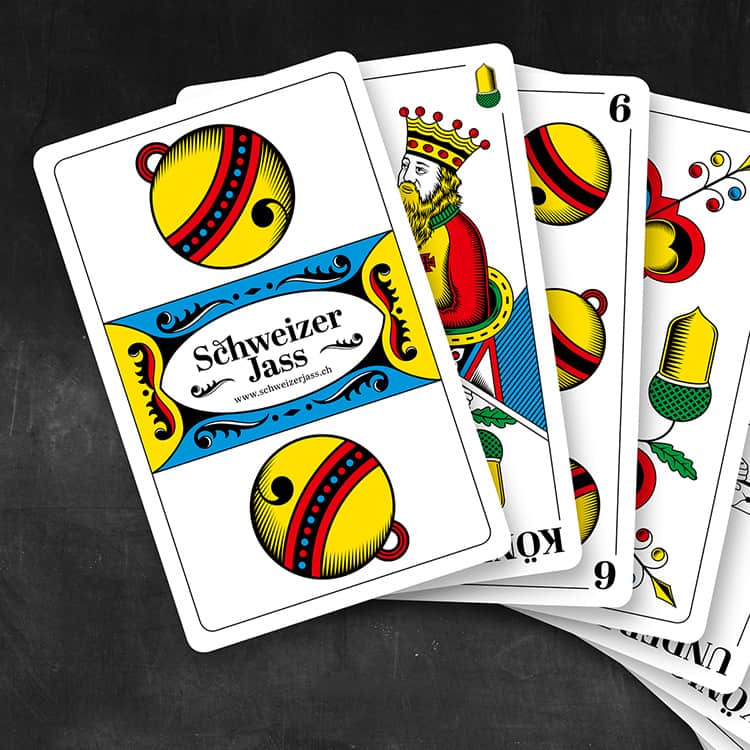

 Swiss Jass cards | |
| Type | Point-trick |
|---|---|
| Players | 4 (variants: 2-6) |
| Skills | Tactics & Strategy |
| Cards | 36 |
| Rank (high→low) | A K O U B 9 8 7 6 |
| Play | Counter-clockwise |
| Playing time | 45 minutes - 1 hour |
| Chance | Medium |
| Related games | |
| Belote • Klaverjas | |
Jass (German pronunciation: [ˈjas] ⓘ)[1] is a family of trick taking, ace–ten card games and, in its key forms, a distinctive branch of the marriage family. It is popular in its native Switzerland as well as the rest of the Alemannic German-speaking area of Europe, Italian South Tyrol and in a few places in Wisconsin, Ohio, California, Oregon and Washington USA.[2][3]
The most common variant of Jass is Schieber (in Vorarlberg also known as Krüzjass), which is played by two teams of two players each. It is often considered Switzerland's national card game, and is so popular there that the Swiss have come to apply the name Jass to trick-taking card games in general.[4]
It is estimated that there are over 70 variants of Jass.[5] The game is so widespread in Switzerland that it is regularly featured on radio and television, for example, radio programmes by SRF 1 and the weekly television programmes of Donnschtig Jass ("Thursday Jass") and Samschtig Jass ("Saturday Jass") on Schweizer Fernsehen.[6] An estimated 3 million Swiss play Jass regularly and it has been described as a Swiss national game.[7][8]
Distribution
[edit]Jass is popular throughout the Alemannic German-speaking area of Europe which includes German-speaking Switzerland, Liechtenstein, the Alsace region in France, Vorarlberg, the westernmost province of Austria, southwestern Germany (in the south of the state of Baden-Wuerttemberg), as well as in Romansh-speaking Swiss Graubünden and the French-speaking area of Switzerland and German-speaking South Tyrol in Italy. It is also played in a few places in the state of Wisconsin and in Tuscarawas County, Ohio, USA.[2][3]
Name
[edit]Jass, first mentioned in Switzerland in 1796,[1] was originally the name of the highest trump, the jack, in a family of related games originally spread from the Netherlands during the Late Middle Ages.
Today, Jass is the name of the game. The traditional 36-card, Swiss-German-suited pack with which it is played is called Jasskarten. By extension, Jass is often used of any game played in Switzerland with such cards. The jack of the trump suit is not known as Jass in the contemporary game. It is called Bauer, Trumpf Puur or simply Puur.
The name Schieber, the most popular variant, is from the verb schieben "to push", from the act of "pushing" the responsibility of choosing trumps on one's partner.
Deck
[edit]
Jass is played with a deck of 36 cards (A, K, Q, J, 10, 9, 8, 7, 6) Swiss-French or Swiss-German cards (A, K, O, U, B (= 10), 9, 8, 7, 6). The Swiss-German packs have an Ober, Under and Banner instead of the Queen, Jack and Ten of the French pack. The Swiss-French cards are in the ordinary French suits but have a distinctive design. The Swiss-German cards use Swiss suits, a variant of German suits, and also have a distinctive design. In Austrian Vorarlberg, cards of the Salzburg pattern are used (see illustration).
| Swiss-German (German) | |||
| Schellen | Rosen | Schilten | Eichel |

|

|

|

|
| Austrian (Bavarian) | |||
| Schellen | Herz | Laub | Eichel |

|

|

|

|
| French | |||
| Diamond | Hearts | Spades | Clubs |

|
.svg)
|

|

|
The game is traditionally played with Swiss suited playing cards east of the Brünig-Napf-Reuss line and with the French in western Switzerland. The Swiss suits are Rosen (roses) Eicheln (acorns), Schilten (shields) and Schellen (bells).[9]
Schieber rules
[edit]Jass is essentially a game of points which are scored for three features known as Stöck, Wiis, Stich, respectively, "marriages, melds, tricks".
To win, the player (or team) must be the first to reach a score of 2500 points (or whatever target score is agreed on beforehand). Play ceases the moment one side reaches the target score, for which purpose it is important to remember that scores accrue in order "marriage, melds, tricks".
The standard Schieber involves four players, sitting in two partnerships, opposite each other. 9 cards are dealt in batches of 3s.
Match type
[edit]Eldest (holder of 7 of Bells or Diamonds) may nominate the trump suit in the first match. The privilege of declaring trumps is passed around the table in counter-clockwise direction for each subsequent match (variant: each deal from the second onwards is made by a member of the side which won the previous deal, so that the losing team has the advantage of making trumps and leading first.[dubious – discuss])
The player who may nominate the trump suit may pass (schieben) the privilege to his partner, who must then exercise it. If elder leads without making any announcement, whatever is led becomes trump.
There are a number of conventional expansions of the type of play that can be chosen beyond the four trump suits, and modifications to the value of the tricks. Most commonly:
- It is usual to double all scores made in contracts with Schilten (Shields) or Schellen (Bells), which are the suits starting with Sch- (these are replaced by the "black" (schwarz) suits – Spades and Clubs – when playing with a French suit) as trump, treble contracts in "tops-down" and quadruple contracts in "bottoms-up". The game target may then be raised to 2500, or 3000.
- Schieber is usually played with two additional bids, Oben-abe and Unden-ufe, which may reasonably be translated respectively as "tops-down" and "bottoms-up". Both are played at no trump, so that there is no Puur (Under of trump) or Nell (9 of trumps), nor cards worth 20 and 14. Instead, all Eights count 8 points each when captured in tricks, thus maintaining the total of 157 points for tricks, including 5 for the last. In "tops-down", cards rank from Ace high to Six low and in "bottoms-up" their trick taking power is in reverse order, being Six the highest in its suit, and Seven the second highest, down to Ace. For Unden-ufe the point value of 11 may be transferred from Ace to the Six. Reversed ranking also applies to melds of equal length, that is, a sequence of 7 8 9 beats another of 8 9 10, although four Jack still count 200 and so beat all else. If the game is also using the rules for multiplying points outlined above, the points in Oben-abe are multiplied by three, and the points in Unden-ufe by four.
- A team taking all nine tricks score 100 extra for the "match" if they were the team that chose trump, thus a total of 257. If the team that didn't choose trump takes every trick, the number of points they win from Stich is doubled, on top of any other multipliers that may have already been considered. This is called a "counter-match".
- Another call that may be added is Misere , meaning "Misery". Play proceeds based on the rules for Oben-abe ("tops-down") meaning there is no trump, and points gained are not multiplied by anything. At the end of the hand, all points won from Stich are given to the opposite teams than that won them.
Tricks
[edit]The trump Jack, also called Puur, counts 20 and is the highest card in the game. The trump Nine or Nell is the second best card. Plain suit numerals below 10 count nothing. The total value of all counters in the pack is 152, that is, 62 in trumps plus 30 in each plain suit. Winning the last trick scores an additional 5 points. Hence the total possible for the third scoring feature, "tricks", is normally 157 points.
- The rank of the cards, from highest to lowest, and their values in card points are shown in the following table:
| Plain suit rank | A | K | O/Q | U/J | 10 | 9 | 8 | 7 | 6 | ||
|---|---|---|---|---|---|---|---|---|---|---|---|
| Value | 20 | 14 | 11 | 4 | 3 | 2 | 10 | 0 | 0 | 0 | 0 |
| Trump suit rank | U/J | 9 | A | K | O/Q | 10 | 8 | 7 | 6 |
The no-trumps game called Obenabe and Undenufe, in which the ranks are reversed, are shown in the following table:
|
|
Marriage
[edit]- Marriage (Stöck): A marriage is the holding in one hand of the König and Ober (King and Queen) of trumps. Its holder claims it upon the second of them to a trick. Its score of 20 is recorded as if made before those for melds and tricks, even though it is not revealed until after melds have been declared.
Melds
[edit]- Meld (Wys or Weis): A meld is a suit-sequence of three or more cards, or a quartet of Aces, Kings, Queens, or Jacks scoring as follows:
- Four Jacks: scores 200
- Four 9's: scores 150
- Five or more in suit sequence: scores 100
- Four A, K, Q, 10: scores 100
- Four in suit sequence: scores 50
- Three in suit sequence: scores 20
A card may not be used in two melds at once, though the trump King or Queen may belong to a meld in addition to being married, that is, a player holding four Kings and a sequence of four to the Ace or King would count only 100 for Kings, not also 50 for the sequence.
- Only the holder of the best meld may score for it, but he may also score for any other melds he holds involving entirely different cards, and in a partnership game, his partner also scores for those held by his partner. The holder of the best meld is found in the following way as each player contributes a card to the first trick. The leader declares the value of his best meld. The next, upon playing his card says "good" (gut) if he can't beat; otherwise he declares a higher value or the same value and the number of cards it contains. A longer meld beats a shorter, so the previous player then says "not good" if he can beat it, "good" if he can't, or "equal" (gleich). If equal, the next states its rank if a quartet, or its top card if a sequence. A higher rank beats a lower, and the previous player again says "not good". "good", or "equal". Equality must mean a sequence is in question, which the second player can then only win by truthfully announcing "in trumps". Otherwise, all else being equal, the previous player wins by prior position. The next player in turn then competes, if he can, with the winner of the first contest. As before, the pecking order is: value, length, height, trump, position.
Play
[edit]Eldest leads to the first trick and the winner of each trick leads to the next. The trick is taken by the highest card of the suit led, or by the highest trump if any are played. If trumps are led, suit must be followed if possible, except that a player whose only trump is the trump Jack (also called Puur, Buur or Bauer), need not play it but may discard any card instead. If a plain suit is led, players must follow suit or trump, as preferred, but any trump played must be higher than any other already played to the trick. Only if unable to follow suit may any of the players then renounce.
Tactics
[edit]The tactical elements of the Schieber derive mostly from the situation of two players each needing to cooperate without seeing, or being allowed to communicate about, the hand the other is holding. The choosing of the trump suit at the beginning of each match is a crucial decision. If the choosing player holds a mediocre hand, he must decide whether to make the call and hope that his partner holds at least some of the cards his hand is missing, or whether to "push" (schieben) the responsibility away in the hope that his partner has an unambiguosly strong hand.
Once the match is in progress, players need to keep track of which cards have been played, especially which card of each suit is currently the highest left in play and which trumps have been played. If the player in the lead plays a card that is certain to take the trick (called a Bock), the partner needs to recognize this and contribute as many points to the trick as he can (known as Schmieren, see schmear) without sacrificing valuable cards that he may still need to use for taking a later trick.
Two-hand variants
[edit]Schaggi Haas
[edit]In Schaggi Haas ("Johnny Hare"), the two players cut every time for the deal; the player with the lowest card deals 12 cards each in packets of 4, turns the next for trump and then deals one more packet of 4, face down as a personal talon. The remaining 3 cards are placed face down and half-covering the trump upcard. A player with the trump 6 may 'rob' the trump upcard. Players may attempt to 'better' (bessern or schönern) their hand by discarding 4 hand cards and picking up their talon. The discards do not count to their score at the end. Forehand (non-dealer) leads to the first trick. Melding and play are as per normal. A player who takes all 12 tricks does not get a Matsch bonus as not all the cards are in play. The last trick scores 5 and game is 1000.[10]
Schmaus
[edit]Schmaus is the Swiss Jass version of Tartl. In each deal, 9 cards are dealt to each of the two players in packets of three, and the remaining 18 cards form the stock. The top card of the stock is turned for trump. This card can be 'robbed' (rauben) by the trump Six until the 9th trick. The bottom card of the stock may not be viewed by either player; if it is, the cards are redealt by the same dealer. The non-dealer leads a card of his choice, but not a trump.[a] Suit need not be followed nor must a trump be played if a player cannot follow. Whoever 'brings home' (Heim bringt) the respective trick takes the top card from the stock. The loser draws the second. The first nine deals are played with 9 cards each. Melding is allowed in each of the first 10 tricks, provided that new melds arise from one deal to the next. Only player with the higher meld scores for it and only one meld may be made per trick. Melds must be made in rising sequence from trick to trick. (The clever Schmaus player makes most of his points by skilful declarations of card combinations!) The player who wins the 9th deal, leads to the 10th. At this point the stock is exhausted and players must follow suit or trump if unable to follow. Game is 1000 or 1500 points as agreed. The winner of a deal, deals next.[11]
Zweier-Sidi
[edit]A Jass variant for 2 players. The game is played with 36 cards, six are dealt face down to each player, six face up on top of the downcards and six dealt to each player's hand. So there are 12 cards in front of each player. The cards are dealt in groups of three, three face down to the non-dealer, three to the dealer, three more to the non-dealer, etc. Before the game begins, players bid, i.e. estimate how many points they will score in the deal. Non-dealer starts the bidding with an announcement of at least 60 points. The dealer must fold or outbid this bid by at least 5 points. Either a suit game, obeabe or undeuf is played. Every type of trump counts singly; there is no melding and Stöck does not count. The maximum score is 157. The player with the highest bid starts. He first determines trumps and then leads off. After a card lying on a face-down card has been played, the card underneath it is revealed. At the end of the game, the points are added together and compared with the bid. If the score achieved is higher than the bid, the difference is scored by the declarer. If the number of points is lower than the bid, the opponent scores the points that the bidder undershot. Game is 50. Example: The bid is 100 points. If the bidder reaches 105 points, he scores 5 points. If he reaches 90 points, his opponent scores 10. One tactic is to play the cards on the table where possible to reveal the cards underneath.
Three-hand variants
[edit]Königsjass
[edit]Jass variant for three. Each player receives 3 cards thrice, the remaining 9 go to the talon. The top card of the talon is the trump card. A player with the trump Six may take the trump upcard and replace it with the Six. In addition, all players may decide in turn whether they want to exchange their hand for the talon. If a player decides to do this, he lays his cards away and picks up the talon. The player with the Six can still swap it at this point. Then the game begins. Each player plays alone and generally to 1000 or 1500 points, but also to other target scores depending on the situation.
Schaffhauserjass
[edit]An older variant for 3 players—1 vs. 2. The solo player begins the game as the dealer. 12 cards are dealt to each player, three at a time; the dealer turns up the last card to make trump. The solo player must score 350 points and the two-player team 1,000. The first to reach their goal wins. Melds are valued as per the basic rules, but the solo player does not need to win a trick to score their melds. The team that takes all tricks in a round earns an additional 100 points. Schaffhauser is typically played in sets of three games, with each player in turn being the solo player.[3]
Unnamed 3-Hand Variant
[edit]Cards are dealt as if four players are present (nine to each hand in sets of three), and one hand is left aside. Trump is called as normal, though instead of having the option to pass, the player calling trump may choose to switch their hand for the spare hand set aside at the beginning. If they decide to switch, they may no longer look at their original hand or switch back. This variation forgoes consistency in the strategies used for consistency in the rules of the game. Remembering which cards have been played in order to know with certainty how powerful your own are is no longer feasible, as there are nine cards that are not being played and which cannot be known by most players. The advantage is that this variation changes very little about how the game works, which makes it easier to learn quickly.
Mittlerejass
[edit]12 cards are dealt to three players. Tricks follow the usual Swiss-Jass trick rules. First card to break suit sets trump. If a non-trump is led, and second player plays a trump, third player can only play a lower trump if void of the original suit. No Stöck or Weissen. The aim is to avoid being in the middle position for total captured card points each round: Middle player gets -2 game points, and highest and lowest pt total gets +1 game points apiece. Going over 100 card-pts or getting no tricks will get you -2 (with +1 for the other two players) as well. The game may also be played without negative points ("Plus-Minus"), or by four players (called "Molotow", though different from the 4p game described below).[12]
Four-hand variants
[edit]Coiffeur
[edit]A corruption of Quoi faire? ("what shall I play?),[citation needed] Coiffeur is a four player compendium game played in partnership. All the contract options must be played once per game by each partnership. The partnership that determined the type of contract scores the points they achieve.[13]
Differenzler
[edit]After assessing their cards, players must announce an amount, which they have to get as close to as possible. This variant is played in the popular show Samschtig Jass ("Saturday Jass") on Swiss TV.
Hindersi-Jass
[edit]Hindersi-Jass or Hintersich-Jass is an unusual older 'reverse' variant for four players in which the aim is to score the fewest points; however a player taking all tricks wins the deal, scoring zero, while the rest score 157 each. Players are dealt 9 cards each in packets of three and the last card is turned for trump. As usual, forehand leads and players may either follow suit or trump, but may only discard if unable to follow. Undertrumping is only permitted if the led suit is not held (this is the usual rule in reverse Jass games). The players with the two lowest scores after a partie of four games are each given a mark (Strich); the players with the two highest scores receive a minus mark (Nuller or Minusstrich). After 4 or 8 parties the winner is the player with the most marks. There is also a variant for three players.[14]
Molotow
[edit]Molotow is a type of Jass for 4 players. The trump card (in the 1st or 2nd round) is determined by the suit played by the first player who is unable to follow suit (i.e. play a card of the same suit as the first card played in this round).
The goal of Molotow Jass is to score as few points as possible. The so-called table melding (Tischweis) poses an additional difficulty in order to achieve as few points as possible. If there is a meld on the table at the end of the round, the player who takes the trick scores the points for the meld as well. As an additional rule, it can be agreed that the players have to change their seats after each round based on the points achieved so far. Especially in smaller or public spaces (railway carriage compartments, cafés etc.) this can on the one hand attract the attention of other people and on the other hand can loosen up the game.
NASA Jass
[edit]A Jass game for 4 players. The basic idea of this variant is to make the game more difficult yet more interesting by incorporating a quiz. As well as playing normal Schieberjass, players must answer quiz questions in the following way: the player who leads poses a question from the area of general knowledge, which then goes around. If an opponent knows the answer, he gets 20 points, if the partner knows the answer, he gets 40 points, if nobody knows the answer, there are 10 penalty points for the questioner or 10 points are awarded to the opposing team. The name of this type of Jass refers to the fact that, as with NASA pilots, several tasks have to be performed simultaneously. The relatively new type of Jass was developed in student circles and can be modified by, for example, asking a question for each "hand" or by asking questions only from individual areas. Colloquially, this variant is called Nase in Switzerland, especially in the canton of Bern.
Palette Jass
[edit]Variant for 4 players (variant for 5 players, see Jass rules Puur-Näll-As). Each player bids in turn based on the cards they have received. The highest bidder takes over as the declarer and starts the game. He can ask for a card. The player with the requested card becomes the declarer's partner, but must not reveal this. Accordingly, he keeps the requested card so that it is only clear when this card is played who is playing with whom. Each deal is scored separately and generates a score for the Jass slate. The declarer receives the following points: 110–119 = 2 game points, 120–129 = 4 game points, 130–139 = 6 game points, 140–149 = 8 game points, 150–157 = 10 game points. Matsch with partner = 12 game points, Matsch as soloist = 20 points. The partner of the declarer receives half of the points. If the target is missed by the declarer, he scores the same amount in minus points. After two rounds (with everyone dealing twice), the loser is determined based on the lowest total number of points. For tips, strategies and 65 other types of jass see AGM AGMüller's Puur-Näll-As Jass Rules.
Pandur
[edit]In Pandur, four players usually play, but only three are active in the game, and each in turn sits out the hand to which he deals. The scorekeeper deals first, giving 8 cards to each player in batches of 4s from a 24-card pack made by stripping out all ranks below Nine. I addition to the usual melds, a player may announce a sequence of six or a quartet of Nines, each counting 150 points. Only the soloist may score for melds, provided that he has the best, that is, if an opponent has a better meld, it does not score itself but only prevents the soloist from scoring.
Each in turn, starting with eldest, may bid or pass, and having passed may not come in again. The lowest bid is 100 and higher bids must be multiple of 10. A numerical bid is the minimum amount the soloist undertakes to make for "marriages, melds and tricks" in return for nominating trumps and leading to the first trick.
A bid of 200 is overcalled by misère, then trumps misère, then 210 etc. In misère, the soloist must lose every trick, playing at no trump. In trump misère, the suit of the card he leads is automatically trump. Players are still required to trump when unable to follow suit, but are not obliged to overtrump. A bid of 250 is over called by Pandur, and 300 by Trump Pandur. In Pandur, the soloist must win every trick, playing at no trump and in Trump Pandur, the suit of the card he leads is automatically trump.
If successful, the soloist wins a number of game points equivalent to the bid divided by 50 (maximum 6). Misère count 4, Pandur 5, Trump Pandur 6. For a failed bid, the game value is credited to each opponent. Game is 15 points or any other agreed target. If four play, the dealer gets the value of a failed bid, but not if he stands at 13 or 14 points.
Each player drops out upon reaching the target, the game being played by three, then two. The last one left in loses the game.
Trump Misère is a bit dangerous and must be made in a very short suit, typically in order to lose a card that would be even more dangerous at no trump, that is, with three safe suits and a singleton Queen, the soloist would announce "trump" and lead the Queen. As the Jack and Nine are top trumps, this would only lose if one opponent held the 10 and the others were void. If played at no trump, there would be three cards lower than the Queen, making the bid very risky. When only two players remain, so that eight cards are out of play, any misère, is riskier than usual, especially with a trump.
Sechser–Schläpf
[edit]A normal game of Jass, except that it is played with hands of six cards rather than nine, hence the Sechser ("Sixer") in the name.
Sidi Barani
[edit]A Jass variant that is similar to Schieber, Sidi Barani is a game for 4 players, with the difference that it is not specified who can choose the contract. This right goes to the person who announces the highest score when bidding (similar to bidding in Skat). If the declarer and his partner reach this score (e.g. 120), they receive a bonus in addition to the declared number of points (e.g. 120). If they do not reach their target, the opponents receive the bonus. However, both teams score at least the points achieved. The opposing team has the option of doubling until the first card is led. If the opposing team doubles, the bonus applies twice. If the game is played for 120 points, for example, the winning team receives a bonus of 240 in addition to their score.
Veehändler
[edit]Jass for 4 players. All the cards are distributed evenly. In the first deal, the player with the Acorn Banner (Ten of Acorns) in his hand leads, then it rotates in turn. A total of three penalty points are awarded in each deal: the first point is given to the player who takes the first trick. The second penalty point goes to the player who captures the Bell Ober in a trick and the third penalty point goes to the player taking the last trick. The player who first reaches nine penalty points (or another number if agreed) loses the game and pays the forfeit. Suit must always be followed. The first player who is unable to follow, determines the trump suit by the card he deals. The trump card is always a suit, i.e. there is no Obeabe and Undeuf. If a player is dealt the Ober of Bells as his only Bell (Schällenober blutt), when the first card is played he may declare that he has the "nasty card" (s’fiise Chart). Now the player who beats the Ober of Bells gets a plus point. The nasty card does not have to be declared, but it is then more difficult to avoid getting a penalty point for ending up with it.
Six-hand variants
[edit]Sechser-Schieber
[edit]A variety of Jass for 6 (hence the name; Sechser = "Sixer") in 2 groups of 3 players. The game is played with 2 packs, each player receiving 12 cards. Basically, the game works the same as normal Schieber. If two cards are the same, the one that was played later wins. Up to three 'shoves' are allowed.
Multi-hand variants
[edit]Bieter
[edit]Bieter, known as Steigerer in Austrian Vorarlberg, is a game for 3 or 5 players, played in teams of 1 against 2 or 2 against 3. Players bid the number of points they hope to win and the highest bidder names a card of his choice. The player with that card becomes his partner and form the two-man team. In the five-hand game, the two-man team only needs to score the declared points to win, whereas the three-man team has to score 1000 points. This is the version that is most like Skat.
Chratze
[edit]Jass for 2 to 7 players, players receive 4 cards each and play for a pot, the Chraztze player (Chratzender) must take 2 tricks and the other active players one trick each. Related to Austrian Kratzen.
Fahnder
[edit]Fahnder is a variant of Jass for three or four players.
Guggitaler
[edit]Guggitaler is a Swiss Jass variant for 3 to 5 players. It is a compendium game in which the aim is to score as few points as possible. It is played without trumps. The game consists of several deals, each deal having different rules. In the first deal, each rose scores 5 points, in the second each trick is worth 10, in the third each Ober scores 20, in the fourth the Rose King scores 45 and in the fifth deal, all these scores are combined. In deals 1, 4 and 5 no Roses may be led as long as you have other cards in your hand. In the sixth deal, a Domino is played, which can change the entire distribution of points. The points distribution in Domino depends on the current point rankings. With 5 players, a card (usually a 6) must be omitted.
Handjass
[edit]Handjass, also known as Butzer, Schläger, Sackjass or, in South Tyrol, Sockn,[15] is a game for 2-5 players—every player for themself (cut-throat). The object of the game is to score 5 (or 7, 9) game points (also called points, strokes, lines, or rubs[3]). As each player counts out after scoring 5 game points, the last player remaining is the loser. With simple scoring, however, the first player to reach 5 game points is the winner.
Game points are scored +1; they are determined by card points won via tricks taken and melds scored. There are generally two game points available each round: one for each of the two highest scoring players. If the second score is tied, the tie can be broken by cutting the deck (high card is awarded the point). Some players house-rule that if the second highest score is tied, there is no tie-breaker and no point is scored. If only one player scores greater than 21 points (or if all but one player folds), that player is awarded two game points. If a player scores fewer than 21 points in a round, they are said to be "in the hole" and earn a negative game point (valued at -1). This negative point value is also called a null, potato, apple, or wheel.
The base rules of Jass for card rank, value, and melds apply. Before each round, each player must declare whether they're staying in or folding. If they fold and turn down their hand, they sit out that round. This can be done to avoid taking a negative game point and is an important strategic consideration as one gets closer to going out/winning.
For a 5 player game, remove the six of spades from the deck. Each player receives seven cards and the dealer turns up the last card as trump. Once a player reaches 5 game points, they count out or win (depending on the scoring type). For a 4 player game (and down), the deck is restored to 36 cards and each player is dealt nine cards. For a 3 player game, each player receives nine cards, but one becomes the blind/talon/stock. Turn up the top card of the blind to determine trump. The player holding the six of trump may rob (exchange) the turned up trump. A player may exchange their hand with the blind, but they must play the hand if they do. In a 2 player game, deal as in a 3 player game, but one hand becomes the blind/talon/stock and the other hand is dead/out-of-play. In the 2 player game, a common house rule is that melds may be scored without taking a trick.
The 2-3 player game can also be played by dealing 12 cards to each player. There is no blind in a 3 player game, but each player must now score 31 card points to stay out of the hole. Dealer turns up the last card as trump. In a 2 player game, the top card of the blind is turned up to make trump.
Klammern
[edit]Game variant for 2 to 4 players. The game scores, as in darts, up to 301, 501 or 1001. The goal is to be the first to cross the line. In addition, the attacking player who chooses trumps must score more points than his opponent. Otherwise, the points are taken by the opponent.
Kreuzjass
[edit]Most popular card game in the west Austrian state of Vorarlberg.[16] Four play in teams of two. Unlike Schieber, the privilege of choosing the trump suit may not be passed to one's partner and trumps are chosen instead by cutting. It is played to 1,000 points.
Ramsen
[edit]Not really a true Jass game, but a form of Rams played during week between Christmas and New Year (Altjahrwoche) primarily in the Upper Basel region (played for Schüfeli or salami), but also in Emmental, from the upper Lake Brienz to Meiringen, in Obwalden, in Oberaargau and in the German-Freiburg Sense District (played for sausages).
Schellenjass
[edit]Literally "Bell Jass", this is a variant for 2 to 4 players, where the aim is to avoid capturing Bells or to take all nine. If a player manages to collect all nine Bells, that is, to make a Turi, he is credited with three lines on the slate, while the other three players are empty-handed. The game is played without trumps and a Bell may only be discarded if a player can no longer follow suit. If Schellenjass is played with French-suited cards, Hearts are chosen as the relevant suit, the game is then called Herzjass.
Zuger
[edit]Zuger is a cutthroat game of temporary alliances for 2–4 players. The object of the game is to have the most points before the total score reaches 100. Meld and Stöck rules apply. The Groß Weis is standard and kreuzweis is valid. Zuger uses simple scoring where the ones unit is dropped, e.g., 123 = 12.
If 4 players are participating, the dealer sits out the round (and receives 10 points in exchange). Each player is dealt 12 cards, with the last card turned up as trump. Before play begins each player must announce whether they're staying or folding. Players may also announce “maybe” – meaning they play only if another player folds. If 2 players stay, they may agree to share 7 points each and split the meld points. Melds worth ≤ 50 points are typically shared, but many players opt to keep higher scoring melds for themselves (Stöck is rarely shared). The second player can be bribed with or demand a greater share of the trick points, divvied up from a total of 14 points. If all 3 players remain, they can negotiate as above, but only if all agree – this ends the round.
The player with the fewest points may force all players to stay if another player is within 14 points of winning.
A player who folds cannot score any points, but avoids a −10 point penalty for going “in the hole.” If all but one player folds or if one player scores a match (takes all tricks) they score a 10-point bonus. In a 3 player game, if one player fails to win a trick, the player holding the Bauer scores an 8-point bonus. The game is over when the sum of all points equals 100. Simple scoring is used, e.g., 127 = 12, a 100-point meld is worth 10 points, etc. Odd numbers are further rounded or the difference is given to the player holding the Bauer.
Older variants
[edit]Other, older Jass variants include Fischentalerjass, Bäretswilerjass, Schaffhauserjass, Raubjass, Zebedäusjass and Zugerjass.[17]
See also
[edit]Footnotes
[edit]- ^ This is not mentioned by Müller.
References
[edit]- ^ a b David Parlett The Oxford guide to card games, pg. 292-293, David Parlett (1990) ISBN 0-19-214165-1
- ^ a b Miles, Dan (19 January 1966). "Clabber or Klob – It's All Jass". The Daily Reporter. Dover, New Philadelphia. pp. 1, 8. Retrieved 2 May 2021.
- ^ a b c d Dusini, Frank L. (12 January 1997). Jass for Beginners. Dover, Ohio.
{{cite book}}: CS1 maint: location missing publisher (link) - ^ The game of Tarot: from Ferrara to Salt Lake City, p. 568, Michael A. E. Dummett, Sylvia Mann - 1980 ISBN 0-7156-1014-7
- ^ Goop (2010), p. 13.
- ^ Müller (2016), jacket and p. 10.
- ^ "Jassen" in Schweizer in Island at schweizerinisland. Retrieved 14 August 2020.
- ^ Spielerisch Jassen lernen at agm.ch. Retrieved 14 August 2020.
- ^ Ralph Scotoni, Swiss Suited Playing Cards.
- ^ Müller (2016), pp. 110–111.
- ^ Müller (2016), pp. 127–129.
- ^ "Mittlere Jass - card game rules".
- ^ Coiffeur-Schieber Jass at pagat.com. Retrieved 1 August 2020.
- ^ Müller (2016), pp. 86–87.
- ^ Bleckl at play.google.com. Retrieved 25 September 2022.
- ^ Alle Vorarlberger Jass-Arten einfach erklärt! at jassa.at. Retrieved 25 September 2022.
- ^ See the relevant article in the Schweizerisches Idiotikon, Vol. III, col. 70.
Literature
[edit]- Goop, Adulf Peter (2010). Jassen: ein wichtiges Stück Volkskultur in Eintracht, pp. 11–30. (in German).
- Müller, Dani (2016). Stöck, Wys, StichLenzburg: Fona. (in German).
- McLeod, John and Michael Dummett. (1975). "Rules of games series: 1. Jass" in The Journal of the Playing-Card Society. Vol. III, No. 3. February, 1975. pp. 21–33. (in English).
External links
[edit]- McLeod, John, ed., Jass Group, Card Games Website
- Jass English explanation of rules and play
- Aelpler Gruppe Swiss Club Jass Events in SF Bay Area


History and Origins
Etymology and Early Mentions
The term "Jass" derives from the Dutch word "Jas(s)," a diminutive form of "Jasper," applied to the jack (knave or Bauer), which serves as the highest-ranking trump card in the game.[11] This nomenclature was first documented in the Netherlands in 1721, marking an early reference to the game or its key card in Dutch-speaking regions.[11] Card games themselves likely trace their roots to Arab origins, entering Europe through 14th-century France and developing into trick-taking variants, including Piquet as an early exemplar that influenced marriage-style games like Jass. From these foundations, Jass emerged as a distinct branch emphasizing melds and trumps, with the jack's prominence reflecting the game's focus on hierarchical card values. The earliest known Swiss reference to Jass appears in 1796 records from Schaffhausen, involving a legal dispute where priest Father Peyer sued farmers Max Tanner and Sebastian Weber for unpaid gambling debts from a game played "around a glass of wine."[3] This incident highlights Jass's early association with social wagering in rural Swiss communities.[3] In the popular Schieber variant of Jass, the name stems from the German verb schieben, meaning "to push" or "to shove," describing the bidding process where the first player may defer the selection of the trump suit to their partner.[12] Jass employs distinctive Swiss-German suited decks with symbols such as bells, shields, acorns, and roses, adapting the game to regional card traditions.[3]Development in Switzerland
Introduced to Switzerland by Protestant mercenaries from the Netherlands in the late 18th century, Jass rapidly gained traction in the 19th century as Switzerland's most popular card game, particularly spreading through the Alemannic German-speaking regions such as Schaffhausen, Solothurn, and broader German-speaking cantons where it supplanted earlier games like Troggen (Tarot).[3] By mid-century, its appeal stemmed from adaptable rules that resonated with local social customs, fostering widespread play in taverns and homes across these areas. Regional dialects and suit preferences—such as Swiss-German designs (e.g., shields, acorns)—influenced these developments, contributing to localized variants like Krüzjass in Vorarlberg, Austria, and similar adaptations in Alsace, France, where Alemannic linguistic ties preserved cross-border similarities.[13] Jass's expansion extended to the Swiss diaspora through 19th-century immigration waves, with communities in Wisconsin—particularly New Glarus and Monroe—adopting Jass in taverns and social clubs to maintain heritage, while similar patterns emerged among settlers in Ohio's Wayne County.[14][15]Distribution and Popularity
Geographic Spread
Jass is predominantly played in the Alemannic German-speaking regions of Europe, where it has become a staple of local card-playing culture. In Switzerland, the game is widespread across all cantons, serving as the country's de facto national card game and enjoyed in both urban and rural settings.[16] Adjacent areas include Liechtenstein, where Swiss-suited decks are commonly used, and Vorarlberg in Austria, the westernmost province, which employs single-ended German-suited cards for its variants.[16] The game's reach extends to Alsace in France, influenced by cross-border Swiss-German traditions, as well as southern Baden-Württemberg in Germany and South Tyrol in Italy, reflecting the linguistic and cultural ties of the Alemannic dialect area.[17][18] This geographic concentration is largely attributable to the Alemannic German-speaking influence, which has acted as the primary vector for Jass's dissemination since its emergence in late 18th-century Switzerland.[13] The dialect's prevalence in these border regions has facilitated adaptations while maintaining core mechanics, with play documented in community gatherings and taverns.[1] Beyond Europe, Jass has spread through Swiss diaspora communities, particularly among immigrants in the United States. In southern Wisconsin, including the Swiss settlement of New Glarus—founded by emigrants in the 1840s—the game is regularly played, preserving traditions from the homeland, such as at historic taverns like Baumgartner's in nearby Monroe.[14] Similarly, in Tuscarawas County, Ohio, Swiss descendants engage in Jass alongside other card games, as evidenced by local family and community records.[19] Minor expansions have occurred via tourism, expatriates, and international Swiss clubs. For instance, the Canberra Swiss Club in Australia hosts Jass tournaments, including one on April 12, 2025, to foster community ties among expatriates.[20][21] These outposts highlight Jass's portability, though they remain niche compared to its entrenched European base.Cultural Role in Switzerland
Jass holds a prominent place as Switzerland's unofficial national card game, deeply embedded in the country's social fabric and identity. Widely regarded as the most popular card game in the nation, it is played by an estimated 3 million Swiss residents regularly according to a 2012 survey, transcending age and gender to foster community and relaxation in everyday settings.[22] In Swiss German, the term "Jass" has evolved to generically denote trick-taking card games, reflecting its pervasive influence on local gaming culture.[4][16][22] The game thrives in social contexts, from intimate family gatherings and cozy evenings at home to lively sessions in taverns, pubs, and mountain huts, often accompanied by traditional elements like cigars to enhance the convivial atmosphere. During festivals, particularly the Fasnacht carnivals, Jass integrates into celebratory traditions; for instance, specialized Schwyzer Fasnachts-Jass decks, featuring local carnival figures and masks from the canton of Schwyz, have been produced to commemorate these events, with editions dating back to at least 1991 and continuing in cultural relevance. On Swiss National Day, August 1st, variations like "La Pomme"—a simplified two-player adaptation—are promoted as family pastimes, underscoring Jass's role in reinforcing communal bonds during national festivities.[5][6][9][23] Jass also enjoys significant media visibility, amplifying its cultural stature through television programming that celebrates Swiss heritage. Shows such as Samschtig-Jass, a long-running weekly series since 1981 on SRF, feature celebrity guests and interactive Jass rounds alongside entertainment segments, positioning the game as a "national sport" that unites viewers. Similarly, Kilchspergers Jass-Show pits prominent Swiss personalities in team-based tournaments, blending competition with cultural showcases to highlight the game's enduring appeal. Despite regional variations—such as the use of French-suited cards in western Switzerland and German-suited ones in the east—Jass symbolizes national cohesion, bridging linguistic divides in German-, French-, and Italian-speaking areas by providing a shared recreational language amid Switzerland's multicultural diversity.[24][25][22][4]Deck and Equipment
Standard 36-Card Deck
Jass is played with a standard 36-card deck derived from a shortened French-suited or Swiss-German-suited pack, consisting of four suits each containing nine ranks: 6, 7, 8, 9, 10, Unter (jack), Ober (queen), king, and ace.[16][26] The suits are typically hearts, diamonds, clubs, and spades in French versions, or acorns, bells, shields, and roses in Swiss-German versions, though the exact artwork does not affect gameplay mechanics.[16] This deck totals 152 card points, with an additional 5 points awarded for the last trick in the standard Schieber variant, bringing the maximum per deal to 157 points.[16][26] In non-trump suits, cards rank from ace (highest) down to 6 (lowest), with point values assigned as follows: ace = 11, 10 = 10, king = 4, ober = 3, unter = 2, and 9 through 6 = 0 each.[16][27] When a trump suit is declared, its hierarchy becomes unique to Jass: the unter (jack) ranks highest at 20 points, followed by the 9 at 14 points, ace at 11, king at 4, ober at 3, 10 at 10, and 8 through 6 at 0 each, while any trump outranks all cards of non-trump suits regardless of rank.[16][26][27] The following table summarizes the point values and ranking in both contexts:| Rank | Non-Trump Points | Trump Points | Trump Rank Order |
|---|---|---|---|
| Ace | 11 | 11 | 3rd |
| 10 | 10 | 10 | 6th |
| King | 4 | 4 | 4th |
| Ober | 3 | 3 | 5th |
| Unter | 2 | 20 | 1st (highest) |
| 9 | 0 | 14 | 2nd |
| 8 | 0 | 0 | 7th |
| 7 | 0 | 0 | 8th |
| 6 | 0 | 0 | 9th (lowest) |
Suit Variations and Regional Decks
In the German-speaking regions of Switzerland, Jass is predominantly played with decks featuring the traditional Swiss-German suits: acorns (Eicheln), bells (Schellen), roses or hearts (Rosen), and shields (Schilten).[16] These suits replace the standard French symbols, with acorns corresponding to spades, bells to hearts, roses to clubs, and shields to diamonds in terms of gameplay ranking.[16] The artwork often emphasizes regional motifs, such as heraldic shields and floral designs, maintaining the 36-card structure from 6 to ace in each suit.[16] In the French-speaking region of Romandy (western Switzerland), players use Swiss-French suited decks with the conventional French symbols: hearts, diamonds, clubs, and spades.[16] These decks preserve the same ranks and point values as the Swiss-German variants but adapt to local preferences through distinct artistic styles, such as simplified court figures influenced by Parisian patterns.[16] The correspondence aligns hearts with bells, diamonds with shields, spades with acorns, and clubs with roses for consistent trump and suit play across regions.[16] Regional adaptations extend beyond Switzerland. In Alsace (France), bordering Switzerland, Jass variants employ German-suited decks with hearts, bells, acorns, and leaves, blending French and Swiss influences in the artwork while adhering to the 36-card format.[17] Similarly, in Vorarlberg (Austria), adjacent to eastern Switzerland, decks use standard German suits of hearts, bells, leaves, and acorns, often in a single-ended Salzburger pattern for practical play.[16] Custom decks, such as the Schwyzer Fasnachts-Jass, incorporate thematic elements like carnival masks and costumes from the Schwyz canton's annual festival, created by artist Léon Schnyder in a 36-card Swiss-German suited edition.[9] All these suit variations maintain compatibility with the core 36-card Jass deck, ensuring interchangeable use in standard four-player games.[16] However, multi-hand variants for more than four players, such as six- or eight-player formats, typically combine two decks to accommodate the increased participant count.[16]Core Rules: Schieber Variant
Match Types and Bidding
Schieber Jass is played by four players divided into two fixed partnerships, with partners sitting opposite each other across the table.[28] The objective is for a partnership to be the first to reach 2500 points over a series of deals, with points accumulated from tricks, bonuses, and declarations.[28] In some regional or tournament settings, the target may be adjusted to 1000 points or structured around a fixed number of 12 rounds, but 2500 points is the standard long-game goal.[28][29] The dealer shuffles the 36-card deck and deals nine cards to each player in three rounds of three cards each, proceeding counter-clockwise starting with the player to the dealer's right (forehand).[12][26] After the initial deal, bidding determines the contract, including the trump suit or no-trump play, and any multipliers that affect scoring.[12] The forehand player initiates bidding by selecting a trump suit for a normal "tops-down" (Obenabe) contract, where card ranks follow the standard order (Unter highest in trumps, followed by 9, Ace, 10, King, Ober, 8-6), or by passing.[12][28] In tops-down, suits like acorns or roses count as single multipliers, while shields or bells double the points in a 2500-point game.[12] A "bottoms-up" (Undenufe) contract is a no-trump play with reversed ranks in all suits (6 highest to Ace lowest), carrying a quadruple multiplier, though it requires agreement among players as it is more advanced.[12][26] Misère is a no-trump bid where the declarer's partnership aims to avoid taking any tricks, often used in variations to add risk and is worth a high point value if successful.[30] If the forehand passes, they may invoke "Schieben," transferring the right to choose the trump or contract type to their partner, who then decides without further bidding.[12][28] This mechanic emphasizes partnership communication, as the non-dealing forehand effectively pushes the decision to their teammate.[12] Additionally, players may declare "Weis" before the first trick to announce melds such as sequences of three or more consecutive cards (20 points for three, 50 for four, 100 for five or more) or four cards of the same rank (100-200 points depending on the rank, with four Unders highest at 200), earning bonus points multiplied by the contract factor.[12][28] Only the highest Weis per partnership scores, preventing double-counting, and it must be declared openly upon the lead of the first card.[12] These elements collectively shape the strategic depth of bidding, balancing risk with potential rewards in the partnership dynamic.[12]Dealing and Trump Selection
In Schieber Jass, played by four players in fixed partnerships of two, the dealer shuffles the standard 36-card Swiss Jass deck and offers it to the player on their left (rearhand) for a cut of at least three cards. The dealer then deals nine cards to each player face down in a counter-clockwise direction, typically in three rounds of three cards each, beginning with the forehand (the player to the dealer's right).[12][31] Following the deal, the forehand selects the trump suit from the four available suits—acorns, bells, roses, or shields—or chooses to "schieben" (shove or pass), thereby transferring the responsibility to their partner without any communication between partners.[12][31] This selection determines the elevated ranking and power of the chosen suit for the hand, with options sometimes including variations like obenabe (top-down, normal order) or undenufe (bottom-up, reversed order with no trumps).[12] The forehand leads the first trick with any card, and subsequent tricks are led by the winner of the previous trick, with play proceeding counter-clockwise around the table.[12][31] A re-deal is required in cases of misdeal, such as an incorrect number of cards distributed, or if cards are prematurely exposed during shuffling, cutting, or dealing.[31] In the initial hand of a session, the holder of the seven of roses serves as forehand regardless of seating, after which the deal rotates clockwise.[12]Trick-Taking and Play
In Schieber Jass, the player to the dealer's right leads to the first trick by playing any card from their hand, and the winner of each subsequent trick leads to the next.[12][29] Each of the four players contributes one card per trick, proceeding counterclockwise, resulting in exactly nine tricks per deal since each player holds nine cards.[12][30] Players are obligated to follow suit to the led card if they hold any card of that suit. If unable to follow suit, a player may play any card, including a trump. A trump may only be played if the player is void in the led suit or if the led suit is trumps. When a trump is led, players must play a trump if they hold one, except if the only trump held is the trump Unter, in which case any card may be played instead.[12][29][28] Failure to adhere to these following obligations constitutes a revoke, resulting in penalties such as the loss of all tricks for the offending team.[12] A trick is won by the highest card of the suit led if no trumps are played, or by the highest trump if any are played to the trick, with the trump suit following its specific hierarchy where the Unter (Jack) ranks highest, followed by the Nine, Ace, Ten, King, Ober (Queen), and the numbered cards from 8 to 6.[12][29][30] The cards from the won trick are collected by the winner, who then leads to the next trick, and play continues until all cards have been played.[28][30]Scoring: Last Trick, Marriages, and Melds
In Schieber Jass, scoring is based on points accumulated from captured tricks, special bonuses, and declared combinations, with a total of 157 base points available per deal. Each card contributes to the trick score according to fixed values: in non-trump suits, the ace is worth 11 points, the king 4, the ober (queen) 3, the under (jack) 2, the banner (10) 10, and the 9 through 6 zero; in the trump suit, the under is elevated to 20, the 9 to 14, the ace to 11, the 10 to 10, the king to 4, the ober to 3, and the 8, 7, and 6 at zero. In no-trump contracts, each 8 is worth 8 points (instead of 0) to compensate for the absence of the trump under (20) and 9 (14). An additional 5 points are awarded to the team that wins the last trick, ensuring the base total reaches 157 points regardless of distribution.[29][12] Marriages, known as Stöck, provide a bonus for holding the king and ober of the trump suit, scoring 20 points per such pair and declared only when the first of the two cards is led to a trick. In French-suited decks used in some regions, the marriage consists of the king and queen instead. These points are multiplied by the contract factor in variants with bidding, such as doubling to 40 points, but only one marriage per partnership is scored as there is only one such pair per hand.[29][12] Melds, or Weis, are announced combinations revealed before the first trick and scored only for the partnership holding the highest-value one, with ties broken by the number of cards, trump priority, or forehand advantage. The possible melds include sequences of three or more consecutive cards in the same suit (20 points for three, 50 for four, 100 for five) and four of a kind in the same rank across suits (100 points each for aces, kings, obers, or banners; 150 for nines; 200 for unders). Representative examples include four unders (jacks) for 200 points or four banners (tens) for 100 points; three unders might score 100 in extended variants combining partial sets, but standard play prioritizes the single best meld per team. These values are also subject to the contract multiplier.[29][12] All scoring elements—trick points, last trick bonus, marriages, and melds—are multiplied by the contract factor agreed upon during bidding: single (×1), double (×2), treble (×3), or quadruple (×4), with some regional rules applying fixed doubles for certain trump suits like bells or shields. The first team to reach 2500 points wins the game, though subsets like 1000-point matches exist for shorter play; if both teams reach the target simultaneously, priority goes to the higher-scoring elements in order of marriages, then melds, then tricks.[29][28]| Meld Type | Example | Points |
|---|---|---|
| Sequence of 3 | Any three consecutive in suit | 20 |
| Sequence of 4 | Any four consecutive in suit | 50 |
| Sequence of 5 | Any five consecutive in suit | 100 |
| Four of a Kind | Four aces, kings, obers, or banners | 100 each |
| Four of a Kind | Four nines | 150 |
| Four of a Kind | Four unders (jacks) | 200 |