Recent from talks
Nothing was collected or created yet.
Truco
View on WikipediaThis article needs additional citations for verification. (February 2012) |
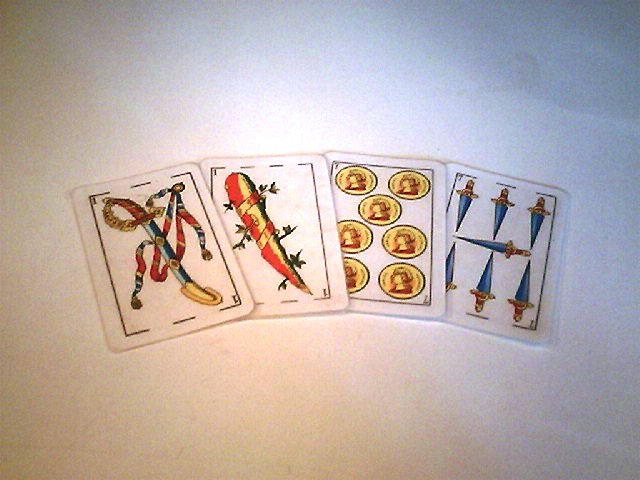
The four top cards in Truco | |
| Origin | Spain |
|---|---|
| Family | Trick-taking |
| Players | 2, 4, or 6 |
| Skills | Tactics, Strategy |
| Cards | 40 |
| Deck | Spanish, French (Some Brazilian variants) |
| Play | Anticlockwise |
| Playing time | 31 min. |
| Chance | Medium |
| Related games | |
| Aluette • Put • Truc • Truc y Flou | |
| Part of a series on the |
| Culture of Argentina |
|---|
| Society |
| Topics |
| Symbols |
|
|
| Part of a series on the |
| Culture of Brazil |
|---|
| Society |
| Topics |
| Symbols |
| Part of a series on the |
| Culture of Chile |
|---|
| Cuisine |
| Art |
| Literature |
| Music |
| Sport |
| This article is part of a series on the |
| Culture of Uruguay |
|---|
|
Uruguay Portal |
Truco, a variant of Truc, is a trick-taking card game originally from Valencia and the Balearic Islands, popular in South America and Italy. It is usually played using a Spanish deck. Two people may play, or two teams of two or three players each.
Card ranking
[edit]- Ace of Swords ("Espada" in Southeast of Brazil, "Espadão" in Southern Brazil, "Ancho de espada" in Argentina, "Macho" (male) in Paraguay, "Espadilla" in Uruguay)
- Ace of Clubs ("Hembra" (female) in Paraguay, "Ancho de basto" in Argentina, "Bastillo" in Uruguay, "Bastião" in Southern Brazil)
- 7 of Swords ("Siete de espadas", "Siete bravo" in Uruguay, "Manilha de espada" in South of Brazil)
- 7 of Coins (Siete de oros in Spanish or Sete ouro, Sete belo or Maneca de ouro in Portuguese, "Siete bello" in Uruguay)
- 3s
- 2s (known as "Perruchos" in Paraguay)
- Ace of cups and ace of coins (Anchos falsos in Spanish, Ás falso in Southeast of Brazil, Gueime in South of Brazil, "Buempes" in Paraguay, "Copon" and "Huevo frito" respectively in Uruguay)
- Kings (Reyes in Spanish and Reis in Portuguese) (12s)
- Knights (Caballos in Spanish) (11s)
- Jacks (Valetes in Brazil, Sotas in Argentina) (10s)
(the face cards of King, Knight and Jack are called Cartas negras) - 7 of clubs and 7 of cups (Sietes falsos in Spanish or Sete copa (seven of cups) in Portuguese, all cards from here down are considered "Cartas blancas")
- 6s
- 5s
- 4s (the 4 of clubs may be called Zap in the southeast of Brazil)
In southern and southeastern Brazil, the most popular variant, called Truco Paulista, uses dynamic card ranking.[1] The ranks from the 3s and downwards remain the same, but the four trump cards, called manilhas, are decided by flipping one extra card up after dealing, called vira. The four cards conventionally ranked immediately above the flipped one (or, in the case of a flipped 3, the 4s) become the strongest cards. Their rank is as follows: clubs > cups > swords > coins. This variant is popular because it makes it harder to cheat and can potentially turn a bad hand into a great one once the card flips.
The Uruguayan version uses a "Muestra" each hand. The following cards of the same suit as the "Muestra" are ranked higher than the Ace of swords and are called "Piezas": 2, 4, 5, Knight, which in some regions is called Perico, worth 30 points,[2] and the Jack, which in some regions is called Perica, worth 29 points.[3] Finally, if any player has the King of the same suit as the "Muestra" and the "Muestra" is a "Pieza", the King becomes that card.
The Venezuelan version is similar to the Uruguayan version, exception that the "Piezas" 2, 4, and 5 are not used.[citation needed] The "Muestra", or "vira" as it is known in Venezuela is designated by turning over the top card of the deck after shuffle or optionally, the top card following the deal. "La Vira" is then placed beneath the deck at right angles to it so that it is visible during the hand. The suit of La Vira designates the suit of El Perico (the Knight) and La Perica (the Jack) which become the highest two cards in the game. The remaining three Knights and Jacks are ranked as initially specified.
Mano (Mão) and Pie (Pé)
[edit]In Truco with four or six players, two concepts govern which player begins the round and who ends it. The mano in Spanish or mão in Portuguese ("hand") is the one that plays first and the pie in Spanish or pé in Portuguese ("foot"), the dealer, is the last to play. The hand is always the player on the right of the foot. The turn to deal is then passed counterclockwise, so the hand of the first round is the foot of the second and so on. If playing in teams, partners sit opposite each other.
They can also refer, when playing in teams of two, which player of the partnership plays before and which after. This has no significance in the game, as the playing is always done counterclockwise. But it has strategic significance since the foot of a team is traditionally considered the "captain" of the partnership that round.
If the game is tied (for example, if two opponents have the same points for envido), the hand wins. That advantage is offset by the fact that, as the last one to play, the foot plays with all their opponent's cards in sight. Also, the foot and the one sitting to the foot's left call envido in a game of four or more. Then, the hand is the first one to call his points for envido.
Scoring
[edit]Players can earn points in three ways:
- Truco - winning in the playing of the cards (the "tricks").
- Envido - having the best combination of two cards of the same suit or a single card.
- Flor - having all three cards of the same suit.
The points won by a player are added to their team's score (when playing in teams). Any bet, win, loss, or surrender by a player also affects their partners. For this reason, partnerships are usually formed by mutual arrangement. As in bridge, it is not rare for partners to share information using already established signs and gestures. Communication is usually performed through these standard gestures. Arranging a secret set of gestures is frowned upon.
Play
[edit]Each player is dealt three cards from a subset of the deck consisting of the numbers 1 to 7 and figures sota in Spanish or valete in Portuguese (jack, worth 10), caballo in Spanish or dama in Portuguese (equivalent to a queen, worth 11) and rey in Spanish or rei in Portuguese (king, worth 12).[4]
The game may be played by two players. Two teams of two players may play; less commonly three teams of two can play. The players sit so that play alternates from one team to the other.
The game is played until a team finishes a game with 30 points or more. The 30 points are commonly split into two halves, the lower half called malas in Spanish or ruins in Portuguese (bad) and the higher half called buenas in Spanish or boas in Portuguese (good). Therefore, a team with 8 points would be ocho malas or oito ruins (8 bad ones), and a team with 21 points would be seis buenas or seis boas (6 good ones). However, because both teams can score points in one round, it is possible (but rare) for both teams to go over 30 points in one round. Usually as soon as one team goes over 30 points, the game is ended, to prevent a tie. However, sometimes the winner is the one with more points, otherwise another hand is played, until the tie is broken.
Each type of scoring can be bid on to score more points. Bids can be accepted, rejected or upped. Bluffing and deception are fundamental strategies.
Each round has three tricks. The mano leads to the first trick by playing one card. Then, counterclockwise, each other player plays one card. The player with the highest card wins the trick. The cards remain face-up on the table during the round. Sometimes the highest cards tie. If these tied cards were played by the same team, that team wins the trick. Otherwise, the trick is called a draw, parda. The same mano then leads the next trick.
Winning two of three tricks wins a round, equivalent to one point. If one team wins the first two tricks, the third is not played. But if one of the games ends in a parda, the team that won the earlier of the other two tricks wins the round (e.g. If trick 1 was won by A, trick 2 was won by B, and trick 3 was a draw, A wins the round for having won the earlier trick). That concept is often referred to as "primera vale doble" (first is worth double) If trick 1 is drawn and trick 2 is won by B, the winner of the round is B and a third trick is not played). In the case of two pardas (ties), the winner of the remaining trick wins the round. In case of three pardas, the mano wins the round. The winner of each round is the first to play the next card. If a round is tied, or "parda", the hand plays first.
During play, the teams have multiple opportunities to raise the stakes.
- Truco - Any player can call truco at any stage to increase the value of the round to 2 points for the winner team. The challenged team says quiero to accept or no quiero to refuse; if refused, the round ends with the calling team winning one point.
- Retruco - The team that answered quiero to the truco can call retruco to increase the value of the round to 3 points. It may be said immediately after truco or after accepting the bid. The other team must answer quiero or no quiero; if refused, the round ends with the calling team winning two points.
- Vale cuatro - The team that answered the retruco can say this immediately after the retruco or after accepting it. This makes the round worth the maximum possible four points; if refused, the round ends with the calling team winning three points.
Truco must be accepted explicitly if playing strictly by the rules: if truco is said, the only way to accept it is by saying quiero, but in a friendly game the players may accept an informal answer such as veo, dale. To call retruco immediately, it is necessary first to say quiero (and the same is true when calling vale cuatro). Instead of saying explicitly quiero, a player can play a card and it is implied that they accepted. So, for example, the dialogue must be truco/quiero retruco/quiero vale cuatro, with none of these words omitted.
A player can play his card face up or face down, in which case it does not count towards the score. A card can be played face down in order to prevent opponents from deducing the value of a remaining card, possible if envido or flor/contraflor has been played. If a player does not want his opponents to know his cards, which can be done in order to trick them into raising their bets, they can play their card face down. This is not the same as irse al mazo (going to the deck), accepting defeat without finishing the hand.
Envido
[edit]In games of two people, envido must be said before the player plays a card. In team games, the foot and the player to the left of the foot are the ones who say envido (when they do, there are already cards played).
Envido bids have precedence before Truco bids. If one team calls Truco and the other calls Envido, the Envido dialogue must be completed (accepting, increasing or declining it) before the Truco.
When Envido is said, the challenged team/player can answer in any of these ways:
- Quiero - accepts to take the bet.
- Envido - accepts the 2 points of the first Envido and proposes to raise the bet by 2 points.
- Real envido - accepts the 2 points of the first Envido and proposes to raise the bet by 3 points.
- Falta envido - if the loser of the bet scores less than 15 points (or is in the "malas" half), the winner will get as many points as the loser needs to get to 15 points, and if the loser of the bet scores more than 15 points, the winner gets as many points as the loser needs to get to 30 points.
- No quiero - refuses to take the last bet. Thus, the challenger team/player earns 1 point if no one raises, and the number of points that were accepted, plus the refuse point (e.g. Envido-Real Envido-No quiero is 3 worth points, and Envido-Envido-Real Envido-No quiero is worth 5 points).
For Real envido, the answers are the same, excepting Envido (because it would "lower" the bet). For Falta Envido, the answers are also the same as in Envido, excepting Envido and Real Envido (that leaves only Quiero and No quiero).
Unlike truco, Quiero and No quiero close the bidding, and Envido cannot be bid again. In the cases where the bidding is ended with Quiero, a comparison of the pairs (puntos de envido = "score of envido") is performed to see which team/player has the highest and wins the envido. To calculate the puntos de envido:
- The score of a pair of the same suit is the sum of the values of the cards + 20, with the face cards, Kings (12s), Knights (11s) and Sotas (10s), worth 0.
- If the player has no suit pair, then his puntos de envido is the value of his highest card, with Kings, Knights and Sotas worth 0.
- If playing without Flor, in case of having three cards of the same suit, the puntos de envido are those of the highest pair of the hand.
- A player is obliged to report his score correctly, even though that can be used later to deduce his cards. For example, if a player has already played a six of spades and they have 27 for envido, they are obliged to report the score correctly, although this reveals that they must hold the ace of spades. If the winner reports his score wrong, the points are given to the other team. The cards must be shown at or before the end of the hand.
The puntos de envido are told from the mano to the dealer player anticlockwise. A player can pass without stating their score if it is too low to win, thus avoiding revealing information about their cards. In case of a tie, the mano or the mano's team has preference. If any player says son buenas ("They're good") on behalf of the team they admit defeat without stating their score. It is usual that while telling the puntos de envido, the partner of the player with the highest envido remains silent unless the other team says a higher envido. Then, the silent player either raises or folds.
After finishing the truco, the winner of envido has to show his cards by placing them on the table and announcing "[the amount of the envido] en mesa", or, in Argentina "las [the amount of the envido] jugadas" meaning that the announced cards have been played. Failure to do so may be noted by the other team who then takes the points.
The envido is referred to in conversation as tanto, as saying envido always counts as a bid.
Flor
[edit]A Flor is three cards of the same suit in the hand. Any player with Flor must announce it or risk a penalty. The player with the best Flor wins 3 points for each Flor. A player without a Flor cannot announce one (on the contrary to Envido, where any player can announce it).
The call for Flor can only be made before playing the first card, by simply saying Flor. Then, any other player having Flor must announce his/her own (play is suspended, so players without Flores wait until the bet is over), going anticlockwise and by saying any of:
- Flor: A simple announcement. If nothing more is said, the team having the best Flor scores 3 points for each Flor announced this way or by an accepted ContraFlor (see below).
- Con Flor me achico: A player announces that they have Flor, but surrenders on behalf of the team. The Flor bet is closed and the opponent team scores 3 points for their Flores and 1 for the player's surrender.
- ContraFlor: A player announces Flor and challenges the opponent to answer (see below).
- ContraFlor al resto: A player announces Flor and proposes to raise the bet to the number of points the leading team needs to win the game plus 3 for each Flor.
After calling ContraFlor, the challenged team must answer:
- Con Flor quiero: the challenged team confirms that each Flor will be three points.
- Con Flor me achico: The same as above.
- ContraFlor al resto: See above.
After ContraFlor al resto, the answers are:
- Con Flor quiero: Accepts raising the bet to the number of points the leading team needs to win plus 3 per each Flor.
- Con Flor me achico: See above.
After the bet has been closed by saying con Flor quiero or con Flor me achico, players announce the Flores. The comparison between Flores is done as in Envido: the values of the three cards are added up plus 20 (Aces to 7 are worth the face value and Sotas, Knights and Kings, 0). When two Flores have the same suit, the one of that player playing earlier (counting anticlockwise) has precedence. If an earlier player announces a better Flor, it is usual to say son buenas, admitting defeat but without revealing information about their cards. At the end of the hand, the Flores must be shown.
As with all bets in Truco, each Flor (or surrender) is made on behalf of the team.
In Argentina, Truco is oftentimes played without Flor, called Sin Flor, or Sin Jardinera (without the gardenmaid).
Pedir Flor
[edit]This is a penalty for those players that, having a Flor, do not announce it. If a player suspects that another is hiding a Flor, he/she can challenge this player by saying Pido Flor. In the case that the player had actually a Flor, the challenger team earns three points. But, if the challenged player shows at least two different cards, his/her team earns one point.
Tricks
[edit]Truco players trick their opponents:
- Playing fast and distracting them through constant conversation and jokes.
- Raising the stakes and bluffing.
- Asking questions with the words envido or truco while holding the cards (when holding cards, a player is active and can call a bet). For example, assuming players A and C form a team, and B and D the opposing team, Player A may bid envido and Player B may ask while being active -- "did he say envido?", which effectively raises the stakes. This may entice either A or C to quickly call "quiero", as they may have been fooled into thinking the raise was out of clumsiness and not really intended.
- When holding both a high and a low card, the low is placed in front of the high a and allowing an opponent to glimpse it, to convince them a truco is possible.
Pica Pica
[edit]In a game of 6, sometimes Pica Pica is also played. Instead of two teams of three, opposing players pair up and play a game, adding the resulting points to their team's score. Usually Pica Pica is played every other game, but only if a team has 5 or more points, and no team has more than 20 (or 25). Pica Pica is also known as Punta y Hacha.
This is a way of finishing the game more quickly, because each pair in a pica pica plays a complete hand, with corresponding scores. Therefore, it is possible to have, for example, three vale cuatro in the same hand, which quickly raises scores. However, envidos and its raises are usually capped (usually 6 points).
Truco in Brazil
[edit]Truco is popular in Brazil, with many regional variations. The most known versions (Truco Paulista and Truco Mineiro) use a French deck and different rules. Truco Paulista can be known as Ponto Acima in some regions.
Truco in Brazil is mostly associated with college culture and lifestyle. Students typically sit on a table to play while drinking alcoholic beverages. This scene has been featured in advertising campaigns and it was included in the program of every University "Olympic" Games around the country, known as Jogos Universitários. Truco can be played by two, three and even four people in each team, which is thought to make it more exciting.
Brazilian Truco has a maximum score of 12 points, values hands and cards differently (depending on where the game is played). It is common to use a best-of-three games system.
Truco Paulista
[edit]
Truco Paulista is a variety of Truco popular in Brazil, originally conceived in the state of São Paulo and is usually played between two teams of two players each. The game is won by the first team to reach 12 points. Each regular round is worth 1 point with some exceptions (see Pointing System).
One player is the first to shuffle and deal. The dealer is allowed to look at the faces of the cards before shuffling so as to be able to place certain cards at certain spots within the deck (e.g. placing the highest-ranking cards together). They are not allowed, however, to browse freely through the deck. After shuffling, the deck must be handed to the player to the left (the cortador), who can either reshuffle (without looking at the faces of the cards). cut it or do nothing. The deck (or the part of it chosen by the cortador) is then returned to the dealer who deals the cards from the top or bottom of the deck (this is chosen by the cortador). The cards must be dealt counter-clockwise, starting with the player to the dealer's right. They can be dealt one at a time or, most commonly, three at a time. If the cortador chooses not to reshuffle, they can deal their and their partner's cards in advance.
The players each play one card, starting with the player to the right of the dealer, the mão (hand) and ending with the dealer, called the pé (foot). The player who played the highest-ranked card wins the trick for the team and begins the subsequent trick.
The rounds consist of a best-of-three tricks. The team that wins two tricks wins the round and gets the point. If the first trick (or first and second tricks) ends in a tie, the winner of the next trick wins the round. If the second or third tricks end in a tie, the winner of the first trick wins the hand. In the rare occasion that all three tricks end in ties, nobody is awarded the point. In the case of a tie, the following trick is started by the player who tied the last trick.
Pointing System
[edit]At any point in Truco Paulista during the game any of the players can raise the stakes by saying truco. When a player asks for truco, the opposing team has three options:
- Accept: the round is now worth three (3) points;
- Fold: the team that asked for truco gets one point;
- Raise the stakes even further by asking for 6 (this can also be done later at any point if the team chooses to accept the truco).
If the team chooses to ask for 6, the round is now worth six points. The opposing team (the one who asked for truco) has the same three options:
- Accept: the round is now worth six points;
- Fold: the team that asked for 6 gets three points;
- Raise the stakes even further by asking for 9.
This system goes on in this same pattern, with the players raising the stakes further to game and finally match.
When one of the teams reaches 11 points, they play the mão-de-onze (round of eleven). In this round, the members of each team can see their partner's cards before the round begins and the team with eleven points may choose to play the round or run away. If they choose to play, the round is worth three points. If they choose to run away, the opposing team is awarded one point. If any of the players ask for truco during the round of eleven, the team loses the round. For this reason, if one of the players is dealt an unbeatable hand (having the two best cards at the same time) they may simply show the cards to the rest of the table and win the round without having to play. If both teams reach eleven points, the round must be played.
If one of the players receives fewer or more than three cards dealt by a member of the opposing team, they can point out this error after the round has begun and win the round. If the error is pointed out before the hand begins the deck must be shuffled and the cards dealt again.
In Truco Paulista the cards are ranked in the following order, from strongest to weakest:
- Trump cards;
- 3s
- 2s
- Aces
- Kings
- Jacks
- Queens
- 7s
- 6;
- 5s
- 4s
8s, 9s and 10s are never included. Upon agreement, the 7s, 6s, 5s, and 4s can be removed from the deck, this is called playing with a clean deck (jogar com baralho limpo).
After the cards are dealt, one card from the remainder of the deck is turned over to determine the trump cards (manilhas), which rank above all others. The trump cards are the cards directly above the one which was turned over (e.g. if the card revealed is a 7, the trump cards are the queens). The strength of a trump card when compared to the others is determined by its suit, with diamonds being the weakest, followed by spades, hearts and clubs being the strongest.
Truco Mineiro
[edit]Truco mineiro is a variety of Truco played mostly in the state of Minas Gerais. The rules are mostly the same as in Truco Paulista, except:
- Regular rounds are worth 2 points instead of 1;
- When a player asks for truco, they propose the round be worth 4 points; if refused, the team receives 2 points.
- When a player asks for 6, they propose the round be worth 8 points; if refused, the team receives 4 points;
- When a player asks for 9, they propose the round be worth 10 points; if refused, the team receives 8 points;
The round of eleven is replaced by the roughly similar round of ten, except that only the team with ten points is allowed to see each other's cards and that the round is worth four points instead of three. If both teams reach ten points the round must be played and they are not allowed to see each other's cards.
Truco mineiro uses a fixed set of trump cards, so there is no need to turn one card over after dealing to determine them (the order of the suits remain the same, however). The ranking of the cards is:
- 4 of clubs (known as zap)
- 7 of hearts
- Ace of spades (known as espadilha)
- 7 of diamonds (known as pica fumo or simply sete de ouros)
- 3s
- 2s
- Aces (except the ace of spades)
- Kings
- Jacks
- Queens
- 7s (clubs and spades only)
- 6s
- 5s
- 4s (except the 4 of clubs)
The game can also be played with only the cards up to the Queens, removing 4 through 7 (but keeping the trump cards).
Señas (signals)
[edit]Señas are gestures used between players of the same team to tell the pie (captain) their most valuables cards or if they have a good envido score. In some versions the official señas must be used, rather than private ones not generally understood. In the Argentine game the accepted señas are:[4]
- Ancho de Espadas (Ace of swords) - Both eyebrows up or wink with the right eye.
- Ancho de Bastos (Ace of clubs) - Wink with the left eye.
- Siete de Espadas (Seven of swords) - With lips closed, slightly move the right side to the right.
- Siete de Oro (Seven of coins) - With lips closed, slightly move the left side to the left.
- Tres (any three) - Slowly and gently move the lower lip inside and take it back out slightly biting it with the two front teeth.
- Dos (any two) - With lips closed, move them to the outside as if they were simulating a kiss. The lips remain closed.
- Ancho Falso (Ace of cups and ace of coins) - Mouth open for few seconds or inflate the cheeks.
- High score for envido - Shrink the middle of the face in such a way that the skin of the nose shrinks too. Another usual gesture is to slightly (and quickly) tilt your head towards the shoulder.
- Low or no score for truco - Blink both eyes.
- 12, 11 or 10 - Touch shoulder, chin, triceps of the arm or elbow.
Señas are optional; there is no obligation to signal one's cards. The intention is that signals are made to one's partner when opponents are not looking, but they can also be used as a deceptive strategy, making a misleading signal intended to be noticed by the opposition; this is not against the rules.
Truco in Paraguay
[edit]In Paraguay, "truco" enjoys great popularity, very similar to the Argentine variant but with certain peculiarities. In Paraguayan truco, if a player has not yet touched their cards, any calls they do will not be considered as such. Therefore, one of the "tricks" is to make these false calls to gauge the reaction of the distracted opponent. However, if a player already in the game has made a call before, what is said can be considered a response to the invitation.
In all cases, in the most important games, the custom of Paraguayan truco is that the rules are reviewed and agreed upon by the participants before starting the game, or at least the most controversial ones like the "Flor" or the "Falta Envido," given the large number of regional variants.
The Flower: There is no uniform rule, so it is customary to agree whether to play with it or not, and whether only during the "bad" (first 15 points) or also during the "good" (last 30 points), before starting the game to avoid inconveniences. If no agreement has been made, the game is played with the Flower during both the bad and good points for the player who calls it, and the game cannot be won with the Flower.
A little-used variant of the Flower, with loosely unified rules, is the "Flor Chaqueña," a play on words with the western region of Paraguay, arid and with scarce vegetation, and consists of having three "Cuatros" in hand. The Flor Chaqueña can award 3 points to the player who has it or grant them the game.
The Envido: As a general rule, the "Falta Envido" has a value equal to the points needed for the team closest to completing 30 points.
The Truco: It is played to the best of three hands, meaning the point is won by the player who wins two out of three games.
Emparde (Tie): If there is a tie in the first hand (empardar), the player or team that wins the second hand wins the point.
The "Pri": If a team wins the first hand, they will win the point if they tie in the second hand, or if, after losing the second hand, they tie in the third. Hence the expression used, "La pri vale oro" (The Pri is worth gold).
Jargon (Spanish)
[edit]Many informal expressions have become part of the game, such as:
- Siete bravo (wild seven) - the seven of spades and the seven of coins are sometimes referred to as wild sevens.
- Estar cargado (to be loaded) - to have high score for a potential envido or to have a good hand for truco.
- Vení (come) or vení acá (come here) - said by the pie to a partner to ask them to play their lowest card, typically because the pie expects to play the winning card.
- Andá allá (go there) - in a game with teams of three, said to a player by the pie to ask them to play their lowest card because the third team member expects to win the hand.
- Estoy seco (I'm dry) or estoy ciego (I'm blind) - a player says this in relation to an envido or playing a hand if they do not have winning cards.
- No ha venido (it hasn't come) - a rhyming response to refuse an envido.
- Va por las tuyas or son las tuyas (play by your own [cards]) - said by a player who does not have good cards when truco or envido is challenged, to tell teammates to decide according to their own cards.
- Falta un vidrio - sometimes said to trick opponents into revealing their score, because it sounds like falta envido.
- Jugála callado (Play it quietly) - warning teammate not to call truco or envido.
- A cara de perro - Literally dog-faced; meaning following rules exactly, especially regarding the displaying of envido. In friendly games a player is often excused if they forget to show their cards to confirm their stated envido score. However, when playing with strangers or for money, games are usually played a cara de perro. Another example would be saying "envido", "truco", etc. in conversation; in strict playing this is a call.
- Está peluda (it's hairy) - This is said either when a player can win the hand but it leaves them with no other cards or when a player has low cards.
- Dormir adentro/ dormir afuera (Sleep inside/ sleep outside) - when a team or sole player makes more/less than 15 points.
Jargon (Brazil)
[edit]- Baralho Vazio/Baralho Limpo (empty deck/clean deck) - used for the variations where the lowest cards 7s, 6s, 5s and 4s are not used. 8s and 9s are always excluded.
- Baralho cheio/Baralho sujo (full deck/ dirty deck) - 7s, 6s, 5s and 4s are used, but 8s and 9s are excluded.
- Melar/Cangar/Embuchar/Empachar/Amarrar - to play a card of the same value as the highest card at the table.
- Mão de Onze (also mão de dez)- When a player (or team) or both players (or teams) has 11 (or 10) points.
- Mão de Ferro (also mão escondida)- When both teams have need one point to win so the last round is playable in the dark (no escuro) where no one sees the cards. (This option is chosen by the players when both teams agree. Usually played in Truco Paulista).
- Cair (to fall) - To accept a Truco, Seis or Nove.
- Correr (to run) - To quit when the other player (or team) calls Truco, Seis or Nove.
- Manilhas - trump cards.
In Truco Paulista, manilha are the cards of the next number of the one who was trumped at the beginning of the round. For example: if a 2 is trumped, the manilha are the 3s. Then, the strength of each manilha depends on the stamp, which follows (strongest to weakest): clubs (zap), hearts (copas), spades (espadilha), diamonds (pica-fumo).
- Mão (hand) - The first to play.
- Pé (foot) - The last to play.
- Marreco/Pato (duck) - During the game, the losers are called patos or marrecos.
- Turco (Turk),Túlio (a male name),Suco (juice)... - words sounding similar to truco, used to joke (and scare team partners) during a Mão de Onze, when it is not allowed to call truco (mostly the play that say truco lose the game).
- Na testa (to the forehead) - The player with the strongest card in the game, the Zap, in order to show complete happiness for winning that round screams Na testa! and smashes the card directly to the opponent's forehead, often after licking it.
- Meio Pau/Meio saco (half dick/half sack)- to call Seis (works like a retruco). Meio means half and Seis is 6 (half dozen). However, in many variations, Seis does not mean 6 points.
- Morrer de pau duro (to die with a boner) - Losing the round despite holding hand the Zap.
- Surra de pau mole (equivalent to "pig blapping") - This one has many similar meanings. Basically it means winning the game or round on a bluff.
- Passar de baixo da mesa (to pass under the table) - When the opponents lose without making any points, they have to literally pass under the table as a punishment. It is used mainly in the southern like in the state of Santa Catarina.
- A primeira vai à missa (first hand is golden) - a way to indicate the importance of the first hand.
Jargon is often used to fool the other team.
References
[edit]- ^ "Como jogar truco paulista, suas regras, ordem das cartas e manilhas". 14 March 2021.
- ^ McLeod, John (22 March 2007). "Card games in Venezuela". National and Regional Games > Venezuela. Pagat.com.
- ^ Parlett, David Sidney (1990). The Oxford guide to card games. Oxford University Press. pp. 100. ISBN 0-19-214165-1.
- ^ a b "Reglas del truco argentino: valores y señas de las cartas" [Rules of truco in Argentina: card values and signals]. Clarín (in Spanish). 22 February 2020. Retrieved 18 April 2020.
External links
[edit]- Truco at Card Games website (a tutorial)
- Truco Rules (Spanish)
- truc.cat (Valencian truc)
Truco
View on GrokipediaIntroduction and History
Origins and Evolution
Truco traces its roots to the 15th century in Spain, emerging as a variant of the traditional card game known as Truc, primarily played in the Valencia region and the Balearic Islands. This earlier game, Truc, involved bluffing and trick-taking elements using a Spanish deck, and Truco adapted these mechanics while incorporating additional bidding features.[5][1] The game's foundational influences stem from Arabic card-playing traditions introduced to the Iberian Peninsula during the Moorish occupation of Spain, which lasted from the 8th to the 15th centuries. Spanish players adopted and modified these elements, leading to Truc's development as a distinctly European pastime. By the colonial era, Truc and its variants began spreading to the Americas through Spanish ports, particularly those in the Viceroyalty of the Río de la Plata, where it took root among rural populations.[3] In the 19th century, waves of European immigration, predominantly from Spain and Italy, facilitated Truco's evolution and popularization in South America, especially in Argentina, Uruguay, and Brazil. There, it merged with local customs, becoming intertwined with gaucho culture in the pampas regions, where it was played in rural gatherings, bars, and estancias as a social and competitive activity. The card ranking system, emphasizing high-value cards like aces and threes, was retained from the original Spanish Truc to suit these adapted play styles.[3] By the mid-20th century, Truco had spread further through cultural exchanges to neighboring countries such as Paraguay and Venezuela, developing regional variations while preserving core bluffing and partnership elements. This diffusion solidified its status as a shared tradition across the Southern Cone, with ongoing minor adjustments by local clubs to standardize rules amid growing urban popularity.[3]Cultural Significance
Truco holds a central place in the cultural fabric of Argentina and Uruguay, particularly through its deep ties to gaucho traditions, where it symbolizes the cunning, bravado, and psychological acumen of rural horsemen.[6] Originating as a pastime among gauchos in the pampas, the game's emphasis on bluffing and deception mirrors the strategic wit required in gaucho life, making it a emblem of Argentine and Uruguayan rural identity.[7] In Uruguay, Truco is similarly embedded in gaucho heritage, evolving from rural practices to represent national folklore and social ingenuity.[3] Beyond its historical roots, Truco serves as a vital social lubricant in everyday life, fostering bonds during family gatherings, casual bar sessions, and community events across both countries.[3] Played in teams of two, it encourages collaboration and verbal sparring, turning matches into displays of psychological warfare that build camaraderie and test interpersonal dynamics.[7] In Uruguay, where nearly every resident has encountered the game, its lexicon—such as "flor" for a high-scoring hand—permeates colloquial speech, reinforcing its role in cultural expression.[3] In contemporary times, Truco has adapted to digital platforms, with mobile apps like Truco Brasil enabling online play since the 2010s and attracting millions of users for virtual matches that preserve traditional rules.[8] These adaptations have extended its reach, including organized tournaments in Brazil that blend the game's bluffing heritage with modern competition.[8] Culturally, Truco features prominently in festivals like Uruguay's Semana Criolla, where it is showcased alongside gaucho arts during annual celebrations of criollo traditions.[9] This integration highlights its enduring function in promoting national pride and communal heritage.[10]Game Components
Deck and Card Ranking
Truco is traditionally played using a 40-card Spanish deck, consisting of four suits—espadas (swords), copas (cups), oros (coins), and bastos (clubs)—with ranks ranging from 1 (ace) to 7, followed by 10 (sota or jack), 11 (caballo or knight), and 12 (rey or king); the 8s and 9s are omitted.[11] In Brazil, a French-suited variant is common, featuring hearts, diamonds, spades, and clubs with the same ranks. In some regional versions, such as Truco Mineiro, a 27-card deck (baralho limpo) may be used, consisting of higher-ranking cards only.[4] The card ranking in the Rioplatense variant (prevalent in Argentina, Uruguay, and Paraguay) follows an unconventional hierarchy that elevates certain low-numbered cards above the face cards, with six specific "cartas bravas" (wild cards) ranking highest overall. From highest to lowest, these are: the ace of swords, the seven of swords, the ace of clubs, the seven of coins, the seven of cups, and the ace of cups. Below them, the remaining cards rank as follows: all threes (of any suit, tied with each other), all twos (tied), aces of coins and cups (tied), all face cards (with kings highest, followed by knights, then jacks, tied across suits), the seven of clubs, all sixes (tied), all fives (tied), and all fours (tied). Suits generally do not affect ranking except for the elevated cartas bravas, and this order determines trick winners unless overridden by regional rules.[11][1] In Brazilian Truco, the ranking incorporates dynamic trumps known as manilhas in some variants. In Truco Mineiro, the manilhas are fixed as the four of clubs (highest), seven of hearts, ace of spades, and seven of diamonds, ranking above all other cards. In Truco Paulista, the manilhas are determined by the vira (the top card of the remaining deck turned face up after dealing) and consist of the four cards of the rank immediately higher than the vira in the cycle (4-3-2-A-K-Q/J-7-6-5-4), one from each suit, ranking above all other cards with suit order clubs (highest) > hearts > spades > diamonds (lowest among manilhas). The remaining cards rank uniformly from high to low: all threes (tied), all twos (tied), all aces (tied), all kings (tied), all queens/knights (tied), all sevens (tied), all sixes (tied), all fives (tied), and all fours (tied). This system promotes variability to each hand.[4] For the Envido betting phase, cards receive distinct point values independent of trick-taking ranks: aces are worth 1 point, cards 2 through 7 retain their face values, and all face cards (sota, caballo, rey) are valued at 10 points each. For instance, holding two sevens of the same suit and a card of a different suit allows a player to score 20 (base for same-suit pair) + 7 + 7 = 34 points if the bet is accepted and won, highlighting how numerical cards like sevens gain strength in this side game despite their variable trick value. These values underscore the strategic duality of cards, where a seven might dominate a trick but contribute maximally to Envido scoring.[11][12]| Rank Category | Cards (Highest to Lowest) | Notes |
|---|---|---|
| Cartas Bravas (Rioplatense) | Ace of swords, 7 of swords, Ace of clubs, 7 of coins, 7 of cups, Ace of cups | Suit-specific elevations; highest overall. |
| High Numerics | All 3s (tied), All 2s (tied) | Tied across suits. |
| Low Aces | Aces of coins and cups (tied) | Non-brava aces. |
| Faces | All kings (12s, tied), All knights (11s, tied), All jacks (10s, tied) | Kings > knights > jacks. |
| Low Numerics | 7 of clubs, All 6s (tied), All 5s (tied), All 4s (tied) | Lowest tier. |
| Manilhas (Brazilian Mineiro) | 4 of clubs, 7 of hearts, Ace of spades, 7 of diamonds | Fixed trumps; 4 of clubs highest. |
| Manilhas (Brazilian Paulista) | [Next rank after vira], clubs > hearts > spades > diamonds | Dynamic; one per suit, clubs highest. |
| Non-Manilhas (Brazilian) | All 3s > All 2s > All As > All Ks > All Qs/Knights > All 7s > All 6s > All 5s > All 4s (tied within ranks) | Uniform across suits. |
Player Positions: Mano and Pie
In Truco, particularly in its Argentine and Uruguayan variants, the player positions of mano and pie define the order of play and strategic dynamics within each hand. The mano, or "hand," refers to the player seated immediately to the right of the dealer, who gains the initiative by leading the first trick and acting first in key phases such as declarations and bids.[11] This position provides an advantage in announcing side bets like envido or flor, where the mano speaks first in anticlockwise order, potentially securing points before opponents can counter.[13] However, the mano may face a disadvantage in escalating bids, as subsequent players can raise challenges with more information from prior actions.[14] The pie, or "foot," denotes the last player in the sequence for each team, typically the dealer and the player to their left in partnerships, who responds to bids and serves as the team's strategic captain.[11] In team play, the pie coordinates with their partner—seated opposite—using subtle signals to assess hand strength and decide on accepts, rejections, or raises, influencing the overall flow of tricks and scoring.[15] Responding players in the pie position can challenge aggressively, leveraging their later vantage to bluff or force concessions, which balances the mano's early lead.[13] Positions rotate anticlockwise after each hand, with the deal passing to the next player in that direction, ensuring all participants experience both roles over multiple rounds.[11] In four-player teams, partners alternate as mano and pie across hands, fostering balanced strategy and communication.[14] Historically, the terms derive from Spanish (mano meaning "hand") in River Plate variants, while Brazilian Truco uses mão (with a circumflex accent) and pé for similar roles, reflecting the game's evolution from Iberian trick-taking traditions.[11] These positions interact with trick-taking by determining lead order, where the mano sets the suit and pace for the round.[13]Core Gameplay
Dealing and Objective
Truco is typically played by four participants divided into two fixed partnerships of two players each, seated opposite their partner, though individual play is possible in some variants. The dealer shuffles a standard 40-card Spanish deck—consisting of suits in cups, coins, clubs, and swords, with cards ranked from 1 (ace) to 7 and 10 to 12 (sota or jack, caballo or knight, rey or king), excluding 8s and 9s—and deals three cards to each player, one at a time in an anticlockwise direction starting with the player to the dealer's left. The dealer position rotates clockwise after each hand, ensuring fair distribution of starting advantages. Unlike certain regional adaptations, standard play in Argentine and Uruguayan variants involves no passing or burning of cards during the deal.[11][1] The primary objective is to accumulate points through successful bids and trick-taking until one team reaches the target score, with games often structured as best-of-three matches to determine the overall winner. In Argentine and Uruguayan Truco, teams aim for 30 points total, split into the first 15 "malas" (bad points), which establish initial dominance, and the subsequent 15 "buenas" (good points), where strategic play intensifies due to higher stakes like "falta envido." Brazilian variants, by contrast, target 12 points, known as "tentos," with scoring mechanics emphasizing bold challenges over divided phases. Individual play follows similar scoring goals but without team coordination.[11][4][15] Each round unfolds in distinct phases to maximize scoring opportunities: players first declare and bid on special hand combinations like Envido or Flor during the initial turn, potentially resolving these before any cards are played to tricks. If no such declarations occur or are declined, the round proceeds to three consecutive tricks, led by the "mano"—the player to the dealer's right—who initiates play and holds a slight advantage in bidding and leading. A round or the entire game concludes upon reaching the target score, or earlier if a team concedes by refusing a bid, forfeiting the associated points to the opponents.[11][1]Trick-Taking Mechanics
In Truco, the trick-taking phase forms the core of the gameplay, with each hand consisting of exactly three tricks. The mano—the player to the immediate right of the dealer—leads the first trick by playing any card from their hand. Play proceeds anticlockwise, with each subsequent player contributing one card. In all major variants of Truco, including Argentine, Uruguayan, and Brazilian, players may play any card to a trick, with no requirement to follow suit.[16][17][11][4] The highest card played to the trick wins it, determined by the regional ranking system where numbered cards like threes and twos often rank above aces and face cards, except for trumps. Trump cards, when played, outrank all non-trumps and can only be beaten by higher trumps. In non-Brazilian variants, trump usage is standardized or suit-based: Argentinean Truco features four fixed trumps—the ace of swords (highest), ace of batons, seven of swords, and seven of coins—which beat all other cards but have no suit-following obligation. Uruguayan Truco designates the suit of a turned-up card (muestra) as trumps, with the two, four, five, horse, and jack of that suit ranking as the top trumps, emphasizing strategic play around the muestra to control tricks. The winner of a trick leads the subsequent one; if a trick ties (parda)—typically when equal high cards from opposing teams are played—the player who laid the first of those cards leads the next. Card rankings, such as threes beating aces in most versions, directly influence these outcomes.[11][17][16][4] Distinctive mechanics enhance the tension during tricks. Retruco allows a player to double the stake mid-hand after a prior Truco acceptance, raising the hand's value from two to three points, and can be called after any trick to pressure opponents. In Uruguayan Truco with six players, Pica Pica introduces a team-based format where three simultaneous two-player sub-games are played (mano against opposite, then neighbors), with individual scores aggregating to teams; this is often invoked when one team nears victory (e.g., at 10 buenas or 25 points), awarding extra points for the added risk and altering alliances dynamically. These elements ensure trick-taking remains unpredictable, blending skill in card play with psychological elements.[11][17][16]Basic Scoring
In Truco, the core of basic scoring revolves around winning tricks during the hand, with points awarded to teams based on achieving a majority. Each hand consists of three tricks, and the team that wins at least two tricks secures the hand, earning 1 point by default.[11] This point structure applies across variants, though the total points for the hand can increase through bidding, up to a maximum of 3 or 4 depending on the regional rules.[18] If a team concedes the hand—by explicitly yielding or failing to contest after a bid—the opposing team receives the full agreed-upon points for that hand, effectively doubling the base value if a raise has been accepted. For instance, conceding after accepting a "truco" bid (which raises the stake to 2 points) results in the opponents scoring 2 points rather than the standard 1.[11] This mechanic encourages strategic bluffing and risk assessment during play. In Argentine variants, points are categorized into "bad points" (the first 15) and "good points" (the next 15), with a full game typically requiring 30 points to win; these labels serve as milestones and have mechanical impacts, such as on the "falta envido" bid, where stakes intensify in buenas.[18] Brazilian Truco lacks this distinction, treating all points equally in a race to 12.[4] The position of "mano" (first dealer) provides a slight scoring advantage, as it influences trick-winning opportunities in tied scenarios.[11] Tiebreakers resolve ambiguities in trick outcomes: a tied trick is set aside, and the first subsequent untied trick determines the winner of both; if all three tricks tie, the mano's team wins the hand.[18] For overall game ties at the end of a set, some rules call for a full replay, while others use sudden-death play where the next hand decides the victor without further accumulation.[4]Special Plays and Bidding
Envido
Envido is a key side bet in Truco that awards points based on the strongest combination of two cards of the same suit in a player's hand, independent of the trick-taking phase. This mechanic emphasizes strategic declaration early in the hand to potentially score additional points alongside the main Truco gameplay. It adds a layer of psychological tension, as players must assess their hand's strength relative to opponents without revealing cards prematurely.[11][1] The declaration of Envido begins with the player in the mano position, who may announce it immediately after receiving their three cards and before the first trick or any Truco bet is made. Subsequent players proceed anticlockwise, with each able to join the bet or pass. Only the first player to declare Envido (or a raise) commits to showing the relevant cards at the hand's end if the bet is accepted; others may verbally concede if outmatched by announcing "buenas" to avoid revealing their hand. In cases of no matching suits, a player defaults to their highest single card's value for comparison.[11][19] Points for Envido are calculated by summing the values of the two highest cards of the same suit and adding 20, with card ranks following the standard Truco hierarchy where aces equal 1, numbered cards 2 through 7 retain face value, and face cards (10, 11, 12) count as 0. For example, a 7 and 6 of the same suit yields 7 + 6 + 20 = 33 points, the maximum possible. If two face cards of the same suit are held, the score is simply 20, as each contributes 0. Without any two cards matching suits, the score reverts to the value of the single highest card (ranging from 0 to 7), emphasizing the importance of suit alignment over individual card strength.[11][1][12] Bidding for Envido allows escalation to increase stakes: the initial "Envido" bet is worth 2 points if accepted, but opponents may reject it to concede only 1 point, accept to play for 2, or raise to "Real Envido" for 3 points. Further raises can go to "Falta Envido," which awards the points needed for the bidding team to win the current set (chico) or the full set if already leading sufficiently, but this cannot be raised further and leads directly to a showdown. Ties in Envido value are resolved in favor of the team that first bid or, if undeclared, the team of the mano player, ensuring decisive outcomes without additional play.[11][19][1] In team play, which is standard for four players in partnerships, Envido bets and responses represent the entire partnership, with scoring determined by the highest Envido value from either teammate's hand rather than combining points across partners. This encourages subtle signaling between partners to gauge collective strength without verbalizing bets, as only the winning hand needs verification at the end. If the Envido bet resolves the overall hand score (e.g., pushing a team to victory), it can override unresolved Truco points.[11][12]Flor
In Truco, particularly in its Argentine and Uruguayan variants, the Flor is a special declaration made when a player holds three cards of the same suit, representing one of the game's highest-value hands and taking precedence over the Envido declaration.[11] This hand must be announced immediately before the first trick is played, and failure to declare it if held results in a penalty, while falsely claiming it is not permitted.[11] If uncontested—meaning the opposing team does not also declare Flor—the declaring team automatically scores 3 points, and no further Envido bidding can occur in that hand.[11][20] The bidding process for Flor mirrors the structure of Envido but begins at a higher base value of 3 points, allowing for escalation through challenges to increase the stakes. After the initial "Flor" announcement, the opposing team may accept by saying "Quiero" (accepting the 3 points risk) or fold with "Con flor me achico," which concedes the points at a reduced rate, typically 1 point to the declarer.[11] To raise the bet, the declarer or opponent can call "Contra Flor," challenging the other side; if rejected, this awards 4 points to the challenger, but if accepted, it doubles the stake to 6 points for the team with the higher-valued Flor (calculated as the sum of the card indices plus 20, with face cards worth 0).[19][20] Further escalation is possible with "Flor al resto" or "Contra Flor al resto," where the bet is raised to the number of points the leading team needs to win the game plus 3 (or 6 in the contra case), potentially ending the hand decisively if accepted and the higher Flor prevails.[11][19] If both teams declare Flor, the hands are compared based on their numerical values, with the higher one securing the points from the bidding; ties result in no points awarded for Flor.[11] At the end of the hand, any player may invoke "Pedir Flor" to request verification of an opponent's undeclared or disputed Flor by revealing two cards of different suits as proof of not having it; refusal to show concedes the 3 points (or the bid amount) to the challenger, while successful verification awards 1 point to the challenged team.[11] This mechanism ensures honesty and adds strategic tension to the declaration process.[11]Truco Bidding
In Truco, the bidding system known as "Truco" enables players to challenge opponents and escalate the points at stake during a hand, adding an element of bluffing and psychological tension to the trick-taking gameplay. Any player, on their turn before playing a card to a trick, can call "Truco" to raise the hand's value from the default 1 point to 2 points if their team wins the hand. This bid must be verbalized clearly, and the calling player does not reveal or play their card until a response is given.[11] The challenged team then responds with one of three options: "Quiero" to accept the bid and continue playing for 2 points; "Retruco" to raise the stake further to 3 points, forcing the original bidders to accept or concede; or "No quiero" to reject the challenge, immediately ending the hand and awarding 1 point to the bidding team. If a raise is accepted, the process can continue with "Vale cuatro," escalating to 4 points—the maximum possible in the standard Argentine and Uruguayan variants—after which no further increases are allowed. Each acceptance or raise requires explicit verbal confirmation to avoid ambiguity.[11][1] Truco bids can be initiated before the first, second, or third trick, with timing playing a crucial role in strategy; an early bid signals strong confidence in the full hand, while a later one might leverage already-won tricks to pressure opponents based on visible card strengths. This flexibility encourages players to evaluate their hand's potential against the evolving board state, often incorporating subtle signals or bluffs to mislead rivals.[11] In Brazilian variants like Truco Mineiro, Paulista, and Gaúcho, the Truco system follows a similar initiation and response structure but uses different terminology (e.g., "aceito" for accept, "corro" for reject). In most such as Mineiro and Paulista, point values start at 3 points for a basic Truco and potentially escalate higher, while the Gaúcho variant follows the Argentine structure starting at 2 points, though certain simpler rules cap it at a maximum equivalent of 4 points overall.[4]Regional Variations
Truco in Argentina and Uruguay
In the River Plate region encompassing Argentina and Uruguay, Truco is traditionally played as a team game with four players forming two partnerships of two, emphasizing collaboration through subtle signals between partners. The standard format uses a 40-card Spanish deck, with each player receiving three cards, and the game proceeds in tricks without a fixed trump suit; instead, victory in each trick is determined by the highest-ranking card according to a static hierarchy modified by regional elements like Uruguay's "muestra." Team play heightens the strategic depth, as partners sit opposite each other and rely on discreet gestures to convey card values or intentions, such as a subtle nose wrinkle to indicate an Envido worth 30 or more points.[15][21][22] The game is scored to 30 points, divided into the first 15 "malas" (bad points, often played more aggressively) and the final 15 "buenas" (good points, where caution increases as the end nears). Bids for Envido and Flor are typically announced if a player holds qualifying cards, immediately after the deal and before the first trick, though optional in standard rules, with the winner required to show their cards to verify the score. In Argentina, this ensures the Envido (scoring up to 33 points based on two or three cards of the same suit plus 20) or Flor (three cards of the same suit, worth 3 points base) is resolved swiftly, preventing delays in the trick-taking phase. Uruguay follows a similar structure but integrates the "muestra," a face-up card placed under the deck after dealing, which designates a special suit whose high cards—known as "piezas" (2 worth 30 Envido points, 4 worth 29, 5 worth 28, 11 and 10 worth 27 each)—dominate the hierarchy and can yield immediate high-scoring hands.[15][21][17] A distinctive Uruguayan feature is the "piezas" system within the muestra suit, elevating the 2, 4, 5, 11 (caballo), and 10 (sota) to top ranks for both tricks and Envido calculations, where the sum of their special base values is calculated and the standard +20 bonus is added for two-card combinations, similar to non-pieza hands. In contrast, Argentine play adheres to a fixed card ranking—led by the As de espadas—without the muestra's variability, focusing instead on consistent Envido bids. Signals in both countries remain subtle to avoid detection, such as pursed lips for a 4 of the muestra in Uruguay or an air kiss for any 2 in Argentina, preserving the game's social and psychological elements.[21][17][22] Unique to Argentine variants, particularly in informal or gaucho settings, is the "Pica Pica" rule for the first trick, where Envido must be bid before any card is played, and failure to do so results in penalties like awarding 4 points to the opposing team; this accelerates early-game tension and is common in six-player formats. No fixed trumps mean tricks are won purely by card strength, with the "mano" (player to the dealer's right) leading the first trick. In Uruguay, the piezas override this for muestra suits, making certain hands unbeatable in tricks unless countered by specific "matadoras" (killer cards like the 1 of espadas).[15][17] Gaucho tournaments in Argentina and Uruguay often adopt these rules in competitive formats, such as elimination brackets with 64 pairs playing best-of-three matches to 30 points each, held in rural clubs or festivals to celebrate regional heritage. These events highlight team synergy and subtle signaling, with referees enforcing mandatory bids and verifying muestra placements to maintain fairness. The emphasis on 30-point games and Envido/Flor obligations distinguishes River Plate Truco from faster variants elsewhere, fostering prolonged strategic duels rooted in gaucho traditions.[23][24][25]Truco in Brazil
In Brazil, Truco is typically played with a 40-card French-suited deck, excluding the 8s, 9s, and 10s, by four players in fixed partnerships sitting opposite each other.[4] The objective is to be the first partnership to reach 12 points, known as tentos, often tracked using ormosia seeds or similar counters.[4] The trumps, called manilhas, consist of the four highest-ranking cards, but their determination varies by regional variant, with the vira—the top card of the remaining deck after dealing—playing a key role in most cases.[4] Truco Paulista, prevalent in São Paulo and surrounding areas, features dynamic manilhas set by the vira card's rank. The rank immediately following the vira in the cyclic order (4, 5, 6, 7, J, Q, K, A, 2, 3) becomes the manilha rank, with the four cards of that rank serving as trumps, ordered by suit: clubs highest, followed by hearts, spades, and diamonds.[4] For example, if the vira is a 4 of any suit, the manilhas are the four 5s, with the 5 of clubs as the strongest.[4] Scoring occurs through a points system where each trick won awards 1 point (up to 3 per hand), and the truco bidding can multiply these to 3, 6, 9, or 12 points if accepted, with bets possible even mid-play.[4] Partnerships are fixed, and players may share cards after a truco call to coordinate strategy.[4] This variant has seen widespread digital adoption, with mobile apps like Truco MegaJogos boasting over 70,000 user ratings and facilitating online play across Brazil.[26] In contrast, Truco Mineiro, originating from Minas Gerais, uses fixed manilhas that do not depend on the vira: the ace of spades, 7 of hearts, 4 of clubs, and 7 of diamonds, ranked in that order with suit precedence as clubs > hearts > spades > diamonds.[4] Scoring mirrors Paulista in basic trick points (1 per trick won) and truco multipliers up to 12, but ties are resolved by both players discarding the tying cards face down and playing another card.[4] This variant emphasizes strong partnerships, often through subtle gestures or codes for signaling hand strength, and allows players to "burn" or pass cards during the deal for tactical advantage.[4] Digital platforms supporting Mineiro, such as Smart Truco, report over 40,000 daily active players as of 2025, reflecting sustained online growth.[27]Truco in Paraguay and Venezuela
In Paraguay, Truco is typically played as a partnership game for four players using a 40-card Spanish deck, with each player receiving three cards, and the objective is to be the first team to reach 30 or 40 points through a combination of envido, flor, and trick-taking bets.[28] The flor, consisting of three cards of the same suit, is particularly emphasized and awards 3 points immediately upon declaration if unchallenged, often influencing early strategy due to its high value and the option to compare flors between opponents.[28] Regional jargon integrates Guarani influences, such as calling the ace of swords "macho" and terms like "empardar" for tying a trick or "estar cargado" for holding strong cards, which add a layer of cultural flavor to gameplay. Side bets known as picas, involving wagers on specific suits or outcomes, are sometimes incorporated in informal settings to heighten stakes, though they are not universal.[29] In Venezuela, the variant known as Truco Venezolano or Perico is also a four-player partnership game with a 40-card Spanish deck, but it features a distinctive vira mechanism: after dealing three cards to each player, one card is turned face up to establish the vira suit, making the caballo (11) of that suit the perico (highest ranking card) and the sota (10) the perica (second highest).[30] This creates unique high-value hands, such as holding both the perico and perica alongside a third card of the vira suit, which forms an unbeatable "flor reservada" worth significant envido points (up to 30 for the perico alone) and often secures the entire hand.[31] Games are longer, typically played to 24 points per set (with variations to 12 or 30), escalating through truco bids that can award 3, 6, 9, or even the full game if accepted, emphasizing bluffing and risk assessment over the three tricks. The card hierarchy prioritizes the perico and perica above traditional high cards like aces of swords and clubs or sevens of swords and coins, altering trick-taking dynamics significantly.[16] Both Paraguayan and Venezuelan variants highlight strong team signaling through subtle gestures and coded language during play, allowing partners to coordinate bids and card plays without alerting opponents, which is crucial in partnership formats.[16] These versions share cultural ties to social gatherings, often played during festive occasions that echo Carnival traditions in both countries, reinforcing community bonds through competitive yet communal entertainment.[32]Advanced Elements
Signals (Señas)
In team-based variants of Truco, signals (señas) serve as a non-verbal communication system allowing partners to discreetly convey information about their hand strength, specific card holdings, or strategic intentions, thereby coordinating plays without alerting opponents.[11] This practice is essential in partnerships, such as the four-player format common in Argentina and Uruguay, where the "pie" (the last player in the rotation) often interprets signals from their partner to inform bidding and card play decisions.[11] Signals must remain subtle and secretive, as overt gestures can lead to penalties in formal tournaments, including point deductions or disqualification if deemed to provide unfair advantages.[4] In the Argentine and Uruguayan variants, signals typically focus on key high-value cards from the Spanish deck, with some overlap but regional differences in execution. Common examples include raising both eyebrows to indicate the ace of swords (the highest card), winking with the right eye for the ace of clubs, and smirking to the left for a seven of swords or coins.[17] For lower cards, players might bite the lower lip for any three, open the mouth briefly for any two, or close both eyes to signal a weak hand.[11] These gestures are often customized by experienced teams but adhere to a core set to ensure mutual understanding.[11] Brazilian Truco employs a distinct set of facial and bodily signals, emphasizing the manilhas (trump cards) and Envido potential, with variations like Truco Mineiro or Paulista. Basic signals include winking for the zap (ace of clubs, highest manilha), raising eyebrows for the copinha (ace of hearts), inflating one cheek with the tongue for the espadilha (ace of spades), and sticking out the tongue tip for the pica-fumo (ace of diamonds).[33] For hand strength, inflating both cheeks signals a manilha, while raising one or both shoulders indicates a three or pair of threes; less common signals for low cards involve placing a hand on the chin for kings or tracing a "J" from ear to chin for jacks.[33] Partners agree on these codes beforehand, and any verbal disclosure of specific cards incurs a one-point penalty.[4] In competitive play, Brazilian rules stress that signals should mimic natural movements to evade detection.[4]| Region | Example Signal | Indicated Card/Strength |
|---|---|---|
| Argentine/Uruguayan | Raise eyebrows | Ace of swords |
| Argentine/Uruguayan | Wink right eye | Ace of clubs or 11 of suit |
| Argentine/Uruguayan | Bite lower lip | Any three |
| Brazilian | Wink | Ace of clubs (zap) |
| Brazilian | Inflate one cheek | Ace of spades (espadilha) |
| Brazilian | Raise shoulders | Three or pair of threes |

