Recent from talks
Nothing was collected or created yet.
Baloot
View on WikipediaThis article has multiple issues. Please help improve it or discuss these issues on the talk page. (Learn how and when to remove these messages)
|
| بلوت | |
| Origin | Hejaz |
|---|---|
| Type | Trick-taking |
| Players | 4 |
| Skills | Skilful |
| Cards | 32 |
| Deck | French-suited Piquet pack (or short 52-card pack) |
| Play | Counter-clockwise |
| Related games | |
| Belote | |
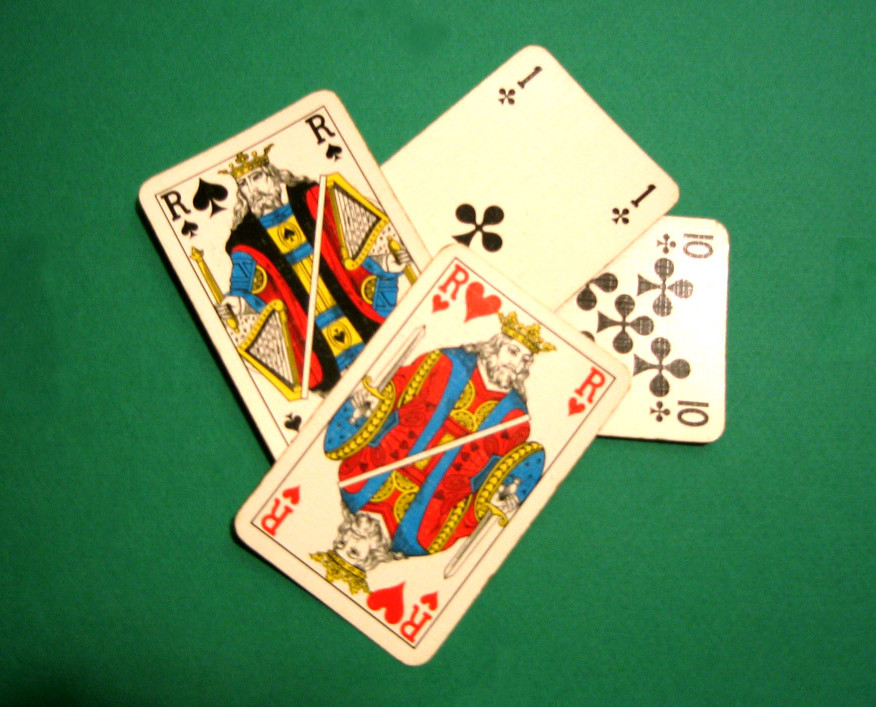
Baloot (Arabic: بلوت, romanized: balūt), is a popular trick card game played in the Arabian Peninsula, which is similar to the French game Belote.[1]
The game
[edit]There are four players in partnerships of two teams. A standard 32-card Piquet pack is used, eight for each player.[citation needed] There are two contracts: Hokum and Sun (from the French sans).[2] The card ranking is:
Sun (suit)
[edit]| 8 | 7 | 6 | 5 | 4 | 3 | 2 | 1 | |
|---|---|---|---|---|---|---|---|---|
| Clubs: | ||||||||
| Diamonds: | ||||||||
| Hearts: | ||||||||
| Spades: |
Hokom (Trump)
[edit]Assume the Hokom suit is the Sherya (Clubs) ♣ (for example)
| 8 | 7 | 6 | 5 | 4 | 3 | 2 | 1 | |
|---|---|---|---|---|---|---|---|---|
| Clubs: | ||||||||
| Diamonds: | ||||||||
| Hearts: | ||||||||
| Spades: |
Starting the game
[edit]The two members of each team are seated across each other at a table in such a way that no player can see the cards of other players .
The first dealer is chosen at random and after each hand the turn to deal passes to the right. The cards are shuffled by the dealer, and cut by the player on the left. The player on the left of the dealer can either say "go" without cutting the deck, shuffling it (just once), take the first card as the public card, can give the bottom three cards to the teammate or keep them for themselves, or take the top three cards to themselves. If the dealer gives a player a card and was mistakenly flipped, the player has no right to refuse it, unless it is an Ace, then the shuffling starts again from the same dealer.
The dealer has 32 cards; he has to deal them to the other players starting from his right three cards at a time, e.g. 3 cards to the right player, 3 cards to the front player, etc., then two cards at a time, then finally one card shown to public . The dealer is now in charge. He calls " First," which means the first round of taking the public card, players "buy" the public card, priority goes to the player on the right of the dealer, then the front player (teammate) and then the player on the left, the person with the least priority to take the card is the dealer. Players should say "no" if they don't want the card; this goes counterclockwise.
If someone takes the card, as (for example) Hokom, any player has the right to refuse and take it as Sun. But if the person took the public card as Sun, then only the person with the higher priority can take the card.
"Ashkal", it is said when a player doesn't want the public card, but wants it for their teammate, just to receive 3 cards instead of 2. note: only the dealer and the player to the left of the dealer have the right to call Ashkal. If a player calls Ashkal where they do not have the privilege, the player is forced to take the public card as Sun. If the card was an ace, the player has no right to say Ashkal, if they do, they are forced to buy it as Sun.
If a player has only zero cards - 7, 8 or 9 of any suit, he may choose to force everyone to abandon this turn with no points to any team (Kawesh/Saneen), where he buys the public card as Sun, and lies his cards face up (If he feels he has an advantage he may still buy the card normally). However, in "Second" the player may not ask for this turn to be abandoned.
If all the players choose to not take the card, then the dealer calls, "Second", which means there is another chance in taking the card. If someone takes it as Sun, then no one else can buy it over him even if they were of a higher priority. That is a significant advantage of buying Sun in the second round over the first; that no one else can take it from you even if they were of a higher priority. They lose that right by saying no in the second round. But if someone takes it as Hokom, then the Hokom must be something different from the suit of the public card because it is on the second mode. Other players can take the card as Sun. The player that takes it as Hokom, has the option to choose between three suits before lifting up the two cards that the dealer just gave. Or it is Sun if the player lifts up the two cards before naming a suit for Hokom. There is not "Ashkal" in the second round.
After someone takes the public card. The dealer continues giving other cards to the players, again starting to the right, counter clock-wise, 3 cards to each but 2 cards to the player who has taken the public card.
Playing
[edit]The Player on the right side of the Dealer starts the round. Players counterclockwise must follow suit if they can; a player who has no cards of the suit led can play any card. Or he/she should play one of the Judges cards in case of Hokom rounds. each trick score should be added to the total scores until one of the team reaches the 152 points and win the game. (see Scores section below)
In case of Hokom, if the first leading card played Hokom, other players should throw the Hokom card, if or example the card played was a King of hearts and the Hokom is hearts, the next player should surrender a card that is bigger in value of the King.
Scoring
[edit]Once a round is over, the score of each team should be added to the total score .Each card has a score rank as the following:
- Note: The team that takes the last trick always add 10 to their score before calculating round score.
In case of Sǔn rounds
[edit]
Score = score + Zero
Score = score + 2
Score = score + 3
Score = score + 4
Score = score + 10
Score = score + 11- Round score = score (to the nearest 10) then divide over 10 then x 2
- Total score = Round score + total rounds scores
In case of Hokom rounds
[edit]Regular Cards
Score = score + Zero
Score = score + 2
Score = score + 3
Score = score + 4
Score = score + 10
Score = score + 11
Trump Cards
Game bonuses
[edit]This section needs additional citations for verification. (June 2023) |
Bonuses are free extra points one of the two teams can earn during a Round. Bonuses also called Projects (Arabic: مشروع). Projects (except for Baloot) are always declared in the first turn and shown in the second turn.
There are several types of bonuses in Baloot. The following list describes each of them starting from the minimum .
Sira (Single line)
[edit]A player declaration Sira, means that he has a 3 serial cards, according to Global cards sorting (A,K,Q,J,10,9,8,7). for example:
Bonus:
- Round score = Round score + 4 (in Sǔn)or
- Round score = Round score + 2 (in Hokom)
50
[edit]A player declaration 50, means that he has a 4 serial cards, according to Global cards sorting.
Bonus:
- Round score = Round score + 10 (in Sǔn) or
- Round score = Round score + 5 (in Hokom)
100
[edit]A player declaration 100, means one of the three positions:
- 1- The player has five cards in a row in the same suit, according to Global cards sorting.


or any other 5 serial cards.- 2- The player has four Jacks, Queens, Kings or tens.


- 3- The player has four aces.


, this is only in case of Hokom because in Sǔn rounds 4 aces means 400.
Bonus:
- Round score = Round score + 20 (in Sǔn) or
- Round score = Round score + 10 (in Hokom)
400
[edit]A player declaration 400, means that he has 4 aces.
Bonus:
- Round score = Round score + 40 (in Sǔn only)
Baloot
[edit]A player declaration Baloot, means that he has the King and the Queen cards of the Judges suit, for example:
The Judges cards of Hokom round are Clubs and a player has:
Bonus:
- Round score = Round score + 2 (in Hokom only)
Notes:
- If two player from different teams, have different projects, only the player with the higher project can show the project and get points for it. 400 > 100 (serial) > 100 (4 of a kind) > 50 > Sira. Only exception is Baloot, which can count.
- If players from different teams has the same level project (e.g.: Two Sira's) Only the one with the highest card can show the project and get points for it.
- Baloot is not declared in the first turn, Baloot is declared when you play the second card of the project. (e.g.: on the first trick you played the king of the judges suit.. two tricks later you're going to play the queen of the judges suit, before you play it you say "Bloot")
- If one (not both) of the Baloot cards is in another project, the Baloot can't be declared. and If both Baloot cards are in a "100" Project, Baloot can not be declared. They still can be declared in "Sira" or "50".
- In Double, Three and Four, Projects are calculated X2, X3, X4 receptively. (See "Multiple scores" below.) (Except for "Baloot", which is always 2).
- If one player of a team gets to show his project that entitles his teammate to show his/her project too. That is why if many projects are declared, it is wise to wait for everyone to say what is his highest card, and see if you can show your project or not.
- If a player has higher project than the player before him/her, but forgets to show it, the other player has the right to show his/her project before he/she plays his/her third card.
- No card can be in two different projects (Except for both Baloot cards in "Sira" or "50").
Multiple scores
[edit]While naming the round by one of the teams, The other team may keep silence or say Double (locked or open), The one who bought the card (and only him/her) can raise to Triple. Then the one who said double (and only him/her) can raise it further Four. Here the buyer can raise it to the limit by saying Gahwa. (Sun can only go up to double, and only when only 1 team has more than 100 points. If both teams are above 100 or below it, Sun can not be doubled).
By saying Double, the competition will be harder because the round scores will be twice as much as the normal round. The Three means 3 times as much as the normal round and Four means four. The main purposes of saying "Double or Four" is to change the way of playing and increase points, since when the game is doubled (or more) points aren't divided, the team with most points takes all. If you were playing in "locked" "Double or Four", the one who says "Double" or "Four" has the option of locking or opening the Hokom. In case it's locked you can't use the Judged suit as a first card in any trick, you can only use them when you don't have the suit that the other player has played, or don't have any other suit to play as a first card in the trick. Otherwise, "if its Three or Gahwa" you can use any suit you want, even if it was the Judged suit.
The Gahwa challenge will end the whole game at once for the round winner.
Probability of game bonuses
[edit]| Projects (Arabic: مشروع) | Frequency | Probability | Odds | Mathematical expression of probability |
|---|---|---|---|---|
| 1 | 0.195% | 514:1 | ||
| 20 | 1.224% | 82:1 | ||
| 20 | 3.45% | 29:1 | ||
| 24 | 23.20% | 4:1 |
See also
[edit]References
[edit]- ^ "Baloot: The No. 1 social activity in Saudi Arabia is an integral part of the culture, and popular with people of all ages". Arab News. 2 November 2018. Retrieved 15 May 2021.
- ^ Baloot at pagat.com. Retrieved 9 June 2023.
External links
[edit]- Baloot rules at gamerules.com.
- Everything You Need To Know About The Baloot Championship In Saudi Arabia at egamersworld.com.
- Baloot: The No. 1 social activity in Saudi Arabia is an integral part of the culture, and popular with people of all ages at arabnews.com.
- Saudi women show off their 'Baloot' skills at gulfnews.com.
- What are the rules to play Baloot Game? at lifeinsaudiarabia.net.
- Baloot is a sport card game in Saudi Arabia; it's not gambling at saudi-expatriates.com.
Baloot
View on GrokipediaOverview
Description
Baloot is a partnership trick-taking card game played by four players in two fixed teams of two, with partners seated opposite each other and gameplay proceeding counterclockwise.[3][4] It uses a 32-card deck, with each player receiving eight cards, and revolves around bidding to determine the contract before playing eight tricks per hand.[3][6] The game features two primary contracts: Sun, a no-trump variant focused on accumulating card points, and Hokom, which designates a trump suit and emphasizes capturing tricks using those trumps.[3][6] In both, teams score points from tricks and special combinations, aiming to reach a total of 152 points to win the game.[4][3] Baloot bears a strong resemblance to the French game Belote, sharing similar trick-taking mechanics and scoring elements, and traces its roots to traditional Hejaz-style card games in the Arabian Peninsula.[6]Players and Objective
Baloot is played by exactly four participants, who form two fixed partnerships of two players each. Partners are seated alternately around the table, directly opposite one another, to ensure that no player can easily observe their partner's cards.[3][7] This arrangement promotes fair play by minimizing visual access to a teammate's hand. The primary objective of Baloot is for a partnership to be the first to accumulate 152 points or more through the scoring of tricks and applicable bonuses, or to achieve a successful Qahwa declaration for an immediate win.[3][7] Points are earned over multiple hands, with each hand contributing to the teams' ongoing totals until one partnership reaches or surpasses the target score, at which point they win the game.[3][7] Partners are prohibited from engaging in any form of signaling or communication about their cards beyond the formal declarations allowed during bidding and trick-taking phases, such as announcing project types or, if necessary, the rank of the highest card in a declared combination. This restriction maintains the integrity of the game by relying solely on strategic play and inference from visible actions.[3]History and Cultural Significance
Origins and Development
Baloot originated in the Hejaz region of present-day Saudi Arabia during the late Ottoman era, likely in the early 20th century, as a trick-taking card game that quickly gained traction among locals.[8] It emerged through cultural exchanges, with most accounts tracing its introduction to European influences via Indian migrants and trade routes connecting ports like Jeddah and Mecca to India during the Ottoman period.[8] [3] This adaptation drew heavily from the French game Belote, a similar partnership trick-taking game that shares core mechanics like trump suits and point-scoring combinations.[3] [9] The game developed as a distinctly local variant, utilizing the standard 32-card Piquet deck—comprising ranks 7 through ace in four suits, excluding lower cards—which was already common for European trick-taking games like Belote and its precursors.[3] Initially played in informal social settings among families and communities in Hejaz, Baloot evolved into a more structured form by the mid-20th century, incorporating unique elements such as the no-trump "Sun" contract for doubled scoring and mechanisms for "locking" opponents' plays to prevent redoubling.[3] These refinements reflected oral adaptations tailored to regional preferences, emphasizing strategy and partnership over chance.[10] Unlike many Western card games with governing bodies, Baloot lacks a formal standardization organization, relying instead on oral traditions and family-transmitted rules that varied slightly by household or locale until the late 20th century.[10] The earliest comprehensive written reference appears in the 1988 book Al-Baloot (The Baloot) by Saudi academic Fouad Anqawi, which documents its history, rules, and cultural role based on consultations with players and scholars.[9] Since then, core rules have remained static, preserving its traditional essence, though minor digital adaptations emerged post-2010 with mobile apps like Yalla Baloot and Jawaker, enabling online multiplayer while adhering to classic formats.[4] [11]Popularity and Regional Variations
Baloot enjoys widespread popularity across the Arabian Gulf region, particularly in Saudi Arabia, the United Arab Emirates, Qatar, and other Gulf countries, where it serves as a favored social activity among youth and adults alike.[1][12] As a trick-taking card game typically played by four players in partnerships, it fosters camaraderie and is commonly enjoyed in informal settings such as coffee shops, homes, and community spaces.[5] In Saudi Arabia, Baloot has been a staple of social life for over a century, often featured in majlis gatherings—traditional reception rooms for hosting guests—and family events like weddings, where groups of players may adapt minor rules to suit their preferences.[1][12] The game holds significant cultural value in Arab traditions, symbolizing hospitality through its role in bringing people together for evenings of conversation and competition, while highlighting players' strategic skills and patience.[13] In Saudi culture, Baloot is an integral part of daily interactions, connecting generations and preserving communal bonds without the need for elaborate setups beyond a deck of cards.[10] It is especially prominent during Ramadan, when families and neighbors gather after Taraweeh prayers for late-night sessions that emphasize friendly rivalry and intellectual engagement.[13][14] Regional variations in Baloot are generally minor, with no substantial divergences in core mechanics across Gulf countries, though local groups may introduce slight tweaks to bidding or scoring in informal play.[1] For instance, the standard 32-card deck is used throughout the region, but some playstyles incorporate subtle differences in how bids like "pass" are handled during the auction phase.[3] These adaptations reflect the game's flexibility in social contexts, allowing it to remain accessible and engaging without altering its fundamental trick-taking structure.[4] Since the mid-2010s, digital adaptations have expanded Baloot's reach, with mobile apps enabling online play that has grown popular among the Gulf diaspora and international communities.[5] Platforms like VIP Baloot and Baloot Masters offer multiplayer features, simulating traditional gameplay and attracting millions of downloads in the region, thus bridging physical distances for expatriates.[15][16] As of September 2025, apps like Kammelna reported over 6 million downloads and 1 million monthly active users, bolstered by a SAR 200 million investment from Saudi VC firm Impact46 in August 2025 to further develop online Baloot experiences.[5][17] While large-scale international tournaments remain absent, local competitions thrive in Saudi cities like Jeddah, where events such as the Jeddah Season Baloot Tournament in September 2025 drew thousands of participants, and the Riyadh Baloot Challenge scheduled for November 2025 underscores the game's enduring community appeal.[18][19][20]Equipment and Basics
Deck Composition
Baloot employs a 32-card Piquet deck, formed by removing the ranks 2 through 6 from each of the four suits in a standard 52-card Western deck, leaving the ranks 7, 8, 9, 10, Jack, Queen, King, and Ace.[3][4] The suits are hearts, diamonds, clubs, and spades, with no jokers or supplementary cards included in the deck.[3][7] In regions of popularity such as the Arabian Peninsula, printed decks often incorporate Arabic motifs and cultural designs while preserving the conventional suit symbols and ranks.[21] No specialized table markers are required beyond basic score tracking, which can be managed using paper, a notepad, or a digital application.[4]Card Rankings
In Baloot, the standard ranking of cards within each suit for non-trump suits follows a specific order from lowest to highest: 7, 8, 9, Jack, Queen, King, 10, Ace.[3][22] This hierarchy applies uniformly to all suits in the Sun contract, where there is no trump suit and no inherent superiority among the four suits (clubs, diamonds, hearts, spades).[3] In the Hokom contract, a trump suit is declared, which overrides the suits of non-trump cards for winning tricks. The ranking within the trump suit, from lowest to highest, is 7, 8, Queen, King, 10, Ace, 9, Jack, with the Jack of trumps being the highest card overall.[3][22] Non-trump suits retain the standard ranking during Hokom play.[3] The following table illustrates the card rankings for clarity:| Contract Type | Lowest to Highest Ranking |
|---|---|
| Sun (No Trump) | 7, 8, 9, J, Q, K, 10, A (all suits equal) |
| Hokom (Trump Suit) | 7, 8, Q, K, 10, A, 9, J (trump overrides others) |
Preparing the Game
Dealing
The first dealer is chosen randomly, such as by drawing lots or mutual agreement among the players, and the role then rotates clockwise to the next player after each hand.[3][23] The dealer shuffles the 32-card deck thoroughly, after which the player to the dealer's left cuts the pack to verify fairness and prevent manipulation.[24] The dealer proceeds to distribute five cards face down to each of the four players, typically in packets of three followed by two, starting with the player to the dealer's right and continuing counterclockwise around the table.[3][25] The next card, the 21st from the top, is placed face up in the center of the table as the public card, which serves as the basis for the subsequent bidding.[3][4] If a misdeal occurs—such as a card being prematurely exposed or an incorrect number of cards distributed—the entire hand is voided and redealt from a fresh shuffle.[3] This process ensures an even and complete distribution of all 32 cards, with the remaining cards allocated after bidding to bring each player to a total of eight cards.[3] Once the initial cards and public card are in place, each player privately evaluates their hand in preparation for the bidding phase.[4][25]Bidding Process
The bidding process in Baloot, also known as the auction phase, occurs after the initial deal of five cards to each player and the exposure of a single card face-up in the center of the table. This phase determines which team will play as declarers, committing to win more than half of the card points available in the contract (81 or more out of 162 for Hokom; 66 or more out of 130 for Sun), and establishes the contract type—either Hokom (with trumps) or Sun (no trumps)—along with the relevant suit if applicable. Bidding proceeds anticlockwise starting from the player to the dealer's right, with the dealer announcing "First" to initiate the process.[3] There are two possible bidding rounds. In the first round, each player in turn may bid, pass, or, if they are the third or fourth to act, declare Ashkal. A bid of Hokom commits the bidder to play with the suit of the exposed card as trumps, while a bid of Sun commits to no trumps and immediately supersedes any prior Hokom bid, ending the bidding. Ashkal functions similarly to Sun but assigns the exposed card and declarer role to the bidder's partner rather than the bidder themselves, and it is typically used when a player's hand lacks high cards that would support a personal bid. Players may pass at any point if their hand does not support a competitive declaration. If all four players pass in the first round, the dealer announces "Second," initiating a second round where bidding resumes from the same starting player, but Ashkal is not permitted and any Hokom bid must specify a trump suit different from the exposed card's suit.[3][26][7] The highest valid bid wins the auction, with Sun taking priority over Hokom. The winner (or their partner in the case of Ashkal) becomes the declarer for their team, takes the exposed card into their hand, and declares the contract accordingly—Hokom with the named trump suit or Sun for no trumps. If all players pass in both rounds, the hand is voided, no points are scored, and the next dealer in turn redeals the cards. Following the declaration, the dealer distributes additional cards from the remaining deck: two face-down to the declarer and three face-down to each opponent, resulting in eight-card hands for all players. The player to the dealer's right then leads the first trick to begin gameplay.[3][26][7]Contracts
Sun Contract
The Sun contract in Baloot represents a no-trump bidding option, where the successful bidder commits to playing without a designated trump suit, prioritizing suit control and point capture across all suits. Declared during the bidding phase—typically in the first or second round when a player announces "Sun" over competing bids—the contract is finalized when the declarer or their partner (in an Ashkal variant) claims the exposed public card to form their eight-card hand. This choice ends the bidding immediately and sets the tone for a game focused on following suit rigorously rather than trump dominance. Under the Sun contract, players must adhere strictly to the led suit whenever possible; if unable to follow suit, any card may be played, but there is no option to "lock" or ruff with a non-existent trump. In the Sun contract, cards in all suits rank from Ace (highest) to 7 (lowest). The declarer's team leads the first trick, and subsequent tricks are won by the highest card of the led suit, emphasizing strategic leads to draw out opponents' high cards and secure valuable tricks. Unlike trump-based play, this contract rewards precise management of long suits and timely discards, as the absence of trumps prevents overriding lower cards in other suits. Card values remain consistent in the Sun contract, with face cards and tens carrying point potential when captured in tricks: for instance, the Jack scores 2 points, the Queen 3 points, and the King 4 points as base values, while Aces and Tens offer higher rewards at 11 and 10 points, respectively. The suit of the exposed public card, while not granting trump privileges, becomes a focal point for potential serial bonuses, where consecutive cards in that suit (or any suit) can yield additional points if held and declared by the winning team. These serial combinations, such as three or more sequential ranks, enhance the value of controlling key suits, encouraging players to prioritize capturing honors in the exposed suit to maximize such opportunities. In contrast to the Hokom contract, the Sun variant eliminates trump mechanics entirely, fostering a play style centered on balanced suit distribution and incremental point accumulation through tricks and bonuses, without the risk of trump interruptions. This makes Sun particularly appealing for hands strong in multiple suits, where the declarer's team aims to outscore opponents by at least a threshold in game points derived from card values and serials.Hokom Contract
The Hokom contract in Baloot is declared when a player calls it during the bidding phase, establishing a trump suit based on the exposed public card's suit, which allows trumps to override any non-followed led suit to win tricks.[3] This choice typically occurs in the first or second round if earlier players pass, with Sun able to overcall Hokom.[4] Unlike no-trump play, Hokom introduces a powerful suit that players can deploy strategically when unable to follow the led suit, fundamentally altering trick control dynamics.[7] Within the Hokom contract, the trump suit features a distinct ranking: 7 (lowest), followed by 8, Queen, King, 10, Ace, 9, and Jack (highest), with the 9 and Jack elevated in strength and point potential compared to plain suits.[6] Trumps outrank all other suits in a trick if the led suit is not followed, enabling the highest trump played to claim the lead regardless of the other cards' values.[22] This hierarchy encourages careful preservation of high trumps early in the hand to counter opponents' strong plays later. Strategic play under Hokom centers on judicious trump usage to secure key high-value cards, as trumps provide a versatile tool for disrupting opponents' suits and forcing discards.[3] The last trick carries extra significance, always awarding 10 additional points to the winner, which amplifies the importance of retaining a trump for the endgame. Players must follow suit when possible, but the option to trump when unable adds layers of tactical depth.[7] To succeed in the Hokom contract, the declarer's partnership must capture at least 81 points from the total 162 available in the deal; failing this threshold results in penalties, typically awarding points to the opponents instead.[25] This commitment underscores the risk-reward nature of bidding Hokom, where strong trump holdings can yield substantial gains but poor distribution may lead to defensive scoring advantages for the opposing team.[4]Gameplay
Leading and Following Suit
The declarer, who is the player that won the bidding process, leads the first trick by playing any card from their hand, with play proceeding counter-clockwise around the table—meaning the next player to the declarer's left responds first.[4][7] Subsequent tricks are led by the winner of the previous trick, following the same direction of play.[27] This ensures a continuous flow through all eight tricks, as each player holds exactly eight cards and must play one card per trick until all hands are exhausted, with no option to pass or revoke.[3] Players are strictly obligated to follow suit—that is, to play a card of the same suit as the one led—if they hold any cards of that suit in their hand.[4][7] If a player cannot follow suit, the rules differ based on the contract: in the Sun contract, with no trump suit established, the player may discard any card from their hand without restriction.[3] In the Hokom contract, where a trump suit is designated, the player must play a trump card if available; otherwise, any other card may be played.[4][7] There is no ruffing (forced trumping) required in Sun, but Hokom requires trumps to override non-trump leads when a player is unable to follow suit and holds a trump.[27]Trick Resolution
In Baloot, the resolution of each trick determines which player wins the four cards played and leads the subsequent trick. The player who leads the trick plays any card from their hand, establishing the lead suit, and subsequent players must follow suit if possible. If all players follow suit, the highest-ranking card of the lead suit wins the trick.[3] In a Hokom contract, trumps play a decisive role when players cannot follow suit. If a player is unable to follow the lead suit, they must play a trump card if they hold any; otherwise, they may play any card. The highest trump card played to the trick wins, regardless of the lead suit, outranking all non-trump cards. If multiple trumps are played, the highest-ranking trump takes the trick, with ties impossible due to the unique ranks within each suit (7 through Ace, ordered specifically for trumps in Hokom). In a Sun contract, there are no trumps, so the highest card of the lead suit always wins, even if some players play off-suit cards.[3][7] The winner of the trick collects all four cards played, setting them aside face down in a shared pile for their partnership. This player then leads the first card to the next trick. Play continues until all 32 cards have been played, resulting in eight tricks per hand.[3] At the end of the hand, the card points from the tricks won by the declarer's team are tallied and scored for that team only if the contract is successfully met (typically by capturing at least half the total card points, such as 82 out of 162 in Hokom). If the contract is met without a double, each partnership scores the game points corresponding to the card points they captured from their tricks. However, if the declarer's team fails to meet the contract, the opposing team scores all the game points from the hand (16 for Hokom or 26 for Sun, derived from the total card points), and the declarer's team receives nothing for that hand.[3][7]Scoring System
Card Point Values
In Baloot, the point values assigned to cards won in tricks form the foundation of the game's scoring system, with values consistent across both Sun and Hokom contracts for most cards, except for specific enhancements in the trump suit during Hokom.[3][4] The deck consists of 32 cards (7 through Ace in four suits), and only certain ranks contribute points when captured in tricks. The universal point values, applicable to all non-trump cards in both contracts and to the trump suit in Sun (where no trumps exist), are as follows:| Rank | Point Value |
|---|---|
| 7 | 0 |
| 8 | 0 |
| 9 | 0 |
| Jack (J) | 2 |
| Queen (Q) | 3 |
| King (K) | 4 |
| 10 | 10 |
| Ace (A) | 11 |
Round and Game Calculation
In Baloot, the score for a round is calculated by first determining the total card points captured by each team in tricks, including an additional 10 points for the team that wins the last trick. These card points are then converted to game points based on the contract type, with bonuses added afterward to the relevant team's total. The conversion process involves rounding the card points to the nearest multiple of 10 and applying a division factor specific to the contract: for Hokom, divide by 10 after rounding (ties at 5 round down); for Sun, round to nearest 10 (no rounding if ends in 5, divide directly by 5) after rounding where applicable. This yields a total of 16 game points from cards in Hokom or 26 in Sun, distributed between the teams according to their shares.[3][7] To determine a team's game points from cards, round their total card points (including last trick if applicable) to the nearest 10 using contract-specific rules, then divide by 10 for Hokom or by 5 for Sun. Bonuses, such as those from projects, are then added directly as game points to the team that earned them, completing the round total. If game points from cards and bonuses are tied, tiebreakers based on rounding losses determine the round winner, often favoring the declarer's team.[3][4] If the declarer's team fails to meet the minimum threshold—such as capturing at least half the card points in Hokom (more than 76 card points) or the equivalent majority in Sun (more than 13 game points)—the opponents score the full game points available from cards (16 in Hokom or 26 in Sun), plus any bonuses shown by the opponents, while the declarer's team scores nothing for the round. This penalty applies only in undoubled hands; doubled or higher stakes alter the distribution further, but the core failure mechanic remains. Note that some variants specify slightly higher thresholds like more than 81 card points for Hokom.[3][7][25] Round scores are accumulated into each team's overall game total, with the first team to reach or exceed 152 game points declared the match winner. Unfinished hands, such as when a team reaches 152 mid-play, are scored normally based on tricks completed, contributing to the final tally without interruption to the ongoing calculation.[3][4]Sun vs. Hokom Differences
The Sun and Hokom contracts in Baloot differ significantly in card valuation, scoring multipliers, bonus structures, and risk-reward dynamics, influencing strategic bidding decisions. In the Sun contract, played without trumps, all suits follow standard non-trump point values: ace (11 points), 10 (10 points), king (4 points), queen (3 points), jack (2 points), and lower cards (0 points), resulting in a total of 130 card points available across the deck plus 10 for the last trick.[3] This contrasts with Hokom, where the trump suit receives boosted values—jack (20 points), 9 (14 points), ace (11 points), 10 (10 points), king (4 points), queen (3 points), and others (0 points)—elevating the total to 162 card points plus the last trick, emphasizing trump control for capturing high-value cards.[3] Scoring conversion further amplifies these distinctions, with Sun using a doubled base score through its formula: card points (including last trick) are rounded to the nearest 10 (no rounding if ends in 5) and divided by 5, yielding a maximum of 26 game points before any doubling.[3] Hokom, by comparison, uses a single multiplier baseline: points rounded to the nearest 10 (rounding down at 5) and divided by 10, for a maximum of 16 game points, though it allows for higher multipliers like triple or quadruple under certain conditions.[3] Sun activates enhanced project bonuses without a trump suit—such as 40 points for four aces, 20 for four kings/queens/jacks/tens, 20 for a 5-card sequence, 10 for a 4-card sequence, and 4 for a 3-card sequence—making it rewarding for balanced, point-heavy hands distributed across suits.[3] Hokom lacks these elevated Sun bonuses but includes the Baloot (trump king and queen, worth 2 points per some sources or 20 in others) and relies on standard project values (e.g., 10 for four aces or a 5-card sequence), favoring hands with a strong trump suit for reliable captures.[3][4] A key risk in Hokom is the minimum threshold: the declaring team must secure at least half the card points (more than 76) to score; failure awards the full 16 game points to opponents, effectively doubling their potential gain relative to a successful minimum bid. Some variants use 81 as the threshold.[3][25] No such minimum applies to Sun, where even partial success contributes to the doubled base score, reducing downside risk.[3] These mechanics guide contract choice—Sun suits balanced distributions without a dominant suit, leveraging higher project potential and inherent doubling for up to 52 game points in an undoubled game, while Hokom is ideal for trump-strong hands aiming for control but carrying penalty exposure.[3] For illustration, a declaring team capturing 100 card points (excluding bonuses and last trick) in Sun yields 100 rounded to 100 / 5 = 20 game points, compared to 10 game points in Hokom (100 rounded to 100 / 10).[3]Bonuses
Serial Bonuses
Serial bonuses in Baloot, also referred to as projects or sequences, reward players for holding consecutive cards in the same suit or specific sets of equal cards, adding extra points to the scoring beyond the base card values. These bonuses are a key strategic element, encouraging players to pursue strong sequential holdings during the bidding and play phases. They are distinct from other special combinations and can only be claimed by the winning team at the end of the round.[3][7] The lowest serial bonus is the Sira, which consists of three consecutive cards in the same suit, such as the 10, Jack, and Queen of hearts. It awards 4 points in a Sun contract and 2 points in a Hokom contract. A Sira can be part of a longer sequence but is only scored separately if not incorporated into a higher bonus.[3][7] The 50 bonus requires four consecutive cards in the same suit, for example, the 10 through Ace of spades. This yields 10 points in Sun and 5 points in Hokom, doubling the Sira's value to reflect the increased difficulty. Like other serials, it must be declared before play begins and verified in the winning team's tricks.[3][7] The highest serial bonus, the 100, is achieved with five consecutive cards in a suit or a set of four cards of equal rank among the face cards and tens (Jacks, Queens, Kings, Aces, or Tens); in Hokom contracts, four Aces also qualify regardless of suit. It provides 20 points in Sun and 10 points in Hokom, establishing it as the top priority among serials due to its rarity and strength. If multiple players declare competing 100s, priority goes to the trump suit over non-trump, followed by the highest top card, and ties resolved by declaration order.[3][7] Declarations for serial bonuses occur at the start of the hand, specifically during the first trick, beginning with the bid winner and proceeding clockwise, but only if no higher bonus has been announced previously. Each player may declare up to two non-overlapping serials, with cards from one bonus unable to contribute to another, ensuring distinct holdings. These must be held in the tricks won by the claiming team to score; undeclared serials may be added by partners after revelation at the second trick, but only the winning side benefits. Serial bonuses integrate into the overall round score without overlapping other types of bonuses.[3][7]Special Hand Bonuses
In Baloot, special hand bonuses refer to exceptional card combinations held by the declarer that yield extra points beyond standard trick-taking scores, applicable only under specific contracts. The "400" bonus is exclusive to the Sun contract and is triggered when the declarer holds all four aces in their hand. This combination awards +40 points to the declarer's team, provided it is declared at the outset of the round and the aces are proven through the tricks won by the declarer.[3][7] The Baloot bonus applies solely to the Hokom contract, where the declarer holds both the king and queen of the trump suit. It provides +2 points, declared by the declarer as soon as the second of the two cards is played. Opponents are unable to claim this bonus, as it is reserved for the declarer.[3][4] Both bonuses must reside entirely within the declarer's hand to qualify and contribute directly to the team's hand total, enhancing the overall round score without affecting trick resolution mechanics. The 400 bonus is exceptionally rare, with an estimated probability of approximately 1 in 514 deals for any single player receiving all four aces from a standard 32-card deck. In contrast, the Baloot is more frequently attainable, particularly in Hokom bids emphasizing strong trump suits, where the chosen trump increases the likelihood of securing both key honors; the base combinatorial probability without suit selection adjustment is approximately 5.6%, calculated as \frac{\binom{30}{6}}{\binom{32}{8}}.[3]Multipliers and Probabilities
In Baloot, score multipliers known as double, triple, and four serve as mechanisms to escalate the stakes of a hand, primarily available in Hokom contracts. These are initiated by an opponent of the declarer immediately after the contract is set but before the first trick, allowing the doubling of the hand's total score if the opponents believe the declarer is vulnerable. The declarer may then counter with a triple, multiplying the score by three, prompting the opponents to raise to four (quadrupling the score). A final counter by the declarer, called gahwa, ends the game in favor of the declarer's team if they succeed in the hand. These multipliers apply to card points from tricks (abnat), the last trick point, and serial bonuses (which are doubled even under triple and quadruple); however, the Baloot special hand bonus is unaffected.[3][4] In Sun contracts, doubling is restricted to situations where one team holds over 100 points and the opponents fewer than 100, preventing late-game abuse, while triples and fours remain unavailable. Declarations occur pre-play, but verification and application happen post-hand during scoring, with the declarer confirming any counters before points are tallied to ensure the multiplied value reflects the actual results. This post-hand check maintains fairness, as the multiplied score only materializes after tricks are resolved and bonuses declared. If the declarer's team fails under a multiplier, the opponents receive the escalated points, heightening the risk.[3] The probabilities of achieving key bonuses provide critical context for bidding and play, as these rare combinations can dramatically amplify scores under multipliers. Serial bonuses like sira (three consecutive cards in suit) occur in roughly 20-23% of hands, making them a common but modest boost. Longer sequences for 50 points (four consecutive) arise about 5% of the time, while 100-point bonuses (five consecutive or four-of-a-kind in tens through kings, or aces in Sun) are far less likely at around 1%. The Baloot special hand bonus in Hokom, requiring the king and queen of trumps in one hand, has an approximate probability of 5-6%, derived from combinatorial analysis as \frac{\binom{30}{6}}{\binom{32}{8}} \approx 0.056 (adjusted higher for trump selection favoring such holdings). The ultra-rare 400-point bonus (four aces in Sun) occurs in under 0.1-0.2% of hands.[28]| Bonus Type | Approximate Probability | Notes |
|---|---|---|
| Sira (3-card sequence) | ~20-23% | Common in both Hokom and Sun; worth 2-4 points base. |
| 50 (4-card sequence) | ~3-5% | Valuable for mid-hand boosts; rarer due to length. |
| 100 (5-card or 4-of-a-kind) | ~1% | High impact; aces variant in Sun. |
| Baloot (KQ of trumps, Hokom only) | ~5-6% | Base combinatorial estimate; player-selected trump increases effective odds. |
| 400 (4 aces, Sun only) | <0.2% | Extremely rare; 40-point equivalent. |
