Hubbry Logo
BriscaBriscaMain
Open search
Brisca
Community hub
Brisca
logo
8 pages, 0 posts
0 subscribers
Be the first to start a discussion here.
Brisca
Brisca
from Wikipedia
Brisca
OriginSpain
TypeTrick taking
Players2 to 6
Skillstactics, memory
Cards40 or 48 cards
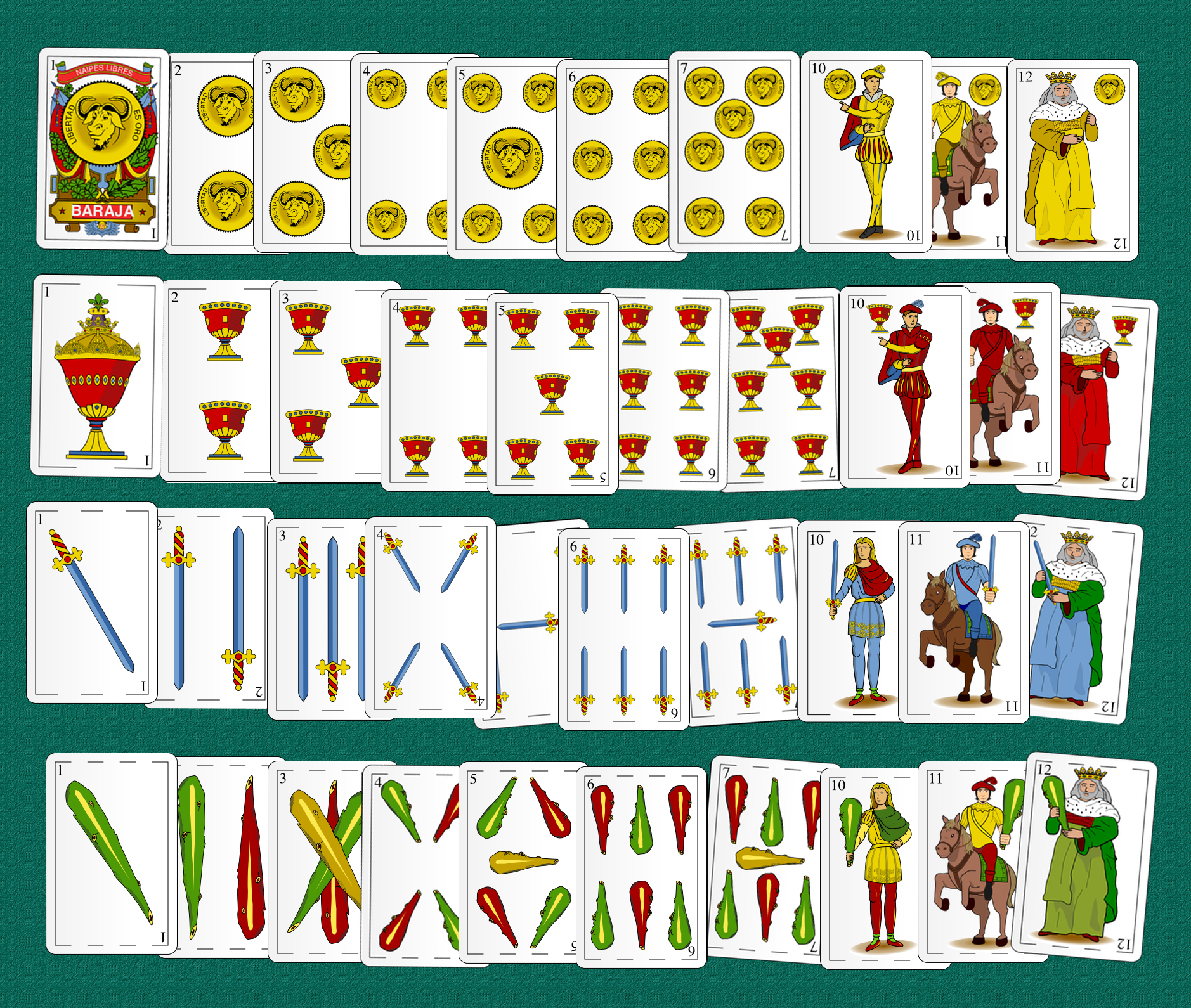
DeckSpanish
Rank (high→low)A 3 R C F 7 6 5 4 2
Playcounter-clockwise
ChanceMedium
Related games
Briscola • Calabresella

Brisca is a popular Spanish card game[1] played by two teams of two with a 40-card Spanish-suited pack or two teams of three using a 48-card pack.

History

[edit]

Brisca and its cousins are widespread in many countries, especially in the Mediterranean and Latin American areas. Related games include Italian Briscola, Lombard Brìscula, Sicilian Brìscula, Neapolitan Brìscula or Brisca, Catalonian Brisca, Portuguese Bisca, Montenegrin and Croatian Briškula, Slovenian Briškola, Maltese Bixkla, and Libyan Skembeel.

Its origin is probably found in Brusquembille, a French game whose rules were published in 1718. The development and scoring of the cards are similar, but Brusquembille was played with a French Piquet pack of 32 cards. This evolved into another game called Brisque that gave rise to Brisca, Bezique and the highly elaborate Briscan. Another theory proposes an Italian origin of from the game of Bazzica, which is similar to Bezique.

Aim

[edit]

To win this game, a player must earn as many points as possible, winning the rounds. The highest cards of each suit are:

Card
Number Ace or One
(As or Uno)
Three or Trey
(Tres)
King or Twelve
(Rey or Doce)
Knight or Eleven
(Caballo or Once)
Jack or Ten
(Sota or Diez)
Value 11 points 10 points 4 points 3 points 2 points

Rules

[edit]

Deal

[edit]

To start the game, three cards are dealt to each player. In the four-player game, in some variants the players of each pair exchange cards to find out which three cards their partner has. If there are six players they can also exchange cards within their team of three.

Trumps

[edit]
Here, a 6 of cups is tucked under the deck to show that cups is the trump suit

After the cards have been dealt, the remainder are placed in the middle of the table and the top card turned and placed face up. The suit of this card determines which suit is the trump suit; the cards of this suit always beat all of the others, however high they may be. In some game variations, one trump suit is assigned per deal, starting with Coins, that is to say, in the first deal it is Coins; in the second, Cups; in the third, Swords, and finally, Clubs. At the end of these four deals, the player with the most victories or the most points from the four deals wins.

Play

[edit]

The player to the right of the dealer leads a card to the first trick and each player plays a card to the trick in turn. Then the player on his right throws another card and so on. If playing between two people then each player must draw two cards alternating the play.

Playing the highest card (assist) is not mandatory as in Tute and a player may choose to play a lower card if they fear, for example, that their opponent may beat it. The last player to play will be the one who has dealt.

The player who plays the highest card wins and takes the trick, bearing in mind that:

a) If all the cards are of the same suit, the player with the highest suit card wins.
b) If cards of different suits are played that are not trumps, the player who has played the highest card of the led suit wins.
c) If plays a trump, the player with the highest trump wins, regardless of the value of the cards in the side suits that have been played to the trick.

After this, the player who has won the trick collects the cards and places them face down in front of him. Players then draw a card from the stock in turn, the player who won the trick first and then the others in counter-clockwise order. Whoever won the trick then leads to the next. This continues successively until the stock is exhausted (17 tricks if two play, 7 tricks if four play and 6 tricks if six play). After the stock is finished, players will play the last three tricks with the three cards in their hands.

If the card that is turned as trumps is greater than Seven, it can be exchanged for the Seven of the same suit by any player who has it, at any time, even while playing a trick, provided that the player in question has won at least one trick. In case the card is Seven or less, it can be exchanged for the Two. Either way, this must be done before the last card of the stock has been drawn.

Towards the end of the game, if a team has in its tricks the three highest trumps, it announces this and collects all the cards, without having to play the final tricks, which they would win anyway. This can also be done when each player has two cards left if they have the two highest remaining trumps in the game.

If a player has the Ace or 1 of the trump suit he may say: "arrastro" ("drag" or "pull") and all the players who have not yet played to the trick must draw the best card from their hands starting with the trump suit in the order: 3, King, Knight, Jack, 9, 8, 7, 6, 5, 4 and 2.

If a player has no trumps, the best card in hand must be played in the order above order.

If, for example, the trump suit is Coins and someone plays the 1 of Coins and says arrastro, if you have not yet played to the trick and you have the 3 of Clubs, 1 of Swords and 1 of Cups; you must play the 1 of Swords or 1 of Cups, but if you have the 3 of Clubs, 1 of Swords and 3 of Coins; you must play the 3 of Coins because it is the highest available trump card you have.

Scoring

[edit]

At the end of the game, each team counts the points they have earned, scoring, as explained above, 11 points for each Ace, 10 for each Three, 4 for each King, 3 for each Knight and 2 for each Jack. The other cards, although they may have helped to win tricks, do not score points. The team with the most points wins. Because the total number of points in the game is 120, the side that passes sixty points wins. If both sides tie on sixty points each, the side with the most cards wins. In some variants, winning by more than a hundred card points is worth two game points. Game is usually 3, 5 or 7 points.

Variants

[edit]

Mexican Brisca

[edit]

In some places in Mexico there is another way to win. The objective is not to add more than 11 total points at the end of the game.

Briscola

[edit]

In Italy, Briscola is one of the most popular card games in the country along with Scopa and Tressette. In parts of Lombardy and Piedmont a Seven is worth 10 points and a Three is worth nothing. In parts of Tuscany the values of the Jack and Knight are reversed.

Briscola to scoperta

[edit]

Briscola to scoperte or "Brisca Ouverte"; the players cards are placed face up on the table. It is normally played between two.

Mariaje or Cinquecento

[edit]

The Sicilian game of Mariaje or Cinquecento is played in the same way, except that if in the King and Knight of the same suit are captured; it earns an extra 40 points if they are trumps and 20 if they are from one of the other 3 suits.

Briscola Chiamata

[edit]

The best known relative is called Briscola Chiamata. It is played exclusively with five players and all the cards are dealt, so that each one receives a hand of 8 cards.

Further variations:

  • Chiamata Buia: trumps are only declared after the first trick.
  • Chiamata a punti: only the points to be won are declared, the suit and the card that will determine the pairs and the trump suit are declared only at the beginning of the deal.
  • Briscola pazza or Gingo.

Brisca Rematada

[edit]

Brisca Rematada is a Chilean game for 3 players. A 40-card pack is used with the Twos and Fours removed to leave 32 cards.

Ten cards are dealt to each player and the remaining two dealt face down on the table, these two cards are called talon.

Players now announce the score they think they can achieve, the minimum bid being 100 points. Players may "pass" if they believe they cannot beat an earlier bid. Once two players have passed, the third player wins the auction, takes the talon adds it to his hand (it is mandatory to show the other players the said cards), selects 2 cards from his hand and places them face down in his pile of countable cards for scoring. The player who wins the "auction" is the one who decides the trump suit for that deal.

When play is finished, the declarer counts his cards to see if he has achieved his bid. If so, the points are added to his score. If he fails, these points are distributed among the other 2 players.

The players who did not win the auction (the defenders) are not considered partners, so the so-called "boarding" strategy cannot be used (whereby if which one of the players does not have cards in his hand of the led suit, but his partner is heading the trick, he can throw any card away).

Tip: it is recommended not to exceed 170 points when finishing as this is calculating the power to obtain the total number of cards with points and the Knight-King combination that scores 40 points, plus 10 points for winning the last trick.

Muerte al Tres

[edit]

Muerte al Tres is a Cuban variant in which the aim is to "hunt" or "kill" the Three of trumps with the Ace of trumps. An important note is that the player who has the trump Ace in his hand cannot play it if the Three has not been played (except in the last trick); the trump Ace is a prisoner until the trump Three is discarded, except for the last trick The moment the Three has been "killed" the deal ends and the team or person who killed the Three wins. If the trump Three manages to escape death by the Ace then the points will be counted normally.

See also

[edit]

References

[edit]
[edit]
Revisions and contributorsEdit on WikipediaRead on Wikipedia
from Grokipedia
Brisca is a traditional Spanish trick-taking from the Tute family, played with a 40-card Spanish-suited deck consisting of the suits oros (golds), copas (cups), espadas (swords), and bastos (clubs), with ranks from to seven plus the face cards sota (jack, value 10), caballo (, value 11), and rey (king, value 12). Also known as Briscas in some Latin American countries. Typically involving two to four players—often in fixed partnerships of two for four players—the game's objective is for teams or individuals to capture tricks worth the most points, using a designated trump suit to determine winners when cards of the led suit cannot be followed. The total points available per deal amount to 120, distributed among specific high-value cards: (11 points), three (10 points), rey (4 points), caballo (3 points), and sota (2 points), with all other cards scoring zero. Ties in a hand's points are shared among the tied players. The gameplay begins with the dealer shuffling and dealing three cards to each player counterclockwise, after which the top card of the remaining deck is revealed as the permanent trump suit for the hand. Players then draw one card from the deck after each trick until it is depleted, allowing for progressive hand-building and strategic depth. The player to the dealer's right leads the first trick by playing any card, and subsequent players must follow suit if possible; otherwise, they may play any card, including a trump. The highest card of the suit led wins the trick unless a trump is played, in which case the highest trump prevails, following the ranking order: ace, three, rey, caballo, sota, seven, six, five, four, two. After winning a trick and before drawing, a player may swap the seven of trumps for the revealed trump card if the latter is a point-scoring card (ace, three, rey, caballo, or sota), or swap the two of trumps if the revealed card is low-valued (four, five, six, or seven), adding tactical options. In partnership play, subtle signals such as eye contact or gestures are permitted to communicate holdings between teammates. Brisca's origins trace back to as a variant of the Italian game , with evidence of card games in the region dating to the and the game itself emerging in the across and before influencing Mediterranean variants. It remains popular in , , and among Spanish-speaking communities, often played socially in homes or during gatherings, with variations including for three or more players, sometimes using a 48-card deck that includes eights and nines. The game concludes after an agreed number of hands (commonly one, three, or six), with the team or player accumulating the most hand wins declared the overall victor; overall ties are resolved by additional play. Its enduring appeal lies in its blend of strategy, partnership dynamics, and simple yet nuanced rules, making it accessible for casual play while rewarding skillful trump management and point prediction.

Background

History

Brisca emerged in the late in as a trick-taking adapted to the Spanish-suited deck, with its earliest documented mention appearing in in the second edition of Madrid por adentro, el forastero instruido y desengañado, describing it as a game played with naipes españoles. The term "brisca" derives from the French "brisque," attested as a card game by 1752 and likely originating from "briscambille" or "bruscambille," the stage name of Jean Gracieux, a 17th-century French renowned for his card-playing prowess. This French influence positioned Brisca as a variant within the broader family of trick-taking games, akin to Tute, incorporating elements like a trump suit and point-based scoring while evolving to suit local Spanish playing traditions. By the early , Brisca had gained traction in and dictionaries, with entries in the Diccionario de la Real Academia Española by and references to "partida de brisca" in the 1823 novel Historia del valeroso caballero Dn. Rodrigo de Peñadura, highlighting its role in everyday social interactions. The game spread to through Spanish and , particularly during the , as settlers introduced it to regions like and , where it adapted to local customs while retaining core mechanics. Evidence of its presence in colonial contexts appears in literary works, such as the 1839 Semanario Pintoresco Español, which alluded to specific card plays in Brisca. In the , Brisca's rules underwent regional evolution in , with documented variants like "brisca robada" emerging by 1909 in and "brisca rematada" by 1954 in , reflecting adaptations in Spanish-speaking regions while maintaining the standard 40-card deck and partnership play. Historically, Brisca played a central in rural Spanish social gatherings, often featured in village festivals and family assemblies as a communal activity fostering interaction, as noted in 19th-century depictions that carried into 20th-century traditions. It bears a close resemblance to the Italian game , from which it likely drew influences during Mediterranean cultural exchanges.

Cultural Significance

Brisca holds a prominent place in Spanish and Latin American social life, often played as a family or tavern game that brings people together across generations. In , it enjoys widespread popularity, particularly in regions like , where it is a staple in bars and cafes, and the Basque Country, valued for its strategic depth among dedicated players. In Latin America, the game is cherished in countries such as and , reflecting its enduring appeal in casual social settings. Its use of the traditional Spanish deck further embeds it in cultural heritage, symbolizing communal entertainment rooted in historical card-playing traditions. The game fosters strong community bonds, frequently featured in intimate family gatherings and lively social events that promote fellowship and intergenerational connection. In and parts of , Brisca serves as a vehicle for shared enjoyment during local celebrations and everyday interactions, enhancing social ties through its accessible yet engaging gameplay. In the , Brisca has adapted to modern lifestyles with numerous online platforms and mobile apps, allowing players to compete remotely while preserving the game's essence. Dedicated sites like Ludoteka host daily tournaments with unlimited participants, drawing competitive interest across and beyond. Platforms such as Casual Arena and VIP Games further enable multiplayer matches, blending tradition with digital accessibility to sustain its popularity among younger audiences. Brisca has influenced depictions of Spanish social life in and media, notably appearing in a 1889 Peruvian caricature illustrating a tense game, which highlights its role in everyday leisure and interpersonal dynamics. Such representations underscore the game's integration into broader cultural narratives of camaraderie and rivalry in societies.

Equipment and Setup

Deck and Cards

Brisca is traditionally played with a 40-card Spanish deck known as naipes, which excludes the 8s and 9s from the standard 48-card Spanish pack. The deck consists of four suits: oros (coins), copas (cups), espadas (swords), and bastos (clubs). Within each suit, the cards rank from highest to lowest as follows: 1 (), 3, 12 (), 11 (), 10 (), 7, 6, 5, 4, and 2. For scoring purposes, only certain cards carry point values, while the rest are worth zero: the is valued at 11 points, the 3 at 10 points, the at 4 points, the at 3 points, and the at 2 points.
Card RankPoint Value
1 ()11
310
12 ()4
11 ()3
10 ()2
7, 6, 5, 4, 20

Players and Partnerships

Brisca is typically played by four players, who form two partnerships of two players each, with partners seated opposite one another across the table to alternate opponents. This configuration promotes strategic coordination between teammates while maintaining fair play against rivals. The game can also accommodate two or three players, in which case each competes individually without partnerships. To select the first dealer, all players draw a card from the shuffled deck, and the one holding the highest value assumes the role. The dealer then chooses their seat, with their partner sitting directly opposite, followed by the opposing players positioned alternately. In partnership games, emphasizes discretion: overt table talk or verbal communication about hands between partners is prohibited to preserve the game's , though subtle, pre-agreed signals—such as raising the eyebrows to indicate the of trumps—are commonly allowed and anticipated among experienced players.

Objective

Aim of the Game

Brisca is a trick-taking in which the primary objective is for a player or team to accumulate the majority of points by winning tricks that contain high-value cards, thereby outperforming the opponents in each hand. The total points available per hand amount to 120, and the game emphasizes strategic capture of key cards to secure at least 61 points, which constitutes a winning hand unless tied at 60-60, in which case the hand is annulled and replayed. High-point cards form the core of scoring, with aces valued at 11 points each, threes at 10 points, kings at 4 points, knights (caballos) at 3 points, and jacks (sotas) at 2 points, while lower cards contribute nothing. Players must prioritize these cards during trick-taking to build their score, as the game's structure rewards control over the distribution of these assets across the 10 tricks played per hand. When played with four participants—the standard format—brisca is contested in fixed partnerships, with teammates seated opposite one another and combining their individual trick points into a shared team total to determine victory against the rival pair. This collaborative element underscores the aim, fostering coordinated play to dominate point accumulation over multiple hands until one team reaches the agreed-upon number of wins.

Winning Conditions

In Brisca, a round concludes after all 40 cards have been dealt, with each of the four players (in teams of two) receiving 10 cards, and all 10 tricks have been played. Points are then tallied from the cards captured in those tricks, where only specific cards have value: aces (11 points each), (10 points each), kings (4 points each), knights or horses (3 points each), and jacks or knaves (2 points each), for a total of 120 points in the deck. The team that secures 61 or more points wins the round. If both teams score exactly 60 points, the round results in a tie, and the hand is annulled and replayed. The overall game consists of an agreed number of hands (commonly one, three, or six), with the team or player accumulating the most hand wins declared the overall victor; ties are resolved by additional play. In social settings, the losing team often buys drinks for the winners as a customary penalty.

Rules

Dealing

In Brisca, the dealer begins by shuffling the 40-card Spanish deck and offering it to the player on their left for a cut, ensuring at least four cards are lifted or left below. The dealer then distributes three cards face down to each player, starting with the player to the dealer's left and proceeding counterclockwise. This initial deal provides each participant with a starting hand of three cards. Following the first distribution of three cards to each player, the dealer turns the next card from the top of the remaining deck face up and places it in the center of the table to establish the trump suit for the round; this card remains visible and indicates the permanent trump until the stock is depleted, at which point its suit continues to govern play. The face-up card is then placed at the bottom of the remaining undealt cards, which form the face-down pile, placed partially covering the visible trump indicator suit, from which players will draw one card after each trick to replenish their hands until the stock is exhausted, allowing each player to participate in ten tricks over the course of the hand. Play begins immediately after the initial deal and trump reveal, with players drawing from the stock after each of the first nine tricks to maintain a hand size of three cards, then playing their remaining three cards in the final trick without drawing. The role of dealer rotates counterclockwise to the next player after each round, ensuring fair distribution across participants. For three-player variants, a 48-card deck including eights and nines is typically used, with the procedure adjusted to the larger deck: three cards dealt initially to each player counterclockwise, the next card revealed as trump (placed at the bottom of the ), and players drawing one card after each trick from the , played as individual competition rather than partnerships.

Trump Suit

In Brisca, the trump suit is established immediately after the initial deal of three cards to each player. The dealer turns the next card face up on the table to reveal the trump suit, which remains fixed for the entire round unless specified by variant rules. This process involves no , distinguishing Brisca from games where players compete to select or influence the trumps. The face-up card, after indicating the trump suit, is placed at the bottom of the remaining undealt cards, which form the and are positioned face down partially covering it to keep the suit visible. This card becomes the last one drawn from the by the player who wins the final trick before the is exhausted. Trump cards hold overriding power in gameplay, outranking all cards of the other three suits regardless of their individual ranks. If multiple trump cards are played to a trick, the highest-ranking trump wins the trick, following the standard hierarchy where aces rank highest, followed by threes, face cards, and then numbered cards down to twos (detailed in the Deck and Cards section). This mechanic emphasizes strategic use of trumps to control key plays throughout the round.

Trick-Taking

In Brisca, the player to the left of the dealer leads the first trick by playing any card from their hand face up on the table. Play proceeds counterclockwise around the table, with each subsequent player contributing one card to the trick. Players are required to follow suit to the led card if they hold any cards of that suit; failure to do so constitutes reneging, which is not permitted. If unable to follow suit, a player may play a card of the trump suit if available, or any other card if no trumps are held. The order of play ensures that all participants contribute to building the trick in turn, maintaining the game's structured flow. The trick is won by the highest card of the suit led, unless one or more trump cards are played, in which case the highest trump determines the winner. Trump cards outrank all non-trump cards regardless of suit, as established by the trump suit mechanics. The winner collects the cards played in the trick and leads the subsequent one, continuing the cycle until all cards have been played. After each trick (except the last three when the is depleted), the winner leads the next trick and each player draws one card from the , starting with the winner. After winning the first trick, the winner has the option to perform special swaps: the escudilla (exchange the seven of trumps for the face-up trump card) or manilla (exchange the two of the trump suit for the face-up trump card), adding tactical depth. A standard round consists of 10 tricks for four players using a 40-card deck, as each participant effectively plays 10 cards through initial dealing and subsequent draws from the stock. This fixed number ensures a complete exhaustion of the deck without remainder, facilitating predictable gameplay duration.

Scoring

In Brisca, scoring is determined solely by the point values of the cards captured in the tricks won by each player or team. The is valued at 11 points, the three at 10 points, the king at 4 points, the (caballo) at 3 points, and the jack (sota) at 2 points, while all other cards (2, 4, 5, 6, 7) are worth 0 points. These values apply uniformly across all suits, with the total point value of the 40-card deck summing to 120 points per deal. At the end of each deal, once all cards have been played, the points from the captured cards are tallied for each player or . In partnerships, the two partners combine their points to form a total. There is no bonus awarded for capturing the last trick. A that secures 61 or more points wins the deal, but ties occur if both sides score exactly 60 points, in which case the deal is typically voided and replayed. Overall game scores are accumulated across multiple deals, with each winning deal contributing to the cumulative total until one team reaches the predetermined target, such as 121 points or a set number of deals won (e.g., 3 or 5). In some regional variations, particularly where players are required to follow if possible, penalties may apply for revoking (failing to follow when able), such as deducting points from the offender's team or awarding the trick to the opponents, though standard rules often do not enforce strict penalties.

Strategies

Bidding and Card Management

Standard Brisca does not feature a formal phase; instead, players privately assess the strength of their hand at the outset based on the number of trumps held and the presence of high-ranking cards such as aces and , which are critical for securing points. This evaluation helps determine an aggressive or conservative approach to trick-taking, prioritizing the accumulation of point cards over mere trick count. Effective card management revolves around conserving high-value cards for opportune moments while shedding lower ones to maintain flexibility. Players typically save aces and threes to capture opponent point cards in key tricks, as these cards yield the highest scores (11 and 10 points, respectively), and discard low non-point cards like fours and deuces early to avoid losing them unnecessarily in uncontested plays. Strategic exchanges, such as swapping the seven of trumps for the exposed trump card if it ranks higher than the seven, or the two of trumps if the exposed card is a 7, 6, 5, or 4, after winning a trick (but not in the penultimate trick), further optimize hand composition by potentially acquiring higher-value cards. In partnership play, subtle signaling enables coordinated efforts without verbal communication, with common conventions including raising the eyebrows to indicate the of trumps or winking for the three of trumps. These signals, along with gestures like pursing the lips for the king of trumps, allow partners to convey possession of key cards and guide leads toward suits where support is available, enhancing overall team efficiency. Risk assessment plays a central role in trump deployment, where players weigh offensive uses—such as an opponent's lead to claim a trick—against defensive applications, like ruffing to prevent the opposing team from winning a point-heavy exchange. This decision hinges on the perceived distribution of trumps among opponents and the potential for partner support, ensuring trumps are not exhausted prematurely in low-stakes situations.

Trick Management

In Brisca, leading a trick involves strategic choices to control the flow of play and deplete opponents' high-value cards. Players often start with low non-trump cards from a to draw out stronger responses, forcing opponents to reveal or waste their honors early while preserving one's own resources. Trumps should be used sparingly in leads, reserved for securing critical point cards rather than routine wins, as overcommitting them early can leave a player vulnerable later. When following to a trick, players must follow if possible; if unable, they may play any card (including a trump), allowing flexibility in such cases, but effective play requires assessing safety and dynamics. If able to win safely with a of the led suit, players should do so to capture points without expending trumps; otherwise, a low card of the led suit (or any card if unable to follow) can be played to force the partner into the lead for better coordination. Trumping is employed only when necessary, such as to overtrump an opponent's potential winner or to claim a trick containing high-point cards like aces or threes, thereby conserving the trump suit's power for defensive needs. Defensive tactics in Brisca emphasize opportunistic ruffing, particularly when void in the led suit, enabling a player to trump the lead and disrupt the opponents' momentum. By playing low or off-suit non-trumps in losing positions, defenders can avoid wasting honors and set up ruffs that regain control, especially against aggressive leads from the opposing team. This approach, akin to ruffing in other trick-taking games, leverages the trump suit's dominance—where the highest trump always prevails—to turn potential losses into gains. In the endgame, after the stock is depleted and players rely on their remaining hands, controlling the final tricks becomes paramount for capturing residual point cards. Players aim to lead suits that opponents cannot trump effectively, using saved high trumps to win the last few tricks and secure any outstanding aces, threes, or face cards. Precise tracking of exposed cards and prior plays helps anticipate voids and trump shortages, allowing for leads that force unnecessary trumps from rivals.

Variants

Mexican Brisca

Mexican Brisca refers to the regional adaptation of the traditional Spanish trick-taking Brisca, which has been played in since at least the colonial period. It utilizes a standard 40-card Spanish-suited deck, excluding the 8s and 9s, with suits consisting of oros (golds), copas (cups), espadas (swords), and bastos (clubs). The game is typically enjoyed by four or more players organized into two opposing teams, who sit alternately to facilitate partnership play without direct communication. This team format emphasizes collaboration and strategy in a social context, distinguishing it from individual play in some European versions. In , Brisca gained prominence as a social game among working-class communities, particularly artisans and laborers, who frequented pulquerías—traditional taverns serving , a fermented drink—as venues for leisure and gambling. Historical accounts describe lively sessions where players wagered daily wages on outcomes, incorporating local expressions for luck, such as "¡Ay, Sota, no te me escondas!" (Oh, Jack, don't hide from me!), to invoke favorable card draws. These gatherings in 19th-century pulquerías underscored the game's role in fostering community bonds and cultural expression, often alongside other card games like conquián and rentoy. By the liberal reform period (1856–1911), Brisca had become embedded in urban , reflecting the integration of Spanish gaming traditions with Mexican social customs.

Briscola

Briscola is the Italian trick-taking from which the Spanish Brisca is derived, originating in and played widely across the Mediterranean region. It employs a 40-card Italian-suited deck featuring the suits of swords (spade), cups (coppe), coins (danari), and batons (or clubs, bastoni), with ranks from (asso) through 7, plus the face cards: jack (fante), (cavallo), and (re). Regional variations may substitute French-suited decks (hearts, , clubs, spades) for the traditional Italian ones, but the core mechanics remain consistent. Unlike the Spanish Brisca, which uses a Spanish-suited deck with oros (coins), copas (cups), espadas (swords), and bastos (clubs), Briscola uses Italian suits. The trump , known as , is determined by turning up the top card of the remaining deck after dealing three cards to each player; this card's becomes the permanent trump for the hand, and it is placed face-up beside the deck before play begins. Players draw one card from the deck after each trick until the is exhausted, maintaining a hand of three cards throughout most of the game. Players must follow if possible; if unable, they may play any card, including a trump. The player to the dealer's right leads the first trick by playing any card. The highest card of the led wins the trick unless a trump is played, in which case the highest trump prevails, with card ranks ordered as 3 (highest), 2, , , jack, 7, 6, 5, 4 (lowest). This shared trick-taking foundation with Brisca allows for strategic depth in managing trumps and , as detailed in the game's core mechanics. Card values in Briscola differ slightly from Spanish Brisca to accommodate the Italian deck's structure: the is worth 11 points, the 3 is worth 10, the 4, the (equivalent to the Spanish caballo) 3, and the jack (fante) 2, while all other cards (including the 2) score 0 points, totaling 120 points per deal. At the end of the hand, after all 10 tricks (for two players) or adjusted for more players, points from captured tricks are tallied; the player or team reaching or more points wins the hand, with exactly 60 resulting in a draw and a redeal. Games are typically played to a set number of hands, such as best of three or five, though some regional rules extend to 121 points overall. In certain playstyles, capturing all tricks allows a player to win the game in a single deal rather than requiring multiple hands to reach the target, providing a strategic incentive for aggressive play.

Brisca Rematada

Brisca Rematada is a three-player variant of the traditional , primarily played in , where an system introduces strategic bidding for control over the trump suit and hand improvement. The game utilizes a 32-card Spanish deck, formed by removing the 2s and 4s from the standard 40-card baraja española, allowing for 10 cards to be dealt to each player and 2 cards set aside as the talon. The , known as the remate, begins with the player to the dealer's right and proceeds counterclockwise, with bids starting at a minimum of 100 points and increasing in increments until two consecutive passes occur. The highest bidder becomes the contractor, reveals the talon cards, discards two from their hand to incorporate the talon, and declares the trump suit, gaining a potential advantage through this exchange. The core gameplay follows standard Brisca trick-taking mechanics, with the contractor leading the first trick and no obligation to follow suit; the highest card of the led suit or the strongest trump wins each trick. Unlike partnership versions, all players compete individually, and the "embarque" strategy of passing high cards to a partner is prohibited. The contractor aims to capture enough point-value cards—aces (11 points), threes (10 points), kings and knights (4 and 3 points respectively)—to meet or exceed their bid, including bonuses such as 10 points for the last trick and 20 or 40 points for capturing kings and knights of the trump suit. Higher bids in the remate reflect confidence in achieving a stronger hand post-exchange, but they raise the stakes for fulfillment. Scoring in Brisca Rematada adjusts based on the contractor's performance relative to their bid, diverging from fixed partnership tallies in standard Brisca. If the contractor secures at least the bid amount in points from captured cards, they earn one game point; failure results in each opponent gaining one game point, effectively penalizing overambitious bids. The game continues until a player reaches a predetermined number of game points, typically three, emphasizing the remate's role in balancing risk and reward. This variant's mechanism adds depth to card management, as players must evaluate their initial hand's potential against the talon's unknown contents during .

Muerte al Tres

Muerte al Tres is a variant of Brisca primarily played in , where the core trick-taking mechanics remain the same, but an additional objective revolves around capturing the three of trumps using the ace of trumps. In this version, the player holding the ace of trumps is prohibited from playing it until the three of trumps has been led or played in a trick, except during the final trick of the hand; this restriction creates a strategic tension, as the ace is effectively "captive" until the three appears. If the ace successfully captures the three of trumps in a trick, the capturing player's team immediately wins the entire hand, regardless of the points accumulated from cards taken up to that point. Conversely, should the three of trumps avoid capture by the ace—such as by being taken by another card or escaping in a trick where the ace cannot be played—the hand proceeds normally, with points scored based on the standard values of captured cards, and the game continues until one team reaches the target score, typically 61 points. This rule introduces a high-stakes element, encouraging players to carefully time the play of lower trumps and manage their hand to either protect or expose the three, altering the risk-reward dynamics of trump usage compared to standard . The variant emphasizes tactical avoidance or pursuit of the three of trumps, the second-highest ranking trump card after the , which in regular play holds a value of 10 points. Popular among Cuban players using the traditional 40-card Spanish deck, Muerte al Tres adds unpredictability and excitement, often leading to bluffing and psychological play around trump declarations and leads.
Add your contribution
Related Hubs
User Avatar
No comments yet.