
.jpg/250px-BAC_Jet_Provost_(cropped).jpg)


.jpg)
Community hub
Recent from talks
Contribute something
Nothing was collected or created yet.
BAC Jet Provost
View on Wikipedia
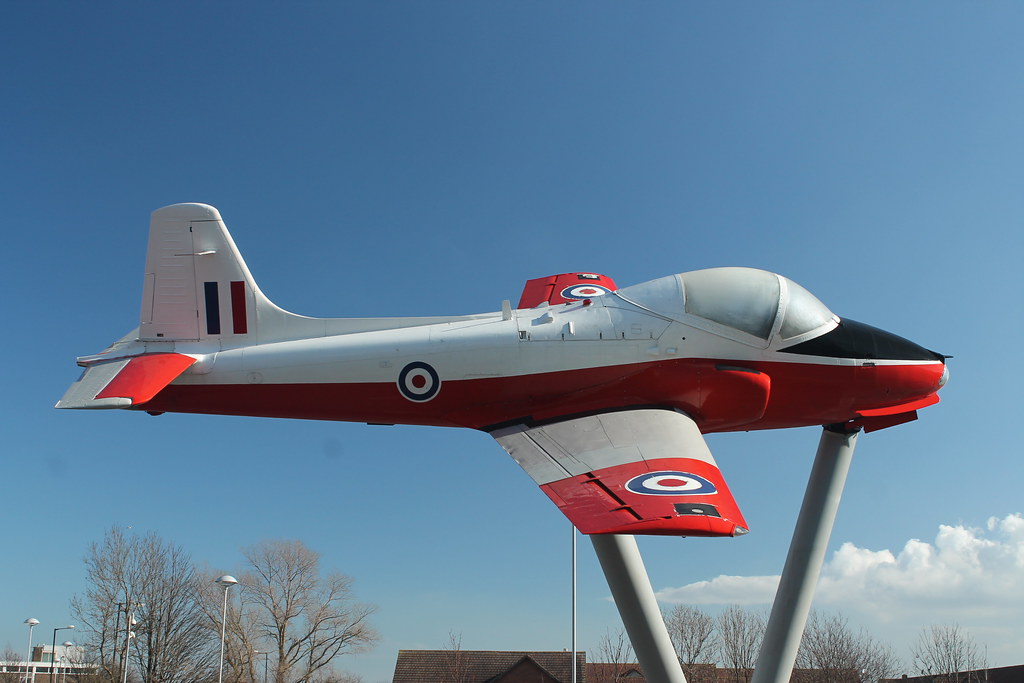
The BAC Jet Provost is a British jet trainer aircraft that was in use with the Royal Air Force (RAF) from 1955 to 1993. It was originally developed by Hunting Percival from the earlier piston engine-powered Percival Provost basic trainer, and later produced by the British Aircraft Corporation (BAC). In addition to the multiple RAF orders, the Jet Provost, sometimes with light armament, was exported to many air forces worldwide. The design was also further developed into a more heavily armed ground attack variant under the name BAC Strikemaster.
Key Information

.jpg)
Development
[edit]Origins
[edit]In early 1951, Hunting Percival began work on the design studies that would ultimately lead to the Jet Provost.[2] At the time, the company was in the process of establishing mass production for the earlier piston-engined Percival Provost basic trainer, but had anticipated that demand for a jet-powered trainer aircraft would be on the horizon. The design team aimed to produce an aircraft capable of equalling the handling characteristics of operational jet fighters of the era while also possessing modest approach and stall speeds and remaining simple to handle, as opposed to aiming to obtain maximum performance.[2]

During the early design process, a series of increasingly frequent liaisons with RAF Flying Training Command took place, helping to gauge the considerations required to succeed in aspects of the proposed aircraft's design, such as instructional processes and maintenance requirements.[2] During development, Hunting Percival had intentionally reused as many existing components and subsystems of the Percival Provost as possible, including the tail surfaces, main planes and main undercarriage legs, to speed development through to the prototype stage.[2] The initial design work was performed as a private venture, independent of any service requirement; in March 1953, sponsorship from the British Government to support the development was made available as a result of interest from the Ministry of Supply.[2] That same month, an order for service-test quantity of Jet Provosts was received.[3]
Prototypes and evaluation
[edit]On 26 June 1954, the prototype XD674 conducted its maiden flight from the factory at Luton Airport, flown by Dick Wheldon.[2] A series of seven flights were flown in quick succession over the following three days. By early November 1954, a total of 123 flying hours had been accumulated by the prototype during Hunting Percival's own flight test program, after which the prototype was submitted for official trials at RAF Boscombe Down.[2] While testing proved the overall performance of the Jet Provost to be satisfactory, refinements were made, such as shortening the legs of the landing gear for a smoother ride when deployed at semi-prepared airstrips.[2]
On 19 February 1955, the first of ten pre-production aircraft, designated as the Jet Provost T1, performed its first flight.[2] In May 1955, three of the pre-production aircraft were assigned for the first stage of service trials with the Central Flying School (CFS) of the RAF to determine the value of the Jet Provost in the ab initio training role and to develop a syllabus for the training program. During the second stage of CFS trials using the same three aircraft, actual students were introduced to the type for practical evaluation purposes, which was performed at RAF Hullavington until the successful completion of trials on 2 July 1956.[4] According to feedback from CFS examiners, the Jet Provost had noticeably improved the performance of students during its trial deployment.[5]
Further development
[edit]As a result of the results and responses produced from the trials performed using the pre-production aircraft, Hunting Percival proceeded to develop and incorporate several different improvements upon the design. Amongst the changes made was an overall smoothing of the fuselage lines, hydraulic systems being substituted for pneumatic counterparts, and the addition of a dorsal fillet; the new model was designated as the Jet Provost T2.[5] On 1 September 1955, the first Jet Provost T2 made its first flight. This variant was used only for development work; in addition to seeing use at Hullavington, three Jet Provost T2s were dispatched overseas for winterization trials in Scandinavia and a series of sales tours across Europe, Canada, the United States of America, and Latin America.[5]

In June 1957, a production order was placed for the first 40 of the developed Jet Provost T3, featuring a more powerful Armstrong Siddeley Viper jet engine, ejector seats, a redesign of the airframe, and a shortened and strengthened version of the retractable tricycle undercarriage.[2] Percival built a single example, which was used purely for structural tests throughout the development stages, giving the designers valuable research into what could be achieved with the basic design.[6] On 22 June 1958, the first Jet Provost T.3 conducted its first flight.[1] In total, 201 T3s were delivered between 1958 and 1962.
The T4 followed in 1960, fitted with a more powerful variant of the Viper engine and first flown on 15 July, and this was followed by the pressurised T5 in 1967.[7] The T51 was an armed export version, sold to Ceylon (present day Sri Lanka), Kuwait and Sudan. It was armed with two 7.7-mm (0.303-inch) machine guns. The T52 was another export version sold to Iraq, South Yemen, Sudan and Venezuela, with the same armament as the T51. The T55 was the final armed export version which was sold to Sudan.[citation needed] A more heavily armed variant of the airframe was developed as the BAC Strikemaster.
Design
[edit].jpg)

The BAC Jet Provost is a dedicated jet-powered trainer aircraft; according to aviation publication Flight International, it has the distinction of being the first ab initio jet trainer to be standardised by any air force.[2] As designed, it was intended for the Jet Provost to replace, rather than accompany, the use of piston-engine trainer aircraft.[8] The Jet Provost incorporates numerous features to support students during training. The aerodynamic design deliberately avoids speed, instead focusing on favourable handling characteristics and ease of recovery from stall and spin conditions. An emphasis was placed on flexibility, enabling use of the type throughout a range of training operations.[9]
The cockpit of the Jet Provost, and much of the operational equipment fittings, is essentially identical to that of the preceding Percival Provost.[10] It features a side-by-side seating arrangement, both positions being fitted with duplicated flight controls and instrumentation, which is well suited to the pupil-instructor pairing.[11] The dual flight controls employs conventional manually-controlled flight control surfaces via a cable-and-tie rod arrangement. A key feature for the era amongst the fittings in the cockpit is the Centralized Warning Panel, which alerts the pilots in the event of a number of unfavourable or hazardous conditions being detected, such as icing conditions, fire, and oxygen failure.[12] The high-flying capabilities of the Jet Provost necessitated the addition of an oxygen system in the cockpit, which was unpressurised on early production aircraft.[13]
The Jet Provost has an uncomplicated structure, the airframe being based on the Percival Provost, albeit being strengthened in key areas such as the main wing spar and featuring a substantially different undercarriage arrangement.[14] It possesses an all-metal stressed-skin fuselage built in two sections, the forward section stretching from the rear of the engine bay to the nose comprises a double-frame to absorb the wing and engine loads, while the rear fuselage section uses an orthodox semi-monocoque structure.[15] Major loads across the fuselage are supported by a combination of four longerons and a single longitudinal beam across the upper-center line.[16] The ailerons, elevators, and rudder are all attached to the airframe via two inset hinges each.[11] The nose contains a hinged metal assembly, housing the radio, batteries, and other electronic equipment, and is easily serviceable by ground crew.[17] All fuel tankage is housed within the wings.[8] Where possible, all components used were designed to maximized interchangeability and to conform with international standardisation; a total of 49 service panels across the aircraft's exterior provides access for maintenance and servicing.[11][12]
The Jet Provost is equipped with a single Armstrong Siddeley Viper 101 turbojet engine, which is mounted behind the cockpit in a roomy stainless steel-lined engine bay upon a secondary steel-tube structure.[18] Air is fed to the engine by a pair of ram-air intakes set on either side of the aircraft's forward fuselage connected via sharply-curving ducts to converge just forward of the engine itself.[19] As supplied, each engine is delivered as a compact engine-change unit, comprising the engine itself, accessories, and oil tank.[16] Both the hydraulic and electrical systems were driven via a fuselage-mounted accessories gearbox connected to the Viper engine by a telescopic drive.[8] One particularly favourable aspect of the Viper engine is the low maintenance demands imposed for the era.[5] Engine ignition is achieved via an electric starter system, the engine controls have been described as being of a conventional nature.[8]
Operational service
[edit]
_(7211694114).jpg)
The Jet Provost proved to be a capable trainer, being used in the ab initio Basic Trainer role from the outset (pilots progressed to the de Havilland Vampire and later the Folland Gnat for Advanced Jet Training).
After successful acceptance trials of the T1 during late 1955 at No. 2 Flying Training School at RAF Hullavington, the RAF formally accepted the type in 1957. The first production version was the T3, powered by the Viper 102, and this entered service with No. 2 FTS, located at RAF Syerston, during June 1959, when deliveries commenced from the Hunting Aircraft factory at Luton airport. The T3 was also operated by Central Flying School at RAF Little Rissington; the Royal Air Force College at RAF Cranwell, Lincolnshire; by No. 1 Flying Training School at RAF Linton-on-Ouse, Yorkshire; 3FTS at RAF Leeming, Yorkshire; 6FTS at RAF Acklington, Northumberland; and 7FTS at RAF Church Fenton, Yorkshire. The twin-seated side by side variant was also used at RAF Brawdy in Wales to train Forward Air Controllers.
The later T4 was fitted with the more powerful Viper A.S.V. 11 of 2,500 lbs static thrust and first flew on 15 July 1960. It quickly entered service with the units listed above.
The T5 variant was fitted with the Viper 201 and cockpit pressurisation. These developments encouraged the RAF to utilise the Jet Provost in a number of different roles besides basic training. With a top speed of 440 mph, excellent maneuverability, mechanical reliability and low operating costs, the Jet Provost was utilized as an aerobatic aircraft, air warfare and tactical weapons training as well as advanced training. The first T5 made its maiden flight on 28 February 1967 and deliveries from BAC's Warton factory commenced on 3 September 1969. Operators of the T5 included the RAFs Central Flying School and No. 1, No. 3 and No. 6 Flying Training Schools.[20]

Besides service with the RAF, the Jet Provost found success in export markets. A single Jet Provost T2 was exported to Australia and was operated by the Royal Australian Air Force (RAAF) to evaluate the type for the purpose of providing 'all-through' jet-based training.[21] Following a six-month evaluation period, the RAAF ultimately decided to retain the de Havilland Vampire to fulfill its requirements for a jet-powered trainer, and later replaced its Vampires with the Italian-built Aermacchi MB-326 during the late 1960s instead. The sole aircraft itself was retained, being presented to the Sydney Technical College for use as an instructional airframe, and was later preserved.[21][22]
Ceylon ordered 12 Jet Provost T51, these went into operational service in early 1960, one crashed in February 1960 following a flame out. The Provost were meant for pilot conversions for jets and intended as a stepping stone to introduce jet fighters to the Royal Ceylon Air Force (RCyAF). However these plans were scrapped due to defense cuts following the attempted coup in 1962 and by the late 1960s the remaining Provosts were mothballed. With the outbreak of the 1971 JVP insurrection in April 1971, the RCyAF took out its mothballed Provosts and started a crash program to bring these to operational readiness in three days. These Provost carried out ground attack sorties on insurgent targets, vectored in by helicopters that used smoke bombs to mark targets for Provosts. One Provost crashed returning from a sortie and its pilot killed.[23]
Nigeria acquired two ex-Sudan Air Force Jet Provost T.51s in 1967, using them for training and ground attack purposes against Biafra during the Nigerian Civil War. Flown both by Nigerian and mercenary pilots, they proved effective as in both roles, but efforts to obtain more Jet Provosts directly from Britain failed.[24]
The Jet Provost was withdrawn from RAF service during the early 1990s, having been replaced by the newer turboprop-powered Short Tucano. Ab initio training had reverted to piston-engined aircraft in the early 1970s, using the Scottish Aviation Bulldog.
The Jet Provost remains popular among private operators and enthusiasts; being an inexpensive jet, many have been acquired and maintained in a flightworthy condition by collectors and private individuals. Some are flown at airshows, whilst roughly equal numbers are maintained in ground-runnable condition at various locations, many of these being in the United Kingdom.
Variants
[edit]
.jpg)
| Model | Number built | Manufacturer | Comments |
|---|---|---|---|
| Jet Provost T1 | 12 | Hunting Percival | Initial production batch for the RAF. |
| Jet Provost T2 | 3 | Hunting Percival | Development aircraft only. |
| Jet Provost T2B | 1 | Hunting Percival | Company demonstrator. Evaluated in Portugal.[25] |
| Jet Provost T3 | 201 | Hunting Aircraft | Main production batch for the RAF. |
| Jet Provost T3A | (70) | Hunting | Modified T3 with improved avionics for the RAF. |
| Jet Provost T4 | 198 | BAC | Variant with more powerful engine for the RAF. |
| Jet Provost T5 | 110 | BAC | Pressurised version for the RAF. |
| Jet Provost T5A | (93) | BAC | Modified T5 with improved avionics and a rough grey coating on the wing to break up the smooth airflow and give the trainee pilot an early indication of the onset of a stall (the T5's original clean wing gave the pilot little warning).[26] |
| (Jet Provost T5B) | (13) | BAC | Unofficial designation: a T5 fitted with tip-tanks used for Navigator training. |
| Jet Provost T51 | 22 | Hunting Aircraft | Export version of the T3 (12 built for Ceylon, four built for Sudan, and six built for Kuwait). |
| Jet Provost T52 | 43 | BAC | Export version of the T4 (20 built for Iraq, 15 built for Venezuela, eight built for Sudan). |
| Jet Provost T52A | ? | BAC | Export version of the T4 (? built for South Yemen). |
| Jet Provost T55 | 5 | BAC | Export version of the T5, built for Sudan. |
| BAC Strikemaster | 146 | BAC | Ground attack version of the T5. |
| BAC 166 | 1 | BAC | Private venture trial variant of the T4 with a Viper 522 engine. |
Operators
[edit]

_(9461785218).jpg)

- Royal Australian Air Force evaluated a single T.2 in No. 1 Flying Training School RAAF for six months in 1959.[22]

- Royal Ceylon Air Force received 12 T.51s.

- Iraqi Air Force received 20 T.52s, with deliveries starting in August 1964.[27]

- Kuwait Air Force received six T.51s.

- Nigerian Air Force received two ex-Sudanese T.51s in 1967.[28]

- Portuguese Air Force evaluated the T.2B in 1959. (Returned to UK in 1960).[25]

- Republic of Singapore Air Force operated three (ex-South Yemen Air Force) T.52s from 1975 until 1980.[29][30][31]

- People's Republic of Yemen Air Force (originally South Arabian Air Force) received four T.52As in 1967, and then four Strikemasters in 1970.[32]

- Sudan Air Force received four T.51s and eight T.52s in 1962. Five T.55s were ordered in 1966.[33]

- Royal Air Force
- No. 1 Flying Training School RAF (1961-)[34]
- No. 2 Flying Training School RAF (1955–70)[34]
- No. 3 Flying Training School RAF (1961-)[34]
- No. 6 Flying Training School RAF (1961-68 & 1970-88)[35]
- No. 7 Flying Training School RAF (1962-66 & 1979-92)[35]
- Central Flying School (1955[36]-at least 1977)[37]
- Royal Air Force College Cranwell[38]
- RAF College of Air Warfare[38]
- Central Air Traffic Control School[39]

- Venezuelan Air Force received 15 T.52s.
Surviving aircraft
[edit] | This section needs additional citations for verification. (August 2023) |

Australia
[edit]- The only Jet Provost T2 to enter service with the RAAF, A99-1, is preserved at the RAAF Museum, RAAF Williams, Point Cook, Victoria, Australia.[21]
- A Jet Provost is outdoors in preservation at Gippsland Armed Forces Museum (West Sale Airport, VIC)
Canada
[edit]- Jet Provost T4, XR679 (C-FDJP), is housed at the Jet Aircraft Museum, London International Airport, Ontario, Canada.[40]
Cyprus
[edit]- Jet Provost T4, XP666 is privately owned at Pafos Airport, Cyprus.
Germany
[edit]- Jet Provost T4, XS217 is privately owned in Germany.
Italy
[edit]- Jet Provost T3A, XM478 is on display at Volandia - Parco e Museo del Volo, Somma Lombardo, Italy.[41]
Jersey
[edit]- Jet Provost T4, XP573 is at the Jersey Airport Fire Section, Channel Islands.
New Zealand
[edit]- Jet Provost T5A, XW357, is on display at the National Transport and Toy Museum, Wānaka, New Zealand.[42]
Sri Lanka
[edit]- 2 Jet Provost T51s are on display at the Sri Lanka Air Force Museum, Rathmalana, Sri Lanka.[43]
United Kingdom
[edit]- Jet Provost T1, XD674 is located in Hangar 1 at Royal Air Force Museum Cosford.
- Jet Provost T1, XM129 (painted as XD693) is stored at North Weald Airfield.
- Jet Provost T3, XM351 is also located at Royal Air Force Museum Cosford.
- Jet Provost T3, XN458 was bought on eBay for £1,050 by a group of people formed for the purpose, the 458 Club.[44] It was put on display after restoration, in the original 1960s colour scheme of 1 FTS,[45] in the beer garden of the Standard Inn, Northallerton, North Yorkshire, England, whose landlord Paul Greig found and snipe-bid for the aircraft.[46][47] Now located at Fishburn Historic Aviation Centre, Fishburn airfield, County Durham.
- Jet Provost T3, XN637 (registered as "G-BKOU" for civilian use) is owned by a private group and flies from North Weald Airfield.[48]
- Jet Provost T3A XM350, is on display at South Yorkshire Aircraft Museum, along with cockpit sections of T3 XM411, T3 XN511 and T4 XS216.[49]
- Jet Provost T3A, XM405 (registered as "G-TORE" for civilian use[50]), is located on a private farm in Market Harborough.[51]
- Jet Provost T3A, XM412, is located on the airfield at Balado, near Kinross, Scotland.[52]
- Jet Provost T3A, XM414, is located at the Ulster Aviation Society at Long Kesh, Northern Ireland.[53]
- Jet Provost T3A, XM479 (registered as "G-BVEZ" for civilian use), is owned by a private group and flies from Leeds East Airport.[54]
- Jet Provost T3A, XN459, (registered as "G-BWOT" for civilian use) is owned by a private group and flies from North Weald Airfield.[55]

- Jet Provost T3A, XN582, is preserved at the Yorkshire Air Museum, Elvington, York, England. The museum has also acquired T3A XN589 with the closure of nearby RAF Linton-on-Ouse and is restoring it.[56]
- Jet Provost T3A, XN586, is on display at the Brooklands Museum, Weybridge, Surrey, England.[57]
- Jet Provost T4, XP556, is at Cranwell Aviation Heritage Museum, North Rauceby, Lincolnshire, England.[58]
- Jet Provost T4, XP557, is at Dumfries and Galloway Aviation Museum, Dumfries, Scotland.[59]
- Jet Provost T4, XP568 is on static display at East Midlands Aeropark.[60]
- Jet Provost T4, XP627, is on display at North East Land, Sea and Air Museums, Sunderland, Tyne and Wear, England.[61]
- Jet Provost T4, XP640, is preserved at the Yorkshire Air Museum, Elvington, York, England,[62] along with the cockpit section of T3 XM373.[56]
- Jet Provost T4, XS209, is located at the Solway Aviation Museum, Carlisle Lake District Airport, England.[63]
- Jet Provost T4, XS228, converted to T52A for South Arabia and exported as G-27-7 before serialled as 104, then South Yemen AF still as 104 until 1975, then 352 for Royal Singapore Airforce until 1980. Purchased by private owners in UK in 1983 with new reg G-PROV. Flown most recently flying in original Southern Arabian markings as G-PROV but marked as 104 until at least 2023, current status unclear.
- Jet Provost T5A, XW290, is stored at Cold War Jets Collection, Bruntingthorpe, Leicestershire, England.
- Jet Provost T5A, XW310 (registered as G-BKOU for civilian use), is stored at North Weald Airfield, Essex, England.
- Jet Provost T5, XW323, is located at the Royal Air Force Museum London, Hendon Aerodrome, London, England.[64]
- Jet Provost T5, XW324 (registered as G-BWSG for civilian use), is stored at East Midlands Airport, England.[65]
- Jet Provost T5A, XW405, is on display at the Hartlepool College of Further Education, Hartlepool, England.[66] The college also uses T5 XW309 and T5A XW404 to educate students.[56]
- Jet Provost T5A, XW375, is on site at the former Highland Aviation Museum
- Jet Provost T5A, XW434, is on display as gate guardian at Wolverhampton Halfpenny Green airport

United States
[edit]- Jet Provost T3, XM349, is on static display at Air Heritage Aviation Museum in Beaver Falls, Pennsylvania.[67]
- Jet Provost T3A, XM357, is housed at the Tillamook Air Museum, Oregon.[68]
- Jet Provost T3, XM455, in a private collection in Las Vegas, Nevada
- Jet Provost T3A, XM464, is on static display at Pima Air & Space Museum in Tucson, Arizona.[69]

- Jet Provost T5A, XW294, located at the Everett Community College. Paine Field, Washington
- Jet Provost T5A, XW306, is privately owned and registered as N313A[70]
- Jet Provost T5A, XW312, also located at the Everett Community College. Paine Field, Washington
- Jet Provost T5A, XW314, in private storage roadside in Maple Hill, North Carolina
- Jet Provost T5A, XW326, registered as N326GV is located at the Zephyrhills airport in Florida. Privately owned and displayed at airshows by its owner aerobatic pilot Dondi Pesquera.
Specifications (Jet Provost T.5)
[edit]Data from Jane's All The World's Aircraft 1971–72,[71] Flight International,[13] BAE Systems[1]
General characteristics
- Crew: 2
- Length: 34 ft 0 in (10.36 m)
- Wingspan: 35 ft 4 in (10.77 m)
- Height: 10 ft 2 in (3.10 m)
- Wing area: 213.7 sq ft (19.85 m2)
- Airfoil: root: NACA 23015 mod; tip: NACA 4412 mod[72]
- Empty weight: 4,888 lb (2,217 kg) [73]
- Gross weight: 6,989 lb (3,170 kg)
- Max takeoff weight: 9,200 lb (4,173 kg)
- Powerplant: 1 × Armstrong Siddeley Viper Mk.102 / Mk.202 turbojet engine, 1,700 lbf (7.6 kN) thrust
- 2,500 lbf (11,120.55 N) Mk.202
Performance
- Maximum speed: 382 kn (440 mph, 707 km/h) at 25,000 ft (7,620 m)
- Range: 780 nmi (900 mi, 1,440 km) with tip tanks.
- Service ceiling: 36,750 ft (11,200 m)
- Rate of climb: 4,000 ft/min (20 m/s)
- Wing loading: 32.7 lb/sq ft (160 kg/m2)
Armament
- Guns: 2× 0.303 in (7.7 mm) machine guns Mark 55
- Rockets:
- 6× 60 lb (27 kg) or
- 12× 25 lb (11 kg) or
- 28x 68 mm SNEB rockets in four pods Mark 55
- Bombs: ** 4× 540 lb (245 kg) Mark 55
See also
[edit]

Related development
Aircraft of comparable role, configuration, and era
Related lists
References
[edit]Citations
[edit]- ^ a b c "Heritage – Product – Jet Provost." Archived 8 May 2016 at the Wayback Machine BAE Systems, Retrieved: 23 April 2016.
- ^ a b c d e f g h i j k Flight International 13 June 1958, p. 795.
- ^ Flight International, 6 May 1955, p. 587.
- ^ Flight International 13 June 1958, pp. 795–796.
- ^ a b c d Flight International 13 June 1958, p. 796.
- ^ Flight International 13 June 1958, pp. 796–798.
- ^ "The Jet Provost T.5". Flight International. 9 March 1967. p. 379.
- ^ a b c d Flight International, 6 May 1955, p. 586.
- ^ Flight International 13 June 1958, p. 798.
- ^ Flight International, 6 May 1955, p. 582-585.
- ^ a b c Flight International, 6 May 1955, p. 583.
- ^ a b Flight International 13 June 1958, p. 799.
- ^ a b Flight International, 6 May 1955, p. 585.
- ^ Flight International, 6 May 1955, pp. 582–583.
- ^ Flight International 13 June 1958, pp. 798–799.
- ^ a b Flight International, 6 May 1955, p. 582.
- ^ Flight International, 6 May 1955, pp. 583–584, 586.
- ^ Flight International, 6 May 1955, pp. 582, 585–586.
- ^ Flight International, 6 May 1955, pp. 584, 586.
- ^ Thetford, pp. 91–95
- ^ a b c "A99 Jet Provost." RAAF Museum, Retrieved: 21 April 2016.
- ^ a b "ADF Serials - Jet Provost". www.adf-serials.com.au.
- ^ "SLAF History : The First Jets Arrive". airforce.lk. Sri Lanka Air Force. Retrieved 21 September 2022.
- ^ Draper 1999, pp. 78–79
- ^ a b Adrian Balch; John Luke & Dave Key. Mark Russell (ed.). "The Jet Provost T.2". Jet Provost Heaven.
- ^ "Percival Hunting P.84 Jet Provost". All-aero.com. Retrieved 10 August 2018.
- ^ Sipos, Milos; Cooper, Tom (2020). Wings of Iraq, Volume 1: The Iraqi Air Force, 1931-1970. Warwick, UK: Helion & Company Publishing. p. 57. ISBN 978-1-913118-74-7.
- ^ Draper 1999, p. 78
- ^ "UK Civil Aviation Authority Aircraft Register – Entry for former Singapore AF Jet Provost T52 registered G-PROV". Archived from the original on 6 June 2011. Retrieved 26 September 2008.
- ^ Andrade 1982, page 192
- ^ "Jet Provost T52 registered G-JETP." Archived 24 February 2014 at the Wayback Machine UK Civil Aviation Authority Aircraft Register. Retrieved: 3 July 2010.
- ^ Cooper, Tom (2017). Hot Skies Over Yemen, Volume 1: Aerial Warfare Over the South Arabian Peninsula, 1962-1994. Solihull, UK: Helion & Company Publishing. p. 30. ISBN 978-1-912174-23-2.
- ^ Cooper, Tom; Weinert, Peter; Hinz, Fabian; Lepko, Mark (2011). African MiGs, Volume 2: Madagascar to Zimbabwe. Houston: Harpia Publishing. p. 112. ISBN 978-0-9825539-8-5.
- ^ a b c Sturtivant & Hamlin 2007, p. 134.
- ^ a b Sturtivant & Hamlin 2007, p. 136.
- ^ Sturtivant 1987, p. 198.
- ^ Sturtivant & Hamlin 2007, p. 84.
- ^ a b Sturtivant 1987, p. 247.
- ^ March 1990, p. 82.
- ^ "BAC Jet Provost." Archived 6 July 2016 at the Wayback Machine Jet Aircraft Museum, Retrieved: 21 April 2016.
- ^ "Volandia". AviationMuseum.eu. 5 February 2016.
- ^ "BAC Jet Provost T5A." Archived 22 January 2016 at the Wayback Machine National Transport & Toy Museum, Retrieved: 21 April 2016.
- ^ "Sri Lanka Air Force Museum". www.airforcemuseum.lk. Retrieved 22 May 2018.
- ^ "XN458". 458 Club. Archived from the original on 11 February 2012.
- ^ "Aircraft Data XN458, 1960 Hunting P-84 Jet Provost T.3 C/N PAC/W/10137". Airport-data.com. Retrieved 10 August 2018.
- ^ "Jet Provost lands in Yorkshire pub beer garden". BBC News. 10 August 2018.
- ^ "Vintage jet in beer garden!". Harrogate Advertiser. 26 May 2005. Archived from the original on 10 August 2018. Retrieved 10 August 2018.
- ^ "JET PROVOST HEAVEN".
- ^ "Aircraft List". South Yorkshire Aircraft Museum. Archived from the original on 15 December 2018. Retrieved 7 July 2023.
- ^ "HUNTING JET PROVOST T.3A XM405 (G-TORE)"
- ^ "Why Won't It Start? T34/85 Episode 1" YouTube, Retrieved: 29 August 2022.
- ^ "Jet Provost T3A XM412." Flickr, Retrieved: 6 March 2017.
- ^ "Jet Provost T3A XM414"
- ^ "Newcastle Jet Provost"
- ^ "JET PROVOST HEAVEN".
- ^ a b c "Hunting Jet Provost". Demobbed. Retrieved 7 July 2023.
- ^ "Powered Aircraft, Gliders & Aircraft Cockpit Sections." Archived 28 April 2016 at the Wayback Machine Brooklands Museum, Retrieved: 21 April 2016.
- ^ "Hunting Jet Provost T.4 XP556" Jet Provost Heaven
- ^ "Jet Provost T4 XP557." Dumfries and Galloway Aviation Museum, Retrieved: 21 April 2016.
- ^ "Aircraft on Display." East Midlands Airport, Retrieved: 29 April 2016.
- ^ "BAC Jet Provost T.4 (XP627)." North East Aircraft Museum, Retrieved: 21 April 2016.
- ^ "Hunting Percival Jet Provost T.4". Yorkshire Air Museum. Retrieved 21 April 2016.
- ^ "Aircraft". Solway Aviation Museum. Retrieved 21 April 2016.
- ^ "British Aircraft Corporation Jet Provost T5A". RAF Museum. Retrieved 21 April 2016.
- ^ https://jetaerobatics.weebly.com/history-of-xw324.html
- ^ "Hartlepool College of Further Education". Retrieved 9 August 2016.
- ^ "BAC Jet Provost T3 – Air Heritage Inc". Retrieved 15 April 2023.
- ^ "Aircraft." Tillamook Air Museum, Retrieved: 21 April 2016.
- ^ "Hunting Jet Provost" Pima Air & Space Museum, Retrieved: 21 June 2024.
- ^ "N313A (1974 BRITISH AIRCRAFT CORPORATION P84 JET PROVST MK.5A owned by GEYMAN EDWARD J) Aircraft Registration".
- ^ Taylor 1971, p. 181.
- ^ Lednicer, David. "The Incomplete Guide to Airfoil Usage". m-selig.ae.illinois.edu. Retrieved 16 April 2019.
- ^ "Warbird Alley: Jet Provost". www.warbirdalley.com. Retrieved 13 June 2020.
Bibliography
[edit]- Bagshaw, Alan; Deacon, Ray; Pollock, Alan; Thomas, Malcolm (2006). RAF Little Rissington. Barnsley, UK: Pen & Sword Aviation. ISBN 978-1-84415-381-7.
- Clarke, Bob. Jet Provost: The Little Plane With The Big History. Stroud, UK: Amberley Publishing Plc, 2008. ISBN 978-1-84868-097-5.
- Draper, Michael I. (1999). Shadows: Airlift and Airwar in Biafra and Nigeria 1967–1970. Aldershot, UK: Hikoki Publications. ISBN 1-902109-63-5.
- "Jet Provost T.3". Flight International, 13 June 1958. Vol. 73, No. 2577, pp. 795–799.
- "Jet Provost: Hunting Percival's New Ab Initio Trainer." Flight International, 6 May 1955. pp. 582–587.
- March, Peter (1990). Royal Air Force Yearbook 1990. Fairford, UK: Royal Air Force Benevolent Fund.
- Matos, José (2017). "Nao obrigado!: Portugal's Flirtation with the Hunting Jet Provost & BAC Strikemaster". The Aviation Historian (20): 84–88. ISSN 2051-1930.
- Sturtivant, Ray (1987). The History of Britain's Military Training Aircraft. UK: Haynes Publishing Group. ISBN 0-85429-579-8.
- Sturtivant, Ray; Hamlin, John (2007). Royal Air Force flying training and support units since 1912. Tonbridge, UK: Air-Britain (Historians). ISBN 978-0851-3036-59.
- Taylor, John W.R. "Hunting Jet Provost and BAC 167." Combat Aircraft of the World from 1909 to the present. New York: G.P. Putnam's Sons, 1969. ISBN 0-425-03633-2.
- Taylor, John W.R., ed. Jane's All The World's Aircraft 1971–72. London: Janes's Yearbooks, 1971. ISBN 0-354-00094-2.
- Thetford, Owen. Aircraft of the Royal Air Force since 1918. Putnam & Company Limited. ISBN 0-370-10056-5.
External links
[edit]

BAC Jet Provost
View on GrokipediaDevelopment
Origins
In early 1951, the British aircraft manufacturer Hunting Percival initiated the design of a jet-powered basic trainer aircraft, driven by the need to succeed the company's earlier piston-engined Percival Provost and Prentice trainers within the Royal Air Force (RAF). This effort was a private venture initiated in 1951, anticipating the RAF's need for a jet-powered basic trainer to succeed the piston-engined Percival Provost for ab initio pilot training, amid the transition to jet propulsion.[1][6] Hunting Percival fully funded the early phases as a private venture, demonstrating confidence in the design's potential to meet emerging RAF requirements for jet training.[1] Key design objectives emphasized safety and instructional efficacy, including side-by-side seating to facilitate dual instruction during initial flight training. The aircraft was engineered for docile handling characteristics, ensuring forgiving flight behavior suitable for student pilots with minimal experience. It incorporated the Armstrong Siddeley Viper turbojet engine, selected for its compact size, reliability, and sufficient thrust to power a lightweight trainer without overwhelming complexity.[1][6] Initially designated as the P.19, the project evolved from conceptual studies rooted in piston-engine trainer designs to a fully jet-configured airframe, adapting the low-wing monoplane layout of the Provost series for turbojet integration. By 1953, the company had constructed the first full-scale mockup to refine ergonomics and systems placement, paving the way for prototype development.[1][6]Prototypes and evaluation
The first prototype of the Jet Provost, XD674, was constructed at Hunting Percival's facility in Luton. It performed its maiden flight on 26 June 1954, piloted by test pilot Dick Wheldon. On 19 February 1955, the first pre-production T.1, XD675, made its maiden flight. The T.2 development variant began with XD694, which first flew on 1 September 1955.[7][1] During manufacturer and official trials at the Aeroplane and Armament Experimental Establishment at Boscombe Down, the Jet Provost achieved a top speed of 440 mph (708 km/h) at 25,000 ft (7,620 m). The aircraft exhibited benign stall characteristics, with effective aileron control maintained up to the stall point and recovery initiated by simply easing the control column forward. Spin recovery tests confirmed straightforward procedures, typically involving rudder and elevator inputs without the need for accelerated rotation, underscoring its gentle handling suitable for ab initio trainees.[8][7] From 1955, the Royal Air Force evaluated the Jet Provost at No. 2 Flying Training School at Hullavington, where pre-production T.1 aircraft underwent service trials involving instructor training and student courses. These assessments included comparisons with contemporary jet trainer candidates such as the Fokker S.14 and Miles M.38, highlighting the Jet Provost's advantages in training progression and reduced solo times compared to piston predecessors. Over 2,200 flying hours were logged in Part B of the trials, confirming its efficacy for all-through-jet training.[7][9][1] The positive results led to the Jet Provost's selection for production as the T.1 variant, with the Air Ministry placing an initial order for 10 units in late 1955 for RAF service evaluation.[7][1]Further development and production
Following successful prototype evaluations, production of the Jet Provost transitioned to the T.3 variant, with the first example flying on 22 June 1958.[1] This model incorporated an upgraded Armstrong Siddeley Viper 102 turbojet engine providing 1,750 lbf (7.8 kN) of thrust, along with the addition of Martin-Baker Mk.4 ejection seats for both crew members to enhance safety during training.[1] A total of 201 T.3 aircraft were built for the Royal Air Force between 1958 and 1962.[2] Development continued with the T.4 variant, which first flew in September 1960 and entered production the following year.[10] The T.4 featured a more powerful Viper 11 engine delivering 2,500 lbf (11.1 kN) of thrust, enabling improved performance for advanced training roles.[10] In total, 198 T.4s were constructed between 1961 and 1967.[11] The final production model, the T.5, was developed starting in 1964 and achieved its maiden flight in February 1967, entering RAF service in 1969.[12] It was equipped with a Viper 202 engine rated at 2,500 lbf (11.1 kN) thrust, and included significant enhancements such as a pressurized cockpit, extended nose for additional avionics, and reinforced wings for greater structural integrity.[12] Production totaled 110 T.5s, with the last delivered in 1973.[12] In 1960, amid industry consolidation, Hunting Aircraft—successor to Hunting Percival since 1957—was acquired by the newly formed British Aircraft Corporation (BAC), which assumed responsibility for ongoing Jet Provost production at its Luton facility.[13] By 1967, BAC had completed assembly of all 734 Jet Provost trainers.[14] Export development paralleled domestic production, with the T.51 adaptation of the T.3 introduced for international markets; it included provisions for light armament such as two 7.7 mm machine guns.[1] The inaugural overseas order came from Ceylon (now Sri Lanka) in 1958, for 12 T.51s delivered starting in 1959.[1]Design
Airframe and structure
The BAC Jet Provost features a low-wing cantilever monoplane configuration, optimized for stable flight characteristics during basic pilot training.[1] The wings incorporate a moderate aspect ratio of approximately 5.84, which contributes to predictable handling at low speeds by reducing sensitivity to turbulence and aiding stall recovery.[15] The airframe employs an all-metal stressed-skin semi-monocoque construction, primarily using aluminum alloys for durability and light weight.[16] This structure comprises bulkheads, built-up frames, and longerons covered by light alloy panels, divided into forward and aft fuselage sections for ease of assembly and maintenance.[16] Overall dimensions vary by variant: early models like the T.3 have a wingspan of 10.77 m, length of 9.88 m, and height of 3.10 m, while the T.5 measures 10.77 m in wingspan (extendable to 11.25 m with tip tanks), 10.36 m in length, and 3.10 m in height to accommodate the enlarged powerplant and empennage.[1][15] The retractable tricycle landing gear, hydraulically actuated at 1,500 lb/in², features Dowty oleo-pneumatic shock absorbers on all units for robust ground handling during training operations.[15][16] Main wheels retract inward into the wings, and the nose wheel folds forward into the fuselage, with a wheel track of 3.27 m to support operations on prepared runways typical of RAF training bases.[15] The design emphasizes simplicity and reliability, with the overall structure facilitating easy access for instructors and students in the side-by-side cockpit setup.[12]Cockpit, avionics, and propulsion
The Jet Provost's cockpit accommodated the instructor and student pilot in a side-by-side arrangement, promoting effective training through shared visibility and dual controls that allowed the instructor to intervene as needed. This configuration, retained from the piston-engined Provost, was enclosed by a rearward-sliding one-piece canopy for both occupants, with an integrated jettison system enabling emergency canopy removal via a dedicated handle or explosive charges to facilitate egress. From the T.3 variant onward, safety was enhanced by the installation of lightweight Martin-Baker Mk.4 ejection seats, which provided zero-zero capability under certain conditions and were a significant upgrade over the earlier models' restraint systems. The avionics installation emphasized simplicity for basic jet training, featuring core instrumentation such as a gyroscopic artificial horizon, VHF radio for communications, and a blind-flying instrument panel to support instrument flight proficiency. In the advanced T.5 series, the suite was augmented with a lengthened forward fuselage to house additional equipment, including provisions for VOR/DME navigation receivers in the T.5A subvariant, while maintaining the focus on essential rather than complex systems to align with intermediate training requirements. The T.5 also featured a pressurized cockpit, allowing operations at higher altitudes without the need for oxygen masks.[12] Propulsion was provided by a single Rolls-Royce Viper axial-flow turbojet engine mounted in the rear fuselage, with air intakes on either side of the forward cockpit section. The T.3 was fitted with the Viper 102 (Mk 11), delivering 1,750 lbf (7.78 kN) of dry thrust for reliable performance in basic training roles. The T.5 upgraded to the more powerful Viper 202 (part of the Viper 20 series), producing 2,500 lbf (11.1 kN) of thrust to support higher speeds and altitudes suitable for advanced instruction. Fuel was primarily stored in integral wing tanks, with an internal capacity of approximately 1,020 liters in early configurations, supplemented by optional wingtip tanks for extended endurance; all fuel systems fed directly to the engine without an auxiliary boost pump. Supporting systems included a hydraulic setup operating at 1,500 psi (105 kg/cm²) to power the flight controls, flaps, airbrakes, landing gear retraction, and wheel brakes, ensuring responsive handling without manual reversion. The electrical system drew power from an engine-driven generator providing 28V DC at up to 4.5 kW, which energized instruments, lighting, and starter mechanisms, with a ram air turbine available as an emergency backup in some variants.Operational History
Royal Air Force service
The BAC Jet Provost entered formal operational service with the Royal Air Force in 1957 at No. 2 Flying Training School, RAF Hullavington, marking the introduction of an all-jet basic training syllabus that replaced the piston-engined Percival Provost for ab initio phases and allowed direct transition to advanced trainers like the de Havilland Vampire T.11, reducing the need for separate initial jet conversion steps.[17][18] The aircraft's stable handling and performance enabled a streamlined progression for student pilots, allowing many to transition directly to advanced jet trainers without intermediate piston types, and by 1959, it had become the standard for RAF basic flying training.[19] During the 1960s and 1970s, the Jet Provost achieved peak operational use across multiple RAF flying training schools, including No. 1 Flying Training School at RAF Linton-on-Ouse and No. 6 Flying Training School at RAF Valley, where it formed the backbone of basic jet instruction.[20] The Jet Provost also supported RAF aerobatic display teams, such as the "Red Pelicans" in the 1960s, showcasing its handling qualities. Over its service life, the type trained thousands of RAF pilots, accumulating extensive flight hours in controlled environments that emphasized instrument flying, formation, and aerobatics to prepare aircrew for front-line operations.[21] The Jet Provost's withdrawal began in the early 1980s as part of a modernization effort, with earlier variants like the T.3A phased out at bases such as RAF Scampton by 1988, ultimately replaced by the turboprop-powered Short Tucano T.1 for cost-effective basic training.[22] The final operational examples, primarily the more advanced T.5 variant, continued in service until their retirement on 20 September 1993 at RAF Linton-on-Ouse, concluding nearly four decades of RAF use.[23] Throughout its tenure, the Jet Provost demonstrated a solid safety record, with only 22 aircraft lost to accidents in RAF service, a majority linked to Viper engine failures during critical phases like takeoff or low-level flight.[24] These incidents were relatively limited compared to the type's high utilization rate, underscoring its reliability as a training platform despite occasional technical challenges.[25]Export and foreign service
The first export order for the Jet Provost was placed by the Royal Ceylon Air Force (now Sri Lanka Air Force) in 1959, with 12 armed T.51 variants delivered to No. 5 Squadron for advanced training and light ground attack roles.[26][27] These aircraft saw combat during the 1971 Janatha Vimukthi Peramuna (JVP) insurrection, where five stored Jet Provosts were rapidly reactivated, armed with Browning machine guns and 60 lb rockets, and deployed for ground attacks against insurgent concentrations starting in early April.[28] The Jet Provost achieved significant export success, with over 100 units supplied to several countries for training and counter-insurgency duties, including Nigeria, Kuwait, Iraq, Sudan, and others.[1] Nigeria acquired two ex-Sudanese T.51s in 1967, employing them alongside mercenary pilots for ground attack missions supporting federal forces during the Biafran War (1967–1970).[1] Kuwait and Iraq operated armed variants such as the T.51 and T.52 for similar roles in the 1960s and 1970s, bolstering regional air training and light strike capabilities.[29] The armed Strikemaster derivative extended the type's combat utility in foreign service, notably during the Dhofar Rebellion in Oman (1970s), where 24 units provided critical close air support to the Sultan's Armed Forces, including cross-border strikes on People's Democratic Republic of Yemen bases in 1972 and 1975 that helped attrit rebel strength and secure the region by late 1975.[30] Most foreign operators retired their Jet Provosts and Strikemasters by the 1990s as more advanced aircraft became available, though some nations upgraded surviving airframes for ongoing counter-insurgency tasks; for instance, the Sudanese Air Force maintained T.51s in limited service into the late 20th century.[1]Variants
Jet Provost trainers
The Jet Provost T.1 was the initial production variant of the unarmed trainer series, with 10 aircraft constructed in 1958 primarily for evaluation purposes within the Royal Air Force. Powered by the Bristol Siddeley Viper 102 turbojet engine, these aircraft featured basic instrumentation suitable for early flight testing and familiarization, lacking advanced safety features like ejection seats. They served as a bridge from the piston-engined Percival Provost to jet training, helping to validate the design's potential for basic pilot instruction.[1] The Jet Provost T.2 was a development variant, with 4 aircraft built for testing purposes. These featured shorter landing gear and improved aerodynamics compared to the T.1.[1] The T.3 represented the main production model, with 201 units built between 1959 and 1962. This variant introduced Martin-Baker ejection seats for enhanced pilot safety and improved cockpit visibility through a revised canopy design, making it ideal for advanced basic training roles. The T.3's reinforced structure and hydraulic systems for landing gear and air brakes contributed to its reliability in service at flying training schools, where it became a staple for developing ab initio jet handling skills. Some T.3s were later upgraded to T.3A standard with improved avionics including VOR-DME navigation, with approximately 70 modified for RAF use.[1][2] The T.4 marked a performance evolution, with 198 examples manufactured from 1962 to 1966, incorporating powered flying controls for improved handling and the Viper 202 engine for additional thrust and approximately 25% higher speeds compared to earlier models. This upgrade enhanced high-speed stability and responsiveness, better simulating operational jet aircraft during intermediate training phases. The T.4 solidified its role in RAF advanced training syllabi at units like the Central Flying School.[31] As the culminating unarmed trainer, the T.5 comprised 110 aircraft built between 1967 and 1969 for RAF use. Equipped with the more powerful Viper 202 engine producing 2,500 lbf of thrust, it included air conditioning for crew comfort during extended flights and enhanced avionics for precise navigation and instrumentation training. These advancements made the T.5 particularly effective for late-stage pilot development, bridging to front-line types before its phased replacement in the 1970s.[2]Strikemaster armed variants
The BAC Strikemaster series represented a family of armed export variants derived from the Jet Provost trainer, optimized for light attack and counter-insurgency roles with enhanced armament and structural reinforcements. These aircraft featured two 7.62 mm machine guns mounted in the nose, each with 550 rounds, and four underwing hardpoints capable of carrying up to 3,000 lb (1,360 kg) of ordnance, including bombs, rockets, gun pods, or napalm tanks. Powered by a Rolls-Royce Viper Mk 535 turbojet producing 3,140 lbf (14 kN) of thrust in later marks, the Strikemaster incorporated a strengthened airframe, armored cockpit, and revised fuel system to support combat operations. Earlier marks used Viper 11 or 201 engines.[32][33] The T.50 served as the initial armed prototype for the Strikemaster program, designated BAC 166 and later redesignated BAC 167, with its first flight occurring on 26 October 1967. This variant introduced the core weaponized configuration, including two 7.62 mm machine guns and underwing hardpoints for rockets or bombs, laying the foundation for subsequent export models. Built by the British Aircraft Corporation (BAC) at Warton, the T.50 emphasized durability for light strike missions while retaining the side-by-side seating of the Jet Provost lineage.[33] The T.51 was an early armed export variant based on the Jet Provost T.3, with 22 units produced by Hunting Aircraft primarily for counter-insurgency duties. Equipped with two 0.303 in (7.7 mm) machine guns and four underwing hardpoints, it was delivered to Ceylon (12 aircraft, now Sri Lanka), Sudan (4 aircraft), and Kuwait (6 aircraft). Although initially powered by an earlier Viper engine variant, some T.51s were later uprated, and the type demonstrated reliability in forward air control and ground attack roles.[1][34] The T.52, produced by BAC in a quantity of 43 units, further advanced the armed export lineup based on the Jet Provost T.4, featuring strengthened wings to accommodate up to 1,000 lb (454 kg) of ordnance per wing and a brake parachute for improved short-field performance. This variant included the same dual machine gun armament as the T.51, with underwing provisions for rockets or bombs, and was supplied to Iraq (20 aircraft), Venezuela (15 aircraft), Sudan (8 aircraft), and South Yemen. The reinforced structure enhanced its suitability for rough airstrips in counter-insurgency environments.[1][34][2] Subsequent Strikemaster marks, such as the Mk 82, Mk 83, and Mk 84, incorporated local modifications for specific export customers while maintaining the core light attack capabilities. The Mk 82 (including Mk 82A subvariant, 24 total for Oman) featured tailored radio and navigation fits for regional operations; the Mk 83 (12 for Kuwait) emphasized enhanced armor plating; and the Mk 84 (16 for Singapore) included avionics upgrades compatible with local air defense systems. These variants, totaling 52 aircraft across the three marks, exemplified the adaptability of the design for diverse export needs, such as integration with Australian-sourced radio equipment in some configurations.[32][33] Overall, Strikemaster production totaled 146 units between 1967 and 1984, manufactured by Hunting and later BAC, with a focus on light attack missions for ten international operators. The series proved effective in conflicts, including Oman's Dhofar Rebellion, due to its ruggedness and payload versatility.[32][33]Operators
United Kingdom
The Royal Air Force (RAF) was the primary operator of the BAC Jet Provost in the United Kingdom, acquiring approximately 500 airframes across its trainer variants from the T.3 to the T.5 for basic and advanced jet pilot training.[1] These included 201 T.3s delivered between 1958 and 1962, 185 T.4s, and 110 T.5s (many later upgraded to T.5A standard), which served at over 10 flying training units such as the Central Flying School, No. 1 Flying Training School at RAF Linton-on-Ouse, No. 3 FTS at RAF Leeming and Cranwell, No. 6 FTS at RAF Finningley, No. 7 FTS at RAF Church Fenton, and the RAF College at Cranwell, among others.[1][20] The aircraft remained in frontline RAF service until their retirement in 1993, with the final phase-out occurring at RAF Shawbury where surviving examples were decommissioned or repurposed for ground instruction.[1] This timeline aligned with the Jet Provost's role in RAF operational history, providing essential ab initio and intermediate training before transition to advanced types.[1] The Royal Navy's Fleet Air Arm made limited use of the Jet Provost for joint service pilot training in the 1970s, with examples such as T.5 XW322 loaned from the RAF and employed at units like RNAS Yeovilton for basic jet familiarization and aerobatic displays under teams like "Simon's Sircus."[35] Similarly, the Army Air Corps utilized a small number of Jet Provosts through RAF channels, primarily for training forward air controllers via No. 1 Tactical Weapons Unit at RAF Brawdy.[20] Following the RAF's retirement, civilian operators in the United Kingdom have preserved and maintained airworthy Jet Provosts for airshow displays and heritage flights. Notable among these is Classic Flight, based in the UK, which operates restored examples like the T.3 XM424 for public demonstrations and formation flying.[36]International operators
The BAC Jet Provost was exported in various marks to multiple foreign air forces, primarily for advanced pilot training and light attack roles, with the armed Strikemaster variant seeing wider adoption in combat scenarios. Over 100 export Jet Provost aircraft were delivered to at least a dozen countries outside the United Kingdom, often customized for tropical climates and equipped with additional weaponry in later models.[1] In Commonwealth nations, the Royal Ceylon Air Force (predecessor to the Sri Lanka Air Force) acquired 12 T.51 trainers based on the T.3 in the early 1960s; these remained in service through the 2000s.[1] The Republic of Singapore Air Force operated three ex-South Yemen T.52s from 1975 to around 1980, primarily for training before transitioning to more advanced jets.[1][14] New Zealand's Royal New Zealand Air Force received 16 Strikemaster Mk.88 aircraft (10 in 1972 and six in 1975) for training and forward air control roles until retirement in 1992.[37] Limited trials of the Jet Provost were conducted by the Royal Canadian Air Force in 1956 at bases including Ottawa and Trenton, evaluating its suitability as a jet trainer, though no production order followed.[38] Middle Eastern and African operators utilized the Jet Provost extensively for both training and combat. The Iraqi Air Force procured 20 T.52 trainers in the 1960s and 24 armed T.55 Strikemasters in the 1970s, with the latter seeing action as light attackers during the Iran-Iraq War (1980–1988).[1] Kuwait's air force obtained six T.51s in the early 1960s and 12 T.55 Strikemasters later that decade, employing them for pilot training and border patrols.[1] Nigeria received two ex-Sudanese T.51s in the late 1960s, which participated in the Biafran War (1967–1970) for reconnaissance and light strike missions.[1] The Sudanese Air Force acquired four T.51s and eight T.52s starting in the 1960s, using them for training until the last were retired around 2014.[1][39] In Asia and the Arabian Peninsula, South Yemen's air force took delivery of eight T.52As in the late 1960s for training and ground support, with some later transferred to Singapore; surviving examples contributed to Yemen's inventory during the ongoing civil war.[1] Other recipients included Venezuela (15 T.52s for training in the 1970s) and Oman (two T.54s and subsequent Strikemaster Mk.82s for counter-insurgency until the 1990s).[1]Preservation
Museum and static displays
Several preserved BAC Jet Provosts are on static display in museums across the United Kingdom, serving as educational exhibits highlighting the aircraft's role in RAF training. The RAF Museum at Cosford houses the Jet Provost T.3 XM351 in its Cold War hangar collection, showcasing early jet trainer technology.[40] The Fleet Air Arm Museum at RNAS Yeovilton displays the T.3 XN462, illustrating advanced training capabilities.[40] At the Midland Air Museum near Coventry, a T.3 cockpit section is preserved, offering visitors an interactive view of the pilot's environment.[41] Internationally, static examples reflect the Jet Provost's export success to various air forces. In Australia, the T.4 XR653 is exhibited at the Bankstown Aviation Museum, representing Commonwealth service.[40] New Zealand's Warbirds over Wanaka museum features the T.5 XW357 on display, a former RAF aircraft highlighting trans-Pacific preservation efforts.[40] In the United States, the Air Heritage Museum at Beaver Falls displays the T.3 XM349, one of few examples in American collections.[40] Other notable locations include Italy's Volandia Park and Museum of Flight, which preserves the T.3A XM478 as part of its aviation heritage exhibit.[42] Germany's Museum of Aviation and Technology in Wernigerode houses the T.4 XS217, acquired from RAF stocks.[40] The Sri Lanka Air Force Museum at Ratmalana maintains two T.51 variants, underscoring the type's early adoption in South Asia. Approximately 30 Jet Provosts are preserved in non-airworthy static condition worldwide, with the majority in the UK and a scattering in former operator nations, ensuring the trainer's legacy endures in public view.[40]Airworthy and private aircraft
In the United Kingdom, approximately 5 BAC Jet Provost aircraft remain airworthy as of May 2025, maintained by private owners and aviation groups for display and demonstration flights. Notable examples include the T.5 G-BWSG (ex-RAF XW324), owned and flown by Viper Classic Aircraft Ltd, which performed at the Eastbourne International Airshow in August 2025 and appeared statically at the Royal International Air Tattoo (RIAT) in July 2025, showcasing the type's agile handling characteristics. It also experienced a tyre incident during taxiing at the English Riviera Airshow in June 2025. These aircraft undergo regular maintenance to ensure compliance with civil aviation standards, often involving specialist engineering support.[43][17][44] In the United States, private ownership supports a small but active fleet, with the T.5 operated by Rich Dawe based in Chester, South Carolina, conducting demonstration flights at events like the 2025 Defenders of Liberty Air Show in March and the Branson Wings of Pride Airshow in September. This aircraft, a former RAF trainer, highlights the Jet Provost's enduring appeal for aerobatic displays in the American warbird community.[45][46] Recent developments include the 2024 importation of an ex-RAF T.5A (XW299) to Australia by a private collector, marking the arrival of a new warbird for the region's heritage aviation scene and potentially expanding Pacific airshow participation. In the UK, G-PROV (a Mk.52 armed variant, ex-Kuwaiti Air Force), remains the sole flying export Strikemaster derivative, preserved in operational condition by its private custodians for occasional flights and static demonstrations.[47][48] Ongoing restoration projects underscore the commitment to keeping the Jet Provost fleet viable, such as the T.3A XN593 under refurbishment at the Yorkshire Air Museum in Elvington, nearing completion as of June 2025. Globally, around 8 examples are estimated to be airworthy as of November 2025, though owners face significant maintenance hurdles, particularly the scarcity and high cost of servicing Rolls-Royce Viper turbojet engines, which require specialized overhauls to address wear from age and limited parts availability.[40][49]Specifications
Jet Provost T.5
The Jet Provost T.5 served as the advanced trainer variant of the BAC Jet Provost series, introduced to the Royal Air Force in 1969 for basic and advanced jet training duties. It featured a redesigned, pressurized cockpit for improved pilot comfort at higher altitudes and a more powerful turbojet engine compared to earlier marks, enabling enhanced performance while maintaining the side-by-side seating configuration for effective instruction. This variant was unarmed, focusing solely on training roles, and incorporated basic avionics suited to its educational purpose. Key general characteristics of the Jet Provost T.5 included a crew of two (instructor and student), a length of 10.36 m, a wingspan of 10.77 m, a height of 3.10 m, and a wing area of 19.85 m². The aircraft had an empty weight of 2,217 kg and a maximum takeoff weight of 4,173 kg.[2][15]| Category | Specification |
|---|---|
| Powerplant | 1 × Rolls-Royce Viper Mk 202 turbojet, 2,500 lbf (11.12 kN) thrust |
| Maximum speed | 440 mph (707 km/h) at 25,000 ft (7,620 m) |
| Range | 900 mi (1,440 km) with tip tanks |
| Service ceiling | 36,750 ft (11,200 m) |
| Rate of climb | 4,000 ft/min (20 m/s) |
BAC Strikemaster
The BAC Strikemaster is a British jet-powered light attack aircraft developed as an armed derivative of the Jet Provost T.5 trainer, incorporating structural reinforcements and provisions for weapons carriage to support counter-insurgency and ground-attack missions.[50] It features side-by-side seating for the instructor and student to facilitate both training and combat operations.[51]General characteristics
- Crew: 2[50]
- Length: 10.27 m (33 ft 8 in)[51]
- Wingspan: 11.23 m (36 ft 10 in)[51]
- Height: 3.34 m (10 ft 11 in)[51]
- Wing area: 19.85 m² (213.7 sq ft)[52]
- Empty weight: 2,810 kg (6,195 lb)[52]
- Max takeoff weight: 5,216 kg (11,500 lb)[50]
Powerplant
- 1 × Rolls-Royce Viper Mk 535 turbojet, 15.2 kN (3,410 lbf) thrust[32]
Performance
- Maximum speed: 708 km/h (440 mph, 382 kn) at sea level[53]
- Ferry range: 1,609 km (1,000 mi, 870 nmi)[50]
- Service ceiling: 9,144 m (30,000 ft)[54]
- Rate of climb: 1,219 m/min (4,000 ft/min)[55]
Armament
- 2 × 7.62 mm FN machine guns with 550 rounds per gun[52]
- 4 underwing hardpoints supporting up to 1,360 kg (3,000 lb) of ordnance total, including bombs, rocket pods, or gun pods[32]