Hubbry Logo
BowlsBowlsMain
Open search
Bowls
Community hub
Bowls
logo
8 pages, 0 posts
0 subscribers
Be the first to start a discussion here.
Bowls
Bowls
from Wikipedia

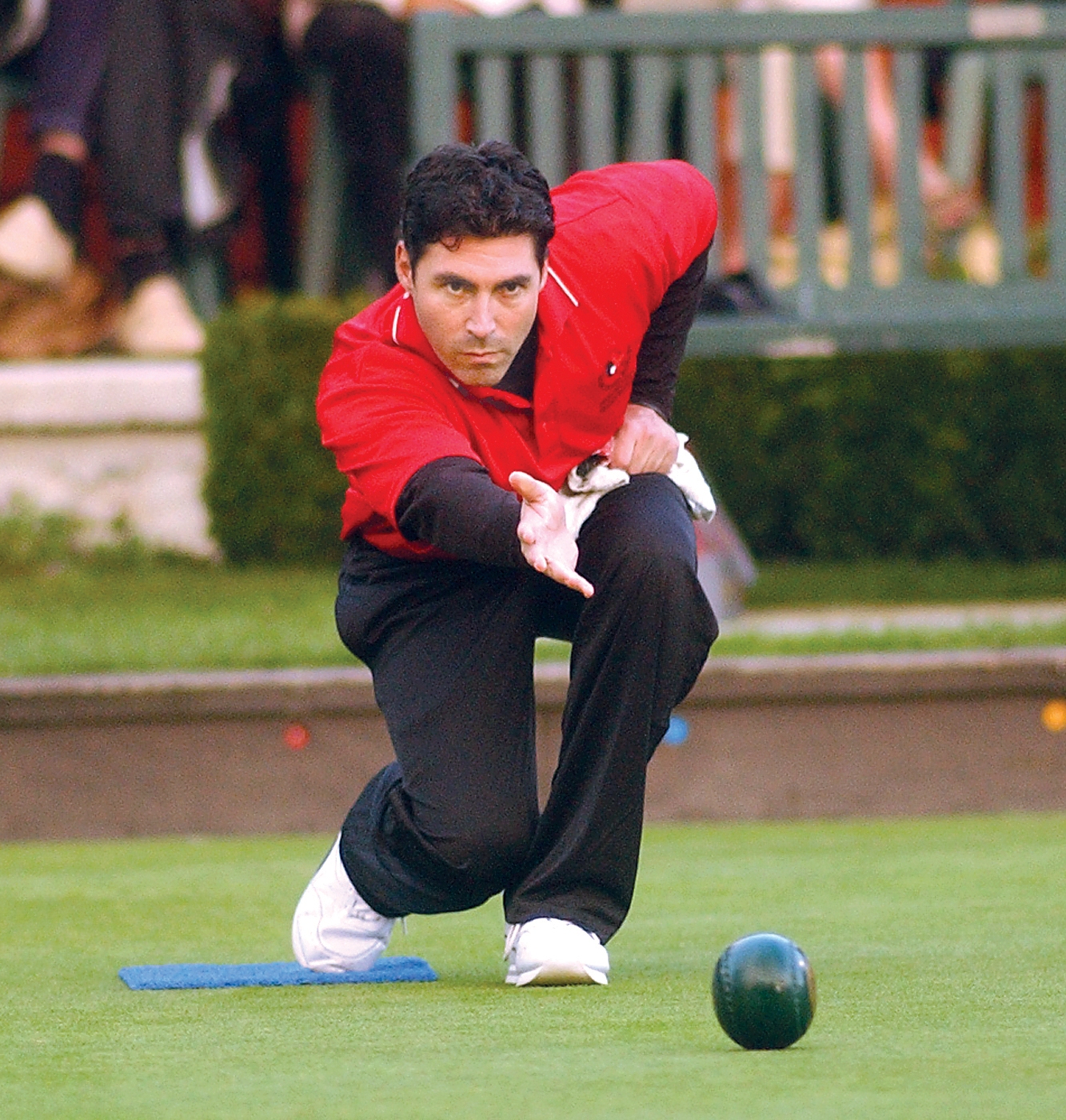
Bowls, also known as lawn bowls or lawn bowling, is a sport in which players try to roll their ball (called a bowl) closest to a smaller ball (known as a "jack" or sometimes a "kitty"). The bowls are shaped (biased), so that they follow a curved path when being rolled. The game is played either in teams or one against one.

Key Information

The game was first played in the 13th century. The game is played on grass, although other surfaces are sometimes used. Matches are held either until one player gets to a score, or when a number of ends are played.

The game is mostly played on a bowling green, which can vary by the type of bowls being played. Whilst the game is often played outdoors, there are indoor bowling venues, and can also be played on rollable carpets. For outdoor games, this is usually on grass; however, it can also be played on cotula in New Zealand.

History

[edit]

Bowls is a variant of the boules games (Italian: bocce), which, in their general form, are of ancient or prehistoric origin. Ancient Greek variants are recorded that involved throwing light objects (such as flat stones, coins, or later also stone balls) as far as possible. The aspect of tossing the balls to approach a target as closely as possible is recorded in ancient Rome. This game was spread to Roman Gaul by soldiers or sailors. A Roman sepulchre in Florence shows people playing this game, stooping down to measure the points.[1]

Bowls in England has been traced certainly to the 13th century, and conjecturally to the 12th century. William Fitzstephen (d. about 1190), in his biography of Thomas Becket, gives a graphic sketch of the London of his day and, writing of the summer amusements of young men, says that on holidays they were "exercised in Leaping, Shooting, Wrestling, Casting of Stones [in jactu lapidum], and Throwing of Javelins fitted with Loops for the Purpose, which they strive to fling before the Mark; they also use Bucklers, like fighting Men."[2] It is commonly supposed that by jactus lapidum, Fitzstephen refers to an early variety of bowls,[3] possibly played using round stone; there is a record of iron bowls being used, though at a much later date, on festive occasions at Nairn.[year needed]. On the other hand, the jactus lapidum of which he speaks may have been more akin to shot put.

It is clear, at any rate, that a rudimentary form of the game was played in England in the 13th century. A manuscript of that period in the royal library, Windsor (No. 20, E iv.), contains a drawing representing two players aiming at a small cone instead of an earthenware ball or jack.[4] The world's oldest surviving bowling green is the Southampton Old Bowling Green, which was first used in 1299.[5]

Another manuscript of the same century has a crude but spirited picture which brings us into close touch with the existing game.[6] Three figures are introduced and a jack. The first player's bowl has come to rest just in front of the jack; the second has delivered his bowl and is following after it with one of those eccentric contortions still not unusual on modern greens, the first player meanwhile making a repressive gesture with his hand, as if to urge the bowl to stop short of his own; the third player is depicted as in the act of delivering his bowl.[7] A 14th-century manuscript, Book of Prayers, in the Francis Douce collection in the Bodleian Library at Oxford, contains a drawing in which two persons are shown, but they bowl to no mark. Strutt (Sports and Pastimes) suggests that the first player's bowl may have been regarded by the second player as a species of jack; but in that case it is not clear what was the first player's target. In these three earliest illustrations of the pastime each player has one bowl only, and that the attitude in delivering it was as various five or six hundred years ago as it is today. In the third, he stands almost upright; in the first, he kneels; in the second, he stoops, halfway between the upright and the kneeling position.[6]

Bowling greens in New York City's Central Park

The game eventually came under the ban of king and Parliament, both fearing it might jeopardise the practice of archery, then so important in battle. Statutes forbidding it and other sports were enacted in the reigns of Edward III, Richard II and other monarchs. Even when, on the invention of gunpowder and firearms, the bow had fallen into disuse as a weapon of war, the prohibition was continued. The discredit attaching to bowling alleys, first established in London in 1455, probably encouraged subsequent repressive legislation, for many of the alleys were connected with taverns frequented by the dissolute and gamesters.

Erasmus referred to the game as globurum. The name of bowls is implied in the gerund bowlyn, recorded in the mid-15th century. The term bowl for "wooden ball" is recorded in the early 1400s. The name is explicitly mentioned, as bowles, in a list of unlawful games in a 1495 act by Henry VII (Tenys, Closshe, Dise, Cardes, Bowles). It occurs again in a similar statute by Henry VIII (1511). By a further act, the Unlawful Games Act 1541—which was not repealed until 1845—artificers, labourers, apprentices, servants and the like were forbidden to play bowls at any time except Christmas, and then only in their master's house and presence. It was further enjoined that any one playing bowls outside his own garden or orchard was liable to a penalty of 6s. 8d. (6 shillings and 8 pence), while those possessed of lands of the yearly value of £100 might obtain licences to play on their own private greens.

In 1864, William Wallace Mitchell (1803–1884), a Glasgow Cotton Merchant, published his "Manual of Bowls Playing" following his work as the secretary formed in 1849 by Scottish bowling clubs which became the basis of the rules of the modern game. Young Mitchell was only 11 years old when he played on Kilmarnock bowling green, the oldest club in Scotland, instituted in 1740.

British bowls team visiting Canada, 1906

The patenting of the first lawn mower in 1830, in Britain, is strongly believed to have been the catalyst for the worldwide preparation of modern-style greens, sporting ovals, playing fields, pitches, grass courts, etc. This, in turn, led to the codification of modern rules for many sports, including lawn bowls, most football codes, lawn tennis and others.[8]

National Bowling Associations were established in the late 1800s. The Victorian Bowling Association was formed in Victoria, Australia in 1880. The Scottish Bowling Association was established in 1892, although there had been a failed attempt in 1848 by 200 Scottish clubs.

Today, bowls is played in over 40 countries with more than 50 member national authorities.[citation needed]

Game

[edit]
Swifts Creek Bowls Club, Victoria, Australia

Lawn bowls is usually played on a large, rectangular, precisely levelled and manicured grass or synthetic surface known as a bowling green which is divided into parallel playing strips called rinks. In the simplest competition, singles, one of the two opponents flips a coin to see who wins the "mat" and begins a segment of the competition (in bowling parlance, an "end"), by placing the mat and rolling the jack to the other end of the green to serve as a target. Once it has come to rest, the jack is aligned to the centre of the rink and the players take turns to roll their bowls from the mat towards the jack and thereby build up the "head".

A bowl may curve outside the rink boundary on its path, but must come to rest within the rink boundary to remain in play. Bowls falling into the ditch are dead and removed from play, except in the event when one has "touched" the jack on its way. "Touchers" are marked with chalk and remain alive in play even if they get into the ditch. Similarly if the jack is knocked into the ditch it is still alive unless it is out of bounds to the side resulting in a "dead" end which is replayed, though according to international rules the jack is "respotted" to the centre of the rink and the end is continued. After each competitor has delivered all of their bowls (four each in singles and pairs, three each in triples, and two bowls each in fours), the distance of the closest bowls to the jack is determined (the jack may have been displaced) and points, called "shots", are awarded for each bowl which a competitor has closer than the opponent's nearest to the jack. For instance, if a competitor has bowled two bowls closer to the jack than their opponent's nearest, they are awarded two shots. The exercise is then repeated for the next end, a game of bowls typically being of twenty-one ends.

Lawn bowls is played on grass and variations from green to green are common. Greens come in all shapes and sizes: the most common are fast, slow, big crown, small crown.

Bowls is generally played in a very good spirit, even at the highest professional level, acknowledgment of opponents' successes and near misses being quite normal.

Scoring

[edit]

Scoring systems vary from competition to competition. Games can be decided when:

  • a player in a singles game reaches a specified target number of shots (usually 21 or 25).
  • a team (pair, triple or four) has the higher score after a specified number of ends.

Games to a specified number of ends may also be drawn. The draw may stand, or the opponents may be required to play an extra end to decide the winner. These provisions are always published beforehand in the event's Conditions of Play.

In the Laws of the Sport of Bowls[9] the winner in a singles game is the first player to score 21 shots. In all other disciplines (pairs, triples, fours), the winner is the team who has scored the most shots after 21 or 25 ends of play. Often local tournaments will play shorter games (usually 10 or 12 ends). Some competitions use a "set" scoring system, with the first to seven points awarded a set in a best-of-three or best-of-five set match. As well as singles competition, there can be two (pairs), three (triples) and four-player (fours) teams. In these, teams bowl alternately, with each player within a team bowling all their bowls, then handing over to the next player. The team captain or "skip" always plays last and is instrumental in directing his team's shots and tactics. The current method of scoring in the professional tour (World Bowls Tour) is sets. Each set consists of nine ends and the player with the most shots at the end of a set wins the set. If the score is tied the set is halved. If a player wins two sets, or gets a win and a tie, that player wins the game. If each player wins a set, or both sets end tied, there is a 3-end tiebreaker to determine a winner.

Bias of bowls

[edit]
Two bowls with club stickers. The jack/kitty is sitting in front of the bowls.

Bowls are designed to travel a curved path because of a weight bias which was originally produced by inserting weights in one side of the bowl. The word bias itself is recorded as a technical term of the game in the 1560s.[10]

The insertion of weights is no longer permitted by the rules and bias is now produced entirely by the shape of the bowl. A bowler determines the bias direction of the bowl in his hand by a dimple or symbol on one side. Regulations determine the minimum bias allowed, and the range of diameters (11.6 to 13.1 cm (4.6 to 5.2 in)), but within these rules bowlers can and do choose bowls to suit their own preference. They were originally made from lignum vitae, a dense wood giving rise to the term "woods" for bowls, but are now more typically made of a hard plastic composite material.

Bowls were once only available coloured black or brown, but they are now available in a variety of colours. They have unique symbol markings engraved on them for identification. Since many bowls look the same, coloured, adhesive stickers or labels are also used to mark the bowls of each team in bowls matches. Some local associations agree on specific colours for stickers for each of the clubs in their area. Provincial or national colours are often assigned in national and international competitions. These stickers are used by officials to distinguish teams.

Bowls have symbols unique to the set of four for identification. The side of the bowl with a larger symbol within a circle indicates the side away from the bias. That side with a smaller symbol within a smaller circle is the bias side toward which the bowl will turn. It is not uncommon for players to deliver a "wrong bias" shot from time to time and see their carefully aimed bowl crossing neighbouring rinks rather than heading towards their jack.

When bowling there are several types of delivery. "Draw" shots are those where the bowl is rolled to a specific location without causing too much disturbance of bowls already in the head. For a right-handed bowler, "forehand draw" or "finger peg" is initially aimed to the right of the jack, and curves in to the left. The same bowler can deliver a "backhand draw" or "thumb peg" by turning the bowl over in his hand and curving it the opposite way, from left to right. In both cases, the bowl is rolled as close to the jack as possible, unless tactics demand otherwise. A "drive" or "fire" or "strike" involves bowling with force with the aim of knocking either the jack or a specific bowl out of play - and with the drive's speed, there is virtually no noticeable (or, at least, much less) curve on the shot. An "upshot" or "yard on" shot involves delivering the bowl with an extra degree of weight (often referred to as "controlled" weight or "rambler"), enough to displace the jack or disturb other bowls in the head without killing the end. A "block" shot is one that is intentionally placed short to defend from a drive or to stop an oppositions draw shot. The challenge in all these shots is to be able to adjust line and length accordingly, the faster the delivery, the narrower the line or "green".

Variations of play

[edit]
A crown green at Edgworth, Lancashire

Particularly in team competition there can be a large number of bowls on the green towards the conclusion of the end, and this gives rise to complex tactics. Teams "holding shot" with the closest bowl will often make their subsequent shots not with the goal of placing the bowl near the jack, but in positions to make it difficult for opponents to get their bowls into the head, or to places where the jack might be deflected to if the opponent attempts to disturb the head.

There are many different ways to set up the game. Crown Green Bowling utilises the entire green. A player can send the jack anywhere on the green in this game and the green itself is more akin to a golf green, with much undulation. It is played with only two woods each. The jack also has a bias and is only slightly smaller than the woods. At the amateur level it is usual for several ends to be played simultaneously on one green. If two moving woods meet, both are taken back and the shots replayed. If a moving wood strikes a stationary wood or jack from another end, it is again taken back and replayed, but the bowl struck is replaced where contact took place. The game is played usually to 21-up in Singles and Doubles format with some competitions playing to 31-up. The Panel (Professional Crown Green Bowls) is played at the Red Lion Bowling Green, Westhoughton daily and is played to 41-up with greenside betting throughout play.[11] The Green was formerly owned by the pub (now demolished[12]) but was purchased in 2007 by The Panel who paid the brewery £12,000 for the green and its surrounds.[13]

Singles, triples and fours and Australian pairs are some ways the game can be played. In singles, two people play against each other and the first to reach 21, 25, or 31 shots (as decided by the controlling body) is the winner. In one variation of singles play, each player uses two bowls only and the game is played over 21 ends. A player concedes the game before the 21st end if the score difference is such that it is impossible to draw equal or win within the 21 ends. If the score is equal after 21 ends, an extra end is played to decide the winner. An additional scoring method is set play. This comprises two sets over nine ends. Should a player win a set each, they then play a further 3 ends that will decide the winner.

Pairs allows both people on a team to play Skip and Lead. The lead throws two bowls, the skip delivers two, then the lead delivers his remaining two, the skip then delivers his remaining two bowls. Each end, the leads and skips switch positions. This is played over 21 ends or sets play. Triples is with three players while Fours is with four players in each team and is played over 21 ends.

Another pairs variation is 242 pairs (also known as Australian Pairs). In the first end of the game the A players lead off with 2 bowls each, then the B players play 4 bowls each, before the A players complete the end with their final 2 bowls. The A players act as lead and skip in the same end. In the second end the roles are reversed with the A players being in the middle. This alternating pattern continues through the game which is typically over 15 ends.

Short Mat Bowls is an all-year sport unaffected by weather conditions and it does not require a permanent location as the rink mats can be rolled up and stowed away. This makes it particularly appropriate for small communities as it can be played in village halls, schools, sports and social clubs.[14]

Bowls are played by the blind and paraplegic. Blind bowlers are extremely skillful. A string is run out down the centre of the lane and wherever the jack lands, it is moved across to the string and the length is called out by a sighted marker. When the woods are sent the distance from the jack is called out, in yards, feet and inches. The position in relation to the jack is given using the clock; 12.00 is behind the jack.[15]

Tra bowls

[edit]
A bowls tra with bowls and spectator seats next to it

In the province of West Flanders (and surrounding regions), tra bowls is the most popular variation of bowls. As opposed to playing it on a flat or uneven terrain, the terrain is made smooth but hollow (tra just means "hollow road" in Flemish). The hollow road causes the path to be curving even more.

The balls are biased in the same way as the lawn bowls balls but with a diameter of about 20 cm (7.9 in), a thickness of 12 cm (4.7 in) and a weight of about 2 kg (4.4 lb), they are a bit bigger than usual bowls. The target is an unmovable feather or metal plate on the ground, instead of a small ball. The length of the tra is about 18 m (59 ft).

The scoring is also different, as a point is awarded for every shot that brings the ball closer to the target than any opponent's ball. This causes pure blocking strategies to be less effective.[16]

In 1972, the West-Flemish tra bowls federation was founded to uniform the local differing rules and to organise a match calendar. Meanwhile, they also organise championships and tournaments.[17]

New Zealand Indoor Bowls

[edit]
A player kneels to bowl in a New Zealand Indoor Bowls competition

A unique variant of indoor bowls developed in New Zealand in the early 20th century. It is played on a carpet mat 6.7 m long and 1.8 m wide. The sport reached its heyday in New Zealand in the 1960s and 1970s with upward of 70,000 registered players, but has seen a gradual decline in membership since. The New Zealand Indoor Bowls Federation is the sport's governing body and it is only played competitively in New Zealand, though there is a biennial Trans-Tasman fixture using custom rules compromising between those used in Australia and New Zealand.[18][19][20]

Competitions

[edit]

There are various bowls competitions held around the world (see - World Bowls Events).

Bowls is one of the "core sports" that must be included at each edition of the Commonwealth Games. With the exception of the 1966 Games, the sport has been included in all Games since their inception in 1930. England has so far dominated the sport with 51 medals.

[edit]
  • Blackball – a 2003 comedy film about a young bowls player, based upon Griff Sanders.[21]
  • Crackerjack – a 2002 Australian comedy film about a wisecracking layabout who joins a lawn bowls club in order to be allowed to use a free parking spot but is forced to play bowls with the much older crowd when the club enters financial difficulty.

See also

[edit]

References

[edit]
[edit]
Revisions and contributorsEdit on WikipediaRead on Wikipedia
from Grokipedia
Bowls, also known as lawn bowls or lawn bowling, is a precision sport played on a flat grass or synthetic surface where competitors roll slightly biased wooden or composite balls, called bowls, toward a smaller target ball known as the jack or kitty, aiming to position their bowls closer to it than their opponents. The game emphasizes strategy, accuracy, and gentle delivery, making it accessible to players of all ages and fitness levels, and it can be enjoyed outdoors on bowling greens or indoors on carpeted rinks. Variants include flat green bowls (the most common international form), crown green bowls (played on a crowned surface primarily in northern England), and short mat bowls (an indoor adaptation using a portable mat). The origins of bowls trace back over 5,000 years to , where archaeological evidence reveals early games involving stone balls rolled toward targets, similar in concept to modern play. The sport evolved through and before developing into its recognizable form in medieval , with records indicating it was well-established in by the 13th century, where King Edward III reportedly banned it in 1363 to encourage practice among soldiers. By the , bowls had become a popular pastime among the English elite, leading to the creation of the first dedicated bowling greens, and it spread globally through British colonialism, particularly to , , and nations. In standard flat green bowls, matches are contested in formats such as singles (one player per side with four bowls each), pairs (two players with four bowls each), (three players with three bowls each), or fours (four players with two bowls each), typically over 21 ends or to a set number of points. Points are awarded for each bowl closer to the jack than the opponent's nearest bowl at the end of an end, with tactics involving blocking paths or drawing shots to nestle bowls protectively around the jack. The bowls' — a weighted side causing them to —adds complexity, requiring players to master line and control. Governed internationally by World Bowls, the sport boasts over 500,000 registered players across 60 member nations and features major events like the and World Bowls Championships, fostering both recreational and competitive participation. Its low-impact nature promotes social interaction and health benefits, including improved balance and coordination, while ongoing innovations like synthetic greens have expanded its reach to diverse climates and urban settings.

Fundamentals

Equipment

The primary equipment in bowls consists of the bowls themselves, which are spherical objects designed to curve during delivery due to an inherent bias. These are typically constructed from either traditional wood or modern composite materials such as or , with a diameter ranging from 112 mm to 134 mm (approximately 11.2 to 13.4 cm). The weight of each bowl is generally between 1.1 kg and 1.5 kg, though the maximum permitted is 1.59 kg (3.5 pounds), allowing players to select sets suited to their strength and style. Sets of four bowls are engraved with unique symbols or colors for team identification, ensuring clear distinction during play. The jack serves as the target, a smaller, unbiased ball usually white or yellow, made of durable plastic or rubber to withstand outdoor conditions. It has a diameter of 63 mm to 64 mm (approximately 6.3 to 6.4 cm) and weighs between 225 g and 285 g. This compact size makes it visible on the green while providing a precise aiming point. The playing surface varies by format: outdoor games occur on natural grass lawns, typically 31 to 40 meters long and 4.3 to 5.8 meters wide per rink, divided by markers into individual playing areas with boundaries, ditches (200-380 mm wide and 50-200 mm deep), and banks at least 230 mm high. Indoor play uses synthetic carpet surfaces, often on raised platforms, with similar rink dimensions but requiring less moisture control. Maintenance for grass greens involves specialist testing for evenness, speed (measured in seconds via green speed meters), and firmness to ensure fair play, while synthetic surfaces need regular cleaning and leveling. Common accessories include measures, such as string or tape devices up to 5 for verifying distances between bowls and the jack during close shots. Wedges, typically rubber chocks, stabilize unstable bowls or the jack during measurements to prevent movement. Scoreboards, often portable frames with numbered plates, track points and ends for officials and players. Over time, bowl materials have evolved from , prized for its density but prone to cracking in varying weather, to resin composites introduced in the early for enhanced durability, consistent bias, and resistance to moisture. This shift, accelerated by manufacturers like Henselite in the 1930s, has made modern bowls more accessible and performant across climates.

Basic Rules

The sport of bowls is governed by the Laws of the Sport of Bowls, a set of 50 laws established by World Bowls to regulate all aspects of play, including match formats, procedures, and umpire responsibilities. Matches are played in four primary formats: singles (one player per team), pairs (two players per team), (three players per team), and fours (four players per team), with the specific number of bowls per player determined by domestic regulations but commonly four bowls each in singles, two to four per player in pairs (totaling eight per team), three per player in (nine total), and two per player in fours (eight total). A match consists of a pre-arranged number of ends, typically 21 for singles and pairs or 15-18 for triples and fours, though this varies by competition format. Each end begins with the delivery of the jack by the player or that won the previous end (or by agreement for the first end), which must come to rest at a minimum distance determined by domestic regulations (commonly 21 or 23 from the mat line) and at least 2 meters from the rear boundary of the rink; if it stops short or too close to the boundary, it is repositioned to comply with these requirements. Teams then alternate delivering their bowls from behind the , with of positioning them as close as possible to the jack without touching it, though contact with the jack does not invalidate a bowl but marks it as a "touchers" for potential live status in faults. The rink is a rectangular playing area on a flat , typically 4.3 to 5.8 meters wide and 31 to 40 meters long, marked by white lines or pegs, surrounded by a shallow , and divided into multiple parallel rinks for simultaneous play. Bowls must be delivered with the player having one foot on or above the , and each bowl must cross the hog line (marked at approximately 21-23 meters from the mat, depending on the ) to remain in play; failure to do so results in the bowl being declared dead and removed. All bowls must stay within the rink boundaries during delivery and rest, or they are dead unless they are touchers in contact with the jack. Common faults include the jack or bowls entering the or going , disturbing the head (the cluster of bowls and jack) improperly, or foot faults during delivery, which may declare the end dead. If the jack enters the , it is re-spotted on the rink centerline with its nearest edge 2 meters from the front if a live bowl or toucher is within 3 meters of the original spot; otherwise, the end is dead and replayed from the original mat position. Touchers—bowls that contact the jack—are marked with or and remain live even if they enter the , provided the end is not declared dead. Umpires, appointed by the controlling body, enforce these laws by resolving disputes, measuring distances, and imposing penalties ranging from warnings to disqualification for repeated or serious violations.

Gameplay

Playing the Game

A game of bowls begins with the lead player of the team that won the previous end—or the nominated team for the first end—placing the mat on the rink and delivering the jack to a minimum distance of 23 meters (25 yards) from the mat, ensuring it remains within the rink boundaries. Once the jack is centered by the opposing skip if necessary, play proceeds with the delivering team's lead rolling the first bowl, followed by alternating deliveries from each team's lead until all eight or nine bowls (depending on the : eight in singles, pairs, and fours; nine in ) have been played in that end. The skip directs the team's , signaling the line and for each shot, while the second and third players support by observing the head and providing input when requested. Players employ various shots to position their bowls favorably relative to the jack. The draw shot, the most common, involves rolling the bowl with controlled weight so it curves due to and comes to rest as close as possible to the jack without overshooting. The yard-on shot delivers more weight to gently push the jack or an opponent's bowl while allowing the player's bowl to stop nearby, often used for tactical repositioning. For aggressive plays, the drive or upset shot propels the bowl at high speed to strike and displace opponents' bowls or the jack itself, potentially disrupting the head. Matches typically consist of 21 ends, though formats may vary to a set number of points or time limits, with the direction of play reversing each end. In extended competitions, a short break often occurs at the halfway point to allow players to regroup and assess conditions. governs the flow of play to ensure fairness and respect. All players not delivering must stand motionless and silent behind the jack or at the side of the rink, avoiding any distraction or interference with the bowler's . Skips may concede an end early if their team cannot improve their position, preventing unnecessary play and promoting . Environmental conditions require constant adaptation during a match. On faster greens, players reduce to prevent overshooting, while slower surfaces demand increased power for . influences the bowl's path, prompting adjustments to the aiming line—bowling into the wind with more weight or allowing extra curve with a tailwind—while slopes on the green necessitate compensating for the by altering the delivery angle to maintain the intended trajectory.

Scoring

In bowls, scoring is assessed at the end of each end after all required bowls have been played and come to rest. The team whose bowl is closest to the jack receives one point for each of its bowls that lies closer to the jack than the opponent's nearest bowl. Only one team can score in an end; if the closest bowls from both teams are equidistant, no points are awarded for that end. Distances are measured as the shortest distance between the nearest points of the jack and the bowls using precise tools such as a flexible , , or electronic devices to determine proximity. Measuring commences after all bowls have come to rest and settled, and is conducted by the marker, skips, or an if disputed. In cases of exact ties, the bowl in question does not score, and measurements must be verifiable to avoid errors. Touchers—bowls that contact the jack during the end—represent a key special case; they must be immediately marked with chalk or spray by the delivering team or marker to remain eligible. Marked touchers remain live during the end even if displaced into the ditch within the rink boundaries. If the jack becomes dead during the end, the end is declared dead and replayed, with any touchers in the ditch removed. An end can yield multiple points if several of the scoring team's bowls, including touchers, surpass the opponent's benchmark distance. Points accumulate across ends to determine the match winner, with standard formats including singles to 21 points or team games over 21 ends. In major tournaments, play often follows a sets structure, such as best-of-three sets of 9 ends each, where the team winning more sets—or the most ends in a tied set—prevails, providing a balanced progression. Since 2020, digital scoring apps have gained adoption for improved precision and record-keeping, notably the BowlsLink Scoring app in , which enables end-by-end digital tallying and automated submission to competition databases, reducing manual errors in live events.

Bias and Technique

In lawn bowls, the of a bowl refers to its intentional , achieved through off-center weighting that makes one side heavier than the other, causing the bowl to curve toward the bias side—typically marked by a smaller ring—during its roll along the . This design allows players to execute curved shots around obstacles, drawing the bowl closer to the jack without requiring unnatural straight-line deliveries. The physics of this curvature involves the interaction between the bowl's momentum, , and from the green's surface. When delivered at high speed, the bowl travels relatively straight as generated by its rotation counteracts the , keeping the heavier side elevated. As speed decreases due to grass , the bias side lowers into contact with the surface, increasing drag on that side and amplifying the curve toward the inner line for strategic positioning near the jack. This dynamic enables varied paths, with slower deliveries exhibiting more pronounced for shots and faster ones minimizing curve for direct approaches. Player technique begins with a stable stance, where the back foot is placed on the pointing toward the aiming line, and the front foot steps forward parallel or slightly ahead to maintain balance without committing a foot fault by overstepping the 's rear boundary. The grip can be relaxed with fingers naturally spread—often called a "claw" grip for control—or more open for reduced tension, ensuring the bowl's ring faces the intended curve direction. Delivery follows a pendulum-like swing, starting from a straight back position and accelerating forward smoothly to release the bowl at height, promoting consistency in line and while avoiding erratic motions that disrupt the path. Advanced skills emphasize precise weight control to adapt the bias effect for specific outcomes, such as running shots delivered with greater to displace opponent bowls while curving minimally, or blocking positions where lighter draws settle to obstruct access to the jack. Positional play integrates these by varying delivery to either run through the head aggressively or nestle protectively, leveraging the to create barriers or openings that influence opponent responses. Training aids like portable practice mats simulate green conditions for honing these elements, allowing players to focus on line accuracy and length judgment in controlled settings. Coaching typically stresses repetitive drills on these mats to refine bias utilization, ensuring players internalize the feel for adjusting swing and weight to match green speed and direction.

Variations

Outdoor Lawn Bowls

Outdoor lawn bowls, the traditional format of the sport, is played on meticulously maintained turf surfaces called greens, which provide a smooth and consistent rolling path for the bowls. These greens demand rigorous upkeep to support optimal play, including frequent mowing to a of 4-6 mm to promote a dense, even sward that minimizes irregularities. Regular rolling with lightweight equipment follows mowing to enhance surface evenness, improve turf health, and control green speed, ensuring the bias of the bowls functions predictably. In temperate climates, such as those in the and , the playing season typically spans spring through fall, aligning with favorable grass growth periods and avoiding winter dormancy or frost damage to the turf. A standard outdoor green is roughly square, measuring about 35-40 per side, and accommodates multiple rinks for simultaneous games, often six to eight in total, allowing clubs to host several matches at once. Each rink spans 31-34 in length from the to the far , with widths ranging from 4.3 to 5.8 , marked by colored pegs to define boundaries and ensure fair play. The overall setup promotes strategic shot-making on a natural surface where subtle contours influence paths. Weather conditions uniquely impact outdoor play, with often leading to suspension to protect the from waterlogging and prevent slips or uneven ball travel; if puddles form, matches are delayed or abandoned until the surface dries. adds moisture that slows the , increasing and causing the bowl's to take effect sooner and more sharply, requiring players to adjust their lines and weights accordingly. Clubs hosting outdoor bowls are commonly situated in public parks or private estates, featuring expansive open s bordered by low ditches and hedges, alongside pavilions that offer essential amenities such as , equipment storage, kitchens, and lounges for post-game socializing. The sport holds dominant popularity in the , , and other nations like and , where it fosters community engagement through local leagues and features prominently in events like the , drawing millions of participants and spectators across these regions.

Indoor Bowls

Indoor bowls, a variant of the sport played within enclosed facilities, utilizes synthetic carpet or mat surfaces laid over subfloors to create a controlled playing environment. These surfaces exhibit lower friction than natural grass, resulting in a faster pace where bowls travel farther with reduced curving, typically measured at green speeds of 13-17 seconds on standardized tests. This consistency allows for precise play unaffected by weather or turf variations. Venues for indoor bowls consist of heated halls designed for year-round accessibility, often accommodating multiple rinks side by side. Each rink measures up to 45 meters in length and 4.6 to 5 meters in width, with boundaries marked by white tapes or rails to define the playing area. The enclosed setup eliminates outdoor elements, enabling regular practice and competition regardless of season or climate. Equipment adaptations for indoor play include bowls with a narrower to account for the faster surfaces, promoting straighter paths and simulating outdoor shots more efficiently. Lighter bowls, weighing around 1.3-1.5 kg, are sometimes preferred to suit the reduced resistance and quicker delivery requirements. Jacks remain similar to outdoor versions but may be slightly heavier for stability on . The popularity of indoor bowls has grown markedly since the 1970s, particularly in where over 100 dedicated centers emerged in by the early part of the decade, fostering shorter match formats like 15-21 ends to suit indoor schedules. In , adoption has accelerated through community clubs, emphasizing recreational play and drawing participants seeking an alternative to outdoor limitations. This expansion reflects broader interest in indoor sports facilities. Indoor bowls offers notable benefits, serving as a low-impact activity accessible to individuals of all ages and mobility levels, from youth to seniors and those with disabilities. Its gentle nature promotes , balance, and coordination without joint strain, while the indoor setting removes weather barriers, encouraging consistent participation and to combat isolation.

Regional Variations

Tra bowls, a variant popular in the West Flanders region of near the French border, features larger bowls and is played on shorter, often uneven village fields rather than manicured lawns, placing greater emphasis on precision and adaptability to the terrain. This adaptation distinguishes it from standard flat-green bowls by requiring players to navigate irregular surfaces, with the West-Flemish Tra Bowls Federation established to standardize local rules and organize competitions. Boule lyonnaise, a French variant originating in the region during the 19th century, uses larger, heavier bowls weighing 800 to 1200 grams and is played on a 27.5-meter with a run-up of up to 3 meters, prioritizing accurate pointing and shooting over long-distance rolling. Developed by silk workers as a precursor to , it influences modern bowls by blending throwing techniques with target precision on compacted dirt or synthetic surfaces. New Zealand indoor bowls, governed by the New Zealand Indoor Bowling Federation, is played on fast synthetic carpet rinks typically 30-34 meters long, often in pairs format, with scoring where touchers—bowls that contact the jack—are marked with and can count as points even if the jack is driven into the . This fast-paced style, emphasizing controlled on the carpet, allows for quicker games and is popular in clubs for its accessibility during inclement weather. Short mat bowls, an indoor adaptation widely used in the UK and beyond, employs a portable 12.2-meter (40-foot) rubber or carpet mat suitable for community halls and non-traditional venues, with rules adapted from outdoor lawn bowls to include no ditches and a rubber block as the jack. This format promotes inclusivity by enabling play in space-limited settings without requiring a full green, and touchers are scored similarly to standard bowls but within the mat's boundaries. Crown green bowls, prevalent in and the , is played on grass or artificial surfaces sloped upward to a central crown rising 15-30 cm (6-12 inches) higher than the edges, which alters bowl paths and demands adjustment for the bias influenced by the incline. Governed by the British Crown Green Bowling Association, games are typically singles or pairs over 21 ends, with the sloped terrain adding strategic depth not found in flat-green variants. In the Pacific Islands, such as , , and the , bowls adaptations incorporate short mat formats to address challenges with maintaining natural grass greens in tropical climates, allowing play on portable mats in community centers and integrating local cultural elements like group participation in events. World Bowls initiatives since 2023 have promoted these modifications to boost participation among island nations, including hybrid events combining traditional and indoor styles for broader . South African variants, under Bowls South Africa, permit synthetic surfaces for rinks to adapt to variable local greens and climate conditions, with modified rules allowing in competitions to ensure consistent play without altering core scoring or principles. This approach supports year-round engagement in regions with dry or uneven natural terrain. is now considered a hub for bowls sports, with growing popularity of lawn bowls alongside variants like boule lyonnaise.

History

Origins and Early Development

The origins of bowls can be traced to ancient civilizations, where precursor games involving rolling stone balls toward targets or markers emerged as early as 3200 BCE in . Archaeological evidence, including artifacts and hieroglyphics depicting players rolling or throwing stones at sticks or markers—often with the aim of knocking them over—supports these early forms, which shared elements of precision with later games but differed in objective from modern lawn bowls' focus on proximity to a jack. In , a similar proximity variation, later evolving into , gained popularity during the era of around the 1st century BCE, featuring unbiased spherical balls rolled on dirt or grass surfaces to approach a smaller target ball. Roman legions likely spread this game across as they expanded the empire, influencing later European pastimes. By the medieval period in Europe, bowls had evolved into a recognizable form, with references appearing in 13th-century manuscripts that illustrate players rolling balls toward cones or marks on lawns. These depictions, often from English and continental sources, show the game as a social activity using wooden or stone implements on grass, highlighting its growing appeal among communities. In Britain, the game solidified by the late 13th century, with the first documented bowling green established in Southampton around 1299, marking its formal integration into English leisure. In , bowls' popularity led to regulatory interventions, as King Edward III banned the game in 1363 to prioritize practice for national defense, prohibiting able-bodied men from engaging in it on Sundays and holidays. Similar edicts followed under later monarchs, yet the persisted among enthusiasts. In , bowls developed concurrently without such widespread suppression, with early records from the late indicating organized play and rudimentary laws governing matches by 1299, fostering a distinct that emphasized flat greens. Equipment advanced in the when , a dense imported from —particularly regions like and Guiana—was adopted for crafting durable, biased bowls due to its resistance to wear and natural weight distribution. This material, valued for its hardness, replaced earlier woods and stones, enabling more consistent play on grass surfaces. Socially, bowls bridged classes in medieval and early modern Britain, enjoyed by nobility as a refined pursuit—evidenced by royal participation—and by commoners in public greens, though bans often targeted the latter to curb idleness. The first formal clubs emerged in the 1840s in , such as the Victoria Park Bowling Club, organizing matches and standardizing play among urban players. British colonial expansion carried bowls to in the 1830s, where settlers established informal greens in and amid rapid immigration. In , British and Scottish settlers introduced the game in the early 1840s, with the first recorded green in by 1861, integrating it into colonial social life.

Modern Evolution

The modern era of bowls began with significant institutional standardization efforts in the early . The International Bowling Board (IBB) was established in 1905 by founding members , , , and to unify the laws of the game, adopting the Scottish Bowling Association's rules as a baseline while allowing regional variations. This body, later renamed World Bowls in 2009, has since overseen periodic updates to the laws, including the incorporation of metric measurements alongside in the 1980s to facilitate international consistency, such as in rink dimensions and equipment specifications. These changes supported the sport's growing global alignment, with the Crystal Mark editions of the laws providing clear, accessible guidelines for players and officials worldwide. Material innovations in the mid-20th century enhanced precision and accessibility, particularly for indoor variants. While wooden bowls dominated early play, the shift to synthetic composition materials began in the 1930s with the invention of bowls by Henselite, offering greater durability and consistent . By the 1970s, these synthetics became standard for indoor bowls, paired with synthetic mats that allowed year-round play in controlled environments, reducing weather dependency and enabling improvements through advanced molding techniques. This evolution improved shot accuracy and expanded participation in urban settings. Inclusivity expanded markedly post-World War II, with women's integration accelerating through dedicated associations and mixed competitions. In , for instance, women's bowls clubs proliferated after the war, often forming alongside or merging with men's clubs, leading to national bodies like the Australian Women's Bowling Association by the 1940s. Youth programs also gained traction, supported by initiatives like the Bowls Development Fund, which funds community-based training to engage younger players. For para-athletes, bowls saw renewed momentum in the 2020s with World Bowls gaining recognition as a Recognised International Federation in July 2025, building on historical inclusion in Paralympics from 1968 to 1996 and fostering classified events for visual and physical impairments. The sport's global reach boomed in the late 20th and early 21st centuries, particularly in and the . In , Hong Kong emerged as a hub, hosting prestigious events like the Asian Lawn Bowls Championships since the 1980s and the Hong Kong International Bowls Classic from 1981, drawing international competitors and boosting regional participation. In the , U.S. membership grew steadily through the , with clubs reporting increased numbers—such as one reaching over 60 members by 2000—and new tournaments expanding the sport's footprint. Recent trends include AI-driven coaching tools, such as apps analyzing delivery mechanics for personalized feedback, and practices in green maintenance, like smart irrigation and synthetic turf alternatives to conserve water.

Competitions and Organizations

Major Tournaments

The World Bowls Championship, organized by World Bowls, is the premier international outdoor competition in lawn bowls, featuring men's, women's, and para categories across singles, pairs, triples, and fours disciplines. First contested in 1966 in , , it brings together the top 31 qualified nations in a host country format, with the recent edition held in Gold Coast, (2023) and the next scheduled for , (2027). The event emphasizes national team representation and has expanded to include para-bowls events since 2016, promoting inclusivity for athletes with disabilities. Bowls has been a core at the Commonwealth Games since its inception as the British Empire Games in 1930 in Hamilton, , with competitions held at every edition except 1966. The program typically features men's and women's singles, pairs, triples, and fours, alongside and para-bowls events introduced in , contested by athletes from nations. At the 2022 Birmingham Games, for instance, won three gold medals, including in men's singles and two women's events (singles and pairs), highlighting the sport's competitive depth among over 70 participating nations. Prominent national championships include the Bowls England National Championships in the , an annual knockout event open to affiliated club members, covering men's and women's singles, pairs, triples, and fours played over 18 or 21 ends depending on the discipline. In , the Australian Open stands as the world's largest bowls festival, held annually on the Gold Coast since 1999, attracting thousands of entrants from to elite levels with a total prize purse of AUD $314,240 for 2025 across open singles, pairs, and other formats, planned to exceed $350,000 in 2026. New Zealand's National Singles Championship, part of the Summerset National Intersport Series, is a key domestic event held annually in , qualifying regional winners for national titles in open and disability categories. The professional landscape is led by the World Bowls Tour (WBT), which sanctions high-stakes events with significant prize money to elevate the sport's global appeal, including a £1 million investment from announced in 2025 for expanded professional play. Notable WBT fixtures include the annual World Indoor Bowls Championship at in , , where the open singles winner receives £50,000 and pairs events offer £20,000 split per team. Invitationals like the International Bowls Classic, established in 1981 and hosted by the Lawn Bowls Association of Hong Kong, Limited, draw elite players from over 40 countries for week-long competitions in singles, pairs, and fours, with the 2025 edition scheduled for November 15-23. Post-2024 developments have focused on through the introduction of more open-gender formats and equal prize structures in major events, such as the Australian Open's 2026 enhancements maintaining frozen entry fees while boosting overall purses to ensure equitable access. has advanced with the launch of Bowls TV in June 2025, providing free live-streaming and on-demand coverage of tournaments like the Australian Open via www.bowlstv.com.au, reaching wider audiences under World Bowls oversight.

Governing Bodies

World Bowls serves as the primary international federation for the sport of bowls, recognized by the and responsible for promoting and regulating the game globally across more than 60 member nations. The organization unifies national authorities to ensure consistent standards and growth, overseeing key aspects such as the biennial update of the Laws of the Sport of Bowls, which apply uniformly to both outdoor and indoor formats. Regional governing bodies handle local administration and development within their jurisdictions, often aligning with World Bowls' frameworks. Bowls England acts as the national authority for outdoor lawn bowls in , managing affiliations for over 2,000 clubs, organizing national competitions, and supporting player pathways from to levels. Similarly, Bowls Australia leads the sport nationwide, governing more than 1,800 clubs and approximately 600,000 annual participants while coordinating state associations and international team selections. The Asian Lawn Bowls Federation, operating as Bowls Asia under the broader Asia Oceania Bowls Confederation, coordinates regional events and development across Asian nations, fostering participation in countries like , [Hong Kong](/page/Hong Kong), and . These bodies collectively fulfill critical roles in rule enforcement, policy implementation, and resource allocation. World Bowls and its affiliates regularly update playing laws to maintain fairness, with the Crystal Mark Fourth Edition introduced in 2023 incorporating refinements for equipment and play conditions. Anti-doping policies are enforced through adoption of the (WADA) code, including testing at major events and education for athletes and support personnel to promote clean . Event sanctioning ensures compliance with international standards for tournaments, while funding primarily derives from member nation dues, sponsorships, and event revenues to support operations and initiatives. Development efforts emphasize expanding access and building capacity, particularly in emerging regions. World Bowls runs programs tailored for developing countries, providing equipment, administrative support, and targeted assistance to boost participation among underrepresented groups like indigenous communities. Coach is a core component, with approved qualifications delivered through structured courses that train instructors to World Bowls standards, aiming to certify hundreds of coaches annually to deliver local programs and elevate technical skills. Governing bodies face ongoing challenges in standardizing practices across formats and adapting to environmental pressures. Harmonizing indoor and outdoor standards remains complex due to differences in rink , bias, and play conditions, requiring periodic revisions to bridge gaps while preserving format integrity. impacts, including , water shortages, and changing green conditions, pose threats to outdoor play, prompting initiatives for sustainable practices and resilient infrastructure in affected regions.

Cultural and Social Aspects

Bowls has appeared in several films and television productions, often highlighting its competitive and social elements. The 2003 British comedy Blackball, directed by Mel Smith and starring Paul Kaye, satirizes the sport through the story of a rebellious young bowler challenging the establishment, drawing inspiration from real-life player Griff Sanders. Similarly, the 2002 Australian film Crackerjack, featuring Mick Molloy, portrays the rivalries and community aspects of bowls clubs, using humor to explore gambling and social dynamics in suburban Australia. On television, the BBC's Top Crown series, broadcast from the 1960s to the 1980s, provided live coverage of crown green bowls tournaments, bringing the sport into British homes and emphasizing its regional intensity. In literature, bowls features in historical and modern works, reflecting its cultural significance. William Shakespeare's Richard II (Act III, Scene 4) references women playing bowls, underscoring its longstanding recreational role in English society. More contemporarily, Caroline Sullivan's 2012 mystery novel Hysteria at the Wisteria centers on a murder at a bowls club, blending suspense with the sport's communal setting to examine interpersonal tensions among players. Artistic depictions of bowls, particularly from the 19th century, capture its leisurely yet strategic nature on village greens. John Singer Sargent's 1889 oil painting A Game of Bowls, housed in the National Trust collections, illustrates a group of players at Ightham Mote, showcasing elegant Victorian-era attire and the game's social appeal. An 1872 illustration from The Illustrated London News depicts Victorians rolling bowls on a lush lawn, highlighting the sport's popularity as a genteel outdoor pastime. In music, while traditional folk songs rarely focus directly on bowls, modern compositions like Larry and Carol Ellis's 2008 tune "Lawn Bowling With You," performed by members of the Long Beach California Lawn Bowling Club, celebrate the joy of playing, evoking community gatherings on the green. The sport is frequently stereotyped in media as a sedate activity for the elderly, reinforcing images of retirees in white uniforms on sunlit greens. This portrayal, evident in casual commentary and advertisements, overlooks the physical demands and tactical depth that attract players in their prime. Efforts to counter this include barefoot bowls events, which have drawn younger participants since the early 2010s, as noted in BBC reports on the trend's growth in Australia and the UK. Post-2010, bowls' media presence has evolved with digital platforms, featuring highlight reels and live streams that showcase dramatic shots and upsets. Social media clips from tournaments, shared on sites like YouTube and club pages, have boosted visibility, with innovations like the Bowls Premier League producing edited videos since 2013. This shift has helped rebrand the sport, emphasizing its excitement beyond traditional broadcasts.

Notable Figures and Legacy

David Bryant, widely regarded as one of the greatest lawn bowlers in history, dominated the sport during the mid-20th century, securing five gold medals, eleven medals at the World Outdoor Bowls Championships, and nine World Indoor Championship titles. His achievements, including three outdoor world singles titles and three indoor equivalents, set benchmarks for precision and consistency that influenced generations of players. Similarly, Scotland's Paul Foster has emerged as a modern icon, amassing four gold medals in the pairs and fours (2014), fours (2018), and pairs (2022), alongside multiple World Indoor titles, establishing him as a pivotal figure in contemporary competitive bowls. In women's bowls, New Zealand's Elsie Wilkie marked a milestone as the inaugural world singles champion in 1973, defeating competitors from seven nations at the first Women's World Outdoor Bowls Championship in , thereby elevating the profile of women's participation globally. Australia's Dorothy Roche, a pioneer in the sport, led the nation's women's triples and fours to victory at the 1988 World Championships, advocating for greater inclusion and development of female athletes. Recent decades have seen innovation in technique through coaching advancements, such as those promoted by experts like Nev Rodda, whose instructional methods emphasize grip, stance, and delivery for enhanced accuracy and control. The sport's legacy extends beyond competition, promoting through low-impact exercise that builds , improves coordination, and supports joint mobility, making it accessible for all ages. Bowls clubs foster by hosting social gatherings and local events that strengthen interpersonal ties and encourage lifelong participation. Charitable initiatives, including tournaments organized by bodies like the Bowls Development Fund, have raised resources for sport development and community projects worldwide. Diversity milestones underscore bowls' evolving inclusivity, highlighted by the 1973 introduction of women's world championships and the groundbreaking success of India's women's fours team—Lovely Choubey, Pinki Singh, , and Rupa Rani Tirkey—who claimed gold at the , India's first in the discipline, followed by further national triumphs in 2025, including gold in women's triples at the Asian Lawn Bowls Championship. These achievements from emerging nations like reflect the sport's growing global reach and its role in empowering underrepresented athletes.

References

Add your contribution
Related Hubs
User Avatar
No comments yet.