Recent from talks
Nothing was collected or created yet.
Worthing
View on Wikipedia
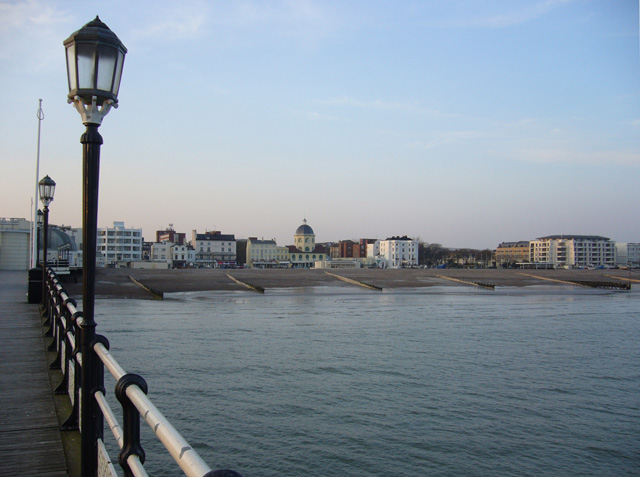
Worthing (/ˈwɜːrðɪŋ/ WUR-dhing) is a seaside town and borough in West Sussex, England, at the foot of the South Downs, 11 miles (18 km) west of Brighton, and 18 miles (29 km) east of Chichester. With a population of 113,094[2] and an area of 12.5 square miles (32.4 km2), the borough is the second largest component of the Brighton and Hove built-up area, the 15th most populous urban area in the United Kingdom. Northern parts of the borough, including the Worthing Downland Estate, form part of the South Downs National Park. In 2019, the Art Deco Worthing Pier was dubbed the best in Britain.[3]
Key Information
Dating from around 4000 BC, the flint mines at Cissbury and nearby Church Hill, Blackpatch and Harrow Hill are amongst the earliest Neolithic monuments in Britain.[4] The Iron Age hill fort of Cissbury Ring is one of Britain's largest. The recorded history of Worthing began with the Domesday Book. Worthing is historically part of Sussex, mostly in the rape of Bramber; Goring, which forms part of the rape of Arundel, was incorporated in 1929. Worthing was a small mackerel fishing hamlet for many centuries until, in the late 18th century, it developed into an elegant Georgian seaside resort and attracted the well-known and wealthy of the day. In the 19th and 20th centuries, the area was one of Britain's chief market gardening centres.[5]
Modern Worthing has a large service industry, particularly in financial services. It has three theatres and one of Britain's oldest cinemas, the Dome.[6] Writers Oscar Wilde and Harold Pinter lived and worked in the town.
Etymology
[edit]The earliest known appearance of the name of Worthing is Wyrtingas, from circa AD 960.[7] It was listed as Ordinges or Wordinges in the Domesday Book[8] of 1086, and was subsequently known as Wuroininege, Wurdingg, Wording or Wurthing, Worthinges, Wyrthyng, Worthen and Weorðingas.[9] The modern name Worthing was first documented in AD 1297.[10][11]
The etymology of the root Worth- is uncertain. Wyrt is the Old English word for "plant," "vegetable," "herb" or "spice,"[12] though there is no obvious connection with the name of the town. Additionally, the "y" was a front-loaded vowel that was indistinguishable from "i" by the end of the Anglo-Saxon period[13] and the spelling never evolved in that direction. The more obvious Middle English worth is not likely as well, as there was a dramatic Norman language influence on the spelling at the time of the Domesday Book.[9] A more probable root is the word for an Anglo-Saxon goddess - Wyrd, known in Norse mythology as Urðr [14] - with a shift of the alveolar consonant d to t as evidenced by the eleventh century evolution of the word.[9]
The suffix -ing is a cognate of inge, an ethnonym for the Germanic Ingaevones peoples, said variously to mean "of Yngvi" - of Freyr in Norse mythology,[15] "family, people or followers of"[16] or a genitive plural form of an inhabitant appellation.[17]
History
[edit]

From around 4000 BC, the South Downs above Worthing was Britain's earliest[18] and largest flint-mining area,[19] with four of the UK's 14 known flint mines lying within 7 miles (11 km) of the centre of Worthing.[19] Graffiti or art scratched into the chalk at Cissbury and nearby Harrow Hill may be the earliest dateable examples of Neolithic art in Britain.[20] An excavation at Little High Street dates the earliest remains from Worthing town centre to the Bronze Age. There is also an important Bronze Age hill fort on the western fringes of the modern borough at Highdown Hill.
During the Iron Age, one of Britain's largest hill forts was built at Cissbury Ring. The area was part of the civitas of the Regni during the Romano-British period. Several of the borough's roads date from this era and lie in a grid layout known as centuriation. A Romano-British farmstead once stood in the centre of the town, at a site close to Worthing Town Hall. In the 5th and 6th centuries, the area became part of the Kingdom of Sussex. The place names of the area, including the name Worthing itself, date from this period.
Worthing remained an agricultural and fishing hamlet for centuries until the arrival of wealthy visitors in the 1750s. Princess Amelia stayed in the town in 1798 and the fashionable and wealthy continued to stay in Worthing, which became a town in 1803. The town expanded and elegant developments such as Park Crescent and Liverpool Terrace were begun. The area was a stronghold of smugglers in the 19th century and was the site of rioting by the Skeleton Army in the 1880s.
Oscar Wilde holidayed in the town in 1893 and 1894, writing the Importance of Being Earnest during his second visit. The town was home to several literary figures in the 20th century, including Nobel Prize-winner Harold Pinter. On 9 October 1934 violent confrontations took place in the town between protestors and Oswald Mosley's British Union of Fascists which subsequently became known as the Battle of South Street.[21] During the Second World War, Worthing was home to several allied military divisions in preparation for the D-Day landings, in particular many Canadian divisions.
Worthing became the world's 229th Transition Town in October 2009.[22] The project explored the town's transition to life after oil, and was established by local residents as a way of planning the town's Energy Descent Action Plan.
Governance
[edit]

Local government for the borough of Worthing is shared between Worthing Borough Council and West Sussex County Council in a two-tier structure. Worthing Borough Council partners with neighbouring local authorities, as part of Adur and Worthing Councils and the Greater Brighton City Region. The borough is divided into 13 wards, with 11 returning three councillors and two returning two councillors to form a total council of 37 members. The borough is unparished.[23] At the 2022 election the Labour Party won control of the council for the first time,[24] ending 18 years of Conservative administration.
The town currently returns nine councillors from nine single-member electoral divisions to West Sussex County Council out of a total of 70.[25] At the 2021 West Sussex County Council election, Worthing returned five Labour and four Conservative councillors. The council is responsible for services including school education, social care and highways. The county council has been controlled by the Conservative Party since 1974, with the exception of the period 1993—97 when the council was under no overall control.
Since 2014, Worthing has also been within the area of the Greater Brighton City Region. The borough is represented on the City Region's Economic Board by the leader of the borough council.[26]
The town has two Members of Parliament (MPs): Beccy Cooper (Labour) for Worthing West and Tom Rutland (Labour) for East Worthing and Shoreham.
At the 2017 general election, the East Worthing and Shoreham seat became a marginal seat[27] for the first time, with both seats having been held by their incumbents since the seats' creation before the 1997 general election. From 1945 to 1997 Worthing returned one MP. From 1945 until 2024 Worthing had always returned Conservative MPs.[28][29] Until 1945 Worthing formed part of the Horsham and Worthing parliamentary constituency.
Geography
[edit]
Worthing is situated in West Sussex in South East England, 49 miles (79 km) south of London and 10 miles (16 km) west of Brighton and Hove. Historically within Sussex, in the rape of Bramber, Worthing is built on the South Coast Plain facing the English Channel. To the north of the urban area are the chalk hills of the South Downs, which form a National Park. The suburbs of High Salvington and Findon Valley climb the lower slopes of the Downs, reaching up to the 120-metre (394 ft) contour line, whereas the highest point in the borough reaches 184 metres (604 ft) at Cissbury Ring. Land at Cissbury Ring and the adjacent publicly owned Worthing Downland Estate together form a 145-hectare (360-acre) area of open access land within the borough. Further high points are at West Hill (139m) north-west of High Salvington and at Highdown Hill (81m) on the boundary with Ferring.[30] Cissbury Ring forms the only Site of Special Scientific Interest in the borough.[31]
With a population of about 200,000,[nb 1] the Centre for Cities identifies the wider primary urban area of Worthing as one of the 63 largest cities and towns in the UK. Extending from Littlehampton to Lancing, the primary urban area is roughly equivalent to the present day borough and the area administered from 1933 to 1974 as the Worthing Rural District, or the 01903 Worthing telephone code area. Worthing forms the second-largest part of the Brighton and Hove built-up area, England's 12th largest conurbation, with a population in 2011 of over 470,000.[32] The borough of Worthing is bordered by the West Sussex local authority districts of Arun in the north and west, and Adur in the east.
Worthing is situated on a mix of two beds of sedimentary rock. The large part of the town, including the town centre, is built upon chalk (part of the Chalk Group), with a bed of London clay found in a band heading west from Lancing through Broadwater and Durrington.[33]
Worthing lies roughly midway between the Rivers Arun and Adur. The culverted Teville Stream and the partially-culverted Ferring Rife run through the town. One of the Ferring Rife's sources is in Titnore Wood, a Site of Nature Conservation Interest and one of the last remaining blocks of ancient woodland on the coastal plain.[34]
The development along the coastal strip is interrupted by strategic gaps at the borough boundaries in the east and west, referred to as the Goring Gap and the Sompting Gap. Each gap falling largely outside the borough boundaries.[35] The borough of Worthing contains no nature reserves: the nearest is Widewater Lagoon in Lancing.[36]
Marine environment
[edit]Lying some 3 miles (5 km) off the coast of Worthing, the Worthing Lumps are a series of underwater chalk cliff faces, up to 3 metres (10 ft) high. The lumps, described as "one of the best chalk reefs in Europe" by the Marine Conservation Society, are home to rare fish such as blennies and the lesser spotted dogfish.[37][38] The site has been declared a Site of Nature Conservation Importance (SNCI) (a site of county importance) by West Sussex County Council.[39] Since 2013 the area has also formed part of the Kingmere Marine Conservation Zone. Just south of the shoreline lies remains of what was once an extensive kelp forest which until the 1980s stretched from Bognor Regis to Brighton and covered approximately 177 km2 (68 sq mi).[40] With only 6 km2 (2 sq mi) remaining, the kelp forest is now being supported to recover.[41]
Climate
[edit]Worthing has a temperate oceanic climate: its Köppen climate classification is Cfb. Its mean annual temperature of 10.6 °C (51.1 °F) is similar to that experienced along the Sussex coast, and slightly warmer than nearby areas such as the Sussex Weald.[42] On most summer afternoons a sea breeze, sometimes known as The Worthing Effect[43][44][45][46] by the local watersports community, blows from the south-west, building throughout the morning and peaking generally mid to late afternoon.[43]
| Climate data for Brighton City Airport,[a] (1991–2020 normals, extremes 1998–present) | |||||||||||||
|---|---|---|---|---|---|---|---|---|---|---|---|---|---|
| Month | Jan | Feb | Mar | Apr | May | Jun | Jul | Aug | Sep | Oct | Nov | Dec | Year |
| Record high °C (°F) | 14.4 (57.9) |
16.5 (61.7) |
19.6 (67.3) |
24.2 (75.6) |
26.5 (79.7) |
29.5 (85.1) |
33.4 (92.1) |
33.2 (91.8) |
29.4 (84.9) |
23.0 (73.4) |
17.8 (64.0) |
14.1 (57.4) |
33.4 (92.1) |
| Mean daily maximum °C (°F) | 8.2 (46.8) |
8.4 (47.1) |
10.5 (50.9) |
13.1 (55.6) |
16.3 (61.3) |
19.1 (66.4) |
20.9 (69.6) |
21.0 (69.8) |
18.9 (66.0) |
15.5 (59.9) |
11.6 (52.9) |
8.9 (48.0) |
14.4 (57.9) |
| Daily mean °C (°F) | 5.3 (41.5) |
5.4 (41.7) |
7.1 (44.8) |
9.2 (48.6) |
12.2 (54.0) |
15.1 (59.2) |
17.0 (62.6) |
17.1 (62.8) |
14.9 (58.8) |
12.0 (53.6) |
8.4 (47.1) |
5.9 (42.6) |
10.8 (51.4) |
| Mean daily minimum °C (°F) | 2.4 (36.3) |
2.3 (36.1) |
3.6 (38.5) |
5.2 (41.4) |
8.1 (46.6) |
11.0 (51.8) |
13.0 (55.4) |
13.1 (55.6) |
10.9 (51.6) |
8.4 (47.1) |
5.2 (41.4) |
2.8 (37.0) |
7.2 (45.0) |
| Record low °C (°F) | −7.4 (18.7) |
−2.8 (27.0) |
−6.7 (19.9) |
−4.2 (24.4) |
−0.5 (31.1) |
3.2 (37.8) |
6.5 (43.7) |
5.0 (41.0) |
2.1 (35.8) |
−3.2 (26.2) |
−4.1 (24.6) |
−10.3 (13.5) |
−10.3 (13.5) |
| Average precipitation mm (inches) | 80.5 (3.17) |
56.7 (2.23) |
45.7 (1.80) |
45.1 (1.78) |
45.9 (1.81) |
46.7 (1.84) |
54.2 (2.13) |
58.7 (2.31) |
59.1 (2.33) |
82.2 (3.24) |
90.4 (3.56) |
87.5 (3.44) |
752.6 (29.63) |
| Average precipitation days (≥ 1.0 mm) | 12.7 | 10.3 | 9.0 | 9.1 | 8.3 | 7.7 | 7.6 | 8.5 | 8.2 | 11.6 | 13.1 | 12.6 | 118.8 |
| Source 1: Met Office[47] | |||||||||||||
| Source 2: Starlings Roost Weather[48] | |||||||||||||
Districts
[edit]The naming of parts of the town reflect its growth in its formative years of the 19th century. Central parts of the town are made up of the former townships of Worthing and West Worthing, which merged in 1890 when the town gained borough status. This area comprises the town centre, East Worthing and West Worthing. To the north and west of this area are the former villages of Worthing which have old roots but only became urbanised in the 20th century. These districts sometimes share their names – although not necessarily boundaries – with local electoral wards and include the former parishes of Broadwater, Durrington, Goring and (West) Tarring, as well as Findon Valley, which was formerly part of the parish of Findon. Other areas within these parishes include High Salvington, Offington and Salvington.
Demography
[edit]Population change
[edit]According to the Office for National Statistics, Worthing's population increased to an estimated 110,570 in 2019.[49] Worthing is the second most densely populated local authority area in East and West Sussex, with a population density in 2011 of 33.83 people per hectare.[49] Worthing underwent dramatic population growth both in the early 19th century as the hamlet had newly become a town and again in the 1880s. The town experienced further growth in the 1930s, and again when new estates were built, using prisoner of war labour, to the west of the town from 1948. The main driver of population growth in Worthing during the 1990s and first decade of the 21st century has been in-migration into Worthing; in particular Worthing is the most popular destination for people moving from the nearby city of Brighton and Hove, with significant numbers also moving to the borough from London.[50]
| Year | Population | Year | Population | |||
|---|---|---|---|---|---|---|
| 1801 | 2,151 | 1921 | 37,906 | |||
| 1811 | 3,824 | 1931 | 45,905 | |||
| 1821 | 4,922 | 1939 | 55,584 | |||
| 1831 | 5,654 | 1951 | 67,305 | |||
| 1841 | 6,856 | 1961 | 77,155 | |||
| 1851 | 7,615 | 1971 | 88,467 | |||
| 1861 | 9,744 | 1981 | 90,686 | |||
| 1871 | 11,873 | 1991 | 98,066 | |||
| 1881 | 14,002 | 2001 | 97,540 | |||
| 1891 | 19,177 | 2011 | 104,640 | |||
| 1901 | 24,479 | 2021 | 111,400 | |||
| 1911 | 31,301 | 2031 | 122,200 | |||
Source: A Vision of Britain Through Time,[51] Office for National Statistics[52] [2]ONS population projections 2014 base / projections uplifted by '21-1,800/'26-2,100/'36-2,500 given underestimation at 2016 - 2,250/
In 2021, 4.02% of residents, rising to 7.08% in central Worthing[53] identified as a sexual orientation other than heterosexual, compared with an average in England and Wales of 3.2%. The figure for under-35s in the borough of Worthing rose to 7.9% compared with an England and Wales average of 6.2%.[54]
Ethnicity
[edit]According to the UK Government's 2021 census, 91.2% of the population was White (85.1% White British, 0.8% White Irish, 0.1% Gypsy/Irish Traveller, 0.2% Roma, 5.2% Other White), 2.5% of mixed ancestry (0.9% White and Black Caribbean, 0.5% White and Black African, 0.9% White and Asian, 0.7% Other Mixed), 4.0% Asian (1.0% Indian, 0.2% Pakistani, 0.7% Bangladeshi, 0.5% Chinese, 1.5% Other Asian), 1.2% Black (0.8% African, 0.2% Caribbean, 0.1% Other Black), 0.2% Arab and 0.8% of other ethnic heritage.[55]
The town also has some notable communities from overseas. At the 2021 census 0.79% (864 people) were born in Poland, 0.70% of its population (778 people) were born in India, 0.68% (753 people) were born in the Philippines and 0.65% (724 people) were born in Romania.
Age
[edit]Worthing has a younger population than the other three districts of coastal West Sussex, albeit older than the South East average. In 2006, 26.7% of the population were between 25 and 44 years old, which is a higher proportion compared to the other districts in the coastal West Sussex area.[50] Over the last 20 years, Worthing has seen the sharpest decline in its population aged 65 years or more with its proportion of the total population falling by 8.1% (7,000 in real terms), at a time when this age group has actually grown across the South East region and elsewhere.[50] In contrast there have been comparatively significant increases in older families (4.5%) and family makers (4.3%) within the borough.[50] In 2010 the estimated median age of the population of Worthing was 42.8 years, 3.2 years older than the average for the UK of 39.6 years.[56]
Religion
[edit]| Religion | 2001[57] | 2011[58] | 2021[59] | |||
|---|---|---|---|---|---|---|
| Number | % | Number | % | Number | % | |
| Holds religious beliefs | 72,477 | 74.2 | 64,326 | 61.4 | 53,428 | 47.9 |
| 70,387 | 72.1 | 60,817 | 58.1 | 48,897 | 43.9 | |
| 330 | 0.3 | 600 | 0.6 | 704 | 0.6 | |
| 214 | 0.2 | 546 | 0.5 | 739 | 0.7 | |
| 256 | 0.3 | 227 | 0.2 | 274 | 0.2 | |
| 733 | 0.8 | 1,348 | 1.3 | 1,912 | 1.7 | |
| 106 | 0.1 | 122 | 0.1 | 124 | 0.1 | |
| Other religion | 451 | 0.5 | 666 | 0.6 | 778 | 0.7 |
| No religion | 16,575 | 17.0 | 31,577 | 30.2 | 50,895 | 45.7 |
| Religion not stated | 8,516 | 8.7 | 8,737 | 8.3 | 7,013 | 6.3 |
| Total population | 97,568 | 100.0 | 104,640 | 100.0 | 111,336 | 100.0 |


More people in Worthing identify as Christian than any other religion (43.9% in 2021)[60] and the borough has about 50 active Christian places of worship. Worthing's Churches Together organisation[61] encourages ecumenical work and links between the town's churches.
Worthing's first Anglican church, St Paul's, was built in 1812; previously, worshippers had to travel to the ancient parish church of Broadwater. Residential growth in the 19th century led to several other Anglican churches opening in the town centre: Christ Church was started in 1840[62] and survived a closure threat in 2006;[63] Arthur Blomfield's St Andrew's Church brought the controversial "High Church" form of worship to the town in the 1880s—its "Worthing Madonna" icon was particularly contentious;[64][65] and Holy Trinity church opened at the same time but with less dispute.[65][66]
Other Anglican churches were built in the 20th century to serve new residential areas such as High Salvington and Maybridge; and the ancient villages which were absorbed into Worthing Borough between 1890 and 1929[67] each had their own church: Broadwater's had Saxon origins,[68] St Mary's at Goring-by-Sea was Norman (although it was rebuilt in 1837),[69] St Andrew's at West Tarring was 13th century,[70] and St Botolph's at Heene and St Symphorian's at Durrington were rebuilt from medieval ruins.[71][72] All of the borough's churches are in the Rural Deanery of Worthing and the Diocese of Chichester.[73]
The first Roman Catholic church in Worthing opened in 1864; the centrally located St Mary of the Angels Church has since been joined by others at East Worthing, Goring-by-Sea and High Salvington. All are in Worthing Deanery in the Roman Catholic Diocese of Arundel and Brighton.[74] Protestant Nonconformism has a long history in Worthing: the town's first place of worship was an Independent chapel.[75] Methodists, Baptists, the United Reformed Church and Evangelical Christian groups each have several churches in the borough, and other denominations represented include Christadelphians, Christian Scientists, Jehovah's Witnesses, Mormons and Plymouth Brethren.[76] A Coptic Orthodox church is also present in the town. The Salvation Army have been established for more than a century, but their arrival in Worthing prompted large-scale riots involving a group called the Skeleton Army. These continued intermittently for several years in the 1880s.[77][78] Other Christian organisations include Worthing Churches Homeless Projects and Street Pastors.
In 2021, 1.7% of the population of Worthing were Muslim.[60] Since 1994 the Muslim community has had a mosque at the Worthing Islamic Cultural Centre, also known as Worthing Masjid (Worthing Mosque) or Masjid Assalam (Mosque of Peace, or Mosque of Allah)[79] which follows the Sunni tradition and holds prayer, education, and funeral services for the local community.[80]
There are also small communities of Buddhists (0.6% in 2021) in Worthing,[60] including a community of Triratna Buddhists. There is a small Jewish community (0.2% in 2021) and the town had a synagogue in the 1930s.[81] In 2011, 0.7% of the population were Hindu, 0.1% were Sikh and 0.7% followed another religion. A small community of the Baháʼí Faith practises in Worthing. 45.7% claimed no religious affiliation, a figure significantly higher than the average for England and Wales of 37.2%, and 6.3% did not state their religion.[60]
Education
[edit]
Worthing has 22 primary schools, six secondary schools, one primary and secondary special school, two independent schools, one sixth form college and one college of higher and further education.
Founded by 1890 as the Worthing School of Art and Science,[82] Northbrook College's main campus is located on the outskirts of Worthing at West Durrington, where its creative arts degrees are validated by the University of the Arts London.[83] Northbrook's Broadwater campus is set to close in 2025 and courses are to be consolidated at West Durrington and at the Broadwater campus of the town's sixth form college, Worthing College.[84] Northbrook and Worthing Colleges share a principal and are both part of the Chichester College Group.
West Sussex County Council provides six state secondary schools: Bohunt School Worthing in Broadwater is a coeducational academy school, Durrington High School and St Andrews High School and Worthing High School are all coeducational, with St Andrew's taking in girls from 2021. Davison High School in East Worthing is a girls' school. St Oscar Romero Catholic School in Goring is a Catholic School. Our Lady of Sion School in the town centre is a private school for children aged 3–18.
Economy and regeneration
[edit]| Total employee jobs | 43,800 | — |
| Full-time | 28,000 | 63.9% |
| Part-time | 15,800 | 36.1% |
| Manufacturing | 3,300 | 7.5% |
| Construction | 1,100 | 2.4% |
| Services | 38,900 | 88.7% |
| Distribution, hotels & restaurants | 9,600 | 22.0% |
| Transport & communications | 1,400 | 3.3% |
| Finance, IT, other business activities | 9,600 | 22.0% |
| Public admin, education & health | 16,200 | 36.9% |
| Other services | 2,000 | 4.6% |
| Tourism-related | 3,000 | 7.0% |
Worthing's economy is dominated by the service industry, particularly financial services. Major employers include GSK, LEMO electronics, Rayner Lenses, HM Revenue & Customs, the Environment Agency and Southern Water.[86]
In October 2009, GlaxoSmithKline confirmed that 250 employees in Worthing would lose their jobs at the factory, which makes the antibiotics co-amoxiclav (Augmentin) and amoxicillin (Amoxin) and hundreds of other products.[87][88] As of 2009[update], there were approximately 43,000 jobs in the borough.[89]
Although Worthing was voted the most profitable town in Britain for three consecutive years at the end of the 1990s,[90][91] the Annual Survey of Hours and Earnings 2009 found that Worthing residents' mean pre-tax pay is only £452 per week, compared to £487 for West Sussex and £535 for South East England as a whole.[89]
In 2008, Worthing was in the top 10 urban areas in England for jobs in each of three key sectors, thought to have a significant impact on economic performance: creative, high-tech industries and knowledge-intensive business services.[92] The 2012 UK Town and City Index from Santander UK ranked Worthing as the second highest town or city in the UK for connectivity[93] and ranked fifth in the UK overall out of 74 towns and cities.[93]
Regeneration
[edit]This section needs to be updated. (September 2017) |
In June 2006, Worthing Borough Council agreed a masterplan for the town's regeneration,[94][95] focused on improving the town centre and seafront. A new £150 million development is proposed for Teville Gate, between Worthing railway station and the A24 at the northern approach to the town centre. It is expected to include two residential towers, a multiplex cinema, hotel and conference and exhibition centre.[96] The developers are expected to apply for planning permission in the summer of 2010.[97] Redevelopment is planned for the Grafton Street car park area;[98] and the town's major undercover shopping centre, the Guildbourne Centre, may be rebuilt entirely and extended to Union Place, covering the site of the town's former police station.

In the longer term, the area around Worthing's museum, art gallery, library and town hall—collectively described as the "Worthing Cultural and Civic Hub"—is to be revamped to provide extra facilities and new housing.[99] In 2009, Worthing Borough Council applied for a £5 million grant from the Heritage Lottery Fund to redevelop and enlarge the museum.[100] A new £16 million municipal swimming pool, Splash Point Leisure Centre, has been designed by Stirling Prize-winning architects Wilkinson Eyre;[101] it was opened by Paralympian Ellie Simmonds in June 2013. It has been proposed that Montague Place is pedestrianised to improve the link between the town centre and the seafront.[102]
Completed regeneration projects include the reopening of the Dome Cinema in 2007 after major investment from the Heritage Lottery Fund, and a £5.5 million mixed-use development on the site of a former hotel near Teville Gate.[103]
Transport
[edit]A turnpike was opened in 1803 to connect Worthing with London,[104][105] and similar toll roads were built later in the 19th century to connect nearby villages.[105][106] Stagecoach traffic grew rapidly until 1845, when the opening of a railway line from Brighton brought about an immediate decline.[107] The former turnpike is now the A24, a primary route which runs northwards to London via Horsham and connects Worthing with the M25 motorway. Two east–west routes run through the borough: the A27 trunk road runs to Brighton in the east, and to Chichester, Portsmouth and the M27 motorway in the west. The A259 follows a coastal route between Hampshire and Kent.[108]
Most local and long-distance buses are operated by Stagecoach South which has its origins in Southdown Motor Services—founded in 1915 with one route to Pulborough.[109] Stagecoach in the South Downs operates several routes around the town and to Midhurst, Brighton and Portsmouth.[110] The most frequent service, between Lancing and Durrington, was branded PULSE in 2006.[111] Worthing-based Compass Travel have routes to Angmering, Chichester, Henfield and Lancing;[112] and other companies serve Horsham, Crawley,[113] Brighton[114] and intermediate destinations. National Express coaches run between London's Victoria Coach Station and Marine Parade.[115] During the 1920s and 1930s, a fleet of up to 15 converted Shelvoke & Drewry dustbin lorries—the Worthing Tramocars—operated local bus services alongside more conventional vehicles.[116][117]
The borough has five railway stations: East Worthing, Worthing, West Worthing, Durrington-on-Sea and Goring-by-Sea. All are on the West Coastway Line and are managed and operated by Govia Thameslink Railway.[118] Worthing opened on 24 November 1845 as a temporary terminus of the line from Brighton, which was extended to Chichester the following year and electrified in the 1930s.[119] Regular services run to destinations such as London, Gatwick Airport, Brighton, Littlehampton and Portsmouth.[120]
Shoreham Airport is about 5 miles (8 km) east of Worthing. The nearest international airport is Gatwick, about 28 miles (45 km) to the northeast.[108]
Public services
[edit]
Home Office policing in Worthing is provided by the Worthing district of the West Sussex division of Sussex Police.[121] The district is divided into two neighbourhood policing teams—North and South—for operational purposes. The police station is in Chatsworth Road.[122] The West Downs division's headquarters is at Centenary House in Durrington.[123] Worthing's fire station has been in Broadwater since 1962. The borough had been in charge of fire protection since 1891, after several decades in which volunteers provided the service. A fire station was built on Worthing High Street in 1908; it was demolished after the move to Broadwater.[124] The Worthing and Adur District Team, part of the West Sussex Fire and Rescue Service,[125] employs 60 full-time and 18 retained firefighters.[126]
Worthing Hospital is administered by the University Hospitals Sussex NHS Foundation Trust. The 500-bed facility on Lyndhurst Road was founded in 1881 as an 18-bed infirmary.[124][127] It replaced older hospitals on Ann Street and Chapel Road.[127] Other medical care facilities include two mental health units (Greenacres and Meadowfield Hospital)[128][129] and a 38-bed private hospital in the Grade II-listed Goring Hall.
Gas was manufactured in Worthing for nearly 100 years until 1931,[124][130] but Scotia Gas Networks now supply the town through their Southern Gas Networks division.[131] Electricity generation took place locally between 1901 and 1961;[124][130] EDF Energy now supply the town.[132] Southern Water, who have been based in Durrington since 1989, have controlled Worthing's water supply, drainage and sewerage since 1974. The town's first waterworks was built in 1852.[133] Drainage and sewage disposal was poorly developed in the 19th century, but a fatal typhoid outbreak in 1893 prompted investment in sewage works and better pipes.[124][134]
Voluntary and community groups
[edit]There are a number of voluntary and community groups active in the town ranging from small volunteer-led groups to large well established charities. There is a Council for Voluntary Service and a Volunteer Centre funded by the local authority to support voluntary action. In 2003-4 registered charities in Worthing indicated a combined income of £56 million in the submitted accounts to the Charity Commission. The Place Survey conducted in all local authority districts by central government in 2009 found that up to 24,000 people in Worthing described themselves as giving volunteer time in the community.
Culture
[edit]Literature
[edit]
Salvington in Worthing was the birthplace of philosopher and scholar John Selden in 1584.[135] Jane Austen's unfinished final novel Sanditon is thought to have been significantly based on experiences from her stay in Worthing in 1805.[136][137] Two of Percy Bysshe Shelley's earliest works were printed in Worthing, including The Necessity of Atheism in 1811, which resulted in Shelley's expulsion from Oxford University and falling out with his father. Shelley's grandfather built Castle Goring and his father was the first chairman of what became Worthing Council.[138] Oscar Wilde wrote The Importance of Being Earnest while staying in the town in the summer of 1894; its main character Jack/Ernest Worthing is named after it.[139] In the 1960s, playwright Harold Pinter lived wrote The Homecoming at his home in Ambrose Place.[140] Other literary figures to have lived in the town include W.E. Henley,[135] W.H. Hudson,[135] Stephen Spender,[141] Dorothy Richardson,[142] Edward Knoblock,[143] Beatrice Hastings,[144] Maureen Duffy,[145] Vivien Alcock,[146] John Oxenham[135] and his daughter Elsie J. Oxenham.[135]
Film and television
[edit]
The history of film in Worthing dates back to exhibitions on Worthing Pier in 1896, and two years later William Kennedy Dickson—inventor of the Kinetoscope, a pioneering motion picture device—visited the town to film daily life. In the early 20th century, several cinemas were established, although most were short-lived.[147][148] Other former cinemas include the Rivoli (1924–1960), the 2,000-capacity Plaza (1933–1968) and the 1,600-capacity Odeon (1934–1986).[148] The Kursaal was built in 1910 as a combined skating rink and theatre by Swiss impresario Carl Adolf Seebold. It was renamed the Dome in 1915 in response to anti-German sentiment during World War I. Seebold opened the 950-capacity Dome Cinema in place of the skating rink in 1922;[147] it is still open, and is one of Britain's oldest operational cinemas.[149] The Connaught Screen 2 cinema (formerly the Ritz, and before that Connaught Hall) was established in 1995.[148][150]
Many films and television programmes have been filmed using Worthing as the backdrop including: Pinter's The Birthday Party (1968),[151] directed by William Friedkin (best known for directing The French Connection in 1971 and The Exorcist in 1973), Black Mirror (2023), Dance with a Stranger (1985),[152] Wish You Were Here (1987),[152] Stan & Ollie (2018),[153] My Policeman (2022),[154] Vindication Swim (2024)[155] and Wicked Little Letters (2024) [156] as well as the television drama series Cuffs (2015).[157]
Music
[edit]Artists from Worthing include Alma Cogan,[158] Royal Blood and The Ordinary Boys. Worthing was home in the late 1960s to the Worthing Workshop, a group of artists and musicians who included Leo Sayer,[159] Brian James of The Damned, Billy Idol and Steamhammer, whose guitarist, Martin Quittenton, went on to co-write Rod Stewart's UK number one hits "You Wear It Well"[160] and "Maggie May".[161] For three days in 1970 a field on the outskirts of Worthing was the site of the Phun City music festival, the UK's first large-scale free music festival and organised by two former Worthing residents, UK underground musician and author Mick Farren and Gez Cox.[162] In the late 1980s and early 1990s Sterns Nightclub was a major centre for rave culture in the UK[163] and Worthing continues to have a notable electronic music scene.[164]
Music venues include the Assembly Hall, the Pavilion Theatre, The Venue, the Factory Live,[165] Jungle[166] and the Cellar Arts Club.[167] The Assembly Hall is home to the Worthing Symphony Orchestra, the Worthing Philharmonic Orchestra[168] and the Sussex International Piano Competition.[169] Howarth of London, the UK's largest manufacturer of professional standard oboes are based in Worthing.[170][171]
Theatre
[edit]As of 2019 Worthing has three council-owned theatres: the Art Deco Connaught Theatre (formerly called Picturdrome),[172] the Baroque Pavilion Theatre[173] and the Modernist, Grade II-listed Assembly Hall, which is mostly used for musical performances (including since 1950 an annual music festival).[172][174][168] Theatre has been performed in Worthing since 1796. Thomas Trotter, the early promoter and manager at the town's temporary venues,[135] was asked to open a permanent theatre in 1807; his Theatre Royal opened on 7 July of that year and operated until 1855. The building survived until 1870. The 1,000-capacity New Theatre Royal in Bath Place, run by Carl Adolf Seebold for several years, lasted from 1897 until 1929.[173]
Museums and galleries
[edit]Worthing Museum and Art Gallery hosts one of the most significant costume collections in the UK.[175] Built in 1908 as the town's museum and library, it is expected to undergo a major redevelopment in 2020.[176] Alfred Cortis, the first mayor of Worthing, and the international philanthropist Andrew Carnegie funded the construction.[177]
In the visual arts, painter Copley Fielding lived at 5 Park Crescent in the mid-18th century.[135] and more recently Jamie Hewlett and Alan Martin created cult comic figure Tank Girl while at college in the town in the 1980s.[178] The town has a famous work by sculptor Elisabeth Frink. Uniquely in England, Desert Quartet (1990), Frink's penultimate sculpture, was given Grade II* listing in 2007, less than 30 years from its creation. It may be seen on the building opposite Liverpool Gardens. Hand-painted by Gary Bevans over more than five years, English Martyrs' Catholic Church in Goring has the world's only known reproduction of Michelangelo's Sistine Chapel ceiling.[179][180]
Buildings and architecture
[edit]


Few structures in central Worthing predate the 19th century, these being a few buildings on Worthing High Street that are survivals from the early fishing hamlet of Worthing.[181] There are some older buildings in the former villages outside the town centre. For example, parts of St Mary's Church in Broadwater date to the Saxon period and West Tarring has several buildings from the medieval and Tudor periods, including St Andrew's Church and the Archbishop's Palace, which date from the 13th century.
There are 213 listed buildings in the borough of Worthing. Three of these—Castle Goring, St Mary's Church at Broadwater and the Archbishop's Palace at West Tarring—are classified at Grade I, which is used for buildings "of exceptional interest, sometimes considered to be internationally important".[182] Worthing Pier, Park Crescent, Beach House and several churches are also listed.[183]

Since 1896, when Warwick House was demolished, many historic buildings have been lost and others altered.[184] The town's first and most distinguished theatre, the Theatre Royal, and the adjacent Omega Cottage (the home of the theatre's first manager) were lost in 1970 when the Guildbourne Centre was built;[173][185] Warne's Hotel and the Royal Sea House burnt down;[186][187] the early bath-houses which were vital to Worthing's success as a fashionable resort were all demolished in the 20th century;[188] Broadwater's ancient rectory rotted away after it fell out of use in 1924;[109] and several old streets in the town centre had all their buildings demolished for postwar redevelopment.[185]
Pale yellow bricks have been made locally since about 1780, and are commonly encountered as a building material.[189] Flint is the other predominant structural material: its local abundance has ensured its frequent use. The combination of flint and red brick is characteristic of Worthing. In particular, walls built alongside streets or to mark out boundaries were almost always built of flint with brick dressings, especially in the late 19th and early 20th centuries.[190]
Boat porches are a unique architectural feature of Worthing. These structures surround the entrance doors of some early 19th-century houses, and take the form of a stuccoed porch with an ogee-headed roof which resembles the bottom of a boat. Historians have speculated that the cottages, examples of which are in Albert Place, Warwick Place and elsewhere, may have been built by local fishermen who used their boats as a basis for the design.[191][192]
The town has a small number of residential high-rise buildings including Manor Lea at 43 metres (141 ft), built in 1967[193][194] and Bayside Vista at 52 metres (172 ft),[195] under development and expected to be completed in 2021. The Splashpoint Leisure Centre won a World Architecture Festival award in 2013.[196] A 46-metre (151 ft) tall Ferris wheel was opened in 2019.[197]
Folklore
[edit]The Midsummer Tree, an oak, stands near Broadwater Green and is said to be around 300 years old. Until the 19th century, it was believed that on Midsummer's Eve skeletons would rise from the tree and dance around it until dawn, when they would sink back into the ground.[198] The legend was first recorded by folklorist Charlotte Latham in 1868.[199] Since 2006, when the oak was saved from development, meetings have been held on Midsummers Eve there.[200]
It was once believed that monsters known as knuckers lived in bottomless ponds called knuckerholes. There were several knuckerholes in Sussex, including one in Worthing by Ham Bridge (on the present Ham Road), close to East Worthing railway station and Teville Stream.[201]
According to legend, a tunnel several miles long led from the now-demolished medieval Offington Hall to the Neolithic flint mines and Iron Age hill fort at Cissbury. It was said to be sealed, and there was treasure at the far end; the owner of the Hall "had offered half the money to anyone who would clear out the subterranean passage and several persons had begun digging, but all had been driven back by large snakes springing at them with open mouths and angry hisses".[199][202]
Open spaces
[edit]
The town has five miles of beach and large areas of open space on the South Downs including the Worthing Downland Estate, Cissbury Ring and Highdown Hill. The town also contains a number of parks and gardens, many laid out in the Victorian and Edwardian eras.
- Beach House Green
- Beach House Park – named after nearby Beach House, the park is home to one of the world's most well-known venues for the sport of bowls. The park is also home to a possibly unique memorial to homing pigeons that served in the Second World War.
- Broadwater Green – Broadwater's 'village green'.
- Brooklands Park
- Denton Gardens – at the southern end of Denton Gardens is an 18-hole Crazy Golf course.
- Field Place – tennis courts, lawn bowls, putting and conference facilities. Can be found north of Worthing Leisure Centre.
- Goring Green
- Highdown Gardens – a garden at the foot of the South Downs containing the National Plant Collection of the plant collection of Sir Frederick Stern[203] containing rare plants collected from east Asia.
- Homefield Park – formerly known as the 'People's Park' it was once home to Worthing F.C. also includes a concrete skatepark and tennis courts.
- Liverpool Gardens – overlooking the graceful Georgian Liverpool Terrace, the gardens and terrace are named after Lord Liverpool. Overlooking the park from the east are four bronze heads known as Desert Quartet, sculpted by Dame Elisabeth Frink.
- Marine Gardens
- Tarring Park
- Palatine Park
- Promenade Waterwise Garden
- Steyne Gardens – which includes a sunken garden re-landscaped in 2007 with a fountain of the Ancient Greek sea god, Triton, by sculptor William Bloye.
- Victoria Park – was donated by the Heene Estate to the poor of Worthing in commemoration of the death of Queen Victoria. (Taken from title deeds to property owned in St. Matthews Road.) The land was previously used for market gardening and once sported a paddling pool which was closed due to foot infections in the children. Victoria Park is used by clubs and casual footballers.[citation needed]
- West Park – has a running track and basketball court and lies next to Worthing Leisure Centre.
Annual events
[edit]The Worthing Festival is a multi-arts festival that is scheduled to take place in venues across Worthing in June 2023; it is intended this will take place annually.[204] Worthing Artists' Open Houses is an annual festival of arts and crafts.[205] In the last two weeks each July, open-air concerts take place in the town centre with a fairground along the town's promenade. Also taking place in July, Worthing Pride has been celebrated in the town since 2018. From 2008 to 2015, Worthing was the home to the International Birdman competition.
In January, the ancient custom of wassailing takes place in Tarring to bless the apple trees. A flaming torchlit procession takes place down Tarring High Street culminating in hundreds of people gathering around an apple tree to shout, chant and sing to drive away evil spirits.[206] The apple trees are toasted with wassail, apple cider and apple cake, followed by fireworks.[207] On May Day, a procession and dancing takes place in Worthing town centre, culminating in the crowning of the May Queen.[208]
Media
[edit]
In the early 19th century, Worthing was served by newspapers with a wider geographical circulation, such as the Brighton Gazette, Brighton Herald, Sussex Daily News, Sussex Weekly Advertiser and West Sussex Gazette.[209] Weekly or monthly publications such as the Worthing Visitors' List and Advertising Sheet (notorious for its condemnation of people who had displeased its owner, Owen Breads),[210] the Worthing Monthly Record & District Chronicle and the Worthing Intelligencer[211] provided some local coverage from the middle of the century onwards; but the town's first regular local newspaper was the Worthing Gazette, introduced in 1883.[211] It favoured the Conservative Party at first, and supported the Skeleton Army's anti-Salvation Army riots later that decade.[212]
In 1921 its scope was extended to include Littlehampton, and it was renamed accordingly.[211] The Worthing Herald was founded in 1920; it acquired the Gazette in 1963, but continued to publish the newspapers separately until 1981. Since then, a single newspaper has been published weekly under the Herald name, but it is officially known as the Worthing Herald incorporating the Worthing Gazette.[211] It is now owned by Johnston Press, and has been based at Cannon House in Chatsworth Road since 1991.[211] The Brighton-based daily The Argus, owned by Newsquest, also serves Worthing. An anarchic local newsletter called The Porkbolter, focusing on environmental issues, has been published monthly since 1997.[213]
Worthing is served by the BBC South television studios based in Southampton,[214][215] BBC South East from Tunbridge Wells, and by the ITV franchise Meridian Broadcasting, also with studios in Southampton.[216] Television signals come from the Rowridge or Whitehawk Hill transmitters.[217][218]
More Radio Worthing is Worthing's local commercial radio station. Launched in 2003 it broadcasts from the Guildbourne Centre on 107.7FM.[219] Heart South, a Global Radio-owned commercial station, also covers Worthing.[citation needed] BBC Local Radio coverage is provided by BBC Radio Sussex.[citation needed]
Sport
[edit]Worthing's 5 miles (8 km) of coastline provide for watersport, especially catamaran racing, windsurfing and kitesurfing. The town has held a regatta for rowing since at least 1859.
The South Downs is commonly used for hiking and mountain-biking, with around 22 trail-heads within the borough. Both of Worthing's golf clubs, including Worthing Golf Club are on the Downs. The Three Forts Marathon is a 27-mile (43 km) ultramarathon from Broadwater to the three Iron Age hill forts of Cissbury Ring, Chanctonbury Ring and Devil's Dyke.
Worthing F.C., nicknamed "The Rebels" or "The Mackerel Men", formed in 1886 is the town's main football club.[220] The men's team play in the National League South, having won the 2021—22 Isthmian League Premier Division and the women's team play in the FA Women's National League South East. Worthing United F.C. nicknamed 'the "Mavericks" were playing in the Division One of the Sussex County League in 2013.[221] Nicknamed Worthing Raiders, Worthing Rugby Football Club play in National League 2 East and since 1977 have been based in the nearby village of Angmering. Formed in 1999 Worthing Thunder play in the National Basketball League. The Worthing Bears (now defunct) won the British Basketball League in 1992—93. Worthing Hockey Club was formed in 1896 and has a number of teams. The home pitches are at Manor Sports Ground.[222]
The promenade is the route used by the Worthing parkrun[223] which has been taking place since June 2016. The free, weekly timed 5 km run had 420 people attending the first event.
Alongside Johannesburg and Adelaide, Worthing is one of only three locations in the world to have hosted the men's World Bowls Championship twice. The events were held in 1972 and 1992, both at Beach House Park, which is sometimes known as the spiritual home of bowls, and is also the venue for the annual National Championships each August. Beach House Park also hosted the Women's World Bowls Championship in 1977.
| Club | Nickname | Sport | League | Venue | Established |
|---|---|---|---|---|---|
| Worthing Cricket Club | Cricket | Sussex Premier League | Manor Sports Ground | 1855 | |
| Worthing Football Club | The Rebels | Football | National League South | Woodside Road | 1886 |
| Worthing Rugby Football Club | Raiders | Rugby union | National League 2 East | Roundstone Lane, Angmering | 1920 |
| Worthing United Football Club | The Mavericks | Football | Southern Combination Football League | Robert Albon Memorial Ground | 1988 |
| Worthing Thunder | Thunder | Basketball | English Basketball League | Worthing Leisure Centre | 1999 |
| Worthing F.C. Women | The Rebels or the Reds | Football | FA Women's National League South East | Woodside Road |
Notable people
[edit]Notable inhabitants include:
- Britt Allcroft, writer/director/producer best known for creating Thomas the Tank Engine and Friends.
- Luke Nelson, basketball player, born and raised in Worthing and first played basketball for the Worthing Thunder youth teams.
- Jane Austen, the author, lived at Stanford Cottage, Worthing, during the autumn of 1805. Her unfinished novel Sanditon (1817) is set in the early days of the development of Worthing as a resort.
- Mary Shelley, author of the 1818 novel Frankenstein; or, The Modern Prometheus , inherited Castle Goring in 1845.
- Oscar Wilde, author, wrote The Importance of Being Earnest while staying in Worthing during the summer of 1894 and even named its protagonist, Jack Worthing, in its honour.
- Liz Smith, actress, 'The Vicar of Dibley', 'The Royle Family'.
- David Remfry, painter and curator
- Henty brothers, Australian pioneer farmers including Edward Henty, born in West Tarring in 1810[224]
- James Bateman, horticulturalist[225]
- Thomas Shaw Brandreth, mathematician and inventor[226]
- Copley Fielding, artist[227]
- Octav Botnar, founder of Datsun UK, ran his automobile import business from the town
- Gwendoline Christie, actress, model.
- Nicollette Sheridan, actress, Desperate Housewives, birthplace
- DJ Fresh, musician, birthplace
- Christopher Hewett, actor, Mr. Belvedere.
- William Henry Hudson, writer and naturalist born in Argentina.
- Billy Idol, musician, Birthplace
- Mike Kerr, singer and bassist of British rock duo Royal Blood, grew up in the town.
- Keith Emerson, musician, lived and attended school in the town
- Peter Bonetti, England goalkeeper
- Byron Dafoe, National Hockey League goaltender
- Patrick Hadley, English Composer. Went to Saint Ronan's School West Worthing.
- Kenny Tutt, English chef and winner of the MasterChef 2018 UK TV show competition
- Laurence Olivier, actor, born at Wathen Road, Dorking, Surrey in 1908.
- Anthony A. Barrett, Classical scholar and author
- Henry Behrens, sideshow performer
In the 20th century, these writers chose to live in the town:
Twin towns
[edit]Worthing is twinned with two rural districts; four small towns in the Eltztal region of Germany — Waldkirch, Elzach, Gutach im Breisgau and Simonswald, since 1997 [230] and the Pays des Olonnes in France that includes the seaside town of Les Sables-d'Olonne, since 1998.[230]
Notes
[edit]- ^ Weather station is located 4.0 miles (6.4 km) from the Worthing city centre.
References
[edit]- ^ a b UK Census (2021). "2021 Census Area Profile – Worthing Local Authority (E07000229)". Nomis. Office for National Statistics. Retrieved 5 January 2024.
- ^ a b "How the population changed in Worthing, Census 2021 - ONS". www.ons.gov.uk. Retrieved 13 November 2022.
- ^ "Art Deco Worthing Pier dubbed best in Britain". BBC News. 10 April 2019. Archived from the original on 10 April 2019. Retrieved 10 April 2019.
- ^ Holgate, Robin; Baczkowski, Jon (January 2017). "Breaking Chalk: the archaeological investigation of early neolithic flint mines at Long Down and Harrow Hill, West Sussex, 1984-86".
- ^ "Worthing, West Sussex". Eventium. Archived from the original on 23 January 2021. Retrieved 6 June 2017.
- ^ "History of The Worthing Dome". www.worthingdome.com. Archived from the original on 10 December 2013. Retrieved 6 June 2017.
- ^ "S 687". King Edgar to Wulfric, minister: restitution of forfeited lands. Anglo-Saxons.net. 5 December 2010. Retrieved 2 June 2022.
- ^ Elwes, Dudley George Cary (1837). A History of the Castles, Mansions, and Manors of Western Sussex. Longmans and Co.
- ^ a b c "Worthing: Major Settlement in the Parish of Worthing". Survey of English Place-Names. English Place-name Society. 1 January 1923. Retrieved 4 June 2020.
- ^ Elleray 1998, p. 112.
- ^ Mawer & Stenson 1929–1930, p. 194.
- ^ Wiktionary,
- ^ "The Pronunciation of Old English". Old English. Daniel Paul O'Donnell. Retrieved 4 June 2022.
- ^ "Fate-Wyrd/Urd". Norse Mythology for Smart People. Norse-mythology.org. 5 October 2014. Retrieved 4 June 2022.
- ^ Seibricke, Wilfried (1996). Historisches Duteches Vornamenbuch (in German). de Gruyter. p. 712. ISBN 3-11-014445-X.
- ^ Briggs, Robert J. S. (11 June 2016). Godalming and Old English -ingas name formations. Surrey Archaeological Society Medieval Studies Forum. Godalming. Retrieved 1 June 2022.
- ^ "Settlement names in -inge". Names in Denmark. Department of Nordic Research. 28 December 2011. Retrieved 17 May 2020.
- ^ Drewett, Peter L., David Rudling and Mark F. Gardine (1988). The South East to Ad 1000. Longman Publishing Group. p. 48. ISBN 978-0-582-49271-4.
{{cite book}}: CS1 maint: multiple names: authors list (link) - ^ a b Russell, Miles. "The Neolithic Flint Mines of Sussex: Britain's Earliest Monuments". Bournemouth University. Archived from the original on 12 February 2013.
- ^ Teather, Anne M. (2017). "The first British Neolithic representational art? The chalk engravings at Cissbury flint mine". Antiquity.
- ^ "Friend of the Nazis who fate left behind". The Argus. 23 January 2003. Archived from the original on 4 May 2018. Retrieved 6 May 2018.
- ^ TTW 2022.
- ^ The Boundary Committee for England (July 2002). "Final recommendations on the future electoral arrangements for Worthing in West Sussex" (PDF). Her Majesty's Stationery Office. p. 9. Archived (PDF) from the original on 1 March 2009. Retrieved 16 April 2009.
- ^ "Sussex election results 2022: Labour wins control of Worthing for first time". BBC News. 6 May 2022. Retrieved 6 May 2022.
- ^ The Boundary Committee for England (November 2008). "Future electoral arrangements for West Sussex County Council" (PDF). pp. 39–53. Archived (PDF) from the original on 23 November 2008. Retrieved 16 April 2009.
- ^ "Meet The Board | Greater Brighton". greaterbrighton.com. Archived from the original on 4 June 2020. Retrieved 23 February 2020.
- ^ Barnes, Peter; Jeavans, Christine (19 November 2019). "Election 2019 in maps: Where are the seats that could turn the election?". BBC. Archived from the original on 19 November 2019. Retrieved 20 November 2019.
- ^ Kimber, Richard (11 March 2008). "UK General Election results July 1945". Political Science Resources. Archived from the original on 23 January 2021. Retrieved 16 April 2009.
- ^ Kimber, Richard (11 March 2008). "UK General Election results: April 1992". Political Science Resources. Archived from the original on 25 September 2006. Retrieved 16 April 2009.
- ^ Sheet 198: Brighton & Lewes Worthing, Horsham & Haywards Heath. OS Landranger Maps. Vol. 198 (E2 ed.). Ordnance Survey. 16 February 2009. ISBN 978-0-319-23143-2.
- ^ "SSSI information: Cissbury Ring". Sites of Special Scientific Interest. Natural England. Archived from the original on 18 January 2012. Retrieved 17 April 2009.
- ^ "2011 Census - Built-up areas". ONS. Retrieved 3 July 2013.
- ^ "Geology of Surrey and Sussex, after Woodward (1904), based on Reynolds (1860; 1889)". Geology of Great Britain—an Introduction with Geological Maps (from the website of Southampton University). Ian West and Tonya West. 2008. Archived from the original on 28 May 2008. Retrieved 1 April 2008.
- ^ "Countryside Character: Volume 7 South East & London" (PDF). The Countryside Agency. p. 133. Archived from the original (PDF) on 6 February 2009. Retrieved 17 April 2009.
- ^ "HDA1 Study Area Map" (PDF). Worthing Gap and Landscape Capacity Study. Worthing Borough Council / Hankinson Duckett Associates. 18 May 2008. Archived (PDF) from the original on 16 July 2011. Retrieved 17 April 2009.
- ^ "Widewater Lagoon". Special places in the West Sussex Coastal Plain Area. West Sussex County Council. 5 February 2009. Retrieved 17 April 2009.[dead link]
- ^ Woolf, Marie (6 August 2002). "Marine wildlife Bill is scuppered by shipping interests". The Independent. London: Independent News and Media Limited. Archived from the original on 6 April 2008. Retrieved 17 April 2009.
- ^ "Local MP joins call for better protection of marine wildlife". Royal Society for the Protection of Birds. 28 September 2007. Archived from the original on 28 March 2008. Retrieved 17 April 2009.
- ^ "The Eastern Channel Marine Natural Area". English Nature. 2004. Archived from the original on 10 July 2011. Retrieved 17 April 2009.
- ^ "Kelp". Sussex Inland Fisheries and Conservation Authority. Archived from the original on 11 November 2019. Retrieved 11 November 2019.
- ^ "Watch stunning underwater Help Our Kelp campaign film, voiced by Sir David Attenborough, showcasing the vital role Sussex waters can play in fighting climate change". Worthing Herald. 1 October 2019. Archived from the original on 11 November 2019. Retrieved 11 November 2019.
- ^ "Mean Temperature Annual Average". Met Office. 2001. Archived from the original on 1 August 2013. Retrieved 22 August 2007.
- ^ a b "Lancing Kitesurfing Club" (PDF). Lancing Kitesurfing Club. Retrieved 6 March 2012.[permanent dead link]
- ^ "Latest News". Boardseeker.com Windsurfing Magazine. Archived from the original on 23 January 2021. Retrieved 6 March 2012.
- ^ "Rampion Offshore Wind Farm". Another Hard Day at the Office. Archived from the original on 2 March 2012. Retrieved 6 March 2012.
- ^ "Freestyle Tour 4 – Worthing". UK Windsurfing Association. Archived from the original on 18 August 2011. Retrieved 6 March 2012.
- ^ "Station: Shoreham Airport, Climate period: 1991–2020". Met Office. Retrieved 15 December 2024.
- ^ "Monthly Extreme Maximum Temperature, Monthly Extreme Minimum Temperature". Starlings Roost Weather. Retrieved 16 December 2024.
- ^ a b Office for National Statistics (28 June 2019). "Population Estimates for UK, England and Wales, Scotland and Northern Ireland, Mid-2018". Archived from the original on 3 July 2019. Retrieved 4 July 2019.
- ^ a b c d "WSx Strategic Housing Market Assessment" (PDF). GVA Grimley. Archived (PDF) from the original on 16 July 2011. Retrieved 6 February 2010.
- ^ A Vision of Britain through Time
- ^ mid year estimate
- ^ "ONS Identity, 2021 Census, Worthing LAD". Office for National Statistics.
- ^ Tutty, Somja (27 January 2023). "More than one in 20 under-35s in Worthing identify with LGB+ sexuality". Sussex World. Retrieved 7 April 2024.
- ^ "2021 Census – Ethnic group (detailed)". ONS. Retrieved 30 November 2022.
- ^ "The Age of the UK: Median Age 1992–2003 by Local Area". ONS. Archived from the original on 14 November 2010. Retrieved 8 November 2010.
- ^ "KS007 - Religion - Nomis - 2001". www.nomisweb.co.uk. Retrieved 25 April 2024.
- ^ "KS209EW (Religion) - Nomis - 2011". www.nomisweb.co.uk. Retrieved 18 October 2022.
- ^ "Religion - 2021 census". Office of National Statistics. 29 November 2022. Archived from the original on 29 November 2022. Retrieved 16 December 2022.
- ^ a b c d ONS 2021.
- ^ "About CT4W". Churches Together for Worthing. 2007. Archived from the original on 21 August 2009. Retrieved 9 November 2009.
- ^ Nairn & Pevsner 1965, p. 386.
- ^ "Historic church is facing closure". The Argus. Newsquest Media Group. 18 May 2006. Archived from the original on 5 May 2013. Retrieved 9 November 2009.
- ^ Elleray 1977, §151.
- ^ a b Elleray 1998, p. 48.
- ^ Elleray 1977, §150.
- ^ Elleray 1998, p. 96.
- ^ Historic England (2007). "Broadwater Church (St Mary's), Broadwater Road (east side), Worthing, West Sussex (1025810)". National Heritage List for England. Retrieved 9 November 2009.
- ^ Historic England (2007). "St Mary's Church, Goring Road (north side), Worthing, West Sussex (1250239)". National Heritage List for England. Retrieved 9 November 2009.
- ^ Historic England (2007). "West Tarring Church (St Andrew's), Church Road (south side), Worthing, West Sussex (1354775)". National Heritage List for England. Retrieved 9 November 2009.
- ^ Historic England (2007). "St Botolph's Church, Lansdowne Road (north side), Worthing, Worthing, West Sussex (1250436)". National Heritage List for England. Retrieved 9 November 2009.
- ^ Historic England (2007). "Durrington Church (St Symphorian's), Durrington Hill (west side), Worthing, Worthing, West Sussex (1263369)". National Heritage List for England. Retrieved 9 November 2009.
- ^ "Rural Deanery of Worthing". Diocese of Chichester. 2009. Archived from the original on 23 January 2021. Retrieved 27 September 2009.
- ^ "Worthing Deanery". Diocese of Arundel and Brighton website. DABNet. 2009. Archived from the original on 17 May 2008. Retrieved 27 September 2009.
- ^ Elleray 1998, p. 54.
- ^ Elleray 1998, pp. 51–56.
- ^ Elleray 1998, pp. 124–125.
- ^ Elleray 1985, §58.
- ^ "Worthing Masjid - Our History". Worthing Masjid. 28 April 2016. Retrieved 11 June 2022.
- ^ "Worthing Islamic Social and Welfare Society". Worthing Islamic Cultural Centre. 2008. Archived from the original on 3 July 2009. Retrieved 9 November 2009.
- ^ "West Sussex Jewish Community". Sussex Jewish Outreach Group. Archived from the original on 14 November 2019. Retrieved 14 November 2019.
- ^ "Worthing: Education". Retrieved 15 April 2024.
- ^ "University Level, Art Design and Media". Northbrook College. Retrieved 16 April 2024.
- ^ Moore, Cliff (22 January 2024). "Major College Campus in Worthing Put Up For Sale". Sussex Express. Retrieved 16 April 2024.
- ^ "Labour Market Profile: Worthing". Nomis official labour market statistics. Office for National Statistics. Archived from the original on 23 March 2012. Retrieved 28 July 2011. Data is taken from the ONS annual business inquiry employee analysis and refers to 2008
- ^ "Economic Profile of Worthing 2019" (PDF). Adur and Worthing Councils. Retrieved 4 August 2022.
- ^ "Worthing". GlaxoSmithKline plc. 10 June 2008. Archived from the original on 31 August 2009. Retrieved 23 November 2009.
- ^ Thomson, Sam (7 October 2009). "Sussex drugs giant still plans job cuts – despite new orders". The Argus. Newsquest Media Group. Archived from the original on 18 January 2012. Retrieved 23 November 2009.
- ^ a b "Weekly pay: Gross". 2009 Annual Survey of Hours and Earnings (ASHE). Office for National Statistics. 2009. Archived from the original (XLS) on 29 June 2011. Retrieved 20 December 2009.
- ^ "About Worthing". Visit Worthing website. Worthing Borough Council. 2008. Archived from the original on 5 May 2013. Retrieved 20 December 2009.
- ^ Buncombe, Andrew (1 September 1998). "Britain's tiger economy is Worthing". The Independent on Sunday. London: Independent News and Media plc. Archived from the original on 19 September 2011. Retrieved 20 December 2009.
- ^ "Updating the evidence base on English cities – final report". Communities and Local Government. 31 January 2011. Archived from the original on 14 June 2011. Retrieved 28 July 2011.
- ^ a b "The Santander UK Town and City Index" (PDF) (PDF). Santander UK. 2012. Archived from the original (PDF) on 26 November 2013. Retrieved 27 November 2013.
- ^ "Worthing Masterplan offers a vision of the future". Worthing Borough Council. 6 December 2006. Archived from the original on 1 September 2009. Retrieved 23 November 2009.
- ^ "Worthing Regeneration". Worthing Regeneration website. Worthing Borough Council. 2007. Archived from the original on 30 August 2009. Retrieved 23 November 2009.
- ^ "Worthing Gateway: a great new place to meet, to live and to work". Worthing Gateway website. Hanson Capital Management. 2010. Archived from the original on 10 November 2010. Retrieved 26 July 2010.
- ^ "Teville Gate – Worthing Gateway" (PDF). Worthing Borough Council. 23 July 2010. Archived (PDF) from the original on 16 July 2011. Retrieved 26 July 2010.
- ^ "Town eyesore could be demolished". BBC. 17 July 2007. Archived from the original on 2 September 2007. Retrieved 24 November 2009.
- ^ "Worthing Cultural and Civic Hub – Development Options Review (Final Report)" (PDF). DTZ. December 2007. Retrieved 20 December 2009.[permanent dead link]
- ^ "Heritage Lottery Fund Committee for South East England Meeting on 10 June 2009" (PDF). Heritage Lottery Fund. 10 June 2009. Retrieved 20 December 2009.[permanent dead link]
- ^ "Splashpoint Leisure Centre | Projects | WilkinsonEyre.Architects". Wilkinsoneyre.com. Archived from the original on 1 February 2014. Retrieved 19 May 2014.
- ^ "Appendix iii: Site Information" (PDF). Worthing Regeneration masterplan. Worthing Borough Council. 2007. Retrieved 20 December 2009.[permanent dead link]
- ^ "Teville Gate's "little brother" takes shape". Worthing Herald. Johnston Press Digital Publishing. 21 January 2009. Retrieved 24 November 2009.
- ^ Elleray 1977, §85.
- ^ a b Elleray 1998, p. 119.
- ^ Elleray 1998, p. 120.
- ^ Elleray 1998, p. 61.
- ^ a b "Travel and Transport – How to get to Worthing". Worthing Borough Council. 2008. Archived from the original on 8 April 2009. Retrieved 9 November 2009.
- ^ a b Elleray 1998, p. 44.
- ^ "Main Bus Routes in Worthing" (PDF). Stagecoach Group. 12 July 2007. Archived from the original (PDF) on 10 July 2009. Retrieved 9 November 2009.
- ^ "Get with the beat ... The Pulse ... NEW to Worthing". Stagecoach Group. 3 September 2006. Archived from the original on 2 October 2009. Retrieved 10 November 2009.
- ^ "Compass Bus Timetables". Compass Travel. 1 September 2009. Archived from the original on 8 December 2009. Retrieved 9 November 2009.
- ^ "Timetables, Route 23/24". Metrobus Ltd. 2009. Archived from the original on 18 December 2008. Retrieved 9 November 2009.
- ^ "Timetable 2/2A" (PDF). Brighton & Hove. 27 September 2009. Archived from the original (PDF) on 22 November 2009. Retrieved 9 November 2009.
- ^ "National Express Coach Timetable 025" (PDF). National Express. 2009. Archived (PDF) from the original on 18 October 2015. Retrieved 10 November 2009.
- ^ Elleray 1977, §. 95.
- ^ Southdown Enthusiasts Club 2002, p. 10.
- ^ "Network Map" (PDF). Southern Railway network map. Govia. 2009. Archived from the original (PDF) on 28 November 2010. Retrieved 9 November 2009.
- ^ Mitchell & Smith 1983, p. iv.
- ^ "Southern Train Times 3: West Coastway and Arun Valley services" (PDF). Southern timetable book 3. Govia. 2009. Retrieved 9 November 2009. [dead link]
- ^ "Policing your Neighbourhood – Local Policing". Sussex Police. 2009. Archived from the original on 11 December 2009. Retrieved 20 December 2009.
- ^ "Worthing District". Sussex Police. 2009. Archived from the original on 10 July 2017. Retrieved 20 December 2009.
- ^ "Freedom of Information Request: Police stations opened or closed since 1997 (Reference: FOI 619/07)". Sussex Police. December 2007. Archived from the original on 8 November 2008. Retrieved 20 December 2009.
- ^ a b c d e Salzman, L. F., ed. (1980). "A History of the County of Sussex: Volume 6 Part 1: Bramber Rape (Southern Part). Worthing: Local Government and Public Services". Victoria County History of Sussex. British History Online. pp. 114–119. Archived from the original on 7 January 2015. Retrieved 20 December 2009.
- ^ "Your District Teams: Worthing & Adur". West Sussex County Council. 4 June 2009. Archived from the original on 13 March 2010. Retrieved 20 December 2009.
- ^ "Fire Stations: Worthing". West Sussex County Council. 29 June 2009. Archived from the original on 30 March 2010. Retrieved 20 December 2009.
- ^ a b Elleray 1998, p. 83.
- ^ "Meadowfield General Information". NHS Choices website. National Health Service. 2009. Archived from the original on 10 July 2009. Retrieved 20 December 2009.
- ^ "Greenacres General Information". NHS Choices website. National Health Service. 2009. Retrieved 20 December 2009. [dead link]
- ^ a b Elleray 1998, p. 77.
- ^ "About Southern Gas Networks" (PDF). Scotia Gas Networks. 2005. Archived from the original (PDF) on 8 October 2011. Retrieved 20 December 2009.
- ^ "EDF Energy Networks: Where we work". EDF Energy. 2009. Archived from the original on 3 December 2009. Retrieved 20 December 2009.
- ^ Elleray 1998, p. 140.
- ^ Elleray 1998, p. 136.
- ^ a b c d e f g Elleray 1998, p. 28.
- ^ Edmonds 2013
- ^ Halperin, John, "Jane Austen's Anti-Romantic Fragment: Some Notes on Sanditon", 1983, University of Tulsa
- ^ Hare 1991, p. 1
- ^ Elleray 1998
- ^ Lahr, John. "Harold Pinter, Demolition Man, from the New Yorker, December 2007". Archived from the original on 12 January 2010. Retrieved 27 February 2010.
- ^ Sutherland, John (2004). Stephen Spender: a Literary Life. London: Penguin Books. ISBN 0-19-517816-5.
- ^ Wojtczak, Helena (2008), Notable Sussex Women, Hastings Press, ISBN 978-1-904109-15-0
- ^ Blue Plaques in Worthing, archived from the original on 5 May 2013, retrieved 27 February 2010
- ^ Emily Alice Haigh (Beatrice Hastings), archived from the original on 4 February 2011, retrieved 27 February 2010
- ^ Maureen Duffy Author Poet Playwright, archived from the original on 30 January 2010, retrieved 7 February 2010
- ^ "Vivien Alcock, Children's writer and wife of Leon Garfield", The Independent, London, 22 October 2003, archived from the original on 19 September 2011, retrieved 27 February 2010
- ^ a b Elleray 1998, p. 57.
- ^ a b c Elleray 1998, p. 58.
- ^ Miller, Norman (16 June 2006). "Wild about Worthing". The Times. UK: Times Newspapers Ltd. Archived from the original on 28 September 2011. Retrieved 15 December 2009.
- ^ "Screen 2". Worthing Theatres website. Worthing Borough Council. 2003–2008. Archived from the original on 28 April 2009. Retrieved 15 December 2009.
- ^ IMDB The Birthday Party (1968), archived from the original on 23 January 2021, retrieved 27 February 2010
- ^ a b "Visit Worthing – A History of Worthing". Archived from the original on 5 May 2013. Retrieved 27 February 2010.
- ^ "How Worthing Lido Landed a Place on the Silver Screen". Sussex Film Office. Archived from the original on 23 January 2021. Retrieved 22 December 2019.
- ^ Marshall, Olivia (6 May 2021). "Harry Styles: Every My Policeman filming location in Sussex". The Argus. Retrieved 17 May 2021.
- ^ Logan, Jennifer (1 July 2020). "Film crews spotted in Lewes – this is why". Sussex Express. Retrieved 24 February 2021.
- ^ Gormley, Connor (6 October 2022). "Wicked Little Letters: Timothy Spall pictured on film set on Worthing seafront". Sussex Express. Retrieved 12 April 2023.
- ^ "Crew film in Worthing for BBC drama Cuffs". 29 April 2015. Archived from the original on 22 December 2019. Retrieved 22 December 2019.
- ^ Henry, James; Walton, Colin (2016). Secret Worthing. Amberley Publishing. ISBN 9781445651415.
- ^ "1948-2010 The Story So Far". Leo Sayer. Archived from the original on 10 March 2015. Retrieved 3 February 2012.
- ^ "ROD STEWART – "You Wear It Well"". FreakyTrigger. 2 September 1972. Archived from the original on 20 March 2012. Retrieved 8 January 2012.
- ^ "Rolling Stone Artists - Rod Stewart". Rolling Stone. Archived from the original on 18 March 2012. Retrieved 3 February 2012.
- ^ "Phun City Free Festival 1970". The Archive: UK Rock Festivals. 2007. Archived from the original on 28 January 2010. Retrieved 27 February 2010.
- ^ Gupta, Tanya (24 August 2019). "Sterns nightclub: The raves in the house on the hill". BBC. Archived from the original on 9 October 2019. Retrieved 12 November 2019.
- ^ Hubbard, Al (16 July 2018). "Worthing Is An Unlikely Hotbed of Electronic Music". Mixmag. Retrieved 7 June 2021.
- ^ "About the Factory Live". The Factory Live. Archived from the original on 12 November 2019. Retrieved 12 November 2019.
- ^ Brooke, Samuel (19 May 2020). "Show must go on for Worthing's budding music scene". The Argus. Retrieved 7 June 2021.
- ^ "Cellar Arts Club". Cellar Arts Club. Retrieved 28 July 2022.
- ^ a b Elleray 1998, p. 104.
- ^ Amey, Richard (9 April 2013). "Worthing plays host to the second Sussex International Piano Competition". The Latest. Archived from the original on 3 June 2013. Retrieved 9 April 2013.
- ^ "About us". www.howarth.uk.com. Archived from the original on 6 June 2017. Retrieved 6 June 2017.
- ^ "Howarth of London Ltd, Worthing | Musical Instrument & Sheet Music Shops - Yell". www.yell.com. Archived from the original on 23 January 2021. Retrieved 6 June 2017.
- ^ a b "Connaught Theatre in Worthing, GB - Cinema Treasures". cinematreasures.org. Archived from the original on 21 January 2018. Retrieved 6 June 2017.
- ^ a b c Elleray 1998, p. 133.
- ^ Elleray 1998, p. 36.
- ^ "Our Vision". Worthing Museum and Art Gallery. Archived from the original on 12 November 2019. Retrieved 12 November 2019.
- ^ "Worthing Museum and Art Gallery Aims for Stunning Redevelopment to "Let the Light In"". Archived from the original on 12 November 2019. Retrieved 12 November 2019.
- ^ Elleray 1998, p. 103.
- ^ "Tank Girl One". 17 July 2009. Archived from the original on 11 March 2010. Retrieved 24 February 2010./
- ^ "Welcome to The Sistine Chapel Reproduction United Kingdom". Sistine Chapel UK. 18 July 2016. Archived from the original on 25 February 2020. Retrieved 25 February 2020.
- ^ Jones, Jonathan (14 January 2020). "The Sistine Chapel in Sussex – painted by the Michelangelo of Goring-by-Sea". The Guardian. Archived from the original on 25 February 2020. Retrieved 25 February 2020.
- ^ "Worthing Heritage Trails - Town Trail 1" (PDF) (PDF). Worthing Heritage Alliance. Archived (PDF) from the original on 5 August 2016. Retrieved 26 November 2019.
- ^ "Listed Buildings". English Heritage. 2010. Archived from the original on 26 January 2013. Retrieved 26 August 2011.
- ^ "Listed Building Register". Worthing Borough Council. 19 August 2008. Archived from the original on 4 October 2010. Retrieved 15 December 2009.
- ^ Elleray 1998, p. 139.
- ^ a b Elleray 1985, Introduction.
- ^ Elleray 1998, p. 89.
- ^ Elleray 1998, p. 91.
- ^ Elleray 1998, p. 38.
- ^ Elleray 1998, p. 41.
- ^ Elleray 1998, p. 76.
- ^ Crafter, Cate (14 July 2021). "9 things you probably didn't know about Worthing". Great British Life. Retrieved 20 July 2021.
- ^ Elleray 1998, p. 40.
- ^ "Manor Lea". Archived from the original on 28 August 2013. Retrieved 15 March 2013.
- ^ "Worthing Local Interest Study" (PDF) (PDF). Worthing Borough Council. Archived (PDF) from the original on 10 September 2013. Retrieved 8 May 2013.
- ^ Bayside Apartments [@BaysideWorthing] (27 August 2018). "Bayside Fact #3" (Tweet) – via Twitter.
- ^ "Winners of the World Architecture Festival 2013". Arch Daily. 3 October 2013. Archived from the original on 1 February 2020. Retrieved 18 November 2019.
- ^ Riddle, Joe (13 July 2019). "Worthing's Big Wheel is Now Open for Business". The Argus newspaper. Archived from the original on 14 July 2019. Retrieved 18 November 2019.
- ^ "Time running out for the Midsummer Tree". The Argus. Newsquest Media Group. 28 March 2006. Archived from the original on 21 April 2013. Retrieved 23 November 2009.
- ^ a b Latham, Charlotte (1878). "Some West Sussex Superstitions Lingering in 1868". The Folk-Lore Record. 1. London: The Folk-Lore Society.
- ^ "The Midsummer Oak and its Skeletons". 8 July 2011. Archived from the original on 12 July 2011. Retrieved 8 July 2011.
- ^ Hare 1991, pp. 3–4.
- ^ Simpson 2002
- ^ "Welcome to Highdown Gardens - a Hidden Gem". Highdown Gardens. Archived from the original on 13 November 2019. Retrieved 13 November 2019.
- ^ "Worthing Festival 2023". Time For Worthing. Retrieved 12 April 2023.
- ^ "Worthing Artists' Open Houses - News". Retrieved 17 May 2021.
- ^ "Events Archive". Archived from the original on 25 March 2008. Retrieved 5 February 2008.
- ^ "Silk Pillows and Design". s-v-m.moonfruit.com. Archived from the original on 11 May 2008. Retrieved 5 February 2008.
- ^ "May 2008". Archived from the original on 25 March 2008. Retrieved 5 February 2008.
- ^ Elleray 1998, p. 105.
- ^ Elleray 1998, p. 107.
- ^ a b c d e Elleray 1998, p. 106.
- ^ Hare, Chris (1988). "The Skeleton Army and the Bonfire Boys, Worthing, 1884". Folklore. 99 (ii). London: The Folklore Society: 223. doi:10.1080/0015587x.1988.9716444. ISSN 0015-587X.
- ^ "Revolting Worthing – ten years of action and protest". The Pork-Bolter. 2007. Archived from the original on 3 May 2009. Retrieved 10 November 2009.
- ^ "BBC – Sussex". BBC. 2009. Archived from the original on 2 December 2009. Retrieved 10 November 2009.
- ^ "BBC South Today". BBC. 2009. Archived from the original on 24 April 2009. Retrieved 10 November 2009.
- ^ "ITV Meridian Tonight". ITV plc. 2009. Archived from the original on 2 November 2009. Retrieved 10 November 2009.
- ^ "South of England: analogue TV transmitters for BBC, ITV and Channel 4". BBC. 2009. Archived from the original on 2 April 2009. Retrieved 10 November 2009.
- ^ "Postcode checker results: Switchover and re-tune dates for BN11 3PX". Digital UK Ltd. 2008. Archived from the original on 17 July 2011. Retrieved 10 November 2009.
- ^ "Local Radio for Worthing and West Sussex – Splash FM". Splash FM Ltd. 2009. Archived from the original on 10 February 2011. Retrieved 10 November 2009.
- ^ "History | Worthingfc". Worthingfootballclub.co.uk. Archived from the original on 5 July 2014. Retrieved 19 May 2014.
- ^ Roberts, Jon (24 August 2013). "Worthing United Fc". Pitchero.com. Archived from the original on 3 April 2013. Retrieved 19 May 2014.
- ^ [1] Archived 20 June 2013 at the Wayback Machine
- ^ "home | Worthing parkrun | Worthing parkrun". www.parkrun.org.uk. Archived from the original on 22 September 2020. Retrieved 11 September 2020.
- ^ "Henty, Edward (1810–1878)". Oxford Dictionary of National Biography (online ed.). Oxford University Press. 2004. doi:10.1093/ref:odnb/12996. Archived from the original on 23 January 2021. Retrieved 18 April 2009. (Subscription, Wikipedia Library access or UK public library membership required.)
- ^ Carlyle, E.I. (2004). "Bateman, James (1812–1897)". Oxford Dictionary of National Biography (online ed.). Oxford University Press. doi:10.1093/ref:odnb/1667. Archived from the original on 23 January 2021. Retrieved 18 April 2009. (Subscription, Wikipedia Library access or UK public library membership required.)
- ^ Lane-Poole, Stanley; R.C. Cox (2004). "Brandreth, Thomas Shaw (1788–1873)". Oxford Dictionary of National Biography (online ed.). Oxford University Press. doi:10.1093/ref:odnb/3272. Archived from the original on 23 January 2021. Retrieved 18 April 2009. (Subscription, Wikipedia Library access or UK public library membership required.)
- ^ Mallalieu, Huon (2004). "Fielding, (Anthony Vandyke) Copley (1787–1855)". Oxford Dictionary of National Biography (online ed.). Oxford University Press. doi:10.1093/ref:odnb/9399. Archived from the original on 5 March 2016. Retrieved 18 April 2009. (Subscription, Wikipedia Library access or UK public library membership required.)
- ^ Zilboorg, Caroline (2004). "Haigh, Emily Alice (1879–1943)". Oxford Dictionary of National Biography (online ed.). Oxford University Press. doi:10.1093/ref:odnb/62223. Archived from the original on 23 January 2021. Retrieved 18 April 2009. (Subscription, Wikipedia Library access or UK public library membership required.)
- ^ Holden, Paul (28 December 2008). "Harold Pinter could be honoured in Sussex". The Argus. Newsquest Media Group. Archived from the original on 23 August 2011. Retrieved 18 April 2009.
- ^ a b "Worthing Twinning Association". Retrieved 13 April 2024.
- ^ The combined population in 2011 of the Worthing urban subdivision (109,120), the Littlehampton subdivision (55,706), Sompting (8,561) and Lancing (18,810) was 192,197
Bibliography
[edit]- Body, Geoffrey (1984). Railways of the Southern Region. PSL Field Guides. Cambridge: Patrick Stephens Ltd. ISBN 0-85059-664-5.
- Brandon, Peter (1998). The South Downs. Chichester: Phillimore & Co. ISBN 1-86077-069-X.
- Brandon, Peter (2006). Sussex. London: Hale. ISBN 978-0-7090-6998-0.
- Edmonds, Antony (2013). Jane Austen's Worthing: The Real Sanditon. Amberley: Amberley Publishing Limited. ISBN 9781445619835.
- Elleray, D. Robert (1977). Worthing: a Pictorial History. Chichester: Phillimore & Co. ISBN 0-85033-263-X.
- Elleray, D. Robert (1985). Worthing: Aspects of Change. Chichester: Phillimore & Co. ISBN 0-85033-551-5.
- Elleray, D. Robert (1998). A Millennium Encyclopaedia of Worthing History. Worthing: Optimus Books. ISBN 0-9533132-0-4.
- Elleray, D. Robert (1999). St Paul's Church, Worthing: a History and Description. Worthing: Optimus Books. ISBN 0-9533132-1-2.
- Hare, Chris (1991). Historic Worthing: The Untold Story. Adlestrop: The Windrush Press. ISBN 0-900075-91-0.
- Kerridge, Ronald; Standing, Michael (2000). Worthing: From Saxon Settlement to Seaside Town. Worthing: Optimus Books. ISBN 0-9533132-4-7.
- Kerridge, Ronald; Standing, Michael (2005). Worthing. Teffont: The Francis Frith Collection. ISBN 978-1-85937-995-0.
- Mawer, A.; Stenson, F.M. (1929–1930). The Place-names of Sussex. The Survey of English Place-names. Vol. VI/VII (2001 reprint ed.). Nottingham: English Place-name Society.
- Mitchell, Vic; Smith, Keith (1983). South Coast Railways – Brighton to Worthing. Midhurst: Middleton Press. ISBN 0-906520-03-7.
- Nairn, Ian; Pevsner, Nikolaus (1965). The Buildings of England: Sussex. Harmondsworth: Penguin Books. ISBN 0-14-071028-0.
- ONS (2021). "ONS Datasets". Office for National Statistics. Retrieved 1 December 2022.
- Russell, Miles (2002). Prehistoric Sussex. Stroud: Tempus Publishing. ISBN 0-7524-1964-1.
- Southdown Enthusiasts Club (2002). An Anthology of the Worthing Tramocars. Crowborough: Southdown Enthusiasts Club. OCLC 52829712.
- Simpson, Jacqueline (2002). Folklore of Sussex. Stroud: Tempus Publishing. ISBN 0-7524-2469-6.
- TTW (2022). "Transition Town Worthing". Transition Town Worthing. Retrieved 8 July 2022.
- White, Sally (2000). Worthing Past. Chichester: Phillimore & Co. ISBN 1-86077-146-7.
External links
[edit]- Worthing Borough Council
- Worthing in the Domesday Book
Worthing travel guide from Wikivoyage
Worthing
View on GrokipediaEtymology
Origins of the name
The name Worthing derives from Old English Worthingas, signifying the 'people', 'dependents', or 'settlement associated with' an individual named Weorth (or a variant of Wortha), a personal name rooted in weorþ denoting 'worth', 'value', or 'enclosure'. This patronymic formation reflects typical Anglo-Saxon naming conventions where the suffix -ingas denoted tribal or familial affiliation with a named ancestor or homestead. An alternative interpretation links it topographically to weorþ as 'enclosed land' or 'homestead', though the personal name derivation predominates in philological analysis.[7][8] The earliest documented form is Worthingum (dative plural), appearing in a late 9th-century charter dated 880–885 preserved in the Codex Diplomaticus. By 1086, the Domesday Book records it as Ordinges (or variant Wordinges), describing two small hamlets with a combined population of about 22 households under the rape of Bramber. Subsequent medieval spellings include Wurdingg (1218), Werthing (1328), Worthyng (1408), and Wordyng (1456), illustrating phonetic shifts and scribal variations toward the modern form by the 16th century.[7][9]History
Prehistoric and medieval periods
Archaeological evidence indicates human activity in the Worthing area during the Mesolithic period, with worked flint tools recovered from sites such as topsoil layers in East Worthing and Highdown excavations.[10][11] The Neolithic era is prominently marked by the flint mines at Cissbury Ring, located north of Worthing on the South Downs, where approximately 270 shafts were excavated over about 300 years, representing one of Britain's earliest industrial-scale flint extraction sites.[12][13] These mines supplied tools across southern England, with associated remains including enclosure ditches and later Iron Age hillfort ramparts enclosing the site.[14] Bronze Age activity is evidenced by barrows within the Cissbury complex and scattered artifacts from transitional periods into the Late Bronze Age, including burnt flint and settlement hollows near Worthing.[15][16] Roman influence in the immediate Worthing vicinity appears limited, with no major villas or roads documented, though minor artifacts and a possible settlement phase at Cissbury suggest peripheral activity.[17] Saxon settlement followed after the 5th century, with villages established in nearby areas like Goring and Sompting for access to water, and cemeteries such as at Highdown Hill indicating pagan burials integrated with prehistoric features.[18][19] The Domesday Book of 1086 records Worthing as a small settlement in the hundred of Brightford with 23 households, alongside the manor of Broadwater, which included a church and mill, held by William de Braose.[20][21] These manors formed the basis of the medieval agrarian system, encompassing farming and fishing communities under feudal tenure. By the 13th century, Broadwater manor featured a documented house and chapel, reflecting Norman consolidation and ecclesiastical oversight.[22][23] Church institutions, including St. Mary's in Broadwater, played central roles in parish administration and land management through the medieval period up to 1500, with limited urban development beyond rural manors.[24]18th and 19th century growth
In the late 18th century, Worthing evolved from a modest mackerel fishing hamlet into an emerging seaside resort, driven by the growing belief in the medicinal virtues of sea-bathing among the British elite. The visit of Princess Amelia, daughter of George III, in 1798 for seawater treatment highlighted the town's gentle shingle beach and calm waters, attracting early visitors seeking health benefits and marking the onset of leisure-oriented development.[25][26] This shift was causal, as medical endorsements of coastal immersion for ailments like rheumatism and skin conditions spurred speculative building of lodging houses and basic amenities by local landowners.[27] Population expansion accelerated in the early 19th century, rising from approximately 2,151 residents in the 1801 census to 17,065 by 1861, reflecting influxes of seasonal tourists and permanent settlers drawn by resort prospects.[28] The opening of the railway line to Worthing on 24 November 1845 connected the town to London and Brighton, slashing travel times and enabling middle-class day-trippers alongside gentry, which catalyzed further residential and commercial growth.[29] Economic activity pivoted from fishing and agriculture to servicing visitors, with trades directories by 1800 listing inns, bathhouses, and pleasure boats as dominant, supplanting prior maritime smuggling and small-scale netting.[30] Key infrastructure supported this transformation, including the construction of Regency-style villas such as Beach House in 1820, exemplifying detached sea-facing residences for affluent summer dwellers with features like verandas for promenade views.[31] The first theatre opened in 1807, followed by the Theatre Royal in Ann Street, fostering entertainment for visitors and establishing Worthing as a cultural outpost akin to Brighton but more affordable.[32] Worthing Pier, designed by engineer Sir Robert Rawlinson and opened on 12 April 1862 at a cost of £6,500, extended 960 feet as a promenade and steamer landing, enhancing accessibility and leisure appeal despite initial simplicity.[33] Socially, development was stratified, with upper- and middle-class patrons dominating early villas and esplanades, while working-class fishing communities clustered in older hamlets; this class divide influenced land use, prioritizing genteel promenades over industrial expansion. Rapid urbanization strained resources, yielding early sanitation challenges like inadequate drainage into coastal ditches, which festered waste and precipitated health risks, culminating in calls for a Local Board of Health by mid-century to address cesspits and contaminated wells amid unchecked building.[34][35] These pressures underscored causal limits of organic growth, where tourism boomed without proportional public works until epidemics loomed.20th century expansions and wars
During the interwar years, Worthing underwent suburban expansion driven by population growth from approximately 19,000 in 1901 to 45,905 by 1931, fueled by its appeal as a seaside resort and improved rail links.[36] [37] This period saw the emergence of Art Deco architecture, symbolizing post-World War I recovery and modernity, with examples including seafront apartments at Onslow Court and Stoke Abbott Court, and the 1935 rebuilding of the pier's amusement pavilion in streamlined Art Deco style.[38] [39] World War II brought evacuations to Worthing, designated a reception area, where over 10,000 children from London and east coast towns like Hastings were billeted with local families starting in September 1939.[40] The town faced Luftwaffe raids, including hit-and-run attacks and a major assault on July 12, 1940, targeting the nearby Poling RAF radar station with around 20-30 aircraft dropping 87 bombs, causing explosions audible in Worthing and damage to infrastructure like railway lines.[41] [42] Further raids in 1940 employed phosphorus bombs, resulting in casualties and prompting residents to shelter indoors or in makeshift protections amid the summer's "devastation."[43] [44] Post-war reconstruction addressed housing shortages and war damage through aggressive council-led initiatives, with Worthing pioneering large-scale builds like the Maybridge Estate (initially Field Place Estate), which delivered nearly 500 homes from 1946 onward for demobilized servicemen and Inland Revenue workers.[45] [46] Between the 1950s and 1970s, continued council housing expansions, alongside commercial developments, supported demographic surges, with the population roughly doubling to exceed 90,000 by the decade's end.[30] Economic shifts diversified beyond seasonal tourism via 1950s trading estates hosting light industries, enhancing resilience through manufacturing and expanded retail hinterlands.[30]Post-1945 developments and recent history
In the immediate post-war period, Worthing expanded through new housing developments such as the Maybridge estate, construction of which began in 1948 using prisoner-of-war labour under the design of Charles Cowles-Voysey.[47] The local corporation shifted policy to promote industrial growth after 1945, seeking to diversify beyond seasonal tourism into more stable employment sources like light manufacturing.[30] This included reopening Worthing Pier in 1949 following wartime damage.[47] Such initiatives addressed housing shortages and economic reconfiguration amid national reconstruction efforts. From the 1980s through the 2000s, Worthing experienced a decline in its traditional seaside tourism sector, mirroring broader trends in British coastal resorts where visitor numbers and spending fell due to factors including cheaper foreign holidays and changing leisure patterns starting in the 1970s.[48] The town adapted by emphasizing its role as a commuter hub for London, supported by rail connectivity, while the economy pivoted toward service industries and professional sectors, reducing reliance on hospitality.[30] The 2010s saw planning frameworks guide sustained housing and urban growth, with the Worthing Core Strategy adopted in April 2011 to direct development, including annual housing targets aligned with regional needs.[49] This built toward the Worthing Local Plan, submitted in June 2021, examined, and formally adopted on 28 March 2023 after inspector modifications, establishing policies for housing delivery, economic development, and infrastructure up to 2039.[50][51] Recent years have featured infrastructure enhancements, notably a £7 million expansion at Worthing Hospital including a new Urgent Treatment Centre for non-life-threatening cases, a Same Day Emergency Care unit, enlarged waiting areas, and 12 consultation rooms, with groundbreaking on 22 November 2024 and completion slated for late 2025.[52] Local business activity has shown resilience, with multiple new retail, hospitality, and service openings in the town centre amid national economic pressures.[53]Geography
Location and physical features
Worthing lies on the south coast of England along the English Channel in West Sussex, positioned approximately 10 miles (16 km) west of Brighton and 49 miles (79 km) south of London.[54] Its central coordinates are 50°49′N 0°22′W.[55] The town sits at the base of the South Downs, a chalk hill range that forms the northern boundary of its topography. Underlying geology features Cretaceous chalk bedrock, part of the White Chalk Subgroup, which outcrops to create the elevated downs rising northward from the coastal plain.[56] This formation contributes to the area's characteristic undulating terrain, with the urban expanse covering a relatively flat lowland strip backed by steeper escarpments. The Goring Gap, a breach in the chalk downs between Goring-by-Sea and Ferring, marks a key topographic feature influencing local drainage and connectivity, separating Worthing's western extent from higher ground.[57] The built-up area spans about 32.5 square kilometres of this coastal-downland interface.[55]Climate and weather patterns
Worthing has a temperate oceanic climate (Köppen Cfb), featuring mild temperatures moderated by the English Channel, with annual mean temperatures averaging around 11°C, highs of 13.7°C, and lows of 9°C based on long-term observations. Winters remain mild, with February recording average highs of 8°C and lows of 2°C, while summers are cool, peaking in August with highs of 20°C and lows of 13°C. Precipitation is evenly distributed, totaling approximately 889 mm annually across about 150 rainy days, with December typically the wettest month at around 80 mm.[58][59] Sunshine duration averages roughly 1,800 hours per year, surpassing the UK national average of 1,340 hours due to the southern coastal location, though variability is high and promotional claims of exceptional sunniness are overstated by historical data. For instance, between 1900 and 1954, maximum temperatures exceeded 29°C in only five years and stayed below 26°C in 23 years, indicating infrequent heatwaves rather than reliably hot conditions. Extreme records include rare highs near 30°C in recent decades and lows dipping to -5°C or below during cold snaps, though such events are uncommon.[60][61]| Month | Avg High (°C) | Avg Low (°C) | Rainfall (mm) | Sunshine Hours (daily avg) |
|---|---|---|---|---|
| Jan | 8 | 3 | 70 | 2.0 |
| Feb | 8 | 2 | 50 | 2.5 |
| Mar | 10 | 4 | 50 | 4.0 |
| Apr | 13 | 6 | 50 | 6.0 |
| May | 16 | 9 | 50 | 7.0 |
| Jun | 19 | 12 | 50 | 7.5 |
| Jul | 21 | 14 | 50 | 8.0 |
| Aug | 20 | 13 | 60 | 7.5 |
| Sep | 18 | 11 | 70 | 6.0 |
| Oct | 15 | 9 | 90 | 4.5 |
| Nov | 11 | 5 | 80 | 2.5 |
| Dec | 8 | 3 | 80 | 1.5 |
Coastal and marine environment
Worthing's coastline along the English Channel consists of a shingle beach extending approximately 5 miles from Goring-by-Sea in the west to Shoreham-by-Sea in the east, with sand exposed at low tide in sandier sections.[65] The shingle, comprising pebbles and cobbles typically 2-64 mm in diameter, provides natural defense against wave action but requires management to prevent loss.[66] Timber groynes, installed since the 19th century, trap shingle to mitigate longshore drift and erosion, with ongoing nourishment efforts replenishing beach volumes.[67] Worthing Pier, a Grade II listed structure designed by Sir Robert Rawlinson and opened on April 12, 1862, projects 300 meters seaward from the beach, originally built to facilitate steamer landings and now serving recreational purposes.[68][33] Offshore, the Kingmere Marine Conservation Zone, designated in 2013 and spanning 47 km² approximately 5-10 km south of Worthing, safeguards habitats including chalk reefs and spawning grounds for species such as black seabream and undulate rays.[69] Recent surveys along the Sussex coast, including areas near Worthing, have documented 81 marine species, encompassing fish like pollack and bass, alongside recovering kelp forests following trawling restrictions.[70][71] Coastal erosion poses ongoing challenges, with historical rates of 1-2 meters per year in adjacent areas without intervention, addressed through shingle recycling and groyne maintenance by Adur and Worthing Councils.[72][67] Pollution, primarily from combined sewer overflows during heavy rainfall, has led to poor bathing water quality classifications at sites like Worthing Beach House, where exceedances of intestinal enterococci and E. coli standards occur post-storm events.[73] Projections aligned with IPCC AR6 indicate relative sea level rise for the UK south coast of approximately 0.5 meters by 2100 under intermediate emissions scenarios (SSP2-4.5), exacerbating flood risks and necessitating adaptive defenses like raised promenades.[74]Districts and neighborhoods
Worthing Borough Council administers the area through 13 electoral wards established following boundary reviews in 2004, which delineate administrative divisions for local governance and planning.[75] These wards include Broadwater, Castle, Central, Durrington, Gaisford, Goring, Heene, Marine, Northbrook, Offington, Salvington, Selden, and Tarring, each electing two or three councillors to represent resident interests in council decisions.[76] The wards align with parliamentary constituencies, with Castle, Central, Durrington, Goring, Heene, Marine, Northbrook, Salvington, and Tarring falling under Worthing West, while others contribute to East Worthing and Shoreham.[77] Central wards such as Castle, Central, and Marine form the urban core, encompassing the high street, Worthing Pier, and seafront, where commercial hubs, theaters, and pedestrian promenades concentrate retail and visitor activities.[77] These areas feature mixed-use zoning with Victorian and Edwardian architecture supporting shops, cafes, and cultural venues, fostering a compact, walkable environment geared toward tourism and daily commerce.[78] Peripheral wards like Durrington to the north, West Durrington within it, and Goring-by-Sea to the west represent suburban extensions, characterized by residential estates, local high streets, and green buffers toward the South Downs.[78] In contrast to the dense town centre, these outskirts emphasize semi-detached housing, community parks, and quieter streets, with socioeconomic patterns showing greater prevalence of family homes and private gardens over high-rise or rental-dominated properties.[79] The 2023 Worthing Local Plan reinforces existing built-up area boundaries without altering ward lines, prioritizing infill development in suburban zones to maintain separation from countryside.Demographics
Population growth and trends
The population of Worthing increased from 97,568 residents in the 2001 census to 104,640 in 2011 and 111,400 in 2021, representing a compound annual growth rate of approximately 0.7% over the two decades.[80] [81] This expansion occurred despite periods of natural population decrease, with net internal migration serving as the dominant driver; between 2011 and 2021, internal migration contributed over 124% to the total change, more than offsetting negative natural change from higher deaths than births.[82] External factors, including Worthing's role as a commuter hub for London and Brighton, have sustained inflows of working-age residents seeking affordable housing relative to urban centers, though empirical data indicate this has not fully reversed the area's longstanding ageing demographic structure.[83] Projections from the Office for National Statistics' subnational estimates anticipate moderate continued growth into the 2030s, aligned with regional trends of 6-7% national increases driven by migration and housing supply.[84] Local developments, such as the Union Gardens project adding 216 apartments in the town center by 2029, are expected to accommodate part of this expansion on brownfield sites, potentially supporting around 1-2% incremental growth through enhanced residential capacity.[85] Post-2010s patterns show an uptick in urban-to-suburban migration, with council reports noting influxes of younger families amid broader South East commuting dynamics, gradually diversifying the traditionally retiree-heavy base without altering core trends of net reliance on inflows.[86]Ethnic and cultural composition
According to the 2021 Census conducted by the Office for National Statistics (ONS), 91.4% of Worthing's residents identified their ethnic group as White, a decrease from 93.8% in 2011, while this figure stood at 81.0% across England and Wales.[83][87] The Asian, Asian British or Asian Welsh category accounted for 3.9% of the population, up from previous years, with subgroups including Indian and Pakistani origins forming a portion of this increase.[83] Other ethnic groups, such as Black, Black British, Caribbean or African (approximately 1.1%), Mixed or Multiple (approximately 2.6%), and Other ethnic group (approximately 1%), comprised the remainder, reflecting limited overall diversity relative to national averages.[88][83] The largest minority within the White category is Other White, primarily comprising individuals from European countries outside the UK, which has grown due to post-2004 EU enlargement migration patterns that facilitated labor mobility from Eastern Europe.[89] Recent non-EU immigration has contributed to modest rises in Asian ethnic groups, aligning with broader UK trends of increased arrivals from South Asia for work and family reasons, though Worthing's foreign-born population remains below national levels at around 10-12%.[83] These patterns indicate gradual diversification driven by economic opportunities in the service sector rather than concentrated settlement. Cultural composition in Worthing remains predominantly British, with minority influences manifesting in localized community events and cuisine rather than widespread institutional changes; for instance, small Indian and Pakistani communities support a handful of cultural associations and places of worship, but integration appears high given the absence of notable ethnic enclaves or high segregation metrics typical in more diverse urban areas.[89] The low proportion of non-White residents (8.6%) compared to the England and Wales average of 18.3% suggests minimal residential clustering by ethnicity, fostering dispersed minority distributions across neighborhoods.[90][87]Age structure and family dynamics
Worthing exhibits an aging population profile, with the median age rising from 42 years in 2011 to 44 years in 2021 according to Census data.[83] This places it above the UK median of approximately 40 years, reflecting lower proportions in younger age bands and higher concentrations among older residents.[91] Approximately 22.4% of Worthing's residents were aged 65 and over in 2021, totaling 24,900 individuals out of a population of 111,400, compared to the England average of 19%.[2] [92] This pensioner-heavy structure stems from extended life expectancies and net inward migration of retirees, contributing to a population pyramid skewed toward the upper segments.[93] Fertility rates in the Adur and Worthing area stood at 1.5 children per woman in recent estimates, aligning with broader UK trends of decline from 1.55 in 2021 to 1.44 in 2023.[93] [94] Birth rates in Worthing averaged 8.4 live births per 1,000 population annually, indicative of smaller family sizes amid delayed childbearing and socioeconomic factors favoring fewer offspring.[82] Household data from the 2021 Census shows average family units with reduced dependent children, exacerbating the aging trend through low replacement-level reproduction.[81] The demographic skew toward older age groups drives elevated demand for age-related services, including over 4,200 residents aged 85 and above requiring specialized elderly care provisions.[93] Local health profiles highlight Worthing's older structure compared to national benchmarks, with implications for resource allocation in geriatric support and end-of-life facilities, though sustained low fertility perpetuates intergenerational imbalances without offsetting youth influx.[95]Religious affiliations
In the 2021 United Kingdom census, 44% of residents in Worthing identified as Christian, a decline from 71% in the 2001 census, while 45% reported having no religion, reflecting a marked secularization trend consistent with broader patterns in England and Wales.[96] Muslims comprised approximately 1.7% of the population (1,916 individuals), with Hindus at 0.7% (740 individuals), Sikhs at 0.1% (125 individuals), and other religious groups, including Buddhists and Jews, each under 0.5%.[97] Not stated responses accounted for about 5%, underscoring self-reported affiliations rather than active practice. This shift highlights a verifiable erosion in nominal Christian identification over two decades, driven by generational changes and cultural secularism, with no religion emerging as the plurality for the first time. Historically, the Church of England maintained dominance among active congregations, with early Anglican parishes like St. Paul's (established 1812) and later ones such as Christ Church serving as central institutions in Worthing's development from a mediaeval chapelries framework in Broadwater and West Tarring.[98] Despite this legacy, contemporary data on attendance remains limited, but the census decline suggests reduced institutional vitality for traditional Christianity amid minimal non-Christian growth.Socioeconomic indicators and political shifts
Worthing ranks in the mid-tier of English local authorities on the Index of Multiple Deprivation (IMD) 2019, with an overall profile indicating lower deprivation than national averages but concentrated challenges in central urban zones. Specific lower-layer super output areas in the town center exhibit elevated scores in income deprivation (affecting around 15-20% of households) and employment deprivation, driven by factors like seasonal tourism reliance and an aging population limiting labor participation.[99][100] The borough's political landscape has historically anchored in Conservative dominance, underscoring a preference for fiscal restraint and local autonomy rooted in its middle-class suburban base. This was evident in the 2016 Brexit referendum, where roughly 59% of voters in the Adur and Worthing districts opted for Leave, a margin reflecting causal priorities for immigration controls and devolved decision-making over supranational integration.[101][102] Shifts toward liberalization emerged prominently from 2022 onward, linked to net migration of urban professionals—many relocating from London amid remote work trends—who introduced more progressive electoral preferences. Per BBC reporting, this influx eroded Tory majorities in the May 2022 local elections, enabling Labour to seize control of Worthing Borough Council for the first time in decades by capturing key wards through appeals to housing and environmental concerns.[103][104] The pattern intensified in the July 2024 general election, where Labour flipped both parliamentary seats: Worthing West (40.2% vote share versus Conservatives' 32.5%) and East Worthing and Shoreham, signaling a structural realignment amid national Tory declines but amplified locally by demographic churn.[105][106]Governance
Local administration structure
Worthing Borough Council serves as the principal local authority for the borough, operating under a leader and cabinet executive model as defined by the Local Government Act 2000. The council consists of 37 elected councillors, representing residents across 13 wards, with elections held every four years on a cycle where approximately one-third of seats are contested annually. This structure facilitates decision-making through full council meetings for major policy, an executive cabinet led by the elected leader for operational oversight, and specialized committees for scrutiny and specific functions.[107] The council maintains a longstanding partnership with Adur District Council, formalized since 2007, encompassing shared services in areas such as IT, procurement, and customer support to achieve economies of scale and operational efficiencies without merging the entities. This collaboration extends to joint committees for cross-boundary issues but preserves distinct borough-specific governance. Responsibilities devolved to the borough level under statutes like the Local Government Act 1972 include district planning, housing provision, leisure and recreation services, waste collection, and environmental protection, while upper-tier powers for education, social services, highways maintenance, and strategic transport remain with West Sussex County Council.[108][109] A key administrative milestone was the adoption of the Worthing Local Plan 2020-2036 on 28 March 2023, following public examination and alignment with national planning policy. This statutory document outlines land allocation, housing targets, and infrastructure priorities to guide development decisions through 2036, superseding prior strategies and ensuring compliance with the National Planning Policy Framework.[110]Political history
Worthing Borough Council, established in 1974 under the Local Government Act 1972 from the prior municipal borough, experienced Conservative Party dominance in its early decades, with the party securing control by 1976 after an initial phase of no overall control.[111] This control persisted through periods of interruption, including Liberal Democrat administrations from 1994 to 1999 and briefly in 2002, before Conservatives regained and held majority until 2022.[112] The party's electoral strength reflected Worthing's traditional alignment with Conservative policies favoring low taxes and business-friendly measures, such as promoting tourism and retail sectors central to the local economy.[103] Parliamentary representation underscored this pattern, with Worthing West held by Conservative Peter Bottomley from 1997—following boundary changes from his initial 1975 by-election win in Woolwich West—until his defeat in 2024, marking nearly five decades of continuous service in the House of Commons. The Worthing area constituencies similarly returned Conservatives in general elections through the 2010s, with majorities sustained on platforms emphasizing fiscal restraint and infrastructure support for small businesses.[103] Electoral flux emerged in the 2020s, driven by demographic shifts including an influx of urban migrants from London and surrounding areas, which diluted longstanding Conservative majorities.[103] In the May 2022 local elections, Labour secured control of the council for the first time, gaining 23 seats against Conservatives' 12 and one Liberal Democrat, ending decades of Tory-led governance.[113] [104] This local reversal preceded national trends, as both Worthing West and the reconfigured East Worthing and Shoreham seats flipped to Labour in the July 2024 general election, with Bottomley losing to Beccy Cooper by a margin reflecting 40.2% Labour vote share to 32.5% Conservative.[105]Recent controversies and transparency issues
In October 2025, opposition councillors accused Worthing Borough Council of suppressing questions during a full council meeting on October 21, describing the administration's actions as a "shocking display of contempt" for democratic processes and raising broader concerns over transparency on controversial issues such as the Worthing Heat Network project.[114][115] Opposition members criticized the Labour-led administration for voting on the heat network without adequate scrutiny or public disclosure of developer details, prompting calls for greater accountability in decision-making.[116] The administration defended its procedures, emphasizing compliance with established protocols, though critics argued that limited question time and selective responses undermined public trust.[117] Earlier in August 2025, a dispute arose among councillors over the symbolism of St George's flags, with Labour members condemning their increased display as potentially "stoking hostility and division" and urging residents to report misuse as a hate symbol, while advocating for the flag to represent national unity.[118][119] Conservative councillors countered that individuals have the right to fly the national flag without restriction, rejecting interpretations linking it to hate and accusing the statements of politicizing a symbol of shared identity.[120][121] The exchange highlighted partisan divides on cultural symbols but did not result in formal council motions or policy changes. In December 2020, debates over a Black Lives Matter motion exposed tensions, with a proposal to affirm solidarity with the movement and condemn racism following George Floyd's death being voted down by a majority, amid objections that discussing the case could constitute contempt of court.[122][123] Proponents argued the motion aligned with anti-racism commitments, while opponents favored a separate condemnation of violence without endorsing BLM explicitly, leading to accusations of evading substantive dialogue on racial issues.[124] An alternative motion passed, reaffirming opposition to racism but omitting BLM support, which some viewed as a compromise lacking empirical measures for outcomes.[125] Transparency critiques have extended to environmental policies, including a December 2024 motion endorsing a Fossil Fuel Non-Proliferation Treaty, which passed without detailed public assessment of local economic impacts or alternatives, drawing opposition claims of insufficient scrutiny despite the council's climate commitments.[126][127] Similar concerns arose in planning decisions, where opposition highlighted opaque processes, though verifiable data on improved outcomes from such policies remains limited.Economy
Primary sectors and employment
Worthing's economy exhibits a heavy reliance on the service sector, which encompasses the majority of local employment, with manufacturing having experienced a notable decline from its historical prominence in pharmaceuticals and related industries. Top employing sectors include financial and insurance activities, human health and social work activities, education, and manufacturing, reflecting a shift toward knowledge-based and care-oriented services amid broader deindustrialization trends in the UK.[128] The employment rate for residents aged 16-64 stood at 82.3% in the year ending December 2023, surpassing the South East average of 79.3%.[129] Unemployment remains low, at 3.3% for those aged 16 and over in the same period, compared to 2.9% regionally and 3.7% nationally, supported by a claimant count of 2.8% as of March 2024.[129] This stability is tempered by significant outward commuting, with substantial portions of the workforce traveling to London and Gatwick Airport for opportunities in aviation, logistics, and professional services, facilitated by rail connections.[1] Economic inactivity affects 11.6% of the 16-64 age group, lower than the South East's 18.3% and Great Britain's 21.2%, indicating robust labor participation.[129] Tourism contributes residually through a seasonal beach economy, centered on the seafront and pier, generating ancillary jobs in hospitality and retail during peak summer periods, though it forms a minor share relative to dominant services like finance.[130] Direct tourism employment lags national and regional averages, constrained by post-industrial shifts away from leisure as a primary driver.[131] Overall, the sectoral composition underscores vulnerability to service-sector fluctuations, with limited diversification into primary industries like agriculture or extraction.[132]Business creation and challenges
In the fourth quarter of 2024, Worthing registered 95 business births, marking an increase from 85 in the corresponding period of 2023, in contrast to the UK-wide total of 65,450 new firms, which represented an 8.5% decline and the lowest quarterly figure since records began in 2017.[133] [134] This local uptick demonstrates resilience amid national economic pressures, including declining business confidence and rising operational costs, with Office for National Statistics data underscoring Worthing's higher birth rate relative to broader downturns observed from 2023 onward.[133] However, business deaths in Worthing also rose to 95 in the same quarter, up from 75 year-over-year, resulting in neutral net growth locally while the UK experienced a net contraction driven by factors such as employment law reforms and increased tax burdens.[133] High business rates exacerbate these challenges, imposing fixed costs that disproportionately affect startups by inflating overheads without regard to profitability, as evidenced by national critiques linking such levies to suppressed entrepreneurship.[135] Worthing Borough Council's projected £4 million budget shortfall for 2026/27 further strains municipal resources, potentially limiting support for new enterprises through reduced grants or infrastructure aid.[136] Empirical patterns indicate that while short-term local adaptability has offset national headwinds, sustained business creation requires deregulation to alleviate causal constraints like escalating rates and compliance costs, which data from 2023-2025 correlate with UK-wide stagnation rather than organic growth barriers.[133] [137]Financial services dominance
The finance and insurance sector is a leading contributor to Worthing's economy, generating £905 million in gross value added (GVA) in 2022, equivalent to approximately 18.5% of the borough's total GVA of £4.88 billion.[138] This share exceeds the national average for financial services, which stood at 8.8% of UK GVA in 2023.[139] The sector's prominence reflects a cluster of financial and insurance firms, supported by over 400 knowledge economy business units in Worthing, of which 9.6% of total local business units fall into high-value categories including finance.[140] Unlike manufacturing, which faced contractions such as the 2017 outsourcing of operations at GlaxoSmithKline's Worthing pharmaceutical site—resulting in over 300 job losses from a UK manufacturing total of 5,000—the financial services sector demonstrated resilience following the 2008 global financial crisis.[141] Local economic strategies highlight a strategic pivot toward knowledge-intensive industries, with finance and insurance employment aligning with broader West Sussex figures of around 10,000 jobs in the sector.[140] While specific firm counts for insurers and banks in Worthing are not disaggregated in official data, the sector's GVA dominance underscores a concentration relative to other coastal districts.[132] Financial services in Worthing are predominantly export-oriented, catering to national and international clients rather than local consumers, which limits the retention of generated value within the borough.[142] This orientation, combined with a focus on professional and advisory roles, has supported post-crisis stability, though recent shifts toward fintech remain nascent and underrepresented in local business formations compared to traditional insurance and banking activities.[132] Economic reports note that while the knowledge economy constitutes about 10% of businesses in Adur and Worthing combined, growth opportunities persist in digital financial innovation to enhance local multipliers.[143]Regeneration and urban development
Major projects and initiatives
In 2020, Adur District Council, Worthing Borough Council, and West Sussex County Council established the Adur and Worthing Growth Deal to coordinate regeneration efforts, emphasizing public realm enhancements, improved accessibility, and infrastructure supporting new homes and jobs through aligned resources and partner funding.[144][145] Work commenced in July 2025 on the £3 million Montague Place project, converting the underused urban space into Montague Gardens—a pedestrian-friendly green area with sociable seating, a hospitality kiosk, and children's play facilities—to better connect the town centre to the seafront, with phased completion over 12 to 15 months.[146][147] Worthing Borough Council initiated a £150,000 seafront and town centre refurbishment in August 2025, targeting the promenade and shopping precinct with repairs to benches, railings, and bins; repainting; and upgrades to seafront shelters to enhance visual appeal and usability.[148][149] Construction began in November 2024 on a £7 million Urgent Treatment Centre (UTC) at Worthing Hospital, featuring a single-storey facility with a large waiting room, 12 consultation rooms, and support areas for minor illnesses and injuries, projected to serve 40,000 patients annually and open in autumn 2025 following a 10-month build and commissioning phase.[52][150] The Worthing Local Plan review, advanced in 2023, incorporates housing targets aligned with national assessments requiring about 15,000 new dwellings over 15 years to meet demand, with interim delivery focused on the 2023-2028 period through site allocations and infrastructure safeguards.[151]Funding sources and outcomes
The Adur and Worthing Growth Deal, a partnership between Worthing Borough Council, Adur District Council, and West Sussex County Council established around 2017, has channeled funds from central government allocations, local authority contributions, and leveraged private investments to support regeneration efforts, with the broader county-wide deals securing over £200 million in total funding by mid-2025.[152] Specific inputs for Worthing include £3.1 million from the Community Infrastructure Levy (CIL) Strategic Fund and business rates for town centre enhancements starting in July 2025.[146] Additional grant opportunities, such as regional and national programs for seafront upgrades, have been pursued to supplement core budgets.[153] Outcomes from these funds have included the creation of improved public realms and parks, contributing to reported opportunities for new housing and employment, though comprehensive, independently verified metrics on footfall increases or economic multipliers remain limited in public council evaluations.[144] The 2023 Infrastructure Investment Plan aligns these inputs with deliverables like aligned resource commitments for sustainable growth, but lacks detailed return-on-investment calculations tied to fiscal inputs.[154] Critics and council reports highlight shortfalls in fiscal sustainability, with Worthing Borough Council facing borrowing debts exceeding £215 million as of August 2025 and projecting a need for government exceptional financial support into the foreseeable future due to budget gaps from services like homelessness aid.[155] [156] This reliance on transient grants amid structural deficits has fueled debates on the net ROI of regeneration spending, as external funding inflows have not offset underlying revenue pressures, prompting calls for reduced dependency on central aid.[157] [158]Criticisms and debates on effectiveness
Regeneration initiatives in Worthing have sparked debates among stakeholders regarding their net effectiveness, particularly in balancing economic gains against fiscal sustainability and cultural preservation. Proponents, including local councils, highlight progress in housing delivery, with the Adur and Worthing Growth Deal facilitating new homes and employment opportunities through partnered funding.[144] Similarly, town centre enhancements, such as the £3 million Montague Place green space project initiated in July 2025, aim to improve connectivity and attractiveness, potentially boosting business activity.[146] These efforts are credited with advancing urban vitality, though measurable business upticks remain projected rather than fully realized in recent data. Critics, including taxpayer representatives and fiscal watchdogs, question the value extracted relative to escalating public debt and operational inefficiencies. Worthing Borough Council's borrowing debts exceeded £215.3 million as of August 2025, with forecasted budget shortfalls reaching £4 million by 2026/27, prompting calls for external financial support into the foreseeable future.[156] [159] Such strains, compounded by prior overspends—like £2.1 million in 2022-23 and a £1.8 million forecast for 2023-24—raise concerns that regeneration spending contributes to inefficiencies without commensurate returns, potentially burdening taxpayers indirectly through service cuts or higher council taxes.[160] Incidents such as the October 2025 reversal of a £165,000 consultancy contract award to a distant firm underscore transparency lapses in procurement, fueling skepticism about accountable use of funds for development.[161] Heritage conservation advocates, exemplified by The Worthing Society, argue that rapid urban development risks eroding the town's architectural and historic fabric, advocating stricter safeguards amid regeneration pushes. The society notes the presence of 27 conservation areas and over 300 listed buildings, emphasizing the need for development to avoid adverse impacts on these assets' settings, as outlined in local planning policies.[162] [163] In contrast, pro-development voices within the council prioritize growth to address housing shortages and economic stagnation, viewing heritage integration—such as pier preservation efforts—as compatible with progress, though debates persist on whether current frameworks sufficiently mitigate risks of over-development diluting Worthing's distinct coastal character.[164] These tensions reflect broader causal uncertainties: while regeneration may yield long-term benefits, short-term fiscal pressures and potential heritage losses challenge claims of unequivocal effectiveness.Transport
Road infrastructure
The A259 serves as Worthing's principal coastal arterial route, traversing the town east-west along the shoreline and connecting to nearby coastal settlements in West Sussex and East Sussex.[165] To the north, the town links to the A27 trunk road, the primary east-west strategic corridor south of the M25, which provides access to the M27 motorway and national networks via junctions such as Grove Lodge.[166] These routes handle substantial traffic volumes, with West Sussex recording 4.34 billion vehicle miles in 2024, reflecting regional reliance on road travel amid limited alternatives.[167] Congestion remains a persistent challenge, particularly on urban links like the A2031 through Worthing town centre, which experiences 101.1 seconds of delay per mile—ranking seventh among congested roads in the Brighton and Sussex area.[168] Despite proposed improvements to junctions and traffic flow on the A27 and A259, such as those outlined in local plans, real-world bottlenecks persist due to high seasonal and commuter demand, often exceeding capacity during peak hours.[169] Parking management falls under Adur & Worthing Councils for off-street facilities and West Sussex County Council for on-street enforcement, with policies emphasizing demand control through tiered charges. In September 2025, on-street rates increased to £2 per hour in premium zones, £1.90 in standard areas, and adjusted annual permits up by approximately 8-10% to generate revenue for maintenance while discouraging prolonged kerbside occupation.[170] [171] Recent integrations of cycling infrastructure into the road network include protected lanes on key arterials, such as the pop-up cycle provision along the A24 Broadwater Road implemented in 2020 to support post-COVID active travel, alongside broader ambitions in the Local Cycling and Walking Infrastructure Plan for segregated paths linking to National Cycle Network Route 2.[172] [173] These additions aim to reduce car dependency but have faced local pushback over space reallocation from vehicular lanes. Road accident rates in Worthing align with UK national averages, with reported casualties and collisions in West Sussex mirroring broader trends of approximately 1,633 fatalities and 29,537 serious injuries across Great Britain in 2024.[174] Local data from police-reported incidents indicate no significant deviation from these benchmarks, though coastal routes like the A259 see typical risks from tourist traffic.[175]Rail and public transit
Worthing is served by two principal railway stations on the West Coastway Line: Worthing and West Worthing, both managed and operated exclusively by Southern Railway, which provides all passenger services.[176] Worthing station, the larger of the two, recorded 1,924,236 entries and exits in the 2023/2024 financial year, reflecting substantial commuter and leisure usage.[177] Trains from Worthing to London Victoria operate frequently, with approximately 41 daily services and an average journey time of 1 hour and 32 minutes, enabling reliable connectivity for work and travel despite the distance.[178] Public bus services in Worthing form a complementary network, primarily operated by Compass Travel alongside providers such as Stagecoach and Metrobus, covering local routes within the town and connections to surrounding areas like Brighton and Horsham.[179][180] Compass Travel maintains an extensive timetable across Sussex, including multiple lines serving Worthing's town center, railway station, and coastal districts, with real-time tracking available via mobile apps for improved reliability.[181] Efforts to enhance sustainability include discussions in West Sussex's Bus Service Improvement Plan on transitioning to battery-electric buses, though implementation in Worthing remains limited as of 2024, with operators prioritizing EURO 6-compliant vehicles for tendered routes. Rail transport supports a significant portion of daily commuting in Worthing, with census data indicating train usage as a primary mode for approximately 10-15% of residents in central wards traveling to work, underscoring its role in reducing road congestion amid high regional demand.[182] Combined rail and bus options provide empirical accessibility, with integrated ticketing and proximity of stops to residential areas facilitating efficient public transit for the borough's population of over 110,000.[183]Cycling and pedestrian improvements
West Sussex County Council and Adur and Worthing Councils developed a Local Cycling and Walking Infrastructure Plan (LCWIP) identifying priority routes for enhancements, including shared paths and contraflow cycling in central areas like Cross Street and Railway Approach to promote active travel.[173] Implementation included contraflow schemes on one-way streets, approved as low-cost infrastructure under active travel funding, with works commencing in early 2024 featuring new paving, wider footpaths, additional seating, and tree planting to benefit pedestrians and cyclists.[184][185] Sustainable Transport Corridors initiatives introduced raised tables at junctions to slow vehicles and facilitate safer crossings for pedestrians and cyclists, part of Stage 1 proposals consulted in 2025.[172] In Goring, a 2025 public realm scheme proposed widening the seafront path from Sea Lane to George V Avenue to accommodate pedestrians, cyclists, and wheelchair users more safely, following public consultation launched in August.[186][187] These upgrades often rely on shared surfaces rather than fully segregated lanes, sparking debates over "wiggly" painted lines in the town centre, criticized for inadequate separation from motor traffic and insufficient enforcement against conflicts.[173] Temporary cycle lanes on the A24 Broadwater Road, installed in 2020 amid pandemic recovery efforts, faced backlash for reducing road capacity, exacerbating congestion, and harming local businesses, with traders labeling them a "knee-jerk reaction" that impeded post-lockdown trade.[188][189] Similar lanes in Worthing and nearby Shoreham were dismantled by late 2020 due to low cycling uptake and resident complaints over disrupted traffic flow.[190] A 2024 project near Worthing Station, costing £3 million for pedestrian-friendly enhancements including cycle facilities, drew criticism from a café owner for "pointless" designs that deterred customers by narrowing access.[191] Despite these interventions, cycling's modal share remains under 5%, with Local Cycling and Walking Infrastructure Plan data indicating approximately 2% of trips by bike in Adur and Worthing, compared to 61% by car, reflecting persistent car dependency and limited shifts from infrastructure alone.[173] Usage metrics from removed schemes underscore inefficacy, as low ridership failed to offset congestion costs, prioritizing vehicular efficiency in a town where cycling infrastructure has not measurably boosted active travel proportions.[190][173]Public services
Healthcare facilities
Worthing Hospital, operated by University Hospitals Sussex NHS Foundation Trust, serves as the principal acute healthcare provider for the area, offering emergency, surgical, maternity, and specialist services to a catchment population of approximately 450,000 across West Sussex.[192] In November 2024, construction began on a £7 million expansion of its emergency department, incorporating a dedicated Urgent Treatment Centre (UTC) for non-life-threatening conditions, a new entrance, enlarged waiting areas, and 12 consultation rooms to enhance capacity and triage efficiency; the facility is slated for completion in late 2025.[52] [150] Primary care in Worthing is delivered through around 20 GP practices, supported by community clinics, though these face ongoing pressure from the borough's aging demographics, where over 25% of residents are aged 65 or older—higher than the national average—and prevalence of long-term conditions like cardiovascular disease and dementia exceeds regional norms.[193] [194] This demographic shift contributes to elevated demand for routine and chronic care management, with some practices reporting complex caseloads dominated by elderly patients.[194] Performance metrics align with broader NHS trends, with the operating trust reducing its elective waiting list by 18.5% over 2024—outpacing the national 1.9% decline—yet post-COVID backlogs remain, including average waits exceeding the 18-week target for non-urgent treatments in specialties like orthopaedics and ophthalmology.[195] [196] A new community health site opened in July 2025 by Community Health and Eye Care (CHEC) supplements provision with outpatient and diagnostic services, aiming to alleviate hospital pressures.[197]Emergency and social services
Sussex Police maintains responsibility for law enforcement in Worthing through dedicated Safer Neighbourhood Teams covering areas such as Worthing Central, Marine-Worthing, Goring, and Durrington.[198] These teams prioritize local issues including anti-social behaviour, which accounted for 28.2% of reported crimes in Worthing Central in recent monthly data.[199] The overall crime rate in Worthing stood at 73 incidents per 1,000 residents for the year ending in 2025, exceeding the West Sussex average by 19%, with violent crimes comprising approximately 32.6% of total offences across the borough.[200] [201] In 2025, Sussex Police addressed rising tensions over the display of flags, such as St George's Cross, amid reports of communities feeling targeted or intimidated; the force emphasized enforcement against illegal attachments or provocative acts while urging calm to prevent escalation.[202] [203] Fire protection is provided by West Sussex Fire & Rescue Service from Worthing Fire Station on Ardsheal Road, equipped with three water tenders and ladder appliances for responding to incidents including structural fires and road traffic collisions.[204] [205] The service handles emergencies via the national 999 system and conducts community safety visits, though it faces broader financial pressures requiring robust spending plans to sustain efficiency amid rising demands.[206] [207] Social care in Worthing falls under West Sussex County Council, which manages adult services emphasizing independence for the elderly through assessments, home support, and referrals via the Connect to Support platform.[208] [209] Given the borough's aging population, services include dementia care and home-based assistance, supplemented by local charities like Guild Care offering specialized elderly support.[210] Funding constraints have strained council budgets, with Worthing Borough Council reporting debts exceeding £215 million in 2025 and seeking central government aid for gaps in homelessness and support accommodation subsidies, potentially impacting resource allocation for social care.[158] [211]Utilities and infrastructure
Southern Water provides mains water supply and wastewater services to Worthing, sourcing primarily from underground chalk aquifers, resulting in hard water with high calcium levels that is not softened prior to distribution.[212] The company conducts regular sampling and testing, achieving over 99% compliance with UK drinking water standards in monitored samples.[213] Following privatization in 1989, the UK water sector, including Southern Water, has reduced leakage by 43% overall through infrastructure investments, though Southern Water's recent performance has lagged peers in areas like sewage spill management, prompting a two-year turnaround plan completed in 2025 that delivered 103 improvement projects at major supply works to enhance reliability.[214][215] Electricity distribution in Worthing falls under UK Power Networks, with the national grid ensuring general stability through flexibility services and synchronous condensers to balance supply amid renewable integration.[216] Gas supply is managed by Scotland Gas Networks (SGN), supporting reliable heating infrastructure typical of UK urban areas. Domestic waste collection and recycling are handled by Adur and Worthing Councils, with a Worthing Recycling Centre at Hambridge Trading Estate processing household materials; the councils are transitioning to electric refuse vehicles, aiming for at least 16 by 2030, and introducing food waste collections from spring 2026.[217][218] Broadband infrastructure has seen extensive full-fibre rollout, with gigabit-capable connections available to 97.5% of premises via providers like toob (partnered with CityFibre) and Home Telecom, enabling speeds up to 5 Gbps for businesses in areas around Worthing.[219][220] Average download speeds reached 133 Mbps in 2025, exceeding West Sussex medians.[221] Flood defenses, maintained by the Environment Agency, include ongoing multimillion-pound upgrades along 3.7 km of Worthing's coastline, with works starting in November 2025 to reinforce groynes, build rock revetments, and extend beaches against erosion and overtopping risks heightened by storms and sea-level rise; these "hold the line" measures aim to protect seafront properties for at least a decade.[222][223]Education
Primary and secondary schools
Worthing maintains approximately 30 state primary schools serving pupils aged 4–11, primarily under the management of West Sussex County Council, with several Church of England and Roman Catholic faith-based institutions. Many receive "Good" or "Outstanding" ratings from Ofsted inspections, reflecting effective teaching and pupil outcomes; for instance, Elm Grove Primary School and Whytemead Primary School have been rated "Outstanding" for overall effectiveness and early years provision.[224] Enrollment remains stable, with pupil numbers influenced minimally by net migration, as local demographics show consistent birth rates and limited influx from non-UK sources compared to urban centers. Secondary education for ages 11–16 is provided by around seven state-funded schools, including academies and faith schools, with no traditional grammar schools but selective admissions criteria in some Catholic institutions based on religious observance.[225] Bohunt School Worthing, an academy converter opened in 2015, holds a "Good" Ofsted rating from its 2023 inspection, praised for curriculum delivery and pupil behavior, though inspectors noted areas for improvement in SEND support.[226] St Oscar Romero Catholic School achieved top rankings in West Sussex for 2024 GCSE progress scores, with 94% of pupils attaining grades 9–4 in English and maths, exceeding national averages of 70.5%.[227] Across Worthing's secondary schools, average Attainment 8 scores hover near or above the national benchmark of 46.1, with 45–50% of pupils securing grade 5 or higher in GCSE English and maths at institutions like Worthing High School.[228] Debates on selection persist, particularly regarding faith schools' prioritization of practicing families, which some argue advantages certain demographics without broader academic selectivity, though evidence shows no significant disparity in overall outcomes versus comprehensive peers.[229] Primary key stage 2 results align closely with national expected standards in reading, writing, and maths, at around 60–65% meeting thresholds, supported by targeted interventions in underperforming areas.[230]Further and higher education
Northbrook College, part of the Chichester College Group, operates multiple campuses in Worthing and nearby Shoreham-by-Sea, delivering further education with a strong vocational orientation across subjects including creative industries, health, engineering, and business.[231] It provides qualifications from entry-level certificates to higher education diplomas and degrees, alongside apprenticeships tailored to local employment needs in service sectors such as hospitality and professional services.[232] Enrollment supports progression to university-level study, with options like foundation degrees and higher national diplomas.[233] Worthing College offers further education courses emphasizing practical skills for careers, including A-level equivalents, vocational diplomas, and university-level programs in areas like computing, early years education, and applied sciences.[234] It facilitates apprenticeships that combine workplace training with college-based learning, often aligned with regional demands in retail, administration, and digital services.[235] Worthing lacks a resident university but benefits from proximity to institutions such as the University of Sussex (approximately 12 miles away in Brighton) and the University of Chichester (about 20 miles distant), enabling local students to access full-degree programs via partnerships or commuting.[236] The higher education participation rate among state school pupils in Worthing stands at 35.13%, reflecting historically moderate engagement compared to national averages exceeding 40%.[95]Educational attainment
In the 2021 Census, 31.74% of Worthing residents aged 16 and over held Level 4 or higher qualifications, equivalent to degree level or above, while 16.22% had no qualifications. Apprenticeships represented 5.42% of highest qualifications, slightly exceeding the England average of 5.3%. Lower levels included Level 1 at 10.68%, Level 2 at 15.22%, and Level 3 at 17.77%.[95][237]| Highest Qualification Level | Percentage (%) | Number of People |
|---|---|---|
| No qualifications | 16.22 | 14,977 |
| Apprenticeship | 5.42 | 5,009 |
| Level 1 | 10.68 | 9,868 |
| Level 2 | 15.22 | 14,057 |
| Level 3 | 17.77 | 16,416 |
| Level 4/5 or higher | 31.74 | 29,318 |
| Other qualifications | 2.93 | 2,710 |
Culture
Literary and artistic heritage
Oscar Wilde spent eight weeks in Worthing during the summer of 1894, residing at a house on The Esplanade with his wife Constance and sons Cyril and Vyvyan, where he wrote the majority of his play The Importance of Being Earnest and named the protagonist Jack Worthing after the town.[238][239] A blue plaque erected at the site commemorates this period of composition.[240] In 2009, the plaque became contentious following publication of a local history book alleging that Wilde's 1895 conviction for gross indecency involved solicitation of underage boys, described by critics as child abuse; campaigners demanded its removal, arguing the town's genteel reputation should not honor such conduct, though the plaque remained.[241][242][243] The Romantic poet Percy Bysshe Shelley maintained familial links to Worthing through his grandfather Sir Bysshe Shelley, who commissioned Castle Goring in the late 1790s as a Sussex estate; the property was earmarked for Percy's residence, though he drowned in Italy in 1822 at age 29 without occupying it.[244] In 1810, at age 18, Shelley visited a printery on Warwick Street in Worthing, where he reportedly engaged with local figures including Miss Phillips, an episode later depicted in art.[245][246] Jane Austen visited Worthing in 1805, staying briefly amid its early development as a seaside resort; scholars identify the town as a primary influence on the fictional Sanditon in her unfinished novel of the same name, reflecting its emerging speculative building and bathing culture.[247][248] Worthing's literary resources include the Worthing Library, part of West Sussex County Council services, which provides access to digitized local newspapers such as the Worthing Gazette (1889–1980) and Worthing Herald (1921–2004) via the British Newspaper Archive, aiding research into regional authors and historical writings.[249] The former Worthing Library, Museum, and Art Gallery, opened on 14 December 1908 with funding from Andrew Carnegie, housed early collections of books and artworks supporting local literary and artistic study until its repurposing.[250]Film, television, and media production
Worthing has been used as a filming location for several feature films and television productions, leveraging its Victorian-era architecture, seafront, and coastal scenery to depict period settings and seaside environments. Notable examples include the 2023 comedy-drama Wicked Little Letters, which filmed scenes at Worthing beach and the lido, starring Olivia Colman and Jessie Buckley.[251] Similarly, the 2022 film Empire of Light, directed by Sam Mendes, utilized the Pavilion Theatre on the seafront for interior and exterior shots.[252] Other productions have featured locations such as Warwick Street for My Policeman (2022) and Beach House Park for Hope Gap (2019).[253] Television series have also incorporated Worthing's backdrop, including episodes of Peaky Blinders and All Creatures Great and Small, with the seafront appearing in the Apple TV+ film All of You (2024).[254] The 1987 film Wish You Were Here filmed at the Dome Cinema on Marine Parade.[255] More recent shoots include the adaptation of Frank and Percy, which began principal photography on Worthing Beach in October 2025, starring Ian McKellen and Roger Allam.[256] Independent productions, such as a Worthing-set feature film wrapping in September 2025 with ambitions for a 2026 premiere, highlight ongoing low-budget activity.[257] While Worthing lacks dedicated production studios or a significant media infrastructure, Adur and Worthing Councils actively permit and support location filming, citing the area's early film heritage dating to some of the UK's first moving images in the late 19th century.[258] The Sussex Film Office facilitates permits and logistics for such shoots, but no quantitative data on local economic contributions from these activities is publicly detailed, positioning Worthing as a supplementary rather than primary hub within the regional industry.[259] BBC programs like Flog It! have recorded episodes at the Pavilion Theatre, though these involve minimal production beyond on-site valuation rather than scripted drama.[260]Music and performing arts
The Pavilion Theatre functions as a central venue for music concerts in Worthing, presenting events spanning rock, pop, acoustic, and tribute performances by acts including The Zombies, Wet Wet Wet, and Colin Blunstone.[261][262] The adjacent Factory Live venue, with a capacity of 285, hosts original artists and genres such as reggae and tribute shows, contributing to the town's live music infrastructure.[263] Worthing's jazz scene centers on dedicated spots like the Cellar Arts Club, a cooperative hosting regular live jazz alongside other genres, and the Hare & Hounds pub, home to the Worthing Jazz Society's weekly sessions.[264][265] These outlets sustain grassroots performances, though specific attendance figures remain undocumented in public records. Classical music thrives via local orchestras, including the amateur Worthing Philharmonic Orchestra, which delivers a minimum of six concerts per year featuring symphonic repertoire.[266] Complementing this, the professional Worthing Symphony Orchestra performs eight concerts annually at the Assembly Hall, engaging musicians from London and the southeast.[267] The annual Worthing Festival in June emphasizes music and performing arts with multiple live stages at Homefield Park, showcasing local bands and drawing a record-breaking crowd over its 2025 edition on June 21–22.[268][269] Free entry and community-driven programming underscore its role in accessible public engagement.[270]Theatre and live events
The Connaught Theatre, a key venue for live performances in Worthing, originated as the Picturedrome cinema, which opened on 29 July 1914 with a seating capacity of approximately 860 on a single level.[271] Designed by architect Peter Dulvey Stonham, the building was extended in 1935 to accommodate repertory theatre productions, marking its transition from cinema to a dedicated stage for plays and musicals.[272] Since 1966, it has been under public management, hosting annual pantomimes and a range of professional touring shows as part of Worthing Theatres and Museum's programming.[272] In 2014, the venue marked a century of operation, underscoring its enduring role in local cultural life.[273] The Pavilion Theatre, situated on Worthing Pier, opened on 6 December 1926 and serves as another prominent space for theatre and live events.[274] Designed by architects Adshead and Ramsey with influences from European concert halls in Rome, Nice, Vienna, and Paris, it features a capacity suited for intimate performances against a seaside backdrop.[275] The venue regularly presents musicals, comedies, and cabaret-style shows, contributing to Worthing's tradition of pier-based entertainment established since the pier's construction in 1862.[276] Worthing's theatre scene extends to live events integrated with annual gatherings, such as performances during Worthing Pride, held in early July, where casts from productions like Priscilla, Queen of the Desert have participated in promenade events.[277] Similarly, the Worthing Rotary Carnival in late August features live music and entertainment stages alongside family-oriented activities, drawing on the town's history of seaside spectacles dating back to the early 20th century.[278] These events complement the fixed theatre offerings by providing open-air and pop-up performances that engage broader audiences.[279]Museums, galleries, and architecture
Worthing Museum and Art Gallery, opened in 1908, serves as the town's primary cultural institution, housing West Sussex's largest museum collection alongside one of the United Kingdom's most significant assemblages of costumes, fine arts, and decorative objects.[280] [281] The museum originated from a 1900 proposal by Dr. Howard Nicholls to lend his private collection to the borough council, encompassing local history artifacts, archaeological finds, juvenilia, historic dolls, textiles, and genealogical records.[282] Its fine art holdings include watercolours, oil paintings, prints, and drawings accumulated since inception.[283] Complementing this, smaller galleries such as Colonnade House provide studio spaces for local artists and makers, while the Seafront Gallery features outdoor exhibitions along the promenade.[284] [285] Worthing's architecture reflects a mix of Victorian seaside development and interwar modernism, particularly Art Deco styles evident in seafront structures. Onslow Court, a purpose-built block of flats completed in 1933, exemplifies Art Deco with its streamlined design and prominent eastern seafront location.[286] The pier's southern pavilion, designed by C. H. Wallis in 1935 following earlier collapses and fires, incorporates Art Deco elements amid the structure's Victorian origins.[287] Other 1930s examples include the former Warnes Hotel site, redeveloped into apartments retaining Art Deco facades.[288] Key listed buildings underscore preservation priorities, with Worthing Pier—opened on April 12, 1862, at a cost of £6,500 under Sir Robert Rawlinson's design—designated Grade II for its architectural and historic value, including attached pavilions.[289] [68] Seafront shelters and related features contribute to the town's ensemble of protected heritage assets, totaling over 200 Grade II listings amid three Grade I structures as of recent surveys.[290] Conservation efforts balance heritage safeguarding against development pressures, as seen in the July 2024 adoption of the Marine Gardens Conservation Area and ongoing proposals to extend the Steyne Gardens area to encompass Denton Gardens and Beach House Park, initiated in 2023 consultations.[291] [292] These extensions aim to protect cohesive architectural groupings but have sparked debates over restricting adaptive reuse, particularly for aging seaside infrastructure like the pier, where maintenance costs strain public resources amid commercial viability challenges.[293] Such policies prioritize empirical historical integrity over unchecked modernization, though critics argue they may hinder economic revitalization in a town reliant on tourism.[33]Folklore and local traditions
Worthing possesses limited distinct folklore, with traditions primarily rooted in romanticized accounts of 18th- and 19th-century coastal smuggling rather than elaborate supernatural myths unique to the area. Tales of hidden smugglers' tunnels extending from town cellars to the sea or inland sites like Cissbury Ring abound in local lore, often embellished with ghostly guardians or serpentine hazards, but folklorist Jacqueline Simpson has contended that such narratives were probably invented by smugglers to mislead authorities and the public, concealing their predominant use of overland paths through rural lanes and wooded copses.[294] A prominent legend concerns the Midsummer Tree, an ancient oak near Broadwater Green, where folklore holds that skeletons rise from its roots at midnight on Midsummer's Eve to dance until dawn before vanishing into the earth; this tale was first documented by folklorist Charlotte Latham in 1868 and draws from broader Sussex motifs of spectral revelry at ancient sites.[295][296] In contemporary practice, local folklorists and singers periodically assemble at the tree on June 21 to observe the supposed phenomenon, perpetuating the oral tradition amid skepticism of its supernatural veracity.[296] Highdown Hill contributes smuggling-related folklore, including stories of miller John Oliver (1709–1793), who purportedly used windmill sails to signal approaching vessels and stashed contraband within his own tomb, elements preserved in oral histories rather than corroborated records.[19] These accounts, while unsubstantiated as literal events, reflect the cultural romanticization of smuggling as a defiant local enterprise against excise enforcement, as seen in dramatized retellings of figures like William Cowerson, a gang leader fatally shot by revenue officers during a 1832 landing near Worthing.[297] Local speech traditions retain archaisms from the West Sussex dialect, such as provincial terms for rural life documented in 19th-century glossaries, serving as a vestige of historical vernacular amid the town's modernization.[298]Parks, open spaces, and recreation
Worthing maintains a network of parks and open spaces managed by Adur & Worthing Councils, encompassing formal gardens, beachside areas, and links to the South Downs National Park. Beach House Park, purchased from the Beach House Estate in 1922, functions as the town's primary green space with tree-lined paths, herbaceous borders, and grassy areas suitable for passive recreation such as walking and picnicking.[299] Adjacent Beach House Grounds, acquired in December 1927, surround the Regency-era Beach House building and provide direct access to the seafront, supporting informal leisure activities amid coastal vegetation.[300] The North East Worthing Downs qualify as a Biodiversity Opportunity Area, prioritizing habitat restoration including rare chalk grasslands at sites like Cissbury Ring, an Iron Age hillfort with over 140 prehistoric flint mines and paths traversing 57 hectares of open downland.[301] Adur & Worthing Councils' October 2025 vision for nature targets landscape-scale enhancements from downs to coast, including pesticide-free policies to bolster pollinators and soil health across these spaces.[302] The 2019 Adur and Worthing Open Space Study documents sufficient provision of amenity greenspace at 2.5 hectares per 1,000 residents, with high usage for health and wellbeing benefits valued economically beyond direct access.[303] Urban greening initiatives include pocket parks integrated into town centre regeneration, such as proposals tied to 216 new homes by 2029 featuring tree planting and seating to expand accessible micro-green areas.[85] These complement broader communal spaces maintained by Worthing Homes across approximately 200 sites, emphasizing biodiversity corridors linking parks to downland habitats.[304]Festivals and annual events
The Worthing Rotary Carnival, organized by the local Rotary Club since 1921, occurs annually over the August Bank Holiday weekend, with a parade on the Monday from Grand Avenue to Steyne Gardens.[305] The 2025 event on 25 August featured over 120 cosplayers, movie vehicles, 24 parade groups, live music, a fun fair, and family entertainment, drawing substantial crowds to support charities aiding homelessness, disability groups, and youth initiatives.[306][307][308] Worthing Artists Open Houses is an annual art trail held over two weekends in September, where local artists invite the public into their studios and homes for exhibitions and sales.[309] The 2025 edition runs 20–21 and 27–28 September, featuring dozens of venues across the town and emphasizing community creativity without specified attendance metrics.[310] The Worthing Festival, launched in 2023 following pandemic disruptions to cultural events, spans mid-June with a focus on music, arts, and heritage activities including guided historical walks, talks on local figures like Richard Jefferies, and cemetery tours.[270][311] The free entry weekend at Homefield Park on 21–22 June 2025 included live performances, workshops, and family events, attracting thousands and highlighting post-2020 community-led revivals of such gatherings.[312][313] Other dated events include the Sea2Shore Worthing Seafood Festival on 13 July 2025, offering seafood tastings, shanties, and children's activities, and the Worthing Food and Drink Festival on 13–14 September 2025 in Steyne Gardens, promoting local producers.[314][315] These contribute to the town's visitor economy, though specific economic valuations remain undocumented in available data.Media
Local newspapers and outlets
The principal local newspapers serving Worthing are the Worthing Herald and the Sussex Express, both weekly titles owned by National World Publishing Limited.[316][317] The Worthing Herald, founded on 15 May 1920 by T.R. Beckett Ltd as a dedicated publication for the town, covers hyper-local stories including council decisions, community events, and resident concerns in Worthing and nearby districts.[318] Its editorial office is based at Cannon House on Chatsworth Road in Worthing.[316] The Sussex Express, established earlier in the 19th century with roots tracing to 1856, extends coverage across East and West Sussex but includes dedicated Worthing sections on topics such as traffic incidents, business developments, and local politics.[317][319] Both papers operate under the SussexWorld digital umbrella, aggregating content from 16 regional brands to facilitate online access.[320] Print circulations for these outlets have declined sharply, mirroring the UK-wide trend where local weekly sales fell by an average of 19% year-on-year in the second half of 2022, driven by the migration of advertising revenue and readership to digital platforms.[321] The Worthing Herald ceased ABC auditing of its circulation, indicating minimal or discontinued print runs, with emphasis now on websites like worthingherald.co.uk and sussexexpress.co.uk for news dissemination.[322] This shift reflects broader industry pressures, including the closure of over 300 local titles since 2009 amid falling print ad revenues exceeding £1 billion in losses.[323]Broadcasting and digital presence
BBC Radio Sussex, operated by the British Broadcasting Corporation, provides public service broadcasting to Worthing and surrounding areas in West Sussex, transmitting on FM frequencies including 95.3 MHz for the Brighton and Worthing locality, with content encompassing local news bulletins, traffic updates, weather reports, and a mix of speech and music programming.[324] The station maintains an online streaming presence via BBC Sounds, allowing digital access to live and on-demand content for listeners beyond traditional radio reception.[324] More Radio Worthing, a commercial independent local radio station owned by The Local Media Company, targets Worthing, Shoreham-by-Sea, and Littlehampton with programming featuring contemporary music, local advertisements, and community-focused segments, broadcasting primarily on 107.7 FM and available via online streams.[325] This outlet emphasizes hyper-local relevance, including shoutouts to area events and listener interactions, supplemented by digital platforms for extended reach.[326] Radio Worthing operates as a community interest company, delivering volunteer-driven content with emphasis on hyper-local news, community announcements, and fostering civic engagement specifically for Worthing residents, accessible through its website for online listening and podcasting.[327] The station's digital footprint includes social media channels, such as a Facebook page used for promoting broadcasts and gathering community feedback, reflecting grassroots efforts to build listener loyalty in a fragmented media landscape.[328] Television broadcasting in Worthing relies on regional services rather than dedicated local channels, with signals from BBC South East and ITV Meridian providing news and general programming receivable via digital terrestrial, satellite, and cable platforms; no independent local TV station is based in the town, though proximity to Brighton enables occasional coverage from outlets like Latest TV.[329] Digital presence for these services extends to apps and websites offering catch-up viewing and interactive features, though engagement metrics specific to Worthing audiences remain tied to broader Sussex-wide viewership data not publicly itemized at the borough level.[330]Sport
Football and cricket clubs
Worthing Football Club, founded in February 1886 as Worthing Association FC through the merger of local teams Worthing Old Boys FC and Woodcolliers FC, initially played home matches at People's Park (now Homefield Park) before relocating to Beach House Park in 1889.[331] The club competed in the Sussex County League, securing six titles, including in the 1920–21, 1921–22, and 1926–27 seasons, and advanced to the FA Cup first round proper on multiple occasions.[332][333] It has won 21 senior cups and achieved a record 21-match unbeaten run during the 2008–09 season.[334] As of the 2025–26 season, Worthing FC competes in the National League South, the sixth tier of English football, at the 4,000-capacity Crucial Environmental Stadium (formerly Woodside Road).[335][336] Worthing Cricket Club, established around 1855 following a merger with Broadwater Cricket Club, traces informal roots to at least 1840 and has played at the Manor Sports Ground in Broadwater since 1927.[337][338] The club fields four senior teams in the Sussex Cricket League, with its first XI currently in Division 2, and was a founding member of the league in 1971.[337] It captured the Sussex Cricket League Cup in 1992 under captain Tim Dunn.[339] Affiliated with Sussex County Cricket Club, Worthing CC emphasizes junior development, with teams in the West Sussex Area Junior Cricket League and Sussex Junior Cricket Festival.[340]Other recreational sports
Worthing is home to several golf clubs emphasizing recreational play over competitive elites, with Worthing Golf Club operating two 18-hole downland courses on well-drained terrain suitable for members of varying abilities.[341] Nearby facilities like Hill Barn Golf Club provide compact parkland layouts that leverage local contours for casual rounds, attracting local enthusiasts rather than producing national champions.[342] Athletics and running draw strong community participation through clubs such as Worthing Harriers, established in 1927, which offers training sessions for ages 9 to masters levels across track, field, and road events without notable elite-level output.[343] Complementary groups like Worthing Striders and Team Synergy host weekly group runs and coaching for all abilities, fostering social engagement over high-performance athletics in the area.[344][345] Coastal location supports sea-based recreation, including sailing at Worthing Sailing Club, where members engage in organized racing on Sundays and holidays for skill-building and leisure.[346] Windsurfing and kitesurfing occur at spots like Goring-by-Sea, supported by local outfitters providing equipment for intermediate users, while rowing via Worthing Rowing Club adds to water pursuits focused on local waters rather than international competition.[347][348] Bowls clubs, such as Tarring Priory, further bolster community sports with flat-green play popular among seniors.[349] Overall, these activities reflect robust grassroots involvement, with West Sussex adult sports participation hovering around 22-24% in surveyed metrics, prioritizing accessibility over professional development.[350]Facilities and achievements
Splashpoint Leisure Centre features a 25-metre six-lane competition pool suitable for competitive swimming, a combined learner and diving pool, and an indoor leisure pool with a flume for recreational use.[351] The centre also includes a 100-station gym, multiple fitness studios for classes, a spa with sauna and steam facilities, and an outdoor paddling pool during warmer months.[351] [352] Worthing Leisure Centre provides a versatile sports hall configurable for 10 badminton courts, two basketball courts, netball, or volleyball, complemented by squash courts and a creche area.[353] Its outdoor offerings encompass six self-enclosed, floodlit 3G football pitches and a 400-metre athletics track for training and events.[353] The venue supports community gatherings, including school sports days and track and field competitions.[353] Additional facilities include Davison Leisure Centre for general recreation, Field Place for multi-use activities, and Manor Sports Ground with two cricket pitches and up to three mini-football pitches available for booking.[354] [355] These venues underpin local sports records and successes, such as sustained participation in regional leagues and cups, though direct Olympic connections remain negligible.[353] In recent years, infrastructure upgrades have facilitated achievements like improved pitch availability, contributing to higher match attendance and youth involvement metrics reported by councils.[354]Notable people
Born in Worthing
Britt Allcroft (14 December 1943 – 25 December 2024) was a writer, producer, and director best known for adapting and producing the children's television series Thomas the Tank Engine & Friends, which aired from 1984 to 2003 and popularized Rev. W. Awdry's Railway Series books globally.[356][357] Nicollette Sheridan (born 21 November 1963) is an actress recognized for her roles as Paige Matheson in the soap opera Knots Landing (1986–1993) and Edie Britt in Desperate Housewives (2004–2009).[358] DJ Fresh, born Daniel Edward Stein (11 April 1977), is a drum and bass producer whose hits include "Louder" (2011, featuring Welch Allday) and "Gold Dust" (2010), achieving multiple UK top-10 chart positions.[359][360] Gwendoline Christie (born 28 October 1978) gained prominence portraying Brienne of Tarth in Game of Thrones (2012–2019) and Captain Phasma in the *Star Wars* sequel trilogy, earning acclaim for her physicality and dramatic range in fantasy genres.[361][362] Luke Pritchard (born 2 March 1985) serves as lead vocalist and rhythm guitarist for the indie rock band The Kooks, whose debut album Inside In/Inside Out (2006) sold over 1 million copies in the UK and featured singles like "She Moves in Her Own Way."[363][364]Residents and associations
Oscar Wilde resided in Worthing for several months in the summer of 1894, during which he completed the manuscript of his comedy The Importance of Being Earnest at a local lodging.[365] This period marked a productive phase in Wilde's career shortly before his imprisonment, with the play's premiere occurring in London in February 1895.[365] Jane Austen visited Worthing in the autumn of 1805, staying for approximately three months at Stanford's Lodge (now part of Stanford's Almshouses) with her family.[366] In her correspondence, she described the town's social scene and sea-bathing, reflecting on its emerging status as a resort.[365] Nobel Prize-winning playwright Harold Pinter lived in Ambrose Place, Worthing, from 1962 to 1964, a time when he was establishing his reputation with works like The Caretaker (1960) and The Homecoming (1965).[365] His residence in the town coincided with the expansion of his international profile, though no direct local productions from this era are documented. Suffragist Ellen Chapman, active in Worthing's civic life in the early 20th century, advocated for poor residents through charitable efforts and became the first woman to stand for election to Worthing Borough Council in 1910.[367] Her work focused on social welfare reforms, contributing to local political discourse amid the suffrage movement.[367]International relations
Twin towns and partnerships
Worthing established its first twin town links in 1997 with four communities in Germany's Elztal region in the Black Forest: Elzach, Gutach im Breisgau, Simonswald, and Waldkirch.[368] These partnerships emphasize cultural exchanges, including visits, language sharing, and local heritage promotion through the Worthing Twinning Association.[369] In 1998, Worthing formalized a twinning agreement with Le Pays des Olonnes, a coastal community in western France encompassing Les Sables-d'Olonne, known for its maritime traditions and the Vendée Globe yacht race.[370][371] This relationship supports reciprocal visits, student programs, and cultural events, such as the 2018 celebration of 20 years of twinning.[372] In September 2022, Worthing's mayor signed a renewed twinning charter with Le Pays des Olonnes to strengthen ongoing ties.[373]| Twin Community | Country | Year Established | Key Focus Areas |
|---|---|---|---|
| Elztal region (Elzach, Gutach im Breisgau, Simonswald, Waldkirch) | Germany | 1997 | Cultural exchanges, heritage visits[368][369] |
| Le Pays des Olonnes (including Les Sables-d'Olonne) | France | 1998 | Student programs, maritime culture, reciprocal events[370][373] |
References
- https://www.coastalwiki.org/wiki/Worthing
