


Community hub
Recent from talks
Contribute something
Nothing was collected or created yet.
Leibniz's notation
View on Wikipedia
In calculus, Leibniz's notation, named in honor of the 17th-century German philosopher and mathematician Gottfried Wilhelm Leibniz, uses the symbols dx and dy to represent infinitely small (or infinitesimal) increments of x and y, respectively, just as Δx and Δy represent finite increments of x and y, respectively.[1]
Consider y as a function of a variable x, or y = f(x). If this is the case, then the derivative of y with respect to x, which later came to be viewed as the limit

was, according to Leibniz, the quotient of an infinitesimal increment of y by an infinitesimal increment of x, or

where the right hand side is Joseph-Louis Lagrange's notation for the derivative of f at x. The infinitesimal increments are called differentials. Related to this is the integral in which the infinitesimal increments are summed (e.g. to compute lengths, areas and volumes as sums of tiny pieces), for which Leibniz also supplied a closely related notation involving the same differentials, a notation whose efficiency proved decisive in the development of continental European mathematics.
Leibniz's concept of infinitesimals, long considered to be too imprecise to be used as a foundation of calculus, was eventually replaced by rigorous concepts developed by Weierstrass and others in the 19th century. Consequently, Leibniz's quotient notation was re-interpreted to stand for the limit of the modern definition. However, in many instances, the symbol did seem to act as an actual quotient would and its usefulness kept it popular even in the face of several competing notations. Several different formalisms were developed in the 20th century that can give rigorous meaning to notions of infinitesimals and infinitesimal displacements, including nonstandard analysis, tangent space, O notation and others.
The derivatives and integrals of calculus can be packaged into the modern theory of differential forms, in which the derivative is genuinely a ratio of two differentials, and the integral likewise behaves in exact accordance with Leibniz notation. However, this requires that derivative and integral first be defined by other means, and as such expresses the self-consistency and computational efficacy of the Leibniz notation rather than giving it a new foundation.
History
[edit]
The Newton–Leibniz approach to infinitesimal calculus was introduced in the 17th century. While Newton worked with fluxions and fluents, Leibniz based his approach on generalizations of sums and differences.[2] Leibniz adapted the integral symbol from the initial elongated s of the Latin word ſumma ("sum") as written at the time. Viewing differences as the inverse operation of summation,[3] he used the symbol d, the first letter of the Latin differentia, to indicate this inverse operation.[2] Leibniz was fastidious about notation, having spent years experimenting, adjusting, rejecting and corresponding with other mathematicians about them.[4] Notations he used for the differential of y ranged successively from ω, l, and y/d until he finally settled on dy.[5] His integral sign first appeared publicly in the article "De Geometria Recondita et analysi indivisibilium atque infinitorum" ("On a hidden geometry and analysis of indivisibles and infinites"), published in Acta Eruditorum in June 1686,[6][7] but he had been using it in private manuscripts at least since 1675.[8][9][10] Leibniz first used dx in the article "Nova Methodus pro Maximis et Minimis" also published in Acta Eruditorum in 1684.[11] While the symbol dx/dy does appear in private manuscripts of 1675,[12][13] it does not appear in this form in either of the above-mentioned published works. Leibniz did, however, use forms such as dy ad dx and dy : dx in print.[11]

At the end of the 19th century, Weierstrass's followers ceased to take Leibniz's notation for derivatives and integrals literally. That is, mathematicians felt that the concept of infinitesimals contained logical contradictions in its development. A number of 19th century mathematicians (Weierstrass and others) found logically rigorous ways to treat derivatives and integrals without infinitesimals using limits as shown above, while Cauchy exploited both infinitesimals and limits (see Cours d'Analyse). Nonetheless, Leibniz's notation is still in general use. Although the notation need not be taken literally, it is usually simpler than alternatives when the technique of separation of variables is used in the solution of differential equations. In physical applications, one may for example regard f(x) as measured in meters per second, and dx in seconds, so that f(x) dx is in meters, and so is the value of its definite integral. In that way the Leibniz notation is in harmony with dimensional analysis.
Leibniz's notation for differentiation
[edit]Suppose a dependent variable y represents a function f of an independent variable x, that is,

Then the derivative of the function f, in Leibniz's notation for differentiation, can be written as
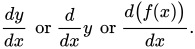
The Leibniz expression, also, at times, written dy/dx, is one of several notations used for derivatives and derived functions. A common alternative is Lagrange's notation
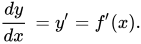
Another alternative is Newton's notation, often used for derivatives with respect to time (like velocity), which requires placing a dot over the dependent variable (in this case, x):

Lagrange's "prime" notation is especially useful in discussions of derived functions and has the advantage of having a natural way of denoting the value of the derived function at a specific value. However, the Leibniz notation has other virtues that have kept it popular through the years.
In its modern interpretation, the expression dy/dx should not be read as the division of two quantities dx and dy (as Leibniz had envisioned it); rather, the whole expression should be seen as a single symbol that is shorthand for

(note Δ vs. d, where Δ indicates a finite difference).
The expression may also be thought of as the application of the differential operator d/dx (again, a single symbol) to y, regarded as a function of x. This operator is written D in Euler's notation. Leibniz did not use this form, but his use of the symbol d corresponds fairly closely to this modern concept.
While there is traditionally no division implied by the notation (but see Nonstandard analysis), the division-like notation is useful since in many situations, the derivative operator does behave like a division, making some results about derivatives easy to obtain and remember.[14] This notation owes its longevity to the fact that it seems to reach to the very heart of the geometrical and mechanical applications of the calculus.[15]
Leibniz notation for higher derivatives
[edit]If y = f(x), the nth derivative of f in Leibniz notation is given by,[16]
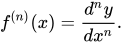
This notation, for the second derivative, is obtained by using d/dx as an operator in the following way,[16]
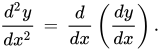
A third derivative, which might be written as,
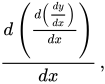
can be obtained from

Similarly, the higher derivatives may be obtained inductively.
While it is possible, with carefully chosen definitions, to interpret dy/dx as a quotient of differentials, this should not be done with the higher order forms.[17] However, an alternative Leibniz notation for differentiation for higher orders allows for this.[citation needed]
This notation was, however, not used by Leibniz. In print he did not use multi-tiered notation nor numerical exponents (before 1695). To write x3 for instance, he would write xxx, as was common in his time. The square of a differential, as it might appear in an arc length formula for instance, was written as dxdx. However, Leibniz did use his d notation as we would today use operators, namely he would write a second derivative as ddy and a third derivative as dddy. In 1695 Leibniz started to write d2⋅x and d3⋅x for ddx and dddx respectively, but l'Hôpital, in his textbook on calculus written around the same time, used Leibniz's original forms.[18]
Leibniz's notation for integration
[edit]Leibniz introduced the integral symbol for integration[19] (or "antidifferentiation") now commonly used today:

The notation was introduced in 1675 in his private writings;[20][21] it first appeared publicly in the article "De Geometria Recondita et analysi indivisibilium atque infinitorum" (On a hidden geometry and analysis of indivisibles and infinites), published in Acta Eruditorum in June 1686.[22][23] The symbol was based on the ſ (long s) character and was chosen because Leibniz thought of the integral as an infinite sum of infinitesimal summands.
Use in various formulas
[edit]One reason that Leibniz's notations in calculus have endured so long is that they permit the easy recall of the appropriate formulas used for differentiation and integration. For instance, the chain rule—suppose that the function g is differentiable at x and y = f(u) is differentiable at u = g(x). Then the composite function y = f(g(x)) is differentiable at x and its derivative can be expressed in Leibniz notation as,[24]
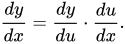
This can be generalized to deal with the composites of several appropriately defined and related functions, u1, u2, ..., un and would be expressed as,

Also, the integration by substitution formula may be expressed by[25]
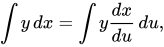
where x is thought of as a function of a new variable u and the function y on the left is expressed in terms of x while on the right it is expressed in terms of u.
If y = f(x) where f is a differentiable function that is invertible, the derivative of the inverse function, if it exists, can be given by,[26]
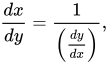
where the parentheses are added to emphasize the fact that the derivative is not a fraction.
However, when solving differential equations, it is easy to think of the dys and dxs as separable. One of the simplest types of differential equations is[27]
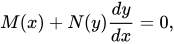
where M and N are continuous functions. Solving (implicitly) such an equation can be done by examining the equation in its differential form,

and integrating to obtain

Rewriting, when possible, a differential equation into this form and applying the above argument is known as the separation of variables technique for solving such equations.
In each of these instances the Leibniz notation for a derivative appears to act like a fraction, even though, in its modern interpretation, it isn't one.
Modern justification of infinitesimals
[edit]In the 1960s, building upon earlier work by Edwin Hewitt and Jerzy Łoś, Abraham Robinson developed mathematical explanations for Leibniz's infinitesimals that were acceptable by contemporary standards of rigor, and developed nonstandard analysis based on these ideas. Robinson's methods are used by only a minority of mathematicians. Jerome Keisler wrote a first-year calculus textbook, Elementary calculus: an infinitesimal approach, based on Robinson's approach.
From the point of view of modern infinitesimal theory, Δx is an infinitesimal x-increment, Δy is the corresponding y-increment, and the derivative is the standard part of the infinitesimal ratio:
- .
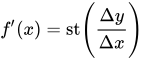
Then one sets , , so that by definition, is the ratio of dy by dx.

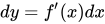

Similarly, although most mathematicians now view an integral

as a limit
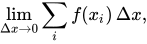
where Δx is an interval containing xi, Leibniz viewed it as the sum (the integral sign denoted summation for him) of infinitely many infinitesimal quantities f(x) dx. From the viewpoint of nonstandard analysis, it is correct to view the integral as the standard part of such an infinite sum.
The trade-off needed to gain the precision of these concepts is that the set of real numbers must be extended to the set of hyperreal numbers.
Other notations of Leibniz
[edit]Leibniz experimented with many different notations in various areas of mathematics. He felt that good notation was fundamental in the pursuit of mathematics. In a letter to l'Hôpital in 1693 he says:[28]
One of the secrets of analysis consists in the characteristic, that is, in the art of skilful employment of the available signs, and you will observe, Sir, by the small enclosure [on determinants] that Vieta and Descartes have not known all the mysteries.
He refined his criteria for good notation over time and came to realize the value of "adopting symbolisms which could be set up in a line like ordinary type, without the need of widening the spaces between lines to make room for symbols with sprawling parts."[29] For instance, in his early works he heavily used a vinculum to indicate grouping of symbols, but later he introduced the idea of using pairs of parentheses for this purpose, thus appeasing the typesetters who no longer had to widen the spaces between lines on a page and making the pages look more attractive.[30]
Many of the over 200 new symbols introduced by Leibniz are still in use today.[31] Besides the differentials dx, dy and the integral sign ( ∫ ) already mentioned, he also introduced the colon (:) for division, the middle dot (⋅) for multiplication, the geometric signs for similar (~) and congruence (≅), the use of Recorde's equal sign (=) for proportions (replacing Oughtred's :: notation) and the double-suffix[clarification needed] notation for determinants.[28]
See also
[edit]Notes
[edit]- ^ Stewart, James (2008). Calculus: Early Transcendentals (6th ed.). Brooks/Cole. ISBN 978-0-495-01166-8.
- ^ a b Katz 1993, p. 524
- ^ Katz 1993, p. 529
- ^ Mazur 2014, p. 166
- ^ Cajori 1993, Vol. II, p. 203, footnote 4
- ^ Swetz, Frank J., Mathematical Treasure: Leibniz's Papers on Calculus - Integral Calculus, Convergence, Mathematical Association of America, archived from the original on December 27, 2016, retrieved February 11, 2017
- ^ Stillwell, John (1989). Mathematics and its History. Springer. p. 110.
- ^ Leibniz, G. W. (2005) [1920]. The Early Mathematical Manuscripts of Leibniz. Translated by Child, J. M. Dover. pp. 73–74, 80. ISBN 978-0-486-44596-0.
- ^ Leibniz, G. W., Sämtliche Schriften und Briefe, Reihe VII: Mathematische Schriften, vol. 5: Infinitesimalmathematik 1674-1676, Berlin: Akademie Verlag, 2008, pp. 288–295 Archived 2021-10-09 at the Wayback Machine ("Analyseos tetragonisticae pars secunda", October 29, 1675) and 321–331 Archived 2016-10-03 at the Wayback Machine ("Methodi tangentium inversae exempla", November 11, 1675).
- ^ Aldrich, John. "Earliest Uses of Symbols of Calculus". Retrieved 20 April 2017.
- ^ a b Cajori 1993, Vol. II, p. 204
- ^ Leibniz, G. W., Sämtliche Schriften und Briefe, Reihe VII: Mathematische Schriften, vol. 5: Infinitesimalmathematik 1674-1676, Berlin: Akademie Verlag, 2008, pp. 321–331 esp. 328 Archived 2016-10-03 at the Wayback Machine ("Methodi tangentium inversae exempla", November 11, 1675).
- ^ Cajori 1993, Vol. II, p. 186
- ^ Jordan, D. W.; Smith, P. (2002). Mathematical Techniques: An Introduction for the Engineering, Physical, and Mathematical Sciences. Oxford University Press. p. 58.
- ^ Cajori 1993, Vol. II, p. 262
- ^ a b Briggs & Cochran 2010, p. 141
- ^ Swokowski 1983, p. 135
- ^ Cajori 1993, pp. 204-205
- ^ Earliest Uses of Symbols of Calculus", School of Mathematics and Statistics, University of St Andrews, Scotland. Retrieved 1 May 2025.
- ^ Gottfried Wilhelm Leibniz, Sämtliche Schriften und Briefe, Reihe VII: Mathematische Schriften, vol. 5: Infinitesimalmathematik 1674–1676, Berlin: Akademie Verlag, 2008, pp. 288–295 Archived 2021-10-09 at the Wayback Machine ("Analyseos tetragonisticae pars secunda", October 29, 1675) and 321–331 Archived 2016-10-03 at the Wayback Machine ("Methodi tangentium inversae exempla", November 11, 1675).
- ^ Aldrich, John. "Earliest Uses of Symbols of Calculus". Retrieved 20 April 2017.
- ^ Swetz, Frank J., Mathematical Treasure: Leibniz's Papers on Calculus – Integral Calculus, Convergence, Mathematical Association of America, archived from the original on December 27, 2016, retrieved February 11, 2017
- ^ Stillwell, John (1989). Mathematics and its History. Springer. p. 110.
- ^ Briggs & Cochran 2010, p. 176
- ^ Swokowski 1983, p. 257
- ^ Swokowski 1983, p. 369
- ^ Swokowski 1983, p. 895
- ^ a b Cajori 1993, Vol. II, p. 185
- ^ Cajori 1993, Vol. II, p. 184
- ^ Mazur 2014, pp. 167-168
- ^ Mazur 2014, p. 167
References
[edit]- Briggs, William; Cochran, Lyle (2010), Calculus / Early Transcendentals / Single Variable, Addison-Wesley, ISBN 978-0-321-66414-3
- Cajori, Florian (1993) [1928], A History of Mathematical Notations, New York: Dover, ISBN 0-486-67766-4
- Katz, Victor J. (1993), A History of Mathematics / An Introduction (2nd ed.), Addison Wesley Longman, ISBN 978-0-321-01618-8
- Mazur, Joseph (2014), Enlightening Symbols / A Short History of Mathematical Notation and Its Hidden Powers, Princeton University Press, ISBN 978-0-691-17337-5
- Swokowski, Earl W. (1983), Calculus with Analytic Geometry (Alternate ed.), Prindle, Weber and Schmidt, ISBN 0-87150-341-7
| History |  | |
|---|---|---|
| Related branches | ||
| Formalizations | ||
| Individual concepts | ||
| Mathematicians | ||
| Textbooks | ||
Leibniz's notation
View on GrokipediaHistorical Development
Leibniz's Contributions to Calculus Notation
Gottfried Wilhelm Leibniz began developing his notation for the differential calculus in unpublished manuscripts during the mid-1670s, with the symbols , , and first appearing in a document dated November 11, 1675.[1] In these early writings, Leibniz employed the symbol to denote infinitesimals, representing quantities smaller than any assignable magnitude but not zero, which allowed him to conceptualize changes in variables as composed of such infinitesimal increments.[8] These notations emerged from Leibniz's efforts to create a symbolic system that treated differentiation as an algebraic operation on functions, facilitating manipulations akin to those in ordinary arithmetic.[9] Leibniz's motivation for this notation stemmed from a desire to transcend the geometric methods prevalent in contemporary mathematics, such as Isaac Newton's fluxions, which relied on rates of change described through flowing quantities and diagrammatic representations.[10] In contrast, Leibniz envisioned calculus as a "calculus of differences" where and signified corresponding infinitesimal changes in independent and dependent variables, enabling the ratio to directly express the derivative as a fraction-like entity amenable to symbolic rules like the product rule.[11] This algebraic approach was intended to make calculus more accessible for solving problems in maxima, minima, and tangents without constant recourse to geometric intuition.[8] The first public presentation of Leibniz's differential notation occurred in his 1684 paper "Nova Methodus pro Maximis et Minimis, itemque Tangentibus" published in Acta Eruditorum, where he outlined rules for differentiation of powers, products, and quotients using prefixed to variables.[8] This work marked a pivotal step in formalizing his symbolic method, though it omitted proofs to prioritize the operational aspects of the notation. The publication ignited a priority dispute with Newton, whose fluxion-based calculus remained largely unpublished until 1711; accusations of plagiarism leveled against Leibniz by Newton's supporters, including a 1712 Royal Society report, highlighted the contrasting emphases, with Leibniz's system praised for its explicit symbolic operations that promoted broader mathematical discourse.[8] Leibniz's notations gained traction among Continental mathematicians in the 18th century, influencing figures like the Bernoulli brothers and Euler in their analytical developments.[10]Adoption and Influence on Mathematical Practice
The adoption of Leibniz's notation for differentials, particularly the form , gained significant momentum in the early 18th century through the efforts of the Bernoulli brothers and Leonhard Euler, who actively promoted it over Isaac Newton's fluxion notation (denoted as ). Johann Bernoulli, having corresponded extensively with Leibniz, began incorporating and in his publications around 1694. His brother Jakob advocated for the integral sign in the 1713 posthumous publication Ars Conjectandi, viewing it as a more intuitive representation of summation compared to his own earlier symbol "I".[12] Jakob Bernoulli similarly embraced the notation in his 1690 printed use of the term "integral," helping to disseminate it within continental mathematical circles during the 1710s. Euler, building on this foundation, systematically employed in his 1728 dissertation and subsequent texts like Institutiones calculi differentialis (1755), emphasizing its algebraic flexibility and clarity for expressing rates of change, which contributed to its preference over Newton's dot notation by the 1730s among European mathematicians.[12][13] By the mid-18th century, Leibniz's notation had achieved institutional adoption across European academies and was integrated into influential textbooks, solidifying its role in mathematical education and research. The Berlin Academy, founded in 1700 with Leibniz's involvement, featured the notation prominently in its Miscellanea Berolinensia publications starting in 1710, while the Paris Academy of Sciences routinely used it in prize competitions and memoirs by the 1740s, reflecting its alignment with the geometric and analytical traditions favored in French mathematics.[12] Textbooks such as Pieter van Musschenbroek's Introductio ad philosophiam naturalem (1762) incorporated for physical applications, making it a standard tool for illustrating differential relationships in mechanics and optics.[12] This widespread use in academic proceedings and pedagogical works helped transition the notation from an innovative proposal to a conventional practice across Germany, Switzerland, and France by the 1750s.[13] In the 19th century, Leibniz's notation evolved further through formalization efforts, particularly by French mathematicians, while encountering resistance in Britain where loyalty to Newton's system persisted. Sylvestre François Lacroix played a key role in this refinement, presenting a comprehensive treatment of and in his Traité élémentaire de calcul (1797–1800), which standardized its application in higher analysis and influenced curricula at institutions like the École Polytechnique.[14] British mathematicians, however, largely clung to fluxions until the early 1800s, as seen in texts from Cambridge and Oxford that prioritized Newton's to affirm national priority in calculus invention, delaying continental advancements in Britain by decades.[15] This resistance began to wane around 1819 with Cambridge's adoption, driven by reformers like Charles Babbage who recognized the notation's superiority for algebraic manipulation.[16] The long-term influence of Leibniz's notation on mathematical pedagogy has been profound, particularly in enabling clearer conceptualizations of rates of change within physics and engineering disciplines. Its fractional form intuitively conveys the ratio of infinitesimal changes, facilitating the teaching of concepts like velocity and acceleration in mechanics, as evidenced by its integration into 19th-century engineering texts such as William Thomson and Peter Tait's Treatise on Natural Philosophy (1867).[12] By the late 19th century, the notation's adoption in American education—via translations of French works at Harvard starting post-1824—extended its reach, supporting practical problem-solving in fields like thermodynamics and structural analysis where explicit variable dependencies enhance instructional clarity.[12] This pedagogical advantage ensured its enduring dominance, outlasting competing systems and shaping modern STEM curricula worldwide.[13]Notation for Differentiation
First-Order Derivatives
Leibniz's notation for the first-order derivative of a function is , which represents the ratio of the infinitesimal change in to the infinitesimal change in .[17] This notation treats the derivative as an operational symbol capturing the instantaneous rate of change, emphasizing the differential structure of functions.[1] In this framework, denotes an infinitesimal increment in the independent variable , while is the corresponding infinitesimal variation in the dependent variable , such that .[17] Leibniz introduced the symbols , , and in a manuscript dated November 11, 1675, viewing them as genuine quantities smaller than any finite nonzero value but nonzero themselves.[1] Leibniz's original justification relied on infinitesimals rather than limits, interpreting directly as the quotient of these differentials to approximate tangents and solve optimization problems.[17] In contemporary analysis, this aligns with the limit definition: where and are finite increments approaching zero, providing a rigorous foundation absent in the infinitesimal approach.[17][18] A representative example is the function , where applying Leibniz's notation yields , demonstrating how the differential ratio simplifies computation of slopes and rates, such as the velocity of a particle moving along the parabola.[17] This operational symbolism facilitated practical applications in geometry and physics during Leibniz's era.[1]Higher-Order Derivatives
Leibniz extended his differential notation beyond the first order by applying the operator repeatedly to represent higher-order changes. For the second derivative, he employed forms such as or in his 1693 publication Supplementum geometriae practicae, interpreting it as the differential of the first differential .[19] This notation emphasized the infinitesimal increments, with the second order capturing "differences of differences" in curvilinear quantities. In contemporary mathematical practice, the second derivative is standardized as , denoting the rate of change of the first derivative with respect to . The general th-order derivative follows as , achieved through recursive differentiation, where each application builds on the previous order. Historically, Leibniz's formulations sometimes featured denominators like , evoking factorial-like structures in the scaling of infinitesimals for series expansions, though without explicit factorials. To illustrate successive differentiation, consider the function . The second derivative is , obtained by first computing and then differentiating again. This process highlights the notation's utility in tracking accelerating rates of change. In physics, particularly mechanics, Leibniz's notation for higher derivatives is pivotal for describing motion. Acceleration, the second derivative of position with respect to time, is expressed as , enabling formulations like Newton's second law . This application underscores the notation's enduring role in analyzing dynamic systems beyond linear velocities.Notation for Integration
Indefinite Integrals
Leibniz introduced the notation for indefinite integrals in 1675, using the symbol ∫, an elongated form of the letter S, to represent "summa," denoting the summation of infinitesimal quantities.[13] This notation first appeared in his unpublished manuscript Analyseos tetragonisticae pars secunda on October 29, 1675, where he wrote ∫ l = omn. l, id est summa ipsorum l, signifying the sum of all such l's, with l representing infinitesimal elements.[13] By November 11, 1675, in Methodi tangentium inversae exempla, Leibniz refined it to include the differential variable, as in ∫... dx, establishing the form ∫ f(x) , dx for the indefinite integral of f(x) with respect to x.[13][11] In this notation, ∫ f(x) , dx denotes the family of antiderivatives F(x) + C, where F is a function satisfying \frac{dF}{dx} = f(x) and C is an arbitrary constant of integration.[20] This inverse relationship to differentiation underscores the integral as the operation that recovers the original function from its derivative, up to the additive constant.[11] For instance, Leibniz computed early examples such as the integral of x, yielding \frac{x^2}{2}, as part of his summation processes, with the modern inclusion of + C reflecting the general solution in contemporary usage.[20] Here, the + C accounts for the fact that differentiation eliminates constants, so the antiderivative includes all possible shifts by a constant.[11] Leibniz interpreted the indefinite integral as an infinite sum of infinitesimal rectangles under the curve of f(x), aligning with his infinitesimal method where dx represents an infinitesimal increment in x and f(x) dx the corresponding area element.[11] This geometric summation tied integration directly to the calculation of areas and accumulated quantities, forming the conceptual basis for the antiderivative without specifying bounds.[13] By 1686, in Acta Eruditorum, Leibniz had adopted the ∫ symbol more consistently, influencing its widespread use in mathematical practice.[11]Definite Integrals
The modern notation for definite integrals, , extends Leibniz's integral symbol by including specified limits of integration and for the lower and upper bounds, respectively; Leibniz himself typically described the bounds in accompanying text rather than with attached sub- and superscripts, a convention first symbolized by Leonhard Euler around 1768 and standardized by Joseph Fourier in 1822.[13][1] This form computes the net accumulation of the quantity represented by over the interval from to . The notation originated in Leibniz's unpublished manuscripts from the 1670s, particularly around 1675, when he began incorporating boundaries to define the scope of summation in his infinitesimal approach to integration.[21][13] By the fundamental theorem of calculus, which Leibniz formulated in the late 1670s and published in his 1684 work Nova Methodus pro Maximis et Minimis, the value of equals , where is any antiderivative (or primitive function) of , such that . This evaluation process highlights the connection between differentiation and integration, allowing definite integrals to be computed without directly summing infinitesimals. For instance, consider the definite integral . An antiderivative is , so the evaluation yields .[10] Geometrically, Leibniz interpreted the definite integral as the net signed area between the curve and the x-axis over the interval , treating it as the sum of infinitely many infinitesimal rectangles of height and width . This visualization aligned with his infinitesimal methods developed in the 1670s, emphasizing practical computation of areas and accumulated quantities in problems like quadrature.[21][10]Applications in Key Formulas
Differentiation Rules and Theorems
Leibniz's notation for differentiation, employing differentials such as and , provides an intuitive framework for deriving fundamental rules by treating infinitesimals as algebraic quantities. This approach allows for straightforward manipulation of expressions involving products, quotients, compositions, and implicit relations, emphasizing the geometric and infinitesimal origins of calculus. In his seminal 1684 publication, Leibniz outlined several key differentiation rules using this notation, enabling efficient computation without explicit limits, though modern interpretations rigorize these via limits or non-standard analysis.[8] The product rule expresses the differential of a product of two functions and . Leibniz formulated it as , which, when divided by , yields . This rule arises naturally from the infinitesimal increment: if changes by and by , the change in the product approximates , neglecting the higher-order term . Leibniz introduced this in his early manuscripts and formalized it in print, highlighting its utility for algebraic simplification in calculus problems.[22][8] Similarly, the quotient rule for follows from differentiating the product . Leibniz derived , or in derivative form, . This emerges by applying the product rule to and using the power rule for the inverse, demonstrating the notation's power in handling reciprocal functions through infinitesimal ratios. Leibniz presented this alongside the product rule in his 1684 work, using it to solve optimization and tangency problems.[8] The chain rule addresses composite functions, where and . In Leibniz's differential notation, , and since , it follows that , hence . This derivation treats differentials as proportional quantities, linking increments along the composition without invoking limits directly; the ratio factors through the intermediate . Leibniz first explored this in a 1676 manuscript, noting a sign error initially, and published the corrected form in 1684, where it proved essential for transcendental functions and higher curves.[23][8] Leibniz's notation excels in implicit differentiation, where relations like define implicitly as a function of . Differentiating both sides with respect to gives , solving to . This process applies the chain rule to , treating as , and leverages the algebraic manipulation of differentials to find tangents without solving for explicitly. Such techniques, rooted in Leibniz's infinitesimal geometry, were applied in his analyses of conic sections and transcendental equations.[8]Integration Formulas and Techniques
Leibniz's notation for integration, employing the elongated "S" symbol ∫ to denote summation and dx to represent the infinitesimal element, facilitates the expression and derivation of key antiderivative techniques. These methods invert differentiation rules, allowing computation of integrals that arise in applications such as physics and engineering. Central to this are substitution and integration by parts, which leverage the differential form du = g'(x) dx to simplify expressions. The substitution method, also known as u-substitution, transforms integrals of composite functions into more manageable forms. In Leibniz notation, if u = g(x) and du = g'(x) dx, then ∫ f(g(x)) g'(x) dx = ∫ f(u) du. This approach justifies the notation's emphasis on differentials, as the replacement du/dx dx = du aligns the integral with a standard form for integration with respect to u. For instance, to evaluate ∫ x √(x² + 1) dx, set u = x² + 1, so du = 2x dx, yielding (1/2) ∫ √u du = (1/3) u^{3/2} + C = (1/3) (x² + 1)^{3/2} + C. Integration by parts serves as the inverse of the product rule for differentiation, providing a means to handle products of functions. Leibniz derived this technique geometrically in the 1670s, using his "omn." notation for summation to express ∫ x dy = x y - ∫ y dx, which translates to the modern form ∫ u dv = u v - ∫ v du in his differential symbolism. This formula is particularly useful when one factor simplifies upon differentiation and the other upon integration, such as logarithmic or exponential terms. Standard integration formulas, expressed in Leibniz notation, form the foundation for these techniques and many direct computations. Notable examples include ∫ (1/x) dx = ln |x| + C, derived from the limit definition of the natural logarithm, and ∫ sin x dx = -cos x + C, obtained by recognizing the derivative of cosine. Similarly, ∫ cos x dx = sin x + C follows from the derivative of sine. These antiderivatives are verified by differentiation and underpin broader integral evaluations. A practical illustration of integration by parts is computing ∫ x e^x dx. Choose u = x (so du = dx) and dv = e^x dx (so v = e^x), applying the formula: ∫ x e^x dx = x e^x - ∫ e^x dx = x e^x - e^x + C = e^x (x - 1) + C. This result can be extended to definite integrals by evaluating the boundary term [u v] from a to b and subtracting the remaining integral, though the indefinite form highlights the technique's core mechanics.Theoretical Underpinnings
Role of Infinitesimals in Original Formulation
Leibniz conceptualized infinitesimals in a syncategorematic manner, treating them not as actual numbers or independent entities but as fictions or shorthand notations that abbreviate limiting processes in calculations.[24] This approach is evident in his seminal 1684 paper, Nova Methodus pro Maximis et Minimis, where infinitesimals function as variable finite quantities that can be made arbitrarily small, aligning with the Archimedean axiom while avoiding contradictions associated with actual infinite divisibility.[24] In this framework, differentials such as were treated as variable finite quantities that could be made arbitrarily small, approaching zero in the limit, yet Leibniz manipulated them algebraically as if they were finite without invoking explicit limits, enabling the derivation of tangents, maxima, and minima through proportionalities.[25] This treatment relied on the law of continuity to justify transitions between finite and infinitesimal scales, preserving the utility of the calculus despite the fictional status of the infinitesimals.[17] Philosophically, Leibniz's use of infinitesimals drew from his Monadology, positing monads as indivisible simple substances that underpin reality, while continua like space and time are ideal constructs infinitely divisible only in approximation.[17] Infinitesimals thus served as a bridge between the finite realm of observable quantities and the infinite divisibility of ideal continua, embodying his principle of continuity—natura non facit saltus—which posits smooth, gapless transitions in nature and mathematics.[17] This foundational reliance on infinitesimals faced sharp criticism from George Berkeley in his 1734 work The Analyst, where he derided them as "the ghosts of departed quantities," neither finite nor infinitesimal nor zero, exposing what he saw as logical inconsistencies and a lack of rigorous justification in the calculus's methods.[26] Berkeley's attack highlighted enduring foundational issues, prompting later efforts to rigorize the calculus beyond Leibniz's original infinitesimal approach.[17]Modern Non-Standard Analysis Interpretations
In the 1960s, Abraham Robinson developed non-standard analysis as a rigorous framework for incorporating infinitesimals into mathematical analysis, thereby providing a modern justification for the intuitive methods originally employed by Leibniz in calculus.[27] The hyperreal numbers, denoted , form a non-Archimedean ordered field that extends the real numbers via an ultrapower construction, including infinitesimal elements such that but for every positive real number .[27] The transfer principle asserts that any first-order logical statement true in holds in , and conversely, enabling the extension of standard theorems to the hyperreals; this supports an interpretation of Leibniz's notation where for infinitesimal , with the standard derivative given by the standard part function , which maps finite hyperreals to their closest real numbers.[27] This approach offers advantages over traditional ε-δ limit definitions by allowing direct manipulation of infinitesimals in proofs and computations, and it finds applications in physics, such as nonconservative numerical simulations of converging shock waves where infinitesimals model discontinuous phenomena rigorously.Additional Notations by Leibniz
Notations for Infinite Series and Sums
Leibniz developed notations for infinite series during his early mathematical investigations in the 1670s, employing an elongated form of the letter S—similar to his integral symbol—to represent summation, derived from the Latin term summa meaning "sum." This symbol was used to denote both continuous summations (integrals) and discrete infinite sums, reflecting his view of series as accumulations of terms. In manuscripts from 1672 to 1676, such as those addressing Huygens' problem and the quadrature of the circle, Leibniz applied this notation to express sums like that of the reciprocals of triangular numbers: ∑{i=1}^n C_i = 2(A_1 - A{n+1}), where C_i denotes combinations and A terms relate to geometric progressions. A prominent example of Leibniz's application of summation notation is his 1673 derivation of the alternating series for π/4, expressed as 1 - 1/3 + 1/5 - 1/7 + 1/9 - ⋯ continuing infinitely. He recorded this as an infinite sum using his elongated S symbol, without the modern index limits, to approximate the arctangent function and circle quadrature geometrically. This series, now written in contemporary notation as demonstrated the power of infinite summations for transcendental constants, though convergence was slow and required acceleration techniques Leibniz later explored.[30] In Leibniz's framework, infinite series served as discrete analogs to integrals, allowing summation of countable terms to yield exact values where continuous integration handled uncountable infinitesimals, thus bridging algebraic and geometric methods without overlapping with derivative fluxions.[30]Notations for Differentials and Fluxions
Leibniz introduced the notation for total differentials to express the infinitesimal change in a function of multiple variables, treating differentials such as and as independent infinitesimals. For a function , the total differential is expressed as a sum of contributions from each variable, such as (differential with respect to x) (differential with respect to y) , reflecting Leibniz's algebraic manipulation of infinitesimals as entities akin to small increments without strict geometric constraints.[12] This notation, developed in his manuscripts around 1675 and first published in 1684, allowed for systematic handling of multivariable changes by summing differential components, emphasizing the infinitesimal nature of and as foundational elements in his calculus framework. Higher-order differentials in Leibniz's system, such as or , extend this approach beyond first-order changes, denoting iterated infinitesimal variations distinct from what would later be formalized as higher derivatives. These were used primarily for approximations, as in expanding functions via successive differentials to approximate curves or surfaces, with capturing the "difference of differences" without equating directly to . Leibniz employed notations like for second-order and even fractional forms such as by the 1690s, building on his 1675 innovations to facilitate algebraic computations in series expansions and geometric problems.[12] In contrast to Isaac Newton's fluxional notation, which relied on geometric interpretations of moments (denoted by or , representing instantaneous rates tied to motion), Leibniz's differentials adopted an algebraic perspective, treating and as manipulable symbols for infinitesimal quantities rather than purely temporal fluxions. Newton’s moments, introduced around 1665 and published in 1711, emphasized geometric flux over symbolic algebra, whereas Leibniz used symbols like occasionally for analogous "moments" but prioritized the differential's versatility in non-geometric contexts, such as pure analysis.[12] This distinction, highlighted in their respective publications and correspondence, underscored Leibniz's notation as more adaptable for abstract manipulations, though it sparked controversy over priority and rigor. A notable application of Leibniz's differential notation appears in geometry, where the arc length differential is defined via the relation , visualizing an infinitesimal right triangle with legs and , and hypotenuse as the curve's local segment. This construction, rooted in Leibniz's 1675-1684 developments, enabled the summation of such elements to compute curve lengths algebraically, integrating over paths without relying on Newtonian fluxional geometry.[12]References
- https://ntrs.[nasa](/page/NASA).gov/api/citations/20080022442/downloads/20080022442.pdf
- https://www.[humanities](/page/Humanities).mcmaster.ca/~rarthur/papers/Fecundity.pdf