


Community hub
Recent from talks
Contribute something
Nothing was collected or created yet.
Lexus IS
View on Wikipedia
| Lexus IS | |
|---|---|
 2021 Lexus IS 300 F Sport (ASE30, Canada) | |
| Overview | |
| Manufacturer | Toyota |
| Also called | Toyota Altezza (Japan, 1998–2005) |
| Production | October 1998 – present |
| Model years | 1999–present |
| Body and chassis | |
| Class | Compact executive car (D) |
| Layout | |
| Chronology | |
| Predecessor | Lexus GS 460/F (for IS 500 F Sport Performance) |
The Lexus IS (Japanese: レクサス・IS, Hepburn: Rekusasu IS) is a compact executive car[1] (D-segment in Europe) sold by Lexus, a luxury division of Toyota, since 1998. The IS was originally sold under the Toyota Altezza (Japanese: トヨタ・アルテッツァ, Hepburn: Toyota Arutettsua) nameplate in Japan from 1998 until 2005 (the word Altezza is Italian for 'height' or 'highness'). The IS was introduced as an entry-level sport model positioned below the ES in the Lexus lineup. It was the smallest car in the Lexus lineup until the introduction of the CT in 2011.
The first-generation Altezza (codename XE10) was launched in Japan in October 1998, while the Lexus IS 200 (GXE10) made its debut in Europe in 1999 and in North America as the IS 300 (JCE10) in 2000. The first-generation models were powered by a straight-six engine and available in sedan and wagon variants. The second-generation IS (codename XE20) was launched globally in 2005 with V6-powered IS 250 (GSE20) and IS 350 (GSE21) and Diesel-powered IS 200d/220d (ALE20) sedan models, followed by a high-performance V8 sedan version, the IS F, in 2007, and coupé convertible versions, the IS 250 C and IS 350 C, in 2008. The third-generation Lexus IS premiered in January 2013 and includes the V6-powered IS 250 and IS 350, turbocharged IS 200t/300, hybrid IS 300h and performance-tuned F Sport variants. The IS designation stands for "Intelligent Sport".[2][3][4]
First generation (XE10; 1998)
[edit]| First generation | |
|---|---|
 Lexus IS 300 (JCE10, US) | |
| Overview | |
| Model code | XE10 |
| Also called | Toyota Altezza (Japan) |
| Production |
|
| Model years | 1999–2005 |
| Assembly | Japan: Kanegasaki, Iwate (Kanto Auto Works)[5][6] |
| Designer |
|
| Body and chassis | |
| Body style |
|
| Related | Toyota Mark II (X110) |
| Powertrain | |
| Engine | |
| Transmission | |
| Dimensions | |
| Wheelbase | 2,670 mm (105.1 in) |
| Length |
|
| Width |
|
| Height | 1,410–1,440 mm (55.5–56.7 in) |
| Kerb weight | |
Produced as a direct competitor to the luxury sports sedans of the leading European luxury marques, the XE10 series Toyota Altezza and Lexus IS was designed with a greater performance emphasis than typically seen on prior Japanese luxury vehicles. The engineering work was led by Nobuaki Katayama from 1994 to 1998 under the 038T program code. Design work which had been done in 1995 by Tomoyasu Nishi was frozen in 1996 and filed under patent number 1030135 on 5 December 1996, at the Japan Patent Office. At its introduction to Japan, it was exclusive to Japanese dealerships called Toyota Netz Store, until Lexus was introduced to Japan in 2006. The Japan-sold AS200 Altezza sedan and AS300 Altezza Gita correspond to the Lexus IS 200 and IS 300 models respectively, as sold in markets outside of Japan. The Lexus IS' primary markets were North America, Australia, and Europe. The Altezza Gita was a hatchback-station wagon version sold in Japan and was known in the US and Europe as the Lexus IS SportCross. The AS300 Altezza Gita was the only Altezza with the 2JZ-GE engine; in export markets this engine was available in the sedan models as well as the Lexus IS300 Sedan.
1998–2000
[edit]Introduced in 1998 with the AS200 (chassis code GXE10) and RS200 (chassis code SXE10) sedans, the compact vehicle was produced using a shortened, front-engine, rear-wheel-drive midsize platform,[9] allowing Japanese buyers to take advantage of tax savings imposed by Japanese government regulations concerning vehicle engine displacement (but not exterior dimensions, as the car was 20 mm wider than the 1,700 mm standard), and adapted parts from the larger second-generation Aristo/GS.[9] The 2.0-litre 1G-FE straight-six powered AS200 (GXE10, sedan) was equipped with a four-speed automatic as standard. The 2.0-litre 3S-GE straight-four-powered RS200 (SXE10, sedan) was equipped a six-speed manual transmission, while a five-speed automatic was optional.
_sedan_03.jpg)
The design received critical acclaim at its 1998 launch and was awarded Japan's "Car of the Year" honor for 1998–1999. A few months later, Lexus began marketing the IS 200 equivalent models in Europe.[10] The IS 200 in Europe was rated at 153 hp (114 kW), with a top speed of 216 km/h (134 mph), and 0 to 100 km/h (0–62 mph) acceleration time of 9.3 seconds.[11] The styling cues of the rear lamp clusters on the first-generation models were copied by a number of after-market accessory manufacturers for applications on other vehicles.[12] This iconic style of one or more internal lamp units, covered with a clear (or tinted) perspex cover made popular by Lexus, became known in many circles as 'Lexus-style' or 'Altezza lights'.[12] The taillight style became so popular, that it influenced the development of clear-covered LED taillamps that only revealed their colour when illuminated. The XE10's chief engineer was Nobuaki Katayama, while the chief test driver and test engineer was Hiromu Naruse.
2000–2003
[edit]
In July 2000, a hatchback/station wagon model, the AS300 (chassis code JCE10), was introduced featuring a 3.0-litre 2JZ-GE straight-six engine. Equipped with rear- or all-wheel drive (JCE10, RWD Gita wagon; JCE15, 4WD Gita wagon), the AS300 was only available with an automatic gearbox; a five-speed automatic for the RWD Gita wagon and a four-speed automatic for the 4WD Gita wagon. The six-cylinder version (2JZ-GE) was only available in Japan on the Gita models. Additionally, a six-speed manual transmission was introduced to the AS200 (chassis code GXE10). In the US, the IS 300 sedan debuted in July 2000 as 2001 model and the wagon debuted in 2001 as a 2002 model with the same 3.0-litre six-cylinder engine (the 2.0-litre six-cylinder was not available), while in Europe, the IS 300 joined the IS 200 in the model lineup. The IS 300 models were initially only available with the five-speed automatic transmission in all markets. A five-speed manual – the six-speed manual from the 2-litre model was not designed for the torque put out by the larger 2JZ-GE engine – was made available in the US in 2001 for the 2002 model year.[13] The manual option was not available on the SportCross wagon. Lexus aimed for 15 percent of American IS 300 sales to be manuals.[13] Visually, the exterior of the European IS 200 Sport and 300 were almost identical, the only differences being the boot insignia and the larger-engined model initially having clear front indicators (later generalized throughout the range).

The first-generation IS' interior featured unique elements not typically found in other Lexus models. These included a chrome metal ball shifter (USDM & European market, other markets received an optional leather-trimmed shifter), (optional) pop-up navigation screen, and chronograph-style instrument panel (with mini gauges for temperature, fuel economy, and volts). For the European and Australian markets, the IS 300 gained full leather seats rather than the leather/Ecsaine of the 200, plus auto-dimming rear view and side mirrors, and HID headlamps. In the US, the Environmental Protection Agency listed the IS 300 as a subcompact car; although it technically had enough overall volume to be called a compact, rear seat room exhibited subcompact dimensions.
The US National Highway Traffic Safety Administration (NHTSA) crash test results in 2001 gave the IS 300 the maximum five stars in the Side Driver and Side Rear Passenger categories, and four stars in the Frontal Driver and Frontal Passenger categories.[14] The Insurance Institute for Highway Safety (IIHS) rated the IS "Good" overall for frontal collisions and "Good" in all six measured front impact categories.[15]
For the first-generation IS in the North American market, sales hit a high of 22,486 units in 2001; subsequent sales years were less than forecast, and below the 10,000-unit mark in 2004.[16][17] The IS 200 fared better relative to sales targets in Europe and Asia, while still well short of the sales volume achieved by the Mercedes-Benz C-Class and other, mostly German-made competitors. This trend was indicative of Lexus' smaller global status; while Lexus' range of cars was very successful in North America, the marque's sales lagged behind its German rivals in Europe.[18] In Europe, the lack of a manual gearbox option for the IS 300 may have limited sales in contrast to its rivals, the BMW 3 Series and the Mercedes C-Class.
In 2000, TTE introduced a compressor kit for the IS 200 in the European market.[19] An Eaton supercharger at 0.3-bar pressure increased the power output to 153 kW (205 hp) without sacrificing fuel consumption (+3.3%). The kit was initially available as an aftermarket fitment, but could also be obtained as OEM Lexus accessory on newer cars through the official Lexus dealer network and was fully covered by the standard warranty.[19] This variant was discontinued when the IS 300 was introduced in the European market.
2003–2005
[edit]_Platinum_Edition_sedan_(2015-07-03)_02.jpg)

In 2003 for the 2004 model year, the IS line received a minor facelift (designed by Hiroyuki Tada). On the exterior, was a redesigned 11-spoke wheel design, redesigned fog lamps, and smoked surrounding trim for the headlamps and taillamps. On the interior, a 2-position memory function was added for the driver seat, a maintenance indicator lamp, automatic drive-away door locking system, a storage compartment on the dash (for models without the navigation system) and updated trim highlights.[20]
An official concept model, the MillenWorks-built Lexus IS 430 was unveiled at the SEMA Show in Las Vegas, Nevada, in 2003.[21] The IS 430 prototype was an IS 300 fitted with a 4.3-litre V8 from the GS 430.[22] Lexus dubbed the IS 430 a one-off with no plans for production. In Europe, Toyota Team Europe (TTE) installed a supercharged 4.3-litre V8 into an IS 300 bodyshell, the result was a 405 PS (298 kW; 399 hp) ECE sedan.
Powertrain and models
[edit]| Engine | Lexus | Toyota | |||||||
|---|---|---|---|---|---|---|---|---|---|
| Engine | Power/torque | Model | Chassis code | Drivetrain and transmission | Model | Chassis code | Drivetrain and transmission | ||
| 2.0 L straight-six (1G-FE) |
114 kW (153 hp); 195 N⋅m (144 lb⋅ft) at 4,600 rpm |
IS 200 (sedan) |
GXE10 | RWD 6-speed manual (J160) 4-speed automatic (A47DE) |
Altezza AS200 (sedan) |
GXE10 | RWD 6-speed manual (J160) 4-speed automatic (A47DE) | ||
| IS 200 SportCross (wagon) |
GXE10 | RWD 6-speed manual (J160) |
Altezza Gita AS200 (wagon) |
GXE10W | RWD 6-speed manual (J160) 4-speed automatic (A47DE) | ||||
| GXE15W | 4WD 4-speed automatic (A340H) | ||||||||
| 2.0 L straight-four (3S-GE) |
154 kW (207 hp); 216 N⋅m (159 lb⋅ft) at 6,400 rpm |
No equivalent | Altezza RS200 (sedan) |
SXE10 | RWD 6-speed manual (J160) 5-speed automatic (A650E) | ||||
| 3.0 L straight-six (2JZ-GE) |
162 kW (217 hp); 295 N⋅m (218 lb⋅ft) at 3,800 rpm |
IS 300 (sedan) |
JCE10 | RWD 5-speed manual (W55, US only) 5-speed automatic (A650E) |
No equivalent | ||||
| IS 300 SportCross (wagon) |
JCE10 | RWD 5-speed automatic (A650E) |
Altezza Gita AS300 (wagon) |
JCE10W | RWD 5-speed automatic (A650E) | ||||
| JCE15W | 4WD 4-speed automatic (A340H) | ||||||||
Second generation (XE20; 2005)
[edit]| Second generation | |
|---|---|
_Sports_Luxury_sedan_03.jpg) Lexus IS 250 (pre-facelift; GSE20R) | |
| Overview | |
| Model code | XE20 |
| Production | |
| Model years | 2006 – 2013 |
| Assembly |
|
| Designer | |
| Body and chassis | |
| Body style |
|
| Platform | Toyota N platform[34] |
| Powertrain | |
| Engine | |
| Transmission | |
| Dimensions | |
| Wheelbase | 2,730 mm (107.5 in) |
| Length | 4,575–4,590 mm (180.1–180.7 in) |
| Width | 1,800–1,816 mm (70.9–71.5 in) |
| Height | 1,410–1,425 mm (55.5–56.1 in) |
| Kerb weight | 1,558–1,741 kg (3,435–3,838 lb) |
| Chronology | |
| Successor | Lexus RC (for IS F) |
2005–2008
[edit]The second-generation of the IS was introduced at the Geneva Motor Show in March 2005 as a pre-production model, with the production version debuting at the 2005 New York International Auto Show that April. Sales of the sedan began worldwide in September and October 2005 as a 2006 model, with the Toyota Altezza name discontinued due to the introduction of the Lexus marque in Japan, and the slow-selling SportCross station wagon version discontinued from the lineup altogether.
-
 Pre-facelift Lexus IS 250 (GSE20, Europe)
 -
 Interior


The second-generation IS marked the next introduction of Lexus' L-finesse design philosophy on a production vehicle, following the premiere of the 2006 GS executive sedan. The sedan's exterior design featured sleeker, coupé-like contours, a fastback profile, and a repeated arrowhead motif in the front fascia and side windows.[35] The IS sedan has a drag coefficient of Cd=0.28.
Production of the sedan commenced in September 2005 at the Miyata plant in Miyawaka, Fukuoka,[23] supplemented in October 2005 with the Tahara plant at Tahara, Aichi.[24] Production of the IS F started in December 2007 at Tahara.[24] The facility at Miyata began manufacture of the IS C in April 2009.[23]
IS F
[edit]-
 Lexus IS F (USE20R)
 -
 Lexus IS F (USE20R)
_Sports_Luxury_sedan_01.jpg)
_Sports_Luxury_sedan_02.jpg)
In North America, IS models sold at launch included the IS 250 and IS 350 sedans; in parts of Europe, the IS models sold by Lexus included the IS 250 and IS 220d sedans. The IS 250 was also available in Australia, New Zealand, Thailand, Singapore, Hong Kong, Taiwan, Chile (automatic only), South Africa and South Korea.
All second-generation IS models offered a more typical Lexus interior compared to the previous generation with a focus on luxurious amenities. The interior is equipped memory leather seats, lightsaber-like electroluminescent instrument display lighting and LED interior lighting accents, the choice of faux-metallic or optional Bird's Eye Maple wood trim (aluminium composite on the IS F), and SmartAccess keyless entry with push-button start.[36] Options ranged from touchscreen navigation with backup camera to a Mark Levinson premium sound system and Dynamic Radar Cruise Control.
On 6 December 2006, Lexus officially confirmed the existence of a high-performance variant of the second-generation IS called the IS F.[37] The Lexus IS F sedan (USE20) premiered at the 2007 North American International Auto Show on 8 January 2007 as the launch product of Lexus' F marque lineup of performance-focused vehicles.[38] The IS F went on sale several months later in North America and Europe. The IS F was capable of accelerating from 0–97 km/h (0–60 mph) in 4.2 seconds,[39][40] and had an electronically limited top speed of 274 km/h (170 mph).[41]
The introduction of the second-generation IS model marked a resurgence in sales for the IS line, with a 332% increase overall in 2006 compared to the previous year. In its first year of sales, the IS sold over 49,000 units, making it one of the ten best-selling luxury cars in the US.[42] The IS line later took a median position in the entry-luxury market; in 2008 it sold behind the variants of the BMW 3 Series, Mercedes-Benz C-Class, and Cadillac CTS, and ahead of the Acura TL, Audi A4, and Infiniti G sedan.[43][44] Outside the US, the Lexus IS spearheaded Lexus' growing sales efforts in Europe, Australia, and South Africa, becoming the best-selling model in Lexus' lineup in many of the aforementioned markets. In the US, as of 2011, the Lexus IS was the third place best-selling vehicle from the marque after the Lexus RX and Lexus ES.[45]
2008–2010
[edit]In 2008, the IS line received a facelift, and the suspension and steering were retuned for improved stability and control. After three years with only one body style, the IS returned with a second body style, this time as a coupé convertible, on 2 October 2008 when the IS 250 C debuted at the Paris Motor Show.[46] A more powerful IS 350 C also became available, with engine specifications analogous to those on the sedan models. The IS convertible went on sale in Europe in 2009, in North America in May 2009,[46] and an IS 300 C was also produced for certain regions. The mid-cycle refresh in 2008 saw slight styling revisions to the interior.
-
 First facelift Lexus IS 250 Prestige (GSE20R, Australia)
 -
 First facelift Lexus IS 250 Prestige (GSE20R, Australia)
 -
 First facelift Lexus IS 250 C (GSE20R, Australia)
_Prestige_(with_F_Sport_Package)_sedan_(2010-07-10).jpg)
_Prestige_sedan_(2011-04-22).jpg)
_Sports_convertible_(2011-03-10).jpg)
2010–2013
[edit]In 2010, coinciding with the second IS line refresh, the revised diesel IS 220d was detuned for improved fuel consumption figures but lowered power output by 27 hp (20 kW; 27 PS).[47] Building on its "F Sport" line of parts and accessories for the IS 250/350,[48][49] Lexus added factory-produced F Sport IS models in 2010.[47] This facelift also includes further interior updates for the IS line.
-
 Second facelift Lexus IS 250 Prestige (GSE20R, Australia)
 -
 Second facelift Lexus IS 350 (GSE21R, Australia)
_Prestige_sedan_(2011-04-22)_01.jpg)
_Sports_Luxury_sedan_(2011-04-22).jpg)
2013–2015
[edit]Changes to the IS C include Intelligent Transport Systems and Dedicated Short Range Communication units become standard equipment. Change to US model of F SPORT Package includes revised silver metallic interior trim. Change to Japan F SPORT Package includes dark rose interior colour, medium silver ornament panel. F SPORT performance accessories include 19-inch forged wheels (set of four), with hardware; brake upgrades, front axle set, rear axle set, carbon fibre engine cover, carbon fibre leather shift knob, floor mats (four-piece set), lowering spring set, performance air intake, performance dual exhaust, shock set (set of four), sway bar set Japan models went on sale on 22 August 2013. Early models include IS 250C, IS 350C.[50] US models went on sale as 2014 model year vehicle. Early models include IS 250C, IS 350C.[51][52]
Changes to IS F include a carbon fibre rear spoiler, front LED fog lamp, all sports seats include embossed 'F' logo at head rests, Alcantara upholstery door trim and center console, standard Intelligent Transport Systems, and Dedicated Short Range Communication unit. IS F Dynamic Sport Tuning model (available in Japan) includes 7 PS (5.1 kW; 6.9 hp) engine power increase via low-friction piston and pump, strengthened body contact, carbon fibre front spoiler/rear diffuser, 7 kg (15 lb) lower body weight via titanium muffler, orange colour brake caliper with LEXUS logo, orange accent engine headcover, carbon interior panel on the centre console and door switch base with nameplate, choice of 7 body colours including starlight black glass flake.[53] Japan models went on sale on 5 September 2013.[54] US models went on sale as 2014 model year vehicle.[55][56]
Safety
[edit]
Safety equipment on the IS models ranged from multiple airbags to stability control systems.[58] A Pre-Collision System (PCS) was the first offered in the entry-luxury performance sedan market segment. NHTSA crash test results rated the second-generation IS the maximum five stars in the Side Driver and Rollover categories, and four stars in the Frontal Driver, Frontal Passenger, and Side Rear Passenger categories;[59] Insurance Institute for Highway Safety scores were "Good" overall score for all fourteen measured categories in the front and side impact crash tests.[60][61]
Powertrains
[edit]| Calendar year(s) | Model no(s). | Chassis code(s) | Engine type | Engine code | Transmission(s) | Power | Torque |
|---|---|---|---|---|---|---|---|
| 2005–2012 | IS 220d | ALE20 | 2.2 L L4 | 2AD-FHV | 6-speed MT (RA63) | 130 kW (174 hp) | 400 N⋅m (295 lbf⋅ft) at 2,600 rpm |
| IS 250 | GSE20 | 2.5 L V6 | 4GR-FSE | 6-speed MT (RA62) | 153 kW (205 hp) | 252 N⋅m (186 lbf⋅ft) at 4,800 rpm | |
| 2005–2013 | 6-speed AT (A960E) | ||||||
| IS 250 AWD | GSE25 | 6-speed AT (A760F) | |||||
| 2005–2013 | IS 350 | GSE21 | 3.5 L V6 | 2GR-FSE | 6-speed AT (A760E) | 228 kW (306 hp) | 375 N⋅m (277 lbf⋅ft) at 4,800 rpm |
| 2006–2013 | IS 300 | GSE22 | 3.0 L V6 | 3GR-FE | 170 kW (228 hp) | 300 N⋅m (221 lbf⋅ft) at 4,400 rpm | |
| 2007–2014 | IS F | USE20 | 5.0 L V8 | 2UR-GSE | 8-speed AT (AA80E) | 310 kW (416 hp) | 503 N⋅m (371 lbf⋅ft) at 5,200 rpm |
| 2009–2012 | IS 250 C | GSE20 | 2.5 L V6 | 4GR-FSE | 6-speed MT (RA62) | 153 kW (205 hp) | 252 N⋅m (186 lbf⋅ft) at 4,800 rpm |
| 2009–2013 | 6-speed AT (A960E) | ||||||
| 2009–2015 | IS 350 C | GSE21 | 3.5 L V6 | 2GR-FSE | 6-speed AT (A760E) | 228 kW (306 hp) | 375 N⋅m (277 lbf⋅ft) at 4,800 rpm |
| 2009–2015 | IS 300 C | GSE22 | 3.0 L V6 | 3GR-FE | 170 kW (228 hp) | 300 N⋅m (221 lbf⋅ft) at 4,400 rpm | |
| 2010–2012 | IS 200d | ALE20 | 2.2 L L4 | 2AD-FTV | 6-speed MT (RA63) | 110 kW (148 hp) | 360 N⋅m (266 lbf⋅ft) at 2,600 rpm |
| 2010–2013 | IS 350 AWD | GSE26 | 3.5 L V6 | 2GR-FSE | 6-speed AT (A760F) | 228 kW (306 hp) | 375 N⋅m (277 lbf⋅ft) at 4,800 rpm |
The IS 250, IS 350 and IS F are equipped with a D-4 (IS250) or D-4S (IS350 and IS F) direct injection system with direct fuel injectors (D-4 and D-4S) and port fuel injectors (D-4S only). Certain Asian markets have the IS 300 (GSE22) model without direct injection.[62]
Third generation (XE30; 2013)
[edit]| Third generation | |
|---|---|
_%E2%80%93_Frontansicht,_3._M%C3%A4rz_2014,_D%C3%BCsseldorf.jpg) Pre-facelift Lexus IS 300h F Sport (AVE30, Germany) | |
| Overview | |
| Model code | XE30 |
| Production | April 2013 –present[63] |
| Model years | 2014–present [63] |
| Assembly | Japan: Tahara, Aichi (Tahara plant) |
| Designer | |
| Body and chassis | |
| Body style | 4-door sedan |
| Platform | Toyota New N platform |
| Related | Lexus RC |
| Powertrain | |
| Engine | |
| Electric motor | 1KM permanent magnet synchronous (IS 300h) |
| Transmission | |
| Battery | 230.4 – 650 V nickel metal hydride 192 cells |
| Dimensions | |
| Wheelbase | 2,800 mm (110.2 in) |
| Length |
|
| Width |
|
| Height |
|
Concept model
[edit].jpg)
The LF-CC concept unveiled at the 2012 Paris Motor Show and later Auto Shanghai 2013 is a rear-wheel drive coupé incorporating designs from LF-LC concept and Lexus LFA. Main features include a 2.5-litre four-cylinder Atkinson cycle petrol engine with D-4S direct injection technology, water-cooled permanent magnet electric motor, 3 LED-projector headlamp design, Daytime Running Lights (DRLs) integrated into the upper bumper surface, rear spoiler integrated within the boot lid, L-shaped combination lamps with three-dimensional design, Fluid Titanium body colour, 2-zone dashboard, seats, door panels and instrument binnacle bonnet upholstered in amber leather.[66][67][68][69]
2013–2016
[edit]_%E2%80%93_Heckansicht,_3._M%C3%A4rz_2014,_D%C3%BCsseldorf.jpg)

The production version of the IS was introduced at the North American International Auto Show in January 2013, followed by the 2013 Auto Shanghai. Exterior design work was done by Masanari Sakae[70] during 2010–2011 and the F Sport models were styled by Yuki Isogai in 2011.[71][72] For the car's third generation, Lexus also hinted at a revival for the IS SportCross station wagon, but that didn't end up happening.[73]
The IS F Sport models include enhanced handling and performance, Adaptive Variable Suspension and Variable Gear Ratio Steering (IS 350). Not only do the F Sport models handle differently, but they are more aggressively styled to set them apart from the base production models. F-Sport styling includes an edition specific F-Sport pattern front grille, F-Sport logo badges, and five spoke split graphite wheels; the cabin includes carbon fibre-like trim, extra bolstered performance seats, an all-black headliner, and a moving vessel gauge cluster (inspired by the Lexus LFA) that displays navigation and audio information. The F-Sport models have an edition specific Ultra White exterior and Rioja Red interior. The 2014 model year also served as the first year to offer all-wheel drive in the IS F Sport line up.[74][75][76][77]
International models went on sale in mid-2013. Early models included the IS 250 RWD, IS 250 AWD, IS 300h and IS 350 RWD. The hybrid IS 300h model is sold in Europe, Japan, and select international markets.[78][79][80]
US models went on sale as 2014 model year vehicles on 28 June 2013.[81] Early models include IS 250 RWD, IS 250 AWD, IS 350 RWD, IS 350 AWD.[82][83][84] In 2015, for the 2016 model year, the IS 250 was discontinued and replaced by the rear wheel drive only IS 200t. The IS 300 is only offered with all-wheel drive, while the top-of-the-line IS 350 can be ordered with either drivetrain.[citation needed] The IS AWD versions use a full-time all-wheel drive system that utilizes a planetary gearset center differential coupled with a multi-disc clutch to act as the slip limiting device. The planetary gearset provides a 30:70 front-to-rear torque split under normal conditions for handling agility, however the system can allow for a torque split of up to 50:50 to control wheel slip. In August 2017, for the 2018 model year, the IS 300 RWD changed to using the 2.0-litre four-cylinder engine from the previous IS 200t while the IS 300 AWD retained the same 3.5-litre V6 engine.[citation needed]
Chinese models went on sale in 2013. Early models include the IS 250 and the IS 250 F Sport.[76][85]
Japanese models went on sale on 16 May 2013. Early models include the IS 250, IS 250 AWD, IS 350 and the IS 300h.[86][87][88]
European models arrived at dealerships in 2013 June/July. Early models include the IS 250 and the IS 300h.[89] For the UK market, the IS 200t was offered in SE, Sport, F Sport and Premier model grades. The IS 300h was also available in those grades plus additional Executive, Luxury, and Advance grades. The base model SE came with 16-inch alloys wheels, the Executive, Luxury and Advance wear 17-inch, and the Sport and Premier are equipped with 5-spoke 18-inch. The 10-spoke 18-inch alloy wheels were exclusively for the F Sport which also features sport suspension with lateral damping system, an F Sport mesh grille, instrument meters inspired by the Lexus LFA, aluminium sports pedals and leather trim on the steering wheel and gear lever.[90]
South Korean models went on sale on 27 June 2013. Early models include the IS 250 Supreme and the IS 250 Executive.[91]
Australian models went on sale in July 2013. Only rear-wheel-drive versions were on offer, the models included the IS 250, IS 300h and the IS 350. The IS 250 was dropped from the line-up in September 2015 and was replaced with the IS 200t.[92]
2017 facelift
[edit]The revamped third generation model includes updated headlamps, taillamps, front fascia and bonnet. It debuted at the April 2016 Beijing Auto Show with interior technology improvements including 10.3 inch infotainment screen, updated steering wheel, and contrast stitching along the dash.[93]
The Lexus IS receives subtle updates in 2017, for the 2018 model year. Most notably, its V-6 engines get a 5-hp power increase, and the rear-drive, inline-four-powered IS200t is now called the IS300. Joining the options list is adaptive front lighting, which turns the headlights with the steering wheel to improve visibility. The F Sport performance trim now includes a standard limited-slip rear differential, but only in the top-tier rear-drive IS350.[94]
-
 2019 Lexus IS 300h (AVE30, UK)
 -
 2017 Lexus IS 300h (AVE30, Japan)


2020 facelift
[edit]The IS received a major facelift in 2020 for the 2021 model year.[95]

The updated styling includes a larger bodywork, restyled headlamps and full-width taillamps, slightly updated dashboard, the center console/cupholders and trackpad and armrest from the Lexus RC and a larger spindle grille design. The parking brake pedal was replaced with an auto electric parking brake, and a new switch to control it. The black headliner in the F-Sport models has been changed to a sportier fabric (changed from the soft black headliner of older models). Brake hold feature has been added. An Active Sound Control has been added, which generates sound from behind the instrument panel (the F-Sport models still have the electronically controlled intake valve which can open up to let more real engine sound into the cabin just like the 2014 - 2020 models). The rear boot water channels have plastic guards to divert leaves and twigs away from the taillight panels. Android Auto and Apple CarPlay capabilities were made available, as well as upgraded driver-assistance systems (auto headlights have been upgraded to be simpler to activate and to ignore false positives) and standard blind-spot monitoring with a new adjustable distance function and 3 levels of brightness. The suspension has also been revised with a more rigid body, more rigid C pillars, extra welding on the radiator mount points and front side members, new swing-valve shock absorbers equipped with ultra low-velocity valves, aluminium wishbone front suspension. The transmission tune was also slightly updated, the IS350 (AWD tested, RWD not yet tested) will downshift to 2nd gear up to 90 kmh / 56 mph (up from 84 kmh / 52 mph from the previous 2014 - 2020 models). In the United States, the F Sport trim is only available on the top IS350 model with its 232 kW (311 hp) 3.5-litre V-6.[96]
The Dynamic Handling Package (DHP), which includes Adaptive Variable Suspension, lighter 19-inch black BBS alloy wheels, Sport S and Sport S+ drive select modes, and carbon fibre rear spoiler, is available for the 2021 IS 350 F Sport. Newer IS models (2022 - present) may no longer have the carbon fiber spoiler or side mirror caps, although special blackout packages will add dark chrome window trim and black side mirror caps.[97]
The IS, along with the CT and RC, was discontinued in Europe in 2020 due to poor sales figures, fierce competition from European rivals, and a shift in the market towards crossover SUVs.[98][99] Following the introduction of stricter crash safety regulations, the IS, along with the CT hatchback and the RC coupe, were pulled out from the Australian market in November 2021.[100]
In August 2022, the F Sport Mode Black III Package was released for the Japanese market IS 350, IS 300h, and IS 300. This package includes matte black BBS forged aluminium wheels, black door mirror covers, black stainless steel window molding, triple-eye full LED headlamps, and black Ultrasuede sport seats.[101]
Continuing the F Sport Mode Black line up, the F Sport Mode Black IV Package was launched in January 2025. Available for the Japanese market IS 300 and IS 300h, this limited edition is similar to the previous Mode Black III Package.[102]
-
 2021 Lexus IS 300 AWD (GSE37, US)
 -
 2021 Lexus IS 300 AWD (GSE37, US)
 -
 2021 Lexus IS 300h F Sport (AVE30, Singapore)
 -
 2021 Lexus IS 300 F Sport (ASE30)


.jpg)

IS 500 F Sport Performance
[edit]In February 2021, for the 2022 model year, the first V8-powered model since the IS F, called the IS 500 F Sport Performance, was unveiled and went on sale exclusively in North America in the third quarter of 2021.[103] The IS 500 F Sport Performance is offered rear-wheel drive only and features the same 5.0 L (4,969 cc) 2UR-GSE engine offered in the IS F, RC F, GS F, and LC 500, rated at 472 horsepower and 395 lb⋅ft of torque in this version. This is the first Lexus model classified as "F Sport Performance", signifying a new class of model that offers the power output and engine of higher "F" marque models, but without the wider body, interior appointments such as sport bucket seats, nor extensively upgraded and tuned brakes, suspension, and chassis.[104]
Distinguishing it from other IS F Sport models, the IS 500 F Sport Performance includes a raised bonnet bulge for the larger V8 engine, stacked quad exhaust tips, Yamaha rear performance dampers, F Sport–tuned Adaptive Variable Suspension, two-piece aluminium 14.0-in front and 12.7-in rear brake rotors, dark chrome window trim, F Sport Performance front door-sill scuff plates, IS 500 startup animation in multi-information display, and F Sport Performance 19-in staggered-width split-10-spoke Enkei alloy wheels, with optional 19-in split-seven-spoke forged alloy Matte Black BBS wheels.[105][106] For 2023, the IS 500 F Sport Performance Premium offers an exclusive Special Appearance Package with Molten Pearl exterior paint, Black NuLuxe interior, 19-inch Matte Black BBS forged alloy wheels, unique colour-matched floor-trimmed mats and matching key gloves.[107]
-
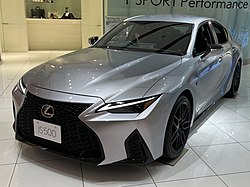 2022 Lexus IS 500 F-Sport Performance (USE30)
 -
 2022 Lexus IS 500 F-Sport Performance (USE30)
_front.jpg)
_rear.jpg)
In May 2025, the IS 500 Ultimate Edition was announced for the North American market. Limited to 500-units, this model features red Brembo 6-pistons aluminium calipers paired with high-friction brake pads and large 380 mm pillar-fin ventilated disc brakes. It also comes with matte black 19-inch BBS forged alloy wheels for reduced weight, increased agility, and enhanced style. Inside, the IS 500 Ultimate Edition has Circuit Red and Black combination of NuLuxe and Ultrasuede seats, dimple-texture genuine leather steering wheel and shift knob, red seatbelts, an analogue clock with multi-layered dial finished with precision red laser etching, and Ultimate Edition badges on center console and scuff plates.[108]
2025 facelift
[edit]The third-generation IS received its third facelift on 9 September 2025.[109] Changes include a redesigned front fascia, new rear spoiler, a redesigned interior, 12.3-inch central display, digital instrument cluster, and modernised driver-assist technologies, while the CD player, track pad, and analogue clock have been removed. Mechanically, the electric power steering now features a variable gear ratio to reduce steering angle at intersections and through corners.[110]
For the US market, the IS range has been trimmed down to the 350 model, and will only be available in F Sport and F Sport Design trims.[111]
Equipment
[edit]Toyota Racing Development (TRD) F Sport parts for the Japanese IS sedan include a front spoiler, side skirts, rear spoiler, sport muffler and rear diffuser, diamond-like carbon fibre shock absorbers, 19-inch aluminium wheels (measuring 19x8.5J front and 19x9J rear, 45 mm front and 50 mm rear insets, 245/35ZR19 front and 265/30ZR19 rear tyres), member brace and performance dampers.[112][113]
Variants
[edit]| Model | Calendar years |
|---|---|
| IS 250 (GSE30) | 2013–2015 |
| IS 250 AWD (GSE35) | |
| IS 200t (ASE30) | 2015–2017 |
| IS 300 (ASE30) | 2017–present |
| IS 300h AWD (AVE35) | 2015–present |
| IS 300 AWD (GSE37) | |
| IS 300h (AVE30) | 2013–present |
| IS 350 (GSE31) | |
| IS 350 AWD (GSE36) | |
| IS 500 F Sport Performance (USE30) | 2021–present |
Powertrains
[edit]| Model | Calendar years | Type/code | Power | at rpm | Torque | at rpm | ||||
|---|---|---|---|---|---|---|---|---|---|---|
| PS | kW | hp | kg·m | N·m | lb·ft | |||||
| IS 250 | 2013–2015 | 2,499 cc (152.5 cu in) V6 (4GR-FSE) | 207 | 152 | 204 | 6,400 | 25.5 | 250 | 184 | 4,800 |
| IS 250 AWD | 207 | 152 | 204 | 6,400 | 25.5 | 250 | 184 | 3,800 | ||
| IS 200t | 2015–2017 | 1,998 cc (121.9 cu in) I4-T (8AR-FTS) | 244 | 179 | 241 | 4,800–5,600 | 35.73 | 350 | 258 | 1,650–4,800 |
| IS 300 | 2017–present | 244 | 179 | 241 | 4,800–5,600 | 35.73 | 350 | 258 | 1,650–4,800 | |
| IS 300 AWD | 2015–present | 3,456 cc (210.9 cu in) V6 (2GR-FSE/2GR-FKS) | 259 | 190 | 255 | 6,400 | 32.6 | 320 | 236 | 2,000–4,800 |
| IS 350 | 2013–present | 315 | 232 | 311 | 6,600 | 38.8 | 380 | 281 | 4,800 | |
| IS 350 AWD | 315 | 232 | 311 | 6,600 | 38.8 | 380 | 281 | 4,800 | ||
| IS 300h/
IS 300h AWD |
2013–present/
2015-present |
2,494 cc (152.2 cu in) I4 (2AR-FSE) | 178 | 131 | 176 | 6,400 | 22.5 | 221 | 163 | 4,200–5,400 |
| 1KM electric motor | 143 | 105 | 141 | 30.6 | 300 | 221 | ||||
| Combined | 223 | 164 | 220 | |||||||
| IS 500 F Sport Performance | 2021–present | 4,969 cc (303.2 cu in) V8 (2UR-GSE) | 479 | 352 | 472 | 7,100 | 54.6 | 535 | 395 | 4,800 |
Transmissions
[edit]| Model | Calendar years | Types |
|---|---|---|
| IS 250 | 2013–2015 | 6-speed automatic (6 Super ECT/ECT-i) (A960E) |
| IS 250 AWD | 6-speed automatic (6 Super ECT) (A760H) | |
| IS 300 AWD | 2016–present | |
| IS 200t | 2015–2017 | 8-speed automatic (8-Speed Sport Direct Shift/ECT-i/SPDS) (AA81E) |
| IS 300 | 2017–present | |
| IS 350 | 2013–present | |
| IS 350 AWD | 6-speed automatic (6 Super ECT) (A760H) | |
| IS 300h | Electronic CVT (L210) | |
| IS 300h AWD | 2015-present | Electronic CVT (L210F) |
| IS 500 | 2021–present | 8-speed Sport Direct Shift automatic (AA80E) |
Production
[edit]Production at the Tahara plant in Japan began on 25 April 2013.[114]
As of June 2013, sales of the Lexus IS had reached 1,919 units.[115]
Between 16 May 2013 and 16 June 2013, the order of IS sedans reached approximately 7,600 units, including 2,100 IS 250 and IS 350, 5,500 IS 300h models.[116]
Safety
[edit]Motorsport
[edit]
The first-generation IS 200/300 and RS200 series was used by many racing teams, including Toyota Racing Development, Endless, TOM'S, APEXi, and Amuse to race in various touring car racing series across Asia, including an Altezza one-make racing series in Japan.[119] In Europe, the Lexus IS 200 was raced in the British Touring Car Championship (through organizations such as BTC Racing),[120] and the IS 300 was raced in the US via the Motorola Cup North American Street Stock Championship touring car series (with the manufacturer-sanctioned Team Lexus).

In 2001, Team Lexus entered three IS 300s in the third race of the 2001 Grand-Am Cup season at Phoenix, Arizona,[121] and won their first IS 300 victory that year at the Virginia International Raceway.[121] In 2002, Team Lexus raced the IS 300 in the Grand-Am Cup ST1 (Street Tuner) class, winning both the Drivers' and Team Championships,[122][123] as well as a sweep of the top three finishes at Circuit Mont-Tremblant in Quebec, Canada.[124]
In 2008, the second-generation IS 350 was entered in the Super GT race series in the GT300 class (cars with approximately 300 hp (224 kW)). The No. 19 Racing Project Bandoh IS 350 driven by Manabu Orido and Tsubasa Abe achieved its first victory in its fifth race at the Motegi GT300 race.[125] In 2009, The Project Bandoh WedsSport IS 350, driven by Manabu Orido and Tatsuya Kataoka, won both driver and team title in the GT300 class that season.[126]
In April 2009, a Lexus IS F entered by Gazoo Racing finished second to the team's Lexus LF-A in the SP8 class[127] in the ADAC-Westfalenfahrt VLN 4h endurance race. An IS F was also entered in the 2009 24 Hours Nürburgring race and finished third in the SP8 class.[128] In August 2009, an IS F entered by Gazoo Racing and driven by Peter Lyon, Hideshi Matsuda, and Kazunori Yamauchi won the SP8 class at the DMV Grenzlandrennen VLN race.[129][130] Kazunori Yamauchi is the developer of Gran Turismo series,[130] of which the IS line is playable in several versions, and the IS F racer carried test equipment for future game modes.[131] The 3 drivers, along with Owen Mildenhall, participated in the 2010 24 Hours Nürburgring and finished in 4th place in the SP8 class, behind the 1st place ranked Lexus LFA.[132]
In 2012, Japanese drift racer Daigo Saito entered an IS 250 C in the Formula Drift Asia series. The car, which was a victim of the 2011 Japan earthquake and tsunami and due to be scrapped, was purchased by Saito and heavily customized for drift racing use. The most notable modification was the swapping of the stock engine to a 2JZ-GTE from a 4th generation Toyota Supra.
A race car based on the Lexus LF-CC entered the 2014 Super GT GT500 class, replacing the SC 430. Vehicle shakedown began at the Suzuka Circuit.[133][134] The car was renamed after the RC F prior to the start of the season.
Sales and production
[edit]Sales data for Lexus IS generations are as follows, with chart numbers sourced from manufacturer yearly data.
| Generation (chassis code) |
Names | Calendar year |
Sales | Total exports, production‡ | ||
|---|---|---|---|---|---|---|
| US | Japan | Other | ||||
| GXE10, SXE10 | Altezza AS 200/RS 200 | 1998 | 0 | ? | ? | ? |
| Altezza AS 200/RS 200/
IS 200 |
1999 | 0 | ? | ? | ? | |
| GXE10, SXE10, JCE10 | Altezza AS 200/300/RS 200/
IS 200/300 |
2000 | 15,540[135] | ? | ? | ? |
| 2001 | 22,486[16] | ? | ? | 30,475[136] | ||
| GXE10, SXE10, JCE10, JCE15 | Altezza AS 200/300/RS 200/
IS 200/300/SportCross |
2002 | 20,306[16] | ? | ? | 23,749[137] |
| 2003 | 13,559[138] | ? | ? | 14,187[139] | ||
| 2004 | 9,972[17] | ? | ? | 11,114[140] | ||
| GXE10, SXE10, JCE10, JCE15,
ALE20, GSE20, GSE21, GSE22, GSE25 |
Altezza AS 200/300/RS 200/
IS 200/300/SportCross/ IS 220d/250/300/350 |
2005 | 15,789[141] | 3,911[142] | ? | 10,253[143] |
| ALE20, GSE20, GSE21, GSE22, GSE25 | IS 220d/250/300/350 | 2006 | 54,267[141] | 10,727[142] | ? | 109,720‡[142] |
| ALE20, GSE20, GSE21, GSE22, GSE25,
USE20 |
IS 220d/250/300/350/F | 2007 | 54,933[144] | 9,514[145] | ? | 110,907‡[146] |
| 2008 | 49,432[144] | 10,110[147] | ? | 93,612‡[148] | ||
| IS 220d/250/300/350/
IS 250C/300C/350C/F |
2009 | 38,077[149] | 5,278[150] | ? | 43,369‡[151] | |
| ALE20, GSE20, GSE21, GSE22, GSE25,
GSE26, USE20 |
IS 200d/220d/250/300/350/
IS 250C/300C/350C/F |
2010 | 34,129[152] | ? | ? | ? |
| 2011 | 29,669[153] | ? | ? | ? | ||
| 2012 | 27,708[154] | ? | ? | ? | ||
| GSE20, GSE21, GSE22, GSE25, GSE26,
USE20, AVE30, GSE30, GSE31, GSE35, GSE36 |
IS 250/300/300h/350/
IS 250C/300C/350C/F |
2013 | 35,017[155] | ? | ? | ? |
| GSE20, GSE21, GSE22, USE20, AVE30, GSE30
GSE31, GSE35, GSE36 |
IS 250/300/300h/350/
IS 250C/300C/350C/F |
2014 | 51,358[156] | ? | ? | ? |
| GSE20, GSE21, GSE22, ASE30, AVE30, AVE35,
GSE30, GSE31, GSE35, GSE36, GSE37 |
IS 200t/250/300/300h/350/
IS250C/300C/350C |
2015 | 46,430[157] | ? | ? | ? |
| ASE30, AVE30, AVE35, GSE31, GSE36, GSE37 | IS 200t/300/300h/350 | 2016 | 37,289[158] | ? | ? | ? |
| IS 300/300h/350 | 2017 | 26,482[159] | ? | ? | ? | |
| 2018 | 22,927[159] | ? | ? | ? | ||
| 2019 | 14,920[160] | ? | ? | ? | ||
| 2020 | 13,600[161] | ? | ? | ? | ||
| ASE30, AVE30, AVE35, GSE31, GSE36, GSE37,
USE30 |
IS 300/300h/350/500 | 2021 | 21,998[162] | ? | ? | ? |
| 2022 | 21,386[163] | ? | ? | ? | ||
| 2023 | ? | ? | ? | ? | ||
Awards
[edit]- J.D. Power and Associates named the second-generation IS 250/IS 350 sedans the best vehicles in the entry luxury class in its 2006 Initial Quality Survey.[164]
- J.D. Power and Associates named the first-generation IS 300 sedan and IS 300 SportCross the best vehicles in the entry luxury class in its 2005 Initial Quality Survey.[165]
- Ward's Auto bestowed the IS 350 V6 engine with one of its 10 Best Engines awards in 2006.[166] The IS 350 V6 engine was also named to Ward's 10 Best Engines list in 2007, 2008, and 2009.
- The 2007 Lexus IS was the winner of the Intellichoice/AutoPacific Motorist Choice Award for Aspirational Luxury Cars, referring to the vehicle owners most desired in the luxury segment.[167]
- The Lexus IS was named the winner of the 2007 IF product design award from the International Forum Design group in Hannover, Germany.[168]
- The 2007 Lexus IS was the winner of the Golden Steering Wheel Award in the Luxury category, according to German newspaper, Bild am Sonntag. This award, selected by a jury panel of 25 automotive experts, was presented to Lexus in a Berlin ceremony.
- British automotive magazine Top Gear named the second-generation Lexus IS as the Executive Car of the Year in 2006.
- The Canadian Car of the Year Awards, selected by the Automobile Journalists Association of Canada, gave the IS 350 its Best New Technology award in 2006.[169]
- The Lexus IS was a finalist for Wheels magazine's Car of the Year (COTY) awards and also the World Car of the Year (WCOTY) award in 2006.[170]
- Kelley Blue Book gave the first-generation IS 300 its Best to Hold Value Award in 2001.[171]
- The IS 250 was the winner in 2006 and 2007 of Best Prestige Car in the Australia's Best Cars awards – awarded by the conglomeration of all of Australia's respective State Automotive Associations.
- The Lexus IS came second in the Top Gear Satisfaction Survey 2005, beaten only by the Honda S2000.
- The Lexus IS came first in the 'J.D.Power' car satisfaction survey in 2011 and joint second in 2010.[172]
References
[edit]- ^ "Review update: 2021 Lexus IS 350 F Sport stands out from the turbocharged crowd". Motor Authority. 10 May 2021. Retrieved 4 November 2021.
- ^ "IS Intelligent Sport". Australia: Lexus. Archived from the original on 1 February 2014. Retrieved 12 July 2013.
- ^ Alexis, Kristian. "Exotic rides: Lexus IS F". AskMen.com. Retrieved 12 July 2013.
- ^ Pornelos, Vince (31 May 2013). "Lexus launches the all new IS 350, IS 350 F Sport models". AutoIndustriya.com. Retrieved 12 July 2013.
- ^ a b "Affiliates (Toyota wholly-owned subsidiaries)-Toyota Motor East Japan, Inc". Toyota. 2012. Retrieved 15 July 2014.
- ^ "History of Kanto Auto Works". Kanto-aw.co.jp. Archived from the original on 27 July 2011. Retrieved 11 October 2010.
- ^ "J-PlatPat". Archived from the original on 28 November 2015. Retrieved 4 April 2016.
- ^ a b c "Lexus Certified Pre-Owned – Model Library IS 300 5-Speed IS 300 E-Shift IS 300 SportCross 2002". lexus.com. Retrieved 27 August 2012.[permanent dead link]
- ^ a b "Altezza トヨタ アルテッツァ 中古車総合情報". Gtnet.co.jp. Archived from the original on 14 June 2010. Retrieved 11 October 2010.
- ^ Allison, Wes. "Championship Contender IS 300". Eurotuner. Archived from the original on 7 February 2008. Retrieved 23 February 2008.
- ^ Simister, John (20 August 1999). "The Car Column: High Thrills of the Lexus IS200". The New York Times. Archived from the original on 15 June 2013. Retrieved 11 October 2010.
- ^ a b Mayfield, Dan (24 September 2001). "Mass-market muscle". The Albuquerque Tribune. Retrieved 12 July 2013.
"Altezza" style lights...the hottest-selling taillight kit
- ^ a b Lassa, Todd, ed. (24 April 2000). "The News: Shifty IS 300". AutoWeek. Vol. 5, no. 18. Crain Communications Inc. p. 6.
- ^ "2002 Lexus IS 300 4-Dr w/ SAB". Safercar.gov. Retrieved 21 May 2009. [dead link]
- ^ "IIHS HLDI: Lexus IS 300". Iihs.org. 5 October 2005. Retrieved 21 May 2009.[permanent dead link]
- ^ a b c "Lexus production figures 2001–2002". Autochannel. 3 January 2003. Retrieved 26 January 2009.
- ^ a b "Lexus production figures 2003–2004". Autochannel. 4 January 2005. Retrieved 26 January 2009.
- ^ Welch, David (28 February 2005). "Is Lexus Sexy Enough To Seduce Europe?". Bloomberg BusinessWeek. Archived from the original on 18 February 2005.
- ^ a b "Autonieuws – Lexus IS200 nu ook mét". Autoweek.nl. 5 December 2000. Retrieved 3 February 2011.
- ^ Flammang, Jim. "2004 Lexus IS 300". cars.com. Archived from the original on 13 May 2016. Retrieved 10 December 2018.
- ^ "Lexus IS 430 Project". UltimateCarPage.
- ^ "Factory Hot Rods: Lexus IS 430". Sport Compact Car. Source Interlink Media, Inc. Archived from the original on 2 March 2008.
- ^ a b c d e "Affiliates (Toyota wholly-owned subsidiaries)-Toyota Motor Kyushu, Inc". Toyota Motor Corporation. 2012. Retrieved 14 February 2014.
- ^ a b c d "Tahara Plant". Toyota Motor Corporation. 2012. Retrieved 14 February 2014.
- ^ U.S. patent D531935
- ^ "多田浩之" [Hiroyuki Tada]. LinkedIn. Retrieved 12 July 2013.
- ^ U.S. patent D562188
- ^ "岡本浩志" [Okamoto Hiroshi] (in Japanese). Chiba University. 2006. Archived from the original on 4 March 2016. Retrieved 21 June 2016.
- ^ U.S. patent D626887
- ^ "Home". Europa (web portal).[permanent dead link]
- ^ "Home". Europa (web portal).[permanent dead link]
- ^ U.S. patent D592555
- ^ U.S. patent D630556
- ^ Akita, Masahiro; Shiohara, Kunihiko (11 June 2012). "Observations on TNGA: How will Toyota's plans to make better cars affect suppliers". Credit Suisse. p. 4. Archived from the original (PDF) on 17 June 2014.
- ^ Morrison, Mac. Mountain Climber: Lexus unveils the next IS sport sedan. AutoWeek, 21 March 2005.
- ^ Conway, Gavin (2006). "Lexus IS environmentally friendly wood". 4Car. Archived from the original on 10 February 2007. Retrieved 6 May 2007.
- ^ "New Lexus Performance Vehicles to Make World Debut at 2007 North American International Auto Show". 5 May 2016.[permanent dead link]
- ^ Joseph, Noah (8 January 2007). "Detroit Motor Show Lexus IS F puts pedal to the floor". Autoblog.
- ^ "2008 Lexus IS F". Car and Driver. 1 October 2007. Retrieved 1 October 2020.
- ^ "The Hottest Lexus Ever". Bloomberg BusinessWeek. Archived from the original on 29 March 2010. Retrieved 16 July 2011.
- ^ "IS F Detailed Specifications". Lexus. Archived from the original on 17 July 2009.
- ^ Lienert, Dan (20 December 2006). "Best-Selling Luxury Cars 2006". Forbes. Archived from the original on 3 January 2007.
- ^ "Lexus 2008 sales figures". Autochannel. 5 January 2009. Retrieved 20 February 2009.
- ^ 2008 sales: C-Class 72,471, ES 64,135, CTS 57,029, TL 46,766, G35 44,969, A4 43,343
- ^ Zach Gale (11 March 2011). "2011 Lexus IS 250 F Sport First Test". Motor Trend. Retrieved 23 April 2012.
- ^ a b McCausland, Evan (2 October 2008). "Auto Shows: 2010 Lexus IS 250C and IS 350C Convertibles". Automobile Magazine. Archived from the original on 6 October 2008. Retrieved 2 October 2008.
- ^ a b "Lexus announces 'significant' updates for IS". Which? News. Which.co.uk. 29 August 2010. Archived from the original on 2 September 2010. Retrieved 11 October 2010.
- ^ "Lexus Debuts F Sport Performance Accessory Line at 2007 SEMA Show". 5 May 2016.[permanent dead link]
- ^ "Lexus F Sport". Lexus.com. Archived from the original on 5 December 2010. Retrieved 11 October 2010.
- ^ "Lexus > プレスリリース > Lexus、IS350C/IS250Cを一部改良". lexus.jp.[permanent dead link]
- ^ "Lexus". lexus.com. Archived from the original on 13 March 2012. Retrieved 19 October 2013.
- ^ "Lexus". lexus.com. Archived from the original on 13 March 2012. Retrieved 19 October 2013.
- ^ "Lexus > プレスリリース > Lexus、LS、IS Fを一部改良 - あわせてIS Fに、運転する楽しさを極限まで追求した特別仕様車を設定 -". lexus.jp. Archived from the original on 19 October 2013. Retrieved 19 October 2013.
- ^ "Special Edition 2014 Lexus IS F Now Available in Japan". lexusenthusiast.com.
- ^ "Lexus". lexus.com. Archived from the original on 13 March 2012. Retrieved 22 October 2013.
- ^ "Lexus". lexus.com. Archived from the original on 13 March 2012. Retrieved 22 October 2013.
- ^ "ANCAP results for Lexus IS variant(s) as tested". ancap.com.au. 2005.
- ^ "Lexus IS – Features & Pricing – Safety & Security". Lexus.com. Archived from the original on 22 February 2012. Retrieved 21 May 2009.
- ^ "2008 Lexus IS250/350 4-DR w/SAB". Safercar.gov. Archived from the original on 17 September 2008. Retrieved 21 May 2009.
- ^ "IIHS HLDI: Lexus IS 250/350". iihs.org. 25 November 2008. Archived from the original on 19 May 2009. Retrieved 21 May 2009.
- ^ "IIHS HLDI: Lexus IS 250/350". iihs.org. 25 November 2008. Archived from the original on 21 June 2009. Retrieved 21 May 2009.
- ^ "43.5–47.9 million Lexus IS 300 landing in China". Autohome.com.cn. Retrieved 3 February 2011.
- ^ a b Vijayenthiran, Viknesh (1 June 2020). "2021 Lexus IS teased ahead of June 9 reveal". Motor Authority. US. Retrieved 3 June 2020.
- ^ Gill, Brian; Knox, Doug (3 August 2010). "Changes Coming" (Press release). US: Lexus. Archived from the original on 6 March 2014. Retrieved 2 March 2014.[clarification needed]
- ^ a b c d "Lexus Premieres New IS" (Press release). Toyota. 16 June 2020. Retrieved 6 October 2021.
- ^ Ramsey, Jonathon (27 September 2012). "Lexus LF-CC Concept is a tidy, welcome look into brand's future [w/video]". Autoblog.
- ^ "LEXUS、パリモーターショーに「Lexus LF-CC」を出展". Japan: Toyota. Archived from the original on 15 June 2013. Retrieved 29 March 2013.
- ^ "Lexus New Generation IS to Be Launched at Auto Shanghai 2013". Archived from the original on 23 October 2013.
- ^ "LEXUS雷克萨斯全新一代IS将于2013上海车展登陆中国市场". Archived from the original on 23 October 2013. Retrieved 22 October 2013.
- ^ "Home". Europa (web portal).
- ^ "Home". Europa (web portal).[permanent dead link]
- ^ "Home". Europa (web portal). Archived from the original on 5 July 2006. Retrieved 11 July 2013.
- ^ Vijayenthiran, Viknesh (11 January 2013). "Lexus Hints At New Generation Of IS SportCross Wagon". Motor Authority. US. Retrieved 17 February 2022.
- ^ "北米国際自動車ショーに新型ISを出展" [IS the new exhibit in the North American International Auto Show] (Press release). Japan: Lexus. 10 January 2013. Archived from the original on 8 March 2013. Retrieved 10 April 2013.
- ^ "Lexus Premieres New Lexus 'IS' Sports Sedan at Detroit Auto Show". Japan: Toyota. Archived from the original on 16 January 2014. Retrieved 16 January 2014.
- ^ a b "New Generation Lexus IS 250 and IS 250 F Sport Debut at Auto Shanghai 2013". Archived from the original on 23 October 2013.
- ^ "Lexus雷克萨斯全新一代IS 250和IS 250 F Sport上海车展正式上市". Archived from the original on 23 October 2013. Retrieved 22 October 2013.
- ^ Paukert, Chris (15 January 2013). "2014 Lexus IS brings boldest design yet to entry-level luxury". autoblog. Retrieved 10 April 2013.
- ^ Ramsey, Jonathon (9 January 2013). "Next-gen Lexus IS design revealed to be swoopiest yet". autoblog. Retrieved 10 April 2013.
- ^ "New Lexus 'IS' to Make World Premiere at Detroit Auto Show 2013" (Press release). Japan: Lexus. 10 January 2013. Retrieved 10 April 2013.[permanent dead link]
- ^ "Toyota Motor Sales Paces Ahead of the Industry in June" (Press release). US: Toyota. 2 July 2013. Retrieved 6 June 2015.[permanent dead link]
- ^ "Lexus" (Press release). US: Lexus. Archived from the original on 13 March 2012. Retrieved 19 October 2013.
- ^ "Lexus" (Press release). US: Lexus. Archived from the original on 13 March 2012. Retrieved 19 October 2013.
- ^ Bowman, Zach. "2014 Lexus IS priced at $35,950*". Autoblog.
- ^ "Lexus雷克萨斯全新一代豪华运动•型车IS 250和IS 250 F Sport" [A whole new generation Lexus – Lexus IS 250 luxury sport • car and IS 250 F SPORT] (Press release) (in Chinese). China: Lexus. Retrieved 6 June 2015.[permanent dead link]
- ^ "新型ISを発表 ―新たにハイブリッドモデル IS300hを追加―" [Announcing the new IS – Added a new hybrid model IS300h] (Press release). Japan: Lexus. 15 January 2013. Retrieved 10 April 2013.[permanent dead link]
- ^ "Lexus > プレスリリース > Lexus、ISをフルモデルチェンジ". lexus.jp.[permanent dead link]
- ^ "Lexus Launches New 'IS' Lineup in Japan". Japan: Toyota.[permanent dead link]
- ^ "News and Events – Lexus". lexus.eu. Archived from the original on 23 October 2013.
- ^ -Clifford, Joe (1 March 2025). "New Lexus IS: prices and specifications" (Press release). UK: Toyota. Retrieved 30 July 2025.
- ^ "泛辑胶" (Press release). Korea: Lexus.
- ^ "Review: Lexus XE30 IS (2013–on)". AustralianCar.Reviews. Archived from the original on 18 October 2015. Retrieved 2 July 2016.
- ^ Fink, Greg (20 April 2016). "Grille-ing Out: Lexus to Debut Refreshed IS Sedan in China". Car and Driver. Archived from the original on 21 April 2016.
- ^ "2018 Lexus IS Review, Pricing, and Specs". caranddriver.com. 15 May 2018. Retrieved 30 January 2022.
- ^ "2021 Lexus IS: Agility and Athleticism Expand Pure Driving Performance" (Press release). US: Toyota. 15 June 2020. Retrieved 27 July 2025.
- ^ Beresford, Colin (15 June 2020). "2021 Lexus IS Gets Sporty Redesign, Handling Upgrades". Car and Driver. Retrieved 15 June 2020.
- ^ "Lexus Launched the 2021 IS and Offers a Wide Variety in Packages" [Three engines, two transmissions, rear- or all-wheel-drive are available.]. 19 December 2020. Retrieved 11 August 2025.
- ^ Gnaticov, Cristian (13 October 2020). "Official: The 2021 Lexus IS Facelift Won't Be Coming To Western Europe". Carscoops. Retrieved 13 February 2025.
- ^ Allan, Lawrence (8 October 2020). "Lexus ceases UK imports of CT, IS and RC". Autocar. UK. Retrieved 13 February 2025.
- ^ "Lexus IS almost sold out in Australia". 11 February 2022. Retrieved 30 July 2025.
- ^ IS (Catalog) (in Japanese), Lexus Japan, August 2022
- ^ Pappas, Thanos (23 January 2025). "2025 Lexus IS300 Gains F Sport Black IV Special Edition, But Only For Japan". Carscoops. Retrieved 27 July 2025.
- ^ Capparella, Joey (22 February 2021). "472-HP 2022 Lexus IS500 F Sport brings the 5.0L V-8 back to the IS". Car and Driver. US. Retrieved 12 January 2022.
- ^ "2022 Lexus IS 500 F Sport Performance: The IS sports sedan, unleashed" (Press release). US: Lexus. 22 February 2021. Retrieved 16 November 2022.
- ^ "2022 Lexus IS 500: A new breed of F Sport Performance" (Press release). US: Lexus. 10 September 2021. Retrieved 16 November 2022.
- ^ "2022 Lexus IS 500 F Sport Performance" (Press release). US: Lexus. Retrieved 16 November 2022.
- ^ "What's new: 2023 IS 300/350/500" (Press release). US: Lexus. 14 September 2022. Retrieved 16 November 2022.
- ^ "2025 Lexus IS 500 Ultimate Edition: The Culmination of Greatness" (Press release). US: Toyota. 19 May 2025. Retrieved 27 July 2025.
- ^ "Lexus world premieres the new IS" (Press release). Japan: Toyota Global. 9 September 2025. Retrieved 9 September 2025.
- ^ Lye, Gerard (9 September 2025). "2026 Lexus IS facelift debuts – IS 350, IS 300h; more aggressive face, new interior, improved dynamics". Paul Tan's Automotive News. Malaysia. Retrieved 9 September 2025.
- ^ "2026 Lexus IS: Perfecting the sport sedan" (Press release). US: Lexus. 9 September 2025. Retrieved 9 September 2025.
- ^ Jonathon Ramsey (20 May 2013). "2014 Lexus IS gets TRD bits". Autoblog.
- ^ "Lexus IS F Sport Parts (TRD)". trdparts.jp.
- ^ Watts, Kevin (25 April 2013). "2014 Lexus IS Starts Production in Japan". Lexus Enthusiast. Retrieved 30 May 2014.
- ^ "Lexus Sales Increase For June 2013". Club Lexus. 3 July 2013. Retrieved 30 May 2014.
- ^ "IS 受注状況について" [IS order situation] (Press release) (in Japanese). Japan: Toyota. 18 June 2013. Retrieved 30 May 2014.[permanent dead link]
- ^ "ANCAP results for Lexus IS Lexus IS 250, IS 350, IS 300h and IS 200t variants". ancap.com.au. 2015.
- ^ "ANCAP results for Lexus IS all variants". ancap.com.au. 2016.
- ^ Takahashi, Hideaki (January 2000). "Altezza Tuning Plan". CARBOY Magazine. Tetsu Interpress. p. 50.
- ^ "BTC look to the future". Crash.net. 3 August 2007.
- ^ a b "Lexus Virginia Festival of Speed race report". Motorsport.com. 1 July 2001. Archived from the original on 4 January 2013. Retrieved 20 May 2009.
- ^ "Team Lexus Stats". Team Lexus. 2006. Archived from the original on 21 August 2007. Retrieved 6 May 2007.
- ^ "Lawson to race Lexus". Crash.net. 29 April 2003. Archived from the original on 5 June 2013. Retrieved 20 May 2009.
- ^ Siegle, Gabe (13 September 2002). "Grand-Am arrives at historic Mont-Tremblant". Motorsport.com. Archived from the original on 15 August 2009. Retrieved 20 May 2009.
- ^ "Motegi, GT300 : Première victoire pour la Lexus IS350(Orido/Abe)" (in French). Endurance Info WebSite. 17 September 2008. Archived from the original on 14 August 2009. Retrieved 26 July 2009.
- ^ "Super GT top rankers awarded at JAF Awards presentation". Super GT.net. Retrieved 4 January 2010.[permanent dead link]
- ^ "BFGoodrich Langstreckenmeisterschaft Nürburgring – Chronologie 56. ADAC Westfalenfahrt". VLN. 4 April 2009. Archived from the original on 22 December 2010. Retrieved 5 April 2009.
- ^ "2009 24 Hours Nürburgring". Adac.24h-rennen.de. Archived from the original on 4 June 2011. Retrieved 11 October 2010.
- ^ "32. RCM DMV Grenzlandrennen Classes results". VLN. 30 August 2009. Archived from the original on 27 September 2009.
- ^ a b "Kazunori Yamauchi, Class Winner in the Nürburgring 4 Hour Race". Gran Turismo Official Website. 21 September 2009. Archived from the original on 29 September 2009.
- ^ "Race at the Track, Then Against Yourself Virtually in GT5". Wot.motortrend.com. Retrieved 11 October 2010.
- ^ "ADAC 24 Hours of Nürburgring results" (PDF).[dead link]
- ^ Ross, Jeffrey N. (16 August 2013). "Lexus to race LF-CC in Japanese Super GT". Autoblog.
- ^ "Lexus to Compete in 2014 Japanese Super GT Series with New Vehicle". toyota.com.[permanent dead link]
- ^ "Lexus sales figures 2000–2001". Autochannel. 3 January 2002. Retrieved 28 January 2009.
- ^ "Lexus.com 2001 IS Specifications" (PDF). Archived from the original (PDF) on 17 June 2011. Retrieved 11 October 2010.
- ^ "2002 IS Art" (PDF). Archived from the original (PDF) on 17 June 2011. Retrieved 11 October 2010.
- ^ "Lexus sales figures 2002–2003". Autochannel. 5 January 2004. Retrieved 26 January 2009.
- ^ "Lexus.com 2003 IS Specifications" (PDF). Archived from the original (PDF) on 17 June 2011. Retrieved 11 October 2010.
- ^ "Lexus.com 2004 IS Specifications" (PDF). Archived from the original (PDF) on 17 June 2011. Retrieved 11 October 2010.
- ^ a b "Lexus sales figures 2005–2006". Theautochannel.com. Retrieved 11 October 2010.
- ^ a b c "Number of Vehicles Produced in Japan by Model" (PDF) (Press release). Japan: Toyota. 2007. Archived from the original (PDF) on 29 December 2009.
- ^ "Lexus.com 2005 IS Specifications" (PDF). Archived from the original (PDF) on 17 June 2011. Retrieved 11 October 2010.
- ^ a b "Lexus sales figures 2007–2008". Theautochannel.com. Retrieved 11 October 2010.
- ^ "Number of Vehicles Registered in Japan" (PDF) (Press release). Archived from the original (PDF) on 6 March 2012.
- ^ "Number of Vehicles Produced in Japan by Model" (PDF) (Press release). Japan: Toyota. 2008. Archived from the original (PDF) on 30 December 2011.
- ^ "Number of Vehicles Registered in Japan" (PDF). Archived from the original (PDF) on 12 June 2009.
- ^ "Number of Vehicles Produced in Japan by Model" (PDF) (Press release). Japan: Toyota. 2009. Archived from the original (PDF) on 8 April 2009.
- ^ "Lexus sales figures 2009". Theautochannel.com. Retrieved 11 October 2010.
- ^ "Number of Vehicles Registered in Japan" (PDF) (Press release). Retrieved 11 October 2010.[dead link]
- ^ "Number of Vehicles Produced in Japan by Model" (PDF) (Press release). Japan: Toyota. 2010. Archived from the original (PDF) on 7 December 2010.
- ^ "Lexus sales figures 2010" (Press release). USA: Toyota. Archived from the original on 3 February 2011. Retrieved 22 June 2011.
- ^ "Lexus sales figures 2010" (Press release). USA: Toyota. Archived from the original on 1 August 2013. Retrieved 14 February 2012.
- ^ "Lexus sales figures 2012" (Press release). USA: Toyota. Retrieved 3 January 2013.
- ^ "Lexus sales figuresfigures 2013" (Press release). USA: Toyota. Retrieved 23 September 2014.
- ^ "December 2014 and Year-End Sales Chart" (Press release). Toyota USA Newsroom. 5 January 2015. Archived from the original on 7 January 2015. Retrieved 6 January 2015.
- ^ Cain, Timothy. "Lexus IS Sales Figures". GoodCarBadCar. Retrieved 16 March 2016.
- ^ "December 2016 and Year-End Sales Chart" (Press release). USA: Toyota. 5 January 2017. Retrieved 5 January 2017.
- ^ a b "December 2018 Sales Chart" (Press release). US: Toyota. 3 January 2019. Archived from the original on 4 February 2019. Retrieved 19 January 2019.
- ^ "Toyota Motor North America Reports December 2019, Year-End Sales" (Press release). US: Toyota. 3 January 2020. Retrieved 3 June 2020.
- ^ Model (7 November 2015). "Lexus IS US car sales figures". carsalesbase.com. Retrieved 20 November 2021.
- ^ "2021 US Auto Sales Figures – By Model (All Vehicle Ranked)". GCBC. 4 July 2021. Retrieved 25 November 2023.
- ^ Sales, Lexus Model. "Lexus IS Sales Figures". GCBC. Retrieved 25 November 2023.
- ^ "Lexus and Toyota Together Capture 11 of 19 Initial Quality Model Awards" (Press release). J.D. Power. 7 June 2006.
- ^ "Toyota, GM Garner Most Awards in 2005 Initial Quality Study" (Press release). J.D. Power. 18 May 2005.
- ^ Visnic, Bill (4 January 2006). "Ward's 10 Best Engines 2006". WardsAuto. Archived from the original on 27 December 2010. Retrieved 10 December 2009.
- ^ "2007 Motorist's Choice Awards". autopacific.com. Archived from the original on 7 July 2011. Retrieved 4 December 2010.
- ^ "iF Design List of winners for the iF product design award 2007". Webserver.ifdesign.de. Retrieved 11 October 2010.[permanent dead link]
- ^ "2006 Best Car, Best Truck, Best Design, Best Technology awards revealed". Cartest.ca. Retrieved 11 October 2010.
- ^ "Lexus GS and IS Nominated for Wheels Car of the Year". Autoweb.drive.com.au. Archived from the original on 1 July 2012. Retrieved 11 October 2010.
- ^ "Carfax – Kelley Blue Book-Models to Best Hold Its Value". Carfax.com. Archived from the original on 25 November 2003. Retrieved 11 October 2010.
- ^ "J.D.Power". Archived from the original on 5 December 2011.
External links
[edit]
A division of Toyota Motor Corporation | |||||||||
| Current models |
| ||||||||
| Discontinued | |||||||||
| Future vehicles | |||||||||
| Concept vehicles | |||||||||
| Motorsport | |||||||||
| Technology |
| ||||||||
| Key people | |||||||||
| See also | |||||||||


Lexus IS
View on GrokipediaFirst generation (XE10; 1998–2005)
Development and launch
The first-generation Lexus IS originated as the Toyota Altezza for the Japanese domestic market, debuting in October 1998 as a compact executive sedan aimed at enthusiasts seeking sporty performance.[4] Developed under Lexus, Toyota's luxury division, the model expanded internationally with the IS 200 launching in Europe in 1999, followed by the IS 300 entering the North American market in July 2000 as a 2001 model year vehicle.[1][5] The development of the XE10 platform emphasized a rear-wheel-drive layout to deliver agile handling and driver-focused dynamics, positioning the IS as Lexus's entry into the compact luxury sports sedan category. Chief engineer Nobuaki Katayama, known for prior projects like the AE86 Corolla and fourth-generation Supra, led the effort with goals of combining premium interior materials—such as leather upholstery and high-quality audio systems—with responsive chassis tuning for enhanced engagement on winding roads. The exterior featured an aerodynamic body design with a low coefficient of drag, sculpted lines for visual appeal, and a compact footprint measuring approximately 175 inches in length to ensure nimble maneuverability.[4] Initial powertrain options included a 2.0-liter inline-six engine producing 155 horsepower in the IS 200 for European markets, while North American buyers received the more potent 3.0-liter inline-six in the IS 300, delivering 215 horsepower and 218 pound-feet of torque for stronger acceleration. Priced starting at $30,500 in the United States, the IS was marketed as a value-oriented alternative to established rivals like the BMW 3 Series and Mercedes-Benz C-Class, offering comparable sportiness and refinement at a competitive entry point while leveraging Lexus's reputation for reliability. The model launched in Europe in 1999, underscoring its global ambitions in the premium segment.[6][4]Model variants and updates
The first-generation Lexus IS (XE10) was marketed under different names and specifications to suit regional preferences. In Europe and Asia, it was sold as the IS 200, while in North America, it was introduced as the IS 300 to reflect its larger-displacement engine. Sport packages were available in select markets, offering enhanced styling and handling components such as 17-inch alloy wheels and a tuned suspension for improved cornering.[4] In 2002, Lexus expanded the lineup with the IS 300 SportCross, a wagon body style launched exclusively for the North American market to provide greater cargo versatility while maintaining the sedan's sporty character. This variant shared the platform with the sedan but featured a extended rear roofline and increased interior space, appealing to buyers seeking practicality without sacrificing performance orientation. No all-wheel-drive option was offered for the SportCross in North America, though the model was produced until the end of the generation.[4][7] Mid-cycle updates were minor but aimed at refining the driving experience and adding convenience features. For the 2002 model year, a five-speed manual transmission became available for the IS 300 sedan in North America, broadening appeal to enthusiasts. Subsequent years saw incremental interior enhancements, including optional wood trim accents and improved navigation systems in higher trims, alongside subtle exterior tweaks like updated taillight designs in later production runs. Manual transmissions were discontinued in certain regions by 2005 as automatic variants dominated sales.[4] Production of the first-generation IS concluded in August 2005, as the platform had aged relative to emerging competitors, paving the way for the all-new second-generation model. Global sales totaled approximately 100,000 units across all variants and markets during its seven-year run.[4]Powertrains
The first-generation Lexus IS (XE10) featured two inline-six gasoline engines, both naturally aspirated and derived from Toyota's reliable engineering lineage. The base IS 200 was equipped with a 2.0-liter 1G-FE engine producing 155 horsepower at 6,200 rpm and 144 pound-feet of torque at 4,400 rpm. This powertrain was paired with either a five-speed manual transmission or a four-speed automatic, delivering a 0-60 mph acceleration time of approximately 9.7 seconds.[8] In markets where the IS 200 was offered, such as Europe, it achieved fuel economy ratings of 22 mpg city and 30 mpg highway under combined European testing cycles, emphasizing efficiency for a sport sedan.[9] The performance-oriented IS 300, standard in the North American market, utilized a larger 3.0-liter 2JZ-GE engine generating 215 horsepower at 5,800 rpm and 218 pound-feet of torque at 3,800 rpm.[10] It shared the same transmission options as the IS 200—a five-speed manual or four-speed automatic—while offering a top speed of 143 mph.[11] EPA fuel economy for the IS 300 sedan was rated at 18 mpg city and 23 mpg highway, while the SportCross wagon variant achieved 16 mpg city, 23 mpg highway, and 19 mpg combined, reflecting minor differences due to body style variations.[12][13] These powertrains were integrated across sedan and wagon (SportCross) body styles without mechanical differences.[14] All variants employed a rear-wheel-drive drivetrain as standard, with no all-wheel-drive option available in this generation, prioritizing agile handling dynamics.[8] The chassis featured a double-wishbone front suspension and a multi-link rear setup, contributing to a near 50/50 weight distribution that enhanced balance and responsiveness.[14] This configuration supported the IS's reputation for precise steering and composed cornering, setting it apart in the compact luxury segment.[15]| Engine | Displacement | Horsepower | Torque | Transmissions | 0-60 mph (est.) | Fuel Economy (city/hwy, mpg) |
|---|---|---|---|---|---|---|
| 1G-FE (IS 200) | 2.0 L I6 | 155 hp @ 6,200 rpm | 144 lb-ft @ 4,400 rpm | 5-speed manual / 4-speed auto | 9.7 s | 22/30 |
| 2JZ-GE (IS 300) | 3.0 L I6 | 215 hp @ 5,800 rpm | 218 lb-ft @ 3,800 rpm | 5-speed manual / 4-speed auto | 7.3 s | 18/23 |
Second generation (XE20; 2005–2013)
Introduction and initial models
The second-generation Lexus IS (XE20) represented a major redesign, building on the first-generation model's strong sales performance in the compact executive segment. Unveiled to the North American market at the 2005 New York International Auto Show following its world premiere in Geneva, the new IS shifted to a stiffer chassis architecture shared with the larger GS sedan, incorporating all-aluminum V6 engines and electronic power steering to achieve weight savings while enhancing handling precision. Owner reports indicate that the electronic power steering (EPS) system in early models, particularly the 2006 IS 250, can feel heavy or stiff on cold mornings, commonly due to a weak battery unable to supply sufficient power to the EPS system in low temperatures (reduced cold cranking amps). Owners have frequently resolved this by replacing the battery, restoring normal steering assist, although other causes may include faults in the power steering ECU or steering rack; battery-related issues are often cited for cold-specific stiffness without warning lights.[16][17][18] The initial model lineup for North America included the IS 250, equipped with a 2.5-liter V6 engine producing 204 horsepower, and the more powerful IS 350 featuring a 3.5-liter V6 with 306 horsepower; both were available with rear-wheel drive and paired to either a six-speed manual or automatic transmission. In Europe, the range debuted with the IS 220d, Lexus's first diesel-powered model, using a 2.2-liter turbodiesel engine delivering 175 horsepower and 295 pound-feet of torque.[19][20][21] Design elements emphasized a sportier aesthetic, with an angular front grille serving as an early iteration of Lexus's signature spindle motif, sharp arrowhead-shaped headlights drawing inspiration from the concurrent LF-A concept, and an aerodynamic body achieving a drag coefficient of 0.28 for improved efficiency and stability. U.S. launch pricing started at $29,990 for the IS 250 rear-wheel-drive manual and $35,599 for the IS 350, with dealer sales commencing in late 2005.[22][23] Critics noted the IS's enhanced ride quality compared to the firmer first-generation model, attributing the refinement to the updated chassis and optional Vehicle Dynamics Integrated Management system, which included adaptive variable suspension for customizable damping.[24][20]IS F and performance variants
The Lexus IS F debuted at the 2007 North American International Auto Show as the flagship performance model in the second-generation IS lineup, marking the introduction of Lexus's F-series high-performance division. Powered by a naturally aspirated 5.0-liter 2UR-GSE V8 engine co-engineered with Yamaha, it delivered 416 horsepower at 6,600 rpm and 371 lb-ft of torque at 5,200 rpm through an eight-speed automatic transmission with paddle shifters. The engine featured a Yamaha-developed variable-length intake manifold for optimized resonance and airflow, contributing to its distinctive high-revving character up to 7,300 rpm.[25][26][27] Performance was highlighted by a 0-60 mph time of 4.6 seconds and an electronically limited top speed of 170 mph, enabled by a rear-wheel-drive layout and a quad exhaust system with stacked tips for reduced back pressure and an aggressive soundtrack. Exclusive to the IS F were F-tuned suspension components, including stiffer springs and dampers, larger stabilizer bars, and model-specific rear control arms for enhanced handling; larger Brembo brakes with 14.2-inch front rotors and six-piston calipers; and aerodynamic aids like a carbon fiber rear spoiler to improve stability at high speeds. These elements elevated the IS F's sporty dynamics while maintaining the lineup's luxury focus.[28][29][30] Production of the IS F began in late 2007 at Lexus's Tahara plant in Japan and continued through 2014, with approximately 12,000 units built globally to emphasize exclusivity. Initial U.S. pricing started at around $56,000, positioning it as a premium alternative in the compact executive segment. The model was discontinued in 2014 as Lexus shifted focus to newer F variants, but it played a key role in establishing the brand's performance credentials by directly challenging rivals like the BMW M3 through its emphasis on refined, naturally aspirated V8 power and balanced grand touring capabilities.[31][32][30]Facelifts and changes
The second-generation Lexus IS underwent its first major facelift for the 2009 model year, debuting at the 2008 Paris Motor Show. This update featured a revised front fascia with a larger spindle-shaped grille, updated headlights, and a new rear bumper incorporating LED taillights for improved visibility and aesthetics.[4] Inside, the cabin received higher-quality materials, a redesigned steering wheel, and subtle refinements to the dashboard layout to enhance perceived luxury.[4] These changes also applied to the high-performance IS F variant, maintaining its aggressive styling while aligning with the sedan's refreshed look. In 2010, Lexus expanded the lineup with the introduction of the IS 250C and IS 350C convertible models, marking the brand's entry into the luxury hardtop convertible segment. These variants featured a power-retractable aluminum hardtop that folded into two sections using 15 electric motors and 37 sensors, preserving coupe-like rigidity and quietness when closed.[33] The convertibles shared the sedan's powertrains—a 2.5-liter V6 for the IS 250C and a 3.5-liter V6 for the IS 350C—both equipped with direct-injection technology for balanced performance and efficiency, achieving EPA estimates of up to 21 mpg city and 30 mpg highway for the IS 250C.[33] Subsequent updates from 2011 to 2013 focused on drivetrain versatility and technology enhancements. For 2011, Lexus introduced all-wheel drive as an option for both the IS 250 and IS 350 sedans, expanding the model's appeal in inclement weather regions; the IS 250 AWD accounted for about 30% of that variant's sales.[34] A six-speed automatic transmission with paddle shifters became standard across IS 350 and IS 250 AWD models, while the IS 250 RWD retained a six-speed manual option.[34] Infotainment systems were upgraded with a touch-enabled display, standard Bluetooth connectivity, and optional navigation with a 13-speaker premium audio setup, improving user interaction without altering the core Remote Touch interface.[34] Minor exterior tweaks included a revised grille, new wheel designs, and HID headlights with LED daytime running lights on higher trims. These iterations emphasized reliability through refined engine management and chassis tuning, contributing to the model's reputation for durability.[4] Production of the second-generation IS concluded in 2013 for North American and European markets, paving the way for the third-generation model on a new platform. In Asia, select variants like the IS 250 and IS 300 continued production into 2015 to meet regional demand.[4] Over its run, the XE20 achieved US sales exceeding 200,000 units, bolstered by consistent reliability improvements such as enhanced piston ring designs in later engines to mitigate carbon buildup.[35]Powertrains and safety
The second-generation Lexus IS offered a range of powertrains designed to balance performance, efficiency, and luxury, with options varying by market and model year. The lineup included gasoline V6 engines for the base IS 250 and sportier IS 350, a high-output V8 for the IS F performance variant, and a diesel option exclusive to Europe. These engines were paired with six-speed transmissions for most models, emphasizing smooth power delivery and rear-wheel-drive dynamics, though all-wheel drive became available later in the production run.[36][37][38]| Model | Engine | Displacement | Power | Torque | Notes |
|---|---|---|---|---|---|
| IS 250 | 4GR-FSE V6 (gasoline) | 2.5 L | 204 hp @ 6,400 rpm | 185 lb-ft @ 4,800 rpm | Standard for North America and other markets; direct injection for improved efficiency.[39][40] |
| IS 350 | 2GR-FSE V6 (gasoline) | 3.5 L | 306 hp @ 6,400 rpm | 277 lb-ft @ 4,800 rpm | Dual injection (port and direct) for enhanced performance; available in sedan and convertible.[36][41] |
| IS F | 2UR-GSE V8 (gasoline) | 5.0 L | 416 hp @ 6,600 rpm | 371 lb-ft @ 5,200 rpm | Naturally aspirated with Yamaha-tuned heads; positioned as a high-performance flagship.[37][26] |
| IS 220d | 2AD-FHV I4 (diesel) | 2.2 L | 175 hp @ 3,600 rpm | 295 lb-ft @ 2,600-3,000 rpm | Turbocharged common-rail; offered in Europe for better fuel economy and torque.[38] |
| IS 300 | 3GR-FE V6 (gasoline) | 3.0 L | 228 hp @ 6,400 rpm | 214 lb-ft @ 4,800 rpm | Available in Asia and Middle East markets. |
| IS 200d | 2AD-FHV I4 (diesel) | 2.2 L | 150 hp @ 3,600 rpm | 251 lb-ft @ 1,600-2,600 rpm | Detuned version introduced in Europe in 2010 for improved efficiency. |
Third generation (XE30; 2013–present)
Concept and development
The development of the third-generation Lexus IS (XE30) was influenced by the LF-CC concept, unveiled at the 2012 Paris Motor Show, which previewed a more dynamic and aggressive design language for the upcoming sports sedan, including the signature spindle grille and sleek proportions. The LF-CC, a rear-wheel-drive hybrid coupe, incorporated advanced styling elements that directly shaped the production IS's exterior aesthetics, emphasizing a lower, wider stance to enhance visual appeal and aerodynamic efficiency.[48] Engineering efforts centered on a revised rear-wheel-drive platform that prioritized sharper handling and reduced weight through the strategic use of lightweight aluminum components and high-tensile steel, resulting in a stiffer body structure while maintaining compact dimensions. Key goals included improved vehicle dynamics via the adoption of electric power steering for more precise control, refined aerodynamics achieving a coefficient of drag (Cd) of 0.28, and the integration of the Lexus Enform infotainment system for enhanced connectivity and safety features like Safety Connect.[49] The platform supported an initial rear-wheel-drive configuration with optional all-wheel drive, aimed at attracting younger buyers seeking a blend of performance and luxury in a compact executive sedan.[50] The third-generation IS was announced at the 2013 North American International Auto Show in Detroit, marking its global debut as a direct evolution from the second-generation model to sustain its position in the competitive sports sedan segment. Production commenced in April 2013 at the Tahara Plant in Japan, Lexus's flagship facility known for its high-quality assembly processes. The hybrid variant's development drew inspiration from the LF-SA concept, a full-hybrid showcase unveiled at the 2015 Geneva Motor Show, which explored compact luxury packaging and efficient powertrain integration for urban-oriented models.[51][52][53]Pre-facelift models (2013–2020)
The third-generation Lexus IS, introduced as the 2014 model year, debuted with a lineup centered on rear-wheel-drive (RWD) and all-wheel-drive (AWD) sedan variants designed to compete in the compact luxury segment. The initial offerings included the IS 250 RWD, powered by a 2.5-liter V6 engine producing 204 horsepower and 185 lb-ft of torque, paired with a six-speed automatic transmission. The IS 350, available in both RWD and AWD configurations, featured a more potent 3.5-liter V6 engine delivering 306 horsepower and 277 lb-ft of torque in RWD form, while the AWD version, badged as the IS 300, was detuned to 255 horsepower and 236 lb-ft to accommodate the drivetrain's demands. These powertrains emphasized smooth performance and refinement, with the IS 250 achieving 0-60 mph in approximately 7.7 seconds and the IS 350 in 5.7 seconds for the RWD model. In Europe and Asia, the lineup was complemented by the IS 300h hybrid, combining a 2.5-liter Atkinson-cycle four-cylinder engine with an electric motor for a total system output of 223 horsepower, prioritizing fuel efficiency with combined ratings around 50 mpg (UK).[54][55][56][57] Standard equipment on the pre-facelift IS emphasized luxury and connectivity, including a 7-inch VGA touchscreen display integrated into the dashboard for controlling the audio system, navigation (optional), and vehicle settings via Lexus' Remote Touch interface. The base infotainment setup featured an eight-speaker premium audio system with Bluetooth connectivity, USB/iPod integration, HD Radio, and satellite radio capability. Safety and driver assistance features were available optionally through the Lexus Safety System+, which included adaptive cruise control as part of the Pre-Collision System, enabling automatic emergency braking and maintaining safe following distances. The F Sport package, offered across all variants, enhanced the sporty appeal with unique exterior styling such as a spindle grille with mesh insert, 18-inch alloy wheels, aggressive front fascia, and LED headlights, alongside interior upgrades like perforated leather seats, aluminum pedals, and a leather-wrapped steering wheel. It also incorporated a sport-tuned suspension with revised spring rates and dampers for improved handling, along with exclusive chassis tuning for sharper steering response via electric power steering adjustments.[58][54][55][56] Exclusive to the sedan body style, the IS measured 4,665 mm in length with a 2,800 mm wheelbase, providing a compact footprint suitable for agile urban driving while offering 480 liters of trunk space. U.S. sales commenced in July 2013, with the IS 250 RWD starting at $36,845, positioning it competitively against rivals like the BMW 3 Series. Regional variations emerged over the model years; the IS 250 was discontinued after 2015 to streamline the lineup, replaced in 2016 by the IS 200t, a turbocharged 2.0-liter inline-four engine producing 241 horsepower and 258 lb-ft of torque, mated to an eight-speed automatic for improved efficiency and performance. This engine was RWD-only and aimed at entry-level buyers seeking better fuel economy without sacrificing responsiveness. The IS 300h remained exclusive to non-U.S. markets, reflecting differing emissions and efficiency priorities.[55][59][56][60] Early market reception was strong, particularly in the U.S., where the IS achieved peak sales of over 52,000 units in 2014, driven by refreshed styling and competitive pricing that appealed to luxury buyers upgrading from mainstream sedans. This figure marked a significant increase from prior years, underscoring the model's success in revitalizing Lexus' entry-level offerings before subsequent updates.[61]2021 facelift
The 2021 Lexus IS underwent a mid-cycle refresh unveiled on June 15, 2020, with sales commencing in the spring of 2021.[62] Exterior updates included a bolder spindle grille, slimmer triple-beam LED headlights with L-shaped daytime running lights, and redesigned taillights featuring a new L-motif pattern, enhancing the sedan's aggressive stance.[63] The front track was widened slightly for improved stability, contributing to better handling dynamics without altering the overall dimensions significantly.[64] Interior enhancements focused on modern connectivity and luxury, with a standard 8.0-inch touchscreen infotainment display—an increase from the previous 7.0-inch unit—integrating wireless Apple CarPlay and Android Auto as standard features across all trims.[65] An optional 10.3-inch display was available on higher trims, paired with the Lexus Interface system for over-the-air updates.[63] The available Mark Levinson premium audio system was upgraded to a 17-speaker, 1,800-watt setup, delivering enhanced clarity and immersion for audiophiles.[66] Chassis refinements emphasized rigidity and ride quality, with a stiffer body structure achieved through reinforced radiator supports, additional spot welds, and laser-brazed body seams, reducing vibrations and improving overall structural integrity.[67] Suspension tuning was updated with lighter components, including 20 percent lighter coil springs and forged aluminum control arms replacing heavier steel ones, resulting in an 18 percent weight reduction for those parts and sharper steering response.[68] Market availability shifted notably, as the IS was discontinued in Europe by late 2020 due to low sales volumes and a strategic pivot toward SUVs, with 1,101 units sold in the region from January to August that year.[69] In Australia, the model was axed mid-2021 to comply with stricter side-impact safety regulations under ADR 85, though emissions compliance also played a role in the decision.[70] Sales continued unabated in the United States, where the refreshed IS remained a core offering.[62] The facelift introduced the IS 500 F Sport Performance variant, powered by a new 5.0-liter twin-turbocharged V8 engine producing 472 horsepower, marking Lexus's return to a high-output V8 sedan in the lineup (detailed further in the performance variants section).[62]2025 facelift
The 2026 Lexus IS, representing the latest mid-cycle refresh of the third-generation model, made its world premiere on September 9, 2025, at an exclusive event in Japan.[3] This update coincides with the 25th anniversary of the IS lineup's debut in 2000, emphasizing refined evolution in design and technology while maintaining the sedan's core performance ethos.[71] Sales are scheduled to begin in early 2026 across select global markets, including the United States, with initial availability focused on rear-wheel-drive and all-wheel-drive configurations.[3][72] Exterior revisions center on a redesigned front fascia that accentuates the IS's low-slung profile and wide stance, featuring slimmer LED headlights more seamlessly integrated with an expanded spindle grille for a bolder, more aggressive presence.[71][73] New wheel designs, including lightweight 19-inch aluminum alloys, enhance the sedan's athletic aesthetic, available across higher trims with options for F Sport-specific styling.[74] Rear updates are subtler, incorporating an optional F Sport spoiler to complement the overall sporty silhouette without altering the fundamental proportions established in prior iterations.[74] Inside, the cabin receives a comprehensive overhaul with a standard 12.3-inch TFT LCD digital instrument cluster offering customizable displays for enhanced driver engagement.[71][75] An updated steering wheel with refined grips and a restyled center console, including new "Forged Bamboo" trim accents, contribute to a more premium and intuitive layout.[76] Enhanced ambient lighting with customizable options illuminates the space, paired with a new "Prominence" interior color scheme for added luxury.[77][76] In the U.S. market, the lineup has been streamlined to focus on the IS 350, available exclusively in F Sport and F Sport Design packages, eliminating the entry-level IS 250 to prioritize higher-performance V6 variants.[78][79] In select international markets, the IS 300h hybrid variant remains available, retaining the pre-facelift Lexus Hybrid Synergy Drive powertrain. This system features a 2.5-liter inline-4 Atkinson-cycle engine (model 2AR-FSE) producing 181 PS (133 kW) at 6,000 rpm and 221 Nm at 4,800 rpm, paired with electric motors for a combined system output of approximately 220 PS, utilizing a planetary gear eCVT transmission and regenerative braking for energy recovery.[80][76] Powertrain options carry over largely unchanged, with the 3.5-liter V6 delivering 311 horsepower in rear- or all-wheel-drive setups, augmented by minor suspension and steering tweaks for improved handling and efficiency.[75][76] These adjustments build on the technological foundations from the 2021 refresh, refining ride dynamics without introducing new propulsion systems.[78]Powertrains and variants
The third-generation Lexus IS offers a range of powertrains emphasizing a balance of performance, efficiency, and refinement, with options spanning turbocharged four-cylinder, V6, and V8 engines, primarily tailored for rear-wheel-drive layouts in the North American market.[81] The lineup includes the IS 300 with a turbocharged 2.0-liter inline-four engine, the IS 350 powered by a 3.5-liter V6, and the high-performance IS 500 featuring a 5.0-liter V8, while a hybrid variant is available in select international markets.[82] These engines are paired with automatic transmissions, with all-wheel drive optional on non-V8 models to enhance traction without compromising the sporty character. The base IS 300 employs the 8AR-FTS 2.0-liter turbocharged inline-four engine, producing 241 horsepower at 5,800 rpm and 258 pound-feet of torque from 1,650 to 4,400 rpm. In rear-wheel-drive configuration, it mates to an eight-speed automatic transmission for responsive shifts and improved highway cruising. All-wheel drive is available on the IS 300 but substitutes a detuned 3.5-liter V6 for 260 horsepower to accommodate the system's demands, paired with a six-speed automatic. Stepping up, the IS 350 utilizes the 2GR-FKS 3.5-liter V6 engine, delivering 311 horsepower at 6,600 rpm and 280 pound-feet of torque at 4,800 rpm, with direct and port fuel injection for optimized performance across rev ranges.[83] Like the base model, rear-wheel-drive versions receive an eight-speed automatic, while all-wheel-drive variants use a six-speed unit for better weight distribution and handling in adverse conditions. This setup enables a zero-to-60 mph acceleration in approximately 5.6 seconds for the rear-drive IS 350.[84] The flagship IS 500 F SPORT Performance introduces the naturally aspirated 2UR-GSE 5.0-liter V8 engine, generating 472 horsepower at 7,100 rpm and 395 pound-feet of torque at 4,800 rpm, drawing from Lexus's F-series heritage for a high-revving character and distinctive exhaust note.[85] Exclusive to rear-wheel drive, it pairs with an eight-speed automatic transmission tuned for quick shifts, achieving zero-to-60 mph in 4.4 seconds.[86] In select international markets (not the US), the IS 300h hybrid variant, including the 2026 model year which retains the pre-refresh powertrain, uses Lexus Hybrid Synergy Drive (also known as Lexus Hybrid Drive) with a 2.5-liter inline-4 Atkinson-cycle engine (model 2AR-FSE) producing 181 PS (133 kW) at 6,000 rpm and 221 Nm (163 lb-ft) at 4,800 rpm, paired with electric motors for a combined system output of approximately 220-223 horsepower. The system uses a planetary gear eCVT transmission and regenerative braking for energy recovery.[80][73] Fuel economy varies by configuration, with the IS 350 rear-wheel-drive model rated at 20 mpg city and 28 mpg highway, while the IS 500 achieves 17 mpg city and 25 mpg highway under EPA testing. The IS 300 rear-wheel-drive offers 21 mpg city and 31 mpg highway, prioritizing efficiency in daily driving without sacrificing acceleration. The hybrid IS 300h, where available, delivers combined efficiency around 50 mpg under NEDC standards, appealing to efficiency-focused buyers in Europe and Asia.[87]| Model | Engine | Horsepower | Torque (lb-ft) | Transmission (RWD/AWD) | EPA MPG (City/Hwy, RWD) |
|---|---|---|---|---|---|
| IS 300 | 2.0L turbo I4 (8AR-FTS) | 241 | 258 | 8-speed auto / N/A | 21/31 |
| IS 350 | 3.5L V6 (2GR-FKS) | 311 | 280 | 8-speed auto / 6-speed auto | 20/28 |
| IS 500 | 5.0L V8 (2UR-GSE) | 472 | 395 | 8-speed auto / N/A | 17/25 |
| IS 300h (intl.) | 2.5L hybrid I4 (2AR-FSE) | 220-223 (sys.) | 163 (engine) | e-CVT / N/A | ~50 combined (NEDC) |
Equipment and production
The third-generation Lexus IS (XE30) comes equipped with the Lexus Safety System+ 2.5 as standard across all models, which includes an enhanced Pre-Collision System capable of detecting pedestrians in low-light conditions and bicyclists during daylight, along with Lane Tracing Assist to help maintain lane centering during highway driving.[89][90] Following the 2021 facelift, an available 10.3-inch touchscreen display integrates Apple CarPlay and Android Auto compatibility, enhancing infotainment accessibility.[66] Heated and ventilated front seats are standard on higher trims like the IS 350, providing climate-controlled comfort for enhanced driver and passenger experience.[91] Optional features elevate the IS's luxury and performance further, including the Adaptive Variable Suspension system on F SPORT models, which adjusts damping in real-time based on driving conditions for improved handling.[81] A head-up display is available to project key information such as speed and navigation onto the windshield, reducing driver distraction.[92] The premium 17-speaker Mark Levinson audio system, offered as an upgrade, delivers high-fidelity sound through advanced surround processing.[93] All third-generation IS models are assembled at the Toyota Motor Corporation's Tahara Plant in Aichi Prefecture, Japan, renowned for its precision manufacturing processes that contribute to the vehicle's build quality.[94] The plant's advanced assembly techniques, including robotic welding and paint application, support production for global markets, with the facility's overall capacity exceeding 396,000 units annually across multiple Lexus models.[95] The IS has consistently earned high marks for reliability. In the J.D. Power 2026 U.S. Vehicle Dependability Study (based on 2023 models after three years), the Lexus IS ranked as the most dependable vehicle overall, with Lexus as the top premium brand at 151 problems per 100 vehicles (PP100).[96] The 2025 Lexus IS received a J.D. Power quality and reliability rating of 91/100 ("Best").[97] Consumer Reports predicts that the 2026 Lexus IS will be much more reliable than the average new car, based on limited data from 2023 and 2024 models and the Lexus brand score.[98] This performance underscores the model's durability, backed by rigorous testing at Tahara. Export markets for the third-generation IS remain robust in the United States and China, where it captures significant shares in the premium sedan category, while availability in Europe has been limited post-2020, with Lexus prioritizing SUVs and hybrids in that region.[99][100]Motorsport involvement
Early racing history
The first-generation Lexus IS, marketed as the Toyota Altezza in Japan, marked its racing debut in the 1999 All Japan Grand Touring Car Championship (JGTC), the precursor to Super GT, competing in the GT300 class. Prepared by the prominent Tom's team, the Altezza demonstrated strong potential from the outset, leveraging its compact sedan platform for agile handling in Japan's premier GT series.[101] Building on this foundation, the Altezza achieved significant success in the GT300 class, with Tom's securing back-to-back championships in 2000 and 2001. These victories highlighted the model's reliability and performance, contributing to multiple race wins across GT300 competitions during its competitive lifespan. Beyond Japan, the Altezza saw entries in the British Touring Car Championship (BTCC) in 2001, where teams like ABG Motorsport and Total Motorsport fielded the car, driven by pilots such as Kurt Luby and Tommy Erdos, achieving finishes up to 12th overall in a challenging field dominated by Vauxhall and Peugeot entries.[102] The second-generation IS expanded Lexus's motorsport footprint, particularly with the high-performance IS F variant introduced in 2007. In Super GT, the IS 350 debuted in the GT300 class in 2008, with entries by teams like WedsSport achieving a race win during the season. The IS F also ventured into other series, such as the Speed World Challenge GT class.[103][104]Modern racing activities
Following the introduction of the third-generation Lexus IS in 2013, factory-backed racing involvement for the model has been notably limited, with Lexus prioritizing development of other vehicles like the RC F for professional competition. Instead, the IS 350 F Sport has seen participation primarily in amateur and club-level series, often with aftermarket modifications for enhanced performance. For instance, in 2014, a near-stock 2014 Lexus IS 250 AWD, prepared by the N1 Racing team with racing-specific upgrades, competed in the NASA Survive the 25 endurance event at Thunderhill Raceway Park, finishing 7th in the E1 class and demonstrating the model's potential in grassroots endurance racing.[105] Lexus's professional motorsport efforts shifted significantly in 2017 toward the RC F GT3 in the IMSA WeatherTech SportsCar Championship, where it has competed in GTD classes with teams like Vasser Sullivan, achieving multiple podiums and class victories through 2025.[106][107] While the IS has not featured prominently in such pro series, it has appeared in support roles, such as serving as the pace car for IMSA events; a modified 2021 Lexus IS 350 F Sport was used for this purpose at the Rolex 24 at Daytona.[108] In Japan, the IS has occasionally supported endurance testing in series like Super Taikyu, though direct entries have been rare compared to Lexus's RC and LC models in ST-X and ST-TCR classes.[109] From 2020 to 2025, no major factory-sponsored racing programs specific to the third-generation IS emerged, reflecting Lexus's strategic pivot toward larger performance models and hybrid/electrified prototypes for technology validation. The upcoming Lexus GR GT3 racer, set for a 2027 debut in global endurance series as a successor to the RC F GT3, continues Lexus's GT3 focus.[110] Notable recent visibility includes the 2026 IS 350's public debut at the 2025 Petit Le Mans IMSA event, where RC F GT3 entries from Lexus Racing competed, but the IS remained focused on club racing and promotional track demonstrations rather than competitive entries.[111] Overall, the IS has seen limited documented successes in amateur contexts post-2013, underscoring its role more as a tunable platform for enthusiasts than a dedicated race car.[112]Sales and market performance
Global sales figures
The Lexus IS has recorded cumulative global sales surpassing one million units since its launch in 1999, with the United States serving as its primary market.[113] Early generations contributed modestly to Lexus's overall volume, while later models experienced peaks driven by performance variants and design updates, though sales have faced headwinds from the industry's shift toward SUVs and crossovers. For the first generation (XE10; 1998–2005), U.S. sales peaked at 22,486 units in 2001 before tapering off to under 10,000 annually by 2004, reflecting initial enthusiasm for the sporty compact sedan but limited long-term demand.[114] Global figures for this period were similarly constrained, with total production and sales estimated at around 100,000 units worldwide, primarily in North America and select export markets. The second generation (XE20; 2005–2013) marked a significant resurgence, with U.S. sales exceeding 340,000 units over the model's run and peaking at 55,933 in 2007 amid strong reception for the IS 250 and IS 350 variants.[61] This era represented approximately 400,000 global sales, bolstered by expanded availability in Europe and Asia, though the lineup remained focused on rear-wheel-drive performance to compete with the BMW 3 Series.| Year | U.S. Sales (Units) |
|---|---|
| 2005 | 15,389 |
| 2006 | 54,267 |
| 2007 | 55,933 |
| 2008 | 50,432 |
| 2009 | 39,077 |
| 2010 | 34,129 |
| 2011 | 29,669 |
| 2012 | 29,803 |
| 2013 | 36,417 |
| Year | U.S. Sales (Units) |
|---|---|
| 2014 | 54,738 |
| 2015 | 47,430 |
| 2016 | 39,289 |
| 2017 | 26,482 |
| 2018 | 23,927 |
| 2019 | 15,920 |
| 2020 | 14,600 |
| 2021 | 24,998 |
| 2022 | 22,386 |
| 2023 | 23,521 |
| 2024 | 19,706 |