


Community hub
Recent from talks
Contribute something
Nothing was collected or created yet.
Daihatsu Boon
View on Wikipedia
| Daihatsu Boon | |
|---|---|
 Second-generation Daihatsu Boon (M600, Japan) | |
| Overview | |
| Manufacturer | Daihatsu |
| Also called |
|
| Production | June 2004 – December 2023 |
| Assembly | Japan: Ikeda, Osaka (Ikeda plant) |
| Body and chassis | |
| Class | Subcompact car |
| Body style | 5-door hatchback |
| Layout | |
| Chronology | |
| Predecessor | Daihatsu Storia |
The Daihatsu Boon (Japanese: ダイハツ・ブーン, Hepburn: Daihatsu Būn) is a subcompact car produced by Japanese automaker Daihatsu since 2004, and also sold under Toyota brand as the Toyota Passo (Japanese: トヨタ・パッソ, Hepburn: Toyota Passo) between 2004 and the ends of 2023. The Passo was once sold at Toyota Corolla Store Japanese dealerships until it was consolidated with other Toyota dealers in 2020.
Outside Japan, the first- and second-generation Boon is sold as the second- and third-generation Sirion. The first-generation Sirion was sold as the Storia in Japan.
According to Daihatsu, the name "Boon" is derived from the English word boon, and also inspired by the sound that Japanese children make when imitating the sound of a car,[1] while the name "Passo" is Italian for "step". According to Toyota, the name conjures up the image of a casual and approachable car.[2]
First generation (M300/AC10; 2004)
[edit]| First generation | |
|---|---|
 Pre-facelift Sirion (Germany) | |
| Overview | |
| Model code | M300/AC10 |
| Also called |
|
| Production |
|
| Designer | Aiji Shimizu, Kazuki Tanaka, Michio Tada, Takumi Ichikawa and Toku Harumino (facelift)[3] |
| Body and chassis | |
| Related | Daihatsu Coo/Materia / Toyota bB / Subaru Dex |
| Powertrain | |
| Engine | |
| Power output |
|
| Transmission | |
| Dimensions | |
| Wheelbase | 2,440 mm (96.1 in) |
| Length | 3,600–3,630 mm (141.7–142.9 in) |
| Width | 1,665 mm (65.6 in) |
| Height | 1,535–1,550 mm (60.4–61.0 in) |
| Curb weight | 900–980 kg (1,984–2,161 lb) |
The development for the first-generation Boon was led by Toyota chief engineer Tetsuya Tada.[4] For the Japanese domestic market, the Boon were available with 996 cc and 1.3-litre engines. The major difference between the Japanese Boon and Sirion are automatic version where the gear-changing located beside the steering on the dashboard and the handbrake below the steering. Both the Japanese Boon and European Sirion were offered in both front-wheel drive and four-wheel drive versions. A 936 cc turbocharged version with four-wheel drive was also available, known as the Boon X4.
The Boon was designed for European tastes and the model took on a larger and stockier frame. It weighs about 940 kg (2,072 lb). With the back seats down, its luggage capacity increases from 225 L (8 cu ft) to 630 L (22 cu ft).
In early 2005, Daihatsu launched the Japanese-built second-generation Sirion in Brunei using the facility and parts from the Boon. The model was discontinued in 2010 before Daihatsu exited the Brunei market as the passenger cars market (except the commercial vehicles) in 2014 and the Sirion is replaced by the Perodua-badged Myvi, which is launched in the country since April 2016.
On 25 May 2005, Malaysian automaker Perodua launched a variant of the Boon known as the Perodua Myvi. Sporting multiple cosmetic changes, the Myvi became Perodua's best-selling car in Malaysia for 2006, 2007, 2008 and 2009. The Myvi was also exported to Singapore and the United Kingdom.
On 25 December 2006, the Boon was restyled. This version was exported to Europe as the Sirion in 2007.
In 2007, Daihatsu launched the Sirion in Indonesia using the facility and parts from the Myvi.[5]
The Subaru Justy was unveiled at the 2007 Frankfurt Motor Show using the Boon model. It is positioned as an entry-level model in Subaru's lineup.[citation needed]
- Boon/Sirion
-
 Facelift Sirion (Germany)
 -
 Facelift Sirion (Germany)
 -
 Facelift Sirion SX (UK)
 -
 Boon X4 (M312S, Japan)
 -
 Boon X4 (M312S, Japan)
 -
 Boon at the 2006 Rally Japan

_%E2%80%93_Heckansicht,_9._Juni_2011,_W%C3%BClfrath.jpg)


- Passo
-
 2004–2006 Toyota Passo (Japan)
 -
 2004–2006 Passo (Japan)
 -
 2006–2010 Passo (Japan)
 -
 2006–2010 Passo (Japan)


- Justy
-
 Subaru Justy

Boon Luminas (M500; 2008)
[edit]| Daihatsu Boon Luminas | |
|---|---|
_front.jpg) Boon Luminas CX Aero (M502G, Japan) | |
| Overview | |
| Model code | M500 |
| Also called |
|
| Production | December 2008 – March 2012 |
| Assembly | Japan: Ōyamazaki, Kyoto Malaysia: Rawang, Selangor (PMSB, Perodua Alza) |
| Designer | Kenyuu Uehata, Masanori Hashimoto and Nobuhiro Hata[6][7] |
| Body and chassis | |
| Class | Mini MPV |
| Body style | 5-door wagon |
| Powertrain | |
| Engine |
|
| Power output | 80 kW (107 hp; 109 PS) |
| Transmission | 4-speed automatic |
| Dimensions | |
| Wheelbase | 2,750 mm (108.3 in) |
| Length | 4,180–4,195 mm (164.6–165.2 in) |
| Width | 1,695 mm (66.7 in) |
| Height | 1,620 mm (63.8 in) |
| Kerb weight | 1,170–1,240 kg (2,579–2,734 lb) |
| Chronology | |
| Predecessor | Toyota Corolla Spacio (E120) (Passo Sette) |
On 25 December 2008, Daihatsu and Toyota launched the seven-seat MPV under the Boon and Passo nameplates called the Boon Luminas (Japanese: ダイハツ・ブーン ルミナス, Hepburn: Daihatsu Būn Ruminasu) and Passo Sette (Japanese: トヨタ・パッソ セッテ, Hepburn: Toyota Passo Sette) in Japan.[8] "Sette" means "seven" in Italian, referring to the car's 7-seater capability. The Boon Luminas and Passo Sette were discontinued in early 2012 due to poor sales. The Malaysian variant was launched in the country as the Perodua Alza on 23 November 2009, and fared much better there.
- Boon Luminas
-
 Boon Luminas (M502G, Japan)
 -
 Boon Luminas CX Aero (M502G, Japan)

_rear.jpg)
- Passo Sette
-
 Passo Sette G (M502E, Japan)
 -
 Passo Sette G (M502E, Japan)
 -
 Passo Sette S (M502E, Japan)
 -
 Passo Sette S (M502E, Japan)
 -
 Passo Sette interior (Japan)


Second generation (M600/AC30; 2010)
[edit]| Second generation | |
|---|---|
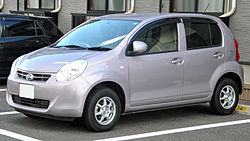
_front.JPG) Boon 1.0 CL (M600S, Japan) | |
| Overview | |
| Model code | M600/AC30 |
| Also called |
|
| Production |
|
| Designer | |
| Powertrain | |
| Engine | |
| Power output |
|
| Transmission |
|
| Dimensions | |
| Wheelbase | 2,440 mm (96.1 in) |
| Length | 3,640–3,650 mm (143.3–143.7 in) |
| Width | 1,665 mm (65.6 in) |
| Height | 1,535 mm (60.4 in) |
| Kerb weight | 910–970 kg (2,006–2,138 lb) |
The second-generation Boon was unveiled in Japan on 15 February 2010 alongside the second-generation Passo. Daihatsu calls this the M600, while Toyota uses the AC30 model code. Toyota also offered a well-equipped version with a redesigned, smoothed off front end, called the Passo +Hana. The +Hana also has champagne-coloured doorhandles and exterior mirrors; there was no equivalent Daihatsu model.
The second-generation Myvi, based on the Boon, was released in Malaysia on 17 June 2011.[12]
The third-generation Sirion for the Indonesian market was unveiled at the 19th Indonesia International Motor Show on 23 July 2011.[13]
In April 2013, Toyota New Zealand announced its decision to stop selling the second-generation Sirion, still on sale, stating it was unable to secure Daihatsu products that comply with future regulatory standards for New Zealand.
The second-generation Sirion was discontinued in South Africa in April 2015, when Daihatsu left the South African market.[citation needed]
- Daihatsu Boon
-
 2010–2014 Boon (Japan)

- Toyota Passo
-
 2010–2014 Toyota Passo (Hong Kong)
 -
 2010–2014 Toyota Passo (Hong Kong)
 -
 2010–2014 Toyota Passo +Hana (Japan)
 -
 2010–2014 Toyota Passo +Hana (Japan)
 -
 2014–2016 Toyota Passo (Japan)
 -
 2014–2016 Toyota Passo (Japan)
 -
 2014–2016 Toyota Passo +Hana 1.0 (KGC30, Japan)
 -
 2014–2016 Toyota Passo +Hana 1.0 (KGC30, Japan)
.jpg)
.jpg)


.jpg)
.jpg)
_front.JPG)
_rear.JPG)
Third generation (M700; 2016)
[edit]| Third generation | |
|---|---|
_front.JPG) 2016–2018 Boon X L Package SA II (M700S, Japan) | |
| Overview | |
| Model code | M700 |
| Also called | Toyota Passo |
| Production | April 2016 – December 2023 (Boon) April 2016 – September 2023 (Passo) |
| Body and chassis | |
| Related | Daihatsu Thor |
| Powertrain | |
| Engine |
|
| Power output | 51 kW (68 hp; 69 PS) |
| Transmission | CVT |
| Dimensions | |
| Wheelbase | 2,490 mm (98.0 in) |
| Length | 3,650–3,680 mm (143.7–144.9 in) |
| Width | 1,665 mm (65.6 in) |
| Height | 1,525 mm (60.0 in) |
| Kerb weight |
|
The third-generation Boon and Passo were unveiled in Japan on 12 April 2016. A better-equipped variant called the Boon CILQ was also available, featuring a pill-shaped grille that was distinct from the redesigned oval headlamps. This model was sold as the Passo Moda by Toyota and replaced the Passo +Hana from the previous generation.
Both the Boon and the Passo received a facelift on 10 October 2018, along with the introduction of a "Style" variant for the Boon. The Passo now includes an improved collision avoidance support system (Smart Assist III), which can detect various elements such as pedestrians, vehicles, preceding and oncoming cars, and obstacles. It can then activate several driver assistance systems, including alerting the driver or switching between low and high beams.[14] For the facelift model, the CILQ/Style/Moda submodels received a much larger grille, pulled all the way down to the bottom of the bumper, and the black C-pillar panel was smoothed off and received a high-gloss finish (other types were matte black plastic with four horizontal ridges).
The third-generation Boon is the only model that is not built as the corresponding generation Perodua Myvi (which is also sold as the Daihatsu Sirion in Indonesia).
- Boon
-
 2016–2018 Boon X "L Package SA II" (M700S)
 -
 2016–2018 Boon Cilq "G Package SA II" (M700S)
 -
 2016–2018 Boon Cilq "G Package SA II" (M700S)
 -
 2018 Boon X "SA III" (M700S)
 -
 2018 Boon Cilq "G Package SA II" (M700S)
 -
 2018 Boon Style "SA III" (M700S)
 -
 2018 Boon Style "SA III" (M700S)
_rear.JPG)
_front.jpg)
_rear.jpg)
.jpg)


_rear.jpg)
- Passo
-
 2016–2018 Passo X "G Package" (M700A)
 -
 2016–2018 Passo Moda "G Package" (M700A)
 -
 2016–2018 Passo Moda "G Package" (M700A)
 -
 2018 Passo X "L Package S" (M700A)
 -
 2018–2023 Passo Moda (M700A)
 -
 2018–2023 Passo Moda (M700A)
 -
 Passo Moda interior (M700A)

_front_(cropped).jpg)
_rear.jpg)
)_front.jpg)


)_interior.jpg)
Sales
[edit]| Year | Japan[15] |
|---|---|
| 2004 | 68,984 |
| 2005 | 87,956 |
| 2006 | 72,099 |
| 2007 | 80,015 |
| 2008 | 72,767 |
| 2009 | 83,593 |
| 2010 | 87,109 |
| 2011 | 52,513 |
| 2012 | 52,281 |
| 2013 | 42,805 |
| 2014 | 49,770 |
| 2015 | 45,449 |
| 2016 | 70,381 |
| 2017 | 54,186 |
| 2018 | 47,871 |
| 2019 | 40,980 |
| 2020 | 32,968 |
| 2021 | 32,542 |
| 2022 | 32,990 |
| 2023 | 24,880 |
References
[edit]- ^ "Data Book 2020" (PDF). Daihatsu. Archived from the original (PDF) on 22 February 2021. Retrieved 13 August 2020.
- ^ "Data: Origin of a car's name". Toyota. 2012. Retrieved 14 April 2020.
- ^ "A00200604253". DGIP.go.id. Pangkalan Data Kekayaan Intelektual. 23 January 2007. Retrieved 10 June 2022.
- ^ O'Kane, Tony (28 August 2018). "Tetsuya Tada: Meet the hero behind the Toyota Supra". Which Car?. Australia: Motor Media Network Pty Limited. Archived from the original on 12 December 2023.
- ^ Daihatsu Sirion in Indonesia uses Myvi styling
- ^ "A00200900921". DGIP.go.id. Pangkalan Data Kekayaan Intelektual. 23 June 2009. Retrieved 10 June 2022.
- ^ "A00200900922". DGIP.go.id. Pangkalan Data Kekayaan Intelektual. 23 June 2009. Retrieved 10 June 2022.
- ^ Toyota Passo Sette 7-seater MPV full details
- ^ "A00200903903". DGIP.go.id. Pangkalan Data Kekayaan Intelektual. 9 March 2010. Retrieved 10 June 2022.
- ^ "A00200903904". DGIP.go.id. Pangkalan Data Kekayaan Intelektual. 9 March 2010. Retrieved 10 June 2022.
- ^ "A00201400179". DGIP.go.id. Pangkalan Data Kekayaan Intelektual. 18 March 2014. Retrieved 10 June 2022.
- ^ "DAIHATSU - News". Archived from the original on 22 August 2011. Retrieved 29 August 2011.
- ^ "DAIHATSU - News". Archived from the original on 13 September 2011. Retrieved 29 August 2011.
- ^ "トヨタ パッソ | 安全性能". toyota.jp (in Japanese). Toyota Motor Corporation. Archived from the original on 20 October 2018. Retrieved 20 October 2018.
- ^ "トヨタ パッソ 新車販売台数の推移/売れ行き(生産台数)と生産状況は?工場とラインの稼働状況も - 株式会社アイディーインフォメーション" [Toyota Passo New car sales trends/sales (production volume) and production status? Factory and line operating status]. id-information.co.jp (in Japanese). Retrieved 21 April 2024.
External links
[edit]
- Official website (Boon)
- Official website (Passo)
A subsidiary of Toyota Motor Corporation | |||||||||||||||
| Subsidiaries |
| ||||||||||||||
| Current vehicles |
| ||||||||||||||
| Discontinued models |
| ||||||||||||||
| Concept cars | |||||||||||||||
| Racing cars | |||||||||||||||
| Platforms | |||||||||||||||
| Engines | |||||||||||||||
| Related | |||||||||||||||

Daihatsu Boon
View on GrokipediaOverview
History and development
The Daihatsu Boon was introduced in June 2004 as a subcompact hatchback, marking the first joint development project between Daihatsu Motor Co., Ltd. (DMC) and Toyota Motor Corporation (TMC) for the Japanese market. This collaboration leveraged DMC's expertise in lightweight construction and compact engineering to create a vehicle with distinctive styling, a roomy interior relative to its size, and suitability for urban environments. The initial model targeted young drivers and families seeking affordability and maneuverability, quickly gaining popularity for its balance of practicality and efficiency.[5] The second generation arrived as a complete redesign on February 15, 2010, building on the original partnership with TMC to prioritize environmental performance and drivability. Key advancements included the integration of a continuously variable transmission (CVT), which boosted fuel efficiency to up to 20.8 km/L under the JC08 test cycle, exceeding Japan's 2010 standards by 15-25% depending on the variant. Development emphasized simplicity in design, enhanced safety features like vehicle stability control, and cost-effective manufacturing to maintain competitive pricing between 1.05 and 1.4 million yen.[5] In April 2016, the third generation launched with a full model change, applying DMC's accumulated know-how from mini vehicles to compact car development. This iteration introduced the "e:S Technology" package for optimized engine and transmission efficiency, achieving class-leading fuel economy of 28.0 km/L in 2WD models under the JC08 test cycle, alongside a 50 kg lighter "D Monocoque" body structure for improved rigidity and handling. Interior space was expanded, with front-to-rear legroom increased by 75 mm to 940 mm, while incorporating customer feedback for better usability and the "Smart Assist" collision avoidance system. A partial redesign in October 2018 added the Boon STYLE variant for enhanced aesthetics and accessibility.[8][1] Production of the Boon ended in December 2023 amid DMC's investigation into procedural irregularities in safety certification testing, affecting multiple models including the Boon and its Toyota Passo counterpart. The model was permanently discontinued, as its 1KR-FE engine was listed as discontinued in June 2024, with no resumption of production despite restarts for other vehicles. No successor has been announced as of November 2025, reflecting broader challenges in Daihatsu's compact vehicle lineup.[6][9]Platform and naming
The Daihatsu Boon is named after the English word "boon," which conveys a sense of closeness and conviviality, evoking the car's role as a friendly, accessible urban companion. Additionally, the name mimics a child's onomatopoeic representation of a vehicle's running sound, emphasizing its approachable and playful character for everyday use.[10] Developed in close collaboration with Toyota since its inception, the Boon shares its core architecture with the Toyota Passo, a badge-engineered twin marketed primarily outside Japan, while the Boon remains exclusive to the Japanese domestic market. This partnership leverages Daihatsu's expertise in compact vehicle engineering to produce a subcompact (B-segment) hatchback optimized for city driving, with shared components ensuring cost efficiency and consistent performance across brands. The model's naming convention extends to variants like the Boon Luminas, introduced in 2008 as a seven-seater extension, where "Luminas" suggests spaciousness and luminosity to highlight its roomier interior compared to the standard five-seater Boon.[11][12] The first-generation Boon (2004–2010) utilizes the NC platform, a Daihatsu-developed architecture rooted in Toyota's NBC (New Basic Compact) platform, which prioritizes lightweight construction and front-wheel-drive layout for enhanced fuel efficiency in subcompact applications. This setup, shared with the inaugural Toyota Passo, supports a compact wheelbase of approximately 2,450 mm, enabling agile handling in urban environments while accommodating 1.0-liter and 1.3-liter engines.[13] For the second generation (2010–2016), the platform evolves as an updated iteration of the NC architecture, retaining the core NBC-derived structure but incorporating refinements such as improved rigidity and integration of Dual VVT-i engine technology for better emissions compliance and drivability. This continuity allows for a seamless transition in design philosophy, with the Boon maintaining its sub-3,700 mm length to qualify for Japanese compact car tax incentives, while the shared platform with the second-generation Passo facilitates badge-engineering efficiencies.[14][13] The third generation (2016–2023) marks a significant shift to the Daihatsu New Global Architecture (DNGA), a modular platform jointly developed with Toyota to underpin A- and B-segment vehicles, emphasizing reduced weight through high-tensile steel and resin components, superior crash safety, and scalability for future electrification. As one of the inaugural applications of DNGA alongside the third-generation Passo, the Boon achieves up to 10% better fuel economy via optimized suspension geometry and a lower center of gravity, while supporting all-wheel-drive options in select trims. This platform's flexibility also extends to derivatives like the Perodua Myvi in Southeast Asia, demonstrating its global adaptability.[15][16]First generation (2004–2010)
Design and features
The first-generation Daihatsu Boon (M300; 2004–2010) featured a compact hatchback body design measuring 3,595 mm in length, 1,665 mm in width, and 1,535 mm in height, with a wheelbase of 2,440 mm, providing a nimble footprint suitable for urban driving.[17] Its exterior styling emphasized a simple, upright profile with minimal overhangs and tall greenhouse for enhanced visibility, characterized by swept-back, high-mounted headlights integrated into the fenders, a compact rhomboidal grille with a chromed accent, and a large lower air intake for a sporty front fascia.[18] The sides presented clean lines with body-colored door handles and subtle character creases along the hood extending to the rear, while the tailgate adopted a split design—allowing the upper glass section to open independently for ventilation—and vertically stacked taillights for a modern, functional rear appearance.[18] Inside, the Boon offered a light-filled cabin with a high seating position and excellent all-around visibility, thanks to large windows and a steeply raked windshield.[19] The dashboard utilized hard but well-fitted plastics in a simple, angular layout, highlighted by a prominent central console and an optional pod-style tachometer mounted atop the instrument panel for quick glances.[20] Front seats were height-adjustable and supportive for long drives, with rear seating accommodating three adults for short trips due to generous legroom and a flat floor; the 60/40-split rear seats folded completely flat to expand cargo space from 225 liters (seats up) to 630 liters (seats folded), without a central hump obstructing loading.[21] Standard interior features across trims included air conditioning, power windows and door locks, power steering, a four-speaker CD stereo system, and remote central locking, with higher grades like the Custom adding alloy wheels, fog lights, a sunroof, and satellite navigation.[22] Safety equipment was robust for the segment, with all models equipped with dual front airbags, anti-lock brakes (ABS), and electronic brake-force distribution (EBD) as standard.[23] Side airbags were available on upper trims, contributing to the Boon's four-star rating in the 2005 Euro NCAP crash tests, where it scored 10.55 out of 16 in frontal offset impacts and 16 out of 16 in side impacts, demonstrating good occupant protection and structural integrity.[24] The tilt-adjustable steering column and height-adjustable seat belts further enhanced driver ergonomics and comfort.[19]Powertrain
The first-generation Daihatsu Boon (2004–2010) featured a selection of inline petrol engines developed by Daihatsu, emphasizing efficiency and compact performance for urban driving, with options for front-wheel drive (FWD) and all-wheel drive (AWD) configurations. These powertrains were paired with either a five-speed manual transmission or a four-speed automatic transmission, providing flexibility for different driving preferences while maintaining lightweight vehicle dynamics.[17][25] The entry-level engine was the 1KR-FE, a 996 cc inline-three with DOHC and multi-point fuel injection, producing 71 PS (52 kW) at 6,000 rpm and 94 Nm of torque at 3,600 rpm. This unit, with a compression ratio of 10.5:1, prioritized fuel economy in the subcompact segment, achieving around 21.7 km/L in combined cycle testing under Japanese standards. It was available in both FWD and AWD setups, the latter using a full-time system for enhanced traction.[17][26][27] A mid-range option was the K3-VE, a 1,298 cc inline-four with DOHC, variable valve timing (DVVT), and electronic fuel injection, outputting 90 PS (66 kW) at 6,000 rpm and 124 Nm at 4,400 rpm at a 10.0:1 compression ratio. This engine offered a balance of responsive acceleration and refinement, suitable for highway use, and was mated to either transmission type in FWD form.[28][29][30] For sportier variants like the Boon X4, Daihatsu fitted the KJ-VET, a turbocharged 936 cc inline-four with DOHC, intercooler, and a lower 8.3:1 compression ratio, generating 133 PS (98 kW) at 7,200 rpm and 133 Nm at 3,600 rpm. This powertrain, exclusive to AWD models with a five-speed manual, delivered agile performance with a 0-100 km/h time under 10 seconds, targeting enthusiasts in the kei-adjacent market.[31][32][33]Boon Luminas variant
The Boon Luminas was introduced on December 25, 2008, as a compact 7-seater variant of the first-generation Daihatsu Boon, expanding the model's appeal to families with its multi-purpose wagon body style.[11] Designed primarily for mothers with young children and active family lifestyles, it featured flexible seating arrangements with foldable second- and third-row seats to accommodate varying passenger and cargo needs, including up to 2,550 mm of interior length when configured for maximum space.[11] The exterior adopted a streamlined silhouette with smooth side lines, measuring 4,180 mm in length, 1,695 mm in width, and 1,620 mm in height, maintaining the Boon's compact footprint while providing enhanced interior versatility compared to the standard 5-seater Boon.[11] Key features emphasized ease of use for daily driving, including a key-free entry system, rear-seat entertainment options, and driving-assistance technologies tailored to female drivers, such as simplified controls and improved visibility.[11] The interior utilized a refined two-tone color scheme for a more upscale feel, with ample space between the front and third rows at 1,630 mm to ensure comfort for all seven passengers.[11] Available in front-wheel-drive and four-wheel-drive configurations, the Luminas shared its platform with the sibling Toyota Passo Sette, which was launched simultaneously and produced alongside it, highlighting Daihatsu's collaboration with Toyota for broader market reach.[11] Powering the Boon Luminas was the 1.5-liter 3SZ-VE inline-four gasoline engine, delivering 80 kW (109 PS) at 6,000 rpm and 141 N·m of torque at 4,400 rpm, paired exclusively with a 4-speed automatic transmission.[11] This setup provided adequate performance for urban and family use, with average fuel consumption around 6.4 L/100 km in combined driving cycles for the front-wheel-drive model.[34] Trims such as CL and CX offered options like all-wheel drive on the CX, enhancing traction for varied conditions without significantly altering the model's efficiency-focused character.[35] Overall, the Luminas differentiated itself from the base Boon through its emphasis on practicality and family-oriented innovations, contributing to Daihatsu's strategy of offering adaptable vehicles in the subcompact segment.[11]Second generation (2010–2016)
Design and features
The second-generation Daihatsu Boon (M600; 2010–2016) featured a compact five-door hatchback body design measuring 3,640 mm in length, 1,665 mm in width, and 1,535 mm in height, with a wheelbase of 2,440 mm, offering a slightly larger footprint than the first generation for improved interior space while maintaining urban maneuverability.[5] Its exterior styling adopted a more modern, upscale appearance with curved surfaces and an egg-shaped upper body, wheels positioned at the four corners for stability, swept-back headlights, a compact grille, and body-colored accents for a fresh look.[5] Inside, the Boon provided a roomy cabin accommodating five passengers comfortably, with a high seating position for better visibility and ample storage options including a retractable shopping hook and multi-purpose tray.[5] The dashboard featured a simple layout with hard plastics, central console, air conditioning, power windows, power steering, and a CD stereo system as standard. Higher trims added alloy wheels, fog lights, and navigation. Rear seats folded flat to expand cargo space from approximately 200 liters (seats up) to over 700 liters (seats folded).[36] Safety features included dual front SRS airbags, ABS with EBD, and optional vehicle stability control (VSC) with traction control (TRC), along with a TAF (Toyota Advanced Framework) body structure for enhanced crash protection.[5]Powertrain
The second-generation Daihatsu Boon featured efficient petrol engines paired exclusively with a continuously variable transmission (CVT), available in front-wheel drive (FWD) and all-wheel drive (AWD) configurations for versatile urban and light off-road use.[5] The base engine was the 1KR-FE, a 996 cc inline-three with DOHC, variable valve timing, and multi-point fuel injection, producing 69 PS (51 kW) at 6,000 rpm and 92 Nm of torque at 3,600 rpm. It achieved 22.5 km/L (10-15 mode) or 20.8 km/L (JC08) in FWD form, qualifying for eco-car tax reductions.[5] The higher-output option was the 1NR-FE, a 1,329 cc inline-four with DOHC, dual VVT-i, and electronic fuel injection, delivering 95 PS (70 kW) at 6,000 rpm and 121 Nm at 4,000 rpm. This engine offered better performance for highway driving, with fuel economy of 21.0 km/L (10-15 mode) in FWD. Both engines emphasized low emissions and efficiency under Japanese standards.[5]2013 facelift
In June 2012, Daihatsu introduced a minor facelift to the second-generation Boon, effective for the 2013 model year, focusing on enhanced fuel efficiency and safety to meet updated Japanese eco-car standards. All two-wheel-drive (2WD) variants received an idling stop system (eco IDLE), which shut off the engine at stops to reduce consumption, improving JC08-mode fuel economy to 23.0 km/L for 1.0L 2WD models—a roughly 10% gain—and qualifying for a 75% eco-car tax reduction.[37] Safety upgrades included standard vehicle stability control (VSC) and traction control (TRC) on all 2WD models, plus a rear center three-point seatbelt. The powertrain lineup remained unchanged, with both 1.0L and 1.3L engines available with CVT. Four-wheel-drive (4WD) models achieved 20.0 km/L (JC08). Interior additions featured a new "CL Limited II" trim with updated fabrics and an eco-drive indicator. Exterior changes were subtle, including new colors like Fresh Green Metallic, maintaining the model's compact, boxy profile.[37]Third generation (2016–2023)
Design and features
The third-generation Daihatsu Boon (M700; 2016–2023) is a subcompact five-door hatchback with dimensions of 3,650 mm in length, 1,665 mm in width, and 1,525 mm in height, featuring a wheelbase of 2,490 mm for improved interior space and stability.[38][39] Launched on April 12, 2016, it adopted a "Rational Statement Design" for the standard Boon, emphasizing horizontal lines for a sense of spaciousness and stability, with a minimum turning radius of 4.6 m suitable for urban maneuvering. The Boon CILQ variant featured a "Smart and High Quality Design" with black pillars and silver accents for a premium feel. Exterior options included 19 color patterns, with three new shades such as Magenta Berry Mica Metallic.[8] The interior provided class-leading space, with a front-to-rear passenger distance of 940 mm (an increase of 75 mm over the previous generation) and efficient packaging for enhanced comfort. Standard features included air conditioning, a multi-information display, and accent-colored seats (bright gray for Boon, black/magenta for CILQ). Higher trims added options like a long tray, alloy wheels, and navigation systems. Cargo space was practical, with 60/40 split-folding rear seats expanding capacity.[8] Safety was a priority, earning a five-star rating in JNCAP crash tests through the use of the TAF (Toyota Advanced Framework) body structure and SOFI (Super Olefin Fiber Interior) materials. All models included dual front airbags, ABS with EBD, and the Smart Assist II system—featuring collision warning with pedestrian detection, lane departure prevention, and adaptive cruise control in select trims—as standard on SA II and higher grades. Additional features encompassed Hill Hold Control, Emergency Stop Signal, and seat belt reminders.[8]Powertrain
The third-generation Daihatsu Boon was powered exclusively by the 1KR-FE, a 996 cc inline-three petrol engine with DOHC, dual intake ports, dual injectors, and Atkinson cycle operation at a 12.5:1 compression ratio. It produced 69 PS (51 kW) at 6,000 rpm and 92 Nm of torque at 4,400 rpm, prioritizing fuel efficiency with JC08 cycle ratings of 28.0 km/L for 2WD models and 24.4 km/L for 4WD. The engine incorporated eco IDLE stop-start technology and was paired with a continuously variable transmission (CVT). Drive configurations included front-wheel drive (FWD) and full-time four-wheel drive (4WD), with no manual option available.[38][8]2021 facelift
The 2021 facelift for the third-generation Daihatsu Boon, introduced on April 1, 2021, represented a partial upgrade focused on enhancing safety, simplifying the lineup, and refreshing select exterior and interior elements without altering the core powertrain.[40] This update made advanced driver-assistance systems standard across all trims, improving accessibility for entry-level buyers while maintaining the model's compact, urban-oriented design.[40] Exterior revisions were subtle, including redesigned 14-inch full wheel caps for a more modern appearance on all grades and the addition of a new monotone body color, Turquoise Blue Mica Metallic (code B86).[40] Two-tone options were expanded with Juicy Pink Metallic paired with White (XG7), Turquoise Mica Metallic with Black Mica Metallic (XH6), and Brilliant Copper Crystal Mica Metallic with Black Mica Metallic (XG2), offering greater customization for style-conscious consumers.[40] On the higher-end Boon X “L Package SA III” trim, LED headlights became standard, enhancing nighttime visibility and aesthetic appeal.[40] Interior updates emphasized practicality, with rear seats now featuring a 60:40 split-folding mechanism on the standard Boon models to increase cargo versatility.[40] Convenience features were broadened by standardizing Auto Light functionality across the lineup, which automatically activates headlights based on ambient conditions.[40] Safety received the most significant emphasis through the inclusion of Daihatsu's Smart Assist system—encompassing collision warning, pedestrian detection, and lane departure prevention—as standard equipment on every grade, aligning the Boon with evolving regulatory and consumer demands for active safety.[40] The grade structure was streamlined to improve purchasing decisions, consolidating offerings into core variants: X “SA III” and X “L Package SA III” for the base Boon, with dedicated “SA III” trims for the CILQ and STYLE sub-models.[40] Pricing reflected these enhancements while remaining competitive in the Japanese kei-adjacent segment, as detailed below (inclusive of consumption tax):| Grade | 2WD (¥) | 4WD (¥) |
|---|---|---|
| Boon X “SA III” | 1,265,000 | 1,469,600 |
| Boon X “L Package SA III” | 1,375,000 | 1,574,100 |
| Boon CILQ “SA III” | 1,562,000 | 1,761,100 |
| Boon STYLE “SA III” | 1,551,000 | 1,750,100 |
Fourth generation (2025–present)
No fourth generation of the Daihatsu Boon was produced. The model was discontinued in December 2023 following Daihatsu's halt of shipments due to procedural irregularities in safety testing across multiple models, including the Boon.[6] As of November 2025, no successor or new generation has been announced by Daihatsu.Sales and reception
Market performance
The Daihatsu Boon has been a consistent performer in Japan's subcompact car segment since its introduction in 2004, targeting urban commuters with its compact size and fuel efficiency. Initial sales were strong, reflecting demand for affordable subcompacts, with the model achieving peak annual sales of 121,000 units in 2010.[41] This positioned the Boon among the top-selling subcompacts in Japan during the early 2010s, contributing to Daihatsu's overall market share in the lightweight vehicle category.[41] Over the subsequent decade, sales gradually declined amid increasing competition from hybrid models and shifting consumer preferences toward taller vehicles like the Daihatsu Tanto. By 2019, annual sales had fallen to 68,000 units, and the trend continued into the early 2020s, reaching 60,000 units in 2022 and 58,000 units in 2023.[41] The Boon's market ranking slipped outside the top five subcompacts by the mid-2010s, though it maintained a loyal base for its reliability and low running costs.[41] The 2023 safety certification scandal severely impacted Daihatsu's operations, including the Boon, leading to production halts and shipment suspensions across models from December 2023 onward.[42] Production of the Boon was discontinued in December 2023 as a result of the irregularities.[6] This resulted in a brand-wide sales drop of over 69% in January 2024 alone, with no new Boon units produced thereafter.[42] By 2025, Daihatsu's sales rebounded significantly, with the brand posting a 117% year-over-year increase in the first half, driven by resumed production and updates to other models like the Move and Tanto.[43] The Boon, however, saw no new sales following its discontinuation, amid a competitive subcompact market growing at 10.2% overall.[43]| Year | Annual Sales (Japan) | Subcompact Segment Ranking |
|---|---|---|
| 2010 | 121,000 | Top 3 |
| 2015 | 82,000 | Top 5 |
| 2020 | 65,000 | Outside Top 5 |
| 2023 | 58,000 | Outside Top 5 |