Hubbry Logo
Mack SennettMack SennettMain
Open search
Mack Sennett
Community hub
Mack Sennett
logo
8 pages, 0 posts
0 subscribers
Be the first to start a discussion here.
Mack Sennett
Mack Sennett
from Wikipedia

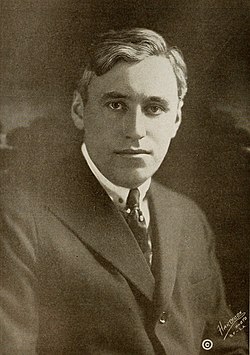
Mack Sennett (born Michael Sinnott; January 17, 1880 – November 5, 1960) was a Canadian-American producer, director, actor, and studio head who was known as the "King of Comedy" during his career.[1]

Key Information

Born in Danville, Quebec,[2][3][4][a] he started acting in films in the Biograph Company of New York City in 1908, and later opened Keystone Studios in Edendale, California in 1912. Keystone possessed the first fully enclosed film stage, and Sennett became famous as the originator of slapstick routines such as pie-throwing and car-chases, as seen in the Keystone Cops films.[5] He also produced short features that displayed his Bathing Beauties, many of whom went on to develop successful acting careers.[6][7]

After struggling with bankruptcy and the dominance of sound films in the early 1930s, Sennett was presented with an honorary Academy Award in 1938 for his contributions to the film industry, with the academy describing him as a "master of fun, discoverer of stars, sympathetic, kindly, understanding comedy genius".[8]

Early life

[edit]

Born Michael Sinnott in Danville, Quebec,[2] to parents of Irish Catholic descent, John Sinnott and Catherine Foy (or Foye). His parents married in 1879 in Tingwick, Quebec and moved the same year to Richmond, Quebec where Sinnott was hired as a laborer.[9] By 1883, when Sennett's brother George was born, Sinnott was working as an innkeeper, a position he held for many years. Sennett's parents had all their children and raised their family in Richmond, then a small Eastern Townships village. At that time, Sennett's grandparents were living in Danville, Quebec. Sennett moved to Connecticut when he was 17 years old.[9]

He lived for a while in Northampton, Massachusetts, where, according to his autobiography, he first got the idea to become an opera singer after seeing a vaudeville show. He said that the most respected lawyer in town, Northampton mayor (and future President of the United States) Calvin Coolidge, as well as Sennett's mother, tried to talk him out of his musical ambitions.[10] In New York City, he took on the stage name Mack Sennett and became an actor, singer, dancer, clown, set designer, and director for the Biograph Company. A distinction in his acting career, often overlooked, is that he played Sherlock Holmes 11 times, albeit as a parody, between 1911 and 1913.[11]

Keystone Studios

[edit]
The Mack Sennett Keystone Studios in 1915

With financial backing from Adam Kessel and Charles O. Bauman of the New York Motion Picture Company, Sennett founded Keystone Studios in Edendale, California – now a part of Echo Park – in 1912. The original main building which was the first totally enclosed film stage and studio ever constructed,[1] is still standing, as of 2023.[12] Many successful actors began their film careers with Sennett, including Marie Dressler, Mabel Normand, Charlie Chaplin, Harry Langdon, Roscoe Arbuckle, Harold Lloyd, Raymond Griffith, Gloria Swanson, Charley Chase, Ford Sterling, Andy Clyde, Chester Conklin, Polly Moran, Slim Summerville, Louise Fazenda, The Keystone Cops, Carole Lombard, Bing Crosby, and W. C. Fields.[b][c]

"In its pre-1920s heyday [Sennett's Fun Factory] created a vigorous new style of motion picture comedy founded on speed, insolence and destruction, which won them the undying affection of the French Dadaists..." —Film historian Richard Koszarski[15]

Dubbed the King of Hollywood's Fun Factory,[16] Sennett's studios produced slapstick comedies that were noted for their hair-raising car chases and custard pie warfare, especially in the Keystone Cops series. The comic formulas, however well executed, were based on humorous situations rather than the personal traits of the comedians; the various social types, often grotesquely portrayed by members of Sennett's troupe, were adequate to render the largely "interchangeable routines: "Having a funny moustache, or crossed-eyes, or an extra two-hundred pounds was as much individualization as was required."[d][17]

"It is an axiom of screen comedy that a Shetland pony must never be put in an undignified position. People don't like it...immunity of pretty girls doesn't go as far as the immunity of the Shetland pony...you can have her fall into mud puddles. They will laugh at that. But the spectacle of a girl dripping with pie is unpleasing...movie fans don't like to see pretty girls smeared up with pastry. Shetland ponies and pretty girls are immune."— Mack Sennett, from The Psychology of Film Comedy, November 1918[17]

Film historian Richard Koszarski qualifies "fun factory" influence on comedic film acting:

"While Mack Sennett has a secure and valued place in the history of screen comedy, it is surely not as a developer of individual talents ... Chaplin, Langdon, and Lloyd were all on the lot at one point or another, but developed their styles only in spite of Sennett, and grew to their artistic peaks only away from his influence ... screen comedy followed Chaplin's lead and began to focus more on personality than situation."[e]

Sennett's first female comedian was Mabel Normand, who became a major star under his direction and with whom he embarked on a tumultuous romantic relationship.[10] Sennett also developed the Kid Comedies, a forerunner of the Our Gang films, and in a short time, his name became synonymous with screen comedy which were called "flickers" at the time.[10] In 1915, Keystone Studios became an autonomous production unit of the ambitious Triangle Film Corporation, as Sennett joined forces with D. W. Griffith and Thomas Ince, both powerful figures in the film industry.[18]

Sennett Bathing Beauties

[edit]
Sennett Bathing Beauties

Also beginning in 1915, Sennett assembled a bevy of women known as the Sennett Bathing Beauties to appear in provocative bathing costumes in comedy short subjects, in promotional material, and in promotional events such as Venice Beach beauty contests.[6] The Sennett Bathing Beauties continued to appear through 1928.[7]

Movie theatre audience members Roscoe Arbuckle and Sennett square off while watching Mabel Normand onscreen in Mabel's Dramatic Career (1913).
Mabel Normand, Sennett, and Charlie Chaplin in The Fatal Mallet (1914)
Silent film Love, Speed and Thrills (1915), directed by Walter Wright and produced by Sennett, is a chase film in which a man (named Walrus) kidnaps the wife of his benefactor, but the so-called "Keystone Cops" are also chasing down Walrus.

Independent production

[edit]
Mack Sennett Studios, c. 1917

In 1917, Sennett gave up the Keystone trademark and organized his own company, Mack Sennett Comedies Corporation.[10] Sennett's bosses retained the Keystone trademark and produced a cheap series of comedy shorts that proved unsuccessful. Sennett went on to produce more ambitious comedy short films and a few feature-length films.[10]

Many of Sennett's films of the early 1920s were inherited by Warner Bros.[11] after Warner had merged with the original distributor, First National. Warner added music and commentary to several of these short subjects, and the new versions were released to theaters between 1939 and 1945. Many of Sennett's First National films physically deteriorated due to inadequate storage. Hence, many of Sennett's films from his most productive and creative period no longer exist.[11]

Move to Pathé Exchange

[edit]

In the mid-1920s, Sennett moved to Pathé Exchange distribution.[10] In 1927, Hollywood's two most successful studios, Metro-Goldwyn-Mayer and Paramount Pictures, took note of the profits being made by smaller companies such as Pathé Exchange and Earle Hammons's Educational Pictures.[10] MGM took over the Hal Roach comedy shorts from Pathé, and Paramount reactivated its short subjects. Hundreds of other independent exhibitors and moviehouses switched from Pathé to the new MGM or Paramount shorts. Sennett fulfilled his contract to deliver silent comedies to Pathé through 1929 (these, like the Smith Family comedies, had already been completed before Sennett temporarily shut down his studio), but he began making sound films for Educational in late 1928.

Sound films

[edit]

In 1928, Sennett canceled all of his talent contracts and retooled his studio for the new talking-picture technology. His leading star at the time, Ben Turpin, was suddenly unemployed and moved to the Weiss Brothers studio.

Sennett's enthusiasm for sound on film was such that he was the first to get a talking two-reel comedy on the market.[10] The Lion's Roar, starring Johnny Burke and Billy Bevan, was released by Educational in December 1928, launching a four-year succession of Mack Sennett sound comedies. Sennett occasionally experimented with color as well.[10]

In 1932, he was nominated for the Academy Award for Live Action Short Film in the comedy division for producing The Loud Mouth (with Matt McHugh, in the sports-heckler role later taken in Columbia Pictures remakes by Charley Chase and Shemp Howard).[19] Sennett also won an Academy Award in the novelty division for his film Wrestling Swordfish, also in 1932.[20] He directed at least two two-reel comedies under the pseudonym Michael Emmes (the "Emmes" representing Sennett's initials): Hawkins and Watkins Inc. and Young Onions (both 1932).

Mack Sennett often clung to outmoded techniques, making his early-1930s films seem dated and quaint: he dressed some of his actors in eccentric makeups and loud costumes, which were amusing in the cartoonish silent films but ludicrous in the new, realistic atmosphere of talking pictures. Sennett was also having financial problems during the Great Depression. One of his biggest stars, Andy Clyde, left the studio after Sennett, wanting to economize, tried to cut Clyde's salary.

In 1932, Sennett attempted to re-enter the feature-film market on a grand scale with Hypnotized. Remembering the successful campaign for his very first feature-length comedy Tillie's Punctured Romance, which in 1914 was the longest comedy film ever produced, Sennett planned Hypnotized along similar lines as an epic production that would be shown first-run in select roadshow engagements. Sennett announced that Hypnotized would run 15 reels, or two-and-a-half hours, more than twice the length of a typical comedy feature of the day.[21] Sennett wanted W. C. Fields to star as a carnival hypnotist, but Fields declined and the role went to Ernest Torrence, sharing the spotlight with blackface comedians Moran and Mack, "The Two Black Crows". Production was completed in August 1932, but fell far short of Sennett's grandiose predictions. The finished film ran an ordinary 70 minutes and was released through ordinary channels by World Wide Pictures (Educational's feature-film outlet) in December 1932.

Sennett was also having differences with his distributor, Earle Hammons of Educational. Jack White, Educational's leading producer, explained, "We put Mack Sennett out of business. Theaters had [our] comedies booked solid. Sennett was very temperamental and wanted the exhibitor to do certain things, but they wouldn't stand for it. Sennett wouldn't stand for Hammons not telling him how much [money] he was cutting out of the grosses for himself. Sennett told him to go to hell."[22][23] Sennett left Educational and signed with Paramount Pictures.[24]

Sennett's sound comedies usually starred young featured players like Frank Albertson or established stage comics like Walter Catlett, but Sennett didn't establish any new star names until he signed both Bing Crosby and W. C. Fields for two-reel comedies. Crosby starred in six; Fields wrote and starred in four. Two other Sennett shorts were made with Fields scripts: The Singing Boxer (1933) with Donald Novis and Too Many Highballs (1933) with Lloyd Hamilton.[10] Despite Paramount's wide distribution of the Crosby and Fields shorts, Sennett's studio did not survive the Depression.[10] Sennett's partnership with Paramount lasted only one year and he was forced into bankruptcy in November 1933.[10] His former protege Bing Crosby, whose popularity and income had skyrocketed, helped Sennett during a period of financial hardship.[25] This act prompted columnist Lloyd Pantages to refer to Crosby as Sennett's "guardian angel."[26]

On January 12, 1934, Sennett was injured in an automobile accident that killed blackface performer Charles Mack (of Moran and Mack) in Mesa, Arizona.[27]

His last work, in 1935, was as a producer-director for Educational, in which he directed Buster Keaton in The Timid Young Man and Joan Davis in Way Up Thar.[10] Sennett was not connected with the 1935 Vitaphone short subject Keystone Hotel, which featured several alumni from the Sennett studios, including Ben Turpin, Ford Sterling, Hank Mann, and Chester Conklin. The film was directed by Ralph Staub.

Sennett made one last attempt to continue working in the comedy field. By this time he had been supplanted as the major producer of two-reel comedies by Jules White at Columbia Pictures. White's brother, Jack White, recalled: "When Jules and I were at Columbia in the 1930s, Sennett tried to come to Columbia but they wouldn't have him. He was finished, and the studio was happy with Jules."[22][23] Sennett did sell some scripts and stories to Jules White, receiving screen credit under his "Michael Emmes" alias. Columbia really didn't need Sennett's services; the studio already had four producers and six directors on its short-subject payroll.[28]

Mack Sennett went into semi-retirement at the age of 55, having produced more than 1,000 silent films and several dozen talkies during a 25-year career.[10] His studio property was purchased by Mascot Pictures (later part of Republic Pictures), and many of his former staffers found work at Columbia.[10]

In March 1938, Sennett was presented with an honorary Academy Award: "for his lasting contribution to the comedy technique of the screen, the basic principles of which are as important today as when they were first put into practice, the Academy presents a Special Award to that master of fun, discoverer of stars, sympathetic, kindly, understanding comedy genius – Mack Sennett."[8][29]

Later projects

[edit]

Rumors abounded that Sennett would be returning to film production (a September 1938 publicity release indicated that he would be working with Stan Laurel of Laurel and Hardy), but apart from Sennett reissuing a couple of his Bing Crosby two-reelers to theaters, nothing happened.[30]

Sennett did appear in front of the camera, however, in Hollywood Cavalcade (1939), itself a thinly disguised version of the Mack Sennett-Mabel Normand romance.[10]

In 1949, he provided film footage for the first full-length comedy compilation film, Down Memory Lane (1949), written and narrated by Steve Allen.[31][32] Sennett made a guest appearance in the film, and received a special "Mack Sennett presents" credit.

Sennett wrote a memoir, King of Comedy, in collaboration with Cameron Shipp. The book was published in 1954, prompting TV producer Ralph Edwards to mount a tribute to Sennett for the television series This Is Your Life.[33] Sennett made a cameo appearance (for $1,000) in Abbott and Costello Meet the Keystone Kops (1955).[34]

Sennett's last appearance in the national media was in the NBC radio program Biography in Sound, relating memories of working with W.C. Fields. The program was broadcast February 28, 1956.[35]

Personal life

[edit]

Sennett was never married, but his tumultuous relationship with actress Mabel Normand was widely publicized in the press at the time.[36] According to the Los Angeles Times, Sennett reportedly lived a "madcap, extravagant life", often throwing "lavish parties", and at the peak of his career he owned three homes.[36]

On March 25, 1932, he became a United States citizen.[37]

Death

[edit]

Sennett died on November 5, 1960, in Woodland Hills, California, aged 80.[38] He was interred in the Holy Cross Cemetery in Culver City, California.[39]

Filmography

[edit]

Tributes

[edit]

For his contribution to the motion picture industry, Sennett was honored with a star on the Hollywood Walk of Fame at 6712 Hollywood Boulevard.[36] He was also inducted into Canada's Walk of Fame in 2014.[40]

The building of Sennett's original studio in Echo Park was deemed a historical landmark by The City of Los Angeles in 1982.[12][41]

[edit]

See also

[edit]

Bibliography

[edit]
[edit]
Revisions and contributorsEdit on WikipediaRead on Wikipedia
from Grokipedia
Mack Sennett (born Michael Sinnott; January 17, 1880 – November 5, 1960) was a Canadian-born American , director, , and innovator of , often called the "King of Comedy" for revolutionizing early cinema with fast-paced, visual humor. Born in Danville, Quebec, to Irish immigrant parents—his father a blacksmith—Sennett moved to the United States as a teenager, settling first in Connecticut where he worked as a boilermaker before pursuing performing arts ambitions in New York City. Inspired by vaudeville, he joined the Biograph Company around 1908, starting as an actor, singer, dancer, and clown; he soon advanced to directing under D.W. Griffith and headed the studio's comedy unit by 1911, appearing in parody roles such as Sherlock Holmes in 11 short films. In 1912, Sennett co-founded Keystone Studios in Edendale, California (now , ), launching the careers of future icons like , , Roscoe "Fatty" Arbuckle, and . He produced over 1,000 short films by 1933. There, he pioneered full-length comedy reels (up to 22 minutes), created the chaotic Keystone Kops police chase series, introduced the glamorous Bathing Beauties chorus line, and popularized gags like the pie-in-the-face (thrown by Normand in 1913); notable works include directing Chaplin in Dough and Dynamite (1914) and producing the first feature-length comedy, Tillie's Punctured Romance (1914), starring , Chaplin, and Normand. Sennett innovated filming techniques, such as in-car cameras for chase scenes and the two-strip color process in 1929, while transitioning to sound films with his first talkie in the late 1920s; he also produced the Oscar-winning short Wrestling Swordfish (1932). However, the Great Depression and unfavorable Paramount contracts led to his bankruptcy in 1933, after which Sennett produced independently until retiring around 1935, later contributing to the compilation film Down Memory Lane (1949). In recognition of his foundational role in American comedy, he received an Honorary Academy Award in 1937, a star on the Hollywood Walk of Fame, and induction into Canada's Walk of Fame in 2004; Sennett detailed his life in his 1954 autobiography, King of Comedy.

Early Life

Childhood and Immigration

Mack Sennett was born Michael Sinnott on January 17, 1880, in Richmond, , , to Irish Catholic immigrant parents John Sinnott, a , and Catherine Foy. The family had settled in around 1875, and Sennett grew up in a large household marked by modest circumstances typical of working-class immigrants. His father's provided basic stability, but economic pressures in rural were significant, contributing to a childhood where formal was limited and practical skills were emphasized from an early age. Due to ongoing financial hardships, the Sinnott family sought better opportunities in the United States, immigrating in 1897 when Sennett was 17 years old and settling first in the industrial town of , . There, Sennett took up manual labor in local factories, including work as a machinist in an ironworks, reflecting the common path for young Irish immigrants entering American industry during the late . The family later relocated briefly to , where similar economic challenges persisted, prompting Sennett to balance factory shifts with emerging personal interests. In , Sennett's initial exposure to entertainment came through amateur theatrical performances in local communities, where he participated in informal stage activities that honed his performative skills. By around , these experiences evolved into more structured involvement with regional stock companies and the fringes of circuits, offering him early glimpses into professional amid his factory routine.

Entry into Vaudeville and Film

Sennett arrived in in 1902 after a chance encounter with actress , who inspired him to pursue a stage career. He debuted as a chorus boy in the musical comedy King Dodo at the Bowery Theatre that year, marking his entry into and . Over the following years, he performed in various productions, including singing, dancing, acrobatics, and low comedy roles, gradually advancing to speaking parts as a in shows like the 1906 Broadway musical The Newlyweds and Their Baby. Sennett's initial exposure to motion pictures occurred through extra roles in filmed versions of Broadway productions by pioneering film companies. This experience led to his hiring at American Mutoscope and Biograph Company in 1908, initially as an actor and utility man under studio head Wallace McCutcheon, and soon assisting director . At Biograph, Sennett's first credited role came in the 1909 comedy short The Curtain Pole, directed by Griffith, where he starred as the bumbling Monsieur Dupont whose mishaps with a replacement curtain pole escalate into chaos involving friends and a pub outing. During his time there from 1908 to 1912, he honed his comedic style through numerous acting roles, notably portraying a version of in eleven short films between 1911 and 1913, exaggerating the detective's mannerisms for effect in titles like A Desperate Lover and $500 Reward.

Silent Film Career

Biograph Studios Period

Mack Sennett joined the American Mutoscope and Biograph Company in mid-1908 as an actor, marking his entry into the film industry after a background in vaudeville. During his tenure, which lasted until 1912, he appeared in numerous short films directed primarily by D.W. Griffith, often portraying comedic or supporting roles such as oafish characters or soldiers. For instance, in the 1910 Civil War drama In the Border States, Sennett played a Union soldier, contributing to the ensemble cast that highlighted Griffith's emerging narrative techniques. His acting work spanned hundreds of Biograph productions, as the studio output under Griffith exceeded 450 films from 1908 to 1912, with Sennett frequently involved in both comedic and dramatic shorts. By late 1910, Sennett had advanced to directing and assisting Griffith, collaborating on innovative methods that shaped early cinema. His directorial debut came with the 1911 short Comrades, a Biograph production where he also starred alongside Jack Dillon, demonstrating his growing command of short-form storytelling. Under Griffith's guidance, Sennett learned key techniques, including parallel editing and , which enhanced dramatic tension through multiple camera angles and shot sequences, as seen in films like the 1909 thriller The Lonely Villa, where he assisted on the influential chase scene inspired by a newspaper account. These methods, combined with to capture natural settings, allowed for more dynamic visuals and pacing, skills Sennett honed while rising to head Biograph's unit by 1911. He also developed an eye for comedic timing in ensemble performances, influencing his later work in that emphasized rapid cuts and physical humor. Sennett's time at Biograph equipped him with foundational expertise in multi-camera setups and narrative construction, though he grew frustrated with the studio's emphasis on dramatic subjects over . This dissatisfaction, coupled with his passion for humorous films inspired by French comedies, prompted his departure in to pursue independent comedy production.

Founding and Operations of Keystone Studios

In 1912, Mack Sennett founded Keystone Studios in Edendale, a neighborhood in , , with financial backing from producers Adam Kessel and of the New York Motion Picture Company. The studio began operations the following month, focusing on one-reel comedies that were distributed nationwide by the Mutual Film Corporation. This partnership enabled Keystone to quickly enter the competitive market for short comedic films, capitalizing on the growing demand for affordable entertainment in nickelodeons and early theaters. Leveraging techniques learned during his time at Biograph Studios under , Sennett prioritized efficiency in Keystone's setup and workflow. In 1913, the studio built the world's first fully enclosed film stage, a concrete-reinforced structure that protected productions from variable weather and allowed for consistent interior shooting. This advancement supported a brisk production pace of nearly one short comedy per week, emphasizing fast-paced to meet distribution schedules. Keystone's emphasized low production costs—often under $1,000 per —combined with high output volume, which drove early financial viability through volume sales to exhibitors. By , the studio had assembled a robust stock company of versatile actors who could perform across multiple roles, enabling seamless continuity in rapid . That year also marked expansion into two-reel comedies, doubling the runtime of many releases to attract longer program slots while maintaining the core formula of physical humor and chases. Despite these successes, early operations faced strains from contractual dependencies on Mutual for distribution, prompting Sennett to seek greater independence as the studio scaled.

Key Productions and Innovations

One of the most iconic creations under Sennett's direction at Keystone Studios was the Keystone Kops, a bumbling police force introduced in the 1912 short Hoffmeyer's Legacy, which featured a chaotic ensemble chase sequence that set the template for slapstick comedy's emphasis on physical absurdity and rapid escalation. These films, such as the 1913 entry The Bangville Police, portrayed the Kops as comically inept officers in frenzied pursuits, influencing the genre's reliance on visual gags involving pratfalls, mistaken identities, and vehicular mayhem. Sennett's collaborations with emerging talents further elevated Keystone's output. Charlie Chaplin joined the studio in late 1913 and appeared in 35 short films during 1914 alone, including Caught in a Cabaret and The Rounders, where he refined his Tramp persona amid Sennett's high-energy production style. Similarly, Roscoe "Fatty" Arbuckle rose to prominence from 1913 to 1917, starring in over 30 Keystone comedies like Fatty's Tintype Tangle (1915), often blending his physical comedy with elaborate stunts. Mabel Normand, a key Sennett collaborator, transitioned to directorial roles, helming or co-directing approximately 26 films between 1912 and 1915, including Mabel's Strange Predicament (1914), which showcased her influence on narrative pacing and gag integration. Sennett pioneered several technical and comedic innovations that defined early . He standardized pie-throwing as a core gag, beginning with Mabel Normand's throw in A Noise from the Deep (), which appeared in numerous subsequent Keystone shorts to heighten comedic timing and visual impact. Additionally, Sennett employed undercranking techniques—filming at slower frame rates to create fast-motion effects when projected normally—allowing exaggerated, frenetic action in chase scenes and falls, as seen across his ensemble comedies. Keystone's prolific pace underscored Sennett's innovative assembly-line approach, yielding over 540 short films by the studio's end in 1917. Among these, Tillie's Punctured Romance (1914), a six-reel collaboration with Chaplin and , stood out as the first feature-length , blending serialized gags with a loose of and romance.

Sennett Bathing Beauties

The were introduced in 1915 as a promotional feature in Mack Sennett's silent comedies, initially featuring a small group of women including , who was hired after auditioning that year. The ensemble, typically comprising 12 to 16 young women dressed in form-fitting swimsuits, performed lighthearted bits and publicity stunts designed to add visual appeal and glamour to Sennett's productions. Sennett conceived the idea in 1914, drawing inspiration from the era's growing interest in beach culture and stage revues like the , with the first group including Evelyn Lynn, Cecile Evans, and . The primary purpose of the Bathing Beauties was to draw larger audiences to Sennett's films by blending humor with eye-catching displays of , often appearing in brief sequences that highlighted their playful antics amid the chaos of Keystone-style . Over the next 13 years, they featured in numerous shorts—estimated at more than 200—evolving from simple parades to more elaborate routines incorporating water-based gags and, by the mid-1920s, elements of to align with rising popularity in aquatic sports. Notable participants included and , who began as Beauties in their teens and transitioned to leading roles, while , though photographed in a during her stint at Sennett's studio, vehemently denied ever being part of the group. Culturally, the Bathing Beauties embodied the exuberant spirit of the flapper era, symbolizing newfound female liberation through their bold displays of athleticism and style, which captivated audiences and became popular pin-ups for soldiers. However, they faced criticism for promoting the of women, reducing performers to visual spectacles that reinforced beauty standards akin to those in Ziegfeld productions, as analyzed in studies of silent-era gender dynamics. Despite such critiques, the group played a pivotal role in launching careers, propelling talents like Lombard and Prevost toward stardom in Hollywood's emerging . The Beauties' run concluded in 1928 amid shifting tastes toward sound films, though their legacy endured as an iconic fixture of early cinema's blend of comedy and spectacle.

Post-Keystone Productions

Independent Comedies Corporation

After selling his interest in Keystone Studios to the Triangle Film Corporation, Mack Sennett established the Mack Sennett Comedies Corporation in 1917 as an independent production entity, funded in part by the proceeds from the Keystone sale. This move allowed Sennett greater creative and operational control, shifting from the constraints of previous affiliations to self-reliant filmmaking centered on comedy shorts. The corporation's output emphasized humor, continuing popular elements like the —a troupe of swimsuit-clad performers featured in aquatic and comedic scenarios to appeal to audiences—while introducing extended formats beyond the standard one-reel structure. Productions included two- and three-reel comedies, experimenting with narrative depth in shorts starring retained talents such as cross-eyed comedian , whose exaggerated physicality drove gags in films like Yukon Jake (1924, though indicative of the style from the independent era). Over the initial years, the company released numerous shorts independently through distributors like (1917–1920), totaling part of Sennett's broader output of approximately 440 comedies from 1917 to 1933. Financial challenges emerged amid and the 1918 , which forced widespread production halts across Hollywood, including at Sennett's studio. Shortages of resources, such as , compounded distribution issues, prompting cost-cutting measures like reduced staff and scaled-back operations. Despite these hurdles, the corporation sustained its focus on innovative , retaining key performers and adapting to post-war market demands.

Partnership with Pathé Exchange

In 1923, Mack Sennett signed a distribution agreement with Pathé Exchange, under which the company took responsibility for the worldwide release of his produced by the Mack Sennett Comedies . This alliance marked a shift from his previous deal with , enabling Sennett to leverage Pathé's robust infrastructure for broader market access. The partnership spurred a notable increase in production output during the late silent era, with Sennett releasing approximately 26 shorts annually, such as the 1924 comedy Galloping Bungalows directed by and starring . Many of these films incorporated innovative color tinting techniques to enhance visual appeal, adding hues like blue for night scenes or amber for interiors, which became a hallmark of Pathé-distributed works. This surge allowed Sennett to experiment with ensemble casts and elaborate chases, maintaining his reputation for fast-paced . Financially, the deal provided stability by guaranteeing steady revenue streams, which enabled Sennett to secure long-term contracts with key performers like , whose versatile roles in over 100 Sennett films exemplified the era's stock company model. Pathé's established international exchanges further amplified the partnership's impact, facilitating exports to markets in , , and , where Sennett's comedies gained popularity among diverse audiences. Signs of strain emerged in the mid-1920s amid broader industry volatility, including Pathé's exposure to fluctuations that pressured its operations. By 1928, these challenges prompted Sennett to pursue options for regaining control over his output, culminating in his departure from to partner with for the 1928–1929 season.

Sound Era and Later Works

Transition to Talking Pictures

As the film industry rapidly shifted following the success of ' The Jazz Singer in 1927, which introduced synchronized dialogue and effects to feature-length cinema, Mack Sennett quickly adapted his comedy production to the new technology. Recognizing the potential for enhanced humor through audio, Sennett installed recording equipment at his Studio City facilities in 1928, becoming one of the earliest independent producers to equip for synchronized . This upgrade involved adopting the system, which allowed for optical recording, marking a departure from the purely visual that defined his silent era work. Sennett's initial foray into sound came with The Lion's Roar (1928), his first short featuring synchronized audio, including music, effects, and limited dialogue, released through on December 12. This two-reeler starred Johnny Burke and emphasized gags, such as roaring lions disrupting a domestic scene, while testing the integration of verbal elements into fast-paced comedy. By 1929, Sennett advanced to fuller dialogue in releases like The Bees' Buzz, which prioritized effects and plot-driven humor over rapid physical action, reflecting the technical demands of synchronization that slowed pacing and required script revisions for audio clarity. The transition challenged Sennett's signature style, as relied on visual , but he viewed as an opportunity to amplify comedic timing through voices and noises, as expressed in promotional materials for his early talkies. Key productions in the early 1930s showcased Sennett's evolving approach, including The Chumps (1930), an all-talking one-reeler directed by Sennett and starring Marjorie Beebe and , which satirized marital mishaps through witty banter and domestic farce. To attract audiences amid the Depression, Sennett collaborated with emerging talents, notably featuring in One More Chance (1931), a musical short where Crosby played a struggling salesman auditioning as a singer, blending songs like "I Surrender Dear" with light verbal humor. However, the costly conversion to sound exacerbated financial pressures, including equipment investments and slower production rates, contributing to the end of Sennett's distribution deal with in 1932.

Short Films and Educational Series

In the early sound era, Mack Sennett signed a distribution deal with Educational Pictures, producing a series of short comedies under the "Mack Sennett Comedies" banner from 1928 to 1932. This partnership facilitated Sennett's transition to synchronized sound, beginning with his debut talkie, The Lion's Roar (1928), a two-reeler starring Billy Bevan that incorporated early audio effects and dialogue while retaining elements of slapstick. The series emphasized fast-paced physical comedy adapted for sound, with Sennett directing several entries himself to refine verbal timing and sound gags. By 1932, Sennett shifted to Paramount for a brief period, but returned to Educational in 1935 for additional shorts, including collaborations with Buster Keaton on The Timid Young Man. Sennett's sound comedies evolved to integrate verbal humor alongside visual antics, particularly evident in his 1932–1933 Paramount productions featuring radio comedian in films like (1932) and The Fatal Glass of Beer (1933), where Fields' acerbic monologues complemented chaotic scenarios. These shorts won critical acclaim, with Sennett receiving an Academy Award for Best Short Subject (Novelty) for Wrestling Swordfish (1931, ), a whimsical underwater adventure blending live-action and miniature effects, and a nomination in the category for The Loud Mouth (1932, Paramount). The Smith Family series, originally a silent domestic prototype from 1926–1928, influenced later sound efforts, though Sennett revisited family-oriented humor in 1935 shorts that prefigured formats through scripted dialogue and recurring characters. Production costs were constrained in the Depression era, typically around $15,000–$25,000 per two-reeler, allowing Sennett to employ radio personalities for voice work and maintain output of approximately 10–15 films annually. Beyond pure comedies, Sennett ventured into educational series with Mack Sennett's Travelogues in the early 1930s, distributed through . These one- and two-reel color shorts, produced using the two-color Sennett-Color process from 1930–1932, combined factual exploration with comedic interludes, featuring performers like and Jimmie Adams as vagabond characters "" in light-hearted vignettes on travel destinations and innovations such as aviation. Over 100 sound-era shorts overall incorporated educational elements, blending humor with informative content on , , and to appeal to family audiences in vaudeville-style programs.

Final Projects and Retirement

Following the conclusion of his contract with in 1935, after directing his final shorts including The Timid Young Man starring , Sennett transitioned to freelance production amid financial difficulties. His earlier 1932 feature Hypnotized, a starring the duo Moran and Mack and directed by Sennett himself, marked one of his last substantial independent efforts before proceedings. Struggling with the industry's shift to and the economic fallout from the , Sennett filed for in November 1933, leading to the loss of his studio assets. He subsisted on residuals from his earlier films and occasional consulting work, entering a period of semi-retirement that saw limited output. In the late 1930s, Sennett made sporadic appearances, including a brief cameo as himself in the 1939 film Hollywood Cavalcade, a nostalgic depiction of early Hollywood where he portrayed a director overseeing a pie-throwing scene reminiscent of his Keystone comedies. By the 1940s, his involvement dwindled further, though he contributed archival footage to projects like the 1949 compilation film Down Memory Lane, narrated by and featuring clips from Sennett's silent and early sound shorts; Sennett appeared in a closing cameo, but the effort failed to revive his producing career. Living modestly on royalties, he avoided new productions, focusing instead on personal reflection. Sennett's advisory role in the 1955 comedy Abbott and Costello Meet the Keystone Kops provided a final connection to his legacy, where he consulted on recreating the Keystone Kops and made his last on-screen appearance directing a slapstick sequence. By the mid-1950s, he fully withdrew from film work, channeling his energies into writing his autobiography King of Comedy, published in 1954 by Doubleday and co-authored with Cameron Shipp, which chronicled his pioneering contributions to slapstick cinema. This memoir encapsulated his transition to retirement, marking the end of an era for the "King of Comedy."

Personal Life

Relationships and Marriages

Mack Sennett maintained a prominent long-term romantic relationship with actress and director Mabel Normand from the early 1910s through the 1920s, during which she became one of his most important collaborators and stars at Keystone Studios. Normand starred in 167 short films and 23 features under Sennett's production, often co-directing works such as Mabel at the Wheel (1914), and their partnership helped define early slapstick comedy. Most scholars agree that Sennett was deeply in love with Normand, whom he later described in his autobiography as the love of his life, though an announced engagement in 1915 never resulted in marriage. The relationship faced significant strain in the early 1920s due to Hollywood scandals involving Normand, including her association with the 1921 Roscoe "Fatty" Arbuckle trial and the 1922 murder of director , which drew intense media scrutiny and damaged her career and their professional dynamic. Sennett's close professional bonds with performers like and Arbuckle further complicated personal dynamics, as Chaplin's departure from Keystone in 1914 and Arbuckle's fall from grace amid the scandal disrupted the studio's ecosystem and Sennett's inner circle. Sennett was also linked to romances with several of his Sennett Bathing Beauties, including actress , who began her career as one of the original group in and appeared in numerous comedies under his direction. Despite these associations, Sennett remained a lifelong with no other recorded marriages after his time with Normand. Normand's death from on February 23, 1930, at age 37 profoundly affected Sennett, deepening his sense of isolation in later years as he reflected on their shared history in his . Thereafter, Sennett largely avoided public discussion of his private life, focusing instead on his career recollections and the legacy of his comedic innovations.

Citizenship and Later Residence

Mack Sennett, born in , became a naturalized citizen on March 25, 1932, in . This occurred amid the , a period of financial strain for the film industry that impacted his career, including losses from the 1929 stock market crash. In his early Hollywood years, Sennett owned multiple residences, including two mansions reflective of his success as a producer. By the 1940s, following his retirement in 1935 and further economic challenges, he relocated to the Motion Picture Country Home in Woodland Hills, , a retirement facility for industry veterans that opened in 1942 and offered a quieter, supportive environment. In later decades, Sennett led a semi-reclusive lifestyle, living modestly on a retirement fund that provided $227 monthly by the mid-. He occasionally participated in industry events, such as a 1957 appearance on the television program This Is Your Life. From the onward, his health declined with increasing frailty, culminating in kidney surgery shortly before his death; care at the Woodland Hills facility helped manage these issues.

Death and Estate

Mack Sennett died on November 5, 1960, at the age of 80, following surgery for a ailment, while residing at the Motion Picture Country Home in Woodland Hills, California. His funeral was held as a private service at Blessed Sacrament Church on Sunset Boulevard in , attended by former studio colleagues and industry friends, followed by burial in . Sennett's estate was modest, primarily consisting of residual film rights and personal effects, with no major heirs; he bequeathed half to the Jewish Orphans Home of in Culver City and the other half to the Los Angeles Catholic Orphans Home, reflecting his Catholic faith. In 1951, prior to his death, Sennett had donated his extensive career papers, photographs, and Keystone studio archives to the of Motion Picture Arts and Sciences' Margaret Herrick Library, preserving materials related to his memoirs and productions. Immediate tributes appeared in major publications, including an obituary in that described him as the film pioneer whose name was synonymous with comedy, and coverage in Variety emphasizing his status as a foundational figure in slapstick innovation.

Legacy

Awards and Honors

Mack Sennett's contributions to early cinema were formally recognized through several prestigious awards during his lifetime, particularly for his innovations in comedy shorts. At the in 1932, he received the Academy Award for Best Short Subject (Novelty) for Wrestling Swordfish (1931), a production that highlighted his ability to blend adventure and humor in early sound films. His short The Loud Mouth (1932) was nominated in the same ceremony for Best Short Subject (Comedy), underscoring the critical acclaim for his work during the transition to talking pictures. In , Sennett was honored with a Special Award for "his lasting contribution to the technique of the screen, the basic principles of which are as valid today as when they were first formulated nearly 25 years ago, and for his visual innovations which brought new dimensions to the screen." This honorary recognition, presented at the , celebrated his foundational role in and Keystone-style . Following his death in 1960, Sennett's legacy continued to be honored posthumously. He was awarded a star on the in the Motion Pictures category, located at 6712 . In 2004, he was inducted into in the Arts & Entertainment category, acknowledging his Canadian roots and global impact on film. Additionally, the original Keystone Studio in Edendale, , was designated a in 1982, preserving the site of his early groundbreaking productions.

Influence on Film Comedy

Mack Sennett pioneered the slapstick genre in American cinema through his Keystone Studios, founded in 1912, where he emphasized physical humor, exaggerated falls, and chaotic action sequences that became hallmarks of comedy films. His innovative use of chase scenes, featuring groups like the Keystone Kops in frantic pursuits, relied on rapid pacing and visual absurdity to generate laughs, setting a template for physical gags that prioritized motion over dialogue. These elements directly inspired later comedians, including the Three Stooges, whose roughhouse antics echoed Sennett's unrefined energy in shorts from the 1930s and 1940s. Similarly, animators at Warner Bros. drew from Sennett's slapstick tradition for Looney Tunes characters like Bugs Bunny and Daffy Duck, adapting chase dynamics and pratfalls into cartoon form during the 1930s and 1940s. Sennett's work standardized the short comedy format, producing over 1,000 one- and two-reel films that emphasized quick setups, escalating gags, and punchy resolutions, influencing the structure of comedic shorts through the 1920s. This approach shaped the timing and rhythm in the films of the , whose anarchic ensemble humor built on Sennett's group dynamics, and , who refined his physical timing into more character-driven routines in the sound era. By focusing on affordable, high-volume production, Sennett helped establish as a staple of vaudeville-to-film transitions, making it accessible to working-class audiences via nickelodeons and early theaters. Technically, Sennett advanced film through rapid techniques that heightened and frenzy, such as quick cuts during chases, which were adopted across Hollywood to amplify comedic impact. He also introduced enclosed sound stages for controlled shooting, enabling consistent production of outdoor-style antics regardless of weather, a practice that became industry standard. Iconic tropes like pie fights, first popularized in his Keystone comedies in 1913, originated as spontaneous gags but evolved into a reliable visual punchline, symbolizing chaotic retribution and influencing countless films thereafter. Sennett's cultural impact lay in democratizing film comedy through low-cost shorts that bypassed elite theater circuits, bringing irreverent humor to mass audiences and reflecting early 20th-century immigrant and urban experiences. His mentoring of emerging talents, including , , Roscoe "Fatty" Arbuckle, and later figures like and , launched careers that defined Hollywood's Golden Age, embedding Sennett's fast-paced, egalitarian style into the broader comedic canon. Mack Sennett's influence on has led to numerous depictions and parodies in later media, often highlighting his Keystone Kops and innovations. The 1923 film Hollywood, directed by , affectionately parodies the chaotic style of Sennett's early productions through scenes of frenzied chases and physical gags that satirize the burgeoning Hollywood industry. Similarly, the 2001 drama , directed by , incorporates biopic elements related to the 1924 yacht scandal involving producer , actor , and Sennett's former star and romantic partner , though Sennett himself is not portrayed. Sennett's life and work have been chronicled in literature and television documentaries. His 1954 autobiography King of Comedy, co-written with Cameron Shipp, provides a firsthand account of his career from Biograph Studios to the height of Keystone fame, emphasizing his role in pioneering American screen comedy. On television, the 2016 documentary Silent Legend: The Mack Sennett Story, directed by Sean Patrick Shaul, examines his contributions through restored footage and interviews, tracing the evolution of his "fun factory" and its lasting comedic legacy. In modern popular culture, Sennett's Keystone Kops have been spoofed in episodes of The Simpsons, such as season 5's "Homer the Vigilante" (1994), where a bungled pursuit sequence evokes the cops' signature incompetence and slapstick mayhem. The 1988 film Who Framed Roger Rabbit, directed by Robert Zemeckis, and its tie-in video game adaptations echo Sennett's slapstick aesthetic in the animated Toontown sequences, blending live-action with exaggerated physical comedy reminiscent of Keystone chases. Post-2000 revivals have kept Sennett's work accessible, including coverage of his 2004 induction into , which highlighted his Canadian roots and Hollywood impact in media retrospectives. In the 2020s, streaming platforms have featured revivals of his shorts; for instance, the Criterion Channel programmed several Mack Sennett comedies in June 2020, introducing his early sound-era works to new audiences.

Filmography

Notable Silent Films

Mack Sennett's career is exemplified by Tillie's Punctured Romance (), the first full-length feature produced in the United States, which starred , , and stage actress in the title role. Directed by Sennett and adapted from Dressler's hit play Tillie's Nightmare, the six-reel film blended with narrative sophistication, marking a milestone in transitioning from short subjects to features. It achieved significant commercial success as a box-office hit upon its December release, grossing substantial returns on its estimated $50,000 budget and establishing Sennett's Keystone Studio as a leader in comedic filmmaking. The Keystone Kops series, a hallmark of Sennett's chaotic style, featured a troupe of inept policemen in high-speed chases and mishaps, appearing in dozens of short films that defined early cinematic comedy's frenetic energy. With over 50 entries produced between 1912 and the mid-1920s, the Kops became an iconic symbol of Keystone's innovative approach to visual gags and rapid pacing. Sennett frequently showcased rising stars in vehicles tailored to their talents, such as Roscoe "Fatty" Arbuckle's Fatty's Tintype Tangle (1915), a two-reel comedy directed by and starring Arbuckle as a beleaguered husband entangled in domestic and flirtatious chaos. Produced under Sennett's supervision at Keystone, the film highlighted Arbuckle's acrobatic physicality and timing, contributing to his status as one of the era's top comedians before transitioning to feature-length work. Similarly, Mabel Normand starred in dramatic-tinged comedies like Mabel's Strange Predicament (1914), where she played a newlywed navigating hotel mishaps, with Chaplin debuting his Tramp persona in a supporting role that added layers of pathos to the slapstick. Directed by Normand with Sennett's oversight, it underscored her versatility in blending humor with emotional depth. Sennett's Bathing Beauties, a chorus of swimsuit-clad women symbolizing the studio's playful allure, originated in proto-form with The Water Nymph (1912), Normand's dual-role comedy as twins causing aquatic confusion at a resort, which introduced the motif of glamorous female ensembles in comedic settings. By the early , this concept evolved into more elaborate features, such as A Small Town Idol (), a seven-reel starring as a yokel mistaken for a , incorporating Bathing Beauties in extravagant production numbers that amplified the film's escapist spectacle. These works highlighted Sennett's knack for integrating visual appeal with narrative farce, influencing the development of Hollywood's and comedic tropes.

Sound Films and Shorts

Sennett's entry into sound production marked a shift from the purely visual of his silent era to comedies that integrated dialogue, music, and synchronized effects, often blending physical humor with verbal wit to appeal to evolving audience tastes. In the early , while under contract with Paramount, he produced a series of two-reel shorts that showcased emerging talents and innovative formats, maintaining his studio's reputation for fast-paced entertainment despite the challenges of the . These efforts demonstrated Sennett's adaptability, as he incorporated sound to enhance gags rather than replace the chaotic ensemble dynamics that defined his earlier work. "One More Chance," released in 1931, served as the debut short for under Sennett's production, combining musical numbers with comedic scenarios in a two-reel format typical of the era's sound comedies. In the film, Crosby portrays a hapless salesman whose attempts at romance and sales pitches lead to a series of mishaps, culminating in a chance to perform his crooning talents, highlighting the blend of Sennett's traditions with the rising popularity of musical elements in early talkies. This short was part of a six-film series Crosby made for Sennett, which helped launch the singer's Hollywood career before his transition to features. Sennett achieved Academy Award recognition in the short subject categories during this period, underscoring the quality of his sound productions. "The Loud Mouth," a 1932 comedy short starring Billy Gilbert as a boisterous announcer whose verbosity causes chaos at a radio station, earned a nomination for Best Short Subject (Comedy) at the 5th Academy Awards. Gilbert's over-the-top performance, leveraging his trademark explosive sneezes and bombastic delivery, exemplified how Sennett adapted silent-era exaggeration to sound's emphasis on vocal humor. Similarly, "Wrestling Swordfish," a 1931 adventure short produced by Sennett, won the Oscar for Best Short Subject (Novelty) at the same ceremony, featuring live-action sequences of deep-sea exploits with innovative underwater filming techniques that created a hybrid of documentary-style realism and comedic peril, contrasting the physical stunts of his silent films with sound-enhanced drama. As Sennett moved to in 1933, his output diversified into educational and domestic comedy series, reflecting a broader experimentation with sound formats beyond pure . Complementing this, like "The Timid Young Man" (1935) featured Buster Keaton's physicality adapted to dialogue-driven gags under Sennett's supervision. These productions emphasized character-driven stories over chases, showcasing Sennett's pivot toward sound's narrative potential. Among Sennett's sound features, "Hypnotized" (1932) represented a rare foray into longer-form , produced and directed by Sennett as a Paramount release featuring the comedy duo Moran and Mack in a tale of mistaken identities and hypnotic mishaps. By the mid-1930s, Sennett's focus returned to shorts.

References

Add your contribution
Related Hubs
User Avatar
No comments yet.