Hubbry Logo
Grifola frondosaGrifola frondosaMain
Open search
Grifola frondosa
Community hub
Grifola frondosa
logo
8 pages, 0 posts
0 subscribers
Be the first to start a discussion here.
Grifola frondosa
Grifola frondosa
from Wikipedia

Maitake
Scientific classification Edit this classification
Kingdom: Fungi
Division: Basidiomycota
Class: Agaricomycetes
Order: Polyporales
Family: Meripilaceae
Genus: Grifola
Species:
G. frondosa
Binomial name
Grifola frondosa
(Dicks.) Gray (1821)
Synonyms
  • Boletus frondosus Dicks. (1785)
  • Polyporus frondosus Fr.[1]
Grifola frondosa
Mycological characteristics
Pores on hymenium
Cap is offset or indistinct
Hymenium is decurrent
Stipe is bare
Spore print is white
Ecology is parasitic
Edibility is choice or can cause allergic reactions

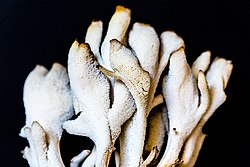
Grifola frondosa, also known as hen-of-the-woods, sheep's head,[2] ram's head, or maitake (舞茸, "dancing mushroom") in Japanese, is a polypore mushroom that grows at the base of trees, particularly old growth oaks or maples. It is native to China, Europe, and North America.

It is an edible mushroom long used in East Asian cuisine and studied for its potential health benefits, though no high-quality clinical evidence supports its medicinal use.

Description

[edit]

Like the sulphur shelf mushroom, G. frondosa is a perennial fungus that often grows in the same place for several years in succession.

G. frondosa grows from an underground tuber-like structure known as a sclerotium, about the size of a potato.[2] The fruiting body, individually up to 10 centimetres (4 in) across but whole clumps up to 50 cm (20 in),[3] rarely 150 cm (60 in), is a cluster consisting of multiple grayish-brown caps which are often curled or spoon-shaped, with wavy margins and 2–10 cm (1–4 in) broad.[4] The undersurface of each cap bears about one to three pores per millimeter, with the tubes rarely deeper than 3 mm (18 in).[4] The cream-coloured stipe (stalk) has a branchy structure[5] and becomes tough as the mushroom matures.[citation needed][6]

In Japan, the maitake can grow to more than 45 kilograms (100 pounds).

Similar species

[edit]

G. frondosa is a very distinct mushroom except for its cousin, the black staining mushroom, which is similar in taste but rubbery. Edible species which look similar to G. frondosa include Meripilus sumstinei (which stains black), Sparassis spathulata[7] and Laetiporus sulphureus, another edible bracket fungus that is commonly called chicken of the woods or "sulphur shelf". Polyporus umbellatus has distinct roundish caps.[5]

Distribution and habitat

[edit]

It is native to China, Europe (August to October),[3] and eastern North America[8] (from September to October).[5]

It occurs most prolifically in eastern North America, but has been found as far west as Idaho.[2]

Uses

[edit]

The species is a choice edible mushroom,[9] especially the young caps when slow cooked, although some may be allergic to it.[2] The softer caps must be thoroughly cooked.[4] It can also be pickled.[2]

Maitake has been consumed for centuries in China and Japan[10] where it is one of the major culinary mushrooms.[citation needed] The mushroom is used in many Japanese dishes, such as nabemono.[citation needed]

Research

[edit]

Although under laboratory and preliminary clinical research for many years, particularly for the possible biological effects of its polysaccharides, there are no completed, high-quality Phase III clinical studies for the species as of 2019.[10][11]

There are reviews of D-faction extracted from Maitake, including completed Phase I/II clinical trial demonstrating that "Treatment with sulfated polysaccharide obtained from Grifola frondosa (S-GFB) resulted in apoptosis of HepG2 cells", and "In a phase I/II trial of breast cancer survivors, Grifola frondosa extract acted as an immunomodulator." Same trial has concluded: "There appears to be no “maximum dose”, only “optimal dose” depending on the immunologic endpoint."[1]

See also

[edit]

References

[edit]
[edit]
Revisions and contributorsEdit on WikipediaRead on Wikipedia
from Grokipedia
Grifola frondosa, also known as hen-of-the-woods, sheep's head, ram's head, or maitake (舞茸, "dancing mushroom") in Japanese, is a renowned for its large, rosette-forming fruiting bodies that emerge in clusters at the base of trees, particularly oaks and maples, resembling a clustered hen or leafy fronds. It is native to China, Europe, and eastern North America.

Taxonomy and Classification

Grifola frondosa belongs to the phylum , class , order , family Meripilaceae, and . The species was first described as Agaricus frondosus by James Dickson in 1785 and later reclassified into the Grifola by Frederick Gray in 1821. It is a distinguished by its poroid hymenophore, featuring small pores on the underside of its caps rather than gills.

Morphology and Identification

The fruiting body of G. frondosa typically measures 15–60 cm across and 10–40 cm high, consisting of numerous overlapping, fan-shaped caps (3–14 cm wide) arranged in tiers on a branched, central stipe. The caps are wavy-edged, with a smoky gray-brown to dark tan coloration that lightens to pale gray or yellowish with age, and the pore surface starts lavender-gray before turning white, with 1–3 pores per millimeter. The flesh is white, firm, and unchanging when cut, while the spores are white, , and measure 4–6 × 3–4 µm. Young specimens have a pleasant , but older ones may develop an acrid and sickly smell.

Habitat and Ecology

This fungus is primarily found in northern temperate regions, including eastern , , and parts of such as , often at higher elevations in subtropical areas. It grows as a weakly parasitic or saprobic organism on the bases of living or dead trees, especially oaks (Quercus spp.), but also beeches, maples, and other species, causing white butt rot that decays the heartwood. Fruiting occurs annually in late summer to fall, with clusters reappearing in the same locations year after year until the host tree declines. In Britain and , it is uncommon and localized, often associated with .

Culinary and Medicinal Significance

G. frondosa is highly prized as an when young and tender, with a rich, earthy flavor; mature specimens become tough and are best avoided. In , known as maitake ("dancing "), it is cultivated commercially on substrates and valued in . Nutritionally, the dry fruiting body contains 1–2% protein, low fat (0.1–0.2%), and 6–7% carbohydrates, along with vitamins like D2 (8–15 IU/g) and minerals such as , , and calcium. It is rich in bioactive , particularly β-glucans, which have been studied for potential immunomodulatory and anticancer properties in preclinical research. However, while traditionally used in , robust clinical evidence for human health benefits remains limited.

Taxonomy

Etymology and nomenclature

The scientific name Grifola frondosa derives from Latin and Greek roots reflecting the mushroom's distinctive morphology. The genus name Grifola is derived from the mythical griffin, a creature with the body of a and the head and wings of an eagle, likely alluding to the fungus's clustered, overlapping structure that evokes the beast's mane or wings. The specific epithet frondosa means "leafy" or "frond-like" in Latin, referring to the tiered, branching caps that resemble foliage. Grifola frondosa was first described in 1785 by Scottish botanist James Dickson as Boletus frondosus in his work Fasciculus plantarum cryptogamicarum Britanniae. In 1821, English botanist Samuel Frederick Gray reclassified it into the new genus Grifola, establishing the current binomial nomenclature Grifola frondosa. This transfer recognized its polypore characteristics, distinguishing it from boletes. The fungus is known by several common names across cultures, each tied to its appearance or historical value. In English, it is called "hen of the woods" due to the clustered, ruffled form resembling a sitting hen. In Japan, it is maitake, meaning "dancing mushroom," a name originating from legends of foragers dancing in joy upon discovery, given its rarity and culinary worth in northeastern Japan and China. In Chinese, it is hui shu hua (灰树花), translating to "gray tree flower," reflecting its grayish tones and floral, branching growth at tree bases.

Classification and phylogeny

Grifola frondosa is classified within the kingdom Fungi, phylum , class , order , family Grifolaceae, and genus Grifola. Note that some classifications place the genus in Meripilaceae, reflecting ongoing revisions in Polyporales . This placement reflects its position among the basidiomycete fungi, particularly the polyporoid group characterized by poroid hymenophores and woody substrates. As the type species of the genus Grifola, established by Samuel Frederick Gray in 1821, G. frondosa serves as the nomenclatural benchmark for the genus, with its basionym Boletus frondosus originating from Dickson's 1785 description. Other synonyms include Polyporus frondosus (Fr. 1821) and Caloporus frondosus (Quél. 1888), reflecting historical reclassifications from earlier genera like Boletus and Polyporus. Phylogenetic studies using (ITS) and large subunit (LSU) rDNA sequences have firmly positioned G. frondosa within the of , confirming its close evolutionary ties to other wood-decaying basidiomycetes. These molecular analyses reveal G. frondosa clustering in a monophyletic group with congeners, showing particularly strong relatedness to Grifola sulcata based on shared sequence similarities in ITS and LSU regions. Recent 2024 research integrating morphological and multi-locus molecular data (including ITS and LSU) has identified two novel Grifola species from , , expanding the genus's diversity while underscoring G. frondosa's basal position in Asian and North American lineages. Such studies highlight genetic partitions, such as those separating eastern North American and Asian isolates, driven by historical biogeographic events.

Description

Macroscopic characteristics

Grifola frondosa produces a that forms a clustered rosette or fan-shaped structure, typically measuring 15–60 cm across and 7.5–40 cm high, composed of multiple overlapping, imbricate caps arising from a shared branched base. The overall form is fleshly to tough, resembling a or hen's feathers, with individual caps that are petaloid or flabelliform. The caps are irregular and fan-shaped, ranging from 3–15 cm wide, with wavy or undulating margins and a surface that is finely velvety, tomentose, or glabrous, often displaying vague concentric zones. Colors vary from pale lavender-gray or cream when young to darker gray-brown, olive, or dull dark brown with age, sometimes yellowing or staining yellowish. The underside features a pore surface that is ivory white to pale cream, with angular to slot-like pores numbering 1–4 per mm, and tubes 1–3 mm deep that are decurrent onto the stipe. The stipe is short, multi-branched, and often partially buried at the base of trees, measuring 2.5–10 cm tall and up to 10 cm wide at the base, with a white to cream or tan coloration and a tough texture. The flesh is white to pale cream, firm and elastic or soft when young, becoming tougher or more fibrous with maturity, and unchanging when cut. It has an earthy or nutlike and a mild, pleasant taste when fresh. The is white.

Microscopic characteristics

The microscopic characteristics of Grifola frondosa are key for confirmatory identification, particularly through examination of its reproductive and structural elements. The spores are , measuring 4–6 × 3–4 µm, , smooth, inamyloid. Basidia are 4-spored and club-shaped, typically 20–30 μm long, serving as the spore-bearing structures on the hymenial surface. The hyphal system is dimitic, comprising generative hyphae (thin-walled, branched, with clamp connections) and binding hyphae (thick-walled, highly branched for cohesion). Clamp connections are present on the generative hyphae, facilitating dikaryotic growth. No cystidia are present in the hymenium or context, a feature consistent across specimens and underscoring the fungus's reliance on basidia for spore production.

Similar species

Grifola frondosa can be confused with several other polypore fungi due to their similar clustered growth at the base of trees, but distinct morphological features allow for differentiation. One common look-alike is Meripilus sumstinei, known as the black-staining polypore, which forms rosettes of overlapping caps like G. frondosa but has larger individual caps (5-20 cm across) with flatter profiles and smaller pores (typically 6–8 per mm). Unlike G. frondosa, the cap surfaces and context of M. sumstinei bruise dark brown to black when handled or injured, and its pore surface is whiter when young. This species primarily grows on hardwoods such as oaks, though it occasionally appears on conifers. Another potential mimic is , or Berkeley's polypore, which produces large, shelf-like clusters up to 60 cm across at the base of trees, often resembling the frondose structure of G. frondosa. However, B. berkeleyi features broader, cream to white caps with minimal zoning and no dark brown coloration, and its flesh is thicker yet tougher and more leathery at maturity compared to the softer, grayish-brown fronds of G. frondosa. The caps of B. berkeleyi lack the intricate branching and leaf-like overlapping seen in G. frondosa, appearing more tiered and bracket-like. It occurs on both hardwoods and conifers, particularly oaks and beeches. In , Grifola sulcata is sometimes encountered as a close relative or variant of G. frondosa, characterized by caps with more pronounced sulcate (grooved) margins and surfaces. Distinction between these often requires molecular analysis, as morphological differences alone may be subtle; phylogenetic studies reveal genetic partitions between European and North American populations of the Grifola complex. While G. frondosa, M. sumstinei, and B. berkeleyi are all considered edible (though M. sumstinei and older B. berkeleyi specimens can be tough), foragers should confirm identification through microscopic examination of spores and hyphae to avoid confusion with toxic polypores such as certain Ganoderma species, which have varnished surfaces and cause bitter reactions.

Habitat and ecology

Distribution

Grifola frondosa is native to temperate regions of the , with its primary distribution spanning eastern , , and . In eastern , the fungus occurs from as far south as Georgia northward to Newfoundland, favoring forests in areas with suitable climatic conditions. Across , it is widespread in temperate zones, extending into the southern boreal forests of , where it associates with mature trees. In , populations are established in countries such as , , and Korea, particularly in temperate woodlands supporting and related hardwoods. Beyond its native range, G. frondosa has been reported in non-native areas due to activities, including cultivation escapes. In , occurrence records indicate the presence of populations, likely stemming from commercial cultivation efforts. The fruiting bodies typically emerge in autumn within the , with peak occurrences from to , triggered by cooler temperatures and adequate moisture following summer. Conservation assessments classify G. frondosa as Least Concern at the global level according to the IUCN Fungal Red List from , reflecting its broad distribution and relative abundance in suitable habitats. However, regional declines have been noted in parts of , where it is considered Near Threatened, primarily attributed to habitat loss from and affecting old-growth forests.

Ecological interactions

Grifola frondosa primarily exhibits a , functioning as a of and in the roots and butt wood of hardwood trees. It causes a white butt rot that slowly advances in infected trees, breaking down and facilitating nutrient release into the . This is most commonly associated with oaks (Quercus spp.) and maples (Acer spp.), and also occurs on other hardwoods such as beeches (Fagus spp.). Additionally, it acts as a weak parasite on living trees, deriving nutrients from roots without immediately killing the host, which contributes to gradual wood decay processes. While not forming true mycorrhizal symbioses, G. frondosa maintains weak parasitic associations with , indirectly aiding nutrient cycling by enhancing and enrichment in forest ecosystems. Through its role in wood decay, the plays a key part in maintaining by recycling carbon and other nutrients, improving , and supporting overall forest dynamics. It serves as a source for various , including that infest its fruiting bodies and small mammals that consume them. In its natural , G. frondosa prefers old-growth forests with minimal human disturbance, where it fruits at the bases of mature hardwoods. Fruiting occurs optimally at temperatures between 10°C and 20°C, aligning with cooler autumn conditions in temperate regions.

Cultivation

Historical development

Grifola frondosa, known as the maitake , has been foraged in for millennia, with its earliest documented references appearing in ancient Chinese texts. It is described in the Shen Nong Ben Cao Jing, a foundational work of dated to around 200 BCE–200 CE, where it is referred to as keisho and noted for improving spleen and ailments, calming the nerves, and treating , establishing its role in early medicinal practices across . In , initial efforts to cultivate G. frondosa emerged in the , driven by growing interest in domesticating wild edibles amid post-war concerns and rising demand for its nutritional and therapeutic properties. These early experiments focused on basic substrate using logs and , though success was limited by the fungus's challenging growth requirements, such as specific temperature fluctuations and levels that mimic its . By the late , small-scale trials had yielded inconsistent fruiting bodies, paving the way for more systematic research. A pivotal commercial breakthrough occurred in the 1980s when Yukiguni Maitake Co., Ltd., established in 1983, achieved the first successful indoor cultivation of G. frondosa in . This innovation involved controlled-environment techniques, including sterilized bag cultures with supplemented hardwood substrates, enabling year-round production and addressing the scarcity of wild harvests. The development was largely motivated by escalating demand for maitake extracts in medicinal applications, particularly for immune-modulating beta-glucans, which spurred Japan's maitake industry from experimental to industrial scale by the mid-1980s. The global expansion of G. frondosa cultivation accelerated in the 2000s with its introduction to North American markets, where pioneering growers like Gourmet Mushrooms Inc. adapted Japanese methods to local hardwoods like and . This period saw the establishment of commercial farms and , fueled by interest in both culinary and health supplements, leading to increased availability beyond wild . More recently, in , wild-simulated cultivation techniques—entailing spawn of forest logs to replicate natural conditions—have been documented in , enhancing sustainable production while preserving ecological integration. As of 2023, produced approximately 32,856 tons annually, primarily in provinces like , , and , underscoring its growing role in global supply.

Modern techniques

Modern cultivation of Grifola frondosa relies on optimized substrate-based systems to achieve consistent yields under controlled conditions. Substrate preparation centers on hardwood sawdust, with oak being the preferred base due to its compatibility with the fungus's natural lignicolous habits, supplemented by 20-35% wheat bran, soybean hulls, or cornmeal to enhance nutrient availability and mycelial growth. The mixture is hydrated to 60-65% moisture content—verified by a squeeze test yielding 1-2 drops of water—and packed into polypropylene bags or jars at 1-2 kg per unit. Sterilization follows via autoclaving at 121°C and 15 psi for 2-2.5 hours to prevent contamination, after which the substrate cools to room temperature before use. Inoculation involves introducing grain spawn or liquid inoculum at 5-10% of the wet substrate weight, typically in a sterile environment like a laminar flow hood to minimize bacterial introduction. Incubation occurs at 20-25°C in darkness with 60-65% for 6-12 weeks (often 2-3 months), allowing full mycelial colonization evidenced by uniform white growth throughout the substrate. Fruiting initiation requires transferring colonized blocks to a dedicated chamber at 15-18°C, with 85-95% relative , 500-1000 indirect light on a 12-hour cycle, and CO₂ levels below 1000 ppm through regular ventilation; primordia form within 1-2 weeks, maturing into harvestable clusters in another 1-2 weeks, potentially yielding multiple flushes. Wild-simulated cultivation, particularly log inoculation in forested settings, offers an alternative to indoor bag culture and remains prevalent in , where oak or broadleaf logs (10-15 cm diameter) are drilled, inoculated with spawn, sealed, and buried or stacked in shaded woods for natural fruiting over 1-3 years. This method mimics ecological conditions but yields lower predictability compared to controlled greenhouses, where optimized indoor protocols achieve biological efficiencies supporting up to 200 g of fresh mushrooms per kg of dry substrate across flushes. Studies in , including those on log inoculation techniques, emphasize sustainable production in rural forests using low-input methods, complementing high-volume factory systems. Cultivation faces challenges from pathogens, notably bacterial spot disease, exemplified by infections from aryabhattai (formerly associated with Pseudomonas-like symptoms) identified in Chinese farms. This results in necrotic spots on fruiting bodies, slashing yields by 20-50% if unchecked. employs sterile techniques during , such as UV-treated environments and filtered air, alongside post-emergence applications of copper-based fungicides (e.g., at 0.1-0.5% solutions) or biocontrol agents like extracts, which inhibit bacterial growth with inhibition zones up to 34 mm. Ongoing refinements, including strain selection for resistance, further bolster resilience in modern protocols.

Uses

Culinary applications

Grifola frondosa, commonly known as maitake or hen of the woods, is prized in culinary contexts for its earthy, umami-rich flavor profile, which arises from compounds such as , , and 5’-nucleotides. When young, the mushroom exhibits a meaty, chewy texture that becomes more tender and juicy upon cooking, making it an excellent substitute in vegetarian dishes. This semi-firm structure holds up well to various heat applications, though older specimens can toughen and are best sliced thinly or braised. Nutritionally, maitake mushrooms are low in calories, providing 31 calories per 100-gram serving of raw fruiting bodies, while being high in (2.7 grams per 100 grams) that supports digestive health. They offer notable amounts of , including niacin (providing about 41% of the daily value per 100 grams) and vitamin B2, along with (up to 28 micrograms per 100 grams when sun-exposed) and minerals such as . These attributes make maitake a nutrient-dense addition to meals, particularly when sautéed, roasted, or incorporated into soups to enhance flavor without adding significant fat or sodium. In traditional , maitake is often prepared as , where clusters are lightly battered and deep-fried to achieve a crispy exterior that contrasts with the tender interior, typically served with soy-based dipping sauces. In Italian-inspired recipes, it features in risottos, where finely chopped maitake is stirred into with and cheeses to absorb notes. For preservation, the mushrooms can be dried to concentrate flavors for later use in stocks or powders, or pickled in to retain a tangy crunch suitable for salads and antipasti. Additional preparations include as "steaks" seasoned with or stir-frying in Asian-style dishes with and . Safety considerations are important when preparing maitake, as raw consumption can lead to digestive upset due to the indigestible in fungal cell walls, which cooking breaks down for better tolerability. It is recommended to harvest or select young specimens, clean them thoroughly by rinsing in cold water and trimming any dirt, and always cook them fully—via sautéing, frying, or stewing—to eliminate potential microbial risks and bitterness.

Medicinal properties

Grifola frondosa, known as maitake in Japanese and hui shu hua in (TCM), has been utilized for centuries as a tonic to support function, which in TCM is associated with , energy production, and overall . In TCM, it is traditionally employed to tonify the spleen and meridians, addressing conditions related to deficiency and excess dampness, thereby promoting balanced energy flow and resilience against illness. Traditional applications also emphasize its role in immune modulation, where it is revered for enhancing the body's defensive to ward off invasions of external pathogens and bolster long-term . For metabolic support, it has been used to regulate blood sugar levels, aiding in the management of symptoms linked to spleen deficiency, such as and poor assimilation. Additionally, established practices attribute cholesterol-lowering effects to its ability to harmonize liver and functions, contributing to cardiovascular equilibrium. In terms of potential anti-cancer properties, traditional lore highlights its immune-stimulating effects, particularly through beta-glucans that activate natural killer cells and macrophages to support the body's innate defenses against abnormal growths. For antidiabetic benefits, it is valued for potentially lowering by improving , aligning with its spleen-tonifying heritage. These effects are commonly accessed through various forms, including hot water extracts, teas brewed from dried fruiting bodies, and powdered supplements standardized for . Herbal traditions recommend a daily dosage of 3-7 grams of dried Grifola frondosa, often divided into multiple administrations to optimize absorption and minimize digestive upset. Research has also explored the potential of Grifola frondosa extracts for supporting female fertility, particularly in women with polycystic ovary syndrome (PCOS). A 2010 prospective clinical study involving 80 PCOS patients found that the SX-fraction (MSX) of maitake extract induced ovulation in 76.9% of patients receiving it as monotherapy and was effective as an adjunct therapy for those unresponsive to clomiphene citrate, with ovulation rates of 41.7% in treatment cycles. This effect may be linked to improvements in insulin resistance, a key factor in PCOS-related hormonal imbalances. However, while promising, these findings are based on a single study, and robust clinical evidence from larger, more recent trials remains limited.

Research

Bioactive compounds

Grifola frondosa contains a variety of bioactive compounds, primarily , terpenoids, phenolics, and , which contribute to its pharmacological potential. These components are extracted from both fruiting bodies and , with being the most studied for their structural diversity and biological activities. , particularly s, represent a major class of bioactive molecules in G. frondosa, comprising approximately 13.2% of the dry weight as (1→3, 1→6)-β-D-glucans in water-soluble fractions. Notable examples include the MD-fraction, a highly purified soluble with a glucan-to-protein ranging from 80:20 to 99:1, derived from fruiting bodies and , known for its immunomodulatory effects through of immune cells such as natural killer cells. Another key is grifolan, a (1→6)-branched (1→3)-β-D-glucan with a molecular weight of about 500 kDa, isolated from , which exhibits antitumor properties by stimulating production and activity. Terpenoids in G. frondosa include , a serving as a precursor to upon UV exposure, present in both fruiting bodies and , with demonstrated antitumor and activities. Triterpenes, another subclass, contribute anti-inflammatory and anticancer effects, though specific structures and concentrations vary across samples. Other bioactive compounds encompass phenolics, such as (e.g., naringenin, hesperidin) and phenolic acids (e.g., , ), which provide protection primarily in fruiting body extracts. , including GFL with molecular weights of 30-52 , are glycoproteins isolated from fruiting bodies that display antitumor . Extraction methods for these compounds typically involve hot water for , yielding soluble beta-glucans like the MD-fraction through subsequent , while alkaline or ultrasonic techniques enhance recovery of other fractions. Variability in compound content is notable, with fruiting bodies containing higher levels of carbohydrates (70-80% dry weight) and thus richer in beta-glucans compared to (57.2% carbohydrates dry weight).

Recent studies

In 2024, morphological and molecular phylogenetic analyses identified two new species within the Grifola genus, G. edulis and G. sinensis, from Yunnan Province, , based on combined ITS and nLSU rDNA sequences that resolved distinct clades separate from G. frondosa. These findings refine species delineation in the genus, highlighting genetic divergence in East Asian populations and necessitating updated taxonomic keys for accurate identification in ecological and cultivation contexts. A 2025 study isolated and identified Priestia aryabhattai as the causative agent of bacterial spot disease in cultivated Grifola frondosa, causing primordial arrest and stipe lesions through 16S rRNA and gyrB gene sequencing. Effective prevention strategies include chemical agents like benziothiazolinone and copper sulfate (EC50 values below 5 mg/L) and biocontrol with Chlorophyllum molybdites, which inhibited pathogen growth by up to 45 mm in vitro assays, supporting integrated disease management in commercial production. A 2025 review on the anti-tumor activity of bioactive compounds from edible and medicinal mushrooms, including G. frondosa-derived β-glucans, highlights their role as adjunct cancer therapies through enhanced natural killer (NK) cell activity and increased IFN-γ production in patients with advanced malignancies when combined with . In parallel, animal model studies (2024–2025) reveal antidiabetic effects, where G. frondosa polysaccharides (e.g., GFP) reduced in high-fat diet-induced diabetic mice by modulating composition, lowering fasting blood glucose by 25–30%, and upregulating expression by over 2-fold. Global production of G. frondosa reached an estimated value exceeding $200 million in 2025, with leading as the primary producer through sustainable wild-simulated cultivation on logs, accounting for over 60% of output and emphasizing reduced chemical inputs to preserve and . These trends underscore a shift toward eco-friendly methods amid rising demand for medicinal extracts, with markets projecting 8–10% annual growth through 2030.

References

Add your contribution
Related Hubs
User Avatar
No comments yet.