


Community hub
Recent from talks
Contribute something
Nothing was collected or created yet.
Maithils
View on Wikipedia
The Maithils (Devanagari: मैथिल), also known as Maithili people, are an Indo-Aryan cultural and ethno-linguistic group from the Indian subcontinent, who speak the Maithili language as their native language.[2] They inhabit the Mithila region,[3] which comprises Northern and Eastern Bihar and Northeastern Jharkhand in India[4][5] & in Nepal constituting Madhesh Province in addition to some Terai districts of Bagmati and Koshi Provinces.[6]
Key Information


The Mithila region forms an important part of Hinduism as it is said to be the birthplace of Sita, the wife of Ram and incarnation of Lakshmi.[7]
History
[edit]Vedic period
[edit]Mithila first gained prominence after being settled by Indo-Aryan speaking peoples who established the Videha kingdom. During the late Vedic period (c. 1100–500 BCE), Videha became one of the major political and cultural centers of South Asia, along with Kuru and Pañcāla. The kings of the Videha Kingdom were called Janakas.[8]
The Videha Kingdom later became incorporated into the Vajjika League which was based in Vaishali.[9] The Licchavis of Vaishali were one of the constituent tribes of the Vajjika league and the territory of the Licchavis formed a single territorial unit along with Videha and Mallakas. The Licchavis remained in Vaishali up to the Gupta period with the fourth century A.D. Gupta Emperor, Samudragupta, being the son of a Licchavi princess from Vaishali.[10][11]
Medieval period
[edit]From the 11th century to the 20th century, Mithila was ruled by various indigenous dynasties. The first were the Karnatas of Mithila who ruled from 1097-1324 A.D. They were followed by the Oiniwar dynasty who ruled from 1325–1526 A.D.[12]
During the Mughal-era, Mithila was controlled by a dynasty of zamindars called the Raj Darbhanga who were tributaries to the Mughals.[13] It was during this period that the capital of Mithila was moved to Darbhanga.[14][15]
Maithili-speaking dynasties and kingdoms
[edit]- Karnat dynasty, 1097 CE–1324 CE[16]
- Oiniwar dynasty, 1325 CE–1526 CE[17]
- Dronwara Dynasty, 14th–15th century CE[18]
- Raj Darbhanga, 1557 CE −1947 CE[19]
- Malla dynasty, 1201 CE-1779 CE[20]
- Senas of Makwanpur, 1518 CE –1762 CE[21]
Region
[edit]India
[edit]Majority of Maithils normally reside north of the Ganges; based around Darbhanga and the rest of North Bihar.[22][2] Native Maithili speakers also reside in Delhi, Kolkata, Patna, Ranchi and Mumbai.[23]
Indian Mithila comprises Tirhut, Munger, Bhagalpur, Darbhanga, Kosi, and Purnia divisions of Bihar and Santhal Pargana division of Jharkhand.[4][2]
- Darbhanga in particular played an important role in the history of Mithila and is considered one of its "core centers". It was the center of Raj Darbhanga who ruled most of the region.[2][24]
- Madhubani also where Mithila painting originated from which is a major part of Maithili culture.[25]
- Sitamarhi is claimed by many to be the birthplace of Goddess Sita with Sita Kund being a major pilgrimage site.
- Balirajgarh, situated in present-day Madhubani district in Bihar is thought to be the capital of ancient Mithila Kingdom.[26]
- Maithils played a major role in building the Baidyanath Temple which is an important pilgrimage site for them.[27][28]
Nepal
[edit]
The adjoining districts of the eastern Terai form Nepalese Mithila.[29] This area was part of the kingdom of Videha.[30] The kingdom appears in the Ramayana. Many people claim Janakpur to be the birthplace of Goddess Sita but this is disputed as many consider Sitamarhi as her birthplace.[31]
There was a movement in the Madhesh region which is predominantly a Maithili community of Nepal for a separate province.[32] Province No. 2 was established under the 2015 Constitution, which transformed Nepal into a Federal Democratic Republic, with a total of 7 provinces. Province No. 2 (now Madhesh Province) has a Maithili speaking majority and consists of most of the Maithili speaking areas of Nepal. It has been demanded by some Mithila activists that Province No. 2 be named 'Mithila Province'.[33] Province no. 2 was given the name Madhesh Province on 17 January 2022.[34]
Language
[edit]
The common language of the Maithil people is Maithili,[2] which is one of the recognised regional languages of India listed in the Eighth Schedule of the Indian Constitution and the second national language of Nepal in the Interim Constitution of Nepal. The Tirhuta script, also known as the Mithilakshar script. However, during the 20th century most Maithili writers gradually adopted Devanagari script for Maithili.[36] Although Tirhuta is still sometimes used by religious pundits for writing ceremonial letters and documents, and efforts are underway to broaden the scope of its usage.[37]
Culture
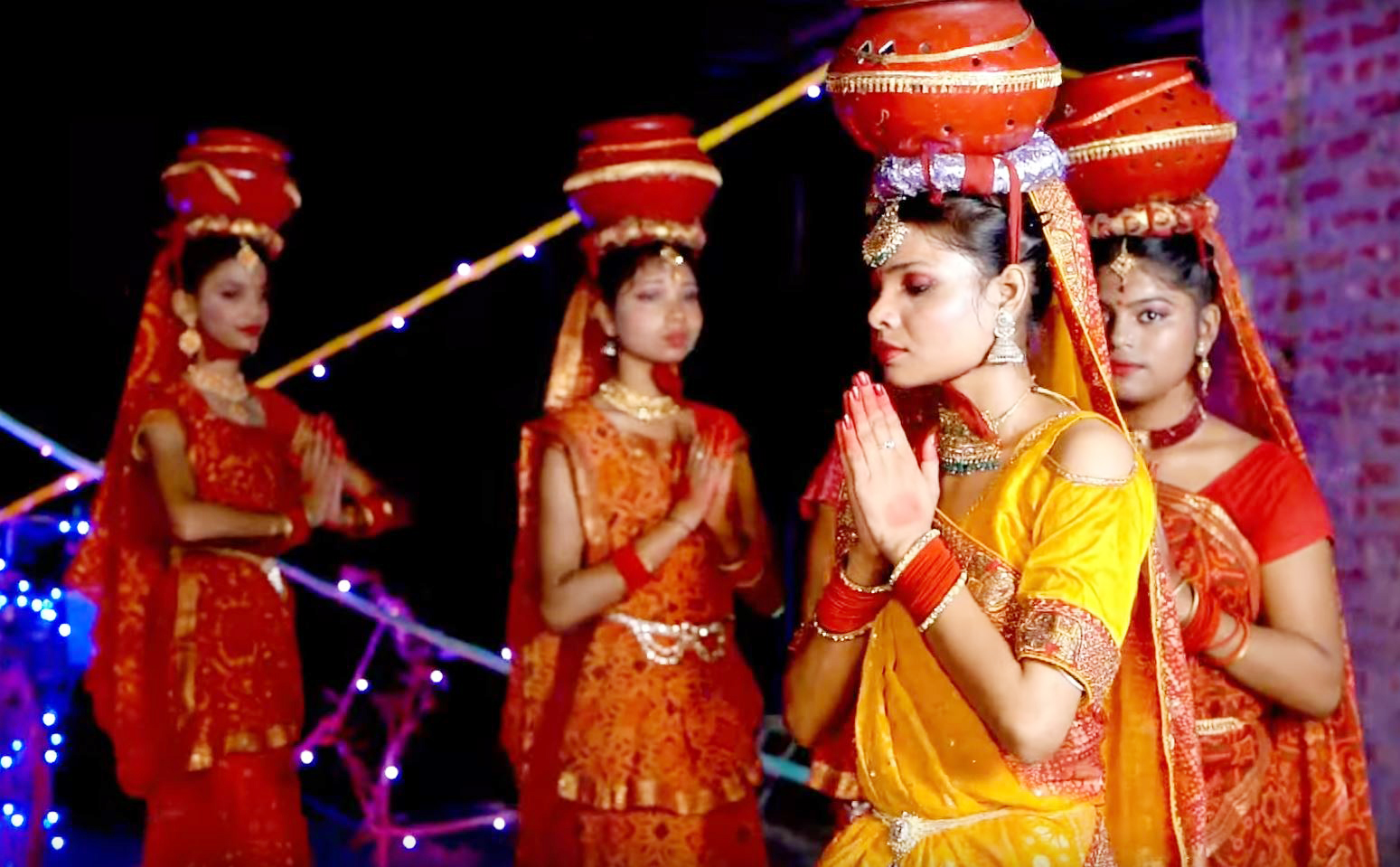
[edit]Men and women in Mithila are very religious and dress for festivals as well. The costumes of Mithila stem from the rich traditional culture of Mithila. Kurta and Dhoti with a Mithila Painting bordered Maroon coloured Gamchha which is the Symbol of Passion, Love, Bravery and Courage are common clothing items for men. Men wear a Gold ring on their nose which symbolizes prosperity, happiness and wealth inspired by Lord Vishnu. Also, wear a Balla on their wrist and Mithila Paag on their Head. In ancient times there was no colour option in Mithila, so the Maithil women wore white or yellow Saree with a red Border but now they have a lot of variety and colour options and wear Laal-Paara (the traditional red-boarded white or yellow Saree)[38] on some special occasions, and also wear Shakha-Pola[39] with a lanthi in their hand which is Mandatory to wear after marriage in Mithila. In Mithila culture, this represents new beginnings, passion and prosperity. Red also represents the Hindu goddess Durga, a symbol of new beginnings and feminine power. During Chhaith, the women of Mithila wear pure cotton dhoti without stitching which reflects the pure, traditional Culture of Mithila. Usually crafted from pure cotton for daily use and from pure silk for more glamorous occasions, traditional attire for the women of Mithila includes Jamdani, Banarisi, Bhagalpuri and many more. Many festivals are celebrated throughout the year in Mithila. Chhath Puja, Durga Puja and Kali puja is celebrated as perhaps the most important of all the celebrations of Mithila.

Household structure
[edit]Traditionally Maithils lived in Badaghars called longhouses with big families of many generations, sometimes 40–50 people. All household members pool their labour force, contribute their income, share the expenditure and use one kitchen.[40] In the courtyard of a Maithil family, there is a Dalaan for relaxation and gathering of the family members, relatives and close neighbours of the society in village. It is also used for cultural activities of the family and the neighborhood.
Religion
[edit]The religious practices of the Maithils is based on orthodox Hinduism as Mithila has historically been a principal seat of Hindu learning.[41] Apart from main stream Hinduism, there are some local traditions of worshiping Baraham Baba and Gosaun Devata by them. In every village of the Mithila region, there is at least one common worship place Brahma Sthan also known as Dihawar Sthan attached to an old pipal tree, where Brahma Baba is worshipped by the Maithils. Brahma Baba also called as Graama Devata is believed to be the protector God of the village.[42] Maharani Sthan is the other common worship place, where Goddess Bhagawati is worshipped by the Maithils. Similarly at every courtyards of the houses of Maithils, there is Gosaunik Ghar where Kuldevata and Kuldevi of the family is worshipped.[43]
Gallery
[edit]-
 Girl from Mithila region of Nepal and India
 -
 Maithil Girl
 -
 Women from Mithila
 -
 Women in Traditional dress of Mithila region
 -
 Women from Mithila region
 -
 Women from Mithilanchal


Politics
[edit]Maithils hold significant influence in the politics of both India and Nepal. They dominate the polity of Bihar, India's third most populous state, by virtue of their majority in 144 of the 243 constituencies of the Bihar Legislative Assembly.[2] Maithils are the largest ethnolinguistic group in the Nepalese Madhesh Province and the second largest ethnolinguistic group in Province No. 1.[44]
Notable people
[edit]The following are notable residents (past and present) of Mithila region:
Historical
[edit]

- Janaka, King of Mithila and Father in Law of King Rama.
- Sita, Princess of Mithila Kingdom and wife of King Rama.
- Udayanacharya, 10th/11th-century philosopher and logician of the Nyaya school.
- Vidyapati, 14th/15th century Maithili and Sanskrit poet-saint.
- Bhanudatta Misra, 15th/16th-century Sanskrit poet from Mithila.
- Harisimhadeva, King of Mithila during the Karnat dynasty from 1304 - 1324 CE.
- Gangadeva, King of Mithila during the Karnat dynasty from 1147-1187 CE.
- Narsimhadeva, King of Mithila during the Karnat dynasty from 1174-1227 CE.
- Ramasimhadeva, King of Mithila during the Karnat dynasty from 1227-1285 CE.
- Jyotirishwar Thakur, 14th-century poet, playwright and musician who composed the earliest prose work in the Maithili language, the Varna Ratnakara.
- Caṇḍeśvara Ṭhakkura, political theorist and general from the 14th century.
- Gaṅgeśa, 13th/14th century philosopher, logician and mathematician .
- Pakshadhara Mishra, 15th-century philosopher.
- Vāchaspati Misra, 9th/10th-century philosopher of the Advaita Vedanta tradition.
- Lakshmeshwar Singh, zamindar and principal landowner of Raj Darbhanga, 1860–1898.
- Rameshwar Singh, zamindar and principal landowner of Raj Darbhanga, 1898–1929.
- Śāriputra, 15th-century Indian Buddhist monk and the last abbot of the Mahabodhi Temple in Bodh Gaya. Born in Simraungadh in modern-day East Champaran district.
Modern
[edit]- Maghfoor Ahmad Ajazi, Indian Freedom fighter, political activist, social worker, poet and writer, born in Muzaffarpur[45][46]
- Bimalendra Nidhi, Member of Nepalese parliament, Vice president of ruling party Nepali Congress and former Deputy Prime Minister of Nepal.[47]
- Ramdhari Singh 'Dinkar' was an Indian Hindi poet, essayist, patriot and academic.[48]
- Bindheshwari Prasad Mandal was an Indian parliamentarian and social reformer who served as the chairman of the Second Backward Classes Commission (popularly known as the Mandal Commission).[49]
- C. K. Raut, formerly US-based computer scientist, author and political leader of Nepal.[50]
- Syed Shahnawaz Hussain, Indian politician, born in Supaul[51][52][53]
- Bhagwat Jha Azad was the Chief Minister of Bihar and a member of Lok Sabha.[54]
- Ram Baran Yadav, First president of Nepal
- Tarkishore Prasad, Deputy Chief Minister of Bihar, born in Saharsa district[55]
- Nagarjun, Renowned Maithili Poet
- Phanishwar Nath 'Renu', A prominent post-Premchand Hindi writer who deeply infused Maithili culture and ethos into his works.
- Acharya Ramlochan Saran, Hindi littérateur, grammarian and publisher
- Vaibhav Sooryavanshi, a young Indian cricketer who plays for Bihar in domestic cricket and Rajasthan Royals in the Indian Premier League
See also
[edit]References
[edit]Notes
- ^ "Demographics of Maithil population of Nepal".
- ^ a b c d e f Kumar Jha, Mithilesh (2017). Language Politics and Public Sphere in North India: Making of the Maithili Movement. Oxford University Press. pp. 37–45. ISBN 9780199091720.
- ^ Burman, B.K.R.; Chakrabarti, S.B. (1988). Social Science and Social Concern: Felicitation Volume in Honour of Professor B.K. Roy Burman. Mittal Publications. p. 411. ISBN 9788170990628. Retrieved 14 February 2017.
- ^ a b Jha, Pankaj Kumar (2010). Sushasan Ke Aaine Mein Naya Bihar. Bihar (India): Prabhat Prakashan. ISBN 9789380186283.
- ^ Brass, Paul R. (8 September 1994). The Politics of India Since Independence. Cambridge University Press. p. 184. ISBN 9780521459709. Retrieved 15 February 2017.
- ^ Gellner, D.; Pfaff-Czarnecka, J.; Whelpton, J. (2012). Nationalism and Ethnicity in a Hindu Kingdom: The Politics and Culture of Contemporary Nepal. Taylor & Francis. p. 251. ISBN 9781136649561. Retrieved 14 February 2017.
- ^ Minahan, J.B. (2012). Ethnic Groups of South Asia and the Pacific: An Encyclopedia: An Encyclopedia. ABC-CLIO. ISBN 9781598846607. Retrieved 14 February 2017.
- ^ Michael Witzel (1989), Tracing the Vedic dialects in Dialectes dans les litteratures Indo-Aryennes ed. Caillat, Paris, pages 13, 141–143
- ^ Raychaudhuri Hemchandra (1972), Political History of Ancient India, Calcutta: University of Calcutta, pp. 85–86
- ^ Jha, Hit Narayan (1970). The Licchavis of Vaishali. Chowkhamba Sanskrit Series. pp. 14–15.
- ^ Trautmann, Thomas (1972). "Licchavi-Dauhitra". The Journal of the Royal Asiatic Society of Great Britain and Ireland. 104 (1): 2–15. doi:10.1017/S0035869X0012951X. JSTOR 25203320.
- ^ Jha, Makhan (1997). Anthropology of Ancient Hindu Kingdoms: A Study in Civilizational Perspective. M.D. Publications Pvt. ISBN 9788175330344. Retrieved 11 December 2016.
- ^ Henning Brown, Carolyn (1988). "Raja and Rank in North Bihar". Modern Asian Studies. 22 (4): 757–782. doi:10.1017/S0026749X00015730. JSTOR 312524. S2CID 143084073.
- ^ Mandal, R. B. (2010). Wetlands management in North Bihar. Concept Publishing Company. ISBN 9788180697074. Retrieved 14 December 2016.
- ^ Jha, Makhan (1997). Anthropology of Ancient Hindu Kingdoms: A Study in Civilizational Perspective. M.D. Publications Pvt. ISBN 9788175330344. Retrieved 14 December 2016.
- ^ Sinha, CPN (1969). "Origin of the Karnatas of Mithila – A Fresh Appraisal". Proceedings of the Indian History Congress. 31: 66–72. JSTOR 44138330.
- ^ Pankaj Jha (20 November 2018). A Political History of Literature: Vidyapati and the Fifteenth Century. OUP India. ISBN 978-0-19-909535-3.
- ^ Rakesh, Ram Dayal (2005). Janakpur: The Sacred Jewel of Nepal. Safari Nepal. ISBN 978-99933-59-96-8.
- ^ Tahir Hussain Ansari (20 June 2019). Mughal Administration and the Zamindars of Bihar. Taylor & Francis. pp. 200–223. ISBN 978-1-00-065152-2.
- ^ Brinkhaus, Horst (1991). "The Descent of the Nepalese Malla Dynasty as Reflected by Local Chroniclers". Journal of the American Oriental Society. 111 (1): 118–122. doi:10.2307/603754. JSTOR 603754.
- ^ Das, Basudevlal (2013). "Maithili in Medieval Nepal : A Historical Apprisal". Academic Voices. 3: 1–3. doi:10.3126/av.v3i1.9704.
- ^ (India), Bihar; Choudhury, Pranab Chandra Roy (1957). "Bihar district gazetteers, Volume 17". p. 16. Retrieved 10 December 2016.
- ^ Maithils at Ethnologue (16th ed., 2009)

- ^ Jha, Makhan (1997). Anthropology of Ancient Hindu Kingdoms: A Study in Civilizational Perspective. M.D. Publications Pvt. p. 62. ISBN 9788175330344. Retrieved 10 December 2016.
- ^ Madhubani paintings. Abhinav Publications. 2003. ISBN 9788170171560. Retrieved 10 December 2016.
- ^ "नालंदा ने आनंदित किया लेकिन मिथिला के बलिराजगढ़ की कौन सुध लेगा ? – News of Bihar". NewsOfBihar.com. 16 July 2016. Archived from the original on 26 October 2017. Retrieved 26 October 2017.
- ^ Narayan, Sachindra (1 June 1983). "Sacred Complexes of Deoghar and Rajgir". Concept Publishing Company – via Google Books.
- ^ Kumāra, Braja Bihārī (1998). Small States Syndrome in India. Concept Publishing Company. p. 146. ISBN 9788170226918. Archived from the original on 17 February 2017. Retrieved 16 February 2017.
- ^ Bolduc, Benjamin; Hodgkins, Suzanne B.; Varner, Ruth K.; Crill, Patrick M.; McCalley, Carmody K.; Chanton, Jeffrey P.; Tyson, Gene W.; Riley, William J.; Palace, Michael; Duhaime, Melissa B.; Hough, Moira A.; Saleska, Scott R.; Sullivan, Matthew B.; Rich, Virginia I. (13 August 2020). "Supplemental Information 3: An excerpt from Data Downloads page, where users can download original datasets". PeerJ. 8: e9467. doi:10.7717/peerj.9467/supp-3.
- ^ Michael Witzel (1989), Tracing the Vedic dialects in Dialectes dans les litteratures Indo-Aryennes ed. Caillat, Paris, pages 13, 17 116–124, 141–143
- ^ Gellner, D.; Pfaff-Czarnecka, J.; Whelpton, J. (6 December 2012). Nationalism and Ethnicity in a Hindu Kingdom. Routledge. ISBN 9781136649561. Retrieved 8 December 2016.
- ^ Burkert, C. (2012). "Defining Maithil Identity". In Gellner, D.; Pfaff-Czarnecka, J.; Whelpton, J. (eds.). Nationalism and Ethnicity in a Hindu Kingdom: The Politics and Culture of Contemporary Nepal. London, New York: Routledge. pp. 241–273. ISBN 9781136649561. Archived from the original on 20 August 2017.
- ^ "Samiti vows to protest for Mithila Province".
- ^ "Province 2 endorses Madhes as its name, Janakpurdham as provincial capital". kathmandupost.com. Retrieved 2022-04-28.
- ^ Jyotiśvara. (1998). Varṇa-ratnākara of Jyotiriśvara of Kaviśekharācārya. New Delhi: Sahitya Akademi. pp. ix. ISBN 81-260-0439-8. OCLC 40268712.
- ^ Chaudhary, Pranava (May 22, 2011). "US scholar's project of encoding Tirhuta script into digital media". The Times of India. Archived from the original on April 5, 2012. Retrieved 26 July 2013.
- ^ "ScriptSource - Tirhuta". scriptsource.org. Retrieved 2025-10-10.
- ^ Maithil women wore Red Boarded Yellow or White Saree during Jhijhiya Naach. Retrieved 27 March 2017.
- ^ "Mithila as well as Bengal wearing शाखा पोला" www.jhajistore.com". Retrieved 12 August 2019.
- ^ Lam, L. M. (2009). "Park, hill migration and changes in household livelihood systems of Maithils in Central Nepal" (PDF). University of Adelaide. Archived from the original (PDF) on 2011-09-28.
- ^ Vidyabhusana, Satis Chandra (1988). A History of Indian Logic: Ancient, Mediaeval and Modern Schools. Motilal Banarsidass Publishers. ISBN 9788120805651. Retrieved 8 December 2016.
- ^ "मिथिलाक लोक देवता डिहवार ,ब्रह्मबाबा". Maithil Manch. Retrieved 2024-11-18.
- ^ Chaudhary, Radhakrishna. Mithilak Itihas (in Hindi). Ram Vilas Sahu. p. 212. ISBN 978-93-80538-28-0.
- ^ "Official status sought for Maithili in Province 2". 26 December 2017.
- ^ Ministry of Culture, Government of India. "Maghfoor Ahmad Ajazi". amritmahotsav.nic.in.
- ^ Sajjad, Mohammad (6 January 2013). "Maghfur Aijazi: A freedom-fighter and a builder of Indian democracy". TwoCircles.net. Retrieved 5 March 2015.
- ^ "Nidhi appointed NC Vice-Prez, Khadka Gen Secy". kathmandupost.com. Retrieved 2022-01-15.
- ^ "Ramdhari Singh Dinker - Hindi ke Chhayavadi Kavi". www.anubhuti-hindi.org. Retrieved 2020-04-26.
- ^ Nitish Kumar and the Rise of Bihar. Penguin Books India. 2011-01-01. ISBN 9780670084593.
- ^ "" मुख्य समाचार " :: नेपाल ::". Ekantipur.com. 24 May 2015. Archived from the original on 4 July 2015. Retrieved 28 May 2015.
- ^ IANS (10 December 2013). "BJP's Shahnawaz Hussain on IM hit list". Business Standard India. Archived from the original on 26 October 2017. Retrieved 26 October 2017 – via Business Standard.
- ^ "BJP leader Shahnawaz Hussain's impersonator arrested". NDTV.com. Archived from the original on 19 December 2013. Retrieved 26 October 2017.
- ^ "PM's 'lack' of leadership has made UPA 'sinking ship': BJP". NewIndianExpress.com. Archived from the original on 4 March 2016. Retrieved 26 October 2017.
- ^ "8th Lok Sabha – Members Bioprofile – AZAD, SHRI BHAGWAT JHA". Archived from the original on 6 October 2011. Retrieved 6 August 2011.
- ^ "I want self-reliant Bihar; Sushil Modi is our guardian, says new deputy CM Tarkishore Prasad". 19 November 2020.[permanent dead link]

Bibliography
[edit]- Alan R. Beals & John Thayer Hitchcock (1960). "Field Guide to India". India: National Academies.


Maithils
View on GrokipediaHistory
Ancient Origins
The ancient origins of the Maithils are rooted in the Vedic-era Videha kingdom, encompassing the Mithila region in the eastern Gangetic plains. Literary evidence from the Shatapatha Brahmana (Kanda 1, Adhyaya 4, Brahmana 1, sections 10-17) describes a migration led by the chieftain Videgha Mathava (also Māthava Videgha) from the Sarasvati River valley westward of the Yamuna to the Sadanira River (modern Little Gandak), where his priest Gotama Rahugana performed rituals to extend Aryan cultural influence eastward. This narrative, composed in the late Vedic period (circa 800–600 BCE), symbolizes the expansion of Indo-Aryan settlements into forested and marshy territories, clearing land for agriculture and establishing Videha as a distinct realm identified with Mithila.[7] The text portrays Videgha halting at the Sadanira due to divine instruction from Agni, marking the eastern limit of early Vedic geography at that time. Subsequent Vedic texts, including the Yajurveda Samhita and Brihadaranyaka Upanishad, reference Videha as a kingdom with philosophical and ritual significance, ruled by kings like Janaka, who engaged in debates with sages such as Yajnavalkya. These sources, dating to circa 1000–500 BCE, depict Videha-Mithila as a center of Brahmanical learning amid Indo-Aryan tribal expansions, distinct from core Vedic heartlands like Kuru-Panchala. The region's inhabitants, precursors to the Maithils, comprised Indo-Aryan groups alongside possible pre-existing non-Aryan populations, as inferred from the gradual assimilation described in migration accounts; however, no direct archaeological corroboration exists for this specific Vedic polity, with evidence limited to general Iron Age settlements in the Gangetic plains from circa 1000 BCE. Maithil Brahmin traditions later retroactively link their lineages to these Videha settlers, emphasizing continuity through genealogical records (pañjī) that associate them with ancient Mithila as the homeland of Sita from the Ramayana.[2][8] Archaeological data for ancient Mithila remains sparse, with no monumental sites definitively tied to Videha kings; excavations in north Bihar reveal Neolithic-Chalcolithic continuity from circa 2000 BCE but lack inscriptions or artifacts naming Videha until later periods. This reliance on textual sources, primarily Brahmanical, underscores potential biases toward elite Indo-Aryan narratives, potentially overlooking substrate influences from indigenous groups in the region's ecology of rivers, forests, and alluvial soils conducive to rice cultivation. The Videha polity likely functioned as a monarchical entity by the 6th century BCE, interacting with neighboring Magadha and influencing early ethical philosophies, as evidenced by Janaka's portrayal in Upanishadic dialogues.[9]Vedic and Classical Period
The Videha kingdom, centered in the Mithila region, emerged as a prominent entity during the later Vedic period (c. 1100–500 BCE), representing the eastern frontier of Indo-Aryan expansion. Vedic texts such as the Shatapatha Brāhmaṇa describe the migration of Videgha Māthava (also known as Videha Madhava), who, guided by the fire god Agni, crossed the Sadānīrā River (modern Gandak) to settle in the area, introducing Vedic rituals and agriculture to previously non-Aryan territories inhabited by groups like the Kirātas.[10] This migration, dated around 1500–1600 BCE in some reconstructions, marked the Aryanization of Mithila, blending with local tribes and establishing a monarchical regime that lasted until approximately 700 BCE.[10] The kingdom's rulers, titled Janaka, symbolized philosophical inquiry, with King Janaka of Videha portrayed in the Bṛhadāraṇyaka Upaniṣad as hosting scholarly debates on the nature of the self (ātman) and ultimate reality (brahman), engaging figures like Yājñavalkya in exchanges that elevated Videha as a hub of Brahmanical intellectualism.[11][12] Mithila under Videha fostered a synthesis of ritual orthodoxy and speculative philosophy, contrasting with the ritual-heavy western kingdoms like Kuru-Pañcāla. Janaka's court, as depicted in Upanishadic dialogues, emphasized detachment (videha, meaning "bodyless" or non-attached), influencing later concepts of jñāna (knowledge) over mere karma (action).[13] The region's fertility from rivers like the Kosi supported agrarian prosperity, enabling patronage of Vedic learning, though archaeological evidence remains sparse, relying primarily on textual references rather than material finds.[12] By the early classical period (c. 600–300 BCE), Videha transitioned from monarchy to a republican oligarchy within the Vṛjji confederacy, led by the Licchavis, as noted in later Vedic and early Buddhist/Jain sources. This shift reflected broader mahājanapada dynamics, with Mithila losing autonomy to neighboring powers like Magadha, yet retaining cultural prestige as a Vedic educational center.[14] Incorporation into the Nanda and Maurya empires (c. 400–185 BCE) integrated the region into centralized imperial structures, but local traditions persisted, evidenced by continued references to Videha in epics like the Rāmāyaṇa, where Mithila is Janaka's capital and Sītā's birthplace.[15] The Maithil populace, tracing ethnic continuity to the Vaidehas, maintained Brahmanical dominance amid these changes, prioritizing scriptural exegesis over political sovereignty.[12]Medieval Dynasties
The Karnata dynasty ruled Mithila from 1097 CE until 1324 CE, marking the onset of organized medieval kingship in the region after the fragmentation following the Pala Empire's decline. Founded by Nanyadeva, a ruler of possible South Indian origin who migrated northward, the dynasty established dual capitals at Simraungadh (in present-day Nepal) and Darbhanga (in present-day Bihar, India), facilitating control over trans-Himalayan trade routes and fertile Gangetic plains. Key rulers included Nanyadeva (r. 1097–1147 CE), his son Udayadeva (r. 1147–1165 CE), and later kings like Harisimhadeva (r. ca. 1295–1324 CE), whose reign ended with the conquest by Ghiyasuddin Tughlaq's forces from the Delhi Sultanate, leading to the destruction of Simraungadh.[16][17] Though not ethnically Maithil, the Karnatas integrated into local Brahmanical society, adopting Maithili administrative practices and patronizing Nyaya and Mimamsa scholarship, which reinforced Mithila's reputation as a center of orthodox Hinduism. Their rule stabilized the region politically, with inscriptions evidencing land grants to Brahmins and temples, while fostering early Maithili literary forms through court poets like Jyotirishwar Thakur, whose Varna Ratnakara (ca. 1324 CE) represents the first known prose work in Maithili. This era saw the codification of Maithil social customs, including Vrata Bandha, a legal digest emphasizing paternal inheritance and ritual purity among Maithil Brahmins.[16][18] Succeeding the Karnatas amid post-conquest instability, the Oiniwar dynasty—composed of Srotriya Maithil Brahmins—emerged around 1325 CE, governing until approximately 1526 CE as semi-autonomous rulers often tributary to the Delhi Sultanate and later Bengal Sultanate. Initiated by local strongmen like Nath Thakur or Jayapati Thakur, who consolidated power in fragmented principalities centered at Oini (near Darbhanga), the dynasty included notable kings such as Bhairava Simha (ca. early 15th century) and Shiva Simha (ca. 1420–1450 CE), who defended against Afghan incursions while maintaining Brahmanical hegemony. Their rule, less militarily expansive than the Karnatas', emphasized administrative continuity through Maithil pandits, with 20 recorded sovereigns in genealogies preserved in Vamsavali chronicles.[19][20] The Oiniwars profoundly shaped Maithil identity by elevating the language and literature, particularly through patronage of Vidyapati Thakur (ca. 1350–1440 CE), whose devotional poetry in Maithili Apabhramsa influenced Vaishnava bhakti across Bengal and Odisha, blending erotic and spiritual themes in works like Padavali. This period also saw military resistance, as under rulers like Chandeshvara Thakur (ca. 14th century), who repelled early Turkic raids, preserving Hindu institutions amid Islamic expansion. The dynasty's decline coincided with Mughal consolidation, transitioning Mithila toward zamindari systems under Khandavala Maithil Brahmins by the 16th century.[21][18]Colonial and Modern Developments
During the British colonial era, the Mithila region fell under the Bengal Presidency until the formation of the Bihar and Orissa Province in 1912, with Darbhanga district established as a separate administrative unit in 1875 from the larger Tirhut district.[22] The Darbhanga Raj, a key Maithil zamindari estate originating in the 16th century, experienced direct British intervention, including placement under the Court of Wards from 1860 to 1880 amid family succession disputes, after which Maharaja Lakshmeshwar Singh expanded its influence through land management and philanthropy.[23] British scholars and administrators in the 19th century documented Maithili as a distinct Indo-Aryan language separate from Hindi, though administrative policies favored Hindi, limiting its official use.[24] The early 20th-century Maithili movement sought to assert linguistic and cultural identity through journalism, literature, and petitions for recognition, including efforts to establish Maithili as a medium of instruction and counter Hindi dominance in education and courts.[25] This period also saw the Mithila State Movement gain initial traction around 1902, advocating separation from Bihar for Maithil-majority areas, though it remained marginal under colonial rule.[26] Following India's independence in 1947, the Mithila region was partitioned between Bihar state in India and the eastern Terai in Nepal, with Maithils integrating into post-colonial governance structures.[27] Maithils exerted significant political influence in Bihar, producing leaders in state and national politics, while in Nepal, they contributed to Terai representation amid the country's shift to democracy post-1951. In 2003, Maithili received constitutional recognition in India via inclusion in the Eighth Schedule, enabling its use in education, administration, and media in Bihar and Jharkhand.[24] Nepal formalized Maithili as an official language in its 2015 constitution, reflecting its status as the second-most spoken language there after Nepali.[28] Modern developments include ongoing cultural revival efforts, such as Maithili-medium schools and digital media promotion, alongside persistent demands for a separate Mithila state encompassing Bihar's northern districts and Jharkhand's Maithil areas, driven by linguistic and developmental grievances.[26] Maithil diaspora communities have grown in urban India, the UK, and North America since the mid-20th century, fostering cultural organizations to preserve traditions like Madhubani painting and Maithil Brahmin scholarship.[29]Geography and Demographics
Distribution in India
Maithils form the predominant ethnic group in the Mithila region of northern and eastern Bihar, where they constitute a majority in several districts. The 2011 Census of India reports Maithili—the primary language of Maithils—as the mother tongue of 12.41% of Bihar's total population, equating to over 12 million speakers concentrated in this area.[30] Districts with the highest proportions include Madhubani (84.07% Maithili speakers), Supaul, Darbhanga, Saharsa, Madhepura, and Sitamarhi, where Maithils often exceed 50-70% of the local populace based on linguistic data serving as a proxy for ethnic distribution.[31] These areas align with the historical Videha kingdom and feature dense Maithil settlements tied to agrarian lifestyles and cultural institutions like maithil brahmin learning centers. Smaller Maithil communities reside in northeastern Jharkhand's Santhal Pargana division, particularly districts such as Godda, Sahibganj, Deoghar, and Dumka, where Maithili speakers number in the tens of thousands amid mixed linguistic landscapes.[24] This extension stems from historical migrations and shared regional boundaries with Bihar's Mithila. Scattered populations also exist in eastern Uttar Pradesh (e.g., Ballia and Ghazipur districts) and northern West Bengal, though these account for fewer than 20,000 Maithili speakers combined, representing marginal diaspora elements rather than core concentrations.[32] Overall, Bihar hosts over 90% of India's Maithil population, with urban migration to cities like Patna and Kolkata contributing to minor dispersions without altering the rural heartland focus.[33]Presence in Nepal
Maithils constitute a substantial ethnic and linguistic community in Nepal, primarily residing in the southern Terai region, particularly Madhesh Province (formerly Province No. 2). This area, encompassing districts such as Dhanusa, Mahottari, Sarlahi, Siraha, and Saptari, forms the Nepalese extension of the historical Mithila region. Janakpur, located in Dhanusa District, serves as a central cultural and religious hub for the community, revered as the birthplace of Sita from the Ramayana epic.[3] According to the National Population and Housing Census 2021 conducted by Nepal's Central Bureau of Statistics, Maithili—the primary language spoken by Maithils—is the mother tongue of 3,092,530 individuals, accounting for 11.67% of Nepal's total population of approximately 29.2 million. This positions Maithili as the second most spoken language after Nepali (44.6%). The overwhelming majority of Maithili speakers (over 95%) are concentrated in Madhesh Province, where they form linguistic majorities in multiple districts, reflecting the community's deep-rooted demographic presence in the eastern and central Terai plains. The Maithil population in Nepal encompasses diverse castes, including Maithil Brahmins (estimated at around 477,000), Yadavs, and Telis, unified by shared linguistic and cultural ties rather than a singular ethnic category in census enumerations. Historically, Maithil migration and settlement in Nepal trace back to medieval periods, with influences from the ancient Videha kingdom extending into the region, though modern presence is characterized by indigenous Terai habitation supplemented by internal migrations. Community organizations and cultural practices, such as observance of festivals like Chhath Puja, reinforce their distinct identity within Nepal's multi-ethnic framework.[34]Population Statistics and Diaspora
The population of Maithils is primarily concentrated in the Mithila region spanning northeastern Bihar and adjacent areas of Jharkhand in India, as well as the Terai districts of southeastern Nepal. In India, the 2011 Census recorded 13,583,464 individuals reporting Maithili as their mother tongue, predominantly in Bihar (where it accounts for about 12% of the state's population) and to a lesser extent in Jharkhand and West Bengal.[6] This figure serves as a proxy for the Maithil ethnic population, though underreporting occurs as some Maithils declare Hindi as their primary language due to linguistic assimilation policies and administrative categorization. In Nepal, the 2011 National Population Census identified 3,079,166 Maithili speakers, comprising 11.7% of the national population and concentrated in Province No. 2 (formerly the central and eastern Terai regions). The 2021 census updated this to approximately 3.3 million speakers, reflecting modest growth amid ongoing migration. ![Flag of India.svg.png][center]![Flag of Nepal.svg.png][center] Estimates of the total Maithil population, accounting for non-linguistic identifiers and broader ethnic self-identification, range from 20 to 30 million across both countries, though such figures lack direct census validation and rely on ethnographic extrapolations from language data. Maithils constitute a significant minority in Bihar (roughly 25-30% of the state's 104 million residents as of 2011) and a plurality in Nepal's Maithili-speaking districts like Dhanusa and Mahottari. Demographic pressures, including rural-to-urban migration within India and cross-border movement to Nepal, have led to declining densities in core rural areas, with fertility rates aligning with national averages (around 2.1 children per woman in Bihar per NFHS-5 surveys). The Maithil diaspora remains modest compared to other Indian ethnic groups, with no comprehensive global census data available. Small communities exist in the United States (estimated at tens of thousands, primarily in professional sectors in states like New Jersey and California), the United Kingdom (concentrated in London and Midlands cities), and Canada (notably in Toronto and Vancouver), driven by post-1990s skilled migration and student inflows.[35] These expatriates maintain cultural ties through associations like the Maithil Society of North America, but population figures are anecdotal and unverified by official immigration statistics, which do not disaggregate by ethnicity. Internal Indian diaspora includes urban pockets in Delhi, Kolkata, and Bengaluru, where Maithils number in the hundreds of thousands, often in academia, bureaucracy, and business.[36] No significant Maithil presence is documented in other regions like the Middle East or Australia, underscoring a limited transnational footprint relative to labor-exporting groups from Bihar.
Language
Linguistic Features
Maithili is classified as an Eastern Indo-Aryan language within the Indo-European family, exhibiting typological similarities to neighboring languages such as Bengali, Odia, and Bhojpuri while retaining distinct phonological and morphological traits derived from its Prakrit and Apabhramsha antecedents.[37] Its core structure aligns with other Indo-Aryan tongues through features like subject-object-verb (SOV) word order, postpositional phrases, and a reliance on case marking that permits relatively flexible constituent ordering within sentences. [38] Phonologically, Maithili features a contrastive vowel length system with ten vowels—three short (/i, u, ə/) and seven long (/iː, eː, ɛː, aː, oː, uː, ɔː/)—where duration serves as a phonemic distinguisher, as in minimal pairs like /kəl/ ("yesterday") versus /kəːl/ ("skin").[39] The consonant inventory includes five places of articulation for stops (bilabial, dental, retroflex, palatal, velar), each with voiceless unaspirated, voiceless aspirated, voiced unaspirated, and voiced aspirated variants, alongside nasals, laterals, flaps, and approximants; retroflex consonants, such as /ʈ, ɖ, ɳ/, are prominent, reflecting areal Indo-Aryan influences.[40] Suprasegmentals include nasalization and tone-like pitch distinctions in some dialects, with acoustic studies confirming nasal vowels as phonemically contrastive, aiding lexical differentiation.[41] Morphologically, nouns inflect for gender (masculine/feminine), number (singular/plural), and eight cases (nominative, accusative, genitive, dative, ablative, locative, vocative, and instrumental), often using postpositions for oblique functions; adjectives agree in gender, number, and case with the nouns they modify.[42] Verbs demonstrate agglutinative tendencies with complex conjugation paradigms marking tense (present, past, future), aspect (perfective/imperfective), mood (indicative, subjunctive, imperative), person, number, and gender, including a distinctive two-dimensional agreement system where primary agreement targets the subject and secondary agreement may index the object or honorific status.[42] [43] Reduplication operates as a semi-morphological process for intensification, plurality, or distributivity, as in ram-ram ("many times" or polite address), a feature common in Indo-Aryan but productively varied in Maithili across lexical categories.[44] Syntactically, Maithili employs free verb movement and tense harmony, where auxiliary placement correlates with aspectual scope, alongside anaphoric strategies that favor null subjects in matrix clauses but overt pronouns in embedded ones; adjectives precede nouns, and objects can be direct or indirect based on animacy hierarchies.[38] Dialectal variation introduces phonetic shifts (e.g., intervocalic lenition) and lexical divergences, yet standard Maithili maintains conservative grammatical structures, including honorific verb forms that encode social hierarchy through suppletive roots or affixation. These elements underscore Maithili's position as a conservatively evolved Indo-Aryan language, balancing inheritance from Sanskrit with regional innovations.[37]Scripts and Standardization
The Maithili language has historically employed multiple scripts, with Tirhuta (also termed Mithilakshar) serving as its indigenous script since at least the 10th century CE, derived from earlier Brahmi-derived systems and used for literary, religious, and administrative texts in Maithili and Sanskrit.[45] Additional scripts included Kaithi for practical records and Newari in certain contexts, reflecting regional scribal traditions in the Mithila area.[45] These scripts feature abugida characteristics, with conjunct forms and vowel matras adapted to Maithili's phonology, though Tirhuta's cursive style distinguished it for manuscript production.[46] By the late 19th century, Devanagari supplanted Tirhuta as the primary script in printed materials and education, spurred by the Hindi-Nagari movement's push for uniformity across northern Indian languages amid colonial administrative reforms.[47] This transition aligned Maithili orthography more closely with Hindi standards, reducing the use of Tirhuta to niche applications like panji (genealogical) records and devotional literature, while Devanagari accommodated Maithili's aspirated stops and retroflex sounds via shared glyphs.[48] Unicode encoding for Tirhuta, proposed in 2009 and implemented thereafter, has enabled digital revival efforts, though adoption remains limited outside cultural preservation projects.[46] Standardization of Maithili orthography and grammar commenced systematically in 1881 through George A. Grierson's seminal grammar, compiled with input from Maithil pandits and establishing norms based on the conservative Central Maithili dialect of the Darbhanga region.[47] This variety, known as Sotipura, functions as the prestige form, preserving archaic features like case inflections and verb conjugations amid dialectal divergence across Bihar, Jharkhand, and Nepal.[49] Despite these foundations, orthographic inconsistencies persist, including variable representations of schwa deletion and nasalization, exacerbated by script shifts and the absence of a centralized academy enforcing rules.[50] Post-independence initiatives, such as inclusion in India's Eighth Schedule in 2003, have spurred calls for codified spelling conventions in textbooks and media, yet elite-driven standards overlook non-standard dialects, limiting broader accessibility.[51] Ongoing linguistic surveys emphasize the need for dialect-inclusive reforms to support computational processing and education.[50]Recognition and Political Movements
The Maithili language movement originated in the early 20th century, driven by intellectuals seeking to establish it as an independent language distinct from Hindi and Bengali dialects, amid colonial linguistic classifications that marginalized regional tongues.[25] This assertion gained traction from the 1920s through India's independence in 1947, with advocates forming organizations like the Maithili Mahasabha to promote literature, script standardization, and administrative use in the Mithila region spanning Bihar and parts of Jharkhand.[25] Post-independence efforts focused on institutional recognition, including inclusion in the Sahitya Akademi as a modern Indian language and pushes for constitutional status, culminating in Maithili's addition to the Eighth Schedule of the Indian Constitution via the 92nd Amendment Act on October 7, 2003, granting it official scheduled language status alongside Bodo, Dogri, and Santali.[52] In Nepal, Maithili received recognition as one of the country's official languages under the 2015 Constitution, reflecting its status as the second-most spoken language there, spoken by approximately 11% of the population primarily in the Terai region.[28][53] Political movements intertwined language recognition with regional autonomy demands, notably the Mithila State Movement, which intensified in the 1900s and seeks a separate state for Maithili-speaking areas to address economic neglect, frequent flooding, and cultural preservation, with roots traceable to 1912 petitions during Bihar's separation from Bengal.[54] Proponents argue that linguistic unity justifies administrative separation, as seen in 2022 protests by the Mithila Students' Union in Delhi and renewed calls in 2019 by Bihar BJP leaders, though the movement has not achieved statehood amid opposition over potential fragmentation of Bihar.[55] In November 2024, former Bihar Chief Minister Rabri Devi reiterated demands for a Mithila state, citing historical self-rule under Mithila's Maharajas until 1947.[54] These efforts persist despite Hindi's dominance in Bihar's official spheres, where Maithili lacks statewide mandatory use.Social Structure
Caste Hierarchy
The caste hierarchy among Maithils follows the traditional Hindu varna framework, adapted to regional jati distinctions, with Brahmins at the apex exerting priestly, scholarly, and administrative dominance in Mithila society. Maithil Brahmins, as the highest varna, have historically monopolized ritual purity, education, and land management roles, reinforced by their role as genealogists via the panji system established under King Harisinghdeva in the 14th century to certify marriages and prevent endogamy violations.[2][56] This internal stratification within Maithil Brahmins divides families into ranked muls (clans), such as Shrotriya (elite, ritually purest), Yogya, Panjeebaddh, Vanshadhar, and Jaiwaar (lowest), with elevations rare and limited to specific muls like Surgane, Ekhare, and Fanebaar in later periods to maintain exclusivity.[56][2] Kayasthas occupy a prominent position below Brahmins as a scribal and managerial jati, serving as accountants, village surveyors, and record-keepers for agrarian elites, often collaborating with Brahmin landowners in administrative functions.[57] Bhumihars, classified as Kshatriya-like landowners, hold intermediate status as small proprietors managing estates, while Vaishya-equivalent trading castes are less emphasized in core Maithil hierarchies. Lower varnas include Shudra cultivators like Yadavs and Musahars, who perform agricultural labor and menial tasks, with Dalit groups facing ritual exclusion from upper-caste domestic rites.[58][57] This structure, rooted in medieval land grants and smriti texts, perpetuated Brahmin-Kayastha alliances for regional governance, as seen in the Darbhanga Raj until 1947, though colonial censuses and post-independence reservations have challenged rigid enforcement without eroding cultural primacy.[2][57]Family Systems and Gender Roles
Maithil society traditionally organizes around patrilineal kinship systems, where descent, inheritance, and family identity trace through the male line.[59][60] Property is held collectively by the family and managed by the karta, the senior male head, with sons inheriting shares upon division.[59] The basic unit, svajana, encompasses up to four generations living jointly, including grandfathers, fathers, brothers, and their children, though nuclear families have become more common as adult sons establish separate households after marriage.[59] Kinship extends beyond the immediate family to kuṭṭumba, comprising paternal (pitṛ-bandhava) and maternal (matṛ-bandhava) relatives, and gotra, the exogamous clan prohibiting intra-clan marriages among Brahmins to maintain lineage purity.[59] Fictive kinship terms, such as dīdī (elder sister) and bahinī (younger sister), reinforce social bonds, particularly among women navigating patrilocal residence.[60] The panjī system, a genealogical registry maintained by panjikārs, ensures marital compatibility by verifying gotra and generational distance, especially in higher castes like Maithil Brahmins and Karna Kayasthas. Marriage, vivāha, is a central sacrament conducted through arranged unions facilitated by mediators (ghāṭak) and adhering to siddhānt traditions that dictate rituals and prohibitions.[59] Ceremonies are elaborate, spanning multiple days with the groom temporarily residing at the bride's home; post-wedding, the kobara period allows newlyweds a honeymoon-like stay there, followed by rituals like muhbajjī (first private conversation) and madhusravanī (a 10-day serpent-worship festival in Shravana).[59] Brides typically relocate to the husband's patrilocal household, solidifying exogamous ties while upholding caste endogamy.[60] Gender roles reflect a patriarchal framework, with men as primary authority figures, economic providers, and property holders, while women assume domestic responsibilities centered on household management, child-rearing, and ritual observance.[59][61] Patrilocality enforces women's integration into affinal families, often generating tensions with mothers-in-law and co-wives, mitigated through female solidarities like storytelling and festivals such as sāmā cakhevā.[61][62] Traditional seclusion restricts women's mobility and public roles, positioning them as economic dependents, though cultural practices like Madhubani painting and folk performances provide avenues for expression and subtle resistance within constraints.[60][63] Recent shifts, driven by education and development initiatives, have begun expanding women's economic participation, challenging entrenched segregation.[63]