Hubbry Logo
MaithilsMaithilsMain
Open search
Maithils
Community hub
Maithils
logo
8 pages, 0 posts
0 subscribers
Be the first to start a discussion here.
Maithils
Maithils
from Wikipedia

The Maithils (Devanagari: मैथिल), also known as Maithili people, are an Indo-Aryan cultural and ethno-linguistic group from the Indian subcontinent, who speak the Maithili language as their native language.[2] They inhabit the Mithila region,[3] which comprises Northern and Eastern Bihar and Northeastern Jharkhand in India[4][5] & in Nepal constituting Madhesh Province in addition to some Terai districts of Bagmati and Koshi Provinces.[6]

Key Information

The Mithila region forms an important part of Hinduism as it is said to be the birthplace of Sita, the wife of Ram and incarnation of Lakshmi.[7]

History

[edit]

Vedic period

[edit]

Mithila first gained prominence after being settled by Indo-Aryan speaking peoples who established the Videha kingdom. During the late Vedic period (c. 1100–500 BCE), Videha became one of the major political and cultural centers of South Asia, along with Kuru and Pañcāla. The kings of the Videha Kingdom were called Janakas.[8]

The Videha Kingdom later became incorporated into the Vajjika League which was based in Vaishali.[9] The Licchavis of Vaishali were one of the constituent tribes of the Vajjika league and the territory of the Licchavis formed a single territorial unit along with Videha and Mallakas. The Licchavis remained in Vaishali up to the Gupta period with the fourth century A.D. Gupta Emperor, Samudragupta, being the son of a Licchavi princess from Vaishali.[10][11]

Medieval period

[edit]

From the 11th century to the 20th century, Mithila was ruled by various indigenous dynasties. The first were the Karnatas of Mithila who ruled from 1097-1324 A.D. They were followed by the Oiniwar dynasty who ruled from 1325–1526 A.D.[12]

During the Mughal-era, Mithila was controlled by a dynasty of zamindars called the Raj Darbhanga who were tributaries to the Mughals.[13] It was during this period that the capital of Mithila was moved to Darbhanga.[14][15]

Maithili-speaking dynasties and kingdoms

[edit]

Region

[edit]

India

[edit]

Majority of Maithils normally reside north of the Ganges; based around Darbhanga and the rest of North Bihar.[22][2] Native Maithili speakers also reside in Delhi, Kolkata, Patna, Ranchi and Mumbai.[23]

Indian Mithila comprises Tirhut, Munger, Bhagalpur, Darbhanga, Kosi, and Purnia divisions of Bihar and Santhal Pargana division of Jharkhand.[4][2]

  • Darbhanga in particular played an important role in the history of Mithila and is considered one of its "core centers". It was the center of Raj Darbhanga who ruled most of the region.[2][24]
  • Sitamarhi is claimed by many to be the birthplace of Goddess Sita with Sita Kund being a major pilgrimage site.

Nepal

[edit]
Ram Baran Yadav former President of Nepal from 2008-2015 and a native Maithili speaker

The adjoining districts of the eastern Terai form Nepalese Mithila.[29] This area was part of the kingdom of Videha.[30] The kingdom appears in the Ramayana. Many people claim Janakpur to be the birthplace of Goddess Sita but this is disputed as many consider Sitamarhi as her birthplace.[31]

There was a movement in the Madhesh region which is predominantly a Maithili community of Nepal for a separate province.[32] Province No. 2 was established under the 2015 Constitution, which transformed Nepal into a Federal Democratic Republic, with a total of 7 provinces. Province No. 2 (now Madhesh Province) has a Maithili speaking majority and consists of most of the Maithili speaking areas of Nepal. It has been demanded by some Mithila activists that Province No. 2 be named 'Mithila Province'.[33] Province no. 2 was given the name Madhesh Province on 17 January 2022.[34]

Language

[edit]
Manuscript of the Varna Ratnakara, the earliest prose work in the Maithili language and dated to the early 14th century[35]

The common language of the Maithil people is Maithili,[2] which is one of the recognised regional languages of India listed in the Eighth Schedule of the Indian Constitution and the second national language of Nepal in the Interim Constitution of Nepal. The Tirhuta script, also known as the Mithilakshar script. However, during the 20th century most Maithili writers gradually adopted Devanagari script for Maithili.[36] Although Tirhuta is still sometimes used by religious pundits for writing ceremonial letters and documents, and efforts are underway to broaden the scope of its usage.[37]

Culture

[edit]

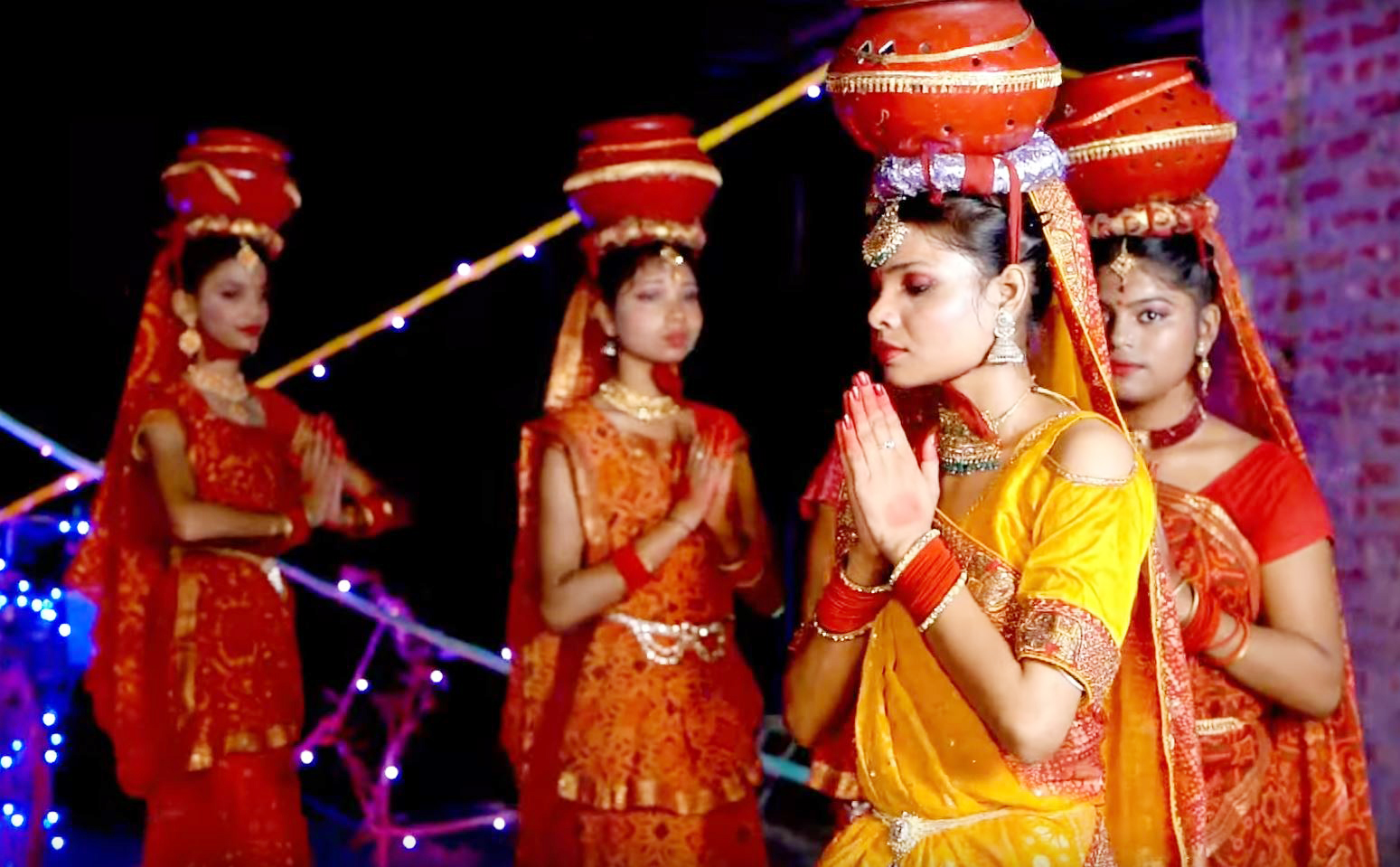
Men and women in Mithila are very religious and dress for festivals as well. The costumes of Mithila stem from the rich traditional culture of Mithila. Kurta and Dhoti with a Mithila Painting bordered Maroon coloured Gamchha which is the Symbol of Passion, Love, Bravery and Courage are common clothing items for men. Men wear a Gold ring on their nose which symbolizes prosperity, happiness and wealth inspired by Lord Vishnu. Also, wear a Balla on their wrist and Mithila Paag on their Head. In ancient times there was no colour option in Mithila, so the Maithil women wore white or yellow Saree with a red Border but now they have a lot of variety and colour options and wear Laal-Paara (the traditional red-boarded white or yellow Saree)[38] on some special occasions, and also wear Shakha-Pola[39] with a lanthi in their hand which is Mandatory to wear after marriage in Mithila. In Mithila culture, this represents new beginnings, passion and prosperity. Red also represents the Hindu goddess Durga, a symbol of new beginnings and feminine power. During Chhaith, the women of Mithila wear pure cotton dhoti without stitching which reflects the pure, traditional Culture of Mithila. Usually crafted from pure cotton for daily use and from pure silk for more glamorous occasions, traditional attire for the women of Mithila includes Jamdani, Banarisi, Bhagalpuri and many more. Many festivals are celebrated throughout the year in Mithila. Chhath Puja, Durga Puja and Kali puja is celebrated as perhaps the most important of all the celebrations of Mithila.

The Paag is the traditional headgear of the Maithil people

Household structure

[edit]

Traditionally Maithils lived in Badaghars called longhouses with big families of many generations, sometimes 40–50 people. All household members pool their labour force, contribute their income, share the expenditure and use one kitchen.[40] In the courtyard of a Maithil family, there is a Dalaan for relaxation and gathering of the family members, relatives and close neighbours of the society in village. It is also used for cultural activities of the family and the neighborhood.

Religion

[edit]

The religious practices of the Maithils is based on orthodox Hinduism as Mithila has historically been a principal seat of Hindu learning.[41] Apart from main stream Hinduism, there are some local traditions of worshiping Baraham Baba and Gosaun Devata by them. In every village of the Mithila region, there is at least one common worship place Brahma Sthan also known as Dihawar Sthan attached to an old pipal tree, where Brahma Baba is worshipped by the Maithils. Brahma Baba also called as Graama Devata is believed to be the protector God of the village.[42] Maharani Sthan is the other common worship place, where Goddess Bhagawati is worshipped by the Maithils. Similarly at every courtyards of the houses of Maithils, there is Gosaunik Ghar where Kuldevata and Kuldevi of the family is worshipped.[43]

[edit]

Politics

[edit]

Maithils hold significant influence in the politics of both India and Nepal. They dominate the polity of Bihar, India's third most populous state, by virtue of their majority in 144 of the 243 constituencies of the Bihar Legislative Assembly.[2] Maithils are the largest ethnolinguistic group in the Nepalese Madhesh Province and the second largest ethnolinguistic group in Province No. 1.[44]

Notable people

[edit]

The following are notable residents (past and present) of Mithila region:

Historical

[edit]
Statue of the 11th century philosopher Udayana
Statue of Maithili language poet, Vidyapati

Modern

[edit]

See also

[edit]

References

[edit]

Bibliography

[edit]
Revisions and contributorsEdit on WikipediaRead on Wikipedia
from Grokipedia
Maithils are an Indo-Aryan ethno-linguistic group native to the ancient Mithila region, spanning the fertile plains between the Himalayas and the Ganges River across northeastern India (primarily Bihar and Jharkhand) and southeastern Nepal (Madhesh Province). They speak Maithili, an Eastern Indo-Aryan language with roots traceable to Old Indo-Aryan through extensive diachronic development, serving as a marker of their cultural identity. Predominantly Hindu, Maithils maintain a society structured around extended patrilineal kinship and caste hierarchies, with historical elites like Maithil Brahmins emphasizing genealogical records (panji) and scholarly traditions. The region's history traces to the Videha kingdom, referenced in ancient texts as a center of Vedic learning under rulers like King Janaka, evolving through medieval dynasties such as the Karnats and Oiniwars before integration into modern nation-states. Maithil culture is distinguished by its literary output, exemplified by the 14th-15th century poet Vidyapati Thakur's devotional and erotic verses in Maithili and Sanskrit, which influenced Bhakti traditions across South Asia. Artistic expressions include Madhubani (Mithila) paintings, a folk art form traditionally created by women depicting mythological themes, nature, and rituals using natural pigments on walls or paper, reflecting the community's psychological and spiritual worldview. Festivals like Chhath Puja and unique customs such as elaborate wedding rites underscore their agrarian lifestyle and reverence for rivers and deities, while Maithili's recognition as an official language in both India (2003) and Nepal highlights its enduring vitality despite pressures from dominant tongues like Hindi and Nepali.

History

Ancient Origins

The ancient origins of the Maithils are rooted in the Vedic-era Videha kingdom, encompassing the Mithila region in the eastern Gangetic plains. Literary evidence from the Shatapatha Brahmana (Kanda 1, Adhyaya 4, Brahmana 1, sections 10-17) describes a migration led by the chieftain Videgha Mathava (also Māthava Videgha) from the Sarasvati River valley westward of the Yamuna to the Sadanira River (modern Little Gandak), where his priest Gotama Rahugana performed rituals to extend Aryan cultural influence eastward. This narrative, composed in the late Vedic period (circa 800–600 BCE), symbolizes the expansion of Indo-Aryan settlements into forested and marshy territories, clearing land for agriculture and establishing Videha as a distinct realm identified with Mithila. The text portrays Videgha halting at the Sadanira due to divine instruction from Agni, marking the eastern limit of early Vedic geography at that time. Subsequent Vedic texts, including the Yajurveda Samhita and Brihadaranyaka Upanishad, reference Videha as a kingdom with philosophical and ritual significance, ruled by kings like Janaka, who engaged in debates with sages such as Yajnavalkya. These sources, dating to circa 1000–500 BCE, depict Videha-Mithila as a center of Brahmanical learning amid Indo-Aryan tribal expansions, distinct from core Vedic heartlands like Kuru-Panchala. The region's inhabitants, precursors to the Maithils, comprised Indo-Aryan groups alongside possible pre-existing non-Aryan populations, as inferred from the gradual assimilation described in migration accounts; however, no direct archaeological corroboration exists for this specific Vedic polity, with evidence limited to general Iron Age settlements in the Gangetic plains from circa 1000 BCE. Maithil Brahmin traditions later retroactively link their lineages to these Videha settlers, emphasizing continuity through genealogical records (pañjī) that associate them with ancient Mithila as the homeland of Sita from the Ramayana. Archaeological data for ancient Mithila remains sparse, with no monumental sites definitively tied to kings; excavations in reveal Neolithic-Chalcolithic continuity from circa 2000 BCE but lack inscriptions or artifacts naming Videha until later periods. This reliance on textual sources, primarily Brahmanical, underscores potential biases toward elite Indo-Aryan narratives, potentially overlooking substrate influences from indigenous groups in the region's ecology of rivers, forests, and alluvial soils conducive to cultivation. The polity likely functioned as a monarchical entity by the BCE, interacting with neighboring and influencing early ethical philosophies, as evidenced by Janaka's portrayal in Upanishadic dialogues.

Vedic and Classical Period

The Videha kingdom, centered in the Mithila region, emerged as a prominent entity during the later Vedic period (c. 1100–500 BCE), representing the eastern frontier of Indo-Aryan expansion. Vedic texts such as the Shatapatha Brāhmaṇa describe the migration of Videgha Māthava (also known as Videha Madhava), who, guided by the fire god Agni, crossed the Sadānīrā River (modern Gandak) to settle in the area, introducing Vedic rituals and agriculture to previously non-Aryan territories inhabited by groups like the Kirātas. This migration, dated around 1500–1600 BCE in some reconstructions, marked the Aryanization of Mithila, blending with local tribes and establishing a monarchical regime that lasted until approximately 700 BCE. The kingdom's rulers, titled Janaka, symbolized philosophical inquiry, with King Janaka of Videha portrayed in the Bṛhadāraṇyaka Upaniṣad as hosting scholarly debates on the nature of the self (ātman) and ultimate reality (brahman), engaging figures like Yājñavalkya in exchanges that elevated Videha as a hub of Brahmanical intellectualism. Mithila under fostered a synthesis of ritual orthodoxy and speculative philosophy, contrasting with the ritual-heavy western kingdoms like Kuru-Pañcāla. Janaka's court, as depicted in Upanishadic dialogues, emphasized detachment (videha, meaning "bodyless" or non-attached), influencing later concepts of () over mere karma (action). The region's fertility from rivers like the Kosi supported agrarian prosperity, enabling of Vedic learning, though archaeological remains sparse, relying primarily on textual references rather than material finds. By the early classical period (c. 600–300 BCE), Videha transitioned from monarchy to a republican oligarchy within the Vṛjji confederacy, led by the Licchavis, as noted in later Vedic and early Buddhist/Jain sources. This shift reflected broader mahājanapada dynamics, with Mithila losing autonomy to neighboring powers like Magadha, yet retaining cultural prestige as a Vedic educational center. Incorporation into the Nanda and Maurya empires (c. 400–185 BCE) integrated the region into centralized imperial structures, but local traditions persisted, evidenced by continued references to Videha in epics like the Rāmāyaṇa, where Mithila is Janaka's capital and Sītā's birthplace. The Maithil populace, tracing ethnic continuity to the Vaidehas, maintained Brahmanical dominance amid these changes, prioritizing scriptural exegesis over political sovereignty.

Medieval Dynasties

The Karnata dynasty ruled Mithila from 1097 CE until 1324 CE, marking the onset of organized medieval kingship in the region after the fragmentation following the Pala Empire's decline. Founded by Nanyadeva, a of possible South Indian origin who migrated northward, the dynasty established dual capitals at (in present-day ) and (in present-day , ), facilitating control over trans-Himalayan trade routes and fertile Gangetic plains. Key rulers included Nanyadeva (r. 1097–1147 CE), his son Udayadeva (r. 1147–1165 CE), and later kings like Harisimhadeva (r. ca. 1295–1324 CE), whose reign ended with the conquest by Ghiyasuddin Tughlaq's forces from the , leading to the destruction of . Though not ethnically Maithil, the Karnatas integrated into local Brahmanical society, adopting Maithili administrative practices and patronizing and Mimamsa scholarship, which reinforced Mithila's reputation as a center of orthodox . Their rule stabilized the region politically, with inscriptions evidencing land grants to Brahmins and temples, while fostering early Maithili literary forms through court poets like Jyotirishwar Thakur, whose Varna Ratnakara (ca. 1324 CE) represents the first known prose work in Maithili. This era saw the codification of Maithil social customs, including Vrata Bandha, a legal digest emphasizing paternal and ritual purity among Maithil Brahmins. Succeeding the Karnatas amid post-conquest instability, the —composed of Srotriya Maithil Brahmins—emerged around 1325 CE, governing until approximately 1526 CE as semi-autonomous rulers often tributary to the and later . Initiated by local strongmen like Nath Thakur or Jayapati Thakur, who consolidated power in fragmented principalities centered at Oini (near ), the dynasty included notable kings such as Bhairava Simha (ca. early 15th century) and Shiva Simha (ca. 1420–1450 CE), who defended against Afghan incursions while maintaining Brahmanical . Their rule, less militarily expansive than the Karnatas', emphasized administrative continuity through Maithil pandits, with 20 recorded sovereigns in genealogies preserved in Vamsavali chronicles. The Oiniwars profoundly shaped Maithil identity by elevating the language and literature, particularly through patronage of Thakur (ca. 1350–1440 CE), whose devotional poetry in Maithili Apabhramsa influenced Vaishnava across and , blending erotic and spiritual themes in works like Padavali. This period also saw military resistance, as under rulers like Chandeshvara Thakur (ca. 14th century), who repelled early Turkic raids, preserving Hindu institutions amid Islamic expansion. The dynasty's decline coincided with Mughal consolidation, transitioning Mithila toward zamindari systems under Khandavala Maithil Brahmins by the 16th century.

Colonial and Modern Developments

During the British colonial era, the Mithila region fell under the Bengal Presidency until the formation of the Bihar and Orissa Province in 1912, with Darbhanga district established as a separate administrative unit in 1875 from the larger Tirhut district. The Darbhanga Raj, a key Maithil zamindari estate originating in the 16th century, experienced direct British intervention, including placement under the Court of Wards from 1860 to 1880 amid family succession disputes, after which Maharaja Lakshmeshwar Singh expanded its influence through land management and philanthropy. British scholars and administrators in the 19th century documented Maithili as a distinct Indo-Aryan language separate from Hindi, though administrative policies favored Hindi, limiting its official use. The early 20th-century Maithili movement sought to assert linguistic and through , , and petitions for recognition, including efforts to establish Maithili as a and counter dominance in education and courts. This period also saw the gain initial traction around 1902, advocating separation from for Maithil-majority areas, though it remained marginal under colonial rule. Following India's independence in 1947, the Mithila region was partitioned between Bihar state in India and the eastern Terai in Nepal, with Maithils integrating into post-colonial governance structures. Maithils exerted significant political influence in Bihar, producing leaders in state and national politics, while in Nepal, they contributed to Terai representation amid the country's shift to democracy post-1951. In 2003, Maithili received constitutional recognition in India via inclusion in the Eighth Schedule, enabling its use in education, administration, and media in Bihar and Jharkhand. Nepal formalized Maithili as an official language in its 2015 constitution, reflecting its status as the second-most spoken language there after Nepali. Modern developments include ongoing cultural revival efforts, such as Maithili-medium schools and digital media promotion, alongside persistent demands for a separate Mithila state encompassing Bihar's northern districts and Jharkhand's Maithil areas, driven by linguistic and developmental grievances. Maithil diaspora communities have grown in urban , the , and since the mid-20th century, fostering cultural organizations to preserve traditions like Madhubani painting and scholarship.

Geography and Demographics

Distribution in India

Maithils form the predominant ethnic group in the Mithila region of northern and eastern Bihar, where they constitute a majority in several districts. The 2011 Census of India reports Maithili—the primary language of Maithils—as the mother tongue of 12.41% of Bihar's total population, equating to over 12 million speakers concentrated in this area. Districts with the highest proportions include Madhubani (84.07% Maithili speakers), Supaul, Darbhanga, Saharsa, Madhepura, and Sitamarhi, where Maithils often exceed 50-70% of the local populace based on linguistic data serving as a proxy for ethnic distribution. These areas align with the historical Videha kingdom and feature dense Maithil settlements tied to agrarian lifestyles and cultural institutions like maithil brahmin learning centers. Smaller Maithil communities reside in northeastern Jharkhand's , particularly districts such as , Sahibganj, , and , where Maithili speakers number in the tens of thousands amid mixed linguistic landscapes. This extension stems from historical migrations and shared regional boundaries with Bihar's Mithila. Scattered populations also exist in eastern (e.g., and districts) and northern , though these account for fewer than 20,000 Maithili speakers combined, representing marginal diaspora elements rather than core concentrations. Overall, Bihar hosts over 90% of India's Maithil population, with urban migration to cities like and contributing to minor dispersions without altering the rural heartland focus.

Presence in Nepal

Maithils constitute a substantial ethnic and linguistic community in Nepal, primarily residing in the southern Terai region, particularly Madhesh Province (formerly Province No. 2). This area, encompassing districts such as Dhanusa, Mahottari, Sarlahi, Siraha, and Saptari, forms the Nepalese extension of the historical Mithila region. Janakpur, located in Dhanusa District, serves as a central cultural and religious hub for the community, revered as the birthplace of Sita from the Ramayana epic. According to the National Population and Housing Census 2021 conducted by Nepal's Central Bureau of Statistics, Maithili—the primary language spoken by Maithils—is the mother tongue of 3,092,530 individuals, accounting for 11.67% of Nepal's total population of approximately 29.2 million. This positions Maithili as the second most spoken language after Nepali (44.6%). The overwhelming majority of Maithili speakers (over 95%) are concentrated in , where they form linguistic majorities in multiple districts, reflecting the community's deep-rooted demographic presence in the eastern and central plains. The Maithil population in Nepal encompasses diverse castes, including Maithil Brahmins (estimated at around 477,000), Yadavs, and Telis, unified by shared linguistic and cultural ties rather than a singular ethnic category in census enumerations. Historically, Maithil migration and settlement in Nepal trace back to medieval periods, with influences from the ancient kingdom extending into the region, though modern presence is characterized by indigenous habitation supplemented by internal migrations. Community organizations and cultural practices, such as observance of festivals like , reinforce their distinct identity within Nepal's multi-ethnic framework.

Population Statistics and Diaspora

The population of Maithils is primarily concentrated in the Mithila region spanning northeastern Bihar and adjacent areas of Jharkhand in India, as well as the Terai districts of southeastern Nepal. In India, the 2011 Census recorded 13,583,464 individuals reporting Maithili as their mother tongue, predominantly in Bihar (where it accounts for about 12% of the state's population) and to a lesser extent in Jharkhand and West Bengal. This figure serves as a proxy for the Maithil ethnic population, though underreporting occurs as some Maithils declare Hindi as their primary language due to linguistic assimilation policies and administrative categorization. In Nepal, the 2011 National Population Census identified 3,079,166 Maithili speakers, comprising 11.7% of the national population and concentrated in Province No. 2 (formerly the central and eastern Terai regions). The 2021 census updated this to approximately 3.3 million speakers, reflecting modest growth amid ongoing migration. ![Flag of India.svg.png][center]
![Flag of Nepal.svg.png][center]
Estimates of the total Maithil population, accounting for non-linguistic identifiers and broader ethnic self-identification, range from 20 to 30 million across both countries, though such figures lack direct validation and rely on ethnographic extrapolations from language data. Maithils constitute a significant minority in (roughly 25-30% of the state's 104 million residents as of 2011) and a plurality in Nepal's Maithili-speaking districts like Dhanusa and Mahottari. Demographic pressures, including rural-to-urban migration within and cross-border movement to Nepal, have led to declining densities in core rural areas, with fertility rates aligning with national averages (around 2.1 children per woman in per NFHS-5 surveys). The Maithil diaspora remains modest compared to other Indian ethnic groups, with no comprehensive global census data available. Small communities exist (estimated at tens of thousands, primarily in professional sectors in states like and ), the (concentrated in and Midlands cities), and (notably in and ), driven by post-1990s skilled migration and student inflows. These expatriates maintain cultural ties through associations like the Maithil Society of , but population figures are anecdotal and unverified by official immigration statistics, which do not disaggregate by . Internal Indian includes urban pockets in , , and Bengaluru, where Maithils number in the hundreds of thousands, often in academia, , and . No significant Maithil presence is documented in other regions like the or , underscoring a limited transnational footprint relative to labor-exporting groups from .

Language

Linguistic Features

Maithili is classified as an Eastern Indo-Aryan language within the Indo-European family, exhibiting typological similarities to neighboring languages such as Bengali, Odia, and Bhojpuri while retaining distinct phonological and morphological traits derived from its and Apabhramsha antecedents. Its core structure aligns with other Indo-Aryan tongues through features like subject-object-verb (SOV) word order, postpositional phrases, and a reliance on case marking that permits relatively flexible constituent ordering within sentences. Phonologically, Maithili features a contrastive system with ten vowels—three short (/i, u, ə/) and seven long (/iː, eː, ɛː, aː, oː, uː, ɔː/)—where duration serves as a phonemic distinguisher, as in minimal pairs like /kəl/ ("yesterday") versus /kəːl/ (""). The consonant inventory includes five places of articulation for stops (bilabial, dental, retroflex, palatal, velar), each with voiceless unaspirated, voiceless aspirated, voiced unaspirated, and voiced aspirated variants, alongside nasals, laterals, flaps, and ; retroflex , such as /ʈ, ɖ, ɳ/, are prominent, reflecting areal Indo-Aryan influences. Suprasegmentals include and tone-like pitch distinctions in some dialects, with acoustic studies confirming nasal vowels as phonemically contrastive, aiding lexical differentiation. Morphologically, nouns inflect for (masculine/feminine), number (singular/plural), and eight cases (nominative, accusative, genitive, dative, ablative, locative, vocative, and ), often using postpositions for oblique functions; adjectives agree in , number, and case with the nouns they modify. Verbs demonstrate agglutinative tendencies with complex conjugation paradigms marking tense (present, , ), aspect (perfective/imperfective), mood (indicative, subjunctive, imperative), , number, and , including a distinctive two-dimensional agreement system where primary agreement targets the subject and secondary agreement may index the object or honorific status. operates as a semi-morphological for intensification, plurality, or distributivity, as in ram-ram ("many times" or polite address), a feature common in Indo-Aryan but productively varied in Maithili across lexical categories. Syntactically, Maithili employs free verb movement and tense , where auxiliary placement correlates with aspectual scope, alongside anaphoric strategies that favor null subjects in matrix clauses but overt pronouns in embedded ones; adjectives precede nouns, and objects can be direct or indirect based on hierarchies. Dialectal variation introduces phonetic shifts (e.g., intervocalic ) and lexical divergences, yet standard Maithili maintains conservative grammatical structures, including verb forms that encode social hierarchy through suppletive roots or affixation. These elements underscore Maithili's position as a conservatively evolved Indo-Aryan , balancing inheritance from with regional innovations.

Scripts and Standardization

The Maithili language has historically employed multiple scripts, with Tirhuta (also termed Mithilakshar) serving as its indigenous script since at least the 10th century CE, derived from earlier Brahmi-derived systems and used for literary, religious, and administrative texts in Maithili and Sanskrit. Additional scripts included Kaithi for practical records and Newari in certain contexts, reflecting regional scribal traditions in the Mithila area. These scripts feature abugida characteristics, with conjunct forms and vowel matras adapted to Maithili's phonology, though Tirhuta's cursive style distinguished it for manuscript production. By the late 19th century, supplanted Tirhuta as the primary script in printed materials and , spurred by the Hindi-Nagari movement's push for uniformity across northern Indian languages amid colonial administrative reforms. This transition aligned Maithili orthography more closely with Hindi standards, reducing the use of Tirhuta to niche applications like panji (genealogical) records and devotional literature, while accommodated Maithili's aspirated stops and retroflex sounds via shared glyphs. Unicode encoding for Tirhuta, proposed in 2009 and implemented thereafter, has enabled digital revival efforts, though adoption remains limited outside cultural preservation projects. Standardization of Maithili and commenced systematically in 1881 through George A. Grierson's seminal grammar, compiled with input from Maithil pandits and establishing norms based on the conservative Central Maithili dialect of the region. This variety, known as Sotipura, functions as the prestige form, preserving archaic features like case inflections and verb conjugations amid dialectal divergence across , , and . Despite these foundations, orthographic inconsistencies persist, including variable representations of schwa deletion and , exacerbated by script shifts and the absence of a centralized enforcing rules. Post-independence initiatives, such as inclusion in India's Eighth in , have spurred calls for codified conventions in textbooks and media, yet elite-driven standards overlook non-standard dialects, limiting broader . Ongoing linguistic surveys emphasize the need for dialect-inclusive reforms to support computational processing and education.

Recognition and Political Movements

The Maithili language movement originated in the early 20th century, driven by intellectuals seeking to establish it as an independent language distinct from Hindi and Bengali dialects, amid colonial linguistic classifications that marginalized regional tongues. This assertion gained traction from the 1920s through India's independence in 1947, with advocates forming organizations like the Maithili Mahasabha to promote literature, script standardization, and administrative use in the Mithila region spanning Bihar and parts of Jharkhand. Post-independence efforts focused on institutional recognition, including inclusion in the as a modern Indian language and pushes for constitutional status, culminating in Maithili's addition to the Eighth Schedule of the Indian Constitution via the 92nd Amendment Act on October 7, 2003, granting it official scheduled language status alongside Bodo, Dogri, and Santali. In , Maithili received recognition as one of the country's official languages under the 2015 Constitution, reflecting its status as the second-most spoken language there, spoken by approximately 11% of the population primarily in the region. Political movements intertwined language recognition with regional autonomy demands, notably the , which intensified in the 1900s and seeks a separate state for Maithili-speaking areas to economic neglect, frequent flooding, and cultural preservation, with roots traceable to 1912 petitions during Bihar's separation from . Proponents argue that linguistic unity justifies administrative separation, as seen in 2022 protests by the Mithila Students' Union in and renewed calls in 2019 by BJP leaders, though the movement has not achieved statehood amid opposition over potential fragmentation of . In November 2024, former Chief Minister reiterated demands for a Mithila state, citing historical self-rule under Mithila's Maharajas until 1947. These efforts persist despite Hindi's dominance in 's official spheres, where Maithili lacks statewide mandatory use.

Social Structure

Caste Hierarchy

The caste hierarchy among Maithils follows the traditional Hindu varna framework, adapted to regional jati distinctions, with Brahmins at the apex exerting priestly, scholarly, and administrative dominance in Mithila society. Maithil Brahmins, as the highest varna, have historically monopolized ritual purity, education, and land management roles, reinforced by their role as genealogists via the panji system established under King Harisinghdeva in the to certify marriages and prevent violations. This internal stratification within Maithil Brahmins divides families into ranked muls (clans), such as Shrotriya (elite, ritually purest), Yogya, Panjeebaddh, Vanshadhar, and Jaiwaar (lowest), with elevations rare and limited to specific muls like Surgane, Ekhare, and Fanebaar in later periods to maintain exclusivity. Kayasthas occupy a prominent position below as a scribal and managerial jati, serving as accountants, village surveyors, and record-keepers for agrarian elites, often collaborating with Brahmin landowners in administrative functions. Bhumihars, classified as Kshatriya-like landowners, hold intermediate status as small proprietors managing estates, while Vaishya-equivalent trading castes are less emphasized in core Maithil hierarchies. Lower varnas include cultivators like Yadavs and Musahars, who perform agricultural labor and menial tasks, with groups facing ritual exclusion from upper-caste domestic rites. This structure, rooted in medieval land grants and smriti texts, perpetuated Brahmin-Kayastha alliances for regional governance, as seen in the Raj until 1947, though colonial censuses and post-independence reservations have challenged rigid enforcement without eroding cultural primacy.

Family Systems and Gender Roles


Maithil society traditionally organizes around patrilineal systems, where descent, , and identity trace through the male line. Property is held collectively by the and managed by the karta, the senior male head, with sons inheriting shares upon division. The basic unit, svajana, encompasses up to four generations living jointly, including grandfathers, fathers, brothers, and their children, though nuclear families have become more common as adult sons establish separate households after .
Kinship extends beyond the immediate family to kuṭṭumba, comprising paternal (pitṛ-bandhava) and maternal (matṛ-bandhava) relatives, and gotra, the exogamous clan prohibiting intra-clan marriages among Brahmins to maintain lineage purity. Fictive kinship terms, such as dīdī (elder sister) and bahinī (younger sister), reinforce social bonds, particularly among women navigating patrilocal residence. The panjī system, a genealogical registry maintained by panjikārs, ensures marital compatibility by verifying gotra and generational distance, especially in higher castes like Maithil Brahmins and Karna Kayasthas. Marriage, vivāha, is a central conducted through arranged unions facilitated by mediators (ghāṭak) and adhering to siddhānt traditions that dictate rituals and prohibitions. Ceremonies are elaborate, spanning multiple days with the groom temporarily residing at the bride's home; post-wedding, the kobara period allows newlyweds a honeymoon-like stay there, followed by rituals like muhbajjī (first private conversation) and madhusravanī (a 10-day serpent-worship festival in Shravana). Brides typically relocate to the husband's patrilocal household, solidifying exogamous ties while upholding . Gender roles reflect a patriarchal framework, with men as primary authority figures, economic providers, and property holders, while women assume domestic responsibilities centered on household management, child-rearing, and ritual observance. Patrilocality enforces women's integration into affinal families, often generating tensions with mothers-in-law and co-wives, mitigated through female solidarities like and festivals such as sāmā cakhevā. Traditional restricts women's mobility and public roles, positioning them as economic dependents, though cultural practices like Madhubani and folk performances provide avenues for expression and subtle resistance within constraints. Recent shifts, driven by and development initiatives, have begun expanding women's economic participation, challenging entrenched segregation.

Culture

Literature and Intellectual Traditions

Maithili literature emerged in the early medieval period, with roots traceable to the through compositions like Buddhist occult songs by monks. The classical phase, spanning roughly 1350 to 1830 AD, is dominated by poetic works in Maithili, focusing on devotional themes, romance, and . Jyotirishwar Thakur, a 14th-century , authored Dhurt Samagam, a notable blending and Maithili elements. The preeminent figure in Maithili literature is (c. 1350–1448), born in Bisaphi village near in Mithila. His padas—lyrical poems—composed in the vernacular Maithili, celebrate the love of and Krishna, blending eroticism with devotion, and exerted influence on later Bengali Vaishnava traditions. Vidyapati also produced Sanskrit treatises on administration and ethics, as well as Apabhramsa narratives and dramas like Kirtilata, a biographical work on King Hari Singh Deva. His contemporary or near-contemporary Govindadas composed similar devotional poetry, though less renowned. Maithil intellectual traditions, particularly among scholars, emphasized rigorous scholarship in , logic, and , shaping a distinct identity tied to textual mastery and . From the medieval period, Mithila emerged as a center for (logic) studies, with contributions to Navya-Nyaya (new logic) methodologies that prioritized precise epistemological analysis. Scholars reinterpreted Dharmaśāstras to codify social norms, reinforcing intellectual authority through patronage by local rulers. This tradition persisted, producing Naiyayikas who engaged in dialectical reasoning, as evidenced by lineages tracing to ancient Vedic roots in the region. Mithila's philosophical output included advancements in Mimamsa and Sankhya alongside , fostering a rational disposition among Maithils. Manuscripts such as Varna Ratnakara by Jyotirishwar exemplify the synthesis of literary and jurisprudential scholarship, cataloging social varnas in verse. These traditions, upheld in institutions like Sanskrit vidyalayas, underscore Maithils' historical role in preserving and innovating Indian intellectual heritage through empirical argumentation over dogmatic assertion.

Arts and Crafts

Mithila painting, commonly known as Madhubani art, represents the preeminent traditional art form among Maithils, originating from the Mithila region spanning Bihar, India, and southern Nepal. This folk painting tradition, historically practiced by Maithil women on the walls and floors of their homes during rituals such as marriages and festivals, features intricate, linear designs depicting mythological scenes, deities, flora, fauna, and daily life motifs like auspicious animals including peacocks, elephants, and fish. Upper-caste Maithil women typically rendered images of Hindu deities using filled colors in the bharni style, while women across castes employed line-drawn katchni techniques for symbolic elements; additional variants include tantrik for esoteric symbols, godna mimicking tattoo patterns, and kohbar for bridal fertility themes centered on lotus ponds and water creatures. Materials traditionally comprised natural pigments derived from plants, minerals, and cow dung mixed with rice paste, applied with twigs, fingers, or brushes on mud-plastered surfaces, rendering the art ephemeral until its adaptation to paper and cloth in the 1960s following a 1934 Bihar earthquake that exposed wall paintings to outsiders. The form's commercialization has sustained Maithil women's livelihoods, with geometric patterns and vibrant hues—black from soot, yellow from turmeric, red from sandalwood—symbolizing cultural continuity and ritual auspiciousness. Beyond painting, Maithils engage in sikki grass handicrafts, utilizing the golden-hued Saccharum spontaneum grass harvested from marshy wetlands in Mithila's riverine areas. Maithili women collect, boil, and dye the grass stems—discarding flowered tops—to weave durable, eco-friendly items such as baskets, mats, dolls, lamp shades, and decorative containers, often embellished with motifs echoing Madhubani designs. This ancient craft, requiring khar grass for core wrapping beneath sikki's outer layer and iron needles for stitching, serves both utilitarian household needs and ornamental purposes, preserving biodiversity through sustainable harvesting practices limited to the plant's post-monsoon growth cycle. Sikki work exemplifies Maithil resourcefulness in transforming local, renewable materials into intricate forms that blend functionality with aesthetic symbolism, such as lotus-inspired patterns denoting purity. These crafts, predominantly women's domains, underscore the gendered division in Maithil artistic expression, where ritual and domestic contexts foster communal skill transmission across generations.

Festivals, Customs, and Daily Life

Maithils celebrate as a principal festival, spanning four days in the Kartik month (October-November) of the Hindu calendar, dedicated to the sun god and Chhathi Maiya for bountiful harvests and family well-being; rituals include rigorous , ritual bathing in water bodies at dawn and dusk, and offerings of fruits, sweets, and bananas without salt or shadow. This observance underscores the community's agrarian roots and emphasis on solar cycles for agricultural prosperity. Jude Sheetal, observed around mid-April as the Maithil New Year, aligns with the onset of the sowing season; families undertake house cleaning, prepare seasonal foods like and , and exchange greetings to invoke prosperity and dispel winter's chill. Similarly, Chauth Chandra, held on the fourth of Kartik's bright , involves moon worship with milk offerings and lamps for familial harmony and progeny, distinguishing it as a Mithila-specific rite. Other notable festivals include , a nirjala fast by mothers on the Ashtami of Krishna in Ashwin (September-October) to ensure children's health and longevity, accompanied by folk songs and swings; and , where sisters craft bird idols from mud, sing songs, and exchange gifts with brothers to strengthen ties during the same month. Madhushravani, observed by women in Shravana (July-August), features 32 ritual items symbolizing marital bliss, including honey listening and protective herbs, rooted in folk beliefs for conjugal harmony. Customs emphasize Vedic-influenced rites, particularly in marriages, which extend over days with stages like tilak exchange, kanyadan, and circumambulations around fire, often incorporating Maithili hymns and symbolic gifts to affirm and familial alliances. Greeting norms involve folded hands (namaskar) and inquiries about well-being, while attire customs feature men in dhoti-kurta paired with the pagri (paag) , a conical denoting status and worn during ceremonies or labor. Women don sarees with geometric borders for daily wear, escalating to embroidered lehengas and jewelry for festivals, reflecting modesty and aesthetic heritage. Daily life centers on extended joint families pooling labor, income, and expenditures under one , promoting resource sharing amid rural settings dominated by paddy cultivation and seasonal migrations for work. Meals, integral to social bonds, comprise staples, , curries, and sabjis prepared communally, with evening snacks of spiced gram and dinner concluding agrarian routines. Religious punctuations like daily puja and festival preparations interweave with farming cycles, sustaining cultural continuity despite urbanization pressures.

Religion

Hindu Practices and Deities

Maithils adhere to with a syncretic tradition encompassing , , and , reflecting the region's historical intellectual and devotional currents. Adherents distinguish their sectarian affiliations through tilak markings on the forehead: (sacred ash) for Shaivites devoted to , white paste for Vaishnavas honoring , and () for Shaktas revering the Divine Mother. This pluralism allows households to incorporate multiple devotional paths, with daily rituals often centered on the panchadevata—the five primary deities of , , , , and —invoked for protection and prosperity. Shiva, as Mahadeva, holds central prominence among Shaivites, with fervent observance of Maha Shivaratri on the 13th night of Phalguna (typically February), involving all-night vigils, fasting, and offerings of milk, bel leaves, and bilva fruit to symbolize devotion and cosmic dissolution. Parvati accompanies Shiva in worship, particularly in rituals emphasizing familial harmony. Vaishnavism, invigorated by the 14th-15th century poet Vidyapati's padavali compositions, fosters intense bhakti toward Krishna and Radha, portraying divine love as a model for human attachment and influencing Maithil poetry and song traditions. Vishnu's avatars Rama and Krishna receive homage during festivals like Vivaha Panchami, commemorating Rama's marriage to Sita, native to Mithila lore. Shaktism elevates Durga and Kali as embodiments of primal energy (shakti), with Durga Puja entailing elaborate iconography and community processions to invoke feminine power against adversity. Local and familial deities supplement pan-Hindu worship, including kuldevata (lineage goddesses) enshrined in household altars for ancestral safeguarding and village protectors like Baraham Baba or Gosaun Devata, propitiated through periodic sacrifices and vows. Surya worship persists via ancient temples, such as the one at Kandaha in Saharsa district, dating to the era of Narasimha Deva (13th century), underscoring solar cults predating widespread Vaishnava dominance. Tantric elements, inherited from medieval interactions with Buddhist esotericism, appear in select rituals involving mantras and yantras for esoteric efficacy, though mainstream orthopraxy prevails among Brahmin custodians. Key lifecycle and seasonal practices underscore Maithil distinctiveness. The samskaras—16 purification rites from conception to —feature Maithil-specific elaborations, such as the mundan () ceremony with communal feasts and the multi-stage vivaha (marriage) involving pre-wedding chumaun blessings and post-nuptial uttar or dakkhin rituals spanning days. The Madhu-Sravani vrata, observed by newlyweds over 15 days in (July-August), mandates bridal fasting, saltless diets, flower-gathering, and pujas to Shiva-Parvati and serpent deities (bisahari), accompanied by folk narratives and songs to fortify marital fidelity and communal ties. These observances, rooted in Smriti texts like , integrate empirical domesticity with metaphysical devotion, adapting Vedic prescriptions to regional ecology and social structure.

Philosophical Contributions

The Mithila region, homeland of the Maithils, served as a major center for the Nyāya school of Indian philosophy, emphasizing logic, epistemology, and debate from at least the medieval period onward. This tradition focused on pramāṇas (means of knowledge) such as perception and inference, developing analytical tools to discern valid cognition from error. Maithil scholars contributed to refining these methods, influencing broader Indian intellectual discourse through precise linguistic innovations and critiques of rival systems like Mīmāṃsā and Advaita Vedānta. A pivotal figure was Vācaspati Miśra (c. CE), a Maithil Brāhmaṇa born in Andhra Tharhi village of Mithila, who authored extensive commentaries spanning multiple darśanas. His Nyāyavārttikatīkā elucidated Uddyotakara's defense of against Buddhist critiques, while works like Tattvabindu analyzed inference's logical structure, and Bhāmatī provided a realist interpretation of Śaṅkara's Advaita, named after his wife. These texts bridged realism with other schools, prioritizing causal analysis over idealistic reductions. Vācaspati's polymathic approach exemplified Mithila's integrative scholarly method, grounded in Vedic and debate. In the 13th–14th centuries, Gaṅgeśa Upādhyāya, another Maithil from Mithila (possibly Chadana village), founded the Navya-Nyāya subschool with Tattvacintāmaṇi ("Jewel of Philosophical Reflection"). This treatise innovated technical terminology—such as avacchedakata for relational qualifiers—to dissect epistemic processes, arguing that knowledge arises from causal chains verifiable through empirical scrutiny rather than mere intuition. Gaṅgeśa's emphasis on "anyathā-anupapatti" (inconceivability of the opposite) as a test for validity advanced causal realism in , countering skeptical challenges and laying groundwork for later logicians like his son Vardhamāna. His work spurred a Mithila-based lineage, including Pa_ksadhara Miśra, fostering rigorous, language-based that prioritized truth over dogmatic authority. Mithila's philosophical ecosystem, supported by institutions like ancient maṭhas and the region's Brāhmaṇa pandits, sustained these developments amid regional patronage from kings like those of the Karnāṭa dynasty. This yielded a legacy of epistemic localism, where validity is context-bound yet empirically anchored, influencing and theology. While later Navya-Nyāya spread to , its core innovations trace to Maithil thinkers, who privileged first-order analysis of reality's over metaphysical speculation.

Folk Beliefs and Syncretism

Maithils maintain a rich array of folk beliefs centered on clan and household deities, known as kuldevta, which are typically local manifestations of or and are enshrined in family temples for protection and prosperity. These beliefs extend to the propitiation of spirits, demons, ghosts, and ancestral entities through offerings and sacrifices, reflecting a where supernatural forces influence health, agriculture, and misfortune. Such practices persist alongside orthodox , with rituals often invoking Puranic figures like , , and nagas (serpents) during seasonal festivals, as narrated in folk storytelling traditions. Village-level worship includes veneration of fierce goddesses like Ugratara, embedded in oral that intertwines pre-Hindu tantric and Buddhist elements with later Hindu narratives, symbolizing power and transition. Superstitions govern daily conduct, such as astrological consultations via the ganita system for auspicious timings and avoidance of omens, underscoring a causal link between adherence and empirical outcomes like family harmony or crop yields. Syncretism manifests primarily within Hindu traditions, blending esoteric with devotional and , as evidenced in ritual arts like aripana—geometric floor designs drawn by women during worship—that incorporate tantric yantras, symbols of bodily vitality, and glorification of as creative feminine energy. This fusion, rooted in Shiva-Shakti cults, permeates Maithil customs, including non-vegetarian offerings in select rites and tantric-infused poetry by figures like (c. 1352–1448), which harmonize erotic mysticism with devotion. Madhubani paintings further exemplify this, depicting tantric motifs alongside Puranic scenes, though orthodox Maithil Brahmans historically subordinated such elements to Vedic norms, creating layered practices rather than wholesale assimilation of external faiths. Tantric influences also appear in women's sabar rites and household geometries, challenging rigid gender roles by elevating sensory experience and material worship, yet remaining integrated into the broader Hindu framework without significant Islamic or Buddhist overlays, despite Mithila's historical proximity to those traditions. This internal underscores Maithil religion's adaptability, prioritizing empirical ritual efficacy over doctrinal purity.

Politics and Identity

Regional Movements

The advocates for a separate Indian state comprising the Maithili-speaking districts of and , spanning approximately 70,000 square kilometers and a of around 70 million. This linguistic and cultural autonomy drive traces its roots to over 300 years ago but intensified in 1902 following British linguist George Grierson's surveys, which classified Maithili as a distinct Indo-Aryan language separate from or Bengali. Proponents argue that integration into has led to neglect in infrastructure, flood management, and economic development, justifying statehood to prioritize Maithili as an official language and address regional disparities. Early formal demands surfaced in 1912 amid Bihar's separation from the Bengal Presidency, with Maharaja Rameshwar Singh of Darbhanga reinforcing the call in 1921 for administrative separation based on historical Mithila identity. Post-independence, Dr. Lakshman Jha advanced the proposal in 1952, followed by Janaki Nandan Singh in 1954, though it faced resistance from Bihar's unified political structure. Revivals occurred in 1986 under Vijay Kumar Mishra and in 2004 led by BJP's Tarakant Jha, with ongoing efforts by groups like the Akhil Bhartiya Mithila Rajya Sangharsh Samiti, including a 2022 rally at Jantar Mantar demanding 30 districts' reconfiguration. In November 2024, former Bihar Chief Minister Rabri Devi reiterated the demand, citing persistent underdevelopment. In Nepal, Maithils in the Tarai's Madhesh region have engaged in broader identity assertions through the Madhesh movement, which pressured for federal recognition of marginalized plains communities. This contributed to the 2015 constitution's creation of Province No. 2 (capital , a historical Mithila center), renamed in 2022 despite debates over Maithil versus broader Madhesi nomenclature. These efforts highlight cross-border Maithil pushes for to preserve , , and address ethnic inequities, though Nepal's movement encompasses diverse Tarai groups beyond Maithils alone.

Language and Cultural Activism

The Maithil Mahasabha, established in 1910 by Maharajadhiraj of Raj, spearheaded early efforts to promote and Maithil cultural identity, including campaigns against social evils and for linguistic recognition. This organization advocated for Maithili's status as a distinct separate from dialects, leading to its recognition by Calcutta University in 1917 as a medium for examinations and literary studies. followed suit in 1933, marking incremental academic acceptance amid broader colonial-era linguistic assertions. Post-independence, Maithili activists intensified demands for constitutional safeguards, culminating in its inclusion in the Eighth Schedule of the Indian Constitution in 2003 through the 92nd Amendment Act, which recognized it as one of 22 scheduled languages eligible for official promotion in education and administration. Despite this milestone, implementation has been uneven, with limited state-level support in for Maithili-medium instruction and media, prompting ongoing activism tied to the Mithila statehood movement that links linguistic preservation to regional autonomy. In Nepal, Maithili holds official status in (formerly Province No. 2), but activists highlight survival threats from Nepali dominance, advocating for enhanced educational resources and cultural programs. Cultural activism extends to diaspora communities and institutions promoting Maithili literature, festivals, and arts; for instance, the Maithil Manch organizes events to foster linguistic continuity among emigrants. Efforts also include demands for classical language status, citing Maithili's antiquity evidenced by medieval texts like those of (14th-15th century), though government expert committees have deferred such recognition as of 2018. These initiatives underscore a commitment to empirical preservation against assimilation pressures, prioritizing vernacular education and media over assimilation into dominant languages.

Contemporary Debates and Controversies

In recent years, the demand for a separate Mithila state carved out of has resurfaced as a focal point of Maithil political activism, driven by claims of regional economic neglect and cultural marginalization. On November 27, 2024, former publicly advocated for Mithilanchal statehood, arguing it would address underdevelopment in the region spanning northern and parts of , where Maithils predominate. Proponents, including the Mithila Rajya Sangharsh Samiti, cite persistent issues like inadequate infrastructure and failure to implement river interlinking projects, such as the K.L. Rao plan, as justification, alongside the need to prioritize promotion over dominance. Critics, however, warn that fragmentation could exacerbate 's administrative challenges without resolving core economic disparities, viewing the push as opportunistic amid 2025 state elections. Maithili language politics remains contentious, particularly regarding its script, official status, and integration into education. Advocates have intensified calls for recognition, highlighting its ancient literary tradition dating back over a , yet it was omitted from India's 2024 list of classical languages despite submissions emphasizing unique grammar and texts like those of . Debates over the Mithilakshar script versus persist, with historical print culture analyses revealing caste influences—Maithil Brahmins favoring traditional forms—complicating standardization efforts in Bihar's schools. In national contexts, such as the controversy, Maithili speakers have raised alarms about Hindi's potential erosion of regional tongues, as noted in March 2025 discussions linking it to broader linguistic homogenization fears. Cultural controversies have spotlighted perceived disrespect to Maithil traditions, exemplified by incidents involving public figures. In October 2025, singer and BJP candidate drew backlash after a video showed her consuming fox nuts (makhana) from a Mithila paag, a sacred symbolizing honor in Maithil society, prompting accusations of trivializing cultural symbols amid electoral sensitivities. Similarly, MLA Ketakee faced criticism for actions deemed irreverent toward the paag, fueling online debates about authenticity in representing Maithil identity versus modern appropriations. These episodes underscore tensions between preserving folk customs and navigating political or performative contexts, with Maithil activists arguing they erode communal pride in a diaspora-heavy .

Notable Maithils

Historical Figures

(c. 1352–1448), revered as the Maithil Kavi Kokil (Nightingale of Maithili), was a prominent Maithili and poet, composer, and scholar from the village of Bisapi in , . He served as a court poet and minister under the rulers of Mithila, including King , composing over 1,000 songs that blended erotic love poetry with Vaishnava devotion to and Krishna. His works, such as Padavali, influenced later poets like Chaitanya and even , emphasizing themes of divine love through human passion. Vidyapati's contributions elevated Maithili literature during the medieval period, preserving cultural expressions amid political transitions in the region. Mandana Mishra (8th century CE), a philosopher from Mithila, was a leading exponent of Mimamsa school, authoring Brahmasiddhi, which reconciled Mimamsa with . He engaged in a famous philosophical debate with , reportedly losing and adopting as Sureshvara, though traditional accounts vary on the outcome's historicity. His scholarship underscored Mithila's role as a center for Vedic exegesis and jurisprudence, influencing Maithil intellectual traditions. Jyotirishwar Thakur (c. 1280–1345), a contemporary of early Oiniwar rulers, was a Maithil scholar and author of Varna Ratnakara, a treatise on social order and duties that codified Maithil customs, including the panji genealogical system. Serving as a minister under King Harisimhadeva of the Karnata dynasty, his work provided legal and cultural frameworks for Maithil society, blending logic with regional practices. Among ancient figures, King of (Mithila), a semi-legendary philosopher-king dated variably to around 800–700 BCE in historical estimates, hosted scholarly debates in his court, as depicted in the Brihadaranyaka , featuring sages like and Gargi. Revered for his rajayoga and detachment, Janaka symbolizes Mithila's early intellectual heritage, with multiple kings bearing the title across Videha's history from the . His association with in epic traditions reinforced Mithila's cultural identity. Hari Singh Dev (r. 1325–1381), a key ruler of the Karan dynasty in Mithila, formalized the panji vyavastha, a meticulous genealogical registry for Maithil Brahmins that tracked marriages and lineages, ensuring social stability and ritual purity. This system, enduring until British times, highlighted administrative innovations in the region amid invasions and dynastic shifts.

Modern Personalities

Ram Baran Yadav (born February 4, 1948), a Maithil from Dhanusha district in Nepal, served as the first President of Nepal from July 23, 2008, to October 29, 2015, following the country's transition to a republic. A trained physician, he represented the Nepali Congress party and was elected by the Constituent Assembly. In music, Udit Narayan Jha (born December 1, 1955), from a Maithil Brahmin family with paternal roots in Saptari, Nepal, and maternal ties to Supaul, Bihar, India, has been a leading playback singer in Indian cinema since the 1980s, recording thousands of songs across multiple languages including Maithili. He has cited his Maithili Brahmin upbringing in religious devotion to deities like Shiva and Kali Ma. Sharda Sinha (October 1, 1952 – November 5, 2024), a folk singer from , gained renown for her performances of Maithili wedding and devotional songs, preserving and popularizing Mithila's oral traditions through recordings and live shows. Her work earned her the title "Bihar Kokila" and recognition for elevating regional nationally. In , Maithil women such as Devi pioneered the global recognition of Madhubani painting in the mid-20th century, transforming traditional wall art into portable forms that depict mythological themes and daily life, with Devi's works exhibited internationally starting in the 1970s. Contemporary personalities include (born circa 2000), a folk singer from who rose to prominence via reality TV shows and joined the in October 2025 ahead of state elections, signaling a blend of cultural advocacy and political engagement.

References

Add your contribution
Related Hubs
User Avatar
No comments yet.