Hubbry Logo
MammonMammonMain
Open search
Mammon
Community hub
Mammon
logo
8 pages, 0 posts
0 subscribers
Be the first to start a discussion here.
Mammon
Mammon
from Wikipedia
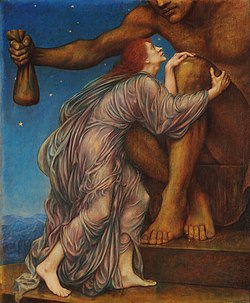
1909 painting The Worship of Mammon by Evelyn De Morgan

Mammon (Aramaic: מָמוֹנָא, māmōnā) in the New Testament is commonly thought to mean money, material wealth, or any entity that promises wealth, and is associated with the greedy pursuit of gain. The Gospel of Matthew and the Gospel of Luke both quote Jesus using the word in a phrase often rendered in English as "You cannot serve both God and mammon."[1][2]

In the Middle Ages, it was often personified and sometimes included in the seven princes of Hell, depicting greed. Mammon in Hebrew (ממון) means 'money'. The word was adopted to modern Hebrew to mean wealth.

Etymology

[edit]

The word Mammon comes into English from post-classical Latin mammona 'wealth', used most importantly in the Vulgate Bible (along with Tertullian's mammonas and pseudo-Jerome's mammon). This was in turn borrowed from Hellenistic Greek μαμωνᾶς, which appears in the New Testament, borrowed from Aramaic מָמוֹנָא māmōnā, an emphatic form of the word māmōn 'wealth, profit',[3] perhaps specifically from the Syriac dialect. The spelling μαμμωνᾷ refers to "a Syrian deity, god of riches; Hence riches, wealth"; μαμωνᾶς is transliterated from Aramaic [ממון] and also means "wealth".[4] However, it is not clear what the earlier history of the Aramaic form was.[3][5] The word may have been present throughout the Canaanite languages: the word is unknown in Old Testament Hebrew, but has been found in the Qumran documents;[6] post-biblical Hebrew attests to māmōn; and, according to Augustine of Hippo, Punic included the word mammon 'profit'.[3] It has been suggested that the Aramaic word māmōn was a loanword from Mishnaic Hebrew ממון (mamôn) meaning money,[7][8][9] wealth,[10] or possessions;[11] although it may also have meant "that in which one trusts".[5]

According to the Textus Receptus of the New Testament,[12] the Greek word translated "Mammon" is spelt in the dative case as [οὐ δύνασθε θεῷ δουλεύειν καὶ] μαμμωνᾷ in the Sermon on the Mount at Matthew 6:24, while in the Parable of the Unjust Steward at Luke 16, it appears respectively as [ἐκ τοῦ] μαμωνᾶ (genitive case) in verse 9, [ἐν τῷ ἀδίκῳ] μαμωνᾷ (dative case) in verse 11, and [οὐ δύνασθε θεῷ δουλεύειν καὶ] μαμωνᾷ (dative case) in verse 13. The 28th edition of the popular Critical Text of the New Testament[13] has the same readings as the TR, except in Matthew: μαμωνᾷ. The LSJ[14] has a listing for only [nominative:] μαμωνᾶς, [genitive ending:] ᾶ, with entry "wealth. Ev.Luc 16.9, al. (Aramaic word)," without any entry for the -μμ- form. The Authorised Version uses "Mammon" for both Greek spellings; John Wycliffe uses richessis.

The Revised Standard Version of the Bible says it is "a Semitic word for money or riches".[15] The International Children's Bible (ICB) uses the wording "You cannot serve God and money at the same time".[16]

Christians began to use "mammon" as a term that was used to describe gluttony, excessive materialism, greed, and unjust worldly gain.

Mammon from Collin de Plancy's Dictionnaire Infernal

Lay not up for yourselves treasures upon earth, where moth and rust doth corrupt, and where thieves break through and steal: But lay up for yourselves treasures in heaven, where neither moth nor rust doth corrupt, and where thieves do not break through nor steal: For where your treasure is, there will your heart be also. No man can serve two masters: for either he will hate the one, and love the other; or else he will hold to the one, and despise the other. Ye cannot serve God and mammon.

— Matthew 6:1921, 24 (KJV)

Early mentions of Mammon allude to the Gospels, e.g., Didascalia, "De solo Mammona cogitant, quorum Deus est sacculus" (lit. They think only of Mammon, whose God is the purse); and Saint Augustine, "Lucrum Punice Mammon dicitur" (lit. "Riches is called Mammon by the Phoenicians" (Sermon on the Mount, ii).

Personifications

[edit]

Gregory of Nyssa also asserted that Mammon was another name for Beelzebub.[17]

In the 4th century Cyprian and Jerome relate Mammon to greed and greed as an evil master that enslaves, and John Chrysostom even personifies Mammon as greed.[18]

During the Middle Ages, Mammon was commonly personified as the demon of wealth and greed. Thus Peter Lombard (II, dist. 6) says, "Riches are called by the name of a devil, namely Mammon, for Mammon is the name of a devil, by which name riches are called according to the Syrian tongue." Piers Plowman also regards Mammon as a deity. Nicholas de Lyra, commenting on the passage in Luke, says: "Mammon est nomen daemonis" (Mammon is the name of a demon).

Albert Barnes in his Notes on the New Testament states that Mammon was a Syriac word for an idol worshipped as the god of riches, similar to Plutus among the Greeks, but he cited no authority for the statement.[19]

No trace, however, of any Syriac god of such a name exists,[11] and the common literary identification of the name with a god of covetousness or avarice likely stems from Spenser's The Faerie Queene, where Mammon oversees a cave of worldly wealth. Milton's Paradise Lost describes a fallen angel who values earthly treasure over all other things.[20][21] Later occultist writings such as Jacques Collin de Plancy's Dictionnaire Infernal describe Mammon as Hell's ambassador to England.[22] For Thomas Carlyle in Past and Present (1843), the "Gospel of Mammonism" became simply a metaphoric personification for the materialist spirit of the 19th century.

Mammon is somewhat similar to the Greek god Plutus, and the Roman Dis Pater, in his description, and it is likely that he was at some point based on them; especially since Plutus appears in The Divine Comedy as a wolf-like demon of wealth, wolves having been associated with greed in the Middle Ages. Thomas Aquinas metaphorically described the sin of Avarice as "Mammon being carried up from Hell by a wolf, coming to inflame the human heart with Greed".

Under the influence of the Social Gospel movement, American populists, progressives and "muck-rakers" during the generation of 1880–1925 used "Mammon" with specific reference to the consolidated wealth and power of the banking and corporate institutions headquartered on Wall Street and their predatory activities nationwide.

In various countries

[edit]
  • "Mamona" (sometimes "Mamuna") is a synonym for mammon among Slavs. In the 21st century, the word mamona is used figuratively and derogatorily in Polish as a synonym of money. In Slovak the word mamonár is sometimes used to refer to a greedy person.
  • The word "mammona" is quite often used in the Finnish and Estonian languages as a synonym of material wealth.
  • In German, the word Mammon is a colloquial and contemptuous term for "money", usually as a phrase in combination with the adjective schnöde ("der schnöde Mammon" = the contemptible mammon).[23]

In literature

[edit]

The 1409 Lollard manuscript titled Lanterne of Light associated Mammon with the deadly sin of greed.

In Past and Present (1843), Thomas Carlyle describes Victorian England's worship of money as the "Gospel of Mammonism".[24]

[edit]

Numerous characters and demons are named Mammon in books, film, television, and games.

See also

[edit]

References

[edit]
[edit]
Revisions and contributorsEdit on WikipediaRead on Wikipedia
from Grokipedia

Mammon denotes material wealth or riches in the New Testament, derived from the Aramaic māmōnā signifying "that in which one places trust," and is personified therein as an impermissible alternative master to God, embodying the perennial tension between spiritual allegiance and economic pursuits.
This conceptualization appears explicitly in Jesus' teachings recorded in Matthew 6:24—"No man can serve two masters: for either he will hate the one, and love the other; or else he will hold to the one, and despise the other. Ye cannot serve God and mammon"—and paralleled in Luke 16:13, underscoring that undivided loyalty precludes simultaneous service to divine authority and pecuniary gain.
Etymologically rooted in Semitic languages where similar terms connote possessions or reliability, mammon illustrates a causal dynamic wherein wealth, when deified, supplants transcendent values, fostering avarice as an emergent vice.
In post-biblical Christian traditions, particularly from the patristic era onward, Mammon crystallized as a demonological figure symbolizing greed, later dramatized in works like John Milton's Paradise Lost (1667), which casts him as a fallen angel whose downward gaze fixates on subterranean riches, advocating pragmatic infernal industry over rebellion.
This enduring archetype critiques the empirical patterns of materialism's dominion, where unchecked accumulation correlates with moral erosion, independent of institutional narratives.

Etymology and Biblical Origins

Etymology

The term Mammon derives from the māmōnā (מָמוֹנָא), denoting "riches," "gain," or "property," a word commonly used in to refer to material wealth or that which one entrusts or relies upon. This form appears in the as a rather than a , reflecting its status as a from everyday speech prevalent in first-century . Scholars trace potential roots to a Semitic base implying "trust" or "deposit," possibly linked to Hebrew ʾămānôn (אֲמָנוֹן), meaning "that in which one places confidence," or mamôn (ממון), signifying "" or "possessions," though the precise etymological pathway remains debated due to sparse pre-Christian attestations. In the Greek text of the , it is rendered as mamōnas (μαμωνᾶς), preserving the phonology without semantic alteration, as seen in passages such as :24 and Luke 16:9, 11, 13. This facilitated its direct adoption into Latin as mammona in the , influencing subsequent European languages where it retained connotations of personified as a rival to divine .

References in the New Testament

The term mammon (Greek: μαμωνᾶς, mamōnas), a transliteration of the Aramaic māmōnā denoting riches or material possessions, appears four times in the , exclusively in sayings attributed to . In the Gospel of Matthew, it features in the at Matthew 6:24: "No one can serve two masters, for either he will hate the one and love the other, or he will be devoted to the one and despise the other. You cannot serve and mammon." This verse occurs amid instructions against anxiety over earthly provisions, emphasizing singular allegiance amid potential rivalry between divine and material claims. A parallel formulation appears in Luke 16:13: "No servant can serve two masters, for either he will hate the one and love the other, or he will be devoted to the one and despise the other. You cannot serve and mammon." This concludes a section following the of the shrewd manager in Luke 16:1–12, where mammon denotes "unrighteous" or worldly twice more: in verse 9, advising to "make friends for yourselves by means of unrighteous mammon, so that when it fails they may receive you into the eternal dwellings"; and in verse 11, questioning fidelity: "If then you have not been faithful in the unrighteous mammon, who will entrust to you the true ?" Here, the term frames wealth as a transient resource for strategic, non-idolatrous application within a of and . The word mammon itself is absent from the Old Testament, though prophetic texts imply parallel concerns with wealth's idolatrous pull, as in Amos 8:4–6, where the prophet denounces those who "trample on the needy" and "make the poor of the land perish" through exploitative practices for silver and gain. These New Testament usages retain the Aramaic loanword untranslated in the Greek manuscripts, underscoring its cultural resonance as a personified or quasi-entity rivaling divine service without explicit demonization in the text.

Theological Interpretations

Christian Doctrine on Mammon

In Christian doctrine, Mammon embodies as a personified to , symbolizing the spiritual peril of divided , as articulated in ' teaching that "no one can serve two masters" and specifically "You cannot serve and mammon" (Matthew 6:24; Luke 16:13). The Bible portrays God as the ultimate provider of all needs, including material provision, while mammon represents the idolatrous pursuit of wealth as a competing false master, not biblically depicted as a giver of money but as an impermissible alternative to divine allegiance. This term, denoting riches or material gain, is interpreted as an idolatrous force that causally displaces divine worship with self-serving accumulation, leading to moral decay through covetousness and injustice. Early reinforced this view by linking attachment to wealth with demonic temptation and ethical corruption; , for example, in his Homily 21 on Matthew, warned believers to "shudder" at juxtaposing 's name with , as it fosters a profane equivalence that erodes true piety. , in City of God (Book I), clarified that while mere possession of riches is neutral, the willful pursuit of them precipitates "temptation and a snare" (1 Timothy 6:9), drowning individuals in "foolish and hurtful lusts" rooted in the , which he identified as the origin of myriad evils, thereby causally undermining the soul's orientation toward eternal goods. Medieval scholastic theology deepened this critique by analyzing greed's mechanisms of spiritual harm. , in (II-II, Q. 78), condemned —lending money at interest—as intrinsically unjust, since it sells non-existent time and generates inequality, exacerbating avarice that perverts natural exchange into exploitative gain and moral . Aquinas distinguished permissible profit from labor or risk-bearing commerce, which sustains societal order, from excessive or usurious excess, which causally fosters hardness of heart and barriers to charity, as greed warps the will away from God-oriented toward self-idolatry. This framework portrayed Mammon not merely as but as a systemic peril, where unchecked desire erodes communal and personal holiness. Reformation thinkers intensified warnings against Mammon's allure while debating wealth's role. , in his Large (1529), deemed money and possessions "Mammon by name," the "most common idol on earth" upon which hearts fixate, causally supplanting God and breeding anxiety, distrust, and ethical compromise as believers prioritize temporal security over . , commenting on Luke 16:1-13 (the ), echoed this peril by urging shrewd use of "mammon of unrighteousness" to gain eternal friends through generosity, yet stressed that true riches lie in fidelity to God, not wealth accumulation; he tolerated moderate prosperity as under but viewed idolizing it as a fatal misdirection that causally severs one from heavenly inheritance. Across these eras, Christian doctrine consistently framed Mammon as a causal agent of spiritual ruin, where greed's progression—from attachment to to moral disintegration—threatens unless subordinated to godly service.

Perspectives in Judaism and Other Abrahamic Traditions

In Jewish tradition, the Aramaic term mammon, denoting wealth or riches, appears in rabbinic literature without the personified connotations found in later Christian texts, often referring to material possessions that must be handled ethically. The concept of "mammon of unrighteousness" (mammon shel lo tzaddik), echoing New Testament phrasing but rooted in Semitic idioms, is interpreted in Talmudic discussions as ill-gotten gains or unjust wealth acquired through deceit, oppression, or exploitation, which cannot be legitimately owned and should be redirected toward charity or restitution to purify the soul. For instance, the Talmud in tractate Bava Kamma (10b) addresses dishonest monetary dealings (mammon shelo shelcha), emphasizing that such wealth corrupts and requires ethical rectification, aligning with Proverbs' warnings against greed, such as Proverbs 15:27: "Whoever is greedy for unjust gain troubles his own household, but he who hates bribes will live." These texts prioritize causal accountability, viewing greed not as an abstract demon but as a practical vice that disrupts communal justice and personal integrity, with no evidence of supernatural personification in primary sources. Medieval Jewish philosophers like Maimonides further nuance this by treating wealth as morally neutral, capable of serving virtue when pursued lawfully and used for philanthropy, but dangerous when hoarded out of avarice. In Mishneh Torah (Laws of Judges 2:7), Maimonides disqualifies judges who love gain (ba'alei batza), underscoring greed's incompatibility with impartiality, yet in Guide for the Perplexed (3:51), he defends rational profit-seeking as aligned with natural order, provided it avoids excess attachment that idolizes material over divine law. This reflects a first-principles approach: wealth enables tzedakah (charity), one of eight ascending levels in Mishneh Torah (Laws of Gifts to the Poor 10:7-14), but obsessive accumulation invites spiritual ruin, as greed warps judgment without invoking mythic entities. In , parallels to Mammon emerge in condemnations of avarice and hoarding, framed as human failings rather than a personified force, with emphasis on wealth's role in () and divine accountability. Surah At-Tawbah (9:34) explicitly warns: "And those who hoard gold and silver and spend it not in the way of —give them tidings of a painful punishment," targeting those who accumulate without circulating resources for communal welfare, leading to and moral decay. Scholarly exegeses, such as those by , interpret this as prohibiting unproductive stockpiling that exacerbates inequality, not mere possession, as evidenced by prophetic hadiths decrying (hirs) as a "" that blinds to ( 6496). Unlike Jewish or Christian , Islamic texts avoid anthropomorphizing , instead attributing it to base desires () curbed through discipline, with no cross-traditional borrowing of Mammon's imagery in foundational sources. Cross-influences remain limited; while medieval Jewish thinkers like engaged Aristotelian economics amid Islamic rule, their treatments of wealth emphasize ethical use over condemnation, diverging from any unified Abrahamic "Mammon" archetype and grounding critiques in textual imperatives for rather than symbolic evil.

Personifications and Symbolism

In

In Christian demonology, Mammon evolved from a New Testament personification of worldly wealth into a distinct demonic entity embodying avarice, particularly during the medieval and early modern periods when theologians systematized infernal hierarchies to align with the seven deadly sins. This development reflected efforts to categorize spiritual temptations as orchestrated by specific fallen beings, with Mammon assigned oversight of greed as a perversion of divine providence into idolatrous accumulation. A pivotal classification appears in Peter Binsfeld's 1589 Tractatus de Confessionibus Maleficorum et Sagarum, where Mammon is designated as the prince of corresponding to avarice, one of seven chief demons each tied to a cardinal —Lucifer to pride, to , and so forth. Binsfeld's , drawing on earlier patristic warnings against as a , positioned Mammon not as a mere abstract force but as an active infernal patron inciting and , influencing subsequent demonological frameworks by emphasizing causal links between and demonic agency. Later grimoires reinforced this status; Jacques Collin de Plancy's (1863 edition) ranks Mammon among the seven princes of Hell as the ambassador of avarice, attributing to the demon command over temptations of riches and temporal power. This portrayal, rooted in scriptural admonitions like Matthew 6:24 ("You cannot serve and mammon"), diverges from apocryphal or pagan antecedents by grounding Mammon's malevolence in opposition to Christian , where wealth serves as a test of allegiance rather than a neutral boon. Mammon's demarcation from figures like , the Greek of agricultural abundance, underscores this theological specificity: while Plutus symbolized blind prosperity in classical lore, often depicted as a neutral or beneficent force, Mammon embodies the scriptural critique of mammon as a rival demanding exclusive loyalty, transforming pagan wealth motifs into a of corrupting desire without redeeming utility.

Artistic and Iconographic Representations

In medieval Christian iconography, direct visual depictions of the personified Mammon remain scarce in surviving manuscripts, with the concept more frequently conveyed through allegorical representations of avarice as one of the seven deadly sins. Writers and artists of the period interpreted Mammon as an evil demon of greed, often symbolizing a crowned or authoritative figure engaged in moral reckonings, such as weighing souls against worldly riches in 14th-century illustrations tied to morality allegories. These elements underscored the biblical dichotomy between serving God and mammon, portraying material wealth as a false idol that perverts divine justice. Renaissance art extended this symbolism through scenes critiquing materialism, as seen in Hieronymus Bosch's depictions of avaricious chaos, where human figures hoard illusory gains amid demonic influences, evoking the inversion of God's created order through obsession with transient possessions. Such compositions, while not always labeling the figure as Mammon explicitly, drew on theological traditions equating unchecked greed with the demonic personification warned against in Luke 16:13. The Protestant of the , involving widespread destruction of religious imagery during the , curtailed the production and preservation of such representations in northern European Protestant regions, limiting them largely to textual or verbal critiques of mammon. In contrast, Catholic artistic traditions in sustained more visual explorations of greed's perils, often integrating symbolic motifs like money bags clutched by monstrous hybrids or tempters offering to the faithful. Surviving examples from these contexts emphasize Mammon's role as a subversive force against spiritual fidelity, with evidentiary traces in illuminated manuscripts and fresco cycles depicting vice's consequences.

Historical Depictions

In Medieval and Renaissance Literature

In Edmund Spenser's epic poem (published 1590–1596), Mammon personifies worldly riches in Book II, Canto VII, where the knight Guyon descends into Mammon's subterranean cave—a of , jewels, and gardens symbolizing . Mammon, self-proclaimed "god of the world and worldlings," offers Guyon unlimited wealth and power, echoing the biblical warning against serving two masters, but Guyon rejects the allure after witnessing its corrupting effects, collapsing in a swoon that tests his temperance. This episode allegorizes the perils of avarice during England's transition from feudal to emerging , with Spenser's Protestant moralism underscoring heroic virtue's fragility against material seduction. Geoffrey Chaucer's (composed c. 1387–1400) does not explicitly personify Mammon but recurrently condemns mammon-like greed through avaricious pilgrims, such as the Pardoner, whose prologue and tale expose clerical : he preaches against covetousness rooted in the root of all evil (1 Timothy 6:10) while peddling indulgences and relics for profit. itself narrates three rioters' self-destruction in pursuit of gold under a tree, framing avarice as a deadly peril that undermines Christian fellowship, reflective of late medieval England's church scandals including and the Avignon Papacy's excesses. These depictions link symbolic mammon-worship to observed institutional , prioritizing narrative over demonic embodiment. John Milton's (1667) reimagines Mammon as a in Book I, lines 678–753, where he addresses Pandemonium's council, advocating laborious construction of a hellish palace from infernal materials rather than futile war against —portraying him as "the least erected spirit that fell," bent earthward even in prelapsarian contemplation of golden pavements. Unlike base hoarders, Milton's Mammon embodies industrious and stoic resignation, subtly critiquing post-Renaissance ambitions for wealth-building empires amid England's and mercantile expansion, while subordinating greed to collective demonic pragmatism.

In Folklore and National Traditions

In Italian , the Gatto Mammone, or Mammon Cat, emerges as a demonic feline entity embodying and retribution, with its name explicitly evoking the biblical figure of Mammon as a of corrupting . Depicted as a colossal, terrifying and self-proclaimed of cats, this creature inhabits remote, filthy domains and imposes grueling tasks on human visitors, such as scouring stables infested with serpents or separating mixed grains overnight. Success through diligence yields rewards like transformation from ugliness to and material , while invites punishment, reinforcing folk cautions against sloth and deceit intertwined with avarice. A tale recounts a dispatching her plain to serve the Gatto Mammone, who aids her covertly in completing chores, ultimately marrying her off to ; the favored beautiful , sent next, sabotages her efforts out of and meets a grim fate, such as being devoured or eternally trapped in servitude. This narrative, preserved in oral traditions and early modern collections, fuses indigenous animal lore—cats as liminal, nocturnal spirits—with post-Christian , where the Mammon association underscores greed's infernal allure over communal . In broader European folk traditions, direct invocations of Mammon remain sparse, yielding instead to localized greed-personifying demons influenced by Christian scriptural warnings. Germanic and Alpine tales feature entities like the , a limbless, cat-headed reptilian horror spawned from a miser's , which devours the greedy or their as divine reprisal for hoarding. Such motifs parallel Norse saga-derived folk warnings against avaricious figures, though without explicit Mammon nomenclature, emphasizing causal links between unchecked wealth accumulation and monstrous retribution in pre-industrial agrarian societies. Eastern European variants, shaped by Orthodox Christian emphases on collective piety versus personal gain, manifest in Slavic lore through trickster demons like the Chort, a horned, cloven-hoofed tempter who lures the avaricious into ruinous bargains for gold or land, often culminating in eternal damnation or communal ostracism. These figures, documented in 19th-century ethnographic records from Ukraine and Russia, adapt biblical avarice critiques to rural contexts, portraying individual greed as disruptive to village harmony and Orthodox moral order, distinct from Western individualism. Colonial-era adaptations in the , per 16th- and 17th-century missionary ethnographies, recast Mammon as a syncretic idol in indigenous wealth taboos, with Spanish chroniclers likening Andean veneration or Mesoamerican cacao hoarding to demonic pacts, urging conversion to avert curses on accumulated riches. Jesuit and Franciscan accounts from and , dated circa 1550-1700, blend European with native prohibitions against excess possession—such as Inca pinchuy rituals destroying hoards to placate spirits—framing colonial extraction itself as a battle against mammonic .

Philosophical and Economic Dimensions

Critiques of Greed and Materialism

Ancient philosophers identified , an insatiable desire for more than one's due share, as a core vice undermining justice and social harmony. , in his , described the pleonektes as grasping and unequal, driven by a psychological disposition toward excess that erodes communal equity by prioritizing personal gain over proportionate distribution. This critique extended to political instability, where unchecked acquisitiveness fosters factionalism and oligarchic excesses, as detailed in his . Stoics reinforced these warnings, viewing as a passion rooted in erroneous judgments about externals like , which disrupts inner tranquility and rational order; , for instance, urged detachment from material pursuits to avoid enslavement to desires that yield fleeting satisfaction at the cost of . Empirically, such correlates with economic volatility, manifesting in boom-bust cycles where speculative overreach amplifies inequality before precipitating downturns. Historical patterns, from in 1637 to the , illustrate how avarice-fueled credit expansions concentrate among speculators, only for crashes to disproportionately burden broader populations through job losses and asset devaluation; data from U.S. analyses show inequality peaking pre-crisis, with the top 1% holding 34% of by 2007, exacerbating post-bust recoveries skewed toward elites. Causal realism attributes these cycles not merely to systemic flaws but to individual incentives rewarding short-term extraction, as agents exploit information asymmetries for outsized gains, perpetuating moral erosion via normalized risk externalization. In the 19th century, reframed materialism's perils through , arguing in Capital (1867) that obscures human behind objectified exchanges, fostering an alienating pursuit of accumulation that Marx likened to infinite displacing natural needs. While this highlights structural incentives for , it overemphasizes deterministic forces over volitional agency, underplaying how personal cupidity—evident in behaviors—drives exploitation beyond mere class dynamics; empirical observations, such as rising executive pay decoupled from productivity, underscore individual moral hazards amplifying systemic inequities. The 2001 Enron scandal exemplifies greed's tangible harms, where executives' short-termism via and off-balance-sheet entities inflated stock values to $90 per share by August 2000, only to unravel in bankruptcy on December 2, 2001—the largest U.S. filing at $63.4 billion in assets—wiping out $74 billion in and 20,000 jobs. This episode, rooted in a culture prioritizing quarterly gains over sustainable operations, prompted the Sarbanes-Oxley Act of 2002 to curb fraud, yet illustrates persistent costs: eroded trust in markets, with Arthur Andersen's dissolution and $11 billion in settlements highlighting how greed-induced opacity fosters cascading failures, widening inequality as executives profited via $1 billion in stock sales pre-collapse.

Rational Defenses of Wealth Accumulation

In economic theory, the pursuit of individual via wealth accumulation generates societal benefits through efficient , as posited by in his treatise An Inquiry into the Nature and Causes of . Smith described this mechanism as the "," wherein private incentives for profit direct capital toward productive uses that enhance overall prosperity without central planning. This framework manifested empirically during the (circa 1760–1840), where profit motives in Britain drove mechanization, factory systems, and expanded trade, yielding annual productivity gains of 1–2% and raising by over 50% for workers by mid-century, in contrast to pre-industrial stagnation. Post-World War II data further corroborates the link between and poverty alleviation: capitalist economies averaged 3–4% annual GDP growth in the , lifting living standards via consumer goods proliferation and , while socialist command economies experienced growth deceleration of approximately 2 percentage points in the decade following policy implementation, contributing to persistent shortages and lower per capita output. Globally, (under $1.90 daily, 2011 PPP) fell from 42% in 1981 to 8.6% by 2018, driven by market liberalization and private investment in and elsewhere, which enabled capital-intensive innovations in and that command systems failed to replicate at scale. Narratives demonizing profit as inherently corrupting have historically constrained ; medieval Europe's bans (prohibiting on loans from the onward) erected barriers to expansion, forcing merchants into inefficient evasions like segmented contracts or ruses, which raised transaction costs and limited banking scale until prohibitions eased in the . The subsequent lifting of these restrictions catalyzed financial advancements, including deposit banking and joint-stock companies, illustrating how ideological aversion to wealth-seeking delayed causal pathways to commercial efficiency and broader economic dynamism.

Cultural Impact and Modern Usage

In Literature and Intellectual Thought

In Honoré de Balzac's , the speculative finance and bourgeois avarice of during the (1830–1848) embody a secular triumph of material pursuit, akin to the dominion of Mammon as wealth's personified force. Works like (1833) portray characters such as Félix Grandet, whose obsessive of gold reflects unbridled capitalism's moral corrosion, mirroring the era's stock market booms and railway speculations that enriched a new elite while exacerbating social divides. Balzac's naturalistic depictions, drawn from his own failed business ventures and observations of Parisian banking, critique this system not through theological but as a deterministic engine of human ambition, detached from earlier Christian warnings against serving "God and mammon." Max Weber's The Protestant Ethic and the Spirit of Capitalism (1905) reframes Mammon's legacy through rationalist , positing that Calvinist and ascetic discipline inverted traditional greed taboos into a "calling" for methodical accumulation. Weber traced how Puritan sects in 17th- and 18th-century and America viewed profit as a sign of divine favor, fostering 's "" of bureaucratic efficiency rather than hedonistic vice; this secularizes Mammon by embedding economic rationality in religious origins, challenging Marxist with empirical links between and industrial output data from regions like and . Critics, however, note Weber's selective emphasis on overlooks Catholic mercantile precedents, yet his thesis persists as a causal explanation for why wealth-seeking became systematized rather than sporadically sinful. In postmodern literature, Thomas Pynchon's (1973) invokes Mammon to dissect corporate technocracy's entanglements, where profit motives propel wartime rocketry and , symbolizing greed's fusion with systemic efficiency. Pynchon's narrative, blending historical events like the V-2 rocket's 1944–1945 deployment with paranoid conspiracies, balances condemnation of "Mammon-doomed" hierarchies against acknowledgments of 's unintended yields, reflecting Enlightenment rationalism's legacy in commodified knowledge. This evolves Mammon from biblical idol to metaphor for late-capitalist abstraction, as seen in E. F. Benson's Mammon and Co. (1908), which satirizes Edwardian London's financial syndicates as a profane of , prioritizing verifiable over moral absolutes. Such portrayals underscore a post-religious pivot, where intellectual discourse weighs materialism's causal drivers— versus exploitation—against disenchanted critiques. In the 1987 film , directed by , Gordon Gekko's declaration that "greed... is good" encapsulated a cultural embrace of wealth accumulation during the Reagan-era deregulations, often critiqued as modern Mammon worship prioritizing financial gain over ethical constraints. This depiction shaped attitudes toward finance by glamorizing aggressive , though subsequent analysis highlights how such portrayals overlooked systemic incentives like reduced oversight that amplified market excesses. Hip-hop artists have invoked Mammon to critique materialism's societal toll; R.A. the Rugged Man's 2020 track "Malice of Mammon," featuring , rails against elite exploitation and wealth hoarding as demonic forces perpetuating inequality. Deca's 2018 song "Mammon's Mantra" similarly frames Mammon as the embodiment of predatory , using biblical imagery to decry of human needs amid economic disparity. Television has perpetuated Mammon's association with avarice, as in (2005–2020), where the entity appears as a greed-driven demanding tribute, reinforcing supernatural narratives of wealth's corrupting power. Modern series like Succession (2018–2023) depict ultra-wealthy families ensnared in dynastic rivalries and moral decay, mirroring Mammon's temptations through empirical portrayals of inheritance battles and corporate intrigue that erode personal bonds. Post-2008 crisis discourse saw religious and moral critics label the collapse "evangelical mammonism," blaming unchecked materialism for inflating asset bubbles and ethical lapses. Empirical reviews, however, attribute root causes to regulatory shortcomings, including lax supervision of leverage ratios exceeding 30:1 at major banks and policy-driven housing expansions via entities like , which fueled beyond private greed alone. These analyses underscore how institutional failures, not inherent avarice, precipitated the $10 trillion in global losses by 2010.

References

Add your contribution
Related Hubs
User Avatar
No comments yet.