Hubbry Logo
Monte CassinoMonte CassinoMain
Open search
Monte Cassino
Community hub
Monte Cassino
logo
8 pages, 0 posts
0 subscribers
Be the first to start a discussion here.
Monte Cassino
Monte Cassino
from Wikipedia

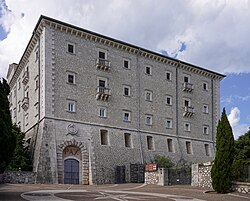
The Abbey of Monte Cassino (today usually spelled Montecassino) is a Benedictine monastery on a rocky hill about 130 kilometres (80 mi) southeast of Rome, in the Latin Valley. Located on the site of the ancient Roman town of Casinum, it is the first house of the Benedictine Order, having been established by Benedict of Nursia himself around 529. It was for the community of Monte Cassino that the Rule of Saint Benedict was composed.

Key Information

The first monastery on Monte Cassino was sacked by the invading Lombards around 570 and abandoned. Of the first monastery almost nothing is known. The second monastery was established by Petronax of Brescia around 718, at the suggestion of Pope Gregory II and with the support of the Lombard Duke Romuald II of Benevento. It was directly subject to the pope and many monasteries in Italy were under its authority. In 883, the monastery was sacked by Saracens and abandoned again. The community of monks resided first at Teano and then from 914 at Capua before the monastery was rebuilt in 949. During the period of exile, the Cluniac Reforms were introduced into the community.

The 11th and 12th centuries were the abbey's golden age. It acquired a large secular territory around Monte Cassino, the so-called Terra Sancti Benedicti ("Land of Saint Benedict"), which it heavily fortified with castles. It maintained good relations with the Eastern Church, even receiving patronage from Byzantine emperors. It encouraged fine art and craftsmanship by employing Byzantine artisans. In 1057, Pope Victor II recognised the abbot of Monte Cassino as having precedence over all other abbots. Many monks rose to become bishops and cardinals, and three popes were drawn from the abbey: Stephen IX (1057–58), Victor III (1086–87) and Gelasius II (1118–19). During this period, a monastic chronicle, Chronica sacri monasterii casinensis [it], was written by two of its own, Cardinal Leo of Ostia and Peter the Deacon (who also compiled the cartulary).

By the 13th century, the monastery's decline had set in. In 1239, the Emperor Frederick II garrisoned troops in it during his war with the Papacy. In 1322, Pope John XXII elevated the abbey into a bishopric but this was suppressed in 1367. The buildings were destroyed by an earthquake in 1349, and in 1369 Pope Urban V demanded a contribution from all Benedictine monasteries to fund the rebuilding. In 1454, the abbey was placed in commendam and in 1504 was made subject to the Abbey of Santa Giustina in Padua.

In 1799, Monte Cassino was sacked again by French troops during the French Revolutionary Wars. The abbey was dissolved by the Italian government in 1866. The building became a national monument with the monks as custodians of its treasures. In 1944, during World War II, it was the site of the Battle of Monte Cassino, when the building was destroyed by Allied bombing. It was rebuilt after the war.

After the reforms of the Second Vatican Council the monastery was one of the few remaining territorial abbeys within the Catholic Church. On 23 October 2014, Pope Francis applied the norms of the motu proprio Ecclesia Catholica of Paul VI (1976)[1] to the abbey, removing from its jurisdiction all 53 parishes and reducing its spiritual jurisdiction to the abbey itself – while retaining its status as a territorial abbey. The former territory of the Abbey, except the land on which the abbey church and monastery sit, was transferred to the diocese of Sora-Cassino-Aquino-Pontecorvo.[2][3] Pope Francis at the same time appointed Father Donato Ogliari as the new Abbot who will serve as the 192nd successor of Saint Benedict.[4] As of 2015, the monastic community consists of 13 monks.[5] Ogliari was succeeded as abbot by Antonio Luca Fallica in 2023.[6]

History

[edit]

Ancient history

[edit]
Cliff on "high mountain"

The history of Monte Cassino is linked to the nearby town of Cassino which was first settled in the fifth century BC by the Volsci people who held much of central Italy. It was they who first built a citadel on the summit of Monte Cassino. The Volsci in the area were defeated by the Romans in 312 BC. The Romans named the settlement Casinum and built a temple to Apollo at the citadel. Modern excavations have found no remains of the temple, but monumental remains of an amphitheatre, a theatre, and a mausoleum show the wealth of the Roman town.[7]

Generations after the Roman Empire adopted Christianity the town became the seat of a bishopric in the fifth century AD. Lacking strong defences the area was subject to barbarian attack and became abandoned and neglected with only a few struggling inhabitants holding out.[7]

Era of Benedict (530–547)

[edit]

According to Gregory the Great's hagiography of Benedict, the Life of Saint Benedict of Nursia, the monastery was constructed on an older pagan site, a temple of Apollo that crowned the hill. The biography records that the area was still largely pagan at the time; Benedict's first act was to smash the sculpture of Apollo and destroy the altar. He then reused the temple, dedicating it to Saint Martin, and built another chapel on the site of the altar dedicated to Saint John the Baptist.

Pope Gregory I's account of Benedict's seizure of Monte Cassino:

Now the citadel called Casinum is located on the side of a high mountain. The mountain shelters this citadel on a broad bench. Then it rises three miles above it as if its peak tended toward heaven. There was an ancient temple there in which Apollo used to be worshipped according to the old pagan rite by the foolish local farmers. Around it had grown up a grove dedicated to demon worship, where even at that time a wild crowd still devoted themselves to unholy sacrifices. When [Benedict] the man of God arrived, he smashed the idol, overturned the altar and cut down the grove of trees. He built a chapel dedicated to St. Martin in the temple of Apollo and another to St. John where the altar of Apollo had stood. And he summoned the people of the district to the faith by his unceasing preaching.[8]

The façade of the church

Pope Gregory I's biography of Benedict claims that Satan opposed the monks repurposing the site. In one story, Satan invisibly sits on a rock making it too heavy to remove until Benedict drives him off. In another story, Satan taunts Benedict and then collapses a wall on a young monk, who is brought back to life by Benedict. Pope Gregory also relays that the monks found a pagan idol of bronze when digging at the site (which when thrown into the kitchen gave the illusion of a fire until dispelled by Benedict).[9]

Archaeologist Neil Christie notes that it was common in such hagiographies for the protagonist to encounter areas of strong paganism.[10] Benedict scholar Terrence Kardong examines why Benedict did not face stiffer opposition in his seizure of the site from the local pagans. He contrasts this with the 25-year struggle faced by St. Martin of Tours in western Gaul by pagans angry at his attacks on their shrines: "By the time of Benedict, paganism was in a weaker condition in western Europe than it had been in Martin's time. And, of course, it must be remembered that Martin as a bishop was a much more prominent churchman than Benedict. This was an isolated and unusual episode in Benedict's monastic career. Martin, however, was thrust out of his monastery into the role of a missionary bishop in the fourth century."[9]

Benedict scholars (such as Adalbert de Vogüé and Terrence Kardong) note the heavy influence of Sulpicius Severus' Life of Martin on Pope Gregory I's biography of Benedict, including the account of his seizure of Monte Cassino. Benedict's violence against a pagan holy place recalls both Martin's assault against pagan shrines generations before and the Biblical story of conquering Israel entering the Holy Land (see Exodus 34:12–14). De Vogue writes "this mountain had to be conquered from an idolatrous people and purified from its devilish horrors. And like conquering Israel, Benedict came precisely to carry out this purification. No doubt Gregory had this biblical model uppermost in his mind, as is clear from the terms he uses to describe the work of destruction. At the same time, neither Gregory nor Benedict could have forgotten the similar line of action taken by St. Martin against the pagan shrines of Gaul."[11]

Pope Gregory I's account of Benedict at Monte Cassino is seen by scholars as the final setting for an epic set in motion at Subiaco. In his earlier setting Benedict "had twice shown complete mastery over his aggressiveness, Benedict is now allowed to use it without restraint in the service of God."[11] Scholars note that this striking contrast is not stressed by Gregory but rather both settings are portrayed as part of a single battle account against the same demonic enemy. Where Satan concealed himself behind underlings at Subiaco, at Monte Cassino he drops the masks to enter into a desperate attempt to prevent an abbey from being built, and "that the sole cause of this eruption of satanic action is the suppression of pagan worship on the high places."[11]

While scholars see some similarities between the story of Benedict's encountering demonic phenomena and diabolic apparitions at Monte Cassino with the story of Saint Anthony the Great's temptation in the desert, the influence of the story of St. Martin is dominant – with the resistance of Satan substituting for Martin's outraged pagan populace. Unlike the stories that may have influenced Pope Gregory's structure of the biography, Benedict's victories are practical, preventing Satan from stopping work on the abbey at Monte Cassino. Benedict's prayers are portrayed as the driving force behind the building of the abbey and the triumphs over Satan, through prayer: "Benedict the monk wrests from the devil a well-determined base which he never leaves."[11] After the completion of the abbey, Satan's appearances in the story diminish back to the same level as Subiaco, "Only after the saint's death and by God's permission would other enemies, the Lombards, succeed in sacking it."[11]Once established at Monte Cassino, Benedict never left. He wrote the Benedictine Rule that became the founding principle for Western monasticism, received a visit from Totila, king of the Ostrogoths (perhaps in 543, the only remotely secure historical date for Benedict), and died there. According to accounts, "Benedict died in the oratory of St. Martin, and was buried in the oratory of St. John."[11]

The Rule of St. Benedict mandated the moral obligations to care for the sick. So in Monte Cassino St. Benedict founded a hospital that is considered today to have been the first in Europe of the new era. Benedictine monks took care of the sick and wounded there according to Benedict's Rule. The monastic routine called for hard work. The care of the sick was such an important duty that those caring for them were enjoined to act as if they served Christ directly. Benedict founded twelve communities for monks at nearby Subiaco (about 64 km to the east of Rome), where hospitals were settled, too, as adjuncts to the monasteries to provide charity. Soon many monasteries were founded throughout Europe, and everywhere there were hospitals like those in Monte Cassino.

Pope Gregory I's account of Benedict's construction was confirmed by archaeological discoveries made after the destruction of 1944. Adalbert de Vogüé recounts that "Traces have been found of the oratories of St. Martin and of St. John the Baptist, with additions from the eighth and eleventh centuries, together with their pre-Christian cellars. The first one which Benedict built in the temple itself was only twelve meters long and eight wide. From this, we can infer a fairly small community. The second oratory, on the mountain-top, where the pagan altar had stood in the open air, was of the same width but somewhat longer (15.25 meters)."[11]

580–884

[edit]
Promontory and post-WWII rebuilt abbey

Monte Cassino became a model for future developments. Its prominent site has always made it an object of strategic importance. It was sacked or destroyed a number of times. "The first to demolish it were Lombards on foot in 580; the last were Allied bombers in 1944."[12] In 581, during the abbacy of Bonitus, the Lombards sacked the abbey, and the surviving monks fled to Rome, where they remained for more than a century. During this time the body of St Benedict was transferred to Fleury, the modern Saint-Benoit-sur-Loire near Orleans, France.

A flourishing period of Monte Cassino followed its re-establishment in 718 by Abbot Petronax, when among the monks were Carloman, son of Charles Martel; Ratchis, predecessor of the Lombard King Aistulf; and Paul the Deacon, the historian of the Lombards.

In 744, a donation of Gisulf II of Benevento created the Terra Sancti Benedicti, the secular lands of the abbacy, which were subject to the abbot and nobody else save the pope. Thus, the monastery became the capital of a state comprising a compact and strategic region between the Lombard principality of Benevento and the Byzantine city-states of the coast (Naples, Gaeta, and Amalfi).

In 884 Saracens sacked and then burned it down,[13] and Abbot Bertharius was killed during the attack. Among the great historians who worked at the monastery, in this period there is Erchempert, whose Historia Langobardorum Beneventanorum is a fundamental chronicle of the ninth-century Mezzogiorno.

The abbey under Desiderius

[edit]
Woodcut of the abbey from the late 15th-century Nuremberg Chronicle (folio 144 recto)

Monte Cassino was rebuilt and reached the apex of its fame in the 11th century under the abbot Desiderius (abbot 1058–1087), who later became Pope Victor III. Monks caring for the patients in Monte Cassino constantly needed new medical knowledge. So they began to buy and collect medical and other books by Greek, Roman, Islamic, Egyptian, European, Jewish, and Oriental authors. As Naples is situated on the crossroad of many seaways of Europe, the Middle East and Asia, soon the monastery library was one of the richest in Europe. All the knowledge of the civilizations of all the times and nations was accumulated in the Abbey of that time. The Benedictines translated into Latin and transcribed precious manuscripts. The number of monks rose to over two hundred, and the library, the manuscripts produced in the scriptorium and the school of manuscript illuminators became famous throughout the West. The unique Beneventan script flourished there during Desiderius' abbacy. Monks reading and copying the medical texts learned a lot about human anatomy and methods of treatment, and then put their theoretic skills into practice at monastery hospital. By the 10–11th centuries Monte Cassino became the most famous cultural, educational, and medical center of Europe with a great library in Medicine and other sciences. Many physicians came there for medical and other knowledge. That is why the first High Medical School in the world was soon opened in nearby Salerno which is considered today to have been the earliest Institution of Higher Education in Western Europe. This school found its original base in the Benedictine Abbey of Monte Cassino still in the 9th century and later settled down in Salerno. So, Montecassino and Benedictines played a great role in the progress of medicine and science in the Middle Ages, and with his life and work St. Benedict himself exercised a fundamental influence on the development of European civilization and culture and helped Europe to emerge from the "dark night of history" that followed the fall of the Roman empire.

The buildings of the monastery were reconstructed in the 11th century on a scale of great magnificence, artists being brought from Amalfi, Lombardy, and even Constantinople to supervise the various works. The abbey church, rebuilt and decorated with the utmost splendor, was consecrated in 1071 by Pope Alexander II. A detailed account of the abbey at this date exists in the Chronica monasterii Cassinensis by Leo of Ostia and Amatus of Monte Cassino gives us our best source on the early Normans in the south.

The abbey in depicted in Giovan Battista Pacichelli's 1703 Il regno di Napoli in prospettiva

Abbot Desiderius sent envoys to Constantinople some time after 1066 to hire expert Byzantine mosaicists for the decoration of the rebuilt abbey church. According to chronicler Leo of Ostia the Greek artists decorated the apse, the arch and the vestibule of the basilica. Their work was admired by contemporaries but was totally destroyed in later centuries except two fragments depicting greyhounds (now in the Monte Cassino Museum). "The abbot in his wisdom decided that a great number of young monks in the monastery should be thoroughly initiated in these arts" – says the chronicler about the role of the Greeks in the revival of mosaic art in medieval Italy.

Architectural historian Kenneth John Conant believed that Desiderius' rebuilding included pointed arches, and served as a major influence in the nascent development of Gothic architecture. Abbot Hugh of Cluny visited Monte Cassino in 1083, and five years later he began to build the third church at Cluny Abbey, which then included pointed arches and became a major turning point in medieval architecture.[14]

Later history

[edit]

An earthquake damaged the Abbey in 1349, and although the site was rebuilt it marked the beginning of a long period of decline. In 1321, Pope John XXII made the church of Monte Cassino a cathedral, and the carefully preserved independence of the monastery from episcopal interference was at an end. That situation was reversed by Pope Urban V, a Benedictine, in 1367.[15] In 1505 the monastery was joined with that of St. Justina of Padua.

Air assault on Monte Cassino, 15 February 1944, painted by Peter McIntyre, an official war artist of New Zealand during WWII
Monte Cassino in ruins after Allied bombing in February 1944

The abbey was sacked by the French Revolutionary Army in 1799. From the dissolution of the Italian monasteries in 1866, Monte Cassino became a national monument.

Battle of Monte Cassino

[edit]

In the Italian Campaign of World War II the town of Cassino formed part of the German forces' 161-kilometre (100-mile) Gustav Line, which aimed to prevent Allied troops from advancing northwards. The abbey itself however, was not initially utilised by the German troops as part of their fortifications, owing to General Kesselring's regard for the historical monument. The Gustav Line stretched from the Tyrrhenian to the Adriatic coast in the east, with Monte Cassino itself overlooking Highway 6 and blocking the path to Rome.

During the Battle of Monte Cassino (January–May 1944) the abbey was heavily damaged. On 15 February 1944 it was nearly destroyed in a series of heavy, American-led air raids. General Sir Harold Alexander, with the support of numerous Allied commanders, ordered the bombing, which was conducted due to several reports from British Indian Army officers suggesting that German forces were occupying the monastery; the abbey was considered a key observation post by all those who were fighting in the field.[16] However, during the bombing no German troops were present in the abbey. Subsequent investigations found that the only people killed in the monastery by the bombing were 230 Italian civilians seeking refuge there.[17] Following the bombing the ruins of the monastery were occupied by German Fallschirmjäger paratroopers of the 1st Parachute Division, due to the ruins providing excellent defensive cover.[18]

Postwar history

[edit]

The Abbey was rebuilt after the war.[19] In the early 1950s, President of the Italian Republic Luigi Einaudi gave considerable support to the rebuilding.[20] Pope Paul VI consecrated the rebuilt Basilica on 24 October 1964. During reconstruction, the abbey library was housed at the Pontifical Abbey of St Jerome-in-the-City.[21] Until his resignation was accepted by Pope Francis on 12 June 2013, the Territorial Abbot of Monte Cassino was Pietro Vittorelli.[22] The Vatican daily bulletin of 23 October 2014 announced that with the appointment of his successor Donato Ogliari, the territory of the abbey outside the immediate monastery grounds had been transferred to the Diocese of Sora-Aquino-Pontecorvo, now renamed Diocese of Sora-Cassino-Aquino-Pontecorvo.[23]

Treasures

[edit]

In December 1943, some 1,400 irreplaceable manuscript codices, chiefly patristic and historical, in addition to a vast number of documents relating to the history of the abbey and the collections of the Keats–Shelley Memorial House in Rome, had been sent to the abbey archives for safekeeping. German officers Lt. Col. Julius Schlegel (a Roman Catholic) and Capt. Maximilian Becker (a Protestant), both from the Panzer-Division Hermann Göring, had them transferred to the Vatican at the beginning of the battle.[24]

Another account, however, from revisionist author Franz Kurowski's The History of the Fallschirmpanzerkorps Hermann Göring: Soldiers of the Reichsmarschall, notes that 120 trucks were loaded with monastic assets and art which had been stored there for safekeeping. Robert Edsel (2006), on the other hand, speculates it might have been looting. The trucks were loaded and left in October 1943, and only "strenuous" protests resulted in their delivery to the Vatican, minus the 15 cases which contained the property of the Capodimonte Museum in Naples. Edsel goes on to note that these cases had been delivered to Göring in December 1943, for "his birthday". This is, however, unproven.[25]

People

[edit]

Abbots

[edit]

Burials

[edit]
Panorama from Polish cemetery

See also

[edit]

References

[edit]

Sources

[edit]
[edit]
Revisions and contributorsEdit on WikipediaRead on Wikipedia
from Grokipedia
Monte Cassino is a historic Benedictine abbey perched on a rocky hilltop overlooking the town of Cassino in the Lazio region of central Italy, founded by Saint Benedict of Nursia in 529 CE on the ruins of an ancient acropolis dedicated to Apollo. As the cradle of the Benedictine Order, it served as the primary center for the dissemination of Saint Benedict's Rule, which emphasized ora et labora (prayer and work) and profoundly shaped Western monasticism, education, and manuscript preservation through its renowned scriptorium and library. The abbey endured multiple destructions and reconstructions, including sackings by Lombards in 581 and Saracens in 883, an earthquake in 1349, and Allied bombing during World War II on February 15, 1944, which reduced much of the structure to rubble amid the Battle of Monte Cassino, a grueling campaign to breach the German Gustav Line. The WWII bombardment, executed despite assurances from German commanders that the abbey itself housed no troops—only refugees and artifacts—sparked controversy over whether the strategic necessity justified the cultural loss, as the resulting debris inadvertently fortified German defenses. Rebuilt in the post-war era to faithful Gothic-Romanesque designs using original materials where possible, Monte Cassino today functions as a territorial abbey, housing the tombs of Saints Benedict and Scholastica, and attracts pilgrims and scholars to its museum exhibiting archaeological finds from Bronze Age to medieval periods.

Geography and Strategic Position

Location and Topography

Monte Cassino occupies a rocky hill in the province of Frosinone, Lazio region, central Italy, rising to an elevation of 520 meters above sea level. The site lies approximately 130 kilometers southeast of Rome, positioned 2 kilometers west of the modern town of Cassino. It overlooks the Liri Valley, a broad floodplain formed by the Liri River, with the ancient Roman settlement of Casinum situated at the hill's base. The topography features steep slopes and limestone outcrops characteristic of the Apennine foothills, providing natural defensibility through limited access routes and sheer elevations that deter casual ascent. These rugged contours, including proximity to key mountain passes, isolate the summit while commanding views over surrounding valleys, historically favoring seclusion amid challenging terrain. Geologically, the area consists of middle Cretaceous limestones prone to karst features and seismic activity due to its position along active fault lines in the central Apennines. A major earthquake on September 9, 1349, with an estimated magnitude of 6.7–6.8, struck the region, causing widespread destruction including damage to structures at Monte Cassino amid a sequence of shocks affecting southern Latium and adjacent areas.

Historical Military Significance

The hill of Monte Cassino, rising to an elevation of 520 meters above sea level, occupies a commanding position within the Apennine Mountains, overlooking the Liri Valley and key ancient routes such as the Via Latina toward Rome. This topography provided natural defensive advantages, enabling surveillance over approaching forces and control of passes critical for military movements between southern Italy and the capital. Prior to Christian establishment, the site functioned as a Roman citadel known as Casinum, featuring a temple dedicated to Apollo atop the acropolis, which underscored its role as a fortified outpost blending religious and strategic functions. Throughout history, this elevated terrain repeatedly drew invaders seeking to neutralize its oversight of valleys and roadways, resulting in multiple destructions of structures atop the hill, including by Lombards in the 6th century and Saracens in the 9th century, as well as French forces in 1799. The causal linkage between geography and vulnerability is evident: possession of the heights facilitated early detection and artillery dominance over supply lines in the valley below, while the steep slopes and limited access routes inherently complicated logistics for besieging armies, exacerbating challenges in sustaining prolonged assaults or resupply efforts. Such features favored entrenched defenders, turning the site into a recurring chokepoint during incursions aimed at Rome. The persistence of Monte Cassino's military relevance extended into the 20th century, where its topographic dominance continued to shape defensive strategies amid the rugged Italian landscape, amplifying the defender's observational edge while imposing severe constraints on attackers' mobility and provisioning. This interplay of elevation-enabled vigilance and logistical hurdles exemplifies how the site's inherent geography dictated its entanglement in conflicts across eras, independent of specific tactical engagements.

Founding and Benedictine Origins

St. Benedict's Life and Motivations

Benedict of Nursia was born circa 480 AD in the town of Nursia (modern Norcia), in the Sabine Hills of central Italy, to parents of Roman noble lineage. As a youth, he was sent to Rome for education in the classical liberal arts, but the experience profoundly disillusioned him with the moral decay, licentiousness, and lingering pagan influences pervasive in the late Roman Empire's capital. Around 500 AD, Benedict abandoned his studies and fled the city, seeking solitude to dedicate himself entirely to God through ascetic practices. Initially, Benedict settled as a hermit in a cave at Subiaco, approximately 40 miles east of Rome, under the guidance of a local monk named Romanus who provided him with food and spiritual counsel. His reputation for holiness attracted disciples, prompting him to organize monastic communities; he eventually founded twelve monasteries in the Subiaco valley, each housing twelve monks under priors, while residing as superior in a thirteenth. Benedict's motivations were rooted in a causal rejection of urban vice and imperial decline—evident in Rome's ethical dissolution—and a pursuit of unadulterated prayer and self-denial, informed by Eastern monastic exemplars conveyed through John Cassian's Institutes and Conferences, which emphasized discretion, humility, and combat against passions. Conflicts with local clergy, including envy from a priest named Florentius, compelled Benedict to leave Subiaco around 529 AD. He relocated southward to Monte Cassino, a hilltop site overlooking the Via Latina, where pagan worship persisted; there, his first act was to demolish a temple dedicated to Apollo and an adjacent altar to Diana, repurposing the space for Christian chapels as a deliberate assertion of Christianity's ascendancy over residual idolatry. This move embodied Benedict's empirical commitment to eradicating pagan remnants amid societal transition, prioritizing spiritual renewal through isolated, disciplined communal life over the Empire's faltering structures.

Establishment of the Monastery (c. 529 AD)

St. Benedict of Nursia relocated to Monte Cassino around 529 AD, following conflicts at his earlier communities in Subiaco. According to Pope Gregory the Great's Dialogues (written c. 593–594 AD), the site was a prominent hilltop formerly hosting a pagan temple to Apollo, complete with an altar and sacred groves used for idolatrous rituals by local inhabitants. Benedict dismantled the idol, demolished the altar, incinerated the groves, and consecrated the location by constructing an oratory to St. Martin of Tours; he later added another to St. John the Baptist on the site's former altar foundation. Benedict's exemplary conduct and doctrinal instruction gradually converted the pagan populace, enabling the formation of an initial monastic brotherhood. The community prioritized self-sufficiency through manual labor—clearing land, erecting a rudimentary church, and fabricating cells—integrated with liturgical prayer, reflecting an emergent ethos of ora et labora that underscored productive discipline over idleness. Disciples, including Roman nobles' sons like Maurus (whom Benedict appointed as a deputy) and the youth Placidus, swelled the ranks, with Benedict personally training select members while dispatching groups of twelve to affiliate hermitages nearby. Benedict governed until his death on March 21, 547 AD, after a brief illness he had predicted; monks supported him during his final moments as he received the Eucharist, and he was interred in the oratory of St. John the Baptist. His sister Scholastica predeceased him c. 543 AD and was buried alongside in a shared tomb, which tradition identifies as the repository for both siblings' relics, later drawing pilgrims despite the account's hagiographic elements in Gregory's narrative.

The Rule of St. Benedict

The Rule of St. Benedict was composed circa 530 AD at Monte Cassino, synthesizing elements from earlier monastic traditions such as those of St. Basil and John Cassian while introducing innovations suited to Western communal life. Structured in a prologue and 73 chapters, it emphasizes core vows of obedience—defined as prompt and ungrudging submission to the abbot—stability, which binds monks to a single community for life, poverty through renunciation of personal property, and moderate asceticism that avoids the extremes of Eastern eremitism. This balanced framework, often summarized as ora et labora (prayer and work), provided a practical guide for cenobitic monasticism, prioritizing adaptability over rigid severity. The Rule establishes a clear community hierarchy with the abbot as paternal authority, assisted by deans overseeing groups of ten monks, fostering disciplined yet humane governance. Daily life follows a rhythmic cycle: the Liturgy of the Hours with seven daytime offices and one nocturnal, manual labor for at least five hours to promote self-sufficiency, and dedicated periods for sacred reading to cultivate spiritual and intellectual growth. These elements underscore moderation, such as regulated meals, sleep, and clothing, which contrasted with more austere Eastern practices and enabled sustainable communal operation. This moderation, while criticized by some contemporaries for leniency relative to Eastern rigor—favoring organized labor and stability over solitary ascetic feats—proved causally instrumental in the Rule's endurance. Its flexibility allowed monasteries to serve as refuges during invasions, as evidenced by the Monte Cassino community's dispersal in 581 AD amid Lombard assaults, yet eventual reconstitution. Empirically, the emphasis on work and study advanced agricultural techniques through land cultivation and preserved literacy via manuscript copying, contributing to cultural continuity amid early medieval disruptions. The Rule's success stemmed from this pragmatic equilibrium, outlasting harsher regimens by aligning discipline with human capacity for long-term adherence.

Early Medieval History (6th–11th Centuries)

Initial Development and Monastic Spread

Following St. Benedict's death around 547 AD, Monte Cassino developed as a stable monastic community governed by his Rule, which emphasized a balanced rhythm of liturgical prayer, manual labor, and sacred reading, enabling self-sufficiency on the challenging terrain. Successive abbots elected from among the monks oversaw the expansion of communal practices, including agricultural work to sustain the brethren and local dependents, fostering economic resilience in central Italy during the 6th and 7th centuries. Pope (r. –604) elevated the monastery's profile through his Dialogues (completed c. 593 ), Book II of which recounts Benedict's life and miracles, portraying Monte Cassino as a beacon of holiness and thereby promoting the Rule's principles across the Latin West. This hagiographic endorsement, drawn from eyewitness accounts including those of Benedict's disciples, affirmed the abbey's spiritual without formal privileges but through implicit papal validation, encouraging emulation by other foundations. The monastery's influence extended via the dispersion of its monks, who established dependent priories in southern Italy and carried the Rule northward, earning Monte Cassino recognition as the originating "mother house" of Benedictine monasticism. A pivotal event in this dissemination occurred around 660 AD, when Abbot Mummolus of Fleury (in modern France) retrieved Benedict's relics from Monte Cassino amid regional disruptions, transplanting them to Fleury and ensuring the Rule's strict adoption there, which in turn propagated Benedictinism among Frankish kingdoms by the 8th century. Monastic labor at Monte Cassino, as mandated by the Rule's ora et labora ethos, involved terracing the steep hillsides and managing irrigation from nearby springs, techniques that enhanced arable land and local food production against the backdrop of post-Roman economic decline. Complementing this, the community's commitment to lectio divina supported an early scriptorium where monks copied biblical texts and patristic works, safeguarding literacy and classical remnants in an era of widespread illiteracy and cultural fragmentation. By the 9th century, these practices had solidified Monte Cassino's role in modeling Benedictine expansion, with affiliated houses adopting its regimen of disciplined communal life across Europe.

Destructions by Lombards and Saracens

The monastery at Monte Cassino was sacked around 581 by Zotto, the Lombard Duke of Benevento, as part of the Lombard expansion into Byzantine-held territories in central-southern Italy. The attack exploited the abbey's isolated hilltop location, chosen for seclusion under St. Benedict's vision but lacking fortifications against armed incursions, leading to its swift overrun and abandonment. The monks fled to Rome, carrying the original text of the Benedictine Rule, which prioritized obedience to the abbot's authority—allowing pragmatic decisions for relocation to preserve the community amid existential threats rather than rigid defense of the site. This dispersal temporarily halted local operations but facilitated the Rule's transmission and adaptation elsewhere, demonstrating empirical resilience through decentralized continuity over centralized vulnerability. The ruins remained deserted for approximately 137 years until Abbot Petronax of Brescia refounded the community circa 718, encouraged by Pope Gregory II and aided by grants from Lombard Duke Romuald II of Benevento, whose predecessors like Gisulf had earlier influenced regional monastic support. Reconstruction proceeded amid ongoing Lombard-Byzantine tensions, with the site's elevated but exposed topography again posing risks, as monastic resources focused on spiritual rather than military preparedness. The Benedictine emphasis on humility and labor enabled gradual repopulation and agricultural self-sufficiency, yet the absence of alliances or walls perpetuated strategic isolation in a fragmented polity prone to raids. Further devastation occurred in 883 when Saracen forces, operating from bases near the Garigliano River amid their incursions from Muslim-held Sicily and southern ports, pillaged and burned the abbey, slaying Abbot Bonus and scattering the monks. These raiders targeted wealthy ecclesiastical sites for plunder, slaves, and disruption, capitalizing on the monastery's remoteness from effective Frankish or local defenses in a period of feudal disarray. The community relocated first to Teano and then Capua by 914, where the Rule's provisions for abbatial discretion in crises ensured survival of liturgical and disciplinary traditions, underscoring causal adaptability: the doctrine's focus on internal order and detachment from material permanence mitigated total cultural loss despite repeated physical obliteration.

Revival Under Desiderius (1058–1087)

Desiderius, a Lombard noble and former monk at Benevento, was elected abbot of Monte Cassino on April 19, 1058, succeeding Abbot Richer. His abbacy marked a period of vigorous revival following earlier destructions, with the monastery achieving architectural grandeur and expanded influence through strategic diplomacy and resource management. Desiderius initiated the rebuilding of the basilica dedicated to Saint Benedict, enlarging it and incorporating advanced decorative elements; construction emphasized monumental scale, including remodelled dormitories and other monastic structures completed by the 1070s. To enhance the church's interior, he dispatched envoys to Constantinople after 1066 to recruit expert Byzantine mosaicists skilled in laying mosaics and pavements, resulting in ornate decorations that reflected eastern artistic influences. Through close ties with the papacy—such as his appointment as cardinal-priest by Pope Nicholas II in 1059—and negotiations with emerging Norman powers in southern Italy, Desiderius safeguarded the abbey's autonomy amid regional power shifts. These alliances, including mediation between papal and Norman interests, protected monastic holdings from feudal encroachments. The abbey's scriptorium thrived under Desiderius, producing illuminated manuscripts and historical texts; it contributed to the compilation of the Chronica Monasterii Casinensis, a key chronicle documenting the monastery's history up to the late 11th century, edited in critical editions from primary monastic records. Revenues from extensive estates, forming the Terra Sancti Benedicti—a secular territory under direct abbatial control—funded these projects, with the domain encompassing lands donated or acquired across southern Italy by the 11th century. Desiderius's tenure culminated in his election as Pope Victor III on May 24, 1086, though he reluctantly accepted and died in 1087, underscoring Monte Cassino's elevated role in ecclesiastical politics.

High and Late Medieval Period (12th–18th Centuries)

Architectural and Cultural Flourishing

During the 12th and 13th centuries, Monte Cassino's architectural complex retained the Romanesque features established in the prior era, including the basilica's nave with aisles and decorative elements characteristic of the Lombard Romanesque style, such as pilaster strips and arched corbels that influenced regional monastic constructions. A catastrophic on September 9, 1349, razed much of the , including the church, prompting a rebuilding phase funded in part by papal mandates. In 1369, ordered Benedictine monasteries across Europe to contribute to the restoration, which integrated Gothic innovations like pointed arches and ribbed vaulting with the surviving Romanesque core, enhancing the structural elegance and verticality of the structures. Culturally, the abbey's scriptorium thrived as a center for manuscript production, generating works in the 12th century adorned with Cassinese decorative motifs—geometric patterns and figural initials—rooted in 11th-century traditions, thereby preserving and disseminating theological, classical, and scientific texts. Monks meticulously maintained codices through practices like retracing faded script and preserving flyleaves, ensuring the longevity of a growing collection that included rare exemplars of ancient authors such as Frontinus and Gregory the Great by the 15th century. This activity positioned Monte Cassino as a key node in medieval Europe's intellectual network, fostering literacy and scholarly exchange despite intermittent administrative strains noted in period records.

Role in Preservation of Knowledge

The scriptorium at Monte Cassino functioned as a key repository for copying Greco-Roman texts during periods of feudal instability and invasions, where the monastery's relative isolation shielded manuscripts from destruction that afflicted secular libraries. Monks there meticulously transcribed works by Virgil and Cicero, countering the attrition of classical literature in the early Middle Ages, with Beneventan script exemplars of Virgil's texts emerging from the abbey's 11th-century copying campaigns. This methodical labor preserved unique exemplars, such as those of Varro and Apuleius, amid broader losses, as the abbey's structured monastic routine prioritized textual reproduction over transient pursuits. A substantial corpus of medieval manuscripts produced at Monte Cassino survives, underscoring the scriptorium's output under abbots like Desiderius (1058–1087), who oversaw the creation and acquisition of volumes that transmitted antiquity's legacy into later eras. The abbey's self-sufficiency, sustained through agricultural innovations including vineyard cultivation and water mills on its estates, generated resources that funded scribal materials and labor without dependence on feudal lords prone to warfare. This economic model, rooted in Benedictine emphasis on manual work, enabled consistent preservation efforts, though critics note the insularity sometimes constrained broader innovation, evidenced by selective adaptations rather than wholesale reinvention of copied texts. Secular historians attribute to Monte Cassino a bridging role from classical antiquity to the Renaissance, crediting its scriptorium with salvaging Latin texts that informed later scholarship, in contrast to minimalist interpretations downplaying early medieval knowledge erosion or those prioritizing Islamic translation centers for Greek works. Empirical evidence from surviving codices supports the former view, as the abbey's outputs—distinct from Eastern preservations—directly influenced Western textual traditions, with some authors extant solely through Monte Cassino-derived manuscripts. While Islamic hubs advanced Aristotelian transmission, Monte Cassino's focus on Roman authors filled a causal gap in Latin continuity during Europe's fragmented phase.

Conflicts and Partial Declines

During the Renaissance and into the 16th century, Monte Cassino faced significant challenges from political instability and military conflicts, as French and Spanish forces vied for control of the Kingdom of Naples, positioning the abbey as a pawn in broader power struggles. This era marked a profound decline, attributed to the progressive loss of the monastery's traditional autonomy amid these wars and the shifting dynamics of Italian Renaissance politics. Internal governance issues exacerbated external pressures, particularly through the increasing appointment of commendatory abbots—often non-resident figures granted the abbey's revenues by secular or ecclesiastical patrons—which began eroding effective monastic administration in the early 16th century. In response to such laxity and in alignment with broader Benedictine reform efforts, Monte Cassino adhered to the Cassinese Congregation in 1504, a movement originating from 15th-century initiatives to restore strict observance of the Rule of St. Benedict across Italian monasteries. This affiliation aimed to counteract mismanagement but did not fully reverse the trend of partial institutional weakening. The scriptorium's productivity waned during this period, coinciding with the widespread adoption of the printing press after 1450, which diminished the demand for handwritten manuscripts across European monasteries; at Monte Cassino, output shifted toward selective commissioning of high-quality codices to affirm the abbey's prestige, though overall activity declined amid resource strains. Papal privileges provided some resilience, preserving the abbey's territorial status and exemptions from local secular oversight, yet these proved insufficient against cumulative pressures, including the scrutiny of Counter-Reformation policies that sought to standardize monastic discipline. By the , under the Bourbon dynasty's rule in from 1734, further erosion of autonomy contributed to renewed decline, marked by reduced cultural output and administrative vitality, though the abbey retained its foundational role within Benedictine networks. Natural calamities, such as regional plagues and seismic activity, compounded these vulnerabilities but were mitigated by the monastery's elevated position and papal safeguards, preventing total collapse.

Modern Era Destructions and Transitions (19th–20th Centuries)

Napoleonic Sacking and Dissolution (1799–1866)

In February 1799, French forces under General Jean-Étienne Championnet invaded the Kingdom of Naples during the Parthenopean Republic campaign, sacking Monte Cassino and dispersing its monastic community amid widespread plunder of ecclesiastical sites across southern Italy. The abbey's valuables, including liturgical objects and manuscripts, were systematically looted, reflecting the revolutionary French policy of secularizing and monetizing church properties to fund military efforts and redistribute assets. This intervention disrupted the Benedictine order's longstanding role in archival stewardship, with empirical records indicating that such sackings causally accelerated the erosion of medieval codices and artifacts, as state-driven confiscations prioritized short-term fiscal gains over institutional continuity. Post-Napoleonic restoration under the Bourbon monarchy in 1815 enabled partial revival of monastic activities at Monte Cassino, including the repatriation of select looted treasures from French collections through diplomatic negotiations aligned with the Congress of Vienna's broader return of seized artworks. However, the abbey's autonomy remained precarious amid ongoing tensions between restored papal authority and emerging nationalist secularism. By the 1860s, Italian unification's liberal policies—enacted via laws suppressing over 300 religious houses nationwide—culminated in Monte Cassino's formal dissolution on October 7, 1866, under Prime Minister Bettino Ricasoli's administration, which seized monastic lands to finance state-building and reduce clerical influence. The 1866 decree transformed the abbey into a national monument under state control, with remaining monks permitted as custodians but stripped of proprietary rights, leading to its temporary use as military barracks and further dispersal of archives—estimated at thousands of documents—through bureaucratic reallocation rather than outright destruction. This secular reconfiguration, justified by proponents as advancing modernization, empirically hollowed out the site's role in preserving classical and patristic knowledge, as religious orders' decentralized guardianship yielded to centralized state oversight prone to neglect or politicization. While some artifacts were salvaged via private ecclesiastical networks, the period's upheavals underscored the causal fragility of cultural institutions when subordinated to ideological state agendas, contrasting with the stabilizing continuity provided by autonomous monastic traditions.

Pre-WWII Status

Following the suppression of religious orders during Italian unification, the abbey was dissolved by the Italian government on October 17, 1866, with its extensive lands expropriated as part of broader confiscations targeting monastic properties to fund the new state. The site was redesignated a national monument, allowing a reduced Benedictine community to remain as custodians responsible for maintenance and treasures, while monastic life persisted in a diminished capacity under state oversight. This arrangement preserved the abbey's religious function, including liturgical services in the church, amid ongoing scholarly interest in its historical artifacts. By the 1870s, Benedictine refounding efforts had stabilized the community, enabling resumption of tourism and academic pursuits as stabilized post-unification. Restorations, such as the 1880 consecration of the ancient Torretta by a legate of , supported partial recovery of the complex's . The , rebuilt after earlier losses, held approximately 30,000 volumes in its antique collection by the early , facilitating research into medieval manuscripts and Benedictine texts. In the interwar period, Benito Mussolini's Fascist regime symbolically venerated the abbey as a pillar of Italian heritage, providing limited state support for upkeep without major interventions. Accessibility improved with the installation of a cable car in 1930, operational until 1943, which boosted pilgrimage and scholarly visits. As tensions escalated toward World War II, the abbey sheltered civilian refugees seeking sanctuary from regional instability.

World War II: The Battle of Monte Cassino

Strategic Context of the Gustav Line

By January 1944, Allied forces advancing northward through Italy after successful landings at Salerno and Anzio had been halted at the Gustav Line, a series of fortified defenses stretching from Ortona on the Adriatic to Gaeta on the Tyrrhenian Sea. This line exploited the Italian peninsula's narrow waist, channeling attackers into predictable corridors while leveraging the Apennine Mountains' rugged terrain for defensive depth. Harsh winter conditions, including rain-soaked slopes and swollen rivers like the Rapido and Garigliano, further compounded the challenges, turning potential maneuvers into grueling infantry assaults against prepared positions. Monte Cassino formed the linchpin of the Gustav Line, its 1,703-foot summit providing commanding panoramic views over the Liri Valley and Highway 6, the primary route to Rome. The hill's steep, terraced slopes and proximity to the Rapido River gorge created natural chokepoints, where defenders could enfilade advancing troops with interlocking fields of fire, mines, and artillery from elevated redoubts. From first principles, such high ground confers inherent advantages in observation, concealment of movements, and concentration of defensive fires, negating numerical superiority by forcing attackers into exposed, attritional climbs under sustained harassment. German commander Field Marshal Albert Kesselring recognized this, positioning elite units to hold the feature as an anchor preventing any flanking maneuvers through the valley. German defenses around Monte Cassino were manned primarily by the 1st Fallschirmjäger Division, paratroopers under the XIV Panzer Corps, who occupied forward slopes and ruined villages without initially entering the abbey itself, per Kesselring's directive to respect its cultural status. Facing them were elements of the U.S. Fifth Army, including the II Corps with American, Indian, and New Zealand divisions, supported by British Eighth Army contingents such as Polish and Indian troops probing the line's eastern sector. The terrain's causal dynamics—impassable mountains to the east, flooded coastal plains to the west—compelled Allies into repeated frontal efforts, yielding disproportionate losses estimated at 55,000 Allied casualties against 20,000 German in the ensuing operations. This lopsided toll underscored the inefficiencies of attrition warfare against entrenched defenders in fortified, observation-dominant positions, where each yard gained exacted a steep human cost without decisive breakthrough.

Phases of the Battle (January–May 1944)

The Battle of Monte Cassino unfolded in four distinct phases from January to May 1944, as Allied forces under U.S. Fifth Army sought to breach the German Gustav Line anchoring on the abbey atop Monte Cassino. The initial assaults emphasized frontal attacks on the town of Cassino and surrounding heights, hampered by rugged terrain, winter weather, and fortified German positions held by elite Fallschirmjäger paratroopers. Subsequent efforts incorporated broader flanking maneuvers, culminating in a coordinated offensive that exploited diversions and multi-national contributions, though high attrition from mud, mines, and close-quarters combat persisted across phases. The first phase commenced on January 17, 1944, with U.S. II Corps, including the 34th Infantry Division, launching assaults on Cassino town and nearby hills like Hill 213, supported by French and British flanking efforts. On January 20–22, the U.S. 36th Infantry Division attempted a diversionary crossing of the Rapido River south of Cassino, involving two regiments paddling across swift, flood-prone waters under heavy fire, resulting in over 1,600 casualties including 143 killed and 663 wounded, due to inadequate reconnaissance, steep banks, and enfilading German artillery from elevated positions. This failed to draw reserves effectively, while the 34th Division's push on January 24 gained limited footholds amid sniper fire and counterattacks, exacerbated by freezing rain turning slopes to ice. Tactical errors, such as insufficient engineer support for the Rapido and underestimation of defensive depth, contributed to stalemate, with Allies withdrawing by late January after 7,000 casualties across the front. In the second phase, from early , renewed assaults followed, focusing on the battered and approaches, but persistent fog, rubble-choked streets favoring defenders, and German reinforcements led to hand-to-hand fighting with negligible gains. U.S. and British Indian troops advanced incrementally amid attrition from terrain-induced exhaustion and supply strains, ending in by mid- with additional thousands of casualties. The third phase, Operation Dickens from March 15–25, 1944, involved New Zealand Corps targeting Castle Hill and the town, preceded by artillery barrages, yet German paratroopers repelled attacks through rubble barricades and snipers, while adverse weather delayed reinforcements and amplified fatigue. New Zealanders captured parts of Point 435 but faced counterassaults, withdrawing after 1,000 casualties, highlighting how debris from prior actions and mountainous defilades neutralized Allied firepower superiority. The fourth phase, Operation Diadem starting May 11, 1944, coordinated a 20-division push along the Gustav Line, with Polish II Corps assigned the monastery sector after French Expeditionary Corps (CEF) under General Alphonse Juin executed a flanking maneuver through the Aurunci Mountains north of Cassino, capturing heights like Monte Belvedere and drawing German reserves away. On May 17, Polish troops assaulted Phantom Ridge and breached defenses, reaching the abbey ruins by May 18 amid fierce close combat, enabling the line's collapse. The CEF's role, involving colonial and Free French units in grueling mountain warfare, has been noted in recent analyses as pivotal yet underemphasized in Anglo-American narratives, with 2024 discussions highlighting their contributions to the breakthrough despite high costs. Overall casualties exceeded 50,000 Allied and 20,000 German, underscoring terrain and weather as causal factors in prolonged attrition beyond direct combat.

Bombing Decision and Controversies

The decision to bomb the Monte Cassino abbey on February 15, 1944, stemmed from Allied suspicions that German forces were using it as an observation post or headquarters, despite conflicting intelligence reports indicating otherwise. New Zealand Corps commander Bernard Freyberg advocated for aerial bombardment to clear the site ahead of a planned infantry assault, arguing it would reduce casualties by denying the Germans a fortified vantage point overlooking the Rapido River valley. U.S. Fifth Army commander Mark W. Clark, initially hesitant due to the abbey's cultural significance, ultimately approved the request after consultations with higher command, including British General Harold Alexander, overriding concerns about precision strikes or alternative artillery options that might preserve the structure. Abbot Gregorio Diamare had evacuated all monks and over 800 civilian refugees from the abbey weeks earlier, providing written assurances to Allied forces on February 14 that no German troops occupied the premises, a fact corroborated by neutral observers and subsequent investigations. The Vatican had protested potential attacks on the historic site, emphasizing its neutrality under international norms, but these appeals were disregarded amid wartime urgency. Intelligence failures, including unverified photo interpretations and refugee accounts misinterpreted as evidence of German presence, contributed to the misjudgment; empirical post-bombing assessments confirmed no Germans were inside prior to the raid. The bombardment involved 142 U.S. heavy and medium bombers dropping approximately 576 tons of high-explosive bombs over three hours, reducing the 6th-century abbey to rubble and creating debris that German paratroopers quickly fortified for defense, paradoxically strengthening their position. Proponents justified the action as a necessary evil in total war to achieve breakthrough on the Gustav Line, citing the abbey's dominant terrain advantage. Critics, including military historians, contend it exemplified flawed intelligence prioritization and disregard for cultural heritage, as the destruction violated emerging protections akin to later UNESCO conventions and handed the enemy enhanced cover without prior occupation. Debates persist over whether Freyberg and Clark ignored viable alternatives like commando raids or targeted strikes, with some analyses attributing the push to Freyberg's insistence on overwhelming force despite aerial reconnaissance ambiguities. Right-leaning commentators have framed the episode as emblematic of secular Allied forces' casual demolition of sacred Christian sites in pursuit of victory, contrasting with German compliance to exclusion zones until the bombing. Official U.S. Army reviews later deemed it a "tragic mistake," underscoring causal errors where the raid's rubble enabled prolonged resistance rather than facilitating Allied advance.

Post-War Reconstruction and Contemporary Status

Immediate Aftermath and Rebuilding (1944–1964)

The Abbey of Monte Cassino was captured by Allied forces on May 18, 1944, when soldiers of the Polish II Corps under General Władysław Anders reached the summit and raised the Polish national flag over the extensive ruins left by aerial bombardment and artillery fire. This event marked the end of the prolonged Battle of Monte Cassino and facilitated the collapse of the German Gustav Line defenses shortly thereafter. Prior to the intense fighting, the abbot and monks had evacuated the abbey's valuable treasures, including manuscripts from its library and artistic holdings, to safety in Rome under Vatican auspices, which substantially mitigated cultural losses despite the destruction of the structure itself. The German commander had initially ordered the evacuation of these items for security reasons, preserving much of the abbey's irreplaceable heritage amid the encroaching conflict. Clearance of the debris began in the immediate postwar period, with over 400,000 cubic yards of rubble removed to prepare the site for reconstruction, a process that underscored the scale of devastation from the 1944 bombing. Major rebuilding efforts commenced on April 1, 1949, directed by Italian architect Giuseppe Breccia Fratadocchi, who utilized surviving documentation, photographs, and original materials to replicate the prewar structure as closely as feasible. The design adhered to historical precedents, incorporating elements reminiscent of the Romanesque style while integrating some modern construction techniques for durability, though this fidelity to prior iterations—itself a 19th-century reconfiguration—drew limited scholarly critique for potentially prioritizing visual restoration over unadulterated medieval authenticity. Funding for the reconstruction, estimated in the millions of contemporary dollars equivalent, derived primarily from Italian state contributions supplemented by international donations, including a 1947 national appeal by the reconstruction committee soliciting 10 lire annually from Italians for five years to cover core expenses. This blend of domestic fiscal support and global philanthropy enabled the project's completion, culminating in the reconsecration of the abbey church by Pope Paul VI on October 24, 1964, who rededicated the site to peace and European unity. The event highlighted the causal efficacy of coordinated international aid in reviving a key Benedictine institution devastated by wartime exigencies.

Recent Developments and Preservation Efforts

In May 2024, the 80th anniversary of the Battle of Monte Cassino's conclusion prompted multiple commemorative events, including ceremonies in Piedimonte San Germano organized by Poland's Institute of National Remembrance, which emphasized the decisive contribution of the Polish 2nd Corps in capturing the abbey on 18 May 1944 after four months of fighting. Allied participation was highlighted through a joint battlefield tour led by NATO's Joint Force Command Naples on 20 May, visiting key sites tied to the campaign against the German Gustav Line. The Commonwealth War Graves Commission also placed its Torch of Commemoration at Cassino War Cemetery on 19 May to honor Allied fallen. Preservation initiatives focus on safeguarding the abbey's medieval heritage amid modern challenges, including the MeMo project, which integrates digital tools for conserving, promoting, and enhancing the collection of manuscripts and printed works housed in the abbey library and archives. Complementary efforts involve ongoing digitization of monastic manuscripts, supported by collaborations such as the Rome Technopole initiative, to ensure scholarly access and physical protection of these artifacts. The Benedictine community, operating under the territorial abbey structure, maintains the site through visitor-supported funding while contending with tourism's strain on infrastructure. Debates over wartime commemorations persist, as seen in the 2018 vandalism of a stele in nearby Pontecorvo honoring 175 soldiers from the French Expeditionary Corps (CEF) for their role in breaching the Gustav Line, reflecting lingering Italian sensitivities toward the Goumiers' documented atrocities during the advance. Such incidents underscore tensions in reconciling multinational contributions with local historical grievances, even as preservation prioritizes empirical conservation over interpretive disputes.

Architecture and Treasures

Current Abbey Complex Design

The current abbey complex at Monte Cassino, reconstructed from 1948 to 1964 following World War II destruction, centers on a triple-nave basilica church of Santa Maria Assunta and San Benedetto, designed in a Latin cross plan with transept and semicircular apse. The basilica's exterior employs local travertine stone to replicate historical appearances, while internal structures incorporate modern reinforcements for enhanced durability against seismic events, a causal adaptation from prior iterations vulnerable to Italy's tectonic activity, such as the 1349 earthquake that razed earlier buildings. Beneath the basilica lies a crypt venerating the relics of Saints Benedict and Scholastica, positioned under the main altar per longstanding tradition. The surrounding complex features restored cloisters, defensive perimeter walls echoing medieval fortifications for hilltop security, and supporting edifices including exhibition spaces. Salvaged artifacts, notably 11th-century bronze doors from Constantinople installed at basilica entrances, integrate historical continuity amid the rebuild. This post-1964 configuration, consecrated by Pope Paul VI on October 24, 1964, prioritizes functional resilience over ornamental patina, utilizing uniform local masonry that critics contend lacks the weathered authenticity and layered modifications of antecedent designs destroyed in successive calamities.

Library, Artifacts, and Cultural Holdings

The library of Monte Cassino houses an extensive collection of approximately 70,000 printed volumes alongside its historical archive of around 80,000 documents, with the core scholarly value residing in its 1,200 medieval and modern codices and numerous fragments that preserve key texts from antiquity through the Middle Ages. Among these, manuscripts produced during the abbacy of Desiderius (1058–1087), such as the Codex Benedictus—a liturgical volume featuring 66 miniatures in gold and vibrant colors—exemplify the scriptorium's role in copying classical authors, patristic works, and contemporary compositions that would otherwise be lost. These holdings include primary historical narratives like Amatus of Monte Cassino's History of the Normans (c. 1080), the earliest surviving account of the Norman conquests in southern Italy and Sicily, offering direct eyewitness perspectives on events such as the sieges of Bari and Salerno. Prior to the Allied bombing of February 15, 1944, the abbey's monks, in coordination with external experts, systematically evacuated the library's contents—including manuscripts, incunabula, and artworks—to safety in Rome, averting total destruction and limiting losses to negligible levels despite the abbey complex's near-complete obliteration. This preservation effort safeguarded irreplaceable artifacts, such as fragments of Cosmatesque pavements—intricate geometric inlays of colored marbles and stones dating to the medieval reconstruction under Desiderius—and Byzantine-style wall mosaics executed by eastern artisans, which reflect cross-cultural artistic exchanges in 11th-century Italy. In recent decades, digitization initiatives have enhanced accessibility to these materials, with projects rendering select codices, including those tied to Amatus's chronicle, available online through institutional repositories, facilitating scholarly analysis of monastic contributions to historiography without reliance on potentially overstated narratives of medieval intellectual continuity. Such resources underscore the abbey's evidentiary role in tracing causal developments in European history, from Norman state formation to textual transmission, countering reductive views that minimize scriptoria's empirical preservation of pre-modern knowledge amid institutional disruptions.

Monastic Life and Enduring Legacy

Daily Practices and Benedictine Influence

The monastic routine at Monte Cassino embodies the ora et labora ("pray and work") ethos of St. Benedict's Rule, structuring the day around communal prayer, intellectual pursuit, and physical labor to cultivate discipline and self-reliance. Monks recite the Liturgy of the Hours, typically seven or eight offices including Vigils (or Matins), Lauds, Prime, Terce, Sext, None, Vespers, and Compline, which punctuate the schedule from predawn to evening, fostering rhythmic stability amid temporal distractions. Manual work complements prayer, encompassing tasks such as maintaining abbey grounds, agricultural endeavors, and artisanal production, which sustain the community and embody the Rule's mandate for idleness avoidance through productive toil. Hospitality remains central, with monks offering reception to pilgrims via guided access to sacred spaces and liturgical participation, interpreting guests as extensions of divine encounter per Chapter 53 of the Rule. Contemporary adaptations integrate these traditions with outreach, including museum exhibitions on monastic history, visitor tours, and commercial dissemination of abbey goods like liqueurs and manuscripts reproductions, thereby educating laity on Benedictine principles without diluting cloistered focus. This framework extends to the global Benedictine network, influencing roughly 400 monasteries housing about 7,500 monks across 19 confederated congregations. Skeptics contend such routines appear anachronistic in a technologically accelerated, individualistic society marked by transient commitments, yet empirical longevity counters this: Benedictine abbeys endure an average of 460 years, attributable to governance minimizing internal conflicts and promoting adaptive resilience over transient ideologies. Despite vocation declines paralleling broader religious trends—e.g., reduced entrants in Europe—the order's persistence relative to dissolving secular communes underscores the Rule's causal robustness in sustaining ordered communal life.

Contributions to Western Civilization

The Abbey of Monte Cassino, established by Saint Benedict in 529 AD, served as the foundational center for the Benedictine Rule, which emphasized communal stability, manual labor, and intellectual pursuits, thereby providing a model for monastic communities that sustained cultural continuity amid the socio-political disruptions following the Western Roman Empire's collapse. This Rule's principle of ora et labora—prayer balanced with productive work—enabled monasteries to function as self-sufficient agrarian units, clearing forests, implementing crop rotation, and cultivating extensive lands, which contributed to agricultural advancements and economic resilience in early medieval Europe. By fostering disciplined labor within a framework of vowed permanence, these institutions helped stabilize feudal structures, offering a counterpoint to the nomadic instability of post-Roman migrations and providing a moral and organizational template that integrated Christian ethics with practical governance. Monte Cassino's scriptorium played a pivotal role in preserving classical Greco-Roman texts during periods of widespread literacy decline, with monks meticulously copying manuscripts that would otherwise have been lost, thus seeding intellectual recovery in later eras. Under Abbot Desiderius (1058–1087), a deliberate program of manuscript renovatio safeguarded key ancient works, maintaining a repository that influenced the broader Benedictine network's scholarly efforts. Secular historians have credited such monastic preservation with enabling the Renaissance revival of classical learning, as rediscovered texts from these libraries informed humanist scholarship, though some critiques argue that the theological focus of Benedictine copying prioritized religious over empirical inquiry, potentially deferring specialized scientific methodologies until the later medieval period. The dissemination of Monte Cassino's model through reforms like those at Cluny Abbey (founded 909 AD), which adopted and refined Benedictine principles of hierarchical discipline and communal prayer, extended its influence to educational institutions, laying groundwork for Europe's universities by establishing cathedral and monastic schools as centers of dialectical learning and textual exegesis. This progression provided a structured moral framework that proponents of Christian Europe's continuity attribute to averting a total cultural void after pagan antiquity's disintegration, contrasting with narratives that underemphasize religious institutions' role in favor of secular diffusionism; empirical evidence from surviving codices underscores the causal chain from Benedictine scriptoria to scholastic advancements. While right-leaning analyses highlight the Rule's debt-forging ethic as essential to civilizational resilience, balanced assessments acknowledge that, despite occasional institutional conservatism, monastic innovations in agronomy and literacy directly supported the empirical foundations of Western progress.

Notable Individuals

Prominent Abbots

Saint Petronax (c. 670–747), a monk from Brescia, served as abbot and refounded Monte Cassino in 718 after its destruction by Lombards in 580, restoring monastic life with papal support from Gregory II and aid from monks dispatched from Rome. He relocated relics of Saint Benedict and attracted notable figures, including Carloman, son of Charles Martel, fostering a revival that reestablished the abbey's spiritual and communal foundations amid post-destruction ruins. Petronax's leadership correlated with renewed Benedictine observance, enabling the monastery's endurance through subsequent centuries of instability. Desiderius (c. 1026–1087), abbot from 1058 to 1087 before becoming Pope Victor III, oversaw Monte Cassino's architectural and cultural zenith, commissioning expansions to the basilica, dormitory, and scriptorium while directing the copying of at least 70 manuscripts of works by figures like Augustine and Ambrose. His diplomatic efforts supported papal reforms in southern Italy, leveraging the abbey's prestige to mediate regional conflicts and host imperial visitors, which elevated its influence during a period of Norman consolidation. Under his tenure, the abbey emerged as a hub for medicine, illumination, and learning, with prosperity evident in increased endowments and monastic output that preserved classical texts. Gregorio Vito Diamare (1865–1945), abbot from 1933 until his death, navigated the abbey through , sheltering refugees and artifacts before the 1944 Allied bombing that reduced it to rubble; he survived the destruction alongside key monks but succumbed to amid early recovery efforts. His prior administration had emphasized archival preservation, providing vital documentation for post-war reconstruction starting in 1949, which adhered closely to pre-existing designs under state and Vatican funding. Diamare's steadfast presence during the crisis underscored the abbey's resilience, linking its medieval legacy to modern restoration amid wartime devastation.

Burials and Associated Saints

The crypt chapel beneath the basilica of Monte Cassino enshrines the relics traditionally identified as those of Saint Benedict of Nursia (c. 480–547 AD) and his sister Saint Scholastica (c. 480–543 AD), placed there following Benedict's death from fever and burial in the same tomb as Scholastica shortly after her passing. These remains, housed in a porphyry sarcophagus since the 11th-century reconstruction under Abbot Desiderius, form the focal point of the abbey's hagiographical tradition, with medieval chronicles attributing their presence to a 751 AD restitution after earlier Lombard-era disruptions. Veneration of these relics, documented in accounts from Pope Zachary's 748 AD correspondence confirming Benedictine translations, underpinned devotional practices including annual feasts and oaths sworn upon them for legal authenticity in southern Italy. Associated saints include disciples such as Saints Maurus and Placidus, child oblates under Benedict whose miracles feature in Gregory the Great's Dialogues (c. 593 AD), though no verified relics of them reside at Monte Cassino; hagiographical ties link them to the founder's cult, with Placidus's purported martyrdom in Sicily inspiring secondary shrines but not interments there. Relic veneration at the site drove medieval pilgrimages, empirically boosting the abbey's economy through alms, land grants, and trade privileges—evidenced by 11th-century charters citing devotee influxes that sustained monastic expansion amid regional instability. Authenticity remains contested, with 7th-century narratives alleging theft of Benedict's body to Fleury Abbey (Saint-Benoît-sur-Loire, France) by monks evading Lombard invasions, a claim Fleury upheld via 9th-century forgeries and papal recognitions, while Monte Cassino countered with assertions of partial returns or original retention, as argued in 16th-century defenses by Angelus de Nuce. Skeptical historians, drawing on the era's relic trade dynamics, posit many such claims as fabricated for prestige and revenue, lacking pre-19th-century forensic tests; yet causally, the disputes elevated Monte Cassino's status, fostering inter-abbey rivalries that preserved Benedictine lore despite evidential ambiguities. No other major burials of canonized saints are recorded, though irregular inhumations near the shrine occurred for proximity to sanctity.

References

Add your contribution
Related Hubs
User Avatar
No comments yet.