Hubbry Logo
Swiss GuardSwiss GuardMain
Open search
Swiss Guard
Community hub
Swiss Guard
logo
8 pages, 0 posts
0 subscribers
Be the first to start a discussion here.
Contribute something
Swiss Guard
Swiss Guard
from Wikipedia
Pontifical Swiss Guard
Pontificia Cohors Helvetica (Latin)
Guardia Svizzera Pontificia (Italian)
Päpstliche Schweizergarde (German)
Garde suisse pontificale (French)
Guardia svizra papala (Romansh)
The generic banner of the Pontifical Swiss Guard
Active1506–1527
1548–1798
1800–1809
1814–present[1]
Country
AllegianceThe Pope
TypeGuard of honour
Protective security unit
RoleBodyguard
Public duties
Size135 men
Garrison/HQVatican City
Patron
MottosAcriter et Fideliter
"Fiercely and Faithfully"
ColorsRed, yellow & blue
Anniversaries6 May[1]
Engagements
Commanders
Commander-in-chiefPope Leo XIV
CommanderColonel Christoph Graf
Vice commanderLt Colonel Loïc Marc Rossier

The Pontifical Swiss Guard,[note 1] also known as the Papal Swiss Guard or simply Swiss Guard,[3] is an armed forces, guard of honour, and protective security unit, maintained by the Holy See to protect the Pope and the Apostolic Palace within the territory of the Vatican City State. Established in 1506 under Pope Julius II, it is among the oldest military units in continuous operation[4] and is sometimes called "the world's smallest army".[3]

The Swiss Guard is recognised by its Renaissance-era dress uniform, consisting of a tunic striped in red, dark blue, and yellow; high plumed helmet; and traditional weapons such as the halberd. Guardsmen perform their protective duties in functional attire and with modern firearms. Since the assassination attempt on Pope John Paul II in 1981, the Guard has placed greater emphasis on its nonceremonial roles and has sought more training in anti-irregular military counterintelligence, commando-style raids, counter-sniper tactics, counterterrorism, close-quarters battle, defusing and disposal of bombs, executive protection, hostage rescue, human intelligence, medical evacuation, reconnaissance, tactical driving, tactical medical services, and tactical fast shooting by small arms.

The Swiss Guard is considered an elite military unit. It is highly selective in its recruitment: candidates must be unmarried Swiss Catholic males between 19 and 30 years of age and at least 5 feet 8.5 inches (1.74 meters), who have completed basic training with the Swiss Armed Forces and hold a professional diploma or high school degree.[5][6] As of 2024, there were 135 members.[7]

The Swiss Guard's security mission extends to the Pope's apostolic travels, the pontifical palace of Castel Gandolfo, and the College of Cardinals when the papal throne is vacant. Though the Guard serve as watchmen of Vatican City, the overall security and law enforcement of the city-state is conducted by the Corps of Gendarmerie of Vatican City, which is a separate body.

History

[edit]

Italian Wars

[edit]
The conclave of Pius V, with Swiss Guard guarding the entrance, Codex Maggi, 1578

The Pontifical Swiss Guard has its origins in the 15th century. Pope Sixtus IV (1471–1484) had allied with the Swiss Confederacy and built barracks in Via Pellegrino after foreseeing the possibility of recruiting Swiss mercenaries. The pact was renewed by Pope Innocent VIII (1484–1492) in order to use Swiss troops against the Duke of Milan. Alexander VI (1492–1503) later used the Swiss mercenaries during his alliance with the King of France.

During the time of the Borgias, the Italian Wars began, in which the Swiss mercenaries were a fixture on the front lines among the warring factions, sometimes for France, and sometimes for the Holy See or the Holy Roman Empire. The mercenaries enlisted when they heard King Charles VIII of France was going to war with Naples. Among the participants in the war against Naples was Cardinal Giuliano della Rovere, the future Pope Julius II (1503–1513), who was well acquainted with the Swiss, having been Bishop of Lausanne years earlier.[citation needed]

The expedition failed, in part thanks to new alliances made by Alexander VI against the French. When Cardinal della Rovere became Pope Julius II in 1503, he asked the Swiss Diet to provide him with a constant corps of 200 Swiss mercenaries. This was made possible through financing by German merchants from Augsburg, Ulrich, and Jacob Fugger, who had invested in the Pope and saw fit to protect their investment.[8]

In September 1505, the first contingent of 150 soldiers departed on foot to Rome, under the command of Kaspar von Silenen. They entered the city on 22 January 1506, now regarded as the official date of the Guard's foundation.[9][10]

"The Swiss see the sad situation of the Church of God, Mother of Christianity, and realize how grave and dangerous it is that any tyrant, avid for wealth, can assault with impunity, the common Mother of Christianity," declared the Swiss theologian Huldrych Zwingli, who later became a Protestant reformer. Pope Julius II later granted the Guard the title "Defenders of the Church's freedom".[11]

The force has varied greatly in size over the years and on occasion has been disbanded and reconstituted.

Its most significant hostile engagement came on 6 May 1527 during the Sack of Rome. As troops of Holy Roman Emperor Charles V advanced, 147 of the 189 Guards, including their commander Caspar Röist, died fighting to allow Clement VII to escape through the Passetto di Borgo, escorted by the other 42 guards. The last-stand battlefield is located on the southern side of St. Peter's Basilica, close to the Campo Santo Teutonico (German Graveyard).[12]

Clement VII was forced to replace the depleted Swiss Guard with a contingent of 200 German mercenaries (Custodia Peditum Germanorum).[12]

In 1537, Pope Paul III ordered the Swiss Guard to be reinstated and sent Cardinal Ennio Filonardi to oversee recruitment. Anti-papal sentiment in Switzerland hindered recruitment. In 1548, the papacy reached an agreement with the mayor of Lucerne, Nikolaus von Meggen, to swear-in 150 new Swiss Guardsmen under commander Jost von Meggen, the mayor's nephew.[12]

Early modern history

[edit]
Armour for the Papal Guard of Gregory XIII, c. 1580s, in the Higgins Armory Museum in Worcester, Massachusetts

After the end of the Italian Wars, the Swiss Guard ceased to be used as a military combat unit in the service of the Pope and its role became mostly that of the protection of the person of the Pope and of an honour guard. However, twelve members of the Pontifical Swiss Guard of Pius V served as part of the Swiss Guard of admiral Marcantonio Colonna at the Battle of Lepanto in 1571.[13]

The office of commander of the Papal Guard came to be a special honour in the Catholic region of the Swiss Confederacy. It became strongly associated with the leading family of Lucerne, Pfyffer von Altishofen, a family which between 1652 and 1847 provided nine out of ten of the commanders. The exception was Johann Kaspar Mayr von Baldegg, of Lucerne, who served 1696–1704.[14]

In 1798, commander Franz Alois Pfyffer von Altishofen went into exile with the deposed Pius VI. After the death of the Pope on 29 August 1799, the Swiss Guard was disbanded and then reinstated by Pius VII in 1800. In 1809, Rome was again captured by the French and the guard was again disbanded.[1] Pius VII was exiled to Fontainebleau. The guard was reinstated in 1814,[1] when the Pope returned from exile, under the previous commander Karl Leodegar Pfyffer von Altishofen.[citation needed]

Modern history

[edit]
Barracks of the Pontifical Swiss Guard in Vatican City.

The guard was disbanded in 1848, when Pius IX fled to Gaeta. In 1849, it was reinstated when the Pope returned to Rome.

After the Piedmontese invasion of Rome, the Swiss Guard declined in the later 19th century into a purely ceremonial body with low standards. Guards on duty at the Vatican were "Swiss" only in name, mostly born in Rome to parents of Swiss descent and speaking the Roman dialect. The guards were trained solely for ceremonial parade, kept only a few obsolete rifles in store and wore civilian dress when drilling or in barracks. Administration, accommodation, discipline and organization were neglected and the unit numbered only about 90 men out of an authorized establishment of 133.[15]

The modern Swiss Guard is the product of the reforms pursued by Jules Repond, commander during the years 1910–1921. Repond proposed recruiting only native citizens of Switzerland, and he introduced rigorous military exercises. He attempted to introduce modern arms, but Pius X permitted the presence of firearms only if they were not functional. Repond's reforms and strict discipline were not well received by the corps, culminating in a week of open mutiny in July 1913, and the subsequent dismissal of thirteen ringleaders from the guard.[16]

In his project to restore the Swiss Guard to its former prestige, Repond dedicated himself to the study of historical costume, with the aim of designing a new uniform that would be both reflective of the historical Swiss costume of the 16th century and suited for military exercise. The result of his studies was published in 1917 as Le costume de la Garde suisse pontificale et la Renaissance italienne. Repond designed the distinctive Renaissance-style uniforms worn by the modern Swiss Guard. The introduction of the new uniforms was completed in May 1914.

In 1929, the foundation of Vatican City as a modern sovereign state was effected by the Lateran Treaty, negotiated between the Holy See and Italy. The duties of protecting public order and security in the Vatican lay with the Papal Gendarmerie Corps, while the Swiss Guard, the Palatine Guard and the Noble Guard served mostly ceremonial functions.[17]

In 1970, the Palatine and Noble Guards were disbanded by Paul VI, leaving the Swiss Guard as the only ceremonial guard unit of the Vatican. At the same time, the Gendarmerie Corps was transformed into a central security office, with the duties of protecting the Pope, defending Vatican City, and providing police and security services within its territory, while the Swiss Guard continued to serve ceremonial functions only. In June 1976, Paul VI in a decree defined the nominal size of the corps at 90 men. In April 1979, this was increased to 100 men by John Paul II . As of 2010 the guard numbered 107 halberdiers, divided into three squads, with commissioned and non-commissioned officers.[17]

Since the assassination attempt on John Paul II of 13 May 1981, a much stronger emphasis has been placed on the guard's non-ceremonial roles.[18] The Swiss Guard has developed into a modern guard corps equipped with modern small arms. Members of the Swiss Guard in plain clothes now accompany the Pope on his travels abroad for his protection.

On 4 May 1998 commander Alois Estermann was murdered on the day of his promotion. Estermann and his wife, Gladys Meza Romero, were killed by the young guardsman Cédric Tornay, who later committed suicide. The case received considerable public attention and became the subject of a number of conspiracy theories alleging Cold War politics or involvement by the Opus Dei prelature. British journalist John Follain, who published a book on the case in 2006, concluded that the killer acted purely out of personal motives.[19]

In 2002, the first non-white Swiss Guard joined the militia.[20][21]

In April–May 2006, on the occasion of the 500th anniversary of the Swiss Guard, 80 former guardsmen marched from Bellinzona in southern Switzerland to Rome, recalling the march of the original 200 Swiss guards to take up Papal service in 1505. The march had been preceded by other celebrations in Lucerne, including a rally of veterans of the Guard and a Mass.[22] In a public ceremony on 6 May 2006, 33 new guards were sworn in on the steps of St. Peter's Basilica, instead of the traditional venue in the San Damaso Courtyard. The date chosen marked the anniversary of the Sack of Rome when the Swiss Guard was nearly destroyed. Present at this event were representatives of the Company of Pikemen and Musketeers of the Honourable Artillery Company of London and the Ancient and Honorable Artillery Company of Massachusetts.

In December 2014, Pope Francis directed that Daniel Anrig's term as commander should end on 31 January 2015, and that he be succeeded by his deputy Christoph Graf. This followed reports about Anrig's "authoritarian style".[23]

In 2015, with the rise of Islamic terrorism in Europe and open threats against the Vatican issued by the Islamic State (ISIS), Vatican officials collaborated with Italian authorities to improve the protection of Vatican City against attacks that cannot be reasonably defended against by the Swiss Guard and Vatican Gendarmerie, notably against drone attacks.[24]

In October 2019, the Swiss Guard was expanded to 135 men.[25][26] Previously, according to article 7 of the regulations,[which?] the Swiss Guard was made up of 110 men.

Recruitment and service

[edit]
An oath ceremony in the Paul VI Audience Hall, 2013
A group of Pontifical Swiss Guard inside St. Peter's Basilica, 2006.

Recruits to the guards must be Catholic, single males with Swiss citizenship who have completed high school at least, basic training with the Swiss Armed Forces, and of irreproachable reputation and health. Recruits must be between 19 and 30 years of age, at least 174 cm (5 ft 8.5 in) tall, and prepared to sign up for at least 26 months.[5][6] In 2009, Pontifical Swiss Guard commandant Daniel Anrig suggested that the Guard might be open to recruiting women far in the future.[27] Guards are permitted to marry after five years of service.[28]

Qualified candidates must apply to serve. Those who are accepted serve for a minimum of 26 months.[5] Regular guardsmen (halberdiers) were paid a tax-free salary of €1,300 per month plus overtime in 2006. They also receive Vatican citizenship for the duration of their service.[29] Accommodation and board are provided.[30] Members of the guard are eligible for pontifical decorations. The Benemerenti medal is usually awarded after three years of faithful service.

Oath ceremony on 6 May

[edit]

If accepted, new guards are sworn in every year on 6 May, the anniversary of the Sack of Rome, in the San Damaso Courtyard (Italian: Cortile di San Damaso) in the Vatican. In 2025, the ceremony was postponed following the death of Pope Francis on 11 April and the announcement that the conclave to elect his successor would be held in early May. The ceremony was eventually held on 4 October, and was also unusual in having the Pope himself present.[31]

At the ceremony, the chaplain of the guard reads aloud the full oath of allegiance in the command languages of the Guard (German, Italian, and French):[32][33]

(English translation) I swear that I will faithfully, loyally and honourably serve the Supreme Pontiff (name of Pope) and his legitimate successors, and dedicate myself to them with all my strength, sacrificing, if necessary, my life to defend them. I assume this same commitment with regard to the Sacred College of Cardinals whenever the Apostolic See is vacant. Furthermore, I promise the Captain Commandant and my other superiors respect, fidelity and obedience. I swear to observe all that the honour of my position demands of me.

When his name is called, each new guard approaches the Pontifical Swiss Guard's flag, grasping the banner in his left hand. He raises his right hand with his thumb, index, and middle finger extended along three axes, a gesture that symbolizes the Holy Trinity and the Rütlischwur, and swears the oath in his native tongue. This may be any of the four official languages of Switzerland. German is the most common, with over 60% of the Swiss population speaking it. Speakers of the various dialects of the Romansh language are rare, at under 1% of the population. In 2021, 34 new guards were sworn in, 23 with a German language oath, 2 in Italian, 8 in French and 1 in Romansh.[34]

(English translation) I, Halberdier (name), swear to diligently and faithfully abide by all that has just been read out to me, so help me God and his Saints.

(German version) Ich, Hellebardier ..., schwöre, alles das, was mir soeben vorgelesen wurde, gewissenhaft und treu zu halten, so wahr mir Gott und seine Heiligen helfen.[35]

(French version) Moi, Hallebardier ..., jure d'observer, loyalement et de bonne foi, tout ce qui vient de m'être lu aussi vrai, que Dieu et Ses saints m'assistent.[35]

(Italian version) Io, Alabardiere ...., giuro d'osservare fedelmente, lealmente e onorevolmente tutto ciò che in questo momento mi è stato letto, che Iddio e i Suoi Santi mi assistano.[35]

(plus various Romansh language versions)

Uniforms

[edit]
Tricolor full dress uniform worn with black beret, 2010
A 1577 fresco with a precursor of the uniform
Morion helmet with red feathers.
A Swiss Guardsman in exercise- and night uniform.

The full dress uniform is of blue, red, orange and yellow with a distinctly Renaissance appearance. It was introduced by commandant Jules Repond in 1914,[36] inspired by 16th-century depictions of the Swiss Guard.

An early precursor of the modern Pontifical Swiss Guard uniform can be seen in a 1577 fresco by Jacopo Coppi of the Empress Eudoxia conversing with Pope Sixtus III.[37] The bearded figure in the center left is wearing clothing similar to today's recognisable three-colored uniform, with boot covers, white gloves, a high or ruff collar, and either a black beret or comb morion, usually black but silver-coloured for high occasions. Sergeants wear a black top with crimson leggings. Other officers wear an all-crimson uniform.

The colors blue and yellow were in use from the 16th century, said to be chosen to represent the Della Rovere coat of arms of Julius II, with red added to represent the Medici coat of arms of Leo X.

The ordinary guardsmen and the vice-corporals wear the "tricolor", yellow, blue and red uniform, without any rank distinctions except for a different model of halberd in gala dress. The corporals have red braid insignia on their cuffs and use a different, more spear-like, halberd.

Headwear is typically a large black beret for daily duties, such as guard duty or drill. A black or silver morion helmet with red, white, yellow, black, and purple ostrich feathers is worn for ceremonial duties, such as the annual swearing-in ceremony, or a reception of foreign heads of state. Historically, brightly colored pheasant or heron feathers were used.[38]

Senior non-commissioned and warrant officers have a different type of uniform. All sergeants have essentially the same pattern of dress as ordinary guardsmen, but with black tunics and red breeches. Each sergeant has a red plume on his helmet. The sergeant major displays distinctive white feathers. When the gala uniform is worn, sergeants have a different pattern of armor with a gold cord across the chest.

The commissioned officers, captains, major, vice-commander and commander, have a completely red uniform with a different style of breeches, and golden embroidery on the sleeves. They have a longer sword, which is used when commanding a group or a squadron of guards. In gala dress, all ranks wear a bigger purple plume on their helmets. The commander wears a white one. Usually the commander and the chief of staff, usually the vice-commander, use armor when present at gala ceremonies. On such occasions "armor complete" – including sleeve armor, is worn. Except for ceremonial occasions and exercises, officers of the guard wear civilian dress when on duty.[17]

The modern regular duty service dress uniform is more functional, consisting of a simpler solid blue version of the more colorful tricolor grand gala uniform, worn with a simple brown belt, a flat white collar and a black beret.[36] For new recruits and rifle practice, a simple light blue overall with a brown belt may be worn. During cold or inclement weather, a dark blue cape is worn over the regular uniform.

On October 2, 2025, a new formal uniform for nonceremonial events was unveiled. The new suit is recreation of a suit that was discontinued by the force in 1976. It is a solid black wool outfit featuring a yellow and white belt, two rows of buttons on the breast, and a mandarin collar.[39]

Manufacture

[edit]

The tailors of the Swiss Guard work inside the Vatican barracks. There, the uniform for each guardsman is tailor-made individually.[40] The total set of Renaissance style clothing weighs 8 pounds (3.6 kg), and may be the heaviest and most complicated uniform in use by any standing army today.[citation needed] A single uniform requires 154 pieces and takes nearly 32 hours and 3 fittings to complete.[41] They are made of high-quality wool exclusively sourced from the town of Biella.[42]

In 2019, after more than 500 years, the Swiss Guard replaced its traditional metal helmet with a new version made of PVC, with hidden air vents, which requires just one day to make, compared to several days for the metal model.[43]

Guards are forbidden from selling their suit. While they can keep the uniform after five years of service, they are contractually obliged to either be buried with the uniform or pass it on to a specific Swiss Guard association.[42]

Equipment

[edit]
The sword worn by the Pontifical Swiss Guard

Bladed weapons

[edit]

The eponymous main weapon of the halbardiers is the halberd. Corporals and vice-corporals are equipped with a partisan polearm. Ranks above corporal do not have polearms, but on certain ceremonial occasions carry command batons.

The banner is escorted by two flamberge great swords carried by corporals or vice-corporals. A dress sword is carried by all ranks, swords with a simple S-shaped crossguard by the lower ranks, and elaborate basket-hilt rapiers in the early baroque style by officers.

Arms and armor used by the Swiss Guard are kept in the Armeria (armory). The Armeria also contains a collection of historical weapons no longer in use.[44][45]

The armory holds a collection of historical plate armor, cuirasses or half-armor. The oldest specimens date to c. 1580, while the majority originates in the 18th century. Historical armor was worn during canonizations until 1970. Since then, their use has been limited to the oath ceremony on 6 May.[46][47]

A full set of replicas of the historical cuirasses was commissioned in 2012, from Waffen und Harnischschmiede Schmidberger in Molln, Upper Austria. The cuirasses are handmade, and the production of a single piece takes about 120 hours.[46][47] The replicas are not financed by the Vatican, but by private donations via the Foundation for the Swiss Guard in the Vatican, a Fribourg-based organisation established in 2000.[48]

Firearms

[edit]

In the 19th century, prior to 1870, the Swiss Guard along with the Papal Army used firearms with special calibres, such as the 12.7 mm Remington Papal.[49]

The Swiss Guard has a tradition of importing Swiss arms for familiarity matters. As recruits to the Swiss Guard must have undergone basic military training in Switzerland, they are already familiar with these weapons when they begin their Swiss Guard service.

Current

[edit]
Weapon Origin Type Notes References
SIG Sauer P220  Switzerland Semi-automatic pistol Standard issue
Glock 19 Austria Used in plainclothes bodyguard duties [44]
Heckler & Koch MP7 Germany Personal defence weapon
SIG SG 550  Switzerland Assault rifle Standard issue
SIG SG 552

Retired

[edit]
Weapon Origin Type
Dreyse M1907 German Empire Semi-automatic pistol
SIG MKMO  Switzerland Submachine gun
Hispano-Suiza MP43/44 Finland
Heckler & Koch MP5 Germany
M1842 T.59–67  Switzerland Rifle
1871 Vetterli
Schmidt-Rubin
K31
SIG SG 510
Gewehr 98 German Empire

Ranks

[edit]

As of 2024 the 135 members of the Pontifical Swiss Guard were:[7]

Commissioned officers
  • 1 Commander with the rank of Colonel
  • 1 Vice-Commander with the rank of Lieutenant Colonel
  • 1 Chaplain equal in rank to Lieutenant Colonel
  • 1 Major
  • 2 Captains
  • 3 Lieutenants, rank introduced in December 2020.[50]
Non-commissioned officers
  • 1 Sergeant Major
  • 9 Sergeants
  • 14 Corporals
  • 17 Vice-Corporals.
Troop
  • 85 Halberdiers.

The names of the current officers and sergeant-major are listed on the Guard's website.[51]

Insignia

[edit]
Commissioned officer ranks

The rank insignia of commissioned officers.

Rank group Senior officers Junior officers
 Pontifical Swiss Guard[52][53]
Colonel Lieutenant Colonel Major Captain Lieutenant
Oberst Oberstleutnant Major Hauptmann Leutnant
Other ranks

The rank insignia of non-commissioned officers and enlisted personnel.

Rank group Senior NCOs Junior NCOs Enlisted
 Pontifical Swiss Guard[52]
Feldweibel Wachtmeister Korporal Vizekorporal Hellebardier
Rank Colonel (Oberst) Lieutenant Colonel (Oberstleutnant) Major (Major) Captain (Hauptmann) Lieutenant (Leutnant) Sergeant Major (Feldweibel) Sergeant (Wachtmeister) Corporal (Korporal) Vice-Corporal (Vizekorporal) Guard (Hellebardier) Drummer (Tambour)
Number 1 1 (+ Chaplain) 1 2 3 1 5 10 10 100
Cap badge
None None
Helmet
[edit]
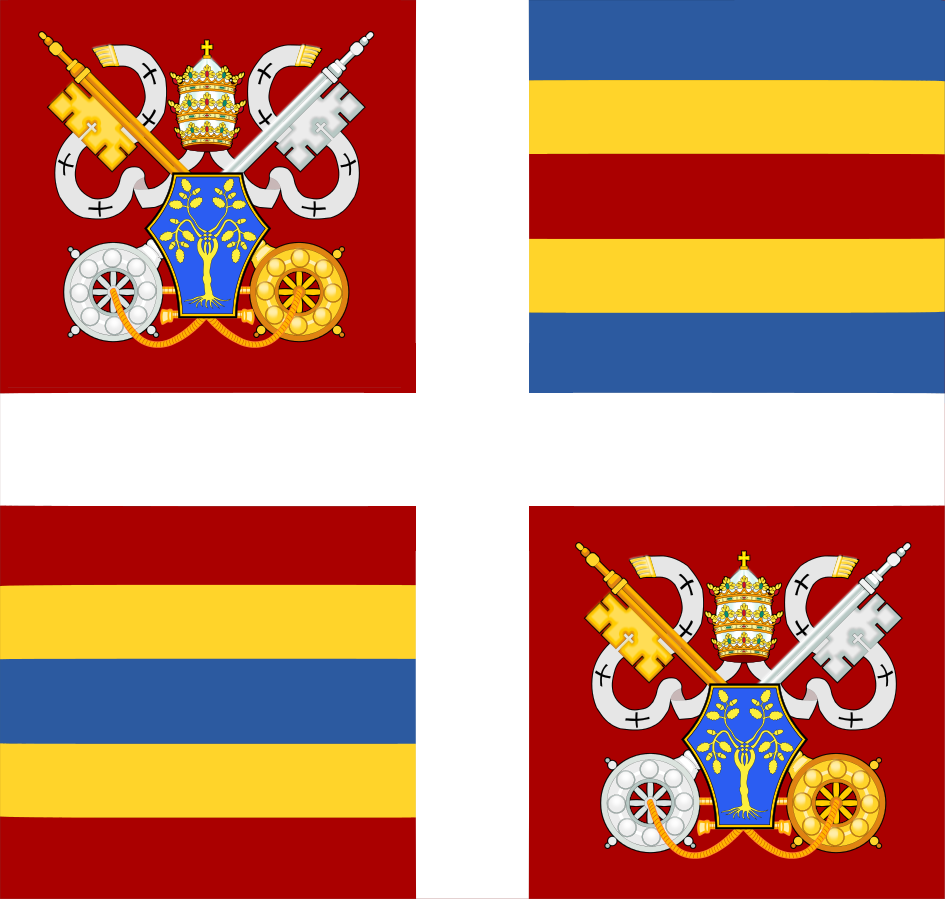
The banner of the Swiss Guard under Pope Leo XIV and commander Christoph Graf, 2025-current.
The della Rovere coat of arms, used by Sixtus IV, Francesco della Rovere, r. 1471–1484, and by his nephew Julius II, Giuliano della Rovere, r. 1503–1513, azure, an oak tree eradicated or, its four branches interlaced in saltire.[54]

The design of the banner of the Pontifical Swiss Guard banner has been changed several times. A fresco by Polidoro da Caravaggio in the burial chapel of the guard in Santa Maria della Pietà in Campo Santo Teutonico, commissioned by the second commander, Marx Röist, in 1522, depicts the commander of the guard flanked by two banners. An early reference to the guard's banner (vennly) dates to 1519, although the design of that banner is unknown.[55]

An early surviving banner is on display in the Sala Regia. The banner changed with each pontificate, and depicted the colors of the coat of arms of the reigning pope. The modern colors of the Swiss Guard, introduced in the early 20th century, are those of the House of Medici, first used under the Medici popes and depicted in a fresco by Giuseppe Porta.[55]

Under Pius IX (Mastai Ferretti, r. 1846–1878), it was divided into three horizontal fields, displaying the coat of arms of the Holy See (keys in saltire surmounted by the papal tiara on a red field), the Swiss flag (a white cross with two laurel branches on a red field) and a yellow field without heraldic charge. On the reverse side of the banner was the papal coat of arms of Pius IX.[56]

Under Pius X (Giuseppe Melchiorre, r. 1903–1914) and commander Leopold Meyer von Schauensee (1901–1910), the top field displayed the papal coat of arms in a blue field. The center field was red without heraldic charge and the bottom field displayed the family coat of arms of the guard commander.[56]

The modern design of the banner was first used under commander Jules Repond of Freiburg (1910–1921).[57] The modern banner is a square divided by a white cross into quarters, in the tradition of the banners historically used by the Swiss Guards in the 18th century. In the fourth quarter (lower right) is Pope Julius II's coat of arms. In the first quarter (upper left) that of the reigning pope. The other two quarters display the Swiss Guard's colors, red, yellow and blue, the colors of the House of Medici. In the center of the cross is the commander's own coat of arms.[58]

The current banner from 2025 thus shows the coat of arms of Pope Leo XIV in the first quarter and a vignette of the family coat of arms of Christoph Graf in the center. It has dimensions of 2.2 m squared, woven in a damask pattern of pomegranates and thistles, in what is known as "Julius-damask", based on the Julius banners of 1512. The central vignette is embroidered on the backdrop of the colors of the flag of Lucerne. The guard colors in the second quarter (upper right) were reversed so that the second and third quarters are identical. The banner was completed in May 2025, and it was first used for the oath of service of new recruits in June 2025.[58]

The banner is carried out during ceremonies and the Urbi et Orbi address and blessing twice a year. During the pontificate of Pope Francis, only the Flag of Vatican City was used instead of the banner during ceremonial occasions, as a sort of national color whenever the Pope was present.

See also

[edit]

Notes

[edit]

Citations

[edit]
  1. ^ a b c d Swiss Guard in German, French and Italian in the online Historical Dictionary of Switzerland.
  2. ^ Tan, Michelle (July 7, 2021). "The Swiss Guard of the Holy See". Catholic News Singapore. Retrieved June 7, 2024.
  3. ^ a b Swiss Guards | History, Vatican, Uniform, Requirements, Weapons, & Facts | Britannica
  4. ^ The Swiss Guard has been disbanded several times, most notably for twenty years during 1527–1548, and briefly in 1564/5, in 1798/9 and during 1809–1814. "Spotlight on the Swiss Guard". news.va. Archived from the original on 5 March 2016. Retrieved 8 February 2015. Extant units of comparable age include the English Yeomen of the Guard, established in 1485, and the 1st King's Immemorial Infantry Regiment of AHQ of the Spanish Army (Regimiento de Infantería "Inmemorial del Rey" no. 1). "Regimiento de Infantería 'Inmemorial del Rey' nº 1" [Infantry Regiment 'Immemorial del Rey' nº 1] (in Spanish). Ejército de Tierra – Ministerio de Defensa – España. Retrieved 6 December 2014.
  5. ^ a b c "Les conditions" (in French). Garde Suisse Pontificale. Retrieved 5 May 2024.
  6. ^ a b "Admission requirements". Official Vatican web page, Roman Curia, Swiss Guards. Archived from the original on 2006-06-14. Retrieved 7 August 2006.
  7. ^ a b "Pontifical Swiss Guard - Structure". Vatican. Retrieved 5 May 2024.
  8. ^ Pölnitz, Götz Freiherr von (6 May 2018). Jakob Fugger: Quellen und Erläuterungen [Jakob Fugger: sources and explanations] (in German). Mohr Siebeck. ISBN 9783168145721 – via Google Books.
  9. ^ Peter Quardi: Kaspar von Silenen in German, French and Italian in the online Historical Dictionary of Switzerland, 2011.
  10. ^ McCormack, John (1 September 1993). One Million Mercenaries: Swiss Soldiers in the Armies of the World. Pen and Sword. ISBN 9781473816909. Retrieved 21 January 2016 – via Google Books.
  11. ^ History of the Pontifical Swiss Guards Official Vatican web page, Roman Curia, Swiss Guards, retrieved on 7 August 2006.
  12. ^ a b c Royal 2006, pp. 91–92.
  13. ^ Alois, Lütolf (1859). Die Schweizergarde in Rom: Bedeutung und Wirkungen im sechszehnten Jahrhundert : nebst brieflichen Nachrichten zur Geschichte jenes Zeitalters von den Gardeofficieren (in German). p. 78.
  14. ^ Royal 2006, p. 114.
  15. ^ Alvarez 2011, p. 285.
  16. ^ Alvarez 2011, pp. 288–290.
  17. ^ a b c Alvarez 2011, p. 368.
  18. ^ Alvarez 2011, p. 365.
  19. ^ John Follain, City of Secrets: The Truth behind the murders at the Vatican (2006).
  20. ^ Willan, Philip (2002-07-04). "Indian-born soldier makes Vatican history". The Guardian. Retrieved 2025-04-22.
  21. ^ Willey, David (2002-07-04). "First non-white joins Vatican guard". BBC News. Retrieved 2025-04-22.
  22. ^ BBC News, Sunday 22 January 2006
  23. ^ "Pope Francis dismisses 'authoritarian' Swiss Guard commander". BBC News. 3 December 2014. Retrieved 3 December 2014.
  24. ^ Swiss Guard Commander on ISIS Threat to Pope: 'We Are Ready to Intervene', National Catholic Register, 24 February 2015. "Vatican on alert for Islamic State attacks against Pope Francis", Reuters, 3 March 2015. Eric J. Lyman, Protecting Vatican from terrorists is an 'enormous' challenge, USA Today, 29 November 2015. Andrew Woods, In Defence of His Holiness: the Pontifical Swiss Guard and the Islamic State Archived 2018-02-22 at the Wayback Machine, Foreign Affairs Review, 1 December 2015.
  25. ^ "Il post sulla pagina Facebook della Guardia" [The post on the Guard's Facebook page]. Facebook (in Italian). Retrieved 9 October 2019.
  26. ^ "Parolin alle Guardie Svizzere: chiamati al martirio della pazienza e della fedeltà" [Parolin to the Swiss Guards: called to the martyrdom of patience and fidelity]. vaticannews.va (in Italian). 6 May 2018. Retrieved 1 July 2021.
  27. ^ "Pope thanks Pontifical Swiss Guard for dedicated, loyal service". Catholic News Service. 7 May 2009.
  28. ^ "Wives of Swiss Guards: work schedules, kids, and school buses create adventure in the Vatican". Rome Reports. 2019-08-03. Retrieved 2023-03-13.
  29. ^ "The Swiss Guard, a centuries-old community of Swiss Abroad in the Vatican". Retrieved 22 October 2025.
  30. ^ Toulmin, Lew (2006). "Interview with a Papal Swiss Guard". themosttraveled.com. Archived from the original on 8 February 2015.
  31. ^ Palermo, Antonella. "Pope praises Swiss Guards' discipline, courage, and faith". Vatican News. Retrieved 28 October 2025.
  32. ^ "May 6th: The Recruits Take their Oath of Loyalty". Vatican – The Holy See. Retrieved 26 April 2012.
  33. ^ "Giuramento 2019 – Eventi" (PDF) (in Italian). Päpstliche Schweizergarde. 30 April 2019. Retrieved 2 January 2022.
  34. ^ "Schweizergarde vereidigt am 6. Mai 34 neue Gardisten". Vatican News (in German). 30 April 2021.
  35. ^ a b c "Formula del Giuramento" [Oath of Loyalty] (in German, French, and Italian). Vatican – The Holy See. Retrieved 4 January 2013.
  36. ^ a b "The Pontifical Swiss Guard – Uniforms". The Vatican. Retrieved 2011-04-17.
  37. ^ Esparza, Daniel. "Michelangelo did not design the Swiss Guard's uniform". Aleteia. Retrieved 22 April 2025.
  38. ^ "The Swiss Guard – The Uniform of the Swiss Guards". vatican.va. Retrieved 8 February 2015.
  39. ^ "The Swiss Guards have a new uniform. Don't worry, the iconic one remains". AP News. 2025-10-02. Retrieved 2025-10-02.
  40. ^ "Päpstliche Schweizergarde: Leben in der Garde" [Pontifical Swiss Guard: Life in the Guard] (in German). Archived from the original on 2013-07-18. Retrieved 2017-08-15.
  41. ^ National Geographic: Inside the Vatican, 2001
  42. ^ a b Williams, Megan. "Dressing the pope's protectors". CBC News. Retrieved 2024-12-26.
  43. ^ Gallagher, Della (January 24, 2019). "Vatican's Swiss Guards wear new 3D-printed helmets". CNN. Retrieved June 22, 2020.
  44. ^ a b Eger, Chris (16 April 2017). "Guns of the Vatican's Swiss Guard". Guns.com. Retrieved 31 August 2017.
  45. ^ Rogoway, Tyler (28 September 2015). "The Pope Has A Small But Deadly Army Of Elite Warriors Protecting Him". Foxtrot Alpha. Retrieved 31 August 2017.
  46. ^ a b Pöcher, Harald (1 August 2012). "Österreichische Waffen für die Schweizergarde" [Austrian weapons for the Swiss Guard]. Der Soldat (in German). No. 15. Archived from the original on 10 May 2017.
  47. ^ a b Wedl, Johanna (16 February 2013). "Rüstungen für Schweizer Garde" [Armor for Swiss Guards]. Neue Zürcher Zeitung (in German).
  48. ^ "Harnischreplikate" [Armor Replicas] (PDF). Fondazione GSP (guardiasvizzera.va) (in German). 2013. Archived from the original (PDF) on 2016-11-24. Retrieved 2016-11-23.
  49. ^ "12,7 mm Remington Papal". www.patronensammlervereinigung.at (in German).; see also "database". www.earmi.it.
  50. ^ "Guardie Svizzere in aumento, da gennaio saranno 135" [Swiss Guards on the rise, from January they will be 135] (in Italian). 6 December 2020. Archived from the original on 6 December 2020.
  51. ^ "About us: The Leaders". Swiss Guards. Archived from the original on 27 April 2023. Retrieved 6 May 2024.
  52. ^ a b "Päpstliche Schweizergarde: Gradabzeichen" (PDF). schweizergarde.ch (in German). Pontifical Swiss Guard. Retrieved 26 May 2021.
  53. ^ "Guardie Svizzere in aumento, da gennaio saranno 135" [Swiss Guards on the rise, from January they will be 135] (in Italian). 6 December 2020. Archived from the original on 6 December 2020.
  54. ^ Woodward, John (1894). A Treatise On Ecclesiastical Heraldry. p. 161.
  55. ^ a b "Die Fahne der Päpstlichen Schweizergarde". www.kath.net (in German). May 4, 2015.
  56. ^ a b Stefan Vogler, Sacco di Roma; Plünderung von Rom (2015), p. 19.
  57. ^ "Gardefahnen der Schweizergarde". www.vaticanhistory.de (in German).
  58. ^ a b Werner Affentranger, Fahne Gardekommandant Graf (Gardefahne) (May 2015). The banner colonel Graf was completed in April 2015. Its central vignette displays the family coat of arms of Graf of Pfaffnau, "gules a plowshare argent and antlers or". WH 1/396.1 Familienwappen \ Familie: Graf \ Heimatgemeinden: Altbüron, Dagmersellen, Pfaffnau, Schötz, Triengen (State Archives of Lucerne).

General and cited sources

[edit]
  • Alvarez, David (2011). The Pope's Soldiers: A Military History of the Modern Vatican. University Press of Kansas. ISBN 978-0-7006-1770-8.
  • Richard, Christian-Roland Marcel (2005). La Guardia Svizzera Pontificia nel corso dei secoli. Leonardo International.
  • Royal, Robert (2006). The Pope's Army: 500 Years of the Papal Swiss Guard. Crossroads Publishing Co.
  • Roland Beck-von Büren: Swiss Guard in German, French and Italian in the online Historical Dictionary of Switzerland.
  • Serrano, Antonio (1992). Die Schweizergarde der Päpste. Bayerland: Verlagsanstalt.
[edit]
Revisions and contributorsEdit on WikipediaRead on Wikipedia
from Grokipedia
The Pontifical Swiss Guard is a professional military corps composed exclusively of Swiss Catholic men dedicated to the personal protection of the and the security of . Founded on 22 January 1506 by , who recruited 150 Swiss mercenaries to serve as his bodyguard due to their renowned and valor in European conflicts, the Guard represents one of the oldest continuously operating military units in existence. Its most defining historical episode occurred during the Sack of Rome on 6 May 1527, when 147 Guardsmen made a heroic against an invading of over 20,000 mutinous imperial troops, sacrificing their lives to enable Clement VII's escape to via a secret passage. This fidelity underpins the annual oath-taking ceremony held on the same date, emphasizing unwavering loyalty to the . Today, the Guard maintains a dual role in ceremonial duties—distinguished by their iconic 16th-century-inspired uniforms and —and modern security operations, including advanced training in firearms and counter-terrorism, reflecting evolved threats to papal safety since events like the 1981 assassination attempt on John Paul II.

Origins and Establishment

Founding under Pope Julius II

Pope Julius II, seeking reliable protection amid the turbulent politics of early 16th-century , requested from the in June 1505, specifically for the custody of the papal palace. This initiative culminated in the recruitment of an initial contingent of 150 soldiers, led by Captain Kaspar von Silenen, who marched from and arrived in on January 22, 1506, marking the formal establishment of the Pontifical Swiss Guard as the pope's personal . The Guard's creation addressed the pope's need for a dedicated force insulated from local Italian factions and rivalries, drawing on the Swiss tradition of service as foreign mercenaries. The selection of Swiss troops stemmed from their proven reputation for discipline, loyalty, and effectiveness in combat, qualities honed through decisive victories in the . Swiss forces had decisively defeated the army of , , at the on June 22, 1476, where approximately 10,000 Swiss pikemen and halberdiers routed a larger Burgundian host, inflicting heavy casualties and capturing vast spoils. This triumph, part of a series including Grandson and Nancy, not only preserved Swiss independence but elevated their pikemen formations as a model of prowess, inspiring fear among European rulers and demand for their services as mercenaries. Upon arrival, the Guard immediately assumed duties as Julius II's escort, accompanying him during travels and ceremonial entries, including his procession into itself. Their role emphasized ceremonial vigilance and personal security rather than field combat at inception, with the contingent housed near the Vatican and sworn to unwavering fidelity to the . This foundational oath underscored the Guard's enduring mandate, prioritizing papal safety over national allegiance.

Rationale for Swiss Mercenaries

The preference for Swiss mercenaries stemmed from the papacy's experience with the unreliability of prior guards, including Italian condottieri and Gascon troops, who frequently shifted allegiances amid the factional intrigues of , such as during the papacies where local forces participated in plots and assassinations. Swiss soldiers, drawn from the Old Swiss Confederacy's militias, offered a stark contrast through their proven discipline and adherence to contracts, qualities forged by a communal defense system against Habsburg incursions and refined into professional infantry tactics that yielded consistent victories from the late onward. Economic pressures in the Swiss cantons, characterized by poor and in alpine regions, compelled many men to seek employment as a primary , transforming poverty-driven volunteers into highly motivated, cost-effective fighters unencumbered by or feudal obligations. This system produced troops loyal to payment and oath rather than homeland politics, bolstered by the Confederacy's neutrality in European power struggles, which minimized risks of divided loyalties or foreign entanglements. Their reputation for ferocity and reliability spread across courts, including , where their defense of monarchs impressed observers with unwavering commitment even in defeat. In 1505, Swiss Bishop Matthäus Schiner, leveraging these attributes, urged to recruit a dedicated Swiss contingent to safeguard the pontiff from Roman volatility, a proposal rooted in the mercenaries' observed fidelity in royal service and their insulation from Italian vendettas. The resulting papal ordinance of January 22, 1506, stipulated the enlistment of 150 Swiss Catholics for perpetual guard duty, bound by solemn oaths of directly to the , ensuring a motivated by religious devotion and contractual honor over transient gain or political opportunism. This framework prioritized fighters whose causal incentives—, , and economic stake in reputation—aligned with long-term papal security, transcending the unreliability of regionally tied alternatives.

Historical Role in Papal Defense

Italian Wars and Early Engagements

The Pontifical Swiss Guard, formed in January 1506 under , augmented papal forces during the initial phases of the , leveraging Swiss infantry's reputation for discipline and pikemen effectiveness. In the War of the (1508–1516), Julius II initially allied against but shifted to the in October 1511, hiring —including Guard contingents—to counter French dominance in . These forces supported offensives that expelled French troops, notably contributing to victories like the Battle of Novara on June 6, 1513, where approximately 20,000 Swiss pikemen routed 10,000 French, securing Lombard territories for papal allies and demonstrating tactical superiority in close-order combat against artillery and cavalry. Under (r. 1513–1521), the Guard maintained its combat role amid ongoing conflicts, deploying in the (1517) to reclaim territories from Duke Francesco Maria della Rovere. Captain Kaspar von Silenen led one of six Swiss and companies, totaling around 1,800 men, dispatched to and surrounding areas to enforce papal authority, showcasing the unit's reliability in skirmishes and sieges that restored control over by mid-1517. This engagement highlighted the Guard's valor in offensive operations, bolstering its status as an elite vanguard within larger hosts. During Pope Clement VII's early pontificate (r. 1523–1534), amid the Habsburg–Valois Wars, the Guard upheld defensive postures and participated in preparatory actions against shifting alliances, including French incursions threatening pre-1527. Their consistent performance in these pre-Sack engagements—marked by low desertion rates and adherence to orders under commanders like Kaspar Röist—cemented causal ties between pacts, prowess, and papal reliance on them for deterrence in power struggles.

Sack of Rome in 1527

On May 6, 1527, mutinous troops of Holy Roman Emperor Charles V, including approximately 14,000 German Landsknechts driven by unpaid wages and led by figures like Georg von Frundsberg after the death of Charles de Bourbon, breached Rome's walls and initiated the sack of the city. These forces, numbering over 20,000 in total with Spanish and Italian contingents, overwhelmed papal defenses amid the chaos of the War of the League of Cognac. The Pontifical Swiss Guard, consisting of 189 men under Captain Kaspar Röist, formed the final line of defense at against the advancing Landsknechts, who harbored particular animosity toward as professional rivals. Ordered to hold the steps of the basilica, 147 Guards engaged in a delaying action with halberds and swords, allowing and surviving papal forces to retreat through the fortified corridor to . Eyewitness accounts, such as those from contemporaries like , describe the ferocity of the assault, with the Guards fighting to near annihilation amid widespread pillage and atrocities that claimed thousands of civilian lives over the following weeks. Of the 189 Guards present, 147 were killed, including Captain Röist, who was reportedly slain after seeking in his quarters; the survivors, numbering 42, either escaped or were captured. This stand enabled Clement VII's escape and prolonged resistance from , where he endured siege until paying a 400,000-ducat . The event's empirical toll on the Guard—verified through papal records and contemporary chronicles—underscores their tactical sacrifice against superior numbers equipped with arquebuses and pikes. In commemoration of this defense, the Swiss Guard's annual recruitment oath is sworn on May 6 before the basilica, renewing vows of loyalty with the formula emphasizing obedience unto death in protection of the pontiff. This tradition, rooted in the 1527 casualty figures and the Guards' role in averting immediate papal capture, symbolizes enduring commitment amid historical vulnerability.

Evolution Through Centuries

Renaissance and Early Modern Period

After the near annihilation of the Pontifical Swiss Guard during the Sack of Rome on May 6, 1527, the corps remained vacant for over two decades until its reestablishment in 1548 under , who appointed Jost von Meggen as commander. This revival ensured the continuation of Swiss service to the papacy despite the heavy losses and temporary reliance on German mercenaries under . Throughout the 16th and 17th centuries, the Guard maintained its protective role with a series of commanders, including Kaspar Leo von Silenen (1559–1564), Jost Segesser von Brunegg (1566–1592), and Stephan Alexander Segesser von Brunegg (1592–1629), providing continuity amid the waning military engagements following the . As direct threats to the diminished, the Swiss Guard's functions shifted toward ceremonial duties, such as honor guards and palace security, while upholding the tradition of disciplined service renowned in during this era. In the , under Franz Alois Pfyffer von Altishofen (1783–1798), the Guard defended papal interests during the French occupation of in February 1798 under , but the invasion led to its temporary disbandment, leaving the corps vacant until 1800. Through the , the Swiss Guard persisted in a reduced form, adapting to the symbolic protection of the pope as papal temporal authority contracted, with reinforcements and reinstatements occurring amid ongoing geopolitical pressures.

19th and 20th Centuries

Amid the , disbanded the Swiss Guard upon fleeing for , but reinstated the unit in 1849 following his return, renewing contracts with Swiss cantons such as to bolster papal defenses against revolutionary threats. In 1850, formalized agreements ensuring a steady supply of recruits, stabilizing the Guard at approximately 90 members as part of broader efforts to reorganize Vatican security amid political instability. However, the by Italian forces on September 20, 1870, marked the end of the ' temporal power, reducing the Guard's operational role to ceremonial duties as successive popes adopted a posture of voluntary confinement within Vatican territory. In the 20th century, the Swiss Guard maintained its ceremonial functions while adhering to Vatican neutrality during both World Wars. During World War I, the unit avoided involvement in hostilities, focusing on internal protection of the Holy See. In World War II, under Pope Pius XII, the Guard continued this neutral stance; in December 1940, members were explicitly prohibited from discussing politics to preserve impartiality amid Rome's occupation by Axis forces. While Pius XII directed discreet Church networks to shelter thousands of Jews and other persecuted individuals in Roman institutions, the Swiss Guard's contributions were confined to routine security logistics within Vatican confines, without direct combat or external operations. Post-war developments included structural reforms aligning with ecclesiastical changes. Pope John XXIII reorganized the Guard on August 6, 1959, refining protocols during the lead-up to the Second Vatican . Subsequently, disbanded the Palatine and Noble Guards on September 15, 1970, designating the Swiss Guard as the Vatican's sole remaining ceremonial and protective force, thereby enhancing its singular responsibilities amid modernizations prompted by Vatican II's emphasis on renewal. The unit's size remained modest, typically around 100 members, underscoring its elite, specialized nature.

World Wars and Post-War Developments

During , the Pontifical Swiss Guard continued their protective duties over and , which upheld strict neutrality amid the surrounding European hostilities, without any direct combat engagement by the Guard. In , the Guard, numbering approximately 110 members, upheld non-combat vigilance while preparing defensive postures against potential incursions, particularly as German forces occupied in following Mussolini's fall and Italy's with the Allies. Their readiness mirrored historical sacrifices, with positions taken to shield during threats from both Axis advances and subsequent Allied bombings of on 19 July 1943, which devastated adjacent districts but respected Vatican signaled by papal insignia. Tensions with Benito Mussolini's fascist regime, despite the 1929 Lateran Pacts securing Vatican sovereignty, prompted measures like a December 1940 prohibition on Guard members discussing politics to avert provocations. Pius XII bolstered their capabilities by directing instruction, enhancing sustainment of papal security in a volatile neutral enclave. Post-1945, the Swiss Guard professionalized through formalized ties to the , mandating that recruits complete compulsory Swiss military training beforehand, which elevated tactical proficiency and operational resilience for contemporary protective mandates. This integration addressed wartime exposures by standardizing drills in marksmanship, close protection, and perimeter defense, ensuring the unit's efficacy beyond ceremonial functions amid emerging geopolitical instabilities. In the era, such enhancements supported alignments against communist expansionism, as articulated by Pius XII's condemnations, by fortifying protocols against ideological infiltration and covert threats to the .

Recruitment and Service Obligations

Eligibility Criteria and Selection Process

Candidates for the Pontifical Swiss Guard must be male Swiss citizens who are practicing Roman Catholics, unmarried upon , between the ages of 19 and 30, and at least 174 cm (5 feet 8.5 inches) tall. They are also required to have completed basic military training with the and possess an irreproachable moral character, verified through background checks that exclude any or history of disciplinary issues. Preference is given to those with a completed or post-secondary education, reflecting the Guard's emphasis on recruits capable of intellectual discipline alongside physical and spiritual readiness. These criteria, rooted in Switzerland's historical reputation for loyal mercenaries and the Guard's need for unwavering fidelity to the , ensure that selected individuals share a profound religious commitment that underpins their service. The selection process is highly competitive, drawing approximately 100 applicants annually for 30 to 35 positions to maintain the at around 135 members. screening filters candidates to 40-50 based on and preliminary qualifications, followed by examinations, psycho-physical assessments to evaluate resilience under stress, and personal interviews lasting 15-20 minutes to gauge moral integrity, motivation, and suitability for the demands of papal protection. Applications typically route through Swiss channels, with final approvals by the Guard's command emphasizing traits that promote long-term and over mere physical prowess. This rigorous vetting, informed by the Guard's tradition of selecting from a pool committed to Catholic doctrine, minimizes risks of disloyalty by prioritizing causal alignments between personal , national heritage, and the defensive imperative of safeguarding the .

Training Regimen

Recruits to the Pontifical Swiss Guard, having completed mandatory basic training in the Swiss Armed Forces, undergo an additional specialized induction program to prepare for their roles. This regimen, lasting approximately five to eight weeks, integrates Swiss security methodologies with Vatican-oriented protocols to ensure readiness for protective duties. The initial phase takes place in Switzerland's canton, including a one-month course with the focusing on , , , and techniques. These elements prioritize non-lethal tactics tailored to urban environments and papal protection scenarios, building on recruits' prior military experience in marksmanship and . Upon arrival in , training shifts to protocols specific to the , encompassing and drills, etiquette, ecclesiastical knowledge, and simulations of emergency responses. Instruction in and culture further equips guards for operational communication and ceremonial functions. Since 2016, the program has been intensified to promote greater professionalization amid rising security demands, incorporating psychological assessments to verify adaptability to communal living and high-stakes responsibilities.

Oath Ceremony and Term of Service

The oath ceremony of the Pontifical Swiss Guard occurs annually on May 6, commemorating the 1527 Sack of Rome during which 147 guards sacrificed their lives defending Pope Clement VII. New recruits, typically numbering around 30 to 40, swear allegiance in the San Damaso Courtyard of the Apostolic Palace, with the event presided over by the Swiss Guard commander and often attended by the Pope. During the ceremony, recruits place their left hand on the regimental flag while repeating a shortened version of the read by the . The full pledges: "I swear to serve faithfully, loyally and honourably the reigning and his lawful successors, and to devote myself to them with all my power, sacrificing if necessary my life in defense of the sacred person and apostolic throne. I desire this to remain valid also in the event that the aforementioned Pontiffs should transfer me in the exercise of my office elsewhere. and these Holy Gospels which I touch with my hand." This vow underscores the Guard's commitment to personal sacrifice, echoing the historical loyalty demanded since their founding. Service terms require a minimum commitment of 26 months for enlisted guards, with officers often extending their tenure beyond this period to maintain leadership continuity. Recruits must enter unmarried and remain so for the first five years, after which marriage is permitted if the guard is at least 25 years old and agrees to an additional three-year extension. This policy ensures focus on duties while accommodating family formation for longer-serving members, with family housing provided for eligible guards.

Living Conditions and Family Policies

The Pontifical Swiss Guard is housed in barracks within , situated near the papal residence for rapid response capabilities. These 150-year-old facilities feature communal arrangements such as multi-occupancy rooms and shared sanitary areas, which have prompted renovation efforts initiated in 2018 to align with contemporary standards amid the standard 26-month minimum service term. The overhaul, estimated at CHF 50 million and funded primarily through a Swiss foundation, includes provisions for expanded family accommodations to better support married personnel. Compensation for guards averages €1,500 monthly, exclusive of and provided , rendering it non-taxable and sufficient relative to local Roman wages when combined with duty-free Vatican residency. This modest remuneration structure, coupled with spartan quarters, enforces the integral to maintaining the unit's disciplined ethos, though it has drawn scrutiny for potentially exacerbating service rigors during barracks upgrades. Family policies permit enlistees—required to be unmarried Catholic Swiss males aged 19-30—to wed only after five years of exemplary service, a threshold eased under from prior officer-only restrictions. Approximately 20 of the 110 guards are married with , who reside in adapted sections; support extends to disability, continuity, and child-rearing aligned with Swiss norms. Children attend the Swiss School in to ensure educational compatibility for eventual , mitigating cultural dislocation from Vatican isolation. These measures, while fostering familial stability amid rotational duties, underscore the trade-offs of prolonged separation from Swiss civilian life, with the policy's selectivity contributing to observed low desertion despite demanding conditions.

Uniforms and Insignia

Ceremonial Attire Design and Symbolism

The ceremonial uniform of the Pontifical Swiss Guard consists of a Renaissance-style doublet featuring vertical stripes in dark blue, red, and yellow, paired with white ruffs, breeches, and stockings. This design, formalized in 1914 by Commandant Jules Repond, draws inspiration from 16th-century civilian and military attire prevalent during the Guard's early years, evoking the era of its founding under Pope Julius II in 1506. A persistent legend attributes the uniform's design to Buonarroti, supposedly commissioned after the 1527 Sack of Rome to honor fallen guards, but historical evidence indicates this is apocryphal; no contemporary records link the artist to the attire, and the multicolored stripes postdate his lifetime by centuries. The colors hold heraldic significance, representing the traditional palette of the Medici family—red for the blood of martyrs and the family's emblem, with blue and yellow denoting loyalty to Medici popes like Leo X and Clement VII, who bolstered the Guard during the . Officers wear open-faced helmets reminiscent of 16th-century morions, adorned with colored plumes—red for commanders, black for other officers—symbolizing rank and readiness in a tradition unbroken since the Guard's inception. The attire is donned for formal papal audiences, processions, and the annual oath ceremony on , commemorating the ; it embodies the Guard's chivalric ethos and fidelity to the , distinct from practical service garb.

Modern and Service Uniforms

The Pontifical Swiss Guard's modern service uniforms prioritize practicality for daily operations, distinct from the Renaissance-inspired ceremonial attire reserved for public and liturgical events. The primary daily service uniform, known as the exercise uniform, is entirely blue and features a white collar and cuffs; it is worn during training, night duties, and routine patrols such as at St. Anne's Gate on weekdays to minimize visual distraction. This uniform allows for of sidearms, including pistols, enabling guards to maintain security without overt armament during standard patrols. For specialized training in modern security protocols, guards utilize a dedicated training uniform adapted to operational needs, reflecting the corps' evolution toward contemporary protective roles post-9/11 while preserving traditional elements. Officers employ a black representation uniform for select official representations, substituting for more elaborate variants at non-gala occasions. In October 2025, the Swiss Guard introduced a new dark blue formal uniform, termed the Mezza Gala, exclusively for the nine senior officers during diplomatic receptions, embassy events, and other non-ceremonial functions outside . This wool-based attire, featuring gold buttons, a Mao-style collar, and Vatican colors in accents, revives a 19th-century "antechamber" style discontinued in 1976, enhancing functionality without supplanting the iconic garb for internal ceremonies.

Manufacture and Recent Updates

The ceremonial uniforms of the Pontifical Swiss Guard are custom-tailored in the Guard's dedicated sartoria workshop within their barracks, where skilled artisans oversee every detail of production. Each uniform is for the individual guard, requiring approximately one month of intensive labor from arrival of new recruits to completion, ensuring fit for ceremonial duties including the annual swearing-in . fabrics are precisely cut and stitched by hand under the supervision of master tailors like Ety Cicioni, prioritizing durability for the physical demands of service while maintaining traditional craftsmanship. Upon completion of a guard's term, typically after 25 months or longer for extended service, retired uniforms are systematically destroyed by the Vatican to prevent unauthorized replication and preserve the attire's exclusivity. Exceptions are rare, such as burial in uniform for deceased guards, but otherwise, or shredding ensures no resale or public display of originals. This practice underscores the Vatican's control over the uniform's symbolic integrity, avoiding while allowing for controlled archival preservation of samples. In a modernization step, the Swiss Guard unveiled a new non-ceremonial formal uniform on , , ahead of the annual recruit swearing-in, designed for external diplomatic events like embassy receptions. This "Mezza Gala" attire, crafted from black wool with gold buttons, a yellow-white striped belt, and a Mao-style collar, revives a pre-1970s style previously phased out for practicality, with initial production limited to nine units in Rothenthurm, . The update balances historical fidelity with functional needs for mobility and formality outside Vatican confines, without altering the Renaissance-era gala uniform retained for internal ceremonies.

Weapons and Equipment

Traditional Bladed Weapons

The Pontifical Swiss Guard's traditional bladed weapons consist of the and , serving as enduring symbols of the corps' 16th-century origins while fulfilling ceremonial functions. Halberds, polearms integrating an axe head, thrusting spike, and rear hook, measure approximately 2 meters in length and are wielded in formations during papal processions, guard mounts, and public duties within . Swords, shorter edged weapons carried especially by non-commissioned officers and the commander, feature straight blades suited for thrusting and cutting, often engraved with papal from the onward. Guards receive instruction in the manipulation of both halberds and swords, encompassing balance, salutes, and coordinated movements to maintain discipline and precision in ceremonial settings. Per the Swiss Guard's official documentation, these weapons are designated exclusively for ceremonial purposes, distinct from modern armaments employed in security operations. Maintenance involves regular polishing and inspection by specialized personnel, preserving the artisanal quality and historical fidelity of the blades.

Contemporary Firearms and Gear

The Pontifical Swiss Guard maintains a modern firearms inventory for operational security, primarily consisting of the semi-automatic pistol as the standard sidearm, supplemented by 19 compact pistols for backup carry. For specialized close-protection roles involving high-risk VIP escorts, guards deploy the submachine gun in limited numbers. Select units are also issued the assault rifle (Stgw 90) and its carbine variant, the SIG SG 552, chambered in , reflecting Swiss manufacturing preferences and compatibility with national military standards. Non-lethal equipment includes tasers and , integrated into protocols to address escalated threats such as those posed by affiliates, with Vatican security enhancements noted after the 2015 Paris attacks and subsequent European incidents. These tools support in crowd control and perimeter defense without relying solely on lethal force. Guardsmen sustain firearms proficiency through recurrent drills, drawing on mandatory prior service in the , where initial training emphasizes marksmanship and tactical handling of similar Swiss-designed weapons. This regimen ensures operational readiness despite the unit's ceremonial public image.

Command Structure and Ranks

Hierarchical Organization

The Pontifical Swiss Guard operates as a compact corps with 135 members, structured for efficient small-unit command to ensure perpetual vigilance over Vatican security. At its head stands the , a appointed directly by the , who holds ultimate responsibility for , , , and operational readiness. Supporting the Commander is a Vice-Commander (), who serves as , oversees , and assumes command in the Commander's absence, often drawn from seasoned Swiss or security backgrounds. The Guard's enlisted strength, including 85 halberdiers, is organized into three squadrons led by Lieutenants, enabling rotational shifts that cover 24-hour duties without compromising cohesion or response capability. These sub-units facilitate specialized tasking, such as gate patrols and internal patrols, while non-commissioned officers—comprising one , nine Sergeants, 14 Corporals, and 17 Vice-Corporals—handle tactical execution and halberdier oversight. Officers beyond the top command are frequently promoted from within the ranks or recruited from Swiss career , fostering institutional knowledge and loyalty tailored to the Guard's unique papal protection mandate. This hierarchy emphasizes streamlined decision-making, with staff officers reporting directly to the to preserve operational from broader Vatican administration, while the corps as a whole falls under the Secretariat of State's oversight for alignment with papal directives. Such organization allows the Guard to function as an autonomous, self-contained force despite its limited size, prioritizing rapid mobilization and fidelity to the Pope's personal security.

Rank Insignia and Distinctions

Halberdiers, the entry-level enlisted guardsmen comprising the bulk of the troop, are identified in the gala uniform by red feathers affixed to their silver helmets. Officers, ranging from lieutenants to the major, wear dark feathers on the same helmets to denote their commissioned status. These plume distinctions reflect Swiss traditions of clear, functional markers adapted to ceremonial roles, with the red plume symbolizing the foundational role and purple signifying leadership authority. Senior non-commissioned officers, such as , typically bear red plumes similar to halberdiers, while the employs white feathers for elevated distinction. The commander, holding the rank of , also utilizes white plumes, emphasizing command precedence in processions and guards. Vice-corporals and corporals, as junior leaders among the enlisted, lack unique plume variations but may carry specialized swords or halberds as positional identifiers during formations. Collar badges featuring crossed keys or papal arms appear on uniforms of more senior personnel to indicate tenure and authority, though all ranks share the standard white ruff collar in gala attire. Sleeve stripes or chevrons, where present on service uniforms, denote non-commissioned progression from vice-corporal (one stripe) to (multiple), aligning with Swiss cantonal guard precedents for understated yet precise rank signaling. These elements ensure rapid visual recognition in operational and ceremonial contexts without compromising the uniform's Renaissance-inspired cohesion.

Duties and Operational Role

Security and Protection Protocols

The Pontifical Swiss Guard maintains tactical oversight of the Pope's personal security, including continuous monitoring of the and readiness to defend against direct threats to the . This involves stationed guards at key posts and patrols securing entrances and perimeters of State to prevent unauthorized access. Members are equipped with modern firearms alongside traditional arms and undergo training emphasizing close protection, reflecting their dual role in ceremonial and operational contexts. During papal travels, Swiss Guard detachments accompany the on apostolic journeys abroad, integrating into advance planning and on-site details to mitigate risks in public appearances. They coordinate closely with the Vatican's Gendarmerie Corps for internal law enforcement and with Italian police for external support, including joint anti-terrorism drills and escort operations beyond Vatican borders. The 1981 assassination attempt on prompted enhanced protocols, with the Guard shifting toward specialized executive protection, incorporating tactical driving, firearms proficiency, and rapid response tactics to address evolving dangers like targeted attacks. Sworn under to defend the Pope unto death, their vigilance is rooted in personal faith commitment, prioritizing threats to the Church's leadership amid historical ideological oppositions such as communism-linked plots and contemporary .

Ceremonial and Diplomatic Functions

The Pontifical Swiss Guard performs ceremonial duties as guards of honor during papal audiences and state receptions in the Vatican, standing at attention in their traditional uniforms to symbolize continuity and loyalty to the . These roles include forming lines or sentries in key locations such as the , where they maintain a formal presence without engaging in active security protocols. In papal processions and solemn liturgical events, members bear the Swiss Guard banner and halberds, participating in formations that underscore historical traditions dating back to the unit's founding in 1506. This flag-bearing function highlights the Guard's role in preserving Renaissance-era customs, often drawing international attention during events like the annual oath-taking ceremony on May 6, which commemorates the 1527 Sack of Rome. Diplomatically, the Swiss Guard escorts the during Apostolic journeys abroad, providing a visible of Vatican authority and Swiss-Vatican alliance, thereby fostering cultural ties between and the . Their presence at international events promotes Swiss heritage, countering perceptions of the unit as obsolete by integrating ceremonial precision with underlying military discipline honed through regular training. Critics who dismiss these functions as mere pageantry overlook the Guard's , as recruits undergo Swiss Army basic training prior to service, ensuring readiness beyond symbolic duties.

Notable Events and Achievements

Heroic Stands and Sacrifices

The most celebrated act of valor by the Pontifical Swiss Guard occurred during the Sack of Rome on 6 May 1527, when mutinous troops of Charles V breached the city's defenses. Commanded by Captain Kaspar Röist, the 189 guardsmen formed a rearguard at the foot of the , engaging in fierce hand-to-hand combat to shield Pope Clement VII's retreat to [Castel Sant'Angelo](/page/Castel Sant'Angelo) via a secret passage. Of the contingent, 147 were killed, including Röist, while the remaining 42 accompanied the pope to safety, demonstrating unparalleled loyalty and sacrifice that preserved papal continuity amid the city's devastation. In a naval context, twelve members of the Swiss Guard detached under served aboard Admiral Marcantonio Colonna's galley during the on 7 October 1571. As part of the Holy League's forces, they fought against the Ottoman fleet in the , contributing to the decisive Christian victory that halted Ottoman expansion in the Mediterranean and marked a rare offensive engagement for the guard beyond Vatican walls. These instances exemplify the guard's tradition of , with the 1527 losses representing the single greatest toll in their history and reinforcing their oath to defend the unto death. Subsequent papal addresses, including those commemorating the Sack of Rome, have invoked this heritage to affirm the guardsmen's role as reliable protectors across centuries of threats, from imperial invasions to modern security challenges.

Key Interventions in Papal History

During , the Swiss Guard participated in Pope Pius XII's defensive strategy for , which emphasized "energetic yet passive" resistance against potential invasions, including readiness to protect papal residences without provoking aggression. This approach involved coordinating with Vatican gendarmes to secure perimeters and deter advances by Allied or Axis forces, amid broader papal efforts to shelter persecuted individuals, though direct Guard engagements remained non-combative. The Swiss Guard played a visible protective role during the May 13, 1981, assassination attempt on in , where guards were stationed and contributed to immediate post-incident containment, alongside Italian police. This event, part of multiple plots against the pope from 1978 to 1984, prompted a shift toward enhanced non-ceremonial , including firearms proficiency and tactical drills, to bolster personal protocols. In response to the attack by , Guard members in plainclothes assisted in the chaos, underscoring their dual ceremonial and operational mandate. In modern contexts, the Swiss Guard has maintained heightened vigilance during specific threats, such as the February 2015 video proclaiming intent to "conquer ," prompting Commander to place all 110 guards on elevated alert and affirm readiness to defend the physically if needed. This included increased patrols and coordination with Italian authorities amid regional jihadist advances in . The Guard ensures secure papal transitions by safeguarding conclaves, where they lock the doors after cardinals enter, patrol external perimeters, and protect the from external interference during voting, as demonstrated in the 2005, 2013, and subsequent elections. During periods without a , their focus shifts to defending apostolic offices and electoral processes until a successor's election.

Controversies and Criticisms

Internal Scandals and Security Lapses

On May 4, 1998, Swiss Guard Commander Alois Estermann, aged 43, and his wife Gladys Meza Romero were shot dead in their Vatican apartment hours after Estermann's promotion by Pope John Paul II, with Vice-Corporal Cédric Tornay, 23, identified as the perpetrator who then fatally shot himself. The Vatican's official investigation concluded Tornay acted alone, driven by resentment over a recent reprimand for subpar performance during exercises and denial of a promotion to the vice-corporal rank he had recently received, highlighting vulnerabilities in internal discipline and personal morale within the small, isolated corps. While conspiracy theories alleging romantic rivalries or external involvement—such as rumored affairs involving Tornay and Estermann's wife—persisted due to inconsistencies like the absence of gunshot residue on Tornay's hands initially reported, ballistic and forensic evidence ultimately supported the lone-gunman account, underscoring the risks of unchecked interpersonal tensions in a unit enforcing celibacy and close-quarters living. Historically, the Swiss Guard's limited numbers have exposed security lapses during major assaults, as seen in the Sack of Rome on May 6, 1527, when 189 guardsmen defended against an invading force of approximately 20,000 mutinous imperial troops under Charles V, resulting in 147 Swiss deaths but failure to prevent the city's plunder due to overwhelming numerical disparity and the attackers' breach of the . This incident revealed a core vulnerability: the Guard's reliance on symbolic rather than scalable defensive capacity, where even determined resistance could not compensate for being outnumbered over 100-to-1, allowing looters to ravage Vatican properties and contributing to the papacy's temporary displacement. In response to the 1998 killings, the Swiss Guard implemented reforms in 1999, including mandatory psychological evaluations for recruits to screen for emotional instability and better predict internal threats, addressing prior gaps in vetting that permitted enlistment of individuals prone to sudden breakdowns under the corps' rigorous demands. These measures aimed to mitigate risks from the Guard's selective of young Swiss Catholics, often inexperienced in high-stress isolation, by incorporating professional assessments alongside physical and moral criteria.

Allegations of Vatican Intrigue and Reforms

In January 2014, Elmar Mäder, who served as commandant of the Swiss Guard from 2002 to 2008, publicly alleged the existence of a "secret society of homosexuals" within the Vatican that constituted a security risk to the , claiming it formed a network capable of influencing appointments and compromising loyalty among personnel. Mäder, drawing from his direct experience overseeing the Guard's operations and vetting recruits, argued that such internal lobbies prioritized personal affiliations over institutional discipline, potentially enabling or infiltration that could endanger papal protection protocols. The Vatican responded by urging Mäder to provide specific evidence to officials, but no formal investigation into his claims was publicly announced, highlighting tensions between whistleblower and institutional opacity. Former Swiss Guard member Nathanaël, interviewed in Frédéric Martel's 2019 investigative book In the Closet of the Vatican, described pervasive moral challenges stemming from Vatican culture, including frequent encounters with homosexual advances and a scarcity of female interactions that tested the Guards' vows. Nathanaël recounted instances of "sickening" propositions from and lay Vatican staff, which he viewed as normalizing indiscipline and eroding the spiritual rigor required for the Guard's role as a faith-based protective force. These accounts, corroborated by other unnamed Guards in the same work, pointed to a broader cultural dilution where lax of undermined recruitment standards and operational cohesion, with recruits facing isolation or that prioritized tolerance of over doctrinal . Such whistleblower testimonies have fueled demands for reforms, including rigorous vetting to exclude influences from alleged internal networks, stricter enforcement of the Guard's requirement—mandatory for all members during their 26-month service—and greater transparency in handling disciplinary lapses to restore discipline eroded by normalized . Proponents argue that without these measures, the Guard risks internal intrigue mirroring Vatican-wide issues, where unaddressed lobbies could parallel historical security breaches like the 1998 command tied to personal grievances. Despite these calls, post- leadership under commanders like (until 2015) and emphasized recruitment from traditional Swiss Catholic backgrounds but implemented no publicly documented overhauls specifically targeting the alleged networks.

Symbolic and Cultural Impact

Representation of Tradition and Faith

The Pontifical Swiss Guard represents Catholic tradition through its , sworn by recruits to defend the and his successors "with all my strength, sacrificing if necessary even my life to defend the holiness of Christ and his Vicars on ." This pledge, recited during the annual ceremony on —commemorating the 1527 defense of the —embodies absolute loyalty grounded in faith, prioritizing spiritual duty over personal survival. Guard service functions as a formation in , where members integrate with daily and liturgical participation, fostering vocations amid a secularizing world. Commanders describe it as more than security provision, emphasizing its role in cultivating devotion to Christ and the Church. Strict eligibility—limited to unmarried Swiss Catholic s aged 19 to 30, standing at least 174 cm—upholds a historically male, faith-committed model of papal service, diverging from modern egalitarian norms that advocate gender-neutral roles. This preservation counters pressures for reform, maintaining exclusivity tied to doctrinal fidelity rather than inclusivity mandates. Founded January 22, 1506, by , the Guard constitutes the oldest active military unit globally, symbolizing institutional continuity against erosive modernism through unchanged Renaissance-inspired uniforms and halberds. Its endurance reflects causal fidelity to papal authority, undeterred by historical upheavals or contemporary secular drifts. The reputation of Swiss soldiers for and , established through their service as mercenaries in European courts during the 15th and 16th centuries, positioned the Pontifical Swiss Guard as an enduring model for protective units emphasizing unwavering to a sovereign. Rulers across , including French kings prior to the 1789 Revolution, employed similar Swiss contingents as palace guards due to their proven reliability over local forces prone to intrigue. The Vatican's , operational continuously since 1506, remains the sole survivor of this tradition, influencing modern ceremonial and security protocols in institutions valuing historical continuity alongside operational readiness. In popular culture, the Swiss Guard features prominently in depictions of Vatican intrigue and heroism, such as the 1983 film , which portrays their auxiliary role in Hugh O'Flaherty's wartime rescue operations sheltering Allied prisoners and from Nazi forces in . Dan Brown's 2000 novel dramatizes them as festooned figures confronting modern conspiracies, amplifying their iconic status in thriller genres. More recent works, including the 2022 film The Swiss Guard exploring a hypothetical female recruit amid assassins, underscore their symbolic role as papal defenders in speculative narratives. The Guard bolsters Swiss national identity as a emblem of disciplined service abroad, with recruits embodying traits of precision and neutrality historically tied to Switzerland's mercenary , fostering public admiration and cultural continuity. Their ceremonial presence at Vatican entrances draws millions of tourists annually, enhancing the appeal of and contributing to the Holy See's visitor-driven economy, where the Museums alone hosted 4.3 million in 2007 amid broader site attractions. Critiques portraying the Guard as anachronistic due to halberds and striped uniforms overlook their integration of contemporary capabilities, including small arms proficiency, drills, and coordination with Vatican police against threats like —evidenced by heightened readiness protocols post-2015 warnings. Recruits undergo five months of Vatican-specific atop mandatory Swiss , enabling adaptation to urban security scenarios while preserving ceremonial functions. This dual posture refutes claims, as their 135-member force, expanded under for risk mitigation, maintains operational viability.

References

Add your contribution
Related Hubs
Contribute something
User Avatar
No comments yet.