Hubbry Logo
Multiple exposureMultiple exposureMain
Open search
Multiple exposure
Community hub
Multiple exposure
logo
8 pages, 0 posts
0 subscribers
Be the first to start a discussion here.
Contribute something
Multiple exposure
Multiple exposure
from Wikipedia
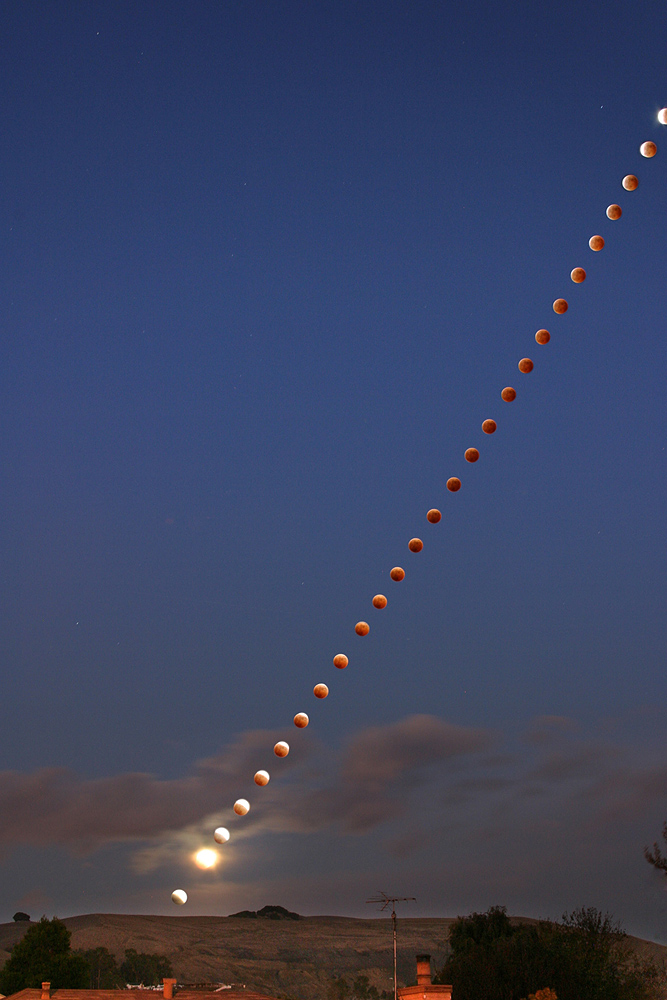
A multi-exposure composite image of the October 2004 lunar eclipse taken from Hayward, California

In photography and cinematography, a multiple exposure is the superimposition of two or more exposures to create a single image, and double exposure has a corresponding meaning in respect of two images. The exposure values may or may not be identical to each other.

Overview

[edit]

Ordinarily, cameras have a sensitivity to light that is a function of time. For example, a one-second exposure is an exposure in which the camera image is equally responsive to light over the exposure time of one second. The criterion for determining that something is a double exposure is that the sensitivity goes up and then back down. The simplest example of a multiple exposure is a double exposure without flash, i.e. two partial exposures are made and then combined into one complete exposure. Some single exposures, such as "flash and blur" use a combination of electronic flash and ambient exposure. This effect can be approximated by a Dirac delta measure (flash) and a constant finite rectangular window, in combination. For example, a sensitivity window comprising a Dirac comb combined with a rectangular pulse, is considered a multiple exposure, even though the sensitivity never goes to zero during the exposure.

Historical multiple exposure photography

[edit]
Chronophotographic study of horse motion
An 1886 chronophotographic study of horse motion, by Etienne-Jules Marey

In the historical technique of chronophotography, dating back to the Victorian era, a series of instantaneous photographs were taken at short and equal intervals of time.[1] These photographs could be overlaid for a single multiple exposure print.

Multiple exposure techniques

[edit]

Analogue

[edit]
Double exposure photograph
Triple exposure photograph from 1915

In photography and cinematography, multiple exposure is a technique in which the camera shutter is opened more than once to expose the film multiple times, usually to different images. The resulting image contains the subsequent image/s superimposed over the original. The technique is sometimes used as an artistic visual effect and can be used to create ghostly images or to add people and objects to a scene that were not originally there. It is frequently used in photographic hoaxes.

It is considered easiest to have a manual winding camera for double exposures. On automatic winding cameras, as soon as a picture is taken the film is typically wound to the next frame. Some more advanced automatic winding cameras have the option for multiple exposures but it must be set before making each exposure. Manual winding cameras with a multiple exposure feature can be set to double-expose after making the first exposure.

Since shooting multiple exposures will expose the same frame multiple times, negative exposure compensation must first be set to avoid overexposure. For example, to expose the frame twice with correct exposure, a −1 EV compensation have to be done, and −2 EV for exposing four times. This may not be necessary when photographing a lit subject in two (or more) different positions against a perfectly dark background, as the background area will be essentially unexposed.

Medium to low light is ideal for double exposures. A tripod may not be necessary if combining different scenes in one shot. In some conditions, for example, recording the whole progress of a lunar eclipse in multiple exposures, a stable tripod is essential.

More than two exposures can be combined, with care not to overexpose the film.

Digital

[edit]
Pineapple double exposure, in-camera, Canon R7, 2025

Digital technology enables images to be superimposed over each other by using a software photo editor, such as Adobe Photoshop or the GIMP. These enable the opacity of the images to be altered and for an image to be overlaid over another. They also can set the layers to multiply mode, which 'adds' the colors together rather than making the colors of either image pale and translucent.

Many digital SLR cameras allow multiple exposures to be made on the same image within the camera without the need for any external software. And some bridge cameras can take successive multiple exposures (sometimes up to nine) in one frame and in one shot. It is the same with high-dynamic-range imaging, which takes multiple shots in one burst captures, then combines all the proper shots into one frame.[2]

Adoption in fine art

[edit]

In addition to direct photographic usage of the technique, fine artists' work has been inspired by the multiple exposure effect. Examples include Joan Semmel's oil on canvas Transitions from 2012,[3][4] and Ian Hornak's acrylic on canvas Hanna Tillich's Mirror: Rembrandt's Three Trees Transformed Into The Expulsion From Eden, from 1978 (depicted below).

Long exposures

[edit]

With traditional film cameras, a long exposure is a single exposure, whereas with electronic cameras a long exposure can be obtained by integrating together many exposures. This averaging also permits there to be a time-windowing function, such as a Gaussian, that weights time periods near the center of the exposure time more strongly. Another possibility for synthesizing long exposure from a multiple exposure is to use an exponential decay in which the current frame has the strongest weight, and previous frames are faded out with a sliding exponential window.

Scanning film with multiple exposure

[edit]

Multiple exposure technique can also be used when scanning transparencies like slides, film or negatives using a film scanner for increasing dynamic range. With multiple exposure the original gets scanned several times with different exposure intensities. An overexposed scan lights the shadow areas of the image and enables the scanner to capture more image information here. Afterwards the data can be calculated into a single HDR image with increased dynamic range.

Among the scanning software solutions which implement multiple exposure are VueScan and SilverFast.

[edit]

See also

[edit]

References

[edit]
[edit]
Revisions and contributorsEdit on WikipediaRead on Wikipedia
from Grokipedia
Multiple exposure is a photographic and cinematographic technique in which two or more separate exposures are superimposed onto a single frame or image sensor to produce a composite result, blending elements from multiple scenes, subjects, or moments into one cohesive artwork. This method often yields surreal, ethereal, or abstract visuals by overlapping translucent layers, where the opacity of each exposure influences the final interplay of light, color, and form. Originating as an experimental process in analog film photography, multiple exposure has evolved into a versatile tool for creative expression, applicable in fine art, portraiture, fashion, and motion picture effects. The practice traces its roots to the mid-19th century, when pioneering photographers began experimenting with multiple exposures on glass plates or early to capture motion or create illusions. In the , it gained notoriety through , where practitioners like William Mumler superimposed ethereal figures onto portraits to simulate ghostly apparitions, sparking both fascination and controversy over photographic authenticity. By the early , avant-garde artists such as and advanced the technique within surrealist and modernist movements, using it to distort reality and explore themes of perception and abstraction—exemplified in works like Man Ray's photograms and Moholy-Nagy's light paintings. Mid-century photographers, including Harry Callahan, further refined multiple exposures for urban and natural studies, layering human figures against cityscapes or landscapes to evoke transience and multiplicity. Traditionally executed in-camera on by rewinding or not advancing the medium between shots—risking overexposure without precise metering—multiple exposure required careful planning to balance densities and avoid muddled results. techniques, such as sandwiching negatives during enlargement, offered post-capture control for analog practitioners. In the digital age, the process has become more accessible and precise through software like , where layer images, adjust opacity and blending modes (e.g., lighten or screen), and apply masks to refine composites without physical limitations. Contemporary cameras from brands like Nikon and include built-in multiple exposure functions, automatically merging shots with customizable overlay parameters, while video applications extend the technique to time-lapse composites in editing tools like . This evolution has democratized the art form, enabling endless experimentation while preserving its core appeal in evoking dreamlike narratives.

Fundamentals

Definition and Principles

Multiple exposure is a photographic technique that superimposes two or more exposures onto a single frame or image, creating composite effects through blended, translucent, or additive visuals. This process intentionally overlaps images to produce layered compositions, where each subsequent exposure modifies the overall visual density without erasing prior ones. In using film, multiple exposure relies on the chemical principles of accumulation within the layer, a gelatinous coating containing crystals. When strikes the , photons trigger a formation by reducing silver ions to metallic silver specks in exposed areas. Multiple exposures superimpose additional on the same , resulting in cumulative in overlapping areas upon development. In , the principles differ, involving pixel value processing on the camera's , typically a () or complementary metal-oxide-semiconductor () array. Photodiodes in the convert incoming photons into electrical charge during each exposure, which is then quantized into digital values; multiple exposures are combined according to the camera's selected mode, such as additive (summing values) or average (normalizing by the number of exposures), to produce blended results. This method allows for real-time in-camera or post-processing. Key effects unique to intentional multiple exposures include ghosting, where translucent overlays create spectral or phantom-like figures; silhouettes, formed by high-contrast subjects masking underlying details; and ethereal blending, yielding dreamlike merges of forms that emphasize transparency and interpenetration. These outcomes arise from the partial opacity of layered elements, enhancing artistic depth without requiring external in traditional setups. While realized differently in analog and digital formats, the core unifies the technique across mediums.

Exposure Compensation Basics

In multiple exposure photography, the total exposure on the film or sensor is the sum of the light from each individual exposure, necessitating adjustments to prevent overexposure when superimposing images. To maintain an equivalent total exposure to a single normal shot, each exposure must be reduced by a factor of 1/n, where n is the number of exposures. Since exposure stops (EV) are defined logarithmically as powers of 2 in light intensity, the required compensation is -log₂(n) stops per exposure. For example, in a double exposure (n=2), apply -1 EV compensation to each shot, halving the light intake per exposure so the combined total matches a standard single exposure. For a triple exposure (n=3), use approximately -1.6 EV (log₂(3) ≈ 1.58), though photographers often round to -1.5 EV for practicality. This logarithmic adjustment ensures balanced without excessive brightness buildup. Practical rules for implementing compensation begin with metering the base exposure for the scene using the camera's in the intended mode (e.g., for depth control). Set the compensation manually via the camera's EV dial or by adjusting ISO equivalently (e.g., doubling ISO simulates +1 EV, so halving effective speed simulates -1 EV). around the compensated value—taking test shots at ±0.5 EV—helps verify results, especially in varying light. In , account for reciprocity failure during long exposures (>1 second), where effective sensitivity drops; correct using the formula T_c = T_m^p, with p as the film-specific factor (e.g., p=1.31 for HP5+), potentially increasing each exposure time beyond the compensated value. Common pitfalls include overcompensation leading to underexposure, resulting in low-contrast, muddy images with reduced detail in . For uneven overlaps—where subjects cover only portions of the frame—calculate compensation based on the maximum overlap rather than full-frame n; for instance, if two subjects overlap in 50% of the area, treat as partial addition and reduce by approximately -0.5 to -1 EV to avoid localized overexposure while preserving highlight detail. Always reset compensation after shooting to prevent errors in subsequent frames.

History

Early Developments in Chronophotography

The pioneering work in chronophotography during the late 19th century emerged from scientific efforts to analyze motion, particularly animal locomotion, using photographic techniques that captured multiple images in quick succession. Eadweard Muybridge's sequential photography in the 1870s laid crucial groundwork by employing a battery of up to 24 cameras triggered by tripwires to produce series of still images depicting stages of movement, such as a trotting horse named Occident in 1878, which demonstrated that all four hooves leave the ground simultaneously during a gallop. This approach, while not superimposing images on a single plate, influenced subsequent experiments by highlighting the potential of photography to dissect time into discrete frames, paving the way for more compact single-plate methods. Building directly on Muybridge's findings, French physiologist developed the in 1882, a portable device resembling a that captured 12 successive exposures per second on a single rotating glass plate coated with photosensitive emulsion. 's invention aimed to study the of motion without the spatial separation of Muybridge's grids, producing superimposed silhouettes that revealed the continuous phases of animal movement, including detailed analyses of horse gallops and bird flights to quantify stride lengths and wing beats. These experiments, conducted at Marey's Station Physiologique in , emphasized physiological insights over artistic representation, marking a shift toward integrated multiple exposures as a tool for scientific visualization. In the , multiple exposure techniques on photographic plates also found application in less rigorous contexts, including scientific hoaxes and early illusions that foreshadowed cinema. By the 1880s, practitioners exploited double exposures and superimpositions—exposing the same plate to multiple subjects or scenes—to fabricate spirit photographs purporting to capture ghosts or ethereal presences, as seen in the works of photographers like William Mumler, whose 1860s methods persisted into the decade despite exposés by figures such as for their manipulative tricks. These plate-based deceptions, often involving re-exposing sensitized plates to blend living sitters with fabricated apparitions, blurred the line between empirical study and spectacle, contributing to public fascination with motion and superposition while underscoring the era's ethical challenges in photographic authenticity.

20th and 21st Century Advancements

In the early , multiple exposure techniques advanced through artistic experimentation within movements, with artists such as and employing the method to distort reality and explore perception—exemplified by 's double exposures and solarization in the 1920s, and Moholy-Nagy's photograms and light paintings. By the mid-20th century, the method gained prominence in and beyond, where artists like continued to evoke dreamlike unions of reality and illusion, often through double exposures and solarization that distorted forms and challenged perceptions. Mid-century photographers, including Harry Callahan and Paul Rudolph, further refined multiple exposures for urban and natural studies, layering human figures against cityscapes or landscapes to evoke transience and multiplicity. This adoption extended to commercial advertising, where double exposures added mystique and visual intrigue to mid-century campaigns in and product promotion, enhancing narrative appeal without relying on extensive post-production. Entering the , digital advancements integrated multiple exposure directly into camera hardware, with Nikon introducing the capability in DSLRs as early as 2003 with the D2H, and Canon's EOS-1D X in 2011 bringing it to their lineup, allowing up to nine layered exposures in models from the onward. The , released in 2022, features a multi-exposure mode supporting up to nine layers with real-time preview and blending options like additive or average, democratizing the technique for contemporary photographers. Parallel to these hardware developments, workflows shifted toward software-driven creation, with tools like enabling precise digital compositing of multiple images via layer blending modes, offering greater control and accessibility beyond analog constraints.

Techniques

Analog Methods

Analog multiple exposure techniques rely on manual manipulation of film cameras to superimpose images on the same frame, requiring precise control to avoid misalignment or overexposure. These methods are inherent to photography's physical constraints, where each exposure adds density to the , demanding careful metering and planning. Photographers often use cameras equipped with dedicated features or employ workaround techniques on standard models to achieve the effect without advancing the . Suitable cameras include 35mm SLRs and medium-format models with built-in multiple exposure capabilities, such as the , which features a dedicated to prevent advance between shots. Other examples are the and , both with double-exposure levers that allow repeated exposures on the same frame. For cameras like the Leica M series, which lack such levers, manual wind-back knobs enable the process by releasing tension and rewinding the slightly after the first exposure. The step-by-step process begins with loading and metering the first scene, typically underexposing by one stop for two exposures or adjusting based on principles to account for cumulative light. After firing the shutter, engage the multiple exposure (if available) or hold the film advance lock while rewinding partially to realign the frame, then compose and expose the second . For selective exposure in larger formats, masks or matte boxes can block portions of the frame during one exposure, preventing unintended overlap and allowing controlled . Alignment is critical, often aided by marking the film leader or observing the rewind for slack. High-speed negative films, such as ISO 400 emulsions like Ilford HP5 Plus or Kodak Portra 400, are preferred due to their wide exposure latitude, which accommodates the buildup from multiple exposures without losing detail in highlights or shadows. Black-and-white films excel in this context for their forgiving contrast handling. In the , adjustments for these negatives involve selective dodging and burning to balance uneven densities, or using contrast filters to enhance the superimposed elements.

Digital Methods

Digital multiple exposure techniques leverage computational power to enable non-destructive editing and precise control, contrasting with the irreversible processes of . Modern mirrorless cameras incorporate dedicated in-camera modes for creating multiple exposures directly during shooting, allowing photographers to blend several images without post-processing. For instance, Nikon's Z series cameras, such as the Z7 II and Z6 II, support recording two to ten NEF (RAW) exposures as a single overlaid , with selectable overlay modes including Add, Average, Lighten, and Darken to control how the images combine. These modes facilitate creative effects like ghosting or silhouettes in real time, with the final composite saved as a high-resolution RAW file for further adjustment. Canon EOS R series cameras, including the R7, offer similar functionality through their Multiple Exposure shooting mode, which merges 2 to 9 exposures and provides real-time preview of the composite in Live View on the LCD or electronic viewfinder. This feature, enhanced in firmware updates through 2025, allows photographers to monitor blending effects on-site, such as additive merging for brighter results or mode for balanced tones, ensuring accurate exposure control without trial-and-error. By 2025, the R7's implementation supports seamless integration with in-body , enabling handheld multiple exposures up to 7 stops, which expands accessibility for dynamic scenes. In software environments, digital multiple exposure is achieved through layer-based editing, where individual images are stacked and blended non-destructively. provides core tools like layer opacity adjustments and —such as Lighten, which retains only the brighter pixels from overlaid images to create ethereal silhouettes—for combining exposures with precision. Additionally, manual synthesis for exposure blending involves stacking photos as layers and using luminosity masks or brushes to selectively blend and retain optimal exposure areas from each image, allowing for precise control over highlights, shadows, and midtones. Mobile applications extend this capability; Google's includes a Double Exposure tool that layers multiple images with adjustable fade and masking for selective blending, ideal for quick edits on smartphones. Mobile, while primarily focused on HDR and merging, supports image stacking for , allowing users to blend sequences via export to Photoshop for advanced multiple exposure effects like opacity-modulated overlays. Post-2020 advancements have integrated AI to automate complex aspects of multiple exposure creation, reducing manual effort in alignment and merging. Adobe , Adobe's AI and framework, powers features in Photoshop (version 2023 and later) such as Auto-Align Layers, which intelligently detects and corrects shifts between exposures using content-aware algorithms, and Auto-Blend Layers, which seamlessly merges them while preserving details and minimizing artifacts. These tools, enhanced by -powered neural networks, enable automatic exposure fusion for up to dozens of images, with options for stack mode blending that prioritizes or . This AI assistance marks a shift toward efficient, scalable workflows, particularly for high-volume applications like event .

Applications

Artistic and Fine Art Uses

Multiple exposure techniques have played a significant role in artistic and , enabling creators to transcend literal representation and delve into the realms of the subconscious, illusion, and personal introspection. In the Surrealist and Modernist movements of the 1920s, artists like pioneered the use of double exposures— a foundational form of multiple exposure—to fuse disparate elements into haunting, otherworldly compositions that mirrored the irrationality of dreams. Ray's experiments, often involving overlaid figures and objects, challenged conventional photographic realism and became emblematic of Surrealism's emphasis on the unconscious, as seen in his contributions to publications like La Révolution Surréaliste. These works built on early 20th-century photographic innovations to prioritize evocative ambiguity over documentary accuracy. Extending these principles into spatial exploration, painter Ian Hornak adapted multiple exposure layering in the late 1970s to craft illusions of depth and transformation in his Hyperrealist landscapes. In Hanna Tillich’s Mirror: Rembrandt's Three Trees Transformed into the Expulsion from Eden (1978), an acrylic-on-canvas piece, Hornak superimposed photographic references of natural forms to distort perspective, evoking biblical narratives through translucent, multi-layered veils that simulate photographic overlays and create paradoxical spatial effects. This method allowed Hornak to blend historical art references with modern perceptual tricks, heightening the viewer's sense of illusory depth. In contemporary , multiple exposures continue to facilitate introspective examinations of the human form, particularly in addressing aging, corporeality, and self-perception. Joan Semmel's Transitions series (2012) exemplifies this through large-scale oil paintings where she superimposes multiple digital photographs of her own nude body in varying poses and transparencies, resulting in fragmented, ethereal figures that convey bodily flux and impermanence. By overlaying views—such as profiles transitioning to backs—Semmel fragments the into disjointed limbs and torsos against muted backdrops, underscoring themes of identity dissolution and reconstruction amid time's passage. These compositions, rooted in photographic processes but rendered painterly, invite contemplation of the female body's evolving narrative. Within , multiple exposures often symbolize the multiplicity of self, layering images to evoke fragmented memories and fluid identities, as artists intentionally misalign elements for surreal, associative results that evoke psychological rather than technical precision. This deliberate imperfection distinguishes artistic applications, fostering dreamlike and emotional depth distinct from controlled commercial outcomes.

Commercial and Scientific Applications

In commercial photography, multiple exposure techniques have been employed to create composite scenes efficiently, particularly in fashion advertising where ethereal or ghostly effects enhance visual appeal without requiring elaborate physical sets. For instance, photographers layer model silhouettes with abstract backgrounds to produce , dreamlike images that evoke movement or otherworldliness, reducing production costs by simulating complex environments digitally or in-camera. This approach draws brief inspiration from surrealism but prioritizes marketable illusions for promotional campaigns. A notable historical example includes magazine covers and portraits from the 1940s, where photographers like collaborating with utilized multiple exposures to craft innovative images featuring distorted figures and impossible compositions, captivating audiences. In product photography, multiple exposures enable the seamless integration of items into virtual scenes, eliminating the need for costly set builds while maintaining high visual fidelity for catalogs. Today, such techniques are prevalent in libraries, where layered exposures generate versatile, royalty-free images for commercial use across industries, with platforms like hosting tens of thousands of such assets. Multiple exposures have also played a role in debunking media hoaxes, particularly in 20th-century spirit photography frauds where practitioners like William Hope employed double exposures to fabricate ghostly apparitions in portraits, later exposed through scientific scrutiny and replication experiments. Investigations by skeptics, including in the , demonstrated these manipulations by substituting pre-exposed plates, highlighting the technique's deceptive potential in pseudoscientific claims. In scientific applications, multiple exposure methods extend to astronomy for composing images, where stacking numerous short exposures reduces noise compared to single long exposures, capturing Earth's rotation around with greater clarity and detail. In , the technique facilitates motion analysis of microorganisms; for example, stroboscopic multiple-exposure has been used to study the helical movements of spirochetes like species, allowing precise measurement of cell shapes and velocities in viscous media. Beyond these, multiple exposures enable dynamic range expansion in imaging systems by combining differently exposed frames into (HDR) composites, improving detail in high-contrast scenes such as medical or without specialized hardware. This method, formalized in estimation-theoretic frameworks, enhances signal-to-noise ratios while preserving tonal fidelity across exposures spanning several stops.

Multiple Exposure in Film Scanning

Multiple exposure in film scanning refers to a digitization technique that involves capturing the same negative or slide at varying exposure levels during the scanning process, followed by software-based merging to expand the effective of the resulting . This method addresses the limitations of early flatbed and dedicated scanners, which often struggled with 's inherent high contrast and density variations. By performing multiple passes—typically two, with one underexposed to preserve highlight details and another overexposed to reveal shadow information—the technique simulates (HDR) imaging, allowing for greater tonal fidelity without clipping in bright or dark areas. The practice emerged in the 1990s alongside the proliferation of consumer-grade flatbed scanners, such as those from and Canon, which provided accessible digitization for analog film but were constrained by CCD sensor dynamic ranges of around 3.0 density units (D), insufficient for materials like high-contrast slides. Software solutions like SilverFast, developed by LaserSoft Imaging since the company's founding in 1986, introduced automated multi-exposure features in the mid-2000s to mitigate these issues, with patents granted in 2008 for the underlying algorithm that combines scans for optimal detail retention. Similarly, incorporated multi-exposure capabilities by the early 2000s, enabling compatible scanners to perform dual passes with adjustable exposure times. These tools automated the , making it practical for photographers to recover details from film's limited latitude, particularly in workflows involving batch scanning of legacy archives. In practice, the process typically uses 2-3 exposures spaced at intervals of approximately ±1 stop to target different tonal regions; for instance, SilverFast's Multi-Exposure performs a standard scan followed by a second with doubled exposure time (equivalent to +1 stop) to enhance shadow recovery, then merges the data via proprietary algorithms to produce a single image with reduced noise and extended range. employs a comparable two-pass approach, selecting pixels from the longer exposure where would otherwise block up, though it is optimized primarily for slide rather than negatives. Benefits are most pronounced for high-contrast emulsions like slides, where traditional single-pass scanning often loses highlight or shadow detail due to the 's exceeding 3.5 D; multi-exposure can boost effective by up to 0.8 D (e.g., from 3.17 D to 3.98 D on a Canon CanoScan 9000F Mark II), enabling faithful reproduction of subtle gradients and colors without post-processing artifacts. This technique has become a standard in professional , particularly for preserving vintage stocks with limited exposure .

Connections to Long Exposures

Multiple exposure and long exposure are distinct photographic techniques, though they share some conceptual overlaps. A long exposure involves keeping the camera's shutter open for an extended period—often seconds to minutes—to capture the cumulative effect of on the or , resulting in blurred motion such as light trails from moving vehicles or silky flows. In contrast, multiple exposure superimposes two or more discrete images onto a single frame, either in-camera or via post-processing, allowing for creative of separate scenes without continuous accumulation. Hybrid approaches, such as intentional light leaks during analog long exposures, can mimic pseudo-multiple exposures by introducing unintended overlays of light streaks or flares, adding ethereal layers to the prolonged capture. Both techniques fundamentally rely on accumulating light over time to achieve effects beyond standard exposures, but they differ significantly in execution and control. Long exposures capture light continuously, which can introduce unwanted blur from camera movement or subject motion unless stabilized, limiting compositional flexibility during the shot. Multiple exposures, however, enable precise control by recording separate, intentional images that are then blended, avoiding the risks of prolonged exposure like thermal noise or overexposure in highlights. This distinction allows multiple exposure to prioritize artistic layering, while long exposure emphasizes natural motion rendering. In modern digital workflows, particularly astrophotography since the early 2020s, hybrid methods blend the two by stacking multiple shorter exposures to simulate the depth and low-noise results of a single long exposure. This approach compounds signal from faint celestial objects while averaging out noise, effectively creating the equivalent of hours-long captures without sensor overheating— for instance, combining 60 three-minute shots to mimic a three-hour exposure. Tools like the open-source Sequator software facilitate this by aligning and averaging RAW files for Milky Way imaging, enhancing detail in night skies. Similarly, devices such as the 2023 Seestar S50 smart telescope incorporate live stacking during sessions, merging multiple exposures in real-time to produce star trail effects akin to traditional long exposures but with greater precision and reduced artifacts.

References

Add your contribution
Related Hubs
Contribute something
User Avatar
No comments yet.