



Community hub
Recent from talks
Contribute something
Nothing was collected or created yet.
Polarity (international relations)
View on WikipediaPolarity in international relations is any of the various ways in which power is distributed within the international system. It describes the nature of the international system at any given period of time. One generally distinguishes three types of systems: unipolarity, bipolarity, and multipolarity for three or more centers of power.[1] The type of system is completely dependent on the distribution of power and influence of states in a region or across the globe.
The Cold War period was widely understood as one of bipolarity with the USA and the USSR as the world's two superpowers, whereas the end of the Cold War led to unipolarity with the US as the world's sole superpower in the 1990s and 2000s. Scholars have debated how to characterize the current international system.[2][3][4]
Political scientists do not have an agreement on the question what kind of international politics polarity is likely to produce the most stable and peaceful system. Kenneth Waltz and John Mearsheimer are among those who argue that bipolarity tends to produce a relatively high stability.[5][6] In contrast, John Ikenberry and William Wohlforth are among those arguing for the stabilizing impact of unipolarity.[7][8] Some scholars, such as Karl Deutsch and J. David Singer, argued that multipolarity was the most stable structure.[9][10] Bruce Bueno de Mesquita has argued that the correlation between polarity of any kind and conflict is statistically weak, and depends critically on systemic uncertainty and risk attitudes among individual actors.[11][12]
Unipolarity
[edit]Unipolarity is a condition in which one state under the condition of international anarchy enjoys a preponderance of power and faces no competitor states.[13][14] According to William Wohlforth, "a unipolar system is one in which a counterbalance is impossible. When a counterbalance becomes possible, the system is not unipolar."[14] A unipolar state is not the same as an empire or a hegemon that can control the behavior of all other states.[13][15][16]
American primacy
[edit]Numerous thinkers predicted U.S. primacy in the 20th century onwards, including William Gladstone,[17] Michel Chevalier,[18] Kang Youwei,[19] Georges Vacher de Lapouge,[20] H. G. Wells in Anticipations (1900),[21] and William Thomas Stead.[a]
Liberal institutionalist John Ikenberry argues in a series of influential writings that the United States purposely set up an international order after the end of World War II that sustained U.S. primacy.[22][8] In his view, realist predictions of power balancing did not bear fruit because the United States engaged in strategic restraint after World War II, thereby convincing weaker states that it was more interested in cooperation rather than domination. U.S. strategic restraint allowed weaker countries to participate in the make-up of the post-war world order, which limited opportunities for the United States to exploit total power advantages. Ikenberry notes that while the United States could have unilaterally engaged in unfettered power projection, it decided instead to "lock in" its advantage long after zenith by establishing an enduring institutional order, gave weaker countries a voice, reduced great power uncertainty, and mitigated the security dilemma. The liberal basis of U.S. hegemony—a transparent democratic political system—has made it easier for other countries to accept the post-war order, Ikenberry explains. "American hegemony is reluctant, open, and highly institutionalized—or in a word, liberal" and "short of large-scale war or a global economic crisis, the American hegemonic order appears to be immune to would-be hegemonic challengers."[22][8]
Current debates
[edit]Scholars have debated whether the current international order (as of 2025) is characterized by unipolarity, bipolarity or multipolarity.[2][3] Michael Beckley argues American primacy is vastly underestimated because power indices frequently fail to take into account GDP per capita in the U.S. relative to other purportedly powerful states, such as China and India.[23] In 2011, Barry Posen argued that unipolarity was in wane and that the world was shifting towards multipolarity.[24] In 2019, John Mearsheimer argued that the international system was shifting from unipolarity to multipolarity.[25]
In 2022, William Wohlforth argued that the international system was heading towards a system that can be characterized neither as bipolarity nor multipolarity. He added that polarity did not appear to matter as much in the current international system, as great powers command a far smaller share of power vis-a-vis the rest of the states in the international system.[26] In 2023, Wohlforth and Stephen Brooks argued that the United States is still the unipole but that U.S. power has weakened and the nature of U.S. unipolarity has changed.[3] They add, "The world is neither bipolar nor multipolar, and it is not about to become either. Yes, the United States has become less dominant over the past 20 years, but it remains at the top of the global power hierarchy—safely above China and far, far above every other country... Other countries simply cannot match the power of the United States by joining alliances or building up their militaries."[3]
Impact on conflict and cooperation
[edit]Scholars have debated the durability and peacefulness of unipolarity. William Wohlforth argues that unipolarity is durable and peaceful because it reduces the likelihood of hegemonic rivalry (because no state is powerful enough to challenge the unipole) and it reduces the salience and stakes of balance of power politics among the major states, thus reducing the likelihood that attempts at balances of power cause major war.[7] Wohlforth builds his argument on hegemonic stability theory and a rejection of the balance of power theory.[7] With no great power to check its adventurism, the United States will weaken itself by misusing its power internationally. "Wide latitude" of "policy choices" will allow the U.S. to act capriciously on the basis of "internal political pressure and national ambition."[27] Bruce Bueno de Mesquita has argued that the correlation between polarity of any kind and conflict is statistically weak, and depends critically on systemic uncertainty and risk attitudes among individual actors.[11]
According to Carla Norrlöf, U.S. unipolarity is stable and sustainable due to a combination of three factors: 1. The status of the American dollar as the world's dominant reserve currency, 2. American commercial power, and 3. American military preponderance. The United States benefits disproportionately from its status as hegemon. Other states do not challenge U.S. hegemony because many of them benefit from the U.S.-led order, and there are significant coordination problems in creating an alternative world order.[28]
Nuno P. Monteiro argues that unipolarity is conflict-prone, both between the unipole and other states, and exclusively among other states.[29] Monteiro substantiates this by remarking that "the United States has been at war for thirteen of the twenty-two years since the end of the Cold War. Put another way, the first two decades of unipolarity, which make up less than 10 percent of U.S. history, account for more than 25 percent of the nation's total time at war."[13] Kenneth Waltz that unipolarity is "the least durable of international configurations."[30] Secondly, even if the United States acts benevolently, states will still attempt to balance against it because the power asymmetry demands it: In a self-help system, states do not worry about other states' intentions as they do other states' capabilities. "Unbalanced power leaves weaker states feeling uneasy and gives them reason to strengthen their positions," Waltz says.[27]
In a 2009 study, Martha Finnemore argues that unipolarity has, contrary to some expectations, not given the United States a free rein to do what it wants and that unipolarity has proven to be quite frustrating for the United States. The reasons for this is that unipolarity does not just entail a material superiority by the unipole, but also a social structure whereby the unipole maintains its status through legitimation, and institutionalization. In trying to obtain legitimacy from the other actors in the international system, the unipole necessarily gives those actors a degree of power. The unipole also obtains legitimacy and wards off challenges to its power through the creation of institutions, but these institutions also entail a diffusion of power away from the unipole.[31]
In a 2021 study, Yuan-kang Wang argues from the experience of Ming China (1368–1644) and Qing China (1644–1912) that the durability of unipolarity is contingent on the ability of the unipole to sustain its power advantage and for potential challengers to increase their power without provoking a military reaction from the unipole.[32]
Bipolarity
[edit]
Bipolarity is a distribution of power in which two states have a preponderance of power.[33] In bipolarity, spheres of influence and alliance systems have frequently developed around each pole. For example, in the Cold War of 1947–1991, most Western and capitalist states would fall under the influence of the US, while most Communist states would fall under the influence of the USSR. According to Wohlforth and Brooks, "the world was undeniably bipolar" during the Cold War.[3]
Historic examples of bipolarity include ancient China's Chu and Jin (636–546 B.C.), Rome and Persia (63 B.C.–395 A.D.),[34] Great Britain and France in 18th century from the end of the War of the Spanish Succession (1701–1715) to the Seven Years' War (1754–1763) and the French Revolutionary and Napoleonic Wars (1792-1815),[35] and the United States and the Soviet Union during the Cold War (1947–1991).
Impact on conflict and cooperation
[edit]Kenneth Waltz's influential Theory of International Politics argued that bipolarity tended towards the greatest stability because the two great powers would engage in rapid mutual adjustment, which would prevent inadvertent escalation and reduce the chance of power asymmetries forming.[5] John Mearsheimer also argued, that bipolarity is the most stable form of polarity, as buck passing is less frequent.[36] Dale C. Copeland has challenged Waltz on this, arguing that bipolarity creates a risk for war when a power asymmetry or divergence happens.[37]
Multipolarity
[edit]Multipolarity is a distribution of power in which more than two states have similar amounts of power. The Concert of Europe, a period from after the Napoleonic Wars to the Crimean War, was an example of peaceful multipolarity (the great powers of Europe assembled regularly to discuss international and domestic issues),[38] as was the Interwar period.[39] Examples of wartime multipolarity include World War I,[40] World War II,[41] the Thirty Years War,[42] the Warring States period,[43] the Three Kingdoms period and the tripartite division between Song dynasty/Liao dynasty/Jin dynasty/Yuan dynasty.
Impact on conflict and cooperation
[edit]
Classical realist theorists, such as Hans Morgenthau and E. H. Carr, hold that multipolar systems are more stable than bipolar systems, as great powers can gain power through alliances and petty wars that do not directly challenge other powers; in bipolar systems, classical realists argue, this is not possible.
Neorealists hold that multipolar systems are particularly unstable and conflict-prone, as there is greater complexity in managing alliance systems, and a greater chance of misjudging the intentions of other states.[44] Thomas Christensen and Jack Snyder argue that multipolarity tends towards instability and conflict escalation due to "chain-ganging" (allies get drawn into unwise wars provoked by alliance partners) and "buck-passing" (states which do not experience an immediate proximate threat do not balance against the threatening power in the hope that others carry the cost of balancing against the threat).[45] John Mearsheimer also argues that buck passing is more common in multipolar systems.[46]
Multipolarity does not guarantee multilateralism and can pose a challenge against multilateralism.[47][48] According to Kemal Derviş, a decline in unipolarity creates a crisis in multilateralism; it is possible to revive multilateralism in a multipolar system, but this is more threatened and the structure to do so is not fully developed.[47] In multipolarity, larger powers can negotiate "mega-regional" agreements more easily than smaller ones. When there are multiple competing great powers, this can lead to the smaller states being left out of such agreements.[48] Though multipolar orders form regional hegemonies around 'poles' or great powers, this can weaken economic interdependencies within regions, at least in regions without a great power.[49] Additionally, as multipolar systems can tend to regional hegemonies or bounded orders, agreements are formed within these bounded orders rather than globally. Though, Mearsheimer predicts the persistence of a thin international order within multipolarity, which constitutes some multilateral agreements.[50]
The term multipolarity has been used to describe the development of close relations between China and the Russian Federation after the Cold War, emerging out of the shared goal to disrupt American leadership in the international system.[51] According to Edina Julianna Haiszky, the Russian-Chinese alliance to create a multipolar international system is informed by their self-perception as independent civilisations rather than nation-states, precipitating a political desire to act as active shapers of the international system.[51]
Measuring the power concentration
[edit]The Correlates of War uses a systemic concentration of power formula to calculate the polarity of a given great power system. The formula was developed by J. David Singer et al. in 1972.[52]
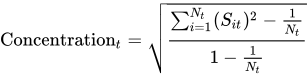
- t = the time at which the concentration of resources (i.e. power) is being calculated
- i = the state of which the proportion of control over the system's power is being measured
- Nt = the number of states in the great power system at time t
- S = the proportion of power possessed. Hence, Sit = the proportion of power possessed by state i at time t.
The expression represents the sum of the squares of the proportion of power possessed by all states in the great power system.

The closer the resulting concentration is to zero, the more evenly divided power is. The closer to 1, the more concentrated power is. There is a general but not strict correlation between concentration and polarity. It is rare to find a result over 0.5, but a result between 0.4 and 0.5 usually indicates a unipolar system, while a result between 0.2 and 0.4 usually indicated a bipolar or multipolar system. Concentration can be plotted over time, so that the fluctuations and trends in concentration can be observed.
See also
[edit]Bibliography
[edit]- Thompson, William R. On Global War: Historical–Structural Approaches to World Politics. Columbia, SC: University of South Carolina Press, 1988, pp. 209–210.
Notes
[edit]- ^ Alexis de Tocqueville in the mid-19th century had expected the bipolar world centered on America and Russia but had not advanced beyond bipolarity.
References
[edit]- ^ Jiang, Shiwei. "Is Bipolarity a sound recipe for world order–as compared to other historically known alternatives. In ICD Annual Conference on Cultural Diplomacy in the USA Options on the Table," Soft Power, Intercultural Dialogue & the Future of US Foreign Policy. 2013" (PDF).
- ^ a b "Did the Unipolar Moment Ever End?". Foreign Affairs. 2023-05-23. ISSN 0015-7120.
- ^ a b c d e Brooks, Stephen G.; Wohlforth, William C. (2023-04-18). "The Myth of Multipolarity". Foreign Affairs. No. May/June 2023. ISSN 0015-7120.
- ^ Røren, Pål (2024). "Unipolarity is not over yet". Global Studies Quarterly. 4 (2). doi:10.1093/isagsq/ksae018. ISSN 2634-3797.
- ^ a b Waltz, Kenneth Neal (1979). Theory of International Politics. McGraw-Hill. pp. 170–171. ISBN 978-0-07-554852-2.
- ^ Mearsheimer, John (2001). The Tragedy of Great Power Politics. W.W. Norton. pp. 44–45.
- ^ a b c Wohlforth, William (1999). "The Stability of a Unipolar World". International Security. 24 (1): 5–41. doi:10.1162/016228899560031. S2CID 57568539.
- ^ a b c Ikenberry, G. John (2001). After Victory: Institutions, Strategic Restraint, and the Rebuilding of Order After Major Wars. Princeton University Press. ISBN 978-0-691-05091-1.
- ^ Deutsch, Karl W.; Singer, J. David (1964). "Multipolar Power Systems and International Stability". World Politics. 16 (3): 390–406. doi:10.2307/2009578. ISSN 0043-8871. JSTOR 2009578. S2CID 53540403.
- ^ Zoppo, Ciro Elliott (1966). "Nuclear Technology, Multipolarity, and International Stability". World Politics. 18 (4): 579–606. doi:10.2307/2009806. ISSN 1086-3338.
Traditional theory of international politics maintains that, other things being equal, a multipolar balance-of-power system is more stable than a bipolar system
- ^ a b Bruce Bueno de Mesquita, “Measuring Systemic Polarity.” The Journal of Conflict Resolution 19, no. 2 (1975): 187–216. http://www.jstor.org/stable/173415.
- ^ Bruce Bueno de Mesquita, “Systemic Polarization and the Occurrence and Duration of War.” The Journal of Conflict Resolution 22, no. 2 (1978): 241–67. http://www.jstor.org/stable/173799.
- ^ a b c Monteiro, Nuno P. (2012). "Unrest Assured: Why Unipolarity Is Not Peaceful". International Security. 36 (3): 9–40. doi:10.1162/ISEC_a_00064. ISSN 0162-2889. S2CID 57558611.
- ^ a b Wohlforth, William C. (1999). "The Stability of a Unipolar World". International Security. 24 (1): 5–41. ISSN 0162-2889.
- ^ Jervis, Robert (2009). "Unipolarity: A Structural Perspective". World Politics. 61 (1): 188–231, p. 190. doi:10.1353/wp.0.0031.
unipolarity implies the existence of many juridically equal nation-states, something that an empire denies
- ^ Nexon, Daniel and Thomas Wright (2007). "What's at Stake in the American Empire Debate". American Political Science Review. 101 (2): 253–271, p. 253. CiteSeerX 10.1.1.136.2578. doi:10.1017/s0003055407070220. S2CID 17910808.
in empires, inter-societal divide-and-rule practices replace interstate balance-of-power dynamics
- ^ Cited in Hans Kohn, “The US and Western Europe: A New Era of Understanding,” Orbis, 6/1, (1962): p 17.
- ^ Michel Chevalier, ‘La Guerre et la Crise Européenne’, Revue des Deux Mondes, (1 June 1866), p. 784–785, https://fr.wikisource.org/wiki/La_Guerre_et_la_Crise_europ%C3%A9enne
- ^ Kang Youwei, (1885): The One World Philosophy, (tr. Thompson, Lawrence G., London, 1958, pp. 79-85).
- ^ Georges Vacher de Lapouge, L`Aryen: Son Role Social, (Nantes, 1899: chapter "L`Avenir des Aryens," pp. XXXI-XXXII).
- ^ Anticipations, p 107.
- ^ a b Ikenberry, G. John (Winter 1998–1999). "Institutions, Strategic Restraint, and the Persistence of American Postwar Order". International Security. 23 (3): 43–78. doi:10.1162/isec.23.3.43. JSTOR 2539338. S2CID 57566810.
- ^ Beckley, Michael (2018). "The Power of Nations: Measuring What Matters". International Security. 43 (2): 7–44. doi:10.1162/isec_a_00328. ISSN 0162-2889.
- ^ Posen, Barry R. (2011), Ikenberry, G. John; Mastanduno, Michael; Wohlforth, William C. (eds.), "From unipolarity to multipolarity: transition in sight?", International Relations Theory and the Consequences of Unipolarity, Cambridge University Press, pp. 317–341, ISBN 978-1-107-01170-0
- ^ Mearsheimer, John J. (2019). "Bound to Fail: The Rise and Fall of the Liberal International Order". International Security. 43 (4): 7–50. doi:10.1162/isec_a_00342. ISSN 0162-2889.
- ^ Wohlforth, William C. (2022), Græger, Nina; Heurlin, Bertel; Wæver, Ole; Wivel, Anders (eds.), "Polarity and International Order: Past and Future", Polarity in International Relations: Past, Present, Future, Governance, Security and Development, Cham: Springer, pp. 411–424, doi:10.1007/978-3-031-05505-8_21, ISBN 978-3-031-05505-8
- ^ a b Waltz, Kenneth (Summer 2000). "Structural Realism after the Cold War" (PDF). International Security. 25 (1): 5–41. doi:10.1162/016228800560372. S2CID 57560180. Retrieved 13 December 2012.
- ^ Norrlof, Carla (2010). America's Global Advantage: US Hegemony and International Cooperation. Cambridge: Cambridge University Press. doi:10.1017/cbo9780511676406. ISBN 978-0-521-76543-5.
- ^ Monteiro, Nuno (Winter 2011–2012). "Polarity and Power: U.S. Hegemony and China's Challenge". International Security. 36 (3). doi:10.1162/ISEC_a_00064. S2CID 57558611.
- ^ "Structural Realism After the Cold War," International Security, 25/1, (2000): p 27.
- ^ Martha Finnemore (2009). "Legitimacy, Hypocrisy, and the Social Structure of Unipolarity: Why Being a Unipole Isn't All It's Cracked Up to Be". World Politics. 61 (1): 58–85. doi:10.1353/wp.0.0027. ISSN 1086-3338.
- ^ Wang, Yuan-kang (2021). "The Durability of a Unipolar System: Lessons from East Asian History". Security Studies. 29 (5): 832–863. doi:10.1080/09636412.2020.1859127. ISSN 0963-6412. S2CID 231808778.
- ^ Waltz, Kenneth N. (1964). "The Stability of a Bipolar World". Daedalus. 93 (3): 881–909. ISSN 0011-5266. JSTOR 20026863.
- ^ Motin, D. (2025). Territorial Expansion and Great Power Behavior During the Cold War: A Theory of Armed Emergence. Routledge. pp. 141–143. ISBN 978-1-040-38258-5.
- ^ Kopalyan, N. (2017). World Political Systems after Polarity. Taylor & Francis. p. 224. ISBN 978-1-315-45139-8. Retrieved 2024-05-30.
- ^ Mearsheimer, John J. (2001). "Chapter 9". The Tragedy of Great Power Politics. W. W. Norton & Company. ISBN 978-0-393-34927-6.
- ^ Copeland, Dale C. (1996). "Neorealism and the myth of bipolar stability: Toward a new dynamic realist theory of major war". Security Studies. 5 (3): 29–89. doi:10.1080/09636419608429276. ISSN 0963-6412.
- ^ Haass, Richard; Kupchan, Charles A. (2021-04-29). "The New Concert of Powers". Foreign Affairs. ISSN 0015-7120. Retrieved 2021-10-25.
- ^ Sullivan, Michael P. (2001). Theories of International Relations : Transition vs Persistence. S. Burchill. Palgrave Macmillan. p. 128. ISBN 1-281-36762-1. OCLC 815569732.
- ^ "A dangerous history of multipolarity". www.lowyinstitute.org. Retrieved 2021-10-25.
- ^ Schweller, Randall L. (1993). "Tripolarity and the Second World War". International Studies Quarterly. 37 (1): 73–103. doi:10.2307/2600832. ISSN 0020-8833. JSTOR 2600832.
- ^ Midlarsky, Manus I.; Hopf, Ted (1993). "Polarity and International Stability". The American Political Science Review. 87 (1): 171–180. doi:10.2307/2938964. ISSN 0003-0554. JSTOR 2938964. S2CID 145530074.
- ^ "China Debates the Future Security Environment". nuke.fas.org. Retrieved 2021-10-25.
- ^ Jervis, Robert (1978). "Cooperation Under the Security Dilemma". World Politics. 30 (2): 167–214. doi:10.2307/2009958. hdl:2027/uc1.31158011478350. ISSN 0043-8871. JSTOR 2009958. S2CID 154923423.
- ^ Christensen, Thomas J.; Snyder, Jack (1990). "Chain Gangs and Passed Bucks: Predicting Alliance Patterns in Multipolarity". International Organization. 44 (2): 137–168. doi:10.1017/S0020818300035232. ISSN 0020-8183. JSTOR 2706792. S2CID 18700052.
- ^ Mearsheimer, John J. (2001). "Chapter 8". The Tragedy of Great Power Politics. W. W. Norton & Company. ISBN 978-0-393-34927-6.
- ^ a b Derviş, Kemal (2018-07-23). "Can multilateralism survive?". Brookings. Retrieved 2021-10-25.
- ^ a b Hoekman, Bernard (2014-06-01). "Sustaining multilateral trade cooperation in a multipolar world economy". The Review of International Organizations. 9 (2): 241–260. doi:10.1007/s11558-014-9187-3. hdl:1814/28962. ISSN 1559-744X. S2CID 154578416.
- ^ Garzón, Jorge F. (2017). "Multipolarity and the future of economic regionalism". International Theory. 9 (1): 101–135. doi:10.1017/S1752971916000191. ISSN 1752-9719. S2CID 151415696.
- ^ Mearsheimer, John J. (2019-04-01). "Bound to Fail: The Rise and Fall of the Liberal International Order". International Security. 43 (4): 7–50. doi:10.1162/isec_a_00342. ISSN 0162-2889. S2CID 139105003.
- ^ a b "Russian-Chinese Relations: A Marriage of Expedience or a true partnership in world politics? - Danube Institute". danubeinstitute.hu. Retrieved 2025-06-03.
- ^ Mansfield, Edward D. (March 1993). "Concentration, Polarity, and the Distribution of Power". International Studies Quarterly. 37 (1): 105–128. doi:10.2307/2600833. JSTOR 2600833.
External links
[edit]Polarity (international relations)
View on GrokipediaConceptual Foundations
Definition and Core Principles
Polarity in international relations refers to the configuration of relative power capabilities among the major states within the anarchic global system, where power is assessed through aggregate resources such as military strength, economic output, and technological prowess. This distribution is typically classified into unipolarity, characterized by a single dominant power holding a disproportionate share of capabilities; bipolarity, involving two roughly equal great powers; or multipolarity, featuring three or more states with comparable influence, none exceeding 50% of systemic capabilities.[8] In structural realism, polarity emerges as a key systemic variable, distinct from the units (states) themselves, shaping interactions under conditions of anarchy where no overarching authority enforces order.[7] Core principles of polarity derive from neorealist theory, positing that the international structure—defined by anarchy and the distribution of capabilities—imposes similar constraints on all states, compelling them to prioritize survival through power maximization or balancing.[9] States behave as rational actors responding to systemic pressures rather than domestic ideologies or leaders' whims, with polarity influencing alliance formation, deterrence, and conflict dynamics: in bipolar systems, direct rivalry fosters clear threat perception and mutual deterrence, whereas multipolar arrangements enable flexible but unstable coalitions prone to miscalculation. This framework assumes capabilities are fungible, allowing conversion across domains like economic to military power, and emphasizes relative gains over absolute ones in state calculations.[8] Empirically, polarity's principles manifest in varying system stability; for instance, the bipolar Cold War era (1947–1991), dominated by the United States and Soviet Union controlling over 50% of global capabilities each, avoided direct great-power war through balanced deterrence, contrasting with the multipolar pre-1914 Europe where shifting alliances contributed to World War I amid diffused power.[8] Structural realists like Kenneth Waltz contend that fewer poles reduce uncertainty and buck-passing, enhancing predictability and peace prospects, though critics note that polarity alone does not fully account for technological or nuclear factors altering power dynamics.[7]Theoretical Frameworks in Realism
Classical realism, exemplified by Hans Morgenthau's framework in Politics Among Nations (1948), conceptualizes polarity through the prism of balance-of-power dynamics in an anarchic international environment driven by states' pursuit of national interest defined in terms of power. Morgenthau viewed multipolar systems as conducive to equilibrium, where multiple great powers engage in flexible alliances and counterbalancing to prevent dominance by any single actor, thereby fostering relative stability via diplomatic maneuvering and restraint rather than rigid confrontation. This approach contrasts with bipolar rigidity, as multipolarity allows for the dissipation of tensions through diverse coalitions, though it risks misalignments if power shifts unevenly; Morgenthau emphasized that the balance is not a utopian formula but an empirical tendency observed in historical great-power interactions, such as pre-World War I Europe.[10][11] Structural realism, or neorealism, advanced by Kenneth Waltz in Theory of International Politics (1979), shifts focus to systemic structure as the primary determinant of state behavior, with polarity—measured by the distribution of capabilities among great powers—dictating stability outcomes. Waltz contended that bipolarity yields the highest stability due to its simplicity: two dominant states, each clearly identifiable as the primary threat to the other, engage in direct balancing without the ambiguities of third-party alliances or buck-passing prevalent in multipolarity, where additional poles multiply uncertainties and escalation risks. Empirical evidence from the post-1945 era, Waltz argued, supported this, as the U.S.-Soviet dyad avoided major war despite tensions, unlike the multipolar prelude to World War I; unipolarity, by contrast, invites overextension by the hegemon and latent challenges from rising powers, though Waltz predicted its transience absent structural reinforcement. This framework prioritizes defensive postures, where states seek sufficient power for security rather than maximization, rendering bipolar structures resilient to internal disruptions. Offensive realism, as formulated by John Mearsheimer in The Tragedy of Great Power Politics (2001), builds on structural foundations but posits that anarchy compels states to aggressively maximize relative power for survival, rendering polarity a battleground for hegemony quests within regional systems. Mearsheimer aligns with Waltz on bipolarity's relative stability—fewer great powers minimize miscalculation and enable clear deterrence—but anticipates persistent security dilemmas, as even bipolar rivals pursue opportunistic expansion when feasible, exemplified by historical U.S. and Soviet interventions. In multipolar contexts, offensive dynamics intensify, with states employing buck-passing or balancing to contain threats, often leading to preventive wars; unipolarity proves illusory and unstable, as the dominant power cannot indefinitely suppress regional aspirants without overcommitment, evidenced by post-Cold War U.S. experiences in Iraq and Afghanistan. Mearsheimer's predictions, grounded in five assumptions including offensive intentions and power uncertainty, underscore polarity's causal role in conflict propensity, critiquing liberal optimism for ignoring structural imperatives.[12][11]Types of Polarity
Unipolarity
Unipolarity denotes a distribution of capabilities in the international system wherein a single state possesses such overwhelming preponderance—particularly in military terms—that it faces no peer competitors capable of challenging its dominance on a global scale.[13] This structure emerged theoretically as a distinct polarity following the bipolar competition of the Cold War, characterized by the hegemon's ability to shape outcomes across multiple domains without equivalent counterweights.[14] The concept gained prominence through Charles Krauthammer's 1990 essay "The Unipolar Moment," which described the post-Cold War order as one centered on an unchallenged United States, surrounded by secondary powers unable to form balancing coalitions. The paradigmatic instance of unipolarity materialized after the Soviet Union's dissolution on December 25, 1991, leaving the United States as the sole superpower with unmatched military projection, economic output, and alliance networks.[15] By 1992, U.S. defense spending exceeded that of the next 13 nations combined, a disparity that persisted; in 2024, U.S. military expenditures reached $997 billion, comprising 37% of the global total and 66% of NATO's aggregate.[16] Economically, the United States accounted for approximately 26% of world GDP in nominal terms as of 2023, underpinned by technological leadership in sectors like semiconductors and aerospace, while maintaining over 700 overseas bases and carrier strike groups that no other state could replicate.[17] This dominance extended to institutional influence, with the U.S. dollar serving as the primary reserve currency (58% of global foreign exchange reserves in 2023) and American-led organizations like the IMF and World Bank directing much of international financial governance. Scholars debate unipolarity's stability and duration, with structural realists like John Mearsheimer positing it as inherently transient and provocative, as lesser powers eventually balance against the hegemon through internal mobilization or alliances, potentially leading to conflict.[18] Conversely, William Wohlforth contends that extreme U.S. preponderance raises the costs of opposition prohibitively high, fostering acquiescence or bandwagoning among secondary states and yielding relative peace among major powers since 1991, evidenced by the absence of great-power wars or direct militarized disputes.[19] Empirical data supports the latter view to date: despite China's military modernization (spending $292 billion in 2023, about 29% of U.S. levels), no state has achieved parity in aggregate capabilities, including nuclear delivery systems or expeditionary forces, allowing the unipole to deter aggression without systemic balancing coalitions forming.[20][21] Unipolarity's implications include the hegemon's capacity for unilateral action, as seen in U.S.-led interventions in the Gulf War (1990–1991) and Kosovo (1999), where coalition resistance was minimal due to capability asymmetries.[22] However, it may incentivize asymmetric challenges, such as terrorism or regional revisionism, rather than conventional balancing, while the unipole bears disproportionate costs for systemic stability, including policing sea lanes and counterproliferation efforts.[23] Recent analyses, including assessments through 2023, affirm the persistence of this structure amid rising challengers, attributing durability to the unipole's enduring advantages in innovation and alliances rather than inevitable diffusion of power.[24]Bipolarity
Bipolarity denotes an international system in which two preeminent powers or coalitions command the overwhelming share of global capabilities, including military, economic, and diplomatic resources, marginalizing the agency of lesser states.[25] [26] This configuration fosters intense rivalry between the poles, often manifesting in ideological divides, proxy conflicts, and formalized alliances that compel alignments along bloc lines.[27] Unlike multipolar setups with fluid balancing, bipolar structures simplify threat perceptions, as states face binary choices between the dominant actors.[28] The paradigmatic instance of bipolarity occurred during the Cold War era, spanning roughly 1947 to 1991, with the United States and the Soviet Union as the rival superpowers.[29] The U.S.-led Western bloc, anchored by NATO established in 1949, contrasted with the Soviet-dominated Eastern bloc via the Warsaw Pact formed in 1955, dividing much of Europe and influencing global alignments.[30] Power asymmetry persisted despite competition: U.S. nominal GDP in 1970 exceeded Soviet GDP by over 2.5 times, though the USSR allocated 15-25% of its GDP to military spending compared to the U.S. average of 5-10%, enabling parity in nuclear arsenals and conventional forces in key theaters.[31] [32] This era avoided direct great-power war, attributable in part to mutual nuclear deterrence, yet featured numerous proxy wars and arms races.[33] Theoretically, structural realists like Kenneth Waltz contend that bipolarity enhances stability relative to multipolarity by reducing uncertainty in power assessments and alliance unreliability, minimizing miscalculation risks amid concentrated capabilities.[34] [35] Waltz emphasized that the system's simplicity—two poles balancing each other—fosters clearer deterrence signals, particularly under nuclear conditions, contrasting with multipolar intrigue prone to buck-passing and chain-ganging.[4] Empirical evidence from the Cold War supports this, as no direct superpower clash ensued despite tensions, though critics note internal bloc cohesion challenges and peripheral instabilities.[36] Quantitative metrics, such as composite indices of military expenditures and GDP shares, confirm the duopoly's dominance, with the two powers accounting for 50-70% of global output and armaments during peak bipolar phases.[37]Multipolarity
Multipolarity denotes an international system characterized by the distribution of power among three or more major states or poles, each possessing comparable capabilities in military, economic, and diplomatic spheres, without any single hegemon dominating global affairs.[38] [39] In such configurations, no pole can unilaterally impose its will on the system, leading to a reliance on alliances, balancing, and negotiation to manage competition.[40] This contrasts with bipolarity's dyadic rivalry or unipolarity's singular preeminence, as multipolar structures foster fluid coalitions where states may align temporarily against perceived threats but shift partnerships based on immediate interests.[35] Key features include heightened uncertainty in power assessments, as actors must evaluate multiple rivals and potential allies simultaneously, often resulting in miscalculations or preemptive actions.[5] Alliances in multipolar systems are typically issue-specific and prone to revision, exemplified by the pre-1914 European balance where ententes like the Triple Alliance and Triple Entente contained but did not eliminate great power rivalries.[38] Economic interdependence may mitigate conflicts, yet military capabilities—such as naval armadas or expeditionary forces—remain central, with poles engaging in arms races or proxy contests to deter aggregation of opposing coalitions.[39] Theoretically, classical realists like Hans Morgenthau contended that multipolarity promotes stability through diplomatic flexibility and mutual checks among equals, allowing for concert-like management of crises as in the 19th-century Concert of Europe.[39] Conversely, structural realists such as Kenneth Waltz argued it heightens instability due to alliance impermanence, buck-passing (shifting burdens to others), and chain-ganging (dragging allies into unwanted wars), contrasting with bipolarity's clear deterrence and reduced misperception risks.[35] Empirical analyses, including Jack Levy's examination of 19th- and 20th-century systems, indicate bipolar configurations exhibit fewer major power wars and shorter conflict durations compared to multipolar eras, attributing this to simplified signaling and accountability.[41] Multipolarity's prevalence in history—spanning ancient Warring States China to interwar Europe—underscores its recurrence but also its association with systemic upheavals when balancing fails.[35]Historical Manifestations
Pre-20th Century Systems
In ancient East Asia, the Warring States period (c. 475–221 BCE) represented a classic multipolar system, wherein seven major kingdoms—Qin, Chu, Yan, Han, Zhao, Wei, and Qi—competed intensely for supremacy through military conquests, strategic alliances, and bureaucratic innovations, culminating in Qin's unification under the first emperor.[35] This era's fragmented power distribution fostered chronic interstate conflict, with no single hegemon dominating until Qin's decisive victories.[42] In the Mediterranean, classical Greece (c. 5th–4th centuries BCE) formed another multipolar arrangement among independent city-states (poleis), such as Athens, Sparta, Thebes, and Corinth, which balanced autonomy with shifting leagues like the Delian (led by Athens) and Peloponnesian (led by Sparta), often erupting into wars like the Peloponnesian conflict (431–404 BCE) that eroded Athenian naval primacy and highlighted the instability of diffused power.[43] Multipolarity prevailed due to geographic fragmentation and cultural emphasis on sovereignty, preventing durable hegemony despite temporary dominances.[44] The Roman Republic achieved a regional unipolar moment in the Hellenistic world from approximately 188 to 146 BCE, following victories over Seleucid Syria at Magnesia (190 BCE) and Carthage in the Third Punic War (146 BCE), which dismantled rival power centers and imposed Roman oversight across the eastern Mediterranean without equivalent challengers.[45] This asymmetry enabled Rome to dictate terms via client kingdoms and direct provinces, reducing systemic wars among great powers in the region until internal Roman strains and external pressures like Parthian resurgence eroded it.[46] By the early modern period, Europe's post-Westphalian order (after 1648) evolved into sustained multipolarity, with the 19th-century Concert of Europe (established 1815 at the Congress of Vienna) institutionalizing coordination among five great powers—Britain, Russia, Austria, Prussia, and France—to preserve territorial balances and suppress revolutions, yielding relative stability until the 1850s.[47] This managed multipolarity emphasized collective decision-making over unilateral dominance, averting general wars for decades amid rising nationalism.[48] Bipolar systems remained atypical pre-1900, often confined to dyadic rivalries like Rome versus Carthage, lacking the global scope of later eras.[35]20th Century Transitions
The international system at the outset of the 20th century exhibited multipolarity, with relative power distributed among several European great powers—primarily Britain, Germany, France, Russia, and Austria-Hungary—alongside rising challengers like the United States and Japan. This configuration, rooted in the 19th-century Concert of Europe, fostered a balance through shifting alliances but proved unstable amid imperial rivalries, nationalism, and arms races, culminating in World War I from July 28, 1914, to November 11, 1918. The war's devastation eliminated Germany and Austria-Hungary as major powers, weakened Britain and France economically and territorially, and elevated the United States as the world's largest economy with a GDP share rising to about 20% by 1919, while the Bolshevik Revolution in Russia in 1917 birthed the Soviet Union as an ideological contender.[49][39] Post-World War I efforts to restore multipolarity via the League of Nations in 1920 faltered due to U.S. isolationism under the Senate's rejection of the Treaty of Versailles on November 19, 1919, and the exclusion of the Soviet Union until 1934, leaving a fragmented system prone to aggression. The interwar period saw Germany's resurgence under the Weimar Republic and later Nazi regime, Japan's expansionism in Asia from the 1931 Manchurian invasion, and Italy's fascist ambitions, leading to renewed multipolar instability marked by the Great Depression starting in 1929, which eroded global trade by 65% and fueled protectionism. This volatility precipitated World War II from September 1, 1939, to September 2, 1945, which further consolidated power asymmetries by decimating Axis powers and European colonial empires, with Allied casualties exceeding 40 million and infrastructure losses in Europe estimated at $230 billion in 1945 dollars.[39][50] The conclusion of World War II marked a decisive transition to bipolarity, as the United States and Soviet Union emerged as preeminent powers with unmatched military capabilities, including the U.S. monopoly on atomic weapons until the Soviet test on August 29, 1949, and control over respective spheres: the U.S. dominating Western Europe via the Marshall Plan's $13 billion aid from 1948-1952, and the USSR imposing influence over Eastern Europe through occupations and the 1947-1948 Czech coup. This duality formalized in institutional alliances, such as NATO's founding on April 4, 1949, and the Warsaw Pact on May 14, 1955, dividing the globe into ideological blocs amid proxy conflicts and arms races. The bipolar structure persisted through the Cold War until the Soviet dissolution on December 26, 1991, reflecting a causal shift from diffused European-centric power to concentrated superpower rivalry driven by wartime outcomes and ideological polarization.[51][52][53]Post-Cold War Era
The dissolution of the Soviet Union on December 25, 1991, marked the end of bipolarity and the emergence of a unipolar international system dominated by the United States, characterized by its unparalleled military, economic, and technological capabilities.[54][55] The U.S. accounted for approximately 25% of global GDP in the early 1990s while maintaining a defense budget that exceeded the combined spending of the next several largest militaries, enabling decisive interventions such as Operation Desert Storm in 1991, where a U.S.-led coalition expelled Iraqi forces from Kuwait with minimal allied casualties and without direct superpower opposition.[56] This period saw the expansion of U.S.-influenced institutions, including NATO's enlargement eastward starting in 1999, which incorporated former Warsaw Pact states, reinforcing American strategic primacy in Europe.[57] U.S. dominance extended to economic and soft power spheres, with the liberalization of global trade under frameworks like the World Trade Organization—established in 1995—facilitating American-led globalization that integrated emerging markets while bolstering U.S. multinational corporations.[58] By the late 1990s, the U.S. military's technological edge, including precision-guided munitions and global power projection via carrier strike groups, lacked peers, as evidenced by the swift NATO intervention in Kosovo in 1999, conducted largely through airpower without ground troop commitments from the unipole.[59] However, this unipolarity was not absolute; regional powers like China began modest military modernizations, though U.S. defense spending, reaching about 40% of the global total by the 2000s, sustained systemic asymmetry.[56][60] Challenges to unipolarity intensified in the 2000s and 2010s, driven by the resurgence of Russia under Vladimir Putin, who assumed power in 2000 and pursued assertive foreign policies, including the 2008 intervention in Georgia and the 2014 annexation of Crimea, signaling Moscow's rejection of U.S.-centric order in Eurasia.[57][61] Concurrently, China's economic ascent accelerated after its 2001 entry into the WTO, with GDP growth averaging over 9% annually through the 2000s, enabling investments in asymmetric capabilities like anti-access/area-denial systems and a blue-water navy, though U.S. alliances such as those with Japan and Australia mitigated direct threats.[61][62] Russia's 2022 invasion of Ukraine and deepening Sino-Russian strategic partnership, including joint military exercises, highlighted coordination against perceived U.S. hegemony, yet these actions exposed limitations: Russia's economy remains smaller than Italy's, and China's military, while expanded, trails in qualitative metrics like nuclear submarines and global basing.[63] By the mid-2020s, empirical indicators of polarity showed persistent U.S. advantages, with American military expenditures at roughly $877 billion in 2022—more than the next ten countries combined—and control over key financial systems like the SWIFT network enforcing sanctions on challengers.[56] Debates persist on whether this constitutes enduring unipolarity or a transition to bipolarity centered on U.S.-China rivalry, as China's share of global GDP approached 18% by 2023 while facing internal economic headwinds like debt burdens exceeding 300% of GDP.[62][61] U.S.-led responses, including AUKUS and QUAD frameworks formed in 2021, underscore efforts to preserve primacy amid these shifts, though overextension in conflicts like Afghanistan's 2021 withdrawal raised questions about sustainability.[64] Overall, post-Cold War polarity has manifested as asymmetric unipolarity under strain, with no rival matching the U.S. in composite power indices across domains.[59][54]Measuring Polarity
Quantitative Indicators
The primary quantitative indicator for assessing polarity in international relations is the distribution of material capabilities among states, aggregated through indices such as the Composite Index of National Capability (CINC) developed by the Correlates of War (COW) project. CINC quantifies national power by summing six normalized components—total population, urban population, iron and steel production, energy consumption, military personnel, and military expenditure—each expressed as a state's share of the global total for a given year, spanning 1816 to 2016 in the latest dataset.[65] This composite approach captures latent power potential across demographic, industrial, and military domains, enabling cross-temporal comparisons of state capabilities.[66] To derive system-level polarity, COW and subsequent studies compute a concentration index from the CINC shares (S_{it}) of identified great powers at time t, typically the top five to eight states by capability. The standard formula normalizes the variance in shares to range from 0 (perfect equality, indicating multipolarity) to 1 (total concentration in one actor, indicating unipolarity): Here, N_t denotes the number of great powers, and the index approximates a standardized measure of inequality, akin to a coefficient of variation; values exceeding approximately 0.4 often signal bipolar or unipolar structures, while lower values suggest multipolarity, though thresholds vary by analytical context.[66] [67] For instance, during the Cold War bipolar period around 1950, the combined CINC shares of the United States (roughly 0.40) and Soviet Union (roughly 0.20) yielded a high concentration value, reflecting dominance by two poles over other powers. Variations on CINC address domain-specific power, such as the modified military CINC (mCINC), which aggregates only military expenditure and personnel shares to isolate realized military concentration.[66] This yields similar concentration indices but emphasizes warfighting potential; for example, analyses from 2017 to 2023 show persistent high concentration under U.S. primacy, with minimal shifts from events like COVID-19.[68] Other metrics, including shares of global GDP or military spending from sources like SIPRI, complement CINC but are critiqued for overemphasizing economic latent power without full integration of mobilization capacity.[68] These indicators prioritize empirical aggregation over subjective assessments, though debates persist on weighting components and defining great-power thresholds, as small changes in N_t can alter concentration scores.[69]Qualitative Assessments
Qualitative assessments of polarity in international relations focus on perceptual, diplomatic, and behavioral indicators that reveal how states and elites interpret the distribution of power, rather than relying exclusively on material metrics like GDP or military expenditures. These approaches, often rooted in constructivist and English School traditions, treat polarity as a socially constructed phenomenon shaped by mutual recognition of great power status, historical analogies, and ideational factors such as legitimacy and prestige. For instance, polarity is evaluated through discourse analysis of official statements, memoirs, and diplomatic correspondence to identify consensus on the number of poles, emphasizing that material capabilities alone do not determine structure without corresponding perceptions of order.[70] A key method involves examining state conduct and alliances for evidence of balancing or bandwagoning against perceived poles. In historical cases, such as the Concert of Europe from 1815 to 1914, qualitative analysis reveals multipolar perceptions tempered by bipolar rivalries (e.g., between Russia and Britain), where weaker states like Austria maintained pole status through diplomatic prestige despite limited capabilities. Similarly, during the Cold War (1945-1991), bipolarity was affirmed not just by U.S.-Soviet military parity but by global alignments and rhetorical framing that marginalized third parties like China until the 1970s. Post-Cold War assessments highlight U.S. unipolarity through its ability to conduct unilateral interventions, such as the 1991 Gulf War coalition under UN auspices without Soviet veto and the 1999 NATO-led Kosovo operation bypassing Russia and China, signaling perceived absence of peer competitors.[70] In contemporary contexts, qualitative evaluations incorporate military-technological edges and control over global commons (air, sea, space, cyber domains). For example, U.S. superiority in power projection—evidenced by 11 nuclear-powered aircraft carriers enabling worldwide operations versus China's two conventionally powered ones limited to regional waters—supports arguments for persistent unipolar dominance, even as China's advances in hypersonics challenge specific domains. These assessments prioritize qualitative judgments of innovation leadership, such as U.S. edges in stealth technology and AI integration, over aggregate counts, revealing how perceived qualitative disparities sustain pole status amid quantitative shifts. Analysts caution that conflicting perceptions, like China's "peaceful rise" rhetoric post-2003 contrasting U.S. views of rivalry, can delay consensus on emerging multipolarity.[62][70]Impacts on International Stability
Conflict Dynamics Across Polarity Types
In bipolar systems, conflict dynamics are characterized by intense rivalry between two dominant powers, often leading to mutual deterrence and avoidance of direct confrontation, as exemplified by the Cold War era from 1945 to 1991, during which the United States and Soviet Union engaged in proxy wars such as the Korean War (1950–1953, resulting in approximately 2.5–3.5 million deaths) and the Vietnam War (1955–1975, with over 3 million fatalities) but refrained from head-on clashes due to nuclear stalemate.[34] Neorealist scholar Kenneth Waltz posited that bipolarity enhances stability by simplifying power balances, minimizing alliance uncertainties and miscalculations inherent in systems with more actors, thereby reducing the likelihood of escalatory errors that plague multipolar arrangements.[34] Empirical analyses of historical bipolar periods, however, reveal mixed outcomes; rare instances like the Peloponnesian War (431–404 BCE) between Athens and Sparta culminated in devastating total war, suggesting that concentrated rivalry can amplify stakes without guaranteeing peace, though post-1945 data shows no major-power direct wars, supporting deterrence claims amid high military expenditures (e.g., U.S. defense spending peaked at 9.4% of GDP in 1968).[41] Multipolar systems, featuring three or more great powers, exhibit heightened conflict risks through fluid alliances and potential for "chain-ganging," where entangled commitments draw states into unintended escalations, as in the July Crisis of 1914 that ignited World War I, involving alliances like the Triple Entente and Central Powers and resulting in over 16 million deaths.[41] Theoretical arguments, including Waltz's, emphasize multipolarity's instability from buck-passing (shifting burdens to allies) and opaque signaling, fostering preemptive actions; yet early quantitative studies by Deutsch and Singer (1964) found multipolar configurations less prone to arms-race-to-war escalations due to diffused tensions, with empirical data from 1816–1965 indicating more frequent but shorter interstate wars under multipolarity compared to bipolarity.[34][41] Historical multipolar epochs, such as Europe's Concert system (1815–1914), maintained relative peace through periodic conferences averting major clashes until systemic rigidities failed, underscoring that while multipolarity permits balancing flexibility, it correlates with elevated great-power war probabilities in datasets spanning 1494–1983, where polarity shifts preceded global power conflicts.[71] Under unipolarity, with one preponderant power, conflicts tend toward asymmetric engagements where the hegemon polices peripheral threats, as observed post-1991 with U.S.-led interventions like the Gulf War (1990–1991, expelling Iraqi forces from Kuwait with coalition casualties under 400) and the Iraq War (2003–2011, involving over 4,400 U.S. military deaths), reflecting the unipole's capacity to project force without peer rivalry but risking overextension against resistant minor powers.[60] Scholars argue unipolarity fosters systemic stability by deterring great-power wars—evidenced by zero interstate conflicts among major powers since the Soviet collapse—yet transitions from unipolarity may precipitate violence as rising challengers test the hegemon, with empirical trends showing a post-Cold War decline in battle deaths (from 231,000 annually in 1980s to under 20,000 by 2010s) but persistent low-level insurgencies.[14][72] Overall, empirical reviews, such as Levy's analysis of 1816–1976 data, reveal no unequivocal polarity-war linkage, challenging structural determinism and highlighting intervening factors like technology and domestic politics in shaping outcomes.[41]Cooperation and Alliance Patterns
In bipolar international systems, cooperation manifests through the formation of enduring, ideologically aligned blocs designed to balance against the rival pole, minimizing defection risks due to the binary power structure. States align predictably, with secondary powers joining the side perceived as weaker to prevent dominance by the stronger contender, fostering high alliance cohesion.[34] This pattern was exemplified by the North Atlantic Treaty Organization (NATO), established on April 4, 1949, by 12 founding members including the United States and Western European states to counter Soviet expansion, and the Warsaw Pact, formed on May 14, 1955, by the Soviet Union and Eastern European satellites in response to West German rearmament.[73] Such alliances exhibited low turnover, with NATO maintaining core membership through the Cold War despite internal tensions, as the clear bipolar distribution reduced hedging incentives.[14] Multipolar systems, characterized by three or more great powers, produce more fragmented and opportunistic alliance patterns, where coalitions are temporary, issue-specific, and prone to realignment due to multiple balancing options and buck-passing tendencies. Alliances form to address immediate threats but dissolve or shift as power dynamics evolve, elevating miscalculation risks from uncertain commitments.[12] John Mearsheimer contends that multipolarity encourages states to avoid entrapment in others' conflicts, leading to less reliable partnerships compared to bipolar rigidity.[74] Historical evidence from the pre-World War I era illustrates this: the Triple Alliance (1882) between Germany, Austria-Hungary, and Italy coexisted uneasily with the Triple Entente (1907) of France, Russia, and Britain, yet secret protocols and shifting Italian neutrality in 1915 underscored fluidity.[73] Empirical analyses confirm greater alliance inconsistency in multipolar configurations, with higher rates of formation and dissolution than in bipolar or unipolar settings.[41] Under unipolarity, a single hegemon dominates, prompting lesser states to bandwagon rather than balance, resulting in hierarchical alliances where the preponderant power extends security guarantees in exchange for deference and limited burden-sharing. Cooperation centers on the hegemon's initiatives, with coalitions often ad hoc for specific operations rather than permanent blocs.[14] Post-Cold War NATO expansion, incorporating former Warsaw Pact states like Poland in 1999, reflected this dynamic, as Eastern European nations sought U.S.-led protection against potential Russian resurgence without equivalent balancing coalitions forming against American primacy.[73] Studies indicate that unipolar alliance behaviors mirror bipolar consistency more than multipolar variability, though with asymmetric contributions—the hegemon assuming disproportionate defense costs.[75]| Polarity Type | Key Alliance Features | Stability Level | Example Dynamics |
|---|---|---|---|
| Bipolar | Rigid blocs, balancing focus, low defection | High | NATO-Warsaw mutual deterrence, minimal shifts 1949–1991[14] |
| Multipolar | Fluid coalitions, buck-passing prevalent, high realignment | Low | Pre-1914 European pacts with frequent secret renegotiations[12] |
| Unipolar | Hierarchical bandwagoning, hegemon-centric, asymmetric burdens | Moderate to High | U.S.-led post-1991 expansions with voluntary alignments[73] |