
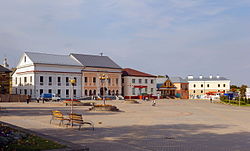


Community hub
Recent from talks
Contribute something
Nothing was collected or created yet.
Novogrudok
View on Wikipedia | This article has multiple issues. Please help improve it or discuss these issues on the talk page. (Learn how and when to remove these messages)
|

Novogrudok or Navahrudak (Belarusian: Навагрудак; Russian: Новогрудок; Polish: Nowogródek, Lithuanian: Naugardukas; Yiddish: נאַוואַראַדאָק, romanized: Navaradok) is a town in Grodno Region, Belarus. It serves as the administrative center of Novogrudok District. As of 2025, it has a population of 27,624.[2]
Key Information


.jpg)


In the Middle Ages, the city was ruled by King Mindaugas' son Vaišvilkas.[3]
During and after Mindaugas' rule, Novogrudok was part of the Kingdom of Lithuania, and later the Grand Duchy of Lithuania, which was later part of the Polish–Lithuanian Commonwealth. In the 14th century, it was an episcopal see of the Metropolitanate of Lithuania.
From 1795 to 1915, the Russian Empire ruled over the lands, with brief periods of intercession, e.g. Napoleon's Grande Armée in 1812 and the Uprisings of 1831 and 1863. After 1915, Novogrudok was occupied by the Imperial German Army for three years in World War I, by the Second Polish Republic until the Soviet invasion of Poland in 1939. Thereafter, the Soviet Union annexed the area to the Byelorussian SSR. From 1941 to 1944, Novogrudok was occupied by the German Army, thereafter returning to the Soviet Union until 1991.
Toponymy
[edit]The name comes from the Old East Slavic words "New town". It was a large settlement in the remote Western lands of the Krivichs, which came under the control of the Ancient Rus' state at the end of the 10th century. The ancient name of Novgorodok (Nov'gorodok,[4] Nov'gorodok',[5] though leaning both parts: to Novagorodka, in Novegorodtsy, "between Novym'gorodkom'", from "Novagorodka" in "Novegorodche"). In some sources, it is called Maly Novgorod.[6]
Archaeological excavations made by Gurevich F. D. in different places of the city, gave a huge number of interesting finds (Byzantine glass, jewellery, and even the ruins of a house with painted walls from the inside, which had suspended lanterns in which oil was lit) this, as well as the conclusion of the archaeologist that the city appeared on this site no later than the 9th century, allows Novogrudok to claim the role of historical chronicle Novgorod.[citation needed] In favour of this version of localization is the fact that in the earliest annals of Novgorod called "Novgorodou", and [ou] in the end later added the letter "k" turned [ouk], so the chronicle "Novgorodou" transformed into "Novgorodouk" and was later simplified to "Novogrudok".[citation needed]
Locals use the older name "Navаgradak",[7][8][9][10] especially the older people. The place of stress is recorded in the publication of the "Tribunal for the inhabitants of the Grand Duchy of Lithuania'" (Vilna, 1586), where it is marked in print "in Novа́gorodku".[7]
At the time of entry into the Polish–Lithuanian Commonwealth, the traditional Belarusian pronunciation Navа́gradak led to Polish exonym Nowogródek. In turn, this led to the written Russian exonym Novogrudok, and the written Ukrainian exonym Novohrudok.[citation needed]
Some historians believe that the chronicle versions of the name of the city – Novogorod, Novgorodok, Novy Gorodok, Novogorodok-Litovsky, etc. indicate that, perhaps, there was an old city center of the district – Radogoshcha.[11]
History
[edit]Early history
[edit]Novogrudok was established in Baltic Yotvingian lands.[12][13] Eastern Slavs, specifically Dregoviches and Volhynians, were the first settlers who established Novogrudok at the end of the 10th century.[14] According to archaeological research conducted in Novogrudok in the 1960s, the settlements arose on modern Novogrudok's territory at the end of the 10th century, and the fortifications by the mid-11th century.[15] Research also suggests that a city already existed on-site in the 9th–10th centuries, which had trade links with Byzantium, the Near East, Western Europe and Scandinavia. These trade links were related to the Amber Road. Archaeologically, Novogrudok was studied in the years 1957-1977. In the first half of the 11th century, the city consisted of two undefended settlements located on the Small castle and Castle hill. In the second half of the 11th century, fortifications were built around the settlement on the Castle hill, thus forming the Novogrudok detinets. On the Small Castle to the West of the detinets formed a settlement, which in the 12th century was also fortified and turned into a roundabout city.
On the territory of the detinets, wooden ground buildings with wood burning stoves made out of adobe and plank floors were studied. The most important activities of the city's population were crafts and trade. Often, there is evidence of local jewelry craft – there were foundries and jewelry workshops that formed a whole block on the small castle.[16] Bone-cutting, wood and stone processing were also common. Graffiti with old Russian letters was found on fragments of frescoed plaster from building No.12 ("house of the boyar" or "powalush") of the 12th century on the Small Castle (an ancient roundabout city).[17][18] Trade relations in the 12th–13th centuries were far-reaching, as evidenced by many imports: from Kyiv came glass bracelets, non-ferrous metal jewellery, engolpions, icons, spindle whorls, faience vessels from Iran, glassware from Byzantium and Syria, from the Baltic – amber.[19]
Novogrudok was first mentioned in the Sofia First Chronicle and Novgorod Fourth Chronicle in 1044 in reference to a war between Yaroslav I and Lithuanian tribes.[20] It was also mentioned in the Hypatian Codex in 1252 as Novogorodok, meaning "new little town". Novogrudok was a major settlement in the remote western lands of the Krivichs that came under Kievan Rus' control at the end of the 10th century. However, this hypothesis has been disputed as the earliest archaeological findings date from the 11th century.[21]
.jpg)
Grand Duchy of Lithuania
[edit]13th century
[edit]In the 13th century, Kievan Rus' disintegrated due to Asian nomadic incursions, which climaxed with the Mongol horde's Siege of Kiev (1240), resulting in the sack of Kiev. This left a regional geopolitical vacuum in which the East Slavs splintered along pre-existing tribal lines and formed several independent, competing principalities. It is known that even prior to Mindaugas' arrival, there was a Catholic church in Novogrudok.[12]

Maciej Stryjkowski asserts that Ringold's father, Algimunt, ruled in Novogrudok over all Rus' and Lithuania, starting from Vilija River up to Starodub, Chernigov, Turau and Karachaev, as well as all of Podlasie with its adjacent castles, Brest, Mielnik, Drohiczyn, etc., holding them in peaceful tenure.[22]
Mindaugas' son Vaišvilkas ruled Novogrudok.[13] Novogrudok was one of Mindaugas' residences.[23] Some identify Novogrudok as Lithuania's first capital,[24][25][better source needed][dubious – discuss] later the Grand Duchy of Lithuania,[25][26][27][28] however, this is refuted by the fact that Voruta is the only contemporary mention of a possible early Lithuanian capital ruled by Mindaugas.[29][30] Voruta's most likely location has been identified as Šeimyniškėliai mound.[31][30] The Great Russian Encyclopedia states that Mindaugas' state had no permanent capitals, but his early residence was Black Rus', whose center was Novogrudok.[32] Encyclopædia Britannica mentions only the following Lithuanian capitals: Kernavė, Trakai and Vilnius, excluding Novogrudok from the list.[33]
During the 16th century, three centuries after the events, Maciej Stryjkowski was the first, in his chronicle,[34] to propose the theory that Novogrudok was the capital of the 13th-century state. Vaišvilkas, the son and successor of Mindaugas, took monastic vows in Lavrashev Monastery[35] near Novgorodok and founded an Orthodox convent there.[36] The enmity between Mindaugas and his relatives, who were refuged in Volhynia, led to a great war with the Kingdom of Galicia–Volhynia, which made several major campaigns against the city. These campaigns forced Mindaugas to ally with the Livonian Order. In 1253, Mindaugas was crowned king of Lithuania on behalf of the Pope. Vaišvilkas made peace on behalf of his father with the Kingdom of Galicia–Volhynia and handed over Novogrudok and all Lithuanian cities to Roman Danylovich.[37][better source needed][dubious – discuss] After breaking the peace in 1258, Vaišvilkas again became a duke in Novogrudok, and then passed it along with the entire country to Shvarn. The Golden Horde Tatars repeatedly attacked Novogrudok in 1255, 1274, and finally in 1279.[38]
.jpg)
14th century
[edit]In 1314, the castle was besieged by the Teutonic Order.[39] It was again attacked by the Teutons in 1321, 1341, 1390 and finally in 1394.
As the centre of the appanage Principality, Novogrudok was owned from 1329 by Prince Karijotas, and then by his son Fyodor from 1358, and from 1386 by Kaributas.[40] At that time, Novogrudok was part of the Trakai Voivodeship, whose population was entirely ethnically Lithuanian, hence Novogrudok was part of Lithuania Proper.[13]
Since 1392, Novogrudok was one of the centres of the Grand Ducal demesne of the Grand Duchy of Lithuania, where the stone Novogrudok Castle was built. The Novogrudok Castle's firmness allowed the existence of a Castellan and a Koniuszy.[41]
15th century
[edit]At the end of the 14th and start of the 15th century, Vytautas settled the Lipka Tatars in Novogrudok and its surroundings. In 1428, he recorded the city along with the surrounding villages in the lifetime possession of his wife Uliana. In 1415, at the Council of Orthodox bishops in Novogrudok, Gregory Tsamblak was elected Metropolitan of the Grand Duchy of Lithuania. The Synod de facto declared autocephaly of the Orthodox Church in the Grand Duchy of Lithuania, and also reformed internal administration in the Church.[42] In 1422, Vytautas the Great founded the Roman Catholic Transfiguration Church in Novogrudok, in which the wedding of the king of Poland and Grand Duke of Lithuania Jogaila with Sophia of Halshany took place.[43][44][45] This marriage gave rise to the Jagiellonian dynasty. Their son Casimir IV Jagiellon granted town rights in 1444.[46] After the Union of Krewo (1385), it was part of the Polish–Lithuanian Union, which became the Polish–Lithuanian Commonwealth after the Union of Lublin in 1569.
.jpg)
16th century
[edit]In 1505, the Tatars tried to capture the city, but failed. Novogrudok was designated as the capital of the Nowogródek Voivodeship from 1507 until the Third Partition of Poland in 1795.[46] On 26 July 1511, the town was granted Magdeburg rights by King Sigismund I the Old, which were reconfirmed in 1562, 1595 and 1776.[44][47] It was a royal city.[44][48] In 1568, there were 10 churches in the city.[49] From 1581 to 1775, the city hosted some of the Lithuanian Tribunal's sessions. On 18 March 1595, King Sigismund III Vasa granted the city a coat of arms depicting Saint Michael the Archangel.[45] After the Union of Brest of 1595-1596, the Department of the Orthodox Metropolitanate became a Uniate one. In 1597, Sigismund III Vasa gave the townspeople of Novogrudok the privilege of 2 fairs a year for 2 weeks on the Catholic holidays Epiphany and Pentecost. In the 16th century, Novogrudok was also one of the Reformation's centers.
17th century
[edit]In September 1655, it was captured by Prince A. Trubetskoy's soldiers in the war between the Tsardom of Russia and the Polish–Lithuanian Commonwealth. In 1661, the city was recaptured by the Polish-Lithuanian army, and was exempt from paying taxes for a period of 4 years.
In the 16th–18th centuries, Novogrudok suffered numerous fires (1578, 1599, 1613, 1652, the most severe – in 1751, when 167 houses, 4 churches, the town hall and the Governor's office burned down) and epidemics (1590, 1592, 1603, 1708). In addition, military events and cataclysms of the 17th–18th centuries caused the city's decline.
18th century
[edit]During the Great Northern War in 1706, the city was occupied by Swedish Army, and later by Muscovite troops, who burned the city and blew up the castle. On 1 May 1751, there was great destruction due to a fire. On 23 September 1784, the king of Poland and Grand Duke of Lithuania Stanisław August Poniatowski arrived in the city. On his way back from Nyasvizh, he visited the city, the Novogrudok Castle's ruins, the tribunal and the city archive. The 6th Lithuanian Infantry Regiment was stationed in the town in 1790.[50] During the War in Defense of the Constitution, in early June 1792, Novogrudok was attacked by the 33,000-strong Tsarist army led by Mikhail Krechetnikov. In mid-June 1792, after the defeat in the battle of Mir, Lithuanian troops under Duke Louis of Württemberg's command retreated through Novogrudok to Grodno. Tatars from General Józef Bielak's Corps were among the last to leave the city. Earlier, they heroically defended the crossing of the Neman river against the Russian soldiers in the Battle of Stolbtsy. At the 18th century's end, there were 6 monasteries, 5 Catholic churches, 3 Orthodox churches, a synagogue, and a Tatar mosque in Novogrudok.
In the 19th century
[edit].jpg)
In 1795, as a result of the third Partition of Polish–Lithuanian Commonwealth, it was annexed by Imperial Russia.[43] Administratively, it was part of the Slonim Governorate since 1796, and the Lithuania Governorate since 1801. It was transferred to the Minsk Governorate in 1843. The city is one of two possible birthplaces of the world-renowned poet Adam Mickiewicz. Mickiewicz was baptized in the local Transfiguration Church and spent his childhood in the city.[43]
.jpg)
During the Napoleonic Wars, the Polish 20th Infantry Regiment and 19th Uhlan Regiment were formed from local residents after Novogrudok's occupation by Napoleon's Grande Armée in 1812.[51] In 1817, the city had 428 wooden and 9 stone houses. At that time, mainly Jews, Belarusians, Poles, Lipka Tatars and Russians lived in the city.[43]
November Uprising of 1831
[edit]During the November Uprising, on 22 July 1831, Novogrudok was occupied for some time by the detachments of Y. Kashits and M. Mezheyevsky.
After the liquidation of the Dominican school in 1834, the tsarist authorities opened a five-class school, which turned into the Novogrudok gymnasium in 1858. In 1837, Novogrudok had 4 unpaved and 9 paved streets and alleys.
January Uprising of 1863 and subsequent repressions
[edit]During the January Uprising, an insurgent organization led by V. Borzobogaty was formed in the city. In 1863, priest Felician Lashkevich from Novogrudok partook in this uprising. As part of anti-Catholic repression following the January Uprising, the tsarist administration closed down the gymnasium as well as Catholic churches, which were transformed into Orthodox churches.[43]
In 1896, Rabbi Yosef Yozel Horwitz founded one of the most famous Jewish higher educational religious institutions in Novogrudok, the Novardok Yeshiva, which was one of the largest and most important yeshivas in pre-war Europe and a powerful force in the Musar movement.
In the 20th century
[edit]In 1905, the first gas street lamps appeared in Novogrudok. In 1910, there were 76 stone and 1074 wooden buildings in the city, and in 1914 there were 6 educational institutions in the city. In 1907-1909, a provincial branch of the Polish society "Enlightenment" worked in the city, which supported Polish education.[52] It had a thriving Jewish community. In 1900, its population was 5,015.[clarification needed][53]
- Old views of Navahrudak
-
 Panorama. Józef Peszka, about 1800.
 -
 Castle mountain. A. Ales, 1835.
 -
 Navahrudak town hall, plan in the 19th century.
 -
 Castle Church before demolition by the tsarist authorities.
 -
![Church of Boris and Gleb, Chair of the Lithuanian Orthodox Archdiocese Vincent Dmachoŭski, 1856.[54]](//upload.wikimedia.org/wikipedia/commons/thumb/0/07/Navahradak%2C_Sabornaja._%D0%9D%D0%B0%D0%B2%D0%B0%D0%B3%D1%80%D0%B0%D0%B4%D0%B0%D0%BA%2C_%D0%A1%D0%B0%D0%B1%D0%BE%D1%80%D0%BD%D0%B0%D1%8F_%28V._Dmacho%C5%ADski%2C_1856%29.jpg/250px-Navahradak%2C_Sabornaja._%D0%9D%D0%B0%D0%B2%D0%B0%D0%B3%D1%80%D0%B0%D0%B4%D0%B0%D0%BA%2C_%D0%A1%D0%B0%D0%B1%D0%BE%D1%80%D0%BD%D0%B0%D1%8F_%28V._Dmacho%C5%ADski%2C_1856%29.jpg) Church of Boris and Gleb, Chair of the Lithuanian Orthodox Archdiocese Vincent Dmachoŭski, 1856.[54]
Church of Boris and Gleb, Chair of the Lithuanian Orthodox Archdiocese Vincent Dmachoŭski, 1856.[54] -

-
 Castle. Vincent Dmachoŭski, 1856.
 -
 The corner of the Market square and the streets of Slonim. Church of the Dominicans.
.jpg)
.jpg)
.jpg)
.jpg)
![Church of Boris and Gleb, Chair of the Lithuanian Orthodox Archdiocese Vincent Dmachoŭski, 1856.[54]](https://en.wikipedia.org/wiki/File:Navahradak,_Sabornaja._%D0%9D%D0%B0%D0%B2%D0%B0%D0%B3%D1%80%D0%B0%D0%B4%D0%B0%D0%BA,_%D0%A1%D0%B0%D0%B1%D0%BE%D1%80%D0%BD%D0%B0%D1%8F_(V._Dmacho%C5%ADski,_1856).jpg)
.jpg)
.jpg)
.jpg)
World War I and Polish–Soviet War
[edit]During the First World War, the city was under German occupation from 22 September 1915 to 27 December 1918.[24] On 22 September 1915, Novogrudok was occupied by the German 10th Army. The Russian-German front was now only 20 km East of the city, along the Servechi river. The Germans built a power plant, a network of narrow-gauge railways, and telephone lines. The creation of polish and belarusian schools was also allowed in the city.
Mickiewicz's house was occupied by General of Infantry Reinhard von Scheffer-Boyadel, the XVII Reserve Corps' commander. Due to the front's proximity, Marshal Paul von Hindenburg came to Novogrudok. During German rule, on 25 March 1918, Novogrudok was declared part of the Belarusian People's Republic. On 27 December 1918, the German army's cavalry left Novogrudok. In the evening, the Bolsheviks entered the city, greeted with an ovation by the Jewish and Russian population. Soon, some Polish activists were arrested, and in March 1919, the Bolsheviks executed some of them in the castle ruins.
On 1 January 1919, following the resolution and Congress of the CP(b) of Belarus, it became a part of the Belarusian SSR.[55] On 25 May 1919, the Novogrudok Belarusian gymnasium was opened here.
.jpg)
During the Polish–Soviet War, Novogrudok changed hands several times. From mid-March 1919, Polish Army detachments began to appear in Novogrudok's vicinity. On 8 April 1919, at dawn, after several hours of fighting, soldiers of the 2nd Kaunas Rifle Regiment of Major Leon Zawistowski and two squadrons of the 10th Lithuanian Uhlan Regiment captured the city. Many Communist Poles from the Western Rifle Division fought in the battles on the Red Army's side. With the city's capture, the Polish Army received large warehouses of military weaponry and ammunition, while also capturing about 300 prisoners of war.[56] The Polish-Bolshevik front stopped for several months along the line of former German trenches on the rivers Servech and Uschi.
On the morning of 19 July 1920, the Red Army again occupied Novogrudok. After crushing defeats in the Battle of Warsaw and later of the Niemen River, on 1 October 1920, Polish troops again occupied the city. These were detachments of the 1st and 5th Legions' Infantry Regiments, the 16th Infantry Regiment, and 3 batteries of the 1st Legionary Artillery Regiment. Most of them belonged to the 1st Legions Infantry Division.
In Second Polish Republic
[edit]Ultimately captured by the Poles in October 1920, it was confirmed as part of the Second Polish Republic by the Peace of Riga. The civil authorities, headed by the headman Joseph Yellin, began to act on 3 November. The traditions of the Lithuanian Tribunal were partially revived by the Novogrudok Voivodeship court, which opened on 11 January 1921, in the building of the former Russian County school.
.jpg)
During the interwar period, Novogrudok served as the seat of the Novogrudok Voivodeship until the 1939 invasion of Poland by Germany and the Soviet Union. Many new buildings were built, including the voivodeship office, district court, tax office, theatre, power plant, city bath and a narrow-gauge railway station.[57] In 1938, a museum was created in the former home of Adam Mickiewicz.[43] The first voivode of Novogrudok (1921-1924) was Władysław Raczkiewicz, later (1939-1947) President of Poland in exile. On 13 May 1922, Adam Mickiewicz's eldest son, Wladyslaw, came to Novogrudok to stay, and on 30 October 1922, the chief of state, Marshal Józef Piłsudski, came here. In the following years, the former power station was converted into a city theatre. Several other Polish presidents visited the city: Stanisław Wojciechowski (25-27 May 1924) and Ignacy Mościcki (September 1929 and the end of June 1931). In the 1920s and 1930s, more than 10 titles of periodicals were published in the city. In October 1922, the first Belarusian-language newspaper "Nasha Batskayshchyna" was published in Novogrudok. In 1924-1931, a mound was built on the small castle in honour of Adam Mickiewicz, and a Museum was opened in his honour on 11 September 1938. As of 1931, there were 1055 residential buildings in the city, 2 catholic churches, 2 orthodox churches, 3 synagogues, and a mosque; in addition to the Belarusian one, there was a polish gymnasium. In addition, there were 2 hospitals, 7 hotels, and 2 printing houses.
- City in old photos:
-
 The House Of Adam Mickiewicz
 -
 Eldership (the former Palace of the Radziwills)
 -
 The office of the Governor
 -
 The house of the Governor
 -
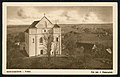 Transfiguration Church
 -
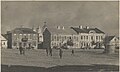 Market square
 -
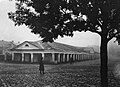 Shopping malls
 -
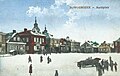 Former Market square 1917
 -
 Train station
 -
 Church in honor of the Archangel Michael
 -
 Former Dominican monastery
 -
 District court
 -
 A former power station building converted into a theater and cinema
 -

-
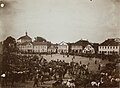 Market square
 -
 Dominican women's monastery, 1929
 -
 The Church of the Dominicans during the destruction by the tsarist authorities
 -
 The Radziwiłł Palace. Snapshot Jan Bułhak, 1926
 -
 Great synagogue. Snapshot Jan Bułhak, c. 1930
 -
 Ruins of a Small gate, a castle
 -
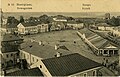 Market square on the side of the Radziwill Palace
.jpg)
_(3).jpg)
.jpg)
.jpg)
.jpg)
.jpg)
_(2).jpg)
_(3).jpg)
_(2).jpg)
.jpg)
.jpg)
.jpg)
.jpg)
.jpg)
.jpg)
_(2).jpg)
.jpg)
.jpg)
.jpg)
.jpg)
.jpg)
World War II
[edit]Soviet occupation
[edit]At the beginning of World War II, after 17 September 1939, Soviet Air Forces' bombers began dropping leaflets written in broken Polish over the city, announcing the imminent liberation "from the yoke of the lords" and other oppressors. On 18 September 1939 Novogrudok was occupied by the Red Army and, on 14 November 1939, incorporated into the Byelorussian SSR. Many residents of the city and region were repressed and exiled to other regions of the USSR, and the region was subjected to severe Sovietization.[58][59][60] In the administrative division of the new territories, the city was briefly the centre of Navahrudak Region until it moved to Baranavichy, and region itself was renamed to Baranavichy Region and to the Novogrudok Raion (15 January 1940).
German occupation
[edit]On 22 June 1941, the city was subjected to German bombing, the former Starostvo, formerly the Radziwill Palace, and shopping malls were destroyed as Germany invaded the Soviet Union. On 4 July, Novogrudok was occupied by the Wehrmacht. Then, the Red Army was surrounded in the Novogrudok Cauldron. Nevertheless, during the German occupation, there was active resistance to the Nazis.
In mid-December 1943, the Polish resistance separated the Novogrudok district of the Home Army from the Bialystok district. The headquarters of the Home Army's district was in Lida. The Nazis killed more than 10,000 Jews in the Novogrudok Ghetto, Novogrudok and nearby villages during the Holocaust.[61] However, in mid-may 1943, the last remaining ghetto prisoners began to dig a 250-metre (820 ft) underground passage outside the ghetto, and five months later, on 26 September 1943, an escape was made through it.[62][63][64] A total of 232 people escaped through the tunnel.[65] Some of the fleeing Jews joined the Bielski partisans, which actively fought against the Nazis in the region.[66]

During the German occupation, the city served as the administrative centre of Kreisgebiet Nowogrodek within the Generalbezirk Weißruthenien of Reichskommissariat Ostland. The local population was subjected to deportations for forced labour to Germany and executions.[43] In February–March 1944, by order of the Gebietskommissar (Area Commissioner) of the Novogrudok district, SS-Obersturmbannführer Wilhelm Traub, former Lieutenant of the Polish army Barys Rahula formed the Belarusian Novogrudok mounted squadron to fight the partisans. In February 1944, the 65th Belarusian Schutzmannschaft Battalion was formed in Novogrudok. However, in early July 1944, Barys Rahula curtailed the activities of the squadron.
During the German occupation in Novogrudok, the Sisters of the Holy Family of Nazareth organized, at the request of the parents of Polish children, underground teaching in the Polish language and history. On 1 August 1943, the underground school ceased to exist after 11 nuns, the Martyrs of Nowogródek, including the main organizer of the school, were shot by the German occupiers on 1 August 1943.[67]

Soviet reoccupation
[edit]In the summer of 1944, units of the Home Army's Novogrudok partisan district partook in Operation Ostra Brama, fighting alongside the Red Army to occupy Vilnius. On 8 July 1944, the Red Army reoccupied Novogrudok after almost three years of German occupation. However, after retaking Western Belorussia from the Germans, the recent allies became enemies. Thus, on 21 August 1944, in the village of Surkontakh, the commander of the Home Army's Novogrudok partisan district, Lieutenant Colonel Maciej Kalenkiewicz, nicknamed "Kotvich" (1906-1944) from the Khubala detachment, was killed in a battle with tenfold superior units of the NKVD.[68] During the war, more than 45,000 people were killed in the city and the surrounding area, and over 60% of housing was destroyed.
After the war, on this region did the organization "the black cat", which was aimed at the struggle against the Soviet regime, so in March 1948, the United group of troops of the organization "the black cat" with several units "bulbivtsiv" (total 200 men) attacked the Novogrudok to release the arrested members of his organization. The city was the base of the MGB's Special Department, which fought against anti-Soviet partisans.[69] The anti-Soviet partisan movement continued until the early 1960s until it completely ceased to exist.[70][71][72]
After the war, the area remained part of the Byelorussian SSR, and most of the destroyed infrastructure was rapidly rebuilt. On 8 July 1954, following the disestablishment of the Baranavichy Region, the raion, along with Novogrudok, became part of the Grodno Region, where it still is, now in Belarus.
Cup of St. Jadwiga
[edit]During the archaeological excavations at the Small Castle in Novogrudok in the period from 1955 to 1962, conducted by the Leningrad Department of the Institute of Archaeology of the USSR Academy of Sciences, an artefact was found, called "glass carved glass", belonging to a group of glass carved glasses, known in medieval studies under the General name "Hedwig glass".[73] The "Cup of Saint Jadwiga" found in Novogrudok (under this name the vessel is listed in the collection of the Hermitage Museum, this Cup was not returned to Belarus, despite requests from the Belarusian side), carved images of a lion, a Griffin and a stylized tree of life in the form of two snakes entwining the Cup of life.[74] According to the British Museum, the vessels of this group are among the first hundred outstanding works of the material culture of universal civilization. All currently known cups of the "Hedwig glass" series, both preserved intact and individual fragments of these cups, were stored for many centuries exclusively in the capital cities of States that were either part of the medieval state of the Holy Roman Empire, or in the capitals of dynasties that had a kinship with the dynasties that ruled these States.[75]
Recent history
[edit]
In 1997, Novogrudok and Novogrudoky district were merged into a single administrative unit. The city has links with the twin cities of Elbląg, Krynica Morska and Leymen.[76]
On 10 September 2011, in honour of the 500th anniversary of the capital of the Grand Duchy of Lithuania Magdeburg law (freed from feudal duties, the power of voivodes, gave the right to create a magistrate-a self-government body, its seal and coat of arms – the image of the Archangel Michael) in the centre of the city as a memory of the history and former greatness of the ancient city, a memorial sign was installed.[77]
According to the state program "Castles of Belarus", in 2012-15, it was planned to preserve the ruins of the Novogrudok castle with the restoration of its compositional structure and historical development, adaptation to modern social and cultural needs.[78]
It was concluded that it is impractical to restore buildings that store artefacts from the 13th to 16th centuries. The concept of "solid ruins" was approved, developed and reviewed at the Republican scientific and methodological meeting, the purpose of which was to reveal all seven towers of the Navahrudak castle, as well as the spinning walls. Thus the castle will be designated in the size of the 16th century.[78]
The metal structure and the brick prigruz will preserve the ruins of the Kostelnaya tower, stabilize it and complete the object's conservation. Eventually, when scientists are convinced that the stabilization was successful, the prigruz will be removed.[78]
It will also partially restored the losses incurred by tower Shitovka. The tower will be covered with a roof, but will remain incomplete. It is planned to open a Museum, the Foundation of which will consist of exhibits that are now stored in the Novogrudok Museum of local history.[78]
The Church of the 13th century, the remains of which are now underground, will be shown with an application. At the level of about 50 centimetres, the masonry of the Palace will be opened. It is not planned to lower the entire porch. The ramparts that were around the perimeter will also be partially open. No buildings will be built on the porch itself.[78]
It is also planned to make a horizontal drainage to organize water drainage and stop the erosion of the soil of the southern slope.[78]
According to the resolution of the Council of Ministers of 3 June 2016 No. 437, Novogrudok castle was included in the list of 27 objects whose conservation costs (in terms of capital expenditures) can be financed from the national budget.[79]
Jewish history
[edit]Novogrudok had been an important Jewish centre. It was home to the Novardok yeshiva, founded by Rabbi Yosef Yozel Horwitz in 1896. It was the hometown of Rabbi Yechiel Michel Epstein and the Harkavy Jewish family, including Yiddish lexicographer Alexander Harkavy. Before the war, the population was 20,000, approximately half of whom were Jews. Meyer Meyerovitz and Meyer Abovitz were then the rabbis there. During a series of "actions" in 1941, the Germans killed all but 550 of the approximately 10,000 Jews. (The first mass murder of Novogrudok's Jews occurred in December 1941.) Those not killed were sent into slave labour.[24]
Notable people
[edit]- Alexander Sack (1890–1937), Belarusian Catholic priest and a Catholic convert from Orthodoxy
- Paval Navara (1927-1983), Belarusian émigré public figure and a co-founder of the Anglo-Belarusian Society
- Siarhei Besarab (born 1984), Belarusian scientist and civil activist
Sites
[edit]- Novogrudok Castle, sometimes anachronistically called Mindaugas' Castle, was built in the 14th century, was burnt down by the Swedes in 1706, and remains in ruins.
- Construction of the Orthodox SS. Boris and Gleb Church, in Belarusian Gothic style, started in 1519, but was not completed until the 1630s; it was extensively repaired in the 19th century.
- The Roman Catholic Transfiguration Church (1712–23, includes surviving chapels of an older gothic building), where Adam Mickiewicz was baptised.
- Museum of Adam Mickiewicz at the poet's former home; there are also his statue and the "Mound of Immortality", created in his honour by the Polish administration in 1924–1931.
- Museum of Jewish Resistance. Also, a red pebble path along the escape route during the heroic escape of ghetto inmates.
- Kastus Kachan Art Gallery
- Church of St. Michael, renovated in 1751 and 1831
- Trade rows at the central square
- Pre-war administration buildings, including the Nowogródek Voivodeship Office and the Voivode's House
Some members of the Harkavy family are buried at the old Jewish cemetery of Novogrudok.
-
 Ruins of the castle
 -

-
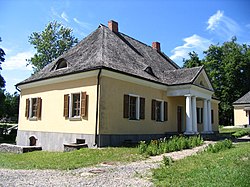 House of Adam Mickiewicz
 -

-
 Trade rows
 -
 Pre-war Voivodeship Office


Climate
[edit]The Köppen Climate Classification subtype for this climate is "Dfb" (Warm Summer Continental Climate).[80]
| Climate data for Novogrudok (1991–2020) | |||||||||||||
|---|---|---|---|---|---|---|---|---|---|---|---|---|---|
| Month | Jan | Feb | Mar | Apr | May | Jun | Jul | Aug | Sep | Oct | Nov | Dec | Year |
| Record high °C (°F) | 4.1 (39.4) |
5.4 (41.7) |
12.7 (54.9) |
22.0 (71.6) |
25.9 (78.6) |
28.3 (82.9) |
29.8 (85.6) |
29.7 (85.5) |
25.1 (77.2) |
18.4 (65.1) |
11.1 (52.0) |
5.8 (42.4) |
29.8 (85.6) |
| Mean daily maximum °C (°F) | −2.2 (28.0) |
−1.1 (30.0) |
4.0 (39.2) |
12.2 (54.0) |
18.0 (64.4) |
21.3 (70.3) |
23.4 (74.1) |
22.8 (73.0) |
17.1 (62.8) |
10.1 (50.2) |
3.5 (38.3) |
−0.8 (30.6) |
10.7 (51.3) |
| Daily mean °C (°F) | −4.3 (24.3) |
−3.6 (25.5) |
0.5 (32.9) |
7.4 (45.3) |
12.9 (55.2) |
16.2 (61.2) |
18.2 (64.8) |
17.6 (63.7) |
12.5 (54.5) |
6.6 (43.9) |
1.4 (34.5) |
−2.6 (27.3) |
6.9 (44.4) |
| Mean daily minimum °C (°F) | −6.3 (20.7) |
−5.8 (21.6) |
−2.4 (27.7) |
3.3 (37.9) |
8.2 (46.8) |
11.6 (52.9) |
13.8 (56.8) |
13.2 (55.8) |
8.8 (47.8) |
3.9 (39.0) |
−0.5 (31.1) |
−4.5 (23.9) |
3.6 (38.5) |
| Record low °C (°F) | −18.4 (−1.1) |
−16.4 (2.5) |
−9.8 (14.4) |
−3.2 (26.2) |
1.3 (34.3) |
5.8 (42.4) |
9.3 (48.7) |
7.8 (46.0) |
2.0 (35.6) |
−3.2 (26.2) |
−8.8 (16.2) |
−13.4 (7.9) |
−18.4 (−1.1) |
| Average precipitation mm (inches) | 54.3 (2.14) |
45.8 (1.80) |
44.3 (1.74) |
45.7 (1.80) |
76.0 (2.99) |
77.7 (3.06) |
104.8 (4.13) |
62.8 (2.47) |
66.4 (2.61) |
61.9 (2.44) |
55.2 (2.17) |
52.0 (2.05) |
746.9 (29.41) |
| Average precipitation days (≥ 1.0 mm) | 12.8 | 11.0 | 10.6 | 8.7 | 10.2 | 10.1 | 11.3 | 8.4 | 8.5 | 9.8 | 11.0 | 12.2 | 124.6 |
| Source: NOAA[81] | |||||||||||||
Twin towns - sister cities
[edit]Novogrudok is twinned with:[82]
 Bolsheboldinsky District, Russia
 Halych, Ukraine


Former twin towns
[edit] Elbląg, Poland
- Krynica Morska, Poland
 Prienai, Lithuania


References
[edit]- ^ "Структура райисполкома / Райисполком / Власть /". Новогрудский райисполком (in Russian). Archived from the original on 5 March 2016. Retrieved 12 November 2015.
- ^ a b "Численность населения на 1 января 2025 г. и среднегодовая численность населения за 2024 год по Республике Беларусь в разрезе областей, районов, городов, поселков городского типа". belsat.gov.by. Archived from the original on 29 March 2025. Retrieved 8 May 2025.
- ^ "Vaišelga". Universal Lithuanian Encyclopedia (in Lithuanian). Retrieved 7 July 2021.
- ^ «И зашли за реку Велю, и потом перешли реку Немон и нашли в чотырех милях от реки Немна гору красную, и сподобалася им, и вчинили на неи город и назвали его Новъгородок». Летопись Красинского // ПСРЛ. — М., 1980. — Т. 35. — С. 129; Евреиновская летопись // ПСРЛ. — Т. 35. — С. 215; Летопись Рачинского // ПСРЛ. — Т. 35. — С. 146; Ольшевская летопись // ПСРЛ. — М., 1980. — Т. 35. — С. 174; Румянцевская летопись // ПСРЛ. — Т. 35. — С. 194.
- ^ Ипатьевская летопись // ПСРЛ. — С-П., 1908. — Т. 2. стб. 828—829, 835—836, 859, 873—874
- ^ Соловьев 1947.
- ^ a b Касцюк 1996, pp. 85–87.
- ^ Расійска-беларускі слоўнік / Укладальнікі: М. Байкоў, С. Некрашэвіч. — Менск: Дзяржаўнае выдавецтва Беларусі, 1928.
- ^ Гарады з «памылкамі» ў назвах: Навагрудак ці Навáградак? // Радыё Свабода, Вінцук Вячорка, Ігар Карней, 30 жніўня 2019 г.
- ^ Назвы населеных пунктаў Рэспублікі Беларусь: Гродзенская вобласць: нарматыўны даведнік / І. А. Гапоненка і інш.; пад рэд. В. П. Лемцюговай. — Мн.: Тэхналогія, 2004. — 469 с. ISBN 985-458-098-9.
- ^ Піваварчык 2003.
- ^ a b Zinkevičius 2000.
- ^ a b c Budreckis 1967.
- ^ Краўцэвіч А. Міндаўг. Пачатак вялікага гаспадарства. Менск, 2005. C. 6
- ^ Гурэвіч 2003, p. 324.
- ^ Дучыц Л. У. Касцюм жыхароў Беларусі ХХ—ІІІ стст.(in Belarusian)
- ^ Гуревич Ф. Д. [Дом боярина XII в. в древнерусском Новогрудке // Краткие сообщения Института археологии — Вып. 99. — 1964 — С. 97–102.
- ^ Васильев Б. Г., Ёлшин Д. Д. Фресковая роспись «дома боярина» в окольном городе Новогрудка (по материалам коллекции фрагментов штукатурки) // Актуальные проблемы теории и истории искусства: сб. науч. статей. Вып. 7. / Под ред. С. В. Мальцевой, Е. Ю. Станюкович-Денисовой, А. В. Захаровой. — СПб.: Изд-во СПбГУ, 2017. С. 398–409.
- ^ Гуревич Ф. Д. Древний Новогрудок. Л., 1981
- ^ Н.П.Гайба. История Новогрудка Archived 2010-06-14 at the Wayback Machine
- ^ "Oshchestvo Srednevekovoj Litvy". Viduramziu.lietuvos.net. Archived from the original on 27 July 2011. Retrieved 18 February 2013.
- ^ Stryjkowski, Maciej (1846). Kronika polska, litewska, żmódzka i wszystkiej Rusi Macieja Stryjkowskiego. T. 1 (in Polish). Warsaw: nakład Gustawa Leona Glücksberga, Księgarza. p. 250.
- ^ Geddie 1882, p. 102.
- ^ a b c Carol Hoffman (2005). "Pinkas Hakehillot Polin: Novogrudok". In Shmuel Spector; Bracha Freundlich (eds.). Encyclopedia of Jewish Communities. Jewishgen.org.
- ^ a b Gritskevich 2007, p. 7.
- ^ Gaiba 2007, p. 357.
- ^ "Великое княжество Литовское" (in Russian). Государственная публичная научно-техническая библиотека СО РАН. Retrieved 23 October 2017.
- ^ Rusina, O.V. (2009). Smoliy, V. A. (ed.). Міндовг (PDF) (in Ukrainian). Vol. 6 (Ла — Мі). Kyiv: Institute of History of Ukraine. p. 740. ISBN 978-966-00-0632-4.
{{cite book}}:|work=ignored (help) - ^ Dubonis, Artūras. "The Myth of Navahrudak | Orbis Lituaniae". LDKistorija.lt. Vilnius University. Retrieved 14 June 2021.
- ^ a b Baranauskas 2021.
- ^ "Šeimyniškėliai mound – where the Voruta castle stood". VisitAukstaitija.lt. Retrieved 14 June 2021.
- ^ Petrauskas, R. "МИНДОВГ". bigenc.ru (in Russian). Great Russian Encyclopedia. Retrieved 29 September 2021.
- ^ "Lithuania - Settlement patterns - Services". Encyclopedia Britannica. Retrieved 14 June 2021.
- ^ Maciej Stryjkowski (1985). Kronika polska, litewska, żmódzka i wszystkiéj Rusi Macieja Stryjkowskiego. Warsaw: Wydawnictwa Artystyczne i Filmowe. p. 572.
- ^ Following the Tracks of a Myth Edvardas Gudavičius
- ^ Rowell 1994, p. 149.
- ^ Полное собрание русских летописей. Ипатьевская летопись. Москва, 1998. pp.880-881
- ^ Mokslo ir enciklopedijų leidybos centras 2021.
- ^ Chlebowskiego & Walewskiego 1886, p. 256.
- ^ "Навагрудак. Летапіс гісторыі". www.gaiba.narod.ru. Retrieved 19 April 2019.
- ^ Laužikas 2004.
- ^ Mironowicz, A. (2011). Biskupstwo turowsko-pińskie w XI-XVI wieku. Trans Humana. p. 135. ISBN 978-83-61209-55-3.
- ^ a b c d e f g Monika Białkowska. "Historie z Nowogródka". Przewodnik Katolicki (in Polish). Retrieved 17 October 2019.
- ^ a b c Melchior Jakubowski, Maksymilian Sas, Filip Walczyna, Miasta wielu religii. Topografia sakralna ziem wschodnich dawnej Rzeczypospolitej, Muzeum Historii Polski, Warsaw 2016, p. 248 (in Polish)
- ^ a b "Jubileusz 975 rocznicy powstania Nowogródka". Powiat Suwalski (in Polish). Retrieved 17 October 2019.
- ^ a b "Nowogródek". Encyklopedia PWN (in Polish). Retrieved 17 October 2019.
- ^ Wanda Rewieńska, Miasta i miasteczka magdeburskie w woj. wileńskim i nowogródzkim, Lida 1938, p. 11 (in Polish)
- ^ Gustaitis 1970, p. 229.
- ^ Гайба, М. (2005). ВКЛ. энциклопедия. Т.2. Минск. p. 358. ISBN 9851103780.
{{cite book}}: CS1 maint: location missing publisher (link) - ^ Gembarzewski, Bronisław (1925). Rodowody pułków polskich i oddziałów równorzędnych od r. 1717 do r. 1831 (in Polish). Warsaw: Towarzystwo Wiedzy Wojskowej. p. 35.
- ^ Gembarzewski, Bronisław (1925). Rodowody pułków polskich i oddziałów równorzędnych od r. 1717 do r. 1831 (in Polish). Warsaw: Towarzystwo Wiedzy Wojskowej. pp. 58, 63.
- ^ Tarasiuk (2007). Życie społeczno-kulturalne. Oświata. pp. 34–37.
- ^ "JewishGen.org". Data.jewishgen.org. Retrieved 18 February 2013.
- ^ Морозова С. "Наваградак — царкоўная сталіца Вялікага Княства Літоўскага (ХIV — XV стст.)". Archived from the original on 8 March 2016. // Гарады Беларусі ў кантэксце палітыкі, эканомікі, культуры: зборнік навук. артыкулаў / Гродз.дзярж. ун-т; рэдкалегія: І. П. Крэнь, І. В. Соркіна (адк. рэдактары) і інш. — Гродна: ГрДУ, 2007.
- ^ Саверченко & Санько 2002, p. 232.
- ^ Wyszczelski. Wyprawa wileńska. 2010. page 94
- ^ Melchior Jakubowski, Maksymilian Sas, Filip Walczyna, Miasta wielu religii. Topografia sakralna ziem wschodnich dawnej Rzeczypospolitej, Muzeum Historii Polski, Warsaw 2016, p. 249 (in Polish)
- ^ "Антисоветский блог: Массовая депортация жителей Западной Беларуси 1940 года". Антисоветский блог. 13 April 2017. Retrieved 25 April 2019.
- ^ "Сталинские репрессий при "воссоединения" Беларуси в 1939г" (in Russian). Заметки о политике и о жизни. 22 August 2011. Retrieved 25 April 2019.
- ^ ""Слушали. Постановили: расстрелять". Историк Игорь Кузнецов о советских репрессиях в Беларуси" (in Russian). TUT.BY. 20 March 2017. Retrieved 25 April 2019.
- ^ "Туннель".
- ^ "Побег из гетто". Archived from the original on 18 June 2017.
- ^ И. А. Альтман. Холокост и еврейское сопротивление на оккупированной территории СССР
- ^ Касцюк 1996, pp. 290, 321–323, 377.
- ^ Касцюк 1996, pp. 321, 377.
- ^ Касцюк 1996, pp. 290, 322–323.
- ^ "Tajne nauczanie polskie w czasie okupacji niemieckiej 1941–1944". Oświata... p. 67.
- ^ "В августе 44-го. И после" (in Russian). warspot.ru. Retrieved 28 April 2019.
- ^ Матох Василий. Лесные братья // Информационно-аналитический еженедельник «БелГазета» (www.belgazeta.by) 17.04.2006. — № 15 (534); на сайте «Историческая правда» (www.istpravda.ru) 04.12.2012 (с фотоматериалами). Archived 2013-06-19 at the Wayback Machine
- ^ Ёрш Сяргей, Лескець Сяргей (2003). "Драгічіншчіна". Была вайна…. Менск: Беларускі Рэзыстанс. p. 12.
- ^ Ёрш Сяргей. Салідарнасць Камандзір беларускіх «лясных братоў» (фота друкуюцца ўпершыню) // Сайт газеты «Салідарнасць» (www.gazetaby.com) 04.11.2007.
- ^ Беларускі пасляваенны антысавецкі супраціў 1944−1957 гг. on YouTube
- ^ А. В. Рощин. НЕМОГРАДАС — Летописный Новогородок
- ^ К. Кузьмич. Какие тайны хранят развалины Новогрудского замка
- ^ Ю. Л. Щапова. О резном бокале из Новогрудка / Средневековая Русь — М., 1976.- с. 214.
- ^ "История Новогрудка | НОВОГРУДОК.BY" (in Russian). Retrieved 25 April 2019.
- ^ В Новогрудке открыли памятный знак к 500-летию получения городом магдебургского права (установлен слева от здания исполнительного комитета Новогрудского района)
- ^ a b c d e f РЭКАНСТРУКЦЫЯ ЗАМКА ПРАЦЯГВАЕЦЦА // Новае жыццё
- ^ Постановление Совета Министров от 03.06.2016 № 437 О некоторых вопросах обеспечения сохранности историко-культурных ценностей
- ^ Climate Summary for Navahrudak
- ^ "World Meteorological Organization Climate Normals for 1991-2020 — Novogrudok". National Oceanic and Atmospheric Administration. Retrieved 12 January 2024.
- ^ "Города-побратимы". novogrudok.gov.by (in Russian). Navahrudak. 28 November 2016. Retrieved 13 January 2020.
Bibliography
[edit]- Гайба, М. (1996). Навагрудак: гады і падзеі [Navahrudak: years and events] (in Belarusian). Navahrudak.
{{cite book}}: CS1 maint: location missing publisher (link) - Гурэвіч, Ф. (2003). Летапісны Новгородок (Старажытнарускі Наваградак) [Annals of Novogrudok (Old Russian Navahrudak)]. Saint Petersburg: РДК-принт.
- Цітоў, А. (1998). Геральдыка Беларускіх местаў [Heraldry of Belarusian places] (in Belarusian). Minsk: Полымя. p. 287. ISBN 985-07-0131-5.
- Zaprudnik, Jan (1998). Historical Dictionary of Belarus. London: Scarecrow Press. p. 338. ISBN 0-8108-3449-9.
- Grędzik-Radziak, A. (2007). Oświata i szkolnictwo polskie na ziemiach północno-wschodnich II Rzeczypospolitej i współczesnej Białorusi 1939–2001 [Polish education and schooling in the north-eastern territories of the Second Polish Republic and modern Belarus 1939–2001] (in Polish). Toruń: Europejskie Centrum Edukacyjne. p. 441. ISBN 978-83-60738-09-2.
- Geddie, John (1882). The Russian Empire: Historical and Descriptive. London.
{{cite book}}: CS1 maint: location missing publisher (link) - Chlebowskiego, Bronisława; Walewskiego, Władysława (1886). Słownik geograficzny Królestwa Polskiego i innych krajów słowiańskich [Geographical dictionary of the Kingdom of Poland and other Slavic countries] (in Polish). Vol. Tom VII: Netrebka — Perepiat. Warsaw.
{{cite book}}: CS1 maint: location missing publisher (link) - Baranauskas, Tomas (2021). "Voruta". Vle.lt (in Lithuanian). Visuotinė lietuvių enciklopedija. Retrieved 14 June 2021.
- Саверченко, Иван; Санько, Дмитрий (2002). 150 пытанняў і адказаў з гісторыі Беларусі [150 questions and answers from the history of Belarus] (in Belarusian). Vilnius.
{{cite book}}: CS1 maint: location missing publisher (link) - Laužikas, Rimvydas (15 October 2004). "VILNIAUS VAIVADIJA". Retrieved 8 July 2021.
- Zinkevičius, Zigmas (2000). Lietuvių poteriai (PDF) (in Lithuanian). Vilnius: Mokslo ir enciklopedijų leidybos institutas. pp. 15–25.
- Gustaitis, Antanas (October 1970). "KUNIGAIKŠČIO M. K. RADVILO (NAŠLAITĖLIO) 1613 METŲ ŽEMĖLAPIS AMŽIŲ PERSPEKTYVOJE". Karys. 8.
- Mokslo ir enciklopedijų leidybos centras (2021). "Naugardukas". Vle.lt (in Lithuanian). Retrieved 7 July 2021.
- Rowell, S.C. (1994). Lithuania Ascending: A Pagan Empire within East-Central Europe, 1295-1345. Cambridge University Press.
- Budreckis, Algirdas (1967). "Etnografinės Lietuvos rytinės ir pietinės sienos". Karys.
- Iršėnas, Marius (2015). The Lithuanian Millennium (PDF). Vilnius Academy of Arts Press. ISBN 978-609-447-097-4.
- Касцюк, М.П. (1996). Памяць: Гісторыка-дакументальная хроніка Навагрудскага раёна [Memory: Historical and documentary chronicle of the Novogrudok district] (in Belarusian). Minsk, Belarus. ISBN 985-01-0050-8.
{{cite book}}: CS1 maint: location missing publisher (link)
Belarusian encyclopedias
[edit]- Gritskevich, A. (2007). "Гісторыя" [History] (PDF). In Pashkov, G. P. (ed.). Вялікае княства Літоўскае: Энцыклапедыя (in Belarusian). Vol. 1 (А – К). Minsk: BelEn. pp. 7–33. ISBN 978-985-11-0393-1.
- Gaiba, M. (2007). "Новагародак" [Novagarodak] (PDF). In Pashkov, G. P. (ed.). Вялікае княства Літоўскае: Энцыклапедыя (in Belarusian). Vol. 2 (К – Я). Minsk: BelEn. pp. З57–359. ISBN 978-985-11-0394-8.
- Энцыклапедыя гісторыі Беларусі. У 6 т. Т. 5: М — Пуд / Беларус. Энцыкл.; Рэдкал.: Г. П. Пашкоў (галоўны рэд.) і інш.; Маст. Э. Э. Жакевіч. — Менск: БелЭн, 1999. — 592 с.: іл. ISBN 985-11-0141-9.
- Беларуская энцыклапедыя: У 18 т. Т. 11: Мугір — Паліклініка / Рэдкал.: Г.П. Пашкоў і інш. — Мн.: БелЭн, 2000. — 560 с.: іл. ISBN 985-11-0188-5
Journals
[edit]- Піваварчык, С. А. (2003). "Гарадзішча Радагошча — магчымы папярэднік Наваградка". Белорусский сборник. 2. Saint Petersburg.
- Малевская, М. В. (1962). "Амфора с надписью из Новогрудка". Soviet Archaeology (in Russian). 4.
- Соловьев, А. В. (1947). "Великая, Малая и Белая Русь" [Great, Small and White Russia]. Вопросы истории. 7.
External links
[edit]
- City administration
- Photos on Radzima.org
- Jurkau kutoczak — Юркаў куточак — Yury's Corner. Наваградак
- History of Jewish shtetl in Novogrudok
- History
- Old Christian Cemetery Database
- The murder of the Jews of Novogrudok during World War II, at Yad Vashem website
- Navahrudak, Belarus at JewishGen
| Districts (raiony) |  | |
|---|---|---|
| District centres | ||
| Cities and towns | ||

| International | |
|---|---|
| National | |
| Other | |

Novogrudok
View on GrokipediaEtymology
Origins and variants
The name of Novogrudok, recorded in medieval East Slavic chronicles as Novogorodok or similar forms, derives from the Old East Slavic phrase novъjь gradъkъ, translating to "new fortress" or "new settlement," reflecting its establishment as a fortified outpost amid earlier regional strongholds.[8] This etymology aligns with common Slavic toponymy patterns where gradъ or hradъ denotes a fortified town, as seen in names like Novgorod. The term's roots trace to the 11th century, when such descriptors distinguished newer constructions from pre-existing pagan hill forts in the region.[3] The earliest documentary evidence appears in the Sofia First Chronicle and Novgorod Fourth Chronicle under the year 1044, describing a campaign by Kievan Rus' prince Yaroslav the Wise against Lithuanian tribes, during which the site—then a frontier settlement—was noted for its strategic defenses.[8] Subsequent medieval sources, including Lithuanian and Polish annals, preserve variants adapted to local phonetics and scripts, underscoring the name's endurance without reliance on unverified legends of foundational myths. Historical variants include Belarusian Navahrudak (Навагрудак), emphasizing nasal vowels and the h sound typical of West Slavic influences; Polish Nowogródek, with accent on the acute ó and diminutive suffix; Lithuanian Naugardukas, incorporating Baltic gardas for enclosure; and Russian Novogrudok (Новогрудок), retaining the East Slavic u diphthong.[9] These forms emerged with shifting linguistic dominance: Lithuanian during the Grand Duchy's consolidation in the 13th–14th centuries, Polish-Lithuanian Commonwealth orthography from the 16th century onward, Russian imperial standardization post-1795 partitions, and modern Belarusian revival after 1918 independence attempts and post-1991 state policy. Such adaptations mirror political transitions rather than substantive semantic shifts, as core elements (novy "new" and grad "fortress") persist across records.[3]Geography
Location and physical features
Novogrudok, also known as Navahrudak, is situated in the Grodno Region of western Belarus, serving as the administrative center of Novogrudok District.[1] The town lies at approximately 53°36′N 25°50′E, within the Novogrudok Upland, a region characterized by undulating terrain formed by glacial processes during the Pleistocene era.[10] [11] The local landscape features moraine hills and ridges, with elevations reaching up to 292 meters above sea level in the town center and surrounding uplands rising 80–120 meters above adjacent lowlands, composed primarily of glacial till, fluvioglacial deposits, and loess-like sediments.[12] [11] These glacial formations, including push moraines and erratic boulders, shaped early settlement by providing natural defensive elevations, such as the prominent Castle Hill. The town occupies an area of about 12 km², traversed by the Servach River, a small waterway that contributes to the dissected hilly relief intersected by ravines and gullies.[1] [13] Forested areas, predominantly mixed pine, oak, and spruce stands, cover roughly 38% of the broader district territory, interspersed with the hilly terrain and influencing local hydrology through numerous small rivers and streams totaling 47 in the district.[14] Novogrudok is positioned approximately 120 km west-southwest of Minsk and 130 km east of Grodno, facilitating its role within regional drainage patterns toward the Neman River basin.[9]Climate
Novogrudok features a humid continental climate classified as Dfb in the Köppen system, marked by distinct seasons with long, cold winters dominated by snow cover and moderately warm, humid summers. Winters are influenced by Arctic air masses, while summers receive warmer Atlantic flows moderated by the proximity to the Baltic Sea, resulting in slightly milder conditions compared to eastern Belarus.[15][16] The average temperature in January, the coldest month, is -5.6 °C, with daily highs around -2.2 °C and lows near -7.2 °C; snowfall accumulates to an average water equivalent contributing to winter precipitation. July, the warmest month, sees averages of 17.5 °C, with highs reaching 22.2 °C and lows of 12.8 °C. Annual mean temperature hovers around 7 °C, with transitional springs and autumns prone to frost variability.[15][17] Precipitation totals approximately 650-750 mm annually, evenly distributed but peaking in summer due to convective storms, with about 70% falling as rain and the rest as snow. Local weather stations in the Grodno Region record higher variability near Navahrudak from Baltic cyclones, enhancing autumn and early winter wetness compared to inland areas.[18]| Month | Avg. High (°C) | Avg. Low (°C) | Avg. Precip. (mm) |
|---|---|---|---|
| January | -2.2 | -7.2 | 10 |
| February | -1.1 | -6.7 | 10 |
| March | 3.9 | -3.3 | 18 |
| April | 11.7 | 2.2 | 30 |
| May | 17.8 | 7.2 | 48 |
| June | 20.6 | 10.6 | 69 |
| July | 22.2 | 12.8 | 69 |
| August | 21.7 | 11.7 | 48 |
| September | 16.1 | 7.8 | 46 |
| October | 9.4 | 2.8 | 36 |
| November | 3.3 | -1.1 | 25 |
| December | -0.6 | -5.6 | 15 |
History
Early settlement and legends
Archaeological excavations reveal that Slavic populations, including Dregoviches tribes, established settlements in Navahrudak by the late 10th century, with evidence of unfortified habitations evolving into a more structured site by the early 11th century.[19] Fortifications, including wooden structures and earthworks, appeared around the mid-11th century, coinciding with increased regional conflicts.[20] The site's strategic position on trade routes linking Ruthenian lands to the south with Baltic regions facilitated early commerce in goods such as amber, furs, and imported luxuries like Byzantine glassware, as indicated by artifact finds from this period.[21] Navahrudak receives its earliest written mention in 1044, recorded in the Sofia First Chronicle in the context of Kievan Rus' prince Yaroslav the Wise's military campaign against Lithuanian tribes, highlighting its role as a frontier outpost amid raids and territorial disputes.[8] This chronicle entry aligns with archaeological data showing defensive enhancements during the 1040s–1060s, likely in response to such incursions from Baltic groups.[22] Later traditions, stemming from 16th-century sources like the Bychowiec Chronicle, portray Navahrudak as the capital of Lithuania during Mindaugas' coronation as king in 1253, with claims of a grand ceremony and royal residence there.[21] However, no contemporary 13th-century documents or archaeological indicators—such as royal regalia, large-scale palatial structures, or centralized administrative artifacts—substantiate this; historians critique the narrative as a later fabrication, emphasizing instead that Mindaugas' power base lay in core Lithuanian territories like those around Kernavė, where geographic and ethnic coherence better explain political consolidation absent reliable evidence for Navahrudak's primacy.[21] Such legends likely arose to retroactively link the site's medieval prominence to Lithuanian state formation, but empirical records confirm only its occupation and military use by Mindaugas in the 1230s without elevating it to capital status.[21]Grand Duchy of Lithuania era
Navahrudak integrated into the Grand Duchy of Lithuania in the mid-13th century, following the Mongol invasions that weakened Kievan Rus' principalities after the 1240 sack of Kyiv, creating a power vacuum in the region known as Black Ruthenia.[23] Lithuanian forces under Mindaugas incorporated the area, establishing control over Navahrudak as a strategic outpost amid threats from Teutonic Knights and residual nomadic incursions.[21] By the early 14th century, the town functioned as a semi-autonomous duchy under Karijotas, son of Gediminas, reflecting Orthodox influences among local Ruthenian elites while under Lithuanian overlordship.[21] From the late 14th century, Navahrudak emerged as a key center of the Grand Duke's demesne, with large-scale stone castle construction commencing around 1394 on the dominant hill, featuring walls and multi-tiered towers equipped with loopholes for defense.[24][25] Grand Duke Vytautas reinforced the fortifications, adding towers and integrating the site into his network of residential castles, which included Vilnius, Trakai, Grodno, and Kaunas, underscoring its role in consolidating Lithuanian authority over Ruthenian territories.[26] In the 14th century, the town also served as the seat of the Orthodox Metropolis of Lithuania, highlighting the blend of pagan Lithuanian rule with Eastern Christian administration among the predominantly Ruthenian populace.[27] During the 14th to 16th centuries, Navahrudak grew as a regional administrative and economic hub, benefiting from its position on trade routes connecting the Baltic to the Black Sea. The castle complex expanded to include up to seven towers by the 16th century, symbolizing military strength amid ongoing conflicts with the Teutonic Order.[28] In 1511, King Sigismund I granted Magdeburg rights, enabling self-governance and fostering urban development, though full implementation reflected the evolving Polish-Lithuanian influences post-Union of Krewo.[29] The town's economy relied on artisanal crafts, including jewelry production drawing from Kievan Rus' traditions, and served as a venue for regional tribunals, balancing Lithuanian ducal oversight with local Ruthenian customs.[30] The 17th century brought decline through the Swedish Deluge (1655–1660), during which Swedish forces devastated Lithuanian territories, contributing to widespread destruction of fortifications and population losses across the Grand Duchy.[31] Subsequent Cossack uprisings and Russian incursions further eroded Navahrudak's prominence, with the castle partially ruined by sieges and neglect, presaging the territorial partitions. From 1581 to 1775, it intermittently hosted the Supreme Tribunal of the Grand Duchy, maintaining judicial significance amid political fragmentation, yet economic stagnation persisted due to recurrent warfare and shifting trade patterns.[27]Russian Empire and partitions
) Novogrudok was annexed to the Russian Empire in 1795 as part of the Third Partition of the Polish-Lithuanian Commonwealth, initially forming part of Slonim Governorate, which was renamed Grodno Governorate in 1801.[23] The town served as the administrative center of Novogrudok Uyezd within Grodno Governorate until 1843, when the uyezd was transferred to Minsk Governorate.[23] This incorporation ended local self-governance traditions and integrated the area into imperial administrative structures, with Russian officials overseeing taxation, military conscription, and legal affairs. Local residents and nobility participated in anti-Russian uprisings, including the November Uprising of 1830–1831 and the January Uprising of 1863–1864, both centered on restoring Polish autonomy but extending to Belarusian territories like Novogrudok.[32] Suppression of these revolts led to severe repressions, including executions of participants, confiscation of noble estates, and demolition of symbolic structures such as the Castle Church by tsarist authorities in the mid-19th century. Following the 1863 uprising, Russification policies intensified, mandating Russian as the language of administration and education, restricting Polish-language publications, and promoting Orthodox Christianity over Catholicism and Uniatism, which eroded local cultural institutions. The 1861 emancipation of serfs further disrupted social structures, as many peasants received insufficient land allotments while Polish landowners faced penalties and forced sales. Economically, Novogrudok experienced stagnation under imperial rule, relying on subsistence agriculture, small-scale crafts, and trade hampered by serfdom's legacy and post-reform instability. Jewish merchants and artisans formed a growing urban presence within the Pale of Settlement, handling commerce in grains, timber, and textiles; by 1897, the Jewish population reached 5,105, constituting 63.5% of the town's total inhabitants.[33] This influx supported local markets but highlighted ethnic divisions, with Jews barred from landownership and focused on urban trades amid broader imperial restrictions on mobility and professions.World War I and interwar period
During World War I, Novogrudok came under Imperial German occupation in 1915, as German forces advanced into the region formerly held by the Russian Empire, and remained so until the armistice in 1918.[23] The occupation involved administrative control through the Ober Ost military district, with local resources exploited for the war effort, though specific impacts on the town included restrictions on movement and economic hardships for the population.[34] In the chaotic aftermath, amid the Polish-Soviet War (1919–1921), Polish troops captured Novogrudok on April 18, 1919, during an offensive that secured the area from Soviet forces.[35] The town changed hands briefly before stabilizing under Polish control, formalized by the Treaty of Riga on March 18, 1921, which delimited the eastern border and incorporated Novogrudok into the Second Polish Republic.[36] As the seat of Nowogródek Voivodeship from 1921, Novogrudok experienced administrative centralization and modest infrastructure improvements typical of interwar Poland, including maintenance of religious and communal facilities.[37] The 1921 Polish census recorded a total population of about 6,373, with Jews at 3,405 (53.4%). By 1931, the population rose to 13,252, including 6,309 Jews, reflecting growth amid multi-ethnic composition dominated by Poles, Jews, Belarusians, and smaller Orthodox groups.[33] [2] Education shifted toward Polish-language instruction in public schools, supplemented by private Hebrew Tarbut and Yiddish institutions for Jews, while Belarusian cultural expression remained limited due to low national mobilization and prevailing Polonization policies.[33] By 1935, the town had 9,567 residents and 1,055 houses, underscoring its role as a regional hub with two Catholic churches, two Orthodox churches, three synagogues, and a Protestant prayer house.[28]World War II and Holocaust
Following the German invasion of the Soviet Union on June 22, 1941, Nazi forces occupied Novogrudok on July 4, 1941, ending the brief Soviet administration that had begun with the annexation of the town from Poland on September 17, 1939.[38] The Germans quickly implemented anti-Jewish measures, including forced labor and restrictions, before establishing a ghetto in late summer 1941 to confine the town's Jewish population, estimated at around 10,000 individuals prior to the war.[39] The ghetto, encompassing several streets in the town center, was overcrowded and subjected to starvation rations, disease, and sporadic killings by German and auxiliary police units. Mass executions commenced in December 1941, when units of the 11th Lithuanian Auxiliary Police Battalion shot approximately 3,000 Jewish men, women, and children in pits outside the town.[40] Further Aktionen in 1942 and early 1943 reduced the ghetto's population through deportations to extermination camps and additional shootings, with Nazi records and survivor accounts documenting the murder of over 10,000 Jews from Novogrudok by mid-1943.[39] Local Polish Home Army (Armia Krajowa) units conducted sabotage against German supply lines in the region but maintained limited direct contact with the ghetto inhabitants, while Soviet partisans, active in the surrounding forests, occasionally smuggled out small groups of Jews amid tensions with Polish nationalist forces.[2] In response to impending liquidation, on the night of September 26, 1943, 232 Jews escaped the adjacent labor camp—remnants of the ghetto—through a hand-dug tunnel approximately 250 meters long, with over 100 of the escapees subsequently joining the Bielski partisan otriad operating in the Naliboki Forest nearby.[41] The Bielski group, led by Tuvia Bielski, prioritized rescuing Jews from ghettos like Novogrudok's, sheltering fighters and non-combatants in forest camps and conducting raids that inflicted casualties on German forces and collaborators, though their unit suffered around 50 deaths overall.[42] Of the tunnel escapees, nearly 170 survived the war, crediting partisan protection amid harsh winter conditions and pursuit by German sweeps. Soviet forces liberated Novogrudok on July 7, 1944, during Operation Bagration, finding the town devastated and its Jewish community virtually annihilated, with only about 350 survivors from the pre-war population.[43] In the immediate aftermath, Red Army units and NKVD executed or arrested several dozen locals accused of collaboration with the Nazis, including former ghetto guards and auxiliary policemen, based on partisan reports and witness testimonies.[43] Regional estimates indicate that the Novogrudok district suffered around 45,000 deaths during the Nazi occupation, encompassing Jewish victims of systematic extermination alongside Polish, Belarusian, and Soviet partisan casualties from combat and reprisals.[40]Soviet period and post-WWII
Following the Red Army's liberation of Novogrudok on July 8, 1944, during the Belostok offensive, the town faced extensive reconstruction amid severe wartime devastation, with approximately 60% of its housing stock destroyed and over 45,000 residents of the district killed.[44] Soviet authorities initiated rebuilding efforts focused on restoring basic infrastructure, including the establishment of a district library in 1946 and a Soviet trade technical school in 1947, as part of broader efforts to integrate the region into the Belarusian SSR.[45] These measures involved population resettlement to repopulate areas depleted by war and Holocaust losses, drawing migrants from other Soviet republics to bolster labor for recovery. Novogrudok served as the administrative center of Novogrudok District within the Belarusian SSR, where post-war policies emphasized forced collectivization of agriculture, consolidating private farms into state-controlled kolkhozy and sovkhozy, which disrupted local agrarian economies and contributed to productivity declines typical of Soviet rural areas.) Limited industrialization attempts included light industry such as food processing and textiles, but the region's economy remained predominantly agricultural, with causal effects including rural depopulation as younger residents migrated to urban centers for opportunities.[46] Repressions targeted former Polish administrators, landowners, and perceived nationalists, enforcing Soviet ideological conformity through arrests and deportations, which suppressed pre-war Polish and Belarusian cultural expressions in favor of Russification.[47] From the 1950s through the 1980s, agricultural collectivization intensified focus on grain and dairy production, while cultural sites like the castle ruins received minimal maintenance under state protection but no significant restoration, preserving them as relics rather than active heritage.[48] Demographic shifts reflected broader Soviet patterns, with the Jewish population nearly eradicated post-Holocaust and gradual influxes of Belarusian and Russian speakers altering ethnic composition toward Slavic homogeneity, amid policies that curtailed national identities through language standardization and historical revisionism.[23] The 1986 Chernobyl disaster deposited radioactive fallout across Belarus, with about 70% of the plume affecting the republic and contaminating roughly one-quarter of its territory, including areas in Grodno Oblast near Novogrudok, leading to long-term environmental degradation such as soil and water contamination and elevated health risks like thyroid cancers in exposed populations.[49] Local agricultural lands faced restrictions and decontamination efforts, exacerbating economic strains in the late Soviet period by limiting crop yields and necessitating monitoring of radiation levels in produce and livestock.[50]Post-Soviet era and recent developments
Following the dissolution of the Soviet Union, Belarus declared independence on August 25, 1991, and Navahrudak retained its status as the administrative center of Navahrudak District within Grodno Voblast, one of the six oblasts established in the new republic.[51][37] This continuity preserved local governance structures amid broader national transitions, with the town serving as a raion (district) hub focused on regional administration and cultural heritage management. In the 2000s and 2010s, efforts to preserve historical sites intensified, including a multi-stage architectural project launched in 2012 for the reconstruction, conservation, and adaptation of Navahrudak Castle's ruins.[52] This initiative involved foundational stabilization, such as sinking 105 piles to 11 meters beneath the Kostelnaya Tower and installing a monolithic cement base, aiming to prevent further deterioration of the 14th-century fortress remnants damaged in prior centuries.[53] By the mid-2010s, partial works had secured structural integrity, with plans extending into later years to restore key elements like the main tower for potential museum use, reflecting state priorities on tangible heritage amid limited resources.[54] Population figures stabilized around 28,000 residents by 2023, following post-independence declines from Soviet-era peaks, with an estimated 28,021 inhabitants marking a slight annual decrease of -0.52% from 2019 levels.[1] In 2025, Belarusian authorities advanced plans for a Holocaust and Resistance Museum in Navahrudak, building on an existing local exhibit to comprehensively document Nazi-era atrocities, including the murder of approximately 11,000 Jews and the 1943 tunnel escape by 250 ghetto prisoners—the largest such documented breakout in occupied Europe.[55][56] Discussions between Belarusian and Israeli officials in July and October 2025 formalized the project, including a July 10 agreement and an August 28 working group, to address narratives suppressed during Soviet times in favor of generalized anti-fascist accounts.[57][58] This development signals a shift toward acknowledging specific Jewish victimhood and partisan resistance, potentially housed in adapted historical structures to integrate with the town's medieval legacy.[59]Demographics
Population trends
In the early 19th century, Novogrudok's population was approximately 4,000–5,000 residents, reflecting modest growth from medieval levels amid its role as a regional trade center within the Russian Empire.[60] By the 1897 Russian Imperial census, the city's population had reached 7,887, driven by expanding commerce and administrative functions in the Novogrudok uezd.[28] This marked a period of steady increase, with the urban core benefiting from fairgrounds and Jewish mercantile activity, though the surrounding uezd totaled 121,487 inhabitants.[61] Interwar growth continued under Polish administration, peaking at around 13,252 by the 1931 census, as the town served as capital of Nowogródek Voivodeship, fostering local industry and services.[2] World War II inflicted severe losses, including near-total annihilation of the Jewish community (over 6,000 pre-war) via ghetto liquidation and mass executions, alongside general wartime attrition, reducing the population sharply to an estimated 10,000–12,000 immediately post-liberation in 1944.[2] By the mid-1950s, recovery was partial, with figures hovering near 15,000 amid Soviet resettlement and reconstruction, though depopulation from combat and deportation lingered.[9] Postwar Soviet censuses documented gradual rebound: approximately 16,000–18,000 by 1959, rising to around 20,000 by the 1970s through state-directed migration and housing projects.[62] The 1989 census recorded further expansion to about 28,000, aligned with broader Belarusian urbanization trends favoring district centers.[62] Independence-era stagnation set in, with the population dipping to 29,200 by 2015 before stabilizing near 27,624 as of January 1, 2025, per official estimates, due to net out-migration to larger cities like Minsk and Grodno, coupled with below-replacement fertility.[63] [64] In the Novogrudok District, urban concentration in the rayon's namesake city accounts for over 70% of the total 40,761 residents (2024), underscoring rural exodus: village populations have contracted since the 1990s as agricultural collectivization waned and younger cohorts relocated for employment, leaving the district's density low at roughly 20 persons per km². This dynamic mirrors national patterns, where peripheral rayons experience hollowing-out while urban hubs like Novogrudok retain administrative and service roles.[65]| Year | City Population | Notes/Source |
|---|---|---|
| ca. 1800 | ~4,000–5,000 | Early 19th-century estimate; trade-driven growth.[60] |
| 1897 | 7,887 | Russian Imperial census.[28] |
| 1931 | 13,252 | Polish census peak pre-WWII.[2] |
| ca. 1950s | ~15,000 | Post-Holocaust/WWII recovery.[9] |
| 1989 | ~28,000 | Soviet census.[62] |
| 2025 | 27,624 | Belstat estimate; slight decline from 2015 peak.[63] |