Hubbry Logo
Open-pit miningOpen-pit miningMain
Open search
Open-pit mining
Community hub
Open-pit mining
logo
8 pages, 0 posts
0 subscribers
Be the first to start a discussion here.
Open-pit mining
Open-pit mining
from Wikipedia
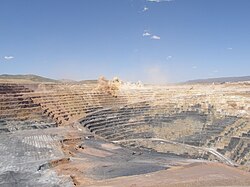
Machinery is minuscule compared to the size of this mine.
Rock blasting at the large open-pit Twin Creeks gold mine in Nevada, United States. Note the size of the excavators for scale (foreground, left), and that the bottom of the mine is not visible.
The giant bucket-wheel excavators in the German Rhineland coal mines are among the world's biggest land vehicles.

Open-pit mining, also known as open-cast or open-cut mining and in larger contexts mega-mining,[1] is a surface mining technique that extracts rock or minerals from the earth.

Open-pit mines are used when deposits of commercially useful ore or rocks are found near the surface where the overburden is relatively thin. In contrast, deeper mineral deposits can be reached using underground mining.[2]

Kittilä Gold Mine in Kittilä, Finland is the largest primary gold producer in Europe.[3][4]

This form of mining carries several risks to the health and safety of miners, and can have a significant negative impact on the environment.

Extraction

[edit]
Refer to caption.
Note the angled and stepped sides of the Sunrise Dam Gold Mine, Australia.
A bucket-wheel excavator extracting lignite from Garzweiler surface mine in Germany during 2008

Miners typically drill a series of test holes to locate an underground ore body. From the extracted samples, they can determine the extent of the ore. This helps them determine the likely location of the veins or benches of ore and its commercial value.[5] Open-pit mines that produce building materials and dimension stone are commonly referred to as quarries.

Open-cast mines are dug on benches, which describe vertical levels of the hole. The interval of the benches depends on the deposit being mined, the mineral being mined, and the size of the machinery that is being used. Generally, large mine benches are 12 to 15 metres thick.[6] In contrast, many quarries do not use benches, as they are usually shallow.[6] Mining can be conducted on more than one bench at a time, and access to different benches is done with a system of ramps. The width of each bench is determined by the size of the equipment being used, generally 20–40 metres wide.[5] Downward ramps are created to allow mining on a new level to begin. This new level will become progressively wider to form the new pit bottom.[5]

Most walls of the pit are generally mined on an angle less than vertical. Waste rock is stripped when the pit becomes deeper, therefore this angle is a safety precaution to prevent and minimize damage and danger from rock falls. However, this depends on how weathered and eroded the rocks are, and the type of rocks involved. It also depends on the amount of structural weaknesses occur within the rocks, such as a faults, shears, joints or foliations.

The walls are stepped. The inclined section of the wall is known as the batter, and the flat part of the step is known as the bench or berm. The steps in the walls help prevent rock falls continuing down the entire face of the wall. In some instances additional ground support is required and rock bolts, cable bolts and shotcrete are used. De-watering bores may be used to relieve water pressure by drilling horizontally into the wall, which is often enough to cause failures in the wall by itself.[7]

A haul road is usually situated at the side of the pit, forming a ramp up which trucks can drive, carrying ore and waste rock.[8]

After closure

[edit]

Open-pit mines are typically worked until either the mineral resource is exhausted, or an increasing ratio of overburden to ore makes further mining uneconomic.[citation needed] After open-pit mines are closed, they are sometimes converted to landfills for disposal of solid waste. Some form of water control is usually required to keep the mine pit from becoming a lake. Several former open-pit mines have been deliberately converted into artificial lakes, forming areas such as the Lusatian Lake District, the Central German Lake District or the Upper Palatinate Lake District. A particular concern in the formation of these lakes is acid mine drainage.

Impacts

[edit]

Open-pit mining is considered one of the most dangerous sectors in the industrial world,[not verified in body] and can cause significant harm to miners' health. It can also have significant negative environmental impact, depending on the type of mineral being mined, and the type of mining process being used.[9]

Waste

[edit]

Open-pit mines create a significant amount of waste. Almost one million tons of ore and waste rock can move from the largest mines per day, and a couple thousand tons moved from small mines per day.[5] There are generally four main operations in a mine that contribute to this load: drilling, blasting, loading, and hauling.

Waste rock is hauled to a waste dump. Waste dumps can be piled at the surface of the active pit, or in previously mined pits.

Leftover waste from processing the ore is called tailings, and is generally in the form of a slurry. This is pumped to a tailings dam or settling pond, where the water is reused or evaporated. Tailings dams can be toxic due to the presence of unextracted sulfide minerals, some forms of toxic minerals in the gangue, and often cyanide which is used to treat gold ore via the cyanide leach process. If proper environmental protections are not in place, this toxicity can harm the surrounding environment.[10]

Pollutants

[edit]

Open-pit mining involves the process of disrupting the ground, which leads to the creation of air pollutants. The main source of air pollutants comes from the transportation of minerals, but there are various other factors including drilling, blasting and the loading and unloading of overburden.[11] These types of pollutants cause significant damage to public health and safety in addition to damaging the air quality. The inhalation of these pollutants can cause issues to the lungs and ultimately increase mortality.[11] Furthermore, the pollutants affect flora and fauna in the areas surrounding open-pit mines.

Open-pit gold mining is one of the highest potential mining threats on the environment as it affects the air and water chemistry. The exposed dust may be toxic or radioactive, making it a health concern for the workers and the surrounding communities.[12]

Deforestation

[edit]

Open-pit nickel mining has led to environmental degradation and pollution in developing countries such as the Philippines and Indonesia.[13][14] In 2024, nickel mining and processing was one of the main causes of deforestation in Indonesia.[15][16] Open-pit cobalt mining has led to deforestation and habitat destruction in the Democratic Republic of Congo.[17]

Safety

[edit]

Open-pit mining is considered one of the most dangerous sectors in the industrial world.[not verified in body] and can cause significant effects to miners' health.


Hydrology in mining

[edit]

Open-pit mines operating in an area with heavy groundwater features may eventually face hydrology-related problems. This includes heaving and bursting of the mine floor due to excessive uplift pressure. A groundwater control system must be installed to fix problems caused by hydrology. The formation of an appropriate open-pit slope design, changes throughout the life of a mine. It is based mainly on an ever-increasing understanding of the rock mass conditions, including groundwater and associated pressures that may be acting within the slopes. The reduction of groundwater related to pore pressures is a crucial aspect of determining whether or not a geotechnical engineering design for open-pit slopes is attainable. Groundwater control systems, which include dewatering and depressurization wells, may also have a large impact on local groundwater. Because of this, an optimization-based version of the control system is required to ensure that local and regional hydro-geological impacts are within acceptable ranges.[18]

Open Pit depressurization is the process of removing tensions or pressure from different areas of a mine. Depressurization helps to make open-pit mines more stable and secure. By using an integrated mine slope depressurization program the likelihood that mine plans can be achieved, and at an acceptable level of risk increase drastically.[18][19] Depressurization allows considerable expansions of a mine, and can extend the life of the mine by 10 to 15 years. One technique used in depressurization is annealing. Annealing is the slow heating and cooling of a metal, alloy or glass. This slow heating and cooling relieves the internal stress of surrounding areas. Annealing will increase a material's workability and durability, which overall increases open-pit mine safety.[20] When groundwater pressures cause problems in open-pit mines, horizontal drains are used to aid in accelerating the slope depressurization process. Which helps to prevent large scale slope failure in the mine. Horizontal drains are used to lower pore pressure by reducing groundwater head, which enhances slope stability.[18]

Untopping

[edit]

A form of open-cast quarrying may be carried out as 'untopping'. This is done where a previous underground mine is becoming uneconomic or worked-out, but still leaves valuable rock in place, often as a result of room and pillar mining. Untopping removes the overburden from above this, opens up the mine from above, and then allows the previously 'trapped' minerals to be won.

Untopping was a feature of Welsh slate workings in the 1930s and 2000s, where Martyn Williams-Ellis, manager at Llechwedd found that earlier Victorian workings could be kept profitable with the newly mechanised techniques for bulk excavation to extract their pillars, and more recently across a number of worked-out mines.[21]

Rehabilitation

[edit]
A reclaimed area next to an active mine is now grassy hills.
A loadout station and reclaimed land at the North Antelope Rochelle open-pit coal mine, in Wyoming, United States

After mining ends at a location, the mine area may undergo land rehabilitation. Waste dumps are contoured to flatten them out, to further stabilize them. If the ore contains sulfides it is usually covered with a layer of clay to prevent ingress of rain and oxygen from the air, which can oxidize the sulfides to produce sulfuric acid, a phenomenon known as acid mine drainage.[22] This is then generally covered with soil, and vegetation is planted to help consolidate the material. Eventually this layer will erode, but it is generally hoped that the rate of leaching or acid will be slowed by the cover such that the environment can handle the load of acid and associated heavy metals.[23] There are no long term studies on the success of these covers due to the relatively short time in which large-scale open-pit mining has existed. It may take hundreds to thousands of years for some waste dumps to become "acid neutral" and stop leaching to the environment. The dumps are usually fenced off to prevent livestock denuding them of vegetation. The open pit is then surrounded with a fence, to prevent access, and it generally eventually fills up with ground water. In arid areas it may not fill due to deep groundwater levels.[24] In Germany, the world's largest producer of lignite (virtually all of which these days is mined open-pit), the former mines are usually converted to artificial lakes. To mitigate the problem of acid mine drainage mentioned above, flooding is often done with the water of nearby rivers instead of using groundwater alone. In some cases, calcium oxide or other basic chemicals have to be added to the water to neutralize the pH-value.

An artificial wetland.
An open-pit sulfur mine at Tarnobrzeg, Poland, undergoing land rehabilitation

Typical open cut grades

[edit]

Gold is generally extracted in open-pit mines at 1 to 5 ppm (parts per million) but in certain cases, 0.75 ppm gold is economical. This was achieved by bulk heap leaching at the Peak Hill mine in western New South Wales, near Dubbo, Australia.[25]

Nickel, generally as laterite, is extracted via open-pit down to 0.2%. Copper can be extracted at grades as low as 0.11% to 0.2%.

Largest open-pit mines

[edit]

Open-pit mining is a common method to extract minerals and samples from the Earth. Due to being cost-effective, this method is very popular and is used all over the world. Listed are the world's ten largest open-pit mines in 2015.[26]

See also

[edit]
  • Artisanal mining – Independent, small-scale, subsistence mining
  • Closure problem applied to open-pit mines for optimal extraction (not related to closing the mine)
  • Cut (earthmoving) – Location where earth is removed to make way for a road, railway, or canal
  • List of open-pit mines
  • Trench – Excavated channel in ground
  • Tunneling – Underground passage made for traffic

References

[edit]
[edit]
Revisions and contributorsEdit on WikipediaRead on Wikipedia
from Grokipedia
Open-pit mining is a surface extraction technique for near-surface mineral deposits, involving the removal of to create a large conical pit accessed via successive horizontal benches. This method utilizes heavy equipment, drilling, and blasting to liberate , which is then loaded and transported for , making it economically viable for large-volume, lower-grade ores like , , and . It accounts for the majority of global production in commodities such as and due to its scalability and lower initial capital costs compared to underground mining. Prominent examples include the in , the deepest and largest open-pit operation, which has yielded over 19 million tons of since 1906 through progressive pit deepening. Open-pit mining has enabled the supply of essential raw materials driving industrialization, but it alters vast landscapes, generates dust and noise, and poses risks of water contamination via acid drainage and , often requiring extensive post-mining reclamation to mitigate long-term ecological effects. Despite regulatory frameworks, controversies persist over unmitigated habitat loss and groundwater impacts in sensitive areas, underscoring the tension between resource extraction and .

Definition and Principles

Core Concept and Applicability

Open-pit mining is a surface extraction technique that involves the removal of —consisting of soil, rock, and other materials overlying the —to access near-surface deposits, creating a large, open excavation from which is retrieved. This method employs large-scale machinery such as hydraulic excavators, haul trucks with capacities exceeding 200 tonnes, and drilling equipment for blasting in competent rock, enabling high-volume material movement on benches typically 10-15 meters high to ensure and operational safety. The core principles revolve around optimizing pit for maximal recovery while minimizing waste handling, guided by geotechnical assessments to prevent wall failures and systems to manage inflow. Applicability is confined to deposits with favorable : broad, tabular, or disseminated ores like porphyry copper, , or placer , where the ore body extends horizontally over large areas but is vertically shallow, generally less than 1 kilometer deep, as deeper excavations escalate costs and risks disproportionately. Economic feasibility hinges on the , defined as the ratio of tonnage to tonnage removed, which must remain below the break-even stripping ratio—calculated as ( value minus processing costs) divided by removal costs—to ensure profitability; typical viable ratios range from 1:1 for high-value ores to 5:1 or higher for bulk commodities like , beyond which underground methods become preferable. Open-pit mining surpasses underground approaches in and for these conditions, accommodating annual outputs in the hundreds of millions of tonnes, but is unsuitable for narrow, high-grade veins or deposits exceeding economical stripping limits, such as those below 300-500 meters in many cases without exceptional grades.

Advantages Over Underground Mining

Open-pit mining enables significantly higher productivity than underground methods, often achieving 3 to 5 times the output due to the deployment of large-scale surface equipment such as haul trucks and shovels capable of handling massive volumes of material. This allows for daily production rates exceeding hundreds of thousands of tons in major operations, contrasting with the constrained throughput of underground tunnels limited by ventilation, support systems, and capacity. The method's reliance on open-air excavation facilitates continuous operations with fewer interruptions, enhancing overall efficiency for deposits suitable for bulk extraction. Economically, open-pit mining offers lower operating costs compared to underground mining, primarily through reduced labor requirements, simpler infrastructure, and from mechanized processes. Underground operations incur higher expenses for tunneling, ground support, and energy-intensive ventilation, often making open-pit viable for lower-grade ores that would be uneconomical underground. For instance, surface mining costs can be substantially less per ton extracted, enabling faster capital recovery and broader applicability to near-surface, large-volume deposits. Safety profiles favor open-pit mining, with fatality rates approximately half those of underground work; U.S. data from indicate 15.7 deaths per 100,000 employees at surface sites versus 37.7 underground, attributable to avoidance of confined-space hazards like roof collapses, flooding, and toxic gas accumulations. Open-air conditions provide natural ventilation, better visibility, and easier evacuation, minimizing risks from seismic events or common in subsurface environments. While both methods require rigorous controls, open-pit's exposure to weather and blasting demands different mitigations, but overall injury incidence remains lower due to reduced manual handling and proximity to support facilities. Additional operational advantages include greater flexibility in adapting to geological variations through adjustable pit walls and benches, as well as simpler and via surface disposal, which contrasts with the rigid stopes and backfill needs of underground layouts. These factors contribute to shorter development timelines and lower upfront complexity for amenable orebodies, though site-specific dictate ultimate selection.

Historical Development

Pre-20th Century Origins

Surface mining techniques resembling modern open-pit methods emerged in ancient civilizations, where laborers manually removed shallow to access near-surface deposits using basic tools like picks, chisels, and wedges. In , gold extraction from quartz reefs involved open cuts and trenches dating to the Predynastic period (c. 4000–3100 BC) and continuing through (c. 2686–2181 BC), with miners following veins exposed at the surface before descending via simple excavations. Similar surface trenching was employed at Laurion in for silver-lead ores, where initial operations focused on rich outcrops before transitioning to deeper workings around the 5th century BC. The Rio Tinto deposit in southwestern represents one of the earliest and most extensive pre-industrial examples, with exploitation beginning around 3000 BC by local Tartessian and Iberian peoples, followed by Phoenicians, Carthaginians, and Romans. Roman operations from approximately the to the 3rd century AD scaled up open-pit extraction ("cortas") of , silver, and , yielding an estimated 24 million tons of raw material over two centuries through systematic removal and processing via . These efforts relied on slave labor and rudimentary technology, including fire-setting to fracture rock, but demonstrated large-scale pit development driven by imperial demand for metals in coinage and weaponry. Medieval and early modern surface mining persisted in for and metals, often exploiting outcrops or shallow seams via strip-like methods, as seen in British coal fields from the 13th century onward, where was stripped by hand to access exposed seams for local fuel needs. By the , pre-mechanized open pits for appeared in regions like Minnesota's , with initial excavations around 1884 involving manual and horse-drawn removal to depths of tens of feet, setting the stage for later industrialization. These practices underscored the economic viability of surface methods for accessible deposits, prioritizing low-cost extraction over deep underground risks until steam-powered equipment enabled 20th-century expansion.

20th-21st Century Expansion and Innovations

The transition to large-scale open-pit mining accelerated in the early with the widespread adoption of steam shovels, which enabled the economical removal of and extraction of low-grade ores that were previously unviable through underground methods. This mechanization facilitated the shift from selective underground operations to bulk mining, exemplified by the in , which pioneered systematic open-pit copper extraction starting in 1909. Similarly, in began open-pit development around 1899–1906, growing into the world's deepest open-pit excavation at 0.75 miles (1.2 km) deep and 2.5 miles (4 km) wide by the late , yielding over 19 million tons of since inception. Post-World War II industrial demand for metals like , iron, and drove further expansion, with operations scaling up through diesel-powered shovels and haul trucks that replaced equipment by , improving mobility and productivity. Mines such as Morenci in transitioned fully to open-pit methods in 1937, while Chuquicamata in , already operational underground, expanded its open pit to become the largest by excavated volume, incorporating oxide processing plants and concentrators by the mid-20th century. emerged as a key innovation during this period, allowing efficient recovery of and from low-grade ores via chemical solutions applied to piled rock, significantly lowering costs and boosting output. In the , open-pit operations have incorporated digital and automated technologies, including GPS-guided haul trucks and computer-aided pit design for optimized extraction paths and . Autonomous haulage systems, deployed in mines like those operated by Rio Tinto since the , reduce labor needs and enhance safety by minimizing human exposure to hazards, while AI and IoT sensors enable real-time monitoring of geological conditions and equipment performance. Larger electric shovels and low-emission trucks have further scaled , as seen in ongoing expansions at Bingham Canyon, which produced over 15 million tons of between 2004 and 2013 despite a major in 2013 that halted operations temporarily. These advancements reflect a focus on efficiency amid rising environmental scrutiny, though challenges like extended permitting timelines—averaging 29 years in the U.S.—constrain new developments.

Site Selection and Feasibility

Geological and Resource Evaluation

Geological evaluation for open-pit mining begins with surface-based reconnaissance to identify prospective deposits, employing techniques such as geological mapping, geophysical surveys (e.g., magnetic, , and seismic methods), geochemical sampling of soils and streams, and via or to detect alterations indicative of mineralization. These methods delineate potential bodies by correlating surface anomalies with subsurface , often informed by regional tectonic and stratigraphic data to assess the deposit's and continuity. For open-pit viability, evaluations prioritize near-surface, tabular, or disseminated deposits with low to moderate dips, as steep or deep structures favor underground methods. Subsurface confirmation relies on drilling programs, typically starting with widely spaced exploratory holes (e.g., 100-500 meters apart) using rotary or core methods to penetrate and , followed by infill at 25-100 meter intervals for delineation. core provides intact samples for lithological , structural analysis, and geomechanical testing, while reverse circulation suits faster, bulk sampling in softer formations. Core recovery rates above 90% are targeted to minimize bias, with down-hole surveys correcting for deviation to accurately georeference samples. Resource estimation integrates drilling data through geostatistical techniques, constructing three-dimensional block models that interpolate grades using methods like ordinary kriging or , accounting for spatial variability and nugget effects. These models classify resources as inferred (broad reconnaissance), indicated (closer-spaced data supporting continuity), or measured (dense sampling with high confidence), per standards like the CIM Definition Standards, which require demonstrated geological and grade continuity for open-pit amenable resources. via conditional simulation or probabilistic modeling refines estimates, incorporating variograms to model semivariances and support selective mining unit sizes (e.g., 10-50 ) suited to open-pit bench heights. Validation against blast hole data during early mining phases iteratively updates models, ensuring alignment with actual extraction outcomes.

Economic and Regulatory Assessment

Open-pit mining projects undergo rigorous economic feasibility studies during site selection to determine profitability, typically involving models that project (NPV), (IRR), and payback periods based on estimated reserves, production rates, and prices. Capital expenditures encompass initial site preparation, equipment acquisition (such as large-scale haul trucks and shovels), infrastructure development (roads, power lines, and processing facilities), and pre-stripping of , often totaling hundreds of millions to billions of dollars; for example, new copper open-pit operations have seen capital intensity escalate to approximately $44,000 per tonne of annual production capacity by 2022 due to deeper pits and regulatory-driven . Operating costs, generally lower per tonne than underground methods owing to bulk extraction and surface , include , blasting, hauling (influenced by stripping ratios of to ), and on-site , with breakdowns typically allocating 40-50% to mining activities, 30-40% to milling, and the remainder to general administration. Sensitivity to volatile metal prices and costs is assessed, as higher recovery rates (up to 90-100% in suitable deposits) can offset risks, but low grades or high volumes may render sites uneconomic unless offset by scale. Regulatory assessment evaluates compliance with permitting frameworks essential for site feasibility, requiring environmental impact assessments (EIAs) or statements under statutes like the U.S. National Environmental Policy Act (NEPA) to quantify effects on hydrology, air quality, and ecosystems prior to approval. Permits, often numbering 10-30 across federal, state, and local agencies, mandate adherence to standards for pit stability, dust control, and water management, with processes averaging 2-7 years due to public consultations and iterative reviews that can escalate costs through delays or modifications. For surface disturbances, operators post performance bonds—financial assurances calibrated to full reclamation expenses, such as regrading, revegetation, and wetland restoration—to ensure post-closure restoration, as exemplified in frameworks like the Surface Mining Control and Reclamation Act (SMCRA), which requires bonds sufficient for regulatory authorities to complete work if operators default. Sites in environmentally sensitive areas or near communities face heightened scrutiny, potentially disqualifying otherwise viable deposits if mitigation proves infeasible or prohibitively expensive under jurisdiction-specific laws prioritizing habitat preservation over extraction. Integrated economic-regulatory in feasibility phases weighs upfront regulatory costs (e.g., EIA preparation at 1-5% of total capital) against long-term liabilities like bond forfeitures or litigation, often favoring sites with streamlined permitting histories or favorable that minimizes environmental footprints. Recent projects, such as a 2021 open-pit study, demonstrated viability through projected tax revenues exceeding $226 million while satisfying bond and compliance mandates, underscoring how regulatory hurdles can enhance economic rigor by enforcing . Non-compliance risks permit or fines, as seen in enforcement actions for inadequate water diversion, emphasizing causal links between regulatory foresight and operational longevity.

Operational Processes

Overburden Removal and Pit Design

Overburden in open-pit mining consists of the , rock, and other materials overlying the economically viable deposit, which must be systematically stripped away to expose the mineralized zone. Removal methods are selected based on overburden thickness, material composition, and site conditions, with thicknesses ranging from tens to over 50 meters in large operations, such as 50-70 meters in certain quarries where excavators, shovels, and chain bucket excavators are employed. For unconsolidated or soft overburden, direct mechanical excavation using bulldozers, scrapers, or rippers predominates to minimize costs and disruption, while harder rock layers necessitate followed by loading with hydraulic excavators and haulage via trucks or conveyor systems to designated dump sites. Geotechnical assessments evaluate of excavated faces and remolded materials during removal, as poor handling can induce instability or compaction issues, with disposal often involving sequential dumping in topographic lows or flooded pits to leverage natural containment while monitoring interactions. Topographical factors, such as pit morphology and proximity to , further dictate whether overburden is stockpiled externally or progressively backfilled to support interim slope stabilization. Pit design integrates overburden stripping strategies with the overall excavation geometry to optimize access, , and long-term stability, typically structured in horizontal benches to facilitate operation and controlled descent. Bench heights are determined by reach, rock strength, and fragmentation needs, commonly ranging from 5 to 20 meters—such as 10-15 meters in hard rock operations—with widths scaled to 20-30 meters to accommodate haul roads and safety berms. angles, including bench faces at 45-70 degrees and inter-ramp angles of 35-55 degrees, are engineered through iterative geotechnical modeling to achieve a of 1.1-1.5 under static conditions, balancing steeper profiles that reduce stripping volumes (e.g., a 1-degree steepening can cut by millions of tonnes in deep pits) against risks of . Key stability factors include rock mass quality (assessed via classifications like RMR or GSI, where values below 21 indicate very poor conditions), structural discontinuities (joints, faults), and hydrological effects such as pore water pressures that diminish and , often mitigated by or drainage systems. Design methods encompass kinematic analysis for structural controls, limit equilibrium techniques (e.g., or Spencer methods) for potential planes, and numerical modeling (finite element or distinct element) to simulate stress distributions, groundwater flow, and blast-induced damage across scales from individual benches to overall pit walls exceeding 500 meters in depth. Economic considerations, like strip ratios, drive configurations that minimize waste rock movement while incorporating catch benches (typically 4-6 meters wide) and geotechnical berms for deflection of rockfalls, with ongoing monitoring via , inclinometers, and piezometers to trigger response plans if deformation thresholds are approached. In structurally complex terrains, domain-specific adjustments—flattening in weak zones or buttressing with waste—ensure causality between design parameters and modes, prioritizing empirical validation over assumptions.

Ore Extraction and Processing

In open-pit mining, ore extraction follows the removal of and involves a cyclic of , blasting, loading, and hauling to liberate and transport the mineral-bearing rock to surface facilities. creates precisely patterned holes, typically 9 to 12.25 inches in diameter for presplit applications, using rotary or percussive rigs to prepare for explosives. Blasting then fragments the body through controlled detonation of ammonium nitrate-fuel oil () or emulsion explosives in bench configurations, optimizing fragmentation for downstream efficiency while minimizing overbreak and flyrock. Common techniques include bench blasting with vertical or sub-vertical holes, where multi-row differential blasting enhances uniformity in large-scale operations. Loading employs hydraulic or electric shovels, front-end loaders, or excavators with bucket capacities often exceeding 20 cubic yards to scoop fragmented into haul trucks, prioritizing high-volume to match production rates. Hauling utilizes off-highway trucks, commonly with payloads of 200 to 400 tons, navigating designed haul roads to deliver to run-of-mine (ROM) stockpiles or directly to crushers, with cycle times optimized through systems to reduce bottlenecks. This drill-blast-load-haul sequence repeats across benches, enabling progressive pit deepening while maintaining grade selectivity through selective units. Ore processing commences upon transport to the concentrator or mill, where initial reduces rock size via primary gyratory or jaw crushers, often in-pit for large operations to minimize distances. Subsequent steps include secondary and tertiary crushing, followed by grinding in semi-autogenous (SAG) mills or ball mills to liberate valuable minerals, typically achieving particle sizes below 100 microns depending on type. Beneficiation then employs physical or chemical methods—such as for ores, heap leaching for low-grade oxides, or for iron—to concentrate the target metal, with recovery rates varying by deposit; for instance, open-pit operations often achieve 80-90% extraction efficiency post-processing. Tailings from these processes are dewatered and stored, ensuring the economic viability hinges on precise grade control to avoid dilution during extraction.

Equipment and Technological Advancements

Open-pit mining relies on heavy-duty designed for large-scale excavation and . Primary loading equipment includes hydraulic excavators and electric rope shovels, with modern models featuring bucket capacities exceeding 100 cubic meters, enabling efficient and removal. Rotary rigs, used for blasting preparation, create holes in rock for explosives placement, supporting bench heights of 4 to 60 meters depending on machinery scale. Transportation centers on ultra-class haul , which dominate material movement from pit to processing sites. The BelAZ-75710, introduced in 2013, holds the record as the largest, with a capacity of 496 metric tons and an empty weight of 360 tons, powered by dual diesel-electric engines totaling 4,600 horsepower. Other prominent models include the 797F, capable of hauling up to 400 tons, optimized for rugged open-pit terrains. Supporting machinery such as bulldozers and graders maintains haul roads, while crushers and conveyors process on-site to reduce truck dependency. Technological advancements have enhanced efficiency, safety, and sustainability in open-pit operations. , including autonomous haulage systems (AHS), has been implemented in major mines, with trucks operating without onboard operators to minimize human exposure to hazards and enable 24/7 productivity; for instance, Rio Tinto's Pilbara operations integrated AHS in 2008, expanding to over 100 vehicles by 2023. and excavation rigs further reduce risks, integrated with AI for precise operations. Recent innovations emphasize and digital integration. Battery-electric haul trucks, trialed since 2020, aim to cut emissions, with prototypes like Komatsu's achieving zero tailpipe emissions in pilots at Swedish mines. Microseismic monitoring and sensor-equipped machinery provide for and ground stability assessment, improving yield and reducing downtime. These developments, driven by demands for lower costs and environmental compliance, continue to evolve, with full-site autonomy projected for select operations by 2030.

Resource Management

Grade Determination and Optimization

Grade determination in open-pit mining involves assessing the concentration of valuable minerals in deposits to classify material as economically viable or waste, primarily through and geochemical analysis. grade is quantified as the or grams per of the target commodity, such as at 0.5% or at 1 g/t, derived from drill core samples assayed via techniques like or . Initial grade estimation relies on exploration drilling spaced at 50-200 meters, followed by drilling for resource modeling using geostatistical methods like to interpolate grades across the deposit. Grade control refines these estimates during active to minimize dilution and loss, employing short-interval such as blast-hole sampling every 5-10 or reverse circulation holes for real-time assays. In variographic analysis, sampling intervals are optimized by measuring grade variance against nugget effect, ensuring representativity; for instance, in porphyry deposits, blast-hole chips provide rapid data but may introduce if not composited properly. Selective mining units, typically 10-25 in dimension, are delineated using grade control polygons to direct excavators, with software like Surpac or integrating GPS-enabled machine guidance for precision. Optimization centers on cut-off grade (COG), the minimum grade threshold separating from , calculated as COG = ( + selling - ) / recovery rate, adjusted for site-specific costs like $5-10/t milling and 90% recovery. Static COG assumes constant parameters, but dynamic or models account for varying metal prices, capacities, and geometallurgical variability, maximizing (NPV) over the mine life; for example, in a copper mine, raising COG from 0.3% to 0.4% can increase NPV by 15-20% by prioritizing high-grade zones early. Advanced techniques employ genetic algorithms or mixed-integer programming for multi-period scheduling, incorporating stockpiling to blend low-grade material later when prices rise, as demonstrated in models yielding 10-25% higher NPV than traditional Lane's algorithm. in grade estimation, quantified via conditional , informs risk-adjusted optimization, preventing over-optimistic plans; peer-reviewed studies emphasize validating models against production to correct for conditional bias, where estimated grades exceed actual by 5-15% due to smoothing in . blending strategies further optimize mill feed uniformity, targeting consistent head grades to stabilize recovery rates above 85% while minimizing energy costs.

Waste Rock and Tailings Handling

In open-pit mining, waste rock comprises and barren material excavated to expose , typically requiring stripping ratios of 2:1 to 4:1, meaning two to four units of waste per unit of ore. This rock is transported via haul trucks to designated dumps, where it is placed in layers to achieve compaction and stability, with designs incorporating internal rock drains to manage infiltration and prevent slope failures. Dump configurations often feature overall slopes of 2.5H:1V to 3H:1V, adjusted for rock type and seismic risks, to balance volume capacity with . Tailings consist of finely milled residues suspended in after extraction, generated at rates proportional to processed , and are directed to engineered storage facilities to contain sludges and . Conventional impoundment build progressively via upstream, downstream, or centerline methods, but these carry risks of seepage and structural if not monitored rigorously; alternatives like in-pit deposition or filtered dry stacking minimize retention and land disturbance by to 15-20% moisture content. Global standards, such as the Global Industry Standard on Tailings Management, mandate independent assessments, emergency preparedness, and progressive closure to address long-term stability. Both waste rock and tailings pose risks of () when exposed sulfides react with oxygenated water, generating and mobilizing like and , with U.S. mining legacy affecting over 7,000 kilometers of streams. Handling protocols emphasize geochemical characterization to segregate acid-generating materials, applying low-permeability covers or encapsulation to inhibit oxidation, and installing liners or geomembranes in facilities to curb migration. Dust suppression through chemical binders or watering, alongside vegetative stabilization on benches, mitigates airborne particulates and during active phases. Reclamation integrates waste rock backfilling into pits where feasible to reduce dump footprints, followed by grading, replacement, and seeding with to promote self-sustaining ecosystems, as evidenced in surface mine sites restored to grassy . Tailings closure involves capping with multi-layered systems—compacted clay, geomembranes, and growth media—to prevent infiltration, coupled with ongoing monitoring of pH and metal concentrations to verify attenuation of potential over decades. These practices, informed by site-specific and material testing, aim to limit perpetual liabilities while complying with regulatory bonds for performance.

Environmental and Hydrological Effects

Water Resource Impacts and Mitigation

Open-pit mining significantly impacts through processes that extract to keep pits dry, often leading to depletion and altered . In moderately transmissive aquifers, prolonged pumping can lower by tens to hundreds of meters; for example, at a German open-pit mine, levels declined by about 95 meters in the pit center after 20 years of continuous extraction to maintain operational depths below the . This drawdown cone can extend kilometers from the site, reducing to rivers and wetlands, thereby diminishing flows during dry periods and affecting downstream ecosystems dependent on consistent . diversion and pit excavation further disrupt natural drainage patterns, potentially causing localized flooding or in surrounding areas. Contamination arises primarily from acid mine drainage (AMD), generated when sulfide minerals like pyrite (FeS₂) in exposed rock oxidize in the presence of atmospheric oxygen and moisture, producing that leaches such as iron, aluminum, , and into solution. AMD lowers receiving water to as low as 2-4 and elevates metal concentrations, impairing aquatic life; for instance, in open pits, hydrochemical analyses have identified elevated and iron levels in pit inflows from seepage. and waste rock stockpiles contribute additional pollutants via rainfall runoff, including sediments that increase and nutrients that promote algal blooms in nearby streams. Operational water use for ore slurrying, flotation, and dust control can exceed millions of cubic meters annually per site, straining local supplies, as seen in mines withdrawing from rivers and ore-entrained . Mitigation begins with proactive dewatering management, including predictive hydrological modeling to minimize extraction volumes and phased pit designs that limit drawdown extent. recycling circuits capture and treat process for reuse, reducing freshwater demand by 70-90% in optimized operations through sedimentation ponds and . For AMD prevention, sulfide-rich materials are segregated and covered with impermeable liners or low-permeability caps to exclude oxygen and , while blending with raises alkalinity. Active treatment neutralizes acidity via lime dosing to precipitate metals as hydroxides, followed by ; passive systems, including anoxic drains and constructed wetlands, leverage microbial reduction and for long-term remediation at lower cost. Post-closure, flooded pits are monitored for stratification to isolate acidic bottom waters, with amendments like to enhance metal , aiding eventual stabilization.

Land Disturbance and Biodiversity

Open-pit mining disturbs vast land areas through the removal of , , and vegetation to access deposits, often resulting in the conversion of natural habitats into barren pits and waste dumps. For instance, analysis of a U.S. mine site showed disturbed areas expanding to approximately acres over 31 years due to progressive excavation and waste placement. Such disturbances directly cause habitat loss, fragmenting ecosystems and displacing and , with empirical studies indicating that open-pit operations reduce local alpha-diversity of plant species, particularly within proximity to active sites where diversity increases logarithmically with distance from the mine edge. Biodiversity impacts extend beyond immediate habitat destruction to include altered species compositions, with mining activities linked to deforestation and the decline of habitat specialists, potentially threatening endemic or range-restricted species through reduced population viability. Habitat fragmentation from pit expansion and associated infrastructure exacerbates these effects by creating barriers to animal movement and gene flow, as observed in studies of large-scale gold mining where wide-ranging species exhibit shifts in habitat selection patterns. Microbial communities in mine pits also show diminished diversity, representing only about 40% of surrounding soil microbiota, underscoring soil ecosystem disruptions that hinder long-term recovery. Reclamation efforts aim to mitigate these disturbances by reshaping landforms, replacing , and revegetating sites, yet success in restoring pre-mining remains limited. Terrestrial restoration projects post-mining increase average by 20% relative to unrestored degraded sites, though outcomes vary widely due to factors like and planting strategies. In regions like , mine rehabilitation has covered 900,000 hectares by 2020, achieving roughly 30% of targeted areas, with effectiveness ranging from 35% to 80% across sites, often falling short of original complexity because of persistent hydrological changes and legacy contaminants. Full restoration to baseline is rare, as altered edaphic conditions and favor invasive species over native assemblages, necessitating ongoing monitoring and .

Air and Soil Pollution Controls

Open-pit mining operations generate airborne particulates primarily through blasting, hauling, and crushing activities, with comprising respirable particles that can travel significant distances and pose risks to workers and nearby communities. Effective controls emphasize suppression, achieved via water spraying on haul roads and stockpiles, which reduces fugitive emissions by binding particles to surfaces. Chemical suppressants, such as polymer-based agents, enhance this by forming crusts on and aggregates, with field applications demonstrating up to 93% suppression efficiency when combined with air-assisted spraying compared to water alone at 42%. Enclosures around crushers and conveyors, along with vegetative barriers, further mitigate wind-blown , particularly in arid regions where operations like those in Australian or Chilean mines have integrated these to comply with local emission limits. Vehicle emissions, including nitrogen oxides and particulate matter from diesel haul trucks, contribute substantially to air quality degradation, prompting transitions to battery-electric or hybrid fleets that can reduce and CO outputs by over 50% in tested prototypes. Continuous monitoring using real-time sensors for PM10 and PM2.5 levels enables adaptive controls, such as automated spray systems triggered by thresholds exceeding 5 m/s, ensuring adherence to standards like the U.S. EPA's . In Colombia's open-pit mines, standardized inventories have quantified annual emissions rising with production from 5 million tonnes in 2000 to 70 million tonnes in 2010, underscoring the need for integrated strategies including reduced-speed hauling and enclosed transfer points to curb exceedances. Soil pollution in open-pit mining arises from heavy metal leaching in waste rock dumps and , where sulfides oxidize to generate contaminating surrounding soils with , , and lead. Controls include geomembrane liners beneath dumps to prevent infiltration, coupled with cover systems using compacted clay or synthetic caps to limit oxygen ingress and , as applied in U.S. sites where such barriers have reduced by 90% in monitored cases. management protocols, including diversion berms and sediment traps, minimize runoff carrying sediments and contaminants, with vegetated buffers stabilizing surfaces and trapping particulates per state best management practices. For remediation, thermal heats contaminated soils to 1600–2000°C, immobilizing metals in glass-like matrices, though energy-intensive and site-specific, it has proven durable in pilot applications without re-release over decades. Regulatory frameworks, such as U.S. EPA oversight of permits under the Clean Water Act, mandate these measures to prevent from abandoned pits, with ongoing monitoring ensuring long-term efficacy despite challenges from variable rainfall and geology.

Socioeconomic Dimensions

Economic Benefits and Contributions

Open-pit mining drives substantial economic value by enabling large-scale extraction of minerals such as , , , and , which are essential for industrial supply chains and infrastructure development. In countries reliant on these resources, the method's efficiency in accessing low-grade deposits at lower costs per ton compared to underground mining amplifies output volumes, thereby boosting export revenues and (GDP). For instance, in , open-pit operations produce over 90% of the nation's copper, with the overall sector accounting for 13.6% of GDP in 2022 and 58% of total exports. Similarly, Australia's mining industry, featuring extensive open-pit sites for iron ore and coal, contributes approximately 10% to annual GDP, equivalent to AUD 35 billion as of recent estimates. The sector generates direct and indirect , supporting labor in extraction, , and ancillary services despite its capital-intensive nature. Globally, employs millions, with multiplier effects extending to transportation, , and local businesses; , the industry sustained 597,200 jobs in 2023 while representing 1.3% of GDP. In resource-dependent economies, these jobs often provide above-average wages, fostering ; for example, Western Australia's open-pit mines support over 100,000 full-time equivalent positions tied to sales exceeding AUD 55 billion in 2023. Governments derive significant fiscal revenues through royalties, taxes, and fees, funding public infrastructure and services. Royalty rates typically range from 2-5% in developed jurisdictions, with higher levies in emerging markets, enabling reinvestment in non-mining sectors to mitigate resource dependency risks. Major operators like Newmont Corporation, which relies heavily on open-pit mines, remitted $1.9 billion in taxes and royalties in 2024 alone, part of a broader $16 billion direct economic contribution including supplier payments and community investments. In , mining royalties and taxes averaged contributions supporting 10.9% of GDP over recent years, underscoring the method's role in national budgets. Beyond direct outputs, open-pit mining attracts (FDI) and spurs such as roads, ports, and power grids, which benefit broader economies post-operation. This FDI inflow, often exceeding billions annually in top producers, enhances technological transfer and ; in , the mining sector's total economic footprint reached 15% of GDP in 2016 through such linkages, a pattern persisting in updated assessments. These contributions position open-pit mining as a for material-intensive global growth, supplying commodities critical for , , and .

Labor, Safety, and Community Dynamics

Open-pit mining operations employ specialized labor forces skilled in operation, drilling, blasting, and materials handling, often structured around 12-hour shifts in remote locations. In the United States, the broader sector (excluding oil and gas) supported around 585,000 jobs as of 2023, with —including open-pit—constituting a major share due to its scale in aggregates, , and metals extraction. Wages reflect the demands of the work, with median annual earnings for extraction workers reaching $62,000 in 2023, surpassing national medians and incentivizing recruitment amid labor shortages. rates vary, remaining higher in surface operations (e.g., via the United Mine Workers) but lower in non-coal open-pit sites, where operator contracts emphasize flexibility over . Fly-in-fly-out (FIFO) arrangements predominate in expansive, isolated open-pit mines, such as those in or , where workers rotate 2-3 weeks on-site followed by equivalent off periods. These models yield high earnings—typically $70,000 to $150,000 annually depending on role and experience—but foster high turnover, fatigue-related errors, and family strains from prolonged absences. Safety protocols address inherent risks like haul truck collisions (responsible for over 40% of surface mining incidents), falls from highwalls, and explosive handling failures, enforced by agencies such as the U.S. Mine Safety and Health Administration (MSHA). MSHA recorded 22 total mining fatalities in fiscal year 2024, yielding a rate of 0.0078 per 200,000 hours worked—a historic low attributed to mandatory training, vehicle safeguards, and real-time monitoring—though surface operations still claim roughly half, often from machinery mishaps. Globally, mining claims about 8% of occupational fatalities despite comprising under 1% of the workforce, with open-pit safer than underground due to open air and mechanization but vulnerable to weather-induced slips or overloads. Local communities near open-pit mines experience amplified economic activity from direct jobs (often 20-30% of regional employment) and supplier spending, yet face pressures including housing shortages that inflate rents by 20-50% and overload utilities. Transient worker influxes correlate with spikes in property crimes and assaults, as documented in resource extraction regions where male-heavy demographics disrupt social norms. Post-expansion busts exacerbate these, yielding surges and service cuts, with studies showing persistent inequality absent proactive diversification. Operators mitigate via community funds for , but data indicate limited enduring cohesion gains, as benefits skew toward skilled incomers over legacy residents.

Controversies and Criticisms

Environmental and Health Debates

Open-pit mining operations generate significant environmental concerns, primarily through the release of dust, , and that can contaminate air, soil, and . Dust emissions from blasting, hauling, and wind erosion contribute to elevated particulate matter levels, with studies indicating that open-pit coal mines can increase by up to 70% in affected areas, exacerbating in nearby waterways. Water contamination arises from sulfide minerals oxidizing to form acidic drainage laden with like , , and lead; for instance, analysis of 16 pit lakes in mines revealed that while most maintained near-neutral pH and low metal concentrations, several exhibited elevated sulfate or specific metal exceedances due to geochemical reactions. Globally, a 2023 study estimated that over 23 million people reside in floodplains potentially contaminated by mining-derived , highlighting the scale of hydrological risks despite regulatory frameworks. These impacts fuel debates over the adequacy of mitigation measures, such as liners and neutralization treatments, which industry proponents argue have reduced long-term liabilities in modern operations, while critics, often drawing from environmental advocacy groups, contend that legacy sites like Montana's —where water levels reached over 900 feet by 2023 with ongoing metal leaching—demonstrate persistent threats to aquifers and ecosystems. Health debates center on exposure risks to workers and adjacent communities from airborne particulates, heavy metals, and diesel exhaust. Miners face heightened incidences of respiratory disorders, with self-reported dust exposure in Arctic open-pit operations linked to reduced lung function and elevated risks of chronic conditions like asthma and bronchitis. Community-level epidemiological data from surface coal mining regions show correlations with poorer overall health outcomes, including increased cardiovascular and cancer rates, attributed to chronic inhalation of fine particulates and bioaccumulation of toxins in local food chains. A 2024 study of coal miners documented adverse effects on immune, renal, and hematopoietic systems, with biomarkers like elevated blood urea nitrogen/creatinine ratios and altered lymphocyte counts tied to prolonged exposure. Proponents of the industry emphasize occupational safety advancements, such as ventilation systems and personal protective equipment, which have lowered injury rates since the 2010s, arguing that regulated open-pit mining poses manageable risks compared to underground alternatives or unmined resource shortages. However, peer-reviewed assessments underscore that even with controls, fugitive dust from open pits can travel kilometers, irritating respiratory tracts and exacerbating conditions in downwind populations, prompting calls for stricter emission standards amid evidence of uneven enforcement. These tensions reflect broader causal realities: while mining extracts essential minerals driving technological progress, localized externalities necessitate rigorous, evidence-based regulation rather than outright bans, as advocated in some policy debates.

Indigenous Rights and Development Conflicts

Open-pit mining operations often overlap with territories inhabited or claimed by indigenous groups, precipitating conflicts centered on sovereignty, inadequate consultation processes, and disruptions to traditional livelihoods such as , , and sacred site preservation. These disputes frequently invoke international standards like the International Labour Organization's Convention 169, which mandates (FPIC) for projects affecting indigenous , though enforcement varies by jurisdiction and is often contested by mining firms citing national laws or economic imperatives. Empirical analyses of global extractive conflicts indicate that indigenous communities experience heightened risks of dispossession, erosion, and social-environmental harms, with over 1,000 documented cases worldwide as of 2023 disproportionately impacting them. A prominent example is the 2020 destruction of Juukan Gorge rock shelters in Western Australia's Pilbara region by Rio Tinto during expansion of its Brockman Syncline open-pit iron ore mine. The site, containing artifacts over 46,000 years old and central to the Puutu Kunti Kurrama and Pinikura (PKKP) peoples' cultural heritage, was demolished on May 24 under a 2013 mining consent granted via outdated Aboriginal Heritage Act provisions, despite PKKP requests for heritage protection review. The incident, yielding an estimated $135 million in iron ore, triggered national outrage, a parliamentary inquiry, the resignation of Rio Tinto's CEO Jean-Sébastien Jacques in September 2020, and legislative reforms including strengthened heritage laws and mandatory cultural mapping. Rio Tinto's internal review admitted systemic failures in heritage management, leading to a $10 million penalty and commitments to co-design new protocols with indigenous groups, though critics argue implementation remains incomplete as of 2025. In Latin America, the Pascua-Lama open-pit gold and silver mine, straddling Chile and Argentina and operated by Barrick Gold, has faced sustained opposition from Diaguita indigenous communities since environmental approvals in 2006, primarily over threats to alpine wetlands, glaciers, and water sources vital for agriculture and herding. Protests escalated in 2012-2013, culminating in a Chilean court suspension on April 10, 2013, for failure to adequately consult indigenous groups under ILO 169 and for environmental violations, halting construction and imposing $16 million in fines. The project, projected to produce 850,000 ounces of gold annually, was permanently revoked by Chilean authorities in 2018 due to unresolved water contamination risks, though Barrick sought revival as "Pascua Lama 2.0" in 2025, prompting renewed Diaguita rejection citing bypassed closure orders and persistent FPIC deficiencies. This case underscores causal tensions between mineral development—driving Chile's economy with mining contributing 10-15% of GDP—and indigenous assertions of territorial rights, where state approvals often prioritize exports over localized ecological dependencies. Similar patterns emerge at Peru's Yanacocha open-pit gold mine, operated by Newmont Mining since 1993, where expansions like the Conga project in province ignited widespread protests from 2011 onward due to fears of watershed depletion affecting 200,000 residents reliant on highland lakes for and potable water. Demonstrations in November 2011, involving thousands, led to a construction halt after clashes resulting in five protester deaths by 2012, forcing Peru's to declare a and shelve Conga, which was estimated to yield $4.8 billion over 17 years. Indigenous and farmer groups, organized under platforms like the National Coordinator for the Defense of Water and Life, cited chronic issues including mercury spills contaminating soils and rivers, with a 2000 accident alone affecting 1,000 people via tainted water. Newmont's operations have generated $7 billion in revenue but faced lawsuits alleging abuses, including police violence during protests, highlighting how profit-driven scaling exacerbates resource competition without equitable benefit-sharing. In Ecuador's Amazonian region, the Mirador open-pit mine, developed by Chinese firm EcuaCorriente since 2010, has divided indigenous communities, with the Arutam Association rejecting operations in 2022 after a ruling affirmed FPIC rights, citing forced relocations, river sedimentation from waste dumps, and intra-community violence fueled by inducements. The project, Ecuador's largest mine with reserves of 3.1 billion pounds of , has led to documented environmental harms like the damming of the Zamora River, displacing fisheries and sparking legal actions by affected parishes as of , while state has escalated tensions, resulting in assassinations of opponents. These conflicts reveal broader patterns where development imperatives—such as Ecuador's push for $1.4 billion in expected revenues—clash with indigenous ontologies prioritizing forest integrity over extractive gains, often yielding fragmented consents and enduring disputes.

Closure, Rehabilitation, and Legacy

Mine Closure Strategies

Mine closure strategies for open-pit operations prioritize long-term physical and chemical stability of excavations, waste facilities, and surrounding land to prevent hazards such as slope failures, , and erosion. These strategies typically commence during the mine's design phase, integrating geotechnical assessments of pit walls and dumps with hydrological modeling to predict post-closure water flows and quality. Guidelines from the Large Open Pit (LOP) project emphasize balancing stakeholder requirements, including regulatory mandates for slope battering or partial backfilling where economically viable, to achieve safe, self-sustaining landforms. Regulatory frameworks in jurisdictions like the require operators to submit closure plans addressing pit stability, with options including fencing highwalls, installing berms, or flooding to form pit lakes if rebound does not generate acidic conditions. Financial assurances, such as performance bonds or reclamation trusts, must cover estimated costs, which for medium-sized open-pit mines built in the past 10-15 years range from $5 million to $15 million, adjusted progressively as disturbance expands or reclamation advances. Inadequate assurances have led to government-funded cleanups in cases of operator , underscoring the need for third-party audits to verify cost estimates. For , strategies often involve in-pit disposal of or backfill to reduce surface footprints, coupled with cover systems using compacted clay or geomembranes to limit oxygen ingress and prevent sulfide oxidation. Revegetation targets on reshaped surfaces to restore hydrological regimes and , though success depends on salvage and during active . The ICMM's integrated approach advocates stakeholder consultation to align closure with visions, such as sites for or recreation, while monitoring post-closure performance for at least five years to confirm compliance. Case studies illustrate effective implementation: at the Golden Pride open-pit gold mine in , closure involved progressive rehabilitation of 1,200 hectares, community training programs, and establishment of a post-mining foundation funded by $2.5 million in , achieving to local authorities in 2014 with minimal ongoing liabilities. Similarly, the Quarry Lake project in demonstrated viable "walk-away" pit lake closure through natural attenuation and engineered inflows, maintaining without perpetual treatment since 2019. These outcomes highlight causal links between early planning, adequate funding, and in mitigating legacy risks.

Post-Mining Restoration and Reuse

Post-mining restoration of open-pit sites involves reshaping disturbed land, reconstructing soil profiles, and revegetating to approximate pre-mining conditions or establish stable land uses, as mandated by regulations like the U.S. Control and Reclamation Act (SMCRA) of 1977, which requires backfilling pits, grading slopes, and replacing to support vegetation. Techniques include the Forestry Reclamation Approach (FRA), which promotes rapid forest succession by using loose, uncompacted soil, planting hardy tree species, and minimizing competition from aggressive grasses to foster native hardwood development on Appalachian sites. In , bauxite mine restoration alters topography to manage drainage, followed by seeding with native species to restore jarrah forest ecosystems, achieving over 80% survival rates in some cases. Challenges persist due to altered , heavy metal contamination, and , which can inhibit plant growth and require ongoing treatment; for instance, open-pit operations often disrupt natural water flows, leading to risks if exceed stable angles of repose. reconstruction demands replacing overburden layers to match original profiles, but compaction and nutrient deficiencies from waste can reduce reclamation success, necessitating amendments like lime for correction or addition. Monitoring is essential, as evidenced by large-scale projects where incomplete cover leads to failures, with studies showing that physicochemical changes post-mining elevate geologic hazards like landslides. Successful cases demonstrate viability: At Wisconsin's Flambeau copper mine, closed in 1997 after 11 years of open-pit extraction, reclamation flooded the pit to form a lake and revegetated 200 hectares, achieving self-sustaining wetland and forest habitats by 2022 with minimal intervention. In Australia, Anglo American's Dawson Mine rehabilitated former coal pit areas starting in 2012 for grazing, establishing productive pastures on over 100 hectares through topsoil spreading and native grass seeding, supporting cattle stocking rates comparable to surrounding lands. New Zealand's Globe Progress gold mine, post-closure since the early 2010s, has progressed to year five of rehabilitation by 2025, focusing on erosion control and native shrub establishment in open-pit voids. Reuse options transform pits into productive assets: Many sites become pit lakes for water storage or recreation, as in studies where controlled flooding mitigates dust and creates aquatic habitats, though management is critical to prevent toxicity. Former open pits have been repurposed for floating photovoltaic arrays on lakes, reducing evaporation and generating , with pilots showing up to 10-15% efficiency gains over land-based solar due to . In Spain's complex, seven open-pit mines covering 835 hectares were restored into parks and by the early 2000s, supporting and public access. Such adaptations, including solar farms on stable spoil piles, address legacy voids while generating economic value, as seen in U.S. brownfield conversions yielding clean energy hubs on mine lands.

Largest and Most Productive Sites

The in , , operated by Rio Tinto Kennecott, stands as one of the largest open-pit excavations by volume and depth, with a pit spanning approximately 4 km in width and reaching 1.2 km deep after over a century of operation starting in 1906. This site has yielded more than 19 million tonnes of historically, alongside significant , silver, and , with 2021 output including 159,400 tonnes of . Chuquicamata Mine in northern , managed by state-owned since 1915, ranks among the deepest open pits at up to 1.1 km, with surface dimensions of roughly 4.5 km long and 3 km wide before its partial transition to underground mining in the . It has been a major producer, contributing to 's dominance in global supply, though exact recent open-pit outputs have declined as operations shift. For productivity, the in Chile's , jointly operated by (57.5% ownership), Rio Tinto, and JECO, leads as the world's highest-output open-pit copper operation, achieving over 1 million tonnes of annually in peak years and setting a 17-year production high in fiscal 2025 through enhanced concentrator throughput. This output, driven by a vast 26 billion tonne resource base, underscores in large-scale open-pit extraction. Other notable sites include the Mirny diamond mine in , one of the deepest open pits at over 500 m, and the in , historically productive for and before emphasizing underground methods. Productivity metrics vary by commodity, with copper sites like exemplifying high-volume efficiency via advanced and .

Emerging Technologies and Sustainability Shifts

Autonomous haulage systems have become a cornerstone of in open-pit mining, enabling unmanned operations that enhance and by reducing human exposure to hazardous environments. In May 2025, the Yimin open-pit mine in deployed the world's first fleet of 100 autonomous electric mining trucks, powered by a 5G-Advanced network for real-time vehicle-cloud synergy, achieving large-scale automation in extraction. Similarly, initiated a with Komatsu in July 2025 to automate fleets of 230- and 300-tonne haul trucks, marking the first such large-scale deployment in the United States for operations. These systems leverage GPS, sensors, and AI algorithms to optimize routes and loads, potentially cutting fuel consumption by 10-15% through precise control. Digital twins and AI integration further drive operational efficiency in open-pit sites by creating virtual replicas for predictive modeling and real-time decision-making. Digital twin platforms simulate mine geometry, equipment performance, and environmental variables, allowing operators to forecast instabilities or optimize blasting sequences before physical implementation. In surface mining, these technologies enable cognitive systems for unmanned pits, as demonstrated in China's integrated mining operating systems applied to over ten open-pit sites, where AI processes sensor data to adjust operations dynamically. AI-driven ore sorting and predictive maintenance, increasingly standard since 2023, minimize waste by identifying high-grade material early and preempting equipment failures, with adoption accelerating due to 5G and IoT advancements. Sustainability shifts emphasize and optimization to curb emissions from diesel-dependent , which accounts for up to 40% of a mine's . Electrified alternatives, such as battery-powered or trolley-assisted , are gaining traction; for instance, studies on open-pit highlight trolley systems and battery swaps as viable for reducing diesel use by integrating with in-pit crushers and conveyors (IPCC). Semi-mobile IPCC configurations have shown potential to lower hauling by 30-50% in large-scale pits by minimizing travel distances. adoption supports this transition, with mining's renewable share reaching 35% of consumption by 2023, driven by on-site solar and to power electrified fleets and processing. These innovations align with broader decarbonization efforts, though challenges persist in scaling battery infrastructure for remote pits.

References

Add your contribution
Related Hubs
User Avatar
No comments yet.