Hubbry Logo
PalakkadPalakkadMain
Open search
Palakkad
Community hub
Palakkad
logo
8 pages, 0 posts
0 subscribers
Be the first to start a discussion here.
Palakkad
Palakkad
from Wikipedia

Palakkad (Malayalam: [pɐːlɐkːɐːɖɨ̆] ), also known as Palghat, historically known as Palakkattussery[citation needed],[3] is a city and a municipality in the Indian state of Kerala. It is the administrative headquarters of Palakkad District. Palakkad is the most densely populated municipality and the fourth-most densely populated city in the state.[4] It was established before Indian independence under British rule and known by the name Palghat. Palakkad is famous for the ancient Palakkad Fort, which is in the heart of the city and was captured and rebuilt by Hyder Ali in 1766 which later fell into the hands of Zamorin in 1784. The city is about 347 kilometres (216 mi) northeast of the state capital, Thiruvananthapuram.

Key Information

The 18th-century Palakkad Fort has sturdy battlements, a moat, and a Hanuman temple on its grounds. North on the Kalpathy River, the 15th-century Viswanatha Swamy Temple is the main venue of the Ratholsavam chariot festival. The river Bharathappuzha flows through Palakkad.[5] Palakkad is on the northern bank of Bharathappuzha River.[5]

Palakkad was included in the South Malabar region of Malabar District during the British Raj. The municipality of Palakkad was formed on 1 November 1866 according to the Madras Act 10 of 1865 (Amendment of the Improvements in Towns act 1850) of the British Indian Empire, along with the municipalities of Kozhikode, Kannur, Thalassery, and Fort Kochi, making them Kerala's oldest modern municipalities.

Indian Institute of Technology, Palakkad is the first and only Indian Institute of Technology in Kerala.[6][7] It is also home to Government Victoria College, one of the state's oldest institutes of higher education, opened in 1888, and NSS College of Engineering, the fourth engineering college in Kerala, opened in 1960. Mercy College is a women's college located in the city which was established in 1964. It is the first Women's college in the Palakkad District.

Palakkad Railway Division of Southern Railway Zone, one of India's oldest Railway Divisions, is headquartered here. A residential colony of the railway employees of Palakkad Railway Division known as Hemambika Nagar Railway Colony, one of the residential colonies under Southern Railway, is also near the office.[8] The only school in the state run by Southern Railways is within the colony.[9] Multi-Disciplinary Divisional Training Institute (MDDTI) for Group C and D employees of the division is also inside the colony.[10]

Etymology

[edit]

The commonly held belief is that the name Palakkad is a fusion of two Malayalam words: pāla, which is the local name for blackboard tree (Alstonia scholaris), and kāṭŭ, which means forest.[11]

History

[edit]
Palakkad Fort was captured and rebuilt by Mysore Sultan Hyder Ali in 1766 CE

The region around Coimbatore was ruled by the Cheras during Sangam period between the first and fourth centuries CE and served as the eastern entrance to the Palakkad Gap, the principal trade route between the Malabar Coast and Tamil Nadu.[12] Palakkad city was ruled by the Palakkad Rajas (Tarur Swaroopam).[13] Palakkad Raja had the right over the Taluks of Palakkad, Alathur, and Chittur. Chittur Taluk was part of Cochin Kingdom.[13] The original headquarters of Palakkad Rajas were at Athavanad, Tirur Taluk, in present-day Malappuram district.[13] It is said that their lands at Athavanad area were given to the Azhvanchery Thamprakkal and the Palakkad-Chittur areas were bought from them instead.[13] The territory of Palakkad Rajas had been under the Zamorin of Calicut for sometime.[13]

In 1757, to resist the invasion of the Zamorin of Kozhikode, the Palakkad Raja sought the help of the Hyder Ali of Mysore.[14] In 1766, Hyder Ali defeated the Zamorin of Kozhikode – an East India Company ally at the time – and absorbed Kozhikode into his state.[14] The Hyder Ali rebuilt Palakkad Fort in 1766.[15] The smaller princely states in northern and north-central parts of Kerala (Malabar District) including Kolathunadu, Kottayam, Kadathanadu, Kozhikode, Tanur, Valluvanad, and Palakkad were unified under Mysore and were made a part of the larger Kingdom of Mysore.[16] His son and successor, Tipu Sultan, launched campaigns against the expanding British East India Company, resulting in two of the four Anglo-Mysore Wars.[17][18]

Tipu ultimately ceded the Malabar District and South Kanara to the company in the 1790s as a result of the Third Anglo-Mysore War and the subsequent Treaty of Seringapatam; both were annexed to the Bombay Presidency (which had also included other regions in the western coast of India) of British India in the years 1792 and 1799, respectively.[19][20][21] Later in 1800, both of the Malabar District and South Canara were separated from Bombay presidency to merge them with the neighbouring Madras Presidency.[15] Palakkad was under British Raj until 1947.

The municipality of Palakkad was formed on 1 November 1866 according to the Madras Act 10 of 1865 (Amendment of the Improvements in Towns act 1850)[22][23][24][25] of the British Indian Empire, along with the municipalities of Kozhikode, Kannur, Thalassery, and Fort Kochi, making them the first modern municipalities in the modern state of Kerala.

At the time of 1951 Census of India, Palakkad was the second-largest city in the erstwhile Malabar District after Kozhikode.[26] At that time only two towns in Malabar was treated as cities: Kozhikode and Palakkad.[26] Following the formation of the state of Kerala in 1956, the erstwhile Taluk of Palakkad in Malabar District was divided into three: Palakkad, Alathur, and Chittur. Chittur and few areas of Alathur was part of Cochin Kingdom. and Palakkad district was formed by taking parts of Malabar District and Cochin Kingdom.[15]

Geography

[edit]
Topography map-Palakkad (Palghat)

Palakkad is the gateway to Kerala due to the presence of the Palakkad Gap in the Western Ghats.[27] The city is in central Kerala. Malayalam is the official language in Palakkad. Two main tributaries of Bharathapuzha, Kalpathi River and Kannadi River flows through the city. Of the numerous dams in Palakkad district, the largest Malampuzha dam is 15 kilometres (9.3 mi) from Palakkad city.[28]

Palakkad is about 347 kilometres (216 mi) northeast of Trivandrum,144 kilometres (89 mi) of Kochi, 50 kilometres (31 mi) southwest of Coimbatore in Tamil Nadu, 66 kilometres (41 mi) northeast of Thrissur, and 127 kilometres (79 mi) southeast of Kozhikode, which are mainly connected by National Highways, namely Salem-Kochi National Highway NH 544, and Kozhikode-Palakkad National Highway NH 966

Climate

[edit]

Palakkad has a tropical wet and dry climate. Temperatures remain moderate throughout the year, with the exception being March and April, the hottest months. A very high amount of precipitation is received in Palakkad, mainly due to the South-West monsoon. July is the wettest month, and the total annual rainfall is around 100 cm.

Climate data for Palakkad (1991–2020, extremes 1943–2020)
Month Jan Feb Mar Apr May Jun Jul Aug Sep Oct Nov Dec Year
Record high °C (°F) 37.6
(99.7)
40.0
(104.0)
41.4
(106.5)
41.9
(107.4)
41.6
(106.9)
40.4
(104.7)
33.6
(92.5)
34.6
(94.3)
35.9
(96.6)
36.2
(97.2)
38.0
(100.4)
36.6
(97.9)
41.9
(107.4)
Mean daily maximum °C (°F) 32.4
(90.3)
34.7
(94.5)
37.0
(98.6)
36.7
(98.1)
34.7
(94.5)
30.4
(86.7)
28.9
(84.0)
29.3
(84.7)
30.6
(87.1)
31.5
(88.7)
31.5
(88.7)
31.0
(87.8)
32.5
(90.5)
Mean daily minimum °C (°F) 22.5
(72.5)
23.2
(73.8)
24.6
(76.3)
25.5
(77.9)
25.3
(77.5)
23.9
(75.0)
23.1
(73.6)
23.4
(74.1)
23.6
(74.5)
23.7
(74.7)
23.8
(74.8)
23.1
(73.6)
23.8
(74.8)
Record low °C (°F) 15.6
(60.1)
15.8
(60.4)
18.6
(65.5)
18.8
(65.8)
19.2
(66.6)
19.0
(66.2)
18.8
(65.8)
19.2
(66.6)
19.4
(66.9)
15.8
(60.4)
16.1
(61.0)
14.0
(57.2)
14.0
(57.2)
Average rainfall mm (inches) 1.8
(0.07)
6.2
(0.24)
18.1
(0.71)
52.3
(2.06)
131.7
(5.19)
376.6
(14.83)
479.0
(18.86)
374.1
(14.73)
203.6
(8.02)
197.2
(7.76)
96.9
(3.81)
13.4
(0.53)
1,951
(76.81)
Average rainy days 0.1 0.4 0.9 3.3 5.6 16.5 20.2 16.2 10.8 9.6 4.8 0.8 89.3
Average relative humidity (%) (at 17:30 IST) 44 39 38 51 60 78 82 81 75 72 63 56 61
Source: India Meteorological Department[29][30][31]

Transport

[edit]

Air

[edit]

The nearest international airport is Coimbatore International Airport, which is about 62 kilometres (39 mi) from Palakkad.Cochin International Airport and Calicut International Airport serve the city as well.

There has been a proposal for a mini domestic airport at East Yakkara with respect to setting up domestic airports for enhanced air connectivity by the civil aviation ministry of India. 60 acres has been identified for the project at East Yakkara Palakkad.[32]

Palakkad Junction Railway Station
KSRTC Bus terminal, Palakkad
G.B.Road, Palakkad
English Church road

Railways

[edit]

The Palakkad railway division is one of the six administrative divisions of the Southern Railway zone of Indian Railways, is headquartered in the city. Railways played an important role in framing of the city. It was established on August 4, 1956, making one of oldest railway division in India. It manages 588 route kilometers of track in Kerala, Tamil Nadu, Karnataka and Mahé (in the Union Territory of Puducherry).

The city is served by two railway stations – Palakkad Junction is a broad gauge railway junction (at Olavakkode, about 4 km from Municipal bus stand) and Palakkad Town railway station in the heart of Palakkad city. Recently, pitline installation has been started at Town Railway Station and is expected to be completed by March 2025. By the completion of this project, it could make not only the city a major railway in the state.[33]

Road

[edit]

Palakkad is well connected with all major cities. The NH 544 from Salem to Ernakulam passes through the city. NH 966 starts from Ramanattukara in Kozhikode and joins NH 544 at Chandranagar, one of the suburbs of the city.[34] Other important roads are the Palakkad – Ponnani road which connects to NH 66 . SH 52 begins near Chandranagar,  which connects to Pollachi, and SH 27 begins at the Civil Station and connects to Meenakshipuram (Kerala-Tamil Nadu State Border).

Palakkad City has four Bus Stations includes Palakkad KSRTC bus terminal and three Private Bus stands named Stadium Bus Stand, Municipal Bus stand, and Town Bus Stand.

Demographics

[edit]
Religions in palakkad
Religion Percent
Hindus
68%
Muslims
27.9%
Christians
3.8%
Others
0.3%

As per 2011 census, population of Palakkad is 130,955; of which male and female are 63,833 and 67,122 respectively.[35]

Total literates in Palakkad city are 112,479, of which 56,065 are males while 56,414 are females. The average literacy rate of Palakkad city is 94.20 percent of which male and female literacy was 96.83 and 91.73 percent. The literacy rate of the Palakkad Metropolitan Area is 92.14%, much higher than the national average of 59.5%.[36][37]

Hindus form 68% of the population with 89098 members.[35] Muslims constitute 27.9% of the population with 36620 members.[35] Christians constitute 3.8% of the population with 5006 members.[35]

Governance

[edit]

Legislature

[edit]

Palakkad city is represented in the Kerala State Assembly by two elected members, one from Palakkad Assembly constituency and another from Malampuzha Assembly constituency. Palakkad Municipality forms part of Palakkad Assembly Constituency. As of 2024, Rahul Mamkootathil is the representative of Palakkad Assembly Constituency and A. Prabhakaran is the representative of Malampuzha Assembly Constituency.

The city is also a part of the Palakkad Lok Sabha constituency and elects a member to the Lok Sabha, the lower house of the Parliament of India, every five years. The current MP is V. K. Sreekandan of the Indian National Congress.

Executive

[edit]

Collectorate of Palakkad district is located in the city. Many other offices including District Court Complex and District Panchayat Office are also in the city. Palakkad taluk office is also in civil station, and administers an area of 713 km2 with a population of 6,21,622, making it the district's most populous taluk.


Law and order

[edit]

The city is the headquarters of Palakkad District Police.[38] Mainly, three police stations serve the city: North, South, and Traffic police stations.[39][40][41] Hemambika Nagar, Palakkad Kasaba, Malampuzha and Walayar Police Stations also serve the city.[42][43][44][45] Kerala Armed Police 2 Battalion is situated at Muttikulangara, one of the suburbs.[46] District Armed Reserved Police Camp of Palakkad district is in Kallekkad, about 10 km from the centre of the city.[47]

Economy

[edit]
Stadium bypass road
Growing Skyline of Palakkad city
A Shopping Mall in Kanjikode
Joby's Mall, first mall in Palakkad
Valiyangadi or Big Bazaar

The presence of Palakkad Gap and proximity to Coimbatore makes Palakkad economically important. British Physical Laboratories (BPL) was founded in 1963 in Palakkad. Market Road is one of the oldest and longest roads devoted to trade and commerce. It stretches from Melamuri Junction on the west to Shakunthala Junction on the east, covering 3 km, and was Palakkatussery's commercial centre and a major marketplace.[48] This stretch of the city is known as Valiyangadi or Big Bazaar. Many wholesale shops are along this road. Kanjikode area of Palakkad city is second largest industrial hub in Kerala after Kochi.[49] Kanjikode has many companies like Indian Telephone Industries Limited (ITI), Instrumentation Limited,[50] Fluid Control Research Institute(FCRI),[51]Saint-Gobain India Private Limited (formerly SEPR Refractories India Private Limited), Patspin India Ltd,[52] Pepsi, PPS steel (Kerala) PVT Ltd, United Breweries, Empee Distilleries, Marico, Bharat Earth Movers Limited (BEML), Rubfila International Ltd, Sitics Logistics, Arya Vaidya Pharmacy,[53] Kottakkal Arya Vaidya Sala[54] have production facilities. There are also many other steel manufacturing units and other production centres making it second largest industrial area in Kerala.

The commercialization of Palakkad city is Picking up and growing at a steady pace in recent years, Nowadays Palakkad city and the suburbs are witnessing a rapid amount of commercial and public development activities.[55] The developments are mainly concentrated on the bypass roads, Both Stadium and Calicut bypass roads[56][57] passing through the city are getting major commercial projects. Major national and international branded Retail chains, food chains, Restaurants, Hotels, Shopping complexes, Textiles, branded jewellers, and Vehicle Showrooms, are functioning in and around the city. There are many housing colonies consisting of Villas and apartments also present in Palakkad City and its suburbs.[58][59][60]

Civic Administration

[edit]

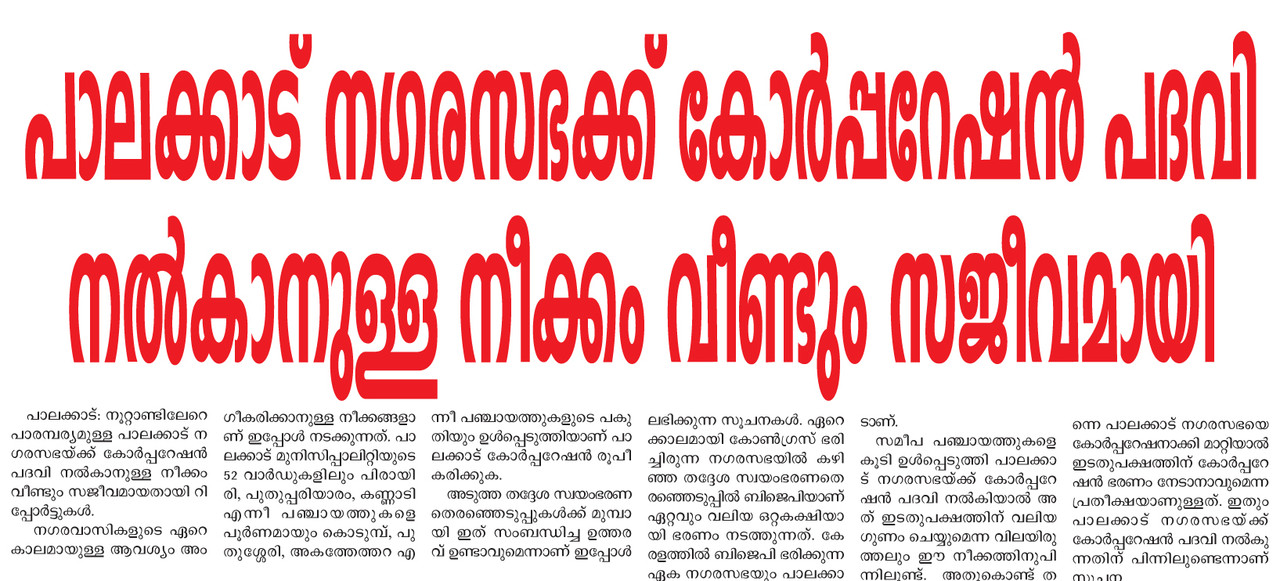
On 3 July 1866, the Governor of Madras declared Palakkad as a city.[61] The municipality of Palakkad was formed on 1 November 1866 according to the Madras Act 10 of 1865. (Amendment of the Improvements in Towns act 1850).[62] On 11 September 1912, the system of electing the city father by the councillors began.[61] City Council expanded to 28 wards in 1938, 32 wards in 1973 and 36 wards in 1978.[61] During the period 1995–98 and in 2015 when Municipality celebrated 150 years, there were proposals to upgrade Palakkad Municipality to a Municipal Corporation.[63][64][65] Palakkad Municipality has 52 wards now, headed by Municipal Chairperson.[66] The current Chairperson of Palakkad Municipality is K.Priya Ajayan and E. Krishnadas is the deputy chairman.

Proposed Palakkad Municipal Corporation

[edit]

The metropolitan area of Palakkad includes Palakkad Municipality, Hemambika Nagar, Marutharode, Mathur, Pirayiri, Pudussery West, Pudussery Central and Puthupariyaram.[37] Its urban / metropolitan population is 293,566 of which 143,650 are males and 149,916 are females. The proposed Palakkad Municipal Corporation has an area of 197.566 km2.[67] Following local bodies are the local bodies which supposed to be the part.

Education

[edit]

The city of Palakkad has number of Prominent Educational Institutions which provide a great platform for higher education.Government Victoria College, Palakkad was established in the year 1866, making it one of the oldest institution of higher learning in Kerala. First and the only Indian Institute of Technology in the state of Kerala, Indian Institute of Technology, Palakkad is located in the city. The campus currently functions in two campuses-temporary one at Ahalia Campus and the Nila campus which are separated by 13 km. It is one of the five new IITs proposed in the 2014 Union budget of India.

Government Medical College, Palakkad, started in 2014 is the first Government medical college in the district. It is the first medical college in country under Scheduled caste Development Department. NSS College of Engineering at Akathethara, is the fourth Engineering Institution established in Kerala, India. It was founded in 1960 by Nair Service Society.The college is one among the only three Govt-Aided Engineering college in Kerala and is the first Govt-Aided Engineering college accredited by NBA of AICTE. Chembai Memorial Government Music College is one of the main center of excellence in teaching Carnatic music in the state. It was given the name of the legendary Carnatic musician Chembai Vaidyanatha Bhagavathar from Palakkad. Mercy College is a women's college located in the city which was established in 1964. It is the first Women's college in the Palakkad District. The college is organized by the University Grants Commission.

Ahalia Campus is the largest Edu-health campus in Kerala. It is located about 18 km from the centre of the city consisting of a number of educational institutions and medical institutes. It has three hospitals, one medical college, one school and five colleges which includes an engineering college, college of pharmacy, college of optometry, college of paramedical sciences and college of management. Basel Evangelical Mission Higher Secondary School, located in the city was established in 1858 making it one of the oldest schools in Kerala. Government Moyan Model Girls Higher Secondary School located in College Road was founded in 1917 and is one of the largest government schools in the state and one of the schools having large strength of students studying.[69]

Healthcare

[edit]

First government medical college in the district (Government Medical College, Palakkad) is located in the city. District Hospital located in Court Road is one of biggest district hospitals in Kerala. There are also some private hospitals for serving the city. Rajiv Gandhi Co-Operative Multispeciality Hospital is a Cooperative Hospital located at Kallekkad, one of the suburbs of the city.[70]Ahalia Campus is the largest edu-health campus in Kerala located about 18 km from centre of the city, consists of 3 hospitals and 1 medical college including Ahalia Foundation Eye Hospital, Ahalia Ayurvedic Medical College and Hospital, Ahalia Diabetes Hospital and Ahalia Women and Children's Hospital.[71]

Notable people

[edit]

Culture

[edit]

Palakkad is a city where people from all religions live together with peace. Many temples, mosques churches and other religious centres are located in and around the city.[72][73] Manappullikavu Vela is one of the largest fests that takes place in the city. It is hosted by 8 sets of committees or deshams. Large crowds gather in front of the fort for witnessing the fest. Elephants and fireworks are the highlights.[74] Kalpathi Ratholsavam is an annual fest that takes place in Kalpathy, which is the first heritage village in Kerala. Chariot is the main attraction of the fest.[75] There are also many other festivals in the city where people come and enjoy with unity by forgetting about religion.

Heritage villages or mostly called by Agraharams are important as far as the city is concerned. There are around 24 heritage villages in and around the city[76] where the Tamil Brahmins migrated from parts Tamil Nadu many years before live together.[77] A Jain temple is located at Jainamedu, one of the suburbs of the city and is one of the few places in Kerala where the vestiges of Jainism in Kerala have survived.[78] Sree Emoor Bhagavathy temple located at Kallekulangara, another suburb of the city is believed to be consecrated by Parasurama for the safety of Kerala.[79] Holy Trinity English Church located near Palakkad Fort was established in the year 1855.[80] The only Urdu Juma Masjid in Kerala is located at Diara Street.[81]

A street in Kalpathy

Media

[edit]

Some of the major Malayalam and English newspapers from Kerala including Malayala Manorama, Mathrubhumi, Deshabhimani, and Suprabhaatham Daily have printing centers in the city, and there are also few evening newspapers published in the city. Local news channels like (ACV) are also functioning in the city. Palakkad Press Club is located on Robinson road, Sultanpet. A private FM Station operating in Palakkad at Ahalya Campus. There is a long-term demand for setting up a government FM Station in Palakkad. At present total number of 8 cinema halls are operational in Palakkad which screens Malayalam, English, Tamil, and Hindi movies, there are few other multiplex screens are under construction and expect to open near future in and around the city.

Sports

[edit]

Palakkad has a rich history of producing some world class athletes in the state, Palakkad, Indira Gandhi Municipal Stadium in the center of city was once used for Major sports meets and football matches in state, now the stadium is not in condition for conducting games due to the lack of maintenance, There is a proposal for the renovation of the stadium with international facilities by the Municipality,[82] The city has Fort Maidan[83] also known as Kota Maidanam, is a multi-use stadium in the center of the Palakkad, India. It is currently used mostly for cricket matches. Fort Maidan holds a maximum capacity of 10,000 people at a time. Up until 2002 the ground was considered for local cricket only.[84] In 2003, Ranji Trophy was introduced in Fort Maidan. The city has an indoor stadium[85] located near Government Victoria College, Palakkad with a total area of 100,000 square feet (9,300 m2) with commercial establishments is still unfinished & incomplete. There is a Synthetic Track with Eight lines operational in the ground of the Government Medical College, Palakkad.[86]

See also

[edit]

References

[edit]
[edit]
Revisions and contributorsEdit on WikipediaRead on Wikipedia
from Grokipedia
Palakkad is a city in the southern Indian state of Kerala, functioning as the administrative headquarters of Palakkad district. Situated in the fertile plains at the base of the Western Ghats, it lies within the Palakkad Gap—a 30 to 40 kilometer-wide topographic break in the mountain range that facilitates road and rail connectivity between Kerala and the neighboring states, earning the city its reputation as the "Gateway to Kerala." The area features a distinctive tropical climate influenced by the gap, which allows monsoon winds to penetrate inland, supporting extensive agriculture particularly paddy cultivation that has led to the district being termed the "Granary of Kerala." Historically, Palakkad's strategic location has shaped its development, with evidence of human settlement dating to the Paleolithic era and notable 18th-century fortifications like the Palakkad Fort constructed under Hyder Ali of Mysore. The city hosts modern institutions such as the Indian Institute of Technology Palakkad and serves as a commercial hub amid verdant landscapes interspersed with rivers and hills.

Etymology

Origins and historical nomenclature

The name Palakkad is derived from the words pāla (referring to the tree, known locally for its fragrant flowers) and kaṭu (meaning forest), literally translating to "forest of pāla trees," reflecting the region's historical abundance of such vegetation. This etymology is corroborated by references to the area's dense tree cover in pre-colonial accounts, where the pervasive scent of pāla blossoms is noted as a defining feature. Alternative derivations propose origins from palai nilam, signifying "dry lands" in ancient Tamil-influenced nomenclature, potentially alluding to the arid stretches around the before extensive cultivation. Another interpretation links the name to the geographic , a low pass through the , with "Palghat" emerging as an anglicized form in 18th- and 19th-century British surveys and maps, which depicted the region as a strategic trade corridor under variants like "Palghaut" or "Palicat." Historically, the settlement was known as Palakkattussery in earlier records, evolving to Palakkad by the medieval period, as evidenced by references to a Chera called Palakada dating to at least the CE. The anglicized "Palghat" persisted in colonial administrative documents until the mid-20th century, but following the formation of on January 1, 1957, from southeastern portions of the former , official nomenclature standardized to Palakkad, with the English variant phased out from government usage by 1994.

History

Pre-colonial and medieval periods

Archaeological excavations at sites like Anakkara in have uncovered megalithic burials and artifacts dating to the , approximately 1000 BCE to 500 CE, indicating early indigenous settlements focused on burial practices and rudimentary agrarian activities. These findings, including dolmens and urns, suggest a continuity of prehistoric communities using the as a natural corridor for movement between the and the Tamil plains. The , a 24-30 km wide breach in the , facilitated ancient trade routes and migrations, linking Kerala's coastal regions with interior and enabling exchanges of goods like spices and grains as early as the Sangam period (c. 300 BCE-300 CE). Under the (c. 4th century BCE-12th century CE), which controlled the Gap and adjacent valley, the area served as a principal conduit for overland commerce between the ports and eastern Tamil polities, evidenced by Roman and Arab trade records referencing southern Indian passes. Chera rulers promoted temple constructions, such as early shrines along trade paths, integrating local Dravidian cults with emerging Brahmanical influences. In the medieval period (c. 8th-16th centuries), Palakkad was governed by local chieftains including the Sekharivarma Rajas and polities like Valluvanad and Vengunad (Kollengodu), who managed agrarian estates and fortified settlements amid feuds with neighboring powers. To bolster defenses against incursions from the east, Palakkad rulers invited Tamil-speaking Brahmins (Iyers) from Tanjore, settling them in agraharams—endowed villages numbering around 18 to 64—starting in the under Sekhari Varma, fostering cultivation and Vedic scholarship. These settlements, such as , established temple-centered communities that preserved Tamil rituals distinct from native traditions. By the late medieval era, the region experienced suzerainty shifts, with forces invading via the Gap in 1510 CE, prompting local alliances and retaliations led by the of Calicut, who exerted nominal control over Palakkad chiefs through tribute systems until the early . influence integrated Palakkad into broader Malabar trade networks, though autonomous local rulers maintained authority over internal affairs like irrigation and temple patronage.

Colonial encounters and Tipu Sultan's influence

The Palakkad Fort was rebuilt and fortified in 1766 by Haider Ali, the de facto ruler of the Kingdom of Mysore, during his military campaigns to expand influence in the Malabar region. This construction served as a key defensive and logistical base amid Mysore's invasions against local rulers allied with the British East India Company. Haider Ali's forces used the fort to consolidate control over Palakkad, which provided strategic access through the Palakkad Gap to the western coast. Tipu Sultan, succeeding his father Haider Ali in December 1782, continued aggressive campaigns in Malabar from 1782 to 1790 as part of the Anglo-Mysore Wars, employing the as a staging point for operations against British positions and forces. These incursions involved Mysorean armies marching from the fort to engage in battles, contributing to regional instability and economic disruption through taxation and requisitions imposed by Tipu's administration. The campaigns culminated in the Third Anglo-Mysore War, where British forces targeted Mysorean holdings in . In November 1790, during the Third Anglo-Mysore War, British troops under Colonel James Stuart captured the , ending direct Mysorean control over the area. The British renovated the structure and used it as a military garrison until the mid-19th century, integrating Palakkad into the of the . This consolidation facilitated administrative reforms and economic extraction, including railway surveys in the 1860s that linked Palakkad to broader networks for resource transport, such as timber and spices from the . Palakkad remained under the until India's independence in 1947, with portions administered directly by British officials while adjacent areas fell under the of Cochin until states' reorganization in 1956. The fort's occupation marked a shift from Mysorean militarism to British colonial governance, emphasizing revenue collection and infrastructure development over prior invasion-driven dynamics.

Post-independence integration and development

Following the States Reorganisation Act of 1956, which restructured India's states along linguistic lines and merged the Malayalam-speaking —previously under —with Travancore-Cochin to form on November 1, 1956, the Palakkad region was incorporated into the new state. This integration aligned with broader efforts to consolidate linguistic homogeneity, transferring Palakkad's predominantly Malayalam-speaking taluks from Madras jurisdiction. The was subsequently delineated as a distinct administrative entity on January 1, 1957, encompassing southeastern portions of the former , including the taluks of Palakkad, , , , , and Mannarkad. Early development prioritized , leveraging Palakkad's alluvial plains and position as Kerala's primary rice-producing area, often termed the state's . The Kerala Land Reforms Act of 1963 fundamentally altered agrarian structures by abolishing landlordism ( system), securing tenancy rights, and enabling redistribution of surplus above ceiling limits to cultivating tenants and landless laborers. In Palakkad, where tenancy prevailed in paddy fields, the reforms conferred ownership on tenants, reducing inequality and fostering smallholder cultivation; statewide, this benefited over 1.5 million tenants by vesting rights to approximately 2 million hectares, with Palakkad's agrarian economy experiencing shifts toward intensified production amid fragmented holdings. Infrastructure initiatives complemented these reforms through irrigation expansion to mitigate rainfall variability and enhance productivity. The Malampuzha Irrigation Project, Kerala's inaugural large-scale scheme initiated in 1953 and progressively operational from 1956, irrigated about 22,554 hectares of paddy in Palakkad via its and network, significantly elevating crop yields in the Bharathapuzha basin. Additional projects, such as the Kanhirapuzha medium and components of the Gayathripuzha scheme including the Chulliar dam, extended coverage to thousands more hectares by the 1970s and 1980s, underpinning agricultural stability up to 2000. These efforts correlated with demographic expansion, as the district's rose from roughly 1.6 million in to 2.38 million by 1991, reflecting improved rural livelihoods.

Geography

Topography and the Palakkad Gap

Palakkad district features extensive fertile plains formed within the , a prominent lowland breach in the mountain range that divides the Nilgiri Hills to the north from the southern extensions of the Ghats. This gap spans approximately 32 kilometers in width and lies at elevations averaging 50 to 140 meters above , creating a relatively flat corridor amid surrounding highlands exceeding 2,000 meters. Geological evidence indicates the Palakkad Gap originated from prolonged tectonic processes, including crustal upwarping, tensional faulting, and subsequent erosion, potentially linked to thermal plume activity and regional crustal imbalances dating back millions of years. Geophysical surveys reveal thinner crustal thickness of 36 to 38 kilometers beneath the gap, contrasting with over 50 kilometers under adjacent Nilgiri regions, highlighting its structural distinctiveness. Geomorphic studies and satellite imagery further delineate the gap as a NW-SE trending lineament aligned with active brittle faults, shaping its morphology through ongoing tectonic influences. Major rivers, such as the Bharathapuzha—which originates in the and flows 209 kilometers westward through the gap—have sculpted the terrain by eroding channels and depositing alluvial sediments, fostering the area's characteristic fertile plains. These fluvial processes contribute to the region's low-relief , interspersed with minor hillocks and streams that enhance productivity in the plains. The Palakkad Gap hosts significant biodiversity hotspots, including the Silent Valley rainforest, preserved as a in 1985 after environmental campaigns in the late 1970s and early 1980s halted a proposed hydroelectric dam that endangered its endemic flora and fauna, such as the . This conservation effort underscored the gap's ecological value as a transitional zone between distinct biogeographic provinces.

Climate patterns and environmental factors

Palakkad exhibits a , with annual rainfall averaging approximately 2,163 mm based on observations from 1951 to 1980 recorded at local stations. The bulk of , peaking during the southwest from June to September, accounts for over 70% of the yearly total, though inter-annual variability introduces risks, as evidenced by IMD records showing deficits in non-monsoon years that have periodically stressed rain-fed agriculture since systematic monitoring began in 1901. Temperatures typically range from 20°C to 35°C year-round, with highs often exceeding 40°C during pre- periods (March-May), as recorded in IMD data. Heatwaves have intensified post-2000, correlating with El Niño events that delay onset and prolong dry spells, leading to extended periods of elevated temperatures; for instance, Palakkad registered 41.6°C in April 2024, among the highest for the region. This pattern, drawn from national meteorological analyses, heightens evaporation rates and exacerbates for crops during critical growth phases. Environmental factors include , with Palakkad experiencing a 3.9% loss of tree cover (8.44 kha) from 2001 to 2024, per satellite-derived assessments, contributing to altered local microclimates and increased to and runoff variability. reports for indicate broader pressures from land conversion, though district-level losses underscore risks to hydrological balance and recharge. These changes amplify variability's agricultural effects by reducing retention during erratic rainy seasons.

Natural resources and biodiversity

Palakkad district's soils primarily consist of , which predominates in upland areas and supports crops like when amended, alongside alluvial soils in riverine lowlands that enhance fertility for paddy cultivation. Other soil types include black cotton and soils, with extraction forming a key minor mineral resource; and building stones are also mined in limited quantities per geological surveys. Water resources center on the Bharathapuzha River and its tributaries, which facilitate irrigation across agricultural tracts. The Malampuzha Dam, built across the Malampuzha tributary, impounds water for a canal network irrigating 21,245 hectares, bolstering rice and cash crop productivity since its operational inception in the 1950s. Biodiversity in Palakkad, particularly in the Attappady hills, encompasses evergreen to dry deciduous forests harboring endemic flora such as Caralluma bicolor and over 66 ethnomedicinal plant species used by local tribes. Fauna includes large mammals like elephants, tigers, leopards, and gaur, with avifauna featuring species such as gray junglefowl and blue-faced malkoha; butterfly inventories record 133 species, including eight regional endemics. Wildlife surveys from the 2000s onward note habitat pressures but quantify endemic insect diversity without attributing causality to unverified narratives.

Demographics

As per the , Palakkad district had a total of 2,809,934, with a of 627 persons per square kilometer across its 4,480 square kilometers. The decadal growth rate from 2001 to 2011 was 7.35%, lower than Kerala's state average of 4.91%, reflecting slower expansion compared to earlier decades. Religious composition in 2011 showed at 66.76% (1,875,980 persons), at 28.93% (812,936), and at 4.07% (114,397), with negligible shares for other groups like (0.01%). Scheduled Castes comprised 14.37% (403,833) and Scheduled Tribes 1.74% (48,972), totaling about 16% of the , concentrated more in rural areas. The district's population was predominantly rural at 75.91% (2,133,124 persons), with urban areas accounting for 24.09% (676,810), including municipalities like Palakkad and . Projections based on trends estimate the 2025 population at approximately 3.03 million, implying an average annual growth of about 0.4% amid Kerala's broader toward aging, as indicated by data showing elevated (75.3 years state-wide in 2014-18) and rising elderly proportions.

Linguistic diversity and cultural influences

Malayalam serves as the primary language in Palakkad, spoken as the mother tongue by the majority of residents, while Tamil holds a notable presence at approximately 20% of speakers, attributable to the district's border position with . This composition, drawn from the , reflects geographic influences on linguistic distribution, with higher Tamil usage in border taluks like Chittur compared to inland areas. Bilingual proficiency in both languages exceeds 50% district-wide, enabling fluid interaction and cultural exchange, as evidenced by census bilingualism data. The Palakkad Iyer community, comprising Tamil who migrated from regions such as in , has profoundly shaped cultural since medieval times, with significant influxes documented from the onward, often encouraged by local rulers seeking administrative and scholarly expertise. These settlers established agraharams—Brahmin enclaves—that preserved Tamil ritual practices, including Vedic poojas and temple customs, while adapting to local contexts, such as hybrid festival observances blending Tamil and elements. In , their influence manifests in vegetarian dishes like pazham pori variants and sambar preparations incorporating staples like and drumstick, distinct from pure styles yet rooted in traditions of ritual purity and seasonal ingredients. Linguistic syncretism is apparent in the Palakkad dialect of Tamil spoken by Iyers, known as "Talayalam," which integrates phonology and vocabulary while retaining , as observed in community oral traditions and 19th-century manuscripts from agraharams. This fusion, supported by historical texts recording bilingual hymns and legal documents, exemplifies causal border dynamics fostering hybrid forms without supplanting dominant languages.

Migration dynamics and socio-economic impacts

Out-migration from Palakkad, particularly to Gulf countries, intensified during the and , driven by demand for semi-skilled labor in and services amid Kerala's limited local opportunities. District-level data indicate Palakkad as part of a high-emigration corridor, with northern districts contributing disproportionately to the state's 2.28 million emigrants estimated in 2011, many in Gulf destinations. Remittances from these migrants have sustained 20-30% of household income in affected households, per analyses of Kerala Migration Survey (KMS) data, though this masks variability with non-migrant families showing lower reliance. This flow peaked pre-2010s but persists, with KMS 2023 reporting Kerala-wide remittances at Rs 216,893 crores, bolstering consumption yet fostering dependency that discourages reinvestment in local sectors. Youth out-migration exacerbates brain drain, coinciding with Palakkad's rates mirroring Kerala's elevated figures of 29.9% for ages 15-29 as of recent assessments, far exceeding national averages and linked to over- relative to job availability. Educated males in the 15-29 bracket face 31.28% , prompting skilled that depletes local talent pools while remittances fund abroad, perpetuating the cycle. In-migration counters labor shortages from local aversion to manual work, with over 100,000 inter-state workers estimated in Palakkad's and sectors by the 2020s, drawn from states like and to fill gaps left by emigrant households. These migrants, comprising part of Kerala's 3.5 million internal workforce, earn daily wages of Rs 500-800 for unskilled tasks, though state averages reach Rs 807 for male agricultural labor, reflecting premiums over national norms but insufficient to attract locals preferring remittance-backed lifestyles. Such inflows sustain in labor-intensive fields, yet highlight causal disconnects where out-migration elevates opportunity costs for farm work. Socio-economic impacts include remittance-driven consumption booms clashing with agricultural decline, as labor outflows contribute to farmland abandonment amid shortages; Kerala reports indicate up to 20% of cultivable land idled in migration-prone districts like Palakkad during the , with mechanization partial and uneven. This duality—household affluence via inflows versus sectoral hollowing—underscores vulnerabilities, as remittances (36% of Kerala's NSDP) inflate asset bubbles without proportional productive investment, per CDS evaluations, while in-migrant reliance exposes gaps in skill transfer and integration.

Economy

Agricultural base and productivity

Palakkad district, often referred to as the rice bowl of , accounts for a substantial portion of the state's paddy production, historically contributing around 40-50% of total output, though this share has declined amid broader trends in cultivation area reduction. In the 2023 agricultural year, Palakkad led districts with approximately 178,130 tonnes of paddy harvested, primarily from cultivation in blocks like Chittur and . Paddy remains the dominant crop, occupying significant portions of the district's cultivable land, supported by from rivers such as the Bharathapuzha and networks, yet facing constraints from erratic rainfall distribution. Average paddy yields in Palakkad range from 2 to 3 tonnes per hectare, with common levels around 3,000 kg/ha in favorable conditions, though productivity has declined by approximately 10% since 2000 due to water scarcity exacerbated by rainfall deficits and groundwater depletion. For instance, a 54% rain deficit in recent seasons has impacted over 50,000 hectares, leading to reduced sowing and lower outputs, as seen in a 22.1% production drop in wetland categories reported for 2024. Cash crops like coconut and rubber complement paddy, with rubber plantations expanding on slopes and coconut integrated into mixed farming systems, while livestock such as cattle and poultry provide supplementary income through dairy and meat production. Approximately 60-70% of the district's workforce remains engaged in , with a heavy reliance on paddy and allied activities, reflecting the agrarian character despite pressures. Mechanization efforts intensified post-2010 through state initiatives promoting tools like tractors and harvesters to labor shortages, yet adoption rates hover around 20% based on surveys, limited by small landholdings, high costs, and fragmented implementation. Irrigation coverage, primarily from tanks and wells, supports but requires enhanced maintenance to counter , as evidenced by over 10,000 wells drying up in the past five years.

Industrial initiatives and diversification efforts

The Palakkad Industrial project received sanction for its third funding instalment of ₹300.2 on October 25, 2025, forming a key node in the Kochi-Bengaluru with a total estimated outlay of ₹3,600 across 1,710 acres in Pudussery and Kannambra. This initiative prioritizes private sector participation through infrastructure like roads, , and power, aiming to draw investments of around ₹10,000 while generating 55,000 direct and indirect jobs via hi-tech manufacturing clusters. Diversification into advanced with the KINFRA Mega Food Park, spanning 79.42 acres and operational since its inauguration at a cost of ₹102.13 , featuring centralized processing centers, cold storage, and to handle spices, fruits, and other perishables for value-added export-oriented production. Complementing this, the Indian Institute of Technology Palakkad, established in , has driven tech-linked hubs such as the Technology IHub Foundation, fostering innovation in engineering and with industry collaborations since its inception. Renewable energy efforts include farms in Agali, where the National Hydroelectric Power Corporation planned a 72 MW project on leased land, building on earlier installations like Suzlon's 4.8 MW units from 2007 to harness the region's potential for non-conventional industrial power. These projects target sustainable diversification, with central funding supporting grid integration and tribal revenue-sharing models to mitigate local impacts.

Economic challenges and policy critiques

Palakkad's agricultural sector, dominated by paddy cultivation, has faced persistent farmer distress linked to escalating input costs and inadequate minimum support prices (MSP). High wages for labor, mandated by state regulations and union influence, contribute to production expenses exceeding ₹25,000 per hectare in some cases, while procurement prices for paddy remained stagnant at around ₹20-22 per kg through much of the 2010s, failing to cover costs amid volatile market rates. This mismatch has driven indebtedness, with surveys documenting over 90 farmer suicides in Palakkad alone during targeted studies in the district, part of broader Kerala trends where agrarian crisis hotspots like Palakkad reported elevated cases tied to debt and crop failures. Labor shortages exacerbate these issues, as local workers increasingly shun farm jobs due to perceived low returns relative to welfare entitlements and alternative remittances, leading to reliance on interstate migrants who accept lower daily wages—often ₹500-800 versus locals' demands of ₹1,000-1,500 for similar tasks. State policies, including generous pensions and subsidies, have been critiqued for fostering among able-bodied , with empirical data showing Palakkad's paddy fields underutilized during peak seasons due to unavailability of local hands unwilling to engage in manual labor amid high reservation wages. This dynamic suppresses farm viability, as migrants fill gaps but introduce dependencies, with locals citing wage gaps where they require double the migrant rate to participate, perpetuating a cycle of underproduction. The so-called , often praised for social welfare, masks underlying economic stagnation in districts like Palakkad through remittances that prop up consumption but conceal a rate of 29.9% in the 15-29 age group as of 2023-24, far exceeding national averages and signaling failures in job creation. Over-regulation, including stringent land reforms and cooperative monopolies, stifles private investment in agri-tech and diversification, limiting and value addition in Palakkad's , where state interventions prioritize controls over market incentives, contributing to fiscal strains with Kerala's debt-to-GSDP ratio hovering above 34% into the 2020s. Critics attribute this to causal links between expansive welfare spending and reduced labor participation, arguing that without to encourage entry, Palakkad's agrarian economy risks further decline despite natural advantages.

Governance and Politics

Administrative framework

Palakkad functions as the headquarters of , formed on 1 January 1957 from parts of the former . The district encompasses two revenue divisions—Palakkad and Ottappalam—seven taluks (, Chittur, , , Palakkad, , and ), and 157 villages. It is further subdivided into 13 community development blocks: , Attappadi, Chittur, Kollengode, Kuzhalmannam, Malampuzha, , , Ottappalam, Palakkad, , , and Tarur. The , responsible for urban local governance in the , was established on 1 1866 under the Madras Act 10 of 1865 and is currently regulated by the Act, 1994. Classified as a Grade A , it administers civic services across an area serving a population exceeding 130,000 in the municipal limits, with the broader urban agglomeration approaching one million residents as per recent censal trends. Implementation of the Institutions in followed the 73rd , effective from 23 April 1994 via the Kerala Panchayat Raj Act, 1994. This established a three-tier including one district panchayat, 13 block panchayats, and 88 grama panchayats, with decentralized planning devolving approximately 35-40% of state plan funds to local bodies since the 1996 People's Planning Campaign. Law and order across the district is overseen by the Palakkad Police District, led by a Superintendent of Police designated as District Police Chief, coordinating multiple police stations and specialized units under the framework.

Electoral history and party dynamics

Palakkad has long served as a stronghold for left-wing parties in Kerala, with the (CPI) securing key victories in the inaugural 1957 state assembly elections, contributing to the formation of India's first democratically elected communist government. This dominance reflected early peasant and worker mobilization in the agrarian region. Over time, electoral contests evolved into triangular battles among the CPI(M)-led (LDF), Congress-led United Democratic Front (UDF), and the BJP-led (NDA), driven by demographic shifts and dissatisfaction with alternating LDF-UDF governance. The BJP's emergence gained traction in the 2020s, evidenced by its capture of the Palakkad Municipality in the December 2020 local body elections, where it won 28 of 52 wards to form a in a direct contest against LDF and UDF candidates. This upset in a traditionally bipolar Left-Congress landscape correlated with the BJP's vote share rising to approximately 25-30% in subsequent polls, linked to organizational consolidation among Hindu voters comprising over 60% of the electorate. Analysts attribute this to empirical voter responses to perceived LDF policy failures on issues like economic stagnation and cultural grievances, rather than ideological shifts alone. In the November 2024 Palakkad Assembly by-election, however, the UDF reasserted control as Rahul Mamkootathil defeated BJP's C. Krishnakumar by 18,840 votes (58,389 to 39,549), with the LDF's independent proxy placing third; turnout dipped slightly to 70.01% from prior assembly averages near 74%. This outcome, despite BJP's municipal foothold and NDA's second-place finish, underscores persistent multi-polarity, with historical turnout hovering around 70% reflecting engaged but polarized voter bases. The BJP's steady 20-25% share in recent cycles signals a structural realignment away from LDF-Congress duopoly, fueled by targeted outreach in Hindu-majority wards.

Local controversies and power shifts

In April 2025, the BJP-controlled Palakkad Municipality passed a resolution naming a skill development center for the differently abled after Rashtriya Swayamsevak Sangh (RSS) founder Keshav Baliram Hedgewar, prompting immediate opposition from Left Democratic Front (LDF) and United Democratic Front (UDF) councillors who boycotted the meeting, raised slogans against the decision, and engaged in physical scuffles with BJP members in the council hall. The move highlighted ideological tensions, with BJP leaders defending it as honoring a national figure dedicated to social service, while critics, including Congress, filed complaints alleging it promoted communalism and divided the BJP internally before the resolution's approval. Municipality officials affirmed they would not retract, underscoring BJP's push to assert cultural influence in local governance amid opposition resistance. The November 2024 Palakkad Assembly bypoll, triggered by the resignation of MLA , intensified rivalries with allegations of communal propaganda from all fronts, including CPI(M)-backed targeted ads against a BJP defector now with , and unsubstantiated claims of black money transport in a trolley against UDF Mamkootathil, which police investigations later dismissed for lack of evidence. secured a with Mamkootathil winning by over 20,000 votes, marking the largest margin in the constituency's history and signaling a power shift away from BJP's 2021 gains, though BJP leaders attributed the loss to internal dissent and defections like that of Sandeep Varier, critiquing it as evidence of tacit Left- coordination to counter Hindu consolidation. Post-poll, municipal council clashes erupted over the results, with BJP accusing opposition of undermining its local authority. Caste dynamics surfaced in land allocation disputes, notably the BJP-led municipality's May 2025 sanctioning of 20 cents of public crematorium land to the (NSS), an upper-caste organization, which opponents decried as enabling segregation and favoring dominant communities over equitable public use. Scheduled Caste (SC) communities in Palakkad face persistent land inequality, with a 2025 analysis revealing that only 12-15% of SC families own over 1 acre compared to higher rates among forward castes, despite Kerala's land reforms intended to redistribute to marginalized groups; Dalit activists have alleged misuse of SC-designated funds and lands, demanding probes into diversions that perpetuate disparities. These issues underscore uneven outcomes, where SC landlessness remains at around 23% in rural areas, fueling calls for targeted enforcement over symbolic allocations.

Infrastructure

Transportation networks

Palakkad's primary air connectivity relies on , located approximately 60 kilometers northeast across the in , serving as the nearest major aviation hub for domestic and international flights. The airport facilitates access for Palakkad residents and businesses, with road travel time typically under 1.5 hours via National Highway 544. No dedicated airport exists within the district, underscoring reliance on this cross-state link for air travel. Rail transport centers on Palakkad Junction, a key station in the classified as NSG 2, handling over 130 trains daily that connect to major cities including , , and Bengaluru. This junction supports more than 20 daily services to principal urban centers, enabling efficient passenger and freight movement through the , a historic low pass in the vital for inter-state corridors linking to Tamil Nadu's industrial hubs like . The gap's role in rail connectivity has historically facilitated commerce, from ancient routes to modern , by providing the lowest elevation crossing for lines bypassing steeper Ghats terrain elsewhere. Recent electrification upgrades, including completion of sections like Shoranur-Nilambur in March 2024, have enhanced efficiency across the Palakkad division, reducing transit times and emissions while achieving near-100% in key branches by the mid-2020s. Road networks are dominated by National Highway 544, the district's arterial route traversing the and serving as a critical lifeline for vehicular traffic between and , supporting heavy freight volumes essential to regional trade. This highway connects Palakkad to (50 km north) and Salem, handling substantial daily volumes that reflect its role in goods transport, though specific counts vary by section due to toll data limitations. (KSRTC) operates depots in Palakkad, including services to destinations like and , with multiple daily buses enhancing inter-state passenger links. These bus routes complement NH 544's capacity, providing affordable options amid the highway's congestion from mixed traffic of trucks, cars, and local vehicles.

Urban development and civic services

Palakkad Municipality manages urban primarily through the Kerala Water Authority, achieving approximately 72% coverage for urban households as reported in state economic reviews. This includes piped connections sourced from local rivers and groundwater schemes, though gaps persist due to uneven distribution and seasonal shortages, with no comprehensive public system in place, leading residents to rely on individual septic tanks for . Projects under earlier national initiatives like JNNURM contributed to upgrades, but ongoing challenges such as unregulated extraction have strained resources, affecting reliability in peripheral areas. Solid waste management involves decentralized collection and centralized processing, with the municipality operating a facility handling 110 tons per day (TPD) as per compliance reports to environmental tribunals. Efforts include door-to-door organic waste collection and composting, aligned with Solid Waste Management Project guidelines, though full implementation lags in high-density zones, resulting in occasional open dumping issues. Additional capacity expansions, such as a proposed 200 TPD integrated plant for cluster municipalities, aim to address growing urban waste volumes estimated at over 100 TPD locally. Housing development focuses on slum rehabilitation, where slums house about 11.64% of the city's , totaling 15,238 individuals across 3,404 notified areas per census data. Under Pradhan Mantri Awas Yojana-Urban (PMAY-U), the municipality implements in-situ redevelopment and subsidies, though specific sanction numbers for Palakkad remain integrated into state totals without isolated reporting, emphasizing land-as-a-resource models for private developer participation. Post-2015 urban initiatives incorporate smart elements like digital monitoring for services via the broader Palakkad Industrial project spanning 1,710 acres, indirectly supporting civic upgrades in water and waste through planned infrastructure corridors, despite the city core not being a primary nominee. The 2031 Master Plan delineates zones for to mitigate expansion pressures, prioritizing sustainable density over sprawl.

Education

Key institutions and access

Palakkad district's higher education landscape features prominent technical institutions, including the Indian Institute of Technology Palakkad (IITPKD), established in July 2015 under the Ministry of Education's expansion of IITs to foster advanced engineering and research capabilities. IITPKD commenced operations with 120 students and has grown to approximately 1,000 students across undergraduate, MS, PhD, and postdoctoral programs in disciplines such as computer science, mechanical engineering, and data science. The institute prioritizes research and development through facilities like the Central Instrumentation Facility and Micro-Nano Fabrication Facility, supporting projects in emerging technologies and interdisciplinary studies. The , Akathethara, founded in 1960 and affiliated to APJ Abdul Kalam Technological University, offers B.Tech and M.Tech degrees in core engineering fields like civil, mechanical, and , serving as a longstanding hub for technical in the region with intake capacities exceeding 500 students annually across branches. Government Engineering College Sreekrishnapuram, established in 1999, provides similar undergraduate and postgraduate engineering programs, emphasizing practical training and contributing to local skill development in areas like and . Access to higher education in Palakkad is supported by an overall district literacy rate of 89.31% as recorded in the 2011 census, though gender disparities persist with male literacy at 93.1% and female at 85.79%, potentially limiting female participation in STEM fields where enrollment gaps mirror broader trends. Vocational training addresses skill gaps, particularly for agriculture-dependent labor; the Krishi Vigyan Kendra Palakkad, operated by Kerala Agricultural University, delivers targeted programs in crop management, , and sustainable farming techniques to farmers and rural youth. Post-secondary dropout rates, estimated at 10-15% based on regional educational assessments, highlight barriers to sustained access despite high initial enrollment.

Literacy achievements and systemic issues

Palakkad district recorded a literacy rate of 89.31% in the 2011 census, with male literacy at 93.1% and female literacy at 85.79%, reflecting Kerala's broader historical push toward universal education driven by 19th- and early 20th-century efforts that established primary and secondary schools accessible to lower castes and women. These initiatives, combined with colonial-era social reforms, laid the foundation for enrollment rates exceeding 90% in subsequent decades, positioning Palakkad above the national average but below Kerala's state figure of 94%. Despite these gains, functional remains undermined by rote memorization-dominant , which prioritizes exam performance over comprehension and stifles and problem-solving skills. The Annual Status of Education Report (ASER) 2024 highlights Kerala's proficiency in basic reading—leading nationally among rural areas—but persistent deficits in arithmetic, where many students struggle with division and basic operations expected at primary levels, indicating shallow mastery rather than deep understanding. A rural-urban exacerbates inequities, with rural Palakkad households showing lower smartphone and for educational purposes compared to urban centers, limiting exposure to tools amid Kerala's uneven digital infrastructure rollout. shortcomings, including overstaffing in aided schools—evidenced by over 3,500 excess teachers statewide as of —have fostered inefficiencies, diverting resources from outcome-focused reforms to surplus personnel management without commensurate improvements in learning metrics.

Healthcare

Facilities and public health metrics

The Government District Hospital in Palakkad, affiliated with the Government Medical College, maintains a capacity of 544 teaching beds, serving as the primary public facility for secondary and tertiary care in the district. Multispecialty private hospitals, including Avitis Hospital and PK Das Hospital, supplement public infrastructure with advanced diagnostics and surgical services, handling significant outpatient loads alongside the district hospital's daily footfall of 1,300 to 1,500 patients. Ayurveda holds a traditional role in Palakkad's healthcare landscape, with dedicated institutions such as Ahalia Ayurveda Medical College Hospital providing integrated treatments for chronic conditions and wellness, reflecting the region's historical emphasis on indigenous systems alongside allopathic care. Public health metrics indicate an infant mortality rate (IMR) of 5 per 1,000 live births in the 2020s, consistent with Kerala's statewide achievement driven by robust maternal and child health programs. Vaccination coverage surpasses 90% for eligible populations, including routine immunizations and COVID-19 doses, bolstering disease prevention efforts. These gains partly stem from central initiatives like Ayushman Bharat, which have marginally lowered out-of-pocket expenditures for inpatient care in public facilities.

Challenges in service delivery

Primary Health Centres (PHCs) in rural Palakkad face significant understaffing, with government hospitals in the Malabar region, including Palakkad, experiencing acute shortages of doctors that result in prolonged wait times for patients. These vacancies, part of broader Kerala-wide gaps in medical officers at PHCs, exacerbate service delivery delays, particularly for routine consultations and emergency care in underserved areas. The highlighted systemic overload, with Palakkad recording 1,762 excess deaths and an undercount factor of 2.9 compared to official figures, indicating higher-than-reported mortality likely tied to strained public facilities and delayed interventions. This excess, reflecting a case fatality burden beyond national averages in similar contexts, underscored vulnerabilities in rural service delivery where infrastructure gaps amplified risks for vulnerable populations. Palakkad's large influx of inter-state migrant workers, concentrated in industrial and sectors, further strains services through ad hoc clinics and inadequate screening, contributing to spikes in vector-borne diseases like dengue in the 2020s. Over 55% of Kerala's migrants report major illnesses, including dengue, with Palakkad's border proximity and labor camps fostering unchecked transmission due to fragmented outreach. Residents' heavy dependence on government care, amid these shortages, often forces shifts to private providers, where out-of-pocket expenditures remain India's highest at over ₹7,889 annually, amplifying financial burdens without resolving access inequities. This reliance highlights causal mismatches between public demand and capacity, perpetuating wait times and uneven service quality.

Culture and Society

Traditions and festivals

The Kalpathy Ratholsavam, also known as the festival, is a prominent in Palakkad centered at the Sree Viswanatha Swamy Temple in village. This ten-day event, typically held in November, features Vedic recitals, traditional performances, and culminates in the pulling of massive wooden carrying deities from four associated temples by thousands of devotees over the final three days. The temple, established around 1425 AD under the patronage of local Akathethara kings with influences from , underscores a heritage dating back over 700 years, preserving rituals like flag hoisting, drum beats, and processions that reflect historical continuity from medieval settlements. Palakkad's traditions exhibit a syncretic blend of and Tamil influences, evident in the dual observance of harvest festivals and Pongal by its diverse communities, particularly the () population. , Kerala's state festival commemorating the mythical king , involves floral arrangements (pookalam), feasts (), and boat races, adapted locally with participation across Hindu, Christian, and Muslim groups, highlighting cultural integration. In contrast, Pongal, rooted in Tamil agrarian customs, marks the sun's northward journey with rituals like boiling fresh rice in milk, observed by Tamil-speaking residents to honor agricultural bounty, fostering a regional fusion where -majority practices coexist with customs such as Navarathri doll exhibitions (kolu). Folk arts originating in Palakkad further illustrate this heritage, including Ottanthullal, a satirical dance-drama form developed in the by , a poet from the nearby Killikkurissimangalam area. Performed solo with rhythmic footwork, expressive gestures, and improvised verses critiquing social norms, it draws from classical drama and local folk elements, gaining prominence as an accessible alternative to temple-based . This art form, integral to festival performances, embodies the district's of blending devotional themes with everyday , maintaining continuity through community troupes.

Media landscape and arts

Palakkad's print media is dominated by major Malayalam dailies, including , which maintains a dedicated local edition for district news coverage. Other outlets like and Desabhimani also publish content tailored to the region, reflecting Kerala's high newspaper circulation rates. These publications often incorporate bilingual elements, addressing the district's Malayalam-Tamil linguistic mix due to its border proximity to . Radio broadcasting expanded in Palakkad during the alongside Kerala's broader FM proliferation, with private stations providing local programming in . Community and institutional FM services, such as those linked to healthcare groups, offer , , and educational content accessible via frequencies like 90.4 MHz. Cinema infrastructure includes multiple halls screening films in and Tamil, accommodating audience preferences shaped by cross-border cultural exchanges. Theaters regularly feature regional releases, with Tamil dubbed or original versions drawing significant viewership in this linguistically diverse area. Theater in Palakkad encompasses amateur groups and traditional folk forms, with organizations like Navarang promoting children's theater since 2002 through structured performances emphasizing cultural narratives. Porattukali, a satirical folk theater practiced by the Panar community, integrates , and social commentary, preserving performative traditions unique to the district. Local arts draw from a multilingual cultural fabric, where literary traditions have historically reinforced Palakkad's identity by weaving motifs of regional customs and inter-community interactions into works. This influence underscores the area's composite heritage, distinct from 's coastal literary streams.

Sports and recreation

Fort Maidan, a in Palakkad with a capacity of 10,000, serves primarily as a venue and hosts state-level matches, including those organized by the Kerala Cricket Association. Athletics and football events also occur there, supporting local leagues and training. In 2024, the Kerala Cricket Association announced a ₹30 Sports Hub project on 21 acres in Palakkad, featuring two floodlit grounds, a practice net facility, and multi-sport amenities to enhance regional infrastructure. Kabaddi maintains strong grassroots appeal, particularly in semi-rural locales like Dhoni and Railway Colony, where the Railway Institute Academy trains players and fields teams in district championships. Palakkad squads have competed in state-level events, such as the 50th Kerala State Junior Girls Championship final against in November 2024, reflecting organized rural and district participation. Athletics facilities include tracks at institutions like the Palakkad Government Medical College and Kalladi Higher Secondary School, the latter hosting an operational Centre focused on youth development with capacity for 30 athletes. Local leagues and inter-school meets occur, though comprehensive participation metrics remain limited. High youth out-migration from Palakkad and —driven by pursuits of , , and improvements abroad or in urban centers—constrains sustained involvement in these activities, with surveys indicating 78% of female students citing such factors for relocation. This trend reduces talent pipelines for local leagues despite available grounds.

Notable Individuals

Political and administrative figures

Shafi Parambil, affiliated with the Indian National Congress, represented the Palakkad Assembly constituency as a Member of the Kerala Legislative Assembly from 2011 to 2016 and again from 2016 to 2021, before being re-elected in May 2021 for the 15th Kerala Legislative Assembly. His tenure emphasized youth mobilization, drawing from his early involvement with the Kerala Students' Union (KSU), where he served as state president, and broader social work initiatives in the constituency. Parambil's electoral successes, including narrow victories in competitive polls against Left Democratic Front (LDF) candidates, highlighted Palakkad's status as a swing seat, with margins such as 3,859 votes in 2021, reflecting debates over development priorities amid alternating UDF-LDF influence. In municipal governance, Sasidharan of the (BJP) was elected chairperson of the Palakkad Municipality in November 2015, securing the position after the BJP's coalition gained a in the local body elections, marking the party's first such control in . She polled sufficient votes to defeat the United Democratic Front (UDF) candidate, amid BJP's emergence in the region through alliances and voter shifts from traditional Congress-LDF dominance. Sasidharan was re-elected in January 2024 with 28 votes in the 52-member council, continuing BJP oversight post-2020 local polls. Her administration has pursued initiatives like infrastructure naming aligned with ideological figures, such as proposals to rename streets (e.g., Jinnah Nagar) and centers after RSS founder , sparking opposition protests and debates on communal harmony versus historical revisionism in local reforms. Administratively, the District Collector, an (IAS) officer, heads Palakkad operations, including revenue, law and order, and development. As of July 2025, M.S. Madhavikutty IAS holds the position. A pivotal event involving the office occurred in October 1996, when then-Collector W.R. was held hostage for nine hours by Ayyankali Pada activists using toy weapons to protest tribal land encroachments, amplifying statewide attention to and administrative responsiveness to marginalized communities without immediate policy shifts.

Cultural and scientific contributors

M. T. Vasudevan Nair (1933–2024), born on 15 August 1933 in Kudallur village of , was a leading litterateur whose novels and short stories chronicled the socio-economic transitions in rural , earning him the in 1996 for contributions to . He authored over 30 novels, including Nalukettu (1959), and scripted more than 20 films, influencing with adaptations rooted in regional realism. (1930–2005), born on 2 July 1930 in Palakkad, gained acclaim as a novelist and political cartoonist for satirical works critiquing post-independence , such as his debut novel (1969), which sold over 100,000 copies and pioneered magical realism in regional literature. His cartoons, published in outlets like , addressed corruption and existential alienation through minimalist illustrations. In , Palakkad's Tamil community has yielded instrumental innovators, notably Palghat T. S. Mani (1912–1981), born in Palakkad, who transformed accompaniment into a virtuosic art form, performing over 10,000 concerts and mentoring disciples who popularized rhythmic complexity in South Indian classical traditions. His innovations, including precise neraval and korvai techniques, were documented in recordings with vocalists like Chembai Vaidyanatha Bhagavatar, influencing global perceptions of percussion in ensembles. The Palakkad Iyer tradition emphasizes Vedic scholarship, particularly in , with agraharams serving as centers for oral transmission of texts like the ; Dr. N. V. Ramachandran, born in 1952 in Nurani village near Palakkad, has advanced this through lectures and publications promoting Advaita philosophy's logical frameworks. Among scientists, A. Mohandas, born on 15 December 1943 in Chittur near Palakkad, advanced marine as an emeritus professor at Cochin University of Science and Technology, authoring over 87 peer-reviewed papers on aquatic pathogen immunology and viral diseases in fish, with research cited more than 1,100 times.

References

Add your contribution
Related Hubs
User Avatar
No comments yet.