


Community hub
Recent from talks
Contribute something
Nothing was collected or created yet.
Panegyric
View on Wikipedia
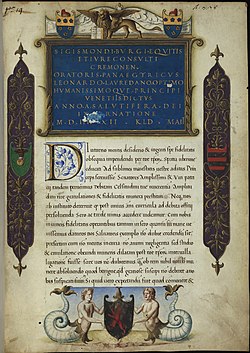
A panegyric (US: /ˌpænɪˈdʒɪrɪk/ or UK: /ˌpænɪˈdʒaɪrɪk/) or praise poem is a formal public speech or written verse, delivered in high praise of a person or thing.[1] The original panegyrics were speeches delivered at public events in ancient Athens.
Etymology
[edit]The word originated as a compound of Ancient Greek: παν- 'all' (the form taken by the word πᾶν, neuter of πᾶς 'all', when that is used as a prefix) and the word Ancient Greek: ἄγυρις, romanized: ágyris 'assembly' (an Aeolic dialect form, corresponding to the Attic or Ionic form Ancient Greek: ἀγορά, romanized: agorá). Compounded, these gave Ancient Greek: πανήγυρις, romanized: panḗgyris 'general or national assembly, especially a festival in honour of a god' and the derived adjective Ancient Greek: πανηγυρικός, romanized: panēgyrikós 'of or for a public assembly or festival'. In Hellenistic Greek the noun came also to mean 'a festal oration, laudatory speech', and the adjective 'of or relating to a eulogy, flattering'. The noun Ancient Greek: πανήγυρις, romanized: panḗgyris had been borrowed into Classical Latin by around the second century CE, as panēgyris 'festival' (in post-Classical usage also 'general assembly'). Correspondingly, Classical Latin also included the adjective panēgyricus, which appears meaning 'laudatory', but also came to function as a noun, meaning 'public eulogy'. These words inspired similar formations in European languages in the early modern period, such as French panégyrique, attested by 1512. The English noun and adjective panegyric seems to have been borrowed from the French word, but no doubt with cognisance of its Latin and Greek origins.[2]
Classical Greece
[edit]In Athens such speeches were delivered at national festivals or games, with the object of rousing the citizens to emulate the glorious deeds of their ancestors. The most famous are the Olympiacus of Gorgias, the Olympiacus of Lysias, and the Panegyricus and Panathenaicus (neither of them, however, actually delivered) of Isocrates.[1] Funeral orations, such as the famous speech of Pericles in Thucydides, also partook of the nature of panegyrics.[1]
Roman Empire
[edit]| Part of a series on |
| Rhetoric |
|---|
 |
The Romans generally confined the panegyric to the living—with the deceased receiving funeral orations instead.[1] The most celebrated example of a Latin panegyric, however, is that delivered by the younger Pliny (AD 100) in the Senate on the occasion of his assumption of the consulship, which contained a eulogy of Trajan considered fulsome by some scholars.[1] Towards the end of the 3rd and during the 4th century, as a result of the orientalizing of the Imperial court by Diocletian, it became customary to celebrate as a matter of course the superhuman virtues and achievements of the reigning emperor,[1] in a formally staged literary event. In 336, Eusebius of Caesarea gave a panegyric of Constantine the Great on the 30th year of his reign, in which he broke from tradition by celebrating the piety of the emperor, rather than his secular achievements. A well-delivered, elegant and witty panegyric became a vehicle for an educated but inexperienced young man to attract desirable attention in a competitive sphere. The poet Claudian came to Rome from Alexandria before about 395 and made his first reputation with a panegyric; he became court poet to Stilicho.
Cassiodorus, magister officiorum of Theodoric the Great, left a book of panegyrics, the Laudes. One of his biographers, James O'Donnell, has described the genre thus: "It was to be expected that the praise contained in the speech would be excessive; the intellectual point of the exercise (and very likely an important criterion in judging it) was to see how excessive the praise could be made while remaining within boundaries of decorum and restraint, how much high praise could be made to seem the grudging testimony of simple honesty".[3]
In the Byzantine Empire, the basilikos logos was a formal panegyric for an emperor delivered on an important occasion.[4]
Arabic
[edit]Panegyric poems were a major literary form among the Arabs. Writing in the Arabic language, Al-Mutanabbi wrote about Sayf al-Dawla's celebrated campaign against the Byzantine Empire.[5]
Persia
[edit]Persian language panegyric poems from the Middle Ages contain details on the life of court poets and their patrons, and shed light on contemporary attitudes and matters of political and military interest such as Farrukhi Sistani's qasida on Ghaznavid ruler Mahmud of Ghazni's incursion against the Somnath temple. Poems were composed for festivals like Eid al-Fitr, Nowruz and Mihragan. Some poems depicted the patron as a hero in a battle between Islam and infidels. Wars against Muslims required additional explanations and some poems by Farrukhi and Mu'izzi advocated in favor of Mahmud's capture of Rayy and Ahmad Sanjar's attacks against the Ghaznavid ruler Arslan-Shah in 1117. These poems are important sources for the Great Seljuq period from which few records survive.[5]
In a panegyric poem address to Mahmud of Ghazna, Firdausi said: "Noble buildings are ruined by rain and by the heat of the sun./I have laid the foundations of a high palace of poetry which will not be damaged by wind and rain." This is similar to the grandiose claims of the Roman poet Horace who says, in an address to the Emperor Augustus, that his poetry was more lasting than bronze and grander than the pyramids.[6]
Africa
[edit]African oral tradition includes panegyric customs such as praise names and praise poetry. Often these customs serve mnemonic and genealogical functions within the continent's numerous ethnic groups, and are usually also tied to tribal spirituality.
Examples include Oriki amongst the Yoruba people,[7] Isibongo amongst the Zulu people,[8] and Iziduko amongst the Xhosa people.[9]
Modern revival
[edit]The custom of panegyrics addressed to monarchs was revived in the Baroque period, though there do exist Renaissance examples such as Bruni's Laudatio florentinae urbis to Florence of 1403, and Erasmus's Panegyricus, first published in 1504. Thus, in 1660, several panegyrics were published by English poets in honour of Charles II of England coming to power. Another significant work includes the "Panegyric for the Duke of Lerma", written by the Spanish poet Luis de Góngora in 1617. Russian poets of the eighteenth century, most notably Mikhail Lomonosov, adopted the panegyric form to celebrate the achievements of Russian emperors and empresses.[citation needed]
References
[edit]- ^ a b c d e f Chisholm, Hugh, ed. (1911). . Encyclopædia Britannica. Vol. 20 (11th ed.). Cambridge University Press. pp. 676–677.
- ^ "pan-, comb. form", "panegyris, n.", "panegyric, n. and adj.", OED Online. Oxford University Press, March 2017. Web. 19 March 2017.
- ^ O'Donnell, James J. (1979). "2". Cassiodorus. Berkeley: University of California Press. ISBN 0-520-03646-8.
- ^ Kazhdan, Alexander; Jeffreys, Elizabeth M. (1991). "Basilikos Logos". In Kazhdan, Alexander (ed.). The Oxford Dictionary of Byzantium. Oxford and New York: Oxford University Press. ISBN 0-19-504652-8.
- ^ a b G.E. Tetley. The Ghaznavid and Seljuk Turks: Poetry as a Source for Iranian History. Taylor & Francis. p. 2.
- ^ G. E. Tetley. The Ghaznavid and Seljuk Turks: Poetry as a Source for Iranian History. Taylor & Francis. p. 1.
- ^ Johnson, Samuel (1921), The History of the Yorubas from the earliest times to the beginning of the British protectorate, p. 85
- ^ Turner, Noleen (1994). "A brief overview of Zulu oral traditions" (PDF). Alternation. 1 (1): 58–67. Retrieved 19 February 2022.
- ^ "African Voices". Archived from the original on 17 July 2012. Retrieved 19 February 2022.
| International | |
|---|---|
| National | |
| Other | |

Panegyric
View on GrokipediaDefinition and Etymology
Definition
A panegyric is a formal public speech or written composition that delivers elaborate, effusive praise for a person, deity, institution, event, or achievement, often employing rhetorical devices to amplify virtues and accomplishments while omitting flaws.[6] [1] In rhetorical tradition, it functions as an encomium, distinct from casual commendation by its structured oratory or prose, designed for ceremonial delivery before audiences to inspire admiration or reinforce social hierarchies.[2] [7] Originating in ancient assemblies like the Greek panegyris—a festival gathering for communal discourse—panegyrics served to publicly honor leaders, victors, or ideals, positioning the subject as an exemplar of valued traits such as courage, wisdom, or piety.[6] [8] Unlike invective, which denounces, the panegyric systematically builds exaltation through amplification, exempla, and hyperbole, though critics have noted its potential for flattery when tied to power.[9] This form extends beyond oratory to poetic or prose works, maintaining a focus on unalloyed laudation without balanced critique.[5]Etymology
The term panegyric derives from the Ancient Greek adjective panēgyrikós (πανηγυρικός), meaning "of or pertaining to a panēgýris" (πανήγυρις), a public festival or general assembly attended by all.[1][10] This compound word breaks down to pan- (παν-, from πᾶν, "all") and ēgýris (from ἁγυρίς or ἄγυρα, akin to ἀγορά, "assembly" or "gathering place").[11][12] Originally denoting orations delivered at such communal events, often featuring praise of deities, heroes, or civic achievements, the term evolved to signify elaborate laudatory discourse.[6] The word entered Latin as panegyricus, used substantively for speeches of public praise, and passed into Old French as panégyrique before appearing in English by the late 16th century, with the Oxford English Dictionary citing its earliest recorded use in 1602 in a text by William Watson.[12][13] This borrowing reflects the Roman adaptation of Greek rhetorical practices, where panegyric came to emphasize eulogies honoring rulers or virtues, distinct from its initial festival context.[10]Rhetorical Characteristics and Purpose
Key Features and Techniques
Panegyrics employ a formalized rhetorical structure rooted in classical epideictic traditions, typically commencing with an exordium to establish rapport and context, proceeding to systematic praise of the subject's ancestry, upbringing, education, accomplishments, and moral virtues, and culminating in prophecies of enduring legacy or divine favor.[14] This progression, evident in works like Isocrates' Panegyricus (delivered circa 380 BCE), allows orators to build a cumulative case for the subject's excellence through logical enumeration rather than argumentation.[15] Central techniques include amplification (Greek auxesis), which expands minor attributes into grand narratives to intensify admiration, often via detailed elaboration on deeds or qualities that might otherwise appear mundane.[16] For instance, an emperor's military victory might be amplified by invoking vast casualty figures—such as the Panegyrici Latini orators' descriptions of defeats numbering in the tens of thousands—or by layering superlatives to portray strategic genius as unparalleled.[17] Complementing this is hyperbole, a deliberate exaggeration ascribing superhuman prowess, such as likening a ruler's justice to Jupiter's thunderbolts or physical beauty to Apollo's radiance, thereby blurring mortal limits to evoke awe.[18] Orators further utilize vivid imagery through similes and metaphors, comparing the praised figure to mythic heroes like Hercules or Achilles to imply inherited or emulated greatness, while apostrophe—direct address to the subject—heightens emotional immediacy, as in Pliny the Younger's Panegyricus (100 CE), where Trajan is invoked as a living god among men.[15] Mythological allusions abound, integrating the subject into divine pantheons to legitimize rule, with rhythmic prose, antitheses, and anaphora (repetition for emphasis) ensuring memorability in oral delivery. These elements prioritize ceremonial display over forensic proof, fostering communal affirmation of hierarchy.[19]Functions in Society and Power Structures
Panegyrics served as rhetorical instruments for reinforcing social hierarchies and communal cohesion, often delivered at public festivals or assemblies to celebrate rulers, victories, or civic achievements, thereby promoting domestic peace and national unity among diverse populations.[8] In non-literate societies, such as certain African traditions, they publicized new statuses or accomplishments, enabling individuals to assert influence while flattering those in authority to secure patronage or avoid reprisal.[20] Within power structures, panegyrics functioned as mechanisms for legitimizing authority, particularly in imperial contexts like the late Roman Empire, where orators publicly praised emperors to affirm their divine right or military prowess, shaping public perception and fostering loyalty among elites and subjects.[21] This genre allowed civilian elites, trained in rhetoric, to demonstrate allegiance and gain proximity to power; for instance, in the fourth century, delivering imperial panegyrics provided access to high office or imperial favor, as seen in cases where orators transitioned from provincial governorships to central administrative roles following successful laudations.[22] Such speeches also enabled nuanced political communication, permitting rulers to project strength while orators could subtly advise, critique, or negotiate through veiled praise, thus balancing flattery with strategic influence in courtly environments.[23] In absolutist regimes, panegyrics endorsed monarchical power while allowing authors to advance their own identities or agendas, as evidenced in seventeenth-century English political poetry where praise of figures like Oliver Cromwell intertwined personal ambition with regime stabilization.[24] Across eastern and western empires in late antiquity, they operated as propaganda tools, integrating praise with historical narrative to retroactively justify transitions of power, such as during imperial successions around 360–361 CE, where panegyrics blended encomium with factual reporting to solidify new rulers' claims.[25] This dual role—bolstering the patron's legitimacy while elevating the speaker—highlighted panegyric's embedded position in patronage networks, where rhetorical skill translated into tangible political capital.[26]Historical Development in the West
Ancient Greece
In ancient Greece, the panegyric developed as a formal rhetorical genre of laudatory oratory, initially delivered at panēgyris—large religious and athletic assemblies such as the Olympic Games or Panathenaea—where speakers extolled the virtues, achievements, and cultural superiority of individual city-states to foster pan-Hellenic solidarity or competitive prestige among the poleis. These speeches, dating back to at least the fifth century BCE, emphasized historical narratives, moral exemplars, and rhetorical amplification to elevate the praised entity, often contrasting it favorably against rivals like Persia or internal competitors such as Sparta. Unlike purely epideictic encomia focused on individuals, Greek panegyrics typically addressed collective civic or pan-Greek ideals, serving diplomatic and ideological functions amid inter-polis rivalries following the Persian Wars (492–449 BCE).[1][2] The genre reached its rhetorical sophistication in the fourth century BCE through figures like Isocrates (436–338 BCE), whose Panegyricus (c. 380 BCE)—though composed for written circulation rather than oral delivery—exemplifies the form's pinnacle, spanning over 180 sections in intricate prose. In this work, Isocrates advocated for Athenian intellectual and cultural leadership over Sparta's militaristic dominance, urging a unified Greek expedition against the Persian Empire to reclaim glory lost after the Peloponnesian War (431–404 BCE); he marshaled arguments from Athens' democratic innovations, philosophical heritage, and contributions to Hellenic identity, using techniques like antithesis (e.g., Athens' nous versus Sparta's dynamis) and selective historical precedents to construct a vision of pan-Hellenism under Attic hegemony. Isocrates' text, intended partly to attract students to his rhetorical school, prioritized persuasive elegance over forensic debate, influencing subsequent orators by blending praise with policy exhortation.[27][28][29] Earlier sophistic precursors, such as Gorgias of Leontini's Encomium of Helen (c. 400 BCE), laid groundwork by defending and praising figures through probabilistic rhetoric and poetic diction, blurring lines between prose panegyric and epideictic display; however, Isocrates systematized the genre's civic-political thrust, distinguishing it from mere flattery by grounding praise in ethical and historical causality. This evolution reflected broader shifts in Greek rhetoric from Sicilian origins in legal persuasion to Attic emphases on public moral suasion, with panegyrics reinforcing power structures by legitimizing hegemonic claims through amplified virtue-signaling.[27][19]Roman Empire
In the Roman Empire, panegyric evolved from republican traditions of laudatory oratory, such as the laudatio funebris—funeral eulogies delivered by family members to honor deceased elites—and consular speeches praising magistrates upon entering office. These forms emphasized virtues like piety, valor, and public service, drawing on Greek rhetorical influences while adapting to Roman values of mos maiorum (ancestral custom). By the early imperial period, panegyrics shifted toward imperial praise, serving to legitimize autocratic rule and foster loyalty among elites and the populace.[30] A foundational example is Pliny the Younger's Panegyricus, delivered on September 1, 100 AD, before the Senate in praise of Emperor Trajan upon his assumption of the consulship. This 70-section oration contrasted Trajan's merits with the alleged tyrannies of Domitian, extolling the emperor's justice, clemency, and restoration of senatorial dignity; it was later published as a model for imperial flattery, influencing subsequent Roman orators. Pliny's work highlighted panegyric's dual role: overt adulation combined with veiled policy advice, such as advocating reduced taxation and provincial governance reforms.[31] In the late empire, panegyrics proliferated amid political instability, culminating in the Panegyrici Latini, a collection of twelve speeches compiled around 390-400 AD, spanning from Pliny's oration to addresses for emperors like Theodosius I. Delivered primarily in Gaul (e.g., Trier) between 289 and 389 AD, these works praised Tetrarchic rulers such as Maximian (e.g., a speech on April 21, 289, celebrating his quinquennalia) and Constantinian dynasty members, emphasizing military victories, divine favor, and administrative benevolence to reinforce imperial legitimacy during civil wars and usurpations. Orators, often provincial elites, used hyperbolic rhetoric—comparing emperors to gods or heroes—to navigate power structures, subtly critiquing predecessors while promoting unity.[32][33] These late Roman panegyrics reflected the genre's adaptation to autocracy, where public performance in forums or basilicas before the emperor, court, and audiences served ceremonial functions, including imperial adventus (entries) and anniversaries. Unlike earlier republican forms, they integrated Christian elements by the 4th century (e.g., in speeches to Gratian and Theodosius), blending classical encomium with emerging imperial theology, though retaining pagan rhetorical structures until the collection's Christian-era editing. Their historical value lies in illuminating obscure events, such as Diocletian's campaigns, though scholars note their stylized propaganda limits factual reliability, requiring cross-verification with inscriptions and histories like those of Ammianus Marcellinus.[34][35]Medieval and Byzantine Christianity
In the Byzantine Empire, imperial panegyrics adapted late antique Roman traditions to a Christian framework, consisting of formal orations delivered at court ceremonies such as accessions, triumphs, or New Year receptions, where emperors were depicted as God's anointed protectors of Orthodoxy.[36] These speeches employed classical rhetorical devices like auxesis (amplification) and ethopoeia (character portrayal) to exalt rulers' military prowess, justice, and piety, often portraying them as New Constantines bridging earthly authority and divine will.[37] The genre lapsed during the 7th–10th centuries amid Arab invasions and iconoclasm, with no direct attestations of such orations, though indirect praise appeared in chronicles and letters.[36] A revival occurred in the 11th century, exemplified by Michael Psellos' panegyrics to Emperor Constantine IX Monomachos (r. 1042–1055), which followed Menandre Rhetor's late antique prescriptions—commencing with origins, virtues, deeds, comparisons to predecessors, and prayers—while Psellos infused philosophical Neoplatonism and subtle critiques to advance his career.[38] In the post-1204 Palaiologan period, panegyrics shifted toward advisory functions, as in Theodore Metochites' orations to Andronikos II (r. 1282–1328), blending effusive praise of orthodoxy and victories with counsel on fiscal prudence and anti-Latin policies to guide governance.[39] This evolution reflected Byzantium's emphasis on the emperor's sacral role, where panegyric reinforced legitimacy amid dynastic instability. In Western medieval Christianity, panegyrics primarily took hagiographical form in saints' vitae, which praised holy lives as exemplars of asceticism, miracles, and martyrdom to foster devotion and clerical authority, drawing from Athanasius' Life of Antony (c. 357) as a model that integrated narrative praise with theological exhortation.[40] By the 8th–13th centuries, thousands of such texts proliferated, as in Bede's Ecclesiastical History (731) encomia to Anglo-Saxon saints or the Golden Legend (c. 1260) compilations, using hyperbolic rhetoric to highlight virtues like chastity and charity for liturgical and moral edification.[41] Funeral orations and de mortuis sermons, continuing Ambrose of Milan's 4th-century precedents, eulogized deceased clergy and rulers by enumerating pious acts and heavenly rewards, as in Gregory of Tours' 6th-century Merovingian biographies.[42] Secular variants praised kings to affirm divine-right rule, such as Venantius Fortunatus' 580 panegyric to Chilperic I, which lauded judicial reforms and orthodoxy to mend episcopal-royal tensions via Merovingian court rhetoric.[43] Einhard's Vita Karoli Magni (c. 817–836) served as a prose panegyric to Charlemagne, modeling Suetonian biography to extol conquests, reforms, and piety, thereby legitimizing Carolingian imperial ideology.[44] Later, 11th-century orations to Henry III (r. 1039–1056) by poets like Wipo blended praise of victories over Slavs with admonitions on justice, illustrating panegyric's role in Ottonian-Salian courts.[45] Unlike Byzantine imperial focus, Western forms prioritized saintly intercession over monarchical sacrality, though both subordinated praise to Christian teleology.Non-Western and Islamic Traditions
Arabic and Persian Courts
In the Umayyad Caliphate (661–750 CE), panegyric poetry, known as madīḥ, served to legitimize caliphal authority through ceremonial recitations that emphasized the ruler's prowess and divine favor, as exemplified by the Christian poet al-Akhtal's odes to caliphs like Abd al-Malik (r. 685–705 CE), which blended hyperbolic praise with invocations of pre-Islamic tribal ideals to construct an image of Islamic hegemony.[46] These works often followed the qasida structure, transitioning from nasib (amatory prelude) to overt laudation, avoiding excessive ghuluww (hyperbole) to maintain rhetorical credibility amid court rivalries.[47] Under the Abbasid Caliphate (750–1258 CE), panegyrics evolved with the adoption of badīʿ (rhetorical embellishment), a modernist style pioneered by court poets to mirror the caliphs' magnificence, as seen in odes recited during Baghdad's ceremonial audiences that praised rulers like Harun al-Rashid (r. 786–809 CE) for their justice and conquests.[48] Poets such as Ali ibn Jabala employed performative elements, embedding political appeals within praise to navigate patronage dynamics, while the genre reinforced caliphal ideology through mythologized depictions of sovereignty.[47] This tradition persisted in later courts, where madīḥ intertwined with satire (hijāʾ) to affirm loyalty amid factional intrigue.[49] In Persian courts, following the Islamic conquest, panegyric qasidas adapted Arabic models into New Persian, flourishing under dynasties like the Ghaznavids (977–1186 CE), where poets such as Farrukhi Sistani (d. ca. 1037 CE) composed odes exalting Sultan Mahmud (r. 998–1030 CE) for military victories and patronage, often invoking pre-Islamic Iranian motifs to evoke royal legitimacy.[50] By the Seljuk period (1037–1194 CE), this genre intensified in ceremonial contexts, with poets delivering praises at nowruz (New Year) receptions or hunts to affirm sultans' cosmic order, as in works by Mu'izzi (d. 1127 CE) that detailed court splendor and justice.[51] Such poetry not only secured bounties—Farrukhi reportedly received 10,000 dirhams per qasida—but also preserved historical details of campaigns and administration, though often stylized with celestial metaphors.[52] Persianate courts extended this practice, blending praise with advisory undertones; for instance, under the Buyids (934–1062 CE), who controlled Abbasid caliphs, poets like al-Mutanabbi (d. 965 CE) critiqued tyrants within laudatory frames, reflecting the genre's dual role in flattery and subtle counsel.[53] In later eras, such as the Safavids (1501–1736 CE), panegyrics continued to ritualize power, praising shahs as restorers of Shi'i orthodoxy through elaborate imagery of divine light (farr), underscoring the form's adaptability across Persian dynasties.[53]African Oral Praise Poetry
African oral praise poetry constitutes a prominent genre within sub-Saharan traditions, featuring forms like izibongo among Nguni groups such as the Zulu and Xhosa, and oriki among the Yoruba, where specialized poets recite epithets honoring chiefs, kings, or lineages through vocative address and evocation of deeds.[54] These compositions emphasize performative delivery at public events, including royal courts and ceremonies, to affirm status and encode historical events in condensed, metaphorical language.[55] In southern African variants, izibongo relies on nominalized epithets—sentence-like phrases transformed into timeless attributes, such as "he-who-floats-across-the-river" alluding to a leader's strategic exile among the Yaka—to encapsulate bravery, cunning, or genealogy, demanding shared cultural exegesis for full comprehension.[54] The imbongi (praise poet) improvises these during gatherings, blending praise with veiled critique to navigate power dynamics while entertaining and educating audiences on communal heritage.[55] Yoruba oriki in West Africa deploys similar praise names, like "Dínà-má-yà" denoting unyielding courage, often extended into narratives (ìtàn) that highlight exceptional traits or events, performed with rhythmic chant to invoke ancestral potency.[54] Across regions, these poems function to legitimize authority, preserve oral records of lineages and conquests—such as those tied to Zulu king Shaka's unification campaigns starting in 1818—and foster social cohesion by reinforcing virtues like valor and generosity.[55][56] Performances exhibit fluidity, with poets drawing from repertoires of fragments, incorporating audience interaction, and adapting to contexts like praise for warriors or subtle admonitions against hubris, thereby embedding causal links between individual actions and societal stability.[54] Though precolonial in origin, these traditions persisted amid colonial disruptions by serving resistance and identity preservation roles.[55]Early Modern Revival
Renaissance Europe
The Renaissance revival of panegyric in Europe stemmed from humanist efforts to recover and imitate classical rhetorical traditions, particularly those of ancient Greece and Rome, integrating them into contemporary civic and courtly discourse. Humanists employed panegyrics to exalt virtues of rulers, cities, and scholars, often blending praise with political advocacy to reinforce republican ideals or monarchical legitimacy. This resurgence aligned with the broader cultural movement emphasizing eloquence and antiquity, as seen in Italian city-states and Northern European courts where oratory served diplomatic and propagandistic functions.[19][57] In Italy, Leonardo Bruni's Laudatio Florentinae Urbis (c. 1403–1404), delivered as a public oration, exemplified civic panegyric by lauding Florence's government as a bastion of liberty against Milanese despotism, tracing its origins to Roman founders and emphasizing its military prowess and constitutional balance. Bruni, serving as chancellor, used the speech to inspire Florentine identity and justify expansionist policies during conflicts with Visconti Milan. Similarly, in Venice, a printed panegyric honored Doge Leonardo Loredan upon his 1501 election, portraying him as a wise steward of the republic's maritime empire and moral exemplar. Florentine diplomats frequently incorporated panegyrics into negotiations, balancing ceremonial flattery with subtle policy critiques to navigate alliances amid Italian Wars.[58] Northern humanists adapted the form for princely courts; Desiderius Erasmus presented his Panegyricus to Archduke Philip the Handsome on January 6, 1504, advocating enlightened governance through peaceful arts over conquest, critiquing martial excesses while praising Philip's Habsburg lineage and potential for just rule. Wandering poet Johannes Michael Nagonius composed verse panegyrics for rulers including Holy Roman Emperor Maximilian I (c. 1500s), King Louis XII of France, and Venice's Doge Loredan, traveling Europe to secure patronage by extolling patrons' virtues in Latin hexameters. In scholarly circles, Lorenzo Valla's 1457 oration in Rome praised Thomas Aquinas as a pinnacle of theology, though Valla's humanist critique of scholasticism infused the eulogy with reformist undertones. These works often circulated in print, amplifying their influence amid the era's growing literacy and printing press dissemination.[19][59][60] Panegyrics in Renaissance Europe thus functioned as tools for cultural prestige and power consolidation, with humanists like Bruni and Erasmus adapting ancient models to address contemporary challenges such as factionalism and absolutism, though their hyperbolic praise sometimes invited skepticism regarding sincerity versus utility.Enlightenment and Political Uses
During the Enlightenment, panegyrics adapted to political discourse by praising absolute rulers who adopted rational reforms, framing them as philosopher-kings who advanced progress without ceding power. This genre supported "enlightened absolutism," where monarchs like Frederick II of Prussia and Catherine II of Russia were lauded for policies promoting tolerance, legal codification, and administrative efficiency, thereby reconciling philosophical ideals with hereditary authority.[61] Such works often appeared in courts, academies, and printed odes, serving to consolidate loyalty amid intellectual challenges to tradition. In Russia, panegyrics proliferated after Catherine II's 1762 coup d'état, which ousted her husband Peter III; poets invoked classical and providential motifs to legitimize her rule, emphasizing her patronage of education, legal commissions, and expansionist stability over Peter's perceived pro-Prussian eccentricities.[62] [63] Gavriil Derzhavin's 1782 "Ode to Felitsa" exemplified this, portraying Catherine as a virtuous sovereign who transcended flattery by embodying moral clarity and accessibility in governance.[64] Earlier, Mikhail Lomonosov's 1755 retrospective panegyric to Peter the Great highlighted imperial labors in reform, setting a precedent for linking tsarist power to enlightenment virtues like justice and piety.[65] Across Europe, Voltaire's contributions elevated Frederick II through epistolary and poetic praise, such as his laudatory verses comparing the king to Apollo for cultivating arts amid martial duties, while underscoring Frederick's 1740 Edict of Potsdam, which invited Protestant refugees and symbolized religious pragmatism.[66] [67] Voltaire's 1750-1753 residence at Frederick's Sanssouci palace amplified these efforts, with writings that tied Prussian military successes—like the War of the Austrian Succession (1740-1748)—to enlightened rationalism, though personal rifts later tempered overt adulation. In Sweden, Carl Michael Bellman's 1777 New Year's verses to Gustav III celebrated the monarch's theatrical reforms and cultural initiatives, aligning absolutism with Nordic enlightenment aspirations.[68] Politically, these panegyrics functioned as tools for ideological alignment, disseminating reformist rhetoric to elites and publics while reinforcing monarchical control; they often exaggerated rulers' philosophical depth to counter critiques of despotism, yet drew from verifiable acts like Frederick's Anti-Machiavel (1740) treatise on benevolent rule.[69] This usage persisted into revolutionary transitions, where panegyric forms occasionally shifted to praise constitutional figures, but retained their core role in power legitimation.Modern Usage and Criticisms
19th-20th Century Examples
In the 19th century, panegyrics persisted as formal eulogies for political figures, often emphasizing national unity and moral virtues amid civil strife. Charles Sumner's eulogy for Abraham Lincoln, delivered on June 1, 1865, before the municipal authorities of Boston, extolled Lincoln's leadership in abolishing slavery through the Emancipation Proclamation of January 1, 1863, and preserving the Union during the American Civil War (1861–1865), portraying him as a martyr whose death advanced the promises of the Declaration of Independence.[70] Sumner's address, spanning over 10,000 words, drew on biblical and classical allusions to elevate Lincoln's character, though contemporaries noted its partisan tone favoring Radical Republican ideals over balanced assessment.[71] Similar orations marked European commemorations, such as those honoring monarchs or reformers, where praise intertwined with ideological reinforcement. In France, 19th-century panegyrics frequently invoked historical figures like Napoleon Bonaparte to model civic virtues, adapting ancient rhetorical forms to contemporary salon and academic settings for moral instruction.[72] The 20th century saw panegyrics evolve into instruments of nationalist mobilization, particularly in independence movements. Patrick Pearse's graveside oration for Jeremiah O'Donovan Rossa on August 1, 1915, at Glasnevin Cemetery in Dublin, lauded Rossa's lifelong Fenian activism against British rule, including his 15-year imprisonment from 1867 and exile, framing his death as a catalyst for Irish resurrection: "The fools, the fools, the fools! They have left us our Fenian dead, and while Ireland holds these graves, Ireland unfree shall never be at peace."[73] Delivered amid rising tensions leading to the Easter Rising of 1916, the speech rallied listeners by invoking Rossa's unyielding resistance, though its hyperbolic fervor reflected Pearse's romantic nationalism rather than detached biography.[73] In totalitarian contexts, panegyrics served state propaganda, distorting facts to deify leaders. Lavrentiy Beria's funeral oration for Joseph Stalin on March 9, 1953, in Moscow's Red Square, before an estimated 1 million attendees, proclaimed Stalin's genius in industrializing the USSR via Five-Year Plans starting 1928 and defeating Nazi Germany in World War II (1941–1945), attributing 27 million Soviet deaths partly to external foes while omitting internal purges that claimed millions from 1936–1938. Such addresses, broadcast nationwide, exemplified how panegyrics under communism prioritized cult-building over empirical accuracy, with later de-Stalinization in 1956 exposing their ideological fabrication.Contemporary Applications and Debates
In contemporary rhetoric, panegyric elements persist within epideictic discourse, particularly in political speeches that ceremonially praise institutions, values, or leaders to reinforce communal identity and shared virtues. For instance, Barack Obama's 2016 address in Athens has been analyzed as a panegyric to democracy, employing high praise for its historical and enduring principles to evoke certainty and evidential support for liberal ideals amid global challenges.[74] Similarly, U.S. presidential rhetoric during crises, such as responses to terrorism or national tragedies, often incorporates panegyric features to commend societal resilience and moral exemplars, aiming to consolidate public sentiment and affirm ethical norms rather than deliberate policy.[75] These applications extend to international forums, where leaders eulogize multilateral cooperation or historical alliances to legitimize ongoing geopolitical stances.[76] Beyond politics, panegyric influences modern literary and cultural forms, including poetry and public tributes that celebrate societal contributors like scientists or activists, adapting ancient praise structures to highlight empirical achievements and inspirational impact.[77] In corporate and academic settings, commencement addresses or award ceremonies deploy laudatory rhetoric akin to panegyric, extolling innovation or intellectual legacies to motivate audiences, though often tempered by data-driven examples to align with evidentiary standards.[78] Debates surrounding contemporary panegyric center on its tension with factual rigor and deliberative truth-seeking. Proponents argue it foundational to politics by publicly enacting visions of nobility, fostering civic cohesion through explicit affirmation of virtues that underpin decision-making, countering claims of mere ornamentation.[79] Critics, echoing Platonic concerns, contend epideictic praise risks epistemological shallowness, prioritizing affective sway over verifiable evidence and potentially enabling manipulation in polarized environments where ceremonial laudation masks policy shortcomings or ideological biases.[80] In an era of information saturation, scholars debate whether such rhetoric distorts causal understanding by idealizing subjects without proportionate scrutiny, urging integration with empirical validation to avoid devolving into unchecked flattery.[81] This scrutiny is amplified in analyses of media-saturated praise, where institutional biases may inflate panegyrics for aligned figures while omitting counter-evidence, underscoring the need for meta-evaluation of sources in rhetorical practice.[82]Propaganda, Flattery, and Truth Distortion
In 20th-century authoritarian regimes, panegyrics often served as vehicles for propaganda, systematically elevating leaders through hyperbolic praise that obscured policy failures and atrocities. During Rafael Trujillo's rule in the Dominican Republic (1930–1961), official discourses including panegyrics lauded the dictator's infrastructure projects and anti-communist stance while concealing systematic torture, assassinations, and the 1937 Parsley Massacre that killed up to 20,000 Haitians.[83] This flattery reinforced Trujillo's cult of personality, equating dissent with treason and enabling unchecked power consolidation over three decades.[84] Similarly, in Stalinist societies, panegyrics to Joseph Stalin portrayed him as an omniscient architect of progress, with Soviet media and speeches extolling his role in industrialization and World War II victories while omitting the Holodomor famine (1932–1933), which caused 3–5 million deaths, and the Great Purge (1936–1938) that executed over 680,000 perceived enemies.[85] Such rhetoric, embedded in state-controlled literature and oratory, distorted causal realities by attributing economic hardships to external saboteurs rather than central planning errors, fostering public acquiescence to repression.[86] Flattery in panegyrics incentivizes sycophancy among elites, who risk ostracism or worse by highlighting flaws, thereby insulating rulers from feedback and exacerbating decision-making errors. Political theorists argue this dynamic corrupts governance, as adulation supplants evidence-based assessment, akin to deception that misleads both audience and subject about competencies and outcomes.[87] In democratic settings, modern equivalents appear in campaign eulogies or media profiles that amplify achievements—such as economic growth under a leader—while downplaying scandals or data contradicting narratives, like selective reporting on policy impacts. This selective truth curation erodes epistemic standards, prioritizing loyalty over empirical scrutiny and enabling prolonged adherence to flawed ideologies or figures.[88]References
- https://en.wikisource.org/wiki/Voltaire/Chapter_20