Hubbry Logo
search
logo
2319402

Paramagnetism

logo
Community Hub0 Subscribers
Read side by side
from Wikipedia
Liquid oxygen (blue) can be suspended between the poles of a strong magnet as a result of its paramagnetism.

Paramagnetism is a form of magnetism whereby some materials are weakly attracted by an externally applied magnetic field, and form internal, induced magnetic fields in the direction of the applied magnetic field. In contrast with this behavior, diamagnetic materials are repelled by magnetic fields and form induced magnetic fields in the direction opposite to that of the applied magnetic field.[1] Paramagnetic materials include most chemical elements and some compounds;[2] they have a relative magnetic permeability slightly greater than 1 (i.e., a small positive magnetic susceptibility) and hence are attracted to magnetic fields. The magnetic moment induced by the applied field is linear in the field strength and rather weak. It typically requires a sensitive analytical balance to detect the effect and modern measurements on paramagnetic materials are often conducted with a SQUID magnetometer.

Paramagnetism is due to the presence of unpaired electrons in the material, so most atoms with incompletely filled atomic orbitals are paramagnetic, although exceptions such as copper exist. Due to their spin, unpaired electrons have a magnetic dipole moment and act like tiny magnets. An external magnetic field causes the electrons' spins to align parallel to the field, causing a net attraction. Paramagnetic materials include aluminium, oxygen, titanium, and iron oxide (FeO). Therefore, a simple rule of thumb is used in chemistry to determine whether a particle (atom, ion, or molecule) is paramagnetic or diamagnetic:[3] if all electrons in the particle are paired, then the substance made of this particle is diamagnetic; if it has unpaired electrons, then the substance is paramagnetic.

Unlike ferromagnets, paramagnets do not retain any magnetization in the absence of an externally applied magnetic field because thermal motion randomizes the spin orientations. (Some paramagnetic materials retain spin disorder even at absolute zero, meaning they are paramagnetic in the ground state, i.e. in the absence of thermal motion.) Thus the total magnetization drops to zero when the applied field is removed. Even in the presence of the field there is only a small induced magnetization because only a small fraction of the spins will be oriented by the field. This fraction is proportional to the field strength and this explains the linear dependency. The attraction experienced by ferromagnetic materials is non-linear and much stronger, so that it is easily observed, for instance, in the attraction between a refrigerator magnet and the iron of the refrigerator itself.

Relation to electron spins

[edit]
Paramagnetism, ferromagnetism and spin waves

Constituent atoms or molecules of paramagnetic materials have permanent magnetic moments (dipoles), even in the absence of an applied field. The permanent moment generally is due to the spin of unpaired electrons in atomic or molecular electron orbitals (see Magnetic moment). In pure paramagnetism, the dipoles do not interact with one another and are randomly oriented in the absence of an external field due to thermal agitation, resulting in zero net magnetic moment. When a magnetic field is applied, the dipoles will tend to align with the applied field, resulting in a net magnetic moment in the direction of the applied field. In the classical description, this alignment can be understood to occur due to a torque being provided on the magnetic moments by an applied field, which tries to align the dipoles parallel to the applied field. However, the true origins of the alignment can only be understood via the quantum-mechanical properties of spin and angular momentum.[4]

If there is sufficient energy exchange between neighbouring dipoles, they will interact, and may spontaneously align or anti-align and form magnetic domains, resulting in ferromagnetism (permanent magnets) or antiferromagnetism, respectively. Paramagnetic behavior can also be observed in ferromagnetic materials that are above their Curie temperature, and in antiferromagnets above their Néel temperature. At these temperatures, the available thermal energy simply overcomes the interaction energy between the spins.

In general, paramagnetic effects are quite small: the magnetic susceptibility is of the order of 10−3 to 10−5 for most paramagnets, but may be as high as 10−1 for synthetic paramagnets such as ferrofluids.[5]

Delocalization

[edit]
Selected Pauli-paramagnetic metals[6]
Material Magnetic susceptibility
(SI definition)
[10−5]
Platinum 26
Tungsten 6.8
Caesium 5.1
Aluminium 2.2
Lithium 1.4
Magnesium 1.2
Sodium 0.72

In conductive materials, the electrons are delocalized, that is, they travel through the solid more or less as free electrons. Conductivity can be understood in a band structure picture as arising from the incomplete filling of energy bands. In an ordinary nonmagnetic conductor the conduction band is identical for both spin-up and spin-down electrons. When a magnetic field is applied, the conduction band splits apart into a spin-up and a spin-down band due to the difference in magnetic potential energy for spin-up and spin-down electrons. Since the Fermi level must be identical for both bands, this means that there will be a small surplus of the type of spin in the band that moved downwards. This effect is a weak form of paramagnetism known as Pauli paramagnetism.

The effect always competes with a diamagnetic response of opposite sign due to all the core electrons of the atoms. Stronger forms of magnetism usually require localized rather than itinerant electrons. However, in some cases a band structure can result in which there are two delocalized sub-bands with states of opposite spins that have different energies. If one subband is preferentially filled over the other, one can have itinerant ferromagnetic order. This situation usually only occurs in relatively narrow (d-)bands, which are poorly delocalized.

s and p electrons

[edit]

Generally, strong delocalization in a solid due to large overlap with neighboring wave functions means that there will be a large Fermi velocity; this means that the number of electrons in a band is less sensitive to shifts in that band's energy, implying a weak magnetism. This is why s- and p-type metals are typically either Pauli-paramagnetic or as in the case of gold even diamagnetic. In the latter case the diamagnetic contribution from the closed shell inner electrons simply wins over the weak paramagnetic term of the almost free electrons.

d and f electrons

[edit]

Stronger magnetic effects are typically only observed when d or f electrons are involved. Particularly the latter are usually strongly localized. Moreover, the size of the magnetic moment on a lanthanide atom can be quite large as it can carry up to 7 unpaired electrons in the case of gadolinium(III) (hence its use in MRI). The high magnetic moments associated with lanthanides is one reason why superstrong magnets are typically based on elements like neodymium or samarium.

Molecular localization

[edit]

The above picture is a generalization as it pertains to materials with an extended lattice rather than a molecular structure. Molecular structure can also lead to localization of electrons. Although there are usually energetic reasons why a molecular structure results such that it does not exhibit partly filled orbitals (i.e. unpaired spins), some non-closed shell moieties do occur in nature. Molecular oxygen is a good example. Even in the frozen solid it contains di-radical molecules resulting in paramagnetic behavior. The unpaired spins reside in orbitals derived from oxygen p wave functions, but the overlap is limited to the one neighbor in the O2 molecules. The distances to other oxygen atoms in the lattice remain too large to lead to delocalization and the magnetic moments remain unpaired.

Theory

[edit]

The Bohr–Van Leeuwen theorem proves that there cannot be any diamagnetism or paramagnetism in a purely classical system. The paramagnetic response has then two possible quantum origins, either coming from permanent magnetic moments of the ions or from the spatial motion of the conduction electrons inside the material. Both descriptions are given below.

Curie's law

[edit]

For low levels of magnetization, the magnetization of paramagnets follows what is known as Curie's law, at least approximately. This law indicates that the susceptibility, , of paramagnetic materials is inversely proportional to their temperature, i.e. that materials become more magnetic at lower temperatures. The mathematical expression is: where:

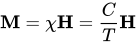
Curie's law is valid under the commonly encountered conditions of low magnetization (μBHkBT), but does not apply in the high-field/low-temperature regime where saturation of magnetization occurs (μBHkBT) and magnetic dipoles are all aligned with the applied field. When the dipoles are aligned, increasing the external field will not increase the total magnetization since there can be no further alignment.

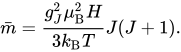
For a paramagnetic ion with noninteracting magnetic moments with angular momentum J, the Curie constant is related to the individual ions' magnetic moments, where n is the number of atoms per unit volume. The parameter μeff is interpreted as the effective magnetic moment per paramagnetic ion. If one uses a classical treatment with molecular magnetic moments represented as discrete magnetic dipoles, μ, a Curie Law expression of the same form will emerge with μ appearing in place of μeff.

Derivation

Curie's Law can be derived by considering a substance with noninteracting magnetic moments with angular momentum J. If orbital contributions to the magnetic moment are negligible (a common case), then in what follows J = S. If we apply a magnetic field along what we choose to call the z-axis, the energy levels of each paramagnetic center will experience Zeeman splitting of its energy levels, each with a z-component labeled by MJ (or just MS for the spin-only magnetic case). Applying semiclassical Boltzmann statistics, the magnetization of such a substance is
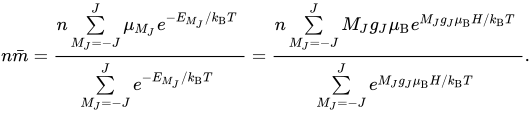
Where is the z-component of the magnetic moment for each Zeeman level, so is called the Bohr magneton and gJ is the Landé g-factor, which reduces to the free-electron g-factor, gS when J = S. (in this treatment, we assume that the x- and y-components of the magnetization, averaged over all molecules, cancel out because the field applied along the z-axis leave them randomly oriented.) The energy of each Zeeman level is . For temperatures over a few K, , and we can apply the approximation : which yields: The bulk magnetization is then and the susceptibility is given by


When orbital angular momentum contributions to the magnetic moment are small, as occurs for most organic radicals or for octahedral transition metal complexes with d3 or high-spin d5 configurations, the effective magnetic moment takes the form ( with g-factor ge = 2.0023... ≈ 2), where Nu is the number of unpaired electrons. In other transition metal complexes this yields a useful, if somewhat cruder, estimate.

When Curie constant is null, second order effects that couple the ground state with the excited states can also lead to a paramagnetic susceptibility independent of the temperature, known as Van Vleck susceptibility.

Pauli paramagnetism

[edit]

For some alkali metals and noble metals, conduction electrons are weakly interacting and delocalized in space forming a Fermi gas. For these materials one contribution to the magnetic response comes from the interaction between the electron spins and the magnetic field known as Pauli paramagnetism. For a small magnetic field , the additional energy per electron from the interaction between an electron spin and the magnetic field is given by:

where is the vacuum permeability, is the electron magnetic moment, is the Bohr magneton, is the reduced Planck constant, and the g-factor cancels with the spin . The indicates that the sign is positive (negative) when the electron spin component in the direction of is parallel (antiparallel) to the magnetic field.

In a metal, the application of an external magnetic field increases the density of electrons with spins antiparallel with the field and lowers the density of the electrons with opposite spin. Note: The arrows in this picture indicate spin direction, not magnetic moment.

For low temperatures with respect to the Fermi temperature (around 104 K for metals), the number density of electrons () pointing parallel (antiparallel) to the magnetic field can be written as:

with the total free-electron density and the electronic density of states (number of states per energy per volume) at the Fermi energy .

In this approximation the magnetization is given as the magnetic moment of one electron times the difference in densities:

which yields a positive paramagnetic susceptibility independent of temperature:

The Pauli paramagnetic susceptibility is a macroscopic effect and has to be contrasted with Landau diamagnetic susceptibility which is equal to minus one third of Pauli's and also comes from delocalized electrons. The Pauli susceptibility comes from the spin interaction with the magnetic field while the Landau susceptibility comes from the spatial motion of the electrons and it is independent of the spin. In doped semiconductors the ratio between Landau's and Pauli's susceptibilities changes as the effective mass of the charge carriers can differ from the electron mass .

The magnetic response calculated for a gas of electrons is not the full picture as the magnetic susceptibility coming from the ions has to be included. Additionally, these formulas may break down for confined systems that differ from the bulk, like quantum dots, or for high fields, as demonstrated in the De Haas-Van Alphen effect.

Pauli paramagnetism is named after the physicist Wolfgang Pauli. Before Pauli's theory, the lack of a strong Curie paramagnetism in metals was an open problem as the leading Drude model could not account for this contribution without the use of quantum statistics. Pauli paramagnetism and Landau diamagnetism are essentially applications of the spin and the free electron model, the first is due to intrinsic spin of electrons; the second is due to their orbital motion.[7][8]

Examples of paramagnets

[edit]

Materials that are called "paramagnets" are most often those that exhibit, at least over an appreciable temperature range, magnetic susceptibilities that adhere to the Curie or Curie–Weiss laws. In principle any system that contains atoms, ions, or molecules with unpaired spins can be called a paramagnet, but the interactions between them need to be carefully considered.

Systems with minimal interactions

[edit]

The narrowest definition would be: a system with unpaired spins that do not interact with each other. In this narrowest sense, the only pure paramagnet is a dilute gas of monatomic hydrogen atoms. Each atom has one non-interacting unpaired electron.

A gas of lithium atoms already possess two paired core electrons that produce a diamagnetic response of opposite sign. Strictly speaking Li is a mixed system therefore, although admittedly the diamagnetic component is weak and often neglected. In the case of heavier elements the diamagnetic contribution becomes more important and in the case of metallic gold it dominates the properties. The element hydrogen is virtually never called 'paramagnetic' because the monatomic gas is stable only at extremely high temperature; H atoms combine to form molecular H2 and in so doing, the magnetic moments are lost (quenched), because of the spins pair. Hydrogen is therefore diamagnetic and the same holds true for many other elements. Although the electronic configuration of the individual atoms (and ions) of most elements contain unpaired spins, they are not necessarily paramagnetic, because at ambient temperature quenching is very much the rule rather than the exception. The quenching tendency is weakest for f-electrons because f (especially 4f) orbitals are radially contracted and they overlap only weakly with orbitals on adjacent atoms. Consequently, the lanthanide elements with incompletely filled 4f-orbitals are paramagnetic or magnetically ordered.[9]

μeff values for typical d3 and d5 transition metal complexes.[10]
Material μeff/μB
[Cr(NH3)6]Br3 3.77
K3[Cr(CN)6] 3.87
K3[MoCl6] 3.79
K4[V(CN)6] 3.78
[Mn(NH3)6]Cl2 5.92
(NH4)2[Mn(SO4)2]·6H2O 5.92
NH4[Fe(SO4)2]·12H2O 5.89

Thus, condensed phase paramagnets are only possible if the interactions of the spins that lead either to quenching or to ordering are kept at bay by structural isolation of the magnetic centers. There are two classes of materials for which this holds:

  • Molecular materials with a (isolated) paramagnetic center.
    • Good examples are coordination complexes of d- or f-metals or proteins with such centers, e.g. myoglobin. In such materials the organic part of the molecule acts as an envelope shielding the spins from their neighbors.
    • Small molecules can be stable in radical form, oxygen O2 is a good example. Such systems are quite rare because they tend to be rather reactive.
  • Dilute systems.
    • Dissolving a paramagnetic species in a diamagnetic lattice at small concentrations, e.g. Nd3+ in CaCl2 will separate the neodymium ions at large enough distances that they do not interact. Such systems are of prime importance for what can be considered the most sensitive method to study paramagnetic systems: EPR.

Systems with interactions

[edit]
Idealized Curie–Weiss behavior; N.B. TC=θ, but TN is not θ. Paramagnetic regimes are denoted by solid lines. Close to TN or TC the behavior usually deviates from ideal.

As stated above, many materials that contain d- or f-elements do retain unquenched spins. Salts of such elements often show paramagnetic behavior but at low enough temperatures the magnetic moments may order. It is not uncommon to call such materials 'paramagnets', when referring to their paramagnetic behavior above their Curie or Néel-points, particularly if such temperatures are very low or have never been properly measured. Even for iron it is not uncommon to say that iron becomes a paramagnet above its relatively high Curie-point. In that case the Curie-point is seen as a phase transition between a ferromagnet and a 'paramagnet'. The word paramagnet now merely refers to the linear response of the system to an applied field, the temperature dependence of which requires an amended version of Curie's law, known as the Curie–Weiss law:
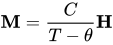
This amended law includes a term θ that describes the exchange interaction that is present albeit overcome by thermal motion. The sign of θ depends on whether ferro- or antiferromagnetic interactions dominate and it is seldom exactly zero, except in the dilute, isolated cases mentioned above.

Obviously, the paramagnetic Curie–Weiss description above TN or TC is a rather different interpretation of the word "paramagnet" as it does not imply the absence of interactions, but rather that the magnetic structure is random in the absence of an external field at these sufficiently high temperatures. Even if θ is close to zero this does not mean that there are no interactions, just that the aligning ferro- and the anti-aligning antiferromagnetic ones cancel. An additional complication is that the interactions are often different in different directions of the crystalline lattice (anisotropy), leading to complicated magnetic structures once ordered.

Randomness of the structure also applies to the many metals that show a net paramagnetic response over a broad temperature range. They do not follow a Curie type law as function of temperature however; often they are more or less temperature-independent. This type of behavior is of an itinerant nature and better called Pauli-paramagnetism, but it is not unusual to see, for example, the metal aluminium being called a "paramagnet", even though interactions are strong enough to give this element very good electrical conductivity.

Superparamagnets

[edit]

Some materials show induced magnetic behavior that follows a Curie type law but with exceptionally large values for the Curie constants. These materials are known as superparamagnets. They are characterized by a strong ferromagnetic or ferrimagnetic type of coupling into domains of a limited size that behave independently from one another. The bulk properties of such a system resembles that of a paramagnet, but on a microscopic level they are ordered. The materials do show an ordering temperature above which the behavior reverts to ordinary paramagnetism (with interaction). Ferrofluids are a good example, but the phenomenon can also occur inside solids, e.g., when dilute paramagnetic centers are introduced in a strong itinerant medium of ferromagnetic coupling such as when Fe is substituted in TlCu2Se2 or the alloy AuFe. Such systems contain ferromagnetically coupled clusters that freeze out at lower temperatures. They are also called mictomagnets.

See also

[edit]

References

[edit]

Further reading

[edit]
[edit]
Revisions and contributorsEdit on WikipediaRead on Wikipedia
from Grokipedia
Paramagnetism is a weak form of magnetism exhibited by certain materials that are attracted to an external magnetic field due to the alignment of atomic or molecular magnetic moments originating from unpaired electrons.[1] These materials possess permanent magnetic dipoles that are randomly oriented in the absence of a field, resulting in no net magnetization, but partially align with the applied field, producing a magnetization parallel to and proportional to the field strength.[2] The magnetic susceptibility of paramagnetic substances is positive but small, typically on the order of 10^{-5} to 10^{-3}, and it dominates over the weaker diamagnetic response present in all materials.[1] At the atomic level, paramagnetism arises primarily from the spin and orbital angular momentum of unpaired electrons in atoms, particularly in transition metals and rare earth elements where inner electron shells are incomplete.[2] In the absence of an external field, thermal agitation randomizes the directions of these atomic magnetic moments, leading to zero net magnetization; however, an applied magnetic field exerts a torque that favors alignment, though thermal effects limit complete orientation except at very low temperatures.[2] Examples of paramagnetic materials include aluminum, oxygen, and platinum, as well as many transition metal ions in compounds like copper sulfate.[1] The quantitative description of paramagnetism is given by Curie's law, which states that the magnetization $ M $ is proportional to the applied magnetic field $ B $ and inversely proportional to the temperature $ T $: $ M = \frac{N \mu^2 B}{3 k T} $, where $ N $ is the number of magnetic moments per unit volume, $ \mu $ is the average magnetic moment, and $ k $ is Boltzmann's constant.[2] This law holds for weak fields and high temperatures, where the alignment is small, and saturation occurs only under strong fields or cryogenic conditions.[2] The susceptibility $ \chi = \frac{M}{B} $ thus follows $ \chi = \frac{C}{T} $, with $ C $ being the Curie constant dependent on the material's properties.[1] In contrast to diamagnetism, which induces an opposing magnetization in all materials due to orbital currents and results in repulsion from magnetic fields, paramagnetism enhances the field and causes attraction, though both effects are much weaker than ferromagnetism, where cooperative interactions lead to spontaneous magnetization and hysteresis.[1] Paramagnetic behavior is temperature-dependent and reversible, disappearing above the Curie temperature for materials that transition to other magnetic states, but it plays a crucial role in applications such as magnetic resonance imaging (MRI) and low-temperature physics experiments.[2]

Fundamentals

Definition and Basic Principles

Paramagnetism refers to the weak attraction of certain materials to an external magnetic field, arising from the partial alignment of permanent atomic or molecular magnetic moments with the applied field. These moments originate primarily from unpaired electrons in the material's atoms or ions, which possess intrinsic angular momentum. Unlike stronger forms of magnetism, paramagnetism results in a positive but small magnetic susceptibility, typically on the order of 10510^{-5} to 10310^{-3} in SI units, indicating a modest enhancement of the internal magnetic field.[3][4][5] To contextualize paramagnetism among other magnetic behaviors, materials can exhibit diamagnetism, where all electrons are paired and the induced moments oppose the applied field, yielding a negative susceptibility (χ<0\chi < 0); paramagnetism, with unpaired electrons leading to weak attraction (χ>0\chi > 0, small); or ferromagnetism, involving strong interactions between moments that produce large susceptibility (χ1\chi \gg 1) and remanent magnetization even without an external field. The net magnetization MM in paramagnetic materials is linearly related to the applied magnetic field strength HH via M=χHM = \chi H, where χ\chi is the dimensionless susceptibility in SI units; this contrasts with diamagnetism, where moments are purely induced by the field rather than pre-existing.[6][4] At the atomic level, the basic principle governing paramagnetism involves the competition between the aligning torque from the external field and the randomizing effect of thermal agitation. Without a field, the magnetic moments are isotropically distributed due to thermal energy; an applied field biases this distribution according to the Boltzmann factor, favoring orientations parallel to the field and resulting in a small net magnetization. This thermal averaging leads to a temperature-dependent susceptibility for paramagnets, unlike the temperature-independent induced moments in diamagnets. The magnitude of individual atomic magnetic moments derives from both spin and orbital contributions to the total angular momentum, expressed as μ=gμBJ\vec{\mu} = -g \mu_B \vec{J}, where μB=e/(2me)\mu_B = e \hbar / (2 m_e) is the Bohr magneton, gg is the Landé g-factor (accounting for spin-orbit coupling), and J\vec{J} is the total angular momentum vector.[2][4][7]

Historical Development

The discovery of paramagnetism emerged during investigations into magnetic properties of materials in the mid-19th century. In 1845, Michael Faraday identified paramagnetic substances, such as salts of iron, which exhibited weak attraction to magnets, while studying diamagnetism in materials like bismuth. These observations distinguished paramagnets from strongly magnetic ferromagnets and repelled diamagnets, laying the groundwork for classifying material responses to magnetic fields. Faraday's experiments, conducted using electromagnets, demonstrated that paramagnetic materials align with external fields but retain no permanent magnetization once the field is removed.[8] Progress in the late 19th century focused on the temperature dependence of magnetic behavior. William Thomson, later Lord Kelvin, contributed by formalizing the concept of magnetic susceptibility in 1850, providing a mathematical framework to quantify weak magnetic responses.[9] Building on this, Pierre Curie's 1895 doctoral thesis systematically examined paramagnetic salts, establishing that magnetic susceptibility varies inversely with absolute temperature, formulated as Curie's law; the associated proportionality constant, known as Curie's constant, honors his contributions.[9] The advent of quantum mechanics in the early 20th century provided theoretical explanations for paramagnetic atomic moments. Paul Langevin developed a classical statistical model in 1905, treating paramagnetic atoms as dipoles aligning with fields, which predicted the temperature dependence observed by Curie. Niels Bohr's 1913 quantum atomic model incorporated quantized angular momentum, accounting for permanent magnetic moments in atoms.[10] Wolfgang Pauli's work on quantum statistics further elucidated electron configurations underlying these moments. In the 1920s, spectroscopic techniques, including analysis of the anomalous Zeeman effect, confirmed the presence of unpaired electrons in paramagnetic substances like transition metal ions.[11] Key theoretical and experimental milestones followed in subsequent decades. In the 1930s, extensions of Pierre Weiss's mean-field theory, originally for ferromagnetism, were applied to paramagnetic systems, incorporating interactions to refine susceptibility predictions near transition temperatures.[12] Post-World War II advancements included the 1964 invention of superconducting quantum interference devices (SQUIDs) by Jaklevic, Lambe, Mercereau, and Silver, enabling precise measurements of magnetic susceptibility at low temperatures and validating quantum models of paramagnetism.[13]

Microscopic Origins

Electron Spin and Unpaired Electrons

Paramagnetism arises primarily from the presence of unpaired electrons in atoms, ions, or molecules, which possess a net spin angular momentum. Each electron has an intrinsic spin quantum number $ s = 1/2 $, and when electrons in a subshell are unpaired, the total spin angular momentum $ \mathbf{S} $ is non-zero, leading to a magnetic moment. The spin magnetic moment is given by $ \boldsymbol{\mu}_s = -g_s \mu_B \mathbf{S} $, where $ g_s \approx 2 $ is the electron spin g-factor and $ \mu_B $ is the Bohr magneton. This moment aligns with or against an external magnetic field, resulting in a net magnetization when thermal energy allows partial alignment. In contrast, paired electrons in filled subshells cancel their spins, yielding no net moment and diamagnetic behavior.[14][5] The configuration of electrons in partially filled subshells follows Hund's rules, which maximize the total spin $ S $ by placing electrons in degenerate orbitals with parallel spins before pairing occurs. This maximizes the multiplicity $ 2S + 1 $ of the ground state, enhancing the magnetic moment.[15] For example, in the oxygen molecule (O₂), molecular orbital theory predicts two unpaired electrons in the $ \pi^* $ antibonding orbitals, resulting in a triplet ground state with $ S = 1 $ and observable paramagnetism, as confirmed by its attraction to magnetic fields.[16] Such atomic or molecular configurations with unpaired spins are responsible for the weak attraction to external fields characteristic of paramagnetic materials. In solid-state materials, the degree of paramagnetism depends on electron delocalization. Itinerant s and p electrons in metals are delocalized, forming conduction bands that exhibit weak Pauli paramagnetism due to spin polarization near the Fermi level, without large atomic moments. In contrast, d and f electrons in transition metals and lanthanides are often more localized, especially in ionic compounds, leading to stronger atomic-like moments from unpaired spins. Transition metals in the d-block dominate paramagnetism due to incomplete d subshells (d¹ to d⁹ configurations), while lanthanides in the f-block show pronounced effects from unpaired 4f electrons in incomplete f shells, except for f⁰ (La³⁺) and f¹⁴ (Lu³⁺) cases, which are diamagnetic.[17][18] In coordination compounds of transition metals, ligand field splitting further influences the number of unpaired d electrons. Ligands create an electrostatic field that splits the degenerate d orbitals into lower-energy t₂g and higher-energy e_g sets in octahedral complexes; weak-field ligands result in high-spin configurations with more unpaired electrons and stronger paramagnetism, while strong-field ligands favor low-spin pairing and reduced moments. For degenerate ground states, such as d⁹ (e.g., Cu²⁺) or high-spin d⁴ configurations, the Jahn-Teller effect causes geometric distortions to remove degeneracy, stabilizing the structure while preserving unpaired spins and paramagnetism.[19] These effects highlight how environmental factors modulate spin contributions in molecular systems.

Orbital and Other Contributions

In paramagnetism, the orbital angular momentum of electrons contributes to the magnetic moment through the motion of electrons around the nucleus, generating a magnetic dipole. The orbital magnetic moment is given by μL=μBL\vec{\mu}_L = -\mu_B \vec{L}, where μB\mu_B is the Bohr magneton and L\vec{L} is the orbital angular momentum operator (with the quantum number LL determining its magnitude in units of \hbar).[20] This contribution aligns with an external magnetic field, enhancing the overall paramagnetic response, though it is often smaller than the spin contribution in many systems.[21] In solids, the orbital angular momentum is frequently quenched by crystal fields, which split the degenerate orbital states and reduce the expectation value of LzL_z to near zero, minimizing its paramagnetic effect.[22] However, in ions with low crystal field symmetry or in free atoms, the orbital moment remains active and can significantly influence susceptibility.[23] Spin-orbit coupling further modifies this by mixing spin and orbital degrees of freedom, particularly in heavier atoms where the relativistic interaction is stronger due to higher nuclear charge.[24] The effective g-factor accounting for this coupling is g=1+J(J+1)+S(S+1)L(L+1)2J(J+1)g = 1 + \frac{J(J+1) + S(S+1) - L(L+1)}{2J(J+1)}, where JJ, SS, and LL are the total, spin, and orbital angular momentum quantum numbers, respectively.[25] Beyond electron spin and orbital effects, minor contributions arise from nuclear spins and higher-order perturbations. Nuclear paramagnetism stems from the alignment of nuclear magnetic moments, yielding a very weak susceptibility on the order of χn108\chi_n \sim 10^{-8} (in cgs units), typically observable only at low temperatures where thermal energy is comparable to the nuclear Zeeman splitting.[26] Van Vleck paramagnetism provides a temperature-independent positive susceptibility through second-order perturbation mixing of the ground state with excited orbital states, arising from off-diagonal matrix elements of the Zeeman Hamiltonian.[27] Rare earth ions exhibit pronounced orbital effects due to their shielded 4f electrons, which experience weaker crystal field perturbations compared to 3d electrons, preserving significant orbital angular momentum.[28] The total magnetic moment for these ions is μJ=gμBJ(J+1)\mu_J = g \mu_B \sqrt{J(J+1)}, reflecting the combined influence of spin-orbit coupling on the JJ multiplet.[28] For example, in Gd3+^{3+} (4f7^7 configuration), the half-filled shell results in L=0L = 0, S=7/2S = 7/2, J=7/2J = 7/2, and g=2g = 2, quenching the orbital moment and yielding a pure spin-only paramagnetism of μJ=7.94μB\mu_J = 7.94 \mu_B.[20]

Theoretical Frameworks

Curie's Law and Susceptibility

In non-interacting paramagnetic systems, Curie's law describes the temperature dependence of the magnetic susceptibility χ, which is given by χ = C / T, where C is the Curie constant and T is the absolute temperature. This law applies to systems with fixed magnetic moments, such as those arising from unpaired electrons in isolated atoms or ions, under the condition that thermal energy significantly exceeds the magnetic energy, i.e., k_B T ≫ μ B, where k_B is Boltzmann's constant, μ is the magnetic moment, and B is the applied magnetic field. The Curie constant C is expressed as C = N μ² / (3 k_B), with N denoting the density of magnetic moments.[20][29] The derivation of Curie's law originates from statistical mechanics applied to classical magnetic dipoles. For a single dipole in a magnetic field B along the z-direction, the average z-component of the moment is ⟨μ_z⟩ = μ [coth(x) - 1/x], where x = μ B / (k_B T) and the term in brackets is the Langevin function L(x). At high temperatures, where x ≪ 1, this approximates to ⟨μ_z⟩ ≈ (μ² B) / (3 k_B T). For N non-interacting dipoles, the magnetization M = N ⟨μ_z⟩ ≈ (N μ² B) / (3 k_B T). The susceptibility χ, defined as χ = μ_0 (∂M / ∂B) in SI units (with μ_0 the permeability of free space), then yields χ = μ_0 N μ² / (3 k_B T) = C / T, confirming Curie's law.[20][27] For quantum mechanical systems with total angular momentum quantum number J, the Langevin function is replaced by the Brillouin function B_J(x), where x = g_J μ_B J B / (k_B T), g_J is the Landé g-factor, and μ_B is the Bohr magneton. The average moment becomes ⟨μ_z⟩ = g_J μ_B J B_J(x), and at high temperatures (x ≪ 1), B_J(x) ≈ \frac{J+1}{3J} x, leading to the same Curie form χ = C / T with C = N (g_J μ_B)^2 J(J+1) / (3 k_B). This quantum generalization approximates the classical result for J > 1/2.[27][30] Curie's law holds for dilute gases or isolated ions where interactions between moments are negligible, such as in paramagnetic salts like CuSO₄·5H₂O, where experimental measurements of susceptibility versus 1/T show linear behavior consistent with the law over a wide temperature range. However, it breaks down near temperatures where magnetic ordering occurs, as thermal fluctuations no longer dominate. For systems with weak interactions, the Curie-Weiss law extends this to χ = C / (T - θ), where θ is the Weiss mean-field temperature reflecting cooperative effects, though θ ≈ 0 for truly non-interacting paramagnets.[20][29]

Pauli Paramagnetism and Band Effects

Pauli paramagnetism arises in metals from the response of conduction electrons to an external magnetic field, where the spins of delocalized electrons align preferentially without thermal activation dominating the behavior. In the free electron gas model, the application of a magnetic field $ B $ shifts the energy levels of spin-up and spin-down electrons by $ \Delta E = \pm \mu_B B $, where $ \mu_B $ is the Bohr magneton. This shift causes a slight imbalance in the populations of spin-up and spin-down electrons near the Fermi level, as the Fermi surfaces for the two spin species adjust to maintain the total electron density. For a degenerate Fermi gas at low temperatures, the difference in electron numbers leads to a magnetization $ M = \mu_B^2 B g(E_F) $, where $ g(E_F) $ is the density of states at the Fermi energy $ E_F $ for both spin directions.[31] The resulting Pauli paramagnetic susceptibility is temperature-independent, $ \chi_\text{Pauli} = \mu_0 \mu_B^2 g(E_F) $, because only electrons within $ \sim k_B T $ of $ E_F $ contribute significantly, but the effect saturates due to the Pauli exclusion principle in the degenerate gas. For a simple free electron gas, the density of states $ g(E_F) = \frac{3n}{2 E_F} $, where $ n $ is the electron density, yields $ \chi = \frac{3 \mu_0 \mu_B^2 n}{2 E_F} $. This weak paramagnetism is observed in alkali metals like sodium and potassium, with susceptibilities on the order of $ 10^{-5} $ emu/mol, consistent with their nearly free s-electron conduction bands.[31][17] In real metals, particularly transition metals, band structure effects enhance the Pauli susceptibility beyond the free electron prediction. The density of states $ g(E_F) $ can be significantly larger due to narrow d-bands near $ E_F $, leading to stronger spin polarization. Additionally, electron-electron interactions introduce an exchange enhancement through the Stoner model, where the effective susceptibility becomes $ \chi = \frac{\chi_\text{Pauli}}{1 - I \chi_\text{Pauli}/\mu_0} $, with $ I $ the Stoner exchange integral representing the Coulomb repulsion strength. The system becomes unstable to ferromagnetism when the Stoner criterion $ I g(E_F) > 1 $ is met, marking the transition from paramagnetism to spontaneous magnetization.[32][33] Palladium exemplifies these band effects, exhibiting a strongly enhanced Pauli susceptibility due to its high $ g(E_F) $ from d-band contributions and a Stoner parameter close to the critical value, placing it near the ferromagnetic instability without developing long-range order. This enhancement results in a susceptibility roughly an order of magnitude larger than in alkali metals, highlighting the role of band narrowing and interactions in itinerant electron magnetism.[32]

Experimental Examples

Materials with Unpaired Electrons

Paramagnetic materials with unpaired electrons typically exhibit behavior dominated by localized magnetic moments from atoms or ions, where interactions between moments are minimal, leading to susceptibility that follows Curie's law at sufficiently high temperatures. Atomic and molecular paramagnets, such as dioxygen (O₂) gas, demonstrate this through their triplet ground state, which features two unpaired electrons in antibonding π* orbitals, resulting in a net spin of S=1 and observable paramagnetism even in the gaseous phase.[34][35] Similarly, nitric oxide (NO) is paramagnetic due to its single unpaired electron in the π* orbital, conferring a spin of S=1/2 and high reactivity associated with this free radical state.[36][37] In ionic compounds, transition metal salts provide classic examples of paramagnetism from unpaired d-electrons. Manganese(II) sulfate monohydrate (MnSO₄·H₂O) features Mn²⁺ ions with a high-spin d⁵ configuration (S=5/2), yielding a large effective magnetic moment of approximately 5.9 μ_B; its molar susceptibility adheres closely to Curie's law above about 1 K, with deviations at lower temperatures due to weak crystal field effects.[38] Rare earth compounds, particularly salts of Gd³⁺ with its f⁷ configuration (S=7/2, L=0), exhibit the highest free-ion moment among lanthanides at μ=7.94 μ_B, making gadolinium sulfate octahydrate (Gd₂(SO₄)₃·8H₂O) a standard for paramagnetic salts used in low-temperature thermometry down to millikelvin scales.[39] Certain metals display weak paramagnetism arising from conduction electrons rather than localized unpaired spins. Aluminum and platinum exemplify Pauli paramagnetism, where the susceptibility is temperature-independent and stems from the spin polarization of electrons near the Fermi level, with values around χ ≈ 1.65 × 10⁻⁵ emu/mol for aluminum and slightly higher for platinum due to enhanced density of states.[40][41] At ultralow temperatures, nuclear paramagnetism becomes prominent in liquid helium-3 (³He), where the spin-1/2 nuclei contribute a Curie-like susceptibility observable below 10 mK, enabling precise magnetization measurements in dilution refrigerators.[42][43] Susceptibility in these materials is commonly measured using the Gouy balance, which quantifies the force on a sample in a magnetic field gradient, or via magnetization curves from superconducting quantum interference device (SQUID) magnetometers. The effective moment μ_eff is derived by fitting the Curie constant C in the relation χ = C/T, where C = N μ_eff² / (3 k_B) with N as the number of magnetic ions per mole and k_B Boltzmann's constant, providing a direct assessment of the unpaired electron contribution.[44][45]

Interacting Systems and Superparamagnets

In paramagnetic systems where magnetic ions interact through exchange coupling, the temperature dependence of magnetic susceptibility deviates from the simple Curie law, following instead the Curie-Weiss law χ=CTθ\chi = \frac{C}{T - \theta}, where θ\theta is the Weiss temperature that reflects the strength and sign of interactions.[45] For antiferromagnetic precursors, θ\theta is negative, indicating dominant antiferromagnetic exchange that suppresses susceptibility at lower temperatures without long-range order. A representative example is found in nickel(II) salts such as NiBr2_2·6H2_2O, which exhibit Curie-Weiss behavior above ~70 K with θ6\theta \approx -6 K, signaling short-range antiferromagnetic correlations among Ni2+^{2+} ions (S=1).[46] In molecular magnets, interactions between spins are often described by the Heisenberg Hamiltonian H=2JSiSjH = -2J \mathbf{S}_i \cdot \mathbf{S}_j, where J is the isotropic exchange coupling constant (positive for ferromagnetic, negative for antiferromagnetic) and Si,Sj\mathbf{S}_i, \mathbf{S}_j are neighboring spin operators. This model captures the effective field arising from neighboring moments, leading to modified susceptibility consistent with Curie-Weiss fits incorporating θzJS(S+1)/3kB\theta \propto zJS(S+1)/3k_B (z = number of neighbors). Such systems, like dinuclear Ni(II) complexes, show antiferromagnetic J values on the order of -10 to -100 cm1^{-1}, resulting in ground states with reduced effective moments compared to isolated ions.[47] Superparamagnetism emerges in ferromagnetic or ferrimagnetic nanoparticles with dimensions below ~10 nm, where the entire magnetic moment behaves as a single giant spin, but thermal fluctuations allow rapid reorientation over an anisotropy energy barrier. Above the blocking temperature TB=KVkBln(τ/τ0)T_B = \frac{KV}{k_B \ln(\tau / \tau_0)}, where K is the magnetocrystalline anisotropy constant, V is the particle volume, kBk_B is Boltzmann's constant, τ\tau is the measurement timescale (~100 s for DC magnetization), and τ0109\tau_0 \approx 10^{-9} to 101110^{-11} s is the attempt time, the assembly mimics a paramagnet with large effective moment μeff=gS(S+1)μB\mu_{eff} = g \sqrt{S(S+1)} \mu_B (S total spin). Below TBT_B, moments freeze into metastable states, yielding remanent magnetization and coercivity. This phenomenon was first theoretically described by Néel in 1949 for assemblies of fine ferromagnetic particles.[48] The dynamics of superparamagnetic switching are governed by the Néel relaxation time τ=τ0exp(Ea/kBT)\tau = \tau_0 \exp(E_a / k_B T), where Ea=KVE_a = KV is the anisotropy barrier height. At temperatures where τ\tau exceeds the experimental timescale, blocking occurs; otherwise, thermal activation enables fast relaxation, restoring paramagnetic-like response. This exponential dependence highlights the sensitivity to size and temperature, with smaller particles exhibiting lower TBT_B. Specific examples illustrate these effects. The iron cores in ferritin, a protein that stores ~4500 Fe atoms as ferrihydrite nanoparticles (~5-8 nm diameter), display superparamagnetism with TB2040T_B \approx 20-40 K depending on iron loading, as the core's ferrimagnetic ordering yields a net moment of ~200-600 μB\mu_B that relaxes via Néel processes.[49] Similarly, the molecular cluster Mn12_{12}-acetate ([Mn12_{12}O12_{12}(CH3_3COO)16_{16}(H2_2O)4_4]), with a ground state S=10 and axial anisotropy D ≈ -0.5 cm1^{-1}, shows slow magnetization relaxation below ~3 K due to a high barrier (~25 K), but paramagnetic blocking above this temperature; this was seminal in identifying single-molecule magnets. In interacting paramagnets and superparamagnets, susceptibility-temperature (χ\chi-T) plots often deviate from Curie-Weiss linearity, showing an upturn at low T (<10-20 K) due to short-range correlations or surface effects that enhance low-field response. Mössbauer spectroscopy confirms these dynamics by resolving hyperfine splitting collapse in superparamagnetic regimes, where fluctuating fields broaden lines or yield paramagnetic doublets, as observed in iron oxide nanoparticles with relaxation rates matching Néel predictions.[50]

Comparisons and Applications

Relation to Other Magnetic Behaviors

Paramagnetism differs from diamagnetism in that all materials exhibit a weak diamagnetic response characterized by induced magnetic moments opposing the applied field, resulting in a negative magnetic susceptibility (χ < 0) typically on the order of -10^{-5}.[45] In paramagnetic materials, this diamagnetic contribution is present but overshadowed by the positive paramagnetic susceptibility (χ > 0) arising from unpaired electrons, with the total susceptibility given by χ = χ_dia + χ_para.[51] In contrast to ferromagnetism, paramagnetism lacks spontaneous magnetic ordering below a critical temperature, requiring an external field to align moments, whereas ferromagnets exhibit permanent magnetization due to cooperative interactions.[52] The transition from ferromagnetism to paramagnetism occurs at the Curie temperature T_C, above which thermal disorder disrupts alignment; for example, iron becomes paramagnetic above 1043 K.[52] Antiferromagnetism features alternating spin alignments that cancel net magnetization, unlike the net alignment in paramagnets, yet both show similar high-temperature susceptibility following the Curie-Weiss law, with antiferromagnets distinguished by a negative Weiss constant θ < 0 reflecting antiferromagnetic interactions.[53] The onset of antiferromagnetic ordering happens at the Néel temperature T_N, below which susceptibility deviates from paramagnetic behavior.[54] Certain systems exhibit transitions involving paramagnetism, such as metamagnetism, where an applied magnetic field induces a shift from an antiferromagnetic ground state to a paramagnetic or weakly ferromagnetic configuration.[55] In frustrated magnetic systems, quantum paramagnets can emerge as disordered states without long-range order, exemplified by quantum spin liquids where competing interactions prevent classical ordering even at low temperatures.[56] In superconductors, the Meissner effect enforces perfect diamagnetism, suppressing any underlying paramagnetism by expelling magnetic fields from the interior.[57] Heavy-fermion systems like CeCu_6 represent non-ordering paramagnets, where strong electron correlations enhance effective masses but maintain paramagnetic behavior down to millikelvin temperatures without magnetic transitions.[58]

Practical Uses and Measurements

Paramagnetism is measured using various techniques that quantify magnetic susceptibility and related properties. Static methods, such as the Faraday balance, determine the temperature-dependent magnetic susceptibility χ(T) by measuring the force on a sample in a magnetic field gradient, providing insights into paramagnetic behavior over a wide temperature range up to 800 K.[59] Dynamic AC susceptibility measurements assess frequency-dependent responses, revealing relaxation processes and distinguishing paramagnetic contributions from other magnetic effects in materials.[60] For ultra-low temperatures down to microkelvin ranges, superconducting quantum interference device (SQUID) magnetometry offers exceptional sensitivity, detecting magnetic moments as small as 10^{-6} emu and enabling precise studies of paramagnetic salts in cryogenic environments.[61] Advanced spectroscopic tools further characterize paramagnetism at the atomic level. Electron paramagnetic resonance (EPR) spectroscopy probes unpaired electrons in paramagnetic species, yielding the g-factor—which reflects the local magnetic environment—and hyperfine splitting from interactions with nearby nuclei, essential for identifying spin states in transition metal complexes.[62] Nuclear magnetic resonance (NMR) spectroscopy detects shifts in nuclear resonances due to paramagnetic effects, where unpaired electrons induce large, temperature-dependent frequency shifts via hyperfine interactions, allowing quantification of nuclear paramagnetism in coordination compounds.[63] Practical applications leverage paramagnetism's responsiveness to magnetic fields. In magnetic resonance imaging (MRI), gadolinium(III) (Gd^{3+}) ions serve as contrast agents, enhancing T1 relaxation times of nearby water protons through their seven unpaired electrons, improving image contrast for diagnostic purposes.[64] Paramagnetic oxygen sensors exploit the paramagnetism of O_2 molecules, which are deflected in a magnetic field gradient according to the Pauling principle, enabling accurate gas analysis in concentrations from trace levels to atmospheric, with response times as low as 130 ms in differential setups.[65] Adiabatic demagnetization refrigeration uses paramagnetic salts, such as gadolinium-based compounds in "salt pills," to achieve cooling to around 10 mK by aligning spins in a field and then isolating the system to allow entropy redistribution, a key technique for millikelvin cryostats.[66] Emerging uses extend paramagnetism into advanced technologies. In quantum computing, paramagnetic spins from unpaired electrons function as qubits, as demonstrated in fluorescent-protein-based systems where optical addressing enables coherent control and readout for potential hybrid quantum-biological interfaces.[67] Site-directed spin labeling (SDSL) in biochemistry attaches paramagnetic nitroxide groups to proteins, allowing electron paramagnetic resonance (EPR) to monitor conformational dynamics and inter-residue distances across timescales from nanoseconds to seconds.[68] Measurements require careful calibration and error mitigation. The compound mercury tetrathiocyanatocobaltate(II), Hg[Co(SCN)_4], serves as a standard for magnetic susceptibility with a known value of 16.44 \times 10^{-6} emu/g at 293 K, used to determine instrument constants in Faraday and Gouy methods.[69] Common error sources include sample impurities, such as iron contaminants contributing spurious moments up to 10^{-5} emu, which can mask weak paramagnetic signals and necessitate high-purity preparation and low-temperature measurements to isolate intrinsic contributions.[70]

References

User Avatar
No comments yet.