


Community hub
Recent from talks
Contribute something
Nothing was collected or created yet.
General Dynamics F-16 Fighting Falcon variants
View on Wikipedia
| F-16 Fighting Falcon | |
|---|---|

| |
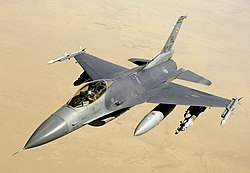
| A USAF F-16C in the skies over Iraq, 2008 | |
| Role | Multirole fighter aircraft |
| National origin | United States |
| Manufacturer | General Dynamics Lockheed Martin |
| First flight | 21 January 1974 |
| Introduction | 17 August 1978 |
| Status | In service, in production |
| Primary users | United States Air Force 25 other users (see operators page) |
| Number built | 4,500+ |
| Variants | General Dynamics F-16 VISTA |
| Developed into | Vought Model 1600 General Dynamics F-16XL Mitsubishi F-2 |
The F-16 Fighting Falcon was manufactured from General Dynamics from 1974 to 1993, Lockheed Corporation from 1993 to 1995, and since 1995, it has been manufactured by Lockheed Martin. The F-16 variants, along with major modification programs and derivative designs significantly influenced by the F-16, are detailed below.
Pre-production variants
[edit]YF-16
[edit]
Two single-seat YF-16 prototypes were built for the Light Weight Fighter (LWF) competition. The first YF-16 was rolled out at Fort Worth on 13 December 1973 and accidentally accomplished its first flight on 21 January 1974, followed by its scheduled "first flight" on 2 February 1974. The second prototype first flew on 9 March 1974. Both YF-16 prototypes participated in the flyoff against the Northrop YF-17 prototypes, with the F-16 winning the Air Combat Fighter (ACF) competition, as the LWF program had been renamed.[1]
- 72-1567 - on display at the Virginia Air and Space Science Center in Hampton, Virginia.[2]
- 72-1568 - under restoration for display at the Fort Worth Aviation Museum in Fort Worth, Texas.[3]
F-16 FSD
[edit]In January 1975, the Air Force ordered eight full-scale development (FSD) F-16s – six single-seat F-16A and a pair of two-seat F-16B – for test and evaluation. The first FSD F-16A flew on 8 December 1976 and the first FSD F-16B on 8 August 1977. Over the years, these aircraft have been used as test demonstrators for a variety of research, development and modification study programs.[4]
- F-16A (FSD)
- 75-745 - modified as F-16/101 with GE F101 engine. Used as a travelling exhibit for USAF recruiting service.<[citation needed]
- 75-746 - Gate guard at McEntire ANGB, South Carolina.[citation needed]
- 75-747 - modified as F-16XL/B with cranked-arrow. On display at the Air Force Flight Test Museum at Edwards Air Force Base near Rosamond, California.[5]
- 75-748 - on display at the Air Force Academy in Colorado Springs, Colorado.[citation needed]
- 75-749 - modified as F-16XL/A with cranked-arrow wing. In storage at the Air Force Flight Test Museum at Edwards Air Force Base near Rosamond, California.[5]
- 75-750 - modified as AFTI test bed. In storage at the National Museum of the United States Air Force.[6]
- F-16B (FSD)
- 75-751 - in storage at the Air Force Flight Test Museum at Edwards Air Force Base near Rosamond, California.[5]
- 75-752 - modified as Wild Weasel test bed, later modified as F-16/79 with GE J79. On display at the Frontiers of Flight Museum in Dallas, Texas.[7]
Main production variants
[edit]| Blocks | Models | Engine |
|---|---|---|
| 1–15 | F-16A / B | PW F100-PW-200 |
| 15OCU, 20 | F-16A / B | PW F100-PW-220 |
| 25,32,42 | F-16C / D | PW F100-PW-220E |
| 30,40 | F-16C / D | GE F110-GE-100 |
| 50,70 | F-16C / D / V | GE F110-GE-129 |
| 52,72 | F-16C / D / V | PW F100-PW-229 |
| 60 | F-16E / F | GE F110-GE-132 |
F-16A/B
[edit]
.jpg)
The F-16A (single seat) and F-16B (two seat) were initially equipped with the Westinghouse AN/APG-66 pulse-doppler radar, Pratt & Whitney F100-PW-200 turbofan, rated at 14,670 lbf (64.9 kN) and 23,830 lbf (106.0 kN) with afterburner. The USAF bought 375 F-16As and 125 F-16Bs, with delivery completed in March 1985.
F-16A/B Block 1/5/10
[edit]Early blocks (Block 1/5/10) featured relatively minor differences between each. Most were later upgraded to the Block 10 configuration in the early 1980s. There were 94 Block 1, 197 Block 5, and 312 Block 10 aircraft produced. Block 1 is the early production model with the radome painted black.
It was discovered that the Block 1 aircraft's black radome became an obvious visual identification cue at long range, so the color of the radome was changed to the low-visibility grey for Block 5 aircraft. During the operation of F-16 Block 1, it was discovered that rainwater could accumulate in certain spots within the fuselage, so drainage holes were drilled in the forward fuselage and tail fin area for Block 5 aircraft.
The Soviet Union significantly reduced the export of titanium during the late 1970s, so the manufacturers of the F-16 used aluminum instead wherever practical. New methods were also used: the corrugated aluminum is bolted to the epoxy surface for Block 10 aircraft, replacing the old method of aluminum honeycomb being glued to the epoxy surface used in earlier aircraft.
The breakdown is as follows: 90 F-16A Block 1, 4 F-16B Block 1, 100 F-16A Block 5, 97 F-16B Block 5, 300 F-16A Block 10, and 12 F-16B Block 10. It is unclear how many of each type were produced, but these figures are generally reasonable. As mentioned above, 375 A-types and 125 B-types were delivered to the U.S. Air Force, and the remaining aircraft were exported.
F-16A/B Block 15
[edit]The first major change in the F-16, the Block 15 aircraft featured larger horizontal stabilators, the addition of two hardpoints to the chin inlet, an improved AN/APG-66(V)2 radar[citation needed], and increased capacity for the underwing hardpoints. The Block 15 also gained the Have Quick II secure UHF radio. To counter the additional weight of the new hardpoints, the horizontal stabilizers were enlarged by 30%. Block 15 is the most numerous variant of the F-16, with 983 produced. Nine hundred F-16A Block 15s and eighty-three F-16B Block 15s were produced and rolled out, the last of which was delivered to the Royal Thai Air Force in 1996.
F-16A/B Block 20
[edit]According to some sources, the F-16A/B variants for the Republic of China Air Force are designated F-16AM Block 20[8] and F-16BM Block 20.[9] Other sources refer to them simply as F-16A/B Block 20 without reference to the "M" designation for Mid-Life Update.[10][11][12] Block 20 added some F-16C/D block 50/52 capabilities: improved AN/APG-66(V)3 radar with added CW mode to guide two types of BVR missiles – AIM-7M Sparrow missiles and AIM-120 AMRAAM, carriage of AGM-84 Harpoon missiles, as well as the LANTIRN navigation and targeting pod. The Block 20 computers are significantly improved in comparison to that of the earlier versions that later integrated into post 1997 Block 50/52, and also getting color MFD. The Republic of China (Taiwan) received 150 F-16A/B Block 20 aircraft. Some sources refer to the F-16 Mid-Life Update as Block 20, but the Block 20 designation was specifically used for new-production jets with upgraded jets being referred to as MLU or Block 15 MLU.[13][14][15][16][17] The breakdown is 100 F-16A Block 20 and 50 F-16B Block 20, but 10 A-models have been lost during missions. At one point, 14 aircraft were sent to the US mainland for training.
F-16C/D
[edit]
.jpg)
F-16C (single seat) and F-16D (two seat). The final number of aircraft built and used by the US Air Force were 209 F-16C Block 25, 200 F-16C Block 30, 100 F-16C Block 32, 200 F-16C Block 40, 115 F-16C Block 42, 35 F-16D Block 25, 200 F-16D Block 30, 133 F-16D Block 32, 200 F-16D Block 40, and 100 F-16D Block 42. At this stage, the A/B models were retired and either exported, scrapped for parts, or mothballed and sent to storage facilities. Currently, with the introduction of the F-22 stealth fighter and the mass production of the F-35, the C/D models are being rapidly retired, and the current (2024) fleet remaining in the U.S. Air Force and National Guard consists of 123 F-16C Block 25, 200 F-16C Block 30, 100 F-16C Block 32, 200 F-16C Block 40, 115 F-16C Block 42, 37 F-16D Block 40, and 100 F-16D Block 42.
F-16C/D Block 25
[edit]The Block 25 F-16C first flew in June 1984 and entered USAF service in September. The aircraft version is fitted with the Westinghouse AN/APG-68 radar and has improved precision night-attack capability. Block 25 introduced a very substantial improvement in cockpit avionics, including improved fire-control and stores management computers, an Up-Front Controls (UFC) integrated data control panel, data-transfer equipment, multifunction displays, radar altimeter, and many other changes. Block 25s were first delivered with the Pratt & Whitney F100-PW-200 engine and later upgraded to the Pratt & Whitney F100-PW-220E. With 209 Block 25 C-models and 35 D-models delivered, today the USAF's Air National Guard and Air Education and Training Command are the only remaining users of this variant. One F-16C, nicknamed the "Lethal Lady", had flown over 7,000 hours by April 2008.[18] The 209 F-16C blocks and 35 F-16D blocks that were manufactured were also deployed to the front lines.
F-16C/D Block 30/32
[edit]
This was the first block of F-16s affected by the Alternative Fighter Engine project under which aircraft were fitted with the traditional Pratt & Whitney engines or, for the first time, the General Electric F110-GE-100. From this point on, blocks ending in "0" (e.g., Block 30) are powered by GE, and blocks ending in "2" (e.g., Block 32) are fitted with Pratt & Whitney engines. The first Block 30 F-16 entered service in 1987. Major differences include the carriage of the AGM-45 Shrike, AGM-88 HARM, and the AIM-120 missiles, which entered service in September 1991. From Block 30D, aircraft were fitted with larger engine air intakes (called a Modular Common Inlet Duct) for the increased-thrust GE engine. Since the Block 32 retained the Pratt and Whitney F-100 engine, the smaller (normal shock inlet) was retained for those aircraft. 200 F-16C Block 30, 200 F-16D Block 30, 100 F-16C Block 32, and 133 F-16D Block 32 were built. Of these, only the early Block 30s were exported to six countries. The Block 32H/J aircraft assigned to the USAF Thunderbird flight demonstration squadron were built in 1986 and 1987 and are some of the oldest operational F-16s in the Air Force.
The Air National Guard procured many upgrades for their fleet of aging block 32s including the addition of improved inertial guidance systems, improved electronic warfare suite (AN/ALQ-213), and upgrades to carry the Northrop Grumman LITENING targeting pod. The standard Inertial Navigation Unit (INU) was first changed to a ring laser gyro, and later upgraded again to an Embedded GPS/INS (EGI) system which combines a Global Positioning System (GPS) receiver with an Inertial navigation system (INS). The EGI provided the capability to use Joint Direct Attack Munition (JDAM) and other GPS-aided munitions (see Block 50 list below). This capability, in combination with the LITENING targeting pod, greatly enhanced the capabilities of this aircraft. The sum of these modifications to the baseline Block 30 is commonly known as the F-16C++ (pronounced "plus plus") version.
F-16C/D Block 40/42
[edit]Entering service in 1988, the Block 40/42 is the improved all-day/all-weather strike variant equipped with LANTIRN pod; also unofficially designated the F-16CG/DG, the night capability gave rise to the name "Night Falcons". This block features strengthened undercarriage for LANTIRN pods, an improved radar, and a GPS receiver. From 2002, the Block 40/42 increased the weapon range available to the aircraft including JDAM, AGM-154 Joint Standoff Weapon (JSOW), Wind-Corrected Munitions Dispenser (WCMD) and the (Enhanced) EGBU-27 Paveway "bunker-buster". Also incorporated in this block was the addition of cockpit lighting systems compatible with Aviator's Night Vision Imaging System (ANVIS) equipment. The USAF's Time Compliance Technical Order (TCTO) that added the night vision (NVIS)-compatible systems was completed in 2004. 200 F-16C Block 40, 200 F-16D Block 40, 115 F-16C Block 42, and 100 F-16D Block 42 were built. All served with the United States Air Force, but were later exported after being replaced by their successors.
F-16C/D Block 50/52
[edit]Originally deployed with the United States Air Force, they were upgraded and sent to Iraq as they became obsolete. The first Block 50 F-16 was delivered in late 1991; the aircraft is equipped with improved GPS/INS, and can carry an additional selection of advanced missiles: the AGM-88 HARM missile, JDAM, JSOW and WCMD.[19] Block 50 aircraft are powered by the F110-GE-129 while the Block 52 jets use the F100-PW-229.[citation needed] Iraq was supplied 36 Block 50/52 jets, 24 single-seat and 12 twin-seat, that are also known by the designation F-16IQ.[20]
F-16C/D Block 50/52 Plus
[edit]
This was an export model and never entered service with the US Air Force; all aircraft were shipped to various countries for delivery upon completion. This variant's main differences are the addition of support for conformal fuel tanks (CFTs), a dorsal spine compartment, the APG-68(V9) radar, an On-Board Oxygen Generation System (OBOGS), and a JHMCS helmet. Also, the engine difference is the same as the 50/52. Block 50 using F110-GE-129, while Block 52 uses F100-PW-229.[19]
The CFTs are mounted above the wing, on both sides of the fuselage and are easily removable. They provide 440 US gallons (1,665 L) or approximately 3,000 pounds (1,400 kg) of additional fuel, allowing increased range or time on station and free up hardpoints for weapons instead of underwing fuel tanks.[21] All two-seat "Plus" aircraft have the enlarged avionics dorsal spine compartment which is located behind the cockpit and extends to the tail. It adds 30 cu ft (850 L) to the airframe for more avionics with only small increases in weight and drag.[22]

Poland took delivery of its first F-16C Block 52+ aircraft on 15 September 2006. The "Poland Peace Sky program" includes 36 F-16Cs and 12 F-16Ds. All 48 aircraft were delivered in 2008.[23] The Hellenic Air Force took delivery of its first F-16C Block 52+ aircraft on 2 May 2003. The Hellenic Air Force is the first Air Force in the world to operate this F-16 type.[24] The total Greek order was 60 F-16C/D.[25] The Israeli F-16I and its Singapore equivalent variant are based on the block 52+ aircraft. In March 2010, it was announced that the Egyptian Air Force would purchase 20 Block 52 aircraft (16 F-16Cs and 4 F-16Ds), the first of which arrived for testing in April 2012.[26]
Under the PEACE ONYX III CCIP program, 165 of Turkish Air Force's F-16s have been upgraded to Block 50+ standards by Turkish Aerospace Industries.[27]
The Pakistan Air Force bought 12 F-16C and 6 F-16D Block 52+ fighters.[citation needed]
F-16E/F
[edit]F-16E (single seat) and F-16F (two seat). Originally, the single-seat version of the General Dynamics F-16XL was to have been designated F-16E, with the twin-seat variant designated F-16F. This was sidelined by the Air Force's selection of the competing F-15E Strike Eagle in the Enhanced Tactical Fighter fly-off in 1984. The 'Block 60' designation had also previously been set aside in 1989 for the A-16, but this model was dropped.[28] The F-16E/F designation now belongs to a version developed especially for the United Arab Emirates Air Force, and is sometimes unofficially called the "Desert Falcon".
F-16E/F Block 60
[edit]
The Block 60 was designed for the United Arab Emirates Air Force (UAEAF).[29] Based on the F-16C/D Block 50/52, it features improved radar, avionics and conformal fuel tanks. At one time, this version was incorrectly thought to have been designated "F-16U". A major difference from previous blocks is the Northrop Grumman AN/APG-80 Active electronically scanned array (AESA) radar, which gives the airplane the capability to simultaneously track and destroy ground and air threats. The Block 60's General Electric F110-GE-132 engine is a development of the −129 model and is rated at 32,500 lbf (144 kN). The Electronic Warfare system is supposed to be quite advanced and includes the Northrop Grumman Falcon Edge Integrated Electronic Warfare Suite RWR together with the AN/ALQ-165 Self-Protection Jammer. Falcon Edge, which was developed by Northrop Grumman specifically for the Block 60, is capable of showing not only the bearing of any threat but also the range.
The Block 60 allows the carriage of all Block 50/52-compatible weaponry as well as AIM-132 Advanced Short Range Air-to-Air Missile (ASRAAM) and the AGM-84E Standoff Land Attack Missile (SLAM). The conformal fuel tanks provide an additional 450 US gallon (2,045 L) of fuel, allowing increased range or time on station. This has the added benefit of freeing up hardpoints for weapons that otherwise would have been occupied by underwing fuel tanks. The Block 60 retains a MIL-STD-1553 data bus to support certain legacy systems, but also features a MIL-STD-1773 fiber-optic data bus which offers a 1,000 times increase in data-handling capability. UAE funded the entire $3 billion Block 60 development costs, and in exchange will receive royalties if any of the Block 60 aircraft are sold to other nations. According to press reports quoted by Flight International, this is "the first time the US has sold a better aircraft [F-16] overseas than its own forces fly".[30] Like the F-35, the Block 60 F-16 has a built in FLIR/IRST/laser targeting system rather than using a dedicated pod that would occupy a hardpoint, increase drag and RCS.[31]
In 2014 the UAE requested an upgrade to Block 61, along with the purchase of 30 more aircraft at that level. However, the UAE cancelled the order of buying and upgrading the F-16E/F Block 61.[citation needed]
F-16V
[edit]On 15 February 2012, Lockheed Martin unveiled a new version of their F-16 at the 2012 Singapore Airshow. The F-16V will feature enhancements including an AN/APG-83 active electronically scanned array (AESA) radar, an upgraded mission computer and architecture, and improvements to the cockpit – all capabilities identified by the U.S. Air Force and several international customers for future improvements. The new variant is dubbed the "Viper", which is intended to better operate with fifth-generation fighters, and should not be confused with Lockheed's F-16IN Block 70/72 "Super Viper", which was offered to India for the Medium Multi-Role Combat Aircraft competition and showcased at the 2009 Aero India Air Show.[32] "The new F-16V will become the new F-16 baseline," said George Standridge, Lockheed Martin Aeronautics' vice president of business development. On 16 October 2015, the F-16V flew for the first time with an APG-83 Scalable Agile Beam Radar AESA, a new Center Pedestal Display, a modernized mission computer, Automatic Ground Collision Avoidance System, and many other upgrades. This can be fitted on new production F-16s or retrofitted on existing ones.[33] The first of these were for Republic of China Air Force (Taiwan) F-16A/B Block 20s. The upgrade of its 144 aircraft fleet started in January 2017 and was completed in February of 2024.[34] In 2019, Taiwan and the United States signed an $8 billion deal that would deliver 66 new-build Block 70 aircraft.[35][36]
F-16 Block 70/72
[edit]In September 2017, the U.S. Department of State approved a Foreign Military Sale to Bahrain for 19 new-build F-16V and upgrade its 20 existing F-16C/D Block 40 to F-16V standard.
In June 2018, Bahrain finalized its order for 16 new-build F-16V.[37]
In October 2017, the U.S. approved the sale of 123 upgrade kits to Greece to bring their existing F-16C and D fighters up to the new F-16 Block 72 standard.[38] On 28 April 2018, Greece decided to upgrade 84 aircraft.[39]
South Korea also plans to upgrade 134 of its F-16C/D fleet to F-16V standard by November 2025.[40]
In April 2018, the U.s. Department of State approved a Foreign Military Sale to Slovakia for 14 new F-16Vs, pending approval from U.S. Congress.[41] The Defence Ministry of Slovakia announced on 11 July 2018 that it intends to purchase 14 F-16 Block 70 aircraft from Lockheed Martin to replace its aging fleet of Mikoyan MiG-29s.[42] The package, which includes armament and training, is worth €1.58 billion ($1.8 billion), and is Slovakia's largest military purchase in modern history. Defence Minister Peter Gajdoš signed the contract with Lockheed Martin representative Ana Wugofski in a press conference at the capital Bratislava on 12 December 2018.[43] after the government approved the purchase.[44][45][46][47]
The first completed jet was unveiled by the manufacturer on 7 September 2023,[48] and first two aircraft were delivered to Slovakia on 22 July 2024.[49]
In December 2018, Bulgaria chose sixteen F-16 Block 70s as replacements for MiG-29s.[50] On 10 July 2019, Bulgaria approved the purchase of eight F-16 Block 70/72 for $1.25 billion (~$1.51 billion in 2024).[51] On 4 November 2022, the Bulgarian parliament approved the purchase of 8 more F-16V for $1.3 billion.[52]
On 27 February 2019, Taiwan requested to buy 66 new F-16 Block 70/72 airframes for an approximate $13 billion (~$15.7 billion in 2024) as replacement for their aging Mirage 2000 and F-5 fighters.[53]
On 16 August 2019, the U.S. Department of Statesubmitted the package to Congress,[54] total package worth $8 billion (~$9.65 billion in 2024) for 66 F-16 Block 70 and other spare parts.[55] On 13 December 2019, the US and Taiwan finalized the F-16V order.[56] On 14 August 2020, Taiwan formally signed an agreement to buy 66 F-16V jets built by Lockheed Martin.[57]
On 25 March 2019, the U.S. Department of Defense announced approvals for two sets of foreign military sales of F-16V hardware to Morocco; one for upgrading its existing 23 F-16s to the F-16V configuration, valued at $985.2 million; and the second for a batch of 25 new Block 72 airframes, 29 new engines, a package of precision-guided munitions, and training valued at $3.787 billion.[58][59]
On 3 March 2020, It was announced that instead of upgrading, Royal Jordanian Air Force is now looking to buy the latest F-16 Block 70/72 model to replace its current fleet of older F-16s. As early as September 2017, the Royal Jordanian Air Force was working with the U.S. Air Force Air Force Life Cycle Management Center (AFLCMC), based at Wright Patterson Air Force Base, Ohio, to begin the Viper Block-70 operational upgrade program. This study is still under way, but it is unclear whether, and when, it will apply where necessary congressional approvals are needed to sell these possibilities to Jordan.[60]
On 30 September 2021, Turkey sent a formal request to the United States to purchase 40 new F-16 Block 70/72 aircraft and nearly 80 kits to modernize its F-16C/D fighters to F-16 Block 70/72 variant.[61] Turkey later cancelled the upgrade kits from the deal and decided to modernize F-16s locally.
- Other
In May 2021, the U.S. Air Force had awarded a $14 billion (~$15.9 billion in 2024) contract to Lockheed Martin to build new 128 Block 70/72 F-16 Fighting Falcon fighter jets on behalf of Bahrain, Slovakia, Bulgaria, Taiwan, Morocco and Jordan through 2026.[62][63]
Major modification variants
[edit]F-16A/B Block 15 ADF
[edit]
The F-16 Air Defense Fighter (ADF) was a special variant of the Block 15 optimized for the United States Air National Guard's fighter interception mission. Begun in 1989, 270 airframes were modified. Avionics were upgraded (including the addition of an Identification friend or foe (IFF) interrogator with "bird-slicing" IFF antennas), and a spotlight fitted forward and below the cockpit, for night-time identification. This was the only US version equipped with the AIM-7 Sparrow air-to-air missile. Beginning in 1994, these aircraft began to be replaced by newer F-16C variants. By 2005, only the 119th Fighter Group "Happy Hooligans", North Dakota Air National Guard, was flying this variant,[citation needed] with these last examples retired from the US service by 2007.[a]
F-16A/B Block 15 OCU
[edit]Beginning in January 1988, all Block 15 F-16A/B were delivered with an Operational Capability Upgrade (OCU). The Block 15 OCU aircraft incorporate the wide-angle HUD that was first introduced on the F-16C/D Block 25, more reliable F100-PW-220 turbofans, updated defensive systems, the ability to fire the AGM-65 Maverick air-to-ground missile, and the AGM-119 Penguin Mk.3 anti-shipping missile developed by the Norwegian company Kongsberg, and provisions for the AIM-120 AMRAAM. Many foreign customers, including Thailand,[64] upgraded their aircraft to the F-16A/B Block 15OCU standard.[65]
F-16AM/BM Block 15 MLU
[edit].jpg)
In 1989 a two-year study began regarding possible mid-life upgrades for the USAF's and European Partner Air Forces' (EPAF's) Block 15 F-16A/Bs. The resulting F-16 Mid-Life Update (MLU) package was designed to upgrade the cockpit and avionics to the equivalent of that on the F-16C/D Block 50/52; add the ability to employ radar-guided air-to-air missiles; and to generally enhance the operational performance and improve the reliability, supportability and maintainability of the aircraft.[66] Key upgrades include a modular mission computer with faster data processing, an advanced IFF system that allows "BVR weapons delivery in excess of radar limits," and an improved radar—the APG-66(V)2A—with increased range and the ability to track and engage more targets.[13][67] Aircraft that received this set of upgrades were designated F-16AM or F-16BM (single-seat or dual-seat respectively).[14][68] Some sources refer to the F-16 MLU as Block 20, but the Block 20 designation was specifically used for new-production jets with upgraded jets being referred to as MLU or Block 15 MLU.[13][14][15][16][17]
Development began in May 1991 and continued until 1997; however, the USAF withdrew from the MLU program in 1992, although it did procure the modular mission computer for its Block 50/52 aircraft.[69][70]
The first of five prototype conversions flew on 28 April 1995, and the first production kits were delivered in November 1996.[71] The original plans called for the production of 553 kits (110 for Belgium, 63 for Denmark, 172 for the Netherlands, 57 for Norway, and 130 for the USAF). Final orders amounted to 325 kits (72 for Belgium, 61 for Denmark, 136 for the Netherlands, and 56 for Norway). The EPAFs re-designated the F-16A/B aircraft receiving the MLU as F-16AM/BM, respectively. Portugal later joined the program and the first of 20 aircraft was redelivered on 26 June 2003, with another 20 scheduled to go through the update in-country. In recent years, Chile, Jordan, and Pakistan have purchased surplus Dutch and Belgian F-16AM/BM for their air forces.[70]
The development of new software and hardware modifications continues under the MLU program. The M3 software tape was installed in parallel with the Falcon STAR structural upgrade to bring the F-16AM/BM up to the standards of the USAF's Common Configuration Implementation Program (CCIP). A total of 296 M3 kits (72 for Belgium, 59 for Denmark, 57 for Norway, and 108 for the Netherlands) were ordered for delivery from 2002 to 2007; installation is anticipated to be completed in 2010. An M4 tape has also been developed that adds the ability to use additional weapons and the Pantera targeting pod; Norway began conducting flying combat operations in Afghanistan with these upgraded aircraft in 2008. An M5 tape enabled employment of a wider array of the latest smart weapons, and was first installed in 2009. In 2015 tape M7 was implemented.[70]
Pakistan finished upgrading 41 F-16 Block 15s to Block 15 MLU in 2014 with help of Turkish Aerospace Industries, after signing a contract in 2009.[72][73]

Within the Peace Carpathian program, the F-16 aircraft purchased by the Romanian Air Force from Portugal were modernized to the MLU 5.2R standard starting c. 2016. This version includes many features that offer capabilities similar to the Block 50/52 variants.[74] Among the key elements of the upgrade process are: the PW F100-PW-220E engine; standard F-16 C/D Block 50/52 cockpit, compatible with night vision systems; two multifunction displays; modular mission computer; modernized fire control radar; hybrid navigation system; advanced IFF system; electronic warfare management system and Link 16 data transmission system.[75] In addition, the package also included the integration of other devices such as the Sniper Advanced Targeting Pod as well as the JHMCS helmet for the use with the AIM-120C-7 AMRAAM, AIM-9M and AIM-9X Sidewinder missiles.[76]
Plans to further upgrade Romanian F-16s to the M.6.5.2 configuration were approved by the US in 2020.[75][77]
F-16C/D Block 30 F-16N/TF-16N
[edit]
The U.S. Navy acquired 22 modified Block 30 F-16Cs for use as adversary assets for dissimilar air combat training (DACT); four of these were TF-16N two-seaters. These aircraft were delivered in 1987–1988. Fighter Squadron 126 (VF-126) and the Navy Fighter Weapons School (NFWS) (or "Top Gun") operated them at NAS Miramar, California, on the West Coast; East Coast adversary training squadrons were Fighter Squadron 43 (VF-43) at NAS Oceana, Virginia, and Fighter Squadron 45 (VF-45) at NAS Key West, Florida. Each squadron had five F-16N and one TF-16N, with the exception of Top Gun which had six and one, respectively. Due to the high stress of constant combat training, the wings of these aircraft began to crack and the Navy announced their retirement in 1994. By 1995, all but one of these aircraft had been sent to the 309th Aerospace Maintenance and Regeneration Group (AMARG) for preservation and storage; one F-16N was sent to the National Museum of Naval Aviation at NAS Pensacola, Florida, as a museum article. As adversary aircraft, the Navy's F-16Ns were notable for their colorful appearance. Most Navy F-16N aircraft were painted in a three-tone blue-gray "ghost" scheme. Top Gun had some of the more colorful ones: a three-color desert scheme, a light blue one and a green splinter camouflage version with Marine Corps markings. VF-126 also had a unique blue example.
In 2002, the Navy began to receive 14 F-16A and B models from the Aerospace Maintenance and Regeneration Center (AMARC) that were originally intended for Pakistan before being embargoed. These aircraft (which are not designated F-16N/TF-16N) are operated by the Naval Strike and Air Warfare Center (NSAWC) / Top Gun for adversary training and like their F-16N predecessors are painted in exotic schemes.
F-16CJ/DJ Block 50/52
[edit]

An unknown number of Block 50/52 aircraft have been delivered to the USAF modified to perform the Suppression of Enemy Air Defenses (SEAD) mission, replacing the F-4G 'Wild Weasel' aircraft; these were unofficially designated F-16CJ/DJ. The first F-16CJ (serial number 91-0360) was delivered on 7 May 1993, with the first Block 52 F-16 ever in the entire Airforce being delivered to the 157th FS in February 1994 due to their new found reputation that was earned after their win in the 1989 Gunsmoke gunnery competition at Nellis AFB (which also earned them the first F-16s ever in service with the U.S. Air National Guard for the same reason).[19][78][79] Capable of launching both the AGM-88 High-speed Anti-Radiation Missile (HARM) and AGM-45 Shrike anti-radiation missiles, the F-16CJ/DJ are equipped with a Lockheed Martin AN/AAS-35V Pave Penny laser spot tracker and the Texas Instruments AN/ASQ-213 HARM Targeting System (HTS), with the HTS pod mounted on the port intake hardpoint in place of the LANTIRN navigation pod. The first combat usage of these pods as well as the Litening II for the F-16 happened with the Block 52 F-16CJs of the 157th FS / South Carolina Air National Guard Squadron aka the "Swamp Foxes" during Operation Iraqi Freedom.[80] They are one of the few Air National Guard squadrons to operate the HARM Targeting system equipped F-16CJs and employed these pods against Iraqi IADS (Integrated Air Defense Systems) hard killing the SAMs opposed to just suppressing them.[80] They were the "first in" providing SEAD for the first strikes of the war including the famous F-117 Strike on Saddam Hussein. Another first for the F-16 came when the M3.1B software equipped F-16CJs of the 157th FS were the only F-16s in the theater which could independently fulfill the entire Air-to-Air ID matrix to satisfy the rules of engagement to shoot down enemy aircraft.[80] The F-16CJ was also used to conduct air support by the same squadron during Operation Anaconda.[80]
F-16C/D Block 52M
[edit]

In 2005, the Greek government ordered 30 more F-16C/D, 20 single-seat and 10 double-seat. These aircraft are called F-16C/D Block 52+ Advanced, but are known in the Hellenic Air Force as F-16 Block 52M (due to improved computing power for mission computer MMC). The differences between the normal Block 52+ and Block 52+ Advanced are that the Advanced version has a LINK 16 Communications System, more powerful Mission Control Computer, an extra Multi Function Display with a movable map navigation, advanced Debriefing System and the capability of carrying the RECCE Reconnaissance Pod. They also feature major upgrades by Lockheed Martin and Hellenic Aerospace Industry. The first aircraft were delivered to Hellenic Air Force in May 2009 and they are flying with the 335 Squadron "Tiger" in Araxos air base.
F-16I Sufa
[edit]
The F-16I is a two-seat variant of the Block 52 developed for the Israeli Defense Force – Air Force (IDF/AF).[81] Israel issued a requirement in September 1997 and selected the F-16 in preference to the F-15I in July 1999. An initial "Peace Marble V" contract was signed on 14 January 2000 with a follow-on contract signed on 19 December 2001, for a total procurement of 102 aircraft. The F-16I, which is called Sufa (Storm) by the IDF/AF, first flew on 23 December 2003, and deliveries to the IDF/AF began on 19 February 2004.[82] The F-16I has an estimated unit cost of approximately US$70 million (2006).[83]
One major deviation of the F-16I from the Block 52 is that approximately 50% of the avionics were replaced by Israeli-developed avionics, such as the Israeli Aerial Towed Decoy replacing the ALE-50 and autonomous aerial combat maneuvering instrumentation, which enables training exercises to be conducted without dependence on ground instrumentation. Elbit Systems produced the aircraft's helmet-mounted sight, head-up display (HUD), mission and presentation computers, and digital map display. Furthermore, the F-16I can employ Rafael's Python 5 infrared-guided air-to-air missile, and often uses Israel Aerospace Industries (IAI)'s removable conformal fuel tanks (CFT) for extended range. Key American-sourced systems include the F100-PW-229 turbofan engine, which offers commonality with the IDF/AF's F-15Is, and the APG-68(V)9 radar.[84]
Special mission variants
[edit]A-16
[edit]The A-16 began as a late-1980s GD project to develop a close air support (CAS) version of the basic F-16 by adding armor and strengthening the wings for a heavier weapons load, including a 30 mm cannon and 7.62 mm Minigun pods. Two F-16A Block 15 aircraft were modified to this configuration. Envisioned as a successor to the A-10, the type was to have received the 'Block 60' designation; however, the A-16 never went into production due to a 26 November 1990 Congressional directive to the US Air Force mandating that it retain two wings of A-10s.[28]
F/A-16
[edit]A second outcome of that directive was a decision by the Air Force that, instead of upgrading the A-10, it would seek to retrofit 400 Block 30/32 F-16s as with new equipment to perform both CAS and battlefield air interdiction (BAI) missions. The new systems for this "F/A-16" Block 30 included a digital terrain-mapping system[85] and Global Positioning System (GPS) integration for improved navigational and weapons delivery accuracy, as well as an Automatic Target Handoff System (ATHS) to allow direct digital target/mission data exchange between the pilot and ground units. This approach, however, was dropped in January 1992 in favor of equipping Block 40/42 F-16C/Ds with LANTIRN pods.[28]
Other CAS initiatives
[edit]In 1991, 24 F-16A/B Block 10 aircraft belonging to the 174th TFW, a New York Air National Guard unit that had transitioned from the A-10 in 1988, were armed with the 30 mm GAU-13/A four-barrel derivative of the seven-barrel GAU-8/A cannon used by the A-10A. This weapon was carried in a General Electric GPU-5/A Pave Claw gun pod on the centerline station and was supplied with 353 rounds of ammunition. There were also plans to convert F-16Cs to this configuration and to incorporate the A-10s AN/AAS-35V Pave Penny laser spot tracker. The vibration from the gun when firing proved so severe as to make both aiming and flying the aircraft difficult and trials were suspended after two days. Although the 174th's aircraft were employed for CAS during Operation Desert Storm, they did not use the gun pods in action, and the Block 10 F/A-16 was phased out after the war.[28]
F-16A(R)
[edit]About two dozen F-16As of the Royal Netherlands Air Force (RNLAF) were supplied with indigenous Oude Delft Orpheus low-altitude tactical reconnaissance pods transferred from its retiring RF-104G. Designated F-16A(R), the first example flew on 27 January 1983, and they entered service with the RNLAF's 306 Squadron in October 1984. The aircraft were common with the regular F-16s. However they were equipped with an extra panel in the cockpit to control the center line mounted pod. Under the MLU program, a more standardized interface was introduced so every aircraft could be used to operate the Orpheus pod or any other pod with the standardized interface.
Beginning in 1995, the Belgian Air Force replaced its own Mirage 5BR reconnaissance aircraft with at least a dozen F-16A(R) equipped with loaned Orpheus pods and Vinten cameras from the Mirages; these were replaced with more capable Per Udsen modular recce pods from 1996 to 1998. The F-16A(R) remained primarily combat aircraft with a secondary reconnaissance role.[86][87][88]
F-16 Recce
[edit]The first reconnaissance variant was a USAF F-16D experimentally configured in 1986 with a centerline multi-sensor bathtub-style pod. The USAF decided in 1988 to replace the aging RF-4C Phantom fleet with F-16C Block 30s fitted with the Control Data Corporation's Advanced Tactical Airborne Reconnaissance System (ATARS) centerline pod, which could carry a variety of sensors. Problems with the ATARS program, however, led to the USAF's departure in June 1993. During the mid-1990s, the U.S. Air Force experimented with a series of centerline recce pod designs, beginning with a prototype pod, the Electro-Optical 1 (EO-1) pod. This was followed by four "Richmond recce pods", which saw service in the Balkans. The USAF finally settled on what would become the definitive AN/ASD-11 Theater Airborne Reconnaissance System (TARS). The first F-16 flight with a prototype TARS flew on 26 August 1995, and on 27 September 1996 the USAF placed its first production order for the pods. Block 30s and Block 25s of five Air National Guard (ANG) squadrons have received the system since mid-1998. The USAF, however, does not designate them "RF-16s".[86][89][90]
RF-16A/C
[edit]The designation RF-16A is used by the Royal Danish Air Force. In early 1994, 10 Danish F-16A were redesignated as RF-16A tactical recce aircraft, replacing the RF-35 Drakens withdrawn at the end of 1993. As a temporary measure they were originally fitted with the Drakens' optical cameras and electro-optical (E-O) sensors repackaged in a Per Udsen 'Red Baron' recce pod, which were replaced a few years later by Per Udsen's Modular Reconnaissance Pod (MRP).[86][89]
Major upgrade programs
[edit]F-16 MSIP
[edit]In 1980, General Dynamics, the USAF's F-16 System Program Office (SPO), and the EPG partners initiated a long-term Multinational Staged Improvement Program (MSIP) to evolve new capabilities for the F-16, mitigate risks during technology development, and ensure its currency against a changing threat environment. The F-16 Falcon Century program, a survey and evaluation of new technologies and new capabilities that began in 1982, was also relied upon to identify new concepts for integration onto the F-16 through the MSIP derivative development effort. Altogether, the MSIP process permitted quicker introduction of new capabilities, at lower costs, and with reduced risks compared to traditional stand-alone system enhancement and modernization programs.[91]
The first stage, MSIP I, began in February 1980 and it introduced the new technologies that defined the Block 15 aircraft. Fundamentally, MSIP I improvements were focused on reducing the cost of retrofitting future systems. These included structural and wiring provisions for a wide-field-of-view raster HUD; multi-function displays (MFD); advanced fire control computer and central weapons interface unit; integrated Communications/Navigation/Identification (CNI) system; beyond-visual-range (BVR) air-to-air missiles, electro-optical and target acquisition pods, and internal electronic countermeasures (ECM) systems; and increased-capacity environmental control and electrical power systems. Delivery of the first USAF MSIP I Block 15 aircraft occurred in November 1981, and work on the first EPG MSIP I aircraft began in May 1982.[78][92]
MSIP II began in May 1981, leading to the F-16C/D Block 25/30/32. Block 25 added systems which the MSIP I provisions had enabled. The first MSIP II F-16C Block 25 was delivered in July 1984. Block 30/32 takes advantage of the Alternative Fighter Engine program that offered a choice between two engines for the F-16: the General Electric F110-GE-100 (Block 30) as well as the newly upgraded Pratt & Whitney F100-PW-220 (Block 32). To take full advantage of the higher-thrust GE engine, a larger, modular air inlet duct was fitted on Block 30s. MSIP II capabilities introduced on the Block 30/32 also included the ability to target multiple aircraft with the AMRAAM; range, resolution, and signal processor improvements to the AN/APG-68 radar; a ring laser gyroscope; ALQ-213 electronic warfare system; added cooling air capacity for the more powerful avionics suite; and employment of the AGM-45 Shrike anti-radiation missiles. The first Block 30 was delivered in July 1986.[78][93]
MSIP III produced the Block 40/42/50/52. Initiated in June 1985, the first MSIP III Block 40 was delivered in December 1988, and the first Block 50 followed in October 1991. Introduced in the MSIP III Block 40/42 were LANTIRN navigation and targeting pods, along with the related diffractive optics HUD; the increased-reliability APG-68V fire-control radar; an aft-seat HUD monitor in the F-16D; a four-channel digital flight-control system; GPS; advanced EW and Identification Friend or Foe (IFF) equipment; and further structural strengthening to counter the aircraft's growing weight. The Block 50/52 received uprated F100-GE-129 and F110-PW-229 engines; an upgraded programmable display generator with digital terrain mapping; an improved APG-68V5 fire-control radar; an automatic target hand-off system; an anti-jam radio; the ALE-47 chaff dispenser; and integration of AGM-88 HARM anti-radiation missiles.[94]
Although only three stages had been originally planned, GD proposed an MSIP IV segment (marketed as 'Agile Falcon'), but this was rejected by the Air Force in 1989. However, most of its elements – such as extensive avionics upgrades, color displays, an electronic warfare management system (EWMS), reconnaissance pods, AIM-9X Sidewinder infrared air-to-air missile integration, and helmet-mounted sights – have been introduced since that time.[78][95][96]
Pacer Loft I and II
[edit]F-16A/B Blocks 1 and 5 were upgraded to the Block 10 standard under a two-phase program: Pacer Loft I (1982–1983) and Pacer Loft II (1983–1984).[65]
Falcon UP
[edit]Although the F-16 was originally designed with an expected service life of 8,000 flying hours, actual operational usage has proven to be more severe than expected and this has been exacerbated by its growing weight as more systems and structure have been added to the aircraft. As a result, the anticipated average service life of the F-16A/B had fallen to only 5,500 flying hours. Beginning in the early 1990s, the Falcon UP program restored the 8,000-hour capability for the USAF's Block 40/42 aircraft. Pleased with the results, the USAF extended the Falcon UP effort to provide a Service Life Improvement Program (SLIP) for its Block 25 and 30/32 aircraft to ensure 6000 flying hours, and a Service Life Extension Program (SLEP) for its F-16A/B aircraft to assure their achieving 8,000 hours.[97]
Falcon STAR
[edit]
Falcon STAR (Structural Augmentation Roadmap) is a program to repair and replace critical airframe components on all F-16A/B/C/D aircraft; like Falcon UP, it is intended to ensure an 8000-hour service life, but it is based on more recent operational usage statistics. The first redelivery occurred in February 2004, and in 2007 the USAF announced that it would upgrade 651 Block 40/42/50/52 F-16s; this is expected to extend the Falcon STAR program, which began in 1999, through 2014.[97]
F-16 ACE
[edit]Israel Aircraft Industries developed an open-architecture avionics suite upgrade for its F-16s known as the Avionics Capabilities Enhancement (ACE). It introduced the first "full-glass cockpit" on an operational F-16, and featured an advanced fire-control radar, an Up Front Control Panel (UFCP), and an option for a wide-angle HUD or a helmet-mounted display. The first flight of an F-16B equipped with ACE was accomplished in May 2001. The ACE upgrade was not taken up by the Israeli Air Force, which ordered a second batch of the F-16I instead; IAI offered ACE to Venezuela, but the U.S. government blocked it and stated that it would only permit elements of ACE, not the whole suite, to be exported.[98][99]
F-16 Falcon ONE
[edit]Singapore Technologies Aerospace (ST Aero) has also developed a state-of-the-art, "glass cockpit" avionics suite as an alternative to the MLU offering. The Falcon ONE suite includes a wide-angle HUD that can display FLIR imagery, the Striker Helmet-Mounted Display (HMD), a datalink capability, and the FIAR Grifo radar. First revealed at the Farnborough Air Show on 25 July 2000, it has yet to find a customer.[100][101]
F-16 CCIP
[edit]The Common Configuration Implementation Program (CCIP) was a $2 billion modernization effort that sought to standardize all USAF Block 40/42/50/52 F-16s to a common Block 50/52-based avionics software and hardware configuration for simplified training and maintenance. Lockheed Martin received a contract to develop the first phase CCIP configuration upgrade packages in June 1998; kit production work started in 2000, and deliveries began in July 2001.[102][103] In 2007, Korean Air was awarded a USAF contract for F-16 upgrades, which included both CCIP, Falcon-STAR, and Drop in Maintenance works. 100 USAF F-16s were to be upgraded and maintained by Korean Air under the contract. The upgrade program would extend the F-16's flying hours from 6,000 to 8,000 hours. The work would continue for six years until 2013.[104]
Phase 1 of the CCIP added new Modular Mission Computers, color cockpit display kits and advanced IFF systems to domestically based Block 50/52 aircraft, and introduced the new Sniper Advanced Targeting Pod (ATP). The ability of the F-16CJ/DJ to employ GPS-guided weapons was extended to the rest of the Block 50/52 fleet. Upgraded Phase 1 aircraft redeliveries began in January 2002. The second phase extended these upgrades to overseas-based Block 50/52 Falcons, and redeliveries ran from July 2003 to June 2007. Phase II also included the introduction of autonomous beyond-visual-range air-intercept capability, the Link-16 datalink, and the Joint Helmet-Mounted Cueing System (JHMCS).[102]
The ongoing Phase 3 effort is focused on Block 40/42 F-16s. Development began in July 2003 and by June 2007 Lockheed Martin had completed roughly a quarter of the USAF's Block 40/42 fleet. Phase 3 incorporates the M3+ Operational Flight Program (OFP) which extends the capabilities of the first two phases to the Block 40/42 fleet and adds Multifunctional Information Distribution System (MIDS), the new NATO-standard datalink network. Development of an M4+ OFP began in late 2002; this update will allow use of the Raytheon AIM-9X on Block 40/42/50/52 aircraft. Northrop Grumman was awarded a contract in early 2004 to develop an M5+ upgrade kit to update the AN/APG-68(V)5 radars on the Block 40/42/50/52 Falcons to the AN/APG-68(V)9 standard; upgrading of Block 40/42 aircraft began in 2007 and is to become operational on the Block 50/52 aircraft by 2010. An M6+ OFP is under consideration, and could include integration of the GBU-39 Small Diameter Bomb (SDB) on CCIP aircraft, which is planned to begin in fiscal year 2012.[102]
Turkey became the first international customer for the CCIP update with the signing of a $1.1 billion contract on 26 April 2005 to upgrade an initial 80 Block 40/50 and 37 Block 30 F-16C/Ds to an equivalent of the Phase 3/M5+ OFP standard under the "Peace Onyx III" Foreign Military Sales (FMS) program. This work will be performed by Turkish Aerospace Industries (TAI) and Turkey holds the option to upgrade the remainder of its 100 Block 40s, which could extend the program.[102][105]
CUPID
[edit]The Combat Upgrade Plan Integration Details (CUPID) effort is an ongoing initiative to bring older U.S. Air National Guard and Air Force Reserve Command Block 25/30/32 F-16s closer to Block 50/52 specifications. CUPID focuses on adding improved precision attack capabilities, night vision equipment, datalinks, carriage of the Litening II infrared targeting pod, and laser- and GPS-guided weapons.[97]
F-16C/D Barak 2020
[edit]In 2011[106] Israeli Air force announced an upgrade program of its aging F-16C/D (blocks 30 and 40) fleet, to make it valuable in 2020 and even later. The upgrade included installation of new avionics and new wiring, which brought these block 30/40 airframes closer to the IAF's I (Sufa) model (itself an upgrade of the Block 52+ F-16D). The program was completed in 2014.[107]
F-16C/D Özgür/Özgür II
[edit]In 2012, the Turkish Air Force announced the modernization of 35 of its F-16 Block 30 aircraft. Replacements within the scope of the modernization include: a Turkish mission computer, secure voice radio module, and IFF system; and upgrades to various other instrumentation and avionics systems. In 2023, it was announced that the upgrade will be applied to other F-16 aircraft starting with the Block 40 variants in the Turkish Air Force.[108] The said aircraft will be dubbed as 'F-16C/D Block 30TM'.
Another important project carried out with ÖZGÜR is the domestic Active Electronic Phased Array (AESA) radar developed by Aselsan. The radar will first be installed on Baykar's AKINCI UCAV before being tested and integrated on the F-16.[108][109][110] Within the scope of ÖZGÜR II program, modernization will be applied to F-16 Block 40/50 with an additional upgrade to Block 30s which will include obtaining External Load Certification for various ammunition types, miniature bombs, and the ASELPOD targeting pod. The project also aims to incorporate communications and radio equipment and facilitate the integration of Bozdoğan and HGK-82 munitions into the Block 30s.[108]
F-16 C/D Post Block Integration Team (PoBIT)
[edit]In 2022, the United States Air Force announced the modernization of 608 of its F-16 Block 40 and F-16 Block 50 to F-16 Block 70 (F-16V) standard.[111] Upgrades for the PoBIT program include the installation of the AN/APG-83 Scalable Agile Beam Radar (SABR), the Center Display Unit (CDU), a programmable data generator, new-generation electronic warfare capabilities, a communications suite upgrade, and a modernized mission computer.[112]
Technology demonstrators, and test variants
[edit]
Flight control variants
[edit]YF-16 CCV
[edit]The initial YF-16 prototype was reconfigured in December 1975 to serve as the USAF Flight Dynamics Laboratory's Control-Configured Vehicle (CCV) testbed. The CCV concept entails "decoupling" the aircraft's flight control surfaces so that they can operate independently. This approach enables unusual maneuvers such as being able to turn the airplane without banking it. The ability to maneuver in one plane without simultaneously moving in another was seen as offering novel tactical performance capabilities for a fighter. The CCV YF-16 design featured twin pivoting ventral fins mounted vertically underneath the air intake, and its triply redundant fly-by-wire (FBW) flight control system (FCS) was modified to permit use of flaperons on the wings' trailing edges which would act in combination with an all-moving stabilator. The fuel system was redesigned to enable adjustment of the aircraft's center of gravity by transferring fuel from one tank to another. The CCV aircraft achieved its first flight on 16 March 1976. The flight test program ran until 30 June 1977, and was marred only by a hard landing on 24 June 1976 that delayed testing until repairs were effected. The CCV program was judged successful and led to a more ambitious follow-on effort in the form of the "Advanced Fighter Technology Integration" (AFTI) F-16.[90][113][114] The first effort accomplished under the AFTI program was a paper study with three separate contractors (i.e., McDonnell Douglas, Fairchild Republic, Rockwell International) to design an advanced aircraft technology demonstrator using new concepts such as direct lift control, direct side force control and drag modulation.[115]
F-16 SFW
[edit]General Dynamics was one of several U.S. aircraft makers awarded a contract by the Defense Advanced Research Projects Agency (DARPA) in 1976 to develop proposals for an experimental forward-swept wing test aircraft. GD's entry, the Swept Forward Wing (SFW) F-16, had a slightly lengthened fuselage to accommodate the larger, advanced composites wing. In January 1981, DARPA selected Grumman's entry, which became known as the X-29A. Although the SFW F-16 was not chosen, the X-29 incorporated some of the F-16's features, particularly its FBW flight control system and its undercarriage.[116]
F-16XL
[edit]The F-16XL featured a novel 'cranked-arrow' type of delta wing with more than twice the area of the standard F-16 wing. Developed under a program originally known as the Supersonic Cruise and Maneuvering Program (SCAMP), the design was intended to offer low drag at high subsonic or supersonic speeds without compromising low-speed maneuverability. As a result, the F-16XL was able to cruise efficiently at supersonic speeds without using afterburner, commonly known as supercruise.[117] In late 1980, the USAF agreed to provide GD with the third and fifth FSD F-16s for modification into single-seat and twin-seat F-16XL prototypes. To accommodate the larger wing, the aircraft was lengthened 56 in (142 cm) by the addition of a 30-inch (76 cm) plug in the forward fuselage and a 26-inch (66 cm) section to the aft fuselage just behind the landing gear bulkhead. The rear fuselage was also canted up by three degrees to increase the angle of attack on takeoff and landing. The F-16XL could carry twice the payload of the F-16 on 27 hardpoints, and it had a 40% greater range due to an 82% increase in internal fuel carriage. The single-seat F-16XL first flew on 3 July 1982, followed by the two-seater on 29 October 1982. The F-16XL competed unsuccessfully with the F-15E Strike Eagle in the Enhanced Tactical Fighter (ETF) program; if it had won the competition, the production versions were to have been designated F-16E/F.[118] Following the February 1984 selection announcement, both examples of the F-16XL were placed in flyable storage.[119]
In late 1988, the two prototypes were taken out of storage and turned over to the National Aeronautics and Space Administration (NASA) for use in a program designed to evaluate aerodynamic concepts for improving laminar airflow over the wing during sustained supersonic flight. From 1989 to 1999, both aircraft were used by NASA for several experimental research programs, and in 2007, NASA was considering returning the single-seat F-16XL to operational status for further aeronautical research. The F-16 XL had much better lift and maneuverability than the normal F-16 A/B Block15.[119][120]
Falcon 21++
[edit]

At a Senate executive session 'Air Force Acquisition Plans and Modernization Requirements' held on 22 April 1991, Major General Joseph W. Ralston, USAF Director of Tactical Programs, testified that the Falcon 21++ was supposed to have a new fuselage carrying AIM-120 AMRAAMs inside the fuselage. The Falcon 21++ was studied in 1990 as a cheaper alternative to the Advanced Tactical Fighter that became the F-22 Raptor. A blurry image of poor resolution shows the Falcon 21++ had a delta wing and twin vertical tails. The Falcon 21++ was also supposed to be powered by an ATF engine (P&W F119) and an AESA radar with ATF avionics, plus "as much observable treatment as could be placed on an airplane like that", according to Major General Ralston.
F-16X Falcon 2000
[edit]In 1993 Lockheed proposed development of a new version of the F-16. This F-16X "Falcon 2000" featured a delta wing based on that of the F-22, together with a fuselage stretch to accommodate the new wing. The F-16X would have 80% more internal fuel volume. The design also permitted conformal carriage of the AIM-120 AMRAAM. Lockheed claimed the F-16X could be built for two-thirds the cost of the F/A-18E/F Super Hornet.[78][121]
NF-16D/VISTA/MATV
[edit]In the late 1980s, General Dynamics and General Electric began exploring the application of thrust vector control (TVC) technology to the F-16 under the F-16 Multi-Axis Thrust-Vectoring (MATV) program. Originally the Israel Defense Forces/Air Force was going to supply an F-16D for this effort; however, the USAF, which had initially declined to support the program, changed its mind and took over the MATV project in 1991 and Israel withdrew from it the following year[122] (the IDF was involved later when Ilan Ramon, who later became an astronaut on the ill-fated STS-107, flew the MATV F-16 during flight testing at Edwards AFB.)
Meanwhile, General Dynamics had received a contract in 1988 to develop the Variable-stability In-flight Simulator Test Aircraft (VISTA). The F-16 VISTA effort was funded by the USAF, the U.S. Navy, and NASA. Calspan, a subcontractor to GD, fitted a Block 30 F-16D belonging to Wright Labs with a center stick (in addition to the sidestick controller), a new computer, and a digital flight control system that allowed it to imitate, to a degree, the performance of other aircraft. Redesignated NF-16D, its first flight in the VISTA configuration occurred on 9 April 1992.[90][122]
In 1993, the variable-stability computers and center stick were temporarily removed from the VISTA for flight tests for the MATV program, under which the first use of thrust-vectoring in flight was accomplished on 30 July. Thrust-vectoring was enabled through the use of the Axisymmetric Vectoring Exhaust Nozzle (AVEN). Following the conclusion of MATV testing in March 1994, the VISTA variable-stability computers were reinstalled. In 1996 a program was begun to fit the NF-16D with a multi-directional thrust-vectoring nozzle, but the program was canceled due to lack of funding later that year. Although the F-16 VISTA program was considered successful, thrust vectoring was not taken up for the F-16 by the U.S. Air Force.[122][123]
F-16U
[edit]The F-16U was one of several configurations proposed for the United Arab Emirates in the early 1990s. The F-16U was a two-seat aircraft that combined many features of the F-16XL and the delta wing of the F-16X.[124]
F-16 Advanced Fighter Technology Integration
[edit].jpg)
In March 1980, General Dynamics began converting the sixth FSD F-16A to serve as the technology demonstrator aircraft for the joint Flight Dynamics Laboratory-NASA Advanced Fighter Technology Integration (AFTI) program. The AFTI F-16 built upon GD's experience with its YF-16 CCV program, and the AFTI F-16 even received the twin pivoting vertical ventral fins from the CCV aircraft, which were likewise installed under the air intake. The aircraft was also fitted with a narrow dorsal fairing along its spine to house additional electronics. Technologies introduced and tested on the AFTI F-16 include a full-authority triplex Digital Flight Control System (DFCS), a six-degree-of-freedom Automated Maneuvering Attack System (AMAS), a 256-word-capacity Voice-Controlled Interactive Device (VCID) to control the avionics suite, and a helmet-mounted target designation sight that permitted the forward-looking infrared (FLIR) device and the radar to be automatically "slaved" to the pilot's head movement. First flight of the AFTI F-16 occurred on 10 July 1982. The Air Force Association gave its 1987 Theodore von Karman Award for the most outstanding achievement in science and engineering to the AFTI F-16 team.[90][125]
The AFTI F-16 participated in numerous research and development programs:[126]
- AFTI Phase I testing (1981–1983): a program to review the DFCS system, which undertook analysis of the VCID, to assess the impact of noise and g-force on speech recognition rates.[127]
- AFTI Phase II testing (1983–1987): evaluation of the wing-root-mounted FLIR and the AMAS system.
- Auto GCAS development and testing (1986–1992): In 1986, members of the AFTI flight test team, in collaboration with General Dynamics, adapted the automated maneuvering capabilities with new ground collision avoidance equations and modified visual and aural cues to develop an automated ground collision avoidance (auto-GCAS) system. The system enabled pilots to set a mean sea level or above ground level floor for maneuvering, and included aural and visual warnings as the floor was approached. With no pilot action, the Auto-GCAS would take over and perform a 5-G pull up. This Auto-GCAS, which began flight testing in 1987, was intended to help reduce the incidence of "controlled flight into terrain" (CFIT) accidents. Later versions of the AFTI system included integration with the digital terrain database to provide 3-dimensional maneuvering capabilities. The flight test team that developed the system was awarded Patent No. US 4924401 A in 1990 for this system. This AFTI Auto-GCAS became the basis for the AGCAS system tested in 1994-96 and later incorporated into the F-16, F-22 and F-35.
- CAS/BAI (1988–1992): a five-phase evaluation program testing a variety of low-level close air support/battlefield air interdiction (CAS/BAI) techniques, including an Automatic Target Handoff System (ATHS) (which transferred target data from ground stations or other aircraft to the AFTI F-16) and off-axis weapons launch.
- Talon Sword Bravo (1993–1994): demonstration of cooperative engagement techniques where the aircraft fires at a target based on targeting information datalinked from a distant sensor; the weapon principally investigated was the AGM-88 High-speed Anti-Radiation Missile (HARM).
- EGI (1994 & 1997): testing of embedded GPS/INS (EGI) navigation systems, including evaluation of the reliability of GPS in jamming environments.
- AGCAS (1994–96): testing of an Automatic Ground Collision Avoidance System (AGCAS or Auto-GCAS) to help reduce the incidence of "controlled flight into terrain" (CFIT); lessons learned from this program were further evolved on the F-16 GCAS.
- J/IST (1997–2000): testing of the world's first all-electric flight control system under the Joint Strike Fighter Integrated Subsystem Technologies (J/IST) program.
F-16 GCAS
[edit]Due to the unavailability of the AFTI F-16 following the AGCAS effort, a Block 25 F-16D was modified for continued investigation of ground collision-avoidance system (GCAS) technologies to reduce CFIT incidents; this joint effort by the USAF, Lockheed Martin, NASA and the Swedish Air Force was conducted during 1997–98.[128] It has recently been reported that the US Air Force had decided to upgrade the F-16, F-22 and F-35 (all Lockheed Martin-designed, fly-by-wire fighters) with the AGCAS system.[129]
F-16 Agile Falcon
[edit]The F-16 Agile Falcon was a variant proposed by General Dynamics in 1984 that featured a 25% larger wing, upgraded engine, and some already planned MSIP IV improvements for the basic F-16. Unsuccessfully offered as a low-cost alternative for the Advanced Tactical Fighter (ATF) competition, some of its capabilities were incorporated into the F-16C/D Block 40, and the Agile Falcon would serve as the basis for developing Japan's F-2 fighter.[130]
F-16 ES
[edit]The F-16 Enhanced Strategic (ES) was an extended-range variant of the F-16C/D fitted with conformal fuel tanks that granted it a 40% greater range over the standard Block 50. The F-16ES also featured an internal FLIR system, which offered the capabilities of the LANTIRN navigation and targeting system without the drag associated with external pods. Unsuccessfully offered to Israel as an alternative to the F-15I Strike Eagle in late 1993, it was one of several configuration options offered to the United Arab Emirates that would ultimately lead to the development of the F-16E/F Block 60 for that nation. An F-16C Block 30 was modified to the ES configuration to test the conformal tanks and simulated FLIR sensor turrets fitted above and below the nose of the aircraft. The F-16ES first flew on 5 November 1994 and flight testing was completed in January 1995.[131][132]
F-16 LOAN
[edit]The F-16 Low-Observable Axisymmetric Nozzle (LOAN) demonstrator was an F-16C fitted in late 1996 with a prototype nozzle with significantly reduced radar and infrared signatures and lowered maintenance requirements. It was tested in November 1996 to evaluate the technology for the Joint Strike Fighter (JSF) program.[133][134][135]
F-16D 'CK-1'
[edit]MANAT, the Israeli Air Force's flight test center, is known to operate a specially built Block 40 F-16D delivered in 1987 as a testbed aircraft designated 'CK-1'. It is used by the IAF for testing new flight configurations, weapon systems, and avionics.[130]
F-16 DSI
[edit]The DSI concept (Diverterless supersonic inlet) was introduced into the JAST/JSF program as a trade study item in mid-1994. The first Lockheed DSI was flown on 11 December 1996 as part of a Technology Demonstration project. A DSI was installed on an F-16 Block 30 fighter, replacing the aircraft's original intake diverter. The modified F-16 demonstrated a maximum speed of Mach 2.0 (Mach 2.0 is the F-16's clean certified maximum speed) and handling characteristics similar to a normal F-16. Subsonic specific excess power was slightly improved. The trade studies involved additional CFD, testing, and weight and cost analyses. A DSI was later incorporated into the design of the Lockheed Martin F-35 Lightning II after proving to be 30% lighter and showing lower production and maintenance costs over traditional inlets while still meeting all performance requirements.[136]
Engine variants
[edit]F-16/79
[edit]
In response to President Jimmy Carter's February 1977 directive to curtail arms proliferation by selling only reduced-capability weapons to foreign countries, General Dynamics developed a modified export-oriented version of the F-16A/B designed for use with the outdated General Electric J79 turbojet engine. Northrop competed for this market with its F-20 Tigershark. Accommodating the J79-GE-119 engine required modification of the F-16's inlet, the addition of steel heat shielding, a transfer gearbox (to connect the engine to the existing F-16 gearbox), and an 18-inch (46 cm) stretch of the aft fuselage. First flight occurred on 29 October 1980. The total program cost to develop the F-16/J79 was US$18,000,000 (equivalent to $68,692,246 in 2024), and the unit flyaway cost was projected to be about US$8,000,000 (equivalent to $30,529,887 in 2024). South Korea, Pakistan and other nations were offered these fighters but rejected them, resulting in numerous exceptions being made to sell standard F-16s; with the later relaxation of the policy under President Carter in 1980 and its cancellation under President Ronald Reagan, no examples of either the F-16/79 or the F-20 were ultimately sold.[137]
F-16/101
[edit]In February 1979, General Electric was awarded a US$79,900,000 (equivalent to $346,160,064 in 2024) contract under the joint USAF/Navy Derivative Fighter Engine (DFE) program to develop a variant of its F101 turbofan engine, originally designed for the B-1A bomber, for use on the F-16 (in lieu of the standard P&W F100) and the F-14A (in place of the P&W TF30). The first Full-Scale Development (FSD) F-16A (serial number 75-0745) was fitted with the F101X DFE engine and made its maiden flight on 19 December 1980. Although the F101 performed better than the F100, it was not adopted for use; however, data from testing the F-16/101 assisted in the development of the F110 turbofan, for which the F101 would serve as the core, and the F110 would become an alternate engine for both the F-16 and F-14.[138][139]
Proposed and other variants
[edit]Vought Model 1600/1601/1602
[edit]The Vought/General Dynamics Model 1600 was a navalized derivative of the General Dynamics F-16 Fighting Falcon designed for the United States Navy's Navy Air Combat Fighter (NACF) program. The Model 1600 lost to the Northrop/McDonnell Douglas F/A-18 Hornet.
F-16BR Block 62+ Super Viper
[edit]For the F-X2 fighter programme for the Brazilian Air Force, Lockheed Martin offered the F-16BR Super Viper. The F-16BR is based on the F-16E/F Block 60 and features conformal fuel tanks; AN/APG-80 AESA radar, GE F110-132A engine with FADEC controls; electronic warfare suite and infra-red searching (IRST); updated glass cockpit; and a helmet-mounted cueing system. F-16BR lost in the competition with JAS-39 Gripen E.[140]
F-16IN Block 70/72 Super Viper
[edit]
Lockheed Martin has proposed an advanced variant, the F-16IN, as its candidate for India's 126-aircraft Indian Air Force Medium Multi-Role Combat Aircraft (MMRCA) competition. According to Chuck Artymovich, the company's business development director for the program, "The F-16IN is the most advanced F-16 ever." Notable F-16IN features include an AN/APG-80 Active Electronically Scanned Array (AESA) radar, advanced electronic warfare suites, and an infrared search and track (IRST) system.[141] In addition, the F-16IN's RCS is reduced from 1.5m2 to 0.1m2, in the same class as the F-18 Super Hornet, Rafale, and Eurofighter Typhoon.[142]
If selected as the winner of the competition, Lockheed Martin will supply the first 18 aircraft, and will set up an assembly line in India in collaboration with Indian partners for production of the remainder. The program is reportedly worth up to ₹550 billion (US$14 billion).[143][144] The F-16IN Super Viper was showcased in the Aero India, 2009.[145]
India initially sent the RFI for an F-16C/D Block 52+ configuration aircraft for the ongoing Indian MRCA competition to supply the Indian Air Force with 126 Multi-Role Combat Aircraft, to replace the Indian air force's fleet of MiG-21s. On 17 January 2008, Lockheed Martin offered a customized version of the F-16, the F-16IN Super Viper for the Indian MMRCA contract.[146] The F-16IN, which is similar to the F-16 Block 60, will be a 4.5 generation aircraft.
Lockheed Martin has described the F-16IN as "the most advanced and capable F-16 ever." Based closely on the F-16E/F Block 60 as supplied to the UAE, the features on the F-16IN include Conformal fuel tanks (CFTs); AN/APG-80 AESA radar,[147] GE F110-132A engine with 32,000 pounds (143 kN) of thrust with FADEC controls; electronic warfare suite and infra-red search and track (IRST); advanced all-color glass cockpit with three large displays; and a helmet-mounted cueing system.[148] Lockheed Martin's vice-president-Business Development (India) Orville Prins has said that "I can assure you, the Super Viper is much more advanced in all aspects than the [Block 50/52+] F-16s being given to Pakistan".[149]
In September 2009, F-16IN Super Viper completed a part of the field trials. Lockheed Martin officials stated that phase I of field trials was over and the week-long training phase was in preparation for Phase II of field trials, which began 7 September and lasted two weeks.
Eventually, the F-16IN Super Viper lost out to the French Dassault Rafale fighter. It was reported 21 September 2012 that the Indian air force would finalize a contract to purchase 126 French Rafale jet fighters that year, in one of 2012's largest armament purchases.[150] The contract for the 126 Rafale twin-engine, canard delta-wing, multirole combat aircraft is worth $20 billion, Indo-Asian News Service reported.
In 2015, after the Rafale order was cut back to just 36 aircraft, Lockheed was offering India the exclusive opportunity to produce, operate and export F-16 Block 70 aircraft.[151]
In 2017, the F-16IN lost in the competition with JAS-39 Gripen E, when Lockheed retired from production in India and decided to move its production line from Fort Worth, Texas to Greenville, South Carolina.[152]
As of 2017, Lockheed Martin has agreed to sign a letter of intent with the Indian defence firm Tata Advanced Systems Limited to manufacture the jets in India if the Indian government accepts their tender for India's request for a purchase of single-engine aircraft to replace its aging MiG-series fighters. The new production line can be utilized to supply jets to India as well as for exporting them overseas.[153][154] On 19 June 2017, during the Paris Air Show, Tata Advanced Systems Limited and Lockheed Martin signed an agreement to produce F-16 Block 70 aircraft in India under the latter's offer to provide the jet to the Indian Air Force under MMRCA.[155]
F-21
[edit]After cancelling the MMRCA tender, the Indian Air Force launched another Request for Information in April 2018 for another tender for around 110 aircraft which was unofficially referred to as MRFA.[156]
Meanwhile, Tata Advanced Systems Limited and Lockheed Martin signed another agreement to produce F-16 wings in India on 4 September 2018.[157] As of September 2019, the prototype wing from the Indian facility would be delivered by 2020.[158] The wing prototype made in the Hyderabad facility of Tata-Lockheed Martin Aerostructures Ltd (TLMAL) was delivered and certified in December 2021, paving way for the facility to be the sole provider of F-16 wings to Lockheed Martin. The wings were described as "a fuel-carrying 9G, 12,000-hour, interchangeable and replaceable fighter wing".[159][160] It is the same facility which is also the sole provider of empennages of C-130J at a rate of 24 units per year and produced 85 units by April 2018.[161]
Lockheed Martin unveiled the F-21 concept at the Aero India air show on 20 February 2019. The F-21 would include 114 "Indian Specific Enhancements". Lockheed Martin had offered the F-16IN variant earlier in the MMRCA tender and has replaced the offer with the current F-21 which is to be built in collaboration with Tata Advanced Systems in the available Hyderabad facility.[162][163][164]
Specific enhancements and changes of the F-21 aircraft includes:[165][166][167]
- Avionics: Northrop Grumman AN/APG-83 Scalable Agile Beam Radar (SABR) AESA radar with higher range, more targets and higher precision couple with long range Infrared Search and Track system.
- Advanced Cockpit: a Large Area Display and a 6″ × 8″ Center Pedestal Display similar to the ones on Lockheed Martin F-35 Lightning II as against the F-16 Block 70 variant.
- Weapons Capacity: 40% higher payload capacity with options for one Triple Missile Launch Adapter on each wing.
- Decoy: Capability to carry AN/ALE-50 towed decoy system on wing pylon as well as tail section. (Block 70 variant would only carry TDS on wing pylons)
- Airframe: Redesigned dorsal fin. A service life of 12,000 hours.
- Powerplant: General Electric F-110-GE-132 engine
- Aerial refueling: Options for both probe-and-drogue and flying boom with added conformal fuel tank for higher range.
KF-16
[edit]
Korean Aerospace Industries (KAI) produced 140 KF-16C/D Block 52 fighters under license from Lockheed Martin in the 1990s. The F/A-18 Hornet had originally won the Korea Fighter Program (KFP) competition, but disputes over costs and accusations of bribery led the Korean government to withdraw the award and select the F-16 instead. Designated the KF-16 the first 12 aircraft were delivered to Republic of Korea Air Force (ROKAF) in December 1994.[168] Almost 2,500 parts are changed from the original F-16C/D.[168] Originally, the KF-16 was equipped with the Pratt & Whitney F100-PW-229 Improved Performance Engine, ASPJ internal ECM, AN/APG-68(V)7 radar, LANTIRN targeting and navigation pod, AMRAAM, HARM, and SLAM anti-ship missile capabilities, and advanced IFF.[169] JDAMs capability was added by ROKAF later on; ROKAF developed the software, successfully carried out 3 tests, and finished pilot training at the end of January 2011. The South Korean JDAMs are equipped with wing kits, which are absent from normal JDAMs, but not from the 2,000-pound JDAM Extended Range kit, which is being developed by Boeing and South Korea.[170] The South Korean F-16s can also employ LIG Nex1's ALQ-200K radar jammer and other locally developed tactical ELINT and EO/IR targeting pods.[171][172]
In late 2011, Korea kicked off the contest for KF-16's mid-life upgrade, which will incorporate, among others, a new AESA radar.[173] The radar candidates are Northrop Grumman's Scalable Agile Beam Radar (SABR) and Raytheon's RANGR, which won the contract.[174] The variant to which the planes will be improved is reported to be Lockheed Martin's newly developed F-16V. The KF-16 will also be integrated with stealth cruise missiles.[175] The proposed budget for the avionics upgrades and weapons integration of 135 KF-16 planes is $1 billion.[176] ROKAF had requested a separate upgrade of its 35 F-16 Block 32 in 2009, which would allow the upgraded planes to employ JDAM, AMRAAM, improved data modem, secure voice capabilities, test and support equipment, and other related training and logistics support. The estimated cost of the upgrade was $250 million.[177] BAE won the contract for $1.1 billion.[178]
GF-16
[edit]Small numbers of each type of F-16A/B/C are used for non-flying ground instruction of maintenance personnel.
QF-16
[edit]
The USAF plans to convert Block 15 F-16As, and Block 25/30 F-16Cs into full-scale target drones under the QF-16 Air Superiority Target (AST) program.[179] These AST drones are used in Weapon System Evaluation Programs (WSEP) for assessing upgrades or replacements for air-to-air missiles (AAM), and they are also useful for giving pilots the experience of a live AAM shot and kill prior to entering combat. QF-16s replaced the QF-4 drones, the last of which flew in 2016.[180] The Air Force's Air Armament Center hosted its first "Industry Day" for interested vendors at Eglin AFB, Florida on 16–19 July 2007.[181] The DoD awarded the nearly $70 million QF-16 Full Scale Aerial Target (FSAT) contract to Boeing on 8 March 2010,[182] with the first delivery scheduled for 2014.[183]
On 22 April 2010, the first F-16 to be converted to an aerial target arrived at Boeing's facility at Cecil Field, Jacksonville, Florida.[184] Six F-16s will be modified during the development phase, as prototypes for engineering tests and evaluation. From 2014, up to 126 QF-16 drones will be created. The prototype QF-16 undertook its maiden flight in May 2012. In January 2013, the 576th Aerospace Maintenance and Regeneration Squadron refit team was due to begin modification work on the QF-16 program. Davis-Monthan has 210 F-16s stocked for conversion. From that pool, the Air Force will draw airframes for its 126 planned QF-16 drones.[185] F-16C Block 30B s/n 85-1569 was the first aircraft delivered in November 2012.
On 19 September 2013, an empty F-16 jet tested by Boeing and US Air Force, two US Air Force pilots controlled the plane from the ground as it flew from Tyndall Air Force Base, Panama City, Florida.[186] Boeing suggested that the innovation could ultimately be used to help train pilots, providing an adversary they could practice firing on. The jet – which had previously sat mothballed at an Arizona site for 15 years – flew at an altitude of 40,000 ft (12.2 km) and a speed of Mach 1.47 (1,119 mph/1,800 km/h). It carried out a series of maneuvers including a barrel roll and a "split S" – a move in which the aircraft turns upside down before making a half loop so that it flies the right-way-up in the opposite direction. This can be used in combat to evade missile lock-ons. The firm added that the flight attained 7 g of acceleration but was capable of carrying out maneuvers at 9 g – something that might cause physical problems for a pilot.[187] Boeing was awarded the contract on 10 October 2013 for low-rate initial production (LRIP) Lot 1 of 13 QF-16s. A second award on 20 May 2014 covered production Lot 2, comprising a further 23 QF-16s. On 27 March 2015, Boeing received a US$24.46 million (~$31.5 million in 2024) contract for 25 Lot 3 QF-16s and 25 four-year warranties of the QF-16 drone-peculiar equipment. The first production Lot 1 FSAT, QF-16C, 86-0233, 'QF-007', was delivered on 11 March 2015 to Tyndall Air Force Base. It was previously operated by the Michigan Air National Guard's 107th Fighter Squadron, 127th Wing and then stored at the 309th AMARG before being moved to Cecil Field in April 2013 for QF-16 configuring.[188]
On 19 July 2017, the first QF-16 was shot down during a Combat Archer Weapons System Evaluation Program (WSEP) exercise.[189]
Derivative fighters
[edit]The performance and flexibility of the F-16 has been an important and visible influence on aircraft development programs of three nations seeking to advance the design and manufacturing skills of their indigenous aerospace industries. These programs have partnered with Lockheed Martin to develop airframes, that while not officially designated F-16s, share design elements and a development path with the F-16.
AIDC F-CK-1A/B Ching Kuo Indigenous Defense Fighter (IDF)
[edit]Due to an American refusal to supply Taiwan with either the F-16/79 or F-20, the Republic of China government tasked its Aerospace Industrial Development Corporation (AIDC) with developing an indigenous fighter. Preliminary design studies began in 1980, and the Indigenous Defense Fighter (IDF) program was launched two years later. Since Taiwanese industry had not developed a sophisticated fighter before, AIDC sought design and development assistance from General Dynamics and other major American aerospace companies.[190] With such assistance, a design was finalized in 1985. The IDF design is by no means a copy of the F-16, but it was clearly influenced by the F-16, such as the layout of control surfaces, yet it also features design elements from the F-5, like its twin-engine configuration. Several components were supplied by Western companies.[191] In December 1988 the IDF aircraft was designated F-CK-1 and named after the late President Chiang Ching-Kuo. The first of four prototypes (three single-seat and one twin-seat) flew on 28 May 1989. A total of 130 Ching Kuo fighters (102 F-CK-1A single-seaters and 28 F-CK-1B two-seaters) were delivered from 1994 to 2000.[192][193][194][unreliable source?]
Mitsubishi F-2A/B (FS-X/TFS-X)
[edit]In 1982, Japan's Technical Research and Development Institute (TRDI) initiated studies of options for an indigenous fighter design to replace the Mitsubishi F-1 strike fighter. This initiative would later be designated FS-X (Fighter Support Experimental; the two-seat trainer version was originally designated 'TFS-X'.) Determining that an entirely indigenous development effort would be cost-prohibitive, the Defense Agency (JDA) sought an off-the-shelf fighter for its FS-X requirement, but none proved entirely acceptable. As a result, the JDA sought a co-development program based on a variant of an existing fighter type, and on 21 October 1987 announced its selection of a modified version of the F-16C/D based on General Dynamics' "Agile Falcon" concept. The FS-X is larger and heavier than the F-16, has a greater wing area, and is mainly fitted with Japanese-developed avionics and equipment. The program was launched a year later and the first of four XF-2A/B prototypes flew on 7 October 1995. The Japanese Cabinet authorized production on 15 December 1995, with the designation F-2A/B being allocated to the single- and two-seat models, respectively. First flight of an F-2A occurred on 12 October 1999, and production aircraft deliveries began on 25 September 2000. Originally, 141 F-2A/B (83 F-2A and 58 F-2B) were planned, but only 130 (83/47 F-2A/B) were approved in 1995; due to high costs, in December 2004, the total was capped at 98 aircraft, and in early 2007 this was reduced to 94.[195][196][197][198][unreliable source?]
KAI FA-50 Golden Eagle (KTX-2)
[edit]Building on its licensed manufacture of KF-16s, in 1992 Samsung Aerospace began work on designing a tandem-seat, supersonic, combat-capable jet trainer to replace the BAE Hawk 67, Northrop T-38 Talon, A-37 Dragonfly, and eventually F-4 Phantom II and F-5E/F Tiger II operated by the Republic of Korea Air Force (ROKAF). Samsung worked closely with Lockheed and the basic KTX-2 design had been laid out by 1995. At this point the aerospace units of Samsung, Daewoo and Hyundai were combined to form Korea Aerospace Industries (KAI) to ensure sufficient industrial "critical mass" existed to successfully develop the KTX-2. The T-50 resembles an 80%-scale F-16, but has a number of differences, not least being the fact that it has an engine air intake under each wing root, instead of a single under-belly intake, as well as a leading-edge extension more similar to that on the F/A-18 Hornet. The South Korean government gave its approval on 3 July 1997, and full-scale development work got underway in October. In February 2000, the KTX-2 was designated the T-50 Golden Eagle, and the first of two T-50 flight-test prototypes flew on 20 August 2002; the maiden flight of the first of two T-50 Lead-In Fighter Trainer (LIFT) prototypes – designated 'A-50' by the ROKAF and capable of combat – followed on 29 August 2003. Lockheed Martin and KAI co-marketed the T-50 internationally.[199] The RoKAF plans to acquire T-50 advanced trainers, T-50B aerobatic demonstrators, TA-50 LIFT/light attack aircraft, and FA-50 multirole fighters. Its first production contract, for 25 T-50s, was placed in December 2003 and the first pair of T-50 aircraft was delivered 29 December 2005, with the type entering operational service in April 2007. In December 2006, the ROKAF placed a second production contract for T-50, T-50B, and TA-50 variants. The development of the FA-50 to replace the remaining old fighters is ongoing as of 2010[update].[200][201][202][unreliable source?]
Specifications
[edit]| YF-16 | F-16A/B | F-16C/D Block 30 | F-16E/F Block 60 | F-16 Block 70 | |
|---|---|---|---|---|---|
| Crew | One (A/C/E model) / Two (B/D/F model) | One | |||
| Length | 48 ft 5 in (14.8 m) | 49 ft 6 in (15.1 m) | 49 ft 5 in (15.1 m) | 49 ft 4 in (15.0 m) | 49.3 ft (15.027 m) |
| Wingspan | 31 ft 0 in (9.45 m) | 31 ft 0 in (9.45 m) | 31 ft 0 in (9.45 m) | 31 ft 0 in (9.45 m) | 31.0 ft (9.449 m) |
| Height | 16 ft 3 in (4.95 m) | 16 ft 8 in (5.08 m) | 16 ft 8 in (5.08 m) | 16 ft 8 in (5.08 m) | 16.7 ft (5.090 m) |
| Empty weight | 13,600 lb (6,170 kg) | 16,300 lb (7,390 kg) | 18,900 lb (8,570 kg) | 22,000 lb (9,980 kg) | 20,300 lb (9,210 kg) |
| Maximum take-off weight | 37,500 lb (17,000 kg) | 42,300 lb (19,200 kg) | 46,000 lb (20,900 kg) | 48,000 lb (21,800 kg) | |
| Maximum speed | Mach 2.0 | Mach 2+ | |||
| Combat radius | 295 nmi (546 km) | ||||
| Engine | PW F100-PW-200 | PW F100-PW-200 | GE F110-GE-100 | GE F110-GE-132 | GE F110-GE-129 |
| Thrust | 23,800 lbf (106 kN) | 23,800 lbf (106 kN) | 28,600 lbf (127 kN) | 32,500 lbf (145 kN) | 29,400 lbf (131 kN) |
| Radar | AN/APG-66 | AN/APG-68 | AN/APG-80 | AN/APG-83 | |
Sources: USAF sheet,[203] International Directory of Military Aircraft,[204] Great Book,[205] F-16 versions on F-16.net,[206] Lockheed Martin[207]
Notes
[edit]References
[edit]- ^ "YF-16: The Birth of a Fighter". F-16.net. Retrieved 21 May 2008.
- ^ "Aircraft." Virginia Air & Space Science Center. Retrieved: 11 July 2023.
- ^ "YF-16 #2 Fighting Falcon." Fort Worth Aviation Museum. Retrieved: 11 July 2023.
- ^ Goebel, Greg (1 April 2007). "F-16 Origins". Vectorsite. Archived from the original on 6 April 2005. Retrieved 30 May 2008.
- ^ a b c "Aircraft Inventory List." Air Force Flight Test Museum. Retrieved: 31 July 2023.
- ^ "General Dynamics NF-16A AFTI." National Museum of the United States Air Force. Retrieved: 31 July 2023.
- ^ "General Dynamics YF-16B Fighting Falcon." Archived 1 June 2023 at the Wayback Machine Frontiers of Flight Museum. Retrieved: 31 July 2023.
- ^ Staff (13 July 2019). "General Dynamics F-16". Aircraft Recognition Guide. Retrieved 9 March 2025.
To bring the existing F-16As closer in capabilities to the F-16C a major modification programme led to the Block 15 MLU, often designated F-16AM. The M is this case stands for Mid-Life Update (MLU). Sometimes, these MLU upgraded F-16s are referred to as Block 20, but these are only new aircraft (see next paragraph). [. . .] Block 20s were newly built F-16As for the Republic of China Air Force. These are externally the same as the Block 15 MLU
- ^ Staff (13 July 2019). "General Dynamics F-16". Aircraft Recognition Guide. Retrieved 9 March 2025.
The Mid-Life Update (MLU) version of the F‑16B Block 15 is called F-16BM [. . .] Block 20 is an externally very similar version, for the Republic of China Air Force.
- ^ Zhicheng, Chen (14 December 2023). "F-16戰機問世50周年! 首架「戰隼」原型機出廠照曝光" [The 50th anniversary of the F-16 fighter! The first "Fighting Falcon" prototype factory photo was exposed].
- ^ "軍武/鐵鷹F-16 高C/P值輕型戰機". 19 August 2019.
- ^ "66 new fighter jets to arrive in Taiwan by 2026". 12 November 2019.
With the expected completion in 2023 of upgrades to Taiwan's existing 142-strong fleet of F-16A and F-16B fighter jets, the island expects to have a total of 208 F-16Vs by 2026, reports said.
- ^ a b c Hehs, Eric (19 February 2014). "History Of The F-16 Fighting Falcon". Code One Magazine. Archived from the original on 2 April 2023. Retrieved 5 November 2023.
- ^ a b c Jennings, Gareth (12 October 2023). "Ukraine conflict: Belgium joins Denmark, Norway, the Netherlands in promising F-16s to Kyiv". Janes.com. Retrieved 5 November 2023.
- ^ a b "Thailand – F-16 Mid-Life Upgrade | Defense Security Cooperation Agency". www.dsca.mil. 30 September 2010. Retrieved 7 November 2023.
- ^ a b "Romania – Weapons, Equipment, and Support for F-16 Block 15 MLU Aircraft | Defense Security Cooperation Agency". www.dsca.mil. 8 November 2013. Retrieved 7 November 2023.
- ^ a b "Belgium - F-16A/B Block 15 Aircraft Mid Life Upgrade | Defense Security Cooperation Agency". www.dsca.mil. 12 May 2014. Retrieved 7 November 2023.
- ^ Ring, Wilson (7 April 2008). "Vermont Air Guard proud of nation's longest flying F-16". Boston Globe. Archived from the original on 16 December 2008. Retrieved 24 May 2008.
- ^ a b c "F-16C/D, Block 50/52". F-16.net. Retrieved 25 January 2009.
- ^ Jennings, Gareth (8 May 2019). "Iraq receives final F-16s". Janes. Retrieved 5 May 2023.
- ^ "News". Lockheed Martin UK. 6 September 2001. Archived from the original on 20 August 2008.
- ^ "F-16 Current Options". Lockheed Martin. Archived from the original on 21 February 2009. Retrieved 16 July 2009.
- ^ "Poland takes delivery of first F-16 Block 52+". F-16.net. 15 September 2006. Retrieved 24 December 2008.
- ^ "F-16C/D Block 52+ Fighting Falcon". Hellenic Air Force. Retrieved 13 December 2017.
- ^ Valmas, Theodore L. (28 May 2009). "Greece takes delivery of first F-16 Block 52+". Jane's. Archived from the original on 15 July 2009.
- ^ "Lockheed Martin Receives $213 Million Contract for 20 New F-16s for Egypt". Defense Aerospace. 3 March 2010.
- ^ "The Turkish Air Force - Current Status and Perspectives". 7 May 2019.
- ^ a b c d "A-16, F/A-16, F-16A (30 mm gun)". F-16.net. Retrieved 21 May 2008.
- ^ "Lockheed Martin reports growing demand for F-16 thanks to new upgrades and variant". Janes. Archived from the original on 14 February 2019.
- ^ "Dubai 2007: UAE shows off its most advanced Falcons". Flightglobal. 11 November 2007. Archived from the original on 2 April 2009. Retrieved 14 January 2009.
- ^ "Aerospace System Improvements Enabled by Modern Phased Array Radar" (PDF). Northrop Grumman Electronic Systems. October 2002. p. 8. Archived from the original (PDF) on 3 January 2011.
- ^ "Singapore: Lockheed Unveils F-16 Viper Variant". Defense News. 16 February 2012. Archived from the original on 8 September 2013. Retrieved 8 August 2013.
- ^ "Meet the F-16V: The Most Technologically Advanced 4th Generation Fighter in the World". Lockheed Martin. 25 September 2018. Retrieved 31 December 2019.
- ^ "First Phase of Taiwan F-16V Program Is Complete". airandspaceforces.com. 5 February 2024. Retrieved 15 August 2025.
- ^ "US seeks to speed up delivery of new F-16 fighter jets to Taiwan". Al Jazeera. Reuters. Retrieved 2 March 2022.
- ^ Trevithick, Joseph. "Taiwan Announces It's Getting New Block 70 F-16s As U.S. Government Advances Deal". The War Zone. Retrieved 2 March 2022.
- ^ Shamim, Asif (8 September 2017). "Bahrain to buy 19 new F-16Vs and upgrade 20 current Block 40s". F-16.net. Retrieved 13 December 2017.
- ^ Trvithick, Joseph (17 October 2017). "Greece Plans to Spend Billions Upgrading Its F-16 Fighter Jet Fleet". The War Zone. Retrieved 8 January 2018.
- ^ "Greece to upgrade 84 F-16 fighter jets to Viper configuration by 2027". The Defense Post. 28 April 2018. Retrieved 28 April 2019.
- ^ Carey, Bill (26 November 2016). "Lockheed Martin Lands Upgrade Contract for South Korea F-16s". AINonline. Retrieved 6 January 2018.
- ^ Trvithick, Joseph (4 April 2018). "Slovakia – F-16 Block 70/72 V Configuration Aircraft". Defence Security Cooperation Agency. Retrieved 4 April 2018.
- ^ Garrett, Reim (12 July 2018). "Slovakia to purchase 14 Lockheed Martin F-16s". FlightGlobal. Retrieved 12 July 2018.
- ^ solutions (www.aglo.sk), AGLO. "Najväčší modernizačný projekt ozbrojených síl v histórii sa stáva realitou, minister obrany podpísal zmluvy k obstaraniu lietadiel F-16:: Ministry of Defense of Slovak Republic". mosr.sk. Retrieved 28 April 2019.
- ^ "Slovakia seals its largest-ever arms deal". news.yahoo.com. Retrieved 28 April 2019.
- ^ "Slovakia seals its largest-ever arms deal". msn.com. Archived from the original on 12 December 2018. Retrieved 28 April 2019.
- ^ "Slovakia seals its largest-ever arms deal - Channel NewsAsia". Archived from the original on 12 December 2018.
- ^ Trimble, Stephen (25 June 2018). "Bahrain order keeps F-16 production ticking over". Flightglobal.com. Retrieved 28 April 2019.
- ^ Hoyle, Craig (8 September 2023). "Lockheed Martin unveils first F-16 fighter for Slovakia". FlightGlobal. Retrieved 18 September 2023.
- ^ "Slovakia gets first new F-16s to boost air defence". Reuters. 22 July 2024.
- ^ "F-16.net - the ultimate F-16, F-35 and F-22 reference".
- ^ "Bułgaria approves F-16". flightglobal.com. 10 July 2019. Retrieved 10 July 2019.
- ^ Jaroslaw Adamowski (5 November 2022). "Bulgarian parliament votes to buy F-16s under $1.3 billion deal". DefenseNews.com.
- ^ "Taiwan Confirms Request to Buy 66 F-16V Fighters from US". defenseworld.net. Archived from the original on 1 April 2019. Retrieved 28 April 2019.
- ^ "Trump administration plans $8 billion fighter jet sale to Taiwan, angering China". The Washington Post. Retrieved 16 August 2019.
- ^ "Defense Security Cooperation Agency News Release". 20 August 2019.
- ^ Strong, Matthew (21 December 2019). "Taiwan and U.S. sign agreement for F-16V fighter jet deal". Taiwan News. Retrieved 18 January 2020.
- ^ "U.S. Formalizes F-16 Jet Sale to Taiwan With China Tensions High". Bloomberg.com. 14 August 2020.
- ^ "Morocco – F-16 Block 52+ Upgrade to F-16V Configuration". Defense Security Cooperation Agency. Retrieved 28 April 2019.
- ^ "Morocco – F-16 Block 72". Defense Security Cooperation Agency. Retrieved 28 April 2019.
- ^ "RJAF is now looking to buy the latest F-16V Block 70/72 model to replace its current fleet of older F-16s". www.udefense.info. March 2020. Archived from the original on 6 August 2024. Retrieved 7 July 2021.
- ^ SABAH, DAILY (12 October 2021). "Biden administration reportedly backs Turkey's $6B F-16 deal request". Daily Sabah. Retrieved 16 October 2021.
- ^ "$14 Billion Contract Marks Start of New Push to Build US F-16 Fighters for Partner Nations". Military.com. 19 May 2021.
- ^ "Air Force opens new F-16 Production line for foreign military sales". AFLCMC. 17 May 2021.
- ^ "F-16.net - The ultimate F-16, F-35 and F-22 reference". www.f-16.net. Retrieved 8 January 2025.
- ^ a b "F-16A/B: Block 1/5/10/15/15OCU/20". F-16.net. Retrieved 7 June 2008.
- ^ Reuber, Eric (October 2015), The Template for the Acquisition of the Next Multinational Multi-Role Fighter (PDF), Maxwell Air Force Base, Alabama, U.S., pp. 6–7, retrieved 5 November 2023
{{citation}}: CS1 maint: location missing publisher (link) - ^ "RNLAF:Upgraded systems | planken.org". planken.org. Archived from the original on 4 March 2016. Retrieved 6 November 2023.
- ^ "Weaponsystem - F-16 - Kleine-Brogel Air Base". www.kleinebrogelairbase.be. Retrieved 6 November 2023.
- ^ "F-16 MLU: Mid-Life Update". F-16.net. Retrieved 30 May 2008.
- ^ a b c "Lockheed Martin (General Dynamics) F-16 Fighting Falcon – EPAF Mid-Life Update (MLU)". Jane's Aircraft Upgrades. 28 April 2008.
- ^ "RNLAF:Developments | planken.org". planken.org. Archived from the original on 7 March 2016. Retrieved 6 November 2023.
- ^ "TAI TO MODERNIZE PAKISTAN F-16S". www.defenceturkey.com. Retrieved 5 November 2023.
- ^ "Last Four TAI-Modernized F-16s Delivered To Pakistan Air Force". DefenceTalk. 4 September 2014. Retrieved 5 November 2023.
- ^ Editorial, Defense Brief (26 March 2021). "Romania receives 17th and final F-16 from Portugal". Defense Brief. Retrieved 5 November 2023.
- ^ a b Victor Cozmei (4 November 2020). "România vrea să-și modernizeze în plus toate avioanele F-16 din flotă". HotNews (in Romanian).
- ^ "F-16 MLU 5.2R". RoAF (in Romanian). Archived from the original on 26 April 2016. Retrieved 17 September 2021.
- ^ Gareth Jennings (4 November 2020). "US approves F-16 upgrade for Romania". Janes.
- ^ a b c d e "Lockheed Martin F-16 Fighting Falcon". All The World's Aircraft. Jane's. 21 January 2008.
- ^ "The Top 10 Moments in SCANG History". 9 December 2021.
- ^ a b c d "Swamp Fox History - Operation Iraqi Freedom". 21 March 2014.
- ^ "Advanced F-16". Defense Update. 13 December 2005. Archived from the original on 6 August 2011. Retrieved 26 July 2011.
- ^ "Israeli F-16s: Latest Developments". Air Forces Monthly. June 2004. pp. 36–39.
- ^ Harel, Amos (20 July 2006). "IDF fighter jet crashes during take-off in Negev; no injuries". Haaretz. Archived from the original on 20 July 2006.
- ^ "Lockheed Martin F-16 Fighting Falcon". All The World's Aircraft. Jane's. 21 January 2008.
- ^ Burnett, Paul C.; et al. (March 1986). "F-16 Digital Terrain System: Concept of Operations and Support (Accession Number: ADA177737)". Defense Technical Information Center. Archived from the original on 3 June 2008. Retrieved 21 May 2008.
- ^ a b c "RF-16/F-16(R): Recce Versions". F-16.net. Retrieved 30 May 2008.
- ^ "F-16A/B Block 1/5/10/15/15OCU/20". F-16.net. Retrieved 30 May 2008.
- ^ Peacock 1997, p. 38.
- ^ a b Peacock 1997, pp. 48–49.
- ^ a b c d Goebel, Greg (1 April 2007). "F-16 Variants". Vectorsite. Archived from the original on 6 April 2005. Retrieved 26 May 2008.
- ^ Camm 1993.
- ^ Camm 1993, pp. 33–35.
- ^ Camm 1993, pp. 35–37.
- ^ Camm 1993, pp. 37–39.
- ^ "The legacy of the F-16 'Fighting Falcon' for the emerging C&EE nations". F-16.net. Retrieved 6 June 2008.
- ^ Camm 1993, p. 27.
- ^ a b c "Lockheed Martin (General Dynamics) F-16 Fighting Falcon – Lockheed Martin Falcon UP/Falcon Star". Jane's Aircraft Upgrades. 21 November 2007.
- ^ "IAI's upgraded F-16 on display in Paris". Defence Systems Daily. 21 June 2001. Archived from the original on 17 June 2008. Retrieved 30 May 2008.
- ^ "Lockheed Martin (General Dynamics) F-16 Fighting Falcon – IAI/ELBIT Avionics Capabilities Enhancement (ACE) Upgrade". Jane's Aircraft Upgrades. 11 January 2008.
- ^ Low, Celina (25 July 2000). "ST Aero Signs Up BAE Systems As Strategic Partner in F-16 Upgrade Suite". ST Engineering (Press release). Archived from the original on 3 June 2008. Retrieved 30 May 2008.
- ^ "Lockheed Martin (General Dynamics) F-16 Fighting Falcon – StAero Falcon One Upgrade". Jane's Aircraft Upgrades. 15 January 2008.
- ^ a b c d "Lockheed Martin (General Dynamics) F-16 Fighting Falcon – Common Configuration Implementation Program (CCIP)". Jane's Aircraft Upgrades. 21 January 2008.
- ^ Dewitte, Lieven (30 June 1998). "Lockheed Martin to develop major F-16C/D upgrade". F-16.net. Retrieved 31 May 2008.
- ^ "Korean Air awarded US contract for F-16 Upgrades". F-16.net. 20 August 2007. Retrieved 1 April 2015.
- ^ "F-16 Peace Onyx III program kicks off at TAI". F-16.net. 11 July 2007. Retrieved 1 April 2015.
- ^ "The Israeli Air Force".
- ^ "Israel completes F-16 Barak upgrade".
- ^ a b c "Contracts Inked for F-16 Block-30 ÖZGÜR-II & F-16 Block-40/50 ÖZGÜR-II Projects". www.defenceturkey.com. Retrieved 14 December 2023.
- ^ "F-16 Blok 30 Modernizasyonu: ÖZGÜR Projesi | SavunmaSanayiST" (in Turkish). 9 November 2020. Retrieved 19 June 2021.
- ^ "F-16 ÖZGÜR projesinde seri imalat başlıyor" (in Turkish). 25 May 2021. Retrieved 28 July 2021.
- ^ "USAF outlines massive F-16 upgrade programme". 3 March 2022.
- ^ "8FW flies first 7AF PoBIT upgraded F-16". 7 April 2023.
- ^ "F-16/CCV: Control Configured Vehicle". F-16.net. Retrieved 25 May 2008.
- ^ Baugher, Joseph F. (31 March 2000). "General Dynamics YF-16/CCV". American Military Aircraft. Archived from the original on 20 January 2009. Retrieved 26 May 2008.
- ^ Fiscal year 1977 authorization for military procurement, research and development, and active duty, selected reserve and civilian personnel strengths: Hearings before the Committee on Armed Services, United States Senate, Ninety-fourth Congress. Washington: U.S. Govt. Printing Office. 1976. p. 4891.
- ^ "F-16 SFW: Swept Forward Wing". F-16.net. Retrieved 30 May 2008.
- ^ Chambers 2000, p. 147: "Langley was involved in research on several variants of the F-16, including the highly impressive F-16XL, which was a derivative that can cruise efficiently at supersonic speeds without use of an afterburner."
- ^ Darling 2003, p. 63.
- ^ a b "F-16 XL: Cranked-Arrow Wing". F-16.net. Retrieved 25 May 2008.
- ^ Somerville, Jon (9 July 2007). "NASA could put F-16XL back into the air". F-16.net. Retrieved 25 May 2008.
- ^ Peacock 1997, pp. 51–52.
- ^ a b c "F-16 VISTA/MATV/NF-16D: Variable-stability In-flight Simulator Test Aircraft, Multi Axis Thrust Vectoring". F-16.net. Retrieved 30 May 2008.
- ^ Peacock 1997, pp. 47–48.
- ^ Peacock 1997, p. 51.
- ^ "F-16 AFTI: Advanced Fighter Technology Integration". F-16.net. Retrieved 25 May 2008.
- ^ Dewitte, Lieven (10 January 2001). "AFTI/F-16 History". F-16.net. Retrieved 26 May 2008.
- ^ Ishamel, Steven D.; McMonagle, Capt. Donadld R. (October 1983). "AFTI/F-16 Fight Test Results and Lessons" (PDF). NASA. Archived from the original (PDF) on 21 October 2021. Retrieved 15 March 2021.
- ^ "F-16 GCAS: Ground Collision Avoidance System". F-16.net. Retrieved 26 May 2008.
- ^ Trimble, Stephen (1 October 2009). "Auto-GCAS technology lives for F-22, F-16 and F-35". Flightglobal.
- ^ a b "F-16 – Various: Agile Falcon/production extension". F-16.net. Retrieved 30 May 2008.
- ^ "F-16 ES: Enhanced Strategic". F-16.net. Retrieved 30 May 2008.
- ^ Peacock 1997, p. 50.
- ^ "F-16 LOAN: Low Observable Asymmetric Nozzle". F-16.net. Retrieved 30 May 2008.
- ^ "Lockheed Martin Completes Testing of New Engine Nozzle". Defense Daily. 20 November 1996. Retrieved 30 May 2008.
- ^ "P&W low-observable nozzle tested on F-16". FlightGlobal. 4 December 1996. Retrieved 28 February 2021.
- ^ "HERE ARE SOME PHOTOS OF THE F-16 USED TO TEST F-35'S DIVERTERLESS SUPERSONIC INLET". www.theaviationgeekclub.com. 11 February 2018. Retrieved 18 February 2022.
- ^ "F-16/79: FX Export Fighter". F-16.net. Retrieved 21 May 2008.
- ^ Dabney, Thomas R.; Hirschberg, Michael J. (13–15 July 1998). "Engine wars – Competition for U.S. fighter engine production". 34th AIAA/ASME/SAE/ASEE Joint Propulsion Conference and Exhibit. Cleveland, Ohio.
- ^ "F-16/101: Derivative Fighter Engine". F-16.net. Retrieved 24 May 2008.
- ^ "F-X2: Brazil Buys Saab's JAS-39E/F Gripen over Rafale, Super Hornet". Defense Industry Daily. 19 November 2014. Retrieved 19 December 2014.
- ^ "F-16IN Super Viper". Defence Aviation. 5 February 2009. Archived from the original on 9 March 2009. Retrieved 6 February 2009.
- ^ Ashley J. Tellis : Dogfight! India's Medium Multi-Role Combat Aircraft decision, Carnegie Endowment for International Peace, 2011
- ^ Pandey, Vinay (17 January 2008). "F-16 maker Lockheed mounts an India campaign". The Times of India. Archived from the original on 5 November 2011. Retrieved 24 May 2008.
- ^ "F-16 maker Lockheed mounts an India campaign". Defense Industry Daily. 11 May 2008. Retrieved 24 May 2008.
- ^ "Aero India 2009: Lockheed Martin will showcase F-16IN Super Viper and the C-130J Super Hercules". India Defense. August 2024.
- ^ Pandey, Vinay (17 January 2008). "F-16 maker Lockheed mounts an India campaign". The Times of India. Retrieved 17 April 2010.
- ^ "New Northrop Grumman AN/APG-80 radar". Northrop Grumman. Archived from the original on 19 January 2009. Retrieved 31 May 2010.
- ^ "Products F-16IN". Lockheed Martin. Retrieved 25 October 2009. [dead link]
- ^ Lakshman, Narayan (29 March 2010). "F-16s offered to India better than Pakistan's: Lockheed Martin". The Hindu. Retrieved 17 April 2010.
- ^ "India air force to buy French fighters". Upi.com. 21 September 2012. Retrieved 8 August 2013.
- ^ "US Air Force: Tech Transfer Issues Key to F-16 Production Line Move to India". Defense News. 8 September 2016. Retrieved 8 September 2016.
- ^ americagreatagain "Lockheed to Move F-16 Production to South Carolina" Defense One, 22 March 2017. Retrieved: 22 March 2017.
- ^ "Lockheed Martin, Tata Announce F-16 India Partnership" (Press release). Lockheed Martin. 19 June 2017. Retrieved 22 July 2025.
- ^ Gady, Franz-Stefan (20 June 2017). "Lockheed Martin Agrees to Build F-16 Fighter Jets in India". The Diplomat. Retrieved 13 December 2017.
- ^ "Lockheed Martin, Tata announce F-16 India partnership". www.tata.com. Retrieved 13 March 2025.
- ^ Gurung, Shaurya Karanbir (6 July 2018). "Six global companies respond to India's RFI for 110 fighter jets". The Economic Times. Archived from the original on 13 March 2025. Retrieved 13 March 2025.
- ^ "Tata, Lockheed Martin to build F-16 wings in India" (Press release). Tata Sons. 4 September 2018. Retrieved 22 July 2025.
- ^ "Lockheed to begin supplying F-16 wings from Indian plant in 2020". Reuters. 26 November 2019. Archived from the original on 2 March 2025. Retrieved 13 March 2025.
- ^ "Tata, Lockheed Martin set to build F-21 wings in Hyderabad". The Times of India. 8 December 2021. ISSN 0971-8257. Retrieved 13 March 2025.
- ^ "Aero India: Already making in India: US firm Lockheed Martin". The Tribune. Retrieved 13 March 2025.
- ^ "Tata, Lockheed Martin bring new cutting-edge aerospace technology to India" (Press release). Tata Sons. 18 April 2018. Retrieved 22 July 2025.
- ^ "Lockheed Martin unveils new F 21 fighter jet to be made in India - BusinessToday". Business Today. 20 February 2019. Retrieved 22 July 2025.
- ^ "Meet the F-21, the fighter jet configured for India". Mint. 20 February 2019.
- ^ "Lockheed unveils new F-21 fighter jet configured for India". Reuters. 20 February 2019 – via reuters.com.
- ^ GDC (30 September 2019). "American Lockheed Martin Submit Proposal to Build F-21 Under "Make In India" Initiatives". Global Defense Corp. Retrieved 13 March 2025.
- ^ "Lockheed Martin F-21". Archived from the original on 1 April 2019. Retrieved 17 March 2019.
- ^ "F-21". Lockheed Martin. Retrieved 28 April 2019.
- ^ a b "F-16 in South Korea". F-16.net. Retrieved 20 May 2008.
- ^ "South Korea signs for block 52 F-16s". F-16.net. Retrieved 18 February 2012.
- ^ "JDAM: A GPS-INS Add-on Adds Accuracy to Airstrikes". Defense Industry Daily. Retrieved 18 February 2012.
- ^ "ALQ-200K radar jammer (Korea, South)". Jane's. Archived from the original on 28 December 2011. Retrieved 18 February 2012.
- ^ "RKF-16용 전술전자정보수집기 (Tactical Eling system)". Korea Defence. Retrieved 18 February 2012.
- ^ "Seoul kicks off contest for F-16 radar upgrade". Flightglobal. 23 November 2011. Retrieved 18 February 2012.
- ^ "South Korea selects Mississippi combat radar technology for fighter jets". The Clarion-Ledger. 10 April 2013.
- ^ "Korea to purchase 177 stealth cruise missiles next year". Korea Times. 6 December 2011. Retrieved 13 December 2017.
- ^ "Ministry in fighters-upgrade wrangle". Taipei Times. 14 December 2011. Retrieved 1 April 2015.
- ^ "Upgrades for South Korean F-16 Block 32 Aircraft". Defence Talk. Retrieved 18 February 2012.
- ^ Ramstad, Evan (31 July 2012). "South Korea Taps BAE for Fighter Jet Upgrade". Wall Street Journal.
- ^ "First unmanned QF-16 takes flight in Florida". Air Force Times. 24 September 2013. Retrieved 6 January 2014.
- ^ "QF-4 Phantom II Final Flight". Defense Visual Information Distribution Service. Retrieved 18 January 2023.
- ^ "Defense Watch: Drone Fest". Defense Daily. 9 July 2007. Retrieved 7 June 2008.
- ^ "Contract: Boeing, $69.7M". Gulf Coast Aerospace Corridor News. 8 March 2010.
- ^ "News Now". Boeing. Retrieved 10 March 2010. [permanent dead link]
- ^ "Boeing Receives First F-16 For Conversion into QF-16 Aerial Drone". Space Daily. 28 May 2010. Retrieved 31 May 2010. [dead link]
- ^ "Desert Lightning News". June 2012.
- ^ Valencia, Andrea (23 September 2013). "First unmanned QF-16 flight takes place". Tyndall AFB. US Air Force. Archived from the original on 5 October 2013. Retrieved 3 October 2013.
- ^ Kelion, Leo (24 September 2013). "Empty F-16 jet tested by Boeing and US Air Force". BBC News.
- ^ "US Air Force Orders 25 More QF-16s". Air Forces Monthly. No. 326. Stamford, Lincs., UK: Key Publishing. May 2015. p. 14.
- ^ Majumdar, Dave (24 July 2017). "America's F-16 Fighting Falcon Can Be Converted into a Drone (And Was Just Shot Down)". The National Interest. Retrieved 25 July 2017.
- ^ "MILAVIA Aircraft - AIDC F-CK-1 Ching-Kuo Indigenous Defensive Fighter (IDF) History". www.milavia.net. Retrieved 9 November 2023.
- ^ "Ching-Kuo (IDF) Multirole Fighter Jet". Airforce Technology. Retrieved 9 November 2023.
- ^ "AIDC F-CK-1 Ching-Kuo". Jane's All The World's Aircraft. 15 January 2004.
- ^ Goebel, Greg (1 April 2007). "AIDC Ching Kuo Indigenous Fighter". Vectorsite. Archived from the original on 6 April 2005. Retrieved 31 May 2008.
- ^ Anon. "Ching-Kuo (IDF) Indigenous Defence Fighter, Taiwan". Airforce Technology. Retrieved 31 May 2008.
- ^ "F-16 FSX/F-2: F-16 Inspired Japanese Fighter". F-16.net. Retrieved 31 May 2008.
- ^ "Mitsubishi F-2". Jane's All The World's Aircraft. 9 October 2007.
- ^ Goebel, Greg (1 April 2007). "Mitsubishi F-2". Vectorsite. Archived from the original on 6 April 2005. Retrieved 31 May 2008.
- ^ Anon. "F-2 Attack Fighter, Japan". Airforce technology. Retrieved 31 May 2008.
- ^ "T-50 Golden Eagle Goes Supersonic". Media - Lockheed Martin. 19 February 2003. Retrieved 9 November 2023.
- ^ "KAI T-50 Golden Eagle". Jane's All The World's Aircraft. 5 December 2007.
- ^ Goebel, Greg (1 April 2007). "KAI T-50 Golden Eagle". Vectorsite. Archived from the original on 6 April 2005. Retrieved 31 May 2008.
- ^ "T-50 Golden Eagle Jet Trainer and Light Attack Aircraft, South Korea". Airforce-technology.com. Retrieved 31 May 2008.
- ^ "F-16 Fact Sheet". US Air Force. October 2007. Archived from the original on 21 October 2005.
- ^ Frawley, Gerard (2002). The International Directory of Military Aircraft. Aerospace Publications. p. 114. ISBN 1-875671-55-2.
- ^ Spick 2000.
- ^ "F-16 Versions". F-16.net. Retrieved 26 January 2009.
- ^ "F-16 Fighting Falcon". lockheedmartin.com. 5 December 2022.
Bibliography
[edit]- Chambers, Joseph (2000). Partners in Freedom: Contributions of the Langley Research Center to U.S. Military Aircraft of the 1990s (PDF). Washington, DC.: NASA. SP-2000-4519. Archived (PDF) from the original on 30 September 2021. Retrieved 15 March 2022.
- "Lockheed Martin F-16 Fighting Falcon". All The World's Aircraft. Jane's. 21 January 2008.
- Camm, Frank (1993). "The F-16 Multinational Staged Improvement Program: A Case Study of Risk Assessment and Risk Management" (PDF). RAND. Accession No. ADA281706. Archived from the original (PDF) on 16 December 2008. Retrieved 2 June 2008.
- Darling, Kev (2003). F-16 Fighting Falcon. Combat Legend. London: Airlife. ISBN 1-84037-399-7.
- Peacock, Lindsay (1997). On Falcon Wings: The F-16 Story. Fairford, UK: The Royal Air Force Benevolent Fund Enterprises. ISBN 1-899808-01-9.
- Senior, Tim (2002). The Air Forces Monthly Book of the F-16 Fighting Falcon. Stamford, UK: Key Books. ISBN 0-946219-60-5.
- Spick, Michael, ed. (2000). The Great Book of Modern Warplanes. Osceola, WI: MBI Publishing. ISBN 0-7603-0893-4.
- Thomason, Tommy H. (2009). Strike from the Sea: U.S. Navy Attack Aircraft From Skyraider to Super Hornet 1948–Present. North Branch, MN: Specialty Press. ISBN 978-1-58007-132-1.
External links
[edit]General Dynamics F-16 Fighting Falcon variants
View on GrokipediaPre-production variants
YF-16
The YF-16 served as General Dynamics' entry in the United States Air Force's Lightweight Fighter (LWF) program, a technology demonstration initiative launched in January 1972 to develop a compact, high-performance air superiority day fighter as a complement to the larger F-15 Eagle.[5] Following concept studies, the USAF awarded contracts on April 13, 1972, to General Dynamics and Northrop Corporation to build and fly prototypes, with General Dynamics receiving $37.9 million to construct two YF-16 demonstrators emphasizing agility, low cost, and advanced controls.[6] The design incorporated a single-engine configuration powered by a Pratt & Whitney F100-PW-100 afterburning turbofan engine, delivering approximately 25,000 pounds of thrust, along with relaxed static stability for superior maneuverability and an analog fly-by-wire flight control system—the first production fighter to use such technology—to enable precise handling despite the inherent instability.[7] These features allowed the YF-16 to prioritize close-in dogfighting capabilities, with a bubble canopy for enhanced pilot visibility and a 30-degree inclined ejection seat to mitigate G-force effects during high-maneuver turns.[8] The first YF-16 prototype, serial number 72-1567, rolled out at General Dynamics' Fort Worth facility on December 13, 1973, and was transported by C-5A Galaxy to Edwards Air Force Base on January 8, 1974, for testing.[8] Its maiden flight occurred unintentionally on January 20, 1974, during a high-speed taxi test piloted by General Dynamics test pilot Phil Oestricher; strong crosswinds and unexpected roll oscillations from the sensitive fly-by-wire controls caused the aircraft to lift off after reaching about 180 knots, prompting Oestricher to complete a 6-minute circuit and safe landing to avoid a potential ground mishap.[7] The official first flight followed on February 2, 1974, reaching 400 mph and 30,000 feet, while the second prototype, 72-1568, flew for the first time on May 9, 1974.[9] Early testing revealed control sensitivity issues, including uncommanded engine idles that necessitated dead-stick landings on two occasions, leading to refinements in the fly-by-wire software and hydraulic actuators to improve stability and response.[8] Over the ensuing fly-off competition against Northrop's YF-17 from mid-1974 to early 1975, the two YF-16 prototypes accumulated 268 flights, demonstrating key milestones such as sustained high-angle-of-attack maneuvers up to 50 degrees and 9G pull-ups at reduced fuel loads—exceeding the design goal of 6.5G—to validate its supermaneuverability for beyond-visual-range and dogfight scenarios.[8] The aircraft achieved supersonic speeds, with Mach 1 on February 5, 1974, and Mach 2.0 by March 11, 1974, while operating above 60,000 feet, showcasing its potential for rapid climb and interception roles.[7] On January 13, 1975, the USAF selected the YF-16 over the twin-engine YF-17 for further development into the Air Combat Fighter (later F-16), citing its lower operating costs, longer combat radius, and superior agility in simulated engagements.[8] Although no full structural crashes occurred during the prototype phase, incidents like a tailplane scrape during the initial flight and a gear-jam-induced belly landing of the second prototype on May 8, 1975, during Paris Air Show rehearsals underscored the need for control system enhancements, which were addressed prior to full-scale development.[8]F-16 Full-Scale Development
The Full-Scale Development (FSD) phase of the F-16 program involved the construction of eight aircraft—six single-seat F-16As and two two-seat F-16Bs—to refine the design from the YF-16 prototypes toward production readiness, incorporating avionics and structures representative of operational models.[10] These FSD aircraft were designated under the F-16 moniker and powered by the Pratt & Whitney F100-PW-100 turbofan engine, providing 23,450 lbf (104 kN) of thrust with afterburner.[2] The first F-16A FSD, serial number 75-0745, achieved its maiden flight on December 8, 1976, from General Dynamics' Fort Worth facility, piloted by Neil Anderson, marking the transition to systems-level testing.[10][11] Key differences from the YF-16 prototypes included a larger bubble canopy for improved pilot visibility and bird-strike resistance up to 350 knots, refined fixed-geometry air intakes optimized for production efficiency and supersonic performance, and initial adaptations for multi-role operations such as enlarged wings (from 280 to 300 square feet) and additional underwing hardpoints to support air-to-ground munitions.[12][13] The FSD aircraft also featured a lengthened fuselage to accommodate the operational AN/APG-66 multimode radar, a pulse-Doppler system developed by Westinghouse for all-weather air-to-air and air-to-ground targeting.[14][13] Testing during this phase emphasized systems integration, particularly weapon delivery accuracy with the M61A1 Vulcan cannon and AIM-9 Sidewinder missiles, alongside evaluation of the fly-by-wire controls for multi-role versatility in dogfighting and ground attack scenarios.[13] Spin recovery emerged as a critical challenge due to the aircraft's relaxed static stability, with early flights revealing potential for post-stall departures; engineers resolved these issues through refined flight control laws and aerodynamic tweaks, ensuring reliable recovery using standard procedures like throttle reduction and opposite rudder input.[10][13] The first FSD aircraft were delivered to the U.S. Air Force in August 1978 for operational evaluation at Edwards Air Force Base, validating the design's maturity ahead of Block 1 production.[10] This FSD effort directly informed the initial F-16A/B Block 1 configuration.[11]F-16A/B production variants
Block 1, 5, and 10
The earliest production variants of the F-16A single-seat fighter and F-16B two-seat trainer, designated Blocks 1, 5, and 10, represented the initial operational configuration of the aircraft, entering production between 1978 and 1981. A total of 94 Block 1 aircraft were built, followed by 197 Block 5 examples and 312 Block 10 aircraft, comprising the foundational batch for the United States Air Force (USAF) and early international partners. These models emphasized a lightweight, agile design optimized for air superiority missions, with production focused on rapid deployment to meet NATO requirements during the late Cold War era.[12][15] Block 1 aircraft, the first to enter production in 1978, were configured primarily for the air-interception role, relying on the AIM-9 Sidewinder short-range infrared-guided missile for within-visual-range engagements. Lacking an operational fire-control radar, these initial F-16s featured a black-painted radome that absorbed excessive heat, limiting their all-weather capabilities and necessitating visual acquisition for targeting. Deliveries began with the USAF's acceptance of the first Block 1 F-16A on August 17, 1978, marking the transition from prototypes to combat-ready fighters.[15][16] The Block 5 introduced significant avionics enhancements, including the Westinghouse AN/APG-66 multimode pulse-Doppler radar for medium-range target detection and tracking in air-to-air and initial air-to-ground modes. This variant also added provisions for the AN/ALQ-119 electronic countermeasures (ECM) pod to improve survivability against radar-guided threats. The F-16 achieved its operational debut with the 388th Tactical Fighter Wing at Hill Air Force Base, Utah, on January 23, 1979—making it the first USAF unit equipped with the F-16—using Block 1 aircraft. The first Block 5 F-16A was delivered to the USAF on October 9, 1979. Early Block 5 aircraft retained the black radome issue but were rapidly fielded to accelerate training and deployment.[15][10][2] Block 10, produced starting in 1980, built on prior blocks with refinements for enhanced endurance and pilot interface, including a 30-gallon increase in internal fuel capacity to extend mission radius and an improved cockpit featuring a better ejection seat, enhanced lighting, and modified leading-edge flaps for superior low-speed handling. These changes addressed feedback from initial operations, improving overall reliability without altering the external airframe. The first Block 10 F-16A rolled out on May 16, 1980, with exports commencing that year to European NATO allies such as the Royal Netherlands Air Force and Royal Danish Air Force under the Multinational Fighter Program.[15][17][10] Across Blocks 1, 5, and 10, the F-16 maintained a focus on close-range air combat, with no capability for beyond-visual-range missiles like the AIM-7 Sparrow, restricting engagements to visual distances supported by the Sidewinder. This limitation reflected the era's emphasis on dogfighting tactics over long-range intercepts. Later, many of these early aircraft received upgrades through the Multi-Stage Improvement Program (MSIP) to extend their service life.[16][12]Block 15
The Block 15 variant marked a pivotal advancement in the F-16A/B series, enhancing its versatility for both air-to-air and air-to-ground missions during the mid-1980s. Production commenced in 1981, with the first deliveries to the USAF. Over 983 units were manufactured between 1981 and 1996 across three production lines, establishing it as the most prolific F-16A/B configuration and supporting the USAF's shift toward multi-role operations within the High-Low mix doctrine. These aircraft were exported extensively to allies including Egypt in the Middle East and Thailand in Asia (Taiwan and South Korea received later blocks), bolstering regional air defense and strike capabilities. Structural modifications in the Block 15 focused on expanding payload and performance envelopes, including the addition of two chin under-fuselage hardpoints (stations 5L and 5R) that increased total stores capacity to nine points and permitted up to 1,000 additional pounds of ordnance. The horizontal stabilator area was enlarged by 30 percent to the "big tail" design, improving aerodynamic stability, control authority at high angles of attack, and overall maneuverability without compromising speed. Internal fuel capacity stood at approximately 7,000 pounds, enabling a combat radius of over 340 nautical miles on internal fuel alone, while the Pratt & Whitney F100-PW-200 engine provided 23,830 pounds of thrust with afterburner for sustained performance. The standard armament included the 20 mm M61A1 Vulcan rotary cannon with 511 rounds, mounted in the starboard wing root for close-range engagements. Avionics enhancements emphasized expanded sensor and weapons integration, with the AN/APG-66 radar upgraded to include track-while-scan mode for simultaneous engagement of multiple targets up to 40 miles away. Initial provisions for the AGM-88 HARM anti-radiation missile were incorporated, allowing the Block 15 to perform suppression of enemy air defenses (SEAD) roles, particularly in export configurations adapted for regional threats. Cockpit improvements featured better air conditioning, secure Have Quick I UHF radios, and wiring for future upgrades like AIM-7 Sparrow compatibility, facilitating the transition from pure air superiority to all-weather multi-role proficiency. The Block 15 served as the foundational platform for subsequent modifications, including the Air Defense Fighter (ADF) and Operational Capability Upgrade (OCU) programs.Block 20
The Block 20 is an F-16A/B variant of the F-16 Fighting Falcon, produced during the 1980s with 150 units built for Taiwan (Republic of China Air Force).[18] This configuration emphasizes advanced capabilities, including Mid-Life Update (MLU) standards comparable to later blocks, with both single-seat and two-seat models. The two-seat F-16B features tandem cockpits with dual flight controls for an instructor and student.[2] Similar in overall design to the Block 15 but adapted for the two-crew layout where applicable, the F-16B Block 20 has reduced internal fuel capacity—about 20% less than the single-seat F-16A—to accommodate the rear cockpit and avionics.[19] Key features include an enlarged bubble canopy extending over both seats for enhanced visibility during training maneuvers, and initial production lacked the dorsal fillet fairing on the vertical stabilizer, which was later incorporated on some units to improve stability at high angles of attack.[15] These aircraft are optimized for weapon delivery training, simulating air-to-ground and air-to-air missions in controlled environments. Exports of the Block 20 went to Taiwan.[20] In service, they have supported operational exercises such as Red Flag, enabling realistic combat scenario rehearsals for international participants.[21] The added structural weight of the second cockpit limits the F-16B Block 20 to fewer effective hardpoints for maximum payloads compared to single-seat models, prioritizing training loads over full combat configurations; subsequent retrofits, including Mid-Life Update enhancements, have expanded their versatility for limited combat duties.[22]F-16C/D production variants
Block 25
The Block 25 marked the debut of the F-16C single-seat fighter and F-16D two-seat variant in production for the United States Air Force, introducing enhanced multirole capabilities in the mid-1980s as part of the Multifaceted Improvement Program (MSIP) Stage II. Production commenced in late 1984, with a total of 209 F-16C and 35 F-16D aircraft delivered exclusively to the USAF. The first F-16C Block 25 (serial number 83-1118) achieved its maiden flight on June 19, 1984, followed by delivery to the USAF on July 19, 1984, and the initial F-16D variant flew on September 14, 1984. These aircraft were powered by the Pratt & Whitney F100-PW-200 engine, later upgraded to the F100-PW-220E standard for improved reliability and performance. Key upgrades in the Block 25 focused on expanding the aircraft's precision strike potential while building on the air-to-air prowess of prior A/B models. The most significant avionics advancement was the installation of the Westinghouse (now Northrop Grumman) AN/APG-68 radar, which featured a larger antenna than the AN/APG-66 used in Block 15 aircraft, providing extended detection range, additional air-to-ground modes, and enhanced electronic counter-countermeasures (ECCM) resistance. Compatibility with the Low Altitude Navigation and Targeting Infrared for Night (LANTIRN) targeting pod system was also introduced, allowing the F-16 to perform all-weather, low-level bombing missions with laser-guided munitions—a capability tested in prototypes but operationalized here for the first time in production USAF fighters. Structural reinforcements beefed up the airframe to handle increased weapon loads, raising the maximum takeoff weight from 37,500 pounds in earlier blocks to 43,300 pounds and enabling carriage of heavier ordnance like the GBU-10 Paveway II bomb. Enhancements to the digital fly-by-wire flight control system improved stability and maneuverability under high-g loads and with asymmetric payloads. This configuration shifted the F-16's primary role toward all-weather precision ground attack, complementing its beyond-visual-range (BVR) air superiority functions, and the first operational deliveries went to the 363rd Tactical Fighter Wing at Shaw Air Force Base, South Carolina, in 1984, where they replaced aging F-4 Phantoms. The F-16D two-seater in Block 25 configuration retained the full combat capabilities of the C model while prioritizing training roles, with the rear seat facilitating conversion training for pilots transitioning from A/B variants. It also supported "fast package" missions, where the weapons systems officer in the back seat could manage complex targeting or coordinate strikes during high-threat operations. Overall, the Block 25 laid the foundation for subsequent C/D blocks by integrating these upgrades without major redesign, ensuring a smooth evolution in USAF fighter inventory.Block 30 and 32
The Block 30 and 32 variants of the F-16C/D Fighting Falcon represented a significant evolution in the aircraft's production line, with manufacturing commencing in January 1986 and the first deliveries occurring in July 1987. Over 700 units were produced through the late 1980s and into the 1990s, including both single-seat F-16C and two-seat F-16D configurations, serving the United States Air Force (USAF) and exported to allies such as Turkey, Israel, Greece, Egypt, and South Korea.[23] These blocks were part of the Multistage Improvement Program (MSIP) Stage III, emphasizing enhanced multirole capabilities for air superiority and suppression of enemy air defenses (SEAD) missions within the USAF inventory.[24] The primary distinction between the blocks lay in their powerplants: Block 30 aircraft were equipped with the General Electric F110-GE-100 turbofan engine, producing 28,984 lbf of thrust with afterburner, while Block 32 variants utilized the Pratt & Whitney F100-PW-220 engine, delivering 23,770 lbf with afterburner. Both shared a common engine bay and airframe design, promoting logistical commonality and easier sustainment across the fleet.[24] Block 30 introduced modular avionics architecture, including the modular mission computer that consolidated multiple legacy systems into a single, upgradable unit to streamline software and hardware modifications over the aircraft's service life.[10] Internal fuel capacity was increased to support extended operations, reaching approximately 7,000 lb in the single-seat configuration, complemented by the standard 510 US gal (1,930 L) centerline drop tank for improved range without compromising maneuverability. An enhanced electronic countermeasures (ECM) suite was also incorporated, featuring doubled chaff and flare dispensers for better survivability in contested environments.[23] Weaponry integration advanced notably in these blocks, with provisions for the AGM-88 HARM anti-radiation missile added in August 1987 to bolster SEAD roles, and full compatibility for the AIM-120 AMRAAM beyond-visual-range air-to-air missile achieved in Block 30B aircraft starting in spring 1987.[23] Additional features included secure voice communications via the Seek Talk system, seal-bonded fuel tanks to reduce leaks, a voice message unit for pilot alerts, and a crash-survivable flight data recorder. These variants formed the basis for the U.S. Navy's F-16N and TF-16N aggressor aircraft, adapted from Block 30 designs for adversary training.[24] Deployed primarily by USAF active-duty and reserve units for air superiority and SEAD operations, Block 30/32 F-16s remain in service with export partners like the Turkish Air Force, underscoring their enduring reliability and adaptability.[11]Block 40 and 42
The Block 40 and 42 variants of the F-16C/D Fighting Falcon represented a significant evolution in the aircraft's capabilities, emphasizing all-weather and nighttime precision strike missions, particularly in challenging desert environments. Production began in 1988 and continued through 1995, with a brief resumption in 1999 for export orders, resulting in a total of 615 airframes built. These variants built upon the modular design of the earlier Block 30/32 series by incorporating engine commonality while adding specialized features for low-level navigation and ground attack in adverse conditions.[25][24] The primary distinction between the subvariants lay in their powerplants, with the Block 40 powered by the General Electric F110-GE-100 engine providing 28,984 lbf of thrust with afterburner, and the Block 42 utilizing the Pratt & Whitney F100-PW-220 engine delivering 23,770 lbf, though many Block 42s were later upgraded to the more powerful F100-PW-229. To support operations from rough, unprepared airstrips common in desert theaters, both incorporated reinforced landing gear with larger wheels, tires, and bulged doors for increased gross weight tolerance up to 42,300 pounds, a design refinement informed by Israeli operational feedback on early F-16s. Additional adaptations included repositioned landing lights and structural enhancements for durability in arid conditions.[25][26][27] Avionics upgrades focused on reducing pilot workload during complex night missions, featuring an integrated GPS-aided inertial navigation system (GPS/INS) for precise positioning and an AN/APG-68(V)5 radar with improved mean time between failures exceeding 100 hours. The cockpit included a night-vision-goggle-compatible setup with multifunction displays (MFDs) to handle data from targeting systems, alongside a wide-angle holographic heads-up display (HUD) and digital flight controls supporting automatic terrain-following. Central to these enhancements was compatibility with the Low Altitude Navigation and Targeting Infrared for Night (LANTIRN) system, comprising the AAQ-13 navigation pod for terrain-following radar and the AAQ-14 targeting pod for laser-guided munitions delivery, enabling all-weather precision strikes.[25][27][24] These variants saw extensive export to allies suited for regional threats, including Block 40 aircraft to Israel as a precursor to their customized F-16I Sufa, as well as to Egypt, Turkey, and Bahrain for desert-oriented operations. The U.S. Air Force deployed Block 40/42 F-16s during the 1991 Gulf War, where they conducted nighttime close air support and precision attacks using LANTIRN pods, flying over 13,000 sorties and demonstrating the effectiveness of their all-weather capabilities in combat.[25][28][16]Block 50 and 52
The Block 50 and 52 variants represent advanced late-production models of the F-16C/D Fighting Falcon, introduced in the early 1990s to enhance multirole capabilities for both air-to-air and air-to-ground missions. Production began in 1991 and continued through the 2000s, resulting in over 800 aircraft built, primarily for export markets with a focus on improved engine performance, radar systems, and precision strike integration.[29] These blocks incorporated upgraded avionics and structural enhancements to support extended range and payload options, making them suitable for diverse operational environments.[27] The Block 50 is equipped with the General Electric F110-GE-129 engine, providing 129 kN of thrust for enhanced performance in high-threat scenarios.[29] It features the AN/APG-68(V)9 radar, which offers a 30% increase in detection range over prior versions, along with synthetic aperture mapping for high-resolution ground imaging and ground moving target indication modes.[30] This radar upgrade improves both air-to-air tracking and air-to-surface targeting accuracy, enabling better situational awareness in contested airspace.[29] In contrast, the Block 52 uses the Pratt & Whitney F100-PW-229 engine, also delivering 129 kN of thrust, and incorporates increased use of composite materials in its airframe to reduce weight and radar cross-section while maintaining structural integrity.[31] Like the Block 50, it employs the AN/APG-68(V)9 radar for advanced multimode operations.[30] The Block 52 is specifically designed for compatibility with precision-guided munitions, including the Joint Direct Attack Munition (JDAM) and Joint Standoff Weapon (JSOW), allowing for stand-off delivery in all-weather conditions.[32] Common features across both blocks include an optional conformal fuel tanks (CFT) configuration for extended endurance without sacrificing external hardpoints, an advanced identification friend or foe (IFF) system for improved airspace management, and a helmet-mounted cueing system that enables pilots to designate targets by simply looking at them.[27] These enhancements, combined with modular avionics bays, support rapid integration of future upgrades and emphasize the variants' role in suppression of enemy air defenses.[33] Deployment of Block 50 and 52 aircraft by the U.S. Air Force has been limited primarily to specialized units, with the majority allocated to export customers for frontline service.[2] Major recipients include Poland, which operates 48 Block 52 fighters as a core component of its air defense, and Thailand, with a fleet of 50 Block 52 aircraft supporting regional security operations.[34] As of 2025, these variants continue in active service worldwide, bolstered by ongoing modernization efforts to extend their operational lifespan.[35]Block 50/52 Plus
The Block 50/52 Plus, also known as the Advanced Block 50/52, emerged in the late 1990s as an enhanced variant of the standard Block 50/52, incorporating provisions for conformal fuel tanks (CFTs) and other survivability improvements tailored for export customers.[27] Developed primarily to meet the needs of nations seeking extended range and advanced defensive capabilities without transitioning fully to the more extensive Block 60 design, it featured limited production primarily for Greece and Israel.[36] Greece ordered 60 aircraft (30 single-seat F-16C and 30 two-seat F-16D) under the Peace Xenia III program in 2000, with deliveries commencing in the early 2000s and completing by 2009.[37] Israel procured 102 F-16I Sufa aircraft starting in 2003, configured as a customized Block 52+ with Israeli-developed systems, marking a significant but limited production run focused on these operators.[38] Key upgrades emphasized enhanced survivability, including the integration of the AN/ALQ-211 Advanced Integrated Defensive Electronic Warfare Suite (AIDEWS), which provides internal radar warning, RF countermeasures, and multi-spectral threat detection to counter advanced air defenses.[39] Complementing this was a larger AN/ALR-56M radar warning receiver, offering improved threat detection range and low-probability-of-intercept capabilities for better situational awareness in contested environments.[29] The airframe was reinforced to handle heavier weapon loads and CFTs, increasing maximum takeoff weight and fuel capacity by up to 450 gallons without external drag penalties, while incorporating radar-absorbent coatings on edges and inlets to reduce radar cross-section modestly.[40] Avionics enhancements included conformal color multifunction displays for pilots, replacing older monochrome screens to improve data presentation and reduce workload, alongside advanced data links such as the Improved Data Modem (IDM) and video data links for real-time targeting and coordination.[36] These features, powered by the AN/APG-68(V)9 radar with extended detection range and synthetic aperture mapping, enabled precision strikes and multi-role operations.[29] Serving as an interim bridge to the full Block 60 (F-16E/F) configuration, the Block 50/52 Plus delivered operational enhancements in the early 2000s, paving the way for subsequent upgrades like the F-16V.[27]F-16E/F production variants
Block 60
The F-16E/F Block 60, known as the Desert Falcon, represents a highly customized export variant of the F-16 Fighting Falcon developed exclusively for the United Arab Emirates Air Force (UAEAF). Production occurred during the early 2000s, with a total of 55 single-seat F-16E and 25 two-seat F-16F aircraft manufactured by Lockheed Martin at its Fort Worth facility in Texas. This variant incorporates significant enhancements in sensors and endurance tailored to UAE requirements, funded entirely by the UAE at a development cost of approximately $3 billion, positioning it as one of the most advanced F-16 configurations at the time.[41][42] The Block 60 is powered by a single General Electric F110-GE-132 turbofan engine, delivering a maximum thrust of 32,500 lbf (145 kN) with afterburner, providing enhanced performance to accommodate the aircraft's increased weight from additional fuel and systems. Internal fuel capacity is 7,000 lb (3,175 kg), supplemented by standard conformal fuel tanks (CFTs) that add approximately 3,000 lb (1,360 kg) without significantly impacting aerodynamics.[41][27] Avionics on the Block 60 include the Northrop Grumman AN/APG-80 active electronically scanned array (AESA) radar, offering superior range, resolution, and resistance to jamming compared to earlier mechanically scanned radars, with the ability to track multiple targets simultaneously. The aircraft integrates the Sniper XR advanced targeting pod for precision strikes and reconnaissance, enabling day/night operations with laser designation and forward-looking infrared (FLIR) capabilities. Defensive systems feature the Northrop Grumman Falcon Edge Integrated Electronic Warfare Suite (IEWS), which provides 360-degree threat detection, automatic countermeasures, and integration with digital radar warning receivers for enhanced survivability in contested environments.[41][42] Deliveries to the UAEAF began in May 2005 with the first batch of 10 aircraft arriving at Al Dhafra Air Base, followed by phased deliveries through 2007, achieving operational capability in the late 2000s. These aircraft operate primarily in multirole missions, including air superiority, ground attack, and maritime strike, under the Desert Falcon designation with limited direct involvement from the U.S. Air Force beyond initial training support at Luke Air Force Base in Arizona. The Block 60's design elements, such as the AESA radar and EW suite, influenced subsequent F-16 upgrades in the Block 70/72 variants.[43][42][41] In 2017, the UAE initiated a $1.6 billion upgrade program to modernize the fleet to Block 61 standard, incorporating advanced avionics and extended service life, with ongoing support contracts as of 2025.[44][45]F-16V production variants
Block 70 and 72
The F-16 Block 70 and Block 72 represent the most advanced production variants of the Fighting Falcon, configured as single-seat (Block 70) and two-seat (Block 72) multirole fighters, respectively, and incorporating the comprehensive Viper upgrade suite to deliver 4.5-generation performance enhancements.[4] These variants feature a scalable avionics architecture designed for global export customers, emphasizing interoperability, extended service life, and integration of modern sensors and weapons.[46] Production restarted in the late 2010s at Lockheed Martin's Greenville, South Carolina facility, with the first Block 70/72 aircraft rolling out in November 2022 and achieving first flight in early 2023.[47] Key upgrades in the Block 70/72 include the AN/APG-83 Scalable Agile Beam Radar (SABR) active electronically scanned array (AESA) radar, which provides fifth-generation-like capabilities for air-to-air and air-to-ground missions, including simultaneous multi-target tracking and synthetic aperture mapping.[46] The aircraft also incorporate an Automatic Ground Collision Avoidance System (Auto GCAS), which has prevented 12 potential crashes since its introduction in 2014, and an upgraded Modular Mission Computer for enhanced data processing and mission planning.[4][48] Propulsion options include either the General Electric F110-GE-129 or Pratt & Whitney F100-PW-229 engines, both delivering approximately 29,000 pounds of thrust, enabling sustained supersonic performance.[46] The Block 70/72's combat radius is extended through the integration of conformal fuel tanks (CFTs), which add up to 450 gallons of fuel without compromising aerodynamics or weapons carriage, supporting long-range strike and patrol missions.[4] The cockpit has been modernized with a high-resolution 6x8-inch Center Pedestal Display, large-area color multifunction displays, and a night-vision-compatible helmet-mounted cueing system, improving pilot situational awareness in contested environments.[46] These variants integrate advanced datalinks such as Link 16 for networked operations and support for missiles like the AIM-120D AMRAAM, enabling beyond-visual-range engagements.[4] The airframe boasts a 12,000-hour structural service life, over 50% greater than prior production blocks, reducing long-term maintenance costs.[46] As of November 2025, over 50 Block 70/72 aircraft have been delivered since production began, with deliveries accelerating amid a production rate of approximately 36 per year, though facing delays for Taiwan (slipping into 2027) while fulfilling orders to other nations; emerging contracts include 20 for the Philippines and potential 12 for Peru.[49][50][51][52] Confirmed contracts include 66 aircraft for Taiwan to bolster its air defense against regional threats, 14 for Slovakia to replace Soviet-era MiG-29s, 16 for Bulgaria as MiG-29 successors, and 16 for Bahrain to enhance Gulf security.[53][54] The flyaway unit cost is approximately $60-63 million, reflecting the advanced features while remaining cost-effective for mid-tier air forces.[55] Overall, the Block 70/72 serves as a bridge for air forces transitioning from legacy F-16 blocks or older platforms, providing enhanced survivability and versatility in multi-domain operations with over 130 units in the current production backlog.[56]Major block-specific modifications
Block 15 ADF and OCU
The Block 15 Air Defense Fighter (ADF) program, initiated by the United States Air Force (USAF) in 1989, involved the modification of 270 existing Block 15 F-16A/B aircraft primarily for the Air National Guard to fulfill NORAD alert missions.[57] These conversions, completed between 1989 and 1993 at the Ogden Air Logistics Center, integrated the Operational Capability Upgrade (OCU) package with specialized air defense enhancements, including the AN/APG-66(V)2 radar for improved look-down/shoot-down intercept capabilities against low-altitude threats.[58] The program emphasized rapid response to potential Soviet bomber incursions during the Cold War's final years, equipping the aircraft with advanced Identification Friend or Foe (IFF) systems, high-frequency radios, and electronic countermeasures for continental defense.[57] Parallel to the ADF effort, the broader OCU initiative in the 1990s upgraded approximately 271 USAF Block 15 F-16A/B aircraft, including the ADF conversions, to extend their multi-role service life and incorporate modern weaponry.[59] Key features included integration of the AIM-120 Advanced Medium-Range Air-to-Air Missile (AMRAAM) for beyond-visual-range engagements, a new modular mission computer with expanded processing capacity, and the HGU-55/P helmet-mounted display for enhanced pilot situational awareness.[58] The upgrade also featured the uprated Pratt & Whitney F100-PW-220E engine, providing approximately 23,770 lbf of afterburning thrust—a 20% increase over earlier variants—for improved acceleration and climb rates in diverse mission profiles.[59] Additionally, a MIL-STD-1553B databus was installed to facilitate future avionics growth and interoperability with emerging systems.[59] While the ADF configuration prioritized NORAD-specific air defense roles with optimized radar and sensor suites for intercept patrols, the OCU focused on sustaining the F-16's versatility across air-to-air and air-to-ground operations through standardized enhancements.[57] By the mid-1990s, most ADF aircraft were placed in storage as post-Cold War threats diminished, with full USAF retirement accelerating in the 2000s to make way for the F-22 Raptor's air superiority dominance.[58] Some ADF airframes were later exported or leased to allies, including 16 to Jordan in 2003 and 14 to Pakistan in 2014, often after partial demilitarization of sensitive systems.[60]Block 15 MLU
The Mid-Life Update (MLU) program for Block 15 and Block 20 F-16A/B aircraft was initiated in the late 1980s, with feasibility studies commencing in 1989 to extend the service life and enhance capabilities of early F-16 variants. The development phase began in May 1991, leading to the first test vehicle flight in April 1995, and full operational rollout spanning the 1990s through the 2000s. This NATO-led initiative upgraded approximately 450 aircraft from allied nations, focusing on avionics standardization to match later Block C/D standards for improved interoperability among European Participating Air Forces (EPAF) and beyond.[61][62] Key upgrades centered on advanced avionics, including the AN/APG-66(V)2 radar with a 25% range improvement, track-while-scan for up to 10 targets, and a new signal processor, while some later configurations incorporated the more advanced AN/APG-68 radar. The aircraft received a Texas Instruments modular mission computer to replace outdated central units, enabling software-driven enhancements, along with two color multifunction displays (MFDs) and an enhanced programmable display generator for better situational awareness. A new MIL-STD-1760 databus was integrated to support future mission growth and weapon expansions.[61] The MLU significantly expanded weapons compatibility, integrating the AIM-120 AMRAAM beyond-visual-range missile from the outset and adding support for JDAM precision-guided bombs via subsequent software tapes, such as M3 and M5 updates. These changes transformed the Block 15 into a multirole platform capable of air-to-air and air-to-ground missions with modern precision strike options.[61] Primary operators encompassed Denmark (61 aircraft), the Netherlands (137 aircraft), and Belgium (90 aircraft) within the EPAF, with additional upgrades for nations like Portugal (20 aircraft) and Jordan (approximately 24 aircraft). As of 2025, over 40 MLU-standard F-16s from Denmark, the Netherlands, and Belgium have been donated to Ukraine, with the Netherlands completing its transfer of 24 aircraft in May 2025; overall, pledges from Denmark (19), Netherlands (24 delivered), Belgium (30 by 2028), and Norway (12) total over 80 aircraft to support Ukraine's air defense. These aircraft underwent further modifications including electronic warfare enhancements and integration with Western munitions for ongoing operations.[61][62][63][64] The program cost approximately $2 million per aircraft, covering avionics, structural overhauls, and testing, with total contracts for the core EPAF effort exceeding $700 million; most upgrades were completed by 2010, though software updates continued into the 2010s. The MLU shared conceptual parallels with the U.S. Air Force's Block 15 Operational Capability Upgrade (OCU) but prioritized NATO-wide standardization over U.S.-specific adaptations.[62][61]Block 30 F-16N and TF-16N
The F-16N and TF-16N variants were developed in the mid-1980s as dedicated aggressor aircraft for the U.S. Navy's TOPGUN program at Naval Air Station Miramar, California, to replace aging F-5 Tiger II and A-4 Skyhawk trainers that could no longer effectively simulate advanced Soviet fighters due to maintenance challenges and performance limitations.[65] Based on the F-16C/D Block 30 airframe, these variants utilized the General Electric F110-GE-100 engine for enhanced thrust-to-weight ratios exceeding 1:1, enabling Mach 2 speeds and supercruise capabilities suitable for high-intensity dissimilar air combat training.[66] A total of 22 single-seat F-16N and 4 two-seat TF-16N aircraft were produced by General Dynamics, with deliveries beginning in 1988 and operational service commencing in 1989.[67] To reduce costs and weight while prioritizing maneuverability, the F-16N featured downgraded avionics compared to standard Block 30 models, including the AN/APG-66 radar for basic target acquisition but omitting advanced systems like the AN/APG-68, radar jamming pods (ASPJ), and the internal 20 mm cannon—replaced by ballast to maintain center-of-gravity balance.[68] The airframe was reinforced with titanium lower wing attach fittings and a dorsal strake for improved stability during high-angle-of-attack maneuvers exceeding 9 Gs, simulating carrier operations and close-quarters dogfights without full carrier compatibility.[66] Key features included adversary paint schemes mimicking MiG-17, MiG-21, MiG-23, MiG-29, and Su-27 threats; an ACMI pod on the starboard wingtip for recording engagements; ALR-69 radar warning receiver; ALE-40 chaff/flare dispensers; and typically a captive-training AIM-9 Sidewinder on the left wingtip, with clean wings or a centerline fuel tank for extended sorties focused on visual-range tactics.[69] The TF-16N, derived from the F-16D Block 30, served primarily as a non-combat trainer with similar modifications but reduced avionics for instructional roles.[70] The F-16N fleet entered service in 1989 with TOPGUN and supporting adversary squadrons like VFC-12 at Naval Air Station Fallon, Nevada, providing realistic fourth-generation threat replication that enhanced Navy and Marine Corps pilot proficiency in beyond-visual-range and dogfight scenarios.[71] However, intensive high-G usage led to structural fatigue, including bulkhead cracks, prompting retirement by early 1995 after just six years of active duty; the aircraft were stored at the Aerospace Maintenance and Regeneration Group (AMARG) due to prohibitive repair costs.[72] They were initially supplemented by F-5E/Fs and F/A-18 Hornets in aggressor roles, with TOPGUN later acquiring 14 stored F-16A/B models from AMARG in 2002 for continued training.[72] In a 2025 development, the U.S. Navy awarded STS Systems Integration a $58.8 million contract to upgrade avionics on its current aggressor F-16 (ex-USAF models) and F-5 fleets, including modernized displays, communications, and electronic warfare systems to extend service life and maintain training relevance against evolving threats.[73] This refresh addresses obsolescence in these legacy platforms used in roles originally filled by the F-16N.[73]Block 50/52 CJ and DJ
The F-16CJ and F-16DJ are dedicated Wild Weasel variants of the Block 50/52 F-16C/D, optimized for the Suppression of Enemy Air Defenses (SEAD) mission by targeting and neutralizing enemy radar and surface-to-air missile (SAM) systems. Derived from the standard Block 50/52 multirole fighters, these single-seat (CJ) and two-seat (DJ) configurations emphasize electronic warfare capabilities while retaining air-to-air and air-to-ground versatility. Development of the CJ/DJ program began in the late 1980s to replace aging F-4G Wild Weasels, with initial operational deployment in late 1990 and full combat capability achieved in the early 1990s; a total of 134 F-16CJs and 36 F-16DJs were converted from existing Block 50/52 airframes.[29][27] These variants feature specialized upgrades for SEAD operations, including the AN/ALQ-184 or AN/ALQ-211 electronic countermeasures pods for jamming and deception, the HARM Targeting System (HTS, AN/ASQ-213) pod that enables autonomous targeting of AGM-88 High-Speed Anti-Radiation Missiles (HARMs) without external cueing, and the AN/APG-68(V)9 radar with expanded detection range and faster signal processing for threat identification. Additional enhancements include an upgraded AN/ALR-56M Radar Warning Receiver (RWR) for improved threat detection and bearing accuracy, as well as secure datalink systems for real-time coordination with strike packages and other SEAD assets. The CJ/DJ made their combat debut during the 1991 Gulf War, where Block 50 F-16s equipped with HARMs suppressed Iraqi air defenses, firing dozens of missiles to clear paths for coalition strikes and contributing to the destruction of numerous SAM sites without losses in SEAD-specific sorties.[29][74][27] Primarily operated by the United States Air Force, the F-16CJ/DJ fleet is assigned to the 52nd Fighter Wing at Spangdahlem Air Base, Germany, and the 55th Fighter Squadron at Shaw Air Force Base, South Carolina, where they support European and U.S. Central Command operations, respectively. These aircraft have participated in subsequent conflicts, including Operations Southern Watch and Iraqi Freedom, evolving from dedicated SEAD platforms to integrated multirole contributors. Ongoing modernization efforts are upgrading CJ/DJ airframes to the F-16V Viper standard, incorporating active electronically scanned array (AESA) radars, advanced mission computers, and auto ground collision avoidance systems to extend service life and enhance networked warfare capabilities through at least 2040.[29][27][75]Country-specific upgrade variants
F-16I Sufa
The F-16I Sufa, meaning "Storm" in Hebrew, is a specialized two-seat variant of the F-16D Block 52 developed exclusively for the Israeli Air Force (IAF).[76] Production began with the rollout of the first aircraft on November 14, 2003, at Lockheed Martin's Fort Worth facility, followed by initial deliveries in February 2004.[77] A total of 102 F-16I aircraft were ordered and delivered between 2004 and 2009 under the Peace Marble V program, comprising an initial batch of 50 followed by an option for 52 more.[77] This variant builds on the Block 52 configuration but incorporates significant Israeli-designed modifications to enhance interoperability with domestic systems.[76] Key structural modifications include conformal fuel tanks (CFTs) mounted along the fuselage, which increase internal fuel capacity by approximately 50% to extend mission range and endurance without sacrificing aerodynamics.[78] A prominent dorsal "spine" fairing behind the cockpit houses additional avionics and fuel, further supporting long-range operations.[77] The aircraft is equipped with the Northrop Grumman AN/APG-68(V)9 multimode radar, featuring enhanced processing speed and memory compared to earlier versions, though the U.S. restricted integration of an indigenous Israeli radar to safeguard sensitive technology.[76][30] An Israeli-developed helmet-mounted display and sight (HMDS), such as the Elbit DASH IV system, allows pilots to cue weapons by simply looking at targets, reducing lock-on times during engagements.[76] The F-16I's avionics suite integrates over 50% Israeli components, including mission computers, head-up displays, and digital mapping from Elbit Systems, ensuring seamless compatibility with IAF infrastructure.[79] The electronic warfare (EW) system, primarily the Elisra SPS-3000 self-protection suite, incorporates radar warning receivers, missile approach warners, and digital radio-frequency memory jammers for threat evasion.[80] Weapons integration emphasizes Israeli munitions, such as Rafael Python-4 and Python-5 air-to-air missiles for beyond-visual-range combat, and Elbit Spice precision-guided bombs for standoff strikes.[77] Designed for multi-role operations with a focus on deep penetration strikes, the F-16I Sufa has been pivotal in IAF missions requiring extended loiter times and precision targeting.[76] It saw extensive combat use in Gaza operations, including Operation Guardian of the Walls in 2021, where it targeted Hamas infrastructure such as tunnels and weapon depots using Spice munitions.[81] The variant's high degree of indigenous content—around 50% of its systems—allows Israel greater autonomy in upgrades and maintenance, distinguishing it from standard Block 52 exports.[79]Block 52M
The Block 52M designation refers to upgrades under the Peace Onyx III Common Configuration Implementation Program (CCIP), which modernized the Turkish Air Force's existing F-16 fleet in the 2000s to align with Block 50/52 standards. A total of 217 aircraft—comprising 104 Block 40, 76 Block 50, and 37 Block 30—were selected for modification by Turkish Aerospace Industries (TUSAŞ), creating a common avionics configuration across the fleet.[82] Key modifications included the AN/APG-68(V)9 multimode radar for improved target detection, color multifunction displays, Joint Helmet Mounted Cueing System (JHMCS), and Link 16 datalink for enhanced situational awareness.[82] The program also integrated advanced precision-guided munitions and upgraded electronic warfare systems, such as the ALQ-178(V)5+ for Block 50 aircraft. Upgrades began in 2007 and were completed by 2016, promoting domestic industrial involvement and standardizing the fleet for NATO interoperability.[82][83]Barak 2020
The Barak 2020 upgrade program, launched in the late 2000s, modernized the Israeli Air Force's F-16C/D fleet to extend its operational viability into the 2020s and beyond. Approximately 124 F-16C/D aircraft, drawn primarily from Block 30 and Block 40 configurations, received the enhancements as part of this initiative, which began with structural evaluations and avionics testing around 2009.[84] The program addressed airframe fatigue through comprehensive structural treatments, ensuring the jets could continue performing multi-role missions in high-threat environments.[85] Key avionics improvements brought the Barak 2020 standard into alignment with the F-16I Sufa, incorporating a new mission computer for enhanced data processing and integration of advanced weapon systems.[84] Pilots benefited from Elbit Systems' wide-angle conventional heads-up display (WAC HUD) and refreshed helmet-mounted sight system, which improved target acquisition and situational awareness during dynamic engagements.[86] The electronic warfare suite was also upgraded to provide better threat detection and countermeasures, bolstering the aircraft's survivability against modern air defenses.[87] The upgrades enabled seamless integration of Israeli-developed precision munitions, including the Delilah loitering cruise missile for standoff strikes and Spice guidance kits for enhanced bomb accuracy in all-weather conditions.[88] The first upgraded F-16C/D achieved flight in late 2010, with the full fleet modernization completed by November 2014, rendering the Barak 2020 configuration fully operational within the IAF's multi-role squadrons by 2020.[89] As of September 2025, the IAF announced plans to further upgrade the Barak fleet with billions in investments, including advanced self-protection and electronic warfare suites developed by Israel Aerospace Industries, to maintain capabilities against evolving threats.[90][91]Özgür and Özgür II
The Özgür upgrade program represents Turkey's initiative to modernize its F-16C/D fleet with indigenous avionics and systems, enhancing operational independence from foreign suppliers. Initiated in the 2010s, the program focuses on replacing U.S.-sourced components with domestically developed alternatives, including advanced radar, electronic warfare (EW) suites, and a national databus, while integrating Turkish munitions. This effort builds on prior upgrades like the Block 52M standard to achieve capabilities comparable to newer F-16 variants without relying on imported kits.[92][93] Özgür I, launched on December 15, 2010, targeted 35 F-16 Block 30 aircraft, equipping them with indigenous avionics such as the Aselsan-developed ASELPOD targeting pod for precision strikes. The upgrade includes a domestic mission computer and software, enabling compatibility with Turkish weapons while extending airframe life through structural modifications from 8,000 to 12,000 flight hours. Prototypes underwent testing starting in 2021, with serial modernization beginning in 2022 under Turkish Aerospace Industries (TAI) and Aselsan. The first three upgraded Block 30 jets were delivered to the Turkish Air Force on May 18, 2023, marking the program's entry into operational service.[93][92][94] Özgür II, an expansion announced in July 2023 at IDEF, extends the modernization to over 100 additional F-16 Block 40 and 50 aircraft, incorporating a full indigenous EW suite with multi-mode receivers and inertial navigation, alongside the Aselsan MURAD active electronically scanned array (AESA) radar featuring 1,152 gallium nitride transmit/receive modules for superior detection range. Key features include a national avionics databus for seamless system integration and certification for Gökdoğan beyond-visual-range air-to-air missiles, demonstrated in a successful live-fire test from an Özgür-equipped F-16 on November 5, 2025.[95][92] Deliveries for Block 30 under this phase are scheduled through 2027, with Block 40/50 upgrades following from 2028 to 2030, aiming to equip the entire fleet for self-reliant operations.[96] Strategically, the Özgür programs mitigate U.S. export restrictions by removing dependencies on American avionics and software, positioning Turkey's F-16 fleet at a 4.5-generation level equivalent to the Block 70 Viper. As of 2025, these upgrades are central to the Turkish Air Force's modernization, with over 150 aircraft slated for completion to sustain air superiority amid regional tensions. The initiative also holds export potential, as the indigenous systems could be offered to other F-16 operators seeking similar autonomy.[92][97][98]Post Block Integration Team modifications
The Post Block Integration Team (PoBIT) program, launched by the U.S. Air Force in 2022, represents the largest combined upgrade effort in the history of the F-16 Fighting Falcon, targeting 608 aircraft primarily from Blocks 40/42 and 50/52 to enhance lethality, survivability, and operational sustainment. Managed by the Air Force Life Cycle Management Center's Fighters and Advanced Aircraft Directorate, PoBIT integrates up to 22 modifications across avionics, communications, radar, and structural systems, with a total program cost of approximately $6.3 billion involving multiple commands, bases, and contractors. This initiative builds on prior sustainment efforts by focusing on post-block enhancements for legacy fleets, ensuring the fourth-generation fighter remains viable against modern threats into the 2040s.[99][100][101] A core component of PoBIT is its alignment with the F-16 Service Life Extension Program (SLEP), which extends the structural service life of participating aircraft from 8,000 to 12,000 equivalent flight hours through rigorous inspections and reinforcements. SLEP modifications include the use of composite materials for crack repairs on critical components such as wing boxes and bulkheads, along with cold-working techniques to strengthen high-stress areas without full replacement. These structural enhancements, combined with updated wiring harnesses to support new avionics, address fatigue in aging airframes while minimizing downtime during depot-level overhauls. The program prioritizes the youngest Block 40/42 and 50/52 variants in the U.S. Air Force inventory, with initial validations confirming safe operation up to the extended limit for hundreds of aircraft.[102][103][104] Avionics and systems upgrades under PoBIT emphasize seamless integration of advanced capabilities, including the Northrop Grumman AN/APG-83 Scalable Agile Beam Radar (SABR) active electronically scanned array for improved detection and targeting, alongside Link 16 tactical datalink for enhanced battlefield networking. Additional enhancements involve cockpit modernizations with new multifunction displays and a high-speed data network to enable rapid data sharing among platforms, as well as provisions for digital engine control refinements to optimize the Pratt & Whitney F100 or General Electric F110 powerplants. The integration of the Lockheed Martin AN/AAQ-33 Sniper Advanced Targeting Pod is facilitated through updated interfaces, allowing for precise laser designation and electro-optical reconnaissance in contested environments. These changes collectively reduce maintenance burdens by streamlining diagnostics and parts commonality, providing significant lifecycle cost efficiencies for the U.S. Air Force fleet.[99][105][106] PoBIT modifications began rolling out in 2023, with the first upgraded Block 42 F-16 returning to operational service at units like the 8th Fighter Wing, and the program continues through 2025 and beyond as aircraft undergo phased depot integrations at facilities such as Hill Air Force Base. While primarily focused on U.S. Air Force assets, the upgrades inform sustainment strategies for allied export operators by standardizing compatible technologies. This effort complements earlier programs like the Common Configuration Implementation Program by addressing emerging gaps in legacy blocks without requiring full-block redesigns. Overall, PoBIT ensures the F-16's role as a multirole workhorse persists cost-effectively, with upgraded aircraft demonstrating improved mission readiness and reduced operational tempo impacts.[107][106][104]Special mission variants
Close air support configurations
In the late 1980s, General Dynamics proposed the A-16 as a dedicated close air support (CAS) adaptation of the F-16 Fighting Falcon, aimed at enhancing its ground attack capabilities while leveraging the aircraft's inherent speed and agility for improved survivability in contested environments.[108] The configuration included a pylon-mounted GPU-5/A Pave Claw gun pod housing the 30 mm GAU-13/A four-barrel rotary cannon—a derivative of the A-10 Thunderbolt II's GAU-8/A—with 353 rounds of ammunition, along with strengthened wing pylons to accommodate twin 7.62 mm miniguns for suppressive fire.[109] Additional features encompassed Kevlar laminate armor kits protecting the cockpit, flight controls, and engine compressor faces, as well as the integration of the LITENING advanced targeting pod for real-time laser designation and infrared imaging to support precision strikes against ground targets.[108][110] Testing of these CAS configurations began in the early 1990s, with two Block 15 F-16s modified at Shaw Air Force Base for evaluations that emphasized enhanced survivability through the combination of armor plating and the F-16's high-speed dash capabilities, reaching up to 600 mph to evade threats.[109] Demonstrations included live-fire trials at Fort Wolters, Texas, where the aircraft successfully engaged M60A3 tanks using the Falcon Eye forward-looking infrared (FLIR) system integrated with the gun pod, achieving consistent hits in simulated CAS scenarios.[108] The pylon-mounted gun pods were further assessed during Operation Desert Storm in 1991, with 24 Block 10 F-16As from the New York Air National Guard deploying them; however, issues such as pylon instability, vibration-induced misalignment after prolonged use, and the lack of continuously computed impact point (CCIP) software for accurate gun runs limited their effectiveness, leading crews to rely on conventional bombs instead.[109][111] Subsequent initiatives, such as the F/A-16 program proposed in 1990 for retrofitting up to 400 Block 30/32 F-16C/Ds, shifted focus toward precision-guided munitions integration, including the AGM-65 Maverick air-to-ground missile for anti-armor engagements, without pursuing a dedicated cannon installation.[111] This variant incorporated low-level navigation aids like the Low Altitude Navigation and Targeting Infrared for Night (LANTIRN) pod, enabling terrain-following radar and automatic altitude hold down to 100 feet for night CAS operations.[112] Despite these advancements, no full-scale production ensued for either the A-16 or F/A-16, as congressional mandates preserved the A-10 fleet and testing revealed the F-16's high-speed profile as suboptimal for prolonged low-altitude gun passes.[108] The efforts resulted in limited U.S. Air Force operational use, primarily during the Gulf War, but influenced export-oriented CAS roles in later F-16 variants, such as those equipped with LITENING pods for precision ground support in international fleets.[109][110]Reconnaissance variants
The reconnaissance variants of the F-16 Fighting Falcon were developed to provide tactical intelligence gathering capabilities, primarily through podded sensor systems rather than extensive airframe modifications, allowing standard fighters to perform imaging and surveillance missions. In the 1980s, early efforts focused on the F-16A, designated F-16A(R) in some configurations, equipped with the Red Baron reconnaissance pod for low-altitude tactical reconnaissance. This pod incorporated an infrared linescan system from Texas Instruments for night and adverse weather imaging, along with four Vinten F95 cameras using 3-inch and 11-inch lenses for vertical and oblique photography, enabling detailed ground mapping without dedicated radar integration in initial setups. Although side-looking radar was proposed for enhanced all-weather reconnaissance on F-16A platforms, it saw limited implementation, with emphasis instead on electro-optical and infrared sensors to support rapid battlefield assessment.[113] By the 1990s, reconnaissance capabilities advanced with the RF-16A and RF-16C variants, which integrated upgraded sensor suites on Block 30 and later airframes, including the AAQ-33 Sniper advanced targeting pod for high-resolution electro-optical and infrared imaging. These variants featured digital data links for near-real-time transmission of reconnaissance data to ground stations, improving operational tempo over film-based systems. Oblique cameras in pods like the Modular Reconnaissance Pod (MRP) allowed for standoff imaging, capturing wide-area visuals while minimizing exposure to threats. The U.S. Air Force, particularly Air National Guard units such as the 192nd Fighter Group, employed RF-16C Block 30 aircraft with the Podded Reconnaissance System (PRS), which supported environmental control for sensors and cockpit interface via the Electronic Warfare Management System.[114] Export users adopted similar modifications; Taiwan operated RF-16A based on F-16A Block 20, later upgraded to F-16V standards, utilizing the Phoenix Eye (AN/VDS-5 LOROP-EO) pod derived from the F-14's TARPS for long-range oblique reconnaissance, enabling surveillance of coastal areas without entering hostile airspace. South Korea's RF-16D, locally designated Saemae ("Watching Falcon") and based on KF-16 Block 32, was modified for imagery intelligence (IMINT) missions with indigenous reconnaissance pods integrated alongside the AN/ALR-69 radar warning receiver, supporting tactical data collection in the Korean Peninsula theater. These configurations emphasized modularity, allowing quick sensor swaps for mission-specific needs like real-time video downlink.[115][116] By the 2000s, dedicated RF-16 variants were largely retired or phased out in favor of podded systems on standard F-16 Block 50/52 aircraft, such as the Sniper or Legion pods, which provided comparable reconnaissance functions without airframe alterations. This shift enhanced fleet flexibility, as multi-role F-16s could integrate reconnaissance missions alongside strike and air superiority roles using underwing or conformal pods.Electronic warfare variants
Subsequent electronic warfare adaptations focused on integrating survivability enhancements into production Block 50 and later F-16 variants, including the HAVE GLASS series of stealth coatings applied to reduce the aircraft's radar cross-section (RCS) and improve its ability to operate in contested electromagnetic environments. These radar-absorbent material treatments, initially tested on Block 30 aircraft in the early 1990s, were refined through iterative upgrades like HAVE GLASS V, which uses ferromagnetic paints to achieve RCS reductions of up to 50% in certain frequency bands, enhancing the F-16's defensive posture against radar-guided threats without compromising aerodynamic performance.[117][118][119] Complementing these stealth modifications, Block 50+ F-16s received upgraded radar warning receivers (RWR), such as the AN/ALR-69A(V), providing 360-degree threat detection and geolocation to enable rapid countermeasures deployment, with operational testing in the 1990s demonstrating improved survivability during simulated high-threat scenarios. External pod options further extended EW capabilities, including the L3Harris Viper Shield pod variant, a modular system compatible with all F-16 blocks that delivers digital radio-frequency threat detection, jamming, and deception for standoff electronic attack roles.[120][121] In operational service, these EW features have been primarily integrated into standard multi-role F-16 configurations rather than dedicated platforms, allowing squadrons to perform electronic attack and defense alongside air-to-air and strike missions; this approach influenced export variants like the Israeli F-16I Sufa, which incorporates a customized EW suite with active jamming and reduced RCS treatments for enhanced contested airspace penetration. As of 2025, the U.S. Air Force is advancing EW upgrades across its F-16 fleet, including the Northrop Grumman AN/ALQ-257 Integrated Viper Electronic Warfare Suite (IVEWS) on Block 50 aircraft, which completed operational assessment testing earlier this year and provides fifth-generation-level digital jamming and threat management to sustain the platform through 2040. These enhancements support dedicated EW squadrons, such as the two new units standing up at Robins Air Force Base, ensuring the F-16 remains viable for electronic warfare operations amid evolving peer threats.[122][123][124][125]Technology demonstrators and test variants
Flight control and aerodynamic demonstrators
The development of the F-16 Fighting Falcon included several experimental variants focused on advancing flight control systems and aerodynamic configurations, primarily through the U.S. Air Force's research programs in the 1970s and 1980s. These demonstrators aimed to push the boundaries of aircraft stability, maneuverability, and supersonic performance, leveraging the F-16's inherent design as a lightweight fighter platform. One of the earliest efforts was the YF-16 CCV (Control Configured Vehicle), modified from the first YF-16 prototype (serial 72-1567) in late 1975 to explore relaxed static stability for enhanced agility. This variant featured digital fly-by-wire controls that allowed the aircraft to operate at stability margins far beyond conventional limits, with the center of gravity shifted aft to reduce trim drag and improve maneuverability. Ground vibration tests and limited flight trials demonstrated the feasibility of such configurations, achieving up to 20% reductions in drag during high-speed flight, though the program was curtailed due to funding shifts toward production F-16s.[126][127] In the early 1980s, the F-16XL program introduced a cranked-arrow delta wing configuration to the F-16 airframe, creating two prototypes (Serials 75-0749 and 75-0750) for supersonic cruise and low-altitude penetration studies. The modified wing, spanning 32 feet 7 inches with a 60-degree leading-edge sweep on the forward section transitioning to 50 degrees aft, increased lift-to-drag ratios by approximately 15% at Mach 0.9 and enabled sustained supersonic flight without afterburner at higher altitudes. Over 550 test flights between 1982 and 1985 validated these improvements, including transonic drag reductions, but the design was not selected for production in favor of the F-15E for the Enhanced Tactical Fighter role.[128] The F-16 SFW (Swept Forward Wing) variant, developed in the mid-1980s, served as a research platform for advanced aerodynamic configurations, modifying the conventional F-16 with forward-swept wings to reduce drag and improve low-speed handling. It flew over 100 sorties to test structural and aeroelastic qualities, complementing wind-tunnel studies that demonstrated potential benefits but highlighted manufacturing challenges with conventional materials. Complementing this was the Agile Falcon initiative, initiated in 1987 following a Secretary of Defense directive for F-16 upgrades codeveloped with NATO allies, which added forebody strakes and close-coupled canards to an F-16 airframe, enhancing pitch authority and vortex control for post-stall maneuvers, with wind-tunnel data showing up to 50% improvements in departure resistance.[129] These demonstrators also conducted specialized tests on high angle-of-attack (AoA) regimes and tailless configurations, such as removing vertical stabilizers to assess directional stability using thrust vectoring concepts. Data from these efforts, including over 1,000 hours of combined flight testing, directly informed the fly-by-wire maturation for later programs like the F-22 Raptor, establishing benchmarks for control system redundancy and aerodynamic efficiency. None entered production, but their innovations standardized relaxed-stability designs across fifth-generation fighters.Engine and propulsion test variants
The F-16/79 was developed in the late 1970s as a downgraded export variant of the F-16A to offer a cost-effective fighter to nations restricted from acquiring the full-capability model due to technology transfer concerns. Powered by a single General Electric J79-GE-17X turbojet engine producing 18,000 pounds of thrust with afterburner (and up to 20,840 pounds via a "Combat Plus" augmentation feature), it featured a modified air intake with a fixed ramp and an extended upper lip to accommodate the engine's airflow requirements, along with a 46-centimeter exhaust plug and a steel heat shield adding approximately 2,000 pounds to mitigate higher exhaust temperatures. One prototype, converted from F-16B serial number 75-0752, conducted its first flight on October 29, 1980, accumulating 122 flying hours over 131 sorties during testing at General Dynamics' Fort Worth facility and Edwards Air Force Base.[130][27] Performance trade-offs in the F-16/79 included reduced thrust (75-87.5% of the standard Pratt & Whitney F100 turbofan's output), higher fuel consumption, and a maximum speed of Mach 2.0 at 40,000 feet, while retaining 9g maneuverability but with limited strike capabilities to comply with export restrictions. The design emphasized affordability, with a unit cost estimated at around $8 million in 1980 dollars, and incorporated inlet adaptations like a bypass valve for cooling the hotter-running turbojet. Despite these efforts, the variant was never produced, as U.S. policy changes under the Reagan administration in 1981 permitted exports of the standard F-16A/B equipped with the F100 or later GE F110 engines, rendering the F-16/79 obsolete; test data from the program informed subsequent low-cost fighter concepts, including Northrop's competing F-20 Tigershark.[130][27] In parallel, the F-16/101 demonstrator in the early 1980s evaluated an alternative propulsion option under the Derivative Fighter Engine program, installing a General Electric F101X turbofan (derived from the B-1 Lancer's F101 and F/A-18's F404) in the first Full-Scale Development F-16A (serial 75-0745), rated at 28,000 pounds of thrust with afterburner. Ground tests began on December 30, 1979, totaling over 430 hours by autumn 1980, followed by flight trials starting December 19, 1980, with 58 sorties and 75 hours completed by May 1981, during which the engine demonstrated superior thrust (about 4,000 pounds more than the F100) but encountered inlet oscillations and fuel leaks. The F101X's scaled-up fan and modified afterburner required no major airframe changes beyond minor inlet tweaks, but the program ended without adoption for the F-16 due to reliability issues; however, its technology directly evolved into the GE F110 turbofan, which became the alternative engine for Block 30/32 production F-16s starting in 1984.[131][27] Thrust vectoring experiments on F-16 platforms began as precursors to advanced maneuverability research, with the Multi-Axis Thrust Vectoring (MATV) program modifying an NF-16D VISTA (Variable In-flight Simulator Test Aircraft) in the early 1990s by integrating a pitch-yaw axisymmetric nozzle on a modified F110-GE-100 engine, enabling ±20 degrees of vectoring. First flown on July 2, 1993, at Dryden Flight Research Center (now Armstrong), the aircraft expanded its flight envelope through 1994, achieving controlled post-stall angles of attack up to 70 degrees and demonstrating enhanced agility for tactical evaluations, including rapid departure recovery and close-in combat simulations. The MATV tests, involving over 100 flights, provided critical data on integrated thrust-vector control for future fighters but did not lead to production integration on the F-16; the aircraft was later reconfigured for other stability research.[132][133][134]Avionics and systems integration testbeds
The NF-16D Variable stability In-flight Simulator Test Aircraft (VISTA), developed in the early 1990s by Lockheed Martin Skunk Works and Calspan for the U.S. Air Force Test Pilot School, functioned as a key avionics integration platform capable of emulating the flight characteristics of various aircraft through its Model Following Algorithm and modular control systems.[135] This two-seat F-16D derivative incorporated advanced fly-by-wire modifications and a multi-axis thrust-vectoring (MATV) nozzle installed in 1993, enabling supermaneuverability testing and evaluation of integrated flight control laws with avionics suites.[136] Operational through the 2020s, the aircraft supported over 1,500 flights, including simulations of unstable configurations and sensor fusion for enhanced situational awareness, before its 2021 redesignation as the X-62A to reflect its evolving role in autonomy research.[135] In the 2020s, the X-62A advanced to testing artificial intelligence-driven avionics, with AI algorithms autonomously controlling the aircraft during maneuvers such as close formation flying and basic dogfights against manned F-16s, achieving safe handoffs without pilot intervention in 2023-2024 evaluations at Edwards Air Force Base. These tests, part of the Air Force's Viper Experimentation and Next-gen Operations Model (VENOM) program, integrated open-architecture software for rapid avionics updates, demonstrating AI's potential for manned-unmanned teaming in contested environments. By May 2025, the program advanced with software, hardware, and instrumentation modifications enabling fully autonomous flights, further validating AI for tactics development and joint interoperability.[135][137][138] The platform had earned recognition for pioneering certification standards for AI in aerospace, influencing features like advanced cockpit displays and network-centric warfare capabilities in the Block 70/72 F-16 Viper upgrades.[139] A modified Block 25 F-16D served as the primary testbed for the Automatic Ground Collision Avoidance System (Auto GCAS) during the 2010s, with flight trials commencing in 2009 at NASA Armstrong Flight Research Center to integrate terrain-aware algorithms into the aircraft's avionics.[48] The system fused GPS navigation, inertial data, and digital elevation models to predict imminent ground impacts, automatically executing a +5g recovery pull-up while allowing pilot override, and successfully prevented over a dozen Class A mishaps after operational fielding in 2014.[48] This avionics enhancement, credited with saving at least 13 pilots and 12 aircraft as of 2024 with additional saves reported through 2025, validated seamless integration with existing F-16 flight management systems, paving the way for similar safeguards in fifth-generation fighters.[48] During the late 1990s and 2000s, a Block 30 F-16 was reconfigured with a diverterless supersonic inlet (DSI) to assess stealth-compatible avionics and propulsion integration for the Joint Strike Fighter program, achieving Mach 2.0 speeds across 12 test flights in December 1996.[140] The DSI employed a low-observable fuselage bump and swept cowl to divert boundary layer air without traditional splitter plates, reducing radar cross-section by up to 30% while maintaining engine performance with the F110-GE-129 turbofan.[140] Ground and wind-tunnel validations confirmed the inlet's compatibility with advanced radar and sensor arrays, contributing to its adoption on the F-35 and informing F-16 avionics upgrades for reduced detectability in networked operations.[140] In the 2000s, F-16 variants incorporated embedded training capabilities through avionics testbeds that simulated tactical scenarios using operational hardware, enabling cost-effective pilot rehearsal without external range support.[141] These systems, integrated via modular software architectures, supported autonomy demonstrations for early loyal wingman concepts, where the F-16 acted as a command node for simulated unmanned assets in distributed mission training environments.[142] Such integrations reduced training costs by 50% compared to live exercises while validating data links and AI decision aids essential for human-machine teaming.[141]Proposed and canceled variants
Early design proposals
The Lightweight Fighter (LWF) program emerged in the late 1960s amid reflections on Vietnam War experiences, where U.S. aircraft like the F-4 Phantom proved vulnerable to the agility of lighter North Vietnamese MiG-17s and MiG-21s, prompting the USAF to seek a complementary, maneuverable day fighter that was simpler and less costly than emerging heavyweights like the F-15 Eagle.[5] Influenced by advocates such as John Boyd and Pierre Sprey—known as the Fighter Mafia—the initiative emphasized single-engine designs prioritizing air superiority, high thrust-to-weight ratios, and minimal avionics to address the operational inefficiencies of complex, multi-role Vietnam-era jets.[5] By 1971, under Deputy Secretary of Defense David Packard's oversight, the program formalized as a technology demonstrator, issuing a concise request for proposals (RFP) on January 6, 1972, to nine manufacturers, with strict goals including a gross takeoff weight under 20,000 pounds and a unit flyaway cost of no more than $3 million (1972 dollars) for batches of 300 aircraft produced at 100 per year.[143][6] Early submissions in February 1972 reflected diverse concepts to meet these criteria, with five viable proposals from Boeing, General Dynamics, Ling-Temco-Vought (LTV), Lockheed, and Northrop; standout designs included LTV and General Dynamics' single-engine configurations, while Northrop offered both single- and twin-engine options, the latter leveraging paired General Electric YJ101 afterburning turbofans for enhanced thrust redundancy.[144] General Dynamics, in particular, explored over 78 variables in pre-RFP studies dating back to 1965 Advanced Day Fighter concepts, evaluating twin-engine layouts (such as the Model 503), canard-delta wing arrangements (like the Model 773), and alternative planforms including full deltas, variable-sweep wings, and chin- or ventral-mounted intakes, ultimately rejecting twins due to higher fuel consumption and mission weights exceeding 21,000 pounds without proportional survivability gains.[6] Cost analyses during evaluation highlighted the advantages of single-engine designs for lifecycle affordability, with twins adding complexity and expense without decisive maneuverability benefits, leading the USAF to select General Dynamics and Northrop in April 1972 for prototype development at a combined $77.9 million.[144] LTV's single-engine proposal, akin to a scaled Vought heritage design, was deemed promising but not advanced to prototyping amid preferences for innovative aerodynamics.[5] As the LWF transitioned toward production, precursor ideas for export variants emerged, including General Dynamics' F-16/79 concept in the late 1970s, which adapted the baseline airframe with a derated General Electric J79-GE-17A engine limited to 18,000 pounds of thrust—versus the standard Pratt & Whitney F100's 25,000 pounds—to create a lower-cost, capability-capped option for developing nations under U.S. policy restricting advanced technology transfers.[145] This austere configuration, featuring reduced avionics and performance, aimed to fill a niche between the F-5E Tiger II and full F-16 while prioritizing affordability in unit price and maintenance. None of these initial proposals resulted in prototypes, as the program refined toward the single-engine YF-16, which first flew in January 1974 and won the 1975 Air Combat Fighter competition, evolving directly into pre-production without the twin-engine or exotic configurations.[143]Export-specific proposals
In the 2000s, Lockheed Martin proposed the F-16BR as a customized variant for the Brazilian Air Force's F-X competition to replace aging Mirage 2000 and F-5 aircraft.[146] This configuration incorporated active electronically scanned array (AESA) radar, elements enabling limited supercruise capability, and enhanced avionics tailored to Brazilian requirements, including provisions for local manufacturing to meet offset obligations.[18] However, the proposal faced challenges from U.S. export restrictions limiting sensitive technologies, resulting in a downgraded package compared to domestic F-16 variants.[147] Ultimately, Brazil selected the Saab JAS 39 Gripen in 2014 due to better technology transfer terms and lower costs, leading to the cancellation of the F-16BR without production.[148] For the Indian Medium Multi-Role Combat Aircraft (MMRCA) competition launched in 2007, Lockheed Martin offered the F-16IN based on Block 60 in 2008, positioning it as a single-engine contender against twin-engine rivals like the Rafale and Eurofighter.[149] The variant featured the APG-83 AESA radar, advanced mission computers, conformal fuel tanks for extended range, and integration of up to 10 air-to-air missiles, but with downgraded autopilot, auto-throttle, and carefree handling systems to comply with U.S. International Traffic in Arms Regulations (ITAR) restricting full technology transfer.[149] It emphasized 50% local content through joint production in India, including assembly and component manufacturing by Hindustan Aeronautics Limited.[150] Despite these adaptations, the F-16IN was eliminated in April 2011 alongside the Boeing F/A-18E/F, primarily due to insufficient offsets, concerns over U.S. arms sales to Pakistan, and preferences for greater indigenous production capabilities in competing bids.[151] The MMRCA tender was later restructured, with no F-16 variant selected. These export-specific proposals highlighted recurring themes of adapting the F-16 platform to foreign demands, such as high local content and ITAR-compliant downgrades, yet none resulted in built aircraft; instead, they informed subsequent Block 70/72 sales to nations like Bahrain and Slovakia by demonstrating viable customization paths.[152]Drone and training variants
In the 1990s, studies explored converting existing F-16 airframes into unmanned combat aerial vehicles (UCAVs) for ground attack roles, aiming to address potential fighter shortages through cost-effective modifications to retired or operational aircraft. One proposal focused on adapting Block 15 F-16As from storage, incorporating a larger wing and remote control systems while removing the cockpit; estimated development costs ranged from $25-90 million, with per-unit conversions at $1-5 million, though concerns over outdated avionics and limited payload capacity like the AGM-65 Maverick missile led to it not being pursued.[153] Another concept targeted Block 40/50 F-16Cs for dual manned-unmanned operations, adding minimal remote piloting equipment at $0.5-0.7 million per aircraft to leverage their combat readiness for rapid deployment; this was recommended for initial testing of 4-6 units but did not advance beyond conceptual evaluation due to range limitations without aerial refueling.[153] The most significant realization of F-16 drone adaptations emerged in the 2010s with the QF-16 program, converting over 210 retired F-16A/B/C/D fighters into full-scale aerial targets (FSATs) to simulate advanced threats for weapons testing and pilot training. Developed by Boeing under U.S. Air Force contracts starting in 2012, the QF-16 retains the core F-16 structure but integrates drone-specific equipment including remote control interfaces, telemetry systems, and pyrotechnic devices to mimic battle damage and missile impacts during live-fire exercises.[154][155] These conversions allow optional manned flights for ferrying or validation, with unmanned operations enabling high-risk scenarios against systems like air-to-air missiles and electronic warfare pods.[156] Primarily operated by the USAF's 82nd Aerial Targets Squadron at Holloman Air Force Base, New Mexico, the QF-16 fleet supports realistic adversary simulations, including supersonic maneuvers and jamming to challenge fifth-generation fighters. As of 2025, the program has transitioned to fleet sustainment with approximately 90 QF-16s, and Boeing received a $10.25 million contract in June 2025 for additional modifications and sustainment extending operations through at least 2035.[157][158] Integration with F-35 training has grown, using QF-16s equipped with radar jamming pods to test stealth aircraft in contested environments, enhancing joint exercises and weapons validation.Derivative fighters
AIDC F-CK-1 Ching-kuo
The AIDC F-CK-1 Ching-kuo, also known as the Indigenous Defense Fighter (IDF), was developed by Taiwan's Aerospace Industrial Development Corporation (AIDC) in the 1980s and 1990s as a response to U.S. restrictions on exporting advanced fighters like the F-16 Fighting Falcon due to diplomatic pressures from China.[159] The program, initiated in 1982 under the "An Hsiang" (Safe Flight) initiative, benefited from limited technology transfer and technical assistance from General Dynamics, the F-16's manufacturer, allowing Taiwan to incorporate elements inspired by the F-16 Block 20 while building indigenous capabilities.[159] The first prototype rolled out in December 1988 and flew in May 1989, with initial operational capability achieved in 1994; a total of 130 aircraft were produced by 2000.[160] This effort marked Taiwan's push toward self-reliance in defense manufacturing, achieving approximately 48% local content in the initial production run through contributions from Taiwanese firms in airframe assembly, systems integration, and subsystems.[161] The F-CK-1 features a compact, single-seat, twin-engine design with a canard-delta wing configuration for enhanced maneuverability and stability at high angles of attack, distinguishing it from the single-engine F-16 while drawing on similar aerodynamic principles for agility.[162] It is powered by two Honeywell/ITEC TFE1042-70 afterburning turbofan engines, each providing up to 9,500 lbf (42 kN) of thrust, enabling a top speed of Mach 1.8 and a combat radius suitable for regional air defense missions.[160] Avionics and radar systems were largely indigenous, led by Taiwan's Chung-Shan Institute of Science and Technology (CSIST), including the Golden Dragon GD-53 multimode pulse-Doppler radar with look-down/shoot-down capability and a detection range exceeding 80 nautical miles (148 km).[160] The fly-by-wire flight control system, supplied by BAE Systems with Northrop Grumman inertial navigation inputs, supports 9g maneuvers, and the aircraft integrates local weapons like the Sky Sword air-to-air missiles alongside compatible U.S. munitions such as AIM-9 Sidewinders, mirroring F-16 armament options without direct export dependencies.[160] The baseline F-CK-1A/B (IDF-A/B) were upgraded to the F-CK-1C/D (IDF-C/D) standard under a dedicated IDF improvement program initiated in 2001, which introduced a glass cockpit, 32-bit mission computers, improved electronic countermeasures, and enhanced radar processing for better beyond-visual-range engagements, with the upgraded aircraft entering service in 2007.[163] Ongoing upgrades to the C/D fleet include testing of an indigenous active electronically scanned array (AESA) radar developed by CSIST, along with upgraded data links and compatibility for advanced precision-guided munitions such as the AGM-65 Maverick.[164] In 2025, the Republic of China Air Force (ROCAF) continued enhancements with flight tests of new electronic warfare pods in August and integration of the air-launched Hsiung Feng III anti-ship missile observed in February.[165][166] By 2025, the upgraded fleet remains fully combat-ready, serving primarily in air defense roles for Taiwan, including interception, air superiority, and limited strike missions against potential threats from the People's Liberation Army Air Force.[167] These enhancements, combined with over 50% indigenous components in later variants, have allowed Taiwan to circumvent full F-16 export restrictions while maintaining a cost-effective, regionally tailored multirole fighter.[161]Mitsubishi F-2
The Mitsubishi F-2, also known as the FS-X (Fighter Support Experimental), originated from a Japanese program initiated in the 1980s to develop an advanced multirole fighter to replace the Mitsubishi F-1, with a focus on maritime strike capabilities for sea lane protection and anti-invasion roles.[168] In November 1988, Japan and the United States signed a memorandum of understanding for joint development, led by Mitsubishi Heavy Industries as prime contractor in partnership with Lockheed Martin, which provided F-16 technology transfer and handled 40% of production while Japan managed 60%.[169] The program emphasized indigenous technology, including avionics and structures, and was approved for production in 1996 after the first prototype flight in October 1995; deliveries began in September 2000 and continued until 2011, with 94 aircraft built instead of the originally planned 130.[168][169] The F-2 features an enlarged airframe derived from the F-16C Block 40, with a 25% increase in wing area for improved lift and payload capacity, a fuselage extended by 17 inches, and composite material wings that are co-cured for reduced weight and enhanced strength, spanning 1.7 meters wider than the F-16's.[170][168] It is powered by a single IHI-built General Electric F110-IHI-129 afterburning turbofan engine, providing 131 kN of thrust with afterburner to support its heavier structure and maritime operations. The aircraft incorporates advanced avionics, including the world's first production active electronically scanned array (AESA) radar developed by Mitsubishi Electric with 800 transmit/receive modules for superior target detection, a Japanese integrated electronic warfare system for threat jamming, and compatibility with ASM-1 and ASM-2 anti-ship missiles for precision strikes.[170][168] Additional features include fly-by-wire controls, stealth-oriented design elements, and integration of the Sniper Advanced Targeting Pod since 2015 for enhanced air-to-surface missions.[169][170] Primarily serving the Japan Air Self-Defense Force (JASDF) in an anti-surface warfare (ASuW) role, the F-2 excels in suppressing enemy air defenses and engaging naval threats to safeguard Japan's maritime approaches, with capabilities for both air-to-air interception and ground attack.[171] The single-seat F-2A handles most operational duties, while the two-seat F-2B variant supports training and combat missions, including upgrades for improved avionics and weapons integration.[168] Influenced by F-16 Block 40/50 technologies such as its radar and engine adaptations, the F-2 remains in active service with the JASDF, expected to operate through the 2030s before replacement by the next-generation F-X fighter.[168][172]KAI FA-50 Golden Eagle
The KAI FA-50 Golden Eagle originated from the KTX-2 program, initiated in the early 2000s as part of South Korea's effort to develop an advanced supersonic jet trainer with light combat capabilities. The program, proposed to the Republic of Korea Ministry of Defense in 1989 and approved for concept development in 1991, faced suspension in 1995 due to financial constraints but resumed as a national project in 1997 through a partnership between Korea Aerospace Industries (KAI) and Lockheed Martin. Renamed the T-50 in 2000 to commemorate the 50th anniversary of the Republic of Korea Air Force, the aircraft achieved its first flight in August 2002, with the light attack FA-50 variant approved for development in 2008 and entering service with the Republic of Korea Air Force (ROKAF) in 2013.[173][174] Designed as a derivative incorporating significant elements from the F-16 Fighting Falcon, the FA-50 features a single-engine configuration powered by the General Electric F404-GE-102 turbofan, delivering 17,700 lbf of thrust with afterburner, which enables supersonic performance up to Mach 1.5. Its airframe, avionics, and flight control systems draw heavily from F-16 technology, including a digital fly-by-wire system and a tandem glass cockpit with heads-up display (HUD), multifunction displays, and hands-on-throttle-and-stick (HOTAS) controls, providing pilots with familiar interfaces akin to those in Block 50/52 F-16 variants. The aircraft is equipped with the Elta EL/M-2032 multimode pulse-Doppler radar for air-to-air and air-to-ground targeting, along with integrated navigation systems such as INS/GPS, radar warning receiver, and countermeasures dispensers, reflecting about 40% heritage in key subsystems from the F-16 lineage developed through the Lockheed Martin collaboration.[174][175][176][177][178] Primarily serving as a lead-in fighter trainer and light attack platform, the FA-50 supports multirole missions with a lighter weapons load than full-scale fighters, including a 20 mm three-barreled cannon, AIM-9 Sidewinder missiles, and precision-guided munitions like JDAMs on seven hardpoints with a total capacity of approximately 4,500 kg. The two-seat TA-50 variant emphasizes advanced training while retaining light attack roles, bridging the gap between basic trainers and operational fighters like the F-16. As of 2025, production continues at KAI facilities, with over 120 units built for domestic and export use, including initial deliveries to the ROKAF and subsequent orders.[176][179] Exports have bolstered the program's success, with 12 FA-50PH units delivered to the Philippine Air Force by 2023 and an additional 12 Block 20-configured aircraft contracted in June 2025 for $700 million to enhance regional defense capabilities. Poland received 12 FA-50GF trainers in 2023, with 36 more FA-50PL light fighters scheduled for delivery from 2025 through 2028 as part of a 48-unit deal, while Malaysia ordered 18 FA-50M variants in 2023. The Block 20 upgrade, ongoing in 2025, integrates the Raytheon PhantomStrike active electronically scanned array (AESA) radar to improve beyond-visual-range detection and multirole versatility, with initial deliveries commencing in November 2025 for international customers including Poland and the Philippines.[180][181][182][183]Specifications
Baseline specifications
The baseline specifications of the General Dynamics F-16 Fighting Falcon define the core design features common to the majority of its variants, emphasizing a lightweight, highly maneuverable airframe capable of air superiority, ground attack, and reconnaissance roles. Developed under the Lightweight Fighter program in the early 1970s, the F-16 incorporates a relaxed stability fly-by-wire control system that enables exceptional agility, with design limits supporting structural loads up to +9 g and -3.6 g. These parameters provide a foundational reference, allowing for consistent performance across single-seat (A, C, E, V) and two-seat (B, D, F) configurations, while later upgrades introduce variant-specific enhancements.[2][16] The aircraft's compact dimensions contribute to its low radar cross-section and rapid acceleration, powered by a single afterburning turbofan engine. Standard powerplants include the Pratt & Whitney F100-PW-200, delivering 23,450 lbf (104.3 kN) of thrust with afterburner, or the General Electric F110-GE-100 variant delivering 28,200 lbf (125.4 kN), with later common variants such as the F100-PW-229 or F110-GE-129 providing 29,000 lbf (129 kN). Internal fuel capacity stands at approximately 7,000 lb (3,175 kg), enabling extended missions when supplemented by external tanks.[2][184][185] Armament integration centers on an internal 20 mm M61A1 Vulcan rotary cannon with 511 rounds, supplemented by 11 external hardpoints (two wingtip, six underwing, three under-fuselage) rated for up to 17,000 lb (7,711 kg) of ordnance, including air-to-air missiles, precision-guided bombs, and targeting pods. This configuration supports a maximum takeoff weight of 37,500 lb (17,010 kg), balancing payload flexibility with operational range. Performance metrics highlight supersonic dash capability at Mach 2.0 (1,500 mph; 2,414 km/h) at high altitude, a ferry range exceeding 2,002 nmi (3,707 km) with drop tanks, and a service ceiling above 50,000 ft (15,240 m).[2][185]| Category | Specification |
|---|---|
| Crew | 1 (single-seat variants: A, C, E, V) or 2 (two-seat variants: B, D, F) |
| Dimensions | Length: 49 ft 5 in (15.06 m) Wingspan: 32 ft 8 in (9.96 m) Height: 16 ft (4.88 m) |
| Weights | Empty weight: 19,700 lb (8,936 kg) Maximum takeoff weight: 37,500 lb (17,010 kg) |
| Powerplant | 1 × Pratt & Whitney F100-PW-200 turbofan (23,450 lbf / 104.3 kN with afterburner) or 1 × General Electric F110-GE-100 turbofan (28,200 lbf / 125.4 kN with afterburner) Later common: F100-PW-229 or F110-GE-129 (29,000 lbf / 129 kN) |
| Performance | Maximum speed: Mach 2.0 (1,500 mph / 2,414 km/h at altitude) Ferry range: 2,002 nmi (3,707 km) Service ceiling: 50,000 ft (15,240 m) g-limits: +9 / -3.6 |
| Armament | 1 × 20 mm M61A1 Vulcan cannon (511 rounds) 11 hardpoints; up to 17,000 lb (7,711 kg) total external stores |
Variant-specific differences
The F-16A and F-16B variants, including the Block 15 configuration, incorporated an internal fuel capacity of approximately 7,000 lb and utilized the AN/APG-66 radar for air-to-air and air-to-ground targeting.[2][14] These early models established the baseline for the F-16 family, with the two-seat F-16B featuring reduced fuel due to the additional cockpit but maintaining the same radar system.[2] In contrast, the F-16C and F-16D Block 50/52 variants enhanced fuel capacity to around 7,160 lb internal, paired with the more advanced AN/APG-68(V)9 radar for improved range and resolution, and supported a maximum takeoff weight of 42,300 lb to accommodate heavier payloads and extended missions.[19][29] These upgrades allowed for greater operational flexibility compared to earlier blocks, including better integration of precision-guided munitions. The Block 60 variant, developed for export, featured a General Electric F110-GE-132 engine providing 32,500 lbf of thrust, along with radar cross-section (RCS) reductions through conformal antennas and inlet modifications, and expanded to 13 hardpoints for increased weapons carriage.[41][42] Later Block 70 and Block 72 models introduced the AN/APG-83 active electronically scanned array (AESA) radar for superior detection and tracking, integrated automatic ground collision avoidance system (GCAS) for enhanced pilot safety, and an extended airframe service life of 12,000 hours through reinforced materials.[4] Among derivatives, the Mitsubishi F-2 incorporates a wing area approximately 25% larger than the standard F-16, improving low-speed handling and lift.[186] The KAI FA-50 Golden Eagle achieves a maximum speed of Mach 1.5, leveraging its F-16-inspired design for lightweight multirole operations.[179]| Variant | Internal Fuel (lb) | Radar | Max Takeoff Weight (lb) | Thrust (lbf) | Hardpoints | Other Key Differences |
|---|---|---|---|---|---|---|
| F-16A/B Block 15 | ~7,000 | AN/APG-66 | 37,500 | 23,800 (PW F100) | 11 | Baseline multirole configuration |
| F-16C/D Block 50/52 | ~7,160 | AN/APG-68(V)9 | 42,300 | 29,000 (GE F110 or PW F100) | 11 | Enhanced avionics for precision strikes |
| Block 60 | ~7,000 (with CFT option) | AN/APG-80 AESA | 48,000 | 32,500 | 13 | RCS reductions via stealth features |
| Block 70/72 | ~7,000 | AN/APG-83 AESA | 48,000 | 29,000+ | 11+ | Auto GCAS; 12,000-hour life |
| Mitsubishi F-2 (derivative) | N/A | J/APG-1 | N/A | 29,000 | 11 | 25% larger wing area |
| KAI FA-50 (derivative) | ~4,850 | EL/M-2032 | 26,929 | 17,700 | 7 | Max speed Mach 1.5; lighter design |