


Community hub
Recent from talks
Contribute something
Nothing was collected or created yet.
Chancellor of Germany
View on Wikipedia | This article needs additional citations for verification. (February 2023) |
| Federal Chancellor of the Federal Republic of Germany | |
|---|---|
| Bundeskanzler der Bundesrepublik Deutschland | |
 Logo of the German Chancellor | |
 Standard of the German Chancellor | |
.jpg) | |
| Executive branch of the Federal Government Federal Chancellery | |
| Style | Mr. Chancellor (informal) His Excellency (diplomatic)[1] |
| Type | Head of government |
| Member of | Federal Cabinet European Council |
| Seat | Federal Chancellery, Berlin (main seat) Palais Schaumburg, Bonn (secondary seat) |
| Nominator | President |
| Appointer | President upon election by the Bundestag |
| Term length | until the constitution of a new Bundestag (renewable) |
| Constituting instrument | German Basic Law (German Constitution) |
| Formation | 1 July 1867 |
| First holder | Otto von Bismarck |
| Deputy | Vice Chancellor |
| Salary | €255,150 per year (as of 2020[update])[2] |
| Website | bundeskanzler |
The chancellor of Germany, officially the federal chancellor of the Federal Republic of Germany,[a] is the head of the federal government of Germany. The chancellor is the chief executive of the Federal Cabinet and heads the executive branch. The chancellor is elected by the Bundestag on the proposal of the federal president and without debate (Article 63 of the German Constitution).[3][4] During a state of defence declared by the Bundestag the chancellor also assumes the position of commander-in-chief of the Bundeswehr.
Ten people (nine men and one woman) have served as chancellor of the Federal Republic of Germany, the first being Konrad Adenauer from 1949 to 1963. (Another 26 men had served as "Reich chancellors" of the previous German Empire from 1871 to 1945.) The current officeholder is Friedrich Merz of the Christian Democratic Union, sworn in on 6 May 2025.
History of the office (pre-1949)
[edit]| This article is part of a series on the |
| Politics of Germany |
|---|
 |


The office of chancellor has a long history, stemming back to the Holy Roman Empire (c. 900–1806). The title of chancellor (Latin: cancellarius) was given to the head of the clerics at the Imperial chapel. The chapel's college acted as the emperor's chancery issuing deeds and capitularies. Eventually, the office of imperial archchancellor was given to the archbishops of Mainz.
In 1559, Emperor Ferdinand I established the agency of an imperial chancellery (Reichshofkanzlei) at the Hofburg Palace in Vienna, headed by a vice chancellor under the nominal authority of the archbishop of Mainz. Upon the 1620 Battle of White Mountain, Emperor Ferdinand II created the office of court chancellor for the Archduchy of Austria. This office was in charge of the internal and foreign affairs of the Habsburg monarchy. From 1753 onwards, the office of an Austrian state chancellor was held by Prince Kaunitz. The imperial chancellery lost its importance, and from the days of Queen Maria Theresa and Holy Roman emperor Joseph II, merely existed on paper. After the 1806 dissolution of the Holy Roman Empire by Napoleon, Prince Klemens von Metternich served as state chancellor of the Austrian Empire. Likewise Prince Karl August von Hardenberg acted as chancellor of the Kingdom of Prussia (1810–1822). At the conclusion of the Napoleonic Wars, the Congress of Vienna established the German Confederation as a replacement for the Holy Roman Empire, but this organisation did not have a government or legislature, only the Bundestag that represented the member states.
The modern office of chancellor was established with the beginning of the North German Confederation in 1867, after the Prussian Army's decisive victory in the brief Austro-Prussian War of 1866 over the rival Austrian Empire. Unlike its predecessor the German Confederation, the North German Confederation did have an office of Bundeskanzler (federal Chancellor), which was given to the Minister-President of Prussia Otto von Bismarck. In 1871 the North German Confederation transformed into the German Empire, with the federal chancellor becoming Reichskanzler (imperial chancellor). The office of Reichskanzler continued under the constitution of the Weimar Republic. In Nazi Germany the office of Reichskanzler was never formally abolished, but instead combined with the office of Reichspräsident. In 1949, after World War II, the Basic Law of the Federal Republic of Germany, aka West Germany, revived the office of Bundeskanzler. The reunification of Germany continued the Basic Law of the Federal Republic for the reunited German state, including the office of chancellor.
The role of chancellor has varied during different eras. From 1867 to 1918, the chancellor was the only responsible minister at the federal level. He was appointed by the Bundespräsidium, (i.e. the King of Prussia; the Emperor of Germany from 1871). The state secretaries (Staatssekretäre) were civil servants subordinate to the chancellor and similar to ministers. Besides his executive duties, the constitution gave the chancellor only one function: presiding over the Bundesrat (Federal Council), the representative organ of the various German states. The chancellor was also nearly always Minister President of Prussia, which was the largest and dominant state in the Empire. Indirectly, this gave him the power of the Bundesrat, including to dissolve the parliament and call for elections.
Although effective government was possible only in cooperation with the Reichstag, the results of the elections had at most an indirect influence on the chancellorship. Only by October 1918 on the verge of disastrous defeat in the First World War, was the Empire's 1871 constitution changed and reformed, to require that the chancellor have the confidence of parliament (as in the British Parliament and other European parliamentary democracies). Some two weeks later, Chancellor Max von Baden declared the abdication of the emperor Wilhelm II of the Hohenzollern dynasty, who then left Germany with his family for exile.
Following the defeat a new post-war democratic Republican government was set up by the popularly elected Weimar National Assembly, which met in the historic town of Weimar in 1919/20. According to the Weimar constitution, the chancellor was head of a collegial democratic government. The chancellor was appointed by the new president of Germany (Reich President), as were the subordinate ministers of various portfolios (departments / agencies) on the chancellor's recommendation. The chancellor or any minister had to be dismissed if Reichstag demanded it. As today, the chancellor had the prerogative to determine the policy direction of government. In reality this power was limited by the needs of coalition governments of the several major political parties (and numerous smaller minor ones) plus the powers of the Reich President. Cabinet decisions were taken by majority vote. Under the circumstances, much like his French counterpart, the Weimar-era chancellor was as much the chairman of the cabinet as he was its leader.
On 30 January 1933, Adolf Hitler of the Nazi Party, the biggest party in parliament, was appointed chancellor by President Paul von Hindenburg. Subsequently, the 1919 Weimar Constitution was de facto set aside. After Hindenburg's death in 1934, Hitler arrogated to himself the powers of the President. The new official title became Führer und Reichskanzler (meaning "Leader and Chancellor of the Reich").
The 1949 constitution gave the chancellor greater powers than during the Weimar Republic of the 1920s and early 1930s, while strongly diminishing the role of the federal president. Germany is today often referred to as a "chancellor democracy", reflecting the role of the chancellor as the country's chief executive.
Since 1867, 33 people have served as heads of government of the German Empire, First German Republic (Weimar Republic), National Socialist Germany (Nazi Germany), Federal Republic of Germany (West Germany) / German Democratic Republic (East Germany) or the earlier North German Confederation of 1867–1871, then the current reunified, revived and expanded Federal Republic of Germany - nearly all of them with the title of Chancellor as the elected head of government.
In the now-defunct communist East Germany, which also existed in a parallel life, first occupied in the eastern Soviet Zone (including a similar wedge of the former German capital of Berlin after World War II by the Red Army of the Soviet Union, which dominated East Germany from 7 October 1949 to 3 October 1990 (when the territory of the former GDR was reunified with the western Federal Republic of Germany), the position of chancellor did not exist. The equivalent position of head of government there was called either Minister President (Ministerpräsident) or the chairman of the Council of Ministers of the GDR (Vorsitzender des Ministerrats der DDR), which was the second powerful position under General Secretary of the Socialist Unity Party of Germany (See Leaders of East Germany).
North German Confederation (1867–1870) and German Empire
[edit]
The North German Confederation was created on 1 July 1867. According to the constitution of this federal state, the king of Prussia served as Bundespräsidium (in fact a head of state) and appointed a Bundeskanzler. This chancellor was the only member of the executive, the only responsible minister. Legislation was the task of two organs:
- the Bundesrat, the federal council, as the representative organ of the German states that had joined the federal state;
- the Reichstag, the federal parliament, representing the voters (male suffrage).
A law could only pass with the consent of both organs. The federal council was not considered to be a parliament or parliament chamber, as its members were not elected for a fixed period of time, but appointed representatives of the states' governments. Though, the two organs can also be described as upper house and lower house since they shared the task of legislation.
After the south German states had joined the federal state in 1870/71, during the war against France, the North German Confederation transformed into the Deutsches Reich or German Empire. At this occasion, the term Bundeskanzler was recoined as Reichskanzler, and the king of Prussia was given the title of emperor additionally. The political system remained largely the same.
Otto von Bismarck was (from 1862) Prime Minister of Prussia, the largest state in the Confederation. He retained this office and used it to set up the new federal state; he was not interested in a fully developed federal executive with cabinet ministers acting independently. But Bismarck also had another reason to remain Prime Minister of Prussia.[5]
According to the constitution, the chancellor was only a federal minister and presided over the Bundesrat. As chancellor, his powers were limited because he could not introduce bills, speak in parliament or dismiss parliament (which the Prussian government could do in Prussia, for example). As chairman of the Bundesrat, he had no voting rights.
It therefore made sense for Bismarck to hold both offices, at federal and state level:
- In Prussia, he was appointed Prussian Foreign Minister and Prussian Minister President at the same time (the Minister President was always one of the cabinet ministers responsible for a ministry).
- As the most powerful politician in Prussia, he had a decisive influence on Prussian votes in the Bundesrat.
- Prussia had 17 votes in the Bundesrat. Although this was not the majority, it was the largest vote of any single state. The Prussian vote usually became the basis for a majority in the Bundesrat, as Prussia only needed a few of the other states to join its position.
Through this bundling of offices, chancellor Bismarck used the power of the federal council to govern. As a member of the federal council, he had speaking rights in the parliament. He de facto introduced draft bills into the legislative process. Thanks to the federal council he could, with the approval of the emperor, dismiss parliament and call for new elections. Likewise, most of Bismarck's successors were chancellor and prime minister at the same time, although the constitution never asked for this combination.[6]
In 1878, a new law (Stellvertretungsgesetz) installed the office of Staatssekretär. The chancellor was given the opportunity to formally install state secretaries to represent him and sign for him (contraseign). The chancellor, though, could overrule any of them any time. The office of State Secretary did not formally evolve into a cabinet minister. In practice, however, state secretaries acted in a similar way to ministers in other countries.
The constitution of the German Empire was reformed on 29 October 1918, when the parliament (Reichstag) was given the right to dismiss the chancellor. However, the reform was too little too late to prevent the outbreak of revolution a few days later.
Revolutionary period (1918–1919)
[edit]On 9 November 1918, chancellor Prince Maximilian of Baden, handed over his office of chancellor to the leader of the Social Democrats, Friedrich Ebert. Ebert continued to serve as head of government during the three months between the abdication of Kaiser Wilhelm II and the end of the German Empire in November 1918, the beginning of the November 11, 1918, Armistice, and the first gathering behind the Western Front battle lines and trenches of the new National Assembly of the German Republic (Weimar Republic) several months later in the town of Weimar, in February 1919, but Ebert only occasionally signed as chancellor.
During that time, Ebert also served as chairman of the "Council of the People's Deputies", until a month and half later on 29 December 1918 together with the allied Independent Social Democrat party leader Hugo Haase. This council de facto took over the roles of emperor, parliament and federal council. The council called for general elections in January 1919.
Weimar Republic (1919–1933)
[edit]
The office of chancellor (Reichskanzler) was continued in the Weimar Republic. The Weimar Constitution provided for a two-part executive consisting of a Reich president and a government made up of Reich ministers and a Reich chancellor (Article 52)[7] who determined the guidelines of the government's policy (Article 56).[7]
The constitution stipulated that the president appoint and dismiss the chancellor and ministers. The ministers were appointed by the president on the recommendation of the chancellor (Article 53),[7] and members of the government required the confidence of the Reichstag (Article 54).[7] The provisions gave rise to the question of who in fact was responsible for forming the government.
Constitutional law expert Ernst Rudolf Huber said that the constitution had tacitly assumed that the president would have discussions with party leaders in the Reichstag before he made ministerial appointments. Based on these talks, the president would get a sense of which potential chancellor would be able to build a stable majority in the Reichstag. According to the sense of the Weimar Constitution, the president was thus to have the initiative.[8] The task of putting together the Reich government was nevertheless the responsibility of the chancellor. The president could not appoint anyone as minister whom the chancellor had not proposed.
The chancellor alone had to answer to the Reichstag and the president for the policy guidelines, and he determined whether the conduct of business by the individual Reich ministries conformed to the guidelines. The government's decisions required a majority vote of the ministers, who sitting together were known as the National Ministry (Article 58).[7] The chancellor could therefore be outvoted, as could a department minister. The chancellor presided over the government, and he had to conduct business in accordance with given rules of procedure.[9][10]
In practice the Reich chancellor's power to determine political guidelines was limited by his own party as well as the other parties in the governing coalition. The Weimar chancellors were accordingly men whose strength lay in mediation rather than political initiative.[11] Constitutionally, there was also the fact that the president had certain special rights. The actions of the president required the countersignature of the chancellor or the minister or ministers concerned, but the president always had to be informed about matters of foreign and defence policy.
The Reichstag could call for the dismissal of any member of the government, including the chancellor. Under Articles 54 and 59,[7] the Reichstag could also impeach the chancellor as well as the ministers and the president before the State Court for the German Reich (Staatsgerichtshof für das Deutsche Reich), the Weimar Republic's constitutional court.
Nazi Germany (1933–1945)
[edit]Adolf Hitler was appointed chancellor of Germany on 30 January 1933 by Paul von Hindenburg. On taking office, Hitler immediately began accumulating power and changing the nature of the chancellorship. After only two months in office, and following the burning of the Reichstag building, the parliament passed the Enabling Act giving the chancellor full legislative powers for a period of four years – the cabinet could introduce any law without consent of parliament.
Technically, however, Hindenburg was able to dismiss the chancellor. On August 1, 1934, when Hindenburg was already ill and expected to die in the near future, Hitler used the Enabling Act to pass a new law, which came into force one day later. This law on the head of state stated that the offices of Reich Chancellor and Reich President would "merge" and that the powers of the Reich President would be transferred to the "Leader and Reich Chancellor Adolf Hitler". This can be interpreted as the abolition of the office of president; a president had to be elected every seven years, which was not in Hitler's interests. Hindenburg actually died on August 2, 1934.
In April 1945, Hitler gave instruction that upon his death, the office of the Führer would dissolve and be replaced by the previous system of administration: that of the office of the president separate from that of chancellor. On 30 April 1945, when Hitler committed suicide, he was briefly succeeded as Chancellor by Joseph Goebbels and as President of Germany by Grand Admiral Karl Dönitz. When Goebbels also committed suicide, Dönitz did not appoint a successor as Chancellor, instead appointing Count Schwerin von Krosigk as head of government with the title "Leading Minister".
Federal Chancellor of the Federal Republic of Germany (1949–present)
[edit]
The 1949 German constitution, the Basic Law (Grundgesetz), invests the chancellor (German, Bundeskanzler) with broad powers to initiate government policy. For that reason, some observers refer to the German political system as a "chancellor democracy". Even though the office of chancellor is often considered the most powerful in the German political system and is seen as such within the German public, it is only the third highest office, following the head of state (the president of Germany) and the president of the Bundestag, a position similar to the speaker of the federal parliament.
Whichever major party (historically, CDU/CSU or SPD) does not hold the chancellorship usually calls its leading candidate for the federal election "chancellor-candidate" (Kanzlerkandidat). The federal government (Bundesregierung) consists of the chancellor and cabinet ministers.
Role
[edit]
The chancellor's authority emanates from the provisions of the Basic Law and in practice from their status as leader of the party (or coalition of parties) holding a majority of seats in the Bundestag (federal parliament). With the exception of Helmut Schmidt and Olaf Scholz, the chancellor has also been chairman of their own party. This was the case with Chancellor Gerhard Schröder from 1999 until he resigned the chairmanship of the SPD in 2004.
The first chancellor, Konrad Adenauer, set many precedents that continue today and established the chancellorship as the clear focus of power in Germany. Under the provisions of the Basic Law giving him the power to set guidelines for all fields of policy, Adenauer arrogated nearly all major decisions to himself. He often treated his ministers as mere extensions of his authority rather than colleagues. While his successors have tended to be less domineering, the chancellor has acquired enough ex officio authority (in addition to their constitutional powers) that Germany is often described by constitutional law experts as a "chancellor democracy".
The chancellor determines the composition of the Federal Cabinet. The president formally appoints and dismisses cabinet ministers, on the recommendation of the chancellor; no parliamentary approval is needed. According to the Basic Law, the chancellor may set the number of cabinet ministers and dictate their specific duties. Chancellor Ludwig Erhard had the largest cabinet, with 22 ministers, in the mid-1960s. Helmut Kohl presided over 17 ministers at the start of his fourth term in 1994; the 2002 cabinet, the second of Chancellor Gerhard Schröder, had 13 ministers, and the Angela Merkel cabinet as of 22 November 2005 had 15.
Article 65 of the Basic Law sets forth three principles that define how the executive branch functions:
- The "chancellor principle" makes the chancellor responsible for all government policies; this is also known as the Richtlinienkompetenz (roughly translated as "guideline setting competence"). Any formal policy guidelines issued by the chancellor are legally binding directives that cabinet ministers must implement. Cabinet ministers are expected to introduce specific policies at the ministerial level that reflect the chancellor's broader guidelines.
- The "principle of ministerial autonomy" entrusts each minister with the freedom to supervise departmental operations and prepare legislative proposals without cabinet interference so long as the minister's policies are consistent with the chancellor's broader guidelines.
- The "cabinet principle" calls for disagreements between federal ministers over jurisdictional or budgetary matters to be settled by the cabinet.
List of chancellors (present)
[edit]| Portrait | Name (Birth–Death) |
Term of office | Political party |
Vice Chancellor(s) | Cabinets | ||||
|---|---|---|---|---|---|---|---|---|---|
| Term | Time in office | ||||||||
| 1 | 
|
Konrad Adenauer (1876–1967) |
15 September 1949 – 16 October 1963 |
14 years, 31 days | CDU | Franz Blücher (1949–57) Ludwig Erhard (1957–63) |
I II III IV | ||
| 2 | 
|
Ludwig Erhard (1897–1977) |
16 October 1963 – 1 December 1966 |
3 years, 46 days | CDU[b] | Erich Mende (1963–66) Hans-Chr. Seebohm (1966) |
I II | ||
| 3 | .jpg)
|
Kurt Georg Kiesinger (1904–1988) |
1 December 1966 – 22 October 1969 |
2 years, 325 days | CDU | Willy Brandt (1966–69) | I | ||
| 4 | 
|
Willy Brandt (1913–1992) |
22 October 1969 – 7 May 1974 |
4 years, 197 days | SPD | Walter Scheel (1969–74) | I II | ||
| Vice Chancellor Walter Scheel served as acting Chancellor from 7 May to 16 May 1974. | |||||||||
| 5 | 
|
Helmut Schmidt (1918–2015) |
16 May 1974 – 1 October 1982 |
8 years, 138 days | SPD | Hans-D. Genscher (1974–82) Egon Franke (1982) |
I II III | ||
| 6 | 
|
Helmut Kohl (1930–2017) |
1 October 1982 – 27 October 1998 |
16 years, 26 days | CDU | Hans-D. Genscher (1982–92) Jürgen Möllemann (1992–93) Klaus Kinkel (1993–98) |
I II III IV V | ||
| 7 | 
|
Gerhard Schröder (b. 1944) |
27 October 1998 – 22 November 2005 |
7 years, 26 days | SPD | Joschka Fischer (1998–2005) | I II | ||
| 8 | 
|
Angela Merkel (b. 1954) |
22 November 2005 – 8 December 2021 |
16 years, 16 days | CDU | Franz Müntefering (2005–07) Frank-W. Steinmeier (2007–09) Guido Westerwelle (2009–11) Philipp Rösler (2011–13) Sigmar Gabriel (2013–18) Olaf Scholz (2018–21) |
I II III IV | ||
| 9 | 
|
Olaf Scholz (b. 1958) |
8 December 2021 – 6 May 2025 |
3 years, 149 days | SPD | Robert Habeck (2021–25) | I | ||
| 10 | 
|
Friedrich Merz (b. 1955) |
6 May 2025 – Incumbent |
184 days | CDU | Lars Klingbeil (Incumbent) | I | ||
Election
[edit]The chancellor is elected by the Bundestag and formally appointed by the president of Germany. This can be done by means of a regular election of the chancellor or by a constructive vote of no confidence. A regular chancellor's election is necessary whenever the office of chancellor has fallen vacant. This is the case if a newly elected Bundestag meets for the first time, or during legislative periods, if the former chancellor died or resigned.
The chancellor's election is one of the few cases in which a vote in the Bundestag requires a majority of all elected members, not just a majority of those assembled at the time, or the so-called Kanzlermehrheit ("chancellor majority"). As with other elections performed by the Bundestag, the chancellor is elected via secret ballot. The election procedure laid down in the Basic Law can be divided into three phases:[12]
Regular Chancellor election
[edit]The regular election of the Chancellor is described in Article 63 of the Basic Law and can extend over up to three election phases.[13]
First voting phase
[edit]The process begins with the president of Germany proposing a candidate to the Bundestag, who is then voted upon without debate ("1st voting phase"). Theoretically, the President is free here, both in terms of the timing of the nomination and the person nominated; in practice, it has become established that the President waits for the usually necessary coalition negotiations after the election and then nominates the person on whom the coalition parties have agreed.
If the nominee reaches the necessary "chancellor majority", the president of Germany will appoint him or her and, after that, the president of the Bundestag will administer the oath of office before the assembled house.
Second voting phase
[edit]If this nominee is not elected, the right of nomination is transferred onto the Bundestag: Candidates can now be nominated for election, whereby a nomination must be supported by at least a quarter of all MPs. The Bundestag can hold any number of ballots in this manner for two weeks. To be elected, a candidate still needs a "chancellor majority" of yes-votes.
Third voting phase
[edit]If the Bundestag is unable to elect a chancellor in these fourteen days, a final ballot is held on the very next day. Once again, candidates must be nominated by at least a quarter of all MPs. Candidates receiving a "chancellor majority" in this ballot are elected. Otherwise, it is up to the President of Germany either to appoint the candidate with the plurality of votes as Chancellor or to dissolve the Bundestag and call new elections.
As of 2025, no Chancellor election has proceeded to this phase.
Constructive vote of no confidence
[edit]Another possibility to vote a new chancellor into office is the constructive vote of no confidence, which allows the Bundestag to replace a sitting chancellor, if it elects a new chancellor with the "chancellor-majority" (see "Confidence", below).
As of 2025, 26 chancellor elections have taken place in the history of the Federal Republic of Germany; 24 of these were regular chancellor elections and two were constructive votes of no confidence. Of the 24 regular elections, 23 were successful in the first election phase; only the election of Friedrich Merz in 2025 went into the second phase. Of the two constructive votes of no confidence, one was successful (Helmut Kohl against Helmut Schmidt in 1982), while one failed (Rainer Barzel against Willy Brandt in 1972).
Confidence
[edit]In principle, the Chancellor is dependent on the confidence of Parliament, which is bestowed upon him with the election. The Bundestag can also withdraw its confidence in the Chancellor; however, this is only possible by means of a motion that simultaneously requests the President to appoint a new Chancellor proposed by name; the motion requires (as in an ordinary election of Chancellor) a majority of all members of the Bundestag in order to pass (Constructive vote of no confidence). Such a motion has been tabled twice so far and was successful only once:
| Date | Proposed Candidate (Party) | Incumbent Chancellor (Party) | Yes-votes | No-votes | Abstentions | Absent / void | Necessary majority | Result |
|---|---|---|---|---|---|---|---|---|
| 27 April 1972 | Rainer Barzel (CDU) | Willy Brandt (SPD) | 247 | 10 | 3 | 236 | 249 | Motion failed |
| 1 October 1982 | Helmut Kohl (CDU) | Helmut Schmidt (SPD) | 256 | 235 | 4 | 2 | 249 | Motion successful |
This is to be distinguished from a motion of confidence. This is a motion that only the Chancellor can submit to the Bundestag (optionally in conjunction with another motion or bill) to the effect that the Bundestag explicitly expresses its confidence in him (again). However, if the Chancellor loses the vote on this motion, this does not mean that he leaves office; rather, it gives him additional options for action: He can ask the President to dissolve the Bundestag and call a snap election or declare a legislative emergency, during which the government can bypass the Bundestag in the legislative process for a limited period of time. This apparent paradox is due to the fact that the motion of confidence is intended as an instrument of discipline for the chancellor vis-à-vis parliament or the factions supporting him: if the MPs fail to place their trust in him, they risk a new election or a (temporary and partial) disempowerment in the legislative process. In practice, however, the motion of confidence has also established itself as a means for the chancellor to deliberately trigger new elections by submitting the motion of confidence with the explicit goal of losing the vote and then requesting a dissolution of parliament. A total of six times a chancellor has submitted a motion of confidence to date; only twice was it a "genuine motion of confidence" (1982 and 2001), while in four cases the respective chancellor had the goal of triggering a snap election from the outset (1972, 1982, 2005, 2024).
Vice chancellor
[edit].jpg)
The chancellor must appoint one of the cabinet ministers as vice chancellor (Article 69.1 Basic Law). The vice chancellor may deputise for the chancellor, if they are absent or unable to perform their duties. Although the chancellor is theoretically free to choose any cabinet minister, in coalition governments the leadership of the second biggest coalition party usually designates one of their ministers for the position, whom the chancellor appoints accordingly.
If the chancellor's term in office ends or if they resign, the Bundestag has to elect a new chancellor. The president of Germany may ask the former chancellor to act as chancellor until a new office holder is elected, but if they are unwilling or unable to do so, the president may also appoint the vice chancellor as acting chancellor. This has happened once: On 7 May 1974, Chancellor Willy Brandt resigned as a consequence of the Guillaume affair, an espionage scandal. In his letter of resignation to President Gustav Heinemann he requested, to be not asked to remain in office in an acting capacity and instead to appoint the vice chancellor as acting chancellor.[14] President Heinemann followed the request. Vice Chancellor Walter Scheel was appointed acting chancellor and served for nine days until the election of Helmut Schmidt on 16 May 1974.
Scheel not taken into account, three persons, Ludwig Erhard, Willy Brandt, and Olaf Scholz, have held both the office of Vice Chancellor and that of Chancellor of Germany.
The current vice chancellor of Germany is Lars Klingbeil, who also serves as Minister of Finance in the Merz cabinet.
List of vice chancellors (1949–present)
[edit]| Portrait | Name (Birth–Death) |
Term of office | Political party | Cabinet | Portfolio | ||||
|---|---|---|---|---|---|---|---|---|---|
| Term | Time in office | ||||||||
| 1 | 
|
Franz Blücher (1896–1959) |
20 September 1949 – 29 October 1957 |
8 years, 30 days | FDP | Adenauer I Adenauer II |
Marshall Plan/Economic Cooperation | ||
| 2 |
|
Ludwig Erhard (1897–1977) |
29 October 1957 – 16 October 1963 |
5 years, 362 days | CDU | Adenauer III Adenauer IV |
Economic Affairs | ||
| 3 | 
|
Erich Mende (1916–1998) |
17 October 1963 – 28 October 1966 |
3 years, 10 days | FDP | Erhard I Erhard II |
Intra-German Relations | ||
| The office was vacant from 28 October to 8 November 1966. | |||||||||
| 4 | .jpg)
|
Hans-Christoph Seebohm (1903–1967) |
8 November 1966 – 1 December 1966 |
23 days | CDU | Erhard II | Transport | ||
| 5 | 
|
Willy Brandt (1913–1992) |
1 December 1966 – 22 October 1969 |
2 years, 325 days | SPD | Kiesinger | Foreign Affairs | ||
| 6 | 
|
Walter Scheel (1919–2016) |
22 October 1969 – 16 May 1974 |
4 years, 207 days | FDP | Brandt I Brandt II |
Foreign Affairs | ||
| 7 | 
|
Hans-Dietrich Genscher (1927–2016) 1st term |
17 May 1974 – 17 September 1982 |
8 years, 123 days | FDP | Schmidt I Schmidt II Schmidt III |
Foreign Affairs | ||
| 8 | .jpg)
|
Egon Franke (1913–1995) |
17 September 1982 – 1 October 1982 |
14 days | SPD | Schmidt III | Intra-German Relations | ||
| The office was vacant from 1 October to 4 October 1982. | |||||||||
| 9 |
|
Hans-Dietrich Genscher (1927–2016) 2nd term |
4 October 1982 – 18 May 1992 |
9 years, 230 days | FDP | Kohl I Kohl II Kohl III Kohl IV |
Foreign Affairs | ||
| 10 | .jpeg)
|
Jürgen Möllemann (1945–2003) |
18 May 1992 – 21 January 1993 |
249 days | FDP | Kohl IV | Economic Affairs | ||
| 11 | 
|
Klaus Kinkel (1936–2019) |
21 January 1993 – 27 October 1998 |
5 years, 279 days | FDP | Kohl IV Kohl V |
Foreign Affairs | ||
| 12 | .jpg)
|
Joschka Fischer (b. 1948) |
27 October 1998 – 22 November 2005 |
7 years, 26 days | Alliance 90/The Greens | Schröder I Schröder II |
Foreign Affairs | ||
| 13 | 
|
Franz Müntefering (b. 1940) |
22 November 2005 – 21 November 2007 |
1 year, 364 days | SPD | Merkel I | Labour and Social Affairs | ||
| 14 | 
|
Frank-Walter Steinmeier (b. 1956) |
21 November 2007 – 27 October 2009 |
1 year, 340 days | SPD | Merkel I | Foreign Affairs | ||
| 15 | 
|
Guido Westerwelle (1961–2016) |
27 October 2009 – 16 May 2011 |
1 year, 201 days | FDP | Merkel II | Foreign Affairs | ||
| 16 | 
|
Philipp Rösler (b. 1973) |
16 May 2011 – 17 December 2013 |
2 years, 215 days | FDP | Merkel II | Economic Affairs | ||
| 17 | .jpg)
|
Sigmar Gabriel (b. 1959) |
17 December 2013 – 14 March 2018 |
4 years, 87 days | SPD | Merkel III | Economic Affairs (2013–2017) Foreign Affairs (2017–2018) | ||
| 18 |
|
Olaf Scholz (b. 1958) |
14 March 2018 – 8 December 2021 |
3 years, 269 days | SPD | Merkel IV | Finance | ||
| 19 | 
|
Robert Habeck (b. 1969) |
8 December 2021 – 6 May 2025 |
3 years, 149 days | Alliance 90/The Greens | Scholz | Economic Affairs and Climate Protection | ||
| 20 |
|
Lars Klingbeil (b. 1978) |
6 May 2025 – Incumbent |
184 days | SPD | Merz | Finance | ||
Official residence
[edit]Since 2001, the official seat of the chancellor is the Federal Chancellery in Berlin (Bundeskanzleramt). The former seat of the Federal Chancellery, the Palais Schaumburg in the former capital Bonn, now serves as a secondary official seat. The chancellor's country retreat is Schloss Meseberg in the state of Brandenburg.
The private lodging of the chancellors at Bonn has previously been the chancellor's bungalow built by Ludwig Erhard in the park of Palais Schaumburg, while his predecessor Konrad Adenauer used to live in his private house near Bonn. Under Adenauer, the government had also acquired a villa in Dahlem in 1962, a suburban district of southwestern Berlin, as a pied-a-terre of the chancellors in West-Berlin. Gerhard Schröder lived there between 1999 and 2001. Since 2004 it has however served as a private residence for the presidents of Germany. Angela Merkel preferred to live with her husband in her private apartment downtown.
-
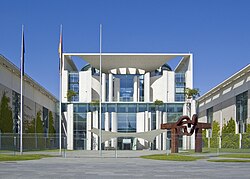 The Federal Chancellery, Berlin
 -
 Palais Schaumburg, Bonn
 -
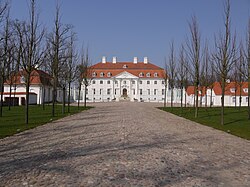 Schloss Meseberg, Gransee


Style of address
[edit]The correct style of address in German is Herr Bundeskanzler (male) or Frau Bundeskanzlerin (female). In international correspondence, the chancellor is referred to as "His/Her Excellency the Chancellor of the Federal Republic of Germany" ("Seine/Ihre Exzellenz der Bundeskanzler/die Bundeskanzlerin der Bundesrepublik Deutschland").[1]
Salary
[edit]Holding the third-highest state office available within Germany, the chancellor of Germany receives €220,000 per annum and a €22,000 bonus, i.e. one and two thirds of Salary Grade B11 (according to § 11 (1) a of the Federal Law on Ministers – Bundesministergesetz, BGBl. 1971 I p. 1166 and attachment IV to the Federal Law on Salaries of Officers – Bundesbesoldungsgesetz, BGBl. 2002 I p. 3020)[15]
See also
[edit]
Notes
[edit]- ^ German: Bundeskanzler(in) der Bundesrepublik Deutschland; often shortened to Bundeskanzler/Bundeskanzlerin, pronounced [ˈbʊndəsˌkant͡slɐ] ⓘ/[ˈbʊndəsˌkant͡sləʁɪn] ⓘ
- ^ It is unclear whether and from when Erhard was formally a member of the CDU; however, he was a member of the CDU/CSU group in the German Bundestag throughout his chancellorship and was chairman of the CDU from 23 March 1966 – 23 May 1967, which implies membership at least during this period.
References
[edit]- ^ a b "Ratgeber für Anschriften und Anreden" (PDF). Bundesministerium des Innern – Protokoll Inland. p. 40. Retrieved 23 May 2019.
- ^ "Das Amt des Bundeskanzlers: Einzelfragen zur Vergütung und weiteren Leistungen" (PDF). Wissenschaftliche Dienste des Deutschen Bundestages. 30 July 2020. p. 3. Retrieved 19 January 2023.
- ^ Parliamentary Council of the Federal Republic of Germany. "Basic Law for the Federal Republic of Germany". Wikisource. Wikimedia. Archived from the original on 28 January 2021. Retrieved 24 November 2020.
- ^ "Basic Law for the Federal Republic of Germany". www.gesetze-im-internet.de. Retrieved 20 September 2025.
- ^ Michael Kotulla: Deutsche Verfassungsgeschichte. Vom Alten Reich bis Weimar (1495–1934). Springer, Berlin 2008, p. 544.
- ^ Ernst Rudolf Huber: Deutsche Verfassungsgeschichte seit 1789. Vol. IV: Struktur und Krisen des Kaiserreiches. Verlag W. Kohlhammer, Stuttgart et al. 1969, p. 130; the same: Deutsche Verfassungsgeschichte seit 1789. Vol. V: Weltkrieg, Revolution und Reichserneuerung: 1914–1919. W. Kohlhammer, Stuttgart et al. 1978, p. 545.
- ^ a b c d e f – via Wikisource. [in English]
- ^ Huber, Ernst Rudolf (1981). Deutsche Verfassungsgeschichte seit 1789. Band VI: Die Weimarer Reichsverfassung [German Constitutional History since 1789. Volume VI: The Weimar Reich Constitution] (in German). Stuttgart: W. Kohlhammer. p. 47.
- ^ Apelt, Willibalt (1964). Geschichte der Weimarer Verfassung [History of the Weimar Constitution] (in German) (2nd ed.). Munich/Berlin: C.H. Beck'sche Verlagsbuchhandlung. p. 210.
- ^ Huber, Ernst Rudolf (1981). Deutsche Verfassungsgeschichte seit 1789. Band VI: Die Weimarer Reichsverfassung [German Constitutional History since 1789. Vol. VI: The Weimar Constitution] (in German). Stuttgart: W. Kohlhammer. pp. 324 f.
- ^ Huber, Ernst Rudolf (1981). Deutsche Verfassungsgeschichte seit 1789. Band VI: Die Weimarer Reichsverfassung [German Constitutional History since 1789. Volume VI: The Weimar Reich Constitution] (in German). Stuttgart: W. Kohlhammer. p. 326.
- ^ Basic Law, Article 63.
- ^ Tomuschat, Professor Christian; Currie, Professor David P.; Kommers, Professor Donald P.; Kerr, Raymond. "Basic Law for the Federal Republic of Germany". Gesetze im Internet. Bundesministerium der Justiz and the Bundesamt für Justiz. p. Article 63. Retrieved 7 May 2025.
- ^ . WILLY BRANDT QUITS POST IN WAKE OF SPY SCANDAL; ASKS SCHEEL TO TAKE OVER
- ^ Gesetz über die Rechtsverhältnisse der Mitglieder der Bundesregierung – § 11. Archived 4 November 2021 at the Wayback Machine gesetze-im-internet.de
Further reading
[edit]Books
[edit]- Klein, Hans, ed. The German Chancellors translated by Edna McCow. Chicago, Berlin, Tokyo, and Moscow, Edition q, 1996. On the Federal Republic of Germany's first six chancellors. At the Internet Archive.
- Padgett, Stephen, ed. Adenauer to Kohl: The Development of the German Chancellorship. London: Hurst, 1994.
- Prittie, Terence. The Velvet Chancellors: A History of Post-War Germany. London: Frederick Muller, 1979. At the Internet Archive.
Articles
[edit]- Harlen, Christine M. 2002. "The Leadership Styles of the German Chancellors: From Schmidt to Schröder". Politics and Policy 30 (2 (June)): 347–371.
- Helms, Ludger. 2001. "The Changing Chancellorship: Resources and Constraints Revisited". German Politics 10 (2): 155–168.
- Mayntz, Renate. "Executive Leadership in Germany: Dispersion of Power or 'Kanzler Demokratie'?" in Presidents and Prime Ministers, ed. R. Rose and E. N. Suleiman, pp. 139–171. Washington, D.C.: American Enterprise Institute 1980. At the Internet Archive.
- Smith, Gordon. 1991. "The Resources of a German Chancellor". West European Politics 14 (2): 48–61.
External links
[edit] Media related to Federal Chancellors of Germany at Wikimedia Commons

North German Confederation .svg) Bundeskanzler (1867–1871) | |
|---|---|
| German Empire Reichskanzler (1871–1918) | |
Weimar Republic .svg) Reichskanzler (1919–1933) |
|
Nazi Germany .svg) .svg) Reichskanzler (1933–1945) |
|
Federal Republic  Bundeskanzler (1949–present) | |
| |


Chancellor of Germany
View on GrokipediaHistorical Development of the Office (Pre-1949)
In the North German Confederation and German Empire (1867–1918)
The office of federal chancellor (Bundeskanzler) originated with the North German Confederation, formed on 1 July 1867 following Prussia's decisive victory in the Austro-Prussian War of 1866, which excluded Austria from German affairs and consolidated Prussian dominance over 22 states.[9] Otto von Bismarck, serving concurrently as Prussian minister-president and foreign minister, was appointed Bundeskanzler on 14 July 1867 by King William I of Prussia, who held the hereditary presidency of the Confederation.[9] The position centralized executive authority under Prussian leadership, reflecting Bismarck's design to unify northern Germany under a federal structure that preserved monarchical elements while enabling coordinated policy, particularly in military and customs matters via the Zollverein.[10] The Confederation's constitution, debated in the North German Reichstag and enacted on 17 April 1867, defined the chancellor as the sole federal executive officer, appointed and accountable exclusively to the president rather than to the bicameral legislature comprising the Bundesrat (state council) and Reichstag (popular assembly).[10] Absent a collective cabinet or ministerial responsibility to parliament—a deliberate omission to avoid diluting Prussian control—the chancellor directed federal administration through subordinate secretaries of state, countersigned presidential decrees assuming political liability, and initiated legislation requiring legislative approval only for passage, not origination or policy direction.[10] This arrangement prioritized executive stability and monarchical oversight, with the Reichstag empowered mainly for budgetary consent and limited impeachment, ensuring the chancellor's independence from democratic pressures.[11] Following the Franco-Prussian War and the proclamation of the German Empire on 18 January 1871, the office evolved into that of imperial chancellor (Reichskanzler), with the 1871 constitution substantially adopting the North German framework, including the chancellor's appointment and dismissal by the emperor (formerly president) and lack of parliamentary accountability.[11] The chancellor chaired the Bundesrat, represented the Empire in foreign affairs, oversaw unified domains like military command (under emperor direction), postal services, and railways, and bore sole responsibility for federal policy, though constrained by the emperor's veto and Prussian hegemony in the Bundesrat.[12] Bismarck retained the role until his ouster by Emperor William II on 20 March 1890, after 19 years marked by Kulturkampf against Catholic influence, anti-socialist laws following assassination attempts (1878–1890), and alliance-building to isolate France.[12] Successors such as Leo, Graf von Caprivi (1890–1894), who prioritized naval expansion and tariff reforms, and Chlodwig Carl Joseph, Prince of Hohenlohe-Schillingfürst (1894–1900), navigated growing Reichstag assertiveness and emperor intervention, yet remained personally responsible to the throne, underscoring the system's monarchical core over parliamentary sovereignty.[11] World War I eroded this structure amid military stalemate and domestic unrest. Theobald von Bethmann Hollweg, chancellor from 1909, resigned on 13 July 1917 due to submarine warfare disputes and calls for broader war aims restriction.[11] His successors—Georg Michaelis (July–November 1917), Georg von Hertling (November 1917–October 1918)—served briefly under intensifying parliamentary demands for influence. On 3 October 1918, Prince Max von Baden became chancellor as part of a reform bid to secure armistice terms and Reichstag confidence, formalized by a 28 October resolution mandating parliamentary dismissal power over the chancellor.[13] On 9 November 1918, amid sailor mutinies and urban revolts, Max announced Emperor William II's abdication, relinquished office to Social Democrat Friedrich Ebert, and transitioned authority to the emerging republican council, abolishing the imperial chancellorship with the monarchy's fall.[13] This abrupt termination reflected the office's inherent vulnerability to executive overreach without democratic anchors, culminating in systemic collapse rather than evolutionary reform.[11]During the Weimar Republic (1919–1933)
The Weimar Constitution, promulgated on August 11, 1919, established the office of Reichskanzler (Chancellor of the Reich) as the head of government, appointed by the President of the Reich and responsible to the Reichstag for the general conduct of policy.[14] The Chancellor proposed the composition of the cabinet to the President and directed the Reich's administration, but required the confidence of the Reichstag to govern effectively, with the ability to dissolve the legislature only through presidential intervention.[15] This framework aimed to balance parliamentary accountability with executive stability, drawing partial inspiration from the British parliamentary model, though the President's extensive powers under Article 48—allowing suspension of civil liberties and rule by decree in emergencies—often overshadowed the Chancellor's authority in crises.[16] In practice, the chancellorship endured profound instability, with 12 individuals holding the office from February 1919 to January 1933, many serving terms of mere months amid repeated cabinet crises.[17] The proportional representation system enshrined in the Constitution fragmented the Reichstag into multiple parties, preventing any single group from securing an absolute majority after the founding elections of January 1919, where the Social Democratic Party (SPD) won 37.9% of seats but relied on unstable coalitions with centrist parties.[18] Early chancellors, such as Philipp Scheidemann (February 13 to June 20, 1919) and Gustav Bauer (June 23, 1919, to March 27, 1920), navigated the postwar revolutionary turmoil, including the Spartacist uprising and the Treaty of Versailles' ratification on June 28, 1919, which imposed reparations and territorial losses exacerbating economic distress.[19] Subsequent governments under Hermann Müller (March 27 to June 21, 1920), Constantin Fehrenbach (June 25, 1920, to May 4, 1921), and Karl Joseph Wirth (May 10, 1921, to November 14, 1922) faced right-wing challenges like the Kapp Putsch in March 1920 and ongoing inflation, leading to frequent no-confidence votes and resignations.[17] The hyperinflation crisis of 1923, triggered by French-Belgian occupation of the Ruhr on January 11, 1923, and passive resistance policies that printed money to fund deficits, further destabilized the office; Wilhelm Cuno (November 22, 1922, to August 12, 1923) resigned amid public unrest, succeeded briefly by Gustav Stresemann (August 13 to November 30, 1923), whose caretaker cabinet introduced the Rentenmark on November 15, 1923, stabilizing currency at the cost of austerity. Stresemann's tenure marked a rare period of relative continuity, but subsequent chancellors like Wilhelm Marx (four terms totaling 1923–1925) struggled with coalition breakdowns. The Great Depression, beginning with the Wall Street Crash on October 29, 1929, intensified fragmentation; Heinrich Brüning (March 30, 1930, to May 30, 1932) governed via presidential emergency decrees under Article 48, bypassing the Reichstag after its dissolution in September 1930, implementing deflationary policies that raised unemployment to 30% by 1932.[20] This shift to "presidential government" eroded parliamentary norms, paving the way for Franz von Papen (June 1 to November 17, 1932), Kurt von Schleicher (December 3, 1932, to January 28, 1933), and ultimately Adolf Hitler's appointment on January 30, 1933, by President Paul von Hindenburg, amid backroom maneuvers by conservative elites seeking to harness Nazi electoral gains (37.3% in July 1932) against communism.[16]| Chancellor | Party/Affiliation | Term Dates | Key Events |
|---|---|---|---|
| Philipp Scheidemann | SPD | Feb 13–Jun 20, 1919 | Proclaimed Republic; resigned over Versailles Treaty.[19] |
| Gustav Bauer | SPD | Jun 23, 1919–Mar 27, 1920 | Ratified Versailles; Kapp Putsch.[17] |
| Hermann Müller | SPD | Mar 27–Jun 21, 1920 | Upper Silesia plebiscite.[17] |
| Constantin Fehrenbach | Centre | Jun 25, 1920–May 4, 1921 | Reparations debates.[19] |
| Karl Joseph Wirth | Centre | May 10, 1921–Nov 14, 1922 | Hyperinflation onset.[17] |
| Wilhelm Cuno | Independent | Nov 22, 1922–Aug 12, 1923 | Ruhr crisis.[17] |
| Gustav Stresemann | DVP | Aug 13–Nov 30, 1923 | Currency stabilization.[17] |
| Heinrich Brüning | Centre | Mar 30, 1930–May 30, 1932 | Depression-era decrees.[16] |
| Franz von Papen | Independent (conservative) | Jun 1–Nov 17, 1932 | Prussian coup attempt.[17] |
| Kurt von Schleicher | Independent (military) | Dec 3, 1932–Jan 28, 1933 | Failed stabilization.[17] |
Under the National Socialist Regime (1933–1945)
Adolf Hitler was appointed Chancellor of Germany on January 30, 1933, by President Paul von Hindenburg, following negotiations amid political instability after the Nazi Party's electoral gains in November 1932.[21] This appointment placed Hitler as head of government within the Weimar constitutional framework, where the Chancellor required presidential support and Reichstag confidence, though the Nazis held only a plurality of seats.[22] The Reichstag fire on February 27, 1933, prompted the immediate issuance of the Reichstag Fire Decree on February 28, which suspended civil liberties including habeas corpus, freedom of the press, and assembly, enabling the arrest of over 4,000 suspected communists and shifting emergency powers toward the executive under the Chancellor's cabinet. Subsequently, the Enabling Act, passed by the Reichstag on March 23, 1933, with a vote of 444 to 94 amid intimidation and exclusion of opposition delegates, authorized the Chancellor to enact laws without parliamentary approval, including those deviating from the constitution, for an initial four years.[23] This legislation effectively centralized legislative authority in the Chancellor's office, bypassing checks from the Reichstag and president, and facilitated the dissolution of rival parties and trade unions by July 1933.[24] Following Hindenburg's death on August 2, 1934, Hitler assumed the presidency's powers by decree on August 3, merging the offices of President and Chancellor into the unified title of Führer und Reichskanzler, which he proclaimed on August 1.[25] A plebiscite on August 19, 1934, approved this consolidation with 90% reported support, vesting supreme executive, legislative, and military command in the Führer while retaining the nominal Reich Chancellery structure. Under this arrangement, the Chancellor's role became subordinate to Hitler's personal dictatorship, with government functions coordinated through the Führerprinzip of hierarchical obedience rather than collegial cabinet decision-making; the Reich Chancellery served administrative purposes but lacked independent authority.[26] From 1934 to 1945, Hitler exercised the Chancellor's powers alongside his Führer role to direct rearmament, territorial expansion, and wartime governance, issuing decrees such as the 1935 Nuremberg Laws and mobilizing for the invasions of Poland on September 1, 1939, and the Soviet Union on June 22, 1941, without parliamentary oversight.[27] Upon Hitler's suicide on April 30, 1945, his political testament named Joseph Goebbels as Reich Chancellor, who served for one day before his own suicide on May 1; Karl Dönitz was designated Reich President, forming a brief caretaker government in Flensburg that surrendered to Allied forces on May 7–8 without appointing a successor Chancellor.[28] The office effectively ceased with the regime's collapse and the Allied occupation.[29]Constitutional and Operational Framework of the Federal Chancellorship (1949–Present)
Legal Basis and Core Responsibilities
The office of the Federal Chancellor is defined in the Basic Law for the Federal Republic of Germany, which entered into force on May 23, 1949, as the foundational constitutional document establishing the parliamentary democracy of West Germany and later unified Germany.[30] Article 62 of the Basic Law stipulates that the Federal Government consists of the Federal Chancellor and the Federal Ministers, positioning the Chancellor as the head of this executive body. This framework emphasizes collective decision-making while vesting directive authority in the Chancellor, distinguishing the role from that of a presidential system by subordinating executive power to parliamentary confidence. The core responsibility of the Chancellor, known as Richtlinienkompetenz (guideline competence), is outlined in Article 65 of the Basic Law: the Chancellor determines and bears responsibility for the general policy guidelines of the government. This embodies the principle of Regierungsverantwortung, whereby the Chancellor holds overall accountability for the government's policy direction, directing federal ministers within these guidelines while ensuring the executive's responsibility to the Bundestag.[30][31] Within these guidelines, Federal Ministers manage their respective portfolios independently and on their own responsibility, adhering to the departmental principle (Ressortprinzip), while the government as a whole decides on cross-cutting matters, which ministers then implement. The Chancellor chairs cabinet meetings, exercises a coordinating function across ministries, and ensures alignment with the established guidelines, thereby maintaining operational cohesion without micromanaging individual ministerial domains.[31] This legal structure underscores the Chancellor's accountability to the Bundestag, as the government's survival depends on maintaining its confidence, per Article 67 of the Basic Law, which allows for a constructive vote of no confidence. In practice, the Chancellor's role extends to nominating ministers for appointment by the Federal President (Article 64) and representing the government's policy direction domestically and internationally, though formal treaty ratification and head-of-state functions remain with the President. These provisions balance centralized policy leadership with ministerial autonomy, fostering a system where the Chancellor sets strategic priorities—such as economic stability or foreign relations—while ministers execute specialized tasks, subject to cabinet consensus on binding decisions.[1]Election Procedures and Accountability Mechanisms
The election of the Federal Chancellor occurs following general elections to the Bundestag or in cases of governmental change, as outlined in Article 63 of the Basic Law. The Federal President proposes a candidate, typically after consultations with parliamentary group leaders and the formation of a governing coalition. The Bundestag then conducts the election without prior debate via secret ballot. In the initial ballot, the candidate requires the votes of a majority of all Bundestag members, constituting an absolute majority.[3][32][4] If the proposed candidate fails to secure an absolute majority, the Bundestag has fourteen days to elect a chancellor by more than half of its members, again requiring an absolute majority. Should no such election occur within this period, a final ballot is held immediately, where the candidate receiving the largest number of votes— a relative majority—is elected. In this case, the Federal President must appoint the elected individual within seven days if they hold an absolute majority; otherwise, the President has seven days to either appoint them or dissolve the Bundestag, triggering new elections. The elected chancellor is formally appointed by the Federal President and sworn in before the Bundestag.[3][32] Accountability mechanisms emphasize parliamentary control while promoting governmental stability. Under Article 67, the Bundestag can remove the chancellor only through a constructive vote of no confidence, requiring the simultaneous election of a successor by an absolute majority of its members; the motion and vote are separated by at least 48 hours. This provision has been invoked successfully only once, on October 1, 1982, when Helmut Schmidt was replaced by Helmut Kohl.[3][4] Complementing this, Article 68 allows the chancellor to seek a vote of confidence. If not supported by a majority of Bundestag members after 48 hours, the Federal President may dissolve the Bundestag within 21 days upon the chancellor's proposal, unless a new chancellor is elected in the interim. This mechanism has been used strategically to resolve legislative deadlocks, as in Willy Brandt's 1972 vote leading to early elections, Helmut Schmidt's unsuccessful 1982 attempt, and Gerhard Schröder's 2005 vote that prompted dissolution. These procedures bind the chancellor's authority to ongoing parliamentary support, mitigating risks of abrupt instability seen in prior German systems.[3][4]Powers in Practice and Decision-Making Processes
The Federal Chancellor's Richtlinienkompetenz, enshrined in Article 65 of the Basic Law, empowers the officeholder to determine and bear responsibility for the government's general policy guidelines, a authority exercised in practice to set overarching priorities and arbitrate disputes among ministries.[33] This guideline-setting competence allows the Chancellor to direct federal policy across domains, ensuring alignment with strategic objectives, while individual ministers retain responsibility for their portfolios' execution, subject to these directives.[1] In inter-ministerial conflicts, the Chancellor holds the decisive voice, fostering centralized leadership within the executive branch.[34] Decision-making processes typically unfold through weekly cabinet meetings chaired by the Chancellor, where draft legislation and policies are debated and finalized before submission to the Bundestag for approval.[1] The Federal Chancellery serves as the central coordination hub, monitoring ministry activities, providing policy advice, and ensuring compliance with the Chancellor's guidelines, thereby exerting substantial influence over implementation across government.[34] In coalition governments, which have characterized nearly all post-1949 administrations due to the multi-party system's fragmentation, the Chancellor negotiates coalition agreements outlining policy commitments, with adherence to these pacts constraining unilateral action to maintain parliamentary majorities.[31] The Vice Chancellor, often from the junior coalition partner, facilitates intra-coalition balance, though the Chancellor's authority to propose ministerial appointments and dismissals to the Federal President reinforces dominance in cabinet composition.[1] In foreign and security policy, the Chancellor's practical powers enable proactive agenda-setting, as demonstrated in responses to crises like the 2022 Russian invasion of Ukraine, where directives on energy diversification and military aid were issued under Richtlinienkompetenz, overriding initial ministerial hesitations.[33] Legislative processes require Bundestag consent for binding laws, but the Chancellor's role in initiating bills—often 70-80% of the government's annual legislative program—ensures control over the policy pipeline, tempered by the constructive vote of no confidence mechanism that demands a successor's election for removal, promoting stability over frequent turnover.[1] The Chancellery's staff, numbering around 600 as of 2024, further amplifies this by embedding Chancellorial priorities into departmental workflows, though empirical analyses note its growing influence has occasionally centralized power at the expense of cabinet collegiality.[34]Administrative Support, Protocol, and Perquisites
The Federal Chancellery (Bundeskanzleramt) serves as the central administrative apparatus supporting the Chancellor, coordinating policy across federal ministries, preparing Cabinet meetings, and monitoring the implementation of government decisions.[34] Headed by the Head of the Chancellery—a position typically held by a federal minister with cabinet rank—the office employs approximately 900 staff members organized into divisions handling personnel, security policy, legal affairs, and interministerial coordination.[34][35] This structure enables the Chancellor to exercise the constitutional principle of directing general policy guidelines while relying on specialized units for operational efficiency.[36] Protocol for the Chancellor adheres to customary federal practices rather than a rigid statutory hierarchy, with the office ranking immediately below the Federal President in official precedence.[37] The Federal Ministry of the Interior manages inland protocol, encompassing ceremonial events, state visits, and address conventions such as "Herr Bundeskanzler" or "Frau Bundeskanzlerin," while the Foreign Office's Protocol Department coordinates international diplomacy.[38][39] In practice, the Chancellor participates in government-hosted ceremonies, including treaty signings and bilateral summits, often jointly with the President to distinguish head-of-state from head-of-government roles.[40] Perquisites include a gross annual salary of approximately €480,000, comprising base pay around €21,900 monthly plus allowances adjusted periodically for inflation and fiscal policy, as updated in 2025.[41][42] The Chancellor receives secure transport via an armored Mercedes-Benz S 680 Guard limousine for domestic travel and the government Airbus designated "Konrad Adenauer" for international flights, both maintained by federal services.[43] Personal security is provided by the Federal Criminal Police Office (BKA), with a protection detail ensuring round-the-clock coverage comparable to that for the President.[44] Unlike the President, the Chancellor lacks a dedicated official residence, instead utilizing a service apartment within the Chancellery complex in Berlin's Tiergarten district for official and private needs during tenure.[45] Post-tenure benefits extend to a lifetime pension, staffed office, and continued security.[46]Lists of Officeholders
Chancellors of the Federal Republic (1949–Present)
The Federal Republic of Germany, established on 15 September 1949, has seen ten chancellors serve as head of government, elected by the Bundestag following federal elections or changes in coalition majorities.[47] Most have led coalitions, with the Christian Democratic Union (CDU) and its sister party the Christian Social Union (CSU) dominating early and late terms, while the Social Democratic Party (SPD) held office during periods of social reform and economic challenges.[47] The following table enumerates the chancellors, their political affiliations, and precise terms in office:| Chancellor | Party | Term Start | Term End |
|---|---|---|---|
| Konrad Adenauer | CDU/CSU | 15 September 1949 | 16 October 1963 |
| Ludwig Erhard | CDU/CSU | 16 October 1963 | 1 December 1966 |
| Kurt Georg Kiesinger | CDU/CSU | 1 December 1966 | 21 October 1969 |
| Willy Brandt | SPD | 21 October 1969 | 6 May 1974 |
| Helmut Schmidt | SPD | 16 May 1974 | 1 October 1982 |
| Helmut Kohl | CDU/CSU | 1 October 1982 | 27 October 1998 |
| Gerhard Schröder | SPD | 27 October 1998 | 22 November 2005 |
| Angela Merkel | CDU/CSU | 22 November 2005 | 8 December 2021 |
| Olaf Scholz | SPD | 8 December 2021 | 6 May 2025 |
| Friedrich Merz | CDU/CSU | 6 May 2025 | Incumbent |
Vice Chancellors (1949–Present)
The Vice Chancellor acts as the primary deputy to the Federal Chancellor, stepping in during absences or incapacitation, and is conventionally the leader of the governing coalition's secondary party, often holding a major ministerial portfolio such as foreign affairs, finance, or economics. The position emerged with the first postwar cabinet in 1949 and has been occupied without interruption except for short transitional gaps.[49]| Portrait | Name | Party | Term start | Term end | Chancellor |
|---|---|---|---|---|---|
| Franz Blücher | FDP | 20 September 1949 | 29 October 1957 | Konrad Adenauer | |
| Ludwig Erhard | CDU | 29 October 1957 | 16 October 1963 | Konrad Adenauer | |
| Erich Mende | FDP | 16 October 1963 | 28 October 1966 | Ludwig Erhard | |
| Hans Christoph Seebohm | CDU | 1 December 1966 | 21 October 1969 | Kurt Georg Kiesinger | |
| Walter Scheel | FDP | 21 October 1969 | 16 May 1974 | Willy Brandt | |
| Hans-Dietrich Genscher | FDP | 17 May 1974 | 17 October 1982 | Helmut Schmidt | |
| Hans-Dietrich Genscher (cont.) | FDP | 21 October 1982 | 18 May 1992 | Helmut Kohl | |
| Jürgen Möllemann | FDP | 18 May 1992 | 21 January 1993 | Helmut Kohl | |
| Klaus Kinkel | FDP | 21 January 1993 | 27 October 1998 | Helmut Kohl | |
| Joschka Fischer | Greens | 27 October 1998 | 22 November 2005 | Gerhard Schröder | |
| Franz Müntefering | SPD | 22 November 2005 | 21 November 2007 | Angela Merkel | |
| Frank-Walter Steinmeier | SPD | 21 November 2007 | 27 October 2009 | Angela Merkel | |
| Guido Westerwelle | FDP | 28 October 2009 | 16 May 2011 | Angela Merkel | |
| Philipp Rösler | FDP | 16 May 2011 | 17 December 2013 | Angela Merkel | |
| Sigmar Gabriel | SPD | 17 December 2013 | 14 March 2018 | Angela Merkel | |
| Olaf Scholz | SPD | 14 March 2018 | 8 December 2021 | Angela Merkel | |
| Robert Habeck | Greens | 8 December 2021 | 6 May 2025 | Olaf Scholz | |
| Lars Klingbeil | SPD | 6 May 2025 | Incumbent | Friedrich Merz |
Analyses of Performance and Impact
Economic Management and Policy Outcomes
Under Konrad Adenauer and Economics Minister Ludwig Erhard, the establishment of the social market economy from 1948 onward facilitated the Wirtschaftswunder, or economic miracle, characterized by rapid reconstruction and growth. Currency reform in June 1948 and the abolition of price controls spurred industrial production, which rose 50 percent within six months, returning output to pre-World War II levels by late 1948. By 1958, the economy had expanded 400 percent from 1948 baselines, with average annual GDP growth exceeding 8 percent through the 1950s. Unemployment fell from 1.3 million in 1949 to 0.7 percent by 1962, driven by export-led manufacturing and limited government intervention.[56][57] Subsequent chancellors Willy Brandt and Helmut Schmidt navigated the 1970s oil crises and stagflation, maintaining relative stability through fiscal prudence and industrial policy, though growth slowed to around 2 percent annually amid rising energy costs. Helmut Kohl's tenure from 1982 to 1998 featured pre-reunification debt reduction and recovery, with GDP expanding robustly before 1990, but unification in 1990 imposed substantial costs estimated at over 2 trillion euros in transfers to the East, elevating public debt from 41 percent of GDP in 1989 to 55 percent by 1995. Eastern productivity, initially below 30 percent of Western levels, led to short-term recession in the East and a mild Western boom, yet long-term integration boosted overall output, with unified GDP growth averaging 1.5 percent in the 1990s despite elevated unemployment peaking at 11 percent.[58][59] Gerhard Schröder's Agenda 2010 reforms, enacted in 2003-2005, deregulated labor markets, shortened unemployment benefits from up to 32 months, and introduced sanctions to incentivize employment, halving unemployment from 11.3 percent in 2005 to 5.5 percent by 2008 and enabling export-driven growth averaging 1.5 percent annually post-reform. These measures, including Hartz IV combining unemployment and welfare benefits, reduced structural rigidities but faced criticism for increasing precarious work, though empirical data links them to sustained low unemployment under subsequent governments.[60][61] Angela Merkel's 2005-2021 leadership weathered the 2008 financial crisis via bank recapitalization and short-time work schemes, preserving jobs and achieving average GDP growth of 1.3 percent, with unemployment dropping to 3.1 percent by 2019. However, the 2011 nuclear phase-out under Energiewende and reliance on Russian gas imports heightened energy vulnerabilities, contributing to industrial electricity prices 2-3 times EU averages by 2020 and foreshadowing deindustrialization pressures. During the Eurozone debt crisis, Germany's insistence on fiscal austerity stabilized the currency union but exacerbated southern European recessions, while domestic current account surpluses exceeding 8 percent of GDP masked rising inequality and infrastructure underinvestment.[62][63] Olaf Scholz's coalition from 2021 to 2025 confronted post-COVID recovery, the Ukraine war's energy shock, and structural stagnation, with GDP contracting 0.3 percent in 2023 and flatlining in 2024 amid recessionary pressures. High energy prices, bureaucracy, and an aging workforce—compounded by insufficient reforms—drove manufacturing decline, with industrial production falling 5 percent year-over-year by mid-2024, unemployment rising to 6 percent, and debt-to-GDP at 64 percent. The government's €200 billion energy relief package mitigated immediate shocks but failed to reverse export dependency and green transition costs, leading to coalition collapse in November 2024 over budget disputes.[64][65]| Chancellor | Term | Avg. Annual GDP Growth (%) | Peak/Avg. Unemployment (%) | Debt-to-GDP End (%) |
|---|---|---|---|---|
| Adenauer/Erhard | 1949-1966 | ~8 (1950s) | 0.7 (1962) | Low (pre-1960s data sparse) |
| Kohl | 1982-1998 | 1.5 (1990s) | 11 (mid-1990s) | 55 (1995) |
| Schröder | 1998-2005 | 1.0 | 5.5 (2008 post-reform) | ~61 |
| Merkel | 2005-2021 | 1.3 | 3.1 (2019) | 70 (2020) |
| Scholz | 2021-2025 | 0.0 (2023-24) | 6 (2024) | 64 (2024) |