Hubbry Logo
Royal antelopeRoyal antelopeMain
Open search
Royal antelope
Community hub
Royal antelope
logo
8 pages, 0 posts
0 subscribers
Be the first to start a discussion here.
Royal antelope
Royal antelope
from Wikipedia

Royal antelope
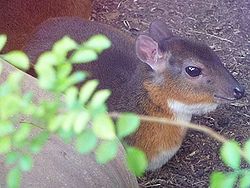
Individual at the San Diego Zoo
Scientific classification Edit this classification
Kingdom: Animalia
Phylum: Chordata
Class: Mammalia
Order: Artiodactyla
Family: Bovidae
Subfamily: Antilopinae
Genus: Neotragus
Species:
N. pygmaeus
Binomial name
Neotragus pygmaeus
Synonyms[2]

Capra pygmaea Linnaeus, 1758
Antilope regia Erxleben, 1777
Antilope opinigera Lesson, 1827
Moschus pygmaeus Linnaeus, 1766
Nanotragus perpusillus Gray, 1851

The royal antelope (Neotragus pygmaeus) is a West African antelope recognized as the world's smallest. It was first described by Swedish zoologist Carl Linnaeus in 1758. It stands up to merely 25 cm (10 in) at the shoulder and weighs 2.5–3 kg (5.5–6.6 lb). A characteristic feature is the long and slender legs, with the hindlegs twice as long as the forelegs. Horns are possessed only by males; the short, smooth, spiky horns measure 2.5–3 cm (0.98–1.18 in) and bend backward. The soft coat is reddish to golden brown, in sharp contrast with the white ventral parts. In comparison to Bates's pygmy antelope, the royal antelope has a longer muzzle, broader lips, a smaller mouth and smaller cheek muscles.

Typically nocturnal (active at night), the royal antelope exhibits remarkable alertness. Territories are marked with dung. An herbivore, the royal antelope prefers small quantities of fresh foliage and shoots; fruits and fungi may be taken occasionally. Like other neotragines, the royal antelope is monogamous. Both sexes can become sexually mature by as early as six months. Births have been reported in November and December. A single, delicate young is born after an unknown gestational period.

The royal antelope prefers areas with fresh and dense growth of shrubs and other plants. It inhabits the warm, moist lowland forests prevalent in western African countries such as Côte d'Ivoire, Ghana, Guinea, Liberia and Sierra Leone. The royal antelope has been categorized as Least Concern by the International Union for the Conservation of Nature and Natural Resources (IUCN). The population is feared to be declining due to habitat deterioration and expanding human settlement. A significant threat to the survival of this antelope is hunting for bushmeat.

Taxonomy and etymology

[edit]

The vernacular name "royal antelope" is based on a statement made by Willem Bosman, a merchant associated with the Dutch West India Company, that the antelope was called "the king of the harts" (i.e., the king of the antelope) by locals.[3]

The scientific name is Neotragus pygmaeus /nˈɒtrəɡəs pɪɡˈməs/. It is placed in the genus Neotragus and the family Bovidae. It was first described by Swedish zoologist Carl Linnaeus in the tenth edition of Systema Naturae (1758). German zoologist Peter Simon Pallas recognised two species – Tragulus pygmaeus and Antilope pygmaea. However, both of them were found to have the same type, the royal antelope. Hence these are treated as synonyms for N. pygmaeus.[4]

The generic name Neotragus consists of two Greek roots: νέος (néos), "new", and τράγος (trágos), "he-goat",[5] while the specific name pygmaeus comes from the Greek πυγμαῖος (pugmaîos), "pygmy, fist-sized".

The tribe Neotragini comprises a variety of dwarf antelopes apart from Neotragus – these include Dorcatragus (beira), Ourebia (oribi), Madoqua (dik dik), Oreotragus (klipspringer) and Raphicerus.[6] The tribe has been shown to be paraphyletic.[7][8] A 2014 phylogenetic analysis based on cytochrome b sequences and linear skull measurements showed polyphyly in Neotragus. The royal antelope is likely to have had an ancestor in common with the klipspringer and duikers (subfamily Cephalophinae). The genus Neotragus was formerly confused with the distantly related pygmy antelope genus Nesotragus (von Düben, 1846), from Greek νῆσος (nêsos), "island".[9]

Description

[edit]
An illustration of the royal antelope from The Book of Antelopes (1894)

The royal antelope is the smallest antelope and ruminant in the world.[10][11][12][6] It is also the smallest African ungulate, followed by Bates's pygmy antelope (Nesotragus batesi).[13][14][15] It is also the smallest of all bovines. The royal antelope reaches merely 25 cm (9.8 in) at the shoulder and weighs 2.5–3 kg (5.5–6.6 lb).[12] The head and body length is typically 40 cm (16 in). A characteristic feature is the long and slender legs, with the hindlegs twice as long as the forelegs – a remarkable similarity to a hare.[12] The thin tail, 5–8 cm (2.0–3.1 in) long, is white on the underside, ending in a white tuft. The species is sexually dimorphic, with females being larger than males. Only males possess horns, these being short, smooth, ventrally reflexed spikes measuring 2.5–3 cm (1.0–1.2 in) long.[2][12][16]

The soft coat is reddish to golden brown, in sharp contrast with the white ventral parts. A brown band runs across the chest, and a distinct rufous collar can be observed on the neck. The chin and the medial surfaces of the legs are also white. The face is characterised by large, round dark brown eyes, small translucent ears, a slim muzzle, and a large grayish pink rhinarium.[12][16] In comparison to Bates's pygmy antelope, the royal antelope has a longer muzzle, broader lips, a smaller mouth and smaller cheek muscles.

Ecology and behavior

[edit]

The royal antelope exhibits remarkable alertness, and consequently little is known about its behaviour. The animal will immediately seek cover if alarmed and flees as soon as the danger is very close. It can move swiftly, either by sprinting fast with the body low to the ground, or through strong leaps powered by the large, well-muscled hindlegs. It can cover 2.8 m (9.2 ft) in a single leap, and rise as high as 55 centimetres (22 in) above the ground.[17] It is typically nocturnal (active at night), though activity may also be observed during the day.[6] It generally rests or ruminates during the day.[18] Territories are marked with dung. The reduced size of the preorbital glands, which are used for scent-marking, could indicate that marking behavior is not very prominent in this antelope.[12]

Diet

[edit]

A herbivore, the royal antelope prefers small quantities of fresh foliage and shoots; fruits and fungi may be taken occasionally. Though the antelope is considered to be nocturnal, zoologist Jonathan Kingdon holds that feeding occurs throughout the day, though some foraging may also be observed at night.[19] In comparison to Bates's pygmy antelope, the royal antelope has a longer muzzle, broader lips, a smaller mouth and smaller cheek muscles. These features do not allow complete digestion of lignified growth. Individuals may often move into new locations foraging for fresh growth.[6]

Reproduction

[edit]

Like other neotragines, the royal antelope is monogamous, though polygamy has been occasionally observed.[12] Individuals of both sexes have been known to reach sexual maturity by six months of age.[20] Births have been reported in November and December. Typically a single, delicate offspring is born after an unknown gestational period, weighing 0.8–1 kg (1.8–2.2 lb) – nearly a third of an adult's weight. Young appear similar to adults in coloration.[17][18] The maximum lifespan of a captive royal antelope was estimated at six years and eight months by a 1993 study.[21]

Habitat and distribution

[edit]

The royal antelope prefers areas with fresh and dense growth of shrubs and other plants. It inhabits the warm, moist lowland forests prevalent in western African countries such as Côte d'Ivoire, Ghana, Guinea, Liberia and Sierra Leone. The animal's habitat also includes forest fringes and secondary forests. Its geographic range extends eastward from the Kounounkan Massif in southwestern Guinea through Sierra Leone, Liberia and Côte d'Ivoire to the Volta River in Ghana. The royal antelope may also be found in the region north to the forested areas of western Africa, which is marked by the interface of forest and savannah habitats.[1][19]

Threats and conservation

[edit]

The royal antelope has been categorized as Least Concern by the International Union for the Conservation of Nature and Natural Resources (IUCN). In 1999, the IUCN SSC Antelope Specialist Group estimated the total population to be about 62,000; however, this is likely to be an underestimate.[22] The populations are thought to be declining due to habitat deterioration and expanding human settlement. A significant threat to the survival of this antelope is hunting for bushmeat; it is seldom hunted in Sierra Leone and Liberia, whereas it is a major source of bushmeat in Côte d'Ivoire. Protected areas where the royal antelope occurs include the Tai National Park, Haut Bandama Fauna and Flora Reserve and Mabi-Yaya Classified Forest (Côte d'Ivoire); Kakum National Park and Assin-Attandanso Game Production Reserve (Ghana); Ziama and Diecke Forest Reserves (Guinea); Tiwai Island and Gola Rainforest National Park (Sierra Leone).[1]

References

[edit]
[edit]
Revisions and contributorsEdit on WikipediaRead on Wikipedia
from Grokipedia
The Royal antelope (Neotragus pygmaeus) is the world's smallest , endemic to the tropical rainforests of West Africa's Upper Forest , where it inhabits moist lowland forests, secondary vegetation, and dense undergrowth at forest edges. Weighing 2–3 kg and standing approximately 25–27 cm at the shoulder, it features fine, soft reddish or golden-brown pelage that is particularly red on the rump, with darker brown on the upper back, crown, and forehead, accented by white spots at the ear bases, a white throat "bib," and pale underparts. Males possess short, conical horns up to 3.4 cm long, often concealed by a crest of hair, while both sexes exhibit large eyes, small flesh-colored ears, long thin legs adapted for agile movement, and a diminutive tail with a white underside. This elusive, primarily nocturnal or crepuscular species forages solitarily or in small groups, relying on its exceptional alertness and high-stepping gait to evade predators in the . Its diet consists mainly of soft, digestible foliage including leaves, buds, shoots, and new growth from crops like yams and sweet potatoes, reflecting its folivorous habits suited to the nutrient-rich but structurally complex forest environment. Distribution spans from southwestern (including the Kounounkan Massif) through , , and d'Ivoire to Ghana's , though records east of the Volta are questionable, and the species favors areas with fresh green regrowth amid dense cover. Reproduction occurs without a marked breeding season, typically producing a single offspring that begins ruminating by four months of age, with longevity in captivity reaching up to 6 years and 8 months. Although classified as Least Concern on the due to its relatively wide distribution and presence in protected areas such as in Côte d'Ivoire and in , the population is decreasing owing to threats from hunting and loss driven by and agricultural expansion. The species is not listed under , underscoring the need for enhanced monitoring and conservation efforts to mitigate ongoing pressures in its fragmented .

Taxonomy

Classification

The royal antelope is classified within the domain Eukarya, kingdom Animalia, Chordata, class Mammalia, order Artiodactyla, suborder Ruminantia, family , subfamily , and tribe Neotragini. Its binomial name is Neotragus pygmaeus, first described by in the 10th edition of Systema Naturae in 1758, where it was initially placed under the genus Capra as Capra pygmaea. Historical synonyms include Moschus pygmaeus, pygmaea, Antilope regia, Tragulus pygmaeus, pygmaeus, and Neotragus pygmeus, reflecting early misclassifications among small ruminants and other based on limited specimens. The genus Neotragus traditionally encompassed three of dwarf antelopes: the royal antelope (N. pygmaeus), Bates's pygmy antelope (N. batesi), and the (N. moschatus). However, a 2014 molecular and morphometric analysis using mitochondrial sequences and skull measurements demonstrated that Neotragus is polyphyletic, with N. batesi and N. moschatus forming a distinct more closely related to each other than to N. pygmaeus, leading to their reclassification in the separate genus Nesotragus. This revision highlights the paraphyly of the tribe Neotragini, which groups various dwarf antelopes but lacks monophyletic support under modern phylogenetic frameworks. Phylogenetically, the royal antelope shares close affinities with other pygmy antelopes within but diverges from duikers of the Cephalophini ( Cephalophinae) in both genetic sequences and morphological traits, such as horn structure and cranial features, underscoring its distinct evolutionary lineage among West African .

The "royal antelope" originates from an account by the 17th-century Dutch trader Willem Bosman in his 1704 A New and Accurate Description of the Coast of , where he described how locals in the Gold Coast (present-day ) called the animal the "king of the harts" due to its diminutive size, rarity, and status as the smallest antelope, reserved exclusively for royal consumption. The genus name Neotragus was established by in 1827, derived from the Greek words neo- (new) and tragos (he-goat), reflecting its novel classification as a small, goat-like distinct from other known at the time. The species epithet pygmaeus, originally described by in 1758, comes from the Latin pygmaeus (dwarf or pygmy), borrowed from the Greek pugmaios (fist-sized), alluding directly to the animal's exceptionally small stature. In local West African languages, the royal antelope is known by various names that often highlight its elusive nature or size, such as "Adowa" in the Twi language of and "Sagbene" in the of and surrounding regions; these terms underscore its cultural role in , where it sometimes symbolizes cunning or is associated with archetypes akin to a "cunning rabbit" in Sierra Leonean stories.

Physical description

Size and morphology

The royal (Neotragus pygmaeus) is recognized as the world's smallest and , as well as the smallest even-toed excluding chevrotains in the Tragulidae. Adults typically measure 40–50 cm in head-and-body length, with a shoulder height of about 25 cm and a length of 5–8 cm. Their weight ranges from 1.5–3 kg, making them comparable in size to a large , though specific measurements can vary slightly in , such as a recorded weight of 2.4 kg. The sexes are similar in size, with males marginally larger or heavier. The species exhibits a slender, delicate build with disproportionately large hindquarters and very thin, long legs that contribute to its rabbit-like appearance. The hind legs are significantly longer than the forelegs—nearly twice their length—enabling powerful leaps of up to 2.8 m. This limb structure, combined with vestigial or absent lateral hooves, supports agile movement through dense undergrowth. Only males possess horns, which are short, straight, and conical, measuring 2.5–3.4 cm in length and often concealed by a crest of hair on the . The head features large eyes, small flesh-colored ears, and a longer muzzle with broader lips compared to the closely related Bates's pygmy antelope (N. batesi), along with smaller muscles (masseter) and a reduced anterior section adapted for browsing. Small preorbital and pedal glands are present, typical of the .

Coloration and distinctive features

The royal antelope features a soft, sleek that exhibits a reddish-brown to golden-brown hue dorsally, gradually paling on the lower sides before contrasting sharply with underparts, including the chin, throat, and inner surfaces of the legs. The pelage is particularly red on the rump, with darker brown on the upper back, , and ; the sides of the face are sandy-red, accented by white spots at the bases and upper margins of the ears. A distinctive rufous-brown band traverses the chest, forming a collar-like marking that bisects the white throat. Additional subtle markings include small white spots on the front of each leg above the hooves, while the face lacks prominent glands or bold patterns. The tail is short and thin, brown on the upper surface with a white underside terminating in a small white tuft, which frequently twitches during movement. The eyes are large, round, and dark brown, positioned to enhance visibility in low-light conditions. Complementing this, the ears are rounded with a translucent, flesh-colored inner surface, contributing to heightened sensory awareness. In comparison to the closely related Bates's pygmy antelope, the royal antelope displays a brighter, lighter overall tone and lacks the subtle black-and-white markings on the ears characteristic of the former. This coat coloration and texture facilitate within dense undergrowth by blending with leaf litter and shaded foliage.

Ecology and behavior

Activity patterns and social structure

The royal antelope exhibits primarily nocturnal activity patterns, with peaks of activity during the night, although it shows intermittent activity throughout the day and may also be crepuscular, particularly around dawn and dusk. During daylight hours, individuals typically rest and ruminate in dense forest undergrowth to minimize exposure to predators. Socially, the royal antelope is generally solitary or occurs in stable monogamous pairs, with larger family groups being rare and transient. These animals maintain small, exclusive home ranges—estimated at around 100 square meters in some observations or less than 4 hectares in others—which they mark primarily through dung middens, as their reduced preorbital glands provide limited scent-marking capability. Territorial defense is subtle and not intensely aggressive, reflecting their secretive lifestyle in dense habitats. Highly vigilant by nature, royal antelopes respond to threats by freezing in place, crouching low in cover, or rapidly fleeing through the with agile dashes and powerful leaps that can span up to 2.8 meters in length and 55 cm in height. This evasiveness contributes to their elusiveness in . In , they have been recorded living up to 6 years and 8 months, though wild lifespans are likely shorter owing to predation pressure. Their shy disposition leads royal antelopes to avoid human-modified landscapes, such as cleared areas, favoring undisturbed cover.

Diet

The royal antelope (Neotragus pygmaeus) is a strict classified as a browser, primarily feeding on fresh foliage, shoots, buds, and weeds found in the forest . It occasionally consumes fruits, flowers, fungi, and tender grasses, but these form a minor portion of its intake. Foraging takes place both day and night, with the antelope using its elongated muzzle and broad lips to precisely select and pluck nutritious leaves while minimizing consumption of tougher plant material. Grazing on grasses is minimal, reflecting its adaptation to selective rather than bulk feeding. As a , the royal possesses a four-chambered that facilitates microbial of plant matter, enabling efficient extraction of nutrients from its fibrous diet. Its selective feeding strategy further aids by avoiding high levels of indigestible fibers, supporting its small body size and high metabolic demands. In comparison to its congener Bates's pygmy antelope (N. batesi), the royal antelope is more strictly folivorous, emphasizing leaves over fruits and other items.

Reproduction and life cycle

The royal antelope exhibits a primarily monogamous , with individuals typically living solitarily or in stable pairs. behaviors are poorly documented due to the species' elusive nature. Both sexes reach between 6 and 12 months of age, enabling relatively early breeding opportunities. Breeding occurs throughout the year in stable habitats, with a noted peak in births from to , likely aligned with seasonal resource availability in West African forests. The gestation period remains unknown for the royal , though estimates based on the closely related suni suggest approximately 180 days (6 months); this data gap underscores the need for further field studies. Females give birth to a single calf, with no confirmed records of twins, and the neonate weighs about 0.3 kg (10.6 oz), representing roughly 10-15% of the mother's body mass. Calves are precocial at birth, capable of standing and moving shortly after delivery, and are initially concealed by the mother in dense vegetation to avoid predators. Maternal care is intensive during the early stages, with the mother nursing the calf for around 2 months until , after which the young begins to independently. The juvenile phase is brief, with calves achieving full adult size by approximately 1 year of age and dispersing soon after to establish their own territories. Lifespan in the wild is estimated at 6 years, though captives have lived up to 10 years; the low reproductive rate and extended development relative to body size highlight vulnerabilities to habitat disruption.

Habitat and distribution

Geographic range

The royal antelope (Neotragus pygmaeus) is endemic to the Upper Guinea forest block of , with a native range extending from the Kounounkan Massif in southwestern eastward to the region of , though records east of the Volta are questionable. This distribution includes the countries of , , and Côte d'Ivoire, where populations occur in forested areas along the coastal belt. The is absent from habitats and the Dahomey Gap, a dry corridor that separates its range from Central African forests where related Neotragus like Bates's pygmy antelope (N. batesi) are found. There have been no successful introductions outside its native West African range. Historically, the royal 's range was likely more continuous across primary forests prior to extensive human modification, but current populations are fragmented due to and habitat conversion. No are recognized, and morphological variation is minimal across the distribution. The overall extent spans roughly the Guinea forest zone, though actual occupancy is patchy and confined to remaining forest patches.

Habitat preferences

The royal antelope primarily inhabits dense lowland rainforests and thickets at elevations below 500 m (1,640 ft), where it favors the shrub layers for concealment and movement. This thrives in moist, warm tropical climates characteristic of forests and forest-savanna mosaics, relying on these environments for consistent access to foliage and fruits throughout the year. It avoids open grasslands and higher elevations, preferring areas with high and minimal exposure to direct or predation in cleared zones. Preferred microhabitats include thickets, growth, and swamp edges, which offer dense vegetative cover essential for hiding and selective browsing on plants. The royal antelope's adaptations to humid conditions enable it to exploit these sheltered niches effectively, supporting its secretive lifestyle amid sympatric such as forest duikers and various monkeys.

Conservation

Threats

The primary threats to the royal antelope (Neotragus pygmaeus) stem from anthropogenic activities that have intensified across its West African range. Habitat loss through deforestation for agriculture, logging, and urbanization is a major driver, fragmenting the dense forest environments essential for the species and reducing available cover. This pressure is particularly acute in regions undergoing rapid human expansion, where forest conversion to farmland and settlements disrupts the antelope's preferred understory habitats. Hunting for represents another significant danger, with the royal antelope targeted using snares, nets, traps, dogs, and guns, leading to high mortality rates especially near human settlements and urban markets. The fetches premium prices in bushmeat trade hubs, such as in Côte d'Ivoire and , where annual sales of thousands of carcasses have been documented, exacerbating population declines. Indirect effects from human activities, including road-building and development, further increase vulnerability by facilitating access for hunters and altering connectivity. Natural predators, including leopards (Panthera pardus), African golden cats (Caracal aurata), servals (Leptailurus serval), crowned eagles (Stephanoaetus coronatus), and large snakes such as pythons, pose ongoing risks, though their impact is amplified by that exposes the to greater predation pressure. The ' small size and typically low population densities (0.2–2.0 individuals/km²) contribute to a slow recovery potential from these combined threats, with an overall declining trend observed since the . Regional variations exist, with higher hunting pressure in areas like compared to and , where cultural taboos limit consumption and provide some respite.

Status and protection

The royal antelope (Neotragus pygmaeus) is classified as Least Concern on the , based on a 2016 assessment by the Antelope Specialist Group, though the population trend is decreasing due to ongoing habitat degradation and pressures. No comprehensive update to this assessment has occurred as of 2025, underscoring the need for renewed evaluations to reflect current conditions. Global population estimates for the species remain outdated, with the most cited figure of approximately 62,000 individuals derived from the 1998 African Database, a collaborative effort by the IUCN/SSC Specialist Group. This estimate is widely regarded as an underestimate, given the challenges in detecting the elusive, forest-dwelling through surveys, and the absence of recent range-wide censuses highlights a critical data deficiency that hampers effective conservation planning. The royal antelope receives protection within several key protected areas across its West African range, including in Côte d'Ivoire, in Ghana, and the Gola Rainforest National Park spanning and , where enforcement helps mitigate local threats. Conservation initiatives emphasize community-based approaches, such as local involvement in monitoring and sustainable resource use, alongside patrols to reduce illegal hunting. Additional research priorities include updating population demographics and resolving uncertainties around reproductive parameters, like the precise gestation period, to inform targeted interventions. In protected reserves, royal antelope populations appear relatively stable, benefiting from reduced human encroachment, but the species faces broader vulnerability from outside these zones. Recommendations focus on creating habitat corridors to link isolated patches, enhancing connectivity and genetic exchange. Captive breeding programs are limited, with the species held in only a handful of zoos worldwide, primarily to support and potential reintroduction efforts, though success remains constrained by the animal's specialized needs.
Add your contribution
Related Hubs
User Avatar
No comments yet.