


Community hub
Recent from talks
Contribute something
Nothing was collected or created yet.
Taruca
View on Wikipedia
| Taruca | |
|---|---|

| |
CITES Appendix I
| |
Scientific classification 
| |
| Kingdom: | Animalia |
| Phylum: | Chordata |
| Class: | Mammalia |
| Order: | Artiodactyla |
| Family: | Cervidae |
| Subfamily: | Capreolinae |
| Genus: | Hippocamelus |
| Species: | H. antisensis
|
| Binomial name | |
| Hippocamelus antisensis (d'Orbigny, 1834)
| |

| |
| Geographic range | |

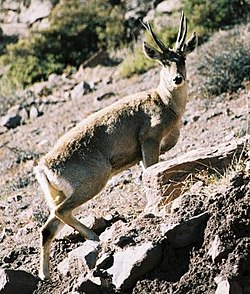
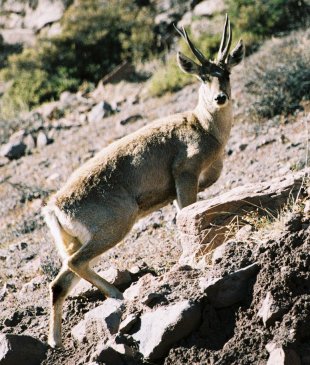
The taruca (Hippocamelus antisensis), also known as the Peruvian guemal, north Andean deer, north Andean huemul, northern huemul or northern guemal, is a mid sized deer species that inhabits the high regions of the Andes mountains in South America. The common name taruca means "deer" in both the Quechua and Aymara languages. The taruca is closely related to the southern guemal (H. bisulcus), the only other member of the Hippocamelus genus.
Description
[edit]The taruca is a medium-sized deer with a heavy body. It measures 128 to 146 cm (50 to 57 in) from head to rump, with an 11 to 13 cm (4.3 to 5.1 in) tail, and stands 69 to 80 cm (27 to 31 in) tall at the shoulder. Adults weigh between 69 and 80 kg (152 and 176 lb). As with most deer, males are significantly larger than females.[3]
It has sandy brown fur over most of its body, with white patches on the underside of its head, neck, tail, and genital region, and on the inner surface of its fore-legs. While females often have a dark brown area on the forehead, facial markings are much clearer in the males. The exact patterns vary between different males, but in general there is a black mask behind the nose, and a black Y or V pattern over the forehead and snout.[3]
As other deer, only male tarucas typically grow antlers. The longer tine of a full grown male generally measures around 30 cm (12-inch). Unlike other South American deer, except for the closely related huemul, the antlers consist of just two tines which branche from the base, and with the posterior tine being the larger. Males also possess canine teeth in their upper jaw, which females usually, but not always, lack.[3]
Distribution and habitat
[edit]Tarucas are found only in the Andes mountains, from central Peru, through Bolivia and extreme north-eastern Chile, and into northern Argentina.
Peru holds the largest population of tarucas in South America. In 2008 it was suggested that between 9,000 and 12,000 individuals lived across the central Andes mountains. The Huancabamba depression marks the northern limit of the species distribution. Tarucas live at altitudes ranging from 3,500 m (11,500 ft) to 5,000 m (16,000 ft), and at lower altitudes within that range, might share territory with the Peruvian whitetail deer that are also endemic to the region. In Argentina, tarucas are found at altitudes of 2,000 m (6,600 ft) to 3,000 m (9,800 ft) where they occupy grasslands marked by occasional shrubs and rocky outcrops, typically near water.[1] There are no recognised subspecies.
Diet and behaviour
[edit]Tarucas are mainly found in rocky slopes, queñual forests and at puna grasslands by the side of glaciar lakes at high altitude mountain terrains. Despite living in grasslands, the taruca feeds mainly on the local bushes, shrubs, and herbs for much of the year, but supplements this diet with grasses during the rainy season. Plants commonly eaten include dwarf gentian, ragworts, lupins, senna, valerian, and clubmosses. Tarucas may also feed on agricultural crops, such as alfalfa, barley, and potato plants.[3]
Tarucas are gregarious, but do not live in stable herds, with individuals moving between groups of up to thirty members each over the course of a few days. Their populations are scattered, due to their need for relatively specialised habitats, with population densities as low as 0.15/km2 (0.39/sq mi), even away from human habitation. Individual groups are typically led by the females.[4] During the breeding season, males may compete with one another, displaying threatening behaviour by raising their forelegs one at a time and pointing their antlers towards one another.[4]
Reproduction
[edit]The rut lasts from May to July, during which time the deer segregate into smaller groups with a single adult male. Males drop their antlers immediately after the breeding season finishes, in September, with the new pair beginning to grow in December, and losing the velvet by February. Pregnancy lasts for 240 days, so that the single fawn is born between January and March, coinciding with the rainy season. Twins have been observed in captivity, but are rare. The mother leaves the group in order to give birth, and keeps the fawn hidden behind rocky outcrops for the first month of life.[3]
References
[edit]- ^ a b Barrio, J.; Nuñez, A.; Pacheco, L.; Regidor, H.A.; Fuentes-Allende, N. (2017). "Hippocamelus antisensis". IUCN Red List of Threatened Species. 2017 e.T10053A22158621. doi:10.2305/IUCN.UK.2017-2.RLTS.T10053A22158621.en. Retrieved 12 November 2021.
- ^ "Appendices | CITES". cites.org. Retrieved 2022-01-14.
- ^ a b c d e Barrio, J. (2013). "Hippocamelus antisensis (Artiodactyla: Cervidae)". Mammalian Species. 45 (901): 49–59. doi:10.1644/901.1.
- ^ a b Roe, N. & Rees, W. (1976). "Preliminary observations of the taruca (Hippocamelus antisensis: Cervidae) in southern Peru". Journal of Mammalogy. 57 (4): 722–730. doi:10.2307/1379442. JSTOR 1379442.
External links
[edit]- Photo of H. antisensis Archived 2011-02-18 at the Wayback Machine
Taruca
View on GrokipediaTaxonomy and nomenclature
Etymology and common names
The common name taruca (also spelled taruka or tarugo) derives from the Quechua and Aymara languages, indigenous tongues of the Andean peoples, where it means "deer." This term has been widely adopted by local Spanish-speaking communities in Peru, Bolivia, and northern Chile to designate the species, reflecting its cultural significance in highland traditions.[5][6] In English, the taruca is commonly known as the North Andean deer, Peruvian huemul, or northern huemul, emphasizing its distribution in the northern Andes. These names distinguish it from the closely related South Andean deer (Hippocamelus bisulcus), sometimes called the Chilean huemul, which has led to occasional confusion in regional nomenclature.[5][7] The scientific binomial Hippocamelus antisensis was established by French naturalist Alcide d'Orbigny in 1834, originally as Cervus antisensis before reassignment to the genus Hippocamelus. The genus name combines the Greek hippos (horse) and Latin camelus (camel), alluding to the animal's robust build reminiscent of both equids and camelids like the Andean llama. The specific epithet antisensis refers to the Antisana volcano in the northern Ecuadorian Andes, denoting the species' high-elevation habitat with the Latin suffix -ensis meaning "of" or "from."[8][7]Classification and evolutionary history
The taruca, or Hippocamelus antisensis, belongs to the order Artiodactyla, suborder Ruminantia, family Cervidae, and subfamily Capreolinae. It is one of two species in the genus Hippocamelus, alongside the southern Andean deer (H. bisulcus), with the genus placed within the tribe Odocoileini of New World deer.[9] Phylogenetic analyses confirm the monophyly of Hippocamelus, with H. antisensis forming a strongly supported sister clade to H. bisulcus based on mitochondrial cytochrome-b sequences, showing an average interspecific genetic distance of 2.9%.[9] The evolutionary origins of Hippocamelus trace back to the late Pliocene colonization of South America by cervids, approximately 3–2.5 million years ago (MYA), facilitated by the formation of the Panamanian land bridge during the Great American Biotic Interchange.[10] This event enabled the migration of at least eight ancestral deer lineages from North America, leading to rapid diversification of South American deer in response to novel habitats, including high-altitude Andean environments.[10] Post-interchange, the genus adapted to montane ecosystems, with Pleistocene climatic oscillations (starting ~2.5 MYA) driving further speciation through habitat fragmentation and isolation.[11] Genetic studies reveal close phylogenetic ties between Hippocamelus and other New World Odocoileini deer, such as gray brockets (Mazama spp.), marsh deer (Blastocerus dichotomus), and pampas deer (Ozotoceros bezoarticus), within a major clade diverging ~5 MYA.[10]Physical characteristics
Size, weight, and morphology
The taruca (Hippocamelus antisensis) is a medium-sized deer characterized by sexual dimorphism, with adult males generally larger than females. Shoulder height ranges from 69 to 80 cm, with males typically measuring 74–77 cm and females 69–71 cm. Head–body length measures 128–146 cm, and the tail is 11.5–13 cm long. Adults weigh 46–60 kg.[2][7][12] Morphologically, the taruca exhibits a stocky, heavy-built body with a thick trunk, relatively short neck, and short legs, which facilitate stability and maneuverability on steep, rocky slopes. The limbs are white on the inner surfaces, with darker coloration around the distal areas near the feet. Hooves are cloven, as in other cervids, providing traction in rugged high-altitude environments. The species possesses tarsal glands located on the inner side of the hind legs at the level of the calcaneum, used for scent communication, while facial glands include prominent pre-orbital glands but lack certain other types such as forehead glands observed in some related deer.[5][2][7][12]Coloration, antlers, and adaptations
The taruca (Hippocamelus antisensis) displays a predominantly sandy-gray pelage, with distinctive white markings on the ventral neck (forming a throat patch), inner legs, rump, tail underside, and genital region; the thoracic-abdominal ventral area is dark brown, while the tail base is darker, ranging from dark brown to black.[13] The coarse outer hairs are thick and hollow, banded with white at the base, brown in the middle, white again, and tipped with dark brown, overlaying a dense layer of curly white underwool that provides insulation against cold high-altitude conditions.[13] Fawns are unspotted, lacking the typical patterning seen in many deer species.[13] Only males develop antlers, which are lyre-shaped and bifurcate once near the base, with the posterior tine larger and curving upward; the anterior tine is shorter and positioned forward.[13] Antlers typically measure a mean of 27.4 cm in length (up to 33.5 cm), and are shed annually in September–November following the breeding season, with new growth emerging in velvet by December and fully hardened by May.[13][2] Physiological adaptations tied to the taruca's appearance include its thick underwool, which enhances thermal retention in frigid Andean environments above 4,000 m elevation, and long, pointed ears (14.0–16.5 cm) that contribute to sensory acuity in rugged terrain.[13][2] The ears are grayish-brown inside with buff hairs, aiding in detecting predators across open, high-visibility landscapes.[13]Distribution and habitat
Geographic range
The taruca (Hippocamelus antisensis) is native to the Andean mountain range in South America, with its current distribution extending from central Peru southward through Bolivia, a small portion of northeastern Chile, and into northwestern Argentina. This range spans approximately from 12°S to 28°S latitude, primarily along the eastern and western slopes of the Andes.[2] Within this region, tarucas occur at elevations between 2,500 and 5,200 meters above sea level, favoring steep, rocky terrains in the high Andes.[7] Historically, the taruca's range was more continuous and extensive across the Andean highlands, but it has become fragmented due to habitat loss from agricultural expansion, livestock grazing, and human settlement. Today, viable populations are isolated in protected or remote areas, with notable concentrations in Peru's Cordillera Blanca region and in the Andean foothills near Salta province in Argentina.[5][14] No subspecies of the taruca are currently recognized.Habitat preferences and environmental adaptations
The taruca (Hippocamelus antisensis) primarily inhabits high-altitude Andean ecosystems, favoring puna grasslands, short shrublands, steep rocky slopes, and edges of Polylepis (queñual) woodlands at elevations ranging from 2,000 to 5,000 meters. These environments provide sparse vegetation, access to water in valleys, and rugged terrain that supports its lifestyle, while the species avoids dense closed-canopy forests by remaining above the treeline. Home ranges typically span 5–23 km² in these specialized habitats, which are characterized by extreme diurnal temperature fluctuations and seasonal precipitation patterns.[5][15] Physiological and morphological adaptations enable the taruca to thrive in these arid, hypoxic, and cold conditions. Its short, sturdy legs facilitate agile movement across steep, rocky slopes and outcrops, reducing the risk of falls in unstable terrain. A thick undercoat of wool combined with coarse, hollow guard hairs provides insulation against subzero nighttime temperatures and high winds common at these altitudes. Additionally, the taruca exhibits efficient water conservation strategies suited to dry seasons, relying heavily on moisture from vegetation rather than free water sources, though specific renal mechanisms remain understudied.[5][16] The taruca demonstrates seasonal altitudinal migration within its range, ascending to higher elevations (up to 5,000 m) during the rainy season (December–May) when forage is abundant in open puna grasslands, and descending to lower slopes (around 2,000–3,000 m) in the dry winter months (June–November) to access reliable water near valleys. On a daily basis, it utilizes microhabitats strategically for safety and foraging: spending mornings to midday in more open grassy areas for vigilance against predators, then descending to rocky cover or shrubby edges in late afternoon and night for protection and rest. These patterns enhance survival in predator-rich landscapes while minimizing exposure.[2][5]Behavior and ecology
Social structure and daily activity
The taruca (Hippocamelus antisensis) exhibits a flexible social structure characterized by mixed-sex groups that persist nearly year-round, unlike many seasonally breeding cervids where segregation by sex is more common.[17] These groups typically consist of several adult females, their fawns, and a few adult or yearling males, with average sizes of 8 individuals and maximum observed sizes up to 31.[7] Groups are often led by an adult female, and individuals frequently move between them, resulting in fluid associations rather than stable herds.[18] During the birth season, females typically segregate into female-only groups for about 30 days to give birth and nurse fawns before rejoining mixed groups.[17][5] Adult males are generally integrated into these mixed groups outside the breeding period, though they may occasionally form smaller bachelor subgroups; solitary males are less common but observed in some contexts. Larger, loose aggregations of up to 30 individuals can form temporarily during seasonal elevational migrations, such as movements to higher slopes in the rainy season (December–May) or lower valleys in the dry season for shelter and foraging.[18] This grouping pattern likely aids in anti-predator vigilance against threats like pumas and Andean foxes, with individuals maintaining alert postures and fleeing in coordinated bursts over rocky terrain.[2] Taruca are diurnal, with activity concentrated during daylight hours and peaks at dawn and dusk, including early morning descents to water sources and late afternoon returns to higher ground.[7] Observations indicate sustained movement and foraging from mid-morning through early afternoon, followed by periods of rest in sheltered areas.[6] Communication within groups involves visual signals, such as tail-flicking during interactions and whitening of the rump patch during flight to signal alarm.[6] Regarding territoriality, taruca show minimal spatial defense outside the breeding season, with individuals maintaining overlapping home ranges rather than exclusive territories.[2] During the rut (June–July), males do not defend fixed rutting areas but instead compete directly for access to females through antler clashes and displays, with aggression limited to this period.[2]Diet and foraging strategies
The Taruca (Hippocamelus antisensis) exhibits a primarily browsing diet, focusing on herbaceous dicotyledons, shrubs, and forbs, with grasses and sedges playing a secondary role, particularly during the rainy season when tender graminoids become available. Key plant species include Werneria nubigena (a cushion-forming herb), Poa gymnantha (a grass), Senecio comosus (a forb), Ephedra americana (a shrub), and Puya species (bromeliads).[20][5] In natural Andean habitats, grasses comprise approximately 70% of the diet fragments during the rainy season, shifting to around 30% in the dry season as the taruca selects more dicotyledonous plants for their higher nutritional quality.[20] In agricultural areas, the diet heavily features introduced herbs like alfalfa (Medicago sativa), which can account for up to 54% of intake in the dry season, alongside 19-46% herbaceous dicotyledons and 21-23% shrubs across seasons, with grasses remaining minimal at less than 3%.[21] This folivorous and partially graminivorous composition reflects the taruca's preference for nutrient-rich vegetation over abundant but lower-quality bunchgrasses.[20] Foraging strategies emphasize selective browsing on palatable, tender plant parts near the ground or in rocky fissures, allowing the taruca to target high-cellular-content forage in sparse high-altitude environments.[5] Diet diversity is higher in the wet season (Shannon index ≈0.75) compared to the dry season (≈0.58), driven by greater availability of fresh growth, though the taruca maintains selectivity year-round as a concentrate selector/browser.[21] Rumen adaptations support this by facilitating efficient digestion of relatively low-fiber, high-protein diets, with stable fecal nitrogen levels around 1.8% indicating consistent nutritional intake despite seasonal forage changes.[21] Daily dry matter intake is estimated at 2-3% of body weight, typical for cervids to meet energy demands in rugged terrains.[22] Ecologically, the taruca's foraging contributes to vegetation dynamics in Andean ecosystems through selective herbivory that influences plant community structure, though specific roles like seed dispersal via feces remain undocumented.[5] Competition for forage with livestock, such as alpacas and cattle, is notable, with dietary overlap on shared resources like alfalfa and native shrubs exacerbating habitat pressures in modified landscapes.[20][21][5]Reproduction and life history
Mating behavior and seasonality
The taruca exhibits a polygynous mating system, in which dominant males form small harems consisting of one male and up to three females during the breeding season, defending them against rival males through aggressive interactions.[5] Males compete primarily via physical confrontations involving antler clashes and chases, as well as dominance displays such as lifting their heads and pointing antlers toward intruders to assert control over receptive females.[5] Female choice appears to favor males demonstrating greater vigor and successful defense of the group, though direct evidence of selective mate preference remains limited.[2] Reproduction in the taruca is highly seasonal, with the rut peaking in June during the dry season across much of its range, though courtship activities may extend from May to July.[5] In southern portions of the distribution, such as Peru and Bolivia, the breeding period aligns closely with the driest months (June–July).[12] During this time, males increase scent marking behaviors, including rubbing tarsal glands on vegetation and creating wallows or rutting pits to advertise their presence and status.[6] Courtship rituals are initiated by males approaching estrous females, often sniffing or licking the vulva to assess receptivity, followed by a flehmen response if the female urinates.[5] Males also produce vocalizations during the rut to communicate with rivals or potential mates, contributing to the overall intensity of breeding aggregations, which temporarily increase group sizes compared to non-breeding periods.[6] These behaviors facilitate mate guarding without establishing fixed territories, allowing males to monopolize multiple females in dynamic, resource-poor highland environments.[2]Gestation, birth, and parental care
The gestation period for the taruca (Hippocamelus antisensis) lasts approximately 240 days, equivalent to about eight months, which is notably long for a deer of its size and is adapted to the species' high-altitude environment with limited resources during the dry season.[5] Females typically produce a single fawn per pregnancy, although twins have been rarely documented in more humid puna habitats.[7] Births occur during the wet season, primarily from January to March and peaking in February, coinciding with increased vegetation availability that supports lactation and fawn growth. Taruca fawns are precocial, capable of standing and walking within hours of birth, a trait common among cervids that enables quick evasion of predators.[2] To minimize detection risks, females give birth in concealed locations such as rocky outcrops and keep newborns hidden for the first month, visiting periodically to nurse while foraging alone or in small subgroups.[18] Parental care is provided almost exclusively by the mother, with males playing no role after the rutting season ends.[2] Females nurse their fawns for several months, with weaning typically occurring between six and seven months of age as young begin to forage independently.[23] By the end of the rainy season in April or May, lactating females and their fawns rejoin mixed-sex groups, where the young gradually integrate into social structures and achieve full independence around one year of age.[5]Conservation status
Population trends and threats
The taruca (Hippocamelus antisensis) is classified as Vulnerable on the IUCN Red List since 2008, primarily due to its small population size and ongoing decline inferred from habitat loss and hunting pressure.[12] The global population is estimated at 15,750–21,000 individuals as of 2016, with 4,162–5,750 mature individuals, though exact figures remain uncertain due to the species' elusive nature and rugged habitat.[24] Population trends indicate an overall decline of at least 30% over the past three generations, driven by anthropogenic factors, though some protected areas in Peru show relative stability.[25] Major threats include habitat fragmentation resulting from mining activities and agricultural expansion, which isolate populations and reduce available foraging areas in the Andean highlands.[5] Illegal hunting for meat, hides, and trophies poses a significant risk, particularly in accessible regions where local communities and sport hunters target the species.[12] Additionally, competition with domestic livestock for resources exacerbates resource scarcity, while disease transmission from cattle, such as potential pathogens like Anaplasma marginale, threatens herd health in overlapping ranges.[26] In Peru, populations in protected areas appear stable due to reduced human disturbance, but in Argentina and Chile, numbers are declining sharply, with fragmented groups totaling fewer than 2,000 mature individuals across both countries.[12] Isolated subpopulations in these southern ranges face genetic bottlenecks from habitat fragmentation, leading to reduced genetic diversity and heightened extinction risk, as modeled in population viability analyses.[27] Recent modeling indicates the species' distribution is fragmented, with approximately 54% in Peru, 30% in Bolivia, 10% in Argentina, and 6% in Chile.[28]Protection measures and future outlook
The taruca (Hippocamelus antisensis) is protected under Appendix I of the Convention on International Trade in Endangered Species (CITES), which prohibits international commercial trade in the species and its parts.[4] In Peru, significant populations occur within protected areas such as Huascarán National Park and the Nor Yauyos-Cochas Landscape Reserve, where habitat safeguards limit human encroachment.[5] In Chile, the species is classified as Endangered as of 2016 and receives legal protection under the general hunting law, which bans hunting and regulates land use to preserve Andean ecosystems.[29][24] Similarly, in Argentina, the taruca is nationally categorized as endangered and protected by federal hunting regulations that prohibit its capture or killing.[14] Conservation efforts emphasize community involvement, including programs in Argentina's Salta and Jujuy provinces that train local residents as "taruca guardians" to conduct monitoring via camera traps and GPS tracking, thereby reducing poaching incidents.[14] Anti-poaching patrols, often integrated into these initiatives, enhance enforcement in remote Andean regions.[14] Habitat restoration focuses on reducing livestock grazing pressure in core areas, as overgrazing by domestic animals competes with taruca foraging and degrades alpine grasslands; targeted reductions in such areas have shown promise for vegetation recovery.[30] Genetic research supports potential translocation efforts, with non-invasive methods using antler tissue enabling population-level DNA analysis to assess diversity and suitability for future movements. Looking ahead, the taruca's future may stabilize through the development of climate-resilient wildlife corridors that maintain connectivity across its transboundary range, mitigating fragmentation from warming temperatures that could shift suitable alpine habitats upward.[28] However, ongoing climate change poses risks by altering high-elevation vegetation and increasing human-wildlife conflicts in shrinking suitable areas.[28] Effective long-term conservation requires enhanced transboundary cooperation among Peru, Bolivia, Chile, and Argentina to establish shared protected zones and harmonize management strategies.[28]References
- https://www.[researchgate](/page/ResearchGate).net/publication/271677273_Preliminary_Observations_of_the_Taruca_Hippocamelus_antisensis_Cervidae_in_Southern_Peru
- https://www.[researchgate](/page/ResearchGate).net/publication/345763626_Non-invasive_genetic_sampling_of_deer_a_method_for_DNA_extraction_and_genetic_analysis_from_antlers