Hubbry Logo
PukuPukuMain
Open search
Puku
Community hub
Puku
logo
8 pages, 0 posts
0 subscribers
Be the first to start a discussion here.
Puku
Puku
from Wikipedia

Puku
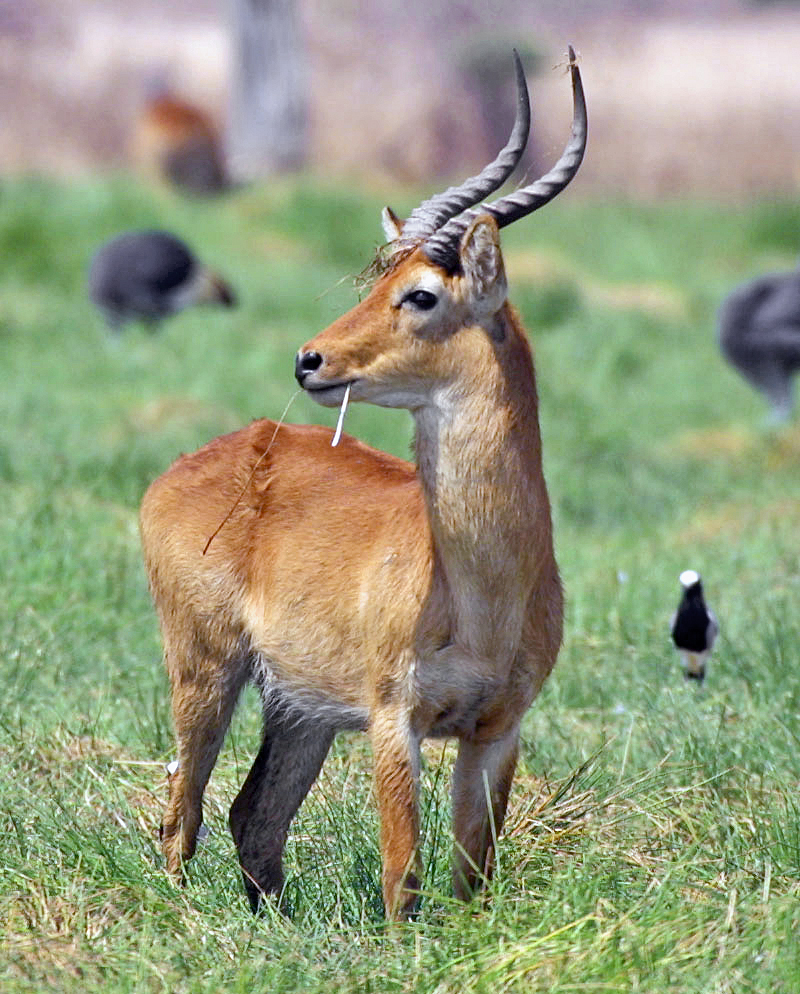
Male (Zambia)
Scientific classification Edit this classification
Kingdom: Animalia
Phylum: Chordata
Class: Mammalia
Order: Artiodactyla
Family: Bovidae
Genus: Kobus
Species:
K. vardonii
Binomial name
Kobus vardonii
(Livingstone, 1857)

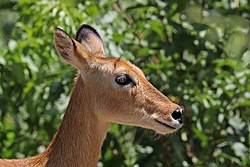
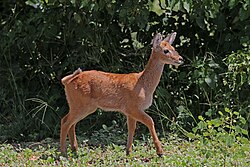
The puku (Kobus vardonii) is a medium-sized antelope found in wet grasslands in southern Democratic Republic of Congo, Namibia, Tanzania, Zambia and more concentrated in the Okavango Delta in Botswana.[1] Nearly one-third of all puku are found in protected areas, zoos, and national parks due to their diminishing habitat.[2][3]

Description

[edit]

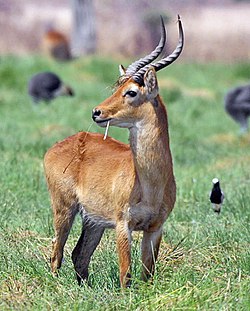
Puku stand about 80 cm (31 in) at the shoulder and weigh from 70 to 80 kg (150 to 180 lb). The puku is sandy brown in colour, with the underbelly a slightly lighter brown. The coat is rougher than that of the similar-sized southern reedbuck, lechwe or impala, or the smaller oribi. Males have horns which are ridge-structured, 50 cm (20 in) long, and lyre-shaped.[4]

Subspecies

[edit]

There are two subspecies, the Senga Puku (Kobus vardonii senganus) and the southern puku (Kobus vardonii vardonii).

Ecology

[edit]

Puku are found almost exclusively in marshy grassland and dambos, where they eat grasses.[3] The puku diet is flexible in regards to type of grasses consumed. There is little dietary competition with other bovids.[5] This species is crepuscular, active in the early morning and late afternoon. When scared, puku repeat a shrill whistle sound. Females gather in herds of up to 20 individuals. During the rainy season, herds will come together for added safety, typically reaching around 50 females. Males hold territories and attempt to persuade herds of females to stay within their territories for as long as possible. In the wet season, due to large floods in their habitat they migrate to a higher elevation and in the dry season remain near water.[6]

[edit]

References

[edit]
[edit]
Revisions and contributorsEdit on WikipediaRead on Wikipedia
from Grokipedia
The puku (Kobus vardonii) is a medium-sized endemic to south-central , characterized by a golden-yellow or fawn-colored coat with white underparts, reddish-brown legs, and lyre-shaped horns present only in males. Standing about 80–90 cm at the shoulder and weighing 60–80 kg, with males typically larger than females, it features shaggy fur approximately 32 mm long, large furry ears, and on the face and inguinal region used for marking. Native to floodplains, moist savannas, dambos, and riverine grasslands, the puku is highly dependent on and rarely ventures far from permanent sources such as rivers or lakes. Its range spans , , the , , , and , with uncertain or vagrant occurrence in and ; serves as the distribution center and hosts the largest . Overall estimates are approximately 130,000 individuals (as of 2016), though numbers are fragmented and declining due to habitat pressures. Socially, pukus exhibit and territorial behavior, with adult males defending individual territories year-round, often marked by scent from enlarged neck glands during the breeding season from May to November. Females and juveniles form unstable herds of 6–20 individuals, while non-territorial males gather in groups; communication includes a distinctive and leaping displays. Primarily herbivorous, they graze on nutrient-rich medium to tall grasses such as Eragrostis and Brachiaria species, feeding mainly in the morning and late afternoon, and they are known for strong abilities in flooded areas. Reproduction occurs year-round with a peak from May to September, featuring a gestation period of about eight months and typically one calf per birth, which hides for the first few weeks and is weaned at six months. is reached at 12–14 months, and calves are often born during the from to April to align with abundant . Classified as Near Threatened by the IUCN (as of 2016), the puku faces ongoing declines from loss due to , , and human settlements, as well as for and skins, particularly outside protected areas where only about one-third of the population resides. Conservation efforts, including anti-poaching measures and protection in reserves like those in and , have stabilized some populations where hunting pressure is reduced.

Taxonomy

Classification

The puku is a species of scientifically known by the Kobus vardonii, first described by the explorer in 1857 based on observations in what is now . Its taxonomic placement reflects its membership in the even-toed ungulates, specifically within the bovid family of grazing mammals adapted to wetland environments. The full taxonomic hierarchy of the puku is as follows: Kingdom Animalia, Chordata, Class Mammalia, Order Artiodactyla, Bovidae, Subfamily Antilopinae, Tribe Reduncini, Genus Kobus, and vardonii. This classification positions the puku among the reedbucks, waterbucks, and lechwes, groups characterized by their dependence on moist habitats and similar cranial and dental features. The common name "puku" originates from the local Bantu term "phuku" or "mpuku," which Livingstone recorded during his travels in Zambia, reflecting indigenous nomenclature for the animal in the region. The genus name Kobus derives from "kob," an African vernacular term for antelopes resembling the kob (K. kob), adopted into scientific usage to encompass related semi-aquatic species. Phylogenetically, K. vardonii is closely allied with other members of the genus Kobus, particularly the (Kobus kob), sharing derived traits such as elongated hooves for traversing swampy terrain and a preference for grasslands that underscore the genus's monophyletic water-dependent adaptations within the Reduncini. Molecular indicate a very close relationship, with only ~0.3% divergence in sequences, leading some researchers to question whether the puku warrants full status or should be considered a of the kob (Birungi and Arctander 2001). These relationships highlight the puku's evolutionary ties to East and Southern African bovids, with the genus comprising approximately six to twelve recognized depending on taxonomic interpretations.

Subspecies

The puku (Kobus vardonii) is generally considered monotypic, though some taxonomic authorities propose two subspecies: the southern puku (K. v. vardonii) and the northern or Senga puku (K. v. senganus; Cotterill 2000, 2003; Castelló 2016). The southern puku (K. v. vardonii) is distributed across Zambia, Botswana, Namibia, Angola, and Zimbabwe, where it inhabits floodplain grasslands and dambos. This subspecies is characterized by a larger body size and a lighter golden-yellow coat that aids in blending with sun-bleached savanna grasses. In contrast, the proposed northern puku (K. v. senganus) occurs in the southern , (e.g., Muchinga ), and (Rukwa and Kilombero valleys), primarily in areas along rivers and lakes. It may exhibit morphological variations such as differences in coat color and body size, though its taxonomic status remains unclear. These proposed are distinguished mainly by variations in coat color, horn length, body size, and geographic isolation, with classifications dating back to 20th-century taxonomic revisions that separated senganus (described by Sclater and Thomas in ) from the nominate form based on morphological and distributional differences.

Physical characteristics

Morphology

The puku (Kobus vardonii) is a medium-sized with a slender build adapted to environments. Adults measure 126–160 cm in head-body length, with a shoulder height of 77–94 cm and a length of approximately 30 cm. Males weigh 67–91 kg on average (77 kg), while females weigh 48–78 kg on average (61–66 kg). The coat is golden-yellow to sandy brown dorsally, transitioning to white or pale underparts, with a coarse, rough texture about 32 mm long; hair is longer on the neck, forming a mane-like fringe, particularly pronounced in males. The face features a browner , a narrow white ring around each eye, and pale areas on the chin and upper lip, with no distinctive markings on the legs. The backs of the ears are golden with black tips. Eyes are positioned laterally, providing a wide field of vision suitable for detecting predators in open grasslands. Puku possess preorbital glands located just in front of the eyes, consisting of thickened glandular with a small tuft of dark , used for scent marking; no other facial glands are present. Hooves are elongated and splayed, facilitating movement on soft, marshy terrain typical of their . Horns are present only in males, appearing as stout, lyre-shaped structures rising from a flat base.

Sexual dimorphism

The puku (Kobus vardonii) exhibits moderate , with males generally larger and more robust than females, reflecting adaptations for territorial defense and . Males possess prominent lyre-shaped horns that are strongly ridged for about two-thirds of their , becoming smooth toward the tips, and typically measure 36-56 cm along the curve. These horns curve backward at the base before sweeping forward, serving primarily in male-male combat and displays to establish dominance over territories. Females lack horns entirely, a trait common in many bovid where horn development is linked to Y-chromosome expression. In terms of body size, adult males are heavier and bulkier, averaging 77 kg with a range of 67-91 kg, compared to females averaging 61–66 kg and ranging from 48-78 kg; this size disparity is most pronounced in shoulder height and overall mass, with males reaching up to 94 cm at the versus slightly less in females. During the breeding season, males develop thicker, more muscular due to elevated testosterone levels, enhancing their ability to fend off rivals and perform threat displays. Both sexes share a similar base coat coloration of golden-brown with white underparts, but territorial males often have a darkened patch on the during the rut, attributed to preorbital gland secretions. Additionally, mature males display a more pronounced mane-like thickening of neck hair, contrasting with the sleeker profile of females. Other notable dimorphic traits include glandular differences that support male reproductive behaviors. Territorial males exhibit swollen preorbital glands, located just in front of the eyes, which produce secretions used to anoint the neck base, creating a characteristic greasy, darkened patch from May to November and a small tuft of ; these glands are less prominent in females and non-territorial males. Females, in contrast, possess four teats positioned on the for , a standard feature in the family that facilitates in polygynous like the puku. These physical distinctions underscore the ' , where male traits emphasize and female traits prioritize .

Distribution and habitat

Geographic range

The puku (Kobus vardonii) is endemic to south-central , with its current geographic range spanning , , the , , , and , with presence uncertain in and . These populations are highly fragmented, confined to isolated pockets of suitable and habitats along rivers, lakes, and floodplains, with serving as the center of distribution. The total population across this range is estimated at 76,000–130,000 individuals as of the early , though recent surveys indicate declines in some areas, reflecting the species' vulnerability to isolation. Historically, the puku was more widely distributed throughout central and , but habitat fragmentation and loss have significantly contracted its range over the past century, leading to local extirpations in areas such as northern . Today, the largest concentrations occur in Zambia's Luangwa Valley and , as well as Botswana's , where densities can reach up to 150 individuals per km² in prime areas; notable populations also exist in Malawi's Kasungu National Park and Vwaza Marsh Game Reserve. Smaller, fragmented groups persist in Tanzania's Kilombero and Rukwa valleys, Angola's Cuando Cubango region, and Namibia's . Two subspecies are recognized based on geographic separation: the southern puku (K. v. vardonii) in , , and , and the northern puku (K. v. senganus) primarily in the southern . Puku exhibit short-distance seasonal migrations, moving from floodplains to adjacent higher-ground woodlands and shrublands during the to avoid deep flooding, though they do not undertake long-distance treks typical of some other ungulates.

Habitat requirements

The puku (Kobus vardonii) primarily inhabits floodplains, dambos (seasonally inundated grasslands), and marshy areas adjacent to permanent water sources such as rivers, lakes, and swamps throughout south-central Africa. These environments provide the necessary cover and foraging opportunities, with the species requiring access to water within approximately 1.5 km of their core areas, averaging around 500 m in observed populations. Vegetation in preferred habitats consists of medium to tall perennial grasses, typically 1–2 m in height, including species like Hyparrhenia and Andropogon, which offer both concealment from predators and suitable forage. Puku avoid dense forests, arid regions, and deeply flooded zones, favoring open grasslands and shrublands that form mosaics near water bodies. They are restricted to lowlands up to about 1,500 m elevation and flat or gently sloping terrain that facilitates movement and visibility. Seasonally, puku adapt by concentrating on floodplains during the when water recedes and grasses remain accessible, but they retreat to higher, drier edges or adjacent woodlands during the to evade flooding. This mobility underscores their sensitivity to alterations, such as drainage or conversion for , which disrupt these dynamic requirements.

Behavior and ecology

Social organization

The puku (Kobus vardonii) displays a flexible adapted to its habitats, with group composition varying by sex, age, and season. Females and their young form the core social units, typically in herds of 6 to 20 individuals that exhibit unstable membership due to frequent joining and leaving by members. These herds can expand to as many as 46 animals during the rainy season, when abundant resources facilitate larger aggregations. Adult males are generally solitary, each defending a personal territory, while immature males form bachelor groups of up to 15 individuals, occasionally reaching 25 in number. Territorial adult males maintain year-round holdings averaging 5 hectares in floodplains and up to 15 hectares in more wooded areas, marking boundaries primarily through neck gland secretions and by rubbing their horns on grass tussocks. Defense involves ritualized displays, including 2 to 4 sharp whistles every 30 minutes to advertise ownership and deter rivals, along with chases of intruders and rare but intense horn-clashing fights, particularly intensifying during breeding peaks. Female home ranges, spanning 24 to 34 hectares, overlap multiple male territories, allowing males to attend passing herds without rigidly herding them. Puku are crepuscular, with heightened activity at dawn and dusk to balance needs and predator avoidance, sometimes extending into nighttime under low-threat conditions. All age and classes produce a shrill, nasal as an upon detecting danger, triggering short escape dashes followed by group reassessment from open vantage points to enhance vigilance; herds preferentially avoid dense vegetation for this purpose. Social interactions within herds show low , promoting loose but enduring bonds, while young males disperse from natal groups between 6 and 12 months of age, and females remain affiliated with their mother's herd into adulthood.

Foraging and diet

The puku (Kobus vardonii) is a specialized grazer, with its diet consisting almost exclusively of grasses, which comprise 93% to 100% monocotyledons year-round. Key grass species include spp., Brachiaria spp., spp., Hyparrhenia/ spp., spp., spp., and spp., among others identified through fecal analysis. Dicotyledons, such as herbs, are rare, making up less than 1% of the diet, though sedges like may supplement intake during the when grass quality declines. This grass-dominated diet reflects the puku's adaptation to nutrient-rich floodplains and dambos, where it exhibits low dietary overlap with browsing or mixed-feeding bovids like (Pianka index ≤0.25 in cool ), due to its specialization in grasslands. Foraging occurs primarily in open, short grasslands during dawn and peaks, with opportunistic selection of available medium-height grasses to maximize . Daily typically ranges from 2% to 3% of body weight, consistent with grazers processing fibrous vegetation. The puku's strategy minimizes competition by concentrating on habitats near water sources, particularly in the , where it exploits regenerating grasses post-flooding. Seasonal variations influence diet breadth and composition, with the broadest niche in the cool dry season (diet breadth B = 0.12–0.21), featuring diverse grasses such as Panicum spp. (up to 36% for females) and Sporobolus spp. (33% for males). In contrast, the late rainy season yields the narrowest diet (B = 0.05), dominated by Brachiaria spp. (66%), while the hot dry season shows intermediate diversity with increased Brachiaria reliance (27–29%). Nighttime grazing intensifies in the cool dry season to access fresher forage. As a , the puku possesses a four-chambered that facilitates microbial of fibrous grasses, aligning with characteristics of bulk-and-roughage feeders. This digestive system enables efficient breakdown of cellulose-rich monocotyledons, supporting the high-volume, low-quality diet typical of grazers.

The puku exhibits a polygynous in which territorial males defend areas and mate with multiple females that enter their territories, while females may exercise some . Males herd receptive females, vocalize with high-pitched whistles to attract them, and chase away rival males through displays involving face-offs or physical confrontations; copulation is typically brief, lasting only a few seconds. During the breeding period, males develop conspicuous dark patches that serve as visual signals of territorial status. Breeding occurs year-round in the puku's range, but it is seasonally influenced by environmental factors such as rainfall and availability, with mating peaking from May to . Consequently, births are concentrated from to , accounting for approximately 67% of calves in studied populations in Zambia's Luangwa Valley, allowing newborns to benefit from abundant green . The period lasts 7 to 8 months, resulting in synchronized calving that enhances survival rates by reducing predation pressure on isolated births. Puku females typically give birth to a single calf, with twins being rare. The offspring are precocial, able to stand and follow the mother within hours of birth, though they employ a hiding strategy for the first 4 to 6 weeks, lying concealed in tall grass while the mother forages nearby and returns periodically to nurse. Females provide intensive , including consuming the calf's urine and feces to minimize scent detection by predators and aggressively defending the young against threats. occurs at around 6 months, after which calves join larger herds; is reached at 12 to 14 months for both sexes. This reproductive strategy, with its emphasis on seasonal synchronization and maternal protection, contributes to relatively high juvenile survival in favorable habitats.

Conservation

Status and population

The puku (Kobus vardonii) is classified as Near Threatened on the , with the assessment conducted in 2016 indicating ongoing risks of decline due to habitat loss and fragmentation. Global population was estimated at 76,000 to 130,000 individuals as of the late (with the upper figure from 1999), though ongoing declines suggest lower current numbers, with approximately one-third occurring in protected areas. Populations remain stable in core ranges such as the , where habitat conditions support consistent numbers, but are declining in other regions. For instance, in Zambia's Kasanka , the puku population has experienced an 84% decline, dropping from an estimated 5,038 individuals (range: 3,268–7,238) in 2009–2010 to 819 (range: 250–2,708) in 2019. Recent surveys, such as in Tanzania's Rukwa (published 2025), show continued local declines of 26% from previous estimates. Overall trends show fragmented populations that are highly vulnerable to local extinctions, particularly outside protected areas, with no major targeted recovery programs implemented to date. Monitoring efforts primarily rely on periodic aerial and ground surveys in key sites, including the in and the in , where the latter holds a significant portion of the global population.

Threats and conservation measures

The puku (Kobus vardonii) faces several major threats across its range in southern , primarily driven by human activities. Habitat loss is a primary concern, resulting from , by domestic , and drainage of wetlands for cultivation, which fragments grasslands essential for the species. In the Kilombero Valley of , cattle numbers have surged from approximately 17,000 in 1989 to over 54,000 in 1998, leading to overgrazing and degradation of boundary-zone habitats used by puku during the . Illegal bushmeat hunting poses another significant risk, particularly during the when puku form large herds in accessible floodplains, making them vulnerable targets near settlements. Human disturbance, including settlement expansion and infrastructure development, further fragments populations by displacing herds from preferred riverine areas. Additional risks exacerbate these pressures. Competition for forage with domestic is widespread, as puku and overlap in grasslands, reducing available resources for the . Disease transmission from livestock to puku is a growing concern at wildlife-livestock interfaces, with tick-borne pathogens like spp. detected in free-ranging puku in , potentially increasing mortality rates. Climate change alters seasonal flood patterns in key habitats such as the and Luangwa Valley, leading to reduced grass availability and heightened fire risks in drier floodplains, which indirectly threatens puku areas. Conservation measures focus on protection and management. The puku is classified as Near Threatened by the IUCN and monitored by the Antelope Specialist Group, though it is not listed under . Significant portions of the are safeguarded in protected areas, including Zambia's Kafue and South Luangwa s, where anti-poaching patrols help maintain stability, and Botswana's , which supports a subpopulation. In Tanzania's Kilombero Valley , community-based management initiatives limit agricultural encroachment and illegal hunting through local involvement in monitoring and zoning, sustaining the largest known puku estimated at approximately 42,000 individuals as of 2013. Translocation efforts, such as the 2017 movement of 150 puku from Kasanka in to the Bangweulu Wetlands, demonstrate potential for reintroduction to suitable s to bolster fragmented groups. Despite these efforts, challenges persist, including ongoing that has caused an 84% decline in Kasanka National Park's puku numbers from 2010 to 2019. Successes, such as population stability in the due to reduced human disturbance in core zones, highlight the value of integrated management. Enhanced enforcement, habitat restoration to counter drainage, and expanded community programs are critical for long-term viability.
Add your contribution
Related Hubs
User Avatar
No comments yet.